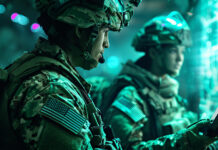


While the high death toll from roadside bombs in Iraq is well
known, fragmentation explosions and blast effects are taking their
toll among severe casualties. Frequent occurrences are eye injuries.
According to Army medical records, 16% of the medical evacuations
from combat zones since March 2003 have included serious eye injuries
– compared to 9% in Vietnam and the 1990- 91 Gulf War. Yet,
many of such eye injuries could be avoided with proper use of
protective eyewear.
|
|
 |
Dust,
low-velocity fragments, high velocity impact and laser radiation
are posing significant threat to warfighters in combat and training.
Yet, almost all ballistic injuries can be prevented by using polycarbonate
shields currently available with spectacles and goggles. "It
is imperative that commanders ensure that their soldiers use their
protective eyewear whenever engaging in field tactical operations
– in combat, security and training" a recent US Army
research recommends. Yet, using any 'performance eyewear' is not
enough, and could, sometime, be extremely hazardous. (more...)

Military
medical professionals reminding troops that not all "ballistic
eyewear" provides the same protection and some styles might
pose more danger than defense. In fact, some brands have been
banned by the military because they do not pass safety tests.
Wearing protective eyewear designed for sports or 'performance'
can result in combat-related eye injuries which could be avoided
with tactical eyewear designed for combat.
The
solution to laser protection is more difficult since military
lasers operate in different wavelengths that have to be addressed
with specific filters. In theory, to be effective, the soldier
will have to carry and install the appropriate filter according
to a reading from a laser detector, prior to an attack. A more
practical concept will deploy a multi-band filter that could sense
and block specific threats as they are detected by the individual
or the combat unit.
The standard issue protective eyewear includes Ballistic Laser
Protective Spectacles (BLPS), Special Protective Eyewear Cylindrical
System (SPECS), and Sun, Wind and Dust Goggle (SWDG). The Army
determined that when laser protection is required, soldiers should
continue to use SPECS, BLPS, or SWDG at this time. However, when
laser threat is not imminent, a wider
range of more stylish protective eyewear is available for
troops. These products are tested by the Army for durability and
ballistic protection, has been approved for use and are now available
for soldiers to choose from. All military approved, commercially
available products offer ballistic and UV protection, and are
available in clear and gray sunglass tainted lenses. While the
new eyewear is offering modern design and attractive style, lens
tints other than clear or gray are not authorized, including yellow,
orange, rose, and others known as "blue blockers" as
they degrade color recognition and therefore could have adverse
effect on mission performance.
Soldiers
requiring prescription lenses for goggle applications also have
more choice among several modern designs, including the Uvex XC
spectacles, ESS ICE 2, Revision Sawfly and Body Specs Pistol models.
ESS
Land Operations and ESS Vehicle Operations may be used as alternatives
to the standard SWDG for wear over prescription eyeglasses or,
ESS Profile NVG goggle may be used with its designated prescription
lens carrier. The Army stressed that wearing non approved spectacle
or goggle may result in serious injury.
You can check a partial list of approved tactical eyewear here.
In this series Defense Update covers the following topics: