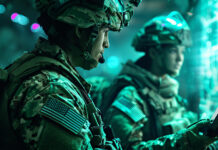


The helmet has been the military trademark for centuries. Even
today, helmet designers highlight their visual attributes side
by side with their ballistic protection and comfort. Modern helmets
are lightweight; providing superior ballistic protection and comfort,
since they are shaped to optimally fit the individual soldier,
even when used with a headwear ensemble.
The US Army has lead the way in helmet designs, Modern designs
evolved from 2nd world-war "Steel Pot" helmet, through
the more recent Personnel Armor System for Ground Troops (PASGT)
helmet designed in the early 1980s, to the latest Advanced Combat
Helmet currently issued to combat troops. Other armed forces adapting
specific helmet designs include the Russian, British, French,
Italian, Australian, Indian and Israeli Armies. The Advanced Combat
Helmet (ACH) is replacing the Kevlar PASGT helmet, improving ballistic,
impact and blast protection, as well as the weight saving of 3.5
lbs lighter then the old model. ACH uses specially designed suspension
to comfortably fit on the Soldiers head. Its design blends better
with the soldier's body armor, enabling less restricted movement
even with full protection. The helmet system is compatible with
all current accessories, including night vision devices, communications
packages, and nuclear, biological, and chemical (NBC) defense
equipment.
The
edges of the new helmet have been cut to improve situational awareness
through improved field of vision and hearing. The shell provides
ballistic protection. While the ACH has 8 percent less surface
area than the Personnel Armor System Ground Troops, or Kevlar,
helmet had, most of the material was removed from the front of
the ACH, with a smaller amount removed from the sides. Nothing
was removed from the back of the helmet. Another improvement currently
supplied for conventional helmets are impact absorbing pads, also
known as "padded
helmet suspension systems", designed to improve blast
protection and protect against other non-ballistic impact.
The system includes a set of seven pads, replaqcing the sling
suspension used in earlier helmets. It is now standard in US Army
ACH and the latest models of the US Marine Corps Combat Helmet.
Special gear is designed to protect troops from the effect of
blast and flash fire associated with IED explosions, fire bomb
attack and penetration of the vehicle's armor by RPGs and other
shaped charge munitions (anti-tank missiles etc.) explosion of
burning ammunition or other flammable materials (diesel fuel,
hydraulic fluids etc.) present a serious risk to the crews of
armored vehicles. Risks of skin burns and internal burns can also
be caused by chemical materials. They are addressed by special
protection gear designed for NBC protection.
Each
threat is addressed with a specific protective gear such as Balaclava
(ski mask), gloves, eyewear and underwear. For example, the new
fire resistant ensemble is composed of up to seven separate layers,
providing an effective fire resistant tactical outfit that provides
effective protection even under extreme cold weather conditions
as low as 50 degrees below zero Fahrenheit. The fire-resistant
gear included T-shirts of various types; gloves, boots, coverall,
jacket and balaclavas. Initial examples of the new gear were sent
by PEO Soldier to Korea and Afghanistan for field testing.
In this series Defense Update covers the following topics: