Our second daily coverage of the Latrun event focus on electro-optical devices shown here. Among many familiar systems, Defense Update has picked several new systems and developers, that have made their first steps in bringing their innovative EO systems to the market. Some are brand new, demonstrated as prototypes and proof of concept demonstrators while others are already fielded and operational, primarily with special operations units.
The MPRS system developed by the IMI comprises a sight for day and night engagement, multi-switch control module mounted on the rifle and the ammunition - an airburst (AB) and time-delay (TD) grenade, self-destruct 40mm grenades. Photo: Noam Eshel, Defense-update
IMI's Time Delay and Airburst 40mm rounds are designed for the MPRS, offering the required lethality.
IMI displayed the integrated weapon station and active protection system, actual technology demonstrator employing elements from the Iron Fist, high performance pedestal, moving both the weapon station and the APS. The installation also includes the Sentinel radar from Rada, and the 'soft-kill'
Girit (Badger) is a sensor optimized to detect and locate the position of hostile gunshots in open or urban area. Photo: Noam Eshel, Defense-Update
Elbit Systems is offering its small, combat sight for riflemen and sharpshooters. Photo: Noam Eshel, Defense-Update
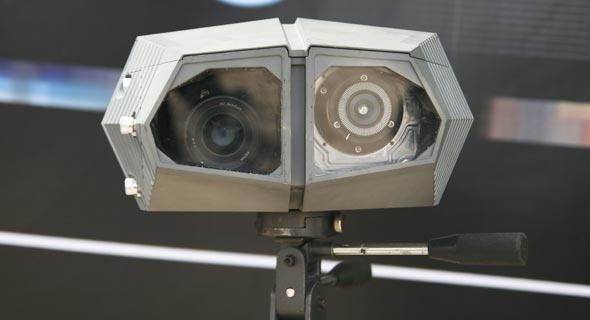
The Ground Forces Command is expecting to field the Lotus long range observation system. Photo: Noam Eshel, Defense-update
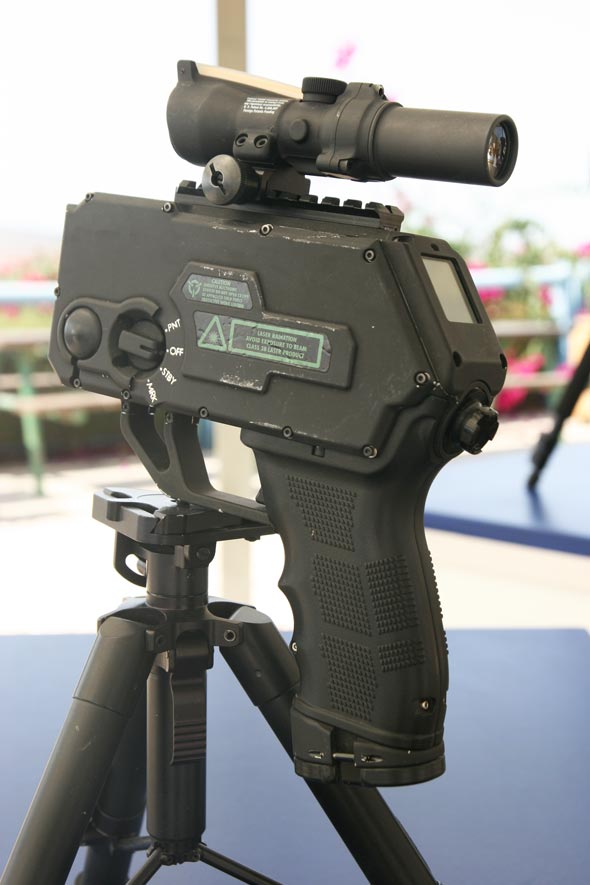
Rattler is a miniature laser designator developed by Elbit Systems El-Op. It can be embedded into small multi-sensor payloads or used independently by forward units. Designed for applications where small form factor is of critical importance, Rattler can designate targets for all types of laser guided munitions and will excel in applications where laser guided munitions are fired in close proximity to friendly forces. Photo: Noam Eshel, Defense-Update.
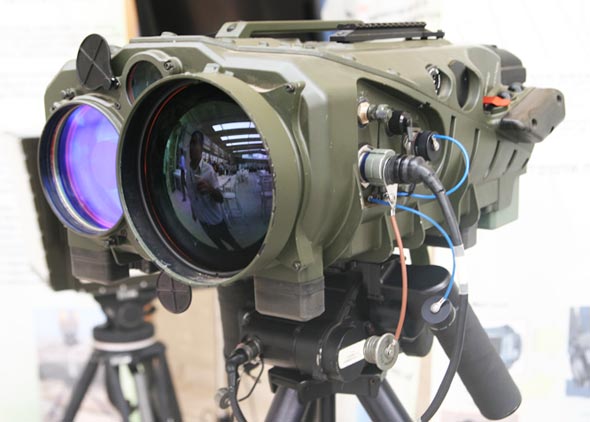
IDF Ground Forces Command displayed at Latron the new Coral target acquisition system, matched with Azimuth pedestal offering high precision targeting employing Azimuth's north finding apparatus. In areas where strong magnetic fields or significant magnetic deviation occurs, the north finding apparatus provides significantly better targeting accuracy. Photo: Noam Eshel, defense-Update
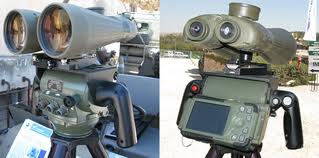
Ethan, hand-held thermal camera designed for medium range surveillance; HHTI generates high quality images on the darkest nights, even through smoke or fog. The HHTI can be used for long range observation with “snap-on” lenses which allow increasing optical magnification 6X. The exceptional zoom capabilities and a use of bi-ocular makes the HHTI a superb tool for surveillance. The soldier can operate the HHTI while standing in a hand held position or by using a tripod to support it when lying on the ground. Photo: Noam Eshel, Defense Update
The Hornet mobile mortar we covered today is empowered by highly advanced target acquisition and fire control systems, enabling the small unit to rapidly fire standard mortar bombs or precision guided variants, and run away to a new, safer location. The target acquisition system employs pattented concept developed by Asio Technologies, enabling the vehicle to prepare for firing without accurate land survey. Typical accuracy provided by the Pointer is north position determination of 1 meter or 3-5 meters via GPS channels. Photos: Noam Eshel - Defense-Update
Visiting the UMEX & SimTEX 2026 exhibition taking place at the ADNEC Centre in Abu Dhabi this week, a new system caught our attention. Slovenian company Carboteh has introduced an unconventional approach to protecting...
The opening week of 2026 has been defined by a singular, paradigmatic shift in modern warfare: the "catastrophic failure" of Venezuela's integrated air defense network during a U.S. special operation. The operation succeeded not through brute force, but by rendering Venezuela's Russian S-300VM and Chinese "anti-stealth" radars effectively blind, validating the supremacy of advanced electronic warfare over legacy kinetic defenses. This failure has sent shockwaves through the global defense market, underscoring why nations like Spain and Germany are rushing to modernize their air defense architectures with Western alternatives, while massive procurement programs exceeding $301 billion signal an accelerated transformation toward unmanned systems, directed energy weapons, and indigenous production capabilities.
Turkey's defense industry transformation extends far beyond its celebrated drones. Now ranking 11th globally in defense exports, Turkey is executing a comprehensive strategy to become a top-tier arms supplier. With 75% of exports flowing to Western markets and five firms in Defense News' Top 100, Turkey is methodically building a complete defense ecosystem through combat-proven systems, integrated defense diplomacy, strategic self-reliance, and real-world R&D in active conflict zones.
Lockheed Martin Skunk Works® and XTEND have achieved a major milestone in JADC2 by integrating the XOS operating system with the MDCX™ autonomy platform. This technical breakthrough enables a single operator to simultaneously command multiple drone classes, eliminating the friction of mission handoffs. From "marsupial" drone deployments to operating in GPS-denied environments, explore how this collaboration is abbreviating the data-to-decision timeline and redefining autonomous mission execution.
As traditional defense primes face mounting competition from agile “neoprimes” such as Anduril, Palantir and Helsing, the balance of innovation is shifting toward software-defined warfare and scalable, dual-use technologies, while global industry consolidation—marked by Boeing’s integration of Spirit AeroSystems and other strategic mergers—signals an intensified race to secure control over the defense technology value chain. Our Defense-Tech weekly report highlights these trends.
In early October 2025, a coordinated wave of unmanned aerial system (UAS) incursions—widely attributed to Russia—targeted critical infrastructure across at least ten European nations. The unprecedented campaign exposed the fragility of Europe’s air defenses...
Executive Summary
The past week (September 18-25, 2025) represents an inflection point where strategic defense concepts have transitioned from doctrine to tangible reality. An analysis of global events reveals four primary, interconnected trends shaping an...