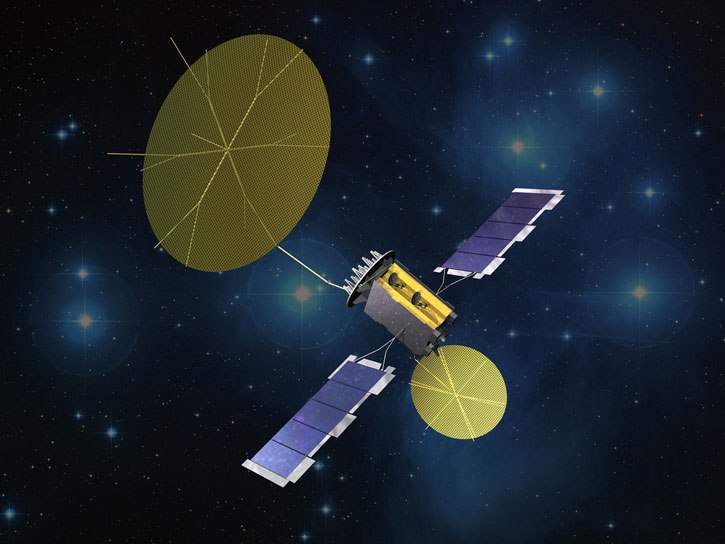
The 7.5 ton MOUS satellite is based on Lockheed Martin's A2100 satellite bus powered by with two five-panel solar array wings. Its dual payload comprises the WDCMA and legacy channels, using 14 and 5 meter diameter reflecting mesh antennae. Image: Lockheed Martin
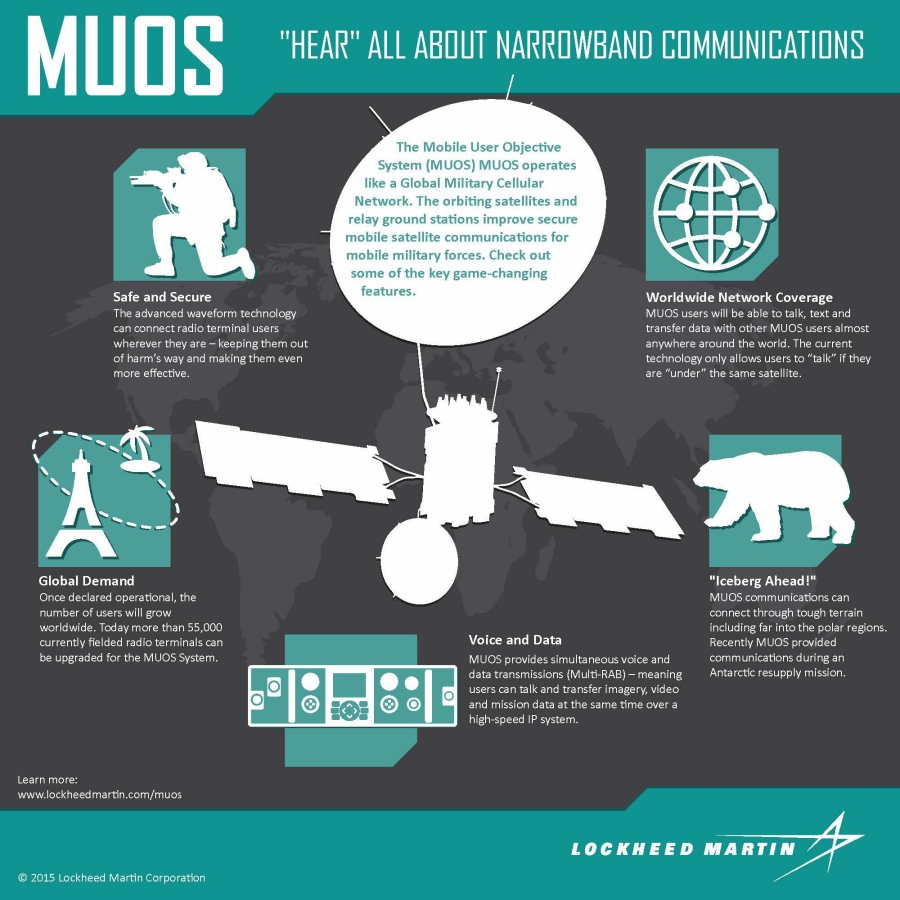
The US Navy’s fifth and last Mobile User Objective System (MUOS) satellite was launched June 24, 2016, aboard a United Launch Alliance Atlas 5 rocket. MUOS is an Internet Protocol (IP)-based system designed to provide improved communications capabilities to users around the world, regardless of where they are in relation to a satellite, and will provide greater than ten times the bandwidth capacity compared with the current ultra-high frequency (UHF) constellation. With near global coverage, the MOUS network will support remote computer access, e-mail, short digital messaging, file and image transfer, and provide an interface for remote reception of sensor data.
Subscribe to get the full version.MUOS offers 16 times the number of access points over the legacy system ensuring availability for prioritized calls while more users are on the system. once fully operational, the demand for MUOS is expected to grow rapidly. While more MUOS-compatible terminals are in development, over 55,000 currently fielded radio terminals can be upgraded to be MUOS-compatible, with many of them requiring just a software upgrade.
Visiting the UMEX & SimTEX 2026 exhibition taking place at the ADNEC Centre in Abu Dhabi this week, a new system caught our attention. Slovenian company Carboteh has introduced an unconventional approach to protecting...
Lockheed Martin Skunk Works® and XTEND have achieved a major milestone in JADC2 by integrating the XOS operating system with the MDCX™ autonomy platform. This technical breakthrough enables a single operator to simultaneously command multiple drone classes, eliminating the friction of mission handoffs. From "marsupial" drone deployments to operating in GPS-denied environments, explore how this collaboration is abbreviating the data-to-decision timeline and redefining autonomous mission execution.
The Israeli Ministry of Defense (IMOD) is evaluating initial proposals from some local companies to decide what types of loitering weapon systems will be deployed on Israel's Defense Forces (IDF) Merkava 4 main battle...
This week’s DefenseTech Brief captures a defense landscape in flux—driven by urgent needs for missile defense, advanced autonomy, and sovereign production capabilities. Across domains and continents, governments and industries are accelerating the integration of...
This article is part of our weekly DefenseTech Brief.
NATO has taken a significant step in modernizing its warfighting capabilities by rapidly acquiring an AI-enabled platform from Palantir Technologies. On March 25, 2025, the NATO...