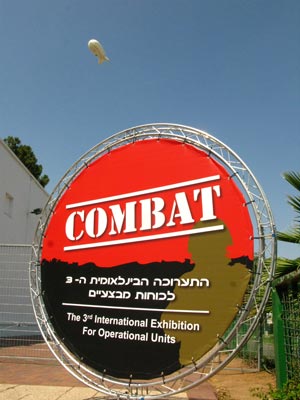
Security Israel 2011 and Combat 2011 – Israel’s military and security event se taking place in Tel Aviv for the 25th year (security) and 4th time (Combat) are providing a unique opportunity for Israeli companies to showcase innovative developments before they reach the world market.
Hydro-Noa, the Israeli cold entry specialist unveiled here a new tool designed to crack hasp locks. Photo: Tamir Eshel, defense UpdateShay Yermiyahu, marketing manager at Hydro Noa, demonstrates the use of hand held door breaking tool using manually driven hydraulic tool to tear the door off its hinges, bend it inside the room or pull it outside. Hydro Noa provides dedicated tools for speciifc uses or multi-purpose tools applicable for a wide range of applications. Photo: Tamir Eshel, defense UpdateMedi-T Mobile Clean Medical Unit. Photo: Noam Eshel, Defense-Update
Top-i Vision Tactical Aerostat System mounting with Lev 4 Stabilized Payload. Photo: Noam Eshel, Defense-UpdateTop-I Vision, aerostat, UAV and EO payload providers have shown here their newest stabilized, dual-sensor payload Lev-6 Z. The payload was demonstrated in operational use, suspended from the Top-I Vision aerostat, deployed outside the exhibit hall. Lev 6 Z is a lightweight system stabilized by two gimbals. The payload uses separate day and night channels, both fitted with continuous zoom. The company has already began working on the integration of a laser target marker into this EO payload. Photo: Tamir Eshel, defense UpdateTop-i Vision Tactical Aerostat System Ground Control Station. Photo: Noam Eshel, Defense-UpdateCol. (Ret) Avi Peer, CEO at Thermal Beacon, displays the company's new dual-band, covert thermal marker, facilitating effective identification, marking and signalling between forces employing I2, low-light TV and thermal imagers covering NIR, LWIR and MWIR (3-12 micron) wavebands. The system has recently entered operational service with military customers. Photo: Tamir Eshel Defense Update.Thermal Beacon also unveiled two new Venom I line of laser markers, infra-red pointer/illuminator mounted on light weapons. The Venom-I emits power levels of 200mw, while the larger IR pointer emits 1.2 watt. By opening beam divergence the the narrow focused beam of the pointer can be turned into an illuminating light source. The low power device is used at short range, typically indoors while the more powerful one is used over extended ranges of 200 - 1000 meters outdoors. The high power level of the outdoor device require users to follow strict safety rules to prevent eye damage, yet the operational benefits are clear, given independence of supporting units (for illumination), employment of covert means, stand-off operation, high intensity illumination over large area, etc. Photo: Tamir Eshel, defense UpdateMilitary DVR of the Goldtech Group displayed two versions of portable digital video recorders, one fitted with an integral display, the other, packing 64 gigabyte storage volume (enough for recording 32 hour of continuous high quality video) and batteries sustaining an eight hour mission. The system has an integral store and replay displaying the stored video on auxiliary peripheral device. Photo: Tamir EshelESC BAZ Night Vision And Thermal Electro Optics Devices. Photo: Noam Eshel, Defense-Update
The lightweight, tripod mounted man-portable pan-tilt mount developed by ESC Baz, coupled with remote control unit, to provide standard EO sensors or EO/IR binoculars to be used as remote controlled surveillance sensors without risking operator exposure. Photo: Tamir Eshel, Defense UpdateElios VMOS - Integrated Vehicle Mount Observation System. Photo: Noam Eshel, Defense-pdate
The Zibar MK.ii Here on Display. Photo: Noam Eshel, Defense-UpdateAutomotive Robotic Industry CEO Amos Goren, Next to the AMSTAF UGV. Photo: Noam Eshel, Defense-Update
Visiting the UMEX & SimTEX 2026 exhibition taking place at the ADNEC Centre in Abu Dhabi this week, a new system caught our attention. Slovenian company Carboteh has introduced an unconventional approach to protecting...
The opening week of 2026 has been defined by a singular, paradigmatic shift in modern warfare: the "catastrophic failure" of Venezuela's integrated air defense network during a U.S. special operation. The operation succeeded not through brute force, but by rendering Venezuela's Russian S-300VM and Chinese "anti-stealth" radars effectively blind, validating the supremacy of advanced electronic warfare over legacy kinetic defenses. This failure has sent shockwaves through the global defense market, underscoring why nations like Spain and Germany are rushing to modernize their air defense architectures with Western alternatives, while massive procurement programs exceeding $301 billion signal an accelerated transformation toward unmanned systems, directed energy weapons, and indigenous production capabilities.
Turkey's defense industry transformation extends far beyond its celebrated drones. Now ranking 11th globally in defense exports, Turkey is executing a comprehensive strategy to become a top-tier arms supplier. With 75% of exports flowing to Western markets and five firms in Defense News' Top 100, Turkey is methodically building a complete defense ecosystem through combat-proven systems, integrated defense diplomacy, strategic self-reliance, and real-world R&D in active conflict zones.
Lockheed Martin Skunk Works® and XTEND have achieved a major milestone in JADC2 by integrating the XOS operating system with the MDCX™ autonomy platform. This technical breakthrough enables a single operator to simultaneously command multiple drone classes, eliminating the friction of mission handoffs. From "marsupial" drone deployments to operating in GPS-denied environments, explore how this collaboration is abbreviating the data-to-decision timeline and redefining autonomous mission execution.
As traditional defense primes face mounting competition from agile “neoprimes” such as Anduril, Palantir and Helsing, the balance of innovation is shifting toward software-defined warfare and scalable, dual-use technologies, while global industry consolidation—marked by Boeing’s integration of Spirit AeroSystems and other strategic mergers—signals an intensified race to secure control over the defense technology value chain. Our Defense-Tech weekly report highlights these trends.
In early October 2025, a coordinated wave of unmanned aerial system (UAS) incursions—widely attributed to Russia—targeted critical infrastructure across at least ten European nations. The unprecedented campaign exposed the fragility of Europe’s air defenses...
Executive Summary
The past week (September 18-25, 2025) represents an inflection point where strategic defense concepts have transitioned from doctrine to tangible reality. An analysis of global events reveals four primary, interconnected trends shaping an...