

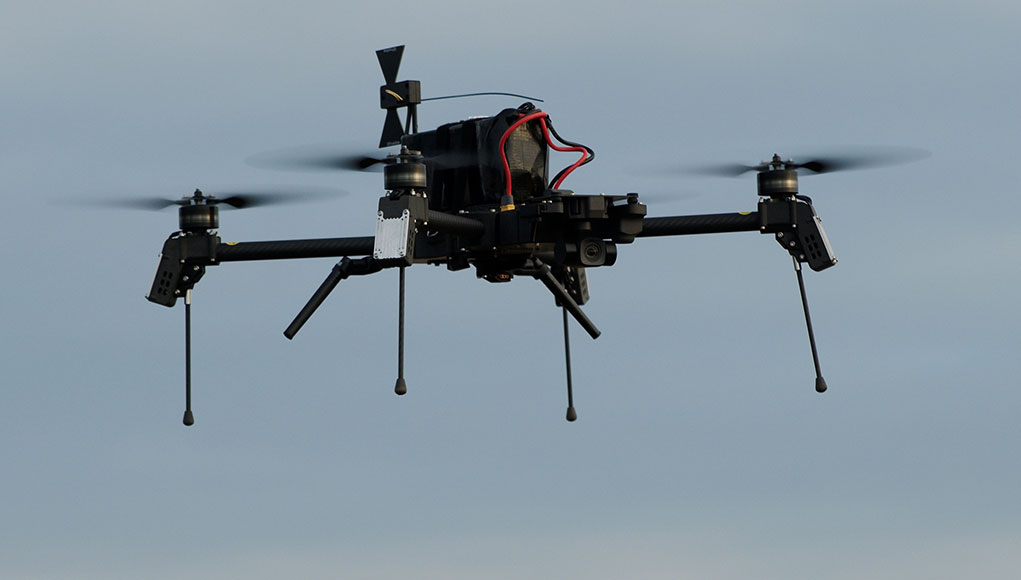
The Linza 3.0, a multi-role tactical drone developed by Ukrainian defense technology company Frontline Robotics, is the first platform produced by Quantum Frontline Industries (QFI), a newly established Ukrainian-German joint venture. The first drone was handed over to President Volodymyr Zelenskyy. The QFI facility will enable the production of 10,000 drones for the Ukrainian Armed Forces in Germany within a year and has now started early-stage production. automate its production capacity to meet the demand from Ukraine and has plans to scale further to provide Ukrainian technology to Europe.
The system builds on the original Linza platform introduced in 2024 by Frontline Robotics and incorporates modifications based on operational feedback from more than 60 units of the Ukrainian Defense Forces.

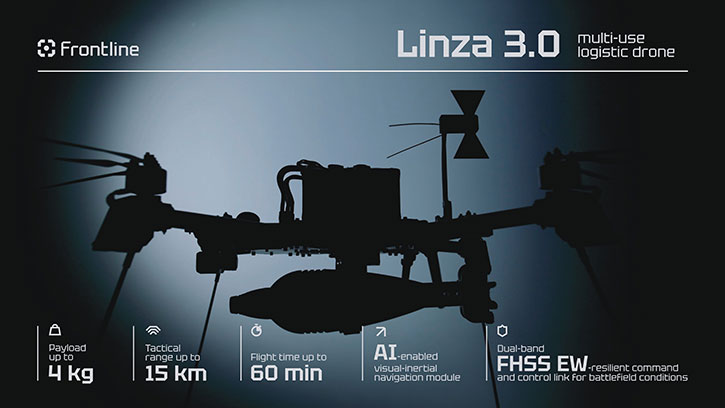
The Linza 3.0 features a 12-inch frame and delivers measurable improvements over its predecessor in three key areas:
- Payload capacity – increased from 2 kg to 4 kg
- Tactical range – extended from 10 km to 15 km
- Flight endurance – reaches up to 60 minutes
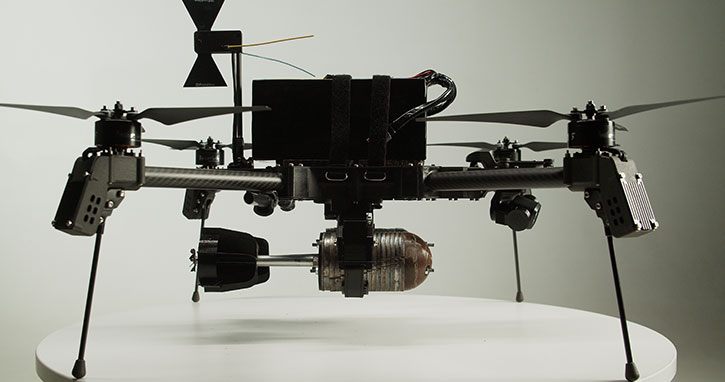
The expanded 4 kg payload enables the platform to perform strike missions and function as a bomber drone capable of carrying ordnance. Operators can select from two sensor packages: a gyro-stabilized daylight camera (1280×720 resolution, 6× digital zoom) or a gyro-stabilized thermal imager (640×512 resolution, 30 Hz frame rate).
 Navigation and EW Countermeasures
 The Linza 3.0 integrates a proprietary, in-house-developed AI-enabled visual-inertial navigation module. This system provides optical navigation, enabling the drone to map flight paths and display completed routes while in loiter mode. The module supports stable hovering over targets at altitudes up to 200 meters, thereby improving survivability against small-arms fire. According to the manufacturer, the navigation system reduces operator training requirements compared with commercial platforms.
To operate in contested electromagnetic environments, the platform employs a dual-band encrypted control link with frequency-hopping spread spectrum (FHSS) technology. Video transmission utilizes a one-way digital system designed to resist electronic warfare jamming.
 Design Philosophy and Operational Roles
Frontline Robotics states that the Linza 3.0 airframe was engineered specifically for military applications rather than adapted from commercial quadcopter designs. The company prioritized resilient control and video transmission systems to meet operational requirements. Beyond strike missions, the platform is configured for logistics and mine-laying operations, signal relay and reconnaissance, and drone recovery and evacuation.
Production and Support
Manufacturing will be handled by Quantum Frontline Industries, the joint venture formed in December 2025 between Frontline Robotics and Germany’s Quantum Systems. The company provides technical support and warranty coverage for up to 80 flights per unit – a fresh and interesting approach to product support for military hardware.
The partnership formalizes European defense industrial cooperation, with production expected to scale through the combined resources of both parent organizations.