

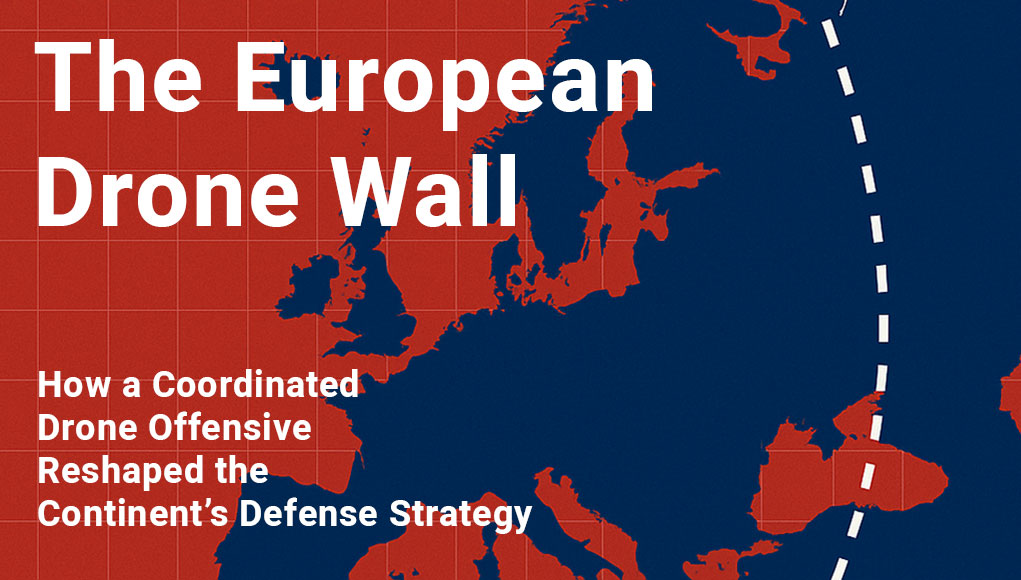
 In early October 2025, a coordinated wave of unmanned aerial system (UAS) incursions—widely attributed to Russia—targeted critical infrastructure across at least ten European nations. The unprecedented campaign exposed the fragility of Europe’s air defenses and triggered a continent-wide response now known as the “Drone Wall” initiative.
The new report, Drone Wall: Europe’s Response to the October 2025 Drone Incursions, offers a detailed account of these events and their far-reaching implications for defense strategy, procurement, and industry dynamics. The report traces the evolution from initial attacks to the rapid formation of a unified European effort to counter the growing drone threat.

A Strategic Wake-Up Call
The October attacks underscored a new reality of hybrid warfare: adversaries can achieve strategic effects using low-cost drones that overwhelm traditional defenses. Expensive missile systems and fighter aircraft were forced into reactive roles—unsustainable against swarms of expendable aerial threats.
The Drone Wall initiative emerged as a direct response. Backed by the European Commission, NATO, and several EU member states, the program aims to establish a multi-layered, networked defense grid across the continent, integrating detection, electronic warfare, and kinetic interception capabilities.
Inside the Report
The Drone Wall study examines:
- The chronology and scope of the European drone incursion campaign.
- The tactics, systems, and motivations behind the attacks.
- The operational and psychological impact on European states.
- Identified defense gaps and the architecture of the “Drone Wall” response.
- The complex procurement framework involves the EU, member states, and NATO.
- Market opportunities for counter-UAS (C-UAS) systems, radars, and C2 integration.
Industry Implications
The creation of the Drone Wall represents the most significant market opportunity for C-UAS technology in a generation. Demand is rising for integrated, affordable, and scalable systems capable of delivering the full kill chain—from detection to interception—within networked command-and-control frameworks.
Firms that can offer cost-effective, multi-layered, and interoperable solutions, or partner with local European manufacturers, stand to benefit most. The report highlights the importance of collaboration with Ukrainian companies, whose frontline experience provides valuable insight into countering evolving drone tactics.
Why It Matters
The European “Drone Wall” will reshape defense cooperation, funding, and industrial alignment across the continent. For policymakers, defense contractors, and investors, understanding its structure and decision-making process is essential to identifying where real opportunities lie.
Listen to or download the “Drone Wall” report to explore the intelligence, analysis, and market insights shaping Europe’s new air defense architecture.