
The Indo-Pacific defense landscape in 2026 has reached a strategic inflection point, characterized by the collapse of traditional US-led export models and a rapid transition toward technological autonomy. For defense stakeholders, this briefing is a strategic necessity as regional powers move beyond mere platform procurement toward integrating sovereign, AI-driven ecosystems.
The Singapore Airshow 2026 has confirmed that the “drone-centric” force is no longer a future concept but an operational baseline, evidenced by the Republic of Singapore Air Force (RSAF) transition to the Orbiter 4 and Hermes 900 fleets. This evolution is mirrored by Indonesia’s aggressive procurement pivot, signaling a preference for “sanction-proof” and “ITAR-free” hardware over restricted Western alternatives.
Core Defense Narratives
- The Collapse of the US F-15EX Campaign in Indonesia: Boeing’s February 2026 confirmation that it is no longer pursuing the F-15ID variant ends the 2023 Memorandum of Understanding for 24 aircraft, marking a significant strategic failure for US regional diplomacy.
- Operationalization of Manned-Unmanned Teaming (MUM-T): The shift from concept to battlefield reality is cemented by the successful RSAF HTeaming trials, which integrated crewed H225M helicopters with autonomous Flexrotor systems.
- “Sovereignty” as the Primary Procurement Driver: Regional buyers now demand total control over software Intellectual Property (IP), local production, and Maintenance, Repair, and Overhaul (MRO) capabilities to mitigate the risk of external political leverage.
This regional realignment is most visible in the radical transformation of Indonesia’s fighter fleet, where strategic diversification has replaced traditional reliance on a single superpower.
The Indonesian Defense Pivot
Indonesia’s “non-aligned” defense posture has evolved into a rigorous strategy of supplier diversification under President Prabowo Subianto. To avoid the historically paralyzing effect of U.S. export restrictions and the threat of CAATSA-related sanctions, Jakarta is building a “mixed fleet” to ensure that no single international partner can exert leverage over Indonesian national security.
The French-led “backbone” now defines the modernization of the Indonesian Air Force (TNI AU). The commitment to the Dassault Rafale is total, with 42 aircraft ordered across three tranches (6+18+18). On January 27, 2026, the first three units arrived at Roesmin Nurjadin Air Base. This acquisition is a “turnkey solution” that includes a comprehensive training package and a specialized center equipped with two full-mission simulators, ensuring the Rafale serves as the primary high-end platform, replacing legacy Russian hardware.
The cancellation of the Boeing F-15EX deal is the decisive “So What” of this pivot. By walking away from the 2023 MOU for 24 aircraft, Jakarta has signaled that it will no longer tolerate the political oversight and operational constraints inherent in US high-end exports. This creates a vacuum being filled by European and Asian alternatives that offer greater technological transparency.
|
Aircraft Type
|
Origin
|
Status
|
Strategic Constraint
|
|---|---|---|---|
|
TAI KAAN
|
Turkey
|
Conditional Deal ($10B/48 jets)
|
ITAR Independence: Must prove 100% freedom from US export controls.
|
|
Chengdu J-10C
|
China
|
Active Consideration (42 aircraft)
|
Logistical Integration: Difficulty integrating with existing Western-spec infrastructure.
|
|
KAI KF-21
|
South Korea
|
Ongoing Partnership (16 Block 2 jets)
|
Funding: Ongoing financial disputes; the restart package remains stalled.
|
While this strategy prevents supplier leverage, it introduces a “logistical nightmare.” Maintaining separate training and MRO pipelines for F-16s, Su-27/30s, Rafales, and potentially Chinese J-10Cs—which are marketed as “combat-proven” alternatives following successes in Pakistan—will strain the TNI AU’s budget. However, the pursuit of sovereignty remains the priority, extending to specialized roles where the Leonardo M-346 F ‘Block 20’ has been selected to replace the aging BAE Hawk fleet for light combat and advanced training.
Autonomous Systems and MUM-T Integration
Regional air forces are rapidly evolving into “drone-centric” entities, a doctrinal shift informed by the need to operate in saturated, low-altitude urban environments. The RSAF has fundamentally restructured its UAV fleet baseline, operationalizing the Orbiter 4 and Hermes 900 to replace the legacy Hermes 450 and Heron 1 platforms, effectively reducing long-term dependency on original Israeli configurations through localized integration.
Key unmanned platforms showcased in 2026 highlight a move toward deep-strike and force multiplication:
- Boeing MQ-28 Ghost Bat (Block 3): This iteration features an internal weapons bay and structural range extensions. Boeing targets 2028 for the first operational RAAF missions, signaling its transition from a demonstrator to a combat asset.
- Airbus Flexrotor/H225M Trials: The “HTeaming” simulations successfully demonstrated a crewed helicopter controlling an autonomous UAS for search and rescue, proving the viability of autonomous force multipliers.
- Anduril YFQ-44 Fury: A pilotless, high-performance autonomous jet explicitly positioned for the Indo-Pacific market to provide low-cost mass.
Loitering munitions have emerged as a core tactical requirement. ST Engineering’s EagleStrike provides ground forces with localized precision strike, while Anduril’s supply of Altius systems to Taiwan underscores the proliferation of “swarming” capabilities. To counter these threats, the RSAF is developing a “Counter-Drone Shield,” a multi-layered system of sensors, jammers, and effectors specifically designed to neutralize low-cost swarms in congested airspaces. This proliferation of autonomy necessitates integrating advanced AI-driven decision-support systems to manage the compressed kill chains of modern warfare.
Regional Airpower Modernization: Fifth-Gen Pivot
The introduction of fifth-generation assets is creating a clear technological divide in the region. Singapore continues to set the benchmark for regional capability; the RSAF is on track to receive its first four F-35B STOVL jets later in 2026. This 20-aircraft fleet mix will operate alongside upgraded F-16V and F-15SG platforms, cementing Singapore’s status as the most sophisticated air power in Southeast Asia.
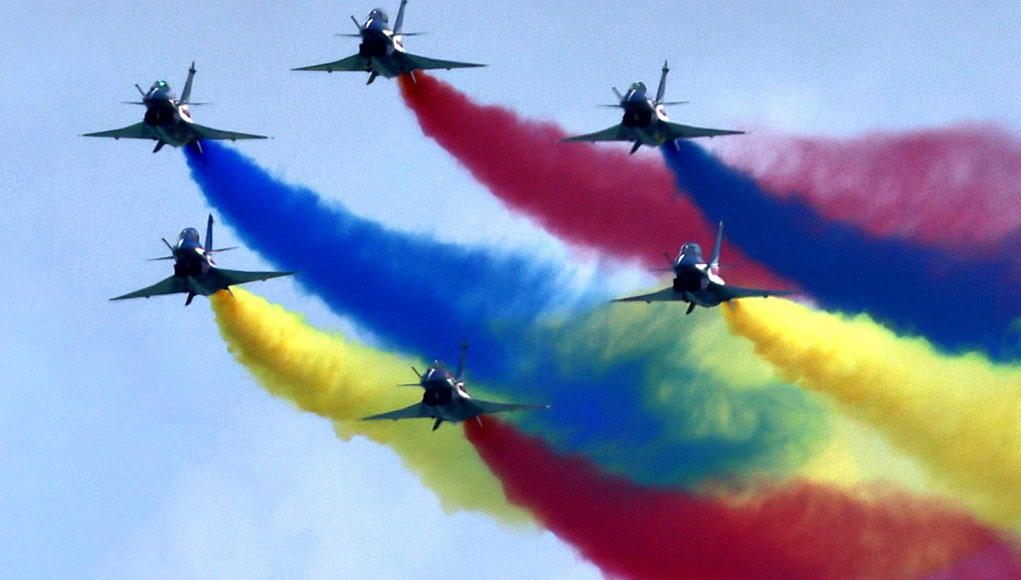
Simultaneously, China is executing a marketing offensive to normalize its military hardware. The public debut of the land-based J-35A stealth fighter model, designed for air superiority and precision strike, alongside the PLAAF Bayi team’s J-10C demonstrations positions Chinese hardware as a “sanction-proof” alternative. This normalization strategy targets nations wary of Western political strings.
In the support and maritime domains, diversification is equally aggressive:
- Embraer C-390 Millennium: Secured selection for South Korea’s LTA-II program and entered the Uzbekistani market, proving its viability as a global transport alternative.
- PTDI Special Mission Portfolio: Indonesia’s PTDI is marketing the CN235-220 ASW and the N219 Maritime Surveillance Aircraft (MSA) to capture the growing regional demand for anti-submarine and maritime patrol capabilities.
These airframes are only as effective as the munitions and data links that support them, which drives a secondary market for high-tech subsystems.
Advanced Munitions, Missile Defense, and Multi-Domain AI
The strategic importance of ITAR-free weapon systems and multi-domain data integration has become the defining technical requirement of 2026.
Major weapon systems on show included:
- ST Engineering has unveiled the EagleStrike loitering munition at the Singapore Airshow, offering the system as a tactical strike option for ground forces operating in increasingly contested environments. The weapon’s range is 20 km, with a mission endurance of up to 30 min, and it reaches a maximum speed of 30 m/s (about 100 km/h).
- IAI/ST Engineering Blue Spear (5G SSM): Marketed by the Proteus Advanced Systems joint venture, this 5G surface-to-surface missile provides a sovereign solution for advanced naval and coastal defense.
- Rafael “Puzzle” AI Suite: A next-generation tool designed to accelerate battlefield decision-making by fusing multi-domain data into actionable intelligence.
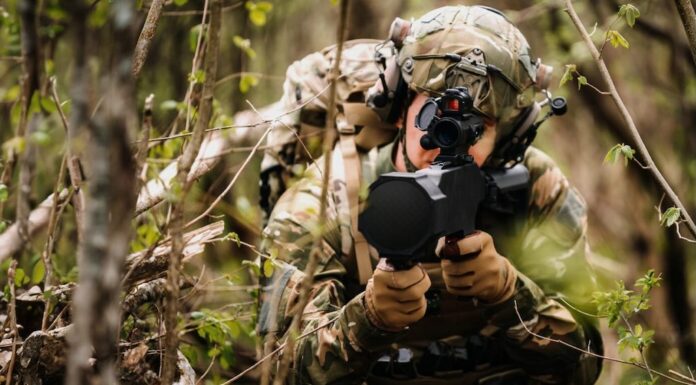
- Tron Future T-Scope: An AI-powered sighting system using multiple sensors and automated ballistic calculations to predict trajectories, transforming unguided rockets into precision munitions.
- ST Engineering AI Cockpit & GEMINI-X: The debut of the “AI Cockpit” voice assistant and GEMINI-X tactical data links highlights a move toward proprietary, secure communications.
- Airbus A330 MRTT: Achieved world-first certification for the Automatic Air-to-Air Refueling (A3R) system, significantly reducing operator workload.
This “Sovereignty” theme is pervasive: buyers are no longer accepting “black box” technologies and instead demand control over software and IP that enables local MRO and operational independence. This terrestrial and aerial autonomy is now being mirrored in the space domain.
Sovereign Constellations in Space
Space has transitioned from a commercial frontier to a top-tier military domain. On April 1, 2026, Singapore formally launched the National Space Agency of Singapore (NSAS), with Minister Tan See Leng announcing a mandate for sovereign space capabilities.
While Germany is pursuing massive scale with its $41 billion SATCOM Stage 4 project (a constellation of over 100 satellites), Singapore is focusing on specialized, high-resolution assets. Key projects include the NeuSAR-2 radar constellation, the Nebula laser communications demonstrator, and the Polaris AI-enabled optical satellite from ST Engineering. These systems provide the secure data link and near-continuous observation required to support autonomous systems. Additionally, Rafael’s LITESAT is being positioned as a “turnkey” orbital intelligence solution for regional partners.
The overarching theme of the 2026 defense landscape is a relentless pursuit of technological autonomy. Regional nations are increasingly rejecting the role of passive customers, striving instead to become sovereign masters of their own defense destiny amidst the escalating US-China rivalry.