Oto Melara has conducted firing tests of the Ballistic Extended Range Vulcano 127 projectile designed for the 127/46 gun mounted on the Italian FREMM and German F125 frigates. Photo: Oto Melara/
Oto Melara has conducted firing tests of the Ballistic Extended Range Vulcano 127 projectile designed for the 127/46 gun mounted on the Italian FREMM and German F125 frigates. Photo: Oto Melara/
On 6 March 2014, the Italian Navy carried out a number of firing trials on board the frigate Bersagliere to test the 127/54 C gun equipped with Vulcano-Kit (V-kit). The firing trials, conducted with 127 Vulcano Ballistic Extended Range (BER) ammunition, proved to be successful, with projectiles achieving a range of over 38 km. The field of fire was limited to 40 km for security reasons.
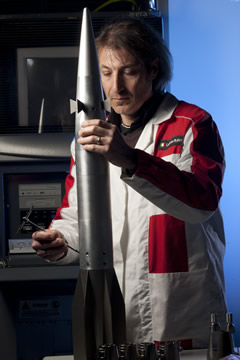
Vulcano 127 has already performed firing testing verifying the enhanced ballistic characteristics of the projectile. The one in the photo is the 127mm Guided Long Range projectile, showing the canard section and GPS/INS guidance and advanced multi-mode fuse section installed in the nose. Photo: Oto MelaraThe Vulcano BER ammunition used in the firing trials are part of a pre-production lot; the production-line qualification is underway on a first pilot lot of ammunition. It is the first time a military ship, not equipped with the naval gun systems used in the Second World War, has reached such ballistic ranges. Vulcan BER ammunition provide very accurate and high precision firing actions at ranges beyond 60 km.
Commenting on the successful test OTO Melara said it is ready to supply Vulcano BER ammunition to the Navies employing the new 127/64 LW weapon system and those employing the previous version 127/54 C naval gun with the V-kit upgrade.
In addition to the BER variant, Vulcano guided ammunition family also include the Guided Long Range (127GLR) and Semi Active Laser (GLR-SAL) guided versions, which will be available on board ships for firing trials starting from next year. The entire family of trajectory-corrected and guided projectiles will be able to conduct naval fire support at ranges from 35 km up to over 100 km, utilizing the OTO Melara naval guns systems.
Lockheed Martin Skunk Works® and XTEND have achieved a major milestone in JADC2 by integrating the XOS operating system with the MDCX™ autonomy platform. This technical breakthrough enables a single operator to simultaneously command multiple drone classes, eliminating the friction of mission handoffs. From "marsupial" drone deployments to operating in GPS-denied environments, explore how this collaboration is abbreviating the data-to-decision timeline and redefining autonomous mission execution.
As traditional defense primes face mounting competition from agile “neoprimes” such as Anduril, Palantir and Helsing, the balance of innovation is shifting toward software-defined warfare and scalable, dual-use technologies, while global industry consolidation—marked by Boeing’s integration of Spirit AeroSystems and other strategic mergers—signals an intensified race to secure control over the defense technology value chain. Our Defense-Tech weekly report highlights these trends.
In early October 2025, a coordinated wave of unmanned aerial system (UAS) incursions—widely attributed to Russia—targeted critical infrastructure across at least ten European nations. The unprecedented campaign exposed the fragility of Europe’s air defenses...
Executive Summary
The past week (September 18-25, 2025) represents an inflection point where strategic defense concepts have transitioned from doctrine to tangible reality. An analysis of global events reveals four primary, interconnected trends shaping an...
At the 2025 Air, Space & Cyber Conference, U.S. Air Force and Space Force leaders unveiled major updates on next-generation fighters, bombers, unmanned systems, and space initiatives, highlighting both rapid innovation and critical readiness challenges as the services race to outpace global competitors. A short version is available here, with a more detailed version for subscribers.
The Taipei Aerospace & Defense Technology Exhibition (TADTE) 2025 crystallized around four dominant strategic themes that collectively illustrate Taiwan's comprehensive approach to defense modernization amid escalating regional tensions. Based on a detailed report by Pleronix (available upon request). Includes a Podcast discussion on TADTE 2025's highlighting Taiwan's four strategic themes beyond the post's coverage.
Israel’s Iron Beam 450 high-power laser system has completed final testing, marking a major leap in air defense. Developed by Rafael, it offers precise, cost-effective interception of rockets, UAVs, and mortars, and is set for IDF deployment by 2025.