
When most people think of Turkey’s modern military capabilities, they think of drones. The Bayraktar TB2 gained global recognition for its effectiveness in conflicts in Nagorno-Karabakh, Syria, Libya, and Ukraine. Its success made the Turkish defense industry a household name among military observers worldwide.
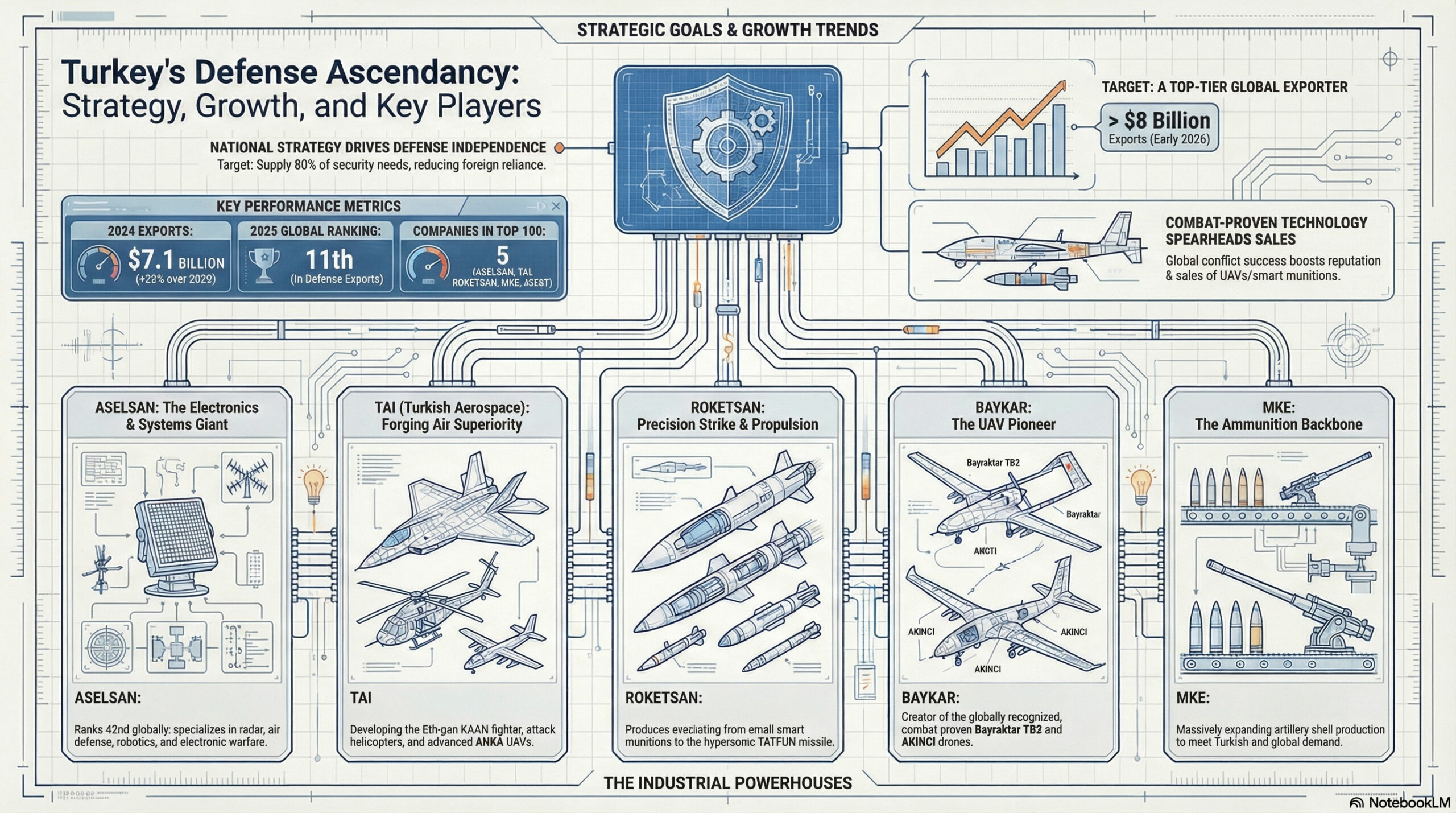
But this focus on drones, while understandable, obscures a far more profound industrial transformation, driven by a national strategy to build a top-tier, globally competitive defense ecosystem. The Turkish government has set an ambitious goal for its industry: to have a company rank among the world’s top 30 defense contractors by the end of this decade. With five firms – ASELSAN, TAI, ROKETSAN, MKE, and ASFAT – already in the Defense News 2024 “Top 100,” that goal is looking increasingly plausible.
This report reveals five key facts about the rapid rise and strategic depth of Turkey’s defense industry. Based on recent analysis, these takeaways explain how Turkey is methodically reshaping its role on the world stage, not just as a regional power, but as a top-tier global arms supplier.
1. Their Biggest Customers Aren’t Who You Think
Now ranking 11th in the world in defense exports, Turkey’s global market presence is undeniable. One might assume its primary customers would be developing nations in the Middle East, Africa, or Central Asia, where its geopolitical influence has grown. The data, however, reveals a different reality: the core of Turkey’s defense export business is firmly anchored in the West.
According to recent business data, a full 75% of Turkey’s defense exports go to the United States, NATO members, and European Union states. To reinforce this point, the five leading individual customers of Turkish defense products are all European countries. This fact tells a story of strategic market penetration on a global scale, suggesting that Turkish military hardware meets the high standards of quality and interoperability required for integration into the arsenals of established Western military alliances.
2. “Combat Proven” Isn’t Just a Slogan—It’s a Core Strategy
In the competitive global arms market, no marketing term is more valuable than “combat-proven.” For Turkey, this is not just a label but the central pillar of its sales strategy. Turkish-made weapon systems have cultivated a positive operational image due to their extensive use in recent conflicts.
These systems, especially UAVs, air-to-ground munitions, and wheeled armored vehicles, have been validated in some of the world’s most demanding theaters, including:
- Turkish military operations in Syria and Iraq
- Ukraine’s war against Russia
- The Nagorno-Karabakh war
- Various theaters across Africa (Sudan, Libya)
This real-world validation provides a level of assurance that sterile test environments simply cannot match. It gives Turkish products a significant competitive edge, making them highly attractive to nations looking for reliable and effective military technology.
3. They Use Arms Sales as a Powerful Diplomatic Tool
Turkey has integrated its defense industry into its national foreign policy, using arms sales as a key instrument of diplomacy and influence. Diplomatic activity and foreign relations are explicitly used as “tools” for business promotion, creating a self-reinforcing cycle of political and industrial gain.
This strategy is put into practice in several ways:
- Donating Equipment: Turkey donates armaments to countries with business potential, for example, transferring COBRA 4×4 armored vehicles to Zambia.
- Establishing Military Bases: Ankara establishes military bases in target countries, creating a persistent presence and opportunities for equipment displays (Qatar, Somalia).
- Training Local Forces: Turkish advisors often train local military forces, typically using Turkish-made equipment, thereby familiarizing a new generation of soldiers and officers with their products.
This multi-pronged approach builds deep, long-term strategic partnerships that go far beyond simple transactional sales. The concrete outcomes are major international co-production agreements, such as joint ammunition production with Poland, vehicle production with Malaysia, and a memorandum on ammunition with Pakistan, cementing Turkish influence for years to come.
4. The Drive for Strategic Self-Reliance
At the heart of Turkey’s defense ambitions is a powerful national drive for strategic self-reliance. The primary government objective is to achieve a “substantial increase in the defense industries’ technological independence and a reduction/elimination of dependence on foreign suppliers.” Today, the Turkish defense industry supplies about 80% of the needs of its national security forces, a significant metric of industrial capacity.
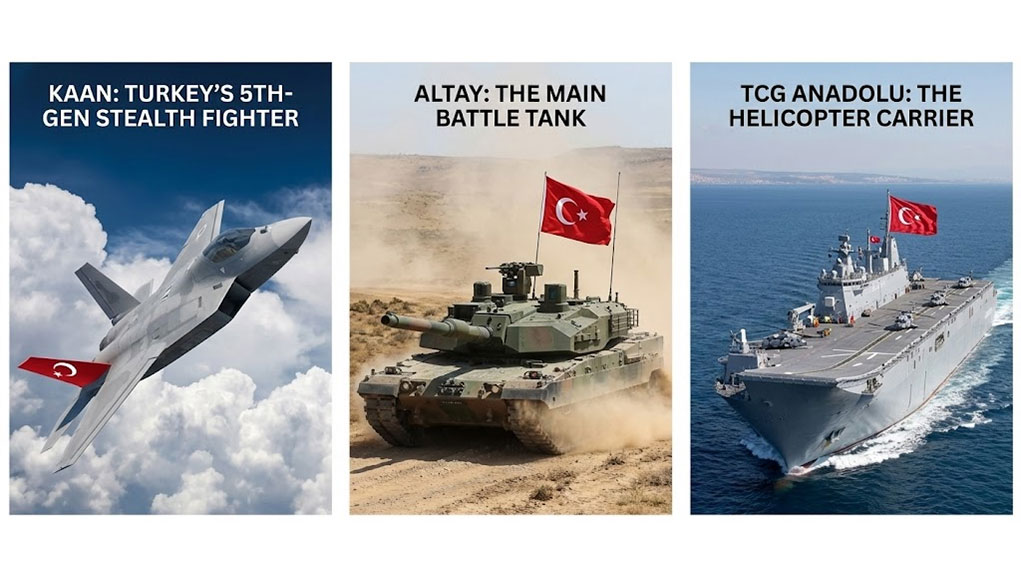
This quest has been accelerated by international arms embargoes and political friction that began after the 1974 invasion of Cyprus and later, the acquisition of S-400 air-defense systems from Russia. In response, Turkey has doubled down on developing its own high-end systems. Turkey still relies on foreign nations for technological support, for example, South Korean know-how for the Altay main battle tank and Spanish expertise for its helicopter carrier. Rather, it is about eliminating critical foreign dependencies. The list of projects is impressive:
- 5th-generation (and future 6th-gen) stealth fighters, Collaborative Combat Aircraft (CCA), and Unmanned Aerial Systems (UAS)
- Advanced aircraft engines
- Modern naval combat ships, including submarines, with a potential nuclear-powered variant under consideration
- Ballistic missiles, including hypersonic versions
- A complete, multi-layered national air-defense system known as the “Steel Dome.”
- A full range of Armored Fighting Vehicles (AFV) from Main Battle Tanks to ground robotics and engines
Pursuing such a broad and technologically demanding industrial goal demonstrates an immense level of strategic investment and determination, ensuring Turkey can chart its own course.
5. Modern Conflicts Are Their Real-Time R&D Lab
While many nations test equipment in controlled settings, Turkey is using active war zones as a real-time research and development laboratory. The relationship with Ukraine and Azerbaijan provides a prime example. Turkish industry representatives conduct “continuous, in-depth lessons-learned processes” directly with Ukrainian forces on the front lines.
Turkey transfers weapon systems in their final development stages to Ukraine, sometimes free of charge, specifically for “operational evaluation.” This feedback loop enables engineers to rapidly identify flaws, improve their systems, and refine them based on actual combat performance. For example, a key lesson learned in combat in Ukraine was the need to improve UAV survivability, leading to new developments in electronic warfare pods and countermeasures. The scope of this real-time R&D is broad, spurring innovation across systems, from mine clearance to autonomous robotic combat systems.
Conclusion
These five takeaways paint a clear picture of a nation methodically executing a long-term strategic vision. From a Western-oriented customer base and a “combat-proven” brand to the fusion of defense sales with diplomacy, a determined drive for strategic self-reliance, and a unique real-world R&D cycle, Turkey has built a formidable defense ecosystem. The drones that captured the world’s attention were just the beginning.
As Turkey executes its ambition to join the top tier of global defense producers, its rise represents a significant shift in the global defense market. It is no longer an emerging player; it is a new power on the world stage.