
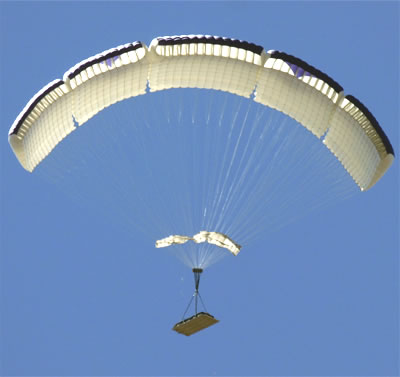
The MegaFly, developed by Para-Flite to meet these requirements was first tested in October 2006, demonstrating the delivery of 25,000 pound (11.3 ton) cargo from an altitude of 25,000 feet. The system uses a 9,000 square foot, fully elliptical, gliding parachute, with a 170 feet span, approximately 20 feet less than the wingspan of a Boeing 747. It can fly autonomously via GPS guidance for distances up to 40 kilometers to a designated point on the ground. The MegaFly is composed of five modular segments which can be separated after the drop to facilitate recovery on the drop zone. In most wind conditions, the Para-Flite JPADS systems can land on a roadway 200 meters long by 40 meters wide. This equates to a 75% reduction in Landing Zone required area when compared to Circular Error Probable (CEP). This type of landing strategy also increases the total number of suitable Landing Zones and decreases recovery time.
From Ukraine to Taiwan: The Global Race to Dominate the New Defense Tech Frontier
As traditional defense primes face mounting competition from agile “neoprimes” such as Anduril, Palantir and Helsing, the balance of innovation is shifting toward software-defined warfare and scalable, dual-use technologies, while global industry consolidation—marked by Boeing’s integration of Spirit AeroSystems and other strategic mergers—signals an intensified race to secure control over the defense technology value chain. Our Defense-Tech weekly report highlights these trends.
U.S. Air and Space Forces Push Next-Gen Programs at the AS&C 2025 Conference and...
Tamir Eshel - 0
At the 2025 Air, Space & Cyber Conference, U.S. Air Force and Space Force leaders unveiled major updates on next-generation fighters, bombers, unmanned systems, and space initiatives, highlighting both rapid innovation and critical readiness challenges as the services race to outpace global competitors. A short version is available here, with a more detailed version for subscribers.
TADTE 2025: Reflecting Taiwan’s Strategic Themes
Tamir Eshel - 0
The Taipei Aerospace & Defense Technology Exhibition (TADTE) 2025 crystallized around four dominant strategic themes that collectively illustrate Taiwan's comprehensive approach to defense modernization amid escalating regional tensions. Based on a detailed report by Pleronix (available upon request). Includes a Podcast discussion on TADTE 2025's highlighting Taiwan's four strategic themes beyond the post's coverage.
Iron Beam 450 Completes Testing, Soon to Join With Operational Air Defense Units
Tamir Eshel - 0
Israel’s Iron Beam 450 high-power laser system has completed final testing, marking a major leap in air defense. Developed by Rafael, it offers precise, cost-effective interception of rockets, UAVs, and mortars, and is set for IDF deployment by 2025.
U.S. Accelerates Drone and eVTOL Integration: What the New Executive Order Means for America
Tamir Eshel - 0
President Trump’s June 6, 2025 executive order “Unleashing American Drone Dominance” sets an aggressive timeline for FAA BVLOS rulemaking, launches an eVTOL Integration Pilot Program, and prioritizes domestic manufacturing and export of U.S. drone technologies—aiming to modernize logistics, public safety, and defense while securing global leadership in advanced air mobility.