

Monday, December 29, 2025
More
    Home Blog Page 225

    U.S. Army Awards Two Contracts for Technology Development of the Ground Combat Vehicles

    The U.S. Army awarded two contracts for the technology development (TD) of the Ground Combat Vehicle Infantry Fighting Vehicle. The winners are General Dynamics Land Systems GDLS, awarded $440 million and an industry team lead by BAE Systems and Northrop Grumman (awarded $450 million). “These contractors have been selected to develop competitive, affordable and executable designs for a new Army Infantry Fighting Vehicle (IFV) over the next 24 months.” the Army announced. The Army plans to buy around 1,800 GCVs to replace the aging Bradley Fighting Vehicles. The research and development associated with the program is expected to cost $7.6 billion.

    A third team competing for the program was lead by SAIC, a company that joined the Boeing Company as lead system integrator of the deceased Future Combat Systems (FCS). The SAIC team also included Boeing, Krauss-Maffei Wegmann and Rheinmetall Defence as subcontractors. GDLS is the developer and manufacturer of the M-1 Abrams main battle tank and the Stryker light armored vehicles (based on the Swiss Piranha design); BAE Systems is the developer and manufacturer of the M2/M3 Bradley Fighting Vehicles and M-113 Armored Personnel carriers, the vehicles that are supporting all U.S. Army and Marine Corps land combat elements.

    “Given the economic environment the nation currently faces, the Army recognizes that it is imperative to continually address requirements as we build a versatile, yet affordable, next-generation infantry fighting vehicle.” Secretary of the Army John McHugh said. The full development program will span over seven years. The purpose of the 24-month GCV TD phase is to complete the preliminary design of the GCV and to reduce the risk of performance of the Engineering and Manufacturing Development phase of the program. “The Army remains committed to a seven-year schedule as the appropriate amount of time necessary to design, develop, build and test the next-generation infantry fighting vehicle.” Army officials confirmed.


    The two contractors are expected to pursue different approaches, one feature a conventional diesel propelled armored vehicle with the other offering a hybrid-electrically propelled platform. Both manufacturers will also provide armor protection segments for testing Rocket Propelled Grenade (RPG) and mine blast protection. The Army wants the GCV to provide blast protection at a level equal to the MRAP. The Army also expects ‘hit avoidance’ (A.K.A. Active Protection Systems) to be featured as an integrated part of the system. The GDLS lead team will feature a system developed by Raytheon, the company responsible for the QuickKill system originally developed for the U.S.Army Ground Combat Systems program. The BAE/Northrop Grumman team has yet to introduce such system, but BAE has developed similar systems in the past.

    “The General Dynamics team’s design is focused on delivering an affordable ground combat vehicle that provides optimal Soldier protection and operational effectiveness. Our design draws on affordable, mature technologies to provide protection, capacity for a nine-soldier squad, network interoperability, mobility and lethality that is unmatched by any existing infantry fighting vehicle,” said Steve Schultz, vice president, Ground Combat Vehicle Program for General Dynamics Land Systems.

    General Dynamics Land Systems leads the first team as the prime contractor and has overall responsibility for program management, vehicle design and integration. General Dynamics also is responsible for vehicle structure and chassis, squad and crew environments and integrated survivability and safety. Lockheed Martin has responsibility for the turret, lethal and non-lethal effects and embedded training. Raytheon is responsible for the RPG protection system, indirect-vision and sensor integration. Tognum America has responsibility for the MTU based power pack, which comprises the engine, transmission and generator. General Dynamics C4 Systems leads the network and communications integrated product team and has responsibility for network integration, communications, computing and information assurance.

    Work is being done at General Dynamics Land Systems sites in Sterling Heights, Mich., and Lima, Ohio; Lockheed Martin in Grand Prairie, Texas; Raytheon in McKinney and Plano, Texas; General Dynamics C4 Systems in Scottsdale, Ariz., Taunton, Mass., and Fort Wayne, Ind.; and Tognum America in Detroit, Mich., Aiken, S.C., and Friedrichshafen, Germany.

    The BAE/Northrop Grumman team is pursuing an “affordable design that provides for maximum force protection and is built to accommodate future technological enhancements,” said Mark Signorelli, vice president and general manager of Weapon Systems at BAE Systems. He added that the team’s vehicle features an adaptive platform that will remain relevant for decades to come, bringing more survivability, mobility and versatility to the Army and with levels of protection scalable to the demands of a variety of missions. The team’s offering includes a hybrid electric drive propulsion system that enables exceptional force protection and mobility in a lower weight vehicle while provisioning for growth in power requirements as new technologies are matured and integrated into the platform. “This technology allows for GCV to meet the demands of near term operations while providing a robust platform for future technology integration and growth at low risk and cost.” The company’s announcement said.

    BAE Systems is leading the team responsible for overall program management, systems integration, vehicle design, structure and logistical support as well as readiness and sustainment of the platform. Northrop Grumman serves as the C4ISR lead. QinetiQ provides the key component of the E-X-Drive hybrid electric propulsion system. iRobot serves as the unmanned ground vehicle integrator and will enhance future autonomous operations. MTU provides the diesel engine and power generation units for the vehicle with Saft providing the battery and energy storage component of the hybrid-electric system.

    Work under the technology development phase will be performed at BAE Systems and Northrop Grumman sites in Sterling Heights and Troy, Michigan; Santa Clara and Carson, California; York, Pennsylvania; Minneapolis, Minnesota; and Huntsville, Alabama.

    AUVSI 2011 Photo Report Part 2

    Northrop Grumman displayed the Andros from Remotec, and provided some details about the next generation version of this leading EOD/ C-IED vehicle. Photo: Tamir Eshel, Defense-Update
    The Dragon Runner 10 from QinetiQ fitted with counter-IED payload. Photo: Tamir Eshel, Defense-Update
    Northrop Grumman displayed the Andros from Remotec, and provided some details about the next generation version of this leading EOD/ C-IED vehicle. Photo: Tamir Eshel, Defense-Update
    DRS unveiled the new GuardBot, a ball-shaped UGV designed to float on water or roll on any surface, including mud, sand or ice. The bot can move autonomously in any direction, providing full 360 degree coverage by two roll stabilized cameras positioned on the two sides. Photo: Tamir Eshel, Defense-Update
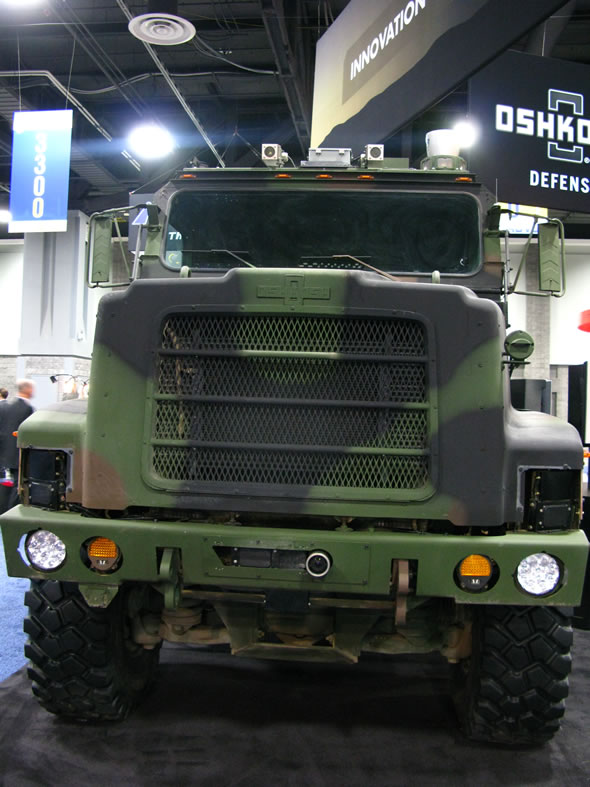
    Oshkosh is displaying the TerraMax Cargo truck, based on a standard MTVR truck being evaluatqed by the U.S. marine Corps Warfighting Lab as a Cargo UGV autonomous resupply missions. Photo: Tamir Eshel, Defense-Update
    Four Ground Unmanned Support Surrogate (GUSS) autonomous cargo carriers are being tested by the U.S. Marine Corps Warfighting Lab. Last year the vehicles participated in RIMPAC 2010 in Australia. Photo: Tamir Eshel, Defense-Update
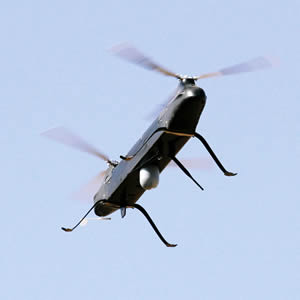
    The use of weaponized UGVs is still controversial, less due to moral arguments, but more due to safety concerns. One of the first platforms to offer such capabilities is the MAARS from QinetiQ, a platform developed specifically for weaponized missions and enhanced with multiple safety measures to prevent accidental shooting at friendly forces. Photo: Tamir Eshel, Defense-Update
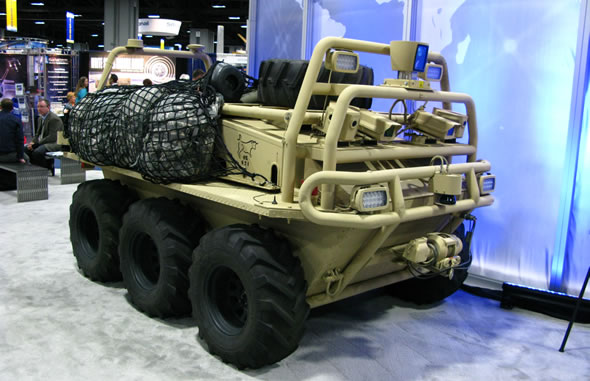
    After winning the Army sponsored 'Project Workhorse', Unmanned Ground Vehicle (UGV) competition, four Lockheed Martin Squad Mission Support Systems (SMSS) vehicles are to be sent to Afghanistan as part of a three-month Military Utility Assessment (MUA). Photo: Tamir Eshel, Defense-Update
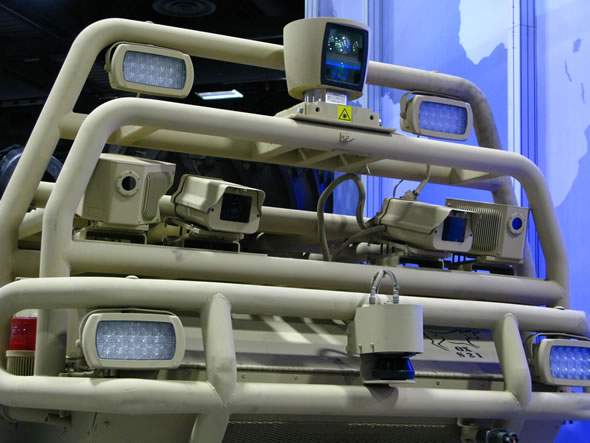
    The autonomous sensor and driving system integrated in the SMSS enables the vehicle to perform autonomous movement or respond to simple user commands. Photo: Tamir Eshel, Defense-Update

    AUVSI 2011 Photo Report – First Impressions

    A family photo of three of AAI's unmanned aerial vehicles, the Shadow (front), Aerosonde 4.7, and the Orbiter 2. Photo: Tamir Eshel, Defense-Update

    A family photo of three of AAI's unmanned aerial vehicles, the Shadow (front), Aerosonde 4.7, and the Orbiter 2. Photo: Tamir Eshel, Defense-Update
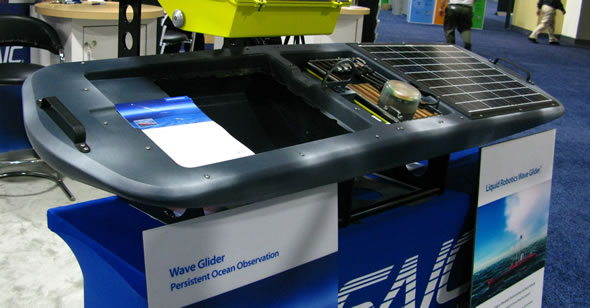
    Among many naval unmanned systems shown at AUVSI was the Wave Glider from SAIC. This solar powered vehicle is designed to provide persistent oceanic surveillance. Photo: Tamir Eshel, Defense-Update
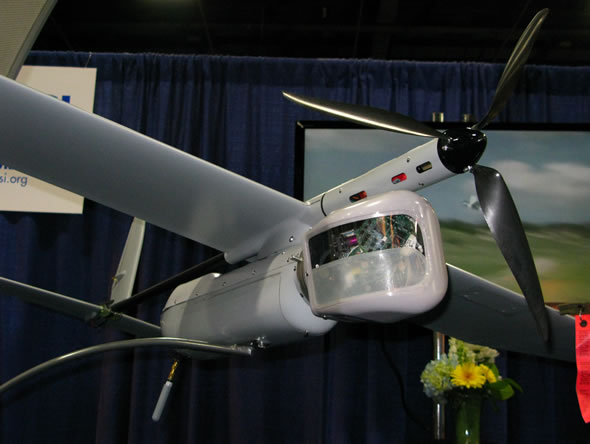
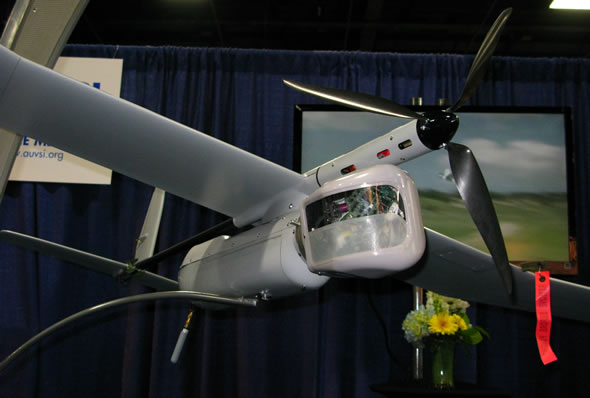
    The Skylark 1LE was enhanced to meet specific U.S. requirements. The mini UAV is currently being evaluated by the U.S. Air Force Research Lab (AFRL), equipped with the multi-sensor M-STAMP payload, more powerful processing capacity and Protonex PEM fuel cell that doubles its endurance to six hours. Photo: Tamir Eshel, Defense-Update
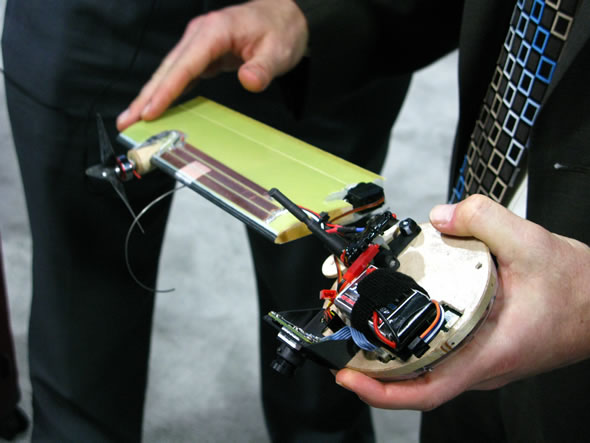
    Lockheed Martin scientists displayed here the Samarai micro UA. The design of this vehicle is derived from the maple leaf, offering an inherently stable vehicle. The propeller rotates the wing to generate lift, controlling the vehicle's flight, and elevation is performed by changing engine speed and elevons. The video is synchronized with the vehicle's rotation to provide 360 degree coverage in stable and ustable format. Photo: Tamir Eshel, Defense-Update
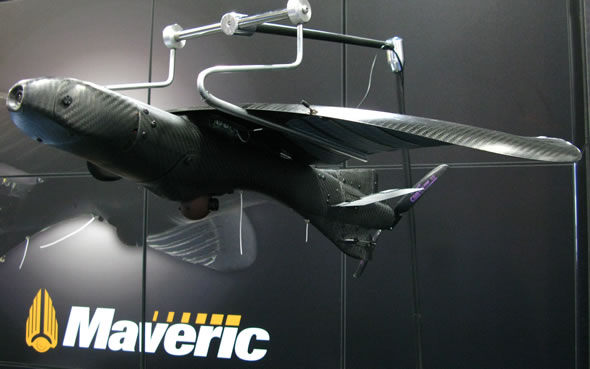
    Maveric hand tossed micro UAV from Preoria has recently found new uses, among these is the T-Remote Aerial Munition (T-RAM) proposed by Textron Defense for the U.S. Air Force LMAMS program. Textron has adapted the hand-tossed vehicle capable to launch from a tube and slightly modified the vehicle and flight controls and software to improve precision at the terminal phase, commonly performed in a steep dive mode. Photo: Tamir Eshel, Defense-Update
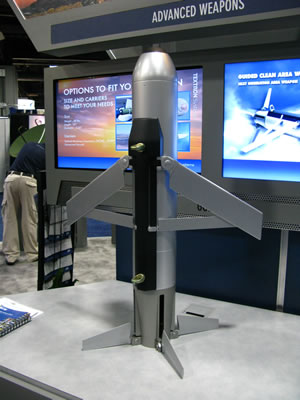
    Textron defense is offering a guided derivative of its 'Clean Area Weapon' (G-CLAW) demonstrated here on an MBDA Sabre lightweight glide bomb. G-CLAW employs GPS guidance, and a range extension wing kit, enabling UAVs flying at medium or high altitude to attack soft area targets with high precision. CLAW uses a powerful blast fragmenting charge designed to cover a wide area without risking unexploded duds, therefore complying with international treaties banning cluster munitions. (Photo: Tamir Eshel, Defense-Update
    This eight-prop Kestrel VTUAV carries a miniature Moving Target Indcation (MTI) radar developed by IMSAR. The radar is integrated with an EI/IR sensor, providing vehicle, dismount detection and identification (using the EO/IR module) at of several kilometers. Photo: Tamir Eshel, Defense-Update
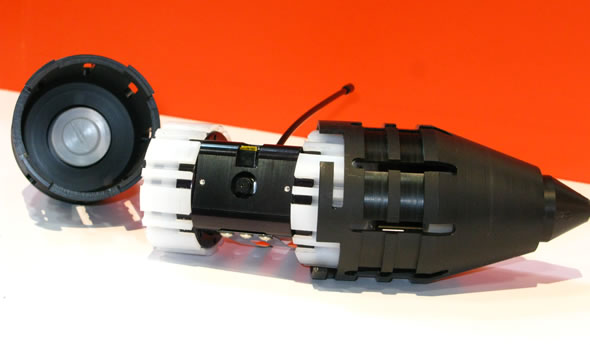
    The Smart Grenade Robot (SG Robot) developed by Hanwha Corp. of Korea is a small unmanned ground sensor packed into an impact-absorbing shell designed to be fired by a rifle grenade , at distances of up to 100 meters. The protecting shell opens by the impact, releasing the robot that can perform surveillance of a building interrior. On detection of a hostile target the operator can activate the grenade packed inside the robot to eliminate the target. Alternatively, the robot can carry a wireless relay to improve communications indoors, enabling other robots to move deeper into the interrior of the building, without losing communications with the operators. Photo: Tamir Eshel, Defense-Update
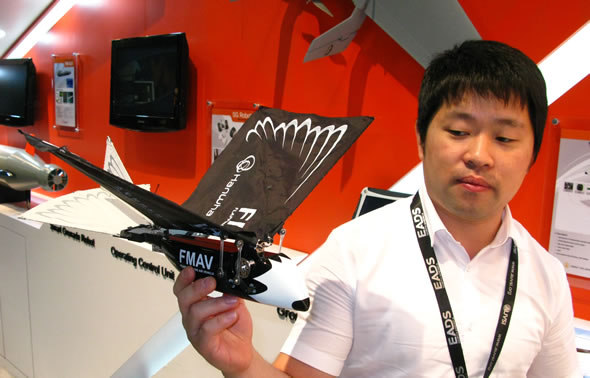
    Another innovative design from Hanwha is the pigeon-size Flapping Micro Air Vehicle (FMAV), developed under the Korean Agency of Defense Development and U.S. Air Force Research Lab (AFRL). This experimental vehicle weighs 200 grams, its wing span is 50 cm, it can fly at a speed of five meters per second, or loiter over one place, for up to 25 minutes. FMAV uses an autopilot developed specifically for this vehicle, performing automatic waypoint navigation. The company plans to continue research into the development of an insect-size FMAV, to enable indoors operations and attack. Photo: Tamir Eshel, Defense-Update


    Skylark 1LE Adapts for the U.S. Military

    The M STAMP is the largest member of Controp's STAMP family of miniature EO payloads. It integrates two sensors - a daylight TV and uncooled FLIR, coupled with an integral laser marker. Photo: Tamir Eshel, Defense Update

    The U.S.-Israeli UAS Dynamics joint venture has taken the Skylark 1LE mini UAV to new levels, enhancing its performance, mission capabilities and operability to new levels. According to Peter Klein, UAS Chief Engineer at the company, assessing U.S. requirements made it clear that the needs of the U.S. forces and Special Operations community were different from those set by the Israelis, which necessitated significant enhancement of the already improved version of Skylark I.

    The M STAMP is the largest member of Controp's STAMP family of miniature EO payloads. It integrates two sensors - a daylight TV and uncooled FLIR, coupled with an integral laser marker. Photo: Tamir Eshel, Defense Update

    “At the AUVSI 2010 we have asked Controp, the original payload manufacturer to come up with a multi-sensor payload for the Skylark, and today we are showing the M STAMP payload on our Skylark 1LE for the first time” Klein told Defense Update. The M STAMP is the largest member of Controp’s STAMP family of miniature EO payloads. It integrates two sensors – a daylight10x zoom TV and dual Filed of view uncooled thermal imager, coupled with a integral laser pointer, all packed into a 1.2 kg payload. The new EO payload offers high resolution and high stabilization, which coupled with the air vehicles high performance, enables the enhanced Skylark 1LE to loiter at higher elevation while maintaining sufficient image resolution for the warfighter. Higher operating altitude means better coverage, communications range and reduced interference which commonly limits the use of small UAS in mountainous areas such as in Afghanistan.

    As part of the preparation of the Skylark 1LE for the U.S. user UAS Dynamics introduced a U.S. datalink, compatible with U.S. military communications standards and security levels. Skylark 1LE can now transmit video directly to U.S. forces using standard video terminals (Rover). According to Klein, UAS Dynamics plans to add more processors on board is also being increased, increasing processing power to support on-board computation of automatic tracking, change detection over a wide area and complex geo-location algorithms supporting advanced networked warfighter applications.

    Another improvement introduced with the U.S. model of Skylark 1LE is the use of more powerful propulsion and efficient three-blade propeller, clearing the miniature aircraft for safe hand launch. Elbit recommends the use of bungee for launching its Skylark 1LE but according to Klein, U.S. operational requirements demand hand launching as an option. On board power is also being increased with the introduction of battery and fuel cell hybrid technology, currently being evaluated by the U.S. Air Force Research Laboratory (AFRL). The system employs a Protonex hydrogen fuel cell that keeps charging the lithium ion batteries throughout the mission, extending mission endurance by 100 percent, from three to six hours with full payload and enhanced avionics. The fuel-cell Skylark 1LE configuration was displayed at AFRL at the AUVSI 2011 exhibition.

    RAFAEL Develops UAS Mission Enhancement Package

    ImiLite M is a standalone system providing a set of tools for mission enhancement, which supports the UAV unit commander or a remote payload operator in carrying out the assigned mission. The system receives video from an analog or a digital source and displays it on the screen along with the payload’s ground footprint. Photo: Rafael

    Focusing on a range systems complementing unmanned aerial systems (UAS) Israel’s weapon systems expert RAFAEL Advanced Defense Systems is introducing at the AUVSI 2011 a range of hardware and software systems, supporting UAS missions. Among such systems are the Reccelite and Recce-U reconnaissance pods, optimized for Medium Altitude Long Endurance (MALE) missions, and a new version of the Toplite EO multisensor payload, enhanced with wide area coverage utilizing on-board real-time video processing.

    ImiLite M is a standalone system providing a set of tools for mission enhancement, which supports the UAV unit commander or a remote payload operator in carrying out the assigned mission. The system receives video from an analog or a digital source and displays it on the screen along with the payload’s ground footprint. Photo: Rafael

    The Enhanced Toplite, equipped with the TIP (Toplite Image processor) has currently being integrated on the Dominator UAV from Aeronautics. RAFAEL and Aeronautics already been selected by a NATO country for installation on helicopters, while the Reccelite and Recce-U pods are being integrated by Aeronautics on the Dominator MALE UAV. Reccelite will be carried underwing while the Recce U will be mounted under the nose. Reccelite has already flown on demonstration flights on the IAI Heron MALE UAV.

    The Reccelite pod is being integrated by Aeronautics on the Dominator MALE UAV. RAFAEL and Aeronautics have launched a close cooperation in the field of UAS recently, where the two companies are promoting system solutions combining products from the two companies.Photo: Aeronautics

    RAFAEL and Aeronautics have launched a close cooperation in the field of UAS recently, where the two companies are promoting system solutions combining products from the two companies. Among the target countries of the JV are several Latin American countries, Canada, as well as other nations. Few weeks ago the two companies acquired joint ownership of Israel’s EO Payload house Controp, further expanding the variety of EO sensors for their unmanned systems platforms.

    Rafael’s DLV-53 broadband data-link also supports these sensors, while field deployable versions of the Imilite intelligence processing center provide efficient tools for multi-intelligence processing and dissemination. These powerful tools are now made available to users at the lowest tactical level, equipped with the man-portable laptop packed version – Imilite M, configured as a ‘smart mobile video terminal’ packed with datalink and networking communications combining the tactical element employing the mobile device, the ground processing Imilite center and airborne element over a single high speed wireless network based on Rafael’s TACMAX. This combination enables the user to obtain full situational awareness, by grouping multiple support elements toto his aid. Other elements in Rafael’s UAV suite include survivability enhancements, one such option is the deployment of the X-Guard advanced airborne towed decoy systems designed for installation on all types of platforms.

    ImiLite M is a standalone system providing a set of tools for mission enhancement, which supports the UAV unit commander or a remote payload operator in carrying out the assigned mission. The Isystem receives video from an analog or a digital source and displays it on the screen along with the payload’s ground footprint. Weighing approximately 4 kg, with 10/100 base-t ethernet USB 2.0 external interface and a touch screen, ImiLite M is crucial for long ISR missions, providing visual and voice alerts, whenever a movement is detected in the image. The system provides high accuracy geo-referencing of the video in real time, and, through the creation of wide-area mosaic based on the video frames captured along the payload’s footprint, it provides a wider FOV for enhanced scene understanding. The system supports both real-time processing and interaction, video enhancement, recording and retrieval of recorded data for further analysis. As such, Imilite center and Imilite M are key components in Rafael’s evolving Wide Area Airborne persistent Surveillance (WAAPS) strategy.

    Flankers at Vigilant Eagle 2011

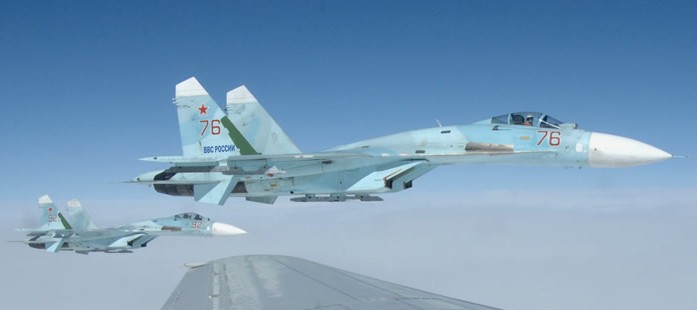
    A pair of Russian air force Su-27 Flanker fighter aircraft escort a ‘hijacked’ airliner as it passes through Russian airspace over the Pacific Ocean. (Photo: DoD by Tech. Sgt. Thomas J. Doscher, U.S. Air Force)

    A pair of Russian air force Su-27 Flanker fighter aircraft escort a ‘hijacked’ airliner as it passes through Russian airspace over the Pacific Ocean. The Russian fighters followed and monitored the aircraft while it was in Russian airspace, handing it over to U.S. F-15 Eagle fighters from Elmendorf Air Force Base, Alaska, when it entered U.S. airspace. The flight was part of the annual joint anti-terrorism exercise Vigilant Eagle, in which Russian air force units, the Federal Aviation Administration and the North American Aerospace Defense Command trained cross-border anti-terror response. (DoD photo by Tech. Sgt. Thomas J. Doscher, U.S. Air Force)

    A pair of Russian air force Su-27 Flanker fighter aircraft escort a ‘hijacked’ airliner as it passes through Russian airspace over the Pacific Ocean. (Photo: DoD by Tech. Sgt. Thomas J. Doscher, U.S. Air Force)

    We invite you to try our new server

    As part of our service improvement campaign we are evaluating a new design for defense-Update, running on a powerful new server. We invite you to give it a try, current news items are already online, along with the new design. As part of our testing we have run traffic load simulations, to prove the system is ready for the mission. We now invite you to kick the tires and tell us what you think. Click here to access the new site.

    DARPA’s HTV-2 Fails to Complete Second Hypersonic Flight Test

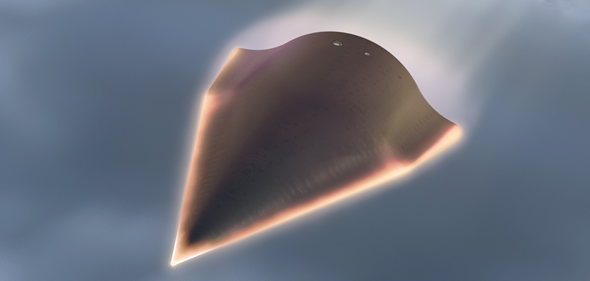
    The wedge shaped HTV-2 capsule is designed to fly about 20 minutes, proving the capability to endure atmospheric flight conditions at Mach 20 speed. Photo: DARPA

    The second and final flight test of DARPA’s Hypersonic Test Vehicle 2 (HTV-2) failed today as the capsule, launched by the Minotaur IV missile, was lost upon reentering earth atmosphere, about nine after launch. DARPA has assembled an independent Engineering Review Board to review and analyze the data collected through the experiment. The findings will inform policy, acquisition and operational decisions for future Conventional Prompt Global Strike programs — the goal of which, ultimately, is to have the capability to reach anywhere in the world in less than one hour.

    The wedge shaped HTV-2 capsule is designed to fly about 20 minutes, proving the capability to endure atmospheric flight conditions at Mach 20 speed. Photo: DARPA

    The wedge shaped unmanned hypersonic test vehicle was launched on 07:45 PDT by a Minotaur IV rocket from Vandenberg Air Force Base on the pacific coast, The flight was expected to take about 20 minutes. The Minotaur IV vehicle successfully inserted the HTV-2 into the desired trajectory, confirming separation by a rocket installed camera. At this phase the aircraft transitioned to Mach 20 aerodynamic flight. According to DARPA, this transition represents a critical knowledge and control point in maneuvering atmospheric hypersonic flight. More than nine minutes of data was collected before an anomaly caused loss of signal. Initial indications are that the aircraft impacted the Pacific Ocean along the planned flight path. The second test vehicle failed at the re-entry phase, where extremely high thermal loads develop. It was the same mission phase where the first test failed last year. “We know how to insert the aircraft into atmospheric hypersonic flight [but] we do not yet know how to achieve the desired control during the aerodynamic phase of flight.” said Air Force Maj. Chris Schulz, DARPA HTV-2 program manager.

    “Prior to flight, the technical team completed the most sophisticated simulations and extensive wind tunnel tests possible. But these ground tests have not yielded the necessary knowledge. Filling the gaps in our understanding of hypersonic flight in this demanding regime requires that we be willing to fly,” said DARPA Director Regina Dugan. “In the April 2010 test, we obtained four times the amount of data previously available at these speeds. Today more than 20 air, land, sea and space data collection systems were operational. We’ll learn. We’ll try again. That’s what it takes.”

    HTV-2 is packaged in a special capsule launched by the Minotaur. After the Minotaur positions the HTV-2 near the planed orbit, capsule will separate, accelerate and fly at a hypersonic glide trajectory within the earth’s atmosphere Mach 20 speeds, approximately 13,000 miles per hour. Photo: DARPA

    The goal of this test was to collect data on the vehicle’s handling, stability and maneuverability at Mach 20 hypersonic speed, enabling scientists to validate current assumptions about vehicle behavior and control under such extreme conditions. “Prior to flight, the technical team completed the most sophisticated simulations and extensive wind tunnel tests possible. But these ground tests have not yielded the necessary knowledge. Filling the gaps in our understanding of hypersonic flight in this demanding regime requires that we be willing to fly,” said DARPA Director Regina Dugan.

    A technology demonstration and data-gathering platform, the HTV-2 is packaged in a special capsule launched by the Minotaur. After separation and reentry into the atmosphere the capsule would have accelerated to fly at a hypersonic glide trajectory within the earth’s atmosphere Mach 20 speeds, approximately 13,000 miles per hour (20,900 km/h). The capsule itself was not required to transmit telemetry through its flight as its status and behavior would be monitored by more than 20 land, air, sea and space test assets, collecting the test data.

    The Minotaur IV rocket stands beside Space Launch Complex-8 at Vandenberg AFB, from where it will launch the HTV-2 hypersonic test capsule today. Photo: U.S. Air Force photo/Staff Sgt. Scottie McCord.

    “Wind tunnels capture valuable, relevant hypersonic data and can operate for relatively long durations up to around Mach 15. To replicate speeds above Mach 15 generally requires special wind tunnels, called impulse tunnels, which provide milliseconds or less of data per run,” Schulz said. “To have captured the equivalent aerodynamic data from flight one at only a scale representation on the ground would have required years, tens of millions of dollars, and several hundred impulse tunnel tests.” According to Schulz, impulse tunnel testing is required to create a portion of Mach 20 relevant physics on the ground. “And even then,” said Schulz, “we wouldn’t know exactly what to expect based solely on the snapshots provided in ground testing. Only flight testing reveals the harsh and uncertain reality.”

    HTV-2’s inaugural flight collected data that demonstrated advances in high lift-to-drag aerodynamics; high temperature materials; thermal protection systems; autonomous flight safety systems; and advanced guidance, navigation, and control for long-duration hypersonic flight.

    Approximately nine minutes into its first test flight in April 2010, telemetry assets experienced a loss of signal from the HTV-2. The vehicle’s onboard system detected a flight anomaly and engaged its onboard safety system—prompting the vehicle to execute a controlled descent into the ocean. “We gained valuable data from the first flight, made some adjustments based on the findings of an engineering review board to improve this second flight, and now we’re ready to put all of that to the test.” For its second test flight, engineers adjusted the vehicle’s centre of gravity, decreased the angle of attack flown, and will use the onboard reaction control system to augment the vehicle flaps to maintain stability during flight operations.

    During its second test flight, “DARPA looks forward to conquering more unknowns about long-duration hypersonic missions. The HTV-2 program is what remained from an ambitious ‘Prompt Global Strike’ weapon known as ‘Falcon’, designed to be based in the Continental U.S. and reach any point on earth within 60 minutes. The ambitious program was reduced to the development of two flight tests of two hypersonic capsules, exploring the unknown hypersonic speed regime. We need to increase our technical knowledge to support future hypersonic technology development,” said Dave Neyland, director of DARPA’s Tactical Technology Office.

    Flying at a speed of 13,000 miles per hour – a speed x22 faster than commercial jetliner – it would take less than 12 minutes to get from New York to Los Angeles creates aerodynamic and thermodynamic conditions, dealing with extreme pressures that cannot be fully replicated by simulation or wind tunnels. Long-duration flight at such speed generates surface temperatures in excess of 3,500 degrees Fahrenheit on the surface, hotter than a blast furnace that melt steel. To maintain an operable environment inside the vehicle, carbon composite material is used, to create a ‘glove’ that keeps the instruments cool only a few inches away from the inferno outside.

    As the wedge shaped vehicle rips the air apart at such high speeds, controlling the capsule at such speed is another challenge, requiring precise sensing and near simultaneous response to flight path disturbances, requiring hybrid controls combining Reaction Control System (RCS) and aerodynamic effects.

    Coalition Forces Kill Taliban Insurgents Responsible for Killing 38 Troops in Chinook Crash

    Following an ‘exhaustive manhunt’ after the Taliban operatives that fired the RPGs that downed the Chinook helicopter earlier this week, killing 38 soldiers on board, Coalition forces managed to kill the Taliban insurgents involved in the event, the commander of U.S. and coalition forces in Afghanistan said today.

    General John R. Allen, Commander, International Security Assistance Forces – Afghanistan (ISAF). Photo: ISAF

    According to Marine Corps Gen. John R. Allen, near midnight on Aug. 8 coalition forces coalition forces called in a precision airstrike with F-16s over the Chak district of Wardak province. Other elements involved in tracking and eliminating the targets included an Air Force AC-130H Spectre gunship, and Army AH-64 Apache helicopters.

    The F-16s dropped GBU-38 and GBU-54 bombs, and the Spectre fired its 105mm and 40mm cannons. The Apaches attacked insurgents with 30mm cannons. The strike targeted Taliban leader Mullah Mohibullah and the insurgent who fired the shot – which ISAF assessed to be a rocket-propelled grenade.

    Mohibullah was a key facilitator in an insurgent attack cell led by Din Mohammad, a Taliban leader killed in a previous special operations mission, ISAF officials said. As a leader in Mohammad’s network in the Tangi Valley, Mohibullah had as many as 12 Taliban fighters under his command, including potential suicide bombers.

    Special operations forces received several intelligence leads and tips from local civilians and after an exhaustive manhunt, ISAF officials said, they located Mohibullah and the shooter as they were trying to flee the country.

    The security force located and followed the insurgents to a wooded area in the Chak district. After making sure no civilians were in the area, the force called for the airstrike that killed Mohibullah, the shooter and several Taliban associates.

    On the night of the deadly helicopter crash, the inbound CH-47 carried special operations forces in pursuit of insurgents from Mohammad’s network who were fleeing from an engagement in which six militants already had been killed, ISAF officials said.
    Allen said ISAF does not yet know if enemy fire was the sole reason for the helicopter crash, but on its approach, the aircraft encountered small-arms fire from several insurgent locations.

    Tailoring Unmanned Platforms for New Missions

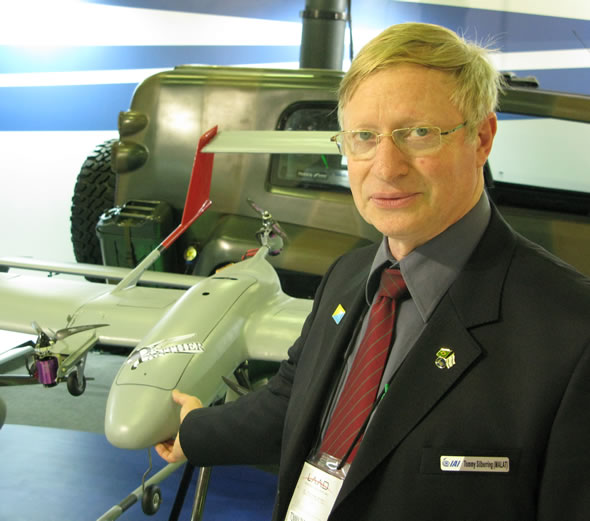
    Tommy Silberring, General Manager, IAI Malat.
    Mini Panther is one of several innovative vertical take-off and landing concepts developed at IAI Malat. Photo: IAI

    Unmanned Aerial Systems (UAS) have established a leading position in modern air power, already performing far more operational hours, compared to any other military aircraft. Typically, UAS fly 2,000 operational hours a year on average, compared to manned fighter jets that perform 200-400 hours / year at a typical military environment.

    The world’s pioneer in tactical UAS and one of the world’s leaders in this field is Israel Aerospace Industries (IAI), UAS division MALAT, part of IAI’s Military Aircraft Group. IAI’s UAS have officially passed 900,000 operational hours, and are rapidly nearing the million hour milestone.

    Tommy Silberring, General Manager, IAI Malat.

    One of the drivers of the immense growth in the demand for UAS is their high utilization, compared to manned aircraft. “UAS incur low overhead cost per flight hour and therefore, they are assigned more and more missions.” says Tommy Silberring, (IAF Col. res) General Manager of IAI Malat Division. “With this extensive operational tempo the user’s appetite for UAS services grow, fulfilling the hunger for more systems. This trend brings the demand for longer endurance, persistence and multi mission capability, far beyond the level offered by manned aircraft or to what UAS were providing in the past.”


    Defense Update: This growing demand also brings competition to this playground

    Silberring: The competition is very intensive at the smaller UAS, where many competitors are offering small and mini UAVs that are relatively simple to build. However, successful systems can only be those developed with entire system approach with the know how and engineering that meet the demands of the users in the field and smoothly integrate within the military logistics and operations and provides the high safety standards and survivability to endure a hostile environment.

    As you go to the upper tiers, there are less and less competitors, as these systems are much more complex and need multidisciplinary approaches that only mature aerospace manufacturer has. As a system house operating in many diversified fields we have great advantages here, offering platforms, sensors and payloads, datalinks and satellite communications, radar, COMINT and SIGINT, intelligence processing and dissemination, command and control. We can combine in house elements into a robust integrated solution, or integrate other equipment manufacturers (OEM) if it is required by the customer. Such capabilities are rare in this field, all under ‘one roof’, integrated with a ‘system of systems’ approach.

    Defense Update: Can you give an example of such integration?

    Silberring: “The Maritime Heron Plus recently introduced by IAI Malat offers new capabilities to enable the aircraft to integrate into a civilian air traffic controlled airspace. We integrated a new communications relay into the platform, enabling the aircraft to receive, process and respond to ATC instructions, flight plan and keep zone just as a manned aircraft. This comes in addition to the standard Maritime Heron mission package, which also includes an ELTA developed, multi-mode maritime search radar, EO payload, COMINT and SIGINT sensors, along with satellite communications link, enabling the system to operate at distances of 1,000 km on 30 hour missions.

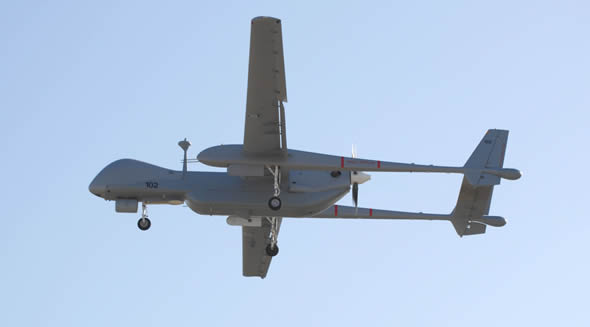
    IAI is currently producing Heron TP MALE UAS to equip the first MALE UAV squadron of the Israel AIr Force. The platform has also been selected by France as the successor of the Harfang (Heron I) UAV. Photo: IAI

    Defense Update: Can you describe this ATC integration in more details?

    Silberring: “To support such capability IAI added several elements to the platform, including an Interrogator Friend/Foe (IFF) and Communications Relay (Com Relay) integrated with the satellite communications channel, enabling the UAV controller to communicate with local air traffic control (ATC) as he/she was inside the aircraft. II has already received approvals from the civil aviation authorities in France, Belgium, Spain, USA, Australia and others, to fly some of its UAVs in civil airspace. Beyond the ATC integration, the Com Relay has also military advantages, when integrated with satellite communications, it extends Line Of Site (LOS) communications (typically limited to 100 – 200 km), to provide an airborne radio and control over a large area, overcoming mountainous terrain or other interference, supporting ground units with efficient, and reliable communications within its area of operation. Airborne relay can also support maritime operations, improving communications with ships at sea and overcoming weather or other atmospheric interference. In addition, all the airborne information gathered by the sensors on board is streamed to a central control and intelligence center to analyze and distribute the information to all users.

    These new capabilities are meeting evolving requirements coming from the field, enabled within the Heron ‘System of Systems’ approach. IAI was the first company in the world that introduced this concept, and we lead in this field today. The systems involved are based on open architecture that can be flexibly modeled to meet different requirements, integrate new capabilities in timely manner and meet urgent customer requirements within a short time. To meet such demands MALAT is responsible for the entire system, sourcing specific services or elements form other IAI divisions or outside the company. While conventional development cycles take years, our teams have demonstrated fulfilling urgent requirements within much shorter periods.

    Defense Update: You have already demonstrated long endurance with your larger platforms, what about tactical and mini UAS?

    Silberring: Long endurance missions will typically require large and heavy platforms, while persistent platforms that have to remain operational over long time in hostile area, should be designed to be more redundant. Fuel cells could provide a solution for these missions. Part of the solution can also be provided by solar panels, providing on-board renewable energy generation to sustain long endurance operations.

    We are examining various types of fuel cells, and their integration in our platforms. Overall, fuel cell technology has yet to mature to an operational level. Most fuel cells are based on hydrogen as a propellant. Some use compressed hydrogen which poses potential hazards if the container is damaged by enemy fire or in an accident, increasing collateral risk to human lives and property. Other methods employ on board hydrogen generation, which produces only the amount of hydrogen needed to produce the energy for the platform’s consumption or battery recharge. These systems can also throttle back and force, further extending mission endurance with given resources. Flying different platforms utilizing fuel cells we have already demonstrated up to three times longer endurance, of up to 10 hours. We expect this energy source to power future versions of the 65 kg Panther and 11 kg Birdeye 650, However, at present, despite the great promise we feel this technology is not matured yet for operational use. The issues are not technological but relate to production and maintenance of such systems at the field level. I expect this capability to mature within the next 18 months, enabling these platform to perform extended day and night missions, generating extremely low acoustic signature for covert operations.

    Defense Update: What about mission persistence? Are you aiming specific platforms for that?

    Silberring: The two requirements are not identical, endurance and persistence are met by different platforms, responding to specific military requirements. Based on cost/performance tradeoff, expensive, multi-mission platforms are generally geared toward the long endurance missions which also associate operations over great distances, while smaller systems with persistent on-station capability will be aimed at wide area, airborne persistent surveillance (WAAPS).

    IAI is examining different new concepts for long endurance platforms. Mission endurance is a central requirement for WAAPS but such a platform also must be able to survive over a hostile area. Nevertheless, if one platform is lost, such loss should not put the entire mission at risk. Therefore, the tradeoff for such platforms is different, aiming at more affordable systems offering redundancy; that can be provided by a constellation of platforms rather then single units. Constellations of multiple vehicles offer the endurance, redundancy, survivability, persistence and resilience required to dominate wide, complex areas supporting multiple users with real-time information.

    To come up with solutions, you have to think ‘out of the box’. An example is the ETOP, developed by IAI, employing a tethered hovering platform that offers virtually unlimited endurance as it is fed by ground bound generator. The ETOP is designed to replace tactical aerostat with an easily and rapidly deployable system, more maneuverable and responsive and much more survivable than an aerostat. Other hovering sensors we are currently developing are the Mini Panther and Ghost, offering small infantry and special operations units an organic mini UAV that supports the lowest tactical level.

    Defense Update: Back to the maritime UAVs, you were developing the Naval Rotary UAV (NRUAV) with HAL of India. What is the status of this program?

    Silberring: We are working with our partner HAL to define the scope of the NRUAV program. Such projects are complex and require long time to mature. The development, funded by the Indian Ministry of defense will require 36-48 month to proceed, depending on the mission requirement and level of complexity. The first level we are aiming at includes opening of the flight envelope, and integration of the basic sensor package including maritime search radar and an electro-optical payload. NRUAV will offer weather independent helicopter operation for ships at sea, enabling the crew to launch missions even in high wind or rough sea. NRUAV will also offer twice the mission endurance of similar manned helicopters (up to 5.5 hours with the Cheetak). When completed, NRUAV will be offered as a flyaway kit for installation in specific helicopters, it will add few hundred pounds to the platform’s weight, and offer significant independence for the user, replacing the crew with fuel, mission payloads or both. We intend to introduce the NRUAV kit during major overhauls, typically involving the replacement of engines and transmissions and other dynamic elements, enabling operators to modernize and enhance the capabilities of their helicopters.

    Defense Update: Another application being proposed for the Heron TP is ballistic missile warning. Do you foresee such capability being met by existing platform or dedicated Heron TPs?

    Silberring: The main advantage of the Heron TP is its cruising altitude. From such heights the horizon is hundreds of kilometer away, far extending its sensing capability, Yet the systems on board should be mission oriented and, therefore, I expect, if a customer decides to integrate a missile warning system, to be a dedicated one rather than an ‘add on’ system. This approach depends on the multi-layered defense system it comes to serve.

    IAI is currently producing Heron TP MALE UAS to equip the first MALE UAV squadron of the Israel AIr Force. The platform has also been selected by France as the successor of the Harfang (Heron I) UAV. Photo: IAI

    IAI Unveils the Ghost – a Miniature UAV For Special Operations

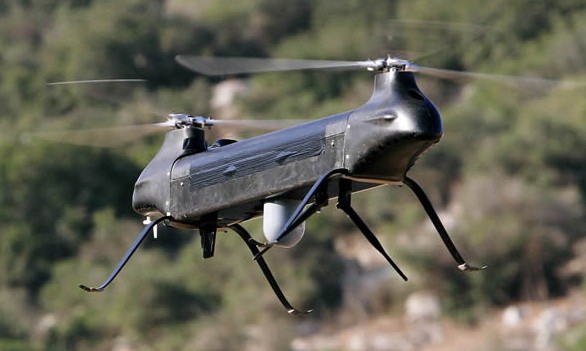
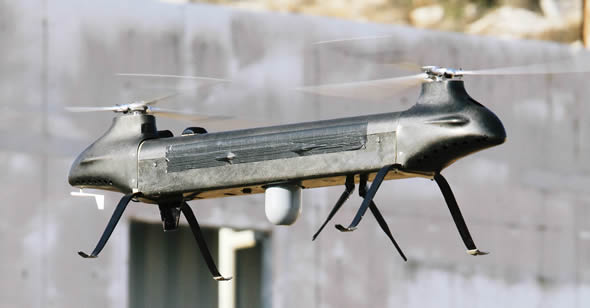
    The twin rotors create adequate lift within a relatively small diameter (0.75 cm / 2.46 ft), enabling the Ghost to navigate safely near obstacles, enter through windows and hover inside built-up areas or penetrate dense vegetation. Photo: IAI

    IAI Malat is unveiling the Ghost and Mini Panther, two new vertical take-off and landing miniature unmanned vehicles currently undergoing test flights, both are expected to be ready for marketing soon. Both vehicles will be displayed at the AUVSI exhibition in Washington next week. The Ghost, 145 cm long (4.76 ft) vehicle designed specifically to support special operations units and and company level infantry operations. Ghost was optimized for operation in built-up areas, rugged terrain and dense brushes, typically of the terrain in South Lebanon. As an electrically powered, twin-rotor mini-UAV Ghost is capable of operating on missions of about 30 minutes.

    The twin rotors create adequate lift within a relatively small diameter (0.75 cm / 2.46 ft), enabling the Ghost to navigate safely near obstacles in complex urban terrain including inside buildings. Photo: IAI

    Its aerodynamic configuration and twin-rotor propulsion system contributes to high stability in hovering mode, and effective station keeping even in strong sidewinds and gusts. The twin rotors create adequate lift within a relatively small diameter (0.75 cm / 2.46 ft), enabling the Ghost to navigate safely near obstacles, enter through windows and hover inside built-up areas or penetrate dense vegetation. The twin rotors are powered by two separate, synchronized electrical motors, offering some redundancy in case one motor is disabled. In fact, the Ghost designers expect the final version to be able to recover back to safe ground using a single motor. The Ghost can travel at speed from 35 knots (64 km/h) to zero.

    The stealthy Ghost operates quietly in day or night. Its hovering capability provides the user flexible view of the area of interest, including a unique horizontal visibility, unavailable with other flying sensors. The Ghost weighs only four kilograms (9 lb.) and comes packed in a suitcase carried by a single soldier. A system is comprising two vehicles, spare batteries and control station employing a laptop computer. Ghost can carry a payload weighing up to 600 gr (21 oz). The current payload includes the stabilized daylight MicroCam D from Nextvision, An IR night capable sensor is also available at a compatible weight; other payloads are also considered by IAI for future missions.

    The twin rotors create adequate lift within a relatively small diameter (0.75 cm / 2.46 ft), enabling the Ghost to navigate safely near obstacles, enter through windows and hover inside built-up areas or penetrate dense vegetation. Photo: IAI
    The Ghost, 145 cm long (4.76 ft) vehicle designed specifically to support special operations and infantry operations in built-up areas, rugged terrain or the dense brushes of South Lebanon, is an electrically powered, twin-rotor mini-UAV capable of operating on missions of about 30 minutes. Photo: IAI

    To support indoor operations the EO system is equipped with mapping capability, automatically measuring indoor space perimeters, to enable the Ghost safe entry and maneuvering inside a room.

    Mini Panther is another electrically powered VTOL UAV developed at IAI. Mini Panther weighs 12 kg and is configured for backpack operation by a single infantryman. Its mission endurance can reach 90 minutes, carrying a payload weight of up to one kilogram. While capable of automatically takeoff and landing in vertical mode, Mini Panther performs its mission mostly in forward  flight, a mode consuming less power, enabling extended mission endurance.

    In 2007 Defense Update reported on an earlier design called ‘DP-6 Whisper‘, developed by Michael W Piasecki, founder of Dragonfly Pictures. The Whisper had similar attributes such as acoustic stealth. The Whisper was also proposed to deploy as a persistent airborne tethered sensor boosting perimeter security around Forward Operating Bases, tethering power from a battery or generator on the ground.

    Invitation to DSEi 2011


    Home Exhibiting Sponsorship Visiting Show Features Seminars Media Centre Contact Us

    August 2011

    Register now with your unique code


    FOLLOW US ON

    DSEi is widely recognised as the
    premier defence exhibition in the world.

    DSEi 2011 has a number of new and improved features, helping you to get more in-depth knowledge of new technology and to see equipment in action. DSEi is the must attend event for all defence and security professionals in 2011, held 13-16 September at ExCeL, London.

    Use you unique code JW006 now to register for DSEi 2011 at the discounted rate of £30.

    Why Attend?
    DSEi gives you the chance to:

    • Meet professionals from the Land, Naval, Aerospace & Security sectors
    • Witness the latest developments in products and services – take home new ideas that will improve performance – touch and see the future of the defence industry
    • Meet new contacts – It’s the major meeting point for the global defence & security industry
    • Participate in information sharing through our expanded seminar and demonstration programme


    By registering to attend you will gain access to:

    Register now to make sure you don’t miss out.

    As a subscriber to Defence Update, we are offering you an exclusive discount on the DSEi administration charge – £50 instead of the current rate of £50 (which will be going up steadily towards the show).

    Use code JW006 in the Guest Code Box on the 2nd registration page.

    We look forward to welcoming you.

    The DSEi 2011 Team


    Platinum Sponsors:


    Supported by:


    In association with:


    To unsubscribe please click here

    Copyright Clarion Events 2011

    38 U.S., Afghan Military Personnel Lost in a Helicopter Crash in Eastern Afghanistan

    38 U.S and Afghan military personnel were killed last night (August 6, 2011) when a U.S. Army A Special Operations CH-47 Chinook was downed in Eastern Afghanistan. Most of the U.S. casualties are believed to be Navy SEALs. According to the pentagon, Five of the U.S. casualties were aircrew members, and 25 were members of U.S. Special Operations Command. The tragedy is the worst combat loss event related to aviation operations, recorded in the Afghan war since 2001. The incident took place in the eastern province of Wardak, considered as a Taliban stronghold. According to Afghan sources quoted by CNN, the Taliban claimed to have downed the helicopter by RPG. Afghan villagers quoted by CNN said the insurgents shot at the craft when it was flying back from an operation.


    This tragic loss took place only one week after the Taliban succeeded to shoot down another U.S. Army CH-47 Chinook, a similar helicopter delivering supplies to a remote forward operating base in Eastern Afghanistan. However, the incident last week ended without fatalities. Last week the cause was also attributed to Taliban RPG fire.

    According to a senior Afghan government official speaking with AFP on condition of anonymity, Taliban executed a planned deception campaign, through informants that tipped U.S. intelligence sources about a high level Taliban meeting held in a remote village at Sayd Abad district of Wardak province in Eastern Afghanistan. He said Taliban commander Qari Tahir exploited four pakistanis to inform the Americans about the meeting. According to the Afghan official, the Taliban knew which route the helicopter would take, as approach paths to the location were limited. “That’s the only route, so they took position on the either side of the valley on mountains and as the helicopter approached, they attacked it with rockets and other modern weapons. It was brought down by multiple shots.” the Afghan source told AFP.

    Marine Corps Col. Dave Lapan warned against jumping to conclusions about the incident. Lapan caution reporters against reading too much into a single combat incident. As tragic as the loss of life is, he said, it is not a trend, but an anomaly.

    “This one single incident does not represent any watershed or trend,” Lapan said. “As we have said continuously, the Taliban were going to come back hard. They weren’t going to take the losses that they have suffered lightly. They were going to try to inflict casualties not only on us, but the Afghans, and those are the things we are seeing.”

    The Taliban are still on the run, and the coalition and its Afghan partners have reversed the momentum of the insurgent group, the colonel said, adding that special operations forces will continue to drive on.

    “In the immediate aftermath, they press on with the mission,” the colonel said. “It is an unfortunate fact of the business we’re in that we take casualties, and our folks are well-trained to recognize that they can’t let the loss of their comrades deter them from the mission, especially since this is a very dangerous undertaking, and you can’t afford to lose focus.”

    South Korea, Indonesia to Jointly develop a New Stealth Fighter

    South Korea and Indonesia announced a planned partnership in Seoul’s future indigenous fighter program (KF-X). This announcement follows the bilateral agreement between the two countries signed in 2010, with an Indonesian commitment to acquire about 50 KF-X fighters in exchange for joint production and marketing of the new fighter. In May this year, Indonesia agreed to purchase 16 of South Korea’s T-50 Golden Eagle trainer jets, marking the first South Korean export of the supersonic jets.

    At the focus of the project is a joint research center opened today in Daejeon. Indonesia has committed to support 20 percent of the research, contributing US$10 million at this early stage. Indonesia will also send 30 researchers to work at the new center, to join about 100 of the South Koreans research colleagues.

    South Korea’s KF-X project, initiated in the early 2000s aims to replace the country’s fleet of aging F-4E Phantom II and F-5E fighter jets with a locally produced fifth generation stealth fighter by 2020. According to DAPA roadmap, a prototype is expected to be selected next year.

    Skunk Works and XTEND Simplify Multi-Drone Command

    0
    Lockheed Martin Skunk Works® and XTEND have achieved a major milestone in JADC2 by integrating the XOS operating system with the MDCX™ autonomy platform. This technical breakthrough enables a single operator to simultaneously command multiple drone classes, eliminating the friction of mission handoffs. From "marsupial" drone deployments to operating in GPS-denied environments, explore how this collaboration is abbreviating the data-to-decision timeline and redefining autonomous mission execution.

    From Ukraine to Taiwan: The Global Race to Dominate the New Defense Tech Frontier

    0
    As traditional defense primes face mounting competition from agile “neoprimes” such as Anduril, Palantir and Helsing, the balance of innovation is shifting toward software-defined warfare and scalable, dual-use technologies, while global industry consolidation—marked by Boeing’s integration of Spirit AeroSystems and other strategic mergers—signals an intensified race to secure control over the defense technology value chain. Our Defense-Tech weekly report highlights these trends.

    Europe’s “Drone Wall”

    0
    In early October 2025, a coordinated wave of unmanned aerial system (UAS) incursions—widely attributed to Russia—targeted critical infrastructure across at least ten European nations. The unprecedented campaign exposed the fragility of Europe’s air defenses...

    Weekly Defense Update & Global Security Assessment

    0
    Executive Summary The past week (September 18-25, 2025) represents an inflection point where strategic defense concepts have transitioned from doctrine to tangible reality. An analysis of global events reveals four primary, interconnected trends shaping an...

    U.S. Air and Space Forces Push Next-Gen Programs at the AS&C 2025 Conference and...

    0
    At the 2025 Air, Space & Cyber Conference, U.S. Air Force and Space Force leaders unveiled major updates on next-generation fighters, bombers, unmanned systems, and space initiatives, highlighting both rapid innovation and critical readiness challenges as the services race to outpace global competitors. A short version is available here, with a more detailed version for subscribers.

    TADTE 2025: Reflecting Taiwan’s Strategic Themes

    0
    The Taipei Aerospace & Defense Technology Exhibition (TADTE) 2025 crystallized around four dominant strategic themes that collectively illustrate Taiwan's comprehensive approach to defense modernization amid escalating regional tensions. Based on a detailed report by Pleronix (available upon request). Includes a Podcast discussion on TADTE 2025's highlighting Taiwan's four strategic themes beyond the post's coverage.

    Iron Beam 450 Completes Testing, Soon to Join With Operational Air Defense Units

    0
    Israel’s Iron Beam 450 high-power laser system has completed final testing, marking a major leap in air defense. Developed by Rafael, it offers precise, cost-effective interception of rockets, UAVs, and mortars, and is set for IDF deployment by 2025.