
Tuesday, December 23, 2025
More
    Home Blog Page 438

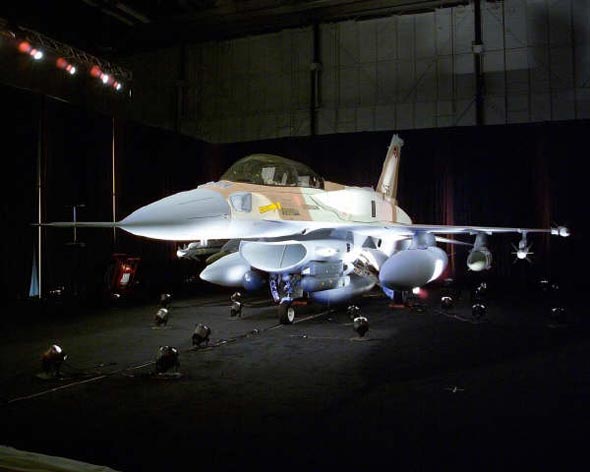
    F-16I Weapons

    With the introduction of inertially aided weapons, such as the GBU-31 Joint Direct Attack Munition (JDAM), and the AGP-68(V)9 SAR imagery, the F-16 gains an enhanced capability for all-weather precision strike from standoff distance. The aircraft can also deliver the AGM-154 Joint Standoff Weapon (JSOW), and CBU-103/104/105 Wind Corrected Munitions Dispensers. So far, the use of such advanced precion attack weapons capability was available in the IAF only with the Boeing F-15I (Raam).
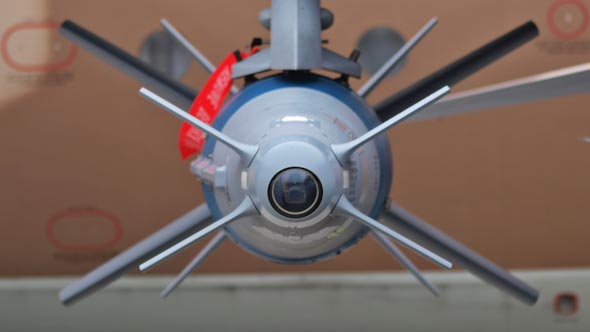
    Rafael Spice

    By 2005, the IAF is expecting to complete acceptance testing and fielding of the RAFAEL SPICE guided weapon kit for Mk84 bombs. Later, the Israel Air Force is expecting to get the RAFAEL Have-Lite standoff attack missile, which will further enhance the range, and survivability of these aircraft. Current versions of F-16Is are equipped with the Python 4 close range (dogfight) all aspect missile, and AIM-120A (AMRAAM) Beyond Visual Range (BVR) missiles. Pyhon 5 a fifth generation of the air/air missiles, currently undergoing advanced flight testing, are developed by RAFAEL as full sphere air/air missiles, which will offer extended range capability both at long range and short range engagement. The missile has a unique lock-on after launch capability, which enables its employment over long ranges, as well as at chasing the launching aircraft. SPICE is an advanced, autonomous navigation system that can be added on to conventional Mk-83/84 weapons, transforming them into autonomous, precision weapons. SPICE uses a combination of inertial and scene matching navigation to home-in on point targets that have distinctive shapes. Since the system uses a combination of navigation methods, is immune to GPS errors and jamming.

    A future addition will be the employment of the RAFAEL/Lockheed Martin Have Lite missile. A derivative of the Have Nap, which is already in use with the USAF, and the air forces of Israel, Australia and Turkey, Have Lite enable improved day/night capability, operation by a single pilot, and is adaptable to smaller platforms such as the F-16. The missile offers high precision attack capability of time sensitive targets, as it enables “man-in-the-loop” control, at the terminal phase of the mission, by the use of imaging homing sensor and a two-way datalink to the transmit a real-time image of the target to the controller. The controller can decide what parts of the target should be attacked, and instruct the missile to aim to these points.
    HVM Starstreak

    Starstreak (Produced by Thales air defense) is a laser guided system, deployed from armored vehicles and other light vehicles, helicopters or by dismounted infantrymen. The system can also be dismounted and deploy on a tripod. The range of the HVM is expected to be 6,000 m’. The missile was recently exported to South Africa, to provide a fully integrated manportable and air droppable air defence capability for South African troops deployed on peace-keeping operations. The missiles are supported by the Page radar systems also supplied by Thales. Thales has also supplied the Starstreak High Velocity Missile (HVM) to the British Army for low level air defence operations. The British system is deployed on the Alvis Stormer armored vehicle, augmented by the ADAD, it has eight ready to fire missiles and twelve reloads. The system automatically generates laser guidance commands for the three hypersonic darts projected at the target. The Armored Starstreak (SP-HVM) is operational with the British Army since 1999.

    Lowprofile UHF Multi-function antenna

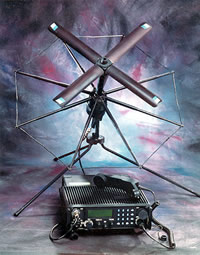
    The Lowprofile UHF Multi-function antenna is designed for installation on military ground vehicle. AN/PSC-5 or AN/PRC-117 transceivers coupled with the omni-directional low profile antenna supports both UHF Line-of-sight (LOS) and UHF SATCOM DAMA communications on the move at speeds up to 50 mph. Frequency Range SATCOM RX 243 to 270 MHz SATCOM TX 292 to 318 MHz LOS 225 to 400 MHz. The low profile design, less than six inches high has low visual signature, it is immersible in water, and withstands tree branch strikes. Vehicles using this combination include: Marine Corps Command & Control (C2) units, ranging from Light Armored Vehicles (LAVs) and Humvees, to Army and Marine Communication Shelters, U.S. Naval Units, and components of the Army Interim Brigade Combat Team (IBCT).

    iSTAR VTOL Miniature UAV

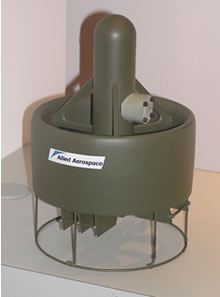
    Allied Aerospace developed the iSTAR family of high speed, vertical takeoff and landing (VTOL) UAVs utilizing Lift Augmented Ducted Fan (LADF) system in response for the US Army Organic Aerial Vehicle (OAV) program. The design concept is simple and efficient and makes use of lightweight composite construction techniques. The structure is comprised of an outer duct enclosing the fan system, centerbody containing the avionics and engine, fixed stators and movable vanes operated by actuators, performing thrust vectoring. The engine is housed in the centerbody, and fuel tanks are located in the forward section of the duct. A variety of payloads may be carried in the nose, tail or duct of the vehicle.

    Unlike other VTOL UAV’s, the iSTAR utilizes the airfoil-shaped duct to provide augmented lift during low and high-speed cruise. Vehicle control is provided by thrust vectoring resulting in a highly stable and controllable vehicle during all phases of flight. The company is currently developing a 23 cm diameter back-packable Advanced Concept Technology demonstrator (ACTD) the iSTAR UAV, under a DARPA contract, developed under the MAV and OAV programs. The small UAV will be able to carry EO payloads, TV, infrared and acoustics sensors. The US Army is also considering deploying the UAV from autonomous Unmanned Ground Vehicles (UGV).

    Infantry Combat Suits – Computers & Communications

    Start < Page 5 of 5 >

    Command, Control & Communications, Situational Awareness 

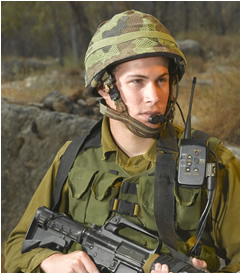
    Traditionally infantry operated in small units such as squads, companies and platoons. While ancient armies used larger formations to aggregate firepower, enhanced communications and devastating firepower of the modern age dictated different tactics for infantry units. In practical terms, allocation of communications determines the smallest size of combat element, which can be controlled as a coherent unit. In most regular armies, the squad is the smallest tactical level unit. Below the squad, only better equipped Special Forces operate in smaller teams. In most recent conflicts, infantry formations were controlled by voice and visual signals commands, shouts and whispers. Lack of communications has sofar limited dismounted infantry operations due to command and control limitations. As they dismount their Armored Personnel Carriers, individual soldiers and sub-squad teams could only disperse within shouting range from each other, to deploy firepower in mutual support and coordinate their movement.

    Intra-squad communications significantly improves infantry operations. For the first time, independent sub-squad elements can be employed and coordinate their activity and firepower. Mutual fire support between and within squads can be controlled. Improved situational awareness and reporting provides better real-time intelligence and information gathered in real time. Modern intra-squad specialized Personal Role Radios (PRR) offer effective communications within the squad and between combat teams, enabling effective dismounted infantry operations at a level previously reserved only for Special Forces.

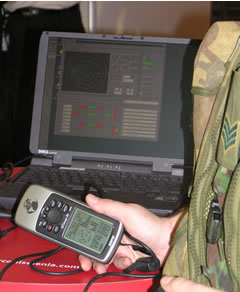
    Digital information is usually displayed on hand held computers and ruggedized Personal Digital Assistants (PDA). These devices provide unprecedented situational awareness and access to information. PDA devices used by dismounted infantrymen and commanders to provide situational awareness combine integrated navigation, observation and orientation devices, utilizing optronics, digital compass and GPS systems and laser rangefinder for combat orientation and coordination. Such PDAs are running mission or role-specific applications linked to data-enabled PRRs or hand held data-enabled combat-net radios, operated by squad and platoon leaders. These computers are presenting maps, aerial imagery, sensor data, intelligence information etc. They generate and distribute standard reports. Whiteboard application allows commanders to share common maps, overlayed with mission-specific information and graphics sketched by each member. Using this facility, commanders can coordinate planning without gathering at vulnerable locations. Other applications are provided to rapid response units such as SWAT and mobile guards, guided by ground and perimeter protection sensors. Provided with own position, target locations, images and navigation instructions, such applications optimize their movement providing the shortest (distance) or fastest (terrain, road condition etc) intercept routes, gaining optimal engagement parameters. Similar PDAs provide remote controlle of sensor systems, including autonomous ground robots, (UGV) miniature UAVs (MAV), unattended ground sensors, and even remotely controlled weapon’s platforms.

    Additional parts of this article:

    Infantry Combat Suits – Firepower

    Start < Page 4 of 5 >

    Infantry weapons firepower enhancement is provided by more accurate improved performance of kinetic ammunition, of advanced multi-purpose munitions such as 40mm grenades and other lethal and less-than-lethal means. The use of optical sights, including red-tot reflection and magnifying optics (x1.5 – x3) improve target discrimination in daylight and nighttime use. Night combat is still considered advantageous for the superior equipped regular forces.

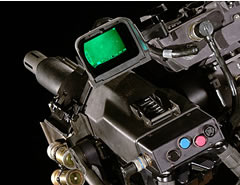
    Lightweight night sights include daylight reflection sights adapted to night vision devices, or dedicated night sights integrated with image intensifiers (I2) or thermal sights. Laser aiming lights complement night vision devices offering accurate coordination of fire, at close ranges. Thermal sights are heavier and more bulky but they provide significant advantages as they are not restricted in operations in total darkness such as in underground facilities or caves; they also provide significant advantages in target discrimination. Another advantage of modern sighting systems is the ability to couple electro-optical sights with video communications, improving training, control and coordination of forces, as well as aiming and firing behind corners or obstacles. Systems are offered as complete solutions such as CornerShot, while others are available as add-on kits for existing weapons. Optical sights, and Sight/Camera combinations are becoming a standard issue for all future infantry combat suits.

    Further improvement in firepower is provided by fire control systems (FCS) for assault rifles and support weapons, including long-range sharpshooting weapons, and support weapons such as 40mm grenades. For small arms, FCS are provided by miniature embedded computers and displays integrating compact laser ranging systems. Systems include electro-optics for target acquisition and marking, range measurement equipment coupled with the optical sight, to project a ballistic corrected aim-points for accurate long range engagements. The use of such integrated FCS enables firing of pre-programmable time-activated air-burst munitions, for enhanced effect against soft, or protected targets.

    Additional parts of this article:

    Infantry Combat Suits – Mobility & Ergonomics

    Start < Page 3 of 5 >

    Apart from their additional weight vests block natural ventilation, preventing sweat heat dissipation. Physiological tests have demonstrated that body and surface temperature of soldiers wearing bulletproof vests can rise by up to 2C degrees (4F) after one hour continuous physical workout, compared to those not wearing vests. Since sweat is gathered between the shirt and vest, air becomes saturated with humidity and the body’s natural cooling process renders ineffective. As result, heartbeat and body temperature rise, to extreme levels effecting physical and mental capabilities. The introduction of “breathing” athletic garments,active air circulation or micro-cooling, as well as redesigned protective vests, introducing larger gaps between the uniform and shield could reduce such adverse effects improving the soldier’s sustained physical abilities.

    Improving mobility of individual soldiers can be achieved by providing lighter, improved fitting and more comfortable equipment, and optimizing to physiological conditions under which they fight. Infantrymen usually go to war carrying loads of up to 50 kg, including personal and mission-specific equipment. Infantry combat suits are designed to reduce this load below 25kg. Further mobility improvements include providing pads to protect neck, knees, elbows and shoulders. Such pads offer mechanical or ballistic protection and assist the soldier in maintaining positions for extended durations. Another mobility improvement can be achieved by offloading some supplies to onto a small load carrier, be it an ATV or small and maneuverable robotic “mule” which can closely follows the troops.

    Additional parts of this article:

    PUMA Combat Engineering Fighting Vehicle

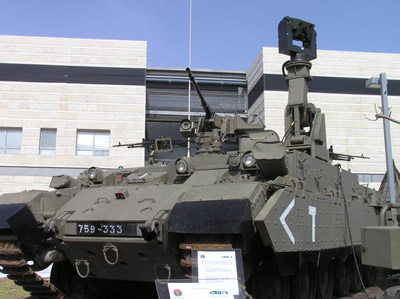
    The Puma Heavy Engineering Vehicle manned by a crew of 8 soldiers. It is also based on the Centurion chassis. It is equipped with enhanced armor protection, and is mounted with various breeching and assault systems such as the Carpet system. An version is also under development, equipped with mast mounted remote controlled optronic payload which feeds a console located under the armor, which can also be used to control various tele-operated vehicles.

    Linebacker M6 Divisional Air Defense System

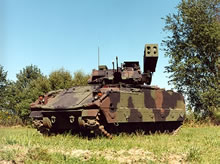
    Developed by United Defense & Boeing, Linebacker (M6) Air Defense System – a variant of the Bradley fighting vehicle family integrates Stinger surface-to-air missiles on a modified M2-series vehicle. Unlike the standard Bradley, the Linebacker replaces the external TOW antitank missile launcher with a launcher carrying four ready-to-fire Stinger missiles. (The vehicle has a basic load of 10 Stingers.) The Linebacker’s sensor suite includes optical, TV and forward-looking infrared systems. The vehicle integrates into the Forward Area Air Defense (FAAD) system trough combat net data networking. Position reporting is provided autonomously, vie the Enhanced Position Location Reporting System (EPLRS).

    Fireball – Precision Mortar Munition

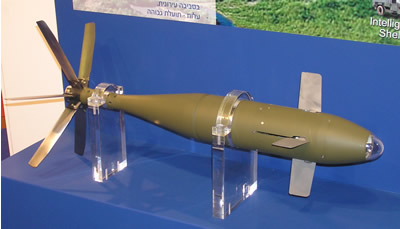
    Developed By IAI/MBT, the Fireball is a laser homing 120/121mm mortar bomb, (the system also fits into a 81mm mortar bomb diameter). It is designed for first-shot, first hit capability and can be used with rifled or smooth bore tubes.

    Firing the Fireball requires no ranging, as the weapon uses a unique guidance method that provides course adjustment by gliding, extending range capability. The bomb to detects the target as it glides to the laser detection “basket”, by GPS navigation, where it acquires the target and diving for the kill. The target’s GPS location is fed to the bomb before launch and provides for improved hit accuracy over standard mortar bombs, when laser designation is not available. With laser designation, the bomb can reach an accuracy of 1 meter CEP or less, attacking stationary or moving targets. Fireball uses various warhead fusing options – fragmentation, against soft targets, percussion against armor and penetration type for defeating bunkers and targets inside buildings. The weapon is designed to score a single-shot target kill in urban environment, utilizing a steep trajectory minimizing collateral damage. Due to the unique aerodynamic design, Fireball has almost twice the range of conventional mortar bombs, (up to 15 km).

    The system is currently in development stage. All its critical components have already been tested under high G loading and actual mortar firing. further system tests are planned soon. A variant of the Fireball is also considered for tube artillery (152, 155mm).

    AN/PSC-5 – Portable SATCOM terminal

    AN/PSC-5 Enhanced Manpack UHF Terminal (EMUT) (also known as SPITFIRE ) is a man portable Demand Assigned Multiple Access (DAMA), line-of-sight and tactical satellite communications terminal. The system has embedded security systems. The system supports VHF-UHF bands (30 – 400 MHz) to communicate with SINCGARS and HAVEQUICK II in Line of Sight modes, and support UHF and DAMA services at the UHF band, (225.000 to 399.995 MHZ) for narrow-band satellite communications.


    LIC C2 System

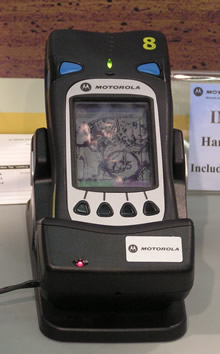
    Elbit and Motorola are fielding an integrated command and control system designed to improve the IDF operations during low intensity conflict (LIC). The system, which went through rigorous testing and evaluation by the IDF, utilizes ruggedized COTS systems, including the INCA Plus (HDT 600) personal digital assistant (PDA) produced by Motorola. LIC C2 system uses cellular communications and GPS and transmit voice, data, automated reports and images between the command and control centers and mobile and dismounted units. The system also tracks the location and status of each unit, and use the information to create a unified situational picture shared by all forces.

    120mm Laser Guided Mortar Bomb (LGMB)

    IMI has introduced a 120mm guided mortar bomb utilizing a combination of homing on a laser spot. The 13.7kb bomb uses four electrically actuated forward canards to control the bomb’s trajectory and guide it to a 1 meter CEP around the designated spot, from ranges of 1.5 through 10.5 kilometers. The system utilizes IMI’s Pure Heart generic guidance kit which is also used in other guided munitions developed by IMI.

    Non Lethal Weapons Programs in the US

    Start < Page 6 of 6 >

    Among the programs currently under development at the USMC Non Lethal Weapons Program are multi-sensory devices aimed to disable individuals within structures, a taser to incapacitate a single individual and mobility denial system that deploys slippery foam to impede the movement of foot and vehicular traffic. The US Navy is also developing non-lethal capabilities. One of the systems is designed to protect a ship perimeter and deny small crafts from closing in to a dangerous distance from the protected ship. The US Air Force is developing UAV non lethal weapon deployment applications, exploring with a mini flyaway weapon kit designed for the Raven mini UAV. These UAVs are commonly used for base security and force protection applications.

    Another system developed by the Air Force is the high power microwave Active denial System. Special Forces are also potential users of non lethal systems. These weapons are developed as part of the standard Special Forces arsenal as they should not limit the capabilities of the combatants and not impair their ability to fight a modern and lethal force. Current lethal weapons are operated under restrictive rules of engagement which significantly inhibit the ability of Special Operations forces to respond to threatening situations during low intensity conflicts and operations other than war. Furthermore, standard (lethal) weapons currently used by combatants and Special Forces are easy to detect when fired. In contrast, some non lethal and disabling weapons are stealthy and ultra-fast. They also provide the ability to repel crowds without permanent, disabling injuries or fatalities, significantly reducing the threat of further violence and potential casualties among friendly and innocent bystanders.

    Additional parts of this article:

    Skunk Works and XTEND Simplify Multi-Drone Command

    0
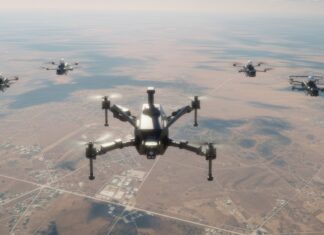
    Lockheed Martin Skunk Works® and XTEND have achieved a major milestone in JADC2 by integrating the XOS operating system with the MDCX™ autonomy platform. This technical breakthrough enables a single operator to simultaneously command multiple drone classes, eliminating the friction of mission handoffs. From "marsupial" drone deployments to operating in GPS-denied environments, explore how this collaboration is abbreviating the data-to-decision timeline and redefining autonomous mission execution.

    From Ukraine to Taiwan: The Global Race to Dominate the New Defense Tech Frontier

    0
    As traditional defense primes face mounting competition from agile “neoprimes” such as Anduril, Palantir and Helsing, the balance of innovation is shifting toward software-defined warfare and scalable, dual-use technologies, while global industry consolidation—marked by Boeing’s integration of Spirit AeroSystems and other strategic mergers—signals an intensified race to secure control over the defense technology value chain. Our Defense-Tech weekly report highlights these trends.

    Europe’s “Drone Wall”

    0
    In early October 2025, a coordinated wave of unmanned aerial system (UAS) incursions—widely attributed to Russia—targeted critical infrastructure across at least ten European nations. The unprecedented campaign exposed the fragility of Europe’s air defenses...

    Weekly Defense Update & Global Security Assessment

    0
    Executive Summary The past week (September 18-25, 2025) represents an inflection point where strategic defense concepts have transitioned from doctrine to tangible reality. An analysis of global events reveals four primary, interconnected trends shaping an...

    U.S. Air and Space Forces Push Next-Gen Programs at the AS&C 2025 Conference and...

    0
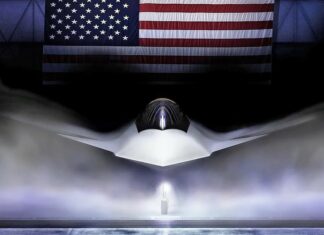
    At the 2025 Air, Space & Cyber Conference, U.S. Air Force and Space Force leaders unveiled major updates on next-generation fighters, bombers, unmanned systems, and space initiatives, highlighting both rapid innovation and critical readiness challenges as the services race to outpace global competitors. A short version is available here, with a more detailed version for subscribers.

    TADTE 2025: Reflecting Taiwan’s Strategic Themes

    0
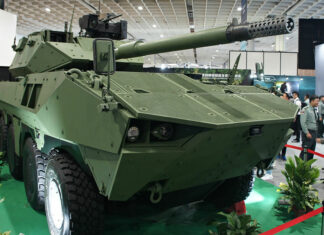
    The Taipei Aerospace & Defense Technology Exhibition (TADTE) 2025 crystallized around four dominant strategic themes that collectively illustrate Taiwan's comprehensive approach to defense modernization amid escalating regional tensions. Based on a detailed report by Pleronix (available upon request). Includes a Podcast discussion on TADTE 2025's highlighting Taiwan's four strategic themes beyond the post's coverage.

    Iron Beam 450 Completes Testing, Soon to Join With Operational Air Defense Units

    0
    Israel’s Iron Beam 450 high-power laser system has completed final testing, marking a major leap in air defense. Developed by Rafael, it offers precise, cost-effective interception of rockets, UAVs, and mortars, and is set for IDF deployment by 2025.