
Tuesday, December 23, 2025
More
    Home Blog Page 437

    Blue on Blue ground incidents during Operation Iraqi Freedom

    Start < Page 2 of 4 >

    The first reported ground fratricide incident during Operation Iraqi Freedom (OIF) occurred shortly after midnight on March 24, when a British Challenger II tank fired on another near Basra. This incident is of particular interest. The two tanks, Britain’s most advanced MBT types, were part of a squadron of the Queen’s Royal Lancers attached to the 1st Battalion Royal Regiment of Fusliers Battlegroup of the 7th Armoured Brigade. The tanks were engaging pockets of Iraqi soldiers near a bridge over the Qanat Shat Al Basra canal which runs along the western edge of the city. In a nearby sector, a troop of CR2 of 2RTR was tracking a group of enemy personnel through their thermal sights, which had been reported by the battle group HQ. The ‘target’ was indicated as an enemy bunker position. The QDL Challenger was, unfortunately, in turret-down position, below the skyline, its crew working on the turret top, visible to the 2 RTR crew as the reported “enemy” troops.


    The RTR TC requested clearance to shoot, which was granted. Firing two shots of HESH at 4000 yards blew the turret off the QDL Challenger, killing two of the crew and seriously wounding the two others. Both tanks were fitted with visual identification systems in working order, but could not render clear visual contact, due to the hull-down positioned tank.

    According to reports, tanks in OIF were issued bolted-on identification panels, including those emitting thermal signature which can be seen at long distance using IR observation devices. However there seemed to remain also some of the older fluorescent sheets, used during Desert Storm on some of the AFVs.

    On March 27 another ground B+B incident caused 37 casualties among the US marines of 2nd Battalion 8th Marines. Although the Marines had some of the most sophisticated equipment to prevent such a tragic accident, including thermal imaging, night vision gear and computers, to keep track of each other’s movements, even this hi-tech equipment failed to prevent such a tragic event. The 2nd Battalion command post called for artillery support near An Nasiriyah Bridge, but the shots fell short, exploding among the Marines with devastating results. Just then a communication break happened, while radio operators were frantically trying to call off the fire in vain. In the midst of the chaos, shells kept exploding for 90(!) minutes, until finally contact was re-established, but the damage was already done.

    Friendly fire destroyed at least one US Army M1A2 Abrams MBT in OIF. According to a briefing by Lt Colonel Bob Lovett, prepared for the US Armor Center Ft Knox Kentucky, a tank of B Troop 3rd Squadron 7th Cavalry Regiment was knocked out at night 24/25 March near Najaf. First investigation in the field suspected the ‘kill’ as result of enemy action firing

    the new Russian Kornet ATGW, but further examination revealed that the damage was from a 25mm Bushmaster cannon, firing eight AP-DU rounds into the rear engine compartment penetrating the engine grills. The same report mentioned another M1A2 Abrams damaged by unidentified source, possibly another US tank firing a 120mm round.

    This other incident reminds of a similar one during the final stages of Desert Storm. On February 27, 1991, 3rd Brigade 2nd US Armored Division was engaged in a night battle in southern Iraq against the Republican Guard, when two rocket propelled grenades hit a M1A1 Abrams, inflicting no damage. The crew of another tank mistook the impacting flashes in their thermal sights, for enemy gun fire and immediately targeted the source. The 120mm DU round penetrated the tank with catastrophic fire results, killing the crew. This incident, among others, triggered instant Pentagon action to solve the problem and the result was the development of the (alas unfortunate) Battlefield Combat Identification System, (BCIS).

    Additional Parts of this Article:

    Eliminating Fratricide In Ground Combat

    Start < Page 1 of 4 >

    The risk of fratricide has always been a consequence of warfare. Preventing such misshapes from occurring, especially in ground-to-ground and air-to-ground, is one of the major tasks in the conduct of modern warfare. According to US Army TRADOC Fratricide Action Plan, “Fratricide is the employment of friendly weapons and munitions with the intent to kill the enemy or destroy his equipment, or facilities, which result in unforeseen and unintentional death or injury to friendly personnel.”

    Implementing this basic doctrine seems at first glance, simple enough:

    • Keep track on your own forces constantly reporting their movement and location to controlling command posts.
    • Determine where the enemy is located, through real-time intelligence
    • Discriminate through optical sight between friend and foe
    • When positive identification established: Shoot-to Kill!

    In military terms this is called: Situational Awareness
    Unfortunately, putting this in practice is one of the more complex operations. There are several factors which dominate every combat situation

    • Modern military offensive operations are conducted at relatively high speed and “round-the-clock”, sometime moving over featureless terrain under limited visibility conditions, such as fog, smoke, sandstorm dust or rain. Much of the combat is shoot-on-the-move engagement on fleeting targets of opportunity, at long acquisition ranges.
    • Especially in desert fighting environment, the virtually unrestricted combat ranges usually outstrip the gunner’s ability to determine positive target identification, even through advanced thermal sights.
    • Real-time accurate knowledge of one’s own location, location of friendly, or enemy forces is affected, not only by limited visibility conditions, but also due to disorientation and even through lack of time to report continuously, by commanders fully engaged in running-combat fire-fights.

    This lack of positive target identification and the inability to maintain situational awareness in combat environment are the major contributors to fratricide. All these ingredients became part of the Blue-on Blue incidents during Operation Iraqi Freedom.

    Experience in Iraq 2003 clearly indicates that modern combat is still a very dangerous business. Ironically, the nature of modern warfare, however technologically advanced, has raised the risk of fratricide. Combat aircraft fly faster, tank gunnery fires at longer ranges, the lethality and precision of advanced munitions leave little margin for error and rarely miss their target, whether hostile or friendly. Technology does not eliminate the human error on the battlefield and the responsibility rests squarely on the shoulders of the tactical commander to carry out his mission with minimum casualties for his men, and this includes situational awareness to reduce the risk of fratricide through constant real-time control of his forces. The moral effects of fratricide can be devastating to fighting troops. It can undermine the confidence in leadership, cause hesitation to carry out orders and degrade unit cohesion.

    Unfortunately, technology does not eliminate human error, “carelessness will kill your buddies”, goes the old saying. In the words of veteran US Colonel David Hackworth: “fear, nervousness, excitement and exhaustion numb the mind and cause miscommunication and misunderstandings. These circumstances are a recipe for error”. Colonel David O. Bird chief of Army material Command Fratricide Task Force commented: “There is no ‘silver bullet’ solution that will do everything we want to”. It goes without saying, that a lot of money and scientific ingenuity will have to be spent, until some of such ever tragic loss will become history.

    Additional Parts of this Article:

    Robotic Systems Control (FCS-C)

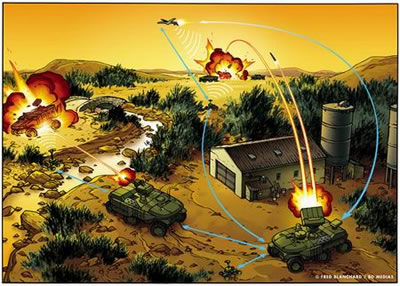
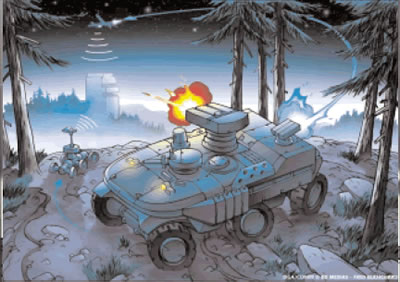
    The DARPA FCS-C program is developing communications / networking technologies and notional systems architectures to support the emerging warfighting concepts for the FCS program. The program’s goal is to demonstrate new enabling technologies supporting real-time FCS fire control and robotic missions.

    Since FCS will require high data rate and low latency communications to operate in a hostile electromagnetic environment, such systems should provide robustness to jamming and significantly improved low probability of detection (LPD) characteristics. FCS-C could meeting these opposing constraints by implementing multi-tiered mobile ad-hoc networks utilizing directional antennas at low-band, and evolving systems such as the Joint Tactical Radio System (JTRS) also using highly directional antennas at high-band (millimeter-wave frequencies).

    French Air/Land Operational Bubble – Net-Enabled Close-Combat System

    bulle opérationnelle aéroterrestre (BOA)

    BOA introduces new concepts of net-centric warfighting with existing and future forces, as it ties together all the assets in the air-land theatre, including land vehicles, sensors, UAVs and infantry in mounted and dismounted formations. In the initial phase, the BOA will be examined in a technology demonstrator which will undergo operational testing in the Battlelab – collaborative engineering and operational procedures laboratory, by members from the French armed forces, French procurement agency (DGA) and industry partners. The new concept will increase the operational tempo, offer improved protection and will be focusing on the deployment of light forces, equipped for a broad range of missions, particularly out of area missions and combat operations in urban area.

    BOA will initially focus on the Air-Land Operational Cocoon (ALOC) by a Thales-led consortium which includes Sagem and GIAT working in partnership with EADS, and MBDA as well as, other European companies. The program will highlight net-centric force integration, and robotics applicable to future forces.

    On 8 December 2005 the French Defense Procurement Agency (DGA) awarded the Thales led team a 129 million Euros contract to develop a concept design demonstrator for BOA1. The program will span over seven years and include the establishment of an integrated battle lab, where new concepts will be studied in a realistic, synthetic virtual environment, using collaborative development tools and simulators. An engineering study of “system of systems” will be evaluate advanced architectures and technologies for close combat, that could be used for in the future by the French Army.

    A new network-enabled system called TACTIC3 will be developed as part of this study. TACTIC3 will provide network-enabled architecture supporting close combat operations in the air-land theater, including infantry, armor, UAVs and sensors. This technology demonstrator will  provide an important step toward the future BOA, enabling operational evaluation of the benefits derived by new net-enabled capabilities (including collective protection, situational awareness, employment of precision indirect fire etc.) Such tests will be representative of a joint regimental-level operation.

    LIC 2004 – C4ISR

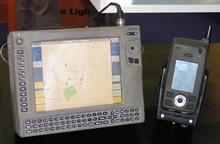
    The IDF is deploying several new systems that are designed to improve the integration between tactical forces, and their links to the regional and strategic command level. In 2002 the IDF launched an ambitious “Digitalized Land Forces” program which will “digitalize” its entire land force. Elbit Systems is the prime contractor for the Digital Army program. One of the key devices utilized for information distribution is the rugged Personal Digital Assistant, (RPDA-88) produced by Tadiran Communications. This device is a fully militarized Pocket-PC used by field commanders and troops. The system is provided with important functions such as situational awareness, communications and navigation derived from integral GPS, processing and networking services. Another system shown here was a new interconnection system, developed by Tadiran Communications, which provides connectivity between different networks, such as those of the Army, Air Force, police, emergency services and security forces. The system links to every network and utilizes a common Voice Over IP (VoIP) interface to provide clear communications between all networks.  The company also unveiled its PRC-710MB, a lightweight multi-band, frequency hopping voice/data VHF/UHF hand held radio system.

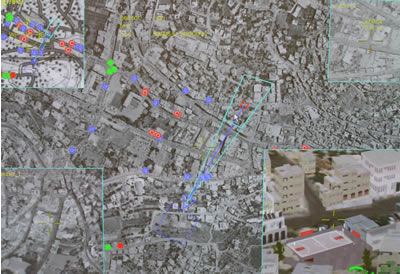
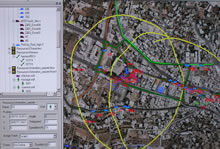
    Elbit, in cooperation with Motorola Communications Systems is also fielding an integrated LIC C2 system, which will be deployed during 2004 with IDF units engaged in LIC activities. The new communication system tracks the location and status of deployed unit, assists in the creation of a unified situational picture and enables seamless transfer of messages, maps and images between deployed forces and command posts. The IDF has invested a great effort in a geographical survey of its theaters of operation, especially the urban area in the West bank and Gaza. The modeling of the area was done by Tiltan Systems Engineering which utilized a special graphical 3D engine which generates photo-realistic models of urban area. Using this 3D model, the IDF can plan, rehearse and simulate missions, on a “digital sand table” which realistically simulates the real scene. The 3D model also assist in fine tuning of operational plans, identifying potential problems such as observation, coverage, and potential engagements between friendly forces operating in the dense urban area. Elbit’s contribution to the IDF LIC operations also includes various observation systems, including the Long Range Observation Systems (LOROS), and the airborne Advanced Multi-sensor Payload System (AMPS), deployed on light aircraft, flying support missions for MOUT operations. The company also produces the Hermes 450 UAVs providing the core of the IDF UAV force. Integrated C4I systems also developed by Elbit facilitate seamless integration of forces, including ground – air and air-air voice and data connectivity between helicopters and ground forces, and effective control of snipers, as part of the MOUT operation. Another network, designed specifically for LIC and urban warfare is the Sniper Control System, which provides full control of multiple snipers, as part of a MOUT operation. Elbit developed several types of elevated sensors designed specifically for LIC. Lightweight, stabilized payloads can be mounted foldable masts or tethered under an aerostat. Other platforms provide accurate targeting for precision guided weapons, such as laser guided missiles and aerial munitions, the company also offers a portable lightweight laser designator (PLLD), which can be employed by forward troops and Special Forces or mounted on lightweight payloads. Ness TSG also introduced an integrated Tactical C2system designed to support tactical commanders in planning and decision making process.

    Integrated C4I systems also developed by Elbit facilitate seamless integration of forces, including ground – air and air-air voice and data connectivity between helicopters and ground forces, and effective control of snipers, as part of the MOUT operation. Another network, designed specifically for LIC and urban warfare is the Sniper Control System, which provides full control of multiple snipers, as part of a MOUT operation. Elbit developed several types of elevated sensors designed specifically for LIC. Lightweight, stabilized payloads can be mounted foldable masts or tethered under an aerostat. Other platforms provide accurate targeting for precision guided weapons, such as laser guided missiles and aerial munitions, the company also offers a portable lightweight laser designator (PLLD), which can be employed by forward troops and Special Forces or mounted on lightweight payloads. Ness TSG also introduced an integrated Tactical C2system designed to support tactical commanders in planning and decision making process.

    RAFAEL unveiled new technologies and systems, which can operate as stand alone systems, or integrate and improve wider C4I systems. The company is also introducing its C4ISR (RTC) system, to provide tactical units with independent support for mission planning, navigation, situational awareness, target acquisition and engagement. The system functions with ruggedized laptop computers and can be employed with mobile and dismounted troops, including Special Forces. This application, formerly known as Spike C4I, was tested with units equipped with the Spike missile where it demonstrated improved combat effectiveness of small units by accelerating the sensor-to-shooter cycle between reconnaissance and assault forces. Other technologies include a new data fusion platform, designed to integrate multiple data feeds from many sensors can generating cohesive, dynamic situational picture in real time, where multiple instances of a single target (such as vehicle moving along a road) are depicted as a single, dynamic target. Data fusion algorithms are based on parameters such as geographic data and time stamps, as well as specific characteristics of every data source (such as sensors). The dynamic presentation helps simplifying a complex situation, by focusing the user’s attention to the relevant information, in a context based situational picture.

    Back to LIC 2004 review

    PRN-500 Personal Role radio

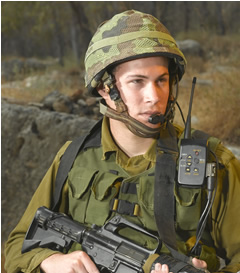
    The Personnel Network Radio PNR-500 from Tadiran Communications is a small Personal Role Radio (PRR) UHF communicator operating in the 410-450MHz band, facilitating effective communications between infantry team members, over a very short range (over 1000 – 800 meters range). When such devices are distributed to all the troops of an infantry squad, these sets enable the squad leader to control his teams more effectively and quietly, while facilitating external communications to the company and other external networks. The PNR-500 is controlled via a specially designed hands free headset or remote activation switch. The individual sets are utilizing dynamic synchronization and and automatic clear channel tuning. They do not need a central control station. Each personal radio on a network can operate up to four separate subnets, allowing individual or intra-squad communications. The sets can also provide intercom when troops are mounted on an Armored Personnel Carrier (APC) and facilitate automatic routing of calls via the vehicle’s tactical Combat Net Radio (CNR). To improve coordination and stealth, the PNR-500 supports whisper mode, voice activated messages and alerts and up to 15 preset network channels. Enhanced models can also transfer data and link to add-on GPS module. Bluetooth support for wireless headset or other accessories is also available.

    PRC-710MB Radio

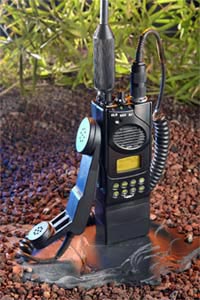
    The PRC-710MB radio communications set is designed especially for Special Forces, air force and naval liaison teams, facilitating essential inter-communications between ground, airborne and naval forces. To ensure connectivity between multiple frequency bands and modulation techniques, the software controlled system uses wide-band radio-frequency modules covering 30-512 MHz, with adaptable antennae matching systems, built-in digital encryption (COMSEC) and navigation (GPS) support. The set supports special operating modes such as Scan, Hail, SELCALL, Beacon, ECCM etc. At a weight of only 0.9kg, including battery and carrying case, PRC-710MB is considered the lightest multi-band radio in the market. The new radio is interoperable with Tadiran’s CNR-900, PRC-710 combat net radios, as well as ground, airborne and naval UHF systems.

    Infantry Combat Suits

    Start < Page 1 of 5 >

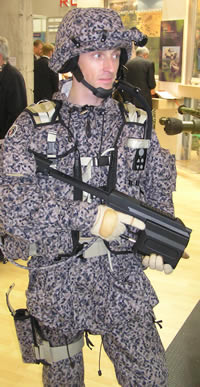
    Infantry warfare went through significant changes in recent years, transforming from heavy mechanized forces, designed to fight post WW-II and cold war operations, to light expeditionary forces which were considered suitable for peacekeeping and rapid intervention operations. However, combat experience in the war against terror further reshaped military thinking. These new conflicts are characterized by operations in urban environment, with regular forces confronted by opponents using guerilla tactics. Guerilla forces try to degrade the technological and firepower superiority of regular armies, denying the use of tanks, APCs, artillery and airpower, while troops are forced to dismount and dragged into “one on one confrontation” in dense urban combat. 

    By improving the capabilities of dismounted infantry and expanding the use of precision weaponry, modern armies are maintaining their technological superiority and are able to fight and win without risking too many casualties among their own troops and non combatants. To maintain this capability armies are beginning to operate “human-centric” weapon systems, balancing soldier’s performance and capabilities in firepower, survivability, mobility, command and control addressing them as a complete and integrated ensemble. Some of these capabilities are available today and used worldwide in combat operations worldwide. Particularly advanced infantry combat suits, are currently under development and should be fielded within the next five years.

    Additional parts of this article:

    Red-Sky 2 Short Range Air Defense System

    Photo: Noam Eshel, Defense-Update

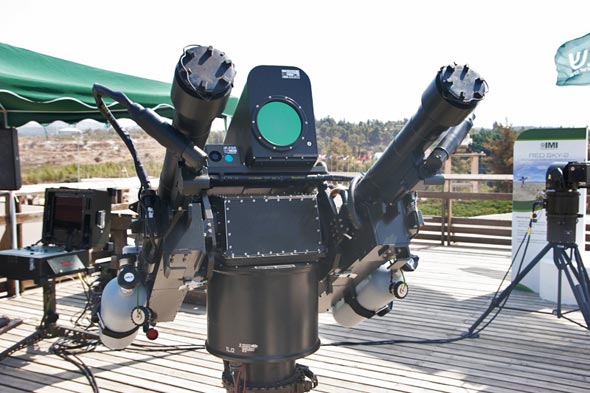
    Israel Military Industries’ Red-Sky 2 SHORAD system is a modular, integrated sensor and Man Portable Air Defense (MANPAD) missile system. The system provides passive 24 hour surveillance, automatic alert generation and weapon cueing to designated targets, supporting optimizes firing decisions. Red Sky extends the capabilities of existing MANPAD systems, which are currently limited by the capabilities of the human operator. For example, Strela (SA-7) and Igla (SA-16/18) missiles can engage targets beyond 5 km, but are usually fired only at a range of 1.5-2 km, where the operator can safely identify the target and perform all pre-launch functions. Red Sky provides target detection and identification at the missile’s effective range. The system is designed to integrate with different types of missile systems, including American (Stinger) and Russian (Strela, Igla, SA-7, 14, 16, 18 etc.) and their indigenous derivatives, available in many countries (Poland, China etc.) The system enables unrestricted operation of such missiles under adverse weather conditions, as well as in restricted visibility conditions such as in mountainous terrain, or urban environment.

    Photo: Noam Eshel, Defense-Update

    Utilizing an Infra-Red Scanner (IRS), Red Sky can automatically detect and track multiple targets, while a separate FLIR, installed on the track and launch (TL) unit is used to engage selected targets. The Command, control and communications (C3) unit is packed in a light weight mobile system. The compact system is designed for a single operator, assisted by two persons for setup. The system can be transported by helicopters and light ground vehicles.

    The IRS utilizes an IR scanner developed by Controp, equipped with the new Fox Flir. This system uses two fields of view – a wide field of view (WFOV) camera which provides continuous, passive day/night coverage of wide field of regard. This FLIR provides the operator with real-time panoramic view of the protected hemisphere. The individual images generated by the panoramic view are processed in real-time, with target detection and tracking algorithms. This information provides the initial situational display presented by for the operator. The C3 unit is based on a ruggedized PC, which process and displays the incoming video signals, to automatically detect and engage aerial intrusions. Once a specific threat is selected for engagement, the TL is automatically slewed toward the threat, where the TL mounted FLIR can acquire the target in its wide FOV. The operator can use the narrow FOV for identification and get accurate range measurement by a laser rangefinder. These systems enable the operator to engage the target effectively at the missile’s maximum range.

    IMI developed Red Sky system in response to specific customer requirements, integrating operationally proven systems such as Stinger or Strela missiles, ruggedized PCs, FLIRs and pedestals, developed by Controp Precision Technology.

    Orbiter Miniature Aerial vehicle

    The Orbiter - from Aeronautics

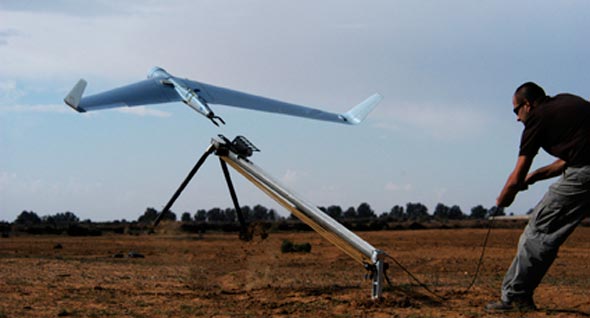
    Orbiter Micro UAV is under development at Aeronautics Defense Systems in Israel. With a maximum takeoff weight of 6.5 kg the flying-wing shaped Orbiter can carry a payload of 1.2kg weight at an altitude of up to 10,000 feet, flying a mission of up to 90 minutes at 500 – 2,000 feet above ground level. Orbiter is designed for simple and easy operation by a single operator. It is autonomous throughout its mission including during launch and recovery, and therefore requires minimal training for operation or support.

    Photo: Aeronautics Defense Systems

    Orbiter is equipped with an electro-optical color payload, fitted with CCD sensor with x10 optical zoom for daylight operations. An optional nigh sensor uses low-light level camera. The weight of the D-STAMP daylight payload is 650 gr. A night capable payload is also in development – it will weigh 0.98 kg.

    With a low acoustic signature, Orbiter is optimized for silent operation even at very low level. Equipped with an advanced avionic package, GPS and inertial navigation system (INS) and datalink system, Orbiter provides real-time transmission of imagery from up to 15 km. The Orbiter length is 1 meter and its span is 2.2 meters.

    Photo: Aeronautics Defense Systems

    January 2010: After the Russian military has ordered Israeli drones last year, the Russian Federal Security Service (FSB) is negotiating with Israel for the sale of another short-range UAV system – the Orbiter electrically powered miniUAV. The systems are produced by Aeronautics Defense Systems and are currently operated with a number of military forces, including the Polish, Irish, Serbian and Azerbaijan armies and the Mexican police. The value of the current program has not been published. The UAVs are required to enhance the control and security along the Russian the southern border in the Caucasus.

    TAG M65 / 80 Rotary Powered UAV

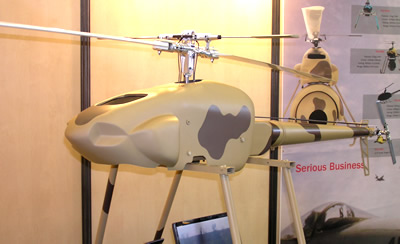
    TAG has developed several types of autonomous unmanned rotorcrafts, optimized for tactical reconnaissance and surveillance missions. M65 is a miniature rotorcraft currently under production for unspecified users in the US Armed Forces. The UAV is designed to carry standardized payloads attached to the belly payload bay. Ground clearance is provided by extended landing racks. TAG developed a 36×45 cm ball shaped payload, weighing 1.5 kg which can carry cameras and other equipment, with a total weight of 4.5kg. The vehicle is powered by a 63.8cc two-stroke piston engine which can lift the vehicle to 4,000 m’ at a gross takeoff weight (GTW) of 11.8kg. Cruising speed can be maintained at 100km/h, with mission endurance of five hours. A larger version, M80 is powered by a 76.8cc engine, has a GTW of 14.4 kg and mission endurance of 8 hours. M2600 is a larger unmanned rotorcraft developed by the company, currently in a prototype phase. At a gross takeoff weight of 654kg M2600 will be able to carry 250kg payload. It will be equipped with a 2600cc engine powering an 8 meter rotor, which will develop Cruise speed of 165km/h and operating ceiling of 3,200m.

    BAT UAV Demonstrates Convoy Protection

    Start < Page 6 of 7 >

    MLB Co. (USA)

    A variety of methods have been proposed to increase the safety of these convoys, including constant airborne surveillance of the convoy and convoy route using unmanned aerial vehicles. MLB has developed and tested a new convoy-following mode of operation for its Bat mini-UAV. The concept is based on automatic coordination between the convoy and the UAV, by means of GPS location signal, relayed from the convoy to the UAV, which coordinates its flight with the convoy while automatically aiming its gimbaled camera. The focus point of the camera can be on the vehicle itself or a point of interest at an offset distance. The UAV updates its flight path continuously to keep its sensor aimed at this focus point. The UAV will follow the convoy wherever it goes, without preplanning or maneuver restrictions. For example, when the convoy stops, the UAV automatically enters an orbiting mode and keeps its camera fixed on the stopped vehicles. When traveling at speed, the Bat moves into fixed formation but aims its camera at a desired location relative to the convoy. Video from the Bat is received in the convoy vehicles and may also be sent back to a stationary base.

    Additional parts of this article:

    Mine Protected Vehicle

    The Indian Ordnance Factories has developed an armored troop carrier, utilizing bullet proof armor, as well as full protection against heavy mine blasts under the tires and hull, Additional crew protection is provided by the roof mounted multi-purpose remote control weapon station. The station enables observation, target acquisition and firing from within the protected vehicle, and accommodates a 0.5 cal heavy machine gun, 7.62 MG or automatic grenade launcher, and has options for stabilization and slave modes.

    LWSPH Low Weight Self Propelled Howitzer

    Singapore Technologies Kinetics is developing the LWSPH program, a 7 ton system utilizing a 39 Cal 155 gun mounted on a light, air transportable chassis which can be delivered by C-130 aircraft and heavy lift helicopters. The system is powered by a turbocharged intercooled diesel engine, and mounted on a lightweight chassis for rapid deployment. The gun can utilize standard projectiles to a range of 19km or extended range ERFB munitions firing 2 – 6 rounds per minute to a maximum range of up to 30km.

    Skunk Works and XTEND Simplify Multi-Drone Command

    0
    Lockheed Martin Skunk Works® and XTEND have achieved a major milestone in JADC2 by integrating the XOS operating system with the MDCX™ autonomy platform. This technical breakthrough enables a single operator to simultaneously command multiple drone classes, eliminating the friction of mission handoffs. From "marsupial" drone deployments to operating in GPS-denied environments, explore how this collaboration is abbreviating the data-to-decision timeline and redefining autonomous mission execution.

    From Ukraine to Taiwan: The Global Race to Dominate the New Defense Tech Frontier

    0
    As traditional defense primes face mounting competition from agile “neoprimes” such as Anduril, Palantir and Helsing, the balance of innovation is shifting toward software-defined warfare and scalable, dual-use technologies, while global industry consolidation—marked by Boeing’s integration of Spirit AeroSystems and other strategic mergers—signals an intensified race to secure control over the defense technology value chain. Our Defense-Tech weekly report highlights these trends.

    Europe’s “Drone Wall”

    0
    In early October 2025, a coordinated wave of unmanned aerial system (UAS) incursions—widely attributed to Russia—targeted critical infrastructure across at least ten European nations. The unprecedented campaign exposed the fragility of Europe’s air defenses...

    Weekly Defense Update & Global Security Assessment

    0
    Executive Summary The past week (September 18-25, 2025) represents an inflection point where strategic defense concepts have transitioned from doctrine to tangible reality. An analysis of global events reveals four primary, interconnected trends shaping an...

    U.S. Air and Space Forces Push Next-Gen Programs at the AS&C 2025 Conference and...

    0
    At the 2025 Air, Space & Cyber Conference, U.S. Air Force and Space Force leaders unveiled major updates on next-generation fighters, bombers, unmanned systems, and space initiatives, highlighting both rapid innovation and critical readiness challenges as the services race to outpace global competitors. A short version is available here, with a more detailed version for subscribers.

    TADTE 2025: Reflecting Taiwan’s Strategic Themes

    0
    The Taipei Aerospace & Defense Technology Exhibition (TADTE) 2025 crystallized around four dominant strategic themes that collectively illustrate Taiwan's comprehensive approach to defense modernization amid escalating regional tensions. Based on a detailed report by Pleronix (available upon request). Includes a Podcast discussion on TADTE 2025's highlighting Taiwan's four strategic themes beyond the post's coverage.

    Iron Beam 450 Completes Testing, Soon to Join With Operational Air Defense Units

    0
    Israel’s Iron Beam 450 high-power laser system has completed final testing, marking a major leap in air defense. Developed by Rafael, it offers precise, cost-effective interception of rockets, UAVs, and mortars, and is set for IDF deployment by 2025.