

Riyadh prepares to host 925 exhibitors from 80 countries as the Kingdom accelerates its transition from defense consumer to industrial partner

The third edition of the World Defense Show opens tomorrow in Riyadh, representing far more than a traditional arms exhibition. Over five days, the event will showcase Saudi Arabia’s ambitious transformation under Vision 2030—a shift from importing finished military hardware to building a domestic defense industrial base capable of meeting half its military needs by the end of the decade.
The numbers tell the story of this acceleration: Saudi Arabia’s defense localization rate has surged from just 4% in 2018 to nearly 25% today. The exhibition has expanded by 58% since its last iteration, now spanning 273,000 square meters at a purpose-built site 70 kilometers from central Riyadh. With a 2025 military budget of approximately $78 billion, the Kingdom is leveraging WDS 2026 to convert financial firepower into industrial capability.
From Procurement to Production
The General Authority for Military Industries (GAMI) and Saudi Arabian Military Industries (SAMI) are orchestrating this transition, using the show as a platform to forge partnerships that will close the gap to their 50% localization target. Global defense primes—Boeing, Lockheed Martin, BAE Systems, and others—are responding by repositioning themselves from suppliers to production partners.
A new Saudi Supply Chain Zone exemplifies this shift, designed specifically to integrate local small and medium enterprises into global defense supply chains. It’s a recognition that sustainable defense independence requires more than assembly lines—it demands a deep ecosystem of specialized suppliers and technical expertise.
Multi-Domain Focus Reflects Regional Realities
WDS 2026’s exhibition layout reflects the security challenges facing Saudi Arabia and the broader Gulf region. For the first time, a dedicated Naval Zone addresses maritime security concerns in the Red Sea and Gulf waters, including surface combatants, coastal defense systems, and maritime command-and-control platforms.
The expanded Unmanned Systems Zone highlights the centrality of autonomous platforms in modern warfare, from aerial drones to ground vehicles and surface vessels. Swarming concepts and AI-driven autonomy feature prominently, reflecting lessons learned from recent conflicts in which unmanned systems have proven decisive.
The new Space Domain zone showcases low-Earth-orbit satellite clusters and space-based intelligence, surveillance, and reconnaissance capabilities. Meanwhile, Integration Zones will demonstrate how air, land, and sea assets communicate and coordinate—the critical interoperability challenge facing modern militaries.
Perhaps most intriguing is the Future Defense Lab, where startups and research organizations will demonstrate emerging technologies in artificial intelligence, quantum computing, and advanced materials. These “never-before-seen” systems suggest Saudi Arabia’s ambitions extend beyond acquiring current-generation hardware to shaping next-generation capabilities.
Live Demonstrations Bring Concepts to Life
The exhibition makes extensive use of a 2,700-meter runway and purpose-built land demonstration track. Daily flying displays will feature the Saudi Hawks aerobatic team alongside frontline combat aircraft including the Eurofighter Typhoon, Rafale C, and JF-17 Thunder. Boeing is expected to showcase its F-15E fighter, KC-46A tanker, AH-64 Apache attack helicopter, and CH-47 Chinook.
On the ground, armored fighting vehicles, mobile artillery, and ground-based air defense systems will conduct dynamic runs under realistic terrain conditions. Synchronized air-land sequences will demonstrate command-and-control integration, while official delegations will have opportunities for hands-on evaluation in the off-road zone.
National and International System Debuts
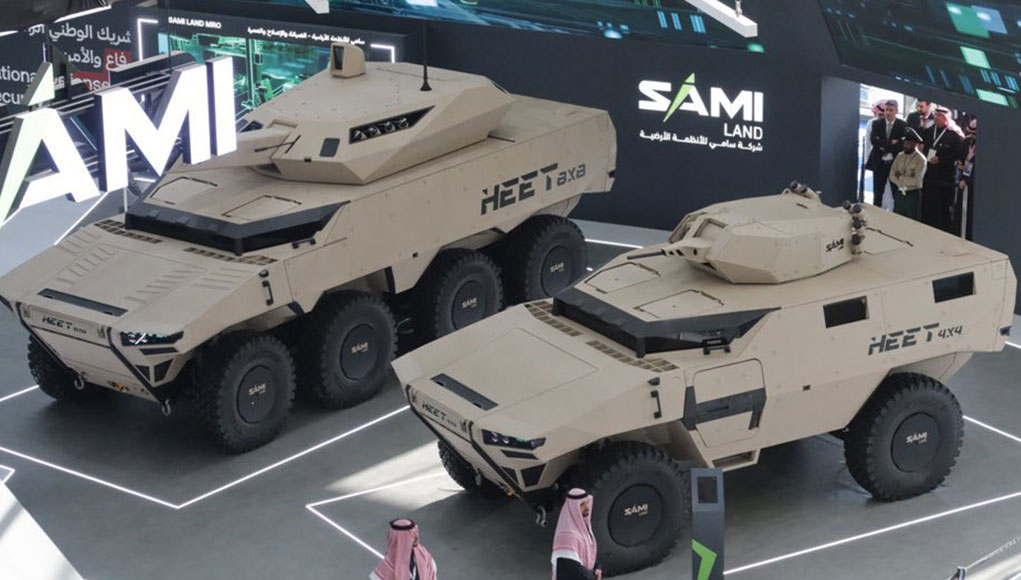
SAMI is preparing to unveil what it describes as “national systems” in advanced electronics and land platforms. The company will provide updates on its futuristic unmanned combat aerial vehicle concept and showcase MRN Systems’ Multipurpose Drone System.
International participants are bringing significant new capabilities. Russia’s Rostec will debut the Sarma multiple launch rocket system with automated guidance, alongside a 30mm air-burst munition designed specifically for counter-drone operations. The Czech Republic’s CSG Group will present the Pandur 8×8 EVO infantry fighting vehicle and ReTwis 5+, a portable radar capable of detecting personnel through non-metallic walls.
Türkiye’s defense industry will showcase the ALPİN 2, a next-generation rotary-wing UAV with enhanced altitude performance and cargo-carrying capability. American firms L3Harris and Lockheed Martin will present counter-UAS systems, electronic warfare suites, and components for the Terminal High Altitude Area Defense (THAAD) system. BAE Systems will introduce Azalea, a constellation of low-Earth-orbit satellites designed for space-based intelligence and multi-domain integration.
A Strategic Demonstration
With over 50 Chinese firms, including CATIC and NORINCO, joining the massive international contingent, WDS 2026 positions Riyadh as a central node in the global defense supply chain. The emphasis on artificial intelligence, autonomous swarming, and localized production signals that this is less a conventional trade show than a strategic demonstration of what Saudi officials call the Kingdom’s “architecture of integration.”
Whether Saudi Arabia can achieve its 50% localization target by 2030 remains unclear. But as the exhibition opens tomorrow, the direction is clear: the Kingdom is building the partnerships, infrastructure, and industrial base to transform how it provides for its own defense. For the 925 exhibitors converging on Riyadh, WDS 2026 represents both an opportunity and a test: can traditional defense relationships adapt to a future in which today’s customers become tomorrow’s competitors and collaborators?