Thursday, December 25, 2025
More
    Home Blog Page 119

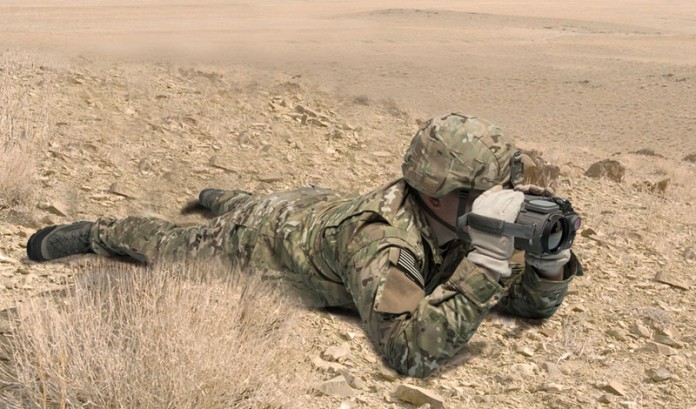
    New Lightweight Target Designator for the US Army

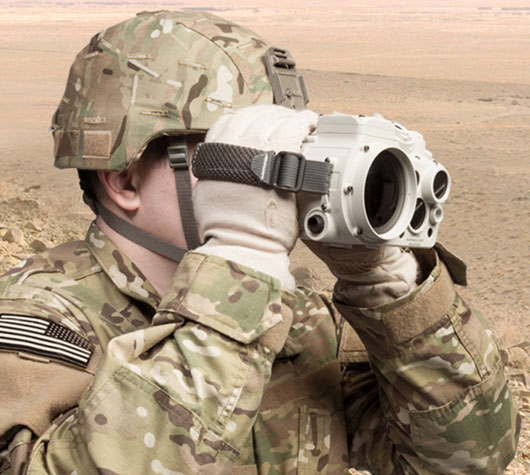
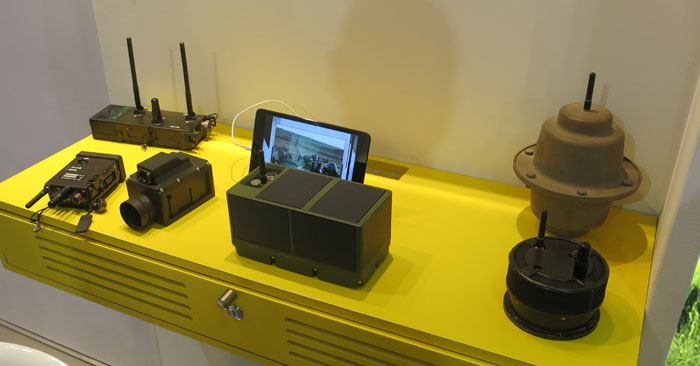
    HAMMER Precision Targeting System. Photo: BAE Systems
    BAE Systems HAMMER precision targeting system successfully completes Critical Design Review for the U.S. Army’s JETS program. Photo: BAE Systems
    BAE Systems HAMMER precision targeting system successfully completes Critical Design Review for the U.S. Army’s JETS program. Photo: BAE Systems

    BAE Systems has completed the U.S. Army’s Critical Design Review for its HAMMER precision targeting system, one of two candidates for the Army’s the Joint Effects Targeting System (JETS) program’s Target Location Designation System (TLDS) system. JETS is an Army-led, joint-interest program with the U.S. Air Force and U.S. Marine Corps.

    Current systems are too heavy, lack the capability to deliver precision fire support in day and at night and do not interface easily with modern, digital radios.

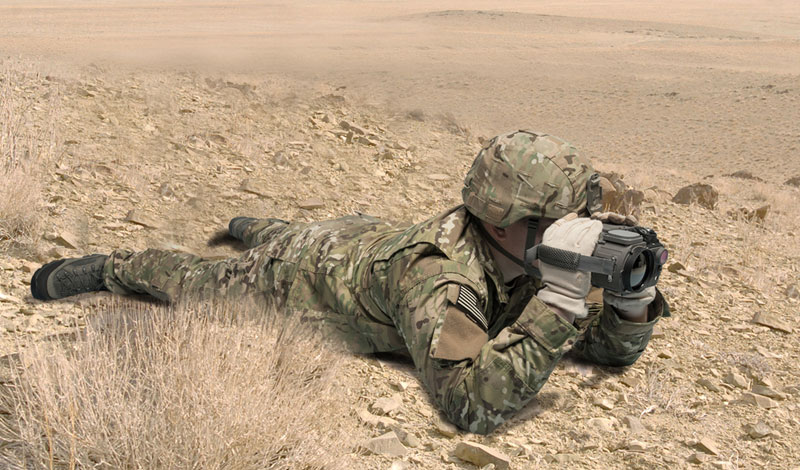
    Systems delivered as part of the JETS program will provide the dismounted Forward Observer and Joint Terminal Attack Controller (JTAC) the ability to acquire, locate and mark for precision Global Positioning System-guided and laser-guided munitions. The TLDS component of this system will provide the dismounted Forward Observer with a common and light-weight handheld precision targeting capability.

    Current systems are too heavy or lack the capability to deliver precision fire support in day and at night. Current systems are also lacking efficient interface with modern digital communications, to receive, transmit, store, display, plan, and coordinate targeting data.

    The system enables dismounted observers to rapidly identify, precisely locate, and accurately mark targets for precision strike. It works in all weather and lighting conditions, and transmits targeting data to existing forward entry systems. The new targeting system will help soldiers distinguish friends from foes with satellite positioning and surveillance information, and allow them to rapidly receive, transmit, and coordinate targeting data.

    In April 2013 the Army awarded two contracts to BAE Systems and DRS. Each company received about $15 million cost-plus-fixed-fee for a three-year engineering and manufacturing development (E&MD) contract to supply prototypes that will meet the JETS TLDS requirements. In the next phase the systems will go through the program’s qualification phase, in which several systems will be manufactured and tested against JETS technical requirements throughout 2014 and early 2015. The program remains on schedule for initial JETS TLDS fielding in 2016.

    “HAMMER will provide forward observers and JTACs with the lightweight, compact, and highly advanced system with the precision required for GPS-guided and laser-guided munitions” Dr. Mark Hutchins

    BAE Systems developed the Handheld Azimuth Measuring, Marking, Electro-optic imaging, and Ranging (HAMMER) addressing the army requirement for a lightweight precision targeting solution. As such, HAMMER weighs less than one-half the weight and cost about half the cost of the targeting systems currently in the Department of Defense inventory.

    The system employs the company’s Target Reconnaissance Infrared Geolocating Rangefinder (TRIGR) system which has already been fielded. HAMMER architecture enhances precision targeting capabilities by adding a compact laser marker and a non-magnetic compass. For the laser designator BAE Systems teamed with Elbit Systems of America, to provide a laser marker based on laser target designators they have developed and fielded with the U.S. Marine Corps.

    BAE Systems and DRS Technologies, Inc., are required to deliver between five and 20 prototypes for testing, between 2014 and 2016. DRS, the U.S. based member of the Italian Finmeccanica group said it will design and produce their TLDS prototypes at DRS facilities in Dallas, Texas and Melbourne, Florida.

    HAMMER Precision Targeting System. Photo: BAE Systems
    HAMMER Precision Targeting System. Photo: BAE Systems

    Colombian Kfir Pilot Killed in a Crash

    Colombian Kfir C10/12 participated in the Red-Flag 7/2012 exercise, claiming eight simulated kills of F-16 and F-15s.
    Colombian Kfir C10/12 participated in the Red-Flag 7/2012 exercise, claiming eight simulated kills of F-16 and F-15s.

    A Kfir TC.12 fighter jet belonging to the Colombian air force (FAC), crashed Tuesday (18 February 2014) on a training mission, killing one of the two pilots and injuring the other. The two-seat fighter jet identified as tail# FAC3006 crashed at 4:53 p.m. local time. It was on a training mission, performing combat manoeuvres over the municipality Norcasia in central Colombia. According to the report one of the pilots managed to eject from the plane before it crashed, the other did not survive. The FAC launched an investigation with the aim of determining the causes of the accident. This is the second crash of a TC.12 in six months.

    This incident represents the first Colombian fatality involved with the upgraded Kfir. In 2008 Colombia acquired 24 Kfir C10/12 and TC.12 fighter jets from Israel. Three were lost in accidents in 2009, 2010 and 2012. The first accident occurred in 2009 as the TC.12 veered off the runway on landing. It was flown by an Israeli crew, and the incident was blamed on human error. (IAI replaced the aircraft). A second Kfir C.10 was lost after takeoff in 2010, the cause was probably an engine malfunction. About six months ago a TC.12 Kfir crashed while on a training mission, both crew members survived this event. Incidently, these crashes involved the entire series of Kfirs – FAC3004 was involved in the 2009 accident, FAC3005 followed in 2010 while FAC3003 (TC7) was involved in the 2012 accident.

    Cyber Intelligence Report – February 20, 2014

    cyber_report

    Executive Cyber Intelligence Bi-Weekly Report by INSS-CSFI

    February 20th, 2014

    Israel

    Israel – A growing cyber nation

    In the last few years, the number of Israeli companies involved in the industry has ballooned from a few dozen to more than 200, accounting for 5 to 10% of cyber security firms worldwide, according to Eviatar Matania, Head of the Cyber Bureau. Matania estimated the global industry to be worth $60 to $80 billion a year.

    IDF reveals five-year plan

    The IDF C4i corps is moving forward with its five year strategic cyber plan. The purpose of the new plan is to bring the Israel corporations of air, ground, sea, and intelligence into one operational Internet network. This would enable different agencies to share information and data quickly and instantly. The program intends to be administered in three steps. The first course would be moving to a cloud based platform, which is scheduled to take place by the end of the year. A significant sum in expenses is estimated to be saved due to the centralization of computer services. The second step is to open an application store (similar to Google Play and App Store) equipping soldiers to share knowledge in more efficient ways. The final step intends to connect soldiers’ cell phones to a specific military system, which would integrate military details with military information security.

    USA

    Edward Snowden used low-cost tool to belittle NSA

    Intelligence officials are investigating how Edward Snowden gained access to copious amounts of classified documents while he was working as a technology contractor managing the National Security Agency’s (NSA) computer systems for the agency in Hawaii in an outpost focusing on China and North Korea. Officials report Snowden used inexpensive and widely available software to “scrape the surface” of the National Security Agency’s (NSA) networks, even continuing after he was briefly challenged by agency officials. Using “web crawler,” a software designed to search, index, and back up websites, Snowden gathered data while attending to his daily routine. NSA insists if Snowden had been located at NSA’s headquarters in Fort Meade, Maryland, he would have failed because the headquarters are equipped with monitors designed to detect when large volumes of data are being accessed and downloaded, and therefore, he would have most certainly been caught. Because Snowden was based at an agency outpost not upgraded with modern security measures, few alarms were raised. Additionally, he gained access to the documents by persuading 25 of his co-workers to divulge information, NBC News disclosed through an unclassified NSA memorandum.

    The Director of the Defense Intelligence Agency, Lt. Gen. Michael T. Flynn, informed lawmakers Snowden’s disclosures could tip off adversaries to American military tactics and operations, forcing the Pentagon to spend vast amounts to safeguard against this. Uncertainty continues to result in the data Snowden posseses. “Everything that he touched, we assume that he took,” General Flynn stated, including details of how the military tracks terrorists, of enemies’ vulnerabilities and of American defenses against improvised explosive devices. He added: “We assume the worst case.”

    Most recently it was revealed through Snowden, that the NSA spied on law firms with foreign clients, as the shown in a document that was circulated from February 2013 depicting Indonesia hiring a US law firm to assist them in trade talks. Australian Signals Directorate (ASD), the Australian counterpart to the NSA, informed NSA of the assistance and conducted surveillance. In their report to the NSA, ASD included attorney client privileged information as part of the report (attorney-client privilege is not subject to protection laws from NSA). The findings are striking as the NSA’s mission includes protecting the nation’s most sensitive military and intelligence computer systems from cyber-attacks.

    Russia

    Internet security concerns at Sochi Olympic Games

    A concern emerged pre-Sochi Olympic Games on the information security level and how secure the Internet networks would be and if it would be safe for visitors to browse through Russian suppliers providing Internet coverage. No cases of cyber-attacks have been reported so far; however, on February 8th NBC released a report written by Richard Engel, claiming foreign athletes should not use Wi-Fi in Sochi because by connecting through the wireless networks, hackers are able to breach the devices (this statement has yet to be confirmed). The Guardian disclosed that the Federal Security Service of the Russian Federation (FSB) intends to monitor all communications made ​​by the participants and guests of the Olympic Winter Games. According to the source, the FSB took steps to install spy technology at the event. Reporters found major changes made in Sochi telephone and Wi-Fi networks to provide extensive and pervasive monitoring to filter all traffic by using the Russian system “SORM,” which intercepts telephone and Internet communications.

    Middle East

    Saudis could face five-year jail term and up to $800,000 fines for sending offensive tweets

    A prominent legal consultant warned Twitter users who retweet abusive or offensive tweets will become liable to the same punishment as the original posters of such remarks. Article 6 of the Anti-Cyber Crime Law stipulates anyone involved in the production, transmission, or storage of material infringing on public order, religious values, or privacy would be sentenced to a maximum of five years in prison or a maximum fine of SR3m ($800,000) or face both forms of punishment.

    Saudi Arabia has more than 3 million active Twitter users and is ranked as the fastest growing Twitter nation in the world with a rate of 3,000%. Riyadh, the capital of Saudi Arabia, is ranked 10th globally among cities with the most tweets. According to experts, social media provides a space for interaction not permitted in public – one of the reasons why people turn to social media to express their opinion.

    The Syrian Electronic Army hacks Forbes.com website

    The website Forbes.com was hacked by the Syrian Electronic Army (SEA). They posted an image of what appeared to be a WordPress administrator panel for multiple Forbes websites. The next day it revealed login details of more than 1 million Forbes users, admin, reporters, and other employees of the company. Forbes confirmed the cyber-attack and asked users and personnel to change passwords. While Forbes.com appears to be back to normal, screenshots taken by Softpedia display that the hackers defaced a number of pages on the site, posting a story claiming to be written by the website’s cyber security correspondent Andy Greenberg under the headline: “Hacked by the Syrian Electronic Army.” SEA tweeted that the reason behind the attack was because “Forces posted many articles against the SEA… [and] they deserved to be embarrassed.”

    Asia Pacific

    Singapore welcomes new Israel Aerospace Industry cyber R&D center

    On the 13th of February, Israel Aerospace Industry (IAI) opened a new cyber R&D center in Singapore. The aim is to find new techniques and technologies to provide warnings and counter measures against cyber-attacks. The R&D center is the first Israeli defense corporation center opened in the Far East. Esti Peshin, head of the cyber programs section at IAI’s subsidiary Elta, said the project was being set up in cooperation with Singapore’s Economic Development Board, and it represented a milestone for the Israeli defense industry. Hired employees are expected to be around 80 – 90% of Singaporeans, including scientists, engineers, and cyber security professionals. The center will focus on three areas: active defenses including catching cyber attackers in real time, monitoring, and redirecting their attacks; finding the geographical location of virtual attackers; and anomaly detection. The head of the cyber program explained the decision to locate the center in Singapore was because of the Asia Pacific region’s high activity in cyber defenses. Countries like South Korea are facing a high number of cyber-attacks, while India is growing as a strong player in the cyber world. Singapore appears to be very satisfied from the new cyber center, which continues the strong relations between the two countries.

    Europe

    German government and intelligence services accused of involvement in NSA affair

    The German Federal Office for the Protection of the Constitution, the BSI (German Federal Intelligence Service) and members of the German government are suspected of having assisted the NSA (National Security Agency) in their data collection program. According to German informant Constanze Kurz, the offenders admitted to using the XKeyScore program by the NSA in order to conduct efficient data analysis through emails, browsing histories, and online chats without authorization. Together with the International League for Human Rights, Kurz intends to sue the responsible parties in federal court. Kurz is a speaker and member of the Computer Chaos Club, Europe’s biggest association of hackers, and she is a reporter for the German newspaper FAZ. After documents leaked by the American whistle blower Edward Snowden, the German Federal Intelligence Service and German government have been cooperating with the NSA by using NSA-provided spying software. The BSI played a major role in exchange of information for named spying tools among intelligence agencies referred to by the NSA.

    UK targeted Anonymous with cyber-terrorism tactics

    According to documents leaked from National Security Agency through Edward Snowden, the United Kingdom has been engaged in denial of service (DDoS) attacks and other cyber tactics against non-belligerents. It is the first time a Western state has been caught using cyber-terrorism tactics. In 2012, a PowerPoint presentation from the Signals Development Conference explained the British Government Communications Headquarters and the Joint Threat Research Intelligence Group declared a shutting down of communications on the hacktivist group Anonymous.

    The speciality of Anonymous is the group’s DDoS attack technique, an attack flooding servers with more requests than the server can address. The DDoS attacks have been and are used by many hackers to attack government websites. In 2012, Anonymous attempted a DDoS attack on the British government websites, including the home office and GCHQ. Since then, the UK has changed its cyber strategy and is becoming more offensive, particularly against hackers and hacktivists. In fact, the British government has invested £500,000 for its cyber army reserve and is continuing to develop its cyber defense. Like the US, the UK has one the biggest worldwide budgets for cyber security.

    inss150About the Cyber Intelligence Report:

    This document was prepared by The Institute for National Security Studies (INSS) – Israel and The Cyber Security Forum Initiative (CSFI) – USA to create better cyber situational awareness (Cyber SA) of the nature and scope of threats and hazards to national security worldwide in the domains of cyberspace and open source intelligence. It is provided to Federal, State, Local, Tribal, Territorial and private sector officials to aid in the identification and development of appropriate actions, priorities, and follow-on measures. This product may contain U.S. person information that has been deemed necessary for the intended recipient to understand, assess, or act on the information provided. It should be handled in accordance with the recipient’s intelligence oversight and/or information handling procedures. Some content may be copyrighted. These materials, including copyrighted materials, are intended for “fair use” as permitted under Title 17, Section 107 of the United States Code (“The Copyright Law”). Use of copyrighted material for unauthorized purposes requires permission from the copyright owner. Any feedback regarding this report or requests for changes to the distribution list should be directed to the Open Source Enterprise via unclassified e-mail at: [email protected]. CSFI and the INSS would like to thank the Cyber Intelligence Analysts who worked on collecting and summarizing this report.


    Pakistan Continues Buying Surplus F-16s – Adding 13 from Jordan

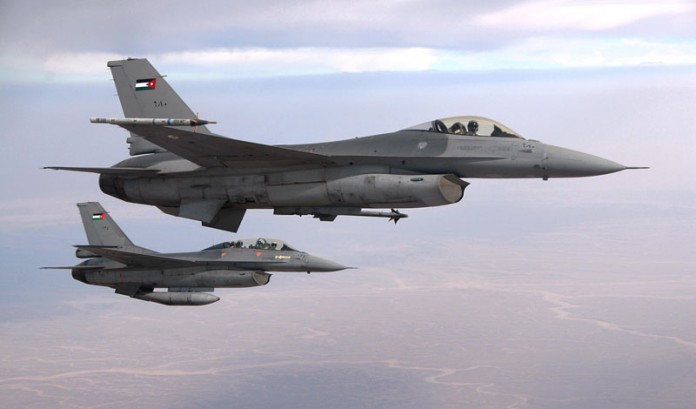
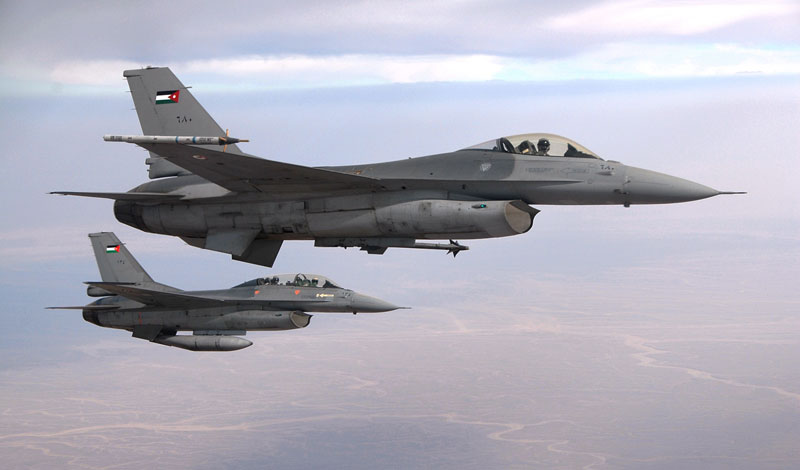
    Two Royal Jordanian Air Force F-16s fly alongside a U.S. Air Force KC-135 Stratotanker aircraft while waiting to connect for fuel over Jordan. Photo: US Air Force

    The Pakistani Air Force (PAF) has acquired a squadron of F-16 multi-role fighter aircraft from Jordan. The early production Block-15 fighter jets will be inducted inducted into the service in March 2014, next month, Pakistan’s TheNews reports.

    Two Royal Jordanian Air Force F-16s fly alongside a U.S. Air Force KC-135 Stratotanker aircraft while waiting to connect for fuel over Jordan. Photo: US Air Force
    Two Royal Jordanian Air Force F-16s fly alongside a U.S. Air Force KC-135 Stratotanker aircraft while waiting to connect for fuel over Jordan. Photo: US Air Force

    Of the fighters acquired from the Royal Jordanian Air Force, 12 of the aircraft are single seaters A models and one is a twin-seat F-16B. Jordan has recently acquired 15 similar aircraft – F-16A/B MLU from the Dutch Air Force, and expect these aircraft to be delivered in 2015. The aircraft Pakistan is receiving have also undergone MLU providing service and are cleared for 20 years operations or 3,000 flight hours on average. Pakistan has already received a number of F-16s 

    Pakistan has been contemplating to acquire more used planes for the PAF from other countries while the induction of new production JF-17 Thunder continues. The JF-17 is a co-production of Pakistan and China.

    Through the upgrade process carried out at the US Air Force Ogden Air Logistics Centre, structural upgrades were performed to extend the aircraft life from the designed 4,000 to 8,000 hours flying time. Other modifications include changes to the engine bay, to receive the upgraded Pratt and Whitney F100-220E engine. Most of Pakistan’s F-16s are of early generation A/B models, acquired from US surplus and upgraded through MLU. Some were delivered free of charge by the US Government. The new acquisition will bring the Pakistani Air Force F-16 fleet to 76. Only 20 are of more modern make, namely F-16C and F-16C/D Block 52.

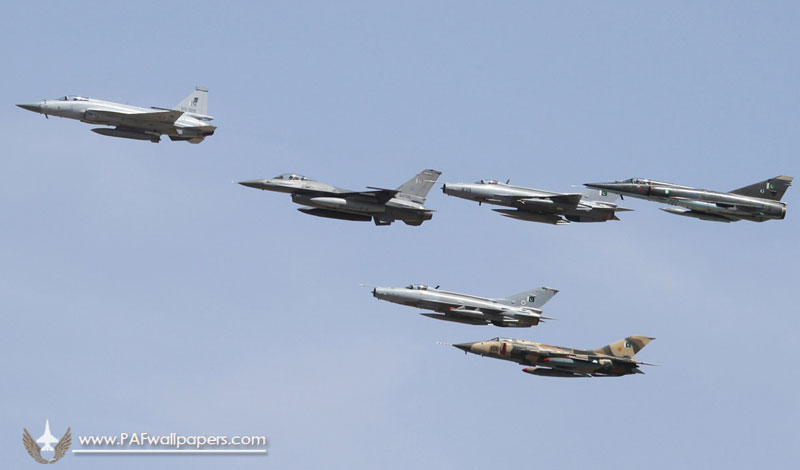
    Pakistan Air Force from left to right: JF-17, F-16, J-7, Mirage III/V and A-5C. Photo: PAFwallpapers.com
    Pakistan Air Force from left to right: JF-17, F-16, F-7, A-5C and Mirage 5. Photo: PAFwallpapers.com

    Through the years Pakistan has been a keen ‘collector’ of Dassault Mirage III/V fighter jets. Between 1967 and 1982 Islamabad bought 66 new Mirage III/V, but through the 1990s ‘collected’ over 130 of the fighters in the surplus market, from the French, Australian and Lebanese air forces. Many of these were modernized through the three phases ROSE program, improving avionics, weaponry and operational capabilities, associated with special missions, special weapons and night capabilities. The F-16, while adding many advanced capabilities, is not fulfilling many of these capabilities, therefore, it can replace the A-5C and F-7s in service, but not the Mirages.

    Buying second hand fighters is one way for the Pakistani Air Force to manage the financial pressure that has limited its modernization since 2007. The acquisition of the JF-17 Thunder  remains the single, highest priority, for which Islamabad secured a Chinese loan to keep production on track at an annual rate of 18 aircraft per year with 50 (Block I) jets in service. Defense News reported. Another significant investment was the acquisition of four Saab2000 Erieye early warning and control (AEW&C) aircraft for US$1 billion, the last of those aircraft was delivered in 2010. (It is unclear how many of these are operational, one of the four was reportedly damaged or destroyed in August 2012 by a Taliban attack on the Kamra air base.)

    Production of 50 Thunders of the second block began in December 2013. The Thunder Block II has improved avionics, weapons load and carriage capability, a data link and an electronic warfare suite, plus an in-flight refueling capability. With these enhancements the cost of the Thunder has increased from US$15 million to $25 million, according to Dawn. Pakistan’s requirement is for up to 250 planes to the F-7 and, eventually, Mirage III/5 fighter aircraft currently in service. The Thunder has already replaced the A-5C Fantan strike fighter with two squadrons.

    While Pakistan is seeking relative parity with India, the PAF currently has no counterpart for India’s Su-30MKI, nor the future Rafale, (when and if the MMRCA is to be fielded). Pakistan has been considering buying Chinese FC-20 (J10) fighter planes they considered could be a fair match to the Rafale. However, it is now considered that Thunder Block III and more upgrades to their F-16s, bringing the Falcons to the Block52 level could satisfy the PAF requirements for the near term.

    Pakistan and China are also working on a combat-capable, two-seat conversion trainer variant of the Thunder, which would meet Pakistan Air Force requirements for special missions and night attack, as well as improve export sales prospects for the aircraft. Further improvements are planned for the Block III, a version which is currently on paper, but could enter design phase in 2016.

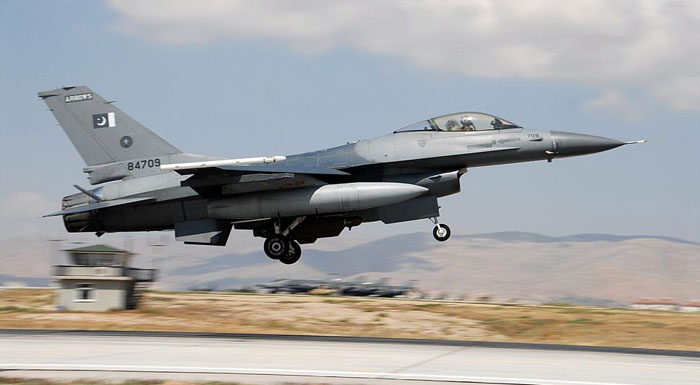
    PAF F-16A block 15 from 11 sqn is seen landing  at Konya AB during Anatolian Eagle 2007. (TuAF photo)
    PAF F-16A block 15 from 11 sqn is seen landing at Konya AB during Anatolian Eagle 2007. (TuAF photo)

    Israeli Fighter Jets Challenge Cypriot Air Defense in Mock Battle Exercise

    Israeli F-16 swoops low over Limasol. Photo: Sotiranews
    Last week Israel deployed 32 F-16 and F-15s to Cyprus for a joint exercise.
    Last week Israel deployed 32 F-16 and F-15s to Cyprus for a joint exercise. Photo: ΠΤΗΣΗ & ΔΙΑΣΤΗΜΑ

    Sharing a common interest in securing offshore mineral exploration areas throughout the Eastern Mediterranean, Israel and Cyprus are tightening defense cooperation through a series of air and naval exercises conducted over the Islands’ southern coast. The relations between Israel, Cyprus and Greece are warming since 2008, as Israel’s close relations with Turkey deteriorated since the rise of Turkish Prime Minister Recep Tayyip Erdoğan to power.

    Israeli F-16 swoops low over Limasol. Photo: Sotiranews
    Israeli F-16 swoops low over Limasol. Photo: Sotiranews

    According to Cypriot Defense minister Fotis Fotiou, Cyprus’ relations with Israel are entering a new phase. “I am confident that the strategic dialogue that began several months ago will benefit both countries and will continue on all areas, including energy security.” Fotiou said while visiting a bilateral exercise the Israel Air Force conducted in Cyprus earlier this month, the Cyprus mail reports.

    Since the missile crisis in 1998 Cyprus reportedly has bought several types of modern air defense systems from Russia, including the SA-15 Tor M1 and SA-17 Buk SAM systems.

    The exercise codenamed ‘Onisilos-Gideon’ was held in Cyprus last week. It took place inside the Nicosia Flight Information Region (FIR), as Israeli fighter jets roared low over Limassol and Chirokitia for several hours. According to sources in Cyprus 32 Israeli fighter  jets and six support aircraft took part in the exercise, including F-15 and F-16s. The exercise included simulated firing at targets on land and at sea, along the Island’s southern coast from Limassol to Paphos, the Cypriot side  played the air defense role, employing the islands’ air defense systems.

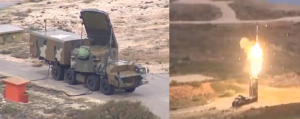
    The Greek air defense forces have fired the first S-300 PMI1 missile in December 2013, 14 years after fielding the system, acquired from Cyprus following the missile crisis between Cyprus and Turkey. Photo: Greek NEA TV video
    The Greek air defense forces have fired the first S-300 PMI1 missile in December 2013, 14 years after fielding the system, acquired from Cyprus following the missile crisis between Cyprus and Turkey. Photo: Greek NEA TV video

    In recent years Cyprus established an impressive air defense network, based on several types of missile systems, primarily Russian made. In 1997 Cyprus acquired an early model of the Russian S-300 air defense system (PMU1). The unit employs 12 mobile launchers, and associated radar and communications units. The entry of that S-300 triggered the missile crisis in 1998 between Cyprus and Turkey, which lead to the transfer of the weapons to Greece. Today the Cypriot S-300 are not based in the island but deployed in Crete under Greek control. In December 2014 the Greek Air Defense forces fired the first S-300 missile during an operational live exercise ‘White eagle’.

    A previous exercise held in April 2013 involved the navies of the two nations, operating joint search and rescue (SAR) missions at sea, south of the island. The drills were held in line with the bilateral agreement drawn up in February 2012 between the Cyprus and Israel on SAR issues.

    Lacking significant military power, Cyprus has relied on foreign powers to secure the island. In the past, British forces based at Akrotiri provided deterrence against foreign aggression. After the British withdrawal, Greece sent F-16s to be based at a special military annex established at the Paphos International Airport, on the western tip of the island.

    “I am confident that the strategic dialogue that began several months ago will benefit both countries and will continue on all areas, including energy security.” Cypriot Defense minister Fotis Fotiou

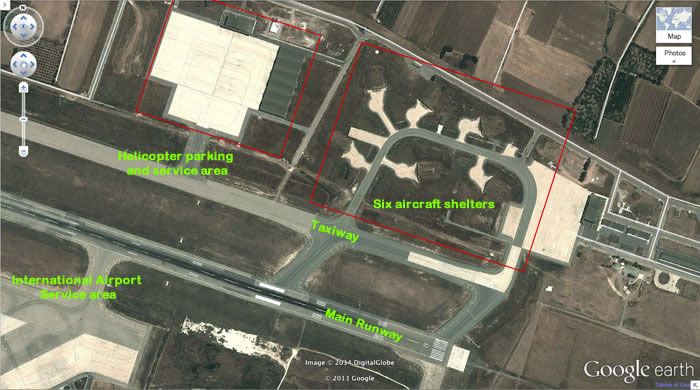
    To support military airpower from abroad the Cypriot government invested in constructing the necessary infrastructure at the Andreus Papandreou Air Base, the primary air base in the island, adjacent to the Paphos International Airport. The military annex has a runway, taxiway, hardened aircraft-shelters and integrated command, control and communication facilities. These facilities were used in the past to host F-16s of the Hellenic Air Force that deployed to Cyprus. Papandreou AFB also houses a small helicopter overhaul and maintenance facility supporting the Cypriot national guard.

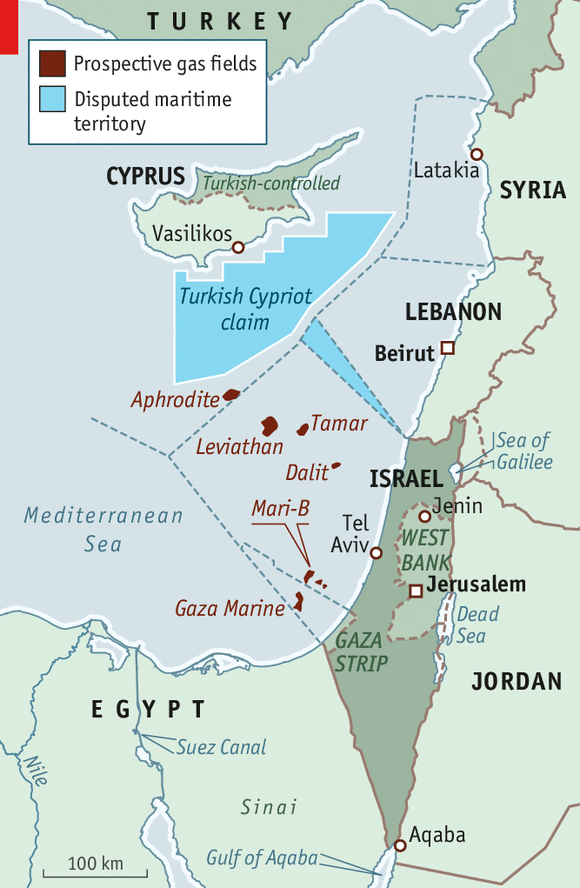
    Israeli, Cypriot, Turkish and Palestinian offshore exploration areas and oil/gas discoveries in the Eastern Mediterranean.
    Israeli, Cypriot, Turkish and Palestinian offshore exploration areas and oil/gas discoveries in the Eastern Mediterranean. Source: Economist

    In recent years, with the simmering tension with Turkey growing into a conflict over rich offshore reservoirs of oil and gas, Cyprus’ security requirements are growing. In addition, the tension in Syria and potential friction with Lebanese elements also have their effect on the island’s security. One of the most serious incidents happened in September 2013, as two Syrian Sukhoi Su-24 strike fighter jets approached the island from the east. British Royal Air Force (RAF) Typhoon aircraft stationed at the time in Akrotiri were scrambled against the Syrian fighters, which turned back before entering the aerial exclusion zone around the base. The British jets were part of a combined force sent by NATO to prepare to assist civilian relief operations following the chemical attacks against civilians in Syria.

    In addition to joint exercises Israel has also applied to Cyprus in a request to establish an operational support site in Paphos. RIEAS reports. In addition to supporting military jets during exercises over the mediterranean, the site could be used to support patrol aircraft and helicopters operating on maritime surveillance flights over the Israeli and Cypriot Aphrodite and Leviathan exploration areas located mid-way between Cyprus and Israel.

    Offshore exploration areas patrolled by the IAF are located within the Israeli Economical Exclusion Zone (EEZ) spanning up to 200 miles from the israeli coastline and adjacent to the Cypriot EEZ. Aircraft patrolling these areas could benefit from a landing base in Cyprus in case of emergency, or when required to maintain persistent surveillance over remote areas. Israel is operating on maritime patrol missions the Sea-Scan maritime patrol aircraft, S-365 Dolphin helicopters helicopters and Heron-I unmanned aerial vehicles.

    The military annex at the Paphos International Airfield. Photo: Google Earth
    The military annex at the Paphos International Airfield, Cyprus. Photo: Google Earth

    British Taranis Stealth UCAV is Expanding Flight Envelope over Australia

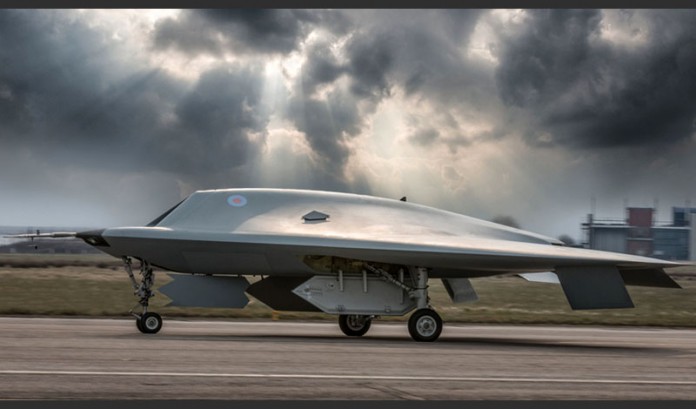
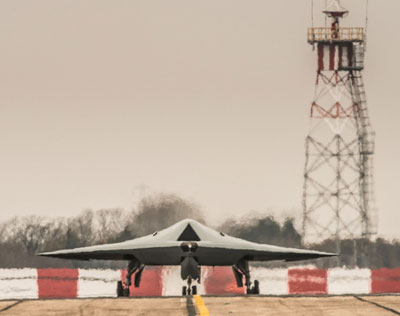
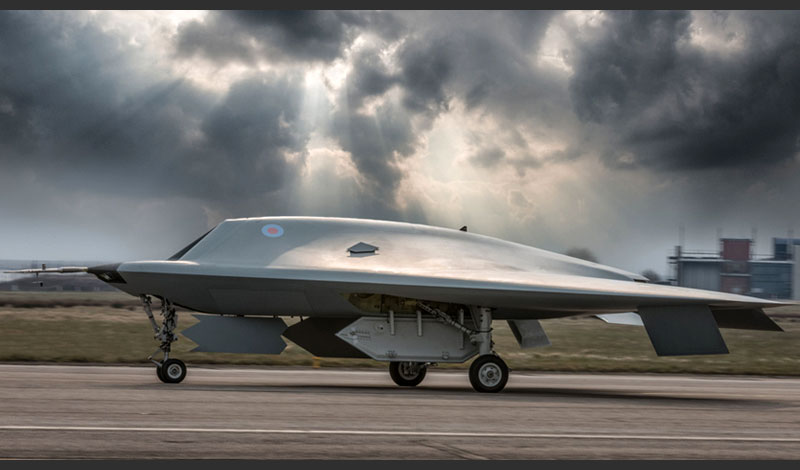
    Taranis awaiting takeoff at Woomera Test Range, South Australia. Photo: BAE Systems/UK MOD

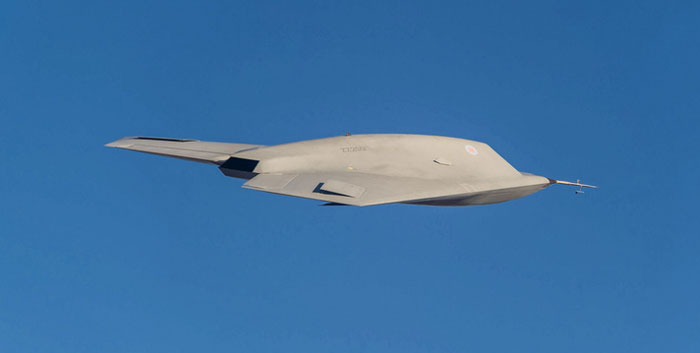
    Last week the UK Ministry of Defence (MOD) and BAE Systems confirmed that the Taranis stealthy Unmanned Combat Air Vehicle (UCAV) demonstrator surpassed all expectations during its first flight trials last year. Since the first flight, conducted August 10th, 2013 the UCAV has been expanding the flight envelope in preparation for the follow-on operational demonstration phase.

    A side view of the Taranis UCAV in flight. Photo: BAE Systems/MOD
    A side view of the Taranis UCAV in flight. Photo: BAE Systems/MOD

    Taranis is designed to demonstrate the UK’s ability to create an unmanned air system which, under the control of a human operator, is capable of undertaking sustained surveillance, marking targets, gathering intelligence, deterring adversaries and carrying out strikes in hostile territory.

    Taranis made its maiden flight at the Woomera test range in South Australia on Saturday 10th August 2013, under the command of BAE Systems’ test pilot Bob Fraser. The first flight lasted only 15 minutes, in which the demonstrator aircraft took off, rotation, ‘climb-out’ and returned for landing. In a number of follow-on flights that took place last year, Taranis extended flight duration to one hour, operating at a variety of altitudes and speeds, as part of the envelope testing.

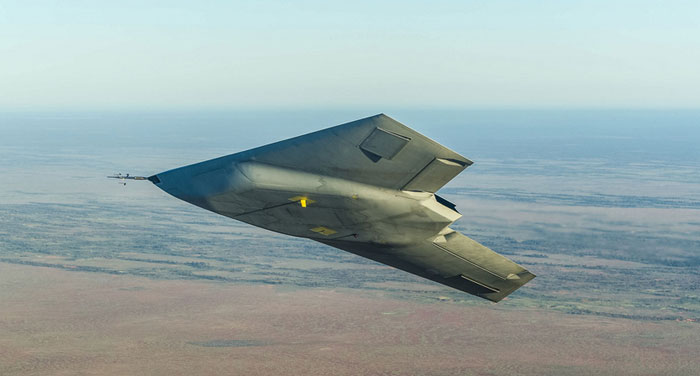
    The serrated contour of the weapon's bay is clearly seen in this photo, where the stealthy Taranis shows its belly and underwing area on a banking turn. Photo: BAE Systems, UK MOD.
    The serrated contour of the weapon’s bay is clearly seen in this photo, where the stealthy Taranis shows its belly and underwing area on a banking turn. Photo: BAE Systems, UK MOD.

    “The findings from the aircraft’s flight prove that the UK has developed a significant lead in understanding unmanned aircraft which could strike with precision over a long range whilst remaining undetected.” BAE Sources said, indicating the technological advances made through Taranis will also help the UK MOD and Royal Air Force make decisions on the future mix of manned and unmanned fast jet aircraft and how they will operate together in a safe and effective manner for the UK’s defences. The MOD is considering a yet undefined ‘Future Combat Air System ‘FCAS’ – possibly a UCAV to replace the Eurofighter Typhoon in RAF service as the Typhoon reaches retirement by 2030. As Defense-Update reported two weeks ago, the UK and France announced an agreement to explore collaborate in the development of such platform, at an investment of £120 million. The two countries are expected to sign a formal memorandum of understanding (MOU) to launch the two-year program in July 2014.

    “The first flight of Taranis represents a major landmark for UK aviation. The demonstrator is the most advanced air system ever conceived, designed and built in the UK. Nigel Whitehead, Group Managing Director of BAE Systems said, commenting on the Taranis flight announcement, “It truly represents an evolution of everything that has come before it. This milestone confirms the UK’s leading position as a centre for engineering excellence and innovation.”

    Taranis awaiting takeoff at Woomera Test Range, South Australia. Photo: BAE Systems/UK MOD
    Taranis awaiting takeoff at Woomera Test Range, South Australia. Photo: BAE Systems/UK MOD

    Costing £185 million ($300 million) and funded jointly by the UK MOD and UK industry, the Taranis demonstrator aircraft was formally unveiled in July 2010. The Taranis demonstrator is the result of 1,500,000 man hours of work by the UK’s leading scientists, aerodynamicists and systems engineers from 250 UK companies, but only few scientists and engineers have ever been given full access to the top secret aircraft.

    About the size of a BAE Systems Hawk aircraft – Taranis has been designed and built by BAE Systems, Rolls-Royce, the Systems division of GE Aviation (formerly Smiths Aerospace) and QinetiQ working alongside UK MOD military staff and scientists. In addition to prime contracting the project, BAE Systems led on many elements of the Taranis technology demonstrator, including the low observability, systems integration, control infrastructure and full autonomy elements (in partnership with QinetiQ).

    Ground testing commenced later in 2010 at BAE Systems’ military aircraft factory in Warton, Lancashire in the UK, followed by a comprehensive and highly detailed programme of pre-first flight milestones including unmanned pilot training, radar cross section measurements, ground station system integration. Taxi trials began in April 2013 taxi trials on the runway at Warton. Following those tests the aircraft and its ground station were shipped to Australia where it was re-assembled and prepared for further tests. The aircraft resumed high speed taxi tests in July 2013 before its maiden flight in August.

    taranis_prepared_tug
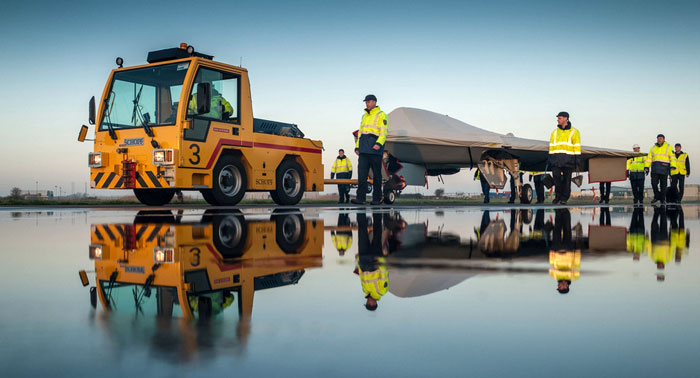
    Taranis is towed to the ground preparation position before flight. Photo: UK MOD/BAE Systems
    Taranis awaiting takeoff at Woomera Test Range, South Australia. Photo: BAE Systems/UK MOD
    Taranis on the runway. Photo: BAE Systems/UK MOD

    Reconnaissance Aircraft Monitor Flooded Areas over Southern England

    Stormy weather and unprecedented rainfall over the UK is causing floods throughout southern England, some areas have been flooded for several weeks. As 14 severe flood warnings remain in place along the Thames, Berkshire and Surrey, and two in the Somerset Levels, the military is called to help local communities fighting the rising water in an effort to protect property and restore routine life.

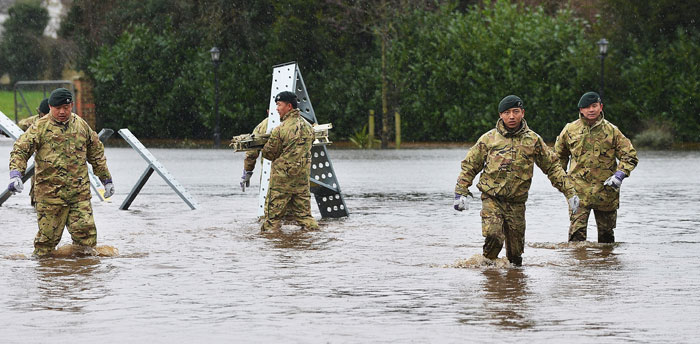
    Soldiers have been working in Staines putting up a dam in a field to redirect water away from housing into fields. The soldiers are from C company Royal Ghurka Rifles. Photo: Crown Copyright
    Soldiers have been working in Staines putting up a dam in a field to redirect water away from housing into fields. The soldiers are from C company Royal Ghurka Rifles. Photo: Crown Copyright
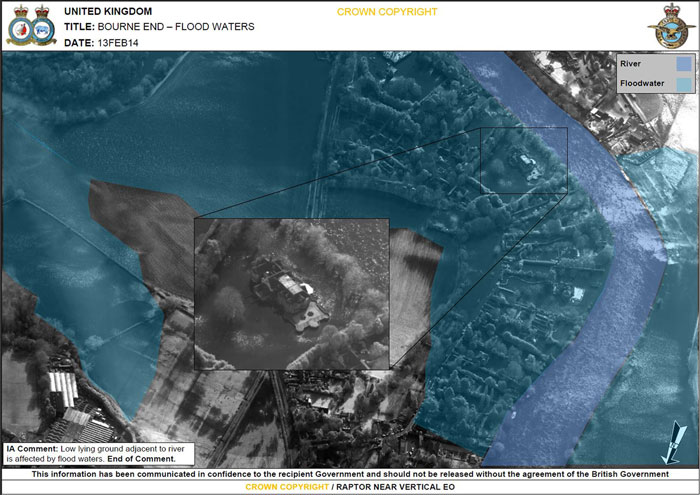
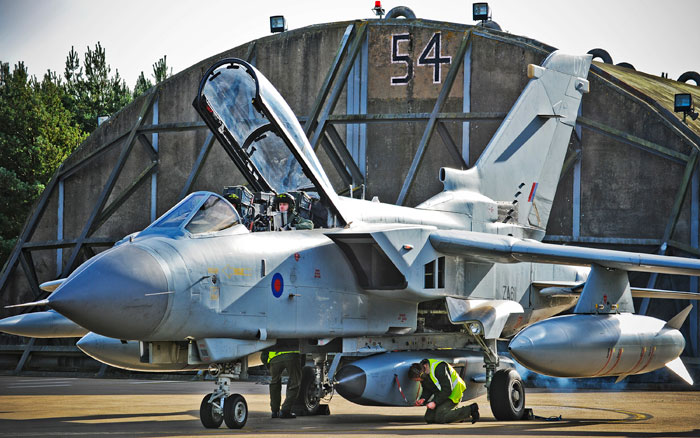
    The deployment of the Tornado GR4 from RAF Marham in Norfolk has produced detailed imagery that will aid the planning and co-ordination of multi-agency efforts to provide relief to local residents and communities. Photo: Crown Copyright
    The deployment of the Tornado GR4 from RAF Marham in Norfolk has produced detailed imagery that will aid the planning and co-ordination of multi-agency efforts to provide relief to local residents and communities. Photo: Crown Copyright

    More than 3,000 military personnel have already joined flood relief efforts, and 5,000 more are preparing to help flood-stricken communities. “We’ve got to treat it like any other national security issue” Labour leader Ed Miliband said, describing the floods and climate change in general as a “national security issue” for the UK.

    While soldiers creating sandbag walls and flood defense are a regular view in the flood stricken areas, the RAF has provided additional support from above, committing surveillance aircraft to provide authorities a unique picture of the situation on the ground.

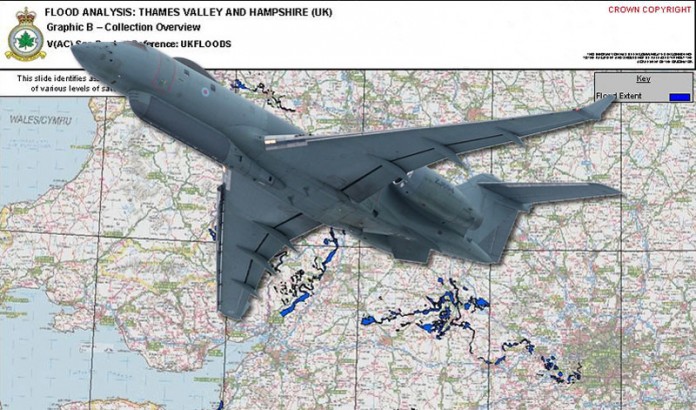
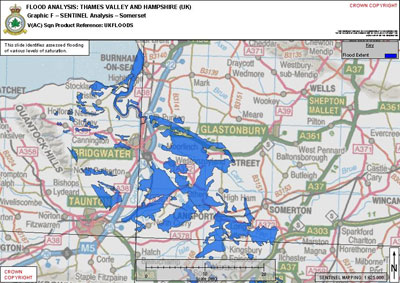
    Flooded area analysis of the Thames Valley and Hampshire, UK generated by SAR imaging provided by Sentinel R1 sortie over Somerset. The Sentinel was operated by the RAF’s 5 (Army Cooperation) Squadron from RAF Waddington in Lincolnshire. Photo: Crown Copyright
    Flooded area analysis of the Thames Valley and Hampshire, UK generated by SAR imaging provided by Sentinel R1 sortie over Somerset. The Sentinel was operated by the RAF’s 5 (Army Cooperation) Squadron from RAF Waddington in Lincolnshire. Photo: Crown Copyright

    Two of the assets employed include surveillance patrols Sentinel R1 employing synthetic aperture radar (SAR) clearly indicating the wet and flooded areas over wide areas of land. With mapping provided the Sentinel, the RAF could deploy Tornado strike fighters carrying RAPTOR electro-optical reconnaissance pods, to bring visual reconnaissance from the affected areas. The combination of wide area surveillance and reconnaissance delivered by fast jets could process a situational picture of the wide area affected by the storm and floods, enabling authorities to focus on the worst affected areas.

    By using the imagery gathered by both systems, civilian authorities will be able to compare the current flooding in the Thames Valley to how the same area was affected during a similar devastating period of flooding in 1947 which was caused by melting snow and extended periods of heavy rain. Being able to draw comparisons may help to indicate what areas are most likely to be affected next and help the civilian authorities to make informed decisions about where best to target their efforts.

    “The Sentinel has long-range capabilities which enable highly trained Airborne Image Analysts onboard to capture imagery of large parts of the flooded areas.” Squadron Leader Victoria Fulton, Chief of Staff 5 (Army Co-operation) Squadron saID, “It is hoped that this key information will greatly assist the civilian authorities when determining where best to focus their efforts.”

    The Tornado aircraft and RAPTOR has been used in many military operations and is currently in use over Afghanistan. It was selected for this task as it can rapidly scan and capture a huge area of interest in just one sortie – in this case areas in need of flood relief work.

    “The sortie launched today demonstrates the versatility of both the [Tornado] aircraft and its reconnaissance systems and of the men and women who support those operations.” Wing Commander Neil Tomlin, Acting Station Commander said, “It is hoped that the imagery provided by our RAPTOR reconnaissance system will provide valuable assistance in supporting the flood relief efforts currently under way in the South of England.”

    The Royal Air Force launched one of its Tornado strike fighters on Thursday February 23, 2014 to capture a highly detailed aerial picture of the areas affected by the floods in southern England, after a request by Gold commanders in the Thames Valley. The aircraft, operated by the RAF’s 31 Squadron, is equipped with the highly versatile RAPTOR – Reconnaissance Air Pod for Tornado – which enables it to gather high-resolution imagery.
    The Royal Air Force launched one of its Tornado strike fighters on Thursday February 23, 2014 to capture a highly detailed aerial picture of the areas affected by the floods in southern England, after a request by Gold commanders in the Thames Valley. The aircraft, operated by the RAF’s 31 Squadron, is equipped with the highly versatile RAPTOR – Reconnaissance Air Pod for Tornado – which enables it to gather high-resolution imagery. Photo: Crown Copyright
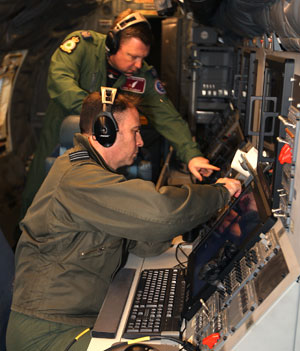
    The air crew of the Sentinel monitoring surveillance images collected in flight. Photo: UK MOD, Crown Copyright
    The air crew of the Sentinel monitoring surveillance images collected in flight. Photo: UK MOD, Crown Copyright

    No 5(Army Cooperation) Squadron operates the Advanced Stand Of Radar (ASTOR) radar surveillance system, and comprises 5 Sentinel R1 aircraft and 8 Ground Stations. The concept of the ASTOR system is to provide a highly effective 24-hour surveillance and target acquisition capability. It delivers wide area, all-weather, tactical, theatre and national surveillance information in near real time. At its heart is a dual mode Synthetic Aperture/Moving Target Indicator (SAR/MTI) radar. The SAR provides high-resolution images and the MTI monitors hostile forces – their quantity, direction and speed. The imagery can be exploited both on board the aircraft and on the ground, is passed to Ground Stations at both theatre and tactical level. By operating at high altitude and considerable stand-off distances, the radar platform is able to remain over safe territory while providing an excellent ‘look-down’ angle of the target area.

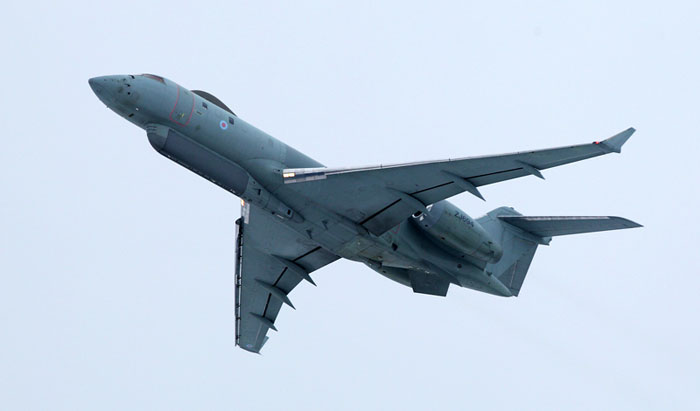
    Sentinel R1 aircraft operated by No 5 Squadron. Photo: UK MOD, Crown Copyright
    Sentinel R1 aircraft operated by No 5 Squadron. Photo: UK MOD, Crown Copyright

    Canada shelves plans to Renew its Arctic Air Patrol Fleet

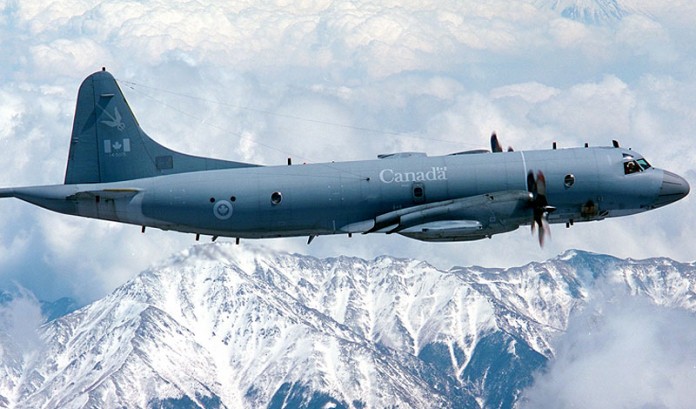
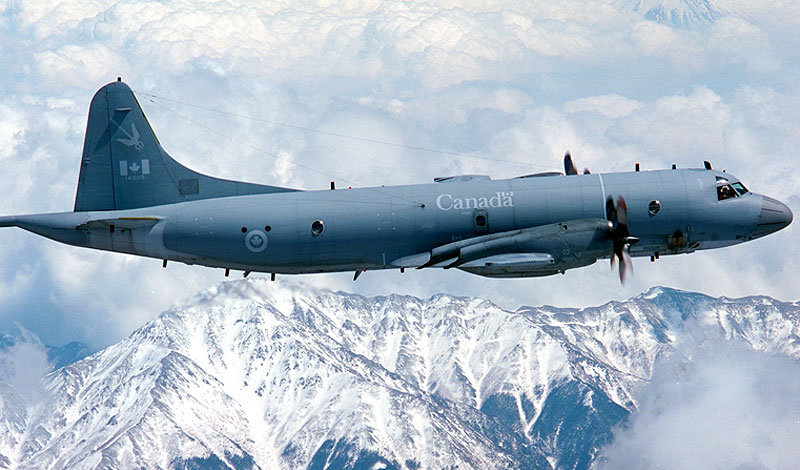
    The CF-140 Aurora was last upgraded in 1999, fitted to continue service through 2020. Photo: RCAF

    The Canadian government has shelved plans to field a new fleet of aerial surveillance aircraft designed to patrol the Arctic territory by 2020. Instead, the conservative government decided to spend $2.13 billion to extend the life of the  CP-140 Aurora maritime patrol aircraft fleet, to continue service until 2030.

    The CF-140 Aurora was last upgraded in 1999, fitted to continue service through 2020. Photo: RCAF
    The CF-140 Aurora was last upgraded in 1999, fitted to continue service through 2020. Photo: RCAF

    The 14 Auroras underwent a 10-year, $1.6-billion upgrade starting in 1999 to keep them flying to 2020. Originally designed for anti-submarine warfare (ASW), the Aurora is able to detect and destroy the latest generation of stealth submarines. Its 17-hour endurance and 7,413 km range make the aircraft ideal for an evolving variety of paramilitary operations. As Canada’s only long-range patrol aircraft, the CP-140 Aurora is is capable of flying more than 7,000 km—or 4,000 nautical miles—without refuelling and is often used for long range patrol over coastal, ocean or the arctic region. In addition to its integral maritime search and ASW sensors the aircraft can also carry air-droppable survival pods, or “Sea Survival Kit-Air-Droppable” (SKAD), supporting search and rescue (SAR) missions at sea or over the Arctic region.

    Employed in paramilitary and homeland security missions, Aurora is frequently used to search out illegal fishing, immigration, drug trafficking and polluting along the coastline, as well as violations of Canadian territorial sovereignty above and below the ocean’s surface.

    The Royal Canadian Air Force is operating 14 CP-140 Aurora aircraft in the maritime and arctic patrol mission. Photo: RCAF.
    The Royal Canadian Air Force is operating 14 CP-140 Aurora aircraft in the maritime and arctic patrol mission. Photo: RCAF.


    Poland Backtracks on its Decision to Replace Strike Fighters with Drones

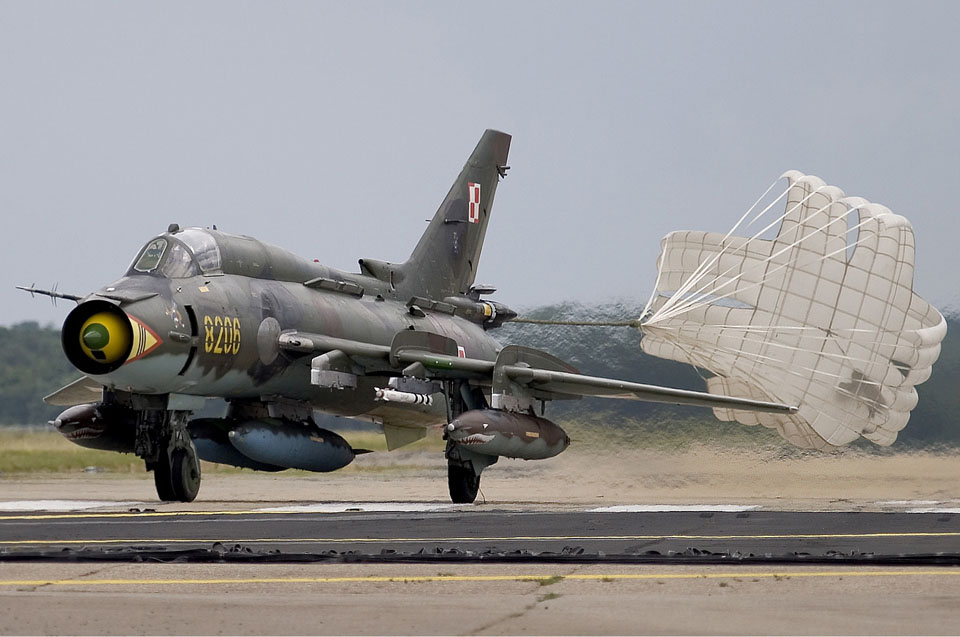
    Warsaw is backtracking on its decision to withdraw 32 Sukhoi Su-22 strike fighters from service by 2015, and replace them with armed unmanned aerial systems (UAS) or drones. Defence Minister Tomasz Siemoniak confirmed recently that the 32 Sukhoi-22s stationed at Swidwin will remain in service for at least 3 years, or even 10.

    Poland currently has 45 Su-22 Fitter strike fightes, out of a total 110 transferred from Russia since 1984. Photo: Chris Lofting
    Poland currently has 45 Su-22 Fitter strike fightes, out of a total 110 transferred from Russia since 1984. Photo: Chris Lofting

    Swidwin currently operates single seater Su-22MK4 strike fighters and Su-22UMK3 two–seater variants (NATO reporting name “Fitter”), used for operational conversion training. The aircraft will be maintained in service at least until 2017. If those fighters will be retained for 10 years, the number of remaining jets is expected to shrink from the two operational squadrons into a single squadron, operating 16 aircraft.

    General (ret) Waldemar Skrzypczak
    General (ret) Waldemar Skrzypczak

    To maintain the force structure the Polish Air Force could acquire more F-16C/Ds, combining the procurement with mid-life upgrades of its current F-16s.

    Apparently, the reversal in the decision came with the realization that the capabilities delivered by current UAS cannot meet the entire spectrum of missions delivered by manned jet fighters. But that may change in the coming years. Poland’s former deputy defense minister and undersecretary of state in the Ministry of Defence for Armaments and modernization, General Waldemar Skrzypczak, supported the procurement of UAS, the effect of  which he has witnessed from the support the Polish troops received in Afghanistan. But the capabilities Warsaw was seeking were not even close to those the US possessed in Afghanistan. Restricted by international limitations of arms transfer treaties and export permissions, the US has agreed to sell Poland the Predator I, but not the Predator B it was offering its more senior NATO allies – the UK, Italy, Germany and France. Another option Warsaw was considering was the Turkish Anka from TAI, a new platform yet to be proven which was significantly inferrior to other alternatives, in terms of payload capacity and mission endurance.

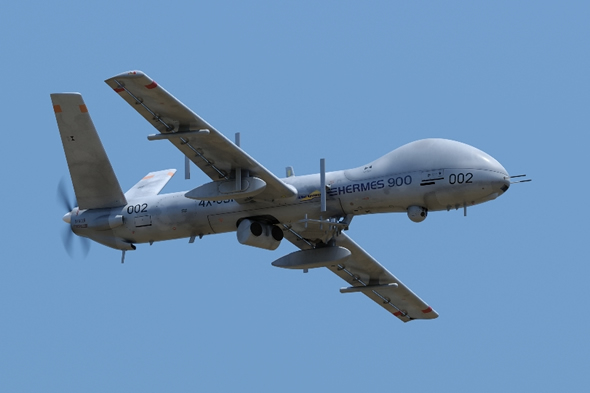
    Elbit has won the third customer for its new Hermes 900 MALE UAS system. Photo: Elbit Systems
    Elbit Systems’s Hermes 900 MALE UAS system may have been the most suitable for the Polish requirement, but apparently that decision was made before the formal tender was completed. Photo: Elbit Systems

    A more suitable solution came from Israel, as twoIsraeli platforms – the Hermes 900 from Elbit Systems and Heron I from IAI – were superior to the US and Turkish alternatives. At the time, Elbit Systems’ Hermes 900 seemed to be superior to the Heron I the IAI was able to offer (at least in terms of the mission payload capability and flexibility – 300 kg vs 250 kg). Moreover, the evolution of Hermes 900 from the Hermes 450 the Israel Defense Forces is already operating for similar applications has positioned the ‘900 as the most likely choice for the poles, a view expressed by Skrzypczak in correspondence with Israel’s director of defense exports. After this letter was leaked to the press, as it was written during the selection process, Skrzypczak resigned in November 2013, amid allegations of favoring foreign arms suppliers.

    Leaking Skrzypczak’s letter to the press could have happened either in Tel Aviv or Warsaw. In Warsaw, Skrzypczak has gathered enough enemies in the MOD to bring about such action, over his harsh criticism over the Polish procurement processes in his past positions as commander of the army. In Tel Aviv, the feud between Elbit Systems and IAI has already caused many casualties, in Israel and abroad. Whoever caused the leak has not been determined, but the doubt that it could have caused the resignation of a friendly and respected general of a foreign nation could not be tolerated.

    Following Skrzypczak’s resignation Dan Harel, the Director General of Israel’s Ministry of Defense (IMOD) tried to bring the two Israeli rivals to join fores by ‘nationalizing’ the program – by turning it into a Government-to-Government sale (as was previously done in the sale of Heron UAVs to Turkey, where the two companies shared the sales package providing different elements of the whole system).

    As the two companies refused such a plan, the IMOD pulled the two Israeli companies out of the Polish competition, denying them an export license. These harsh measures are likely to be temporary, given the leading position in the selection process and the fact that there was no allegation of wrong doing from either side. The Polish decision to delay the retirement of the Su-22 for at least three years will give the Israelis time to cool down. Originally, the Polish plans were to field the new armed drones’ capability by 2018, a schedule that could coincide with the three-year life extension given to the Fitters.

    If the Poles decide to keep their Fitters extra 10 years, that decision opens a new opportunity for the modernization of these ageing strike fighters, which have never been upgraded since their fielding back in the 1980s. This could bring an opportunity where the two Israeli rivals could find themselves competing again – as both Elbit Systems and IAI carried out upgrades of similar Russian-made aircraft in the past.

    GDLS Canada to Deliver Armored Vehicles Worth $10 Billion To Saudi-Arabia

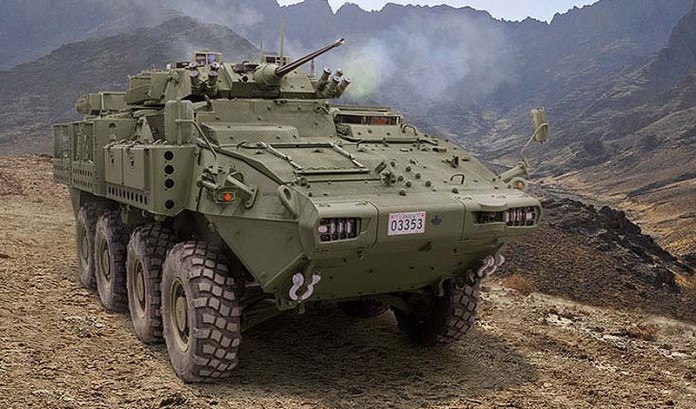
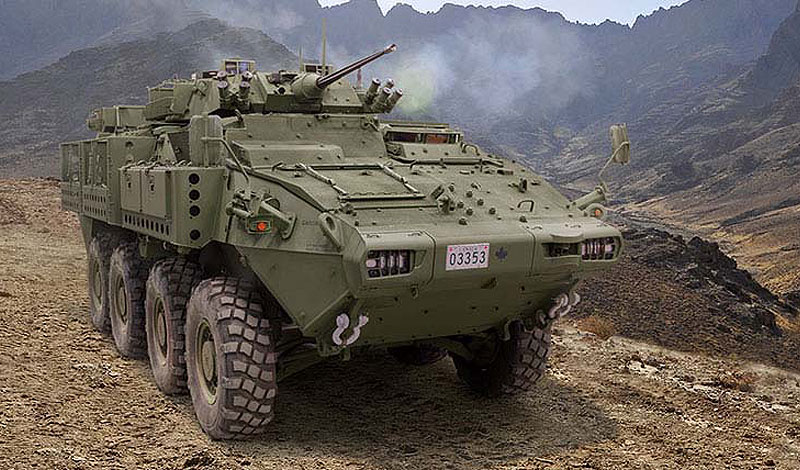
    GDLS is currently producing the upgrade kits for the Canadian LAV III vehicles (LAV UP) for the Canadian Army. Photo: GDLS Canada

    General Dynamics Land Systems (GDLS) Canada has won a major arms procurement contract from Saudi Arabia, for the procurement of armored vehicles worth over $10 billion. The vehicles will follow a new design to be built at GDLS Canada plant at London, Ontario.

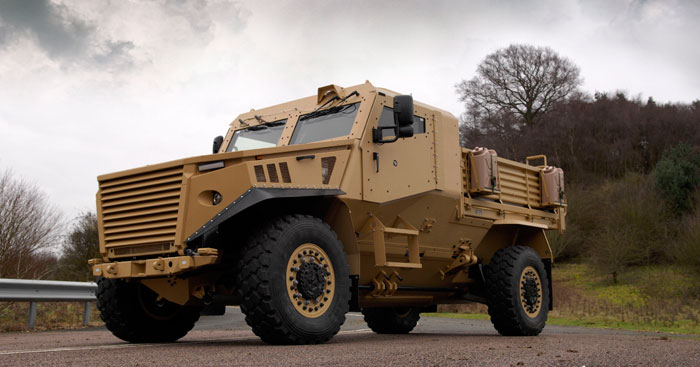
    GDLS Canada is currently producing at London, Ontario the Ocelot light armored vehicle and the Piranha based LAV 8x8 vehicle. Photo: DLS Canada.
    GDLS Canada is currently producing at London, Ontario the Ocelot light armored vehicle and the Piranha based LAV 8×8 vehicle. Photo: DLS Canada.

    Two vehicle families are currently built at the plant – the Piranha based Light Armored Vehicle (LAV) and Ocelot originally designed by Force Protection Inc. The first vehicles will roll off the production line in 2016. The number of vehicles included in the deal has not been disclosed. The package includes training in Canada and Saudi Arabia, as well as logistical support.
    The Saudi government has been shopping for light, fast and off-road maneuverable armored vehicles from different manufacturers since 2009.

    Responding to criticism about selling arms to a country that have systematically violated human rights, the Canadian Government defended the deal saying that the Saudi deal will create and sustain more than 3,000 jobs a year for 14 years and will benefit 500 Canadian companies. “Canada won these jobs over rival bids from our western allies Germany and France. We supported this agreement to bring these jobs to Canada.” Trade Minister Ed Fast said, adding that the value of the deal could climb to nearly $14 billion if all options are exercised.

    The contract with the Saudis follows an agreement last year that saw General Dynamics win a $65.3-million US contract with the Colombian government for the acquisition of 24 light armored vehicles. General Dynamics continues to bid for other international orders, including one from Morocco.

    In contrast, last December the Canadian Ministry of Defense cancelled the procurement of 108 ‘Close Combat Vehicles’ (CCV) in a deal that would have worth $2 billions. GDLS Canada, the French Nexter and KMW of Germany were all competing for this program.

    GDLS is currently producing the upgrade kits for the Canadian LAV III vehicles (LAV UP) for the Canadian Army. Photo: GDLS Canada
    GDLS is currently producing the upgrade kits for the Canadian LAV III vehicles (LAV UP) for the Canadian Army. Photo: GDLS Canada

    IMI Expands MPR Multi-Purpose Bomb Line

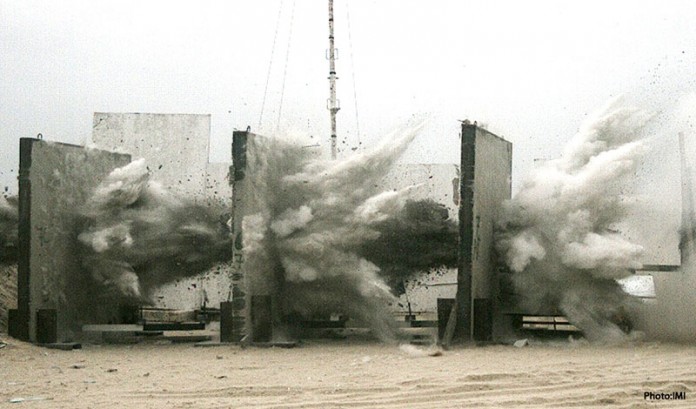
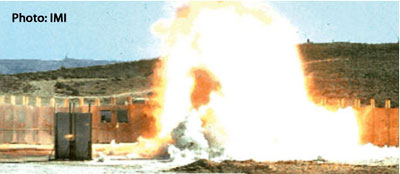
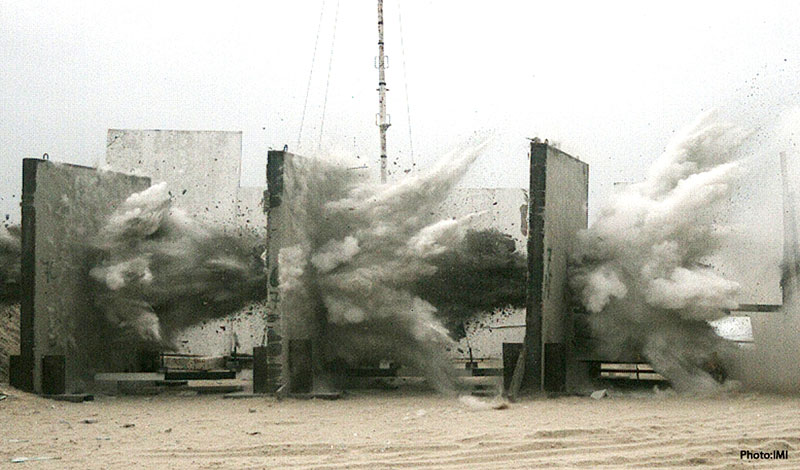
    With improved, more durable design the MPR can penetrate four walls or floors without loosing direction, as a general purpose warhead will do. The MPR2000 will also be able to penetrate at least two meters of concrete. Photo: IMI
    IMI's Multi-Purpose Reduced (MPR) bombs are designed to focus the weapon's lethality over a relatively small radius, thus limiting collateral damage or risk to nearby friendly forces, enabling more effective and accurate combat air support. Photo: IMI
    IMI’s Multi-Purpose Reduced (MPR) bombs are designed to focus the weapon’s lethality over a relatively small radius, thus limiting collateral damage or risk to nearby friendly forces, enabling more effective and accurate combat air support. Photo: IMI
    IMI is expanding its family of Multi-Purpose Rigid Bombs (MPR) providing a warhead optimized for modern aerial weapons’ guidance kits. The first of the line, which is already operational, is the MPR 500 – fully compatible with the standard MK82 general-purpose bomb. Its improved design and more predictable target penetration significantly improve mission success when using laser, EO or GPS guidance kits.
    When these kits are employed with General Purpose (GP) bombs, the warhead, being the least costly element in the system, is often the cause mission failure – either the weapon jitters off the surface, totally missing the target or causing collateral damage. MPR was designed to match the attack profile of guided weapons, enabling four times the penetration, compared to GP bombs of a similar weight class. As a blast fragmentation warhead, the MPR packs 26,000 fragments, sending a dense curtain affecting an area of 2,200 square meters around the impact point for maximum lethality.

    iai-125x125-Sing14

    Nevertheless, this lethality effect is focused to a small area, limiting collateral damage to 60-100 meters. In fact, the effect of the current MPR 500 is comparable to that of Mk84 general-purpose bomb, whose use in urban setting is limited, due to the large collateral damage radius of the Mk84, which covers hundreds of meters, limiting its use in support close to friendly forces.

    With improved, more durable design the MPR can penetrate four walls or floors without loosing direction, as a general purpose warhead will do. The MPR2000 will also be able to penetrate at least two meters of concrete. Photo: IMI
    With improved, more durable design the MPR can penetrate four walls or floors without loosing direction, as a general purpose warhead will do. The MPR2000 will also be able to penetrate at least two meters of concrete. Photo: IMI

    Based on the positive results gained by the MPR500, IMI is expanding these weapons to more weapon types. The company has already conducted testing of MPR1000 (compatible with Mk83 1000 pound warhead) and is proceeding with testing of MPR2000 (compatible with Mk84 / 2000 pound warhead). The MPR 2000 will be able to penetrate at least two meters of concrete, enabling cost-effective, multi-purpose use against a wide target range.

    Development is also in progress with the lightweight MPR250, which will offer an SDB alternative at a fraction of the cost of this guided weapon, which comprises an integrated warhead rather than strap-on guidance kit.

    To further improve the weapon’s adaptability for modern air forces and naval air arms, IMI is negotiating with a foreign company to deliver the MPR family with Insensitive Munitions (IM) explosive charges. IM has become a prerequisite for ammunition storage, particularly on board naval vessels.

    Elbit Systems’ Treasures – a Network of Unattended Ground Sensors

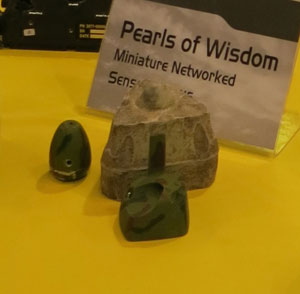
    'Pearls of Wisdom' miniature, covert, networked, unattended ground sensors were part of Elbit Systems' new 'Treasures' UGS system. Photo: Noam Eshel, Defense-Update
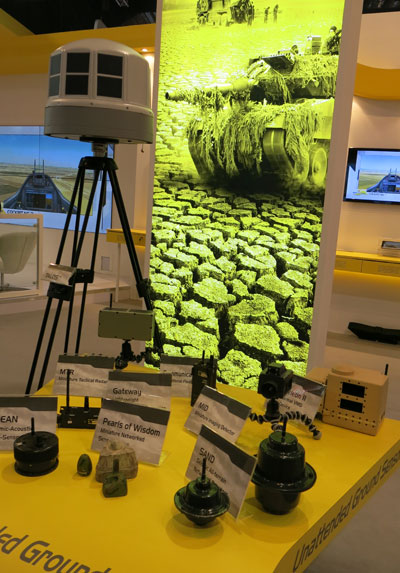
    Elbit Systems' "Treasures" networked UGS system displayed at the Singapore Airshow 2014. Photo: Noam Eshel, Defense-Update
    Elbit Systems’ “Treasures” networked UGS system displayed at the Singapore Airshow 2014. Photo: Noam Eshel, Defense-Update

    Elbit Systems introduced a new system of unattended ground sensors (UGS) dubbed ‘Treasures’. The system is designed for intelligence gathering, force protection and augmenting border surveillance, by enhancing situational awareness, localising suspected activity and providing early warning for security forces. The system was displayed last week at the DEFEXPO exhibition in New Delhi, India and this week at the Singapore Airshow.

    Singapore125x125

    The Treasures system automatically detects, classifies and tracks human and vehicular targets, in real time, on any terrain and in all weather conditions. The system combines a range of small, persistent sensors designed with extremely low power consumption, ensuing the sensors can be emplaced in the area under surveillance and operate unattended for long periods.

    While the system is built around sensors provided by Elbit Systems, it is also providing easy integration with third-party sensors, subsystems and C4I systems. The systems’ sensors comprise a wide range of sensing technologies, coupled via a proprietary communications protocol into into a network of sensors employing multi-hop, ad-hoc, self forming and self healing network. Sensor input and alerts are delivered via handheld radio, designed to use the Treasures’ proprietary protocol, enabling operators to access multiple nodes in the system, set and program additional sensors, effectors, relays and hubs.

    'Pearls of Wisdom' miniature, covert, networked, unattended ground sensors were part of Elbit Systems' new 'Treasures' UGS system. Photo: Noam Eshel, Defense-Update
    ‘Pearls of Wisdom’ are a network of miniature, unattended ground sensors that can be inconspicuously deployed by a mounted or dismounted unit, to detect human activity. The system was recently tested by the US Army. The Pearls were part of Elbit Systems’ new ‘Treasures’ UGS system. Photo: Noam Eshel, Defense-Update

    The sensors comprise the operational proven Smart All-terrain Networked Detectors (SAND) seismic sensors, designed for real time, Beyond-Line-Of-Sight (BLOS) human and vehicular targets detection, for years of continuous operation.

    A new sensor unveiled by the company is the OCEAN, seismic-acoustic multi-detector designed to detect and classify human and vehicular activity. Each unit is designed as a sensor array, enabling direction finding (DF) and wind interference reduction, alongside seismic-acoustic fused algorithm which reduces false alarm rate (FAR) and improves target classification and tracking.

    The system also comprises a Miniature Imaging Device (MID) using a day/night imager with built-in processing unit providing video motion detection (VMD) and visual recognition. The MID sensor transmits automatically day and thermal images correlated to target track, through the UHF narrowband network. The network can also comprises the Chameleon 2 from Seraphim, a covert, day/night imaging sensor mounted on a panning platform, enabling wide area surveillance and high resolution imaging with no external moving parts. To further secure the communications link the system uses wide band communications for video transmission.

    Two radar variants are also supported, providing human and vehicular tracking. The Miniature Tactical Radar (MTR), employing a patented, ultra low-power system relying solely on solar power. The MTR employs a single emitting unit covering both horizontal and vertical sectors considerably larger, compared to the coverage generally provided by UGS. A larger unattended ground radar, the Talos, also operates on solar energy and uses multiple emitting elements to deliver omni-directional coverage, tracking targets at distances of ‘hundreds of meters’.

    Another variant of the Treasures system was displayed at DEFEXPO India. Photo: Noam Eshel, Defense-Update
    Another variant of the Treasures system was displayed at DEFEXPO India. Photo: Noam Eshel, Defense-Update

    New Amphibian Tailored for Homeland Security, Disaster Relief

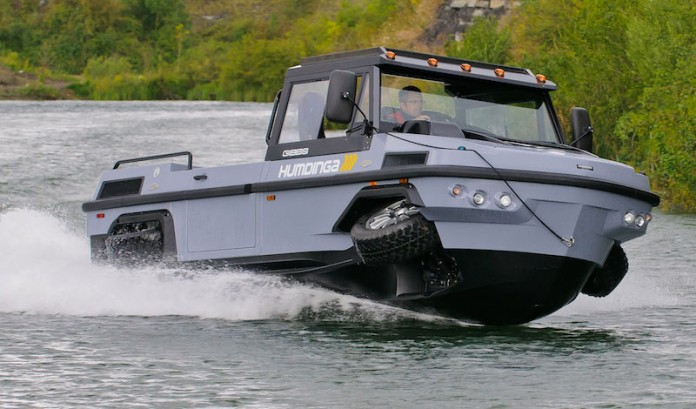
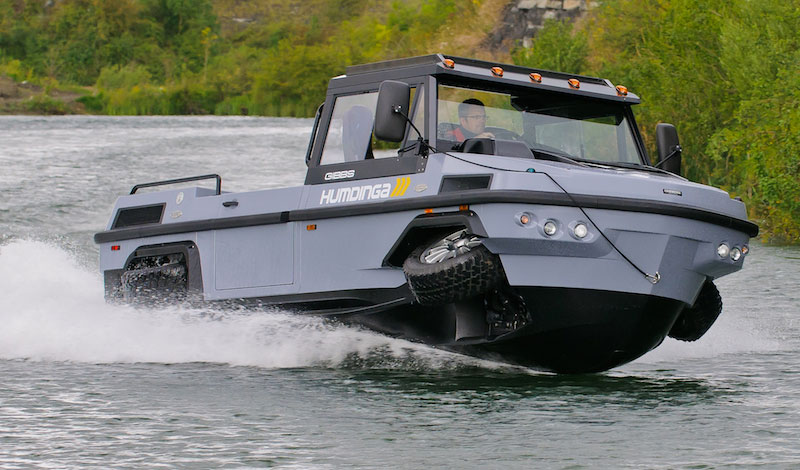
    In addition to first responder and humanitarian uses, Humdinga also have the potential to provide military units with specialized capabilities as well as many general transport applications. Photo: Gibbs Amphibians

    Singapore Technologies Kinetics Ltd (ST Kinetics) and Gibbs Amphibian Ltd. have signed a partnership agreement covering Gibbs’ Humdinga, an amphibious truck, which ST Kinetics intends to use as part of its plan to enhance its offering of smart disaster relief and first responder solutions.

    In addition to first responder and humanitarian uses,  Humdinga also have the potential to provide military units with specialized capabilities as well as many general transport applications. Photo: Gibbs Amphibians
    In addition to first responder and humanitarian uses, Humdinga also have the potential to provide military units with specialized capabilities as well as many general transport applications. Photo: Gibbs Amphibians

    Equally adept over land and water, the Humdinga is designed to make transitions from land to water modes within seconds, offering almost seamless travel between land and water. Swiftly configurable for cargo and passenger-carrying purposes, the Humdinga is ideal for disaster relief agencies and first responders to bring relief to difficult-to-access areas through both land and water.

    “With the Humdinga, we have expanded our stable of unique and versatile solutions for disaster relief and first responder emergency vehicles.” Patrick Choy, EVP & Chief Marketing Officer, ST Kinetics

    Designed by Gibbs, the Humdinga integrates more than two decades of experience in amphibious vehicle development for transportation and recreational applications. Featuring Gibbs’ proprietary High Speed Amphibian technology, the Humdinga incorporates innovations in vehicle suspension, water propulsion and wheel-retraction design. Equally capable of off-road driving and water travel, the Humdinga boasts highway-capable speeds on land and in excess of 50km/h on water.

    Gibbs' HSA technology can be applied to amphibians of all sizes – from 800 pounds to 10 tons.  It solves the persistent challenges of land-sea borders around the world, such as beachhead landings or crossing waterways and lakes. Photo: Gibbs Amphitrucks
    Gibbs’ HSA technology can be applied to amphibians of all sizes – from 800 pounds to 10 tons. It solves the persistent challenges of land-sea borders around the world, such as beachhead landings or crossing waterways and lakes. Photo: Gibbs Amphitrucks

    Humdinga complements disaster relief and response vehicles from ST Kinetics, like its ExtremV all-terrain emergency response vehicle based on the ‘Bronco’, to meet the needs for first responder operations, emergency rescue, medical evacuation, emergency personnel transportation and even essential supplies transportation. Specifically, Humdinga fills the gap in the area of mitigating devastating water-related humanitarian emergencies and in gaining access to areas unreachable by land transportation.

    “This new partnership signals a significant step for Gibbs, ST Kinetics and the future of transport. After over 15 years development and over US$200m invested, Gibbs has removed the land/water boundary for transport and created a whole new generation of High Speed Amphibians. That boundary between land and water just isn’t there anymore. ST Kinetics has recognised this and they are poised to capitalise on the opportunity.” Neil Jenkins, Chairman and founder of Gibbs Amphibians said.

    Managing Life with Cyber Threats

    Joseph Weiss, President & CEO - IAI
    Joseph Weiss, President & CEO – IAI
    IAI is developing the tools and methodologies enabling organizations to better prepare to cyber attacks and minimize the negative effects that such attacks can cause

    Israel Aerospace Industries (IAI) is expanding its activities into the cyber world, offering operational solutions for government authorities and large corporations, seeking advanced solutions to secure their information systems.

    iai-125x125-Sing14The company has been active in this field for years; Operations have been ongoing for several years focusing on communications, networks and information system security. “As a leading defense contractor in Israel we are positioned at the forefront of cyber security. The advanced and unique capabilities we are developing are those that should be implemented by government agencies, critical national infrastructures, finance and security organizations and other large corporations, seeking to establish comprehensive, resilient security throughout their information systems. We have the tools, platforms and infrastructure to take a leading position in cyber” Stated Yossi Weiss, IAI President and CEO.

    The solutions provided by IAI as part of a comprehensive cyber defense and early warning suite providing multi-level security for large organizations. Such package generally includes operational planning and training, persistent monitoring, alerting and cyber forensic capabilities. The system also facilitates management and control of cyber events, enabling the cyber response teams to contain damages and recover the systems, information and assets as quickly as possible.

    “The philosophy behind our systems is based on the fact that cyber attacks are part of our daily life and cannot be fully eliminated” Weiss added, The effects of such attacks can be controlled, minimizing the potential damage they can cause. “Getting there requires intimate acquaintance with the threat, observing its behavior, controlling its activity and responding to any unexpected transactions” Weiss explained.

    The first step in advanced cyber defense is to discover an attack at an early stage, before any damage is caused. IAI is implementing advanced early warning systems developed in its research and technology excellence centers. The center has developed new approaches based on advanced statistical anomaly detection engines, data modeling capabilities, and advanced analytics designed to predict and detect subtle, low signal threats (such as Advanced, Persistent Threats – APT). “Part of these new solutions is derived from the expertise gained through signal intelligence and EW.” Weiss added.

    Skunk Works and XTEND Simplify Multi-Drone Command

    0
    Lockheed Martin Skunk Works® and XTEND have achieved a major milestone in JADC2 by integrating the XOS operating system with the MDCX™ autonomy platform. This technical breakthrough enables a single operator to simultaneously command multiple drone classes, eliminating the friction of mission handoffs. From "marsupial" drone deployments to operating in GPS-denied environments, explore how this collaboration is abbreviating the data-to-decision timeline and redefining autonomous mission execution.

    From Ukraine to Taiwan: The Global Race to Dominate the New Defense Tech Frontier

    0
    As traditional defense primes face mounting competition from agile “neoprimes” such as Anduril, Palantir and Helsing, the balance of innovation is shifting toward software-defined warfare and scalable, dual-use technologies, while global industry consolidation—marked by Boeing’s integration of Spirit AeroSystems and other strategic mergers—signals an intensified race to secure control over the defense technology value chain. Our Defense-Tech weekly report highlights these trends.

    Europe’s “Drone Wall”

    0
    In early October 2025, a coordinated wave of unmanned aerial system (UAS) incursions—widely attributed to Russia—targeted critical infrastructure across at least ten European nations. The unprecedented campaign exposed the fragility of Europe’s air defenses...

    Weekly Defense Update & Global Security Assessment

    0
    Executive Summary The past week (September 18-25, 2025) represents an inflection point where strategic defense concepts have transitioned from doctrine to tangible reality. An analysis of global events reveals four primary, interconnected trends shaping an...

    U.S. Air and Space Forces Push Next-Gen Programs at the AS&C 2025 Conference and...

    0
    At the 2025 Air, Space & Cyber Conference, U.S. Air Force and Space Force leaders unveiled major updates on next-generation fighters, bombers, unmanned systems, and space initiatives, highlighting both rapid innovation and critical readiness challenges as the services race to outpace global competitors. A short version is available here, with a more detailed version for subscribers.

    TADTE 2025: Reflecting Taiwan’s Strategic Themes

    0
    The Taipei Aerospace & Defense Technology Exhibition (TADTE) 2025 crystallized around four dominant strategic themes that collectively illustrate Taiwan's comprehensive approach to defense modernization amid escalating regional tensions. Based on a detailed report by Pleronix (available upon request). Includes a Podcast discussion on TADTE 2025's highlighting Taiwan's four strategic themes beyond the post's coverage.

    Iron Beam 450 Completes Testing, Soon to Join With Operational Air Defense Units

    0
    Israel’s Iron Beam 450 high-power laser system has completed final testing, marking a major leap in air defense. Developed by Rafael, it offers precise, cost-effective interception of rockets, UAVs, and mortars, and is set for IDF deployment by 2025.