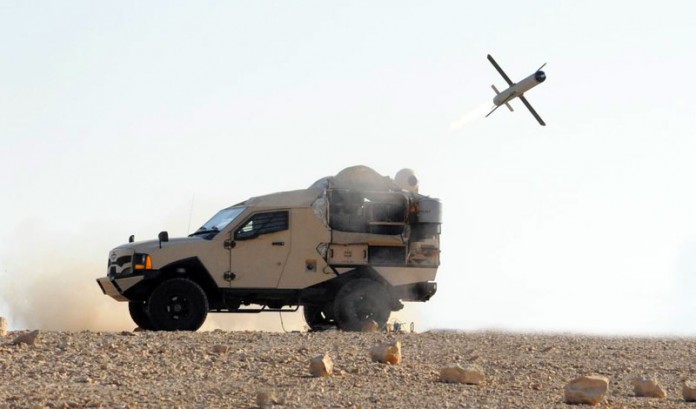
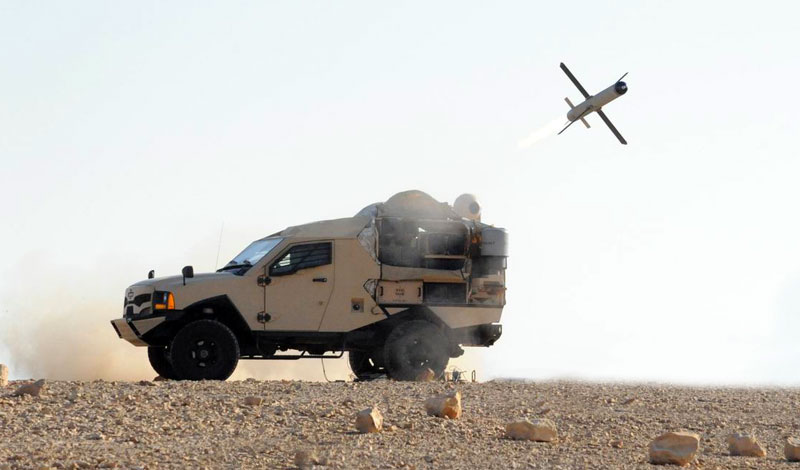
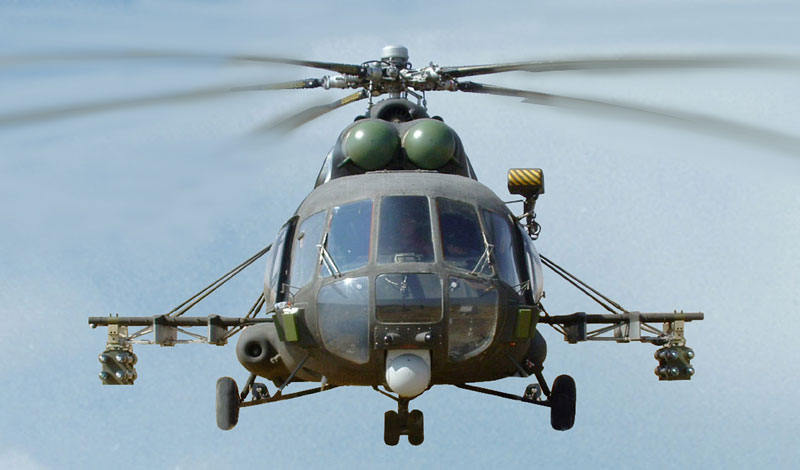
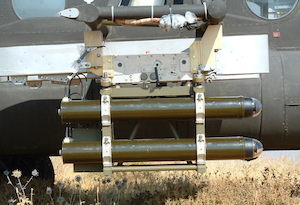
Spike NLOS is designed for launch from aerial, naval and land platforms. photo: RAFAEL
RAFAEL is introducing enhanced versions of the Spike family missiles, including a Spike NLOS offering improved seekers and targeting capabilities and adaptation to air, land and naval platforms. The smaller, affordable Spike LR is also extending its range, and adapted to heliborne platforms.
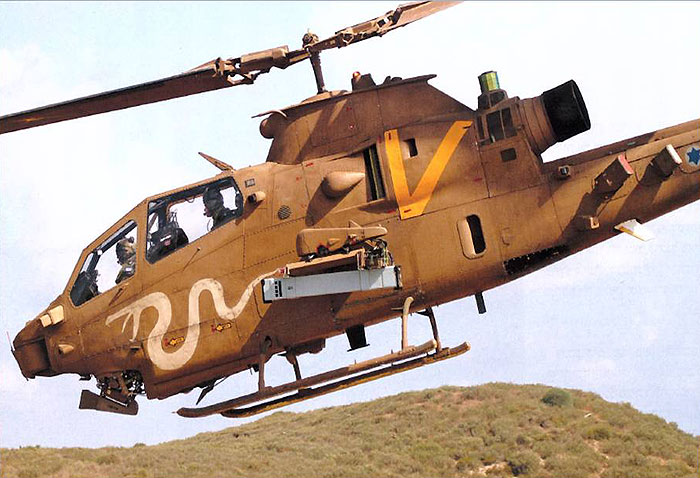
RAFAEL has integrated the SPIKE NLOS on several heliborne platforms. A recent addition was the integration of the lighter SPIKE LR version on light helicopters. Photo: RAFAEL
RAFAEL engineers are working on expanding the NLOS versatility, enhancing the existing EO-IR/CCD seeker with semi-active laser (SAL) capability. The enhanced seeker has already demonstrated good performance in flight tests, according to company sources the new capability will be fielded in 2015.
While the laser capability introduces a new mode of operation, for the operator, most of the mission remains unchanged – as the operator can see the laser spot designating the target on the same display; this capability also improves operator orientation – particularly valuable in conditions such as urban environment and close support, as well as improved sensor to shooter capability against targets requiring fast reaction.
Spike NLOS’ lethality has also been improved with a choice of anti-armor, blast-penetration and high-explosive fragmentation warheads, meeting specific applications. Such modularity in payloads and sensors enables RAFAEL to tailor the weapon to specific customer requirements. According to our sources, these new capabilities will enter production and become part of our offering beginning this year.
RAFAEL is also introducing new capabilities with Spike LR, extending the missile’s range by 25 percent, to five kilometers. This improvement was achieved without changes to the missile’s weight, dimensions or interfaces. The weapon uses a two-way fiber-optic datalink to transfer the seeker’s image from the missile to the operator, while carrying target updates back to the weapon’s guidance system. This fiber-optic datalink is especially effective against hidden targets and engaging targets in complex area, where its pinpoint hit capability minimizes collateral damage. Therefore, hit accuracy in five kilometers was maintained at the same accuracy previously achieved in four.
This capability will be particularly important for mobile and new heliborne applications for which integration is currently underway. At a weight of 30 pounds (13.7 kg) Spike LR will be able to offer light helicopters to engage targets with high precision, five kilometers away. In addition, the launcher will be able to carry the missile on all the platforms currently carrying Spike NLOS/ER/LR missiles, offering more versatile configurations.
Spike NLOS is designed for launch from aerial, naval and land platforms. photo: RAFAEL
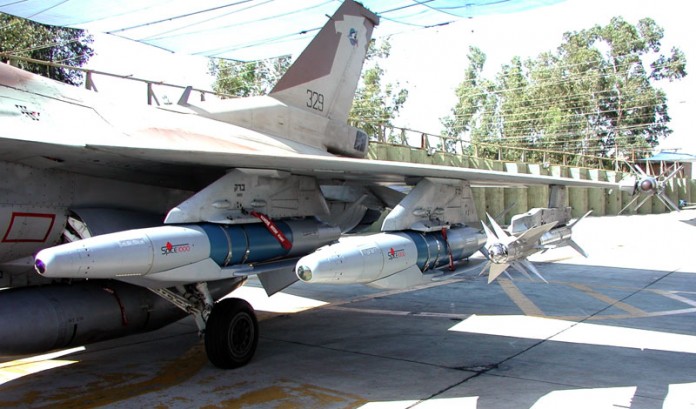
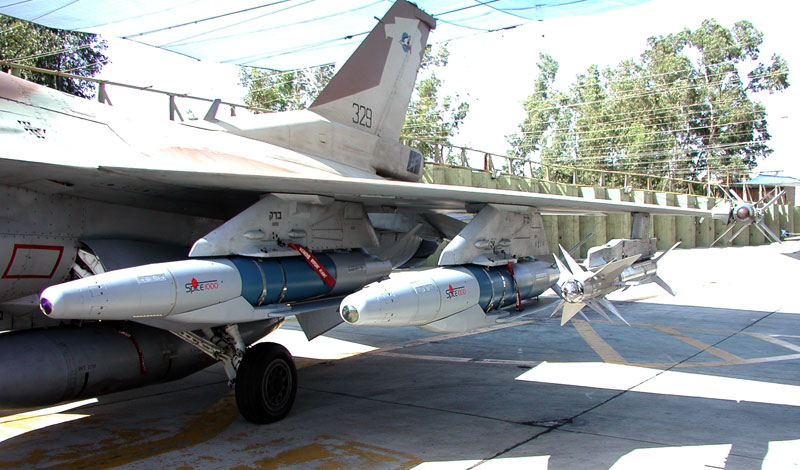
Spice 1000 and Python V loaded on an IAF F-16 fighter jet. Photo: RAFAEL
Spice 1000 and Python V loaded on an IAF F-16 fighter jet. Photo: RAFAELRafael is proceeding with the adaptation of the Spice 1000 Electro-Optically, Stand-Off guided weapon as part of its roadmap to carry this family of weapons into the future. “The Israel Air Force will be able to operate the F-35s with Spice 1000 soon after these fighter jets arrive in Israel later in the decade” a source in RAFAEL told Defense-Update. The aircraft will be able to carry the weapon in either internal or external configuration.
RAFAEL is expanding the SPICE family that began with the combat-proven SPICE 2000, with the introduction of SPICE 1000 and expansion of the platform it is designed to operate with. The next phase is the SPICE 250 – a smaller, lighter and smarter weapon that, according to company officials, will introduce a paramount change in air warfare. The new weapon is currently in development and is expected to enter flight-testing soon.
“The Spice offers air forces to engage pixel-size targets from standoff ranges, with a weapon designed for high immunity to interference and countermeasures.” Rafael VP Marketing Oron Oriol told Defense-Update, “This performance has been demonstrated in combat for quite a while. With the Spice 250 we are downsizing these capabilities further, offering a smaller, lighter and more affordable weapon that also reduces collateral damage and increases mission effectiveness.”
With the new Spice 250 Rafael delivers a weapon that quadruples the strike capability of conventional strike fighters such as the F-16, enabling a single aircraft to deliver 16 highly lethal warheads, striking with high precision from ranges over 100km, a capability currently enabled by eight aircraft or more.
To increase weapon load the Spice is delivered with a smart quad rack carrying four weapons. An F-16 carries four such racks, thus hauling a loadout of up to 16 weapons. An F-15I would be able to carry 28. “Such weapon loadouts that were previously available only on strategic bombers, are now available for tactical strike fighters” Oriol noted.
The missile rack provides all the weapon’s interfaces, including dedicated communications link. This link provides the transfer of mid-course navigation corrections to the weapon, as well as target updates and selective targeting. The weapon is also delivering pre-strike snapshots for Battle Damage Assessment (BDA).
The Spice 250 will be fitted with day/night sensors and laser seeker, backed by GPS/INS. These seekers, along with the integration of the new weapon datalink, deliver mobile target engagement capability over land and sea, and improved operations under adverse weather conditions. “This versatile weapon is designed to engage almost all types of targets in the modern battlefield” Oriol added. He noted that while the weapon’s 250 lbs warhead weighs half the mass of 500 lbs class weapons its enhanced effect exceeds that of the 500 lbs weapon, particularly in target penetration capability.
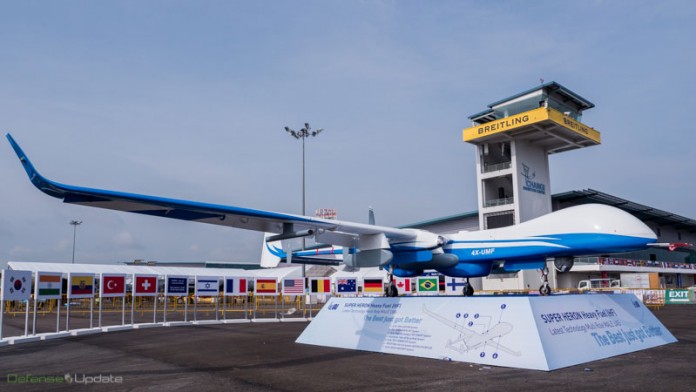
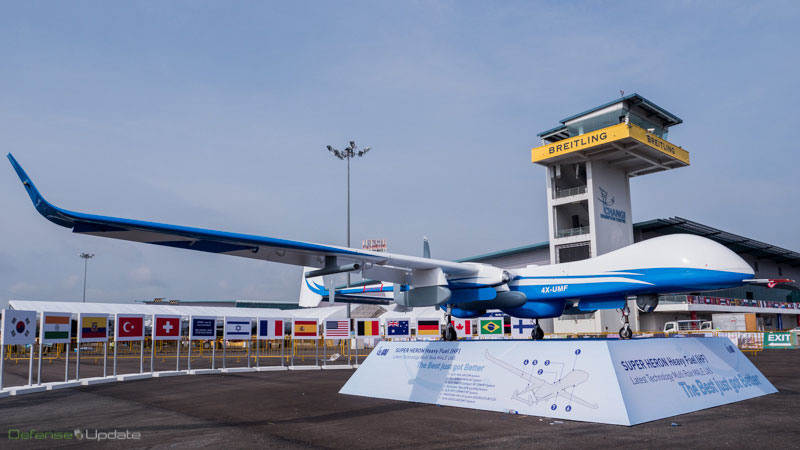
The slender lines of the new Super Heron are clearly visible in the sleek aerodynamic lines of the fuselage and winglets, tipping the 17 meter wing span. With its 200HP diesel engine the new Israeli drone can fly faster, and carry more payload. Photo: Noam Eshel, Defense-Update
IAI’s newest unmanned aerial vehicle is designed with range and payload performance just below the maximum performance set under the Missile Technology Control Regime (MTCR), an issue that has sofar restricted the export of several Israeli unmanned aerial platforms.
The slender lines of the new Super Heron are clearly visible in the sleek aerodynamic lines of the fuselage and winglets, tipping the 17 meter wing span. With its 200HP diesel engine the new Israeli drone can fly faster, and carry more payload. Photo: Noam Eshel, Defense-Update
Israel Aerospace Industries’ (IAI) unveiled today at the Singapore Air Show an enhanced design of its Heron I unmanned aerial vehicle (UAV) called ‘Super heron’. The new drone offers improved payload capacity and optional Heavy Fuel Engine configuration. Its weight/range characteristics position it below the MTCR export control threshold, thus improving its competitive advantage.
The Super Heron has new aerodynamic design, featuring more streamlined curves, larger engine bay and winglets, improving the drone’s aerodynamic efficiency.
“Based on IAI’s world-renowned Heron UAS, the Super Heron introduces the latest technology and re-defines Medium-Altitude Long-Endurance (MALE) Unmanned Aerial System (UAS).” Said Joseph Weiss, IAI’s president and CEO. “The Super Heron offers a flexible and modular design that adapts well to many of IAI’s customers seeking to extend their UAS capabilities, as well as for new customers entering the field.” Weiss added.
A rear view of the Super Heron showing the aft section of the fuselage, designed to mount either a Rotax 914 engine or Dieseljet Heavy Fuel Engine currently undergoing type certification. Photo: Noam Eshel, Defense-Update
The Super Heron has new aerodynamic design, featuring more streamlined curves, larger engine bay and winglets, improving the drone’s aerodynamic efficiency.
“Based on IAI’s world-renowned Heron UAS, the Super Heron introduces the latest technology and re-defines Medium-Altitude Long-Endurance (MALE) Unmanned Aerial System (UAS).”
The engine bay is adaptable to carry two engine types – either the existing Rotax 914 engine or a new Heavy Fuel Engine (HFE) with fuel injection made by the Italian company DieselJet SRL. This 200HP engine is based on an automotive diesel engine made by FIAT which is currently undergoing aviation certification by EASA. The HFE engine is slightly heavier than the ROTAX. To compensate for the additional weight the diesel offers better fuel consumption, which is further enhanced by the winglets, extending the wings spanning 17 meters. The new engine significantly increases the airspeed of the Super Heron over the current Heron I. According to IAI, it will exceed 150 KTAS (knots true airspeed = 278 km/h).
For optimal mission endurance and reconnaissance capability the drone maintains a low speed loiter capability at 60-80 KTAS (111-148 km/h). The mission radius of the drone is 250km (134 nautical miles) using line of sight datalink, or 1000 km (539 nm), employing satellite communications (SATCOM).
The drone weighs 1,450 kg (3,197 lbs) and can carry a payload of 450 kg (992 lbs), positioning the platform 50 kg below the MTCR limits imposing export restrictions on guided platforms capable of delivering payloads (a.k.a warheads) of 500kg (1,102 lbs) weight over distances of more than 300km (162 nm). Using non-SATCOM datalink the Super Heron will meet both range and payload criteria, while adding the improved SATCOM datalink will maintain its compliance by the payload maintaining below threshold level.
A top view showing the various sensors attached to the Super Heron. Photo: Noam Eshel, Defense-Update
Super Heron has six hardpoints carrying external stores. The configuration displayed at the Singapore Airshow does not show weapons carried, but various sensors carried in pylons, including communications intelligence, signals intelligence and self-protection systems. Photo: Noam Eshel, Defense-Update
At the Singapore Airshow 2014 IAI circled the new Super Heron with 17 flags of its UAS customers Subscribe for the full article IAI’s various UAS have accumulated over 1.1 million operational flight hours around the world, with the Heron family drones accumulating 250,000 operational flight hours. The new drone has already made initial flight-testing and have met the expected performance set for the platform, using the Rotax engine configuration. IAI is already proceeding with the platform certification, part of which will be based on certifications already received for Heron I. The design already implements preparations for future sensors that are expected to become mandatory for drone flights in non-segregated airspace. Certification of the Dieseljet engine is also undergoing with the original manufacturer.
We are uploading the following video from the media preview held Monday, February 9 at the Singapore Airshow, two days before the official opening of the Singapore Airshow, some of the visiting aircraft and most of the Singapore Air Force aircraft are already parked at the static display area.
You are invited to visit our sponsors at the Singapore Airshow 2014
We are sending the following post from the media preview held today at the Singapore Airshow, two days before the official opening of the Singapore Airshow, some of the visiting aircraft and most of the Singapore Air Force aircraft are already parked at the static display area.
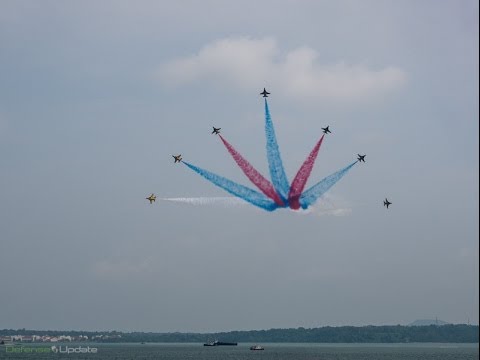
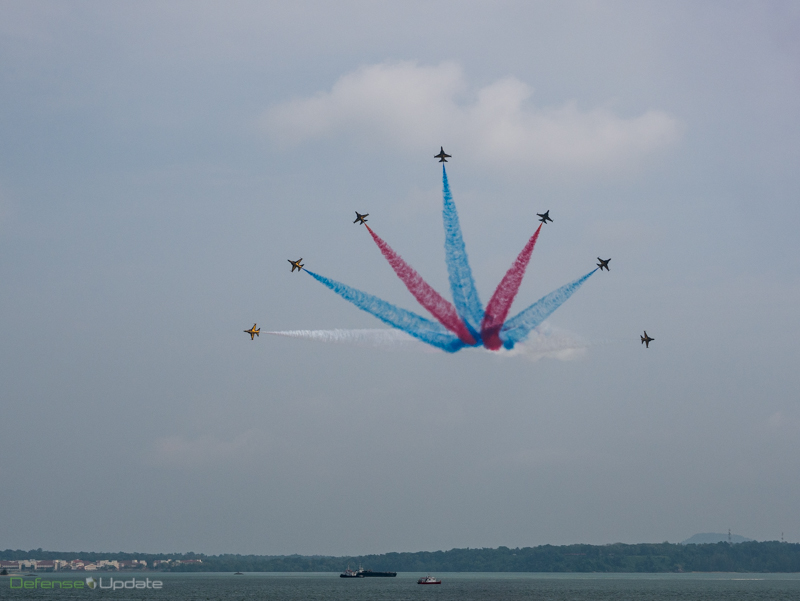
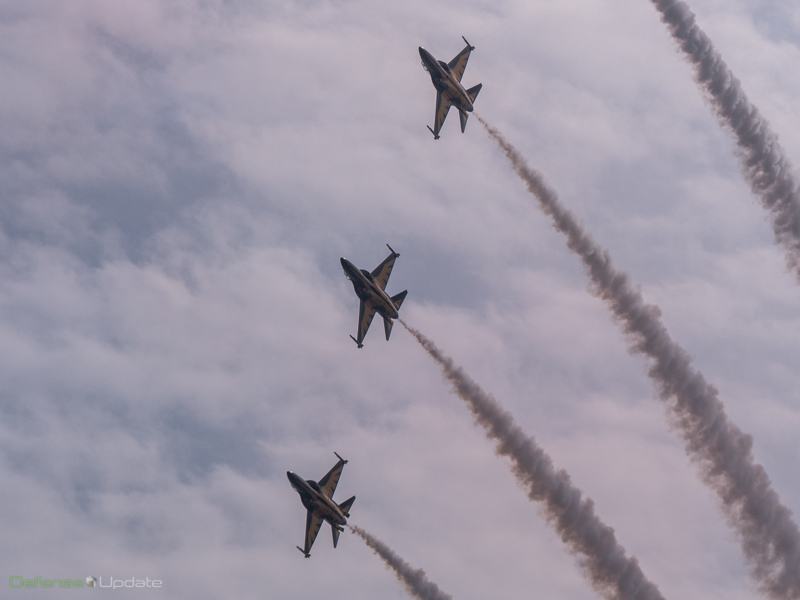
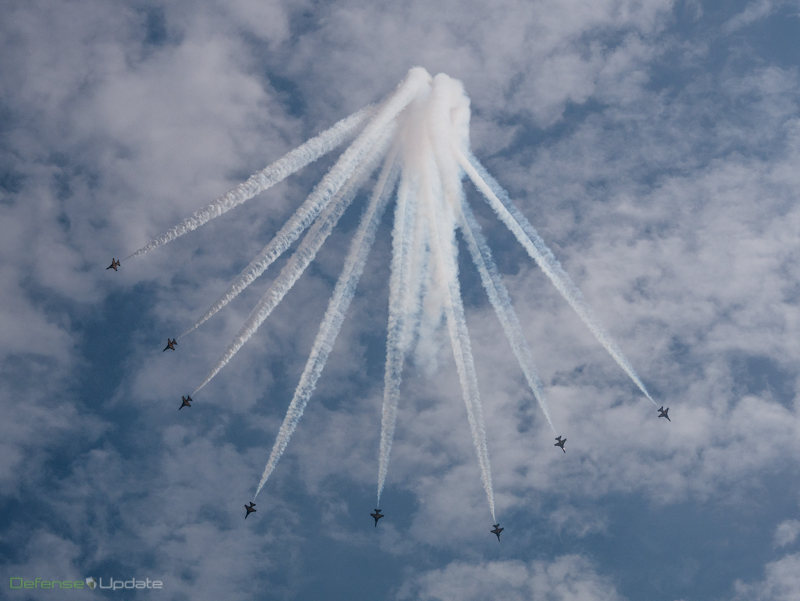
The seven-aircraft Korean T-50B ‘Golden Eagle’ display team, the “Black Eagles”, fan out on the final manoeuvre of their impressive display at Singapore Airshow rehearsal on February 9th.
The Korean Black Eagles flight demonstrations at the Singapore Airshow 2014. Photo: Noam Eshel
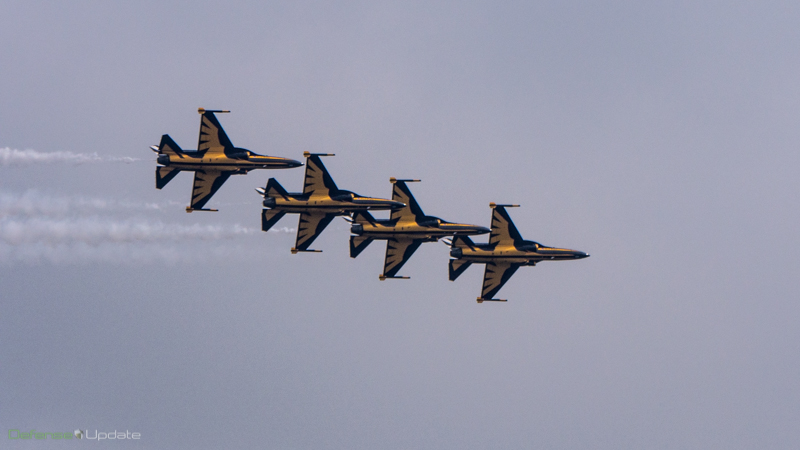
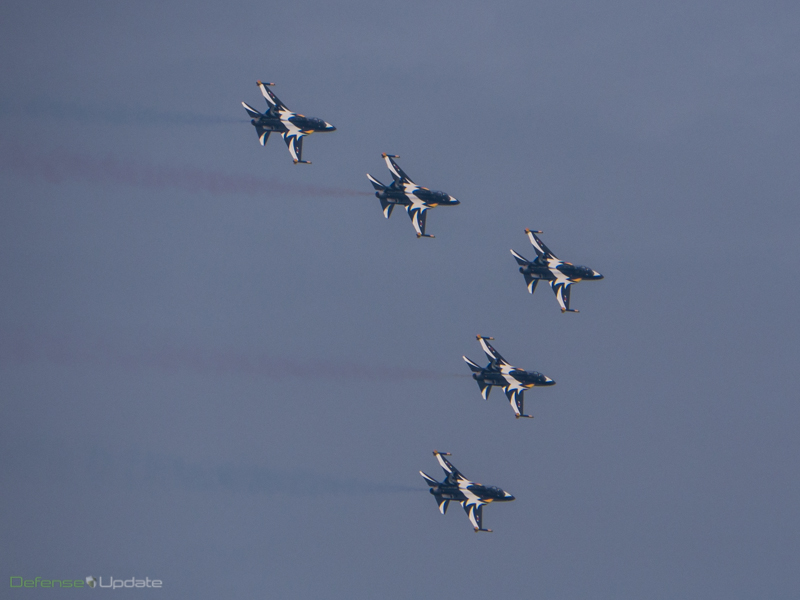
The ROKF T-50B ‘Black Eagles’ demonstration team.
Another view of the ROKF Black Eagle demonstration team.
The ‘Black Eagle’ flight demonstration team from Korea perform an eight aircraft inverted fan menouver
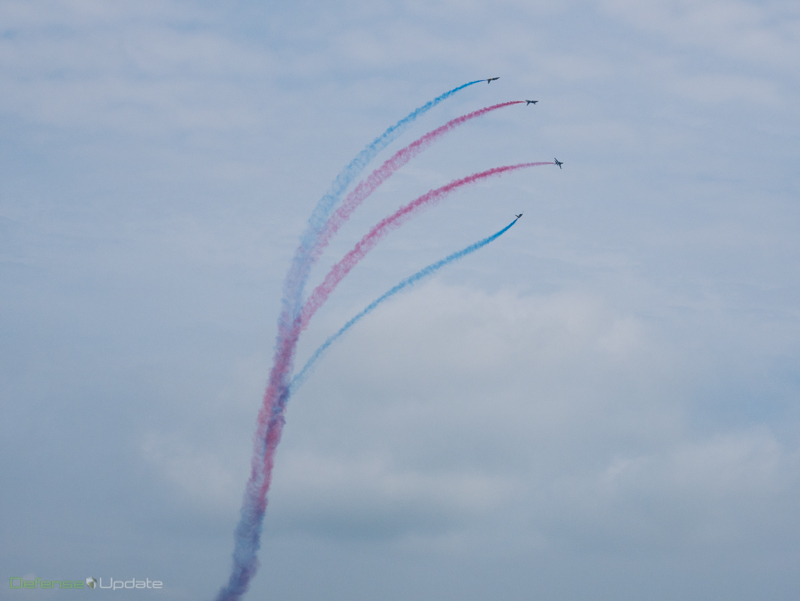
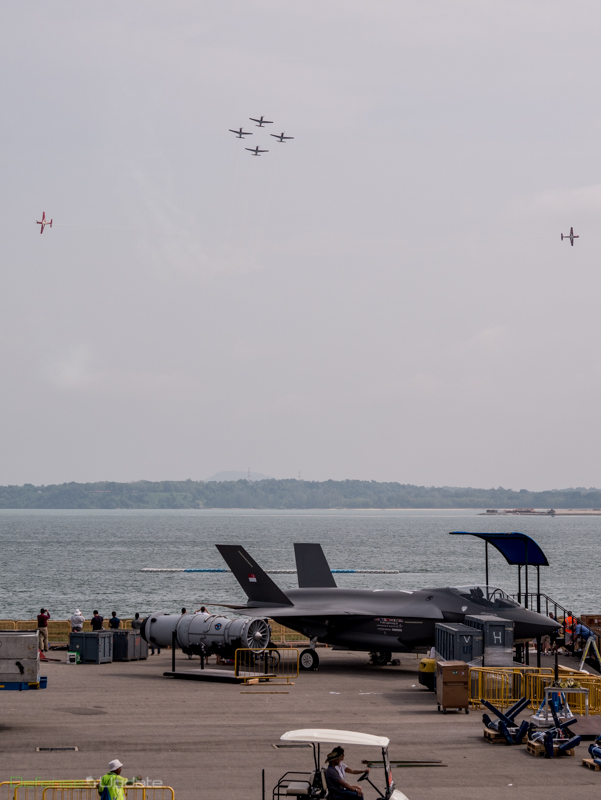
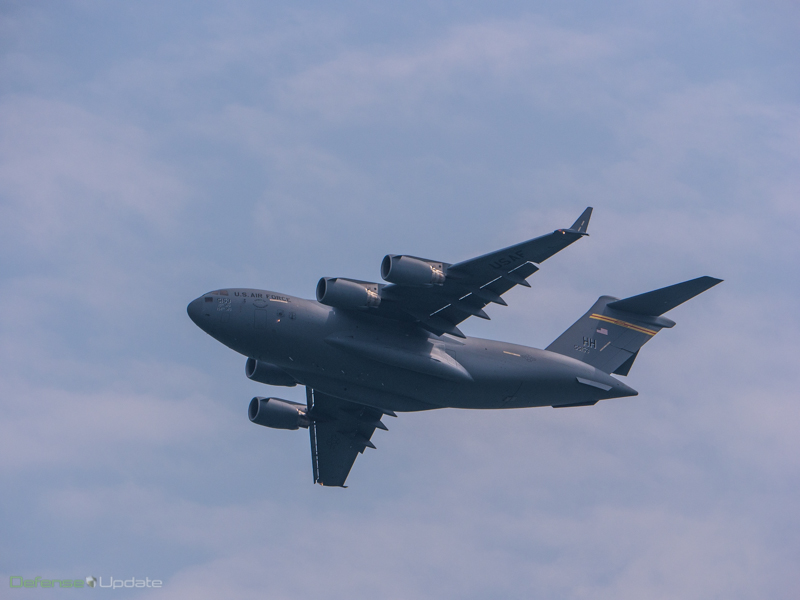
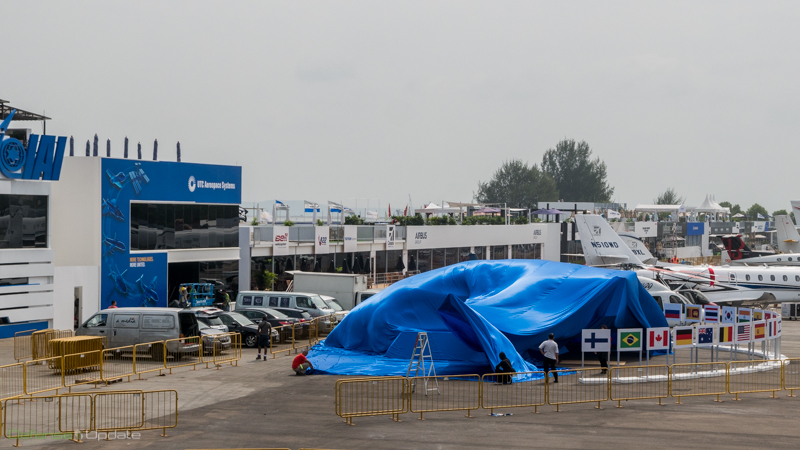
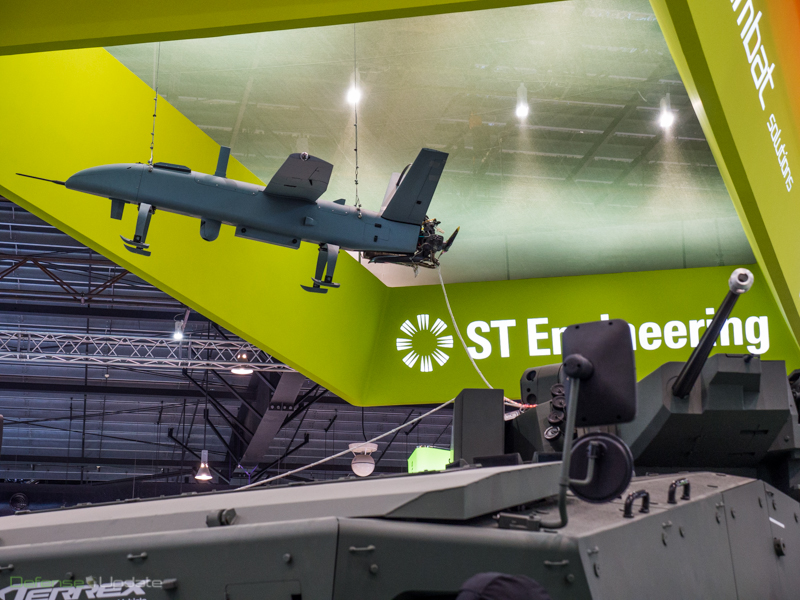
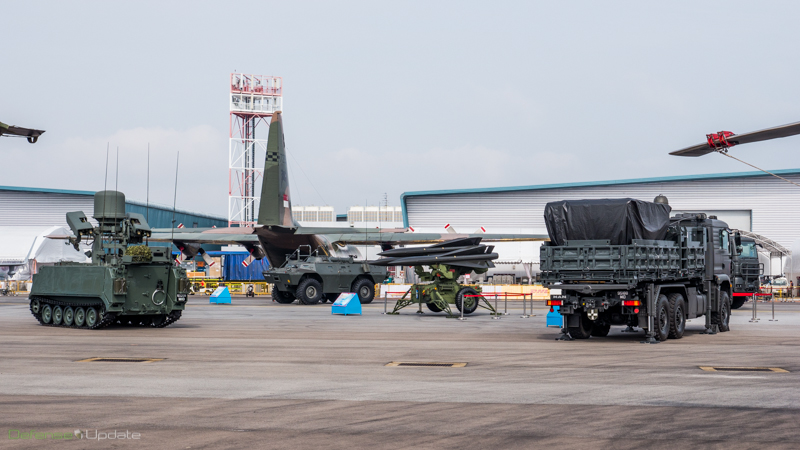
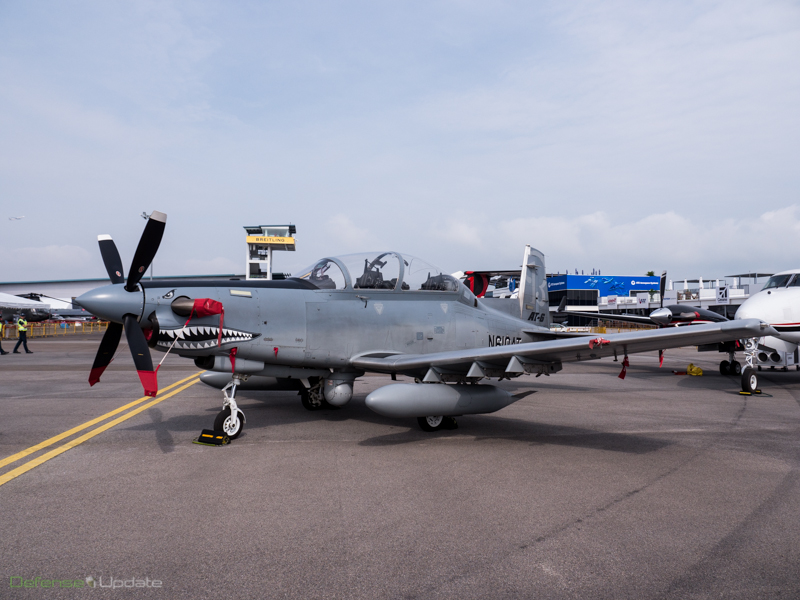
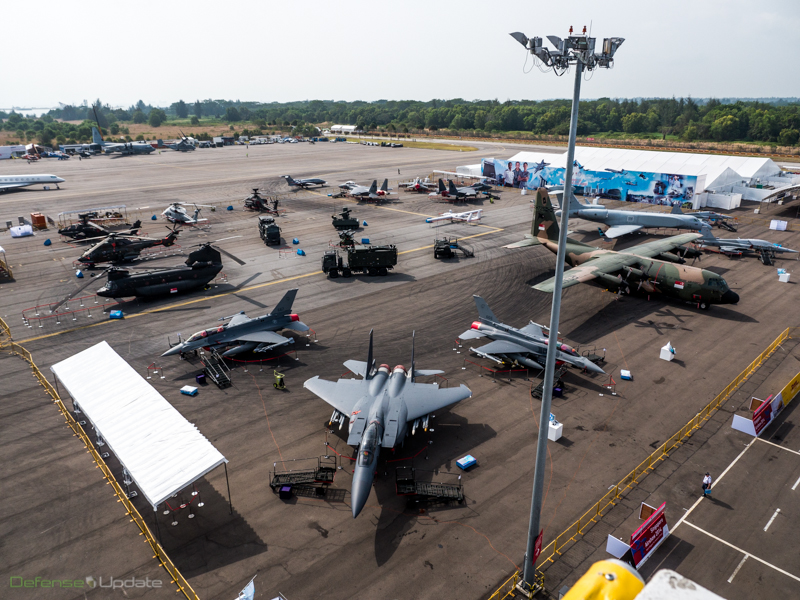
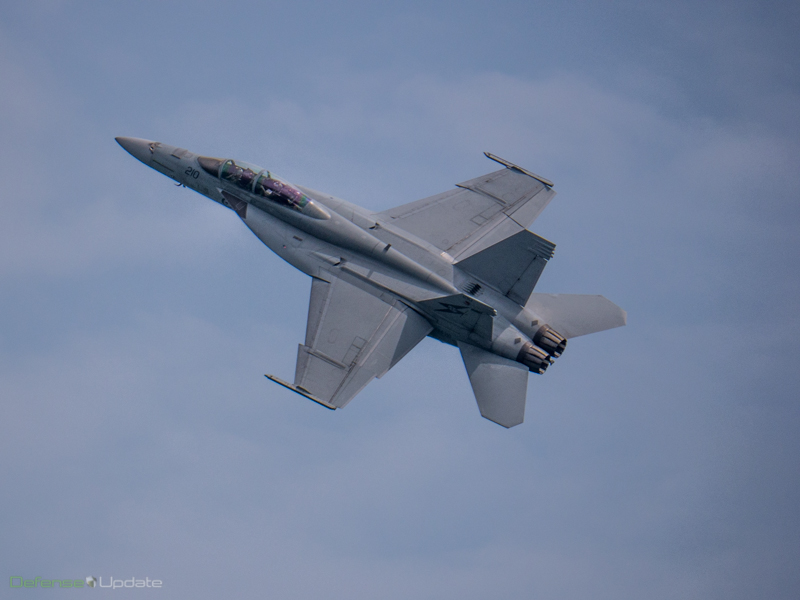
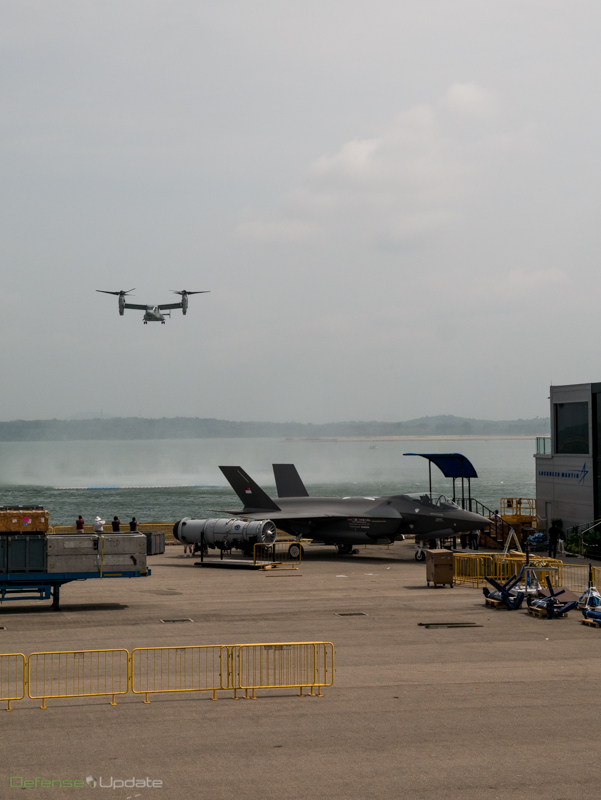
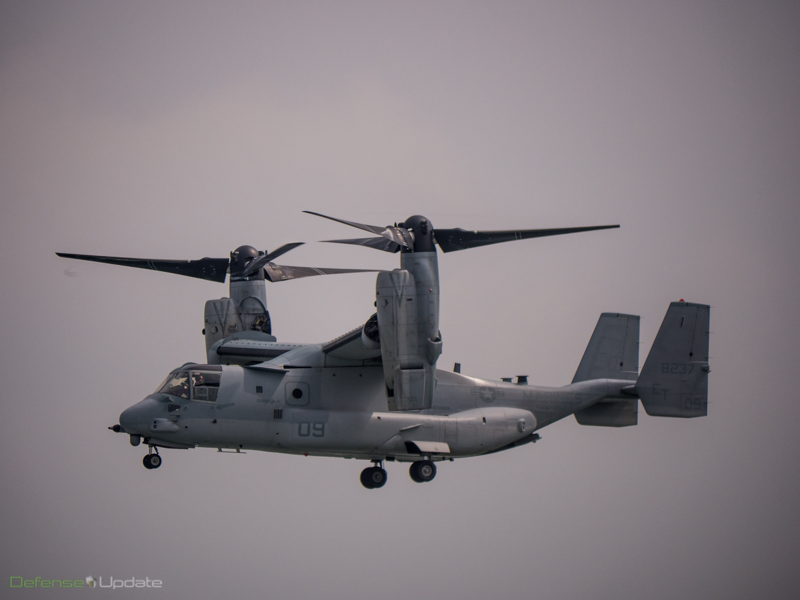
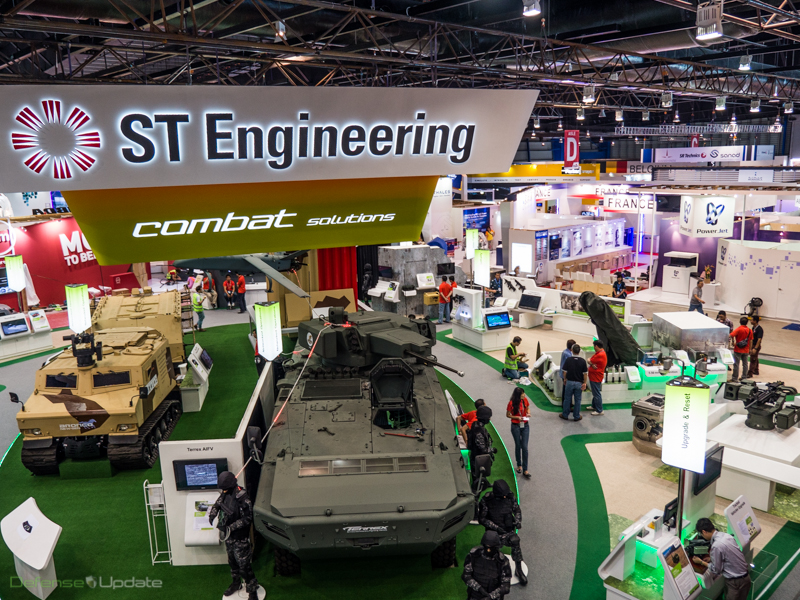
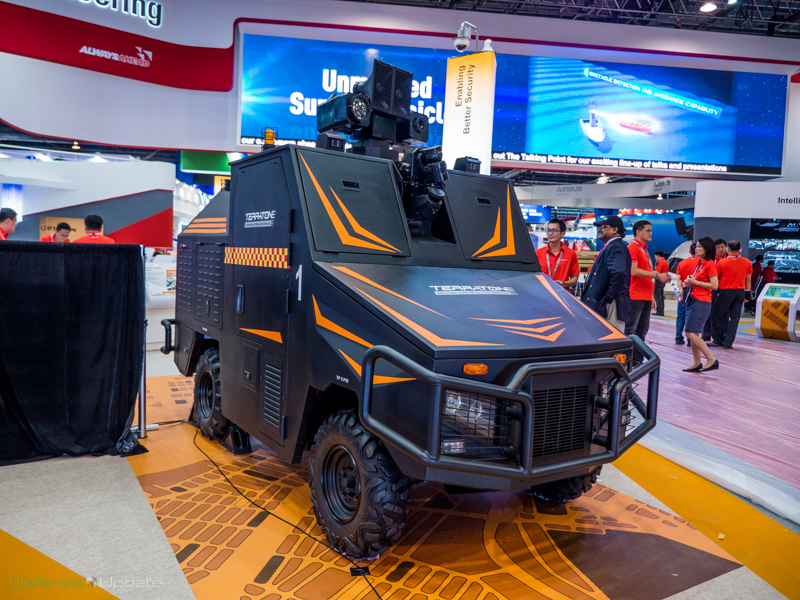
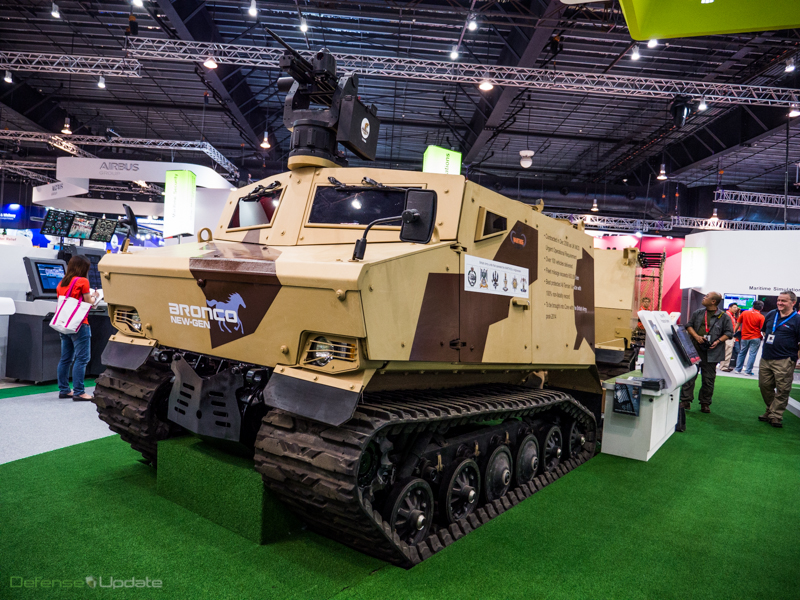
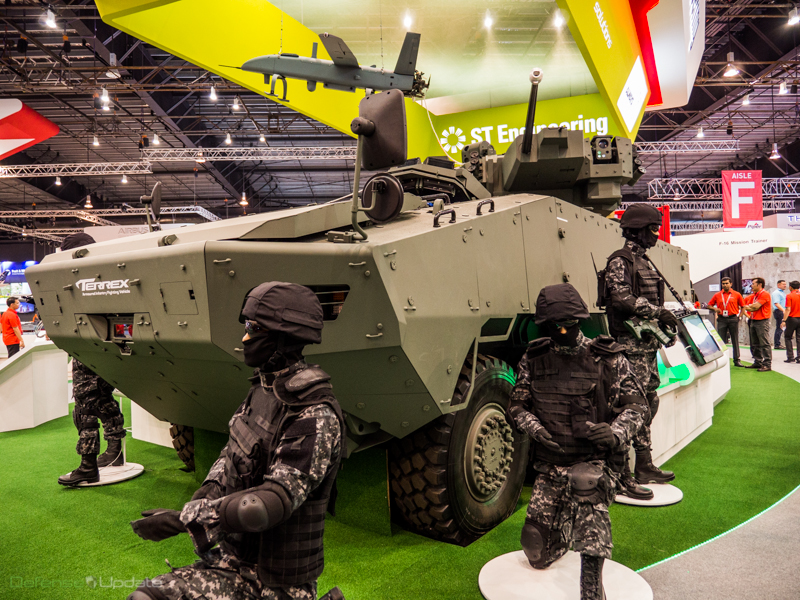
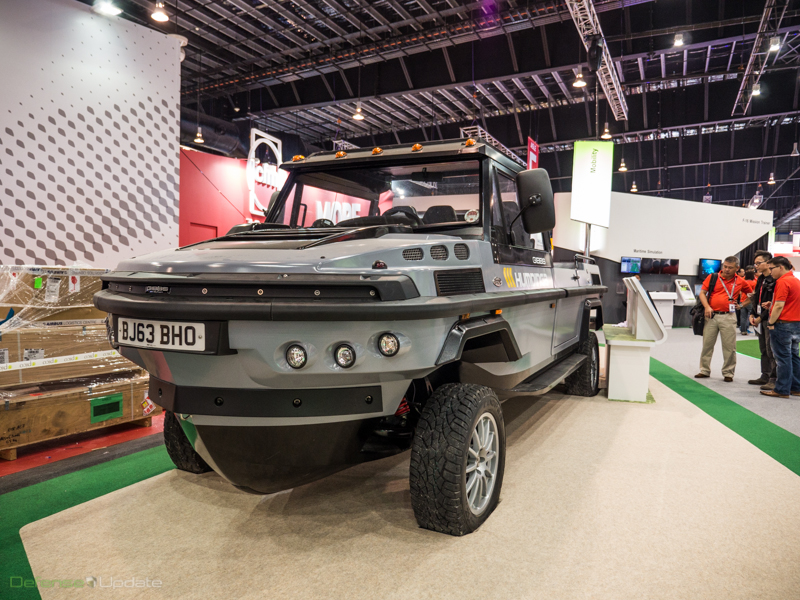
Another visiting aerobatic team is the ‘Jupiters’ from TNI-AU – the Indonesian Air Force, flying with six KT-1B Woong Bee. Photo: Noam EshelPart of the from the Jupiter flight demonstration team from the Indonesian TNI-AU. The “Jupiter Aerobatic Team” is the current Indonesian Air Force aerobatic display team flying with six KT-1B Woong Bee aircraft painted in red and white. Photo: Noam EshelThe USAF Boeing C-17A Globemaster displaying low-level, low speed maneouvers over the waterfront, as part of the Singapore Airshow flight display. Photo: Noam EshelIAI is preparing a surprise for UAV fans. It’s loaded with good stuff that the Israelis will not say anything about, before the official unveiling this coming Tuesday, so stay tuned to see it here on defense-Update as it happens…An example of how the ST Kinetics connected combat team could work, is the integration of the Blade IV UAS and ‘Terex Mothership’ armored vehicle, supporting a squad with firepower, protection, mobility, communications, computing and energy storage. Photo: Noam EshelThis year there is also an interesting representation of air defense systems, with the Israeli Spyder, Improved Hawk (MIM-23) and and , M-113A2 Ultra Mechanized Igla VSHORAD vehicle carrying six Russian Igla air defense missiles and a radar. Photo: Noam EshelHawker Beechcraft AT-6B Texan II displaying a mean face at the Singapore Airshow. Photo: Noam EshelA group photo showing the Singapore Air Force military aircraft park, including F-16E, F-15SG, CH-47 Chinook, Apache AH-64D, S-70B maritime helicopter, Heron I and hermes 450 drones, Gulfstream V CAEW airborne early warning aircraft and C-130H. In total the 17 aircraft static display and the dramatic ‘Black Knights’ RSAF F-16 aerobatic team display will be part of the RSAF is celebrating its 45th anniversary this year. Noam EshelRoyal Australian Air Force F/A-18F Rhino displaying high manoeuvrability at a solo display at the Singapore Airshow. Photo: Noam EshelUS Marine Corps V-22 demonstrates hovering over water with a model of the F-35 at the foreground. Photo: Noam EshelThe Bel/Boeing V-22 Osprey is demonstrating its hovering, fast and slow performance here at the Singapore Airshow. Photo: Noam EshelWorkers at the ST Engineering display are preparing an impressive display that covers the whole group’s activities. Photo: Noam EshelAs part of Singapore technologies engineering innovations, the company displayed the Terratone, an autonomous robotic vehicle designed for homeland security missions. It can be seen here with non-lethal mission payload and situational awareness sensors enabling the vehicle to operate in complex urban terrain. Photo: Noam EshelFollowing a successful service with the British forces in Afghanistan, the Bronco/Warthog is receiving an upgrade in protection (particularly agains mines and blasts), it is will being offered in a more modular configuration, enabling rapid reconfiguration with mission specific modules. Photo: Noam EshelThe concept behind ‘Terex Mothership’ is the provision of total support for the combat troops – from mobility and protection, through firepower, command and control to logistical support. Photo: Noam EshelSingapore Technologies Engineering and Gibbs Amphitrucks are working together to introduce the Humdinga, an amphibious vehicle that can move from land to amphibian mobility without any preparation. Humdinga is a full-time 4WD Amphitruck powered by a 300BHP turbo diesel engine. It is capable of highway speeds on land and over 30mph on water. With the touch of a button Humdinga transitions between land and water in seconds. On water Humdinga utillizes GIBBS Amphibians proprietary HSA twin water jet propulsion technology. Humdinga was developed to access remote destinations and has robust marine, highway and off-road performance. Photo: Noam Eshel
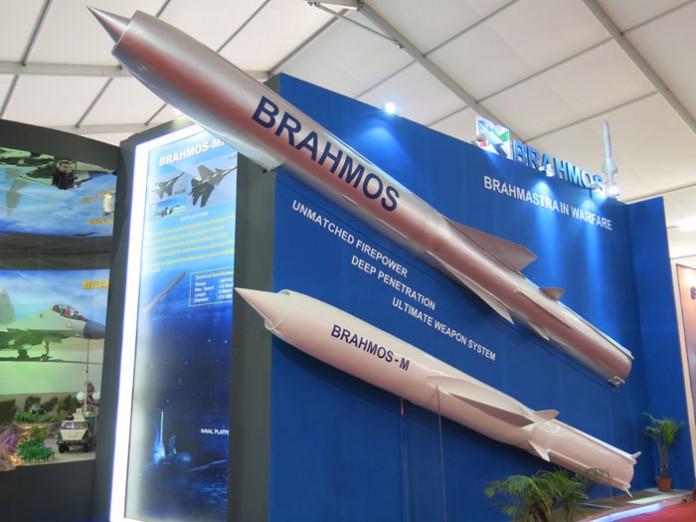
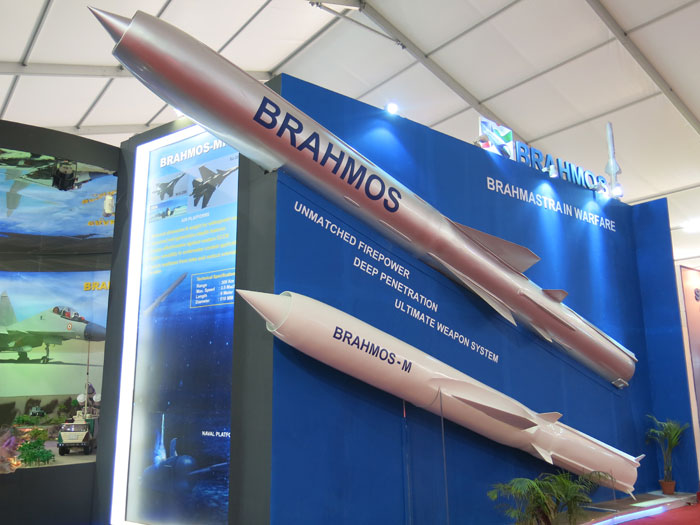
A model of Brahmos M was displayed at Defexpo 14. As the next generation of the current Brahmos, the missile will have reduced dimmensions, lower weight and higher speed, compared to the current BrahMos. It will be three meter shorter, with a diameter 190mm smaller, compared to the Brahmos. Optimized for airborne and tube-launched submarine applications, Brahmos M will have a range of 300 km (290 for Brahmos) and its speed will be increased to 3.5 Mach (2.8 max in Brahmos). The missile will have stealth features to reduce radar signature and will also have improved electronic counter-countermeasures.
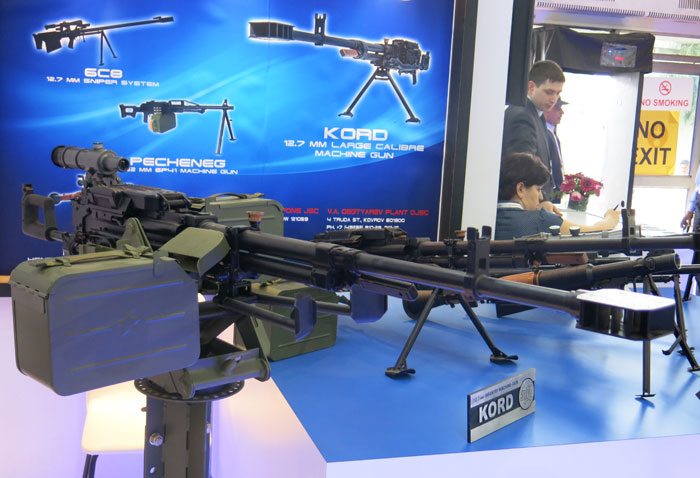
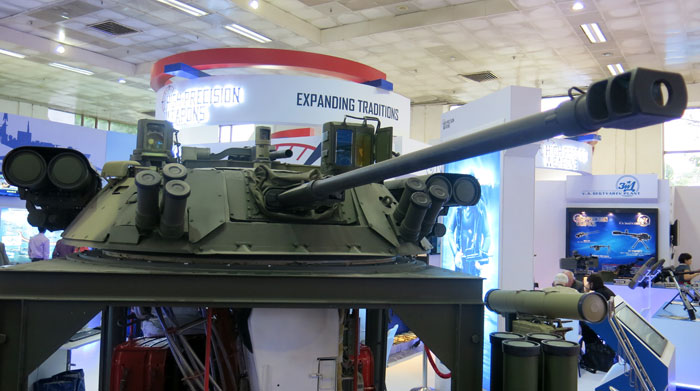
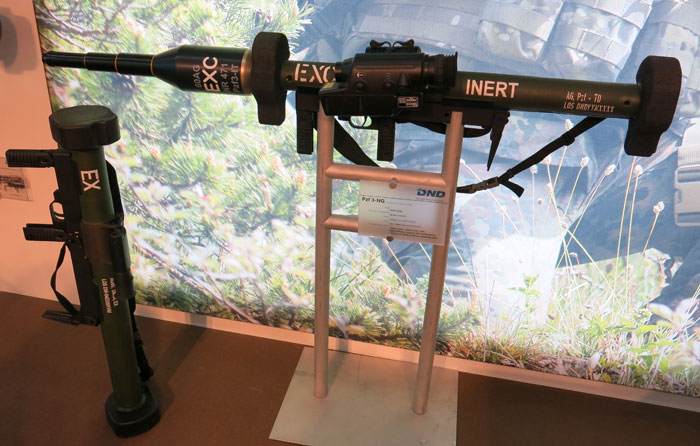
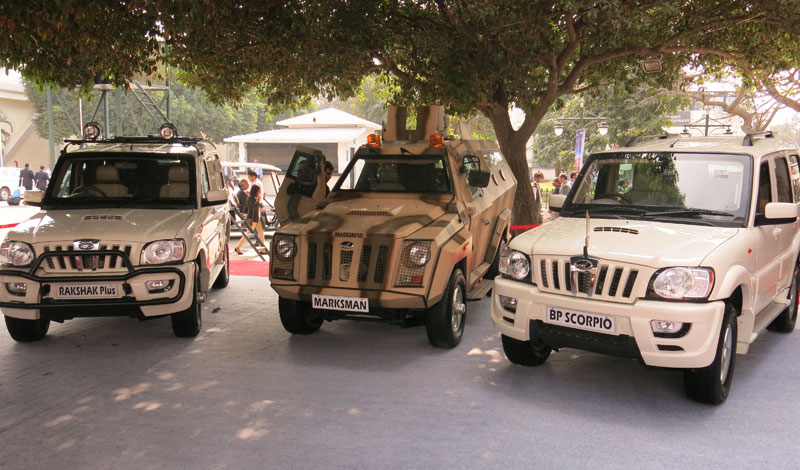
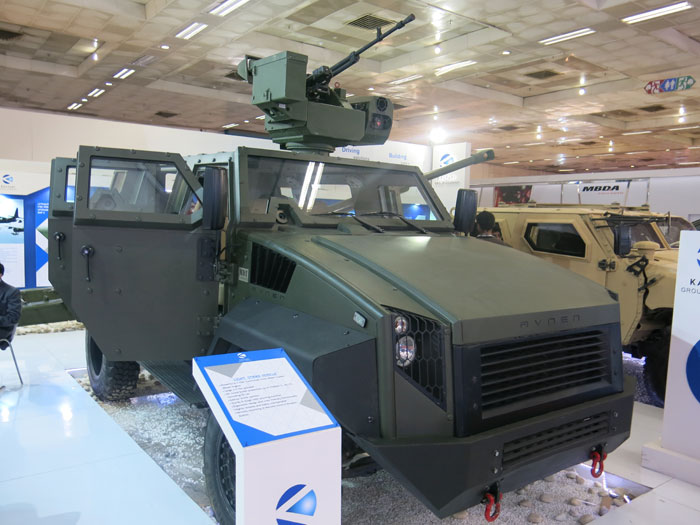
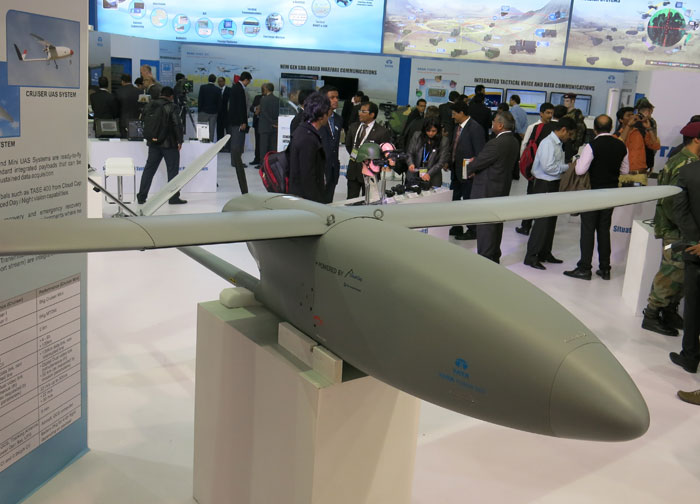
12.7mm ‘Kord’ 6P59 heavy machine gun from the Russian weapon manufacturer Degtyerev.A full scale model of the Berezhok turret developed by KBP Tula for the BMP II upgrade is displayed at Defexpo. Although the system is based on the existing turret, KBP claims it surpasses the existing capability nearly four times, adding full day/night capability, integration of Kornet guided missiles and improved fire controls.RAFAEL’s Samson MkII remotely controlled weapon system mounts the 30mm cannon from ATK and two Spike LR missiles from RAFAEAL. The turret is designed to fit armor protection according to the level specified by the customer. Photo: Tamir Eshel, Defense-UpdateThe German company DND displayed the new Panzerfaust 3-NG with its Daynahawk electro-optical sight, enabling the weapon an effective range of 600 meters. The weapon uses the standard RGW60 launcher with an oversized, tandem warhead designed to defeat all current armor types.A group photo of Mahindra’s armored vehicles – from left to right: Rakshak Plus, Marksman and BP Scorpio.The Raven Light Strike Vehicle, displayed by Kalyani Group is based on MDT’s Tiger. Photo: Tamir Eshel, Defense-UpdateTata Advanced Systems Ltd. (TASL) displayed the ‘Cruiser II’, a mini-drone originally developed by the Slovenian company ETAIR-UAV. At Defexpo the Cruiser that weighs 50 kg Max. Takeoff carries the Cloudcap TASE400 gimballed EO payload. The company also displayed the smaller ‘Mini Cruiser’, designed for six kilogram MTOW. Last month TASL has emerged as the lowest bidder for a contract for mini-unmanned aerial vehicles (UAV) from the Indian Army’s Northern Command.
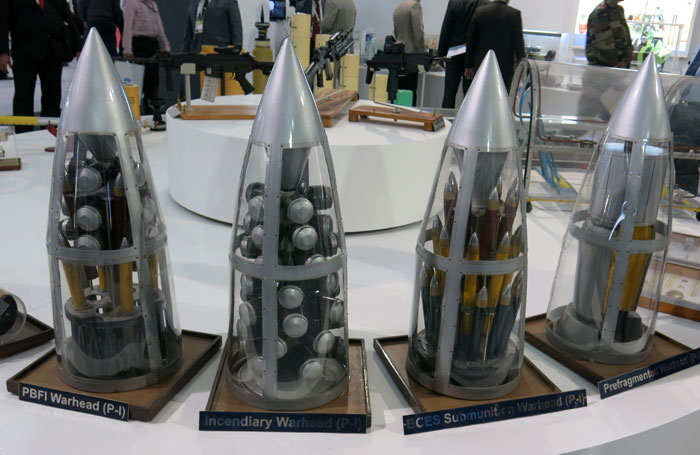
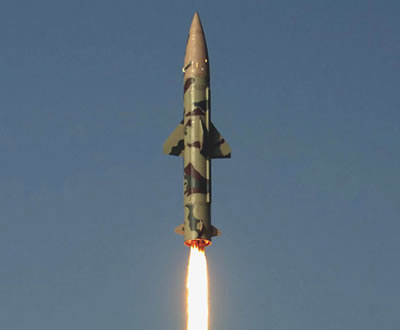
A model of Brahmos M was displayed at Defexpo 14. As the next generation of the current Brahmos, the missile will have reduced dimmensions, lower weight and higher speed, compared to the current BrahMos. It will be three meter shorter, with a diameter 190mm smaller, compared to the Brahmos. Its weight will be 1500kg, about 500 less than Brahmos. Optimized for airborne and tube-launched submarine applications, Brahmos M will have a range of 300 km (290 for Brahmos) and its speed will be increased to 3.5 Mach (2.8 max in Brahmos). The missile will have stealth features to reduce radar signature and will also have improved electronic counter-countermeasures. The new missile could be operational by 2017, on Indian Su-30MKI, MiG-29 and MiG-29K of the Indian Army and Naval Aviation arm.A deadly family of warheads developed by the Defense Research and Development Organization (DRDO) for the Prithvi missile. From left to right: a combined cluster of anti-armor and incendiary bomblets, a warhead loaded with incendiary cluster, a load of penetrating darts and prefragmented, unitary blast-fragmentation charge.
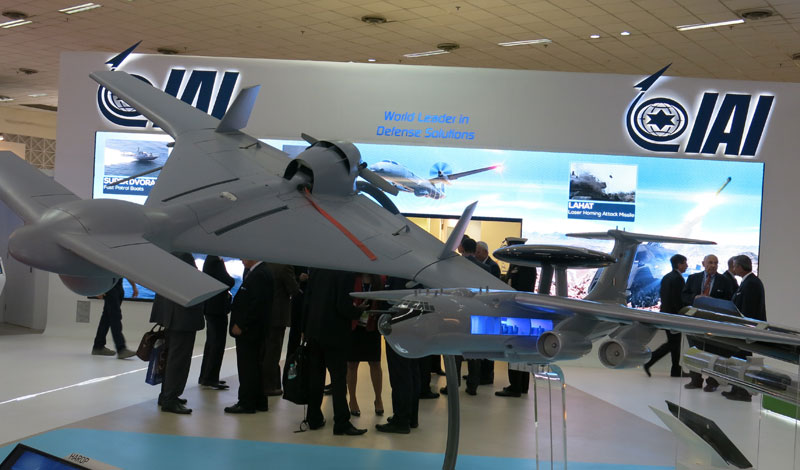
IAI is participating at DEFEXPO 2014 with a large display of capabilities in space, air, land and sea. Photo: Tamir Eshel, Defense-Update
With two of the major Israeli companies IAI and RAFAEL cleared from the bribery investigations that have casted shadows on business and dried out new contracts for months, the recent clearing of the Israeli companies form suspicion are likely to re-open the Indian wallets once again, moving forward with a number of programs that were on the waiting list for quite some time.
IAI is participating at DEFEXPO 2014 with a large display of capabilities in space, air, land and sea. Photo: Tamir Eshel, Defense-Update
Barak I is one of those programs. Admittedly an old (yet not obsolete) system, Barak I is still the principal point defense system protecting Indian surface combatants and the missile boats of the Israeli Navy. In recent years the missiles used for testing and training have gradually depleted war ready stocks, and the Navy desperately needs replenishment stocks that are likely to be released now, as the shadow of investigation cast away. Barak I is one of the systems protecting India’s ‘indigenous’ surface combatants, along with a number of associated radars and other combat systems provided by Elta, IAI and other Israeli and foreign suppliers. Another missile program currently underway is Barak 8, also known for its designation – MRSAM. The missile developed by IAI MBT and DRDO is positioned to be the ultimate anti-air medium-range weapon, designed to defeat any threat – ballistic, cruise, or guided missile that may challenge the protected vessel. The program has been delayed for considerable time. Although most of the delays are derived by technical and coordination issues between India and Israel, the program has shown progress recently and is expected to reach system integration testing soon.
Avionics systems are another area for cooperation between India and Israel. The leading authority for the collaborative work in this area is Hindustan Aeronautics Limited (HAL) which has teamed with Israeli Aerospace Industries to integrate the EL/M-2052 active electronically scanned array (AESA) radar in the Indian Indigenous fighter – the LCA. This advanced radar will provide the LCA superior combat capabilities, compared to any jet fighter using standard radars. Although the LCA is referred to as ‘indigenous’, this aircraft is filled with foreign systems. For example, none of the indigenous weapons developed for this indigenous fighter have reached maturity, and the Indian Air Force is now seeking the integration of Israeli missiles, including the Python V imaging infrared (IIR) homing missile and Derby Beyond-Visual-Range RF guided missile on this platform. The Israeli targeting pod – Rafael’s LITENING, will also equip this fighter.
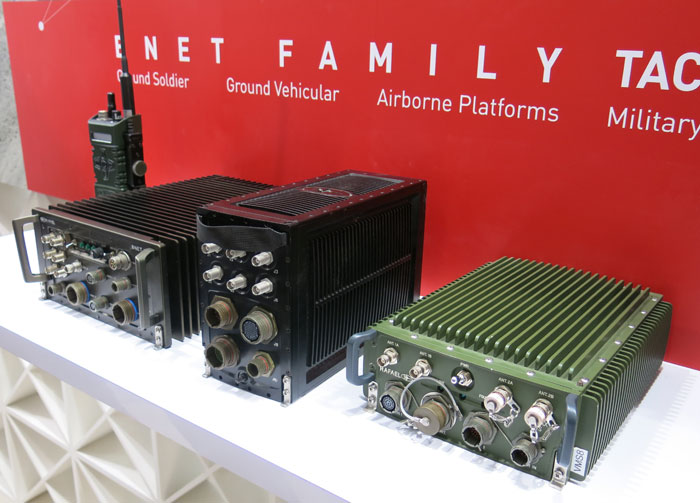
RAFAEL BNET Family systems are modern software defined radio modules enabling high capacity data transfer and voice communications. Photo: Tamir Eshel, Defense-Update
Both RAFAEL and IAI were recently shortlisted to compete in the prestigious Airborne SDR (software defined radio) tender, offering the Indian Air Force a modern, high capacity data and voice network that will eventually replace the IAF networks and airborne datalinks. The two Israeli companies were the only ones that managed to pass the challenging selection process conducted by the air force labs.
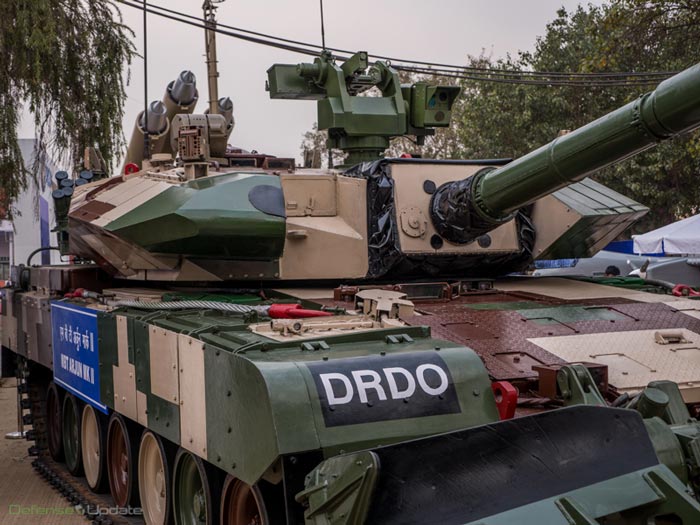
Part of the systems mounted on the Arjun MkII Main Battle Tank are of Israeli origin, these include the commander’s independent sight and laser warning systems seen on the turret. Photo: Noam Eshel, Defense-Update
On land, indigenous systems are also relying on Israeli systems. For example, the new Arjun Mk II tank, a new and improved version of the Arjun is relying on a number of Israeli hardware, primarily from Elbit Systems. These include the commander’s independent sight and gunner’s optronics, laser-warning devices and active countermeasures against guided weapons. Many of the improvements implemented in the Arjun Mk II were based on a study and recommendations done by another Israeli company – IMI, which has since banned from India for 10 years, following allegations of bribery by an independent consultant that was associated with the company. While IMI has to wait years until it can rebuild its operations in the country, its investment and contribution into the improvement of the tank’s armor, weapon system and mobility will benefit and protect the Indian warfighter for years to come.
Realizing many of the developments could be produced in India, the government is insisting on major procurement programs to be produced in the country, through joint ventures and affiliated companies that share up to 26 percent of foreign ownership.
Israeli companies were quick to take this opportunity, seizing large contracts for communications systems, night vision devices, weapon sights, simulation systems, ammunition and more. These JVs are likely to be elevated to larger systems, with the establishment of several cooperation agreements announced last year. One such agreement is a JV between Elbit Systems and Bharat Forge, for the joint development and manufacturing of artillery systems. IAI and Tata have struck another deal, aiming at unmanned systems while RAFAEL has already established cooperation with India’s leading missile house Bharat Dynamics and is negotiating several JVs with corporations in the government owned PSU and private sector undertakings, these JVs are likely to focus on evolving opportunities related to missile technologies.
weapons and developed by IAI Elta. for joint development of have entered into joint development programmes to manufacture Chetak helicopters into ship-borne UAVs, and the Indian Navy has placed an order for eight such machines.
The scope of Elbit Systems’ involvement in defense programs in India has not been published but this market is considered to be a of a substantial part of the company’s turnover. At Defexpo Elbit Systems displayed the unmanned aerial systems it would like to introduce in the market, while artillery systems and electro-optical systems for tanks and armored vehicles were displayed by Elbit Systems customers and business partners in India. Photo: Tamir Eshel, Defense-Update
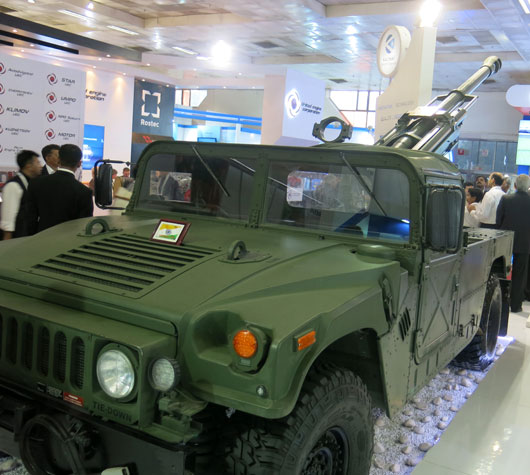
At a weight of less than one ton, and soft recoil technology, Garuda 105 can be mounted on light tactical vehicles such as this HMMWV. Photo: Tamir Eshel, Defense-Update
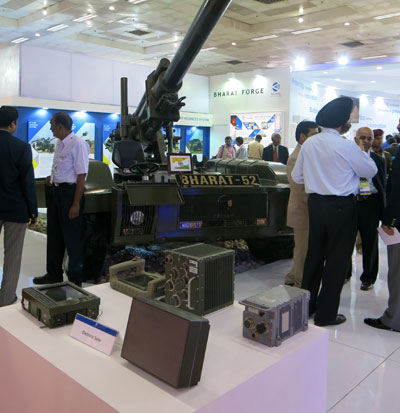
Bharat 52 is a self-propelled variant of the 155mm/52Cal gun produced in India by Bharat Forge. The system uses self-propelling capability and automatic laying, enabling rapid ‘shoot and scoot’ even with towed guns. The self propelling system can move the cannon at a speed of up to 30 km/h, and provide sufficient mobility for change of positions. The system weighs 14 tons and has a maximum firing range of 41 km, with 3-5 rounds per minute rate of fire.The joint venture company set up by Bharat Forge and Elbit Systems will also provide electronic systems for artillery systems including computerized equipment and software applications (left), handheld data display unit (far left), mission and ballistic computer, navigation equipment (right) and muzzle velocity measurement radar (front). Photo: Tamir Eshel, Defense-Update
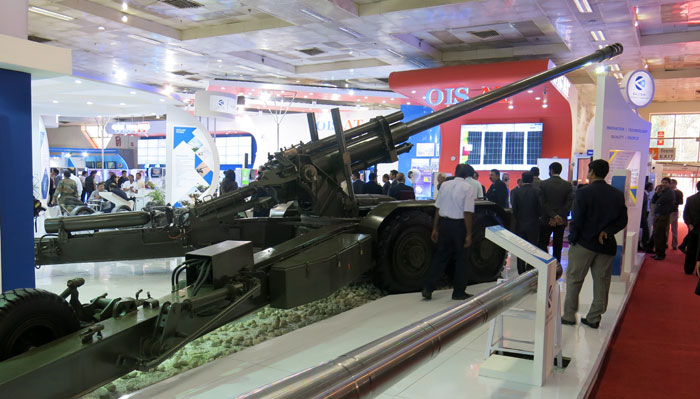
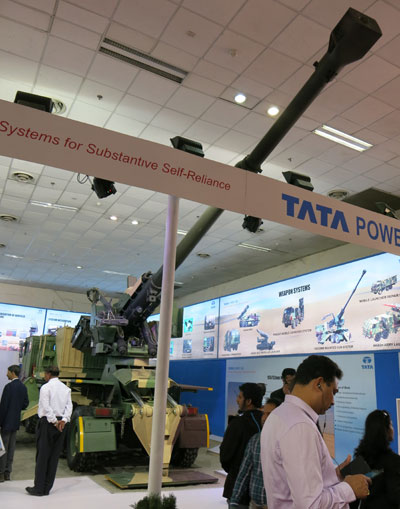
With upgrades and modernization for its artillery systems long overdue, the Indian Ministry of Defense is likely to make heavy investments in this field in the coming years. Among the systems being replaced or fielded are towed guns, self propelled howitzers, mobile gun systems (truck mounted), self propelled guns carried by tank chassis, self propelled (trackd) guns and lighweight artillery supporting light, mountain and special forces. Traditionally, production of weapon systems Private sector, Both Tata Power, Larsen & Turbo and the Kaliani Group’s Bharat Forge units – all private sector companies owned by some of India’s largest commercial conglomerates. All these groups are vying for part of the Indian artillery pie and all have teamed with foreign companies to offer operationally proven designs. For the mobile gun system (MGS) the French Nexter unveiled here a lightweight variant of CAESAR, carried by a Super Stallion truck built by Ashok Leyland. Bharat Forge and Elbit Systems are also offering variants of the ATMOS, as part of the JV’s growing portfolio. Elbit Systems is the original equipment manufacturer (OEM) of the ATMOS. (Soltam, the original designer of ATMOS is currently part of Elbit Systems Land Systems division). ATMOS has also been deployed with a number of armies, including Azerbaijan, Cameroon, Uganda and, most recently Thailand, which has received a new low-profile version of the ATMOS. The Israel Defense Forces are also interested, but as happened with many armies in recent years, spending on artillery modernization has been delayed. ATMOS has been developed as an autonomous and open system that can be integrated on every suitable truck, a concept that was proven even in ‘limited editions’ comprising a small number of trucks.
At a weight of less than one ton, and soft recoil technology, Garuda 105 can be mounted on light tactical vehicles such as this HMMWV. Photo: Tamir Eshel, Defense-Update
GARUDA 105, an ultra light light weight mobile gun system was displayed by Bharat Forge, based on an indigenous design. At a gross weight of one ton (compared to three tons for other, average artillery pieces) the Indian Garuda 105 incorporates soft recoil technology that enables it to mount on standard tactical vehicles such as HMMWV or other prime movers.
The Mobile Gun System proposed by Tata Power uses the G6 155mm/52Cal gun developed by Denel. Photo: Tamir Eshel. Defense-Update.
Tata Power is also competing with a truck mounted G6 gun from Denel. Tata power is responsible for the design, development and manufacturing of the system; the understructure, hydraulics, fire control. The company will locally produce the barrel, breech system and muzzle break, gun, based on technology transfer provided by Denel. The gun system is fitted with an automatic rammer, feeding from a three-round magazine, and an integrated crane for ammunition loading. The laying and navigation system comprises of Ring Laser Gyro inertial sensor and weapon management system.
The Pune based engineering technology focused Kalyani Group is intensifying its efforts in addressing the requirements of Indian defence sector. The company is expanding its legacy operations in metal forging and processing, entering defence, aerospace and nuclear areas of activity.
In the past 3 years, the Kalyani Group has invested sizeable resources to develop a wide range of products and technological capabilities to manufacture various critical items of defence systems, equipment and components. This move is part of a new strategy to help and contribute towards indigenization efforts of the Indian Defense sector, reduce the country’s dependence on imports and save precious foreign exchange through large scale indigenization. Chairman of the group Baba N. Kalyani said with a host of artillery products his company wants to become a globally known artillery house. “But for that we would need to the accepted in India as only then will other countries accept us. the Hindo reported.
“Kalyani Group is determined to scale up its contribution to the armed forces and play a vital role in India’s defence sector by providing a range of technology-intensive state of the art weapon systems.” Baba N Kalyani, Chairman of Kalyani Group stated. “We are encouraged by Government of India’s clear intent to ramp up domestic defence capabilities and as a Group, our focus would be to become a major player in the land systems segment.”
Bharat 52 is a self-propelled variant of the 155mm/52Cal gun produced in India by Bharat Forge. The system uses self-propelling capability and automatic laying, enabling rapid ‘shoot and scoot’ even with towed guns. The self propelling system can move the cannon at a speed of up to 30 km/h, and provide sufficient mobility for change of positions. The system weighs 14 tons and has a maximum firing range of 41 km, with 3-5 rounds per minute rate of fire.At a weight of less than one ton, and soft recoil technology, Garuda 105 can be mounted on light tactical vehicles such as this HMMWV. Photo: Tamir Eshel, Defense-Update
Other systems are based on cooperation and joint ventures with foreign companies, that are willing to provide technology and knowhow to establish local manufacturing, support and eventually, self sufficiency for the Indian military.
Kalyani group has recently forged a joint venture with Elbit Systems of Israel for advanced technology manufacturing of modern gun systems & Mine protected vehicles in India. With our partner we are competing in number of important artillery programs and are hopeful of bringing the best to the armed forces. JV will undertake major manufacturing within the country.
The company intends to bid for several opportunities with the Indian Army artillery, including the Mobile Gun System, for which the ATMOS truck mounted howitzer is offered. Other types include the ATHOS self propelled cannon, and towed artillery acquisition plans.
“With our partner we are competing in a number of important artillery programmes and are hopeful of bringing the best to the armed forces. The joint venture will undertake major manufacturing within the country,” he said.
The group has also signed an agreement with SAAB of Sweden to provide Air Defence Solutions. “The partnership with these two major defense companies will strengthen the Kalyani group capabilities within the defence space.” Kalyani added.
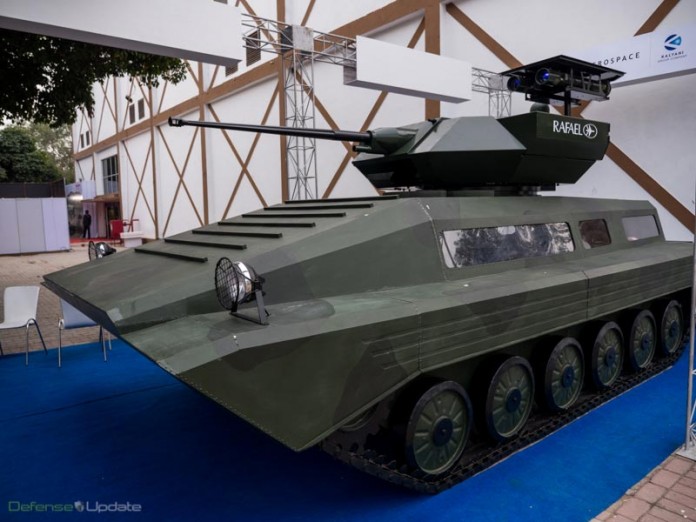
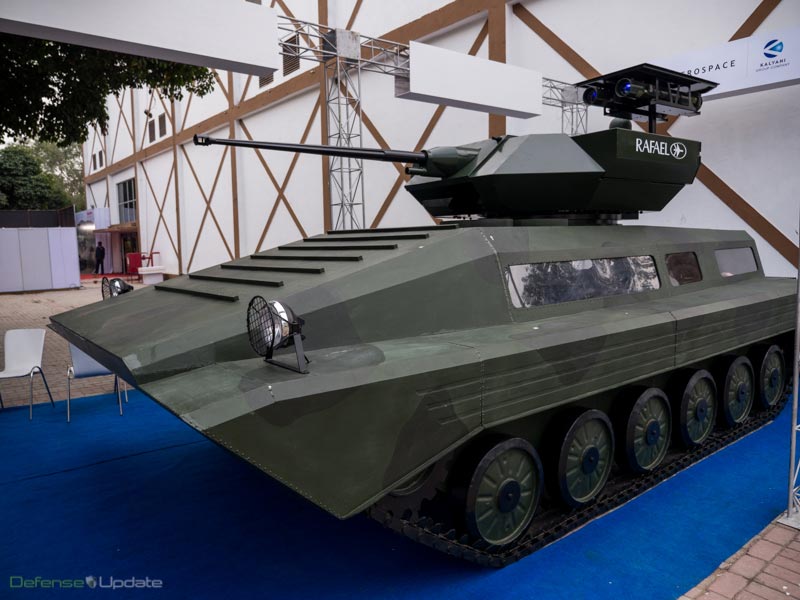
Another prospect the company is pursuing is the upgrading of the BMP II armored vehicle used by the Indian army. At Defexpo the company is displaying a full scale model of the new design, employing firepower upgrades based on RAFAEL’s Samson Mk2 remote weapon station. The weapon station has full protection for the weapon system and optronics, and has an opening enabling the crew to reload and operate the gun under armor protection. The new system is much lighter, compared to the original BMP II turret. Since the turret does not penetrate the armor, the new system clears valuable space inside while reducing more than half ton in the vehicle weight.
RAFAEL’s Samson MkII remotely controlled weapon system mounts the 30mm cannon from ATK and two Spike LR missiles from RAFAEAL. The turret is designed to fit armor protection according to the level specified by the customer. The turret includes two optronic sights – both MiniPOP, one for the gunner and the other, providing an independent sight for the commander. Photo: Tamir Eshel, Defense-Update
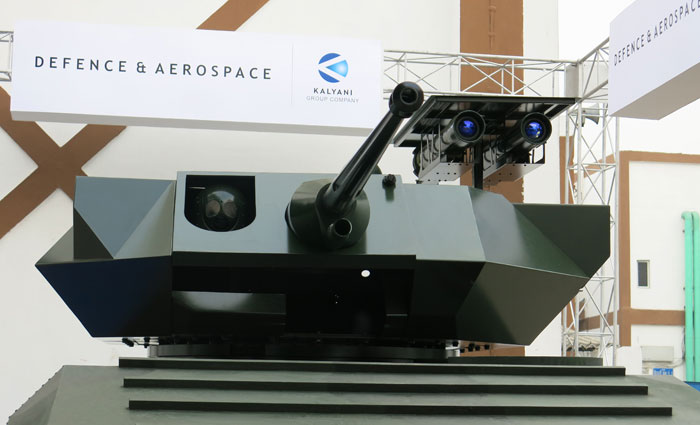
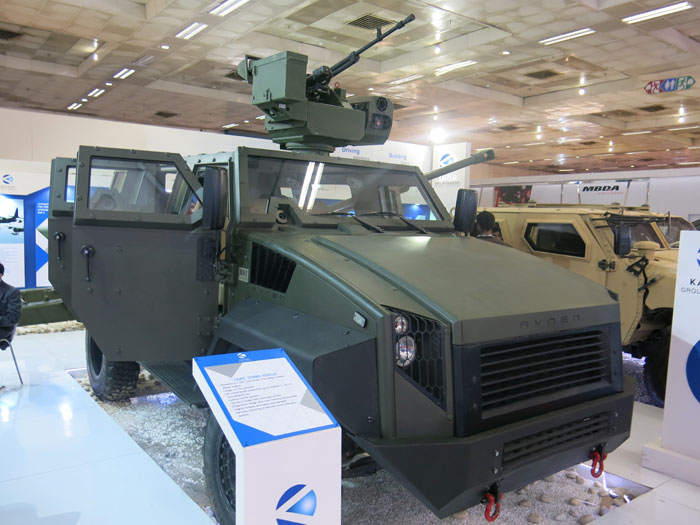
Another product the company has adopted from an Israeli company is the Raven Light Strike Vehicle. This powerful armored vehicle is based on the Tiger, developed by the Israeli company MDT. As an all-protected vehicle Raven meets STANAG 3 (NIJ IV) ballistic protection, including 0.5Cal. It can also can take add-on armor for increased protection. The vehicle can carry 2.5 tons of payload, including a remote weapon station.
The Raven Light Strike Vehicle, displayed by Kalyani Group is based on MDT’s Tiger. Photo: Tamir Eshel, Defense-Update
India and Israel will jointly build an integrated anti-missile system to be deployed against Chinese nuclear and conventional missiles. Defense News reports from Defexpo.
The proposed missile defense program will see participation by Rafael and Israel Aircraft Industries in partnership with DRDO and state-owned Bharat Dynamics Limited (BDL) and Bharat Electronics Limited (BEL).
the Modular Integrated C4 Air Defense (MIC4AD) system from Rafael. Photo: Tamir Eshel, Defense-Update
The system will integrate the homegrown Prithvi air defense system, which is ready for induction next year, with the mobile detection radar being built by BEL in partnership with IAI. In addition, DRDO and BEL will work with IAI and Rafael for this program. An executive from Rafael said his company has offered to build a dedicated C4I system for the program. India does not yet have a C4I system for missile defense threats, the executive added
Indian MoD sources said talks have been underway on the integrated missile defense program for over six months, but gave no details on the program’s fate.
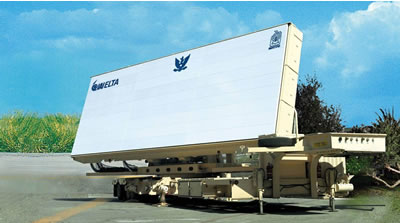
Israel Aerospace Industries has developed the Super Green Pine radar to enhance its Arrow II ballistic missile defense systems. Green Pine radars have already been deployed in India, and are becoming part of the missile defense system evolving in the country. (Photo: IAI)
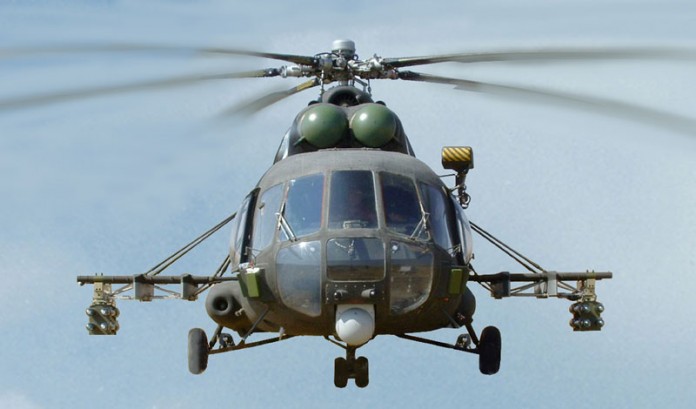
LAHAT missiles carried under the wing pylons of Mi-17 helicopter. n this configuration the Mi-17 can carry 16 guided missiles capable of striking targets with pinpoint precision from 10 kilometers away. Photo: IAI.
Israel Aerospace Industries (IAI) has successfully completed a series of firing demonstrations of the Laser Homing Anti-Tank (LAHAT) missiles firing from helicopters in which the missile successfully engaged targets at extended ranges.
LAHAT missiles carried under the wing pylons of Mi-17 helicopter. n this configuration the Mi-17 can carry 16 guided missiles capable of striking targets with pinpoint precision from 10 kilometers away. Photo: IAI.
The recent firing demonstration comprised eight successful launches, carried out against stationary and moving targets, at ranges of up to 10 km, and altitudes of 300 to 6,000 feet. Missiles were fired helicopters both from moving and hovering positions. The tests included firing at direct fire and Non Line Of Sight (NLOS), with engagement at extended range using the helicopter’s observation capability with remote laser designation by a ground unit.
The Heliborne LAHAT system comprises IAI’s MOSP3000D observation payload with designation capabilities, a Weapons Control System (WCS) and two quad pack missile launchers. In October 2013 IAI announced an award of a ‘substantial contract’ for the delivery of LAHAT missile systems, to be used as a primary weapon system for combat helicopters.
The LAHAT quad launcher mounted on the Mi-17. Photo: IAIIn the late 1990s and mid 2000s, with the IDF and other military forces began focusing on ‘aerial dominance’, the LAHAT missile was adapted to airborne platforms, with the development of the lightweight Quad Launcher and helicopter weapon system. By the mid 2000s the missile was tested on several airborne platforms, including assault, scout and attack helicopters such as the AH-1 Cobra, Mi-8/17, MD530 and the Indian Advanced Light Helicopter (ALH Druhv). The current contract is likely to be the first production of the missile.
Originally developed as an anti-tank guided weapon, the LAHAT is offered with a range of mission-customized warheads. The weapon is particularly suitable for as a helicopter carried weapon, as the lightweight missiles and their associated launcher do not adversely affect the helicopter’s effective mission time. The lightweight system enables the LAHAT System to be adapted to most all helicopter types, including the light scouts. Other applications include ship-borne, vehicles and gun-fired configurations from Main Battle Tanks.
Oron Oriol, RAFAEL’s VP Marketing & Business Development
Rafael is coming to Defexpo this year after implementing a major restructuring process, in which the company dissolved its old product-focused organisational structure into into a leaner, customer oriented structure. “The new formation enables Rafael to better align its offering to meet customer requirements, particularly with complex, modern ‘systems of systems” Oron Oriol, the company’s Executive Vice President Marketing told Vayu Aerospace. “It also garners closer focus our activities to best address customer requirements.”
The new formation eliminated the old structure to create three new divisions, along with the establishment of cross-corporate support groups. These three include the Air Operations and Intelligence, Division, Air Superiority Division and Land Systems Divisions. Several cross-organizational groups were also created, providing common engineering, manufacturing, and testing supporting the three divisions activities.
“I am confident that when requirements for longer-range precision attack weapons are laid out, the SPIKE NLOS that we are also displaying here at DEFEXPO will come to the limelight.”
“Missiles have always been the core of RAFAEL’s activity, and at Defexpo we are highlighting a number of the missiles we are currently offering in India” Oriol continued, “We highlight the missiles, Along with other systems that are supporting those capabilities, from sensors and target acquisition systems, intelligence gathering, command, control and communications to cyber warfare systems and homeland defence.”
After over a decade of continuous activity in the country, RAFAEL’s sales in India span over many programs; “India is one of our most important international markets” Oriol said, “It is a strategic market for Rafael.”
Among the leading programs highlighted at DEFEXPO this year are the SPIKE missiles. “We offer our Spike MR anti-tank missile to the Army and the extended range SPIKE ER missile to equip Army helicopters. We are focusing on these two variants as these are the more mature requirements.” Oron explains that RAFAEL also has other variants of the SPIKE, considered one of the most widely used among modern anti-tank missiles – “All variants are battle proven and operational with many armed forces worldwide.” According to Oron, the Indian customer is very thorough in the preparation and sourcing procedures, therefore, these other systems should not be proposed prematurely, “I am confident that when requirements for longer-range precision attack weapons are laid out, the SPIKE NLOS that we are also displaying here at DEFEXPO will come to the limelight.”
The SPIKE NLOS that can be operated from helicopters, vehicles or naval vessels has been operational with a number of international forces, including the Israel Defense Forces. This missile has no comparison worldwide” Oron said, “Similar to the rest of the SPIKE family of EO guided weapons, in its ability to collect intelligence, obtain target updates throughout its flight and provide last-second impact confirmation, but SPIKE NLOS it unique in its ability to strike pinpoint targets at ranges up to 25 km.” According to Oron, the requirement for such weapon has evolved exclusively in RAFAEL, as we had to address operational necessities faced by our customers.
“as air forces cutting back on their combat aircraft fleets refocus on land-based assets to safeguards their airspace”
Oron highlights another RAFAEL forte – its end-to-end integration of sensors and effectors using electro-optical sensing technology. “RAFAEL provides a variety of imaging sensors, capable of collecting intelligence and acquiring targets at extremely high definition. We also possess different precision-guided weapons that can locate and strike targets by their image. The image thus becomes a new ‘common language’ that best interface between the sensors and shooters in real-time.” Oron explains that this new language alleviates the need for external mediation techniques such as geolocation or laser designation, which require translation, and processing are vulnerable to human error or enemy countermeasures. As a result, this ‘electro-optical language’ facilitate rapid attack cycles, enabling the engagement of targets that appear only for few seconds or minutes at most.
Typical systems supporting this electro-optical ‘sensor to shooter’ cycle include the RECCELITE reconnaissance pod and RECCEU system, supporting unmanned aerial systems (UAS), LITENING targeting pod and TOPLITE E/O stabilised payload on the sensor side, and the SPICE stand-off aerial guided weapon, and SPIKE family of guided multi-purpose missiles.
The ‘air superiority division’ established last year reflects a profound shift in missile applications. ”Moving from the air/air focused operation that characterised our past activities at the missile division, the new division addresses the modern air-defense focused market.” Oriol said. “This trend that is going on for quite some time has intensified in recent years, as air forces cutting back on their combat aircraft fleets refocus on land-based assets to safeguards their airspace.”
Rafael was among the first to address this trend with the Spyder air defense system, employing the same missiles developed for fighter aircraft, on ground-based systems. “We have sold the Spyder to India on one air-defense program, and are currently competing in two additional programs – the QRSAM and SRSAM, where various versions of the Spyder are strong contender.” Oriol confirmed.
According to Oriol, part of the answer to new asymmetric threats, dominated by stand-off attack by unguided ballistic and guided weapons, is the capability to establish credible air defense through a multi-layered defense system that would be able to take out all forms of attack – from aircraft launching their guided munitions from stand-off range to salvos of long- and medium range ballistic missiles and rockets that could be targeting those defensive assets. At DEFEXPO RAFAEL is showing part of the solution, comprising the SPYDER, IRON DOME and an air defense integration system called MIC4AD that would combine multiple assets into such multi-layered defense system.
“India is an important market for each of our divisions.” Elbit Systems President and CEO Bezhalel Butzi Machlis told Vayu, “We have established here a number of joint ventures, with public and private sector units.” To thrive in this market you have to believe in it play for the long run Machlis explains in an exclusive interview for Defense-Update.com and Vayu Aerospace.
The government requirement to limit foreign ownership of JVs to 26 percent is also a tough one, but sofar Machlis said Elbit has managed to cope. “ These JVs enable us to merge our technologies and systems, tailoring the right operational solution to meet the customer’s requirements. I hope that we’ll be able to increase our share in the future, if new policy is implemented. It will enable us to bring more technology and know how, and bring even more capabilities to these JVs. “ Machlis said.
“We sees artillery far beyond the barrel and projectile, since artillery is perfectly weaved into Elbit Systems’ core competencies”
An example for such a successful cooperation is in the field of artillery – one of the most promising areas for Elbit Systems in India, and one where Machlis says Elbit Systems is bringing a unique value to the table.
“We sees artillery far beyond the barrel and projectile, since artillery is perfectly weaved into Elbit Systems’ core competencies. On one hand, these systems blend clear operational requirements, accurate ballistics, and measurable data and orderly procedures that can be transformed into effective and streamlined mechanized and computerized processes. “ Machlis noted.
“What we can offer is to take this transformation to the next level – through networking and integration with modern command and control, yielding dramatic operational benefit. In fact, a modern artillery gun is a highly sophisticated robot, operated that will be operated by a reduced crew. You take a great cannon, and enhance it with robotic system that replaces a crew of seven hands that perform manual processes with three operators that control a much faster and efficient robotic machine. Everything here is linked to advanced computing, hydraulics and communications, all are fields Elbit Systems has excelled in.”
“What we can offer is to take this transformation to the next level – through networking and integration with modern command and control, yielding dramatic operational benefit
Winning the towed artillery tender is important in its own merit but, it will also provide an advantage for future opportunities, as the Indian Army moves forward with additional tenders for self propelled howitzers and other systems.
“What are your current JVs here in India? We ask. “We already have a great cooperation with Bahrat Forge, with which we established a Joint Venture (JV) for the future production of our artillery systems for the Indian Army.” Machlis answered.
Another area where Elbit excelled through the years is fire control systems for T-72 tanks and BMP2 armored fighting vehicles. “We have supplied these systems for several generations of tanks, and implemented them here through our diversified network of partnerships with public and private sector units in India.” Machlis confirmed.
He continued “Another JV we have with HAL is well positioned to sustain the army, navy and air force with various avionic solutions, including the latest aviator helmets, integrated with optronic and night vision systems. In recent years this activity has also expanded into sophisticated training systems. “
Electro-optics is also a growing area for Elbit Systems in India. “It reflects long standing cooperation between Elbit Systems, its local industry partners and customers, particularly among our military and paramilitary markets. Through these cooperations we have established a number of operations with strategic importance to us, in which we supplied a wide range of products, including ground surveillance, aerial reconnaissance for helicopters and aircraft, etc. In this field, I feel we have a great potential looking forward. “ Machlis added.
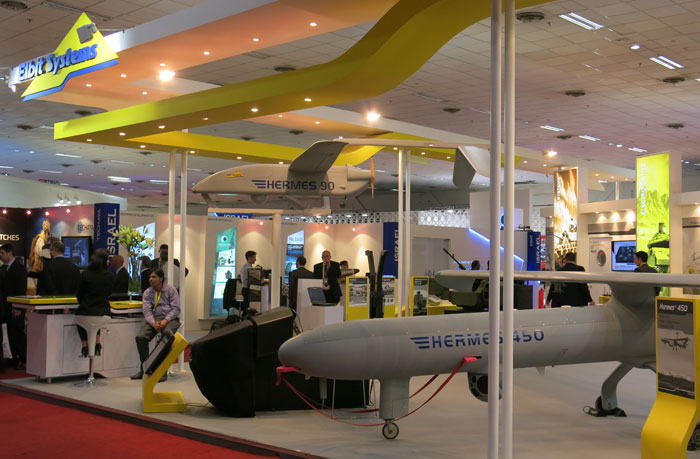
At Defexpo 2014 Elbit is expanding this activity, introducing its growing family of unmanned aerial systems (UAS), with emphasis on two of the proven Hermes family UAS – the Hermes 450 and Hermes 900. The later is a highly versatile multi-mission platform, carrying multiple payloads including radars, EO, and various SIGINT payloads. As part of its multi-mission approach, the drone has been optimized for maritime surveillance and paramilitary / homeland security missions, equipped with advanced means for persistent wide-area surveillance.
New applications for Elbit Systems’ C5I knowhow is now implemented in the field of homeland defense and cyber warfare, which are becoming major growth areas for defense and other government agencies.
In the communications field we have a sound basis here in India, since the days our subsidiary Tadiran made the first sales of communications equipment here. Together we have developed and inducted a wide range of communications systems supplied to the military through the partnerships we established with local industries. “Today, we are introducing the future generation based on Software Defined Radios, (SDR), the next level that will be integrating future military systems at all levels. These technologies are positioning our company and JV partners to reach new heights in the future. “ Machlis concludes.
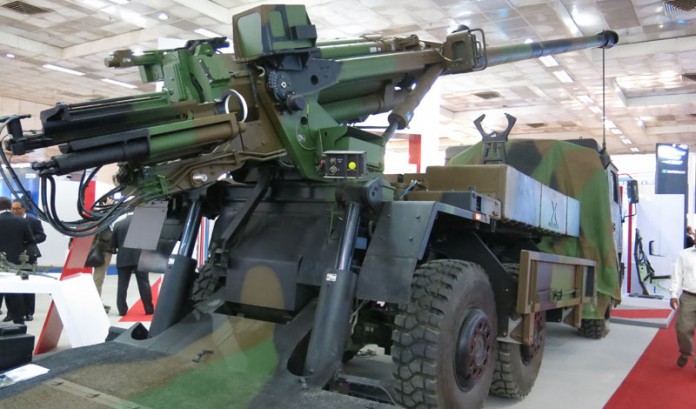
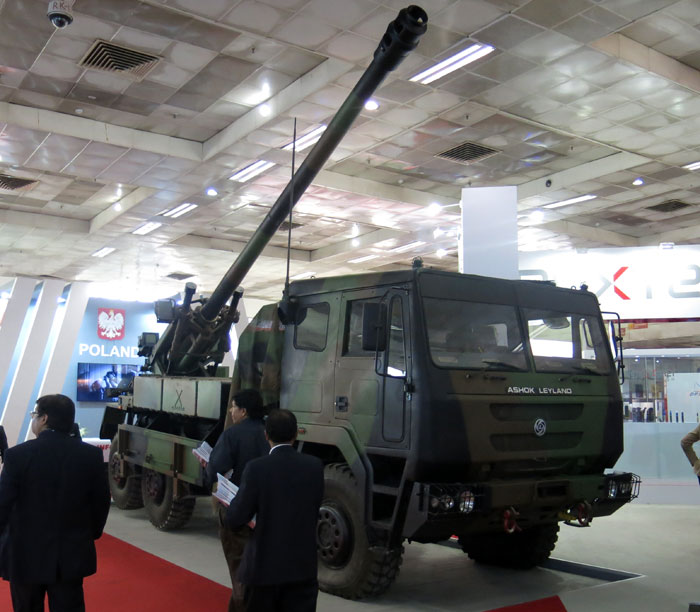
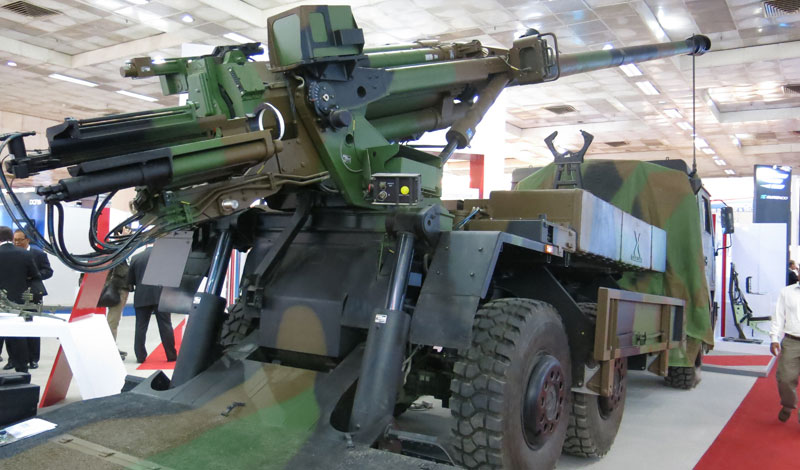
The CAESAR carries a 155mm/39Cal or 52Cal firing standard NATO 155mm ammunition at ranges of 4.5 to 42km. The gun is equipped with automatic laying and relaying between each round firing, thus maintaining high efficiency in continued fire of up to six rounds per minute. The truck carries 24 rounds on board, using insensitive munitions for improved survivability. Photo: Tamir Eshel, Defene-Update.
The French group Nexter unveiled today a lighter version of its truck-mounted howitzer CAESAR at the Defexpo defense exhibition in New Delhi. Nexter has entered in partnership with two Indian companies – Larsen & Toubro, and Ashok Leyland which supplied the Super Stallion truck chassis for the CAESAR.
Developed under joint program between Nexter, Larsen & Turbo and Ashok Leyland, this variant of CAESAR mounts 155mm/52Cal cannon on a 6×6 Super Stalion truck chassis. Photo: Tamir Eshel, Defense-Update
Larsen & Toubro will be the team leader in India, presenting the group’s response to the Mounted Gun System (MGS) program. The company will also provide the integration of howitzer the Indian Army will select for the MGS. Both groups are actively cooperating on other artillery programs for the Indian Army, including the Towed Gun System (TGS), and M46 Up-gunning programs.
The CAESAR artillery system is already in service in the French, Saudi Arabian and Thai armies. Indonesia has also selected the French mobile gun and Denmark is considering the system as well. As a rapid deployed system CAESAR has a proven operational, combat track record in Afghanistan, Lebanon and Mali where it has been deployed by the French Army.
The CAESAR MGS was originally mounted on a Renault truck, but later the system was modified to fit other chassis according to the customer’s request. In 2012 Nexter demonstrated the system on a Mercedes-Unimog truck, designed to address the Saudi requirement. Mounting the gun on the Super Stallion offers a third choice, bringing Indian interests in mind. The main advantage of the CAESAR is its light weight, enabling effective air and land mobility. The vehicle maintains a road speed of more than 80 km/h and can travel more than 600km without refuelling. It is operated by a crew of four or five.
The CAESAR carries a 155mm/39Cal or 52Cal firing standard NATO 155mm ammunition at ranges of 4.5 to 42km. The gun is equipped with automatic laying and relaying between each round firing, thus maintaining high efficiency in continued fire of up to six rounds per minute. The truck carries 24 rounds on board, using insensitive munitions for improved survivability. Photo: Tamir Eshel, Defene-Update.
Lockheed Martin Skunk Works® and XTEND have achieved a major milestone in JADC2 by integrating the XOS operating system with the MDCX™ autonomy platform. This technical breakthrough enables a single operator to simultaneously command multiple drone classes, eliminating the friction of mission handoffs. From "marsupial" drone deployments to operating in GPS-denied environments, explore how this collaboration is abbreviating the data-to-decision timeline and redefining autonomous mission execution.
As traditional defense primes face mounting competition from agile “neoprimes” such as Anduril, Palantir and Helsing, the balance of innovation is shifting toward software-defined warfare and scalable, dual-use technologies, while global industry consolidation—marked by Boeing’s integration of Spirit AeroSystems and other strategic mergers—signals an intensified race to secure control over the defense technology value chain. Our Defense-Tech weekly report highlights these trends.
In early October 2025, a coordinated wave of unmanned aerial system (UAS) incursions—widely attributed to Russia—targeted critical infrastructure across at least ten European nations. The unprecedented campaign exposed the fragility of Europe’s air defenses...
Executive Summary
The past week (September 18-25, 2025) represents an inflection point where strategic defense concepts have transitioned from doctrine to tangible reality. An analysis of global events reveals four primary, interconnected trends shaping an...
At the 2025 Air, Space & Cyber Conference, U.S. Air Force and Space Force leaders unveiled major updates on next-generation fighters, bombers, unmanned systems, and space initiatives, highlighting both rapid innovation and critical readiness challenges as the services race to outpace global competitors. A short version is available here, with a more detailed version for subscribers.
The Taipei Aerospace & Defense Technology Exhibition (TADTE) 2025 crystallized around four dominant strategic themes that collectively illustrate Taiwan's comprehensive approach to defense modernization amid escalating regional tensions. Based on a detailed report by Pleronix (available upon request). Includes a Podcast discussion on TADTE 2025's highlighting Taiwan's four strategic themes beyond the post's coverage.
Israel’s Iron Beam 450 high-power laser system has completed final testing, marking a major leap in air defense. Developed by Rafael, it offers precise, cost-effective interception of rockets, UAVs, and mortars, and is set for IDF deployment by 2025.