Thursday, December 25, 2025
More
    Home Blog Page 118

    Boeing Tests a Challenger 605 Based Maritime Surveillance Platform

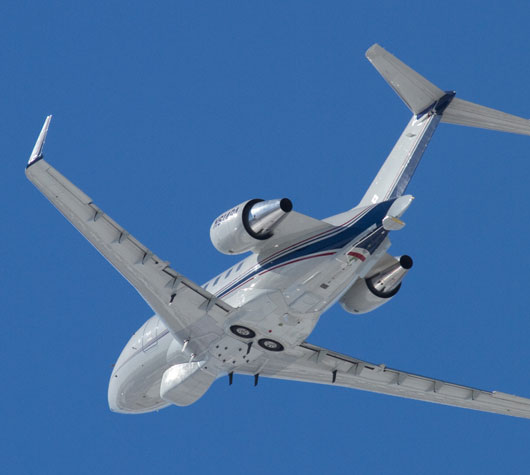
    Boeing’s [NYSE: BA] Maritime Surveillance Aircraft (MSA) demonstrator recently completed its first flight to verify airworthiness, an important milestone toward providing a low-risk and cost-effective maritime surveillance solution designed for search and rescue, anti-piracy patrols and coastal and border security. Boeing teammate Field Aviation conducted the successful testing during a four-hour flight on Feb. 28 from Toronto’s Pearson International Airport. Photo: Boeing

    Boeing is developing a new type of Maritime Surveillance Aircraft (MSA) addressing mission requirements for smaller, more affordable systems, compared to the company’s B-737 platform used for the P-8A Poseidon aircraft.

    Boeing’s [NYSE: BA] Maritime Surveillance Aircraft (MSA) demonstrator recently completed its first flight to verify airworthiness, an important milestone toward providing a low-risk and cost-effective maritime surveillance solution designed for search and rescue, anti-piracy patrols and coastal and border security. Boeing teammate Field Aviation conducted the successful testing during a four-hour flight on Feb. 28 from Toronto’s Pearson International Airport. Photo: Boeing
    Boeing’s Maritime Surveillance Aircraft (MSA) demonstrator recently completed its first flight to verify airworthiness, an important milestone toward providing a low-risk and cost-effective maritime surveillance solution designed for search and rescue, anti-piracy patrols and coastal and border security. Boeing teammate Field Aviation conducted the successful testing during a four-hour flight on Feb. 28 from Toronto’s Pearson International Airport. Photo: Boeing
    The company began testing a smaller platform using the Bombardier Challenger 605 business jet, configured as a Maritime Surveillance Aircraft (MSA) demonstrator. The aircraft recently completed its first flight to verify airworthiness, an important milestone toward providing a low-risk and cost-effective maritime surveillance solution designed for search and rescue, anti-piracy patrols and coastal and border security.

    Boeing teammate Field Aviation conducted the successful testing during a four-hour flight on Feb. 28 from Toronto’s Pearson International Airport. Field Aviation modified the Bombardier Challenger 604 aircraft’s structures and systems into the MSA configuration. Additional flights are scheduled for the next two months to complete the airworthiness verification phase. Once they are complete, the aircraft will fly to a Boeing facility in Seattle where the MSA mission systems will be installed and tested.

    According to the company, MSA uses proven technologies developed for the P-8A Poseidon to provide multi-mission maritime surveillance capabilities. The baseline configuration features an Active Electronically Scanned Array multi-mode radar housed in a special belly mounted radome, an Electro/Optical/Infrared sensor, Electronic Support Measures, a Communications Intelligence sensor and Automated Identification System.

    Boeing said it achieved first flight of the MSA demonstrator on an accelerated schedule due to rapid prototyping and lean manufacturing techniques by Boeing Phantom Works, the company’s advanced technology organization, working closely with industry teammates.

    Boeing unveiled the MSA last November at the Dubai Airshow. The Challenger 605 was selected as the platform for new Intelligence, Surveillance and Reconnaissance missions.

    NUSHIP Canberra, the Newest Australian Landing Ship Begins Sea Trials

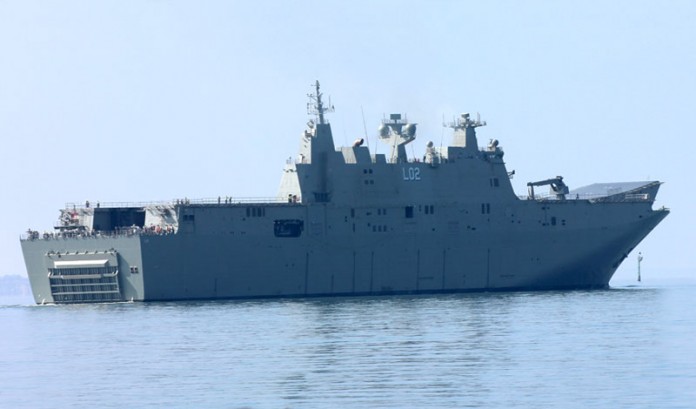
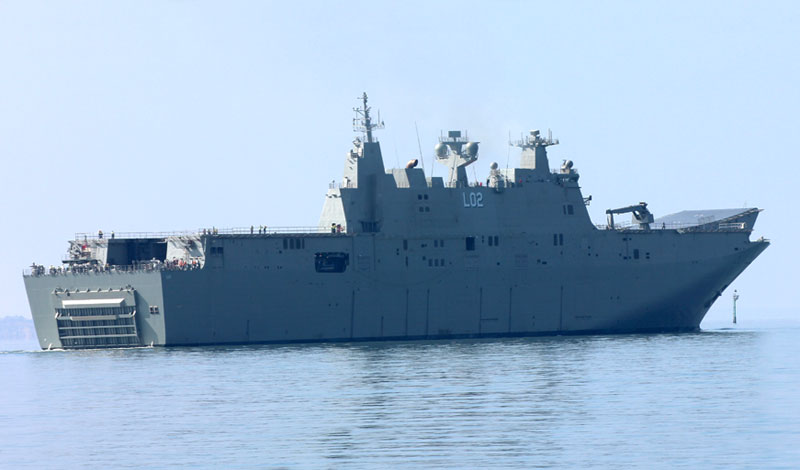
    NUSHIP Canberra, one of two Landing Helicopter Dock (LHD) ships being built for the Australian Defence Force (ADF), left BAE Systems Williamstown March 4, 2014 bound for Sydney on the first part of her sea trials and docking period at Sydney. BAE Systems Australia announced. The sea trials will span over 16 days.

    Nuship_Canberra800

    LHD Project Manager, Captain Craig Bourke, said the trials will test a variety of systems in different conditions. “The trials will be conducted in various locations so systems and equipment can be tested at different depths and different speeds,” Captain Bourke said. “How the ship handles and moves in different conditions, how long it takes to stop the ship at different speeds, and how much fuel the ship uses at different speeds and configurations are all examples of trials that will be undertaken during this period.” The ship will be tested through a series of manoeuvres, at various speed during different swell and sea conditions.

    The Canberra Class LHD’s are bigger than Australia’s last aircraft carrier HMAS Melbourne. They are more than 230 metres long, 27.5 metres high and will weigh around 27,500 tonnes once completed.

    “The ship will undergo a series of tests before we hand it over to the ADF which includes both platform tests as well as testing the ship’s combat and communication systems,” added Bill Saltzer, Director of BAE Systems Maritime. The tests will undertake approximately 240 hours over 16 days of testing on the ship and to ensure all systems perform to their capability.

    “Some of the trials will run concurrently and cover everything from basic systems operations such as alarms, to the ships manoeuvrability while at sea.” Saltzer added, “Trials will be conducted under a number of scenarios. Some trials need the ship in certain conditions and or water depths while other trials require systems in specific configurations.”

    While in Sydney Nuship Canberra will have its hull cleaned and deck painted at Garden Island ahead of returning to Williamstown where final work on the ship will be completed ahead of testing the combat and communications systems. After the LHDs are commissioned, a contingent of Australian Army soldiers will be posted to the ship to work alongside the Navy ship’s company.

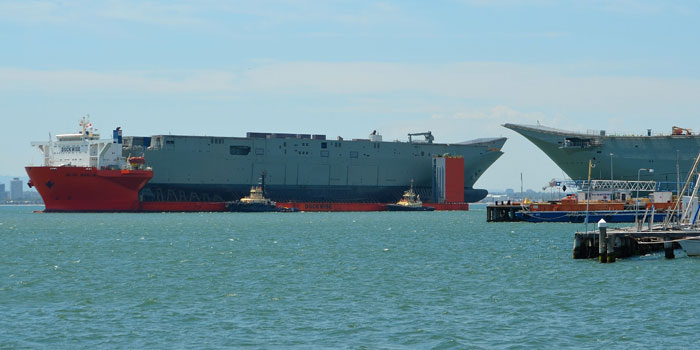
    The new hull of Nuship Adelaide carried by the Blue marlin passes by Nuship Canberra nearing completion at BAE Melbourne. The Adelaide was ferried from Spain to Australia. Photo: Ross Johnson
    The new hull of Nuship Adelaide carried by the Blue marlin passes by Nuship Canberra nearing completion at BAE Melbourne. The Adelaide was ferried from Spain to Australia. Photo: Ross Johnson

    The second LHD, NUSHIP Adelaide arrived in Williamstown on 12 February after being ferried from Spain by Heavy Lift Ship, Blue Marlin. Preparation works for the consolidation of the superstructure are well underway. “We are currently preparing for the heavy lift of the superstructure blocks which we expect to have in place by the end of March,” Saltzer said. The Adelaide will now be fitted out, with combat system and communications systems added, expected for delivery in 2015.

    The Canberra Class LHD’s are bigger than Australia’s last aircraft carrier HMAS Melbourne. They are more than 230 metres long, 27.5 metres high and will weigh around 27,500 tonnes once completed. Each ship can carry a combined armed battle group of more than 1100 personnel, 100 armoured vehicles and 12 helicopters and also features a 40 bed hospital.. BAE Systems is the Prime to deliver the project with subcontractors Navantia, which constructed the hulls in Spain, and SAAB and L3 which supplied the combat and communications systems respectively.

    LHD_AWD_ANZAC_FFG_Size_ComparisonAmphibious Operations Officer Lieutenant Colonel Jamie Parkins said the arrival of NUSHIP Adelaide was a significant event in the development of the ADF’s Amphibious Capability. “Soldiers will be fully integrated into the ship’s company working in many of the ship’s departments and directly contribute to the ship’s capability,” Lt-Col Parkins said. “To prepare, the Ship’s Company will begin to concentrate in Sydney in the middle of the year and start a range of individual and collective training activities, including contractor delivered training.”

    Lieutenant Colonel Parkins said his crew was lucky to be able to benefit from the lessons and hard work of the HMAS Canberra Army detachment. “We will realise the full Amphibious Capability when HMAS Adelaide joins HMAS Canberra and HMAS Choules along with 2RAR and supporting troops from across the Army to exercise the Amphibious Ready Group during Exercise Talisman Sabre 2017.

    Royal Navy’s HMS Daring seen alongside with NUSHIP Canberra at Williamstown Dockyard, Victoria.

    [/wlm_ismember]LHD_AWD_ANZAC_FFG_Size_Comparison[/wlm_ismember]

    British Watchkeeper UAV Finally Cleared to Enter Military Service

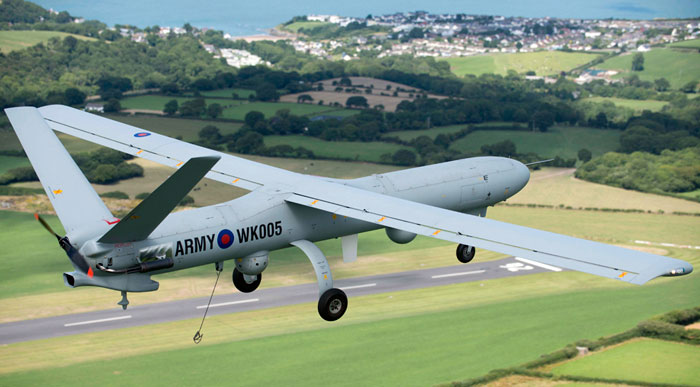
    Watchkeeper UAK flying over Wales. Photo: UK MOD

    The British Army is expected to induct the long awaited Watchkeeper UAV system with its field units, following Release To Service (RTS) by the UK’s Ministry of Defence (MOD). Unfortunately, this milestone is achieved three years behind schedule.

    The British Army's Watchkeeper unmanned aerial system in flight over the UK during testing. Picture: Thales UK by Richard Seymour.
    The British Army’s Watchkeeper unmanned aerial system in flight over the UK during testing. Picture: Thales UK by Richard Seymour.

    Certified to the same safety standard as manned aircraft, Watchkeeper is the first UAS to be awarded a full (RTS) and is the only UAS of its type allowed to fly in UK airspace. Although 26 air vehicles and 14 ground systems already produced, lack of the formal safety clearance prevented the full induction of the drone with Army units. Thales UK is on contract to deliver 28 additional systems and one additional ground system.

    Cleared for operations in the UK, the RTS will allow army crews to fly Watchkeeper sorties in segregated airspace, integrating with the military exercises taking place on Salisbury Plain. The RTS follows the announcement (24 February) that the British Army will begin training flights from Boscombe Down, Wiltshire. Sofar the drone operations were restricted to testing and evaluation – nearly 1000 flight hours were performed by the operators of the prime contractor, Thales UK, 600 of these flights were performed in the approved test airspace near Parc Aberporth, West Wales.

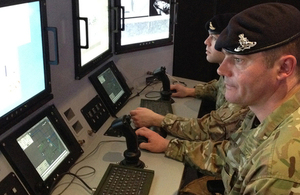
    Army personnel operating the Watchkeeper unmanned aerial system. Photo: UK MOD
    Army personnel operating the Watchkeeper unmanned aerial system. Photo: UK MOD

    Lt Col Craig Palmer of the British Army commended the high safety levels demonstrated by the new system, “The safety bar for Watchkeeper has been set very high. The detailed reviews and testing of the whole system have provided significant evidence that the system is maturing rapidly; sufficiently enough to support an RTS recommendation.” Over the coming weeks the pilots and support crews of 1st Artillery Brigade will be trained to fly the drones in a restricted airspace over the Salisbury Plain Training Area. The flights, which will take place between 8,000 and 16,000 feet, will be overseen by military air traffic controllers.

    “The process of achieving RTS and the other certifications required for Watchkeeper has been ground-breaking, not only for Thales but also for the MOD and the CAA”, said Victor Chavez, CEO of Thales UK. “Much painstaking work has been required by all parties to deliver the comprehensive and rigorous certification, but our collective achievement is a great one: the first tactical UAS allowed to fly in UK airspace.”

    An RTS is the formal statement, on behalf of the Chief of General Staff, that an acceptable safety case has been prepared for the aircraft and its equipment. An RTS is required for all aircraft (manned and unmanned) subject to Military Aviation Authority (MAA) regulated service flying, and is written for the aircrew and engineers responsible for the day-to-day supervision of flying operations and the desk officers responsible for developing policy and procedures. 

    Watchkeeper is a high-performance, multi-sensor, all-weather UAS that can remain airborne for more than 16 hours in a single mission. These unarmed tactical UAS will be deployed by the British Army surveillance, reconnaissance, intelligence gathering and target acquisition missions, in support of military operations at supporting brigade-level and below. Watchkeeper is expected to remain in service at least until 2040.

    Watchkeeper has been developed by Thales with strong support from its supply chain, including UAV Tactical Systems Limited (U-TacS), which was established at contract award as a joint venture company between Thales and Elbit Systems.

    Israel Sizes a Gaza-Bound Shipload of M-302 Heavy Rockets

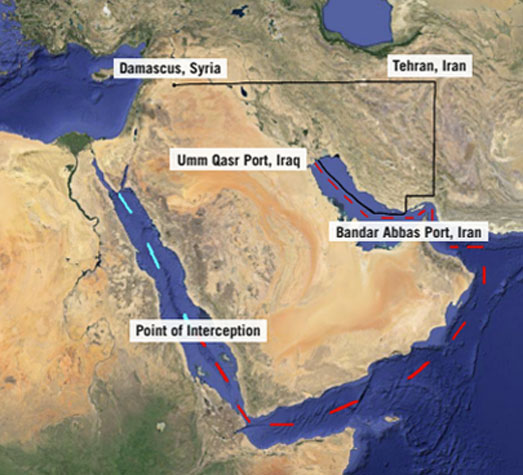
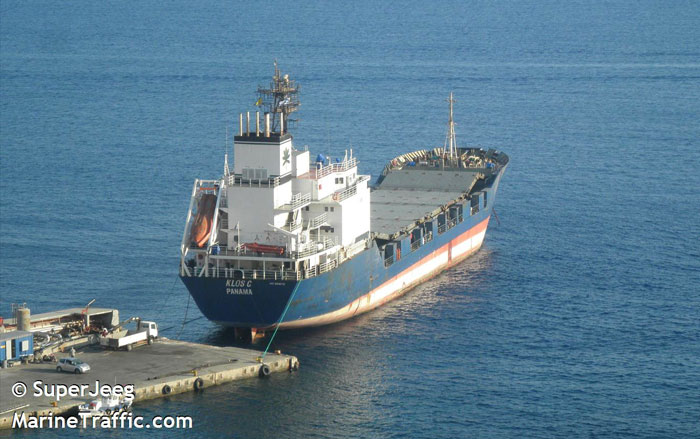
    The KLOS-C loaded the rockets at the Iranian port of Bandar Abbas. From there she sailed to the port of Umm Qasr in Iraq, taking another load of cement destined to Port Sudan in the Red Sea.
    Israeli naval commandos inspecting wooden carts containing Syrian made M-302 rockets loaded on the KLOS-C at the Iranian port of Bandar Abbas. the rockets were later covered with another cargo of cement, loaded at the Iraqi port of Um Qasr. The destination of the cargo was Port Sudan in the Red Sea. Photo: IDF
    Israeli naval commandos inspecting wooden carts containing Syrian made M-302 rockets loaded on the KLOS-C at the Iranian port of Bandar Abbas. the rockets were later covered with another cargo of cement, loaded at the Iraqi port of Um Qasr. The destination of the cargo was Port Sudan in the Red Sea. Photo: IDF

    Earlier today the IDF naval forces have seized a large shipment of weapons sent from Iran and destined to the Gaza strip. The shipment was discovered on a cargo vessel intercepted in the Red Sea on its way from Iran to Sudan. The vessel is currently heading under Israeli control to the Israeli port of Eilat, where it is expected to anchor in 2-3 days. The operation, code named “Full Disclosure” was based on precise intelligence collected throughout the Middle east, that enabled the IDF to locate, track and eventually seize the shipment en-route to the Gaza Strip.

    Last night, following extensive preparations, and on the government’s authorization, the IDF Chief of the General Staff, Lieutenant General Benjamin (Benny) Gantz, ordered the Israel Navy to intercept the Klos-C, a Panama registered cargo vessel that departed from the port of Um Qasr in Iraq 22 February carrying civilian cargo. IDF naval commandos that boarded the vessel have found a load of Syrian made M-302 (302mm) heavy rockets. The Israeli raid took place a day before the ship was set to dock in Sudan, some 1,500 kilometers off the coast of Israel.

    The KLOS-C loaded the rockets at the Iranian port of Bandar Abbas. From there she sailed to the port of Umm Qasr in Iraq, taking another load of cement destined to Port Sudan in the Red Sea.
    The KLOS-C loaded the rockets at the Iranian port of Bandar Abbas. From there she sailed to the port of Umm Qasr in Iraq, taking another load of cement destined to Port Sudan in the Red Sea.

    Several months ago, IDF intelligence identified a weapons transfer of M-302 rockets, known to be manufactured in Syria, from Damascus to Tehran. These rockets were being flown from the International Airport in Damascus to Iran in a move carefully orchestrated by the Quds Force. This unusual event caught the attention of Israeli intelligence, as most arms transfers are taking place from Iran to Syria, not vice versa.

    After landing in Tehran the shipment was moved to the port of Bandar Abbas, south of the Straits of Hormoz, where it was subsequently loaded onto a Panama registered commercial cargo vessel identified as the KLOS-C. This is the same port used to load up the Francop, another ship involved in an Iranian weapon smuggling attempt in 2009.

    The operation was performed very close to the ship’s destination, possibly, in order to avoid potential confrontation with Iranian naval forces operating in the area.

    From Bandar Abbas the KLOS-C sailed to Umm Qasr Port in Iraq. It was loaded with more containers, all holding bags of cement – in an attempt to obscure its true cargo and Iranian connection. From Iraq the ship headed towards Port Sudan. As the ship entered the Red Sea, it was intercepted by Israeli naval forces, including missile boats and the Naval Commando (Shayetet 13) who boarded the vessel and uncovered its illegal cargo. The Israeli authorities believe that the rocket cargo would have been unloaded in Port Sudan and the rockets would have been transferred via land, through the Sinai Peninsula reaching Gaza few weeks later.

    Israel claimed the foreign identity of the vessel and the complex route taken by KLOS-S was designed to hide its true cargo and destination.

    The operation was performed very close to the ship’s destination, possibly, in order to avoid potential confrontation with Iranian naval forces operating in the area. In previous occasions Israeli forces have struck missile convoys in Sudan, on their long journey north through Egypt to Sinai. The Iranian Navy is routinely operating in the Gulf of Aden, Bab-el Mandeb and the southern part of the Red Sea, where the Iranian Navy’s 29th Fleet recently thwarted two piracy attacks on an Iranian oil tanker sailing at the Red Sea. Last month, Iranian Navy Commander Rear Admiral Habibollah Sayyari announced that his naval forces have foiled tens of attacks by international pirates on the country’s cargo ships and oil tankers. He noted that the Iranian Navy warships have escorted some 2,000 merchant vessels and freighters in the same period.

    According to UN Security Council resolutions, different countries can send their warships to the Gulf of Aden and coastal waters of Somalia against the pirates. Linking the Indian Ocean with the Suez Canal and the Mediterranean Sea, the Gulf of Aden is an important energy corridor for tankers transporting oil from the Persian Gulf to the West, via the Suez Canal.

    The KLOS-C seen at one of its recent port visits. Photo: Super Jeeg, Marinetraffic.com
    The KLOS-C seen at one of its recent port visits. Photo: Super Jeeg, Marinetraffic.com

    According to Israeli assessments, KLOS-C may not be the first arms smuggling ship that is intercepted by the IDF, but it is distinguished by the lethality and quality of its cargo – previous shipments contained standard weaponry such as mortars, rifle ammunition, and 122/220mm rockets rockets. This shipment, while certainly containing some of these, comprised weapons with a dramatically larger strike range and substantially heavier rocket warheads than previously seen in the region.

    M-302 rockets were used against Israel during the 2006 war, fired by Hezbollah against targets in Central Israel. The basic model first appeared during the early 1990s carrying a 170kg warhead over a range of 90-100 km (55-60 miles). It have since evolved into different variants offering strike ranges between 100 to 215 km and warhead weight of 175 – 125 kg.

    Seizing the weapons cargo of the KLOS-C is one in a series of successful operations conducted by the Israel Navy, against Iranian weapons shipments destined to Gaza in recent years. On January 22nd, 2002, Israeli Navy commandos boarded the merchant vessel Karine-A which had been purchased by Palestinian owners in order to smuggle weapons from Iran to the Gaza Strip. The ship had loaded 50 tons of weapons in Iran, sailed through the Persian Gulf and was stopped on its way to Israel. In 2009 the Israel Navy intercepted the Antiguan registered Francop, that carried 500 tons of Iranian-made weapons. Iranian weapons were also found on the Cypriot merchant vessel Monchegors when boarded by Capriot inspectors. On March 2011, Israeli Navy commandos boarded the civilian vessel Victoria as she was heading from Syria to the Egyptian port city Alexandria. The ship was carrying approximately 50 tons of concealed weaponry, including Iranian-made C-704 surface-to-sea missiles, mortars and ammunition. The shipment was intended for terror organizations in the Gaza Strip.

    Cyber Intelligence Report – March 4, 2014

    cyber_report

    Executive Cyber Intelligence Bi-Weekly Report by INSS-CSFI

    March 4th, 2014

    Israel

    New opportunities and new challenges in cyber sector

    Israel’s cyber industry is gaining another big boost from the People’s Republic of China. WBP Venture Partners, Founder Group, and others will begin investing millions of dollars into Israeli high-tech and cyber companies. The companies are a compilation of a variety of different sectors including private investors, Peking University, and the Chinese government. Yet, while the public sector grows stronger within Israel, the cyber and technologic units of the Israel Defense Force (IDF) are losing their most valuable resource – the people. New records conducted by the Human Resources Directorate indicate the IDF is losing its human advantage in two ways: a reduction of high school students graduating in the field of technology and soldiers and officers deciding to conclude their army service after the mandatory years. The problematic issue of less Israeli high school students studying physics and high-level math is that this means less students join technological army units. Those who do join technological units end up serving the required years, but they leave afterwards to the public sector where opportunities are more appealing in terms of promotions and salaries.

    USA

    Anonymous member sentenced to 12 years of prison in U.S.

    An Anonymous member, British citizen Lauri Love, was sentenced to 12 years of prison for hacking the U.S. Federal Reserve: 10 years for hacking and 2 for theft and aggravated identity. This is according to the U.S. Attorney for the Southern District of New York office. The U.S. Federal Reserve servers had been hacked in October 2012 and February 2013 where the personal information of 104,000 people had been stolen and made publicly available by Anonymous, which cost the U.S. $3.7 million to deal with the fallout. The U.S. government tracked down Love by cracking Anonymous’ restricted chat rooms, were Love made comments about the attack in the forum. Andy Archibald, head of the NCA Cyber Crime Unit stated: “Cyber-criminals should be aware that no matter where in the world you commit cyber crime, even from remote places, you can and will be identified and held accountable for your actions.” Love is awaiting indictment, as he is currently on bail in the U.K. Though dozens of Anonymous members have been arrested, very few have been sentenced and even fewer have been sentenced to prison.

    White House announces voluntary Cybersecurity Framework

    The Obama administration released the first phase of a voluntary framework developed by hundreds of companies, several federal agencies, and many international contributors as a how-to cybersecurity guide for organizations in the business of running and protecting the nation’s critical infrastructure. The framework closely resembles a similar one President Obama released in October 2013. “Cyber threats pose one the gravest national security dangers that the United States faces,” President Barack Obama explained in a statement released by the White House. “This voluntary framework is a great example of how the private sector and government can and should work together to meet this shared challenge.” The framework attempts to identify, protect, and detect companies or organizations responding to and recovering from cyber intrusions. The framework seems to be published as a new push from the Department of Defence to push the importance of cyber security. Defense Secretary Chuck Hagel plans to shrink the United States Army to its smallest size pre-World War II, and will have distinct focus on special operations and cyber warfare, which will be considered the new way of American defence.

    Russia

    Sophos Labs revealed Russian spam contributes to large part of world’s spam

    “SophosLabs” revealed the dirty dozen top spam-relaying nations, disclosed at the final “Spampionship” league table of 2013. Once again, it was the USA earning the league’s top spot, generating 14.5% of the total spam volume sent during the last quarter of the year. However, the gap to second place narrowed, with China re-emerging as a major player in spam sending, leaping from 4.6% to 8.2%, while Russia’s spam contribution edged up from 3.0% in third quarter, to 5.5% in the fourth quarter. This comes days after Russia Today, one of Russia’s leading newspapers, was hacked inserting the word “Nazi” into headlines.

    Major cyber malware Uroburos pinpointed as Russian

    German computer security and antivirus company G Data Security targeted the Russian government behind the malware “Uroburos,” because of the file name, encryption keys and behavior to a previous malware associated with Russia, Agent.BTZ, which attacked the U.S. Pentagon in 2008. Uroburos, active since 2011, steals files and monitors network traffic by taking control of infected computers through an Internet connection. It then connectesto other computers within the same network, providing random commands. Uroburos and camouflages its involvement by sending all information back to the malware author, making it very dangerous as new features can be added to its already damaging capabilities. According to G Data, Uroburos targets intelligence agencies, big companies, and nation states. Currently, there are very few governments undertaking writing malware, the most famous example of which would be the production of Stuxnet.

    Middle East

    United Arab Emirates investing more money in cyber security

    The United Arab Emirates is doubling its homeland security budget from $5.5 billion to over $10 billion in the next 10 years. The majority of that funding will go toward cyber security, according to the 2013-2014 annual reports by the US Commerce Department’s International Trade Administration and reported by state news agency WAM.

    Cyber-attacks on critical installations in Saudi Arabia and Qatar in 2012 and 2013 provided a wakeup call to governments in the Gulf Cooperation Council (GCC). In 2012, they announced the creation of the National Electronic Security Authority, the first national authority for cyber security in the region to combat online threats to military and critical installations. The main goals of this authority are to monitor the war against cyber-attacks; protect the country’s communications networks; and continue to develop, modify, and use devices required in the field of electronic security. It will also be responsible for proposing and implementing the UAE’s national policy on electronic security and developing a national plan to confront any risks, threats, or attacks.

    FC Barcelona Twitter account hacked by SEA

    The Syrian Electronic Army (SEA) targeted the Barcelona Football Club for its ties to Qatar money, which SEA claimed is “full of blood and kills.” Three accounts associated with the football club, with millions of followers, were compromised by the SEA on Wednesday morning following Barcelona’s 2-0 defeat over Manchester City in the Champion’s League. The hackers posted the same message on all three accounts, saying: “Dear FC Barcelona management, don’t let the Qatari money funds you, it’s full of blood and kill.” The tweets, which were removed, responded to the Qatari commercial sponsorship of the football club from the Qatar Sports Investment, followed by Qatar Airways.

    China and APAC

    China planning to be strong Internet power

    During an official meeting on security, President Xi Jinping called for a “master strategy… and innovative development,” stressing the strategic importance of “Internet security and information,” demonstrating the growing concern for cyber security in China. China has the biggest Internet market in the world with $618 million users, with cyber-security becoming a major issue after the country was hit by a large scale cyber-attack in January 2014. According to the  Beijing Times, a large amount of Internet users do not necessarily correspond with safe cyber security standards. With the help of senior leaders, the Chinese government is drafting national strategies and policies within the cyber field. Compared to the U.S., China is far behind in becoming a major cyber powerhouse, as the U.S. is more advanced in technology. The cyber competition between China and the U.S. will be the main focus of cyber strategy in the next 10 years, as China intends to become a cyberpower in the coming years. China is determined to bridge this gap, especially since the U.S. has cracked down on cyber-attacks emerging from supposed state sponsored Chinese hackers (even though China has denied being behind any cyber-attacks against any state).

    Europe

    France inaugurated new cyber defense headquarters

    On the 20th of February, the French Prime Minister inaugurated the new cyber defense headquarters. Created in 2009, the French ANSSI (Agence Nationale de Sécurité des Systèmes d’Information) is charged for the information systems security of the state and its critical infrastructures, such as the following: hospitals, power stations, nuclear power plants, airports etc. The new center is open 24 hours a day to respond to threats and cyber-attacks. The French agency is currently hiring 357 cyber security experts and is planning to increase this number to 500 through 2015. The Ministry of Defense, which has its own analysis and computer control center in the same building as the ANSSI, claims to have treated 790 incidents or cyber-attacks in 2013. The general directorate for weapons, which is a government agency managing the major future programs in the defense field, decided to develop a new specialized branch located in the west of France. The goal of this new branch is meant to recruit 400 new engineers coming from the best universities and engineering schools to develop equipment and techniques of defense against electronic attacks. Today, the ministry is hiring 1400 cyber-fighters and is planning to recruit 350 more by the end of the military program in 2019. The development of cyber weapons has been very discreet, but since 2008, the offensive systems are meant to deploy virulent computer viruses used against the enemies of France.

    Despite these efforts, France is still late in terms of cyber defense when compared to the other major nations such as the United Kingdom. Indeed, the cyber human resources of France to counter cyber-attacks are weak compared to other nations. This lack of human resources is due to several factors. First, France has a lack of computer security experts, and secondly, the French did not anticipate the problem of cyber-attacks and the protection of its computer systems.

     A darknet website shut down in Netherlands

    The Dutch and German police arrested five people and shut down a “darknet” website as part of an investigation into online criminal marketplaces. Dutch police were ‘astonished’ after acquiring ecstasy and cocaine through the website, as well as being offered a down payment for a killing  contract at the website called “Silk Road. The anonymous marketplace.” This case is one of many that are related to crimes within the darknet revealed in the past year. The success of “Silk Road” was the patronage anonymity that the “darknet” succoured. In October 2013, the Silk Road site was shut down by U.S. authorities, and the mastermind behind the marketplace was arrested. Law enforcement agencies in other countries are also cracking down on similar darknet sites, the latest called “Utopia Marketplace.”

    To reach the darknet, The Onion Router (TOR) must be downloaded, which is a free software enabling anonymity necessary to enter the darknet and works by causing bits of data to be drawn from thousands of computers worldwide using proxy servers in order to establish a marketplace or web portal such as Silk Road. It appears incidents will only increase, and the desire for anonymity and the motivation for criminals and others to sell, buy, and merchandise all sorts of goods will develop and advance darknet activity. Tools like TOR intend to increase the aspect of anonymity by creating further instruments like TOR Instant Messaging Bundle (TIMB), which keeps instant messaging conversations encrypted and a real time anonymous chat system routed through TOR’s encrypted network.

    inss150About the Cyber Intelligence Report:

    This document was prepared by The Institute for National Security Studies (INSS) – Israel and The Cyber Security Forum Initiative (CSFI) – USA to create better cyber situational awareness (Cyber SA) of the nature and scope of threats and hazards to national security worldwide in the domains of cyberspace and open source intelligence. It is provided to Federal, State, Local, Tribal, Territorial and private sector officials to aid in the identification and development of appropriate actions, priorities, and follow-on measures. This product may contain U.S. person information that has been deemed necessary for the intended recipient to understand, assess, or act on the information provided. It should be handled in accordance with the recipient’s intelligence oversight and/or information handling procedures. Some content may be copyrighted. These materials, including copyrighted materials, are intended for “fair use” as permitted under Title 17, Section 107 of the United States Code (“The Copyright Law”). Use of copyrighted material for unauthorized purposes requires permission from the copyright owner. Any feedback regarding this report or requests for changes to the distribution list should be directed to the Open Source Enterprise via unclassified e-mail at: [email protected]. CSFI and the INSS would like to thank the Cyber Intelligence Analysts who worked on collecting and summarizing this report.


    DHS to Invest $145 Million Establishing Surveillance Towers along the Arizona-Mexico Border

    border-security700Elbit Fort Worth, (EFW), a subsidiary of Israeli based Elbit Systems Ltd was awarded a long-awaited $145 million contract by the United States Department of Homeland Security Customs and Border Protection (CBP) for the Integrated Fixed Tower project. Through the first phase to span over the current year EFW will deliver a number of ‘Pergerine’ systems for installation on towers at the area of Nogales, Arizona overlooking the Sonoran desert range. Follow-on options could span over five additional border sections in Arizona. The total value of the contract plus support of eight years could add up to $145 million or more, if all options are implemented.

    “Arizonans have been waiting more than a decade for the Department of Homeland Security (DHS) to place the needed technology along our border to support the Border Patrol and fully secure our Southern border.” U.S. Senator John McCain.

    Elbit Systems has won against some of the largest players in the industry, including Boeing and Lockheed Martin, Raytheon and General Dynamics.

    Subscribe to read the full version
    Subscribe to read the full version of this article

    “Arizonans have been waiting more than a decade for the Department of Homeland Security (DHS) to place the needed technology along our border to support the Border Patrol and fully secure our Southern border.” U.S. Senator John McCain (R-AZ) said, “If this technology is developed, integrated and fielded correctly, these Integrated Fixed Towers in Southern Arizona, coupled with the tremendous work of the Border Patrol, will give our agents the ability to detect, evaluate, and respond to all illegal entries crossing our border.” McCain added.
    The U.S. bypassed some of its biggest contractors and turned to an Israeli company for help securing its borders. “It is odd to go offshore for this work, but in extraordinary circumstances, one really wants to employ the best,” Bloomberg quoted Mark Amtower, a partner at Amtower & Co., a government contracting consulting firm in Clarksville, Maryland. “A company with a track record of doing this work in Israel is “liable to be much further advanced in this particular arena,” Amtower said.

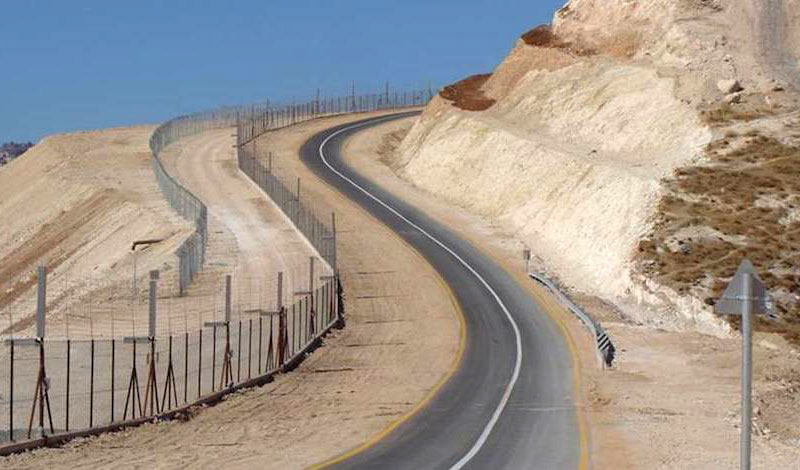
    Elbit Systems was one of several contractors participating in the establishment of Israel's separation line with the Palestianian west bank, following the second uprisal (2000-2004). The barrier is attributed with the dramatic reduction in terrorist actions since 2004.
    Elbit Systems was one of several contractors participating in the establishment of Israel’s separation line with the Palestianian west bank, following the second uprisal (2000-2004). The barrier is attributed with the dramatic reduction in terrorist actions since 2004.

    On its part, Elbit Systems has deployed a number of border protection systems including hundreds of kilometers of the ‘separation line’ border fence and obstacle between Israel and the Palestinian Authority, erected by Israel following the second Palestinian uprising in 2000-2004. The number of terrorist acts against Israelis has dropped dramatically since the establishment of that barrier. The company has also provided key elements securing the Israeli border area with Gaza and Egypt, through the use of ‘multi-sensor surveillance systems’.

    The chain of observation towers also known as Integrated Fixed Towers (IFT) was a major element of SBInet, and one the Customs and Border Protection (CBP) has always wanted. The baseline phase of the IFT contract will be part of the CBP 2014 funding for Border Security Fencing Infrastructure and Technology (BSFIT), part of a procurement budget estimated at $77 million.

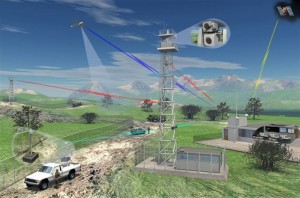
    The IFT is part of a more comprehensive system Elbit Systems has been pitching to the DHS for several years. Such system consists of a layered concept, combining radar and electro-optical sensors, unattended ground sensors, unmanned air systems, and manned or unmanned ground vehicles and unmanned vehicles, enhancing the agents’ flexibility, responsiveness and ability to respond. The integration of all sensors and systems though a common operating picture (COP) provides detailed information for detecting, tracking, identifying, and classifying items of interest; maximizing the efficacy of the mission.

    First of a New Class Patrol Ships Laid Down at Zelenodolsky Shipyard in Russia

    Project 22160 offshore patrol ship
    Project 22160 offshore patrol ship
    Project 22160 offshore patrol ship

    The lead vessel in a new class of patrol vessels designed for maritime security was laid down in a ceremony at Russia’s Zelenodolsky shipyard (Gorky) Wednesday February 26, 2012. The vessel, to be named ‘Vasily Bykov’ will be the first diesel-powered Project 22160 patrol ship.

    The new generation, 1,300-ton ship will have a range of 6,000 nautical miles on missions up to 60 days at sea. It will be manned by a crew of 80 sailors.

    The ship will be armed with a single 57mm cannon, heavy machine guns, air defense systems, radar, electronic warfare and electronic countermeasures (ECM). The large deck can be configured to accommodate a pair of weapon launchers as an option. These weapons can include two torpedo launching tubes, a Shtil-1 air defense system with two launchers, two Club-N cruise missiles or two Uran-E anti-ship missile.

    Powered by diesel or combined diesel-gas turbine, (CODAG), the 94 meter vessel can reach a top speed of 30 knots. The vessel is designed with a ‘telescopic hangar’ and aft deck supporting helicopters weighing up to 12 tons.

    The new class is intended for economic zone patrol, search-and-rescue operations, anti-piracy and anti-smuggling activities, environmental monitoring, as well as coastal defense and escort service. Six ships of the new class are expected to be built by 2019.

    Based in Tatarstan, the Gorky shipyard is building medium size vessels for the Russian navy and export customers. On the same day the shipyard laid the new patrol boat it also announced it will build two additional Project 11661 Gepard-class frigates for the Vietnam People’s Navy. These vessels will be delivered in 2017. This brings the cumulative number of frigates that Vietnam has contracted to six. The first hulls for these vessels are already under construction at the shipyard. Vietnam received first two Gepard-class frigates from Russia in 2011 under a contract signed in 2006. A follow-on order for two more frigates was signed in 2013, for which work is currently underway.

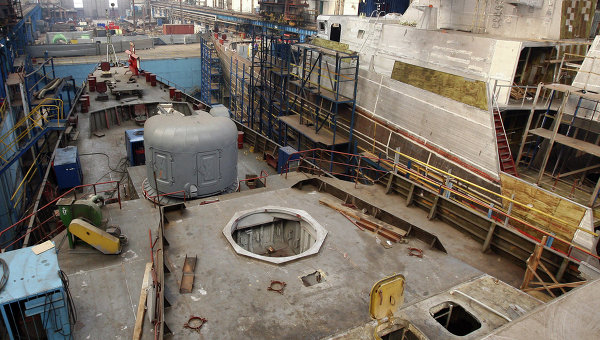
    Vietnam received first two Gepard-class frigates from Russia in 2011 under a contract signed in 2006. A follow-on order for two more frigates was signed in 2013, for which work is currently underway. Photo: Rian.ru
    Vietnam received first two Gepard-class frigates from Russia in 2011 under a contract signed in 2006. A follow-on order for two more frigates was signed in 2013, for which work is currently underway. Photo: Rian.ru

    ‘Skyshield’ – Counter MANPADS Laser Countermeasure Completes Testing

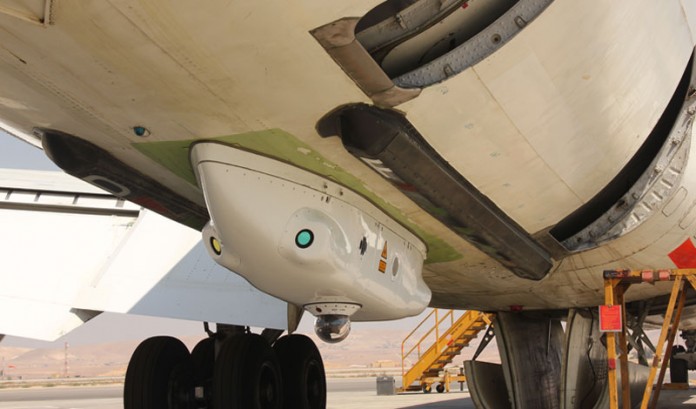
    C-MUSIC DIRCM pod installed on an IAF Boeing 707 tanker. Photo: IMOD

    The Israeli C-MUSIC laser-based Directional InfraRed CounterMeasure (DIRCM) system has recently passed a major milestone, following the completion of a qualification test series, an essential part of the systems’ certification process. In 2009 the system was selected by the Israel Ministry of Defense and Ministry of Transportation to defend commercial airplanes operated by Israel’s three commercial airlines.

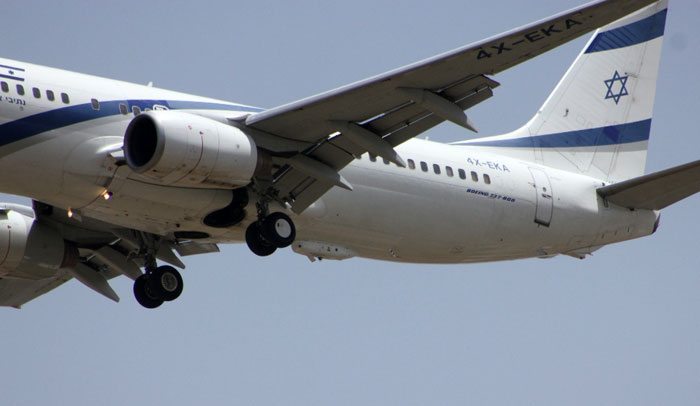
    A C-MUSIC system has already been installed on one of ElAl Boeing 737-800 aircraft for testing. The system has also went through extensive testing phase installed on an Israel Air Force Boeing 707 flying tanker. Photo: Elbit Systems
    A C-MUSIC system has already been installed on one of ElAl Boeing 737-800 aircraft for testing. The system has also went through extensive testing phase installed on an Israel Air Force Boeing 707 flying tanker. Photo: Elbit Systems

    Designated ‘Skyshield’, the counter- MANPADS (man portable anti-aircraft missiles) system designed to protect civilian passenger planes from missile attacks completed full system acceptance test recently, meeting a major milestone after a long development that spanned over more than a decade. The recent test series involved the Israeli Civil Aviation Authority (CAA) at the Ministry of Transport, the authority responsible for the civilian certification of the system.

    The system developed by Elbit Systems employs a fiber-laser based DIRCM to defeat heat seeking anti-aircraft missiles. The laser consists of a compact fiber-laser that can effectively engage the seeker incoming IR homing missiles, thus deflecting such missile from their course. The Skyshield has been selected by the Israel Ministry of Transport to protect the civilian aircraft operated by all Israeli commercial airlines.

    According to Brig. General Eitan Eshel, the head of R&D at the IMOD, the Skyshield test series was one of the most complex tests conducted in Israel. The test involved multiple engagements against targets simulating an aircraft protected by the system. The tests included a wide variety of threats that the SkyShield system would have to tackle in order to protect passenger aircrafts.

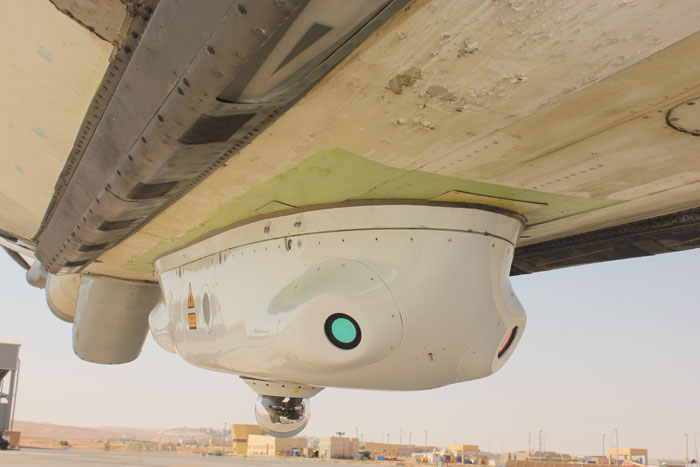
    C-MUSIC DIRCM pod installed on an IAF Boeing 707 tanker. Photo: IMOD
    C-MUSIC DIRCM pod installed on an IAF Boeing 707 tanker. Photo: IMOD

    Subscribe to read more

    Subscribe to read the full version

    The proliferation of MANPADS has been a concern for many years. Terrorist organizations and narco cartels have gained access to such weapons worldwide. The supply of more advanced missiles has increased following the collapse of the Libyan army in 2011, and the availability of such weapons from alternative sources, including China and Iran.

    According to a report published recently by the Wall Street Journal, Saudi Arabia has offered to deliver Chinese MANPADS to the Syrian opposition. The U.S. has long opposed arming rebels with antiaircraft missiles for fear they could turned against commercial airlines, in the region or around the world.

    Unlike the permanent installation of infrared countermeasures on military aircraft and helicopters, commercial airliners do not carry such systems on every flight. Instead, the aircraft are installed with an ‘A Kit’ that includes all the necessary attachments, wiring and connections for the system. An add-on ‘B Kit’ that includes the entire system, will be installed on specific aircraft flying to destinations the national security agency consider to present ‘high risk’. Once installed on the aircraft and switched on, ‘SkyShield’ is programmed to protect aircrafts automatically, without posing any environmental or safety hazards. The systems will be provided to the airline companies as part of the government sponsored security envelope they already receive on their international operations.

    The 'Skyshield' system comprises an installation kit installed on each aircraft destined to carry the system, and the complete DIRCM assembly contained in a 'gondola' shaped pod attached to the aircraft belly. The container has four IR sensors detecting the threat, imaging sensors for tracking and the laser emitter engaging the missiles. It is seen here installed on an Israel Air Force Boeing 707 tanker. Photo: IMOD
    The ‘Skyshield’ system comprises an installation kit installed on each aircraft destined to carry the system, and the complete DIRCM assembly contained in a ‘gondola’ shaped pod attached to the aircraft belly. The container has four IR sensors detecting the threat, imaging sensors for tracking and the laser emitter engaging the missiles. It is seen here installed on an Israel Air Force Boeing 707 tanker. Photo: IMOD

    Saudi Arabia’s New Missile Force

    A recent article in Newsweek reported that “according to a well-placed intelligence source,” in 2007 Saudi Arabia began to purchase CSS-5 (DF-21) ground-to-ground missiles from China. While similar reports appeared in the past, the recently published information is distinguished by its confirmation by an official – albeit anonymous – source, and by the revelation that the Americans knew about the Saudi-Chinese deal and were involved in it. The report raises many questions about the Saudis’ motivations, the implications of the deal, and the timing of the exposure. INSS analysts Yiftah Shapir , Yoel Guzansky  wrote in a recent INSS analysis.

    A recent article in Newsweek reported that “according to a well-placed intelligence source,” in 2007 Saudi Arabia began to purchase CSS-5 (DF-21) ground-to-ground missiles from China. While similar reports appeared in the past, the recently published information is distinguished by its confirmation by an official – albeit anonymous – source, and by the revelation that the Americans knew about the Saudi-Chinese deal and were involved in it. The report raises many questions about the Saudis’ motivations, the implications of the deal, and the timing of the exposure.

    Denied purchase of ground-to-ground missiles by the United States in the 1980s, the Saudis, unbeknownst to the United States, purchased about ten launchers and several dozen Chinese DF-3A missiles (called CSS-2 by NATO), which apparently were customized to carry conventional warheads. The missiles were stationed in a number of sites in Saudi Arabia and maintained by Chinese technicians. The covert deal led to a crisis in relations between Riyadh and Washington, particularly because the missiles were originally intended to carry nuclear warheads. The crisis ended when Saudi Arabia agreed to join the NPT.
    The DF-3A missiles were already outdated when the Saudis purchased them, and it was only a matter of time until they would seek to replace them or add more modern missiles to their arsenal. Moreover, these missiles use liquid fuel, are cumbersome to prepare for launching, and have low accuracy. And indeed, for several years there have been reports on Saudi expansion of its missile arsenal. In 2009, the existence of additional sites suspected of belonging to the Saudi missile arsenal was reported. A book by a former CIA employee published in 2010 even claimed that in 2003, the Saudis, with the knowledge of the United States, purchased advanced ground-to-ground missiles capable of carrying nuclear warheads. Also in 2010, there were reports that the strategic missile arsenal was being upgraded and that a new headquarters was dedicated outside of Riyadh for the kingdom’s Strategic Missile Force. Already then, doubts surfaced as to whether the Saudis needed the facility if they still had the old missiles.
    The latest report confirms the previous ones: the Saudis did in fact purchase missiles from China, with the knowledge of the United States. According to the report, CIA personnel examined the missiles in Saudi Arabia in order to confirm that they did not carry nuclear warheads. It may be that the deal was not revealed until now because the Americans examined the missiles and were not concerned by what they found or because of a desire to avoid embarrassment on both sides. The Americans may also have understood that if they were not involved in the process, Saudi Arabia could do without them, as it did in the past, and they preferred to retain control of the process.
    The Dong Feng 21 missile (East Wind 21) is a two-stage ballistic missile that uses solid fuel, which shortens the launch preparation time and makes maintenance easier. It has a range of some 1,700 kilometers and can carry a load of about 600 kilograms. It is much more accurate than the old DF-3A, and its CEP (Circular Error Probable, a measure of accuracy) is estimated at about 300-400 meters. Its later models are also equipped with terminal guidance, which enables it to hit pinpoint targets (though it is unlikely that these later models were exported).
    It is possible that the Saudis have purchased other missiles in addition to the DF-21, including other models produced in China (such as the DF-11 or the DF-15) or Pakistani-made missiles, such as one of the Shaheen series. Moreover, the Saudi efforts to acquire long range weapons have extended to cruise missiles, and the British reportedly sold the kingdom Storm Shadow cruise missiles as part of the Saudi program to upgrade its Tornado jets. The missile has a range of some 500 kilometers (and therefore, its export is restricted under the Missile Technology Control Regime agreements). An unofficial confirmation of the sale of the missile appeared in WikiLeaks documents in 2009, and in 2013 it was reported that in contrast to previous refusals, the United States had agreed to sell the Saudis SLAM-ER cruise missiles.
    While the new missiles have a shorter range than their predecessors, they have better accuracy. This gives them a greater deterrent value in Saudi eyes, even if they have conventional warheads, because of their ability to hit government buildings, strategic facilities, and military bases in Iran. Does the presence of these missiles significantly change the military balance in the region? Not as long as the missiles are armed with conventional warheads.
    The recent Newsweek report raises new questions as to the kingdom’s intentions in the nuclear realm. Officials in Saudi Arabia, which is in the midst of a significant conventional military buildup, have often stated that the kingdom is focusing on a nuclear program to meet the country’s energy needs and reduce its dependence on oil. However, Saudi Arabia has previously examined the military nuclear path, and to this end, has increased its cooperation with a number of countries, in particular Pakistan. It has had military cooperation with Pakistan for some years, and funded part of its nuclear program. In addition, several unusual comments from Riyadh since 2011 have indicated Saudi Arabia’s willingness to examine the nuclear path if the international community is unable to prevent Iran from attaining military nuclear capability. Because Saudi Arabia lacks an independent knowledge infrastructure, if it makes a decision to pursue a nuclear option, it will presumably prefer to purchase an off-the-shelf nuclear deterrent.
    The Saudis’ motivation in purchasing the missiles is Iran’s progress in its missile program and the growth and improvement in its ground-to-ground missile arsenal. It is possible that the progress in the Iranian nuclear program will lead to increased Saudi pressure on Pakistan to provide the kingdom with some type of nuclear guarantees, whether through extended deterrence, the stationing of nuclear forces in Saudi Arabia, or transfer of nuclear warheads to the Saudis for installation on the new missiles (in a regulated move or by turning a blind eye).
    Not only have Saudi Arabia’s concerns not been mitigated by the interim agreement signed with the Islamic Republic; they have actually intensified, if only because of the agreement’s significance for Iran’s international and regional status. The Saudis are anxious about the Iranian buildup, and it may be that the “revelations” on its missile arsenal are part of an attempt by Saudi Arabia to make its fears public. Furthermore, the report on the American involvement comes in advance of an expected visit by President Obama to the kingdom, which inter alia is designed to assuage Saudi fears that current American policy endangers Saudi security interests.
    In recent years, the discussion on strategic issues inside and outside the kingdom has become more public, and therefore, it is likely that further “revelations” can be expected. This is due to the negotiations with Iran and the significance Riyadh attributes to deterrent signals of this kind. The deal itself is also significant, indicating China’s growing interest in selling advanced weaponry to the region (and to Saudi Arabia, China’s largest oil supplier), but perhaps also the weakness of America’s standing in the region.
    To date there is no solid evidence that Saudi Arabia intends to pursue the nuclear route, even though nuclear weapons in Iranian hands would be a grave threat to the kingdom. However, in light of its great wealth and relative military weakness, Saudi Arabia will likely seek to construct security arrangements that will lend it more independence in decision making and better chances of maintaining a stable balance of deterrence in the Gulf over time. This is because of the tension in relations with the United States and the fear that it will reduce its involvement in the region after improving its relations with Iran, which would once again turn Iran into the dominant power in the Gulf.
    inss150It is not clear whether Israel has received any guarantees from the United States (perhaps even from Saudi Arabia) about the deals in question. Israel, as a rule, does not favor equipping an Arab state with advanced weapons that are capable of threatening it too. In the past, Israel actively opposed any such buildup. However, in recent years, given the joint Iranian threat, Israel has preferred to turn a blind eye to Saudi Arabia’s military buildup (and that of the other Gulf states), which has even been perceived in Jerusalem as an advantage. Nevertheless, Saudi Arabia’s arming itself with modern ballistic missiles should worry Israel. In addition to the fact that these weapons are in the hands of a state hostile to Israel, the buildup, particularly the silence surrounding it, and the nature of US involvement, bode ill for the stability of the region and the struggle against missile proliferation.

    IHS: Terrorism is on an Upward Trend

    The figures could not be clearer. Any objective analysis of the information obtained from open sources by the defence intelligence supplier IHS Janes shows that across the world the incidents of what they refer to as ‘damaging attacks’ has markedly increased in the last year. The average number of such attacks occurring over the six months to September 2013 is nearly sixty per-cent higher that the figure in the run up to the London Olympic Games. By any measure this is an astonishing increase. It is one that shows little sign of abating.

    While aficionados of the debate on what constitutes terrorism might wish to suggest that these figures do not provide a detailed analysis of what can be defined as terrorism a look at the detailed reporting provided by IHS Janes shows that these ‘damaging attacks’ are to all intents and purposes acts of terrorism. Their motivation and targets all fit the definition developed by the United Nations which, despite some academic resistance, is largely accepted as the basis for trying to track trends in the international security landscape.

    At current projections, if the rate of attacks continues to increase as they have done recently, the world will soon experience a month in which 2,000 incidents are recorded in the IHS Janes Terrorism Intelligence Centre (JTIC). The rapidly deteriorating security situation in Iraq and Egypt alongside rising threats in the Sahel and Maghreb regions of North Africa and continuing insecurity in Pakistan and Nigeria makes the likelihood of this figure being reached early in 2014 quite high. This will create quite a backdrop against which delegates and equipment suppliers will meet at Olympia for the annual Counter Terrorism Expo in April 2014.

    Those attending CTX 2014 will have the opportunity to discuss these trends and to explore what they mean for potential terrorism in Western Europe and the United States. This analysis shows this will be a timely event. As events in Boston, Woolwich and Nairobi have shown terrorism remains unconfined to specific countries in the Middle East and North Africa.

    Al Qaeda Far From Undefeated

    Despite some political posturing around the start of the year in Washington the simple fact of the matter is that Al Qaeda is far from defeated. Whilst strikes by unmanned aircraft have had a disruptive impact on the operations of the movement in some of the areas with the most active franchises its acolytes and adherents are still able to stage manage major events that are reminiscent of what happened in Mumbai and London. Given these trends the question on the lips of many that will attend CTX 2014 is how can future strikes be prevented? If recent developments are anything to go by the Americans are beginning to show a greater flexibility as the geographic range of Al Qaeda is extending from Pakistan across the Middle East to the Atlantic shoreline of West Africa.

    Disruption and prevention of such attacks of course requires increased intelligence. In some areas where international terrorism is beginning to establish a new footprint, such as along the North African coastline and into the Sahel, it will take time to develop reliable sources of human intelligence to target key leaders involved in the planning of attacks. Strikes by unmanned aircraft, often referred to as drones, do require a range of intelligence sources to ensure that the possibility of collateral damage is minimised. Reliable human intelligence is always at a premium.

    Of late the Americans appear to have signalled a slight shift in their approach to prosecuting what are referred to as high value targets. The capture of a leading member of Al Qaeda in broad daylight in Tripoli sparked a furious reaction from the Libyan Government and appeared to be the trigger for the Prime Minister to be kidnapped.

    The failed raid in Somalia at the same time also targeted a leading figure in Al Shabab. Days later, the capture of a leading member of the Pakistani Taliban using a similar Special Forces mounted raid provides a pointer as to how the Americans are having to shift their tactics away from unmanned air strikes to contain the escalating threats that are now emerging. Where intelligence is thin on the ground Special Forces raids can pick up additional and potentially valuable intelligence at the location where the high value target has been located.

    The Disposition Matrix

    This apparent shift in tactics also shows the way in which the so-called ‘Disposition Matrix’ (a targeting matrix by any other name) that the Americans are now using to create the framework for operations to disrupt the leadership of Al Qaeda is being applied. Recent statements emerging from the White House have offered some increased transparency as to how individuals that are thought to occupy senior positions in the international operations of Al Qaeda are being pursued.

    Each situation is clearly being seen on a case-by-case basis. Getting an operator on the ground in the Nevada Desert to pull the trigger and unleash a Hellfire Missile against a moving truck is not the only option the Americans now seem to favour in the global effort to attack the increasing trends in international terrorism.

    For many Americans the one lesson that can never be forgotten is that before September 11 the terrorists gained a sanctuary in Afghanistan from which they were able to project evil onto the international in what will be an event long marked in history. The prevention of any repeat of that event requires some form of upstream engagement in areas where terrorists seek to exploit ungoverned spaces.

    Sadly at the moment they have simply too many hiding places. With the terrible costs of the military involvement in Iraq and Afghanistan likely to be counted for many years to come alternative methods must be found to contain international terrorism. CTX 2014 provides the ideal international forum in which those involved in prevention, protection and responses when terrorists do succeed to come together and debate these fast moving issues.

    Aussie Poseidon will be an advanced version of the US Navy P-8A

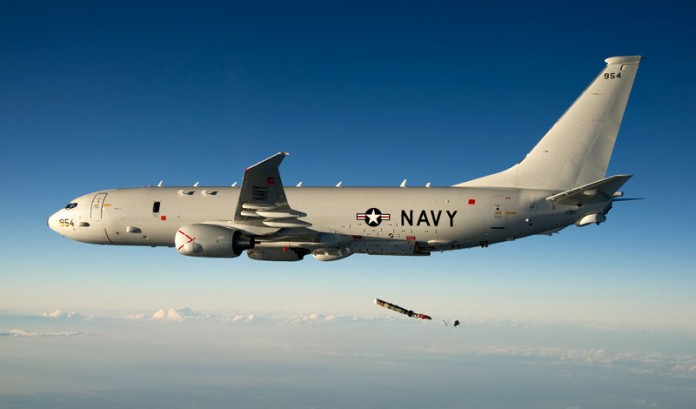
    A P-8A Poseidon assigned to the Bureau of Air Test and Evaluation Squadron (VX) 20 replicates the characteristics of an MK-54 torpedo. (Photo: U.S. Navy photo by Greg L. Davis)

    The Australian Government has approved the acquisition of eight Boeing P-8A Poseidon maritime surveillance aircraft at an investment of about A$4 billion (US$3.6 Billion). 

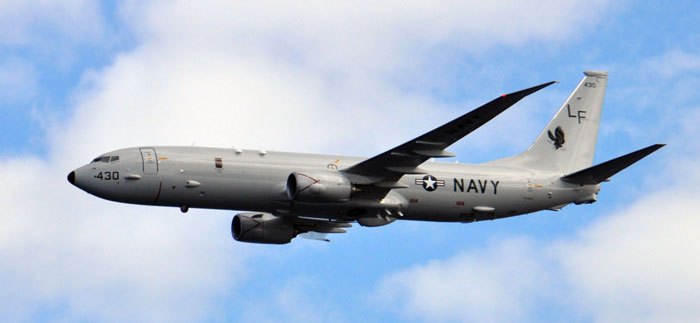
    A P-8A Poseidon assigned to Patrol Squadron (VP) 16 is seen in flight over Jacksonville, Fla. (Photo: U.S Navy by Anthony Petry)
    A P-8A Poseidon assigned to Patrol Squadron (VP) 16 is seen in flight over Jacksonville, Fla. (Photo: U.S Navy by Anthony Petry)

    The new fleet is expected to become fully operational in 2021. Together with high-altitude unmanned aerial vehicles, these aircraft will replace the Royal Australian Air Force AP-3C Orions that have served Australia so well for over four decades.

    There are 18 Orions in service with the Royal Australian Air Force (RAAF). Delivered in the late 1970s the Aussie Orions fleet went through a comprehensive upgrade in the early 2000s, improving radar, ESM and other avionic capabilities.

    Manned-Unmanned Team

    The replacement of those aircraft comes under the Australian Defence Force’s (ADF) Project Air 7000 plan estimated to cost about A$7 billion. Phase 2B outlines the manned element (Poseidon) plan with the follow-on phase 1B element defining the unmanned Broad Area Maritime Surveillance (BAMS) element. Phase B will cost about A$3 billion and include six or seven Northrop Grumman MQ-4C Triton High Altitude Long Endurance (HALE) drones. A formal announcement expected later in 2014.

    “The P-8 gives us an unprecedented capability to find, fix and track both surface ships and submarines,” RAAF chief Air Marshal Geoff Brown

    The purchase of Tritons was opposed in military circles in 2012, due to its inability to carry weapons. The new government has backed the procurement, particularly for its exceptional area coverage capacity – the US Navy claims a Triton can monitor an area of close to seven million square kilometres in one operation.

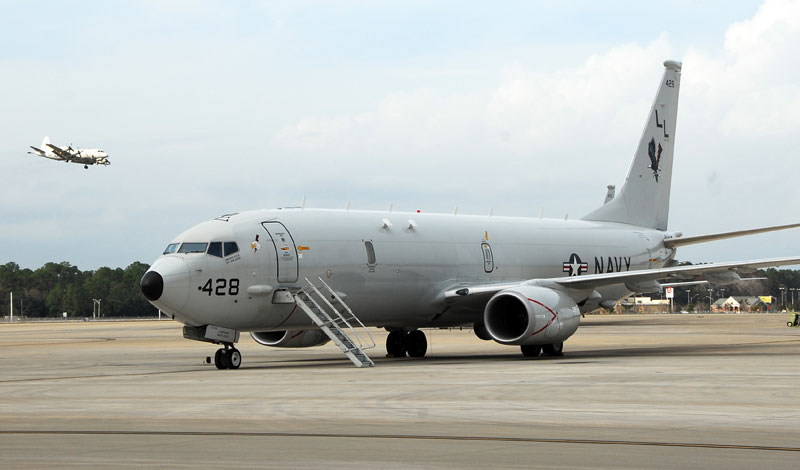
    An U.S. Navy P-8A Poseidon aircraft sits on the flight line at Naval Air Station Jacksonville, Fla., as a Navy P-3C Orion aircraft flies in the background Jan. 9, 2013. (Photo: U.S. Navy by Gulianna Dunn)
    An U.S. Navy P-8A Poseidon aircraft sits on the flight line at Naval Air Station Jacksonville, Fla., as a Navy P-3C Orion aircraft flies in the background Jan. 9, 2013. (Photo: U.S. Navy by Gulianna Dunn)

    The Australian acquisition would be the second international Poseidon sale for Boeing and the first international sale for the Triton UAS. The first eight P-8I ‘Neptune’ were ordered by India in 2009 for US$2.1 billion. Three have already been delivered to India. Additional four aircraft were ordered in 2011.

    Boeing is expected to hand over the first Australian P-8 in 2017, with all eight aircraft delivered and fully operational by 2021. The Australian Government has also approved an option for a further four aircraft subject to the outcomes of the Defence White Paper review.

    Extending the Reach of Maritime Surveillance

    “The P-8 gives us an unprecedented capability to find, fix and track both surface ships and submarines,” RAAF chief Air Marshal Geoff Brown said. The P-8A has an unrefuelled range of over 4,000 nautical miles (7,500 kilometres) or the ability to remain on station conducting low-level Anti Submarine Warfare (ASW)

    Lt. Cmdr. Colette Lazenka, Tactical Coordinator with Patrol Squadron (VP) 30, shows Chief of Naval Air Training Rear Adm. Mark Leavitt some of the new features of the P-8A Poseidon.(Photo: U.S. Navy  by Richard Stewart)
    Lt. Cmdr. Colette Lazenka, Tactical Coordinator with Patrol Squadron (VP) 30, shows Chief of Naval Air Training Rear Adm. Mark Leavitt some of the new features of the P-8A Poseidon. (Photo: U.S. Navy by Richard Stewart)

    missions for over four hours at a range of more than 1,200 nautical miles (2,200 km) from base. These aircraft can also be refuelled in flight, from the boom of tanker aircraft such as the KC-30A, pushing its endurance out to over 20 hours, making it possible to patrol Australia’s isolated Southern Ocean territories up to Antarctica.

    In addition to patrolling Australia’s maritime approaches and supporting coalition operations in the Pacific Ocean, the Australian Poseidons will be tasked to conduct search and rescue; anti-submarine and maritime strike missions using torpedoes and Harpoon missiles.

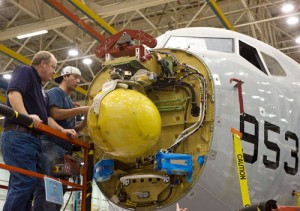
    Boeing Team Installs Radar Antenna on P-8A Poseidon. Photo: Boeing
    Boeing Team Installs the Raytheon APY10 Radar Antenna on the P-8A Poseidon test aircraft. Photo: Boeing

    In addition to the military missions, Australia also need real-time surveillance in the vast sea areas north east of Australia, all the way to Sri-Lanka, to help find asylum seeker vessels on their way to Australia. On such non-military missions the Poseidon will work closely with the Australian Customs and Border Protection Service (ACBPS) aviation fleet, to secure ocean resources, including offshore energy resources off northern Australia.

    Aussie P-8A to be More Mature Aircraft

    The aircraft is equipped with the Raytheon APY10 maritime surveillance radar, providing all weather, day and night surveillance for surface, anti-submarine and anti-surface warfare as well as intelligence, surveillance and reconnaissance (ISR) mission support.

    “Increment 2 will have sufficient capability to allow the RAAF to replace one squadron of AP-3Cs, achieving initial operational capability in 2019.”

    Full version of this article is available for our subscribers

    Subscribe to read the full version

    Australia’s first P-8As are likely to be delivered in an increment 2 configuration, which adds acoustic equipment and a maritime automatic identification system capability to the USN’s baseline increment 1 aircraft now entering use. The future standard will have sufficient capability to allow the RAAF to replace one squadron of AP-3Cs, and should achieve initial operational capability in 2019.

    Since 2007 Australia has invested about $250 million in the P-8A development, becoming a ‘minor partner’ in the US Navy lead program. Australian businesses have already won approximately $8.5 million of work associated with Australia’s participation in the P-8A program. According to Ministry of defence sources, Australian companies stand to benefit by as much as $1 billion through construction of facilities at RAAF Base Edinburgh in South Australia and elsewhere and work to meet maintenance and other support needs.

    Additional photos attached to the full version:

    A P-8A Poseidon assigned to the Bureau of Air Test and Evaluation Squadron (VX) 20 replicates the characteristics of an MK-54 torpedo. (Photo: U.S. Navy photo by Greg L. Davis)
    A P-8A Poseidon assigned to the Bureau of Air Test and Evaluation Squadron (VX) 20 replicates the characteristics of an MK-54 torpedo. (Photo: U.S. Navy photo by Greg L. Davis)

    Aviation Ordnancemen assigned to Patrol Squadron (VP) 16, prepare to load a MK-54 torpedo onto a P-8A Poseidon aircraft. (Photo: U.S. Navy, by Eric A. Pastor)
    Aviation Ordnancemen assigned to Patrol Squadron (VP) 16, prepare to load a MK-54 torpedo onto a P-8A Poseidon aircraft. (Photo: U.S. Navy, by Eric A. Pastor)

    Green Hills Improves Security Solutions for Embedded Systems

    Embedded software provider Green Hills is integrating a powerful cryptographic engine and an Embedded Cryptographic Toolkit with INTEGRITY Real-Time Operating System (RTOS) to increase the system’s capability to run complex and more powerful security levels. Implementing the Freescale Semiconductor C29x cryptographic coprocessor family, the new solution enable designers to efficiently accommodate the exploding demand for secure processing in applications, in government and defense systems. The company is demonstrating the integration for the first time this week at the RSA Conference in San Francisco.

    Compute-intensive math behind key transactions and secure network communications quickly saturates today’s general-purpose processors and even multicore systems-on-a-chip (SoC) with cryptographic acceleration. According to said Tareq Bustami, vice president of product management for Freescale’s Digital Networking business, the C29x security engine (SEC) offloads this processing with unparalleled performance. “As modern commerce and communications require higher levels of security, Freescale’s C29x crypto coprocessor family brings new scalability in both power and performance at a low cost” he added.

    The Green Hills solution, comprised of its INTEGRITY real-time operating system (RTOS), Embedded Cryptographic Toolkit and advanced MULTI integrated development environment (IDE), is optimized to utilize the C29x security engines (SEC).

    To implement the enhanced security level the company offers the Embedded Cryptographic Toolkit, providing a complete set of C- language cryptographic algorithms, random number generators, secret-key and public-key cryptography and secure networking protocols, validated to FIPS 140-2 level 1 and meeting the NSA Suite B Standard. The associated High Assurance Embedded Cryptographic Toolkit (HA-ECT) is a complete set of cryptographic algorithms, including AES encryption and Elliptic Curve Cryptography (ECC) for key agreement and digital signatures.

    Marine Corps to Support Afghan Electronic Attack Missions from Qatar

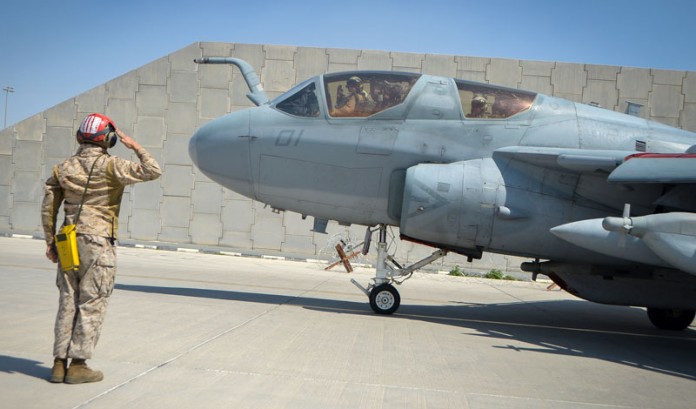
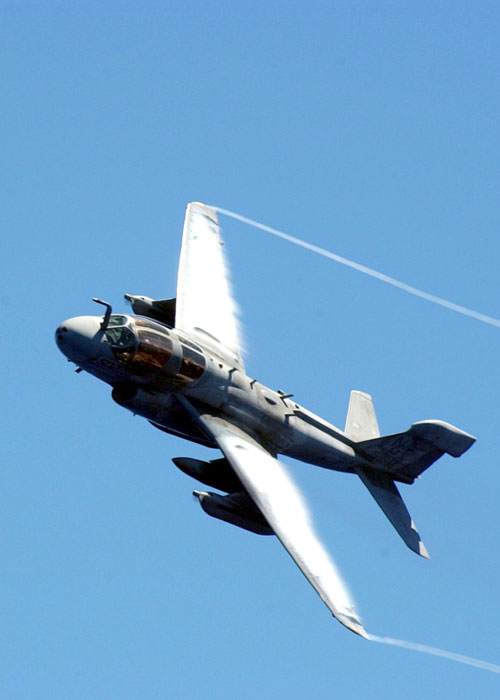
    The Prowlers who were previously deployed to Afghanistan have been moved to AUAB and are currently being supported by more than 200 Marines from Marine Corps Air Station Cherry Point, N.C. (U.S. Air Force photo by Senior Airman Jared Trimarchi)

    As part of the redeployment from Afghanistan, the U.S. Marine Corps is shifting Electronic Attack (EA) assets from Bagram to Qatar, where VMAQ-3 “Moondogs” has deployed to last week.

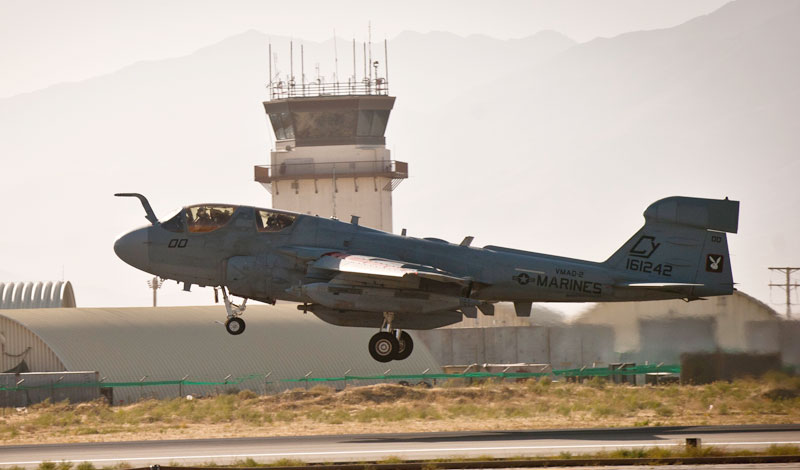
    In recent years Prowler detachments were regularly operating from Bagram in Afghanistan, tasked primarily in providing electronic support for ground operations, assisting ground forces in Afghanistan and Iraq with counter IED jamming, signals intelligence and selective jamming. Photo: US Air Force Capt. Raymond Geoffroy
    In recent years Prowler detachments were regularly operating from Bagram in Afghanistan, tasked primarily in providing electronic support for ground operations, assisting ground forces in Afghanistan and Iraq with counter IED jamming, signals intelligence and selective jamming. Photo: US Air Force Capt. Raymond Geoffroy


    In recent years Prowler detachments were regularly operating from Bagram in Afghanistan, tasked primarily in providing electronic support for ground operations, assisting ground forces in Afghanistan and Iraq with counter IED jamming, signals intelligence and selective jamming. Supporting traditional marine corps missions, such as amphibious operations, and other high intensity warfare operations require different techniques, tactics and procedures the units currently deployed to Japan can practice. Such activities are regularly performed in exercises they deploy to in Korea, Japan and other parts of the Pacific theatre.

    The Prowlers who were previously deployed to Afghanistan have been moved to Al Udeid and are currently being supported by more than 200 Marines from Marine Corps Air Station Cherry Point, N.C.

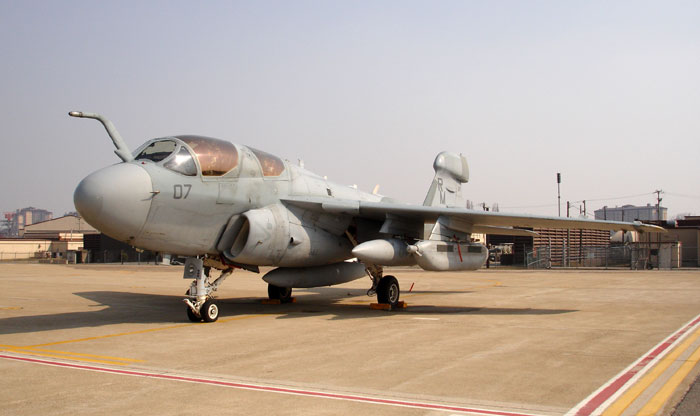
    The EA-6B Prowler is a four-seat, twin-engine tactical electronic attack aircraft capable of attacking and jamming enemy radio, communications and radar operations. In service for 37 years the Grumman EA-6B Prowler is one of the Marine Corps’ oldest combat aircraft serving today, yet it carries out one of the most challenging and sophisticated missions – electronic attack. “Electronic warfare is always changing by its nature,” Whitten said.

    The Prowlers who were previously deployed to Afghanistan have been moved to AUAB and are currently being supported by more than 200 Marines from Marine Corps Air Station Cherry Point, N.C. (U.S. Air Force photo by Senior Airman Jared Trimarchi)
    The Prowlers who were previously deployed to Afghanistan have been moved to AUAB and are currently being supported by more than 200 Marines from Marine Corps Air Station Cherry Point, N.C. (U.S. Air Force photo by Senior Airman Jared Trimarchi)

    “The airframe was capable of being updated over the years and that’s why it was able to stay around for so long. Thirty-five years later, they’re still doing another evolution to keep up with the threat.” said Retired Col. Wayne Whitten who flew as a crew member with the first Prowlers.

    Prowlers have been supporting ground troops during Operation Enduring Freedom for more than 10 years. Photo: USMC
    Prowlers have been supporting ground troops during Operation Enduring Freedom for more than 10 years. Photo: USMC

    The aircraft was designed to suppress enemy air defense so Marine aircraft could traverse hostile airspace in relative safety. However, in the past 10 years, the Prowler has flown almost exclusively in support of ground forces in Iraq and Afghanistan. Whitten said it is unique for an aircraft to fulfil completely different roles as the Prowler has.

    The Prowler may be the last Marine aircraft dedicated solely to electronic warfare. The Marine Corps still plans to cycle the Prowler out of service for the stealthy F-35B, which will perform some electronic warfare roles using its powerful radar’s Active Electronic Scanned Array as a directional jammer.

    “There is a huge shift in the mindset, going away from kinetic fires and dropping bombs… Sometimes the targets are easier to attack electronically than they are kinetically.” Maj. Bart Macmanus, VMAQ-4 XO

    The F-35B will not replace each of the specific function the Prowler has today, it will provide the Marine Air-Ground Task Force (MAGTF) Electronic Warfare with the same capabilities the Prowler has today as a dedicated EA platform. The US Navy is maintaining the dedicated EA role with the EA-18G Growler, which is also geared to fire guided missiles against radars and other targets that can be identified by their electronic signature.uses

    One of the new rotations announced this week is the deployment of Marine Tactical Electronic Warfare Squadron 3 (VMAQ-3) “Moondogs” at Al Udeid Air Base (AUAB), Qatar. The squadron arrived here with its EA-6Bs, on February 17, 2014, to support the U.S. Central Command area of responsibility. The Prowlers were previously deployed to Afghanistan have been moved to AUAB and are currently being supported by more than 200 Marines from Marine Corps Air Station Cherry Point, North Carolina.

    Though the Prowlers will continue to fly missions to Afghanistan, their main mission is to be ready to support any contingencies or operations which may need electronic attack in the Central Command (CENTCOM) Area Of Responsibility (AOR). “We are excited to be back at Al Udeid Air Base and look forward to providing electronic attack for U.S. and coalition forces in the area,” said Marine Capt. Keith Hibbert, a Moondog pilot who hails from Ithaca, N.Y. “Prowlers have been supporting ground troops during Operation Enduring Freedom for more than 10 years, and we look forward to continuing that support.”

    An EA-6B Prowler aircraft sits ready to conduct training missions at Osan Air Base, Republic of Korea. Marine Tactical Electronic Warfare Squadron 4 is supporting these deployments out its base at Marine Corps Air Station Iwakuni, Japan. Photo: USMC by Sgt. Charles McKelvey
    An EA-6B Prowler aircraft sits ready to conduct training missions at Osan Air Base, Republic of Korea. Marine Tactical Electronic Warfare Squadron 4 is supporting these deployments out its base at Marine Corps Air Station Iwakuni, Japan. Photo: USMC by Sgt. Charles McKelvey


    Another Marine Corps electronic attack squadron, VMAQ-4 “Seahawks” has deployed to Marine Corps Air Station, (MCAS) Iwakuni, Japan in November, replacing VMAQ-2 “Death Jesters” that were deployed here since August. The squadron was returning to the Pacific Area of Operation after six year of absence, when all electronic attack were directed at the ongoing conflicts in Southwest Asia and the Middle East. VMAQ-1 is based in the SUA and is responsible for operational training of air crews and personnel for the EA-6B fleet.

    ”There is a generation who has done nothing but (Operation Iraqi Freedom and Operation Enduring Freedom) and they never got the chance to do UDP [Unit Deployment Plan]” said Maj. Bart Macmanus, VMAQ-4 executive officer. “We are trying to do a lot of training,” said Macmanus. “This is the first time Prowlers have been out here in a while, so we are trying to reeducate people, mainly on the capabilities that we bring to the fight.”

    ”There is a generation who has done nothing but OIF and OEF… With the vacuum that’s been here since the Prowlers have been gone, there’s a lot of resident knowledge that has been lost” Maj. Bart Macmanus, VMAQ-4 XO

    Although now fully employed, the unit’s mission in OEF and OIF varied from what the Marine Corps now expects of its electronic experts. “Being back out here is a totally different mindset and it’s good to get us back out here,” said Macmanus. “It is more dynamic out here and it requires a lot more work to understand your mission set.” Macmanus also said one of the unique opportunities of this UDP is the ability to work with other military branches, such as the U.S. Air Force, stationed at Osan Air Base, Republic of Korea.

    “With the vacuum that’s been here since the Prowlers have been gone, there’s a lot of resident knowledge that has been lost,” said Macmanus. “So, we’re just trying to reeducate the masses on what are our capabilities and what we bring out here, not just with the Air Force, but the Marines as well.” Last year the squadron deployed to Iwakuni’s for a short introductory exercise with Marine Corps Hornets and Harriers, plus joint operations with U.S. Air Force and Naval units.

    On their current deployment the Seahawks focus again on training. While it’s not putting rounds down range, their presence in the combat arena is certainly felt. “There is a huge shift in the mindset, going away from kinetic fires and dropping bombs,” Macmanus said. “Sometimes the targets are easier to attack electronically than they are kinetically.”

    While absent in the Pacific, the Prowler’s reputation became comparable to an old novel with a bookmark. The Seahawks now re-open that book and prepare to write new chapters, almost 45 years in the making.


    Future Bombers has Legacy to Uphold

    Lt. Gen. Burton Field and Dr. Rebecca Grant talk about new capabilities during their, "The Future Bomber," discussion at the 30th Annual Air Force Association Air Warfare Symposium and Technology Exposition Feb. 20, 2014, in Orlando, Fla. Field said as the technological climate of war advances, the new long-range strike bomber will need the capability to combat new threats. Field is the deputy chief of staff for operations, plans and requirements and Grant is the president of IRIS Independent Research. (U.S. Air Force photo/Scott M. Ash)
    The next generation bomber designed by Boeing and Lockheed Martin will have a 'global reach' operating as a piloted or an unmanned platform, on nuclear or conventional attack missions. Photo: Boeing
    The next generation bomber designed by Boeing and Lockheed Martin was designed for ‘global reach’, operating as a piloted or an unmanned platform, on nuclear or conventional attack missions. The current program, known as ‘Long Range Strike -Bomber’ is part of the Pentagon’s global strike strategy that includes both manned, unmanned and missile-based strike capabilities. Photo: Boeing
    Lt. Gen. Burton Field and Dr. Rebecca Grant talk about new capabilities during their, "The Future Bomber," discussion at the 30th Annual Air Force Association Air Warfare Symposium and Technology Exposition Feb. 20, 2014, in Orlando, Fla. Field said as the technological climate of war advances, the new long-range strike bomber will need the capability to combat new threats. Field is the deputy chief of staff for operations, plans and requirements and Grant is the president of IRIS Independent Research. (U.S. Air Force photo/Scott M. Ash)
    Lt. Gen. Burton Field and Dr. Rebecca Grant talk about new capabilities during their, “The Future Bomber,” discussion at the 30th Annual Air Force Association Air Warfare Symposium and Technology Exposition Feb. 20, 2014, in Orlando, Fla. Field said as the technological climate of war advances, the new long-range strike bomber will need the capability to combat new threats. Field is the deputy chief of staff for operations, plans and requirements and Grant is the president of IRIS Independent Research. (U.S. Air Force photo/Scott M. Ash)

    With a proven history of success, today’s bomber fleet has a reputation for excellence. It is, however, an aging fleet in need of a new addition, the deputy chief of staff operations, plans and requirements said during the 30th Annual Air Force Association Air Warfare Symposium and Technology Exposition Feb. 20, in Orlando, Florida.

    Throughout history, bombers have played an integral role in major conflicts and rose to the challenge of new threats, said Lt. Gen. Burton Field, deputy chief of staff for operations, at the Headquarters of the U.S. Air Force.

    Major campaigns have been well documented, crediting their capabilities as both bombers and hostile act deterrents. As the technological climate of war advances, the new long-range strike bomber will need the capability to combat these new threats.

    “Because of what (bombers) have done, they represent power, they represent potential … and they have a proven record of effectiveness in conflicts going back to War World II, and in every (conflict) until today,” Field said.

    The LRS-B must continue the legacy by assisting with land, sea and even cyberspace warfare in the form of communications interception, said Dr. Rebecca Grant, the president of IRIS Independent Research, a small business that specializes in national security.

    The bomber must be proficient in all theaters.

    “We have a tremendously noble fleet that has performed beyond expectations in conflicts ranging from Iraq to Afghanistan,” Grant said. “(However,) we are already short for today’s current theater demands. Looking a little bit ahead, it’s clear we don’t have enough penetrating bombers for the threats and challenges of the 2020’s and beyond.”

    Grant cited the U.S. has yet to face a modern surface to air, or SAM, missile threat with its current fleet and may not be adequately suited for combat against more advanced SAM sites. A new bomber would be up to the task of tomorrow’s combat environment and possibly replace some of the more dated aircraft, especially during a time when forces are being rebalanced.

    “In (the mid 2020’s) … our armed forces will face challenges for which it was not designed,” Grant said, noting the way to mitigate that challenge is by beginning plans now.

    The bomber fleet is important not only for its ability to get bombs on target, but as a show of force, Field said. He cited several examples of bombers used as deterrence, including flying B-26 Peacemakers over Russia in 1952 during a parade, a B-52 Stratofortress’ flight over China, and the more recent B-2 Spirit flight over North Korea.

    The inventory goal for the new long-range strike bomber is 80-100 bombers by the mid 2020’s, Field said. Bombers must be able to reach deep behind enemy lines with sufficient numbers to to conduct operations across the depth of an entire theater simultaneously, the general continued.

    The addition of a new bomber is paramount to maintaining this capability for tomorrow’s conflict.

    “Bombers can send messages,” Field said. “They can influence or initiate action, and they are credible because of what they have done in the past.”

    Written by: Senior Airman Zachary Vucic, First published by the Air Force News Service

    Update: US Air Force Secretary Deborah Lee James announced Thursday (February 27, 2014) that a formal Request for proposal (RFP) for the new bomber will be released in the fall of this year. The program will be one of the Air Forces’ top acquisition priorities for this decade, with fielding tentatively starting in the mid 2020.

    Skunk Works and XTEND Simplify Multi-Drone Command

    0
    Lockheed Martin Skunk Works® and XTEND have achieved a major milestone in JADC2 by integrating the XOS operating system with the MDCX™ autonomy platform. This technical breakthrough enables a single operator to simultaneously command multiple drone classes, eliminating the friction of mission handoffs. From "marsupial" drone deployments to operating in GPS-denied environments, explore how this collaboration is abbreviating the data-to-decision timeline and redefining autonomous mission execution.

    From Ukraine to Taiwan: The Global Race to Dominate the New Defense Tech Frontier

    0
    As traditional defense primes face mounting competition from agile “neoprimes” such as Anduril, Palantir and Helsing, the balance of innovation is shifting toward software-defined warfare and scalable, dual-use technologies, while global industry consolidation—marked by Boeing’s integration of Spirit AeroSystems and other strategic mergers—signals an intensified race to secure control over the defense technology value chain. Our Defense-Tech weekly report highlights these trends.

    Europe’s “Drone Wall”

    0
    In early October 2025, a coordinated wave of unmanned aerial system (UAS) incursions—widely attributed to Russia—targeted critical infrastructure across at least ten European nations. The unprecedented campaign exposed the fragility of Europe’s air defenses...

    Weekly Defense Update & Global Security Assessment

    0
    Executive Summary The past week (September 18-25, 2025) represents an inflection point where strategic defense concepts have transitioned from doctrine to tangible reality. An analysis of global events reveals four primary, interconnected trends shaping an...

    U.S. Air and Space Forces Push Next-Gen Programs at the AS&C 2025 Conference and...

    0
    At the 2025 Air, Space & Cyber Conference, U.S. Air Force and Space Force leaders unveiled major updates on next-generation fighters, bombers, unmanned systems, and space initiatives, highlighting both rapid innovation and critical readiness challenges as the services race to outpace global competitors. A short version is available here, with a more detailed version for subscribers.

    TADTE 2025: Reflecting Taiwan’s Strategic Themes

    0
    The Taipei Aerospace & Defense Technology Exhibition (TADTE) 2025 crystallized around four dominant strategic themes that collectively illustrate Taiwan's comprehensive approach to defense modernization amid escalating regional tensions. Based on a detailed report by Pleronix (available upon request). Includes a Podcast discussion on TADTE 2025's highlighting Taiwan's four strategic themes beyond the post's coverage.

    Iron Beam 450 Completes Testing, Soon to Join With Operational Air Defense Units

    0
    Israel’s Iron Beam 450 high-power laser system has completed final testing, marking a major leap in air defense. Developed by Rafael, it offers precise, cost-effective interception of rockets, UAVs, and mortars, and is set for IDF deployment by 2025.