
Friday, December 26, 2025
More
    Home Blog Page 122

    Rafale Tested with Maximum Weapons Load – 12 Guided Weapons Underwing

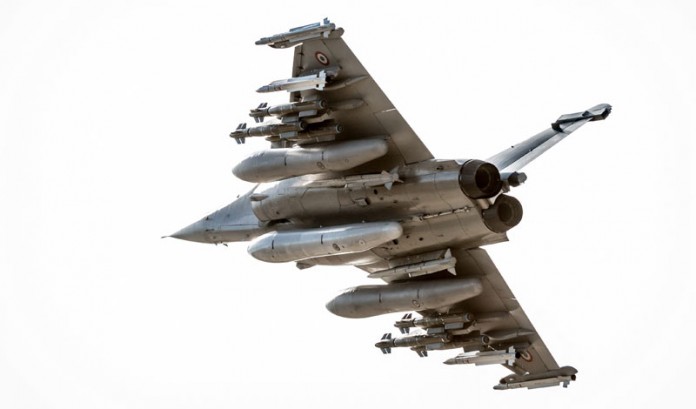
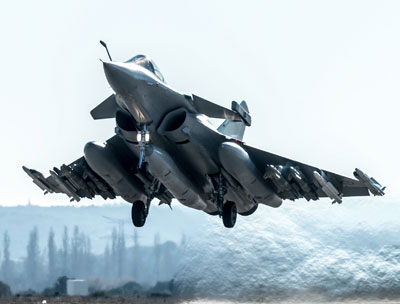
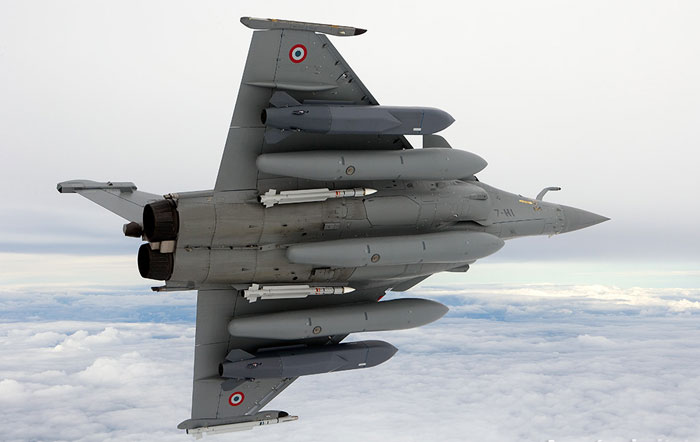
    The Rafale has successfully completed its first test flights in a new heavily-armed configuration, comprising six air-to-ground precision AASM Hammer missiles, four medium and long range air-to-air missiles from the MICA family, two very long range METEOR missiles, as well as three 2,000 liter fuel tanks. Photo: Dassault Aviation
    This preliminary work, self-funded by Dassault Aviation's are conducted in collaboration with the DGA and will eventually lead to a complete clearance of the flight envelope. Photo: Dassault Aviation
    This preliminary work, self-funded by Dassault Aviation’s are conducted in collaboration with the DGA and will eventually lead to a complete clearance of the flight envelope. Photo: Dassault Aviation

    Dassault Aviation has begun testing an upgraded variant of the Rafale  configured to carry an expanded configuration of weapons and fuel. This configuration will enable the French strike fighter aircraft to attack more targets and conduct counter-air missions at longer range.

    At present, the French military remains the single user of this impressive, but controversial jet fighter, since it failed each and every competition except the largest, most lucrative one – the MMRCA competition in India. But Dassault can’t cash in this win, since even after two years of negotiations the contract with the Indian government hasn’t been signed. The Rafale won that competition after it was selected ‘the lowest bidder’, against the Eurofighter Typhoon. But since its selection its cost escalated sharply and almost doubled, bringing the Indian government, currently heading for election, to develop cold feet about their decision to favor the French fighter.

    Nevertheless, Dassault is committed to bring new capabilities to the Rafale, according to plan, upgrading the aircraft to the Rafale F3-R standard by 2018. These initial tst flights were only the first in a long series, additional test flights are planned to a complete the clearance of the flight envelope for this configuration, providing the Rafale full multi-role capability at extended range.

    Equipped with this configuration, two Rafale aircraft represent the same potential as six Mirage 2000 class aircraft

    This configuration comprise a full increment of six air-to-air and six air-to-ground weapons. The air-to-ground ordnance includes six Sagem/MBDA Hammer guided weapons (AASM), carried on two triple-ejector racks, designed specifically for the weapon. The AASM is deployed with one of three optional guidance methods utilizing a GPS guided, laser homing or thermally guided seekers. To extend its range the Hammer is also equipped with a rocket booster. Four MICA air-to-air missiles and two very long range Meteor missiles will be complementing the fighter’s air-to-air capability. The MICA missiles are operational and can be employed with IR or radar guided. These Meteor missiles are yet to enter service – but they are expected to be fielded with the F3-R variant  by 2018. In addition to that impressive weapons complement, Rafale will retain its Nexter 30M791 30 mm internal cannon, firing 2500 rounds/min. According to the manufacturer, equipped with this configuration, two Rafale aircraft represent the same potential as six Mirage 2000 class aircraft.

    Since June 2013 all production aircraft configured to the new F3-04T-standard are equipped with the new radar, along with an improved front sector optronics equipment (also from Thales) and the DDM-NG passive missile approach warning system, produced by MBDA.

    The weapons would take less than a third of the fighter’s payload – the rest will be used to carry fuel to sustain the long range missions the fighter is required to perform. The Rafale can carry up to 9.5 tons of payload (21,000 lbs). To support  missions at extended ranges the fighter also carries three 524 gallons (2,000 litre) fuel tanks weighing additional 6.7 tons (14,700 lbs) that will top up the fighter’s internal fuel capacity of 4.7 t (10,300 lbs). These fuel tanks can also be used for ‘buddy refuelling’, further increasing the range and mission endurance of a Rafale-based strike force, a capability particularly important for the naval strike missions.
     

    In the current configuration Rafale carries two Scalp cruise missiles or four Hammer guided weapons, with four MICA air-to-air missiles. Photo: French Air Force
    In the current configuration Rafale carries two Scalp cruise missiles or four direct attack weapons (Hammer/laser guided bombs), with four MICA air-to-air missiles. Photo: French Air Force

    In the past the French Rafale could strike deep behind enemy lines utilizing the Scalp cruise missiles, as demonstrated in Libya in 2011. On such missions the Rafales carried two Scalp missiles and three 524 gallon fuel tanks. Other weapons typically carried by the Rafale include GBU-12/24 laser-guided bombs, GBU-49 GPS-guided bombs, AASM and Scalp cruise missiles. On maritime strike missions the Rafale M can also carry the Exocet AM39 Block 2 air-launched anti-ship missile. Since 2010 one of the Air Forces’ Rafale squadrons, EC-1/91 has also assumed the nuclear strike role, carrying ASMP-A missile. By increasing the capabilities of its fourteen hard points, (eight under the wings), with an empty weight of about 10 tons [22000 lbs], the F3 variant is limited to 24.5 tons [54,000 lb.]) thus being capable of carrying 1.5 times its own mass.
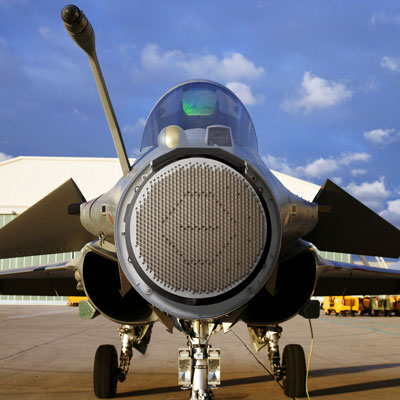
    Rafale No. 137 was the first to be equipped with Thales' new RBE2 AESA radar and the new optronic suit. Photo: Dassault Aviation
    Rafale No. 137 was the first to be equipped with Thales’ new RBE2 AESA radar and the new Front Section Optronics Optronic (FSO-IT) suit. Photo: Dassault Aviation

    Clearance of this new configuration was initiated and funded by the aircraft maker Dassault Aviation, in collaboration with the Direction Générale de l’Armement (the French Defense Procurement Agency DGA). According to Dassault, the rapid development of the new configuration is attributed to the open architecture of the aircraft, designed from the outset to perform all of the missions previously assigned to seven different types of aircraft in France.

    The Rafale entered service with the French Navy in 2004 and with the French Air Force in 2006. Of the 180 aircraft ordered by France to date, 126 have been delivered. India has also selected the Rafale for its Medium Multi Mission Combat Aircraft (MMRCA) requirement, planning to order at least 126 of the jet fighters. However, two years after the selection New Delhi has not finalized the contract with Dassault and, pressed by the upcoming elections, the Indians are considering a limited order of 18 aircraft to be produced in France, as a near-term solution to get the deal in motion.

    The defence ministry headed by AK Antony has developed cold feet after the cost doubled compared to the original estimate. With the general elections just months away, Antony is unsure about the fate of the deal, a defence ministry official said. India’s Diligent Media Corporation (DNA) reports. In January 2012, when Rafale was declared the winner, its price was quoted between $60-65 million (Rs373-Rs400 crore). Today, according to the , its price could now soar to $120 million (Rs746 crore). The second bidder, Eurofighter, had quoted $80-85 million (Rs497-Rs528 crore). The price hike would mean that the deal would cost India nothing less than $28-30 billion (Rs1.75 lakh crore-Rs1.86 lakh crore) DNA quoted an anonymous Indian Air Force source close to the negotiation committee. In 2007, when the tender was floated, the cost of the programme was $12 billion (Rs42,000 crore). When the lowest bidder was declared in January 2012, the cost of the deal shot up to $18 billion (Rs90,000 crore).

    The Rafale fleet with the French Air Force and Navy currently totals almost 120,000 flight hours, including 16,000 in operations. Since mid-2013, production Rafale aircraft are equipped with an active array RBE2 AESA radar from Thales.

    Expected to become operational in 2018, Rafale F3-R will be an evolutionary upgrade of the current F3 variant, a part of an ongoing enhancement of the French fighter. Among the improvements are the introduction of RBE2 active electronically scanned array (AESA) radar, developed by Thales. This radar has already been fielded with at least 60 of the Rafales. The first to get the new radar was aircraft #137, that rolled of the production line in October 2012.

    Since mid 2013 production aircraft are configured to the new F3-04T-standard are equipped with the new radar, along with an improved front sector optronics (FSO-IT) equipment (also from Thales) and the DDM-NG passive missile approach warning system, produced by MBDA. Another new capability to be integrated with the fighter by 2018 will be the PDL-NG new-generation laser designation pod, currently under development at Thales. Other planned sensors upgrades related to air-to-surface capabilities include assisted target recognition and enhanced sensor resolution, enabling the Rafale to attack ever more elusive targets.

    According to Dassault, the ongoing effort will ensure more robust detection, tracking and identification of emerging air-to-air threats, and increase the Rafale’s survivability with new low observable modes and with the latest advances in electronic warfare systems.
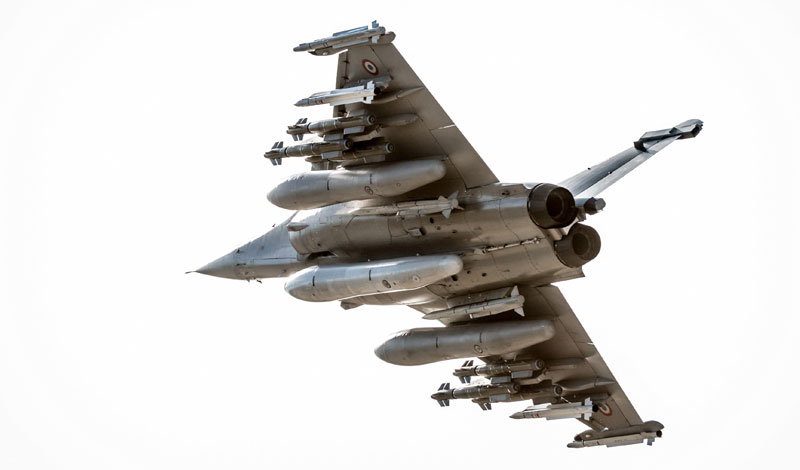
    The Rafale has successfully completed its first test flights in a new heavily-armed configuration, comprising six air-to-ground precision AASM Hammer missiles, four medium and long range air-to-air missiles from the MICA family, two very long range METEOR missiles, as well as three 2,000 liter fuel tanks. Photo: Dassault Aviation
    The Rafale has successfully completed its first test flights in a new heavily-armed configuration, comprising six air-to-ground precision AASM Hammer missiles, four medium and long range air-to-air missiles from the MICA family, two very long range METEOR missiles, as well as three 2,000 liter fuel tanks. Photo: Dassault Aviation

    Pentagon’s Chief Tester Warns: F-35B Block 2B software is not Ready for 2015 IOC

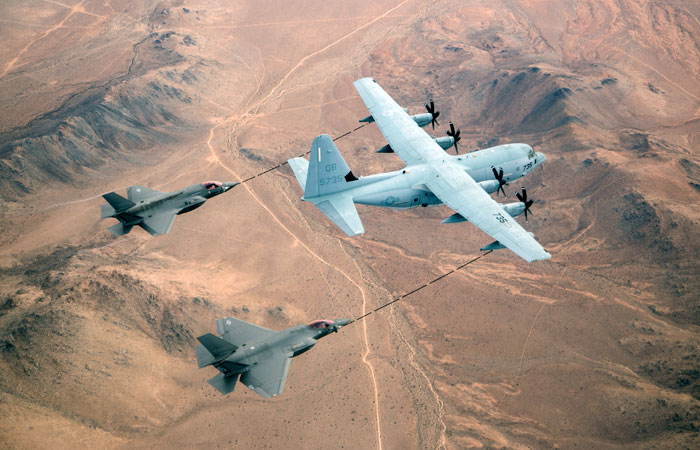
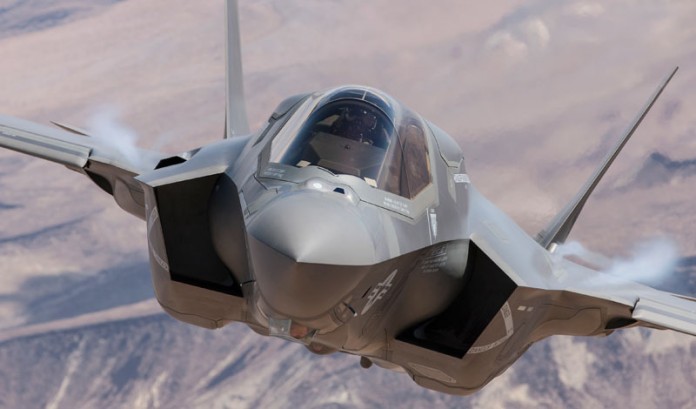
    F-35B approaching a USMC KC-130J tanker. Photo: Lockheed Martin.

    A new U.S. Defense Department report warns that ongoing software, maintenance and reliability problems with Lockheed Martin Corp’s F-35 stealth fighter could delay the Marine Corps’ plans to start using its F-35 jets by mid-2015. Reuter reported today

    An F-35B (left) and F-35C (right) Lightning II fighters flying from Edwards AFB refuel from a USMC KC-130J tanker over the Mojave desert, Ca.
    An F-35B (left) and F-35C (right) Lightning II fighters flying from Edwards AFB refuel from a USMC KC-130J tanker over the Mojave desert, Ca.
    .

    The latest report by the Pentagon’s chief weapons tester, Michael Gilmore, forecast a possible 13-month delay in completing testing of the Block 2B software needed for the Marine Corps to clear the jets for initial combat use next year, a priority given the high cost of maintaining current aging warplanes. The report, due to be sent to Congress this week, said the aircraft is proving less reliable and harder to maintain than expected, and remains vulnerable to propellant fires sparked by missile strikes.

    Gilmore: “Aircraft is proving less reliable and harder to maintain than expected, and remains vulnerable to propellant fires sparked by missile strikes”

    Air Force Lieutenant General Chris Bogdan, the Pentagon’s F-35 program chief, said in a statement to Reuters that Gilmore’s report was factually accurate but did not reflect concerted efforts under way by his office. “The basic design of the F-35 is sound, and test results underscore our confidence in the ultimate performance that the United States and its international partners and allies value so highly,” Bogdan said, adding that he remained confident that the F-35’s initial combat capability would be ready in time for the U.S. Marine Corps next year. He cited a series of successful weapons tests done late last year. He said the program was about halfway through developmental testing after completing 1,153 flights and accomplishing more than 9,000 test objectives in 2013. “Of course, we recognize risks still exist in the program, but they are understood and manageable.” Bogdan added.

    The Escalation in Gaza – Who’s Calling the Cards?

    inss150The past week has seen significant escalation from the Gaza area, with the launching of rockets from the Gaza Strip and Israeli responses to these launchings. There is concern that the dynamic of escalation will inevitably lead to a decision by Israel to initiate another large scale operation in the Gaza Strip along the lines of Operation Pillar of Defense and perhaps even Operation Cast Lead. Since it is likely that the current escalation is not due to a deliberate policy by Hamas, rather the result of its loss of control in a situation in which a border incident motivates a response by a Palestinian group, leading to an Israeli response, and so forth, Israel’s main objective is to prevent escalation into a full scale conflict that neither side wants, without harming the ability to deter Hamas and other players in the Gaza Strip.

    Analysis by Shlomo Brom, INSS.

    The past week has seen significant escalation from the Gaza area, with the launching of rockets from the Gaza Strip and Israeli responses to these launchings. There is concern that the dynamic of escalation will inevitably lead to a decision by Israel to initiate another large scale operation in the Gaza Strip along the lines of Operation Pillar of Defense and perhaps even Operation Cast Lead. The purpose of this article is to analyze the reasons for the escalation, the chances that it will continue, and the best policy for Israel.

    The key questions are whether the escalation is intentional, and whether both sides still share an interest in maintaining quiet but are liable to lose control of the escalation dynamic.

    The key questions are whether the escalation is intentional, and whether both sides still share an interest in maintaining quiet but are liable to lose control of the escalation dynamic. The picture on the Israeli side is clear: Israel has no interest in unseating the calm. For Prime Minister Netanyahu, the dramatic and almost complete halt in rocket fire from the Gaza Strip since Operation Pillar of Defense is a substantial achievement, and there is no reason why he would want to risk it. The Arab world can amuse itself with conspiracy theories about Israel wanting to torpedo the negotiations with the Palestinians through escalation in the Gaza Strip, but there are no grounds for this claim, because continuation of the negotiations after April 2014 is in Israel’s interest. A crisis in the negotiations, especially when the chances are that Israel will be blamed for it due to its “disproportionate response,” in not in Israel’s interest.

    Among the Palestinians in the Gaza Strip, the picture is less clear. There is no doubt that some of the armed organizations in the Gaza Strip, be they Islamic Jihad elements or Salafist-jihadist factions and other small groups, want to upset the negotiations and intensify the violent conflict with Israel. As far as is known, the rockets were launched by these groups without authorization from Hamas, the ruling power in the Gaza Strip, and probably also without authorization from commanders of Islamic Jihad, the second largest organization in the Gaza Strip after Hamas. Until recently Hamas was able to take decisive action against these groups and restrain them. The question therefore is whether Hamas has changed its policy or whether it is unsuccessful in restraining these groups, which could indicate that its control in the Gaza Strip is becoming less effective.

    The Hamas movement is experiencing a difficult period that is weakening it politically and militarily. The civil war in Syria forced it to sever its connections with two of its important supporters, Syria and Hizbollah, and caused an almost complete break with Iran, its main source of support in money and arms. Hamas counted on closer ties with those considered to be the new rising stars following the upheavals in the Arab world – the Islamic movements. It believed that its close ties with Egypt under the Muslim Brotherhood, wealthy and influential Qatar, and Turkey under Erdogan would more than compensate for the loss of its traditional allies, but events proved otherwise. President Morsi was overthrown, and the military government in Egypt is very hostile to Hamas, which it regards as part of the military and subversive threat posed by the Muslim Brotherhood. Egypt has in effect cut off the lifeline to the Gaza Strip – the smuggling tunnels on the Sinai-Gaza border, and furthermore, Egypt attributes the activity by the Bedouin jihad groups in Sinai against the Egyptian regime and its security forces to the direction and aid supplied by Hamas. In Qatar, the aging and ill emir transferred his title to his son; this young successor is much less enthusiastic about Qatar’s activist foreign policy and its relations with Hamas. Erdogan, meantime, has his own troubles, and in any case the access of Turkey and Qatar to the Gaza Strip depends on Egypt’s (non-existent) goodwill. The result is that in contrast to the situation following Operation Cast Lead, when Hamas quickly restocked its weapons stores – and with heavier rockets since Operation Pillar of Defense Hamas has had difficulty in its regular weapons smuggling. It is attempting to make up for this by developing and producing long range rockets by itself, but there is an enormous difference in accuracy and destructive power between these rockets and the rockets of military quality smuggled from Iran. Militarily, Hamas is thus not ready for a new round of full scale warfare, and its political situation is even worse. Other parties in and outside the region are no longer eager to conduct relations with it, and key players in the Arab world, headed by Egypt and Saudi Arabia, are actively hostile to it.

    Militarily, Hamas is thus not ready for a new round of full scale warfare, and its political situation is even worse. Other parties in and outside the region are no longer eager to conduct relations with it, and key players in the Arab world, headed by Egypt and Saudi Arabia, are actively hostile to it.

    Hamas is making efforts to improve its unfavorable situation through two channels. On the one hand, it is trying to renew its relations with Iran, thus far with only partial success. Iran under President Rouhani is attempting to achieve a rapprochement with the West, and has no reason to highlight relations with Hamas. For example, Khaled Mashal’s request to visit Tehran was rejected. It is also possible that Hamas’s behavior has made Iran regard it as an untrustworthy group that cannot be trusted, and that Iran is therefore wary of a renewal of relations with it. On the other hand, Hamas is behaving in a conciliatory fashion vis-à-vis Egypt and the Palestinian Authority leadership in Ramallah. Recognizing its dependence on Egypt, the organization is trying to avoid irritating it, and is also attempting to jumpstart reconciliation talks with Fatah, under the assumption that this will alleviate its political isolation. For this reason, the organization, beyond its routine statements, is making no special effort to undermine the diplomatic negotiations with Israel (which it regards as likely to fail in any case).

    It could be argued that further deterioration in Hamas’s situation could back the organization into a corner and lead it to conclude that it has nothing to lose, and that the only way out of its plight is to ignite the situation. This might indeed occur in the future, but to date it appears that no such conclusion has been reached, and the organization is trying to relieve the pressure on it through political measures. It is therefore likely that the current escalation is not due to a deliberate policy by Hamas, rather the result of its loss of control in a situation in which a border incident motivates a response by a Palestinian group, leading to an Israeli response, and so forth.

    Israel’s main objective is to prevent escalation into a full scale conflict that neither side wants, without harming the ability to deter Hamas and other players in the Gaza Strip.

    If so, Israel’s main objective is to prevent escalation into a full scale conflict that neither side wants, without harming the ability to deter Hamas and other players in the Gaza Strip. Israel cannot alter its basic policy formulated after Operation Pillar of Defense, whereby it must respond to rocket launchings from the Gaza Strip with painful attacks on targets of Hamas and the other organizations in Gaza, as otherwise the deterrence achieved in the two large scale operations in the Gaza Strip will lose its effectiveness. These responses, however, must be proportionate, and at the same time it is necessary to closely monitor the behavior of Hamas, which Israel regards as responsible for events in Gaza, even if other groups are the ones launching rockets. If Israel reaches the conclusion that Hamas is making a real effort to prevent other groups from operating against Israel, it should halt the cycle of responses and counter-responses through a tactical delay of its responses. If this proves ineffective, Israel can always renew its attacks.

    inss150Shlomo Brom, a senior research associate at the Institute for National Security Studies, joined the Jaffee Center in 1998 after a long career in the IDF.

    Forced by Budget Cuts, US Army is Likely to End GCV Program

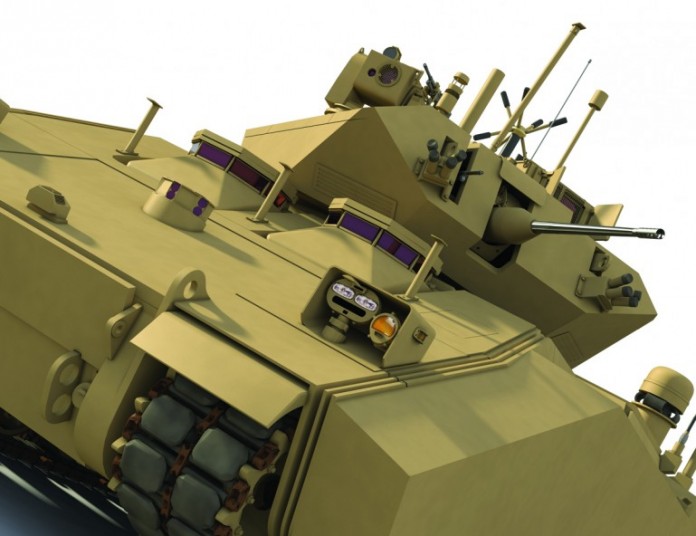
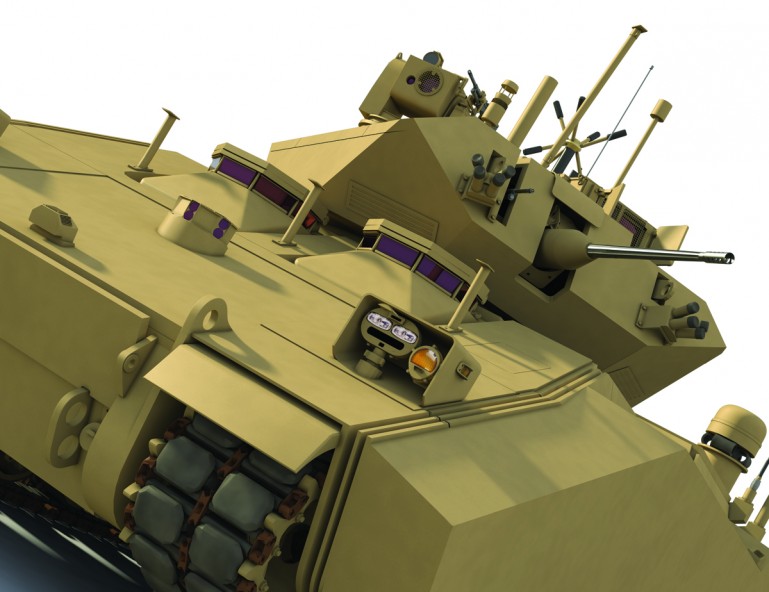
    The Ground Combat Vehicle variant developed by BAE Systems would have used a new hybrid-electric propulsion system that would rely on a diesel engine running a generator and electrical drive motors to power the vehicle and feed its many electronic systems. Photo: BAE Systems
    The Ground Combat Vehicle variant developed by BAE Systems would have used a new hybrid-electric propulsion system that would rely on a diesel engine running a generator and electrical drive motors to power the vehicle and feed its many electronic systems. Photo: BAE Systems
    The Ground Combat Vehicle variant developed by BAE Systems would have used a new hybrid-electric propulsion system that would rely on a diesel engine running a generator and electrical drive motors to power the vehicle and feed its many electronic systems. Photo: BAE Systems
    If the US omnibus budget bill that President Obama signed earlier this month didn’t already make it clear, the Army’s Ground Combat Vehicle program is all but dead. Paul McLeary reported on Defense News today, quoting U.S. Army Chief of Staff of the General Raymond T. Odierno talking on a breakfast speech earlier today. A week after Congress slashed $492 million of the program’s funding for 2014, leaving merely $100 million that will suffice to keep some technology development, Odierno has made it clear where this program stands: “Do we need a new infantry fighting vehicle? Yes. Can we afford a new infantry fighting vehicle now? No.” Odierno stated.

    Odierno said he hopes that the remaining funding will allow the Army to continue to develop technology so that “three to four years from now” the service can get back to building a new infantry fighting vehicle to replace the aging Bradley.

    Parallel development has been underway at BAE Systems and General Dynamics since 2011. However, the program came under pressure, as the costs of buying the 1,748 vehicles at about $17 million a piece, and sustaining them in service would cost the Pentagon $29 billion in the next 16 years.

    Not less concerning was the vehicle’s growing weight. At a combat weight comparable to an M-1 tank, the GCV could not be rapidly transported by air, and would be too heavy for the type of small intervention missions the Pentagon foresees for the near future. The funding cut essentially killed the GCV acquisition program, as there isn’t enough money for the Army to move forward by awarding a production contract to one of the two companies. The move could affect BAE systems, which has already announced it will close one of its armored vehicles manufacturing lines at Sealy TX in June 2014. The company still operates the second line in York, PA. where BAE is hopeful to remanufacture Bradley armored vehicles into AMPVs. Nevertheless, the prospects are likely for part of the GCV remaining funds spent on BAE Systems’ hybrid electric propulsion, given its potential to introduce new capabilities that would be relevant for the Army for years to come.

    The news are even more alarming to General Dynamics Land Systems (GDLS) operating the Joint Systems Manufacturing Center, also known as the Lima Army Tank Plant (LATP) in Ohio, where the modernization and remanufacturing of M-1 tanks continues at a slow pace through 2015. The future here isn’t bright, with the planned cut in production of Namer armored vehicles, and uncertainty of continued supplies of M-1A1 kits to Egypt. The hope to get substantial orders for GCV after 2017 would provide some incentive to retain part of the workforce at Lima.

    “We have to be expeditionary” Odierno said, “We have to be prepared to deploy very quickly. We have to get there in small packages. We have to get there with the least amount of support necessary. We have to be able to go to remote areas.” “We’re going to build new when its absolutely essential,” Odierno said, calling out the Joint Light Tactical Vehicle (JLTV) and Armored Multi-Purpose Vehicle (AMPV) as programs that will live on. “We have to have these systems” to replace the ancient M113 infantry carrier and the Humvee.

    armor728by90
    Join Armourforum.com to get new insights on modern armor technology. Click above to apply for an invitation

    Searching New Home for 13,000 MRAPs

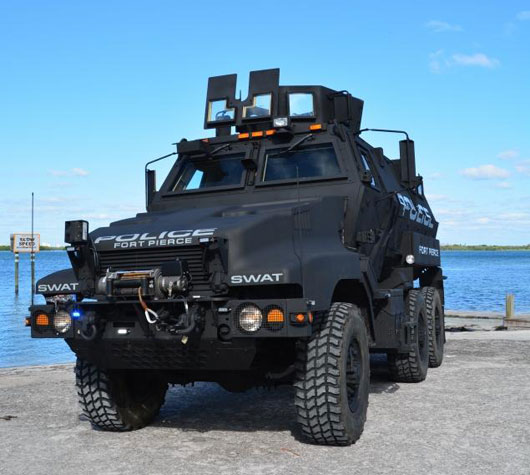
    This ex-military Caiman MRAP will be used to transport Fort Lee SWAT teams. Local police bought the vehicle from the U.S. Department of Defense for just $2,000. Photo: Fort Pierce Police Department

    While pentagon planners are hoping to save money by scrapping thousands of mine resistant armor protected (MRAP) vehicles bought only few years ago for over US$25 billions, defense contractors could bear heavy losses if those vehicles are not maintained in operational use somewhere around the world. Wall Street Journal Robert Tita reports that the Pentagon plans of scrapping 13,000 Used MRAPs would cut into replacement-parts business at Navistar, Oshkosh and BAE.

    mraps_storage800
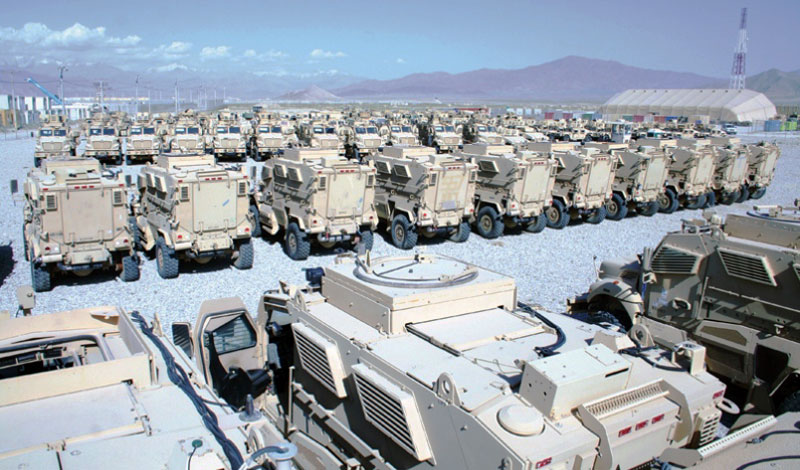
    MRAP armored trucks lined to return to the US after ending their mission in Afghanistan. Photo: Stars & Stripes

    The Army, Marine Corps and other services intend to keep about 11,000 MRAPs. About 6,500 trucks are still being used in Afghanistan, but the bulk of those will return stateside by the time the U.S. military withdrawal is completed late this year. About 6,000 trucks—many of them, older models used in Iraq—already have been returned to the U.S., Another 1,600 or so are in Kuwait. Many of these vehicles will be scrapped, if new users aren’t found.

    Scrapping unclaimed MRAPs would be a blow to truck maker Navistar International Corp., which built nearly 9,000 of the 27,000 vehicles bought by the Pentagon. Navistar’s defense-related revenue fell 51% last year to $541 million as demand for trucks and replacement parts dried up. The company wants the U.S. Army to repurpose MRAPs for other uses, such as vehicles for battalion commanders.

    Oshkosh predicts that defense sales could fall by about 40% this year, after dropping 23% in 2013. The Wisconsin company cut 900 employees from its military-truck assembly business last year. Production of an all-terrain MRAP for Afghanistan kept Oshkosh afloat when sales of its commercial and public-safety vehicles crashed during the 2008 recession.

    BAE is closing a truck plant in Sealy, Texas, for lack of work and is fighting to keep a York, Pa., plant afloat with low-rate refurbishment work the Bradley tracked armored fighting vehicle.

    The Pentagon wants to give away 13,000 MRAPs “We’ve notified our friends and allies that we have MRAPs available and if they want them they can have them,” Alan Estevez, deputy undersecretary of defense for acquisitions, technology and logistics said. Interest from foreign militaries has been tepid as these ultra-heavy vehicles that have operated in Afghanistan have been worn out by the harsh terrain.

    This ex-military Caiman MRAP will be used to transport Fort Lee SWAT teams. Local police bought the vehicle from the U.S. Department of Defense for just $2,000. Photo: Fort Pierce Police Department
    This ex-military Caiman MRAP will be used to transport Fort Lee SWAT teams. Local police bought the vehicle from the U.S. Department of Defense for just $2,000. Photo: Fort Pierce Police Department

    There is some interest stateside with police agencies. Almost 200 trucks have been distributed to police departments since August and requests are pending for an additional 750 trucks. The vehicles, many of which feature machine-gun turrets, are off-limits to private citizens and businesses.

    Lucky recipients include the Fort Lee SWAT teams FL, – local police bought the vehicle from the U.S. Department of Defense for just $2,000. Ohio State University campus police force and Florence County, S.C., also replaced an armored vehicle from the 1970s that the sheriff department’s SWAT team had used for about 15 years. A new armored truck would have cost at least $188,000, they say. “The price was right because it was free and it fit with what we need it to do,” says sheriff’s Capt. John Crouse. “It stops bullets. It keeps you from getting shot.”

    armor728by90
    Join Armourforum.com to get new insights on modern armor technology. Click above to apply for an invitation

    Russian Tank Biathlon is Gathering Momentum

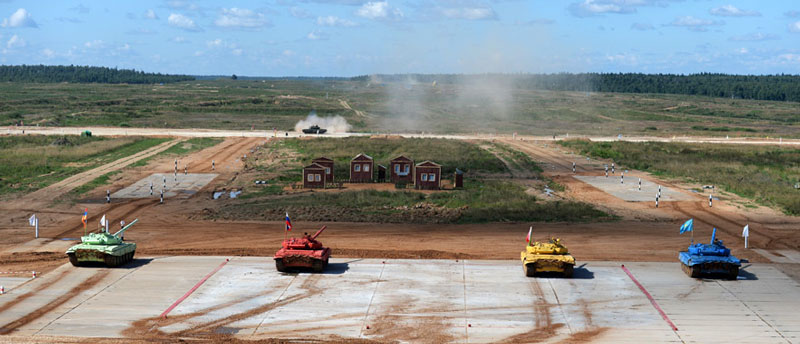
    The first tank biathlon was held in the Moscow suburb of Alabino in August last year. Photo: Vikimedia
    Tank crews from Armenia, Belarus, Russia and Kazakhstan participate in the first Tank Biathlon in Alabino proving grounds in 2013. Photo: RT.
    Tank crews from Armenia, Belarus, Russia and Kazakhstan participate in the first Tank Biathlon in Alabino proving grounds in 2013. Photo: RT.

    The United States and a number of European countries have asked to participate in Russia’s international tank biathlon, President Vladimir Putin said Wednesday. “They filed a request with the Defense Ministry to participate. We will be happy [to have them],” News agency Novosti quoted president Putin addressing questions from students at a Moscow university. The Defense Ministry said in a statement Wednesday that more than 40 countries had expressed interest in participating. Putin said the event helps promote the nation’s defense industry, noting that Russia is second only to the US in terms of the volume of arms exports. With the global decline of demand for tanks and other heavy, tracked armored vehicles Russia emerges as the largest manufacturer and exporter of such vehicles, including T-90 and upgraded T-72s.

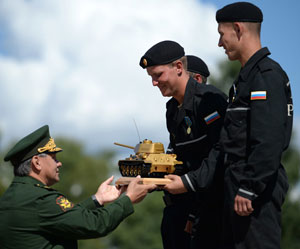
    Russia's defense minister Sergai Shoigu decorating the Russian team, winners of the international tank biathlon competition. Photo: RT
    Russia’s defense minister Sergai Shoigu decorating the Russian team, winners of the international tank biathlon competition. Photo: RT

    Russia invited the US to participate back in August at a meeting of defense officials. The first tank biathlon was held in the Moscow suburb of Alabino in August last year, with members from four armies participating. This year’s competition is planned to run from July 26 to August 10. According to the Russians, the Tank Biathlon is analogous to the Olympic event. Tank crews must navigate a 20-kilometer (12.5-mile) course that includes obstacles such as a slalom run, water crossings, bridges and steep climbs. The tanks must also accurately shoot with guns, machine guns and rifles a set of targets at distances of up to 2.2 kilometers (1.4 miles) that simulate other tanks or low-flying helicopters and cross military-representative obstacles such as mine fields and barricades.

    Through the 2013 biathlon tank crews went through a three-round route of 6-10 kilometers. During the first round crews fire at targets positioned at a distances of 1,800, 1,700 and 1,500 meters. The second round firing is at targets imitating an anti-tank mortar (RPG) squad and an infantry unit – these targets are at a distance of 600–700 meters, and must be engaged with a 7.62mm coaxial machine gun. The third round targeting is at an anti-tank gun and ATGM unit by use of heavy machine guns at a distance of 1,200 meters. Like in usual biathlon firing misses lead to an extra round, 500 meters long. On the final round tanks have to go through various terrain obstacle course.

    armor728by90
    Join Armourforum.com to get new insights on modern armor technology. Click above to apply for an invitation


    Point Blank Introduces Lightest-Weight Body Armor Based on Dyneema Force Multiplier Technology

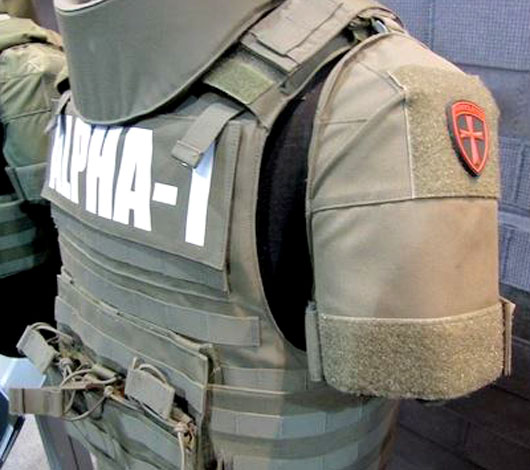
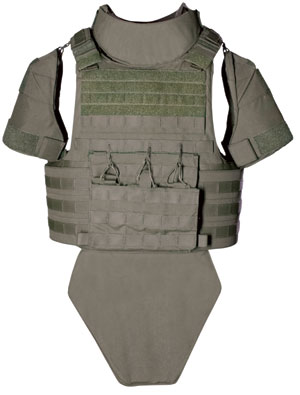
    The new Alpha Elite body armor system on display at Shot Show 2014. Photo: Point Plank
    The new Alpha Elite body armor. Photo: Point Blank
    The new Alpha Elite body armor. Photo: Point Blank

    Point Blank Enterprises Introduced last week a new range of high-performance, ballistic protection vests offering the lightest-weight and highest-performing levels.

    Point Blank Enterprises Inc. has introduced the ‘Alpha Elite’ Series NIJ Level II and IIIA tactical and concealable body-armor systems at the Shot Show in Las Vegas last week. The new body armor features the Dyneema Force Multiplier Technology released by DSM at Milipol 2013. The ballistic material used with ‘Dyneema Force Multiplier Technology’ was designed to defeat high-velocity handgun rounds and fragmentation with minimal backface deformation. According to Point Blank, the protection systems based on this innovative material are complying to NIJ Standard 0101.06 Level II and IIIA ballistic standards and meet or exceed FBI multihit test protocol. Point Blank collaborated closely with DSM to become the first trademark licensee in law enforcement personal protection. The new body armor is designed to meet the needs of Law Enforcement, Military and U.S. Special Operations.

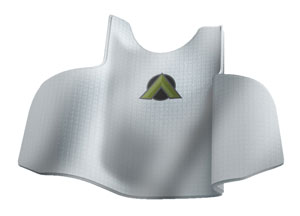
    Alpha Elite is the first implementation of Dyneema's Force Multiplier armor in a body armor system. The thin, lightweight material can be moulded in complex curved shapes for maximum comfort. Photo: Point Blank
    Alpha Elite is the first implementation of Dyneema’s Force Multiplier armor in a body armor system. The thin, lightweight material can be moulded in complex curved shapes for maximum comfort. Photo: Point Blank

    “Rigorous testing by independent labs has shown the Level II and Level IIIA Alpha Elite products are the best performing and lightest-weight products on the market today, and we are able to offer them at a cost that is comparable to other soft-armor ballistic solutions,” said Michael Foreman, vice president of government and international sales and head of product-line management at Point Blank Enterprises.

    The new series is available in both concealable and tactical configurations. Independent testing has confirmed that the Alpha Elite Level II and Level IIIA offer the lightest and highest performing NIJ 0101.06 body armor in the world today. Level III tests included maximum velocity approaching or exceeding 2,000 fps. According to Point Blank “Test-lab personnel stated that they had never seen this level of performance in a package of this weight and thinness during the testing of soft-armor ballistic solutions. The company quoted V50 for the Level II armor at 1,761 fps (.357 MAG test) and 1,794 fps for 9mm. For Level IIIA, V50 for 44 MAG was 1,744 fps and 1,870 fps for .357 MAG. (V50 is the maximum speed of projectile the vest could stop at least 50% of the bullets fired it. The higher V50 is, the better protection the armor provides.) The vests tested to these levels were also very – as they came at aerial weight of 87psf (pounds per square foot) for the Level IIIA and 63psf for Level II. The thickness was also unprecedented – 0.20 inch (5mm) and 0.18 inch (4.5mm) respectively.

    The new Alpha Elite Level II system was proven to be 20 percent lighter and six percent higher performing than the best NIJ .06 Level II models previously on the market. According to Foreman, even the heavier Alpha Elite III meets NIJ Level IIIA performance yet offers comfort levels more typical of Level II body armor. “Compared to Point Blank’s previous lightest Level IIIA vest, the Alpha Elite Series is a full 12 percent lighter. It is also 31 percent thinner than the average of the best Level IIIA packages in the industry.” Foreman concluded.

    armor728by90
    Join Armourforum.com to get new insights on modern armor technology. Click above to apply for an invitation

    Israeli Herons Supplied through France end up in Morocco

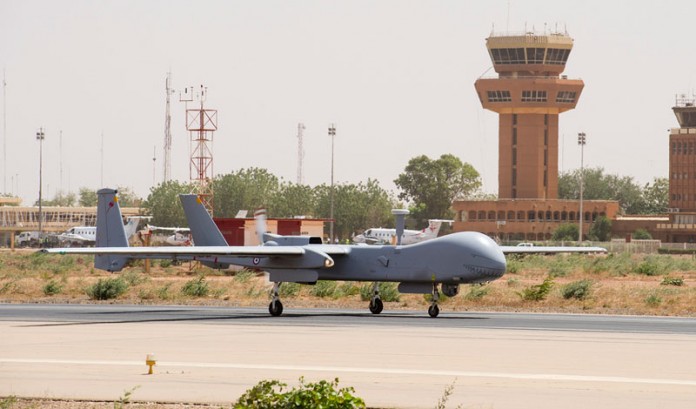
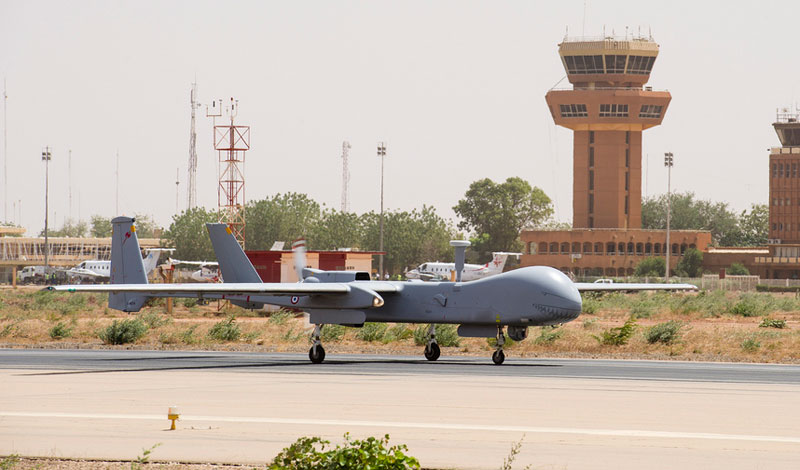
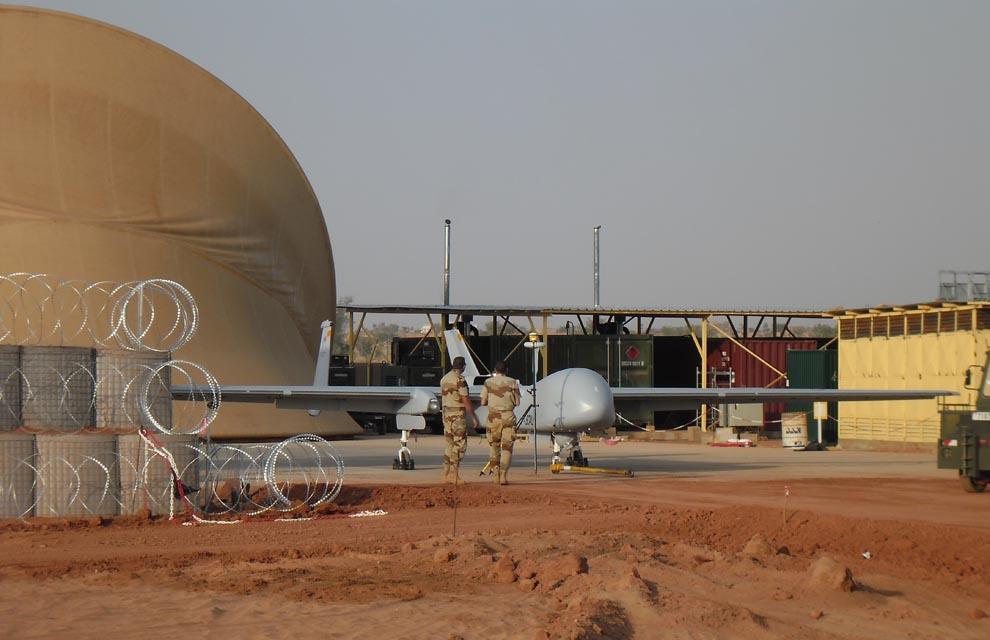
    French Harfang (Heron I) operating with from the Niamey airport in Niger. Photo: French Air Force

    International media sources have reported recently that Royal Moroccan Air Force (RMAF) has acquired the three ‘Harfang’ unmanned aerial systems retired by the French Air Force after several years of service in Afghanistan. Harfang which deployed with the Armee de L’air in 2008 was delivered by EADS (Now Airbus Defense & Space), under the Eagle I cooperative development with Israel Aerospace Industries.

    French Harfang (Heron I) operating with from the Niamey airport in Niger. Photo: French Air Force
    French Harfang (Heron I) operating with from the Niamey airport in Niger. Photo: French Air Force

    The drone was based on the Israeli IAI/Malat Heron-I system. Morocco and France have long established military cooperation, although in recent years Rabat has aligned closer to the US, procuring a range of new military systems, including F-16C/D Block 52 jet fighters, along with the latest air/air and air/ground weaponry, M-1A1 Main Battle Tanks and, as reported above, the Predator drones.

    Morocco is regarded an important stronghold in West Africa, in the effort to push al-Qaeda in the Magreb (AQIM) from its power bases in the Sahara. To combat irregular forces in the Sahara, Morocco has developed a significant reconnaissance and strike force, in which drones are becoming an important part. The agreement to transfer drones to Morocco is therefore a manifest to the level of support the country has among major powers.

    In recent months France has deployed two General Atomics Reaper (MQ-9) unmanned aircraft systems which were delivered from systems originally destined for the US Air Force. France required the US drones to support operations in Africa, where it claimed the Harfang was not suitable to support those operations, but Harfang has been operating in Mali since 18 January 2013. In February 2014, Harfang passed the symbolic mark of 10,000 flight hours, which it clocked up in over 900 missions for the FAF, operating with 1/33 Belfort UAV squadron from the Niamey airport in Niger, supporting Operation SERVAL. In June 2014 these drones were tested to operate under control of operators 5,000 km away, communicating via satellite communications. The demonstration preceeded a planned upgrade of the French Harfang are slated under a joing Airbus/IAI contract.

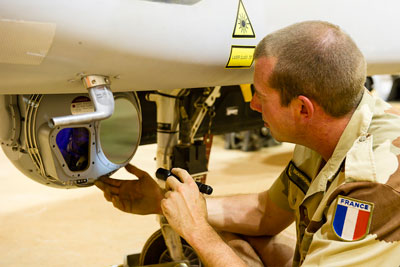
    A French Air Force technician inspects the Harfang's MOSP electro-optical stabilized payload. The version of MOSP operated by the French (and possibly transferred to Morocco) includes laser target designation capability, as evident by the pictured system. Photo: French Air Force
    A French Air Force technician inspects the Harfang’s MOSP electro-optical stabilized payload. The version of MOSP operated by the French (and possibly transferred to Morocco) includes laser target designation capability, as evident by the pictured system. Photo: French Air Force

    According to media sources, the transfer of the Herons to the Royal Moroccan Air Force was sealed in the spring of 2013. It is still unclear if these were the three Harfang drones that remained in French service which were transferred, or other Heron I drones supplied by Dassault Aviation specifically for that end customer. Both Dassault and EADS had ongoing cooperation with IAI, regarding the marketing of Heron I and Heron TP drones. Press reports indicated the drones were delivered with their EO payloads, datalinks and satellite communications and ground control systems. Some of these systems were provided by French suppliers while others were delivered with the drones from Israel. One of the first sources reporting on the Moroccan Herons was FAR-MAROCCO.
    In addition to the three Herons, the RMAF also operates four General Atomics Predator XP drones, believed to have been supplied directly from the USA. According to some sources, Morocco could receive additional drones sustaining the operation of the three systems acquired under the tripartite deal.

    Harfang operating with the 1/33 "Belfort" UAV squadron was based at the French contingent at Niger, supporting the campaign in Mali, February 2013. Photo: French Air Force.
    Harfang based with the 1/33 “Belfort” UAV squadron at the French contingent at Niamey airport in Niger, supporting the campaign in Mali, February 2013. Photo: French Air Force.

    Blue Flag – a Pilot View

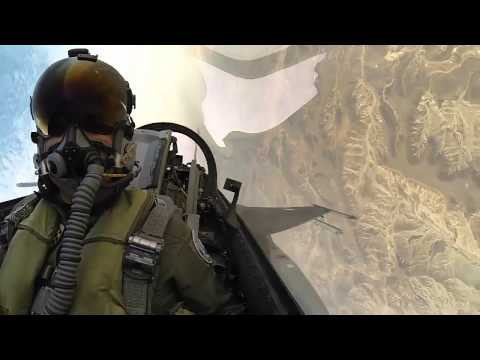
    The following video, aired by the Hellenic Air Force shows a ‘Blue Flag’ mission over southern Israel, as viewed from the cockpit of one of its F-16s. Many thanks for David Cenciotti, the Aviationist blog and the Hellenic Air Force for posting it first. Full coverage of Blue Flag is available on the Blue Flag 2013 report post we published in November.

    TRADEC Evaluates 6T Li-ion Batteries for Military, Commecial Vehicles

    Drop-in 6T Li-ion battery from Navitas Systems. Photo: Navitas Systems
    Drop-in e6T Li-ion battery Saft, originally developed for military vehicle applications, is now being tested on commercial vehicles. Photo: Saft
    Drop-in e6T Li-ion battery Saft, originally developed for military vehicle applications, is now being tested on commercial vehicles. Photo: Saft

    CALSTART, a member supported organization that specializes in clean transportation technologies is evaluating the use of military 6T Lithium-Ion (Li-ion) battery technology in commercial vehicles. The purpose of this effort is to apply recent advances in Lithium-Ion introduce drop-in replacement for traditional lead-acid batteries currently used in commercial and military vehicles. The 6T standard Li-ion based 12V and 24V 6T batteries are promising to provide significantly improved power and energy densities over existing lead acid alternatives. The three battery companies participating in the CALSTART-led test are Navitas Systems LLC, EaglePicher Technologies and Saft. CALSTART will assess the efficacy of the new batteries in operations in hot and cold weather, testing on Class 8 highway trucks. During the testing process CALSTART will be collecting the data generated from the three battery manufacturers. The field testing activities are designed so that the prototype battery technology can achieve a Technology Readiness Level (TRL) level 6.

    Drop-in 6T Li-ion battery from Navitas Systems. Photo: Navitas Systems

    Drop-in 6T Li-ion battery from Navitas Systems. Photo: Navitas Systems

    Saft announced today it has delivered CALSTART its e6T Lithium-ion (Li-ion) battery, designed for use in military and commercial applications. This development marks the first time the military e6T Li-ion battery configuration will be tested for commercial trucks application, opening a potential new market for this advanced power supply, far beyond the military applications it was originally designed for. Saft said The agreement also includes delivery of 28V e6T power supplies to TARDEC, the U.S. Army’s Tank and Research Development and Engineering Center.

    In 2013 Saft was selected by Lockheed Martin for the delivery of e6T Li-ion battery systems for the engineering and manufacturing development (EMD) phase of the Joint Light Tactical Vehicle (JLTV) Program. In the military configuration the e6T Li-ion battery system features an advanced, lightweight design within the dimensions of a traditional lead-acid battery, enabling easy integration into the vehicle. The system provides power for starting, lights and ignition, as well as for silent watch missions, while also providing critical front-line power to recharge personal electronics like night sights and GPS devices. The 25.5V battery features CANBus communications technology which relays vital information such as state-of-charge, cell voltages and temperatures, and battery diagnostics. For commercial vehicles the battery is also available in 12V versions. 

    “Lithium-Ion battery technologies promise to hold out better in the field,” says CALSTART President and CEO John Boesel. “In its own testing thus far, the military has found that lithium batteries last longer, resulting in fewer battery replacements and less need for inventory. If these field tests prove successful, the commercial trucking industry may, in the future, make the switch to lithium starter batteries. Higher production volumes would result in lower prices, benefiting both the military and commercial sectors,” Boesel says.

    The the U.S. Army is funding the program, in which CALSTART and participants will evaluate and test 12V Li-ion military format batteries as starter batteries. Compared to lead-acid batteries, Li-ion technology enables increased lifecycle, depth of charge and faster recharges, resulting in greater fuel and cost savings. The Army anticipates that with larger market volume, the cost of military batteries will also drop.


    India Test Launch Third Agni-4 Ballistic Missile

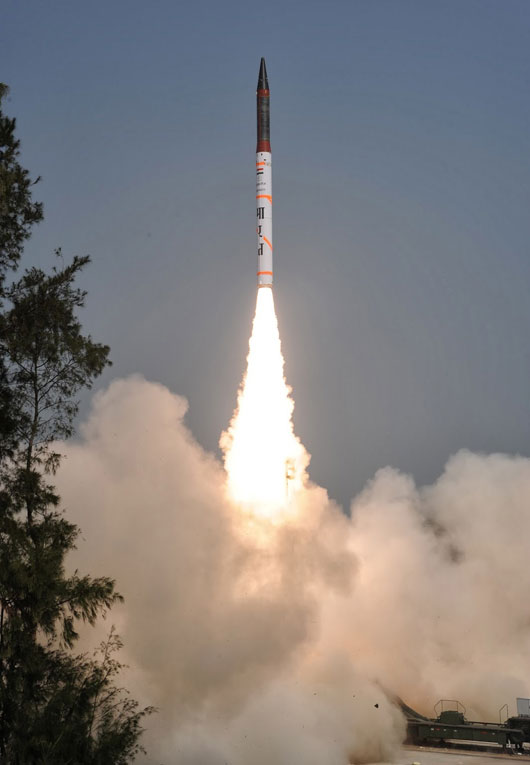
    AGNI IV launched from the Wheeler Island in Orisa, January 20, 2014. Photo: DRDO
    AGNI IV launched from the Wheeler Island in Orisa, January 20, 2014. Photo: DRDO
    AGNI IV launched from the Wheeler Island in Orisa, January 20, 2014. Photo: DRDO

    India successfully launched today (Monday, January 20, 2014) its nuclear-capable strategic missile Agni-IV. It was the third test flight, as part of the developmental trials currently underway prior to the missile’s induction with India’s strategic missile force. The first flight was conducted on 15 November 2011, the second on 19 September 2012, from the same test site at the Wheeler Island in Orisa.

    The 20 meter long missile has a strike range of about 4,000 km. An advanced, two-stage intermediate range missile, AGNI IV uses two solid-rocket propelled stages. It weighs 17 tonns and is designed for operation from a mobile launcher. The missile carries a warhead weighing about one ton. To enable the reentry vehicle to survive the ultra high temperatures of the reentry stage the RV case has been treated to survive high temperatures. According to the DRDO press release, The re-entry heat shield withstood temperatures in the range of 4000 degree centigrade and made sure the avionics function normally with inside temperature remaining less than 50 degree centigrade.

    The missile employs an advanced avionic architecture comprising triple-redundant navigation system integrating ring-laser gyro (RLG), inertial navigation (INS) unit and micro-navigational system (MINGS) digital flight control, high speed communications bus and high-speed computer, all developed indigenously by the Indian defense industry and Defense Research and Development Organization (DRDO).

    Enhanced Missile Warning System to Protect U.S. Army Troops

    bae-cmws
    The CMWS (AAR-57A(V) Gen3 missile warning system features a modular, customizable design that allows for seamless integration with other aircraft and survivability systems. According to BAE Systems, beyond the provision of missile warning and hostile fire indication it can also serve as a centralized processing system for Integrated Aircraft Survivability Equipment. Photo: BAE Systems.

    The U.S. Army has awarded BAE Systems a $39 million contract for more than 300 third-generation (Gen3) Common Missile Warning System (CMWS), a key element in helicopter and aircraft countermeasures  systems protecting US aviators in combat theatres; The Army has already acquired 2,100 such systems and has operated them in combat, accumulating more than 2,000,000 combat flight hours. Based on the accumulated experience the Army is upgrading the CMWS into the AN/AAR-57A(V) standard, enabling systems to better respond to evolving threats, a wider range of countermeasures and decoys including laser-based Directed InfraRed Countermeasures (DIRCM). By providing Hostile Fire Indication (HFI) capability, the system combines warning cue and situational awareness for guided and unguided threats to host platform. Furthermore, the system effectively protects against surface and air launched missile threats. Besides providing warning and triggering countermeasures against missile attacks the CMWS Gen3 system also indicates when small arms fire is directed at the protected platform. The system can also record the data throughout the mission for post mission debriefing and threat signal processing.

    cmws
    Besides providing warning and triggering countermeasures against missile attacks the CMWS Gen3 system also indicates when small arms fire is directed at the protected platform. Photo: BAE Systems

    “The Gen3 enhancements allow us to provide a missile warning, hostile fire indication, and data recording system all in one box. This can immediately make a difference for our troops by improving survivability and increasing situational awareness,” said Bill Staib, director of Threat Management Solutions at BAE Systems.

    As a highly automated and tightly integrated infrared countermeasures suite, CMWS locates threats and dispenses countermeasures without requiring pilot intervention. The system features a modular, customizable design that allows for seamless integration with other aircraft and survivability systems. To that end, CMWS has demonstrated its ability to serve as a centralized processing system for Integrated Aircraft Survivability Equipment.

    The $39 million order is the first under a proposed $496 million indefinite delivery, indefinite quantity (IDIQ) contract and increases the total U.S. Army Gen3 procurement to more than 1,300 units. The current contract includes unit spares and engineering and technical services. The Gen3 systems will be fielded to more than 1,000 U.S. Army platforms over the next two years, and has already begun with in-theater installations on the Apache, Kiowa, and Blackhawk aircraft in Afghanistan.

    Taiwan Unveils ‘Wan Chien’ Air-To-Ground Stand-Off Weapon

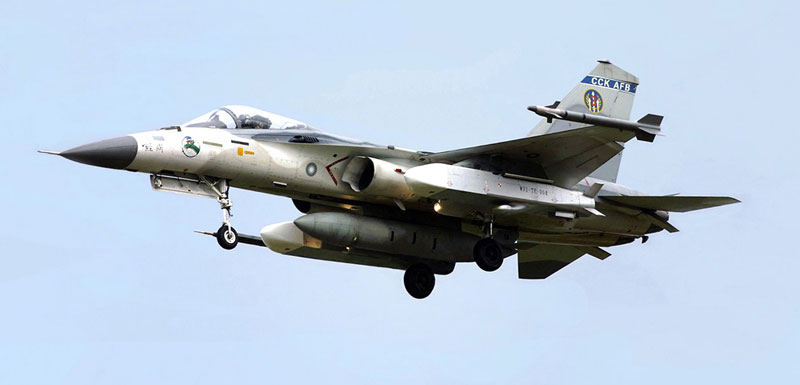
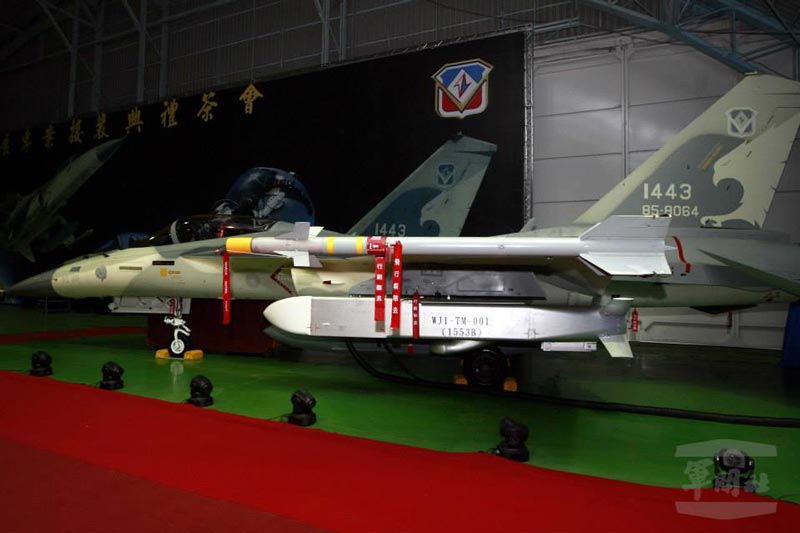
    Taiwan's newly upgraded FC-1K Indigenous Defense Fighter (IDF) will be equipped with four Wan Chien stand-off attack missiles, capable of attacking targets at 200 km range. The '1553B' marked on the fuselage could indicate the weapon's ability to receive in-flight updates from the fighter's databus before the weapon is launched. Photo: RoCAF

    The Taiwanese Air Force unveiled an locally developed air-to-ground stand-off weapon developed for the nation’s F-CK-1 Indigenous Defense Fighter (IDF) ‘The Diplomat’ Reports. Known as the Wan Chien, or “Ten Thousands Swords,” the powered stand-off weapon was developed by the military-run Chung Shan Institute of Science and Technology (CSIST). According to news reports, Wan Chien is expected to enter production in 2015.

    ADIC FC-K1A carrying two Wan Chien standoff attack weapons on a test flight. The integration of the new weapon has completed but serial production is planned to begin in 2015.
    ADIC FC-K-1 carrying two Wan Chien standoff attack weapons on a test flight. Although the integration of the new weapon has been completed, serial production is planned to begin only in 2015.

    Pre production examples are reportedly supporting the Aerospace Industrial Development Corp’s IDF mid-life upgrade program. In January 2013 news reports in Taiwan claimed the Ministry of Defense was prepared to cut the number of the indigenous stand-off weapons by half, given the US agreement to provide Joint Direct Attack Munitions (JDAM) to the Republic of China Air Force. While both weapons are targeted at a predesignated coordinates, the two are inherently different in performance – JDAM is a unitary weapon with a range of up to ‘tens of kilometers’ while the stand-off weapon designed for target penetration, such as the Wan Chien is a cargo ‘bus’, capable of striking surface (area) targets at a range of 200km. The new Taiwanese weapon is more similar to the AGM-154A (JSOW) which the US is not offering to Taipei.

    The new missile was unveiled during a ceremony held at Tainan Air Force Base in Southern Taiwan, marking the completion of the US$587 million mid-life upgrade (MLU) for the 71 IDFs in service with the 443rd Tactical Fighter Wing operating from this base. The program was launched in 2009 by the state-owned Aerospace Industrial Development Corporation (AIDC). Upgrades of additional 56 fighters, part of the 427th Tactical Fighter Wing in Taichung, are expected to begin in 2014, with expected completion in 2017. By then all RoCAF IDF fighters will be able to carry the new stand-off weapon.

    Initiated in 2006, the Hsiang-Chan Project IDFs underwent modernization in three principal areas – upgrading the central computer from 16 bit to 32-bit platform, improved radar software and avionics. The cockpit is also improved with full color displays and head-up display (HUD). The radar system, developed by Han Shiang Corp, received a software upgrade, enabling multiple target tracking and better counter-countermeasures. The aircraft expanded its weapon carriage capability clearing four stations for air/air missiles, up from the previous two ‘Tien Chien II’ (Sky Sword) missiles and Tien Chien IIA anti-radiation missiles.  Equipping the fighter with the Wan Chien standoff attack weapon will further expand the IDF’s mission in the ground attack. The box shaped weapon is believed to be a ‘cargo container’ for submunitions, such as area denial submunitions that could be used air bases, air defense and missile launching sites. Typically, such weapons are guided by a combined Global Positioning Satellite / Inertial Navigation System (PGS/INS), following preplanned flight path to reach their planned destination.

    In recent years Taiwan has enhanced its capabilities to conduct standoff attacks inside mainland China. Among the weapons that have reached maturity are the Hsiung Feng IIE (HF-2E) Land Attack Cruise Missile (LACM), developed by CSIST, the submarine launched UGM-84L land and naval attack Harpoon delivered by the USA. In the F-16 modernization plan discussed with the USA, Taiwan will receive a variety of air/ground weapons, including GPS guided and laser guided bombs but its arsenal does not include standoff weapons capable of reaching China.

    FC-K-1A with Wan-Chien missiles
    Taiwan’s newly upgraded FC-K-1 Indigenous Defense Fighter (IDF) will be equipped with two Wan Chien stand-off attack missiles, capable of attacking targets at 200 km range. The ‘1553B’ marked on the fuselage could indicate the weapon’s ability to receive in-flight updates from the fighter’s databus before the weapon is launched. Photo: RoCAF

    Lawless Southern Libya Turns into a Haven for al-Qaeda

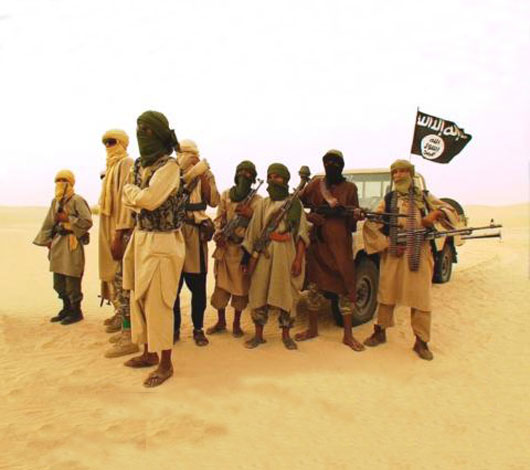
    Al Qaeda in the Magreb (AQIM) is regaining strength at its new bases in the Libyan Saharan Desert, after being chased out from Mali by the French.
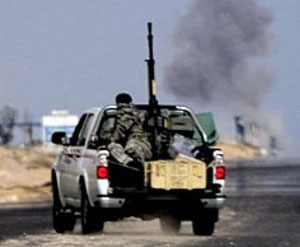
    While al Qaeda is growing its presence in the Libyan Sahara, it was the clashes between rival tribesmen and the seizing of the nearby military airbase at Libya's southern city of Sabha triggered the military to intervene.  Photo: AFP
    While al Qaeda is growing its presence in the Libyan Sahara, it was the clashes between rival tribesmen and the seizing of the nearby military airbase at Libya’s southern city of Sabha triggered the military to intervene. Photo: AFP

    Libyan war planes attacked targets in south-central area of Libya on Saturday (January 18, 2014) after gunmen stormed and seized the Tamahind air force base outside Sabha, 770 km (480 miles) south of the capital Tripoli. At least 15 people have been killed in clashes between two tribes in Libya’s south, between al-Tabw tribe and the Awlad Soliman tribe. While the violence was sparked by the killing of a guard for the city’s military leader, media reports indicated the growing influence of al-Qaeda in the Islamic Maghreb (AQIM) branch in the region. The group has established a haven in the borderless southern Libya, after French and West African forces drove them out of their fledgling Islamic state in northern Mali a year ago. Following the attack the Libyan government ordered ground troops to be sent south.

    Prime Minister Ali Zeidan went on national television to announce he had ordered troops to be sent to the south following the attack on the base. Defence Ministry spokesman Abdul-Raziq al-Shabahi said later that government forces had regained control of the base after air strikes. “The situation in the south … opened a chance for some criminals … loyal to the Gaddafi regime to exploit this and to attack the Tamahind air force base,” Shabahi said. After Zeidan’s announcement, the General National Congress (GNC) assembly voted to put the army on general alert, state news agency Lana and a deputy said. In Tripoli, security forces were also been put on maximum alert, a security spokesman said.

    Following the collapse of the Qaddafi regime in 2011 Libya has turned into a weapons smuggling route for al Qaeda in sub-Saharan countries, and an arms supply corridor to the Palestinians in Gaza and for Islamist fighters heading to Syria. Originally identified with anti-Qadafi rebels during the 2011 conflict, AQIM is building up links with like-minded jihadists in northern Libya, especially in eastern coastal cities such as Derna and Benghazi. AQIM has also established ties with militant groups in Nigeria, and preparing for new attacks on Western targets. The group is also eying regrouping against Northern Mali, once the French contingent leaves the area.

    Skunk Works and XTEND Simplify Multi-Drone Command

    0
    Lockheed Martin Skunk Works® and XTEND have achieved a major milestone in JADC2 by integrating the XOS operating system with the MDCX™ autonomy platform. This technical breakthrough enables a single operator to simultaneously command multiple drone classes, eliminating the friction of mission handoffs. From "marsupial" drone deployments to operating in GPS-denied environments, explore how this collaboration is abbreviating the data-to-decision timeline and redefining autonomous mission execution.

    From Ukraine to Taiwan: The Global Race to Dominate the New Defense Tech Frontier

    0
    As traditional defense primes face mounting competition from agile “neoprimes” such as Anduril, Palantir and Helsing, the balance of innovation is shifting toward software-defined warfare and scalable, dual-use technologies, while global industry consolidation—marked by Boeing’s integration of Spirit AeroSystems and other strategic mergers—signals an intensified race to secure control over the defense technology value chain. Our Defense-Tech weekly report highlights these trends.

    Europe’s “Drone Wall”

    0
    In early October 2025, a coordinated wave of unmanned aerial system (UAS) incursions—widely attributed to Russia—targeted critical infrastructure across at least ten European nations. The unprecedented campaign exposed the fragility of Europe’s air defenses...

    Weekly Defense Update & Global Security Assessment

    0
    Executive Summary The past week (September 18-25, 2025) represents an inflection point where strategic defense concepts have transitioned from doctrine to tangible reality. An analysis of global events reveals four primary, interconnected trends shaping an...

    U.S. Air and Space Forces Push Next-Gen Programs at the AS&C 2025 Conference and...

    0
    At the 2025 Air, Space & Cyber Conference, U.S. Air Force and Space Force leaders unveiled major updates on next-generation fighters, bombers, unmanned systems, and space initiatives, highlighting both rapid innovation and critical readiness challenges as the services race to outpace global competitors. A short version is available here, with a more detailed version for subscribers.

    TADTE 2025: Reflecting Taiwan’s Strategic Themes

    0
    The Taipei Aerospace & Defense Technology Exhibition (TADTE) 2025 crystallized around four dominant strategic themes that collectively illustrate Taiwan's comprehensive approach to defense modernization amid escalating regional tensions. Based on a detailed report by Pleronix (available upon request). Includes a Podcast discussion on TADTE 2025's highlighting Taiwan's four strategic themes beyond the post's coverage.

    Iron Beam 450 Completes Testing, Soon to Join With Operational Air Defense Units

    0
    Israel’s Iron Beam 450 high-power laser system has completed final testing, marking a major leap in air defense. Developed by Rafael, it offers precise, cost-effective interception of rockets, UAVs, and mortars, and is set for IDF deployment by 2025.