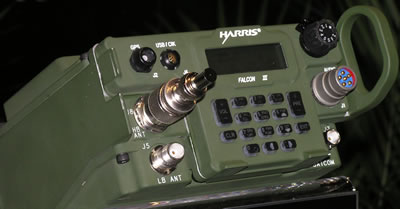
Harris Corporation has received $36 million in orders from U.S. Special Operations Command (USSOCOM) to accelerate its deployment of an advanced wideband tactical communications system. The company will provide Falcon III wideband AN/PRC-117G manpack and AN/PRC-152A handheld radios that will sustain Special Operations Forces wireless broadband capabilities at remote locations independent of existing infrastructure. “Our Falcon radios wirelessly extend the reach of network services such as situational awareness, e-mail, imagery, video, biometrics and Voice Over Internet Protocol” said George Helm, president, Department of Defense business unit, Harris RF Communications. The new radios will enable deployed forces to stay connected as a team, even when operating far from each other or from a tactical operations center.
Harris has shipped more than 40,000 Falcon III wideband manpack and handheld tactical radios worldwide. These radios currently are used by all branches of the U.S. Department of Defense and allied forces worldwide. Falcon III is the next generation of radios supporting the U.S. military’s Joint Tactical Radio System (JTRS) requirements, as well as network-centric operations worldwide. Harris RF Communications is also a leading supplier of assured communicationssystems and equipment for public safety, utility and transportation markets — with products ranging from the most advanced IP voice and data networks to portable and mobile single- and multiband radios.
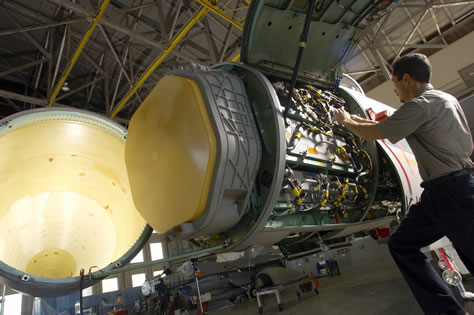
Boeing Company has awarded Raytheon a follow-on contract for the sixth production lot of APG-63(V)3 active electronically scanned array radars for United States Air Force and Air National Guard F-15C aircraft. The original contract from Boeing began in 2007 as part of the F-15C upgrade program. To date, more than 46 radar systems plus spares have been delivered. Production lot six, awarded in March of 2013, includes radar modification kits and spares for the Air Force and Air National Guard. The APG-63(V)3 AESA radar is an all-weather, multi-mode radar that offers extended range, improved tracking and precision engagement for the F-15C. Designed for easy integration of growth options and technology advances, this versatile radar provides the F-15 fleet with significantly enhanced air-to-air capabilities and gives warfighters a substantial combat edge. Raytheon recently delivered its 500th tactical AESA radar – an industry first. The company’s AESA product line, which is flown on F-15, F/A-18 and EA-18G aircraft, has achieved more than 400,000 operational flight hours.
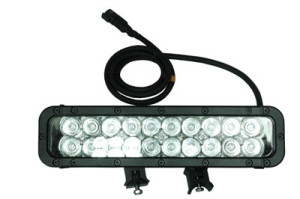
LEDLB-20E-IR-MHL infrared LED headlight. Photo: Larson Electronics
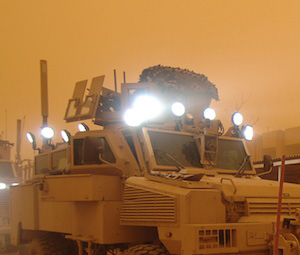
Larson Electronics is introducing an infrared Light Emitting Diodes (LED) based headlight system for vehicles, designed to allow users to replace or augment their vehicles current headlights with infrared illumination that is visible only with the use of night vision devices. The 60 Watt LED’s output is set to be in the infrared 940Nm end of the light spectrum, making it ideal for military applications where covert operations require the ability to illuminate areas without being visible to others. The company describes the LEDLB-20E-IR-MHL LED Infrared LED Headlight as a rugged and powerful LED light bar that gives operators in military and security related fields the ability to illuminate the area in front of their vehicles with infrared illumination that is visible only with the use of night vision goggles and headgear or infrared camera systems. Because of their heavy duty design and high power infrared output, these infrared LED headlights are also well suited to similar applications such as security and law enforcement as well as marine applications where night vision equipment is commonly used.
The entire lamp assembly measures only 12 inches long by 3 inches high, making it easy to mount in a variety of locations where space is at a premium. The LED assembly contains twenty Edison Edixeon 3 watt infrared emitters paired with high purity optics to provide high output and excellent beam quality without the irregularities and unevenness associated with HID and incandescent infrared lighting systems. These units can operate from any voltage ranging between 9 and 42 VDC, and have active heat control programming that allows them to maintain full power output without excessive heat buildup that can lead to premature LED failure. The entire lamp assembly measures only 12 inches long by 3 inches high, making it easy to mount in a variety of locations where space is at a premium. The mounting system consists of a pair of adjustable aluminum brackets with rubber isolators and stainless steel hardware for secure installation and added resistance to the effects of heavy vibration and jarring impacts.
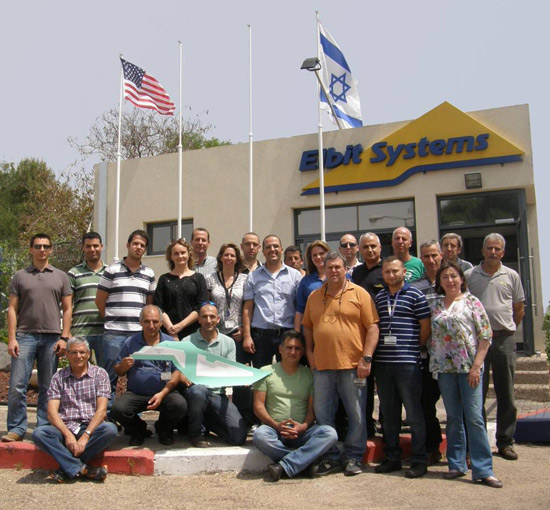
Elbit Systems Cyclone team proudly present the first F-35 component delivered to Northrop Grumman. Photo: Via Northrop Grumman
Elbit Systems Cyclone team proudly present the first F-35 component delivered to Northrop Grumman. Photo: Via Northrop Grumman
Elbit Systems-Cyclone has delivered its first advanced composite component for the F-35 Lightning II joint strike fighter center fuselage produced by Northrop Grumman. This delivery is a significant milestone for the F-35 program, as it is the first composite part manufactured by a country committed to purchasing future F-35s under the U.S. foreign military sales agreement. The composite component delivered is one of 16 unique parts to be manufactured by Elbit Systems-Cyclone under a seven-year F-35 agreement with Northrop Grumman, which was signed in December 2011. “We’re anticipating receiving more than 50 component deliveries from Cyclone this year, so this is a great start and shows Cyclone’s commitment to the program,” said Michelle Scarpella, vice president of the F-35 program for Northrop Grumman Aerospace Systems. “With the first delivery under its belt, Cyclone has demonstrated that it is equipped and qualified to manufacture and deliver quality composite parts for the joint strike fighter aircraft, 19 of which Israel has committed to purchasing.”
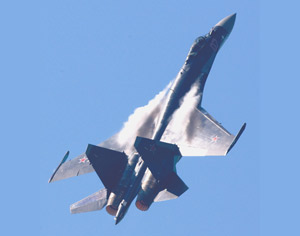
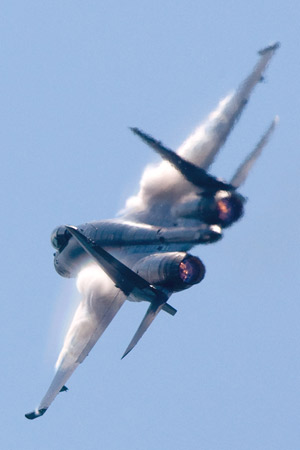
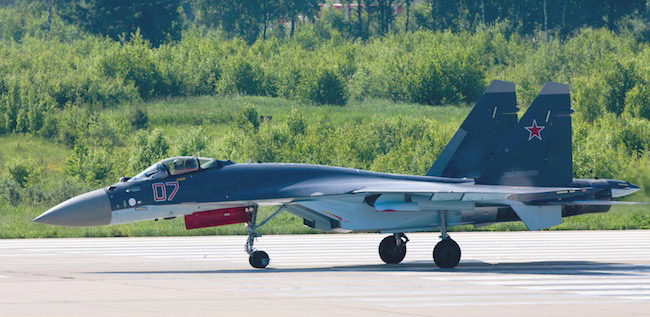
Su-35 practicing for the aerial display at the paris Air Show. The Test pilot Sergey Bogdan, honored as ‘Hero of Russia’. Photo: Sukhoi
The 50th Paris Airshow presents a weeklong celebration for aviation enthusiasts. As the most important annual aerospcace business event, it attracts thousands of companies and trade visitors. On the military side, the airshow takes a lower key, reflecting reduced spending in Europe and the United States. Nevertheless, the Russian impact is growing, demonstrating Moscow’s claim for a leading position in world defense exports.
The Su-35 is making its international debut here, along with Yak-130 trainer, which will also be displayed here in flight. At the airshow the Yak-130 will have the opportunity to meet its sibling Italian M346 Master from Italy. However, this year the Master participation will be limited to the static display.
Another ‘new’ aircraft making the international debut is the Antonov AN-70 from the Ukraine. This transport plane, powered by four turboprop engine was first flown in 1994. The lead customer was the Russian Air Force, which considered this platform as a successof for the An-12 (Cub). However, after the prototype crashed on its fourth flight, the Russians lost interest although the Ukrainian designer built a second prototype about two years later. This prototype will be flying to Paris and at the airshow this year, as Ukraine hopes it will generate new interest among countries considering modernizing their military transports but lacking the budgets for C-130J (absent this year from the show) or A-400M (which will also be flying here). However, competition from Brazil (KC-390), Spain (C-295) and Italy C-27J (both will be on static display in Paris) is likely to pose significant challenge to the Russian plane.
The Su-35S fighter was first introduced in public at the MAKS airshow in Russia in 2009. Training flights of the Su-35S are taking place these days ner Moscow, at the Zhukovsky airfield at the M.M.Gromov Flight Research Institute. Test pilot Sergey Bogdan, honored as ‘Hero of Russia’ works on two sets of aerobatics – for normal and complex weather conditions. The Manoeuvres will include spatial barrels, somersaults, a flat spin, and, of course, the famous “Pugachev’s Cobra”, the most famous stunt introduced by MiG-29 and Su-27 pilots in the 1990s. Su-35S is a deeply modernized super-maneuverable multirole fighter of the “4 + +” generation. According to the manufacturer, the Su-35 offers improved flight characteristics and better avionics, compared with existing fighters equipped with older analog systems. Sukhoi say the Su-35 characteristics exceed European and US made tactical all fighters like Rafale (taking part in the daily flying display at Paris), Gripen and Typhoon (both shown at the static area), F-15, F-16 and F-18 (all absent this year from Paris). They also claim the Su-35S can successfully counter the 5th generation fighters – F-35 and F-22A (both absent as well), as it is faster, having higher thrust and range/endurance.
Among the military helicopters participating in the airshow this year are the Eurocopter EC665 Tigre ALAT in French Army service, participating in the daily flight display along with NH Industries NH90. Two additional NH90s will be on the static line – one of them, the ‘Caiman’ NH90 Tactical Transport Helicopter (TTH) in French Army service, one of the first batch delivered recently to the French forces. Bell will be one of few US companies from the US, bringing aircraft to the show. The company will display the new military armed scout model, Bell 407GT on the static display. Two military helicopters from AgustaWestland include the AW149 and 159 models. Arriving from Russia is the KA-52 ‘Alligator’ gunship, based on the unique coaxial rotor propulsion system. The Alligator is not new, the first prototype flew in 1982 and the current version has made its debut in 1987. Why are the Russians sending this gunship on this long and expensive quest? The Russians intend to equip their new Mistral Class helicopter carriers with eight of these helicopter, configured in the KA-52K navalasied version. Eventually the Russian Naval Aviation is planning to buy 40 such helicopters. The Alligator will also participate in the flying display.
Su-35 on the runway at Zhukovsky airfield where the new fighter is undergoing flight testing at the M.M.Gromov Flight Research Institute and where it is practicing for the airshow. Photo: Sukhoi
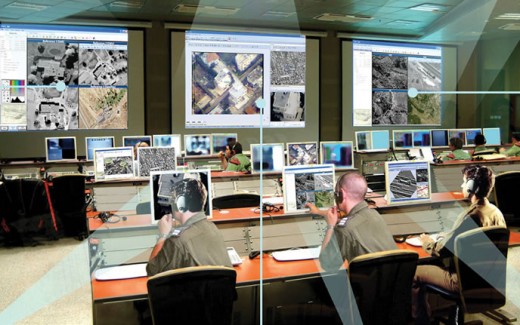
Rafael offers ImiLite as a stand alone workstation or a complete intelligence exploitation center, optimized for contingency operations. Concept illustration: Rafael
RICNET prototype at Elta Systems
Israel’s BIG Data Analysis: The evolving capability to turn ‘Big Data’ into intelligence in timely and methodical processes enable governments, law enforcement and intelligence agencies to tap new sources of intelligence, gaining insights never before available. Israel’s leaders in Big Data Analysis gathered in Tel Aviv today, for the first Israel Big Data Fusion (IBDF) conference organized today by i-HLS. The event provided a unique insight into the technologies, concepts and procedures employed by security and intelligence agencies, to collect, assess and publish information derived from huge databases constantly gathered in daily life. Systems that can automatically track and collate information, detect patterns and relationships, even circumvent attempts of suspects trying to cover their tracks.
In recent years the traditional structured databases of the past are being complemented by much bigger repositories of unstructured data, information that have never been tapped before – video surveillance, satellite images, emails, social networks, internet pages, open source news, voice and data interception etc. Managing these new repositories require new systems, storing huge volumes of information and able to retrieve specific pieces of data in an efficient and timely manner.
Such systems require unique solutions, represented here by companies such as Oracle, Microsoft, IBM, VMware and Netapp. Other companies are providing tools for information extraction, filtering and analysis, turning Big Data into Intelligence. To extract ‘the needle from the haystack’ of data, smart processing and analysis is automatically implemented, performing geographical analysis, links association and semantic analysis to reduce a mountain of raw data into a grain of valuable information.
IAI subsidiary Elta Systems is also specializing in this field, particularly in strategic defense applications providing specialized gateways for certain intelligence domains, such as Signals and Cellular Intelligence (SIGINT), imaging (RICent), processing space, aerial imagery and Synthetic Aperture Radar data into a national repository of intelligence data. Similar solutions are currently being provided for homeland security applications.
Among the applications presented at the conference were new studies in semantic web, presented by Prof. Haim Assa, performed under a Defense Research & Development Organization (DR&DD) program, based on Expert Systems’ COGITO.
Systems utilizing these data processing capabilities are addressing targets that, in the past, were considered highly illusive – such as the ability to detect and mitigate ‘advanced persistent threat’ (APT) cyber-attacks, enabling pre-emptive defense against such threats, or Chasing money laundering and terror financing. Such applications were discussed here by Elbit System’s Wise Intelligent Technology (WIT) or ThetaRay’s cyber security application against APT.
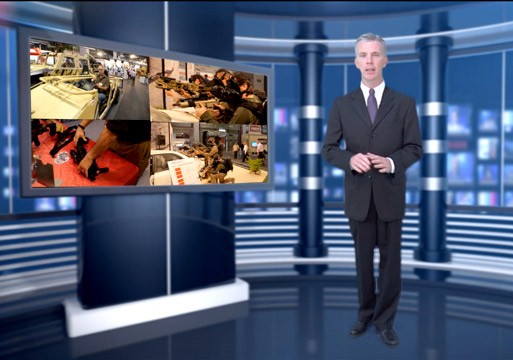
The ISDEF 2013 exhibition opened yesterday in Tel Aviv is the largest, most impressive defense expo taking place in Israel in recent years. Among over 100 exhibitors gathered here, are leading names from the local and international defense community, attracting with thousands of visitors. Our ISDEF 2013 VideoReport highlights several aspects of this show, including Unmanned `systems & Robotics, Land Vehicles and C4ISR and Small Arms.
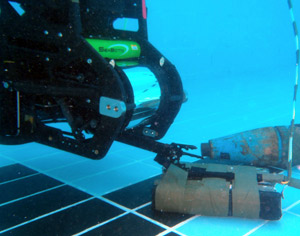
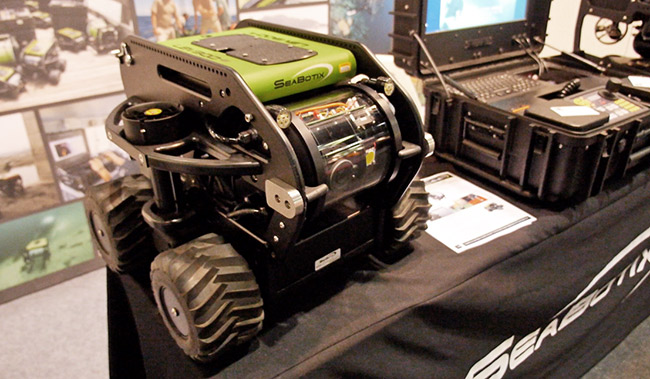
A SEABOTIX underwater reconnaissance vehicle places training explosives next to simulated unidentified ordnance during training conducted by Explosive Ordnance Disposal Mobile Units 1, of the US Navy. Photo: Petty Officer 3rd Class Scott Raegen.
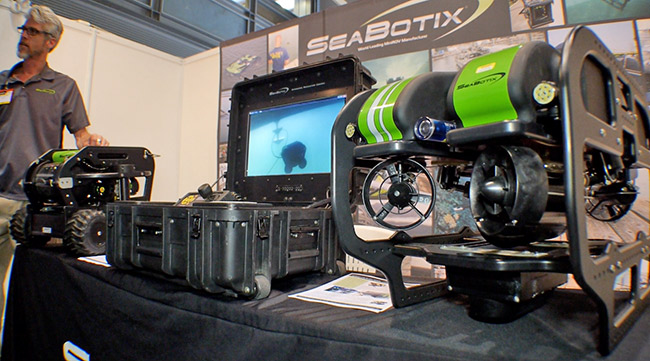
The VLB 300 MiniROV from SeaBotix is employed by divers to scan vessels, protecting from leaech mines and underwater IEDs. All Photos: Noam Eshel, Defense-Update
The ISDEF 2013 exhibition opened yesterday in Tel Aviv is the largest, most impressive defense expo taking place in Israel in recent years. Over 100 exhibitors gathered here, with thousands of visitors attracted by many professional seminars and demonstrations of assault means, weapon systems and CBRNE protective measures. In this brief coverage we highlight Unmanned `systems & Robotics. Two additional reports cover other themes including: Land Vehicles and C4ISR and Small Arms.
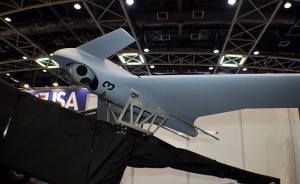
Orbiter 3 tactical UAV from Aeronautics, was presented here with a mockup of T-STAMP multi-sensor EO payload, developed by Controp Precision Systems.
ISDEF provided an insight into several new unmanned vehicles and payloads designed for new missions. Familiar faces were the Orbiter 3 tactical UAV from Aeronautics, making the Israeli debut of the system. The Orbiter was presented here with the S-STAMP multi-sensor EO payload, developed by Controp Precision Systems.
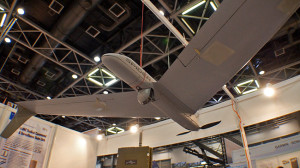
Innocon unveiled the Spider, a 3.5 kg micro-drone designed with a 1.75 meter span upper wing. According to the manufacturer, the Spider combined with one of three gimbaled, stabilized EO payloads, distinguish small detail such as a car license plate number.
Unmanned systems developed Innocon unveiled the Spider, a 3.5 kg micro-drone designed with a 1.75 meter span upper wing. According to the manufacturer, the Spider combined with one of three gimbaled, stabilized EO payloads, distinguish small detail such as a car license plate number.
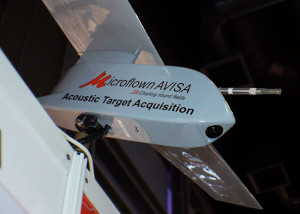
Another new payload coming from the Netherlands is the Acoustic Multi-Mission Sensor (AMMS) a patented Acoustic Vector Sensor developed by Microflown-Avisa. At a weigh of 70 grams the sensor can be mounted on the tip of a UAV, detecting gunshots, RPG firing or rocket launches from an altitude of about couple of hundred meters and at tactically effective range. The company is already delivering 3 Acoustic Multi-Mission Sensor systems (AMMS) equipping Dutch military units and is also in the process of adapting the system into vehicular sensors.
An integration of Acoustic Vector Sensor on an Unmanned Aerial Vehicle will son begin in India, under cooperation between Microflown-Avisa and an Indian military research agency.
This configuration will provide a low-profile sensor, offering many advantages compared with existing high-profile acoustic sensors. Another development, currently at the early stage with the an Indian research agency, will integrate the AVS into mini UAVs.
In earlier posts we have also covered the AMSTAF robot. Here at ISDEF the robot is displayed geared for CBRNE evacuation mission.
SeaBotix, a MiniROV system developer with a pedigree of underwater expertise displayed here a range of MiniROVs used to scan vessels, protecting from leaech mines and underwater IEDs. The company displayed here the LBC and LBV variants, equipped with multiple thrusters and vortex attraction, enabling the bot to fly at a distance, operating a powerful high resolution sonar, or crawl on the vessel’s hull using the vortex attraction system, when taking closer inspection of the surface. The robot can be controlled via tether from above water or directly assist divers under water. The systems are already operational with the US, Canadian, Swedish and Russian navies.
Stay tuned for more VideoReports from ISDEF in the coming days!
MiniROVs like this LBV300 The robot can be controlled via tether from above water or directly assist divers under water.
The latest Zibar variant that arrived straight from the workshop is the Z-COM an all terrain vehicle designed for special operations. Z-COM is designed with foldable flatbed and forward load surface, and collapsing roll cage, squeezing the fit snugly inside the V-22!. Three can be packed into the cargo bay of a CH-53 helicopter.
The ISDEF 2013 exhibition opened yesterday in Tel Aviv is the largest, most impressive defense expo taking place in Israel in recent years. Over 100 exhibitors gathered here, with thousands of visitors attracted by many professional seminars and demonstrations of assault means, weapon systems and CBRNE protective measures. In this brief coverage we highlight Tactical vehicles. Two additional reports cover other themes including: Unmanned Systems & Robotics and C4ISR and small arms.
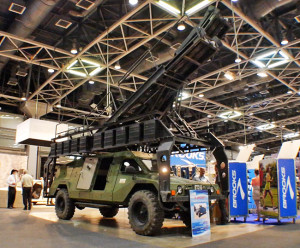
IAI RAMTA displayed at ISDEF the Tactical Assault Ladder mounted on the RAM2000 MkIII assault armored vehicle. The hydraulically operated ramp eliminates the need for hand carried ladders in most tactical situations, enabling rescuers and tactical assault teams to enter a structure or an aircraft at different level, through multiple entry points at height up to 10 meters. The structure weighs about one ton and has a maximum reach of 10.2 meters in height. The TAL is configured for various tactical vehicles, including the Ford 350, Ford 550, RAM 2000 MkIII and Iveco 4×4.
IAI RAMTA displayed at ISDEF the Tactical Assault Ladder mounted on the RAM2000 MkIII assault armored vehicle. The hydraulically operated ramp eliminates the need for hand carried ladders in most tactical situations, enabling rescuers and tactical assault teams to enter a structure or an aircraft at different level, through multiple entry points at height up to 10 meters. The structure weighs about one ton and has a maximum reach of 10.2 meters in height. The TAL is configured for various tactical vehicles, including the Ford 350, Ford 550, RAM 2000 MkIII and Iveco 4×4.
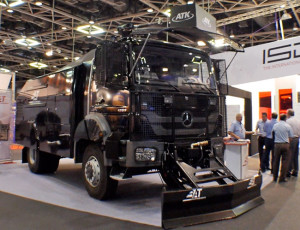
Fitted with Beit Alpha Trailers (B.A.T) unique Jet Pulse Water Cannon this Riot Control Vehicle can effectively close-in and disperse riots by ‘firing’ short pulses, long pulses and continuous, powerful streams of water, injected with tear gas (CS) or pepper spray (OC) agents, with or without dye coloring, marking rioters during the dispersal actions.
Another vehicle dealing with riots and public disturbance comes from Beit Alfa Trailers (B.A.T.). Fitted with B.A.T unique Jet Pulse Water Cannon the vehicle can effectively close-in and disperse riots by ‘firing’ short pulses, long pulses and continuous, powerful streams of water, injected with tear gas (CS) or pepper spray (OC) agents, with or without dye coloring, marking rioters during the dispersal actions. This behemoth is also protected against ‘soft’ or ‘hard’ attack, using all-round cameras for situational awareness, ballistic armor, runflat tyres and foam protect against firebombs thrown under chassis or on the upper deck. It also has tear gas nozzles dispersed around the vehicle, deterring rioters attempts to assault the vehicle. The vehicle is equipped with a front dozer blade for obstacle removal.
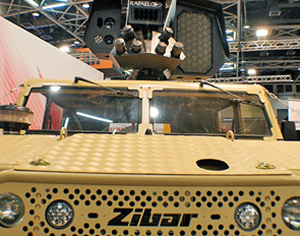
Zibar has already been displayed at ISDEF and other exhibitions in the past, but ISDEF 2013 offered the opportunity for RAFAEL to display two of its latest weapon systems mounted on this light, highly manoeuvrable platform.
A ‘non lethal weapon station’ displayed here by RAFAEL (Defense-Update covered this system at the Eurosatory 2012 event). The system represents a new concept for remotely operated station mounting non-lethal weapons. Utilizing a standard Samson Junior weapon station, the NLW kit mounts a modular set of devices providing more levels of flexibility for the tactical commander. The non lethal weapons shown include flash-bang payloads and loudspeakers, rubber balls and tear gas. The NLW kit can be loaded to any ‘Samson Junior’ weapon station, instead of the standard machine gun.
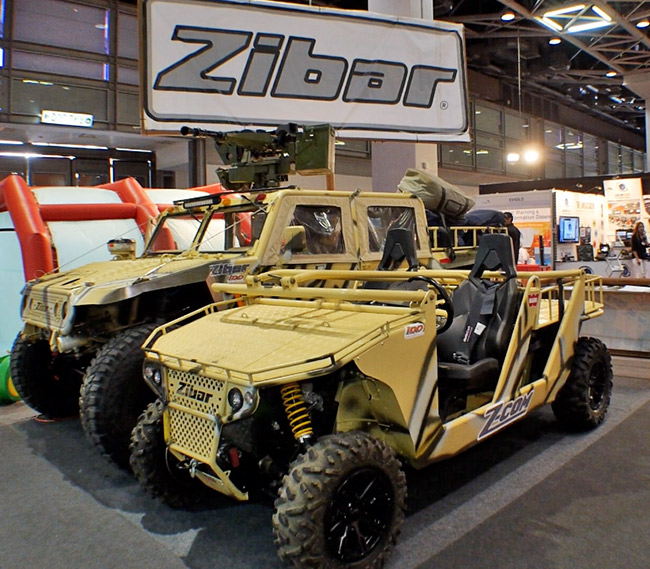
Zibar is a familiar vehicle for Defense-Update readers, as we covered this exciting special ops vehicle in the past. At ISDEF, Off Road Ido Technology unveiled two variants – Zibar Mk 2 and Zibar Mk2 Truck, both powered by a GM 6.2 V8, 430hp engine and automatic transmission. The five seat Zibar Mk2 is designed as a 4.2 ton Gross Vehicle Weight (GVW), with a curb weight of 2.7 tons (5,950 lbs) and carries a payload of 1.5 tons. The truck version is designed for 5.6 ton GVW, carrying up to 2.8 tons of payload (6,172 lbs).
The latest Zibar variant that arrived straight from the workshop is the Z-COM an all terrain vehicle designed for special operations. Powered by a Rotax BRP engine, accelerating the Z-COM to an offroad speed of 130 km/h, and range of over 400 km. The vehicle has a curb weight of only 750 kg, meaning it Z-COM can currently carry six fully equipped soldiers plus payload at a total weight of 800 kg. According to Ido Cohen, the vehicle designer and builder, Z-COM will soon be able to increase the payload capacity by more than 50 percent, bringing the vehicle to a two-ton GVW category. What makes this vehicle unique are its small dimensions and flexible deployment. Z-COM is designed with foldable flatbed and forward load surface, and collapsing roll cage, squeezing the fit snugly inside the V-22!. Three can be packed into the cargo bay of a CH-53 helicopter. The vehicle is currently competing for a new US Special Operations Command requirement for V-22 internally transported vehicles (ITV).
Automotive Industries (AIL) brought the latest Storm 3 R-Type, a versatile reconnaissance vehicle, a powerful 4×4 off-road light intervention vehicle suited for surveillance, base security and rapid offensive actions. The four-seat version is designed to carry modular storage systems, weapon mounts etc.
Automotive Industries (AIL) brought the latest Storm 3 R-Type versatile reconnaissance vehicle, a powerful 4×4 off-road light intervention vehicle suited for surveillance, base security and rapid offensive actions. The four-seat version is designed to carry modular storage systems, weapon mounts etc. The vehicle uses a collapsing outer tube frame enabling the vehicle to easily transport via air and sea. The vehicle has a GVW of 3.358 tons, of which the payload is 1.058 tons.
Stay tuned for more VideoReports from ISDEF in the coming days!
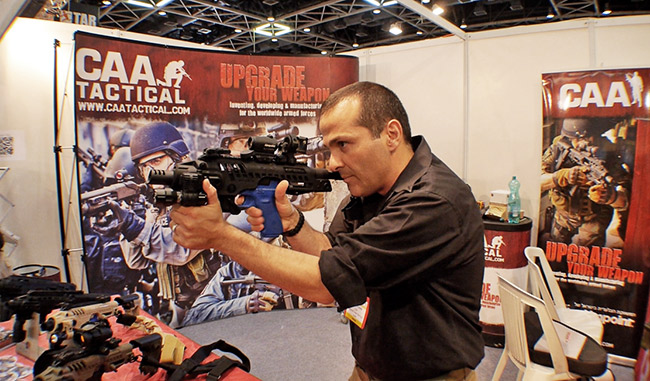
The versatile RONI, turning an ordinary pistol in few seconds, into an effective, versatile weapon system.
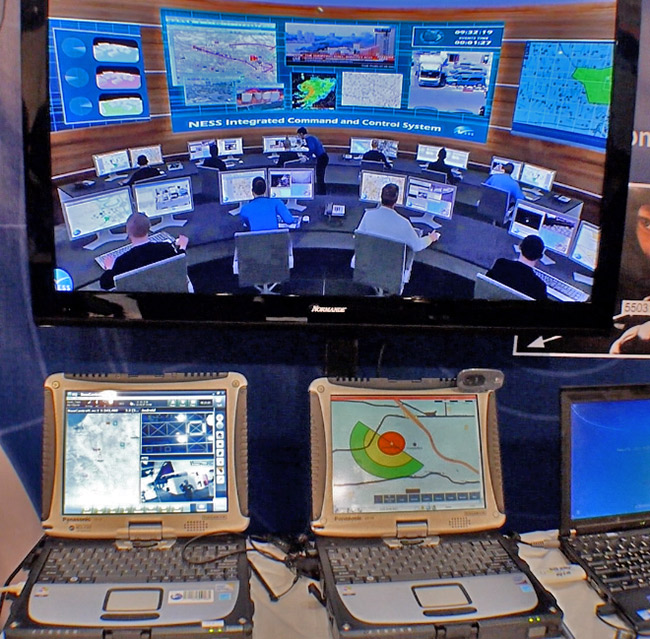
Hindsight from NESS provides a central recording hub for all the operational data recorded at a command post. It provides an essential tool for real-time analysis and post operational debrief.
The ISDEF 2013 exhibition opened yesterday in Tel Aviv is the largest, most impressive defense expo taking place in Israel in recent years. Over 100 exhibitors gathered here, with thousands of visitors attracted by many professional seminars and demonstrations of assault means, weapon systems and CBRNE protective measures. In this brief coverage we highlight C4I and small arms. Two additional reports cover other main themes including: Land vehicles, Unmanned vehicles.
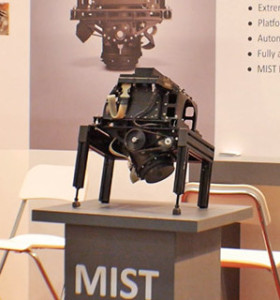
the MIST airborne imaging system. The system is now supporting still imaging at very high definition visual as well Infra-red spectral bands.
Several companies presented here new C4I applications. VisionMap, first covered last year in our AUVSI 2012 coverage, introduced a new enhancement of the MIST airborne imaging system. The system is now supporting still imaging at very high definition visual as well Infra-red spectral bands. According to the company, the VIS sensor uses an 80 Megapixel camera mounted on a unique gimbal performing high speed scan to generate high-resolution 3D photogrammetric representation of the scene. Such missions that until now were used mostly for urban planning can now be processed rapidly and efficiently, providing military users at the operational level a valuable tool for intelligence analysis and operational planning.
Another tool assisting commanders at command posts is the Hindsight from NESS TSG. The system records everything that is happening at a command and control center, offering a central, synchronized recording of all sources, including all operational screens, surveillance videos, audio from all sources, data channels, control room ambience via cameras and microphones, providing important record keeping of all operational data as well as an essential tool for real-time operational debrief.
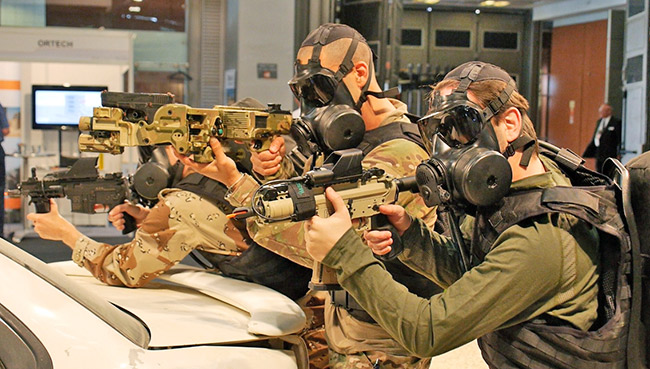
Among the weapons on display were various types of the Cornershot and the versatile RONI, from CAA Tactical, turning an ordinary pistol in few seconds, into an effective, versatile weapon system.
Stay tuned for more VideoReports from ISDEF in the coming days!
Crnershot and Gilboa APR from Silver Shadow, demonstrated with Avon’s CBRN masks.
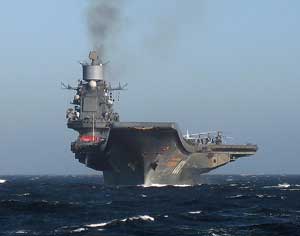
The Russian Navy plans to deploy its single aircraft carrier in support of its newly formed Mediterranean task force, Commander Admiral Viktor Chirkov said, a declaration that could further escalate rhetorics over the Syrian conflict. The carrier “Admiral Kuznetsov” will be ready to join the naval task force by the end of 2013. Defense-Update reports.
Last year the Russian carrier was deployed off the Syrian coast supporting a two-week naval mission in the Mediterranean. The carrier returned to its home base in Severomorsk on February 17 2012 and was scheduled to enter a four year mid-life upgrade by year’s end.
The Russian Navy sought to replace the P-700 Granite anti-ship missiles with catapults, more hangars and new air defense systems, enabling the carrier to operate with more aircraft (MiG-29K fighters would have replaced the current Su-33s.)
The overhaul to be carried out by the Severodvinsk Sevmash shipyard would include the removal of the P-700 Granit anti-ship missiles, installing of catapults to the angled deck, and upgrading of the vessel’s powerplants. The air wing currently operating Su-33 fighters would expand, and convert to modern MiG-29K jets. Upgrades to the ship’s electronics and sensor equipment were also planned, along with the installation of the new anti-aircraft system. Admiral Kuznetsov was scheduled for a relaunch in 2017. Pushing back the refit seems to be a blow to the Navy, as the ‘Kuznetzov’ is already considered a ‘goulag’ for seamen, due to appalling living conditions on board.
This ambitious refit is now cut short, enabling the vessel to redeploy, responding to heightened tension in the Eastern Mediterranean. Russia’s only Mediterranean naval base is at the Syrian port of Tartus. Moscow has been reinforcing its Mediterranean presence as the conflict in Syria has worsened. In March, warships from Russia’s Pacific Fleet entered the Mediterranean for the first time in decades to become part of what Moscow says is a permanent task force. That task force also includes vessels from the Northern, Baltic, and Black Sea fleets.
The Russian Navy only aircraft carrier Admiral Kuznetsov was scheduled to go on the dry dock at Severodvinsk to begin a four-year upgrade, but due to the hightened tension in Syria it is likely to continue service unchanged, joining the new Mediterranean Task Force the Russian Navy is deploying to the Mediterranean sea.
LTAS provides a quick and affordable configuration of armor protection enabling military units to match specific threats by applying modular ballistic protection kits on 'A Kit' attachments installed on the vehicle. Photo: BAE Systems
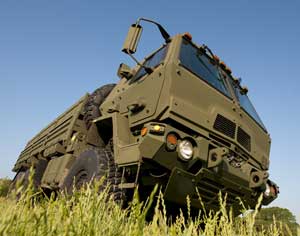
LTAS provides a quick and affordable configuration of armor protection enabling military units to match specific threats by applying modular ballistic protection kits on ‘A Kit’ attachments installed on the vehicle. Photo: BAE SystemsThe U.S. Army Tactical Vehicle Armor Development (TVAD) program is interested in ballistic armor solutions meeting the Long-Term Armor Strategy (LTAS) Objective performance requirement, at less than 2.5 inches thick, weighing no more than 30 pounds per square foot that can be applied to tactical vehicles.
Over the recent years the Army has implemented a modular approach to vehicle protection, pertaining mainly to the ability to adapting the vehicle’s ballistic armor to changing threat levels. LTAS is defining the specification and attachments (A-Kit) installed on the vehicle, and an add-on B-Kit, consists of both transparent armor and opaque armor, providing the appropriate level of protection.
Units can store B-Kits of different levels of protection, used only on missions where certain levels of threats are expected.
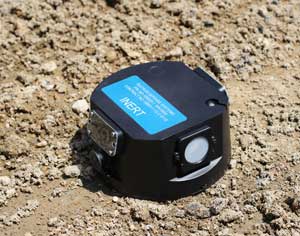
As part of the program testing DARPA is using sensors built by Textron Systems to test and measure buried-to-buried and buried-to-above ground communications, using UHF (330 MHz) low-power (1 watt) communications transferring data at a rate of 9.6 kbps. These studies examined the physical performance features of ADAPT hardware, optimizing sensing, communication, and concealment capabilities and evaluating potential operational environment applications. Photo: DARPA
Unattended sensors have evolved through the years, from hand emplaced and retrieved systems inserted and retrieved from enemy area by special forces, to lightweight, expendable sensors that could be dropped from the air and tapped, via wireless links to report on enemy movements in an area under surveillance. In recent years, unattended ground sensors (UGS) have evolved with the progress made in the miniaturization of cameras, processors, wireless communications and power management, offering such systems extremely long endurance. However, the cost of such system remains high. The U.S. Defense Advanced Research Programs Agency (DARPA) is seeking to make these sensors much more affordable, by employing Adaptable Sensor System (ADAPT) using an original design manufacturer (ODM) process, similar to that used in the commercial smartphone industry. The goal is to develop low-cost, rapidly updatable intelligence, surveillance and reconnaissance (ISR) sensors in less than a year, a marked improvement to the current three-to-eight year development process.
Since DARPA embarked on the program in 2012 the core ADAPT hardware and software package were developed, using a customized Android Operating System (OS) to provide capabilities common to all ISR sensors. The program recently completed its first reference design and developed application-specific software for an unattended ground sensor (UGS) that uses the ADAPT core. This new UGS could provide users with a cost-effective ground sensing capability. A number of ADAPT based UGS will be available to begin field testing this summer. Defense-Update reports.
Packed in small cylinder the UGS features applications to remotely sense ground activity for a number of potential military applications. “You take the ADAPT core and easily plug it into any number of ISR sensor reference designs” said Mark Rich, DARPA program manager. The sensor is self-powered and can wirelessly network with other sensors or user interfaces, such as a video monitor at an operations center. “We believe that the ADAPT building block approach will transform how the military Services and the defense industry approach ISR sensor research and development. This method has the promise of being much more cost-effective, faster to the warfighter, and easier to refresh with technology upgrades.”
DARPA may develop additional reference designs that integrate the ADAPT core and sensor-specific apps into airborne, sea and undersea sensor designs. To demonstrate this capability researchers recently removed the control interface of a small quad-copter unmanned aerial vehicle (UAV) and replaced it with the ADAPT core. This successfully provided flight control input to the UAV and marked an initial step in applying the ADAPT core to other sensor reference designs.
While most military requirements are derived from requests coming from the field, sometime troops would like to get stuff they have learned to play with in video games like this Ghost Recon and see on science fiction movies. Illustration: Tom Clancy Ghost Recon
The US Special Operations Command is looking for revolutionary new gear assisting troops in exceeding human performance in combat. The idea sounds similar to a science fiction tale, but if the command will be successful in its quest – this time it may be real. The command has posted a Request For Information (RFI) to government research centers, academy and industry, to provide information that could contribute to the evolution of the Tactical Assault Light Operator Suit, or TALOS. Defense-Update reports.
The kit will be applied as part of a futuristic uniform suit, using powered exoskeleton providing the wearer superhuman strength or ultra protection with full-body ballistic armor. Using wide-area networking, wearable computers and antennae, operators will have more situational awareness, through bionic visual and aural sensing. Other technologies that could be implemented include non-visual means of information display, including the utilization of cognitive thoughts and immersive displays depicting personalized information over the surrounding environment. health and medical monitoring features could employ embedded monitoring, oxygen supply systems, wound stasis and electromechanical compensation. Thermal and energy generation and management are also likely to be explored.
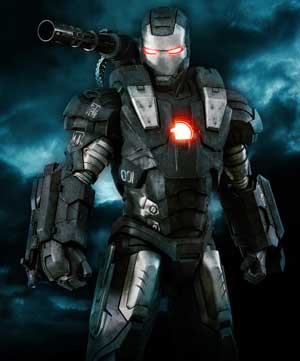
The US Special Operations Command may be looking for an Iron Man type suite, at least this is how it sounds from the description of technologies for the TALOS suits. Illustration: Iron-Man 2
SOCOM issued the RFI on the US Government Federal Opportunity Bulletin board, and is expecting submissions by June 15. The command expects submissions of technologies already in development (TRL 5 or higher) that could be demonstrated in a short term. As much as this vision seems futuristic, SOCOM is looking for practical, near-term capabilities. typical of the command’s no nonsense attitude, the technologies selected for demonstrations should be integrated to form an initial capability within twelve months. A secondary goal is to determine the feasibility of fielding objective capabilities within three years. Such technologies could be submitted by research and development organizations, private industry, government labs and academia as well as individuals.
One of the responders is the U.S. Army Research, Development and Engineering Command (RDECOM), is one of the government establishments that have responded to the call. “There is no one industry that can build it,” said SOCOM Senior Enlisted Advisor Command Sgt. Maj. Chris Faris during a panel discussion at a conference at MacDill Air Force Base, Fla. The demonstrations of relevant technologies would take place a month later, on July 8-10, in Florida.
TALOS will have a physiological subsystem that lies against the skin that is embedded with sensors to monitor core body temperature, skin temperature, heart rate, body position and hydration levels. The body armor could consist of magnetorheological fluids – also known as ‘liquid body armor‘ – that transforms from liquid to solid in milliseconds when a magnetic field or electrical current is applied. Though still in development, this technology will likely be submitted to support TALOS.
“[The] requirement is a comprehensive family of systems in a combat armor suit where we bring together an exoskeleton with innovative armor, displays for power monitoring, health monitoring, and integrating a weapon into that – a whole bunch of stuff that RDECOM is playing heavily in,” said. Lt. Col. Karl Borjes, an RDECOM science advisor assigned to SOCOM. “RDECOM cuts across every aspect making up this combat armor suit,” Borjes said “It’s advanced armor. It’s communications, antennas. It’s cognitive performance. It’s sensors, miniature-type circuits. That’s all going to fit in here, too.”
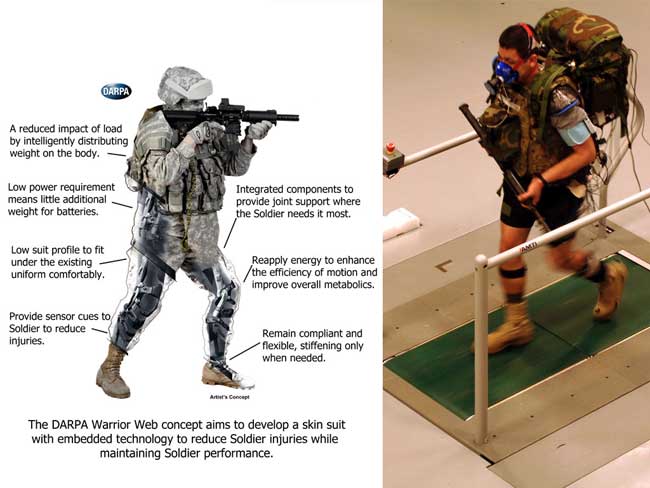
One of the programs that could be considered for this quest is ‘Warrior Web’, an exoskeleton capability currently managed by the Defense Advanced Research Agency (DARPA) and the U.S. Army, exploring a new kit enabling soldiers to reduce fatigue and potential injuries caused by excessive loads they carry on dismounted operations. DARPA’s Warrior Web is a soft, lightweight under-suit that will augment the work of the Soldiers’ own muscles, to significantly boosting endurance, carrying capacity and overall warfighter effectiveness–all while using no more than 100 Watts of electrical power.
The Warrior Web program consists of two related program tasks – the first task currently underway aims to develop a mix of core ‘critical technologies’, deemed criticalCurrently underway, Task A seeks to develop a mix of core technologies deemed critical for the program’s success. On the second phase, scheduled to commence in fall 2013 researchers will develop and fabricate an integrated suit that would eventually undergo real-world testing to evaluate its performance.
A prototype suit is already undergoing testing at the U.S. Army Research Laboratory Human Research and Engineering Directorate (ARL HRED), evaluating various prototype devices. The testing evaluates how each prototype incorporates different technologies and approaches to reduce forces on the body, decrease fatigue, stabilize joints and help Soldiers to maintain a natural gait under a heavy load. The testing uses a multi-camera motion-capture system to determine any changes in gait or balance, a cardio-pulmonary exercise testing device to measure oxygen consumption and a variety of sensors to collect force, acceleration and muscle activity data.
DARPA’s Warrior Web exoskeleton concept vision. The soldier on the right takes part in an Army test carrying 61 pounds of weight, to evaluate Warrior Web technologies. Photo: DARPA
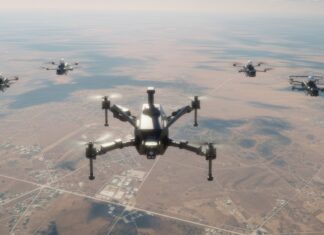
Lockheed Martin Skunk Works® and XTEND have achieved a major milestone in JADC2 by integrating the XOS operating system with the MDCX™ autonomy platform. This technical breakthrough enables a single operator to simultaneously command multiple drone classes, eliminating the friction of mission handoffs. From "marsupial" drone deployments to operating in GPS-denied environments, explore how this collaboration is abbreviating the data-to-decision timeline and redefining autonomous mission execution.
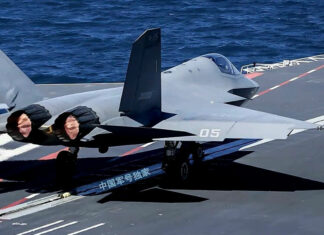
As traditional defense primes face mounting competition from agile “neoprimes” such as Anduril, Palantir and Helsing, the balance of innovation is shifting toward software-defined warfare and scalable, dual-use technologies, while global industry consolidation—marked by Boeing’s integration of Spirit AeroSystems and other strategic mergers—signals an intensified race to secure control over the defense technology value chain. Our Defense-Tech weekly report highlights these trends.
In early October 2025, a coordinated wave of unmanned aerial system (UAS) incursions—widely attributed to Russia—targeted critical infrastructure across at least ten European nations. The unprecedented campaign exposed the fragility of Europe’s air defenses...
Executive Summary
The past week (September 18-25, 2025) represents an inflection point where strategic defense concepts have transitioned from doctrine to tangible reality. An analysis of global events reveals four primary, interconnected trends shaping an...
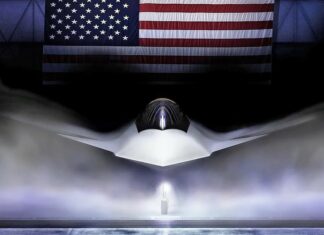
At the 2025 Air, Space & Cyber Conference, U.S. Air Force and Space Force leaders unveiled major updates on next-generation fighters, bombers, unmanned systems, and space initiatives, highlighting both rapid innovation and critical readiness challenges as the services race to outpace global competitors. A short version is available here, with a more detailed version for subscribers.
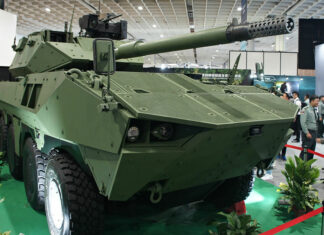
The Taipei Aerospace & Defense Technology Exhibition (TADTE) 2025 crystallized around four dominant strategic themes that collectively illustrate Taiwan's comprehensive approach to defense modernization amid escalating regional tensions. Based on a detailed report by Pleronix (available upon request). Includes a Podcast discussion on TADTE 2025's highlighting Taiwan's four strategic themes beyond the post's coverage.
Israel’s Iron Beam 450 high-power laser system has completed final testing, marking a major leap in air defense. Developed by Rafael, it offers precise, cost-effective interception of rockets, UAVs, and mortars, and is set for IDF deployment by 2025.