
Sunday, December 28, 2025
More
    Home Blog Page 148

    Airbus Military to add Winglets on all C295 in 2014

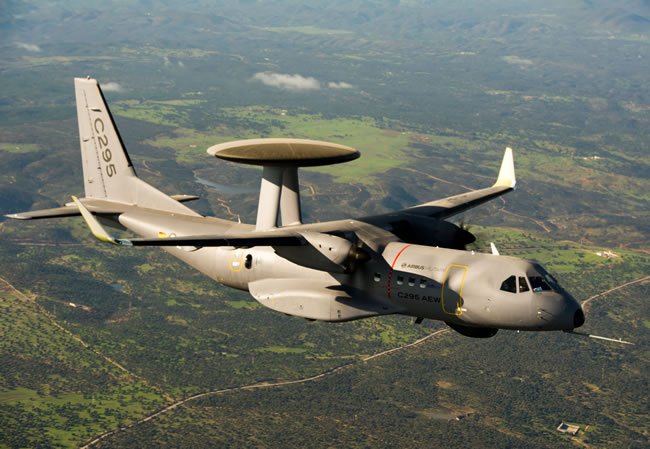
    c295aew_wg4
    By late 2014 Airbus will deliver C295 transport planes with new winglets, offering better fuel consumption and improved payload capability. Photo: Airbus Military

    Airbus Military has launched a new member of the C295 medium transport and surveillance aircraft – the C295W. The company will make its public debut at the Paris Air Show later this month.

    The new model, equipped with uprated engines and winglets will be available in 2014. Company sources said that the new version will become standard for all Seville assembled CN295 beginning from the fourth quarter of 2014, following the completion of certification, expected by the middle of next year.
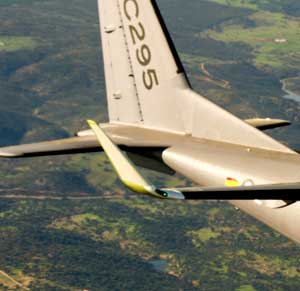
    C295winglets300
    The winglets to be employed on the C295W were demonstrated in flight-trials which showed positive results for a weight penalty of only around 90kg. Photo: Airbus Military

    The aircraft uses the same Pratt & Whitney Canada PW127 turboprops engines which power all versions of the C295. The increased power is available from implementing new procedures recently certified by Canada and Spain, permitting operation in the climb and cruise phases at higher power settings at the discretion of the operator. When implemented at higher altitude and hot temperatures, these procedures improve operation over very high terrain such as the Andes or Himalaya mountains with only a minor influence on maintenance cost. The winglets were demonstrated in flight-trials which showed positive results for a weight penalty of only around 90kg.

    According to Airbus, the new model will be optimized for operation from “hot and high“ airfields, where the company expects payload increases in excess of 1,000kg; improvements are also likely to provide operators with enhanced performance in all flight phases. The new features will also provide an overall reduction in fuel consumption of around 4% depending on configuration and conditions.

    In intelligence, surveillance and reconnaissance (ISR) roles such as airborne early warning (AEW) the enhancements will increase endurance by 30-60 minutes and permit an operating altitude up to 2,000ft higher than now. The C295 is currently used in maritime surveillance. Airbus is also developing an airbore surveillance version using an Elta radar.

    C295 aircraft are currently operational with a number of air forces and navies, including: Spain, Portugal, Poland, Indonesia, Mexico, Algeria, Brazil and Egypt are the main operators of this type, with Chile, Colombia, the Czech Republic, Finland, Ghana, Indonesia, Jordan, Kazakhstan and Oman operating 2-5 aircraft each.

    Asia is becoming a most important market for the C295, where Airbus Military is leveraging its partnership with Indonesia based PT Dirgantara Indonesia (DI) manufacturing and support capability to promote its market position. Last month Airbus Military embarked on a marketing tour to six ASEAN countries, sending a CN235 (the Indonesian designation of C295, operated with the Indonesian Ministry of Defense). The tour visit included the Philippines, Brunei Darussalam, Vietnam, Thailand, Myanmar and Malaysia.

    “The visits will allow explanations on the specific capabilities of the CN235 and the NC212i, an upgraded version of the C212 launched in November 2012 between PTDI and Airbus Military with new avionics and autopilot systems as well as an increased passenger seating, increasing its cost efficiency significantly,” Airbus Military said. Vietnamese Defense Minister Gen. Phung Quang Thanh said Hanoi plans to send a delegation to study the Indonesian invitation. Thanh recently met with Indonesian Deputy Defense Minister Sjafrie Sjamsoeddin in Hanoi.
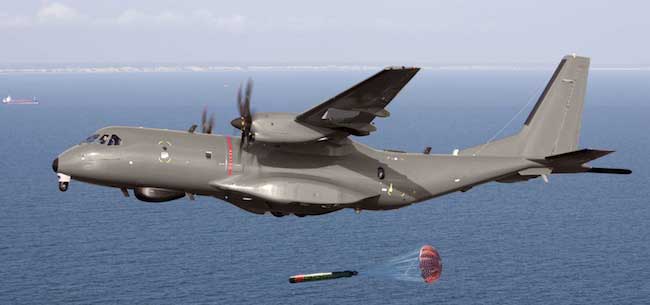
    C295 dropping an antisubmarine lightweight torpedo on a maritime anti-submarine warfare exercise. The Maritime Patrol/ASW configuration of the aircraft includes a chin mounted EO/IR turret, Magnetic Anomaly Detector boom at the aft, a surface search radar and other sensors at the belly and underwing weapons stores.
    C295 dropping an antisubmarine lightweight torpedo on a maritime anti-submarine warfare exercise. The Maritime Patrol/ASW configuration of the aircraft includes a chin mounted EO/IR turret, Magnetic Anomaly Detector boom at the aft, a surface search radar and other sensors at the belly and underwing weapons stores.

    First F-35B Unit will be Combat Ready in Two Years

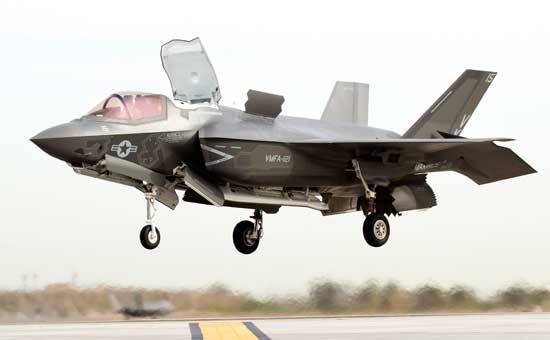
    vfma121_landing
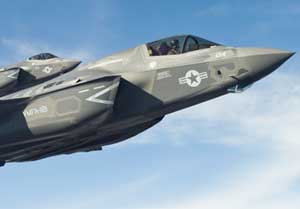
    The first F-35B stealth fighters of US Marine Corps VFMA 121 are already flying at Yuma Air Station in New Mexico. The unit is expected to become combat ready by mid or late 2015. Photo: Lockheed Martin

    The US Marine Corps is expected to be the first service to declare the F-35 Joint Stike Fighter (JSF) operational. If all goes according to plan, the corps could have up to 16 of the stealth fighters operational by mid 2015. These fighters will be ready to conduct Close Air Support (CAS) missions, offensive and defensive counter air, air Interdiction, assault support escort, and armed reconnaissance in concert with Marine Air Ground Task Force resources and capabilities. The USMC also requires the jet’s Autonomic Logistic Information System V2 software to declare IOC. Like the USAF, the Marines require Block 3F for their future needs.

    The training unit at Eglin is expected to receive the first Block 2A aircraft, equipped with software upgrade and increased capability. For the IOC, the first Marine squadron will operate the jets with the next version – Block 2B. “If the F-35 IMS Version 7 executes according to plan, Marine Corps F-35B IOC criteria could be met between July 2015 (Objective) and December 2015 (Threshold),” the Marine Corps confirmed in a recent report submitted to Congress by the three services scheduled to operate the Lightning II fighter. The Marines will declare IOC when the first squadron of between 10 and 16 aircraft is trained and ready.

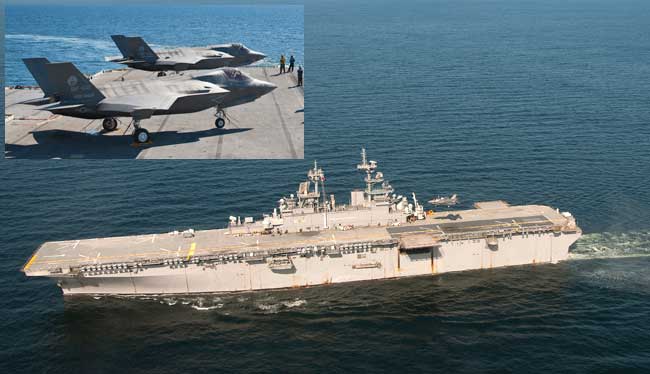
    Two F-35B STOVL fighters performed sea trials with USS Wasp LHD in October 2011. Following these tests the Navy recommended a list of modifications to be performed on its amphibious support vessels before they can accommodate the STOVL JSF.
    Two F-35B STOVL fighters performed sea trials with USS Wasp LHD in October 2011. Following these tests the Navy recommended a list of modifications to be performed on its amphibious support vessels before they can accommodate the STOVL JSF.

    The corps’ F-35B will initially operate from land bases, as the planned operation from Landing Helicopter Dock (LHD) will require significant modifications to accomodate the STOVL jet fighters. According US Navy Admiral Jonathan Greenert, chief of naval operations, certain modifications for the Wasp-class LHDs ship have already been designed. According to Aviation Week, The modifications are intended to offset the stresses associated with JSF exhaust during vertical landing. Extra shielding will be required, protecting vulnerable elements on the deck, that cold be vulnerable to the heat generated by the jet exhaust. The Navy has not disclosed how long it will take to implement the modifications across the LHD/LHA fleet.

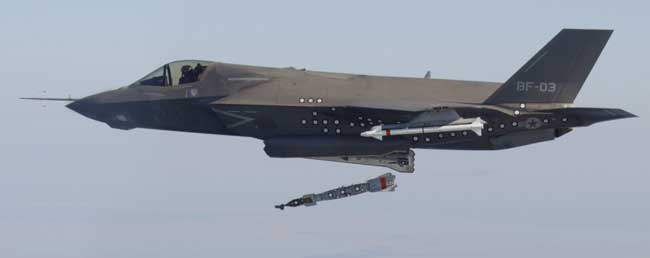
    First release of a GBU-12 from the F-35B. Photo: Lockheed Martin
    First release of a GBU-12 from the F-35B. Photo: Lockheed Martin

    The F-35 program schedule calls for the first Marine F-35B unit, VMFA-121, to be ready for a “contingency deployment” by late 2015. However, there is no firm date for a second squadron. VMFA-121 is the first operational fleet squadron anywhere in the world for the F-35 and comprised of flyers and maintainers trained at Eglin. While the squadron is expected to become ‘combat ready’ in two years, its actual combat capability is not clear, Aviation Week wrote. Out of the weapons cleared in the Block2B/3I software standard, only the laser-guided bomb is considered useful for close air support (CAS), which is the primary mission of embarked AV-8Bs. None of the 2B weapons are suitable for use against quickly moving targets or for a situation in which the risk of collateral damage is high. (For these missions the US Navy employs weapons like Laser JDAM and Hellfire, and will ultimately employ the SDB-II as it becomes available).

    Another concern about the F-35B CAS capability is lacks the Rover (remote video receiver) technology. Traditionally, U.S. stealth aircraft lacked interface to non stealth assets, and Rover, considered as the minimum essential interface for CAS, will have to be included if the stealthy F-35B would ever be considered for this basic air support application. To implement such capability in the short time left for IOC the Marines could be carrying Rover in an extenal pylon or pod, until an internal solution is available for teir F-35B. The US Navy however is holding firm on requiring the full Block 3F configuration for its F-35C IOC date. “If the F-35 IMS Version 7 executes according to plan, Navy F-35C IOC criteria could be met between August 2018 (Objective) and February 2019 (Threshold),” the report reads.

    The aircraft will fly with the current software configuration known as Block 2B configuration in 2015. “If the F-35 IMS Version 7 executes according to plan, Marine Corps F-35B IOC criteria could be met between July 2015 (Objective) and December 2015 (Threshold),” the report states.

    The Marines will declare IOC when the first squadron of between 10 and 16 aircraft is trained and ready “to conduct CAS, offensive and defensive counter air, air Interdiction, assault support escort, and armed reconnaissance in concert with Marine Air Ground Task Force resources and capabilities”. The USMC also requires the jet’s Autonomic Logistic Information System V2 software to declare IOC. Like the USAF, the Marines require Block 3F for their future needs, the report says.

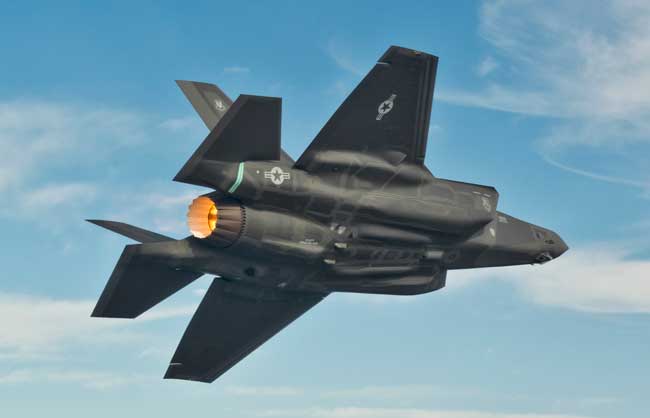
    The US Air Force has already deployed F-35As to Nellis, in support of operational training and development of tactics, but the first squadron is scheduled to become combat ready only by the end of 2016. Photo: Lockheed Martin
    The US Air Force has already deployed F-35As to Nellis, in support of operational training and development of tactics, but the first squadron is scheduled to become combat ready only by the end of 2016. Photo: Lockheed Martin

    Unlike to the Marines, the US Air Force, the largest customer for the tri-service jet, is willing to wait few months longer to get the next software version known as Block 3i, declaring its first squadron operational in the second half of 2016. The first squadron will fly 12-24 F-35As equipped and train to conduct basic close air support (CAS), interdiction, and limited suppression and destruction of enemy air defense (SEAD/DEAD) operations in a contested environment.

    This new schedule reflects a departure from previous plans to field the JSF a year later, in 2017, with the final Block 3F configuration. The current IOC will suffice with either the earlier Block 2B software load or with Block 3i, currently being tested. The new schedule emphasize the Air Forces determination to improve its capabilities to operate in contested and denied airspace even if such capabilities are partial.

    The report said the Air Force will need to field full Block 3F capability, facilitating enhanced lethality and survivability, but noted “the IOC will provide sufficient combat capability for the threat postulated in 2016,”

    The US Navy however is not compromizing on Block 3F and is willing to wait more than three years, until mid 2019, after the Marines field their own STOVL F-35Bs, untill having the first F-35C unit operatioonal with at least 10 aircraft on board one of its aircraft carriers. these aircraft will be configured with Block 3F. The USN says that it must have the Block 3F configuration to deal with threats in the post-2018 environment.

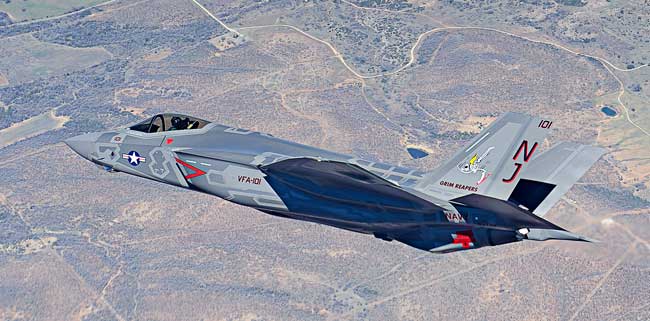
    The US Navy has painted their first production F-35C in the colors of VF101 'Grim Rippers', but the service decided to pass on the possibility to deploy the current version. Therefore, the first naval aviation unit isn't likely to become operational for six years. However, when the first squadron deploy at sea, in 2019, it will be equipped with the full capabilities envisioned for the 5th Generation fighter. Photo: Lockheed martin
    The US Navy has painted their first production F-35C in the colors of VF101 ‘Grim Rippers’, but the service decided to pass on the possibility to deploy the current version. Therefore, the first naval aviation unit isn’t likely to become operational for six years. However, when the first squadron deploy at sea, in 2019, it will be equipped with the full capabilities envisioned for the 5th Generation fighter. Photo: Lockheed martin

    France Opts for U.S. Reapers

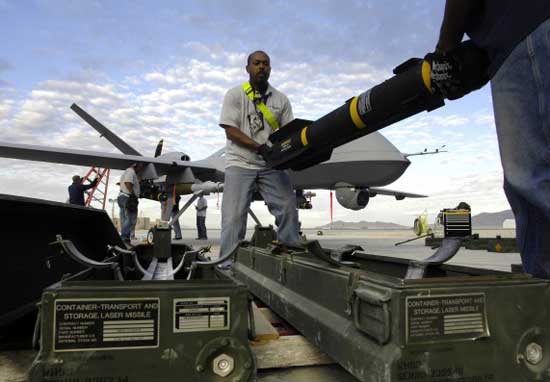
    Laser guided bombs and hellfire missiles are loaded on a General Atomics MQ-9 Reaper drone prior to a mission in Afghanistan,
    Laser guided bombs and hellfire missiles loaded on a General Atomics MQ-9 Reaper drone prior to a mission.

    France has decided to buy two MQ-9 Reaper medium-altitude long endurance (MALE) drones from the USA, to extend the strategic reconnaissance capability of the French Air Force after the current Harfang drones end their planned mission in 2014. The two General Atomics (GA-ASI) MQ-9 Reapers that will be delivered by 2013 year-end. The two drones are not likely to be used in armed recce missions as they do  with the US Air Force. Defense-Update reports.

    Given the short delivery schedule, it is likely the two Reapers will not be new but taken from the US Air Force inventory. According to the French Defense Minister Jean-Yves Le Drian the French Air Force desperately need the new drones to address the immediate situation in the Sahel region.

    The Harfang was fielded with the French Air Force under the SDIM program in June 2008. France ordered three planes and two ground control stations which became operational with the Drone Experimentation Squadron 1/330 Adour, in Cognac, in June 2008. From the beginning the program was regarded as an interim capability, and proposals for the full capability plan were submitted by EADS Since 2007. Despite their ‘interim’ capability, the French Harfangs were supporting all contingencies the French forces were involved in, including Afghanistan, Libya and Mali.

    Through the years the Ministry of Defense evaluated only two options – the Israeli Heron TP and US made MQ-9 Reaper. IAI, the developer and manufacturer of the Heron and Heron TP has teamed with Dassault Aviation and EADS to form industry teams to support the selection of its drones, but has not succeeded in winning the French Air Force support for its system.
    The procurement of the two Reapers is also considered an interim phase, until France is capable of establishing its own drones, considered as the centerpiece of future intelligence and combat operations. Two parralel programs are currently underway in France – the collaborative development of a jet-powered Unmanned Combat Air Vehicle (UCAV) known as NeuroN, expected to replace some manned aircraft by 2030. Another collaborative development of a UAS, with the British industry. Dassault is also cooperating with Israel Aerospace Industries, on the development of a future MALE platform addressing the French requirements. However, it is not clear whether this alliance will hold after failing to win the interim MALE program. France is currently interested in MALE drones designed for strategic reconnaissance, attack missions are currently not a priority for these assets.

    IAI is also coopreating with Rheinmetall’s Unmanned Aerial Systems, a joint entity set by EADS and Rheinmetall, pursuing a similar program in Germany. Defense Minister Thomas de Maiziere said Berlin is set to decide on the procurement of 16 drones, five to be operational by 2016.

    Source: Defense-Update


    AUSR-180x250Autonomous Unmanned Systems & Robotics

    As one of the world’s leading technological drivers of unmanned systems and robotics, Israel provides a hub for technological innovation, technical knowhow and practical, operational experience.

    The upcoming Autonomous Unmanned Systems & Robotics conference will provide an opportunity for local and international experts in the field, for networking and exchange of ideas.

    Defense-Update is a Media Partner of AUS&R. Defense-Update members – Register here!


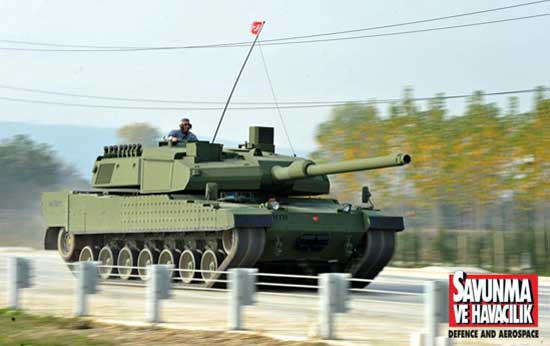
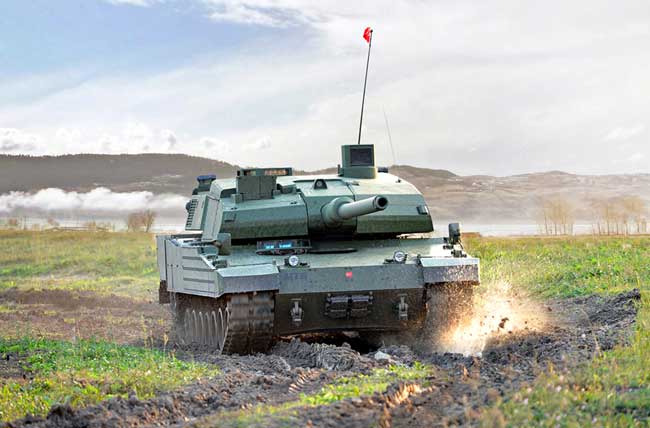
    Syrian Conflict Could Win Ankara a Saudi Order for Altay Main Battle Tanks

    Turkish new main battle tank Altai is expected to enter production in 2015
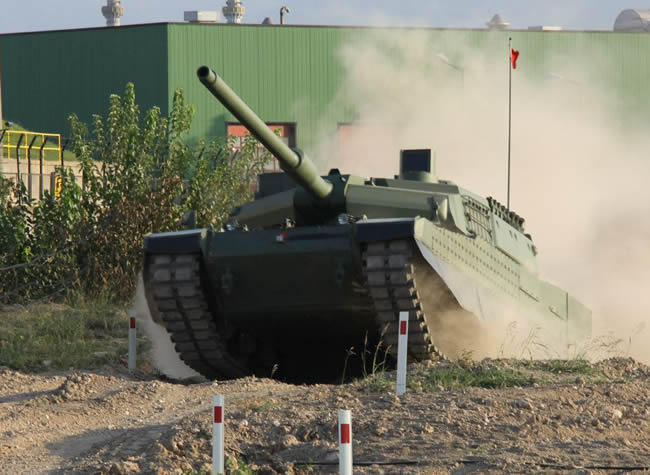
    Ankara hopes that by 2017, as the first Altay MBT rolls off the production line it will be produced both for Turkey and Saudi Arabia. Photo: Savunma ve havacilik, Turkey
    Ankara hopes that by 2017, as the first Altay MBT rolls off the production line it will be produced both for Turkey and Saudi Arabia. Photo: Savunma ve havacilik, Turkey

    Turkey’s defense industry may sell hundreds of new generation Altay battle tanks (video) to Saudi Arabia, as the two countries show a common understanding on the civil war in Syria – Defense-Update reports.

    The rift between Sunni and Shiite moslems reflected in the Syrian Civil war could open new business opportunities for Turkish defense industries, the Turkish Hurriyet Daily News reports. One of the main prospects, Saudi Arabia is sharing political and strategic interest with Turkey, particularly over the Syrian civil war and support for Syrian rebels. “There are indications that their political alliance with Ankara may facilitate bigger contracts,” Hurriyet quoted a top defense industry official in Turkey.

    An executive from a Turkish armored vehicles manufacturer said that reinforced alliances with some of the Gulf countries over the Syrian crisis have already indicated that new contracts could be in the offing for the Turkish arms industry. “I can say that we are more warmly welcomed in certain [Gulf] capitals than before. Our counterparts have made it clear that almost excellent political relations their countries have with Turkey could soon turn into new business opportunities for Turkish defense companies,” he said.

    Turkey has already offered hundreds of Altay Main Battle Tanks (MBT) to Saudi Arabia. While the Altay is still in development, Ankara is hopeful a preliminary agreement over a future order of the Altay could be struck in the near future. “The Altay is not available for immediate sale, but is potentially a powerful export product when you think of a medium-term deal. Saudis are good customers with available cash, good political ties and their need for new tanks. We are hopeful about a future deal [for the Altay],” an official with the Turkish Defense procurement agency (SSM) said. Riyadh expressed interest in modernizing its fleet of MBTs for years, but has yet to decide what tank it would like to buy. Among the platforms they have considered in the past were the leopard II, which is still in consideration, French AMX-56 Leclerc, the cancelled T-95 and its successor T-99 ‘Armata’ from Russia. Saudi Arabia already operates several hundreds American M-1A2 currently undergoing systems upgrades. New tanks are required to replace 320 AMX-30 tanks delivered from France in the 1980s.

    Koç Holding’s Otokar is currently producing prototypes of the Altay MBT. Under the turkish defense procurement plan, four tranches of 250 units will be procured over the next decade, gradually replacing some 3,000 German-made Leopard 1 and US made M-60s and obsolete M48 still in service. Ankara is hopeful that a Saudi order could further improve the production cost of the new tank, expected to begin in 2017, establishing the new tank’s position in the export market.

    Source: Defense-Update

    Otokar Altay Main Battle Tank
    Otokar Altay Main Battle Tank

    A UN Report on the Legal, Moral and Ethical Implications of Combat Robotic Systems ‘Killer Drones’

    A report on the legal, moral and ethical implications of the use of Lethal Autonomous Robotics (LAR) submitted to the by Christof Heyns.
    on the use

    Lethal autonomous robotics (LARs) are weapon systems that, once activated, can select and engage targets without further human intervention. They raise far-reaching concerns about the protection of life during war and peace. This includes the question of the extent to which they can be programmed to comply with the requirements of international humanitarian law and the standards protecting life under international human rights law.

    Beyond this, their deployment may be unacceptable because no adequate system of legal accountability can be devised, and because robots should not have the power of life and death over human beings. The Special Rapporteur recommends that States establish national moratoria on aspects of LARs, and calls for the establishment of a high level panel on LARs to articulate a policy for the international community on the issue.

    More reports are available for members


    Autonomous, Unmanned Systems & Robotics - International Conference and Exhibition - November 26-28, Israel

    Autonomous Unmanned Systems & Robotics

    As one of the world’s leading technological drivers of unmanned systems and robotics, Israel provides a hub for technological innovation, technical knowhow and practical, operational experience.

    The upcoming Autonomous Unmanned Systems & Robotics conference will provide an opportunity for local and international experts in the field, for networking and exchange of ideas.

    Defense-Update is a Media Partner of AUS&R. Defense-Update members – Register here!


    General Dynamics Integrates APS on Stryker/LAV III

    Another view of the Trophy APS installed on an up-armored Stryker. This view clearly shows the significant reduction in size between the first and second generation APS. While Trophy 1 was developed for main battle tanks, Trophy Light is designed specifically for integration on smaller, lighter vehicles.
    For the OSD evaluation Rafael has integrated the TROPHY System in a different configuration from the method used on the Merkava 4M Main Battle Tank. A similar system was mounted in the past on a Stryker Armored Fighting Vehicle. The current configuration, optimized for the up-armored version of the vehicle.

    Another system, currently in development, is utilizing a new configuration, adapted to lighter vehicles. The Stryker system visible in the photo comprises of two types – the standard ASPRO-A on the vehicle’s left side and the new TROPHY-LIGHT  on the left, both systems are linked to the ‘WindGuard’ radar, (two of the four panels are visible here). Both countermeasure units are adapted to match the latest add-on hybrid armor modules developed by Rafael for the Stryker. Photo: RAFAEL

    General Dynamics Land Systems has recently concluded a successful Critical Design Review of its APS project. The company said the design is leading an effort to develop the first North American combat vehicle with a fully integrated Active Protection System (APS). The vehicle was tested with the Trophy HV system, similar to the one currently protecting Israel’s Merkava 4M tanks. More information for members

    AUS&R Autonomous Unmanned Systems & Robotics


    Autonomous, Unmanned Systems & Robotics - International Conference and Exhibition - November 26-28, Israel
    Autonomous, Unmanned Systems & Robotics – International Conference and Exhibition – November 26-28, Israel

    AUS&R Autonomous Unmanned Systems & Robotics Conference, Israel November 26-28, 2013

    Organizer: I-HLS.

    As one of the world’s leading technological drivers of unmanned systems and robotics, Israel provides a hub for technological innovation, technical knowhow and practical, operational experience. The upcoming  Autonomous Unmanned Systems & Robotics conference will provide an opportunity for local and international experts in the field, for networking and exchange of ideas. Defense Update is the Media Partner of AUS&R.


    Early Registration

    Only $126 + VAT

    Special offer ends 1st. September 2013

    The conference will highlight the following topics:

    Autonomous Systems & Robotics Overview:

    • Defense and Security Applications for Autonomous systems
    • Future trends in defense and security robotics
    • Development of autonomous combat systems – world trends

    Applications Focus:

    • Robots in the War on Terror
    • Advanced Payloads & Mission Systems for Autonomous Systems
    • Operations of Robots in Urban Terrain

    Technology Focus:

    • The human dimension in unmanned systems
    • Advanced Man-Machine Interface for Autonomous & Robotic Systems
    • Energy Management for Autonomous Systems

    Russia Challenges the U.S. by Equipping Syria With S-300, Yakhont Missiles

    The delivery of Russian SS-N-26 coastal defense and SA-21 (S-300 PMU2) air defense missile systems to Syria is significant, since Moscow is providing the Syrian regime the capability to defend from Foreign intervention. Defense-Update reports.

    In fact, the Russian weapons are providing Syria a level of defense so that the Russians will not have to send in their military power to defend their strategic assets in Syria. Although Israel may consider this move a potential challenge to its ‘qualitative superiority’, the Russian move is not aimed against Israel, but against the USA and Europe.

    By supplying Syria with such weapons Russia is ‘drawing a line in the sand’, to prevent a possible intervention in Syria, as the west have practiced in Iraq in 2003 and in Libya in 2011. Unlike the two countries that gave in to the West, Russia feels Syria is committed to Syria under a defense pact, and is now making this statement clear. Another manifestation of this statement and strategy is growing presence of Russian naval vessels in the Eastern Mediterranean and at Port of Tartus.

    This is part of the analysis. More analysis is available for members – Join now!

    U.S. sources claim that the current systems are delivered with an upgraded radar, “that makes them more effective, according to American officials who are familiar with classified intelligence reports”. Moreover, the missiles could also only put Israeli assets at risk, but also limit international activities off the Syrian coast, would a U.N. embargo enforced on the Syrian regime. Moscow has repeatedly blocked several initiatives to bring an end to the bloodshed of Civil War in Syria. More recently, investigations about alleged use of chemical weapons in Syria were also derailed by Russian opposition. Russia is determined not to allow NATO and the Western Alliance to “politicize the issue” (off alleged use of Weapons of Mass Destruction – WMD) as was the case of the “Iraqi scenario”. Russia’s foreign minister, Sergey V. Lavrov, said.

    Russia regards Syria as one of its longstanding allies in the region. while Moscow is reluctant to intervene in Syria and act forcibly against the rebels, it is apparently providing Basher al Assad all the help they can to remain in power, maintain his military forces and protect, at least parts of the Syrian territory that is important to the Russians and to the Syrian regime – the concentration of Ala’awite minority, along the coastal area and in Northern Syria, and areas along the Lebanese border, including Damascus. Able to keep U.S. and NATO warships at risk would potentially deter possible foreign action, such as maintaining a ‘no fly zone’ or a naval blockade, as part of an embargo like the one implemented by the UN over Libya and Iraq.

    At the United Nations, the Russians recently blocked proposals that the Security Council mount a fact-finding trip to Jordan, Turkey and Lebanon to investigate the burgeoning flood of refugees, according to Western diplomats.

    Source: Defense-Update

    20130519-081557.jpg

    North Korea Fires Short Range Missiles, Call Off Musudan Test

    North Korea on Saturday launched three short-range missiles into the Sea of Japan, apparently as part of a military drill, South Korea’s defense ministry said. The tests were conducted in two sessions, two missiles were fired during the morning and one in the afternoon. A fourth missile was launched on Sunday. All missiles landed in the East Sea. Defense-Update reports.

    The US and South Korean forces had been on heightened alert for a medium-range ballistic missile test in recent weeks amid tensions triggered by North Korea’s nuclear test in February.

    A US defense official said last week that two North Korean Musudan medium-range missiles that had been primed for firing as tensions flared in the run-up to the North’s national celebrations on April 15 had been moved from their launch site. Musudan missiles have an estimated range of 2,500 to 4,000 km (1,500 to 2,500 miles), enough to reach South Korea and Japan and potentially US military bases on the Pacific island of Guam.

    The missiles fired today are thought to be modified anti-ship missile or the KN-02 surface-to-surface missile derived from the Soviet era SS-21 that has a range of about 120 km, sources in Seoul reported.

    US and South Korean officials had been worried that any test of the medium-range missiles would trigger a fresh surge in tensions, which escalated after the North carried out a nuclear test in February. Seoul refrained from launching its Musudan missiles, maintaining its missiles on their launch positions for weeks. U.S. sources reported that Pyongyang has apparently called off the missiles recently.

    Source: Defense Update

    The mission to detect debris on runways- help increase safety and security

    TLV1 - CopyThe Israel Airports Authority (IAA) has declared the FODetect, an automated Foreign Object Debris (FOD) detection system developed by Xsight fully operational at Ben -Gurion airport in Tel-Aviv. I-HLS reports

    In May 2011, following a two year evaluation period, the IAA selected and began the FODetect project deployment. In June 2012, the FODetect system successfully passed site acceptance testing, a procedure conducted according to FAA regulations for FOD detection equipment.

    The FODetect system is installed on the airport’s primary 0826 runway, the first of three runways planned to be equipped with a FOD detection system. The operational status was declared after a rigorous evaluation process and soft launch testing at the airport’s primary runway.

    According to Xsight FODetect is a comprehensive automatic FOD detection solution, comprising multiple Surface Detection Units (SDUs) that are collocated with the runway edge lights. The system’s capabilities are based on a hybrid radar-optical sensing technology utilizing optimized algorithms, advanced image processing software and close range detection. the entire system provides automatic detection and close-up view of suspected FOD over the entire runway, during day and night, including inclement weather conditions.

    TLV drk - Copy

    Scanning between each aircraft movement, FODetect not only markedly enhances safety, but also increases operational efficiency and runway capacity. Xsight’s FODetect system is fully compliant with the FAA’s regulation for FOD detection, as it meets or exceeds the highest performance levels in every parameter required by the FAA.

    The FODetect system is installed on the airport’s primary 0826 runway, the first of three runways planned to be equipped with a FOD detection system.

    FOD is an international problem The certification in Israel opens the way for a way to deal with it in a more efficient way.

    Experts say that the systems’ sensors are located along airport runways and therefor can serve as an added tool to detect any suspicious movement that can be connected to an terror act.

    “It would have to be evaluated but the potential is there” one of the experts told I-HLS.

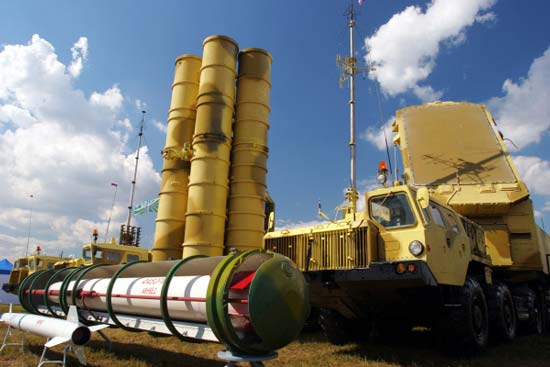
    How Dangerous is the S-300 Syria is About to Receive?

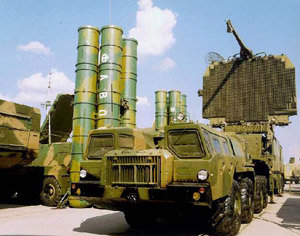
    S-300 Air Defense System "Favorit" PMU-2
    S-300 Air Defense System “Favorit” PMU-2

    What are the implications of Moscow delivering S-300 air-defense systems to Syria, could one weapon system decide the outcome of the Syrian power struggle, is the Russian missile system as invincible as it is described? Alexey Eremenko from the Russian news agency Novosti provides some answers. Defense-Update reports.

    “The missile batteries would give Syrian President Bashar al-Assad’s regime a powerful weapon against foreign air strikes” Eremenko comments, “one of the options being bounced around as a form of international intervention – and could fracture the fragile accord on Syria reached last week between Moscow and Washington, which hope to get the warring sides to negotiate.”

    According to Eremenko, “Verifiable information about the S-300 deal is desperately scant: Was there a deal at all? What did it cover? Has any part of it been implemented? For now, what we know about the S-300 saga, from its origins to its implications, has been based on disappearing documents, anonymous sources, rumors, approximations and misunderstandings.”

    Is there really a deal to sell Russian S-300 systems to Syria?

    Technically, it’s all hearsay, according to Eremenko. The single evidence was a 2011 annual report by S-300’s manufacturer, the Nizhny Novgorod Machine Building Plant, which mentioned a contract for such missiles for Syria. However, the report has since vanished from the plant’s website. The Vedomosti business daily that commented about that story said the contract was worth $105 million and that an unspecified number of S-300 systems were slated for delivery between 2012 and early 2013. Based on the quoted price, the alleged contract would cover the infrastructure required for one battery only. (One S-300 missile system is estimated to cost some $115 million, the cost of each missile is over one million US$.)

    Other reports commonly attributed to ‘western intelligence sources’ mention that Syria has ordered four S-300 batteries and 144 missiles, thus committing $900 million for such order. Deliveries of the hardware would commence by late summer. Other media sources reported initial shipments were made in December 2012. Russian official sources have stated that a contract covering the delivery of advanced air-defense systems to Syria has been signed two years ago.

    Can the international community or any third parties affect the sale?

    “The deal is strictly between Moscow and Damascus – which is to say, it’s all in the hands of Russian President Vladimir Putin,” Eremenko wrote, “all attempts to ban arms sales to Syria via the UN Security Council have been blocked by Russia. Of course, there is behind-the-scenes haggling and arm-twisting, but that’s unofficial.”

    Why are the S-300s dangerous? They’ve been on the production line since 1978 – aren’t they outdated by now?

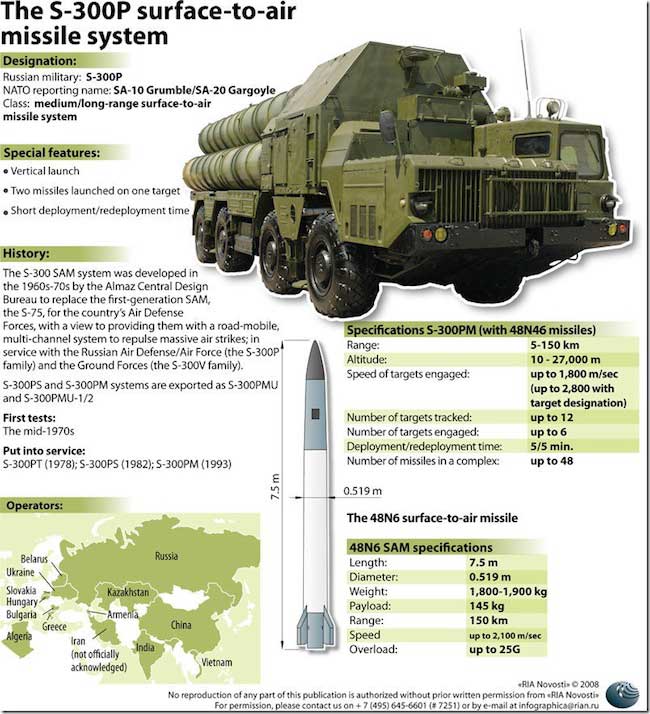
    The S-300 systems have been modernized repeatedly to remain state-of-the-art airplane- and rocket-destruction machines. The S-300PMU2 Favorit can launch six missiles at once and engage 12 targets simultaneously, both at high and low altitude. The missile interceptors (effectors) used by the S-300 PMU2 outmaneuver any modern fighter, including F-16, F-15, F-18 and F-22, these missiles can also effectively hit cruise missiles at ranges of 40-70km. The same unit can also employ the latest 48N6E2 missiles to intercept short and medium range ballistic missiles that would be targeting the site. This missile having a maximum range of 195km is what makes the system ‘strategic’ When covered by by point defense missile systems, such as the SA-15 Tor or SA-22 Pantsir S1, an S-300 PMU2 would be virtually immune to standoff attack by precision guided weapons. The system is also designed to operate effectively even when subjected to severe countermeasures and electronic attack, which makes it especially difficult to suppress.

    Who are the targets?

    In addition to engaging fighter aircraft, cruise and ballistic missiles, the S-300 system will also pose acute danger to strategic assets flying well beyond the Syrian border, including Israeli or coalition support aircraft, airborne early warning, electronic warfare and monitoring or aerial refueling aircraft which are part of strike packages or aircraft supporting intelligence gathering and surveillance. “Any attempts by foreign powers to enforce a no-fly zone over Syria, as was done in Libya in 2011.” Eremenko wrote.

    What’s the possible time frame? How long until Assad can shoot foreign fighter jets out of the sky?

    The S-300 system deploys in five minutes – once it’s paid for, produced, tested, shipped, and manned by trained personnel. Novosti wrote, still, it would likely take a while before Damascus actually gets any missiles. However, there are few issues that would delay delivery. The manufacturer is unlikely to have ready-to-ship S-300 systems lying on the shelves: Whatever leftovers there were from a deal with Iran, scrapped in 2010, were long ago snatched up by other customers such as Algeria, according to Ruslan Pukhov of the Center for Analysis of Strategy and Technologies, a for-profit research group in Moscow. This means the systems would need to be produced and test launches conducted, a job that would take about a year, Pukhov said. “Furthermore, dozens or even hundreds of staff would have to be trained to operate the complicated machinery, which should take about six months. This would push Assad’s most optimistic deadline of owning fully operable S-300 complexes to November at best, with spring of 2014 being a more realistic estimate.”

    According to Israel’s 1st TV news channel, Syrian soldiers have recently completed a two-month training on the S300 air-defense system in Russia. These crews are expected to become the lead cadre receiving the systems expected within two months in Syria. Israel is concerned about the possibility that the S300 systems will be manned by Russian troops in Syria. In the early 1970s Russian crews have maintained a full air-defense division in Egypt, assisting in defending the country from Israeli attacks during the War of Attrition that followed the Egyptian defeat in the Six Day War of 1967.

    Source: Defense-Update

    s300_rian
    Source: Novosti News Agency

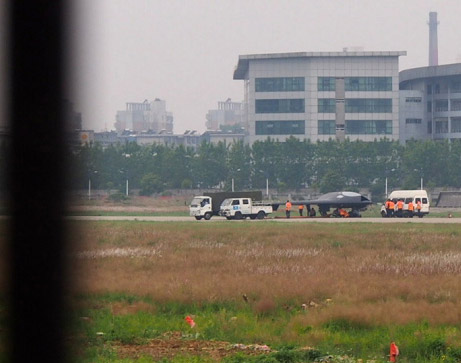
    China’s Lijian UCAV “Sharp Sword” spotted taxiing

    China’s Lijian "Sharp Sword" unmanned combat aerial vehicle taxiing.
    China’s Lijian “Sharp Sword” unmanned combat aerial vehicle (UCAV) taxiing.

    China’s first jet-powered stealth unmanned combat aerial vehicle (UCAV), the Lijian or “Sharp Sword,” was recently spotted undergoing taxiing tests in China, AIN reports.

    The Lijian prototype rolled off the assembly line late last year after three years’ joint development by Hongdu Aviation Industry and Shenyang Aircraft , subsidiaries of the state-owned China Aviation Industry (Avic). Photos of prototype 001 taxiing on the runway of an unidentified air base, likely located in Jiangxi Province where Hongdu Aviation is based, became available on Chinese websites on May 6.

    The Lijian is said to have a wingspan of 46 feet (14 meters), smaller than the 62-foot wingspan of the U.S. Navy’s X-47B demonstrator, which China considers an equivalent. It is powered by a single jet engine, presumed to be the Shenyang WP7 used for the J-7 fighter. With the WP7 engine, the Lijian’s ordnance payload might not exceed the 2,000-kg (4,400-pound) capacity of the Northrop Grumman X-47B. The Chinese CM-506 small-diameter bomb, showcased at Airshow China 2012, is one of the weapons being recommended for the Lijian. It has a range of 130 km (80 miles) against land or maritime targets.

    The China’s Lijian "Sharp Sword" UCAV. Internet photos
    China’s Lijian “Sharp Sword” UCAV on the runway. Internet photos

    Israel Shipyards Introduces the SAAR 72 Mini-Corvette Design

    saar_72

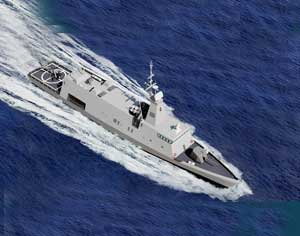
    Israel Shipyards is expanding the SAAR class of missile boats, extending the range from missile boats into ‘Mini Corvette’ class vessels. The new class is addressing the growing requirements of Israel and other nations in extending maritime control and sovereignty far from their territorial waters. Defense-Update reports from IMDEX 2013.

    Visit IAI at IMDEX 2013
    Visit IAI at IMDEX 2013

    The Israel Navy is required to expand the security and responsibility over much larger area while doing that with an ageing  fleet of Saar 4, 4.5 missile boats and 5 corvettes. If only to maintain the numbers of boats in service, the Israel Navy will require several new vessels in the coming years. Many of these vessels are becoming obsolete – some of the oldest missile boats in service – INS Atzmaut (Independence) and INS Nitzahon (Victory) are reaching 35 years in service – an age considered the end of service life for such boats. Therefore, new platforms will be required in the near future. Through the years the Navy acquired 20 Saar 4/4.5 vessels, but the cash-strapped service could not afford to buy larger vessels, and, therefore limited the procurement of the larger Saar 5 corvettes to the three vessels built in the U.S. funded by Washington’s Foreign Military Sales (FMS).

    A more detailed version of this article is available for members – Join now!

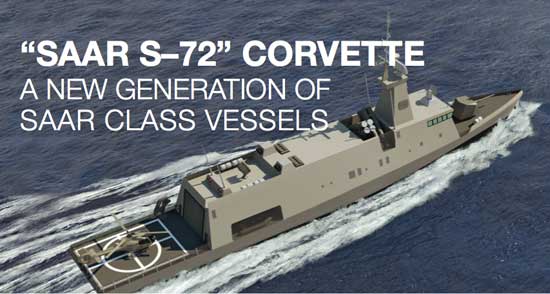
    The new Saar S-72 unveiled by Israel Shipyard at the recent IMDEX event in Singapore fits between the Navy’s existing Saar 4.5 missile boats, and Saar 5 corvettes. Through the years Israel Shipyards have built 33 Saar 4 and 4.5 class missile boats; 20 were delivered to the Israel Navy over the years. With the new Mini Corvette the shipyard hopes to expand it’s offering to meet the evolving requirements, of the Israel Navy, as well as of international customers overseas.

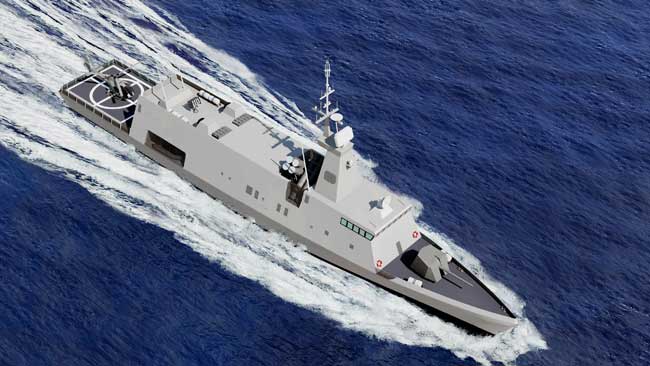
    For Coast Guards and non-military operations the S-72 is a new platform that better fits the category of Offshore Patrol Vessel (OPV). For naval applications the same 800-ton vessel can be finished as a versatile ‘Mini Corvette’. Both are highly applicable to asymmetric warfare at sea, providing sufficient space for command and control, accommodation for special task forces on military or counter terror missions, or supporting rapid response or rescue operations. The large hangar stores a medium size helicopter and UAVs. The adjacent 15 meter long flight deck supports medium size helicopters up to AW139 class. The vessel is configured with loading crane, storage and berth deploying rubber boats / RHIB’s or unmanned surface vessels.

    The military version of SAAR S-72 mini corvette will be able to carry the latest weaponry required for a modern navy
    The military version of SAAR S-72 mini corvette will be able to carry the latest weaponry required for a modern navy

    In the military configuration the Saar-72 will offer a significant upgrade over the current Saar 4.5 – in performance and combat capabilities. Applied with a slanted stealth finish, recessed exhausts, and radar integrated mast, designed to host both emitters (radar, EW) and passive sensors (ESM) without interference. The vessel can accommodate the IAI Elta EL/M-2258 Advanced lightweight Phased Array (ALPHA) multi-mission naval radar, designed for blue water and littoral warfare support. This radar was selected by the Israel Navy for the upgrading of existing vessels as well as for its new combatants. The vessel can carry different weapons, including IAI’s Barak 8 type missiles, various anti-ship missiles and precision surface attack weapons. The naval configuration is also fitted with an advanced naval gun.

    Saar 72 type vessels are designed with spacious accommodation to 50 crewmembers plus 20 additional accommodations for passengers or special troops. It is equipped to sail on a 21 day missions, with mission range above 3000 NM.

    Sources at the Israeli shipyard said they can complete the design and construction of the lead S-72/Saar-72 ship within a period of 30 months, and produce follow-on vessels in eight months. The shipyard can build the 72m’ vessel with its current facilities, but to accommodate the 85 meter version some expansions will be necessary.

    Photo Report: Singapore Hosts International Navies IMDEX 2013

    Indonesian Navy corvette KRI Frans Kaisiepo. Photo: Noam Eshel, Defense-Update
    International navies are gathered at Changi Naval Base in Singapore for the bi-annual IMDEX show. Photo: Tamir Eshel, Defense-Update
    International navies are gathered at Changi Naval Base in Singapore for the bi-annual IMDEX show. All photos: Noam and Tamir Eshel, Defense-Update
    Visit IAI at IMDEX 2013
    Visit IAI at IMDEX 2013


    KRI_Frans_Kaisiepo
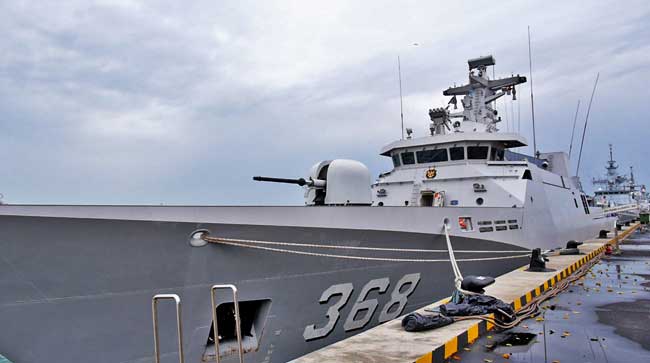
    Indonesian Diponegoro Class Corvette (SIGMA) KRI Frans Kaisiepo (368).
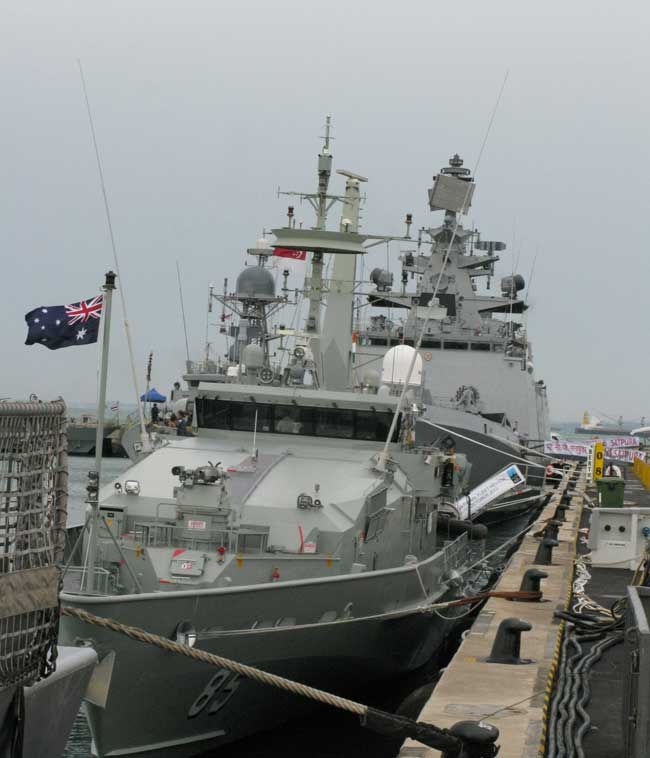
    The Australian Armidale class Patrol Craft HMAS Bathurst is seen by the pier at the Singapore Changi Naval Base open day.
    The Australian Armidale class Patrol Craft HMAS Bathurst is seen by the pier at the Singapore Changi Naval Base open day.
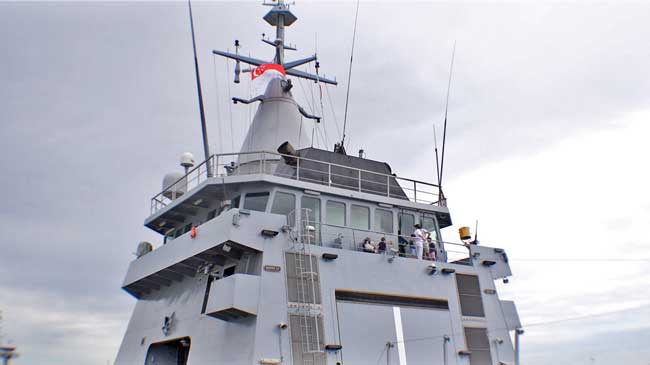
    The bridge of HMAS Armidale class Patrol Craft HMAS Bathurst
    The bridge of HMAS Armidale class Patrol Craft HMAS Bathurst.
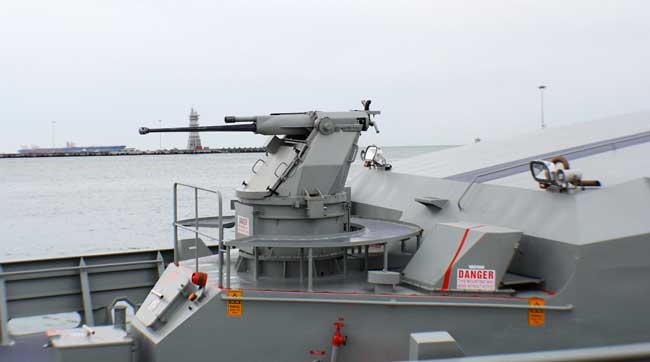
    Typhoon 25mm gun mount on the Armidale class Patrol Craft HMAS Bathurst
    Typhoon 25mm gun mount on the Armidale class Patrol Craft HMAS Bathurst.
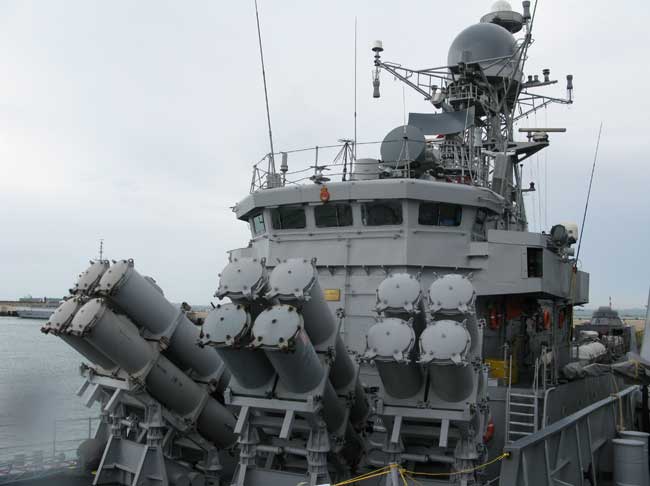
    Kora Class corvettes such as the INS Kirch shown here during her visit to Singapore this week, carry 16 Kh-35 Uran-E anti-ship missiles carried in fixed positions in the forward section. These missiles are the Russian equivalents of the US made Harpoon and are designed to attack vessels up to 5000 tonnes. Photo: Tamir Eshel, Defense Update
    Kora Class corvettes such as the INS Kirch shown here during her visit to Singapore this week, carry 16 Kh-35 Uran-E anti-ship missiles carried in fixed positions in the forward section. These missiles are the Russian equivalents of the US made Harpoon and are designed to attack vessels up to 5000 tonnes.
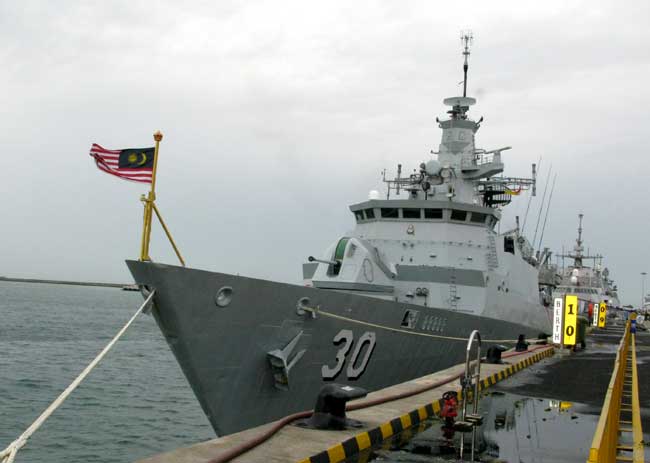
    The Malaysian frigate KD Lekiu frigate (F30). The design is based on the F2000 light frigate originally designed by Yarrow Shipbuilders of Glasgow (now BAE Systems Surface Ships) in the early 2000s. Two frigates of this class are in service with the Malaysian Navy. Photo: Tamir Eshel, Defense-Update
    The Malaysian frigate KD Lekiu frigate (F30). The design is based on the F2000 light frigate originally designed by Yarrow Shipbuilders of Glasgow (now BAE Systems Surface Ships) in the early 2000s. Two frigates of this class are in service with the Malaysian Navy.
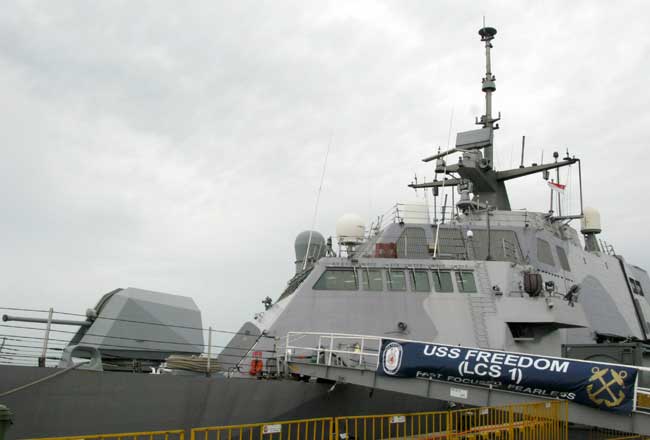
    Fast - Focused - Fearless: USS Freedom (LCS-1) seen at the pier at the Changi Singapore Naval Base, the Freedom arrived here as part of her 8 months tour of the Asia Pacific. The US is planning to maintain Littoral Combat Ships at forward locations in Asia, as part of its new Pacific Pivot strategy. Photo: Tamir Eshel, Defense-Update
    Fast – Focused – Fearless: USS Freedom (LCS-1) seen at the pier at the Changi Singapore Naval Base, the Freedom arrived here as part of her 8 months tour of the Asia Pacific. The US is planning to maintain Littoral Combat Ships at forward locations in Asia, as part of its new Pacific Pivot strategy.
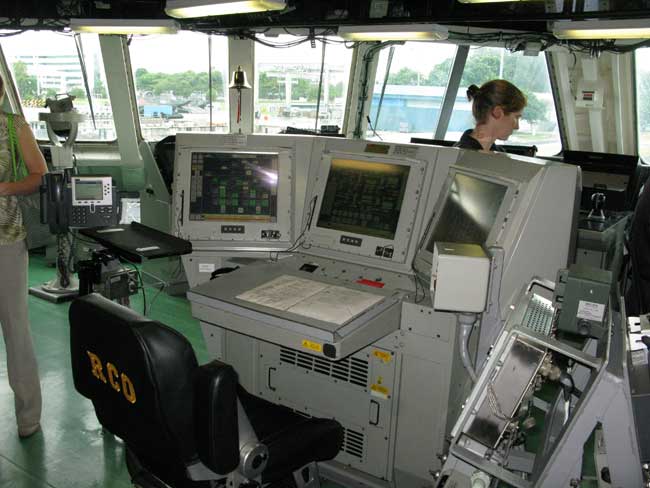
    An inside view of the bridge of USS Freedom. Photo: Tamir Eshel, Defense Update
    An inside view of the bridge of USS Freedom.
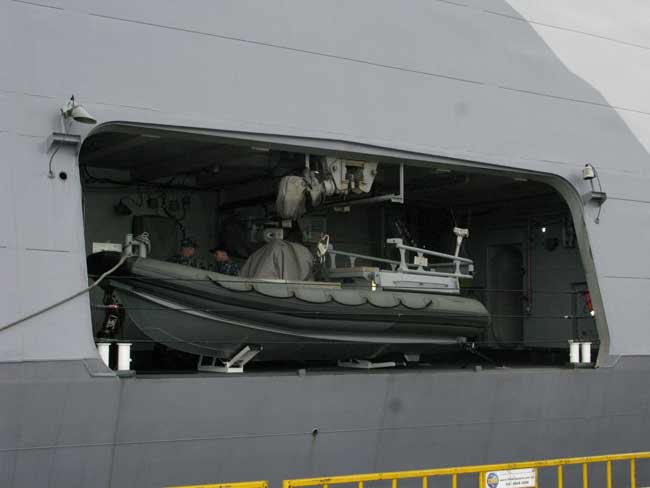
    RIBS stored at one of the side launching bays of the Freedom. Photo: Tamir Eshel, Defense Update
    RHIBS stored at one of the side launching bays of the Freedom.
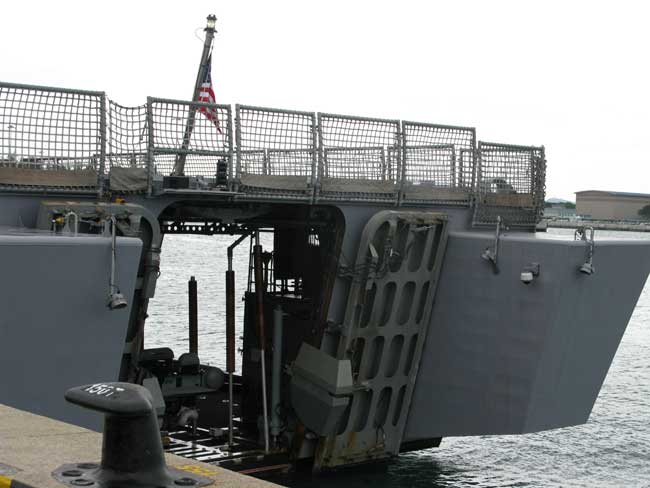
    The rear ramp of the LCS-1 Freedom shows two open ramps, to the rear and starboard.
    The rear ramp of the LCS-1 Freedom shows two open ramps, to the rear and starboard, this configuration enables loading and offloading RHIBS on the move and is particularly effective for law enforcement and security operations as well as special missions.
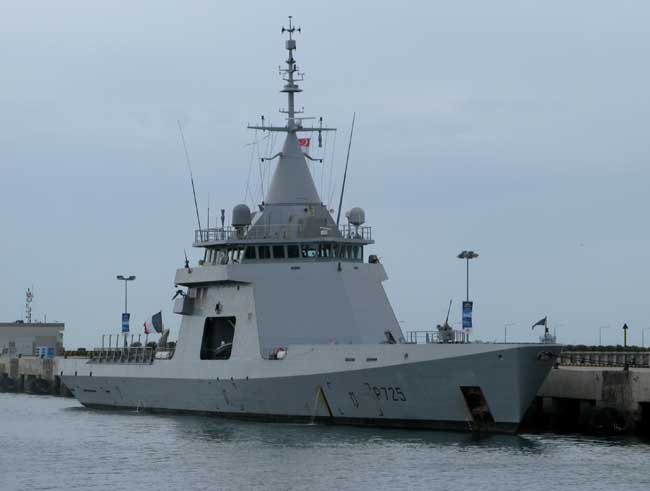
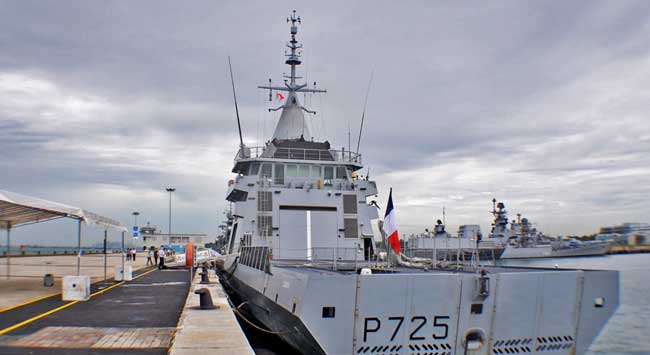
    The French L'adroit is the new class of Offshore Patrol Vessel designed and built by DCNS. The vessel was the first to employ the modern conical mast protection covering a structured mast that houses sensors including radar, electronic support measures and other electronic systems in a protected environment. Photo: Tamir Eshel, Defense-Update.
    The French L’adroit is the new class of Offshore Patrol Vessel designed and built by DCNS.
    Photo: Noam Eshel, Defense-Update
    L’Adroit was the first to employ the modern conical mast protection covering a structured mast that houses sensors including radar, electronic support measures and other electronic systems in a protected environment.
    The rear deck of L'adroit houses the helipad and two ramps for loading and offloading RIBS afloat. Photo: Noam Eshel, Defense Update
    The rear deck of L’adroit houses the helipad and two ramps for loading and offloading RHIBS afloat.
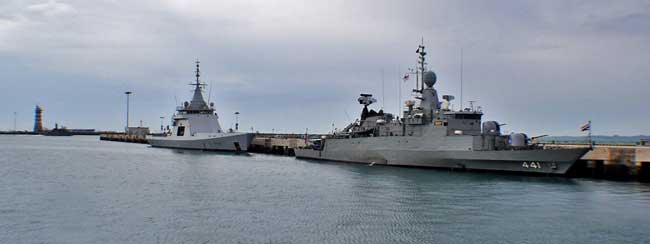
    The French OPV L'adroit berthed near the Thai frigate HTMS Rattanakosin
    The French OPV L’adroit berthed near the Thai frigate HTMS Rattanakosin.
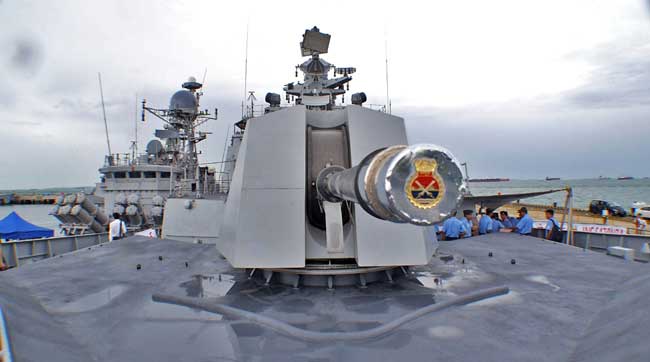
    The Otobreda 3 inch gun of INS Satpura. Photo: Noam Eshel, Defense-Update
    The Otobreda 3 inch gun of INS Satpura.
    Shivalik Class frigate INS Satpura berthed along the corvette INS Kirch at Changi
    Shivalik Class frigate INS Satpura berthed along the corvette INS Kirch at Changi.

    Skunk Works and XTEND Simplify Multi-Drone Command

    0
    Lockheed Martin Skunk Works® and XTEND have achieved a major milestone in JADC2 by integrating the XOS operating system with the MDCX™ autonomy platform. This technical breakthrough enables a single operator to simultaneously command multiple drone classes, eliminating the friction of mission handoffs. From "marsupial" drone deployments to operating in GPS-denied environments, explore how this collaboration is abbreviating the data-to-decision timeline and redefining autonomous mission execution.

    From Ukraine to Taiwan: The Global Race to Dominate the New Defense Tech Frontier

    0
    As traditional defense primes face mounting competition from agile “neoprimes” such as Anduril, Palantir and Helsing, the balance of innovation is shifting toward software-defined warfare and scalable, dual-use technologies, while global industry consolidation—marked by Boeing’s integration of Spirit AeroSystems and other strategic mergers—signals an intensified race to secure control over the defense technology value chain. Our Defense-Tech weekly report highlights these trends.

    Europe’s “Drone Wall”

    0
    In early October 2025, a coordinated wave of unmanned aerial system (UAS) incursions—widely attributed to Russia—targeted critical infrastructure across at least ten European nations. The unprecedented campaign exposed the fragility of Europe’s air defenses...

    Weekly Defense Update & Global Security Assessment

    0
    Executive Summary The past week (September 18-25, 2025) represents an inflection point where strategic defense concepts have transitioned from doctrine to tangible reality. An analysis of global events reveals four primary, interconnected trends shaping an...

    U.S. Air and Space Forces Push Next-Gen Programs at the AS&C 2025 Conference and...

    0
    At the 2025 Air, Space & Cyber Conference, U.S. Air Force and Space Force leaders unveiled major updates on next-generation fighters, bombers, unmanned systems, and space initiatives, highlighting both rapid innovation and critical readiness challenges as the services race to outpace global competitors. A short version is available here, with a more detailed version for subscribers.

    TADTE 2025: Reflecting Taiwan’s Strategic Themes

    0
    The Taipei Aerospace & Defense Technology Exhibition (TADTE) 2025 crystallized around four dominant strategic themes that collectively illustrate Taiwan's comprehensive approach to defense modernization amid escalating regional tensions. Based on a detailed report by Pleronix (available upon request). Includes a Podcast discussion on TADTE 2025's highlighting Taiwan's four strategic themes beyond the post's coverage.

    Iron Beam 450 Completes Testing, Soon to Join With Operational Air Defense Units

    0
    Israel’s Iron Beam 450 high-power laser system has completed final testing, marking a major leap in air defense. Developed by Rafael, it offers precise, cost-effective interception of rockets, UAVs, and mortars, and is set for IDF deployment by 2025.