Paris Le Bourget: A new pilot Helmet Mounted Systems (HMS) will be installed in the Israeli airforce (IAF) Eurocopter AS 565 SA (Atalef) helicopters operated on board Israel Navy missile corvettes, i-HLS reports.
Sources at the Paris airshow said that the selection process in underway. The Atalef is the last IAF helicopter to be equipped with such a system. The IAF’s CH-53’s and Blackhawks are already equipped with such helmets. The Eurocopter AS 565 SA are operated for the navy operational needs.
The HMS will make it easier to operate the helicopter conjunction with with the Heron-I unmanned air system (UAS) maritime version.
This operational requirement has evolved as the navy and airforce are tightening cooperation and planning on joint missions to protect offshore oil and gas facilities located off the Israeli coastline in the Mediterranean Sea.
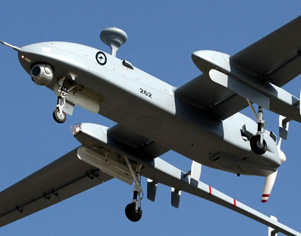
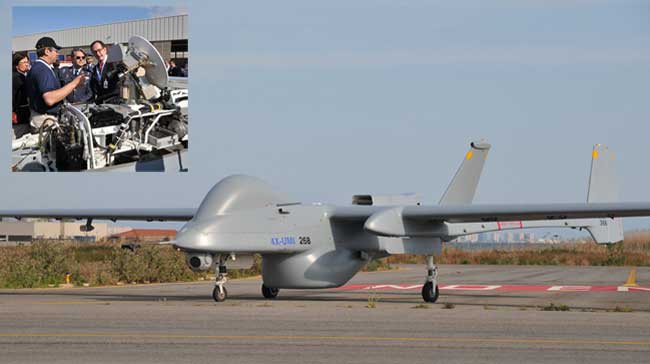
The Israeli airforce (IAF) is operating Heron-I (Soval) UAS with maritime patrol sensors, in support of the Israeli navy.
The maritime Heron is operated parallel to the Israel aerospace industries (IAI ) Westwind 1124 ‘Seascan’ maritime patrol jets, that have been operated since 1978. The maritime UAS are equipped with a similar payload carried now by the Seascan. This includes an Elta search radar with and a Tamam stabilized long range optical observation system. In addition, the drone can also carry Electronic Support Measures and radio-electronic emitter locators capable of detecting, localising and monitoring radio transmissions. The Heron-1 has an endurance of over 40 hours at an altitude of 30,000 feet. It can carry multiple payloads with a total weight of 250kg.
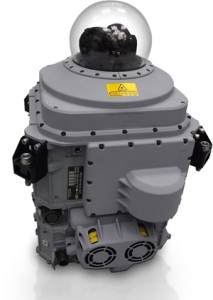
The new Mini-MUSIC is the newest member of the DIRCM family. Photo: Elbit Systems
Elbit Systems is presenting the newest member of the MUSIC Directional Infrared Countermeasure (DIRCM) systems at the 2013 Paris Airshow. Defense-Update reports.
The new, compact system dubbed ‘mini-MUSIC’ is designed to protect small rotary and fixed-wing aircraft against heat seeking Ground to Air Missiles (MANPADS) threats. In 2012 the company has demonstrated the C-MUSIC pod system in flight, mounted on a Boeing 707 flying testbed. More recently the system was installed on a Boeing 737 passenger jet to be used for type certification. The system has been selected for the Israeli national program for protection of Israel’s commercial fleet, installing MUSIC DIRCMs on Boeing B737, B747, B757, B767, B777 and Airbus A320 platforms. While all relevant aircraft will be fitted with the A-kit attachments, MUSIC DIRCM systems will be provided to those aircraft flying to high threat destinations or such locations reported to be high-risk, based on short-term assessments.
The proliferation of shoulder-fired anti-aircraft missiles, particularly with terrorist groups operation in Asia, Africa and Latin America has increased the demand for DIRCM, protection helicopters, medium and large transport planes, as well as VIP aircraft and heads of state transportation aircraft (VVIP). Several manufacturers are currently developing similar systems, including Northrop Grumman, Selex ES, BAE Systems and Raytheon – all developing lightweight DIRCM systems under the CIRCM . The Israeli system is considered the most mature of these systems.
Elbit System’s DIRCM systems are providing optimal solutions for the ever-growing MANPADS threat. Mini-MUSIC is a derivative of the flight-tested MUSIC, packed in a single compact and lightweight package. The MUSIC family now includes four systems providing protection for all different aircraft types: MUSIC designed for protection of medium to large rotary and fixed-wing aircraft; C-MUSIC – the world’s first DIRCM system in production for commercial jet aircraft; J-MUSIC – for distributed installation for aircraft such as military transport, air refueling tankers, business jets, etc. and mini-MUSIC – for small and medium sized platforms.
The system comprises a fiber-laser based DIRCM housed in a sealed turret for maximized reliability. A missile warning system provides the initial detection of incoming threats. When a threatening missile is detected, the warning is passed to the DIRCM that then directs a thermal tracker to acquire and track the threat. A powerful laser beam is then fired accurately at the missile causing it to be deflected away from the aircraft.
Elbit Systems is under contract to provide MUSIC based DIRCMs for several customers, including the Italian Air Force for C130J, C27J and CSAR AW101 (together with our Italian partners at ELT), the KC-390 for EMBRAER and the Brazilian Air Force, VIP helicopters.
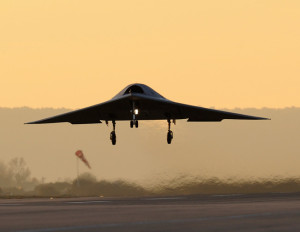
nEUROn undergoing radar cross section (RCS) testing at the DGA lab. Photo: Dassault
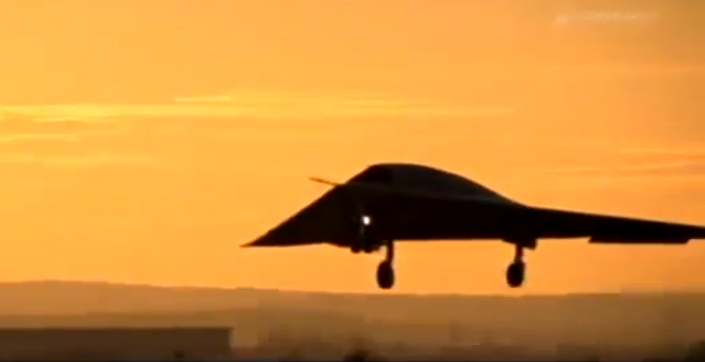
After the failure of the Telemos collaborative program, France and the UK are embarking on another cooperation, targeting unmanned combat aircraft systems based on nEUROn (in photo) and Taranis. Photo: Dassault.
Dassault Aviation and BAE Systems are working on a collaborative study of a future Joint Unmanned Combat Air System (UCAS) project, to agree on the definition of a joint demonstrator that could fly by the end of this decade. Under the joint program the two countries will share information of current UCAS technology demonstration programs run separately by both nations – Taranis in the UK and nEUROn in France. The nEUROn recently went through a comprehensive radar signature evaluation, to verify its stealth characteristics. The unmanned stealth aircraft made its maiden flight in 2012 and will perform more flight tests in Italy and Sweden later in 2013. Taranis is expected to enter flight tests this summer in Australia.
The risk reduction study has been running since the summer of 2012 under a $62 million Future Combat Air System (FCAS) effort announced by the two countries two years ago. The FCAS program could be launched in 2014 and will be followed by technology development programs in late 2015. The UCAS is one of the top priorities in the long-term unmanned systems roadmaps of both counties, which also calls for the fielding of some 30 tactical drones and 9 Medium Altitude Long-Endurance (MALE) drones for France, and a similar number of Reapers and Watchkeeper drones for the UK.
nEUROn UCAV, sheltered from the pouring rain in its styled protective bubble at the 50th Paris Air Show. Photo: Dassault
Navigating Israel Aerospace Industries (IAI) through difficult and challenging time, President and CEO Joseph Weiss has set ambitious goal for the company’s future growth. With slow US market and declining European demand, IAI is setting its aim on emerging markets, a move that could have been easier if the government owned IAI could be managed in a more flexibly and efficiently.
Facing a deep budget deficit, Israel’s ministry of finance is keen to proceed with the privatization of the defense companies currently owned by the government, a trend that provides positive headwind for IAI’s calls for such move. Finance minister Yair Lapid has recently set a goal to privatize up to 20 percent of IAI and Rafael, an act that would improve the company’s flexibility, and competitiveness domestically and overseas.
Being a government owned company was not an impediment for IAI’s success. Maintaining continuous growth trend over the recent years, IAI reporting net sales of more than 3.3 billion in 2012. “Our backlog of US$ 9.8 billion and increased book-to-bill ratio constitute a strong foundation of activity and growth for IAI in the coming years.” Joseph Weiss.
Over the past decade IAI has established a strong presence in India, and in recent years its sales to Russia have increased significantly. It has now set aim at Brazil, as the next growth market. “We view Brazil as one of our key markets, we are actively pursuing cooperation with local industries in Brazil and we will continue to invest in Brazil in other segments.” Weiss said.
Among IAI’s recent wins IAI in Brazil was a large-scale air-refueling project, delivering several Boeing 767-300 aircraft to the Brazilian Air Force. In April Brazil’s electronics giant IACIT has entered a partnership with ELTA’s subsidiary LARDOSA, targeting defense and public security projects in Brazil. In the near term the partnership is set to bid on large-scale defense programs the Brazilian government is planning to float.
One of the main thrusts emphasized at the Paris Air Show is company’s ‘total System’ approach to Intelligence, Surveillance and Reconnaissance (ISR) systems, particularly addressing the latest trend of ‘persistent surveillance’. IAI is providing a hint of what these future activities may include. “We are unveiling a new air/ground surveillance system packed in a special mission aircraft equipped with advanced phased-array surveillance radar and other electronic intelligence sensors, all fused to deliver a multi-dimensional, constantly updated situational picture.” Weiss told Defense-Update, “The information derived from such systems can be used for strategic, intelligence assessment, persistent surveillance and actionable response.”
Heron UAS are currently operated by several air forces in Asia Pacific, including Australia, India, Indonesia and Singapore and
The unmanned air systems (UAS) experts of Israel Aerospace Industries (IAI) are using the Paris air show to further evaluate the market for UAS powered by heavy fuel. I-HLS reports.
According to Shaul Shahar General Manager of IAI’s Malat UAS division the company plans to adapt its Heron UAS to fly with heavy fuel.
Shahar said that the planned test will be used to understand the full operational meaning of such a change. “Heavy fuel is an option because clients want to achieve commonality in fuel for their land and air platforms. Heavy fuel is also more secure than regular fuel used today”
The use of heavy fuel has been evaluated for some time, first for smaller UAS like the company’s Searcher but it did not result in any operational decision. The planned test with the company’s Heron UAS may determine the future of the adaptation on series production UAS or as an upgrade.
The heavy fuel for UAS has been an option for some time but there was no serious effort to implement is on a wide scale.
Landing support team Marines with Combat Logistics Battalion 5 rush toward a hovering Kaman K1200, "K-MAX," unmanned helicopter in Helmand province, Afghanistan, May 22. Marine Unmanned Aerial Vehicle Squadron 2 made history with the CLB-5 Marines by performing the first ever unmanned, mid-flight cargo hookups, also known as "hot hookups." Photo: USMC Cpl. Lisa Tourtelot
One of two K-MAX unmanned helicopters supplying the U.S. Marine Corps in Afghanistan has crashed June 5th at Camp Leatherneck near Kandahar. The helicopter crashed at a landing zone when it was operating an autonomous resupply mission, as it was delivering supplies at the remote site. The official announcement said that at no time soldiers’ lives were at danger by the drone. Defense-Update reports.
The two helicopters were operating in Afghanistan since November 2011, hauling over 6,000 tons of supply and equipment supporting Marine outposts in the area, avoiding the risks of IED and RPG attacks on the long desert roads. The official announcement did not mention the cause of the accident. The K-MAX can operate by user command (remotely controlled) or autonomously, relying on on-board autopilot, mission computer and on-board navigation system.
Modern asymmetric warfare has exposed war machines to new kinds of hazards and countermeasures, among them rudimentary, and highly sophisticated electronic countermeasures, assembled by subject experts using hardware acquired by foreign sponsors seeking to test and evaluate the effectiveness of their equipment against western military hardware. Drones, particularly those relying on autonomous GPS navigation based systems are becoming primary target for electronic attack, as manifested by the Iranian downing of the U.S. top secret RQ-170 Sentinel and several Scan-Eagle drones. Some reports attributed the attack to a combination of electronic warfare and cyberwarfare, after security at the U.S. based command and control center was compromised by a keylogger bot planted in computers operating at the base that operated the drones. Iranians EW units also managed to hack the drone, using deceptive signals that brought it to descend and land at the wrong destination. In another incident in South Korea, North Korean GPS jamming caused a Schiebel S-100 Camcopter to crash, killing one of the company technicians. It is therefore possible that the crash of the K-MAX in Afghanistan could be attributed to hostile actions, particularly when flying autonomously.
The vulnerability of drones’ analog datalinks is well known and documented secret, that has caused the loss of lives of many service members in different armies. It is essential to secure the command links and navigation systems against hacking and deception. otherwise, weaponized drone could be turned by insurgents against the armies that operate them.
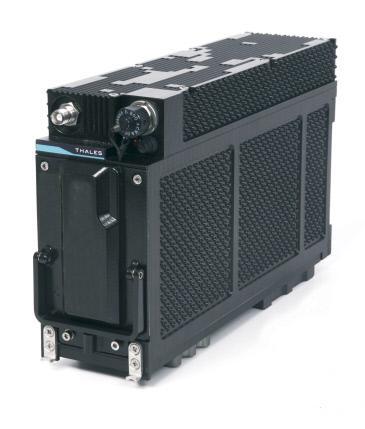
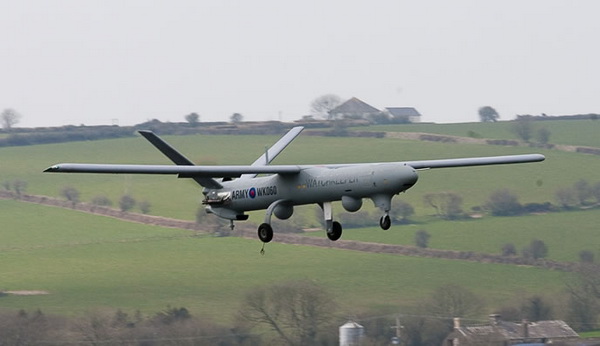
Thales is due to complete a study that will assess the possibility of integrating its Thales Modem for Air (TMA) 6000 wideband airborne Ku-band datalink terminal on the WK450 Watchkeeper UAV – Digital Battlespace reports. The company is under contract with the French MoD for the study, which is currently carrying out a flight test programme on the platform that has been designed for the British Army.
According to Bruno Kerjean, product line manager for high rate datalinks within Thales, France is assessing the British requirement under contract from Thales UK. The program is studying the replacement of the Cubic Tactical Common Datalink (TCDL) currently employed with Watchkeeper, with the wideband link started earlier this year and is expected to end this month. TMA offers high transmission rate of sensor data, required for delivery of live, high-definition video and multi-sensor support.
U-Tacs, the JV between Thales and Elbit responsible for the aircraft development and production is also part of the study. The UK MoD is also looking at the TMA 6000 for potential integration on future versions of the aircraft, which has yet to enter service, including the the Reaper and Heron UAVs – in service with UK and French Air Forces.
Enhancements to the system include support for a new waveform optimized for special forces, offering improved countermeasures and resistance to interference, by better cancelling echo multipass. The TMA will also carry an improved broadband SATCOM waveform, also developed by Thales, enabling the TMA to transfer data over satellite data terminal when available on the platform.
In 2012 thesystem received the STANAG 7085 certification by the Joint Interoperability Test Command (JITC), making the TMA 6000 the first European terminal of its kind to obtain certification in the United States. With this certification the TMA 6000 has officially demonstrated its capacity to transmit all types of data (navigation, video, images) to the US-made manpack terminals (ROVER) in service with NATO ground forces.
The IAI Heron 1 UAV was employed on a maritime surveillance test test recently, where the drone was flown in non segregated airspace using satellite communications control. Photos: Spanis MOD
The U.S. Positions Patriot Missiles, F-16 Fighter at Bases Jets in Jordan
U.S. Defense Secretary Chuck Hagel has approved a request from the Kingdom of Jordan to keep a detachment of F-16s and Patriot Missiles in Jordan following the conclusion of Exercise ‘Eager Lion’ taking place in the Kingdom this month. Eager Lion is held annually training a coalition of air forces in irregular warfare. This year the exercise more than 8,000 service members from about 19 countries participated in the exercise, running from June 9 to 20. “All other U.S. personnel assigned to Jordan for Eager Lion will depart at the conclusion of the exercise. The United States enjoys a longstanding partnership with Jordan and is committed to its defense,” George Little, Pentagon spokesperson noted.
The decision to position Patriot batteries in Jordan, south of the Syrian border, has been particularly controversial for Russia, Syria’s main ally. Russia is worried the missiles could be used by the United States and its allies to impose a “no-fly” zone over Syria, a first direct Western military intervention in the conflict. The missiles could be used to protect Jordan from a retaliatory missile attack from Syria, would the U.S. decide to assist Rebels from Jordan, or protect Syrian rebel strongholds in the region of Dara’a, in southern Syria.
Russian Foreign Minister Sergei Lavrov said on Saturday any attempt to enforce a no-fly zone over Syria using F-16s and Patriot missiles from Jordan would violate international law. Jordan and Syria’s other neighbors are increasingly nervous the Syrian civil war will spill over its borders.
In April the U.S. Army dispatched about 200 personnel Jordan, to bolster border security, particularly aimed to mitigate spillover of violence and Syrian chemical weapons accross the Jordanian border. Last week the Jordanians warned the Syrian ambassador after he threatened that Syrian missiles could be used against the U.S. Patriot missile batteries positioned in the kingdom. Similar missile systems were positioned several months ago by NATO, protecting the Turkish southern border against Syrian missile attacks.
Meanwhile, following the U.S. administration’s decision to support the rebels, weapons are being the other way around – transferred into Syria. Jordan, with its stable regime and unquestioned loyalty would offer a more likely route of supply, over the Iraqi option, which is already supporting the extremist rebel factions In Syria as well as the Syrian military itself. The U.S. supplied weapons are likely to include rocket-propelled grenades and mortars, weapons the rebels have been using for months, seized from Syrian military stocks.
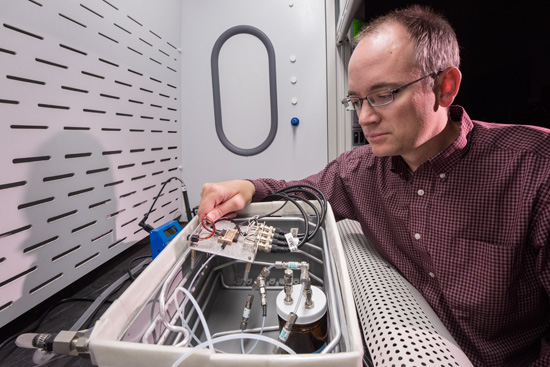
Sandia National Laboratories researcher Chris Brotherton checks tiny sensors in a test fixture, where he exposes them to different environments and measures their response to see how they perform. Brotherton is principal investigator on a project aimed at detecting a common type of homemade explosive made with hydrogen peroxide. (Photo by Randy Montoya)
ALBUQUERQUE, N.M.: Scientists at the Sandia National Laboratories are working on explosive detection methods that would reliably detect homemade explosives, but will not be triggered by the ordinary materials like hydrogen peroxide used in these compounds. Hydrogen peroxide is found in everyday products ranging from soap, toothpaste and hair color to laundry bleach, carpet cleaners and stain removers. Defense-Update reports.
“Hydrogen peroxide explosives are a challenge because they are dangerous, but there are so many personal hygiene products that have hydrogen peroxide in them that the false positive rate is very high,” Chris Brotherton, principal investigator for a Sandia research project on chemiresponsive sensors explained. His work is built on field-structured chemiresistor technology developed at Sandia more than a decade ago by researchers James Martin and Doug Read. Chemiresistors are resistance-based sensors for volatile organic compounds. These materials allow users to tailor the sensors’ response range and sensitivity.
The research team at the lab is investigating methods to develop a portable sensor, able to detect a common homemade explosive called a FOx (fuel/oxidizer) mixture, made by mixing hydrogen peroxide with fuels. The detector must be able to spot hydrogen peroxide in concentrations that don’t also raise suspicions about common peroxide-containing products.
Brotherton’s Early Career Laboratory Directed Research and Development (LDRD) project proved a sensor could identify relatively high concentrations of hydrogen peroxide and differentiate that from a common interfering substance such as water, he said. The next step, Brotherton said, would be to work with an industrial partner to design an overall system that works faster and can be mass produced.
A major challenge was distinguishing between hydrogen peroxide and water, which exhibit similar behavior in chemiresistors. The key was choosing certain molecules in a polymer matrix, suggested by Brotherton’s Sandia technical mentor, polymer chemistry expert David Wheeler. When exposed to peroxide, those molecules react in a different way than when exposed to water.
The idea is to engineer the polymer to be as similar to the target material as possible, relying on the undergraduate rule that like dissolves like. For example, Wheeler said, if the target is a substance that’s not very polar, you’d choose a polymer with nonpolar groups. If the target has a lot of polarity, like water does, you’d develop polymers that could hydrogen-bond with water.
The tiny sensor incorporates the polymer and chains of miniscule conductive metal beads. The polymer reacts when it’s exposed to the substance being analyzed. “We tried to include specific molecules that would react with the peroxides,” Brotherton said.
Exposure to water also changes the polymer, but it returns to its previous state once the water is removed. Exposing the polymer to concentrated hydrogen peroxide, however, is irreversible. “So once you’ve done this to the polymer you’ve permanently changed it,” Brotherton said. “Instead of being a reusable sensor, it’s more of a disposable dosimeter.” According to Brotherto the proposed detector doesn’t react to toothpaste and other common peroxide products, thus making it more efficient for passenger inspection in airport security applications.
The sensor isn’t a silver bullet, but Brotherton said the technology has shown good results. “It has some challenges that have to be overcome, but we think it’s worth pursuing to the next level,” he said. For instance, the chemical reaction time must be reduced, so the sensor can be useful at a checkpoint. The detector also must be incorporated into a larger unit that includes equipment to gather a sample for analysis. “This technology would be easier to integrate into other detection technologies without impacting them too significantly,” he said. Such detectors, already available on the market today are about the size of a small, handheld vacuum cleaner. The support equipment would suck up a sample of air and the detector would test it.
“You’d need to know where the fumes were coming from,” Brotherton said. “It’s not enough to open up the whole room and suck in all the air and say, ‘There are peroxides somewhere in here, watch out.’ What we’d like to do is go up and down luggage, or be next to some sort of industrial process so we know this is most likely the source and it’s above a level we care about.”
Although a detector package could target a single type of vapor, a manufacturer could add it to a unit that detects several substances. That way, a checkpoint could have one sensing system rather than separate units for every material of concern, Brotherton suggested.
Source: Sandia National Laboratories/ Defense-Update.
A Dassault Aviation production reviewing the long and complex development program of the nEUROn unmanned combat aerial vehicle (UCAV) developed by a pan-European team headed by the French Dassault. The video is brought to you as part of the Paris Airshow coverage, courtesy of Defense-Update VideoReport.
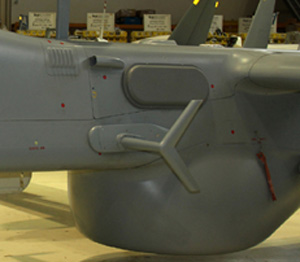
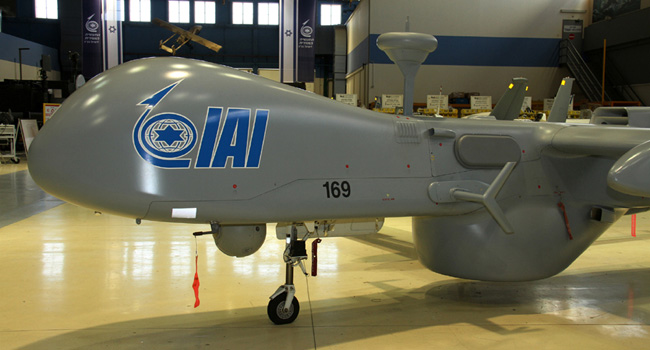
A compact three dimensional (3D) high frequency (HF) radio direction finder technology developed by a team of communication intelligence (COMINT) experts at Israel Aerospace Industries’ (IAI) Elta Systems group enables law enforcement and military users to effectively intercept, locate and tap HF radio transmissions hitherto performed only by stationary monitoring stations that are typically operated by national intelligence agencies. The company is demonstrating the arrow-shaped antennae (designated EL/K-7065) on the Heron I Unmanned Aerial System (UAS) on display at the Paris Air Show this week. Defense-Update reports.
HFDF systems typically locate targets at two dimensions (geographical location) using huge antennae farms, yet, these methods relying on sky waves, lack providing target elevation data. At a weight of merely 3 kilograms and the size of 30×50 cm (11.8 by 19.6”), the arrow-shaped 3DHFDF uses multiple antennae picking the same HF signals both in sky waves and direct propagation, performing ‘vector processing’ to fix an emitter location within 160 millisecond.
According to the system’s developer, the 35 cm long conformal configuration of the system system can be also be used on ship-born and ground platform applications. The system that was developed in the past 10 months have already gone through initial tests. With the prototype surpassing expectations the team plans to conduct more tests in the coming months. Discussed with only few potential customers, the system has attracted much interest. The same concept has also been applied to conformal antennas, that can be installed on marine vessels and ground vehicles, enabling low radar cross section (RCS) and minimize body obstruction.
ELTA’s unique capabilities, demonstrated by the ELK- 7065 3D HF COMINT system, allow for better classification and distinction of incoming signals. The maritime and ground vehicle antennas are merely 35 centimetres (13.7 In) long.
Its advanced technology requires comparatively very small antennas for aerial purposes or small pick-up antennas for shipborne and ground platforms in order to provide an HF COMINT and geolocation capability which up to now, was provided only by antenna arrays measuring tens of meters.
As a COMINT system, EL/K-7065 tags and labels signal identifiers such as power, frequency, modulation, geo-location and polarization, in order to provide quick labelling and identification of the received signals, creating a reliable Electronic Order of Battle (EOB) picture. In addition, the system can also monitor selected conversations, providing valuable intelligence.
Parallel to the growth in satellite communications, and the law enforcement agencies are witnessing a growth in use of HF communications, for its advantage in long-range, Beyond Line of Sight communications without relying on expensive satellite links. It is also becoming popular communications with illegal elements, realizing the lack of law enforcement agencies to employ tactical COMINT to detect and locate such transmissions – an activity easily performed with SIGINT based on satellite communications. HF communications has the advantage of using sky wave propagation to link over great distances, or propagate well within urban or forested terrain, enabling close-range communications utilizing ground waves. The main limitation of HF communications, being the quality of service, has been improved in recent years, with the advent of related technologies such as Automatic Link Establishment (ALE).
Source: Defense-Update
Elta Systems’ EL/K-7065 3D HF Direction Finder (3DHFDF) mounted on the IAI Heron I drone. Photo: IAI
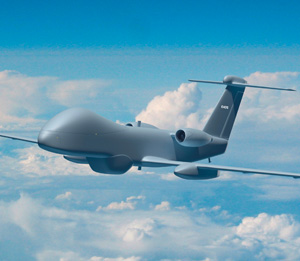
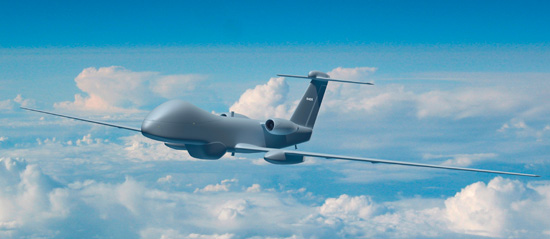
Cassidian is its latest design study for a possible Future European MALE UAS at Paris Airshow 2013
Paris, Le Bourget: European aerospace industries and defense establishments are promoting pan-European collaboration in launching a collaborative development of Medium Altitude, Long Endurance (MALE) drone capability that will rely on the collective knowhow, skills and technologies of member countries. EADS Cassidian, Dassault Aviation and Finmeccanica Alenia Aermacchi declare their readiness to coordinate on such a program supporting the security needs of European governments and armed forces. Defense-Update reports from the Paris Airshow.
Similar collaborative programs pursued in the past included the Tornado strike fighter, Typhoon 4th Generation fighter plane, the Aster anti-aircraft/anti-missile weapon system, and FREMM class frigates, developed under French-Italian collaboration. Other programs undertaken more recently included U.S. participation, such as the AGS and MEADS encountered significant obstacles in cost sharing and access to state of the art technology. Similar problems were also encountered with the enhancement of General Atomics MQ-9 Reaper drones, whose weaponization were refused by the US administration. Another European cooperative program in the field of UAS, known as nEUROn, lead by Dassault, is aimed to conceive, produce, and test the first European Unmanned Combat Aircraft System (UCAS) demonstrator with stealth characteristics.
The Israeli Heron TP alternative has not officially cleared to carry weapons, according the the Israeli policy of not admitting Israeli drones are used or capable of carrying weapons, although, according to foreign sources, such capabilities have been available for decades. Germany, France and Spain have developed cooperative channels with Israel Aerospace Industries (IAI) in the past, pursuing the use of Heron TP as a future MALE platform.
As for an independent European advanced MALE capability, such a joint program would support the capability needs of European armed forces while optimizing the difficult budgetary situation through pooling of research and development funding.
With a new development, critical requirements around the certification of drones, allowing their safe passage and operation in European air space, would inherently be built into the program from the onset. European sovereignty and independence in the management of information and intelligence would be guaranteed while at the same time delivering a robust system resilient against cyber attacks. The program would be orientated to foster the development of high technologies and contribute to sustaining key competencies and jobs within Europe.
Cassidian has tried to develop a MALE Drone in the past, known as the Talarion, but this program was shelved in 2012. The Italian Finmeccanica group has several UAS programs but currently do not have a platform in the scale required for a future European Advanced MALE.
Dassault has already collaborated with IAI and BAE Systems on two other programs – the Heron TP with IAI and Telemos, an exclusive research and development program struck with BAE Systems, anticipating a future MALE program for the British Royal Air Force. However, due to lack of government support for the program, the Telemos cooperation has now been shelved in favour of collaboraive work on UCAS. It is not clear yet how this exclusivity will effect Dassault joining a European Advanced MALE program.
Alenia Aermacchi’s Unmanned Aerial Systems (UAS) main activities are focused on the development of technological demonstrators such as Sky-X, Sky-Y, and Neuron, that are aimed at the definition and production of advanced MALE products (Medium Altitude Long Endurance) and UCAS Unmanned Combat Aerial System).
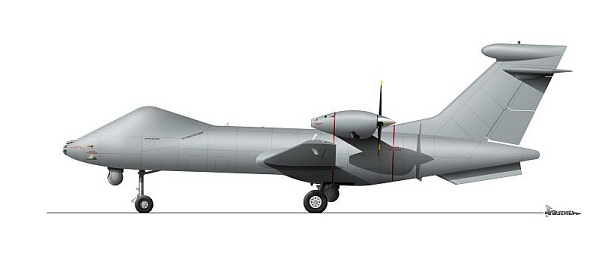
Dassault is already collaborating with BAE Systems on the development of the TELEMOS MALE drone, fulfilling the future British requirement for MALE capability. Photo: Dassault.
This is the full report of Defense-Update VideoReport, covering the recent IMDEX Asia maritime exhibition. Stay tuned for additional reports from the Paris Airshow this week!
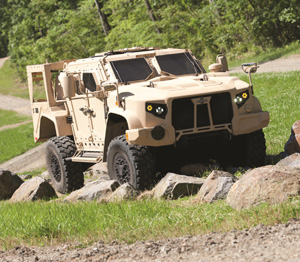
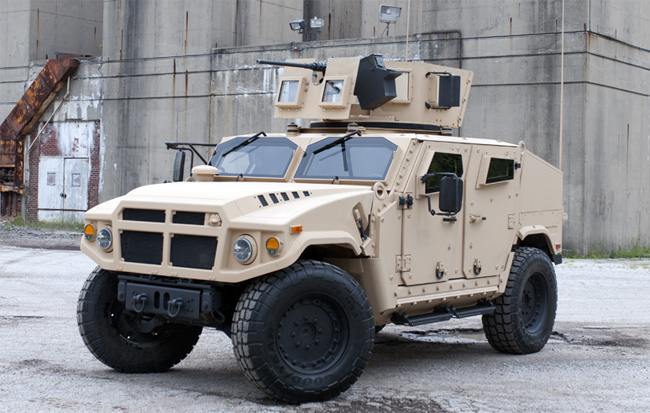
Oshkosh is submitting the Light Armored Tactical Vehicle (LATV) design for its proposed version of the JLTV. The LATV is seen here racing through the SORT obstacle course at Quantico, June 2013. Photo: Oshkosh.
Lockheed Martin, AM General and Oshkosh Defense are producing and preparing their Joint Light Tactical Vehicle (JLTV) prototypes for the final test, scheduled to begin in August 2013. three competitors will enter the race with 66 vehicles, only one will cross the finish line to win the coveted production order for the US Army and Marine Corps. According to the Army, the goal at the end of the Engineering, Manufacturing and Development (EMD) Phase is for the Army and Marines to down-select to a single vendor and move into Low Rate Initial Production (LRIP) by 2015. Current plans then call for three years of Low Rate Initial Production (LRIP), followed by five years of full rate production resulting in incremental delivery of the JLTV. At present the Army plans to buy about 20,000 vehicles while the Marine Corps will suffice in 850, potentially deferring their first buy to 2020.
Oshkosh Defense has already completed the production of 22 vehicles for the government tests. The company has recently demonstrated the Light Combat Tactical All-Terrain Vehicle (LATV) it is proposing for the JLTV at the military’s severe off-road track (SORT). According to Oshkosh, the LATV went through the tough obstacle course without fail. The SORT located at the 395-acre Transportation Demonstration Support Area (TDSA) at Quantico gives the military and industry partners an opportunity to get a quick, informal assessment of real-world, off-road performance. The course includes several obstacles designed to demonstrate vehicle capabilities on the rugged terrain, including hills with steep inclines, a staggered rock climb, log crawl.
22 JLTV prototypes designed by Lockheed martin are currently in assembly for the final testing of the JLTV program. Photo: Lockheed Martin
The JLTV demonstration was one of the recent events taking place at the Quantico SORT recently. “TDSA is a perfect venue to host the JLTV capability demonstration, due to its proximity to the Pentagon and the nation’s capital,” said Dave Branham, congressional and public affairs officer for Program Executive Office Land Systems. “The site affords the opportunity for both senior Defense Department leadership and congressional members and staff to engage with the competing JLTV prime vendors and view their static displays, and ride in the prototype vehicles to experience some of the capabilities JLTV will provide to the joint warfighter.”
AM General Vice President, Business Development and Program Management, Chris Vanslager said that during the two week JPO event his team successfully demonstrated its game changing improvements in vehicle survivability, affordability, sustainability, transportability, versatility, agility and safety.
Oshkosh said it has completed the manufacturing of 22 prototypes under the JLTV EMD phase. The company announced the vehicles were built on an active manufacturing line by a highly-skilled Oshkosh workforce using Lean processes and a proven quality management system. “It was amazing to see the first JLTV prototype make its way down a warm assembly line, start right up and drive off the line – as if we’ve been making them for years,” said John Bryant, senior vice president of Defense Programs for Oshkosh Defense. “Our truck’s performance at the JLTV demonstration reflects a deep commitment to our troops and a true understanding of the critical role this vehicle will play in protecting them.” These prototypes will be delivered to the government in August 2013. The 22 prototypes include both the 4-door multi-purpose variant and the 2-door utility variant.“Experience has taught us that the very nature of warfare has changed – and the JLTV program is addressing the fact that our troops need a light, protected vehicle that can perform on any number of future battlefields with unpredictable conditions and threats,”
AM General has also been producing its Blast Resistant Vehicle – Off road (BRV-O) JLTV prototypes on an active production line, the company has aligned its Light Tactical Vehicle Assembly Line to produce the BRV-O. The first prototype have already been completed in early June for the Joint Light Tactical Vehicle (JLTV) government testing. As the BRV-O JLTVs leave the LTVAL at the Military Assembly Plant, they will receive additional “mission packages” some provided by AM General and others as Government Furnished Equipment (GFE), to convert each base vehicle into a specific mission package configuration such as the Heavy Guns Carrier. Then each vehicle undergoes AM General break-in and shake-down testing before delivery to the military.
The assembly line at AM General’s Military Assembly Plant is dedicated to light tactical vehicles and is capable of producing different vehicles, models, configurations and paint schemes at the same time. The company often has done so in manufacturing HMMWVs for U.S. and foreign military customers while earning a record of delivering reliable and versatile vehicles on time and on budget. As one of the three competitors, AM General is building 22 BRV-Os for delivery in August and subsequent government testing in the EMD phase.”A measure of the high quality level of the BRV-O engineering and manufacturing was recently displayed when the weight of the first eight BRV-O vehicles validated the design weight.” AM General Vice President of Business Development and Program Management Chris Vanslager said, “Light tactical vehicles are in our DNA, and it shows in the focus, excitement and pride all along the assembly line.”
The vehicles currently being produced will include a 4-seat variant Combat Tactical Vehicle that supports three different mission package configurations and a 2-seat variant Combat Support Vehicle that supports a utility mission package configuration for different mission roles across the full spectrum of military operations.
The third company selected to develop prototypes for the EMD phase is Lockheed Martin. In December 2012 the company’s designs have passed the government successfully completed a top-to-bottom government design understanding review, in preparation for the production of 22 prototypes currently underway. Through this three-day review the government assessed all the elements the manufacturer planned to use through the production, confirming the overall maturity and requirements compliance. In refining its EMD design, the Lockheed Martin team optimized a JLTV model already proven in government testing. The production-enhanced JLTV maintains the proven force protection, transportability and reliability of the earlier Technology Demonstration model, while significantly reducing weight and cost. “Our JLTV is affordable both to buy and to operate.” Scott Greene, vice president of Ground Vehicles for Lockheed Martin Missiles and Fire Control said, “It provides proven performance with room to upgrade capabilities as required and is ready for production.”
The JLTV EMD models developed by Lockheed Martin also participated in the event. “During the two-week event, we had the opportunity to receive direct feedback from the customer, which will help us refine our design to meet the specific needs of the Soldiers and Marines whose lives will depend on this vehicle.” a Lockheed martin spokesperson said, “The high levels of dependability that characterized our Technology Demonstration vehicles are now becoming apparent in our EMD vehicles. EMD break-in testing has revealed no significant reliability issues, and our vehicle ran without any maintenance required throughout the two weeks of hard use at Quantico.”
BRV-O is the design AM General is submitting to the US Government JLTV EMD program. Photo: AM General
Lockheed Martin Skunk Works® and XTEND have achieved a major milestone in JADC2 by integrating the XOS operating system with the MDCX™ autonomy platform. This technical breakthrough enables a single operator to simultaneously command multiple drone classes, eliminating the friction of mission handoffs. From "marsupial" drone deployments to operating in GPS-denied environments, explore how this collaboration is abbreviating the data-to-decision timeline and redefining autonomous mission execution.
As traditional defense primes face mounting competition from agile “neoprimes” such as Anduril, Palantir and Helsing, the balance of innovation is shifting toward software-defined warfare and scalable, dual-use technologies, while global industry consolidation—marked by Boeing’s integration of Spirit AeroSystems and other strategic mergers—signals an intensified race to secure control over the defense technology value chain. Our Defense-Tech weekly report highlights these trends.
In early October 2025, a coordinated wave of unmanned aerial system (UAS) incursions—widely attributed to Russia—targeted critical infrastructure across at least ten European nations. The unprecedented campaign exposed the fragility of Europe’s air defenses...
Executive Summary
The past week (September 18-25, 2025) represents an inflection point where strategic defense concepts have transitioned from doctrine to tangible reality. An analysis of global events reveals four primary, interconnected trends shaping an...
At the 2025 Air, Space & Cyber Conference, U.S. Air Force and Space Force leaders unveiled major updates on next-generation fighters, bombers, unmanned systems, and space initiatives, highlighting both rapid innovation and critical readiness challenges as the services race to outpace global competitors. A short version is available here, with a more detailed version for subscribers.
The Taipei Aerospace & Defense Technology Exhibition (TADTE) 2025 crystallized around four dominant strategic themes that collectively illustrate Taiwan's comprehensive approach to defense modernization amid escalating regional tensions. Based on a detailed report by Pleronix (available upon request). Includes a Podcast discussion on TADTE 2025's highlighting Taiwan's four strategic themes beyond the post's coverage.
Israel’s Iron Beam 450 high-power laser system has completed final testing, marking a major leap in air defense. Developed by Rafael, it offers precise, cost-effective interception of rockets, UAVs, and mortars, and is set for IDF deployment by 2025.