
Tuesday, December 30, 2025
More
    Home Blog Page 179

    BAE Systems Wins Contract to Upgrade South Korean KF-16 Fighters

    RoKAF F-16B landing at Kunsan AFB, South Korea. Photo: US Air Force
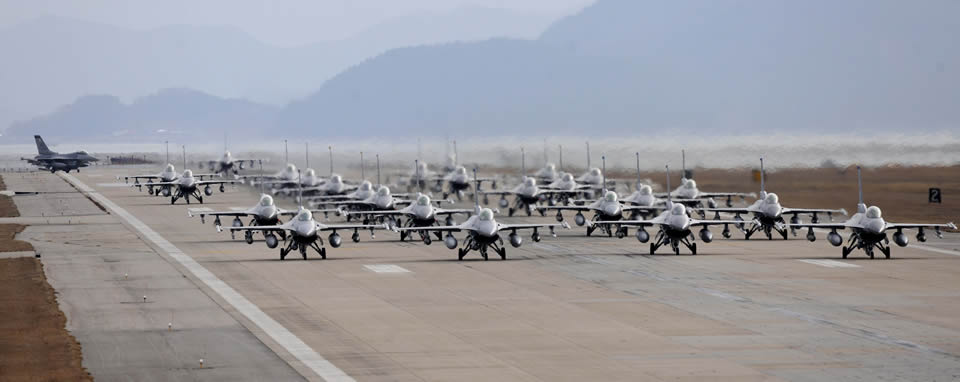
    RoKAF and USAF F-16s at Kunsan AFB, Korea perform an ‘Elephant Walk’ mobilization exercise. March 2012. Photo: USAF

    British defense firm BAE Systems Incorporated has been selected as the prime integrator to provide critical upgrades for South Korea’s KF-16 fighter jets. The multi-year contract is valued at an estimated $1.1 billion based on a bid submitted to South Korea’s Defense Acquisition and Procurement Agency (DAPA) by BAE’s United States’ branch office in December. The contract will be processed through the US government’s Foreign Military Sales (FMS) program.

    DAPA’s approach to contracting for the KF-16 upgrades is unorthodox. Prime integration bids were submitted to DAPA in December and now, with a bidder finally selected, DAPA will submit a formal Letter of Request (LoR) to the United States to request the US government negotiate a contract with BAE through the FMS program.

    In this way, DAPA expects to lock-in performance and service guarantees while keeping contract costs to an absolute minimum. A formal LoR will be delivered to the United States in August and DAPA anticipates finalizing the contract later this year.

    The director of BAE’s South Korean office, Joe McCabe, said that the most attractive feature of BAE’s bid was flexibility in the transfer of technology. He went on to say that BAE would request approval from the US government to allow the firm to share source codes for the aircraft’s flight and weapon’s control operational programming with South Korea. Code sharing will make it possible for the Republic of Korea Air Force (ROKAF) to integrate weapons of its own choosing into the aircraft’s weapon’s system at a later date without the need for outside assistance.

    The upgrade agreement covers the installation of new state-of-the-art mission computers and advanced operating systems in Korea’s 134 KF-16 fighters. The contract includes replacement of the existing APG-68v5/v7 radar systems, installation of advanced avionics, and upgrading the aircraft’s cables and databuses to MIL-STD-1760 standards. The upgrade package will also include an advanced Ethernet interface offering a high-speed communication interface required to operate Active Electronically Scanned Array (AESA) radar and other state-of-the-art displays and sensors.

    Under the provisions of this contract, BAE will supervise and manage the installation of advanced software and hardware that will also include a commercial fire control computer (CFCC), a Link-16 military tactical data exchange network, and a multifunction display component. The upgrade will also provide the equipment needed to allow the KF-16s to fire GPS-guided munitions, AIM 120C Advanced Medium-Range Air-to-Air Missiles (AMRAMM), and Wind Corrected Munitions Dispensers (WCMD).
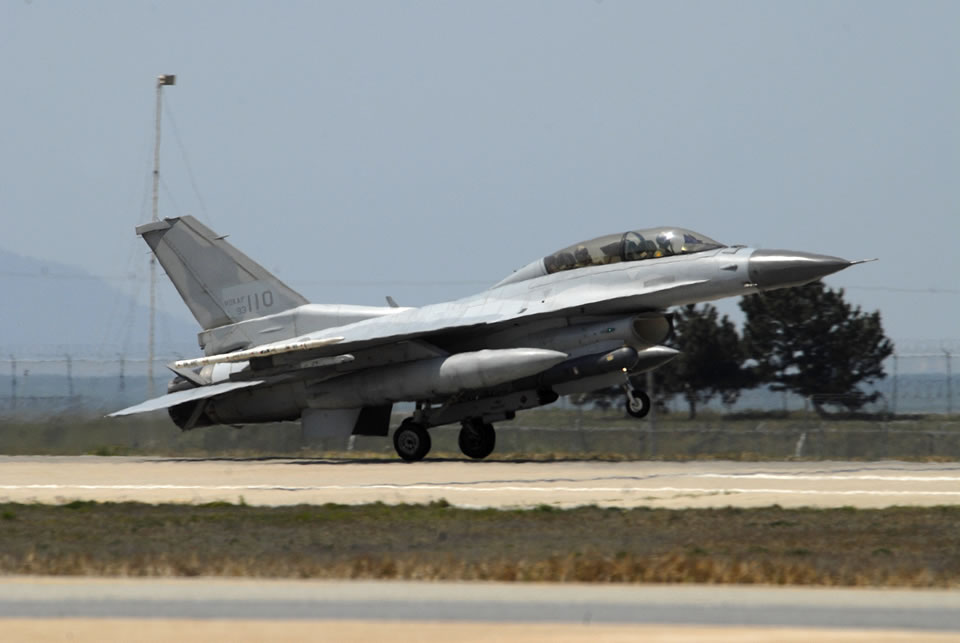
    RoKAF F-16B landing at Kunsan AFB, South Korea. Photo: US Air Force

    While BAE will not provide the AESA radar, the firm will exercise oversight to integrate the radar into the aircraft once DAPA announces selection of the radar provider. The main competitors for the AESA purchase are Northrop Grumman and Raytheon.

    The ROKAF has long favored an advanced US AESA radar. A South Korean Request for Proposal (RFP) issued in 2011 focused on US systems that included the full spectrum of air/ground radar modes and industrial offsets intended to assist Seoul gain experience in building AESA components. In the past, US policy prohibited the export of sensitive weapon’s technology, but a Defense Security Cooperation Agency (DSCA) September announcement approving an AESA upgrade for Taiwanese F-16s appeared to open the door for South Korea to gain access to AESA technology. It does appear that Seoul’s export request will also be approved with minimal delay.

    Northrop Grumman has developed a Scalable Agile Beam (SABR) system that can be delivered as a “drop-in” AESA replacement for existing F-16 radars and Raytheon’s Raytheon Advanced Combat Radar (RACR) is designed to work in a similar manner. DAPA is expected to announce a solicitation for bids to select an AESA supplier early next year.

    According to a ROKAF officer, when the KF-16 upgrades are completed, “the KF-16 will have a detection range at least two times longer than now and be able to detect and track multiple targets simultaneously,” and will give the aircraft the capability “to hit key facilities in the enemy zone at longer range.”

    The KF-16 is a Korean version of the Lockheed Martin F-16C/D Block 52 fighter built locally under license by Korea Aerospace Industries (KAI) between 1994 and 2004. The ROKAF currently operates a fleet of 134 KF-16s, a force that is a critical component of the South Korean combat air fleet.

    The ROKAF also operates 60 F-15K Slam Eagles built by Boeing and plans to acquire an additional 60 fifth-generation stealth fighters during its F-X Phase III competition. This competition pits Lockheed Martin’s F-35 Lightning II Joint Strike Fighter (JSF) against Boeing’s F-15 Silent Eagle and the Eurofighter Typhoon in pursuit of a contract valued at $7.3 billion.
    Lockheed Martin Submits Final Proposal For Air & Missile Defense Radar

    Lockheed Martin has submitted its final proposal to the U.S. Navy to design, build, integrate and test the new Air and Missile Defense Radar (AMDR) for the future DDG-51 Flight III class destroyer. The scalable AMDR S-band radar and radar suite controller will provide significantly increased sensitivity for simultaneous long-range detection and engagement of advanced anti-ship and ballistic missile threats.

    India’s Private Industry Demand More Volume to Enter HS748M Avro Replacement Program

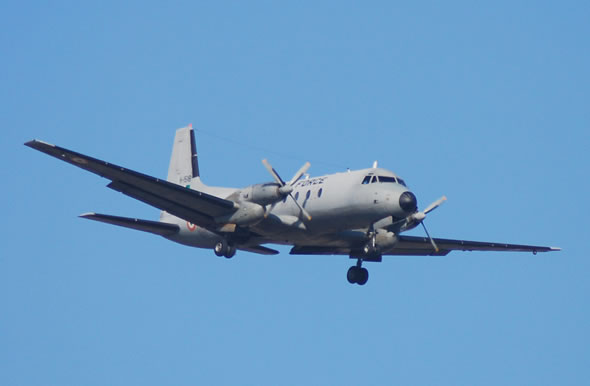
    The Indian Air Force plans to replace the aging HS748M Avro fleet as part of the Air Force transport fleet modernization. Photo: Debarka Banik
    The Indian Air Force plans to replace the aging HS748M Avro fleet as part of the Air Force transport fleet modernization. Photo: Debarka Banik

    In an effort to expand its domestic supplier base, India’s Ministry of Defense is planning to open the tender for medium transport aircraft beyond the government owned Hindustan Aeronautics Ltd (HAL). The Defense Acquisition Council (DAC) last week cleared US$2.6 billion (12,000 crore) for a global tender that will open to foreign vendors that can partner with a domestic private companies to manufacture 56 transport aircraft for the Indian Air Force, replacing the obsolete fleet of HS748M Avro planes. According to local defense sources the first 16 aircraft will be delivered four years after the contract award, to be manufactured abroad by the foreign vendor while they partner with a local private or public sector firm to transfer production to India. The next 16 aircraft will have to have 30 per cent indigenous component, while the remaining 24 planes will have 60 per cent locally-procured and produced items, DAC determined. While the contract opens new opportunities for the private sector, leading companies are not too enthusiast to come abroad, without a government commitment to quadruple their orders.

    HAL produced 89 HS748M Avro aircraft since 1964. Part of the fleet has already been replaced with Russian Antonov An-12 and An-32, which itself is due for replacement by the jointly developed Russia-Indian Medium Transport Aircraft (MTA). The Ilyushin IL-214 MTA is being developed under a collaborative $771 million program between United Aircraft Corporation (UAC) of Russia and HAL in India. The Indian Air Force plans to buy 45 these 20-15 ton class tactical transport planes.

    The logistical transport mission would be carried by a smaller plane, designed to replace the remaining fleet of 60 year old Avro HS748M. While Russian Ilyushin or Ukrainian Antonov are theoretically considered, but the more likely contenders are European EADS Casa C-295 and Italian Alenia C-27J Spartan, with Indian Government intentions to bring western technology to the country. The aircraft should be able to transport 6-8 tons of cargo over 2,500 – 2,700 km range, at a cruising speed of cruise speed of 800 km/h. The aircraft should have a rear ramp and short-field capability, which both C-295 and C-27J provide.

    These aircraft are transporting personnel and cargo between airbases. Indian defense officials said the 56-aircraft project would help in developing a domestic aerospace industry and capability to undertake such projects, opening new offset opportunities for foreign contractors seeking to expand business with India.

    The decision has opened doors for private sector players like Tata, Mahindra and Reliance, which can form a consortium with the foreign vendors. Companies such as Boeing Company and EADS have signed defense contracts with Indian government and, are committed to source 30% of the deal value from Indian firms, according to India’s offset law. Aerospace manufacturing however has been minimal in India, due to high taxation and lack of infrastructure. The development of private sector aerospace companies could change that, pouring billions of dollars into the Indian economy. Three of the leading private sector groups have already moved into this spot.

    Tata Advanced Systems Ltd., the new aerospace and defense unit of Tata Sons is building its aerospace industrial complex in Hyderabad, the company has entered into a pact with Sikorsky Aircraft. The company also has JVs with AgustaWestland, IAI and a new cooperation with Lockheed Martin, supplying parts for the C-130J. Tata also owns  Tata Technologies, which offers design and subcontracting of aerostructures, interiors, as well as various systems including electrical, mechanical, fuel and hydraulics.

    Mahindra has embarked on an ambitious plan to import Australian aerospace technologies, by gradually establishing local production of the Australian Airvan and Nomad airplanes. The largest models, Airvan 18 and Nomad 24 are currently designed to carry loads below the 7-8 ton goal foreseen for the Avro replacement.

    As for Reliance, last week the group applied for license to design and manufacture components and equipment for aircraft and helicopters. The group intends to invest over US$1 billion in the new business and hire as many as 1500 new employees for the new operation. In February 2012 Reliance Industries entered into a pact with France’s Dassault Aviation S.A. to work on defense projects in support of the multi-billion Indian procurement f French Rafale fighters, under the MMRCA program.

    F-22 Raptors Arrive in Okinawa

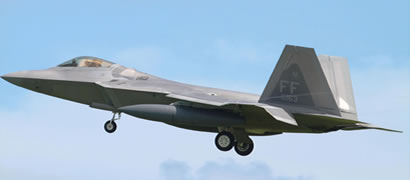
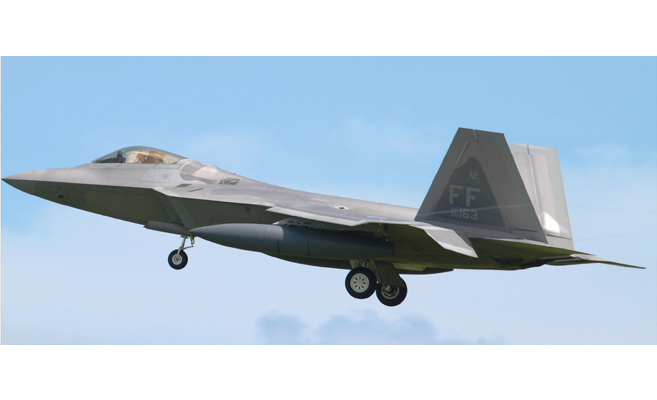
    One of eight F22A landing at Kadena AFB in Okinawa, Japan following the cross-ocean flight from the USA.

    The first contingent of United States Air Force (USAF) F-22 Raptor stealth fighters arrived at Kadena Air Force Base located on Japan’s southernmost island of Okinawa on 28 July. USAF leaders see this deployment as an opportunity to demonstrate that the oxygen problems that have plagued the F-22 have been resolved and to highlight the safety and superior capabilities of the aircraft.

    Eight of the Lockheed Martin Raptors landed at Kadena early Saturday evening with an additional four aircraft scheduled to arrive in the near future. The Air Force has been quoted as saying that this deployment represents the first step towards a return to “normal” operations. In flying to Okinawa, the aircraft followed a flight path that ensured the pilots had a landing site within range in case of an emergency and they flew at a lower altitude to lessen the possibility of a repeat of the oxygen problems that have led to the grounding of the aircraft in the past.

    Secretary of Defense Leon Panetta approved the deployment of the Raptors to Japan and authorized an easing of flight restrictions on 24 July because, he stated, the Air Force had identified the cause of the hypoxia mishaps and initiated corrective measures to resolve the issue.

    Recurring incidents of hypoxia, resulting from a disruption in the flow of oxygen, are believed to be attributable to a valve in the pilot’s pressurized vest. The Air Force says that the valve would sometimes cause the pressure vest to inflate and remain inflated creating a situation that limited the pilot’s ability to breath. Corrective measures include increasing the volume of oxygen reaching the pilot, replacement of the affected valves, and removal of a filter designed to detect contaminants in the aircraft’s life-support system.

    In contrast to the recent spate of intense Japanese opposition to the deployment of Marine Corps MV-22B Ospreys to Okinawa, deployment of the F-22 Raptors has not ignited any significant protests in Japan.

    After Saudi-Arabia, Qatar is also Interested in German Leopard 2 Tanks

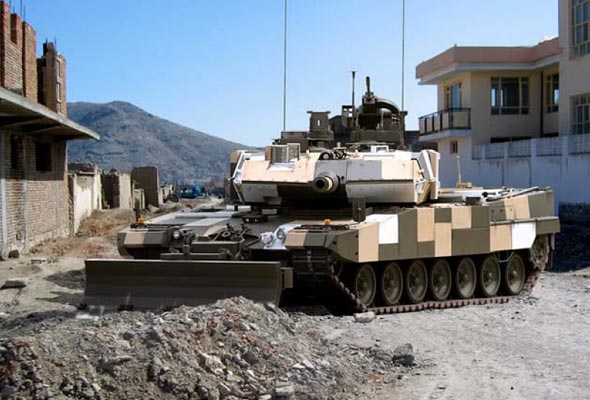
    Indonesia is expecting to receive 103 Leopard II tanks from german army surplus.

    Qatar is also interested in the German Leopard 2 tanks.
    The emirate of Qatar has expressed interest in buying up to 200 Leopard 2 tanks, the german magazine Der SPIEGEL wrote. It is not clear whether the tanks are new production or refurbished from the German Army surplus stocks. A delegation from the tank manufacturer Krauss-Maffei Wegmann travelled several weeks ago to Qatar to discuss the project. Unlike the opposition the proposed sale of similar tanks to Saudi Arabia, offering the tanks to Qatar has not caused any adverse objections in Germany.

    Another customer for the used German tanks is Indonesia. Jakarta is about to receive 100 tanks by October, if the acquisition will pass the German Parliament objections. Such objections, particularly by the left parties, have aborted Berlin’s plans to sell 270 of the latest model Leopard 2 tanks to Saudi-Arabia. The Saudi deal would be for new production series, meaning billions in revenues for the german industry.

    Following the opposition raised in Germany for recent arms sales initiatives, the government, backed by defense industries lobby is calling for the revision of the German arms sales policy, revisiting the ‘black list’ of countries to which German made arms should not be exported. Such a move has recently been opposed by other NATO members during the Chicago summit in May 2012.

    US Navy Awards Ingalls $1.5 Billion for Final LPD Class Amphibious Landing Ship

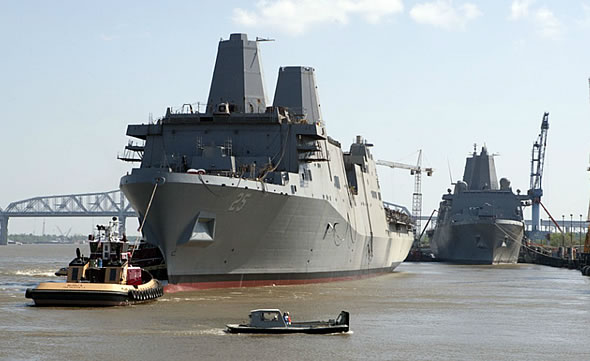
    LPD25 Somerset was named in honor of the fallen Flight 93 victims of 9/11. Photo: HII.

    The US Navy christened today the ninth San Antonio class amphibious transport dock USS Somerset (LPD25) at the Huntington Ingalls Industries (HII) shipyard in Avondale, Louisiana. LPD 25 is named to honor the courage of the passengers and crew members of United Airlines Flight 93, which crashed on Sept. 11, 2001, near Shanksville in Somerset County, Pa. San Antonio class is the new class of Landing Platform Dock (LPD) fielded by the navy. The dockyard is currently building LPD26 (John P Murtha) and as of last Friday (July 27, 2012) HII was awarded a follow-on contract worth US$1.5 billion for the design and construction of the 11th and final San Antonio class vessel – LPD 27, yet unnamed, to be delivered in five years time.

    The 11 ships of the LPD 17 class are a key element of the Navy’s ability to project power ashore. Collectively, they functionally replace more than 41 ships (the LPD 4, LSD 36, LKA 113 and LST 1179 classes of amphibious ships), providing the Navy and Marine Corps with modern, sea-based platforms that are networked, survivable and built to operate with 21st century platforms, such as the MV-22 Osprey.


    The LPD 17-class ships are 684 feet long and 105 feet wide and displace approximately 25,000 tons. Its overall beam is 105ft (32 m’) and navigational draft is 23ft (7 meters). The vessel is powered by four turbo-charged diesel engines to cruise at a speed of 22k. Their principal mission is to deploy the combat and support elements of Marine Expeditionary Units and Brigades. US Navy Commander Cole Hayes is the ship’s prospective commanding officer. He will lead a crew of 360 Navy officers and sailors as well as three Marines. The ships can carry up to 800 troops and have the capability of transporting and debarking air cushion (LCAC) or conventional landing crafts, augmented by helicopters or vertical take-off and landing aircraft such as the MV-22. The ships will support amphibious assault, special operations or expeditionary warfare missions through the first half of the 21st century.

    The hanger deck of the frigate enables the launch and recovery of landing craft and amphibious vehicles to support missions. Additional features of the vessel include AN/SLQ-25A Nixie-towed decoy system and the mk53 Nulka decoy launching system, The principal area search sensor is the ITT AN/SPS-48E 3D air search and AN/APQ-9B surface surveillance and tracking radars. The ship’s flight deck is designed to carry two Sikorsky CH-53E Sea Stallion helicopters, six Bell AH-1W Super Cobra helicopters, four Boeing Vertol CH-46 Sea Knight helicopters or two Boeing Bell MV-22 Osprey tilt rotor aircraft.

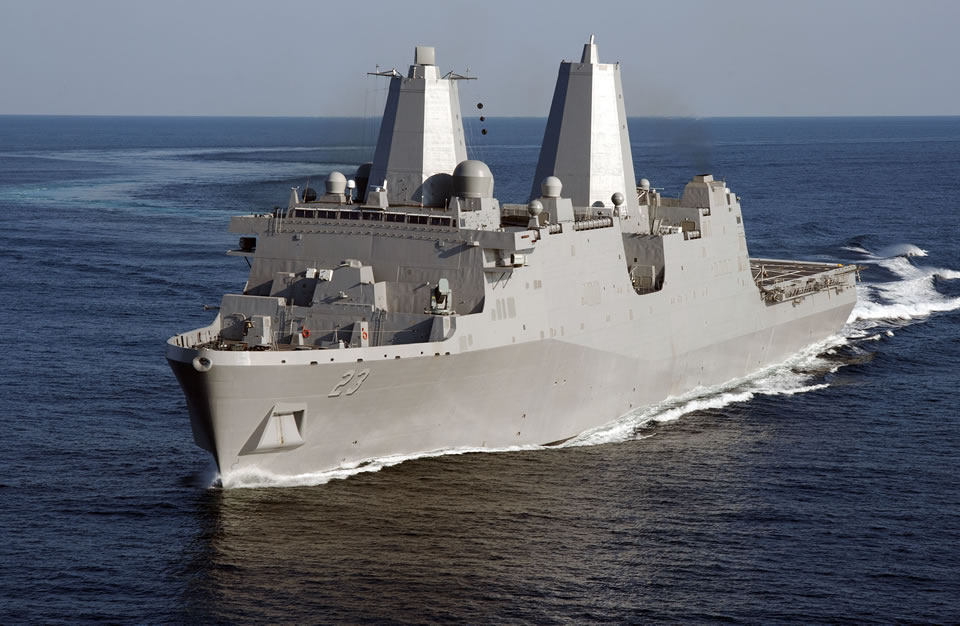
    LPD25 is the ninth of 11 San Antonio amphibious landing support vessels constructed for the US Navy. USS Anchorage, LPD 23 shown above was christened in 2011. $1.5 billion contract for the construction of the last vessel of theis class, LPD 27 was awarded on Friday. Photo: HII.

    China, Indonesia Expand Military Cooperation

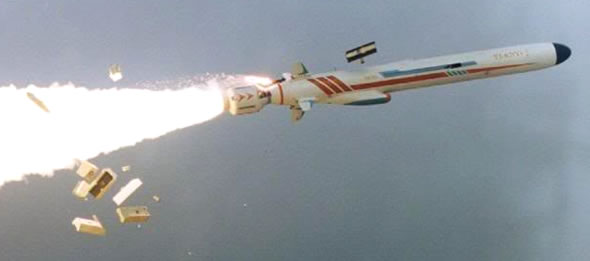
    Chinese C705 boosted into cruise flight on a firing test.

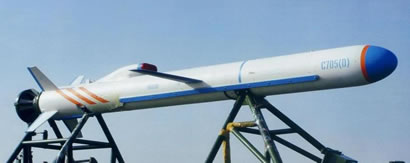
    Chinese C-705 medium anti-ship missile.
    China and Indonesia have started talks on the local production of C-705 anti-ship missiles, as part of Indonesia’s efforts to achieve independence in weapons production. The initial talks were conducted as part of the first China-Indonesia defense industry cooperation meeting held in Jakarta on Wednesday, July 25, 2012.

    According to sources in Indonesia, a seaside site for the production plant and open sea testing has already been located. The Indonesian Navy already received C-705 missiles and has recently conducted a successful firing test in the Sunda Strait.

    Indonesia is currently negotiating three levels of cooperation – local assembly of C-705 missiles from kit supplied from China, partial production of kit elements in Indonesia and collaborative research and development regarding future missile programs.

    Indonesia and China have tightened their military cooperation in recent months, culminating in the recent “Sharp Knife” joint Special Forces exercise in China, involving Chinese and Indonesian special forces. China has also invited ten Indonesian Air Force pilots to train using a Sukhoi fighter flight simulator in China.


    Indonesia has already embarked on similar international cooperationIn 2011 Jakarta embarked on a joint development with South Korea, eying the development of an advanced, yet affordable stealth fighter. A similar cooperation is eying the development and construction of Korean designed submarines. Jakarta is cooperating with the Netherlands on building the SIgma class frigates while Spanish based Airbus Military selected Indonesia as its regional hub for building C-295 transport medium transport planes.

    “We have allocated Rp 150 trillion [US$15.8 billion] to modernize our weapons-defense system from 2010 to 2014. It would be wasteful paying such a huge amount to foreign defense industries without any attempt to improve our own.” Chairman of the Indonesian House of Representatives’ Commission I on defense issues, Mahfudz Shiddiq.

    Chinese C705 boosted into cruise flight on a firing test.

    Manila Wants Better Armed Frigates

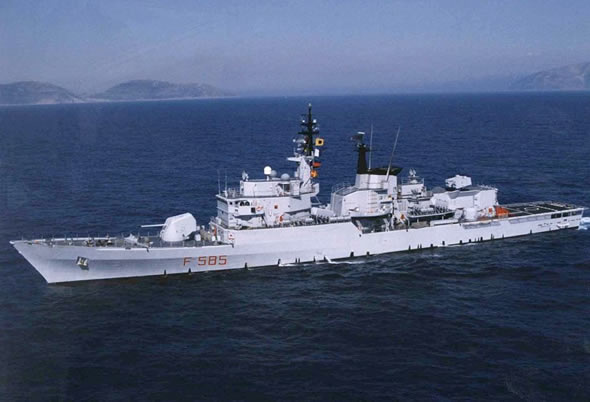
    MM Granatiere (F 585) is one of four 'Soldati' Class (Lupo) frigates operated by the Italian Navy, these vessels were originally built for the Iraqi Navy in the 1980s.
    MM Granatiere (F 585) is one of four ‘Soldati’ Class (Lupo) frigates operated by the Italian Navy, these vessels were originally built for the Iraqi Navy in the 1980s.

    Manila is seeking to add a third frigate to the Philippine Navy. According to Peter Paul Galvez, defense spokesman, Manila is planning to acquire new frigates that will be armed with more advanced weaponry than the current vessels provided by the US, including surface-to-air capability. Philippine Defense Secretary Voltaire Gazmin said earlier the military wants to acquire additional naval crafts from Italy. The only class of frigate available from Italian navy surplus that has air-defense capability is the Lupo Class patrol frigate ‘Soldati’.

    This 2,500 ton vessel is armed with eight Otomat Mk 2 anti-ship missiles, a launcher of Sea Sparrow or Aspid surface to air missiles, two Mk 32 torpedo tubes, two Oto Melara twin 40mm L70 DARDO compact guns (also designed for air defense) and a 127/54 gun turret. It is equipped with a comprehensive array of radars for air defense, surface search, fire control and navigation, sonar, electronic support measures, decoy launchers and acoustic countermeasures. The Philippines are also interested in acquiring a larger vessel, possibly an Italian Navy “Maestrale” class destroyer. This vessel is employed in anti-submarine warfare role, it has a displacement of 3,300 gross register tons and a speed of 33 knots.


    The Philippine navy currently operates an ex US Coast Guard Hamilton class 3,250 ton cutter, which went through extensive upgrades and modification for their new mission. One of the vessels, Gregorio del Pilar was converted into a frigate. The vessel is equipped with 76 and 25mm guns, but has no missiles or air defense capability and its sensors are designed primarily for navigation, search and rescue. The second vessel of this class, BRP Ramon Alcaraz is scheduled to enter service in December 2012. In addition, the Philippines Navy still maintains a single Cannon Class escort ship, BRP Rajan Jumabon, after retiring two of its sister ships after long service.

    “We are not totally relying on the United States (for) our equipment acquisitions.” Gazmin said, “We are also looking at the possibility of getting some of our equipment from Europe, specifically from Italy, depending on our budget.” he added.

    The Philipine Navy also operate 11 corvettes are also in service, but these are less suitable for the long range missions currently required to secure the nation’s interests in the South China Sea.

    China Launches a New Class of 5,000 Ton Patrol Vessel

    China launched its largest and most advanced patrol vessel Haixun01 on Saturday in Wuhan, a city in the Hubei province. The 5,000 ton class Haixun01 is the first Chinese patrol vessel to simultaneously incorporate marine inspection and rescue functions. It will be assigned maritime inspection, safety monitoring, rescue, oil spill detection and handling, said Xu Guoyi, head of the Shanghai Maritime Bureau, which will manage the ship. The vessel is expected to enter service by year’s end. China currently operates two 3,000-ton patrol vessels, Haixun 11 and Haixun 31, and the 1,500-ton patrol vessel Haixun 21, all handling maritime inspection, salvage and maritime traffic management in the country’s coastal waters.

    The 5,418 ton ship is 128.6 meters in length. Its sailing speed is 20 knots and the unrefueled mission range is 10,000 nautical miles (18,520 km). The vessel was built by the Wuchang Shipbuilding Industry Company Ltd.

    The ship has accommodations for 200 people rescued at sea and will be equipped with devices to offer basic medical treatment and surgeries. The vessel also has a helipad to support airborne search and rescue missions. In addition, the ship is able to tow other vessels or assist in firefighting on other boats.

    Hard-Charging Australian Submarine Temporarily Sidelined During RIMPAC 2012 by Leak Causing Minor Flooding

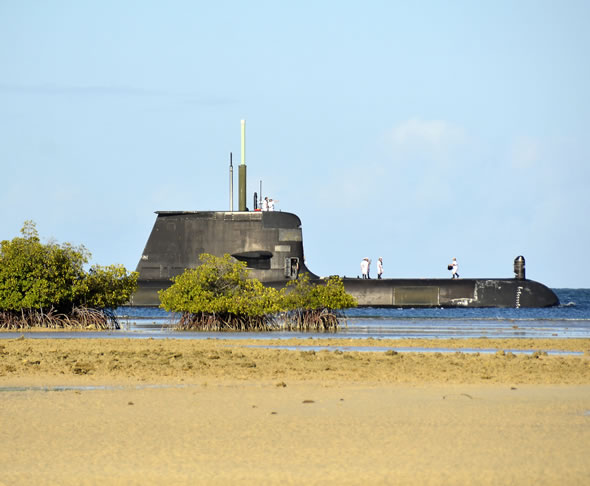
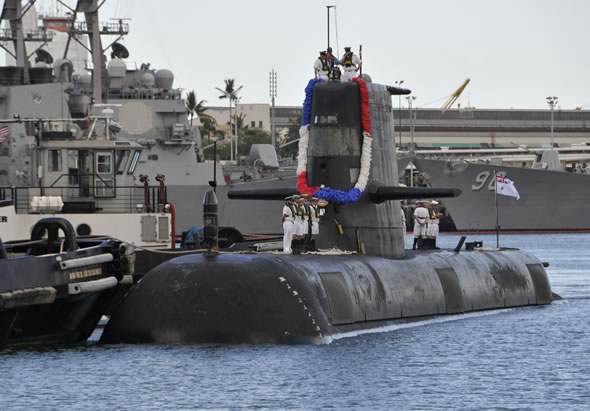
    Australian Navy Collins-class submarine HMAS Farncomb (SSG 74) arriving in Hawaii for RIMPAC 2012. US Navy photo by Daniel Barker

    The HMAS Farncomb (SSG 74), an Australian Collins-class submarine, has put on quite a thrilling demonstration of her warfighting capabilities during the Rim of the Pacific 2012 (RIMPAC 2012) international maritime training exercise giving Australian national pride a welcome boost.

    On 23 July HMAS Farncomb closed in on its prey, the 12,106 ton decommissioned USNS Kilauea (T-AE-26), and sank her in forty minutes with one MK48 torpedo. HMAS Farncomb’s single torpedo struck the USNS Kilauea just below the bridge breaking the vessel in two before she slipped beneath the waves some forty minutes after being hit. The decommissioned former ammunition ship sank in 15,500 feet of water 63 miles off the coast of Kauai Island in the Hawaiian Archipelago.
    The sinking of the target ship was the highlight of a very successful Australian naval performance in RIMPAC 2012. Australia’s RIMPAC Combined Forces Maritime Component Commander, Commodore Stuart Mayer, stated that the Farncomb has performed exceptionally well against the US Los Angeles-class nuclear-powered “hunter-killer” submarines during this year’s RIMPAC exercise, a performance he says has come as quite a surprise to the assemblage of international naval officers participating in the exercise.


    HMAS Farncomb is one of the largest conventionally-powered submarines in the world renowned for its undersea agility and quiet operation. In head-to-head competitions against American Los Angeles-class submarines, Commodore Mayer said the Farncomb frequently emerged victorious and said the vessel is “doing extremely well” in all aspects of the exercise. Commodore Mayer also said that foreign submariners were quite anxious to test themselves against the finely-tuned Farncomb crew. The Commodore further stated that the Farncomb had been developed into an exceptional warfighter that employed state-of-the-art combat systems and sophisticated weapon’s delivery systems incorporated into the vessel with American assistance.

    Only two days after sinking the Kilauea, the Farncomb was herself the victim of a mishap while engaged in combat training. According to the Australian Defense Force (ADF), the Farncomb experienced flooding while cruising at periscope depth during an exercise. The flooding was identified as minor resulting from a shipboard water hose that unexpectedly split. At the time of the incident, the submarine was traveling just below the ocean surface under the power of her diesel engines while recharging her onboard batteries.

    In a public statement, the ADF stated that the ship “suffered a minor flood in one of the submarine’s machinery spaces,” an event that triggered the immediate execution of standard procedures designed to guarantee the safety of the boat and the crew. In compliance with standard operating procedures, the ship’s captain ordered the vessel to surface as a precautionary measure.

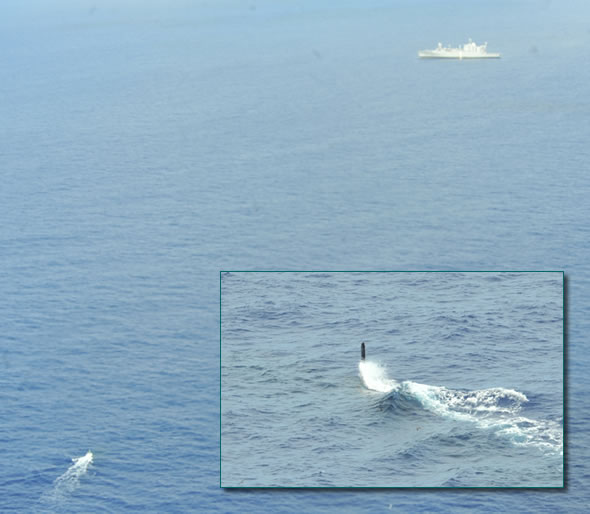
    Pacific Missile Range Facility, off Hawaii, this week. HMAS Farncomb fired a Mark 48 Torpedo into the Submerges at periscope level, HMAS Farncomb closes in on the target ship, former USNS Kilauea, launching the Type 48 torpedo that sent the Kilauea to the bottom. Photo: Ausralian defence.

    The near sinking of the HMAS Dechaineux caused by the failure of a seawater cooling hose in 2003 led to the installation of an automated system in other undersea craft designed to close all hull valves should a similar mishap occur. The automated system was installed on the Farncomb and was readily available for use. Once the Farncomb surfaced, the crew was able to trace the flooding to a split hose in the boat’s weight compensation system. The damage to the hose was quickly contained to ensure the Farncomb remained seaworthy. The Farncomb was forced to retire from the ongoing exercises and sail for Hawaii to effect repairs to the damaged hose. An investigation will be conducted into the circumstanced of the incident.

    This is not the first incident requiring the Farncomb to return to base for repairs. In 2010, the ship suffered a generator failure forcing her to return to port for immediate repairs. With Farncomb’s departure from her assigned area of operations, Australia was reduced to a force of only one mission-capable submarine as the fleet’s remaining four submarines were undergoing maintenance and repairs.

    Australia is one of 22 nations participating in this year’s RIMPAC exercise. Australian soldiers are also training with US Marines in the conduct of amphibious operations and Royal Australian Air Force (RAAF) AP-3C Orions and a Wedgetail aircraft are also providing air support.

    Renault Trucks Defense to acquire French manufacturer Panhard

    Renault Trucks Defense, a member of the Swedish Volvo Group’s Governmental Sales business area, announced it is acquiring the French armored vehicle manufacturer Panhard. The transaction is expected to be finalized during the fourth quarter of 2012, following receiving the required approval from the French authorities.

    The deal was in the making for several years, with Panhard seeking to divest its market leading position given the expected delay in decision on on the next wave of acquisition programs for the French Army, under the Scorpion program. Panhard was aiming for part of the program, namely the armed reconnaissance vehicles, while Renault and Nexter would seek ‘coopetition’ on the majority of the program – replacement of the French Army infantry fighting vehicles and armored personnel carriers. With only two competitors left, both companies are likely to win enough business to maintain long term health.

    Panhard is a private company with about 300 empployees, with long background in the car industry. The company specializes in manufacturing light transport vehicles adapted for defense operations. In 2011, Panhard reported sales of EUR 81 Million and operating profit amounted to EUR 9.4 Million.

    Renault Trucks Defense is included in the Volvo Group’s Governmental Sales business area. The operation comprises primarily of production and sales of vehicles adapted for operations in defense, security and international projects. Renault Trucks Defense has approximately 500 employees, mainly in France.

    Indonesian Sukhois Arrive at Darwin for Pitch Black 2012

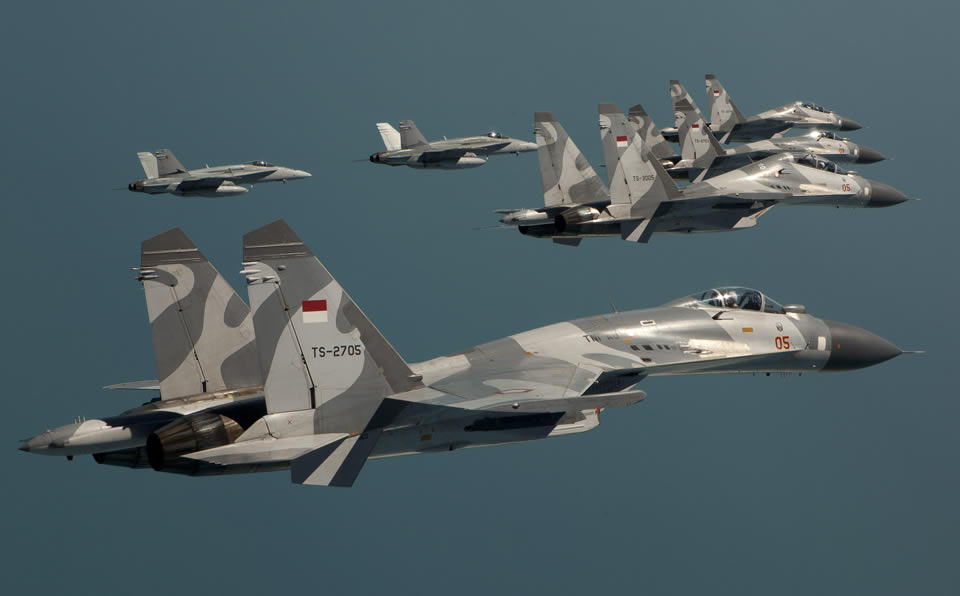
    Indonesian Su-30 and Su-27 arrive at Darwin, welcomed by Australian F/A-18s. Photo: Australian Defence by SGT Shane Gidall
    Indonesian Flankers welcomed to Darwin for Pitch Blask 2012. Photo: Australian Defence

    Four Flanker type fighters from Indonesia are participating for the first time in the annual Pitch Black exercise in Australia opening today. Arriving at Darwin, Australia the Indonesian fighters two Su-30 and two Su-27 were escorted by to Australian No. 77 Squadron F/A-18 Hornet Aircraft.

    Exercise Pitch Black is a major multi-national biennial exercise hosted by the Royal Australian Air Force, involving Offensive Counter Air and Offensive Air Support missions being flown at training ranges across the Northern Territory. Exercise Pitch Black 12 beginning today (27 July) will continue through 17 August 2012, and involve 2,200 personnel and up to 94 aircraft from Australia, Indonesia, Singapore, Thailand, New Zealand and the United States. Operations will be commanded from Darwin and Tyndal AFB in the US.


    The Exercise provides the first opportunity to test the new Australian hardware, including Super Hornet, Wedgetail Airborne Early Warning and Control aircraft (AEW&C), and KC-30A Multi-Role Tanker Transport. Singapore will also deploy its newest fighters and AEW&C – the F-15SG and Gulfstream G550 Conformal Airborne Early Warning aircraft.

    Participants at Exercise Pitch Black 12 will utilise massive military training areas near Bradshaw and Delamere to practice offensive counter air and offensive air support operations with large formations of foreign aircraft.

    Australia and Indonesia defense and security cooperation may be on the rebound following a recent meeting between Indonesian President Susilo Bambang Yudhoyono and Australian Prime Minister Julia Gillard. Canberra’s military ties with Jakarta have been strained over many years. Relations hit their lowest point in 1999, when Australian troops were sent to East Timor to quell violence by pro-Indonesian military militia groups. But in recent years the military-to-military relationship warmed as Australia provided expertise to Indonesia’s security forces to counter terrorist groups.

    The decision to send the Sukhois to Australia is believed to have been approved by Dr Yudhoyono. Indonesia’s air force has been on a buying spree recently. It already operates 10 Sukhoi-27s and four Sukhoi-30 MK2 jets, and recently announced a new order for six Sukhoi-30 MK2 fighters.

    Indonesian Su-30 and Su-27 arrive at Darwin, welcomed by Australian F/A-18s. Photo: Australian Defence by SGT Shane Gidall

    Japan-Based USAF F-16s Resume Flight Operations After Crash

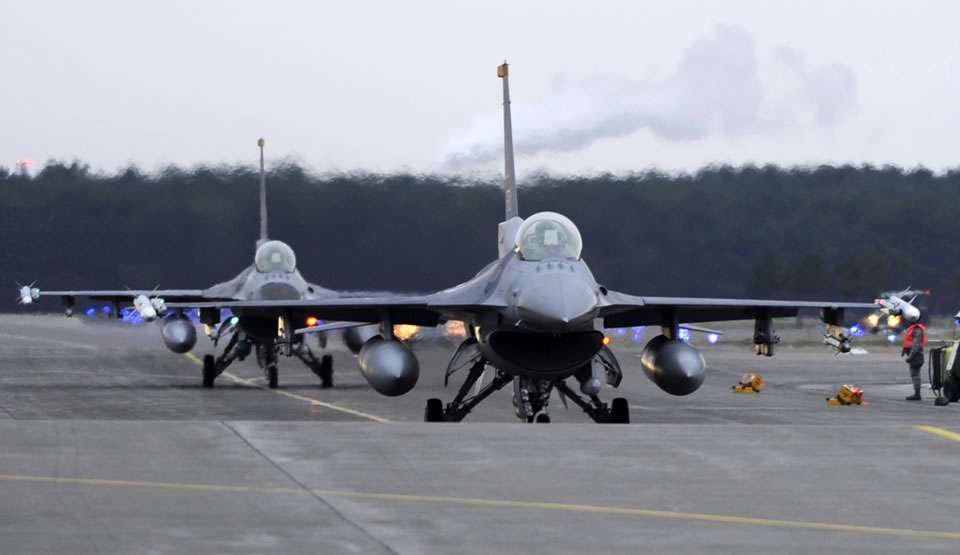
    35th Fighter Wing taxi on the runway in preparation for takeoff during an operational readiness inspection at Misawa AFB, Okinawa. Photo: Tech. Sgt. Marie Brown, USAF
    35th Fighter Wing taxi on the runway in preparation for takeoff during an operational readiness inspection at Misawa AFB, Okinawa. Photo: Tech. Sgt. Marie Brown, USAF

    Following the crash of a lone United States Air Force (USAF) F-16 Fighting Falcon assigned to the 35th Fighter Wing off the northeast coast of Japan on 22 July, the Wing’s F-16s were ordered grounded for safety inspections. On 26 July, the grounding order was lifted after USAF leaders determined the aircraft were safe to resume operations following an intense maintenance and safety review. On 22 July, an F-16 crashed in the sea approximately 470 kilometers northeast of Japan’s northernmost island of Hokkaido. The aircraft was enroute from Japan to Alaska at the time of the incident while flying in formation with two other F-16s.

    The pilot ejected safely and was rescued by a Japanese civilian vessel, the F/V Hokko Maru, some six hours after the crash as the result of a joint Japanese/American search effort conducted by military naval vessels and civilian ships. The pilot has not yet been identified, but a Misawa spokesperson stated that the pilot is in stable condition after being transferred to a US treatment center, rumored to be in Alaska, and is expected to return to Misawa following treatment for minor injuries.


    This was the first crash of a Misawa-based F-16 since 2002. The 35th Fighter Wing is stationed at Misawa Air Force Base in Aomori Prefecture, Japan and is the parent command of the 13th and 14th Fighter Squadrons. The 13th and 14th Fighter Squadrons are equipped with approximately 45 F-16CJ/DJ Block 50D/52D Fighting Falcons.

    Colonel Van A. Wimmer Jr., Vice Commander of Misawa Base and the 35th Fighter Wing, ordered a “safety stand down” immediately after being notified of the F-16 crash. The grounding continued in effect until 26 July to allow ground crews and maintenance teams to conduct a detailed inspection of all the Wing’s F-16s. The inspection covered engines, flight controls, tires, brakes, fuel systems, ejection seats, and structural surfaces.

    Colonel Wimmer informed Misawa City Mayor Kazumasa Taneichi that the base would resume flight operations on 26 July, but would restrict flights over urban areas for the present time. Colonel Wimmer and other staff officers assured the mayor that the F-16s were determined to be safe to fly following the five-day safety stand down. The mayor was also told that four aircraft, including the two flying with the F-16 that crashed, would be relocating to North America in the very near future. The cause of the F-16 mishap is currently under investigation and a final report is not expected for several weeks.

    Misawa Air Force Base is the only combined, joint service facility currently operating in the western Pacific and is home to units of the US Navy, US Marine Corps, USAF, and US Army as well as elements of the Japanese Self-Defense Forces (JSDF). The 35th Fighter Wing is part of the US Pacific Air Force’s (PACAF) Fifth Air Force.

    Misawa, being the northernmost US air facility in Japan, is located in a relatively remote area and is largely unknown to most Japanese. The base is subject to heavy snowfalls in the winter months, which serves to limit the frequency of military altercations with the local populace, and rarely draws any significant media attention. Misawa has an enviable rapport with the local community given that aircraft mishaps are rare, noise issues are almost unheard of, and military-related crimes are equally uncommon.

    The F-16 crash occurred at an especially inopportune time for US Forces Japan with opposition to the deployment of Marine Corps MV-22B Ospreys to Okinawa continuing unabated. Although dissension related to the Ospreys in and around Marine Corps Air Station (MCAS) Iwakuni in Yamaguchi Prefecture has evaporated, opposition in Okinawa continues to give the United States and Japanese Prime Minister Yoshihiko Noda cause for concern.

    The first twelve Ospreys were delivered to MCAS Iwakuni on 23 July for final assembly and testing prior to being shipped to Okinawa where they are scheduled to replace the aging CH-46E Sea Knight helicopters currently in service.

    Okinawa has long been the center of Japanese opposition to the American military presence on the island. Approximately half of the US forces in Japan are stationed in Okinawa, a situation that has been a matter of passionate dispute for several years and the deployment of the Ospreys has added to the intensity of the opposition. The safety of the MV-22B and the government’s failure to relocate the air facility at MCAS Futenma are at the heart of the Okinawa protests and of considerable concern to local community leaders.

    Japanese and US officials held their first joint meeting on 26 July in Tokyo to begin developing a plan of action to provide Japanese leaders with documentary evidence attesting to the Osprey’s operational safety record and to assure the Japanese public that the tiltrotor aircraft can be safely flown in Japan.

    Kuwait Bolsters Missile-Defense Arsenal with PAC-3 Buy

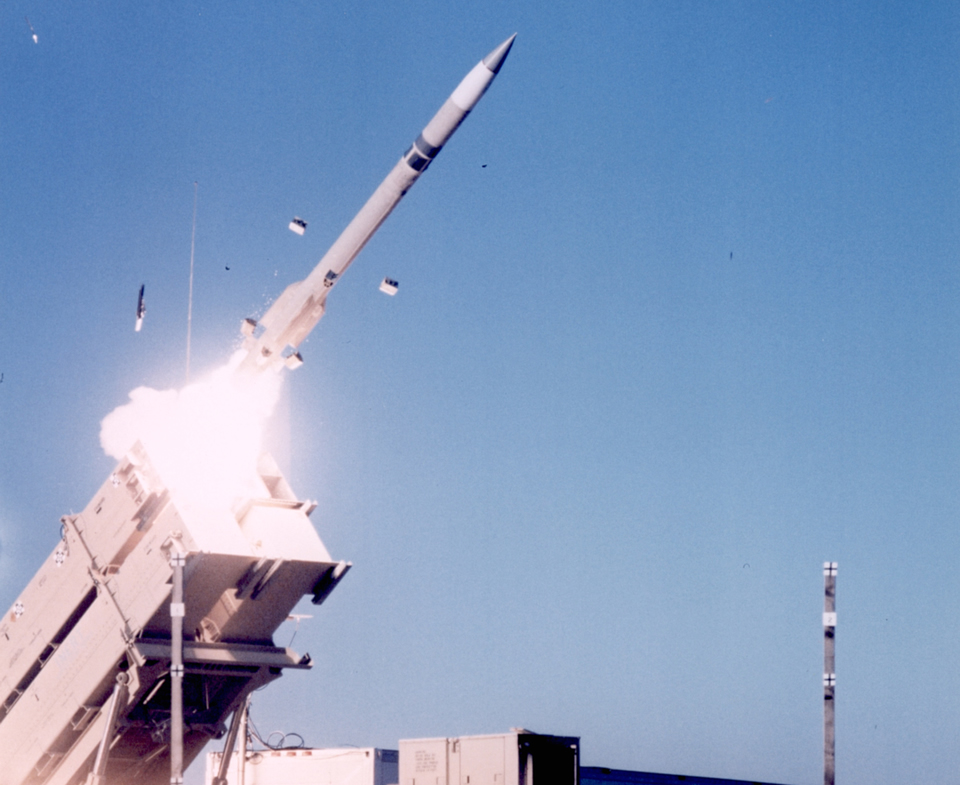
    Test launch of a PAC-3 missile. Photo: Lockheed Martin
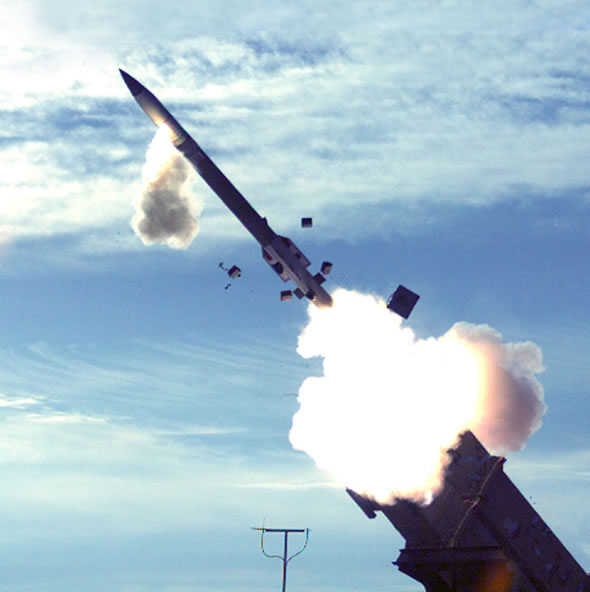
    PAC-3 launch. Photo: Lockheed Martin

    Kuwait is planning to acquire 60 Patriot Advanced Capability (PAC-3) missiles systems under a $4.2 billion acquisition plan announced last week by US Defense Security Cooperation Agency (DCSA). The package Kuwait is seeking includes four unit sets comprising of AN/MPQ-65 radars, AN/MSQ-104 Engagement Control Stations and OE-349 Antennae Mast Groups supporting four independent unit deployments comprising 20 M109 Launching Stations. The systems destined for Kuwait will also include two Information Coordination Centrals, supporting communications equipment and ten Electric Power Plants. This package is part of several PAC-3 procurement programs currently underway in the Middle East, bolstering the Gulf State missile protection capability against potential missile attacks from Iran.

    In addition to strengthening Kuwait’s homeland defense, the proposed sale of PAC-3 missiles and equipment will enhance Kuwait’s interoperability with the U.S. and its allies, making it a more valuable partner in the Gulf, DSCA said. Kuwait has already acquired 80 PAC-3 missiles in 2007, under a $1.36 billion program as part of its Patriot system upgrade. As part of that program part of Kuwait’s Patriot systems were upgraded to MIM-104F (PAC-3) standard while the remaining systems were modernized into Guidance Enhanced Missile -T (MIM-104E GEM-T) standard. At that time the UAE also ordered nine PAC-3 and GEM-T units.

    The UAE is another big user of PAC-3 missiles in the gulf, in the past 3 years DSCA announced an export package worth over US$12 billion to enhance air and missile defense in the emirates. The systems include the medium range THAAD interceptor and short-range PAC-3 missile interceptors. Saudi Arabia has also a large number of Patriot PAC-2 GEM-T missiles in its arsenal, however these are less suitable for missile defense applications. In the future, these interceptors are likely to be replaced by the extended-range, missile-intercept optimized Patriot Missile Segment Enhancement (PAC-3 MSE) variant currently undergoing advanced testing.

    The US has its own PAC-3 systems deployed in the gulf, protecting its own bases in Bahrain and Saudi Arabia. These US systems are believed to be able to integrate the entire region into an interoperable missile defense system. The capability of such systems will be enhanced, as a new early warning radar site the U.S. is constructing in Qatar will be plugged-in. This is probably another TPY-2 radar the US is deploying, augmenting the US Navy Aegis vessels stationed in the gulf. These vessels have yet to be armed with missile-defense interceptors and currently provide primarily floating early warning sensors. Additional coverage is rendered by US radar systems stationed in Turkey and Israel, but the Qatar based station would be needed to further enhance the system’s capability, especially against medium-range missiles fired from Iran.

    Test launch of a PAC-3 missile. Photo: Lockheed Martin

    Skunk Works and XTEND Simplify Multi-Drone Command

    0
    Lockheed Martin Skunk Works® and XTEND have achieved a major milestone in JADC2 by integrating the XOS operating system with the MDCX™ autonomy platform. This technical breakthrough enables a single operator to simultaneously command multiple drone classes, eliminating the friction of mission handoffs. From "marsupial" drone deployments to operating in GPS-denied environments, explore how this collaboration is abbreviating the data-to-decision timeline and redefining autonomous mission execution.

    From Ukraine to Taiwan: The Global Race to Dominate the New Defense Tech Frontier

    0
    As traditional defense primes face mounting competition from agile “neoprimes” such as Anduril, Palantir and Helsing, the balance of innovation is shifting toward software-defined warfare and scalable, dual-use technologies, while global industry consolidation—marked by Boeing’s integration of Spirit AeroSystems and other strategic mergers—signals an intensified race to secure control over the defense technology value chain. Our Defense-Tech weekly report highlights these trends.

    Europe’s “Drone Wall”

    0
    In early October 2025, a coordinated wave of unmanned aerial system (UAS) incursions—widely attributed to Russia—targeted critical infrastructure across at least ten European nations. The unprecedented campaign exposed the fragility of Europe’s air defenses...

    Weekly Defense Update & Global Security Assessment

    0
    Executive Summary The past week (September 18-25, 2025) represents an inflection point where strategic defense concepts have transitioned from doctrine to tangible reality. An analysis of global events reveals four primary, interconnected trends shaping an...

    U.S. Air and Space Forces Push Next-Gen Programs at the AS&C 2025 Conference and...

    0
    At the 2025 Air, Space & Cyber Conference, U.S. Air Force and Space Force leaders unveiled major updates on next-generation fighters, bombers, unmanned systems, and space initiatives, highlighting both rapid innovation and critical readiness challenges as the services race to outpace global competitors. A short version is available here, with a more detailed version for subscribers.

    TADTE 2025: Reflecting Taiwan’s Strategic Themes

    0
    The Taipei Aerospace & Defense Technology Exhibition (TADTE) 2025 crystallized around four dominant strategic themes that collectively illustrate Taiwan's comprehensive approach to defense modernization amid escalating regional tensions. Based on a detailed report by Pleronix (available upon request). Includes a Podcast discussion on TADTE 2025's highlighting Taiwan's four strategic themes beyond the post's coverage.

    Iron Beam 450 Completes Testing, Soon to Join With Operational Air Defense Units

    0
    Israel’s Iron Beam 450 high-power laser system has completed final testing, marking a major leap in air defense. Developed by Rafael, it offers precise, cost-effective interception of rockets, UAVs, and mortars, and is set for IDF deployment by 2025.