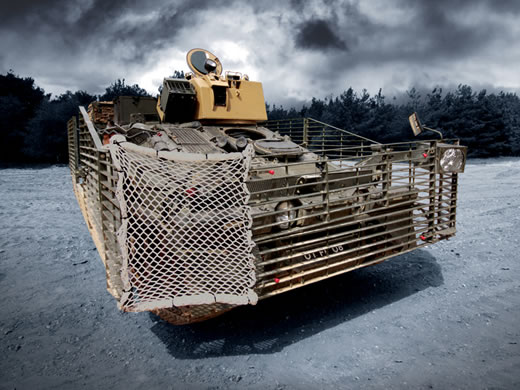
The QuickShield textile-based armor is applied as a 'band aid’ for bar armor' enabled armored vehicle crews to rapidly replace damaged bar (slat) armor on military vehicles in the field. Photo: MOD
QuickShield, a textile-based, lightweight net designed to stop rocket-propelled grenade threats (RPG) from penetrating vehicle armor was unveiled by the U.K. Ministry of Defense netting today, as part of the ministry’s National Science and Engineering Week. QuickShield is applied as a ‘band aid’ for bar armor’ enabling armored vehicle crews to rapidly replace damaged bar (slat) armor on military vehicles in the field. The QuickShield net is stowed in the vehicle, and can be fitted immediately without any tools. It is due to be delivered to Afghanistan in April 2011 as part of a £2.6m contract.
The QuickShield textile-based armor is applied as a 'band aid’ for bar armor' enabled armored vehicle crews to rapidly replace damaged bar (slat) armor on military vehicles in the field. Photo: MOD
Textile-based TARIAN armor (below) was developed by the Defence Science and Technology Laboratory (Dstl) with Dorset-based AMSAFE in Bridport. TARIAN provides lightweight protection against RPGs, in places where bar armor cannot be applied. In 2009 MOD aquired the first sets of TARIAN to protect Heavy Equipment Transporters bound to Afghanistan.
A ground-breaking new armour system was unveiled by the Ministry of Defence at the defence equipment event called DVD today.The revolutionary, textile-based TARIAN vehicle armour system will give lightweight protection against RPGs, in place of the current bar armour that is fitted to vehicles such as Mastiff and Ridgback.More than 20 sets of TARIAN have been ordered, with half of them fitted to the Heavy Equipment Transporters which are in use on operations in Afghanistan. The armour has been developed with Dorset-based AMSAFE in Bridport and will mean the weight savings can be applied elsewhere on the vehicle.
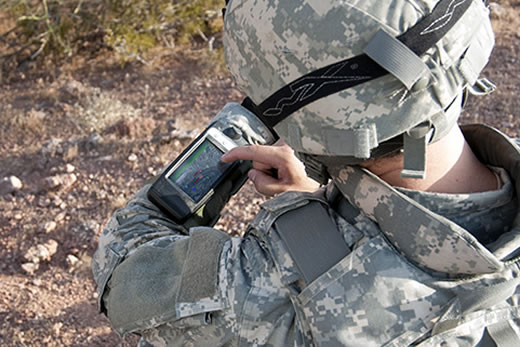
The Itronix GD300 unit combines a compact, rugged, handheld computer running an Android-based operating system, commercial global positioning and communications technology. Cable interface enables simple integration with tactical and commercial radios for secure access to the network. GD300 devices are also provided for first responders or commercial field service users. Photo: General Dynamics C4
The U.S. Army will soon evaluate prototypes of wearable mobile handheld computers running battle command capability. New applications, utilizing GDC4’s GD300 and other devices, will be able to provide dismounted soldiers with network connectivity, command, control and situational awareness just like modern smartphones are doing in the commercial market. General Dynamics expects to deliver 40 prototype handheld devices by September 2011 for user evaluation under the current $2.3 Army contract. During the second phase of the program, up to 250 JBC-P interoperable handheld devices may be purchased as part a contract option. The Army plans to evaluate several versions of such handheld devices under the U.S. Joint Battle Command – Platform (JBC-P) Handheld program. JBC-P is considered by the Army as the successor network for today’s the follow-on for Force XXI Battle Command Brigade and Below, or FBCB2, delivering today’s situational awareness services at the brigade level and below.
The Itronix GD300 unit combines a compact, rugged, handheld computer running an Android-based operating system, commercial global positioning and communications technology. Cable interface enables simple integration with tactical and commercial radios for secure access to the network. GD300 devices are also provided for first responders or commercial field service users. Photo: General Dynamics C4
"What I watched with interest today was the ability to take pictures of high-value targets, immediately provide them to the company or to the battalion command post," Gen. Peter Chiarelli, Army vice chief of staff said after attending an exercise with paratroopers of the 82nd ABN., using handheld devices in a combat-like scenario. Photo: U.S. Army.
Sofar Army units have been evaluating standard smartphone used as handheld computing devices, plugged into tactical radios to empower small Army units. During a recent exercise performed by paratroopers of the 82nd Airborne Division, JTRS HMS Rifleman and Manpack radios were married with PEO C3T prototype handhelds, demonstrating interoperability between programs of record in the “transport layer” (radios) and the “application layer” represented by reporting and situational awareness systems.
Ruggedized, Android-based smartphones were used for this exercise, running two applications a Joint Battle Command-Platform, or JBC-P Handheld, and Tactical Ground Reporting, known as TIGR Mobile. Feedback from the 82nd Airborne Division will be used to reduce risk for upcoming tests of the equipment, including the Integrated Network Baseline Exercise, or INBE, in June and the Brigade Combat Team Integration Exercise in October, program officials said.
The system relied on two communications networks supporting the different echelons involved in the exercise – the secure terrestrial network provided by HMS Manpack and Rifleman Radios supporting the individual soldier while the Warfighter Information Network – Tactical, (WIN-T) ‘Increment One’ transferred information to and from the battalion tactical operations center. A WIN-T satellite terminal known as SNAP (Secure Internet Protocol Router/Non-secure Internet Protocol Router, or SIPR/NIPR, Access Point) extended the network’s range up to higher headquarters.
PEO C3T is working with several vendors to evaluate handheld devices that support different transport methods, including Netted Iridium and several radio models selected by the Army and Marine Corps. Interoperability with existing battle command systems is mandatory for all systems and associated security services, to ensure data, communications services and networks are fully protected.
Smartphones used by medics of the 82nd Airborne Division to take a picture of wounds on wounded soldierslti, pasing it to the doctors at he MASH, expediting the most efficient treatment upon the casualties arrival. Photo: US Army
The evaluation will assess the applications of enhanced battlefield awareness by visualizing and highlighting information that might not otherwise be available with conventional aids – for example, enhancing maps with real-time position location information. “This win brings our vision of ‘every soldier connected to the network’ closer to reality. With the capabilities of the rugged GD300, combined with mission command applications like TIGR, soldiers and Marines will have the information they need to accomplish their mission more effectively,” said Kevin Merrigan, vice president of Battle Management Systems for General Dynamics C4 Systems.
For its prototype design, General Dynamics will provide the rugged, eight-ounce GD300 tactical computer that hosts an ‘apps-friendly’ operating system. Designed to provide dismounted users with situational awareness of events, people and structures, along with chat and texting capabilities, the GD300 also delivers position location information and access to popular military software ‘apps’ like the Tactical Intelligence Ground Reporting (TIGR) system. When connected to a ‘networked device’ such as the Joint Tactical Radio System (JTRS) Handheld, Manpack, Small Form Fit (HMS) Rifleman radio (AN/PRC-154) or the Iridium satellite communications handset, users will be able to make voice, video or data contact whether in close proximity or miles apart.
Charles Edelstenne, Dassault Aviation president and CEO. Photo: Dassault Aviation
Dassault Aviation presented the annual reports for 2010 yesterday. Thanks to record-breaking deliveries of Falcon business jets, the company demonstrated an impressive 22% increase in net sales, compared to 2009. However, with orders for business jets declining, Falcon alone cannot sustain the company for much longer and Dassault is hoping to win at least one export order for the Rafale to secure its future growth.
Charles Edelstenne, Dassault Aviation president and CEO. Photo: Dassault Aviation
Despite the slowdown in the business aviation sector, the Falcon activities managed to deliver 95 aircraft, in 2010. Dassault’s operating margin for 2010 also increased to 14.1% (up from 12.5% in 2009); yet the net margin (excluding the Thales Group) remained unchanged at 9.4%.
In contrast to the overall positive performance of the company, its defense activities went through a difficult year in 2010, with new orders of € 792 million, far lower compared to the € 2,529 million received in 2009, this peak year included a follow-on order for 60 Rafale fighters from France. In fact, Dassault’s 2010 defense order book was slightly lower han 2007 in terms of new business. In actual deliveries Dassault completed and delivered 11 Rafale fighters in 2010 (compared to 14 in 2009). The same production rate is expected to be maintained for 2011.
In 2010 new orders correspond mainly to military support and development programs in France and abroad. Among these programs are the integration of ‘sensor to shooter’ capability on the Rafale, with the introduction of Damocles Laser Designation Pod (LDP) and laser guided bombs, integration of AEROS reconnaissance offering improved pod capability and the integration and qualification of MIDS-L16 Data links on the French Air Force Mirage 2000D strike fighters.
As expected, defense activities in France totaled € 606 million, 75 percent down in 2010, compared to € 2,276 million peak year in 2009. Defense exports fared slightly better, down 27 per cent to € 186 million in 2010. Defense exports included primarily integration and support programs, including the integration of laser guided bombs on UAE Mirage 2000 fighters.
The forecast for 2011 indicates a challenging year – global economic slowdown, growing competition in the business aviation sector, depreciated dollar impacting the competitiveness of European companies, reduced defense spending in Europe and abroad all present negative trends. Winning one of the tenders in India or Brazil could change the picture dramatically. “We are discussing with several export prospects. They recognized our military aircraft’s qualities during its evaluation and we are looking forward to concluding deals.” Said Charles Edelstenne, Dassault Aviation president and CEO. Among the leading prospects are Brazil and India, both are expected to announce their decision in 2011-2012. Another prospect for future improvement is the unmanned systems business, Dassault is leading an international industry group developing the European Unmanned Combat Aircraft nEUROn and has also launched a JV with BAE Systems, to develop the Medium Altitude Long Endurance (MALE) drone in response to British and French governments evolved operational requirements.
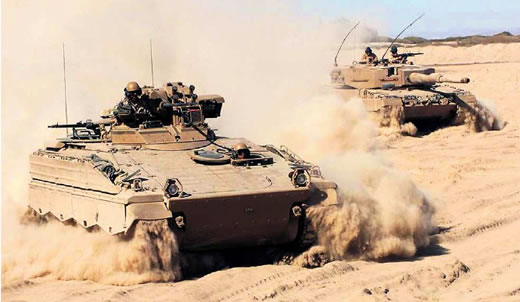
An armored team comprising a Leopard 2A4 and Marder armored infantry fighting vehicle training in the Chilean desert. Photo: Chilean Army
With a long military tradition and a lengthy coastline, Chile is spending substantially on arms purchases. Its defense bill was $4.8 billion in 2008, representing 3.5 percent of the nation’s gross economical product, twice over the region’s average level.
An armored team comprising a Leopard 2A4 and Marder armored infantry fighting vehicle training in the Chilean desert. Photo: Chilean Army
Major programs in recent years included the induction of ten F-16C/D/Block 50+ with the Chilean Air Force (FACh) under the Peace Puma program. The aircraft were transferred from the U.S., along with advanced weapons, including AMRAAM, Sidewinder air/air missiles, Maverick and JDAM guided weapons. These F-16s can also operate the Israeli-made Rafael Derby and Python IV air-to-air missiles carried by F-5E/F Tiger III fleet. Along with ten new Falcons Chile also acquired 36 used F-16 block 20 (MLU upgraded) from the Royal Netherlands Air Force which is planning to transfer 18 additional MLU Falcons. In 2007 Chile received 12 new Bell 412 helicopters from U.S. Bell Textron Helicopters. In 2009 a dozen new EMB-314 light attack aircraft/trainers were delivered from Brazil.
Chile was the first country in Latin America to take advantage on the availability of massive quantities of modern armored vehicles offered as military surplus by NATO members. In total, Chile acquired Leopard 1 main battle tanks, Marder armored infantry fighting vehicles and Leopard II tanks. Germany and the Netherlands emerged as the leading suppliers of armored vehicles – with Netherlands delivering 202 Leopard 1V tanks (114 operational) and 139 YPR765 armored personnel carriers. In March 2006 Chile concluded a deal to buy 118 Leopard 2 tanks from Germany to replace 131 obsolete tanks still in service.
Our sponsor - Rafael
In addition, the Chilean Navy is using a locally produced variant of the 6×6 Pirahna and is also considering the acquisition of wheeled armored vehicles – the Pirahna 8×8 (Stryker) alongside the French Panhard PVP are considered.
In recent years Chile has modernized its surface fleet with the acquisition of frigates from the Netherlands and U.K. Among these vessels, two are Dutch built “Karel Doorman” M class multi-purpose frigates (“Almirante Blanco Encalada” and “Almirante Riveros”). The other two ex-Dutch frigates are “Jacob van Heemskerck” L class air defense frigates (“Capitan Prat” and “Almirante Latorre”), both armed with Harpoon anti-ship missiles. Among the four delivered from Royal Navy surplus are a single type 22 “Almirante Williams” and three type 23, “Almirante Condell”,”Almirante Lynch” and “Almirante Cochrane”.
The Piloto Pardo is one of two Fassmer OPV 80 vessels designed by the German designer Fassmer for the Chilean Navy. Photo: Fr. Fassmer GmbH
In addition, the Chilean Navy received two Offshore Patrol Vessels in recent years – the “Piloto Pardo” built by the Chilean Navy Shipyards (Asmar) and the “Comandante Toro” built by the German company Fassmer. Two additional vessels are under construction. The new Oceanographic Research Ship “Cabo de Hornos” is also scheduled to become operational soon. In 2010 the Chilean navy received the first of eight CASA C-295 Persuader maritime patrol aircraft including. The Navy also operates eight Dauphin naval helicopters.
Howard L. Lance, Harris Corp. chairman, president and chief executive officer
Harris Corporation provided yesterday a peek into its future business forecast. For the fiscal year 2012 beginning July 2, 2011, Harris is expecting revenue to increase $6.4 billion to $6.6 billion, 7 to 10 percent above the current year).
The growth reflects the inclusion of the Schlumberger Global Connectivity Services business and Carefx acquisitions, which are expected to close in early April 2011. “We expect fiscal year 2012 to be another year of growth in revenue and earnings,” said Howard L. Lance, chairman, president and chief executive officer. “Our core businesses, recent acquisitions, and expansion of our core capabilities into adjacent high-growth markets position us well for fiscal 2012 and beyond.”
Swedish Defense and security company Saab presented its 2010 results today. The report sends mixed signals to the market. On one hand, the company’s order bookings has increased this year by 43 percent, from 18,428 million Swedish krones (MSEK) about US$2.84 billion reported in 2009 the backlog jumped to 26,278 MSEK (just over $4 billion) by year’s end in 2010. This increase was due in large part to several orders in the fourth quarter, for the further development of the Gripen system received from FMV and a major order for an airborne surveillance system. International customers accounted for 66 per cent of order bookings.
Despite the increase in order intake, the company remains conservative in its vision, forecasting a slight decline in sales this year (2011) compared to 2010. This reduction is due to the lower orders received in 2009 which are being completed this year. The strong orders gained in 2010 are expected to sustain better performance in future years. 2010 sales (business recognized for the current year) remained flat, while operating income reduced to MSEK 975 ($150 million, compared to 1,374 or $211 millionin 2009).
Håkan Buskhe, Saab President and CEO
For 2011 Saab expects operating margin to increase slightly over 2010. Order backlog at year-end amounted to MSEK 41,459 compared to 39,389 in 2009 with operating cash flow trippled over 2009 to MSEK 4,349 (compared to 1,447 in 2009). Over a business cycle, organic sales growth is expected to average 5 percent per year over the long term, primarily from operations overseas.
“We continuously evaluate our market potential and analyze how our technologies and solutions can meet demand in the around 90 markets, both traditional and emerging, where we sold our products in 2010” Håkan Buskhe, Saab President and CEO wrote in his annual report. “Today, Sweden and the rest of Europe account for over 59 per cent of our sales. In addition to the Gripen system, we see other significant business opportunities and growth potential in these markets.” Buskhe indicated.
For the future, Saab also focuses its investments on selected markets with good growth opportunities in a number of regions. “A large share of our growth will have to be found in markets with significant, stable defense spending and otherwise favorable conditions. These especially attractive growth markets include North America, Brazil, India and a number of countries in Southeast Asia.” Buskhe notes. He also emphasized the business potential of the United Nations, to which the company established itself in 2010 as a supplier with a local presence in East Africa. “The UN is expected to procure products and services for a total of around USD 15 billion (approx. SEK 100 billion), with a focus on services central to our offering: camp, medical and security solutions, vehicle maintenance, training and 3D mapping.” Bushke said.
Growing business overseas is not a simple task. “How we establish ourselves in various regions depends on an array of factors, including political, regulatory, competitive and industrial conditions, local business models and financial arrangements, and how our technologies meet local needs. The strategies in each market in turn include everything from an increased market presence and marketing to joint ventures and partnerships, industrial cooperation, technology transfers and re-exports. We may also strengthen our local presence through acquisitions in selected markets if opportunities arise within our prioritized areas.”
Saab still has a long way to go in recreating itself as a global-local company. “At present, slightly over 83 per cent of our employees work in Sweden and about 12 per cent in South Africa and Australia.” Bushke confirmed.
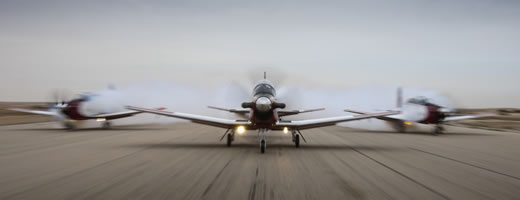
The IAF currently operates the Texan T-6 as an advanced and intermediary trainer, followed by F-16A/B used as lead-in trainer for fighter pilots. The IAF plans to field new advanced trainers to augment and replace the aeging A-4T Skyhawks, withdrawn from service following repeated safety incidents, due to their advanced age. Photo: Nehemia Gershuni, NGPhoto.biz
Israel Aerospace Industries (IAI) and Elbit Systems are launching a joint venture aimed at acquiring, operating and maintaining advanced training aircraft for the israel Air Force. The JV will operate under “Joint Entity” established under an agreement signed by the two companies today. The two companies will own equal shares in the new company. Certain portions of the Project’s work scope will be acquired from IAI and Elbit Systems, respectively, in accordance with a work sharing plan determined by the two sides.
The IAF currently operates the Texan T-6 as an advanced and intermediary trainer, followed by F-16A/B used as lead-in trainer for fighter pilots. The IAF plans to field new advanced trainers to augment and replace the aeging A-4T Skyhawks, withdrawn from service following repeated safety incidents, due to their advanced age. Photo: Nehemia Gershuni, NGPhoto.biz
The Israel MoD is currently reviewing contractual possibilities with regards to the Project, based on a request for information (RFI). The two companies are planning to submit a response to this RFI in the coming days, through the Joint Entity. Given the substantial value of the aircraft procurement and MOD commitment for through life cycle cost reimbursment, the value of the projected contract is expected to be substantial to both companies. The scope and long term commitment of the companies and customer could justify financing part of the program by raising capital by in a public offering.
In the framework of a contract for the Project, it is expected that the Joint Entity will seek sources of financing for the establishment of infrastructure, procurement of aircraft, spares, and support equipment, simulators and other taining aids. The IAF has evaluated several options and is currently considering either the South Korean T-50, proposed jointly by Korean Aerospace Industries (KAI) and Lockheed Martin or the Italian M-346 from Alenia Aermacchi, (derivative of the Russian Yak-130). Both aircraft are offered with advanced virtual avionics suite, enabling the trainers to depict the cockpit layout and functionality of state of the art fighters such as the F-16I Block 50/52 (Sufa), F-15I and future F-35.
According to the Agreement, the scope of the Project will be divided to the extent possible equally between Elbit Systems and IAI, and if required, balancing arrangements will be established between the two companies.
Leasing basic, intermediate and advanced trainers to air forces has become a big business for major system integrators, with primes such as Boeing, Lockheed Martin, BAE Systems embarking on such ventures in the U.S., U.K., Canada and Singapore. The Israel Air Force has contracted Elbit Systems and IAI private financeing initiatives for the operation of basic trainers, simulator farms, and maintenance of lead-in trainers. The expected contract for the advanced trainer expected to add significant volume to such initiatives.
IAI and Elbit Systems have already established several JVs for the joint development and marketing of unmanned ground vehicles (G-NIUS). Other joint operations has not been successful, due to firece competition between the two companies.
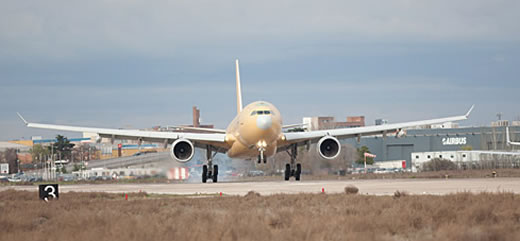
First Airbus Military A330 MRTT for Royal Saudi Air Force makes maiden flight: The picture shows the first A330 MRTT for the RSAF landing at Getafe Airbus Military in Spain. Photo: EADS
The first Airbus Military A330 MRTT for the Royal Saudi Air Force (RSAF) has successfully completed its maiden flight lasting 4hr 15min. Following the 15th March flight the aircraft now enters the final certification and qualification phase for this version of the A330 MRTT, prior for delivery to the customer later this year. The second RSAF MRTT is already in conversion at the EADS’s Getafe site (close to Madrid, Spain) and the third will begin the process in mid-year.
First Airbus Military A330 MRTT for Royal Saudi Air Force makes maiden flight: The picture shows the first A330 MRTT for the RSAF landing at Getafe Airbus Military in Spain. Photo: EADS
Prior to this flight, five A330 MRTTs had already flown. Those include three for the Royal Australian Air Force (RAAF), and two for the UK Royal Air Force. Two of the aircraft are already technically complete and ready for delivery to the RAAF in Getafe, pending finalisation of contractual discussion.
In recent years the Latin American market has been aligned along two parallel axis – one led by the U.S., including Colombia, Costa Rica, Mexico, Paraguay, Peru, Salvador and, more recently Chile. The other, led by Venezuela and its charismatic leader Hugo Chaves, followed by Ecuador, Bolivia and Nicaragua. Prosperous Brazil has remained nonaligned, with economically pressed Argentina leaning toward Venezuela, handing generous support to its fledged economy.
Latin American defense spending is expected to grow from approximately $63 billion in 2011 to more than $65 billion by 2014, according to Forecast International’s “The Military Market for Latin America” report. Forecast estimates that about 20 percent of this amount will be available for military procurements, with the rest tied up in salaries and sometimes social security or pension funding. The market leaders are Brazil, Colombia, Venezuela, Chile and Mexico account for 90% of total defense spending in the region.
Internal conflict remains the primary driver behind the Latin American arms market. While the region as a whole faces minimal external threat; armed guerilla groups pose the real peril to regional stability. However, many of these homegrown guerilla groups are no longer contained within the confines of their own nation and continue to increase in militancy. Assisting local governments combating drug traffickers, the U.S. government is offering significant financial, intelligence as well as operational support, eradicating coca fields, processing and trafficking.
Our sponsor - Rafael
“As violence spills over the borders, the governments of Latin America must push for enhanced military capabilities to fight back,” said Forecast’s Latin America & Caribbean analyst Rebecca Barrett. “It is this internal conflict that is driving the long-overdue force modernization for the region.”
With the region finally emerging from a downward economic cycle, Latin-American defense market has shown stability through the most recent global recession. Thus prospects for the defense market are showing improvement” Barrett said.
“Seeking to boost its position as a global superpower, Brazil’s need to modernize its armed forces is pressing.” Barrett added, “Between protecting its vast offshore oil fields and resource-rich Amazon from terrorist groups, Brazil must rely on its military to protect its national sovereignty and secure its wealth.”
Through the years Brazil has maintained an independent foreign policy, economy, and culture, a strategy that also determined its national defense and internal security posture. While the U.S. and European economies are stagnating, Brazil’s economy has increased dramatically in recent years, along with the world’s fastest growing economies – Russia, China and India (BRIC).
Unlike Brazil, relying on internal funding for defense procurement, Venezuela’s ambitious arms procurement plans are being financed by generous Russian funding. With the U.S. Embargo restricting western trade with the country, Russia has undeniably dominated the Venezuelan market in recent years with sales reaching as high as $6.6 billion. providing that all current contracts are carried out. “Russia is pushing hard for domination of the Latin American arms market and has been successful because of the flexible financing options and wide array of equipment offered at reasonable prices,” said Barrett. “In addition to Venezuela, Argentina and Peru are also emerging as lead buyers of Russian hardware.”
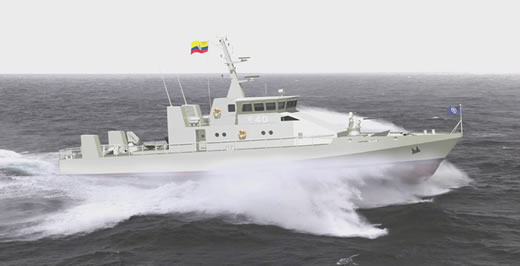
The latest Coastal Patrol Vessel (CPV40) to be commissioned by the Colombian navy was launched December 16th, 2010 at Fassmer facilities in Berne, Germany. The 40 meter vessel will make its maiden voyage to Cartagena, Venezuela through the Atlantic Ocean in early summer, 2011. Photo: Fassmer
Fighting the drugs trade fueling Latin America’s oldest guerrilla war and relying heavily on U.S. military assistance, Colombia has the second-largest armed forces in Latin America, after Brazil. Unlike Brazil’s peaceful situation, Colombia has an ongoing internal armed conflict spilling also over its border with Venezuela.
In 2011, Colombia is expected to spend 20 percent of its national budget on defense, representing 3.9 percent its entire economy. At this level, Bogota is spending the highest percentage of its GDP on defense in the region.
The Colombian Kfir C1 were recently upgraded to C7/C10 versions, and are currently operating along wit a 767 tanker refurbished by Irael's IAI Bedek. Photo: Colombian Air Force via patricksaviation.com
Among the top programs in Colombia are the acquisition of Airborne Early Warning aircraft to augment the Israeli Kfir C7/C10 fighters already operated by the Colombian Air Force, modernization of UH-60 A-L assault helicopters and C-312 systems AT/27 light attack aircraft (Tucano).
The Colombian Army has several ongoing arms procurement programs, including the acquisition of hundreds of new or upgraded main battle tanks and light reconnaissance vehicles. In 2010 Colombia considered the acquisition of ex IDF Merkava but plans are likely shifting toward the upgrading M-60 or Leopard II tanks which have already been introduced in the region (Chile).
The latest Coastal Patrol Vessel (CPV40) to be commissioned by the Colombian navy was launched December 16th, 2010 at Fassmer facilities in Berne, Germany. The 40 meter vessel will make its maiden voyage to Cartagena, Colombia through the Atlantic Ocean in early summer, 2011. Photo: Fassmer
The Colombian Navy has also embarked on several modernization programs, including investing about US$650 million in the modernization of FS1550 missile frigates, U209/1200 submarines and Fassmer 80 vessels, establishing mobile river-support stations along the main inland waterways, acquisition of CN235 Maritime Patrol aircraft and life extension for the Bell 212 naval helicopters.
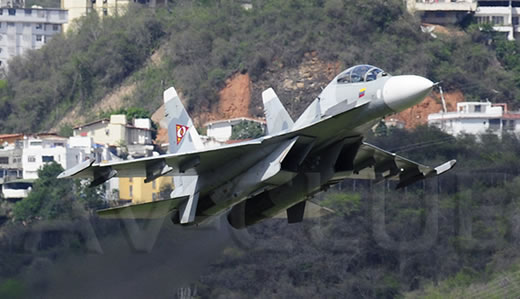
Venezuela received 26 Su-30 air dominance fighters from Russia, as part of the first arms deal signed between the two countries in 2006. In 2011 Venezuela is expected to reach an agreement on a second arms package worth more than US$2 billion. Photo by Enver Cuervos, www.fav-club.com
Following the rise into power of Hugo Chaves, and the U.S. imposing embargo on arms sales to the country, Venezuela reached east to China and Russia for its arms modernization plans. Despite the move’s high profile, President Chaves has not been hasty in committing his economy to excessive spending, releasing firm orders only with vendors granting generous credit lines to finance the deals.
Venezuela received 26 Su-30 air dominance fighters from Russia, as part of the first arms deal signed between the two countries in 2006. In 2011 Venezuela is expected to reach an agreement on a second arms package worth more than US$2 billion. Photo by Enver Cuervos, www.fav-club.comThe delivery of Igla-S man portable air defense missiles (MANPADS) to Venezuela raised concern in the U.S. that these missiles will fall into the hands of terrorists or druglords improving their capability to hit civil aircraft and counter-terror forces of neuighboring governments. Photo: Enver Cuervos, www.fav-club.com
Revamping the country’s air defense was the first step in the modernization of Venezuela’s military. In 2006 China supplied Caracas three JYL-1 long range air surveillance radars. Venezuela’s first large acquisition of Russian arms was also marked in 2006, with Caracas ordering 24 Russian Sukhoi Su-30 air dominance fighters, with comprehensive weapons assortment including 200 KAB-500 and KAB-1500 laser guided bombs, 50 Kh-29 air-to-surface missiles, 50 Kh-31A1 anti-ship missiles, 50 Kh-59ME electro-optically guided missiles and two types of air/air missiles – 100 Vympel R-27 medium range AAM and 150 Vympek R-73 short range missiles. To fuel these deals Russia has granted Venezuela credit worth one billion US$.
Along with this massive package, Venezuela received 40 Mi-17 and 3 Mi-26 transport helicopters along with eight Mi-35 gunships. 100,000 Kalashnikov assault rifles and Igla-S Man-Portable Air Defense missiles (MANPADS) were also delivered. Since 2008 Venezuela also received 24 Chinese K-8 Karakorum jet trainers from China to be used as advanced trainers.
Following a visit to Caracas in 2010, Russian Prime Minister Vladimir Putin said that Venezuelan orders for Russian arms could top US$5 billion. To encourage these orders, Russia has issued credit lines up US$2.2bn of the total amount, enabling deliveries to be expedited through 2010-2011. Part of the package included 92 T-72 tanks and S-300 advanced anti-aircraft missile systems. Despite the U.S. imposed embargo, Venezuela is negotiating a deal with Spain’s Navantia for the modernization of the country’s shipyards.
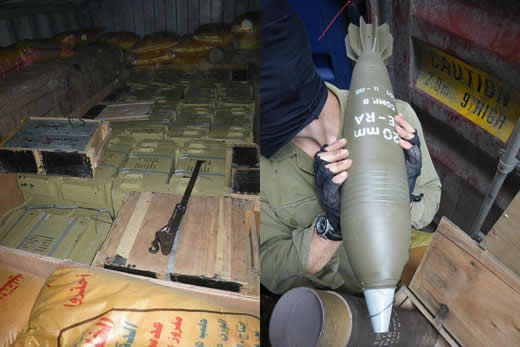
A weapons cache uncovered in the cargo bay of a Liberian flagged vessel Victoria, intercepted toay by the Israel Navy. The cahche contained 120mm (shown here) and 60mm mortar bombs, and other arms. Photos: IDF Spokesman
This morning Israeli Naval vessels intercepted the Liberian flagged cargo ship ‘Victoria’ about 200 miles west of the Israeli coast, after intelligence reports indicated the vessel could be carrying arms shipments destined for Gaza.
Victoria being intercepted earlier today by Israeli Naval Commandos. Photo: IDF SpokesmanC-704 anti-ship missile found by the Israeli commandos on the Victoria. This Iranian made missile was destined for the Palestinians in the Gaza strip. Photo: IDF Spokesman,
An initial investigation revealed the ship was loaded with C-704 anti-ship missiles – shore-to-sea missiles with a range of 35 km that could put at risk Israeli vessels at sea as well as strategic infrastructure targets near Ashkelon. Iran is known to possess and is actually producing such missiles, which, along with identifying documents (including a missile identification document, below) gives substantial evidence of Iran’s involvement in the weapons smuggling attempt, and yet another example of Iran’s use of innocent merchant ships as a means of transferring arms to terrorist organizations.
By first daylight, Naval commandos boarded the vessel and verified the existence of weaponry on board. Following the encounter with the Israeli Navy the Victoria headed to an Israeli port of Ashdod for detailed inspection of its cargo. The vessel was on its way from Mersin Port in Turkey to Alexandria Port in Egypt. According to Israeli assessments, the true destination of the weapon shipment was probably the Egyptian port of El-Arish, from where the shipment would be smuggled on land, through tunnels, reching terror organizations operating in the Gaza Strip.
According to shipment documents and crew questioning, the vessel initially departed from Lattakia Port in Syria and then proceeded to Mersin Port in Turkey. “Turkey is not considered as involved in the incident in any way” an Israeli statement clarified.
The interception of the Victoria today is only one stop in the Israeli pursuit of arms transfers from Iran to terror organizations in the Middle East, including Hamas and Hizbollah. Interestingly, the recent vessels involved in arms smuggling from Iran – the Hansa India, Francop and Victoria were registered in Germany.
Some of the Iranian arms shipment interdicted by the Israel Navy in recent years include:
May 7th, 2001: The Santorini, a Syrian registered ship acquired by the PFLP-GC terrorist group, was intercepted on its way from Lebanon to the Gaza Strip. It carried 40 tons of weapons, including anti-aircraft missiles, mortars, rifles and guns, grenades, mines and explosive material, anti-tank RPG-7 missile-launchers, and artillery rockets. The ship’s captain, a convicted weapon smuggler and two of his relatives abroad the ship had been involved in three previous smuggling attempts backed by Hezbollah and PFLP-GC. Part of the anti-tank weaponry originated from Iran.
January 3rd, 2002: Karin-A was intercepted in the Red Sea, heading towards Gaza. The ship 50 tons of weapons packed in 80 submergible containers. The shipment included RPG-7 rockets, RPG-18 anti-tank rocket launchers, Iranian-made anti-tank and anti-personnel mines, 2,200 kg of military grade high-explosive, assault rifles, machine guns, and hand grenades, 700,000 rounds of small ammunition, and diving equipment. The submergible containers were to be dropped into the sea and then washed ashore the Gaza Strip or picked up by a smaller vessel and delivered to the Strip. The PLO and leadership of the Palestinian Authority were directly involved in the plan. The ship was purchased in Lebanon and sailed to Sudan and Yemen to pick up civilian goods to disguise the weapons aboard.
May 21st, 2003: Abu Hasan, a fishing boat was intercepted at sea west of the Israeli port of Haifa, sailing from Lebanon to Egypt carrying a shipment of explosives sent from Lebanon, bound for the Gaza Strip. The cargo also contained radio-activation systems for remote activation of explosive charges, rocket fuses and detonators.
October 12th, 2009 Hansa India sailing from Iran flying a German flag, Hansa India was due to unload a cargo of eight containers in Egypt. Following warnings from the German authorities, the vessel was not unloaded and continued to Malta where it was seized and found to be carrying bullets and industrial material intended for the production of weapons, seemingly bound for Syria.
November 3th, 2009: Francop, a German vessel was intercepted by the Israel Navy off the coast of Cyprus en route from Iran to Syria, The ship contained 36 containers with 500 tons of arms: 9,000 mortar bombs, 3,000 Katyusha rockets, 3,000 gun shells, 20,000 grenades and half of a million rounds of small ammunition, all hidden behind sacks of polyethelene. The arms shipment was bound to be transferred on land to Hezbullah in Lebanon. The Iranians exploited a civilian ship with its crew unaware of the cargo they were transporting. The weapons cache was loaded at the Bandar Abbas Port in Iran on an Iranian vessel and was transferred at an Egyptian port, unloaded onto the Francop.
A weapons cache uncovered in the cargo bay of a Liberian flagged vessel Victoria, intercepted toay by the Israel Navy. The cahche contained 120mm (shown here) and 60mm mortar bombs, and other arms. Photos: IDF Spokesman
The Marine Corps will buy 80 of the F-35Cs, along with 340 of the F-35Bs. This plan brings the total acquisition of F-35C to 340. Illustration: Lockheed Martin
In an effort to minimize the alarming gap in its fixed-wing marine aviation capability, the U.S. Marine Corps is joining the U.S. Navy in buying 80 F-35C – the carrier-based conventional takeoff and landing variant of the joint strike fighter (JSF). Until the Short Take-Off Vertical Landing (STOVL) F-35B variant is ready, the corps will deploy its fighters from U.S. Navy aircraft carriers.
Under a joint agreement signed yesterday by Navy Secretary Ray Mabus, Chief of Naval Operations Adm. Gary Roughead, and Marine Corps Commandant Gen. James F. Amos, both signed a memorandum of agreement today on the purchase of F/A-18E/F and F-35B/C fighter jets they say will improve air capabilities for both services. “The continued development of F-35B remains the centerpiece of the Corps’s tactical fixed wing modernization program” an official statement the Marine Corps maintained.
The Marine Corps will buy 80 of the F-35Cs, along with 340 of the F-35Bs. This plan brings the total acquisition of F-35C to 340. Illustration: Lockheed Martin
Under the agreement, the two services will maintain the planned acquisition of 680 F-35s but change the proportion between the carrier based and STOVL variants. Under the new plan the Navy will buy 260 of the F-35C carrier variant, with the Marine Corps adding additional 80, along with 340 F-35Bs STOVL versions. Reduction of 80 ‘B’ aircraft is expected to further increase the unit cost of the STOVL version, already blamed to be the most complex, expensive and troubled part of the JSF program.
Addressing the Senate Armed Services Committee last week, Gen. Amos said that flying Marine Corps F-35s off large-deck aircraft carriers was something the Corps was hoping for years. The acquisition of the F-35C will bring this dream to reality. Once the new fighters are operational, the Corps will assign five of its air squadrons to flying the F-35Cs in the Navy’s carrier air wing. The F-35Bs will be assigned to ‘L-class’ amphibious support ships. “Our priority is to do testing of the F-35Cs on the carrier,” he said. “We will learn a lot about the F-35Bs on the L ships” to determine if the STOVLs may be used on carriers. The U.S. Navy operates 11 aircraft carriers and 11 large-deck amphibious landing ships that could support the F-35B.
“These quantities match the fiscal 2012 budget request” Said Thomas E. Laux, the Navy’s deputy assistant secretary for air programs. The agreement reflects the “enduring partnership” of Navy and Marine Corps aviation, Laux said. Training for the aircraft will be “completely integrated,” and there will be only one pipeline, he said.
The new plan relieves some of the pressure from the JSF program as it realigns the development of the troubled ‘B’ model. Defense Secretary Robert M. Gates announced in January that he was placing the F-35B on the equivalent of two year probation due to testing problems with the STOVL aircraft. “It’s my hope we can get off probation well before two years.” said Gen. Amos. He said by this spring, a set of metrics will be available, defining a threshold for getting the airplane off probation and getting it back into the regular mode of production,” the Marine Commandant added.
The first Carrier based F-35C seen here on one of its first test flights, flown by Jeff 'Slim' Knowles. Photo: Lockheed Martin
Brazil has allocated about US$9 billion (15 billion Rais) for defense spending, but natural disasters hitting the country, required emergency funding, part of which will be allocated by slashing over a quarter of the 2011 defense spending, being reduced to $6.6 billion (around 11.2 billion Rais). Minister of Defense Nelson Jobim said in February that the reduction will apply mainly to operating and sustainment spending. But a few acquisition programs were also affected.
The UT-30BR comprises a low profile, armored, unmanned turret comprising the gun mount, target acquisition and fire controls, along with coaxial mount for machine gun (7.62 mm). The system also features an advanced fire control system with automatic target tracking, ballistic computing, sensors management and displays. The target acquisition system includes a dual-axis stabilized gunner’s sight, integrated laser rangefinder, video daylight and thermal cameras. Photo: Elbit Systems
Lacking a definitive cross-border threat, Brazil was slow to invest in major acquisition programs such as the FX-2 advanced fighter, aircraft carrier, submarines and armored vehicles modernization. Today, as Brazil is seeking major regional power position, the country is fully committed to naval modernization programs, helicopter acquisitions and the fielding of new armored vehicles, once decisions are made.
Within the land forces, current acquisition programs include the procurement of more than 2,000 medium armored vehicles. The VBTP-MR Guarani made by Iveco is already underway. Additional contracts for light armored vehicles are also expected. Since 2009 the Brazilian army also received 220 Leopard 1A5 tanks from German Army surplus, refurbished by the German manufacturer KMW. Fielding of night vision equipment, light weapons, ground surveillance radars are expected. Modernization of command and control networks, through the acquisition of advanced software defined radios is also in the planning. Intelligence support will be enhanced with the acquisition of modern electronic warfare and communications surveillance (COMINT) means. Mobile air defense systems are expected to bolster land forces defense against aerial attack.
The first fully modernized AMX is expected to fly in early 2012. Photo: Sgt. Johnson Barros, FAB
The Brazilian Air Force acquisition of the next FX-2 generation fighter and associated weaponry has been underway for several years, but decision has been delayed till 2012, due to budget constrains. For the FX-2, Brazil is evaluating three options – the Rafale, Gripen NG and Super Hornet. For the longer term, Brazil is planning to develop an advanced fighter, to be matured toward the end of this decade (around 2019). For this program preliminary offers for cooperation were submitted by Russia. Acquisition of new helicopters and unmanned aerial systems is already underway. Other major programs include the induction of locally developed and produced transport/tanker – the KC-X2 to be based on Embraer’s C/KC-390. In the coming years Brazil is also expected to field new multi-mission aircraft, including maritime patrol aircraft, electronic warfare support aircraft and airborne early warning platforms, these functions are currently supported by the locally built Embraer ERJ-145 platform.
Our sponsor - Rafael
Developing space capabilities, Brazil is planning to launch reconnaissance satellites operating in a polar orbit supporting national security missions. Sofar the country relied on imagery obtained from commercial providers and on imagery obtained from three China-Brazil Earth Resources Satellite (CBERS) launched by the Chinese-Brazilian consortium since 1989. Brazil is planning to position communications satellites in geostationary orbit to superior coverage of the large country. To operate these assets Brazil plans to construct a central ground operations center, while supporting specific users in the different states via mobile ground control stations.
A satellite view of the Rio de Janeiro naval base, showing the Brazilian Navy aircraft carrier Sao Paolo, a Tupi submarine on a flaoting dock and three Inhauma class frigates at the port. Photo: Imagesat International
The Brazilian Navy has already embarked on construction of new nuclear powered and French designed Scorpene class conventional (diesel/electric) submarines, augmenting the five Type 209 subs currently being upgraded. The Navy has been refitting the ex-French Navy Clemenceau class aircraft carrier, the São Paulo since 2005. The new carrier should be ready for service in 2011. Brazil is planning to equip its new carrier with a revamped air wing, equipped with airborne early warning and flying tankers, utilizing the S-2T Turbo Tracker platform. For the time being, the combat element on the vessel relies on the obsolete A-4E Skyhawk, but as the new vessel will reach full operational capability, it is likely to attract new interest in the acquisition of modern carrier-based fighters such as the F-35B/C, Rafale or MiG-29K.
Enhancing internal security over the vast amazon region is given extra attention, with the acquisition of river transport vessel for the Amazon and Pantanal area and a hospital assistance vessel for the Amazon region. To enhance maritime security throughout Brazil’s Economic Exclusion Zone (EEZ) the Navy is planning to operate an Italian designed 1,800 ton Oceanic Patrol Vessel (OPV), multi-purpose escort ships and a logistics support vessel. The first two NAPA class 500 ton ‘Vigilante’ class patrol vessels have been commissioned since 2009 with additional four being underway. Brazil aims at building 17 such vessels. The Navy is also planning to field new amphibious support vessels. Improving the proficiency of crews by advanced simulation and enhanced capabilities through the fielding of more advanced combat systems and maritime electronic warfare systems, in support of surface and sub-surface operations.
A new structure of the ministry of defense is promoting better coordination among various branches, and increased interoperability through the creation of a joint staff. The military is also on the way to implement new, network-enabled, joint-operations doctrine. This structure also enables the military to enhance internal security operations, in support of law enforcement programs undertaken by the federal and local authorities.
Brazil’s homeland security market has grown significantly in recent years and is expected to surpass current national investment in defense, as the country prepares laying the infrastructure in support of major international events in coming years. Among these events are the World Military Games to be held in July in Rio de Janeiro, hosting 5,000 athletes from 110 countries; the FIFA World Cup planned for 2014, will take place in 12 venues across the country; Brazil is expected to spend US$2.8 Billion on security and over $8.6 Billion on infrastructure improvements toward these games. By 2016 Brazil will host the summer Olympic Games. Toward this event, the country will spend additional $1.4 billion on security and $10 billion on venues and infrastructure. (Read more about Brazil’s HLS opportunities.)
Lockheed Martin Skunk Works® and XTEND have achieved a major milestone in JADC2 by integrating the XOS operating system with the MDCX™ autonomy platform. This technical breakthrough enables a single operator to simultaneously command multiple drone classes, eliminating the friction of mission handoffs. From "marsupial" drone deployments to operating in GPS-denied environments, explore how this collaboration is abbreviating the data-to-decision timeline and redefining autonomous mission execution.
As traditional defense primes face mounting competition from agile “neoprimes” such as Anduril, Palantir and Helsing, the balance of innovation is shifting toward software-defined warfare and scalable, dual-use technologies, while global industry consolidation—marked by Boeing’s integration of Spirit AeroSystems and other strategic mergers—signals an intensified race to secure control over the defense technology value chain. Our Defense-Tech weekly report highlights these trends.
In early October 2025, a coordinated wave of unmanned aerial system (UAS) incursions—widely attributed to Russia—targeted critical infrastructure across at least ten European nations. The unprecedented campaign exposed the fragility of Europe’s air defenses...
Executive Summary
The past week (September 18-25, 2025) represents an inflection point where strategic defense concepts have transitioned from doctrine to tangible reality. An analysis of global events reveals four primary, interconnected trends shaping an...
At the 2025 Air, Space & Cyber Conference, U.S. Air Force and Space Force leaders unveiled major updates on next-generation fighters, bombers, unmanned systems, and space initiatives, highlighting both rapid innovation and critical readiness challenges as the services race to outpace global competitors. A short version is available here, with a more detailed version for subscribers.
The Taipei Aerospace & Defense Technology Exhibition (TADTE) 2025 crystallized around four dominant strategic themes that collectively illustrate Taiwan's comprehensive approach to defense modernization amid escalating regional tensions. Based on a detailed report by Pleronix (available upon request). Includes a Podcast discussion on TADTE 2025's highlighting Taiwan's four strategic themes beyond the post's coverage.
Israel’s Iron Beam 450 high-power laser system has completed final testing, marking a major leap in air defense. Developed by Rafael, it offers precise, cost-effective interception of rockets, UAVs, and mortars, and is set for IDF deployment by 2025.