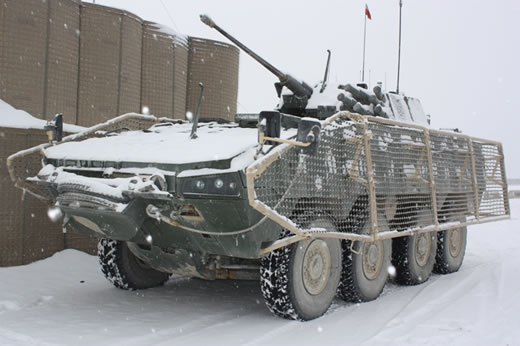
A Rosomak M1 (Patria AMV) of the Polish Army in Afghanistan, equipped with RPG Net offering RPG protection. Photo: Polish Ministry of National Defence
The U.S. Army has ordered 829 rocket-propelled grenade RPG Net kits for the MaxxPro Mine Resistant Ambush Protected (MRAP) vehicle. In February 2011 the Army (TACOM) awarded Navistar Defense a $40 million contract to supply the kits designed to augment the MaxxPro MRAP vehicle protection, improving its effectiveness in defeating RPG attack. The RPG Net, developed by QinetiQ North America, has been developed to defeat RPGs by disrupting their fusing mechanism as the incoming rocket is trapped by the net.
A Rosomak M1 (Patria AMV) of the Polish Army in Afghanistan, equipped with RPG Net offering RPG protection. Photo: Polish Ministry of National Defence
The RPG Net provides a lightweight solution used as an add-on protection on top of existing armor. It can be used to protect the entire vehicle, or apply on specific locations where other types of armor are less effective. Navistar is expected to deliver the kits by the end of July 2011.
Net/ mesh protection against RPGs is not a new concept, in fact it was tried and tested since the invention of the shaped charge anti-tank warhead in the second world war. It was used during by the U.S. Army and Marines during the Vietnam War and even as makeshift protection measures by some of teh forces deployed to Afghanistan. Two concept are currently offered – the wire-mesh SidePro made by the Swiss company RUAG and the RPG Net, manufactured of ultra-strong net made of composite materials, offering low-weight and effective protection against RPG. The RPG net has already been employed on the Polish AMV Rosomak M1 deployed in Afghanistan. The current order for the Maxxpro MRAP is the first use of the RPG net on this type of vehicle which has sofar employed only bar (slat) armor solutions.
The British forces are also expecting to receive a similar armor by the summer of 2011, following an order for the QuickShield quick-repair armor for its armored vehicles.
The Indian Army is planning to equip its ground forces with thousands of anti-tank missiles to be built in India. The Indian military considers two options, both of them exclusive – the FGM-148 Javelin, proposed under a Government-to-Government (G2G) program via U.S. Foreign Military Sale (FMS), and the Spike MR, proposed by Israel’s Rafael Advanced Defense Systems, being the only bidder in an international tender, which specified characteristics and specifications only the Israeli company could meet.
India Plans to buy thousands of Israeli Spike missile to equip its armored infantry fighting vehicles. Photo: RAFAELThe Indian MOD is still undecided on which missile will replace its current Milan 2. The U.S. is offering the FGM-148 Javelin as part of a Foreign Military Sale program. Photo: Raytheon
The Indian Army plans to install the missiles on infantry combat vehicles currently carrying locally produced AT-5 or Milan missiles.
The Indian Ministry of Defense plans to order 321 launchers, and 8,356 missiles, plus 15 training simulators in a multi-phase arms package worth over one billion US$. Two options are currently on the table – the U.S. Javelin and the Israeli Spike MR.
The current decision by the Indian authorities clears the way for an official selection of Rafael as a preferred supplier of the missile but does not guarantee winning the order, since as a single supplier a company is most exposed to procedural and bureaucratic objections that are likely to delay the program, enabling competitors to gain pressure in hope for a wind change at the Indian MOD. Overall, a single supplier status is often approved for short term programs, justified by rapidly addressing urgent operational requirements. (An examplem is the recent French acquisition of Javelin missiles, to equip its units in Afghanistan.)
Recent news reports (Defense News 24 June, 2010 and 24 March, 2011) claimed both companies have won the program. Both are premature, and, technically, both can be correct, as the Indians have not made their selection yet. Both programs are proceeding in parallel channels; each has its own advantages and obstacles. Eventually, only one channel will be selected – either the open bid contract or the G2G path. The later means the work share Indian companies will get would be minimal (unless Lockheed Martin and Raytheon will be authorized by the U.S. government to outsource Javelin work to India, a procedure that hasn’t been approved yet). In addition to limited local production will not be possible, as the procurement would be made through the U.S. Army channels and, as such, is likely to be more expensive than the Israeli alternative. On the positive side, the G2G path is less susceptible to public scrutiny and bureaucratic obstacles, and therefore, could be available in short term.
The open selection means the process will be longer, yet offer much more Indian industrial involvement, technology transfer, and local production, in addition to the benefit of offset, as mandated by the Indian government.
Rafael being the only bidder in this tender, the Indian Army had to obtain a special permit to sign a deal on the basis of a tender with just one potential vendor. While technology transfer is a big issue in India, another reason for the absence of competitors was the Indian insistence on unique weapons performance – the Indians demanded that the missiles will enable “active-passive fire-and-forget guidance system”, which only Rafael can offer. Off the shelf third generation (3G) missiles are employing passive sensors to lock on the target before launch, and perform ‘fire and forget’ engagement. At present, only the Spike can offer ‘active passive 3G fire and forget’ – the ability for the user to correct the missile’s aiming in flight, as it closes in on the target, thus offering the ‘active’ element of the engagement.
While the Indian Army is currently interested in the medium range version of Spike, other requirements also include will longer range guided weapons which could offer the Spike an advantage in establishing a common logistics, training and support.
As industrial participation and technology transfer, if Rafael eventually wins the order, the Indians will get the first deliveries of missiles from Israel but Rafael is likely to shift production to India, as it successfully have done in other markets, some of the recent examples include Poland and Spain. In India, Rafael is likely to work with Bharat Dynamics Ltd., an Indian government-owned company specialized in missile development and production. In addition to missile assembly, India could produce most of the system, particularly if Rafael is successful in negotiating the joint venture it plans with Bharat Electronics Ltd (BEL), in establishing a private, India based company to produce missile seekers for air/air and surface/air missiles. This JV could also address the Spike’s EO seekers.
The Department of Defense (DoD) today issued a stop work order in connection with the Joint Strike Fighter alternate engine program, halting development of the F-136, which was designed to offer competing engine option for F-35 customers. The program is under development by a consortium of General Electric and Rolls Royce. While the announcement does not terminate the alternate engine program, it poses significant doubts as to its future.
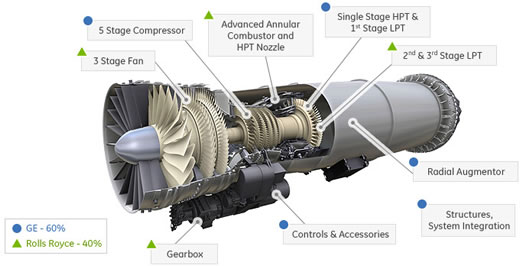
The F-136 engine was designed to offer a competitive engine option for F-35 customers. Image: GE AviationDavid Joyce, President & CEO, GE Aviation
“We are not deterred by this decision and feel so strongly about this issue, as do our Congressional supporters, that we will, consistent with the stop work order directives,self fund the F136 program through this period”, said David Joyce, President and CEO of GE Aviation. “We will not walk away from a $3 billion taxpayer investment and your hard work to deliver what the Senate has called a ‘near model program.'” He said in a letter to GE AViation employees. Joyce said the F136 engine is meeting or exceeding performance expectations, is demonstrating significant advantages over the Pratt&Whitney engine, and is nearly complete. On the other side, Joyce claimed the competing engine – P&W F135 – has racked up $3.4 billion in cost overruns with continued delays and technical issues.
All initial F-35s were powered by the Pratt & Whitney F135. New contracts from 2010 onwards were planned to be competitively tendered from Lot 6 onward. The F-35B STOVL version of the JSF are equipped with the Rolls-Royce LiftSystem regardless of which powerplant is selected.
The Pentagon has been trying to terminate the alternate engine for five years but lawmakers have repeatedly added funding, citing concerns about associated jobs and the need to maintain more than one engine option to power thousands of new fighters. “The administration and the DoD strongly oppose the extra engine program, as reflected in the President’s fiscal 2012 budget proposal that was recently submitted to Congress” the Pentagon announced.
Reflecting the DOD attitude, recent fiscal years budget proposals as well as the FY 2012 President’s budget request did not include funding for the alternate engine. The battle on its funding waged on Capitol Hill between opponents and supporters of the program, which means $100 billion in future spending exclusively to Pratt & Whitney or split by P&W, General Electric and Rolls Royce.
The F-136 engine began full engine testing in July 2004 and delivery of production engines was expected this year. GE is responsible for 60 percent of the program, developing the compressor, coupled turbine, controls and accessories, structures and the augmentor. Rolls-Royce, with 40 percent of the program, is responsible for the fan, combustor, low-pressure turbines and gearboxes.
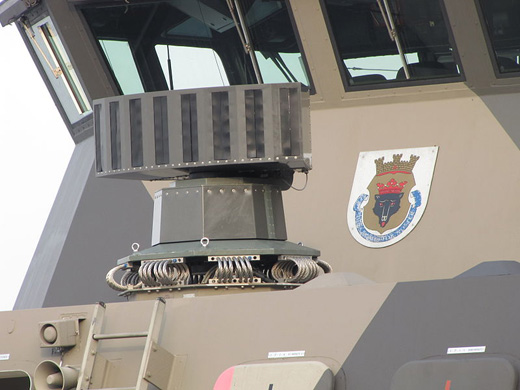
MASS (Multi Ammunition Softkill System) decoy launcher of the Finnish missile boat Pori.
To protect their fleets from missile attacks, the navies of Peru, Finland and Germany have all ordered MASS, Rheinmetall’s “Multi Ammunition Softkill System”, a state-of-the-art decoy system for protecting frigates, corvettes, minesweepers and patrol craft. In winning these three orders, MASS has once again outclassed its international rivals as well as gaining a foothold in the South American market. The three orders are worth a total of approximately EUR15.5 million.
MASS (Multi Ammunition Softkill System) decoy launcher of the Finnish missile boat Pori.
As part of a comprehensive modernization of its LUPO-class frigates, the Peruvian Navy has placed an order with Rheinmetall Defence initially to equip two ships with the MASS naval countermeasure system. The contract also includes an option for equipping two more frigates of this class within the next two years.
The German Navy has awarded Rheinmetall with another follow-on order for equipping its minesweepers with MASS, reflecting the great emphasis Germany places on force protection.
Following immediate retrofitting in 2008 of two countermine vessels in response to an urgent operational requirement (UNIFIL), two more vessels of the same class were equipped with MASS in 2009. Under the current order, two more countermine vessels will be equipped with a MASS two-launcher configuration with integrated detection unit.
The Finnish Navy, opting once again for MASS, has contracted with Rheinmetall Defence to retrofit six RAUMA-class missile boats. In 2002, Finland – the system’s pilot customer – had its Hamina-class fast attack craft outfitted with MASS technology.
Since its market launch in 2002, customers around the globe have ordered no fewer than 172 launcher units.
Superior protection with MASS Guided missiles and other projectiles pose a constant threat to civilian shipping and naval vessels alike. MASS protects ships from attacks using advanced, sensor-guided missiles on the high seas and coastal waters as well as from asymmetric, terrorist-type threats. MASS fires decoy rounds which lure incoming projectiles away from their intended target.
Fully automatic, the MASS naval countermeasure system offers significant tactical, operational and logistical advantages and can be installed onboard any vessel. Moreover, it can be integrated into any command and control system or operated in standalone mode.
The MASS system’s innovative, programmable omnispectral rounds assure protection in all relevant wavelengths of the electromagnetic spectrum (radar, infrared, laser, EO, UV). Numerous international test campaigns have demonstrated its effectiveness in compelling fashion.
MASS with integrated detection unit Featuring an integrated detection unit, the “MASS ISS – Integrated Sensor Suite” represents an innovative departure in naval electronic warfare. Jointly developed by Rheinmetall Defence and Saab (Electronic Defence Systems), this new version of MASS comes with sensors capable of detecting both radar and laser threats.
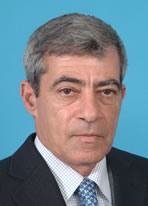
. IAI's CEO, Itzhak Nissan: "IAI continued to set aside resources for investments in strategic projects"
Israel Aerospace Industries reported today an increase of 54 percent in its net profit in 2010, compared to the net profit reported in 2009. Overall, the company reports net profit of $94 million, from annual sales of $3.15 billion. Part of the increase in net profit was attributed to the sale of IAI shares in its former subsidiary Spacecom, which contributed $34 million to the bottom line. In the past year the company increased sales by 9 percent over 2009, passing again the milestone of $3 billion sales per year (2007 and 2008 were IAI’s best year ever, with sales of $3.58 billion).
“The growth in sales and profit and the state of the company’s cash flow reflect IAI’s strength and its continued preparation for privatization.” said Chairman of IAI’s Board of Directors, Yair Shamir “The setting in motion of the privatization process is called for, subject to a decision by the Government of Israel”.
In fact, the orders intake through 2010 was $4.4 billion, increasing the backlog by one billion, to $8.9 billion by year’s end. This level reflects an increase of 13 percent from the beginning of the year. In 2010 IAI’s domestic operations reduced to 20 percent, mostly in defense business, while export activities surged to 80 percent ($2.5 billion) reflecting a mix of commercial aviation and military orders. Recovering from the economic crisis of 2009, IAI’s commercial aviation sales have increased by 19 percent in 2010, reaching about 769 million, derived primarily from passenger aircraft conversions and overhauls, both are considered precursors of recovering market trends.
. IAI's CEO, Itzhak Nissan: "IAI continued to set aside resources for investments in strategic projects"
Sales of defense systems increased 7 percent over 2009, amounting about $2.4 billion. Through the year IAI invested over 4 percent of its sales ($137 million) in research and development, increasing 13 percent over R&D investments in 2009. IAI’s CEO, Itzhak Nissan emphasized the company’s growth potential as the commercial market reaches full recovery. “Our performance reflects the company’s strength in a year when the commercial market hasn’t reached yet its level prior to the global crisis.” Nissan stated that, in addition to increasing R&D funding, IAI also continued to set aside resources for investments in strategic projects such as the G250 and heavy UAV’s. Gross profit reported in 2010 has increased by 4 percent over 2009, to $455 million. Gross profit growth was pressed down by the weakness of the US dollar against the Israeli Shekel. To stem cost increases, IAI implemented a company-wide profitability initiative, increasing efficiency, and implementing cost-cutting measures resulting in better margins.
VADM (Ret.) Yedidia Yaari, Rafael’s President and CEO
Rafael Advanced Defense Systems Ltd. ended the year 2010 with a record net profit of $170 million, with orders totaling $1.9 billion, an order backlog of almost $3.5 billion and sales of $1.8 billion. As in 2009, 74 per cent of the sales were derived from export orders.
VADM (Ret.) Yedidia Yaari, Rafael’s President and CEO
“Our achievements in 2010 were the result of Rafael’s ability to implement its goals, while adjusting to changing condition that demanded quick solutions, these achievements, joined by a positive start of 2011 will create further growth” said VADM (Ret.) Yedidia Yaari, Rafael’s President and CEO. Rafael’s order backlog in 2010 was $3.5 billion, comprising 1.8 years of sales activity, of which 74% is intended for export to countries in Europe, Latin America, the U.S. and the Far East.
Israel’s Rafael Advanced Defense Systems continued its growth and increased net profit in 2010, as reflected by the financial report the company published today. Despite a decrease in sales compared to 2009, Rafael posted a record profit $170 million (%9.2 of sales) this year but this net profit resulted from financing revenues resulting from the sale of its subsidiary Medingo, which significantly contributed to Rafael’s profits. Medingo, a developer of micro pump insulin delivery system, was sold the Swiss based pharmaceutical company Roche for $160 million. Rafael’s interests in Medingo were managed through its civil subsidiary, responsible for civilian derivatives of its advanced technology. Currency hedging and research and development activities also contributed to Rafael’s net profit. Rafael provides the national defense-development laboratory for certain defense related areas in Israel, offering Israel’s defense establishment the most advanced systems available.
Rafael achieved its target sales figure for the year, against falling global defense budgets and demand in some of its major markets; Spyder and Iron Dome air defense systems, Spice air-to-surface weapons, Spike electro-optical-tactical precision missile systems, Litening and Reccelite navigation, targeting and tactical reconnaissance pods were among top sellers in aviation related products while various types of armor and protection systems, remote-controlled weapon stations, breaching munitions comprised the land systems sales. Space propulsion activities were also among the fields driving revenues in 2010.
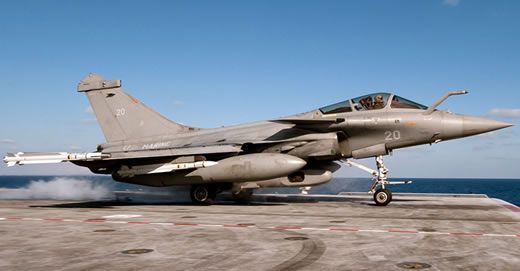
Rafale F3 from the 12e naval aircraft squadron, flew today their first combat mission over Libya. The aircraft carried the RECO NG recce pod and MICA air/air missiles. Photo: French Navy.
On Tuesday morning of March 22, early morning, the French aircraft carrier launched its first mission supporting operation Hartmattan, as Squadron 12E launched two of its Rafale F3 fighters on a four hour combat recce mission over Libya, with the fighters carrying air/air missiles and RECO NG reconnaissance pods, able to transfer aerial imagery in real-time to the combat operations center on the ship.
Rafale F3 from the 12e naval aircraft squadron, flew today their first combat mission over Libya. The aircraft carried the RECO NG recce pod and MICA air/air missiles. Photo: French Navy.Admiral Samuel J. Locklear, commander of Joint Task Force U.S. Odyssey Dawn, visited the aircraft carrier Charles de Gaulle upon arrival at the theater of operation Monday. Photo: EMA / French Navy
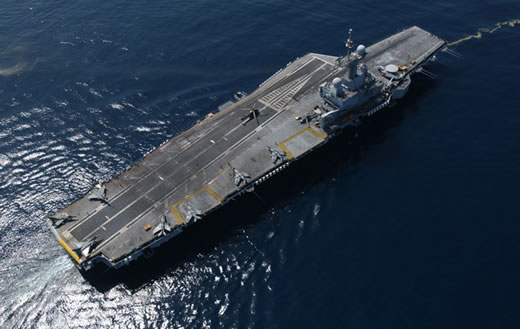
The French Naval contingent supporting operation the operation includes the aircraft carrier Charles de Gaulle, two escort frigates, Dupleix and Aconite and two additional frigates already operating in theater – the Forbin and the Jean Bart.
Admiral Samuel J. Locklear, commander of Joint Task Force U.S. Odyssey Dawn, visited the aircraft carrier Charles de Gaulle upon arrival at the theater of operation Monday, March 21, Where he met Admiral Philip Coindreau, commander of Task Force 473 operating from the French carrier. Admiral Locklear directs is campaign from the U.S. command ship USS Mount Whitney operating off Libya.
The French Naval contingent supporting operation the operation with Task Force 473 includes the aircraft carrier Charles de Gaulle, two escort frigates, Dupleix and Aconite and two additional frigates already operating in theater – the Forbin and the Jean Bart. Photo: EMA / Marine nationale
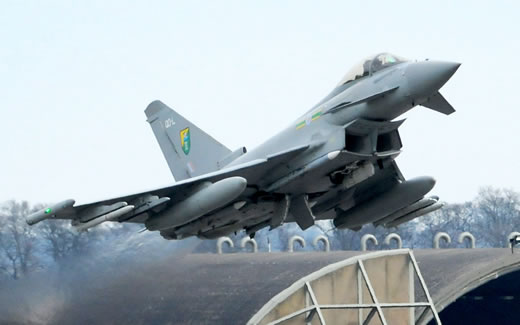
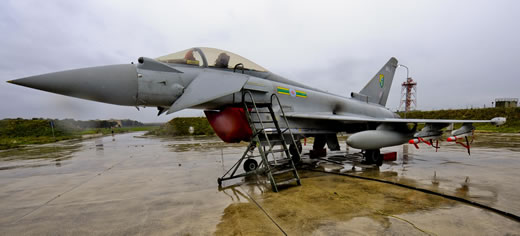
RAF Typhoon fighters, deployed to Gioia del Colle in Italy on Sunday, mounted their first ever mission into hostile airspace, patrolling the no-fly zone under the control of an RAF Sentry AWACS aircraft and supported by an RAF VC10 tanker. Photo: MOD Crown Copyright
Following military pressure mounting with a third night of attack by the coalition, forces loyal to Muammar Gaddafi were reported withdrawing from Benghazi. Shifting their pressure to the west on Tuesday, Gaddafi’s forces attacked two Libyan towns on the eastern border with Tunisia. Realizing that air strikes are not limited to air defense, but are now targeting mechanized formations near rebel concentrations, Libyan forces have taken alternative means of action, utilizing ‘urban guerilla’ type activities, by employing small dismounted formations and snipers to take out rebel targets. Overall, despite the chaos raging in the recent month, Libyan loyal forces seem to be relatively organized and under control, while anti-Gaddafi rebels still struggle accepting an agreement on a command structure that will be able to capitalize on the support by coalition air strikes, as long as it will last.
This F-15E Strike Eagle being prepared for a combat air patrol over Libya has deployed from RAF Lakenheath, to the Aviano air base in Northern Italy. Photo: USAF
Yesterday, coalition air forces have suffered their first loss, as an F-15E crashed in Libya. Both crewmen have ejected and ‘are safe’, a U.S. Air Force statement said. News reports claim the two crewmen were picked up by rebel forces. The incident happened over Libya on 10:30 p.m. as both crewmen ejected after the aircraft ‘experienced equipment malfunction over northeast Libya, the Air Force said. The aircraft, based out of Royal Air Force Lakenheath, England, was flying out of Aviano Air Base in support of Operation ‘Odyssey Dawn’ at the time of the incident.
Three U.S. Air Force B-2 Spirit bombers followed the U.S. Navy cruise missile attack with precision strikes against Libyan airfields and air defenses. Photo: Senior Airman Kenny Holston, USAF
While the U.S. has so far paid most of the bill, spending the majority of ordnance used, France and Britain have yet to agree on who will lead the operations, as Washington plans to pull back to a supporting role. The U.K. has recommended control should be transferred to NATO but France is objecting such move raising concern over Arab sensitivity of European military power being involved in Middle Eastern affairs. Since operation Odyssey-Dawn began, U.S. Army General Carter F. Ham, Commander, U.S. Africa Command is leading the coalition enforcement of the No Fly Zone over Libya. Ham is expected to transition command to one of his European piers in the coming days. “This is a very complex task under the best of conditions,” Han commented, “my goal is to not cause disruptions to the on-going operation while we effect the headquarters transition.”
“The number of countries conducting military operations enforcing the UN resolution continues to grow. US, French, Danish, Italian and British aircraft were yesterday joined on patrol over Libya by Spanish F-18s for the first time. So far this joint operation remains under US command, but this could change, said Major General John Lorimer, the Chief of the Defence Staff’s Strategic Communications Officer.
RAF Typhoon fighters, deployed to Gioia del Colle in Italy on Sunday, mounted their first ever mission into hostile airspace, patrolling the no-fly zone under the control of an RAF Sentry AWACS aircraft and supported by an RAF VC10 tanker. Photo: MOD Crown Copyright
Lacking an aircraft carrier in the area, Coalition forces depended on long-range strikes and cruise missile attacks to gain the initial effect. The U.S. Navy offered the most dominant firepower, supporting the initial attack with Tomahawk cruise missiles while the Air Force’s B-2 Spirits bombers followed with precision strikes against Libyan airfields and air defenses. F-15E Strike Eagles and F-16CJ Fighting Falcons flying from bases in Northern Italy covered these missions. Their primary goal was to eliminate the risk from the Libyan integrated air defense systems, a network of radars, surface-to-air missiles in fixed and mobile sites connected through a command and control system. Although considered a potent threat to an average opponent, the Russian-origin air defenses were no match for the U.S. forces, which have already demonstrated their capability in dealing with modern air defenses in the past.
“We judge these strikes to have been very effective” director of the Joint Staff, Vice Admiral Bill Gortney said in a press briefing in the Pentagon. Directed at the Libyan air defense command and control nodes at known sites, the initial attack has ‘significantly degraded’ Libyan air defense capability in launching their SA5s, SA3s and the SA2s, Gortney said. By the next day (March 20) all Libyan radars were silent. “We detected no radar emission from any of the air defense sites targeted, and there has been a significant decrease in the use of all Libyan air surveillance radars, most of those appear to be limited now only to the areas around Tripoli and Sirte” Gortney added.
While the fixed air defense sites are neutralized, mobile surface-to-air missiles (SA-6, SA-8, SA-24 and many SA-7 type MANPADS) remain operational. As some of these use passive sensors (TV/IR), they do not rely on radar for operation and, therefore, coalition forces cannot pre-empt their attack, but only use self-defense measures (flares, deception etc.) Electronic attack aircraft (E/F-18G Growler) are available to deal with the radar guided sites. This threat is likely to prevent coalition air forces from flying low level missions, and could also restrict the operation of aerial gunships, attack helicopters and casualty evacuation missions in theater.
Among the B-2s targets was the Libyan Air Force base in Ghardabiya, where Libyan fighter aircraft were believed to be parked in hardened shelters. Some 90 shelters were located on this base, each accommodating a single fighter plane (most likely Su-22 or MiG-23/27). Three B-2 Spirit stealth bombers, flying from the Whitman U.S. Air Force in Montana, targeted these shelters with JDAM GPS guided concrete penetration bombs. Many shelters were hit and partly destroyed.
On the opening strike Coalition forces launched 118 Tomahawk and Storm Shadow cruise missiles, targeting air defense and airfields throughout Libya. In total, Coalition forces launched 124 Tomahawk cruise missiles at Libyan air defenses, command and control nodes, a Scud missile site and an air defense site.
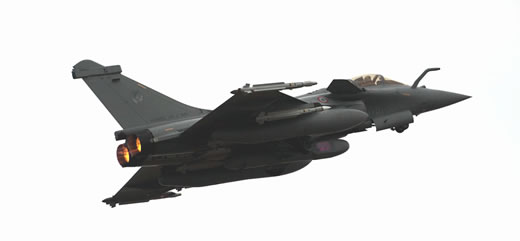
Two French Rafale fighters taxi for to take off from Saint Dizier base, on a mission to Libya. Rafales have been flying combat missions in Libya for the past four days, supporting 'Operation Harmattan', as the French contingency is called. Some of the Rafales are now forward deployed at the Solenzara airbase in Corsica. Photo: EMA Armee de l'Air.
Enforcing the no-fly zone is also making progress, but coalition aircrews still confront dangerous environment, especially with low-level attacks. Despite France and the U.K. gaining high profile for their operations, the U.S. forces are bearing the majority of the work load. Yesterday, about 50 per cent of the missions were flown by U.S. forces with the remaining flown by France, U.K and other coalition partners. Among the U.S. units operating over Libya, F-15E deployed from RAF Lakenheath in the U.K to Aviano air base in Northern Italy, where U.S. Air Force F-16CJs are permamently based. These Falcons were also taking part in the recent combat operations. Others aircraft are supporting combat missions, include EC-135 Rivet Joint electronic intelligence plane, EC-130H Compass Call electronic attack platform, EC-130J Commando Solo psychological warfare platform, KC-135 aerial refueling aircraft and E-3C Airborne Warning & Control (AWACS).
Overall, the Libyan Air Force ceased operations since the ‘No Fly Zone’ regime was declared by the U.N. “I assess that our actions to-date are generally achieving the intended objectives,” Army Gen. Carter F. Ham, said. “We have not observed Libyan military aircraft operating since the beginning of coalition operations.” General Ham said.
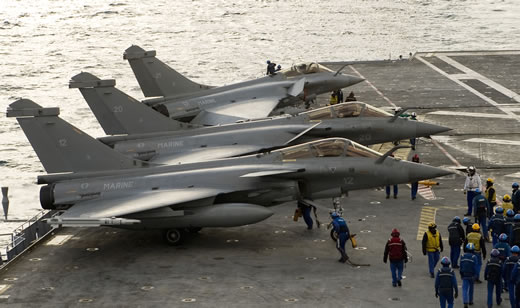
Naval air power stationed off the Libyan coast has now been deployed and is expected to increase the European partners’ operational tempo. The arrival of the French aircraft carrier Charles DeGaulle and the Italian carrier Garibaldi is introducing French Rafale F3 and Super Étendard strike fighters with the Italians operating AV-8Bs, used mostly for ground attack role.
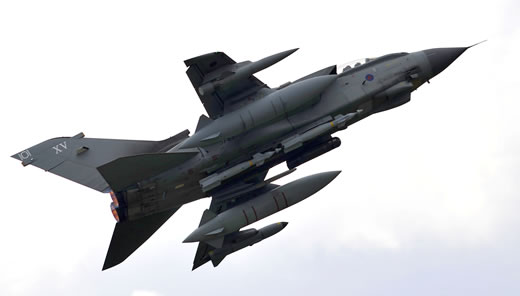
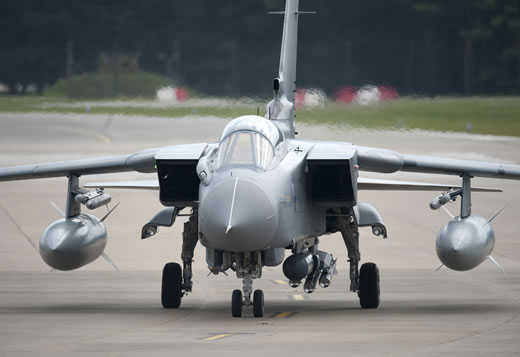
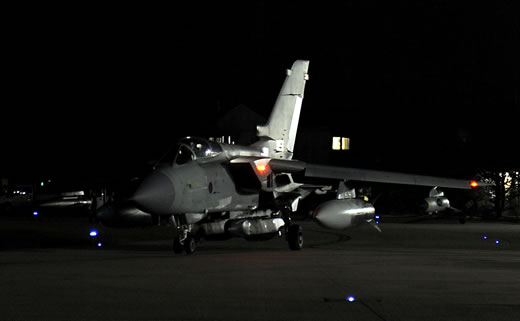
As part of the Operation ELLAMY, the British contingent of the operation, the new RAF Typhoon fighters, deployed to Gioia del Colle in Italy on Sunday, mounted their first ever mission into hostile airspace, patrolling the no-fly zone under the control of an RAF Sentry AWACS aircraft and supported by an RAF VC10 tanker. Separately, a formation of Tornado GR4 aircraft again flew south from RAF Marham. Unlike their previous sorties on Saturday and Sunday, which were focused on Libyan military command and control facilities and air defense infrastructure, their mission yesterday was an armed reconnaissance sortie directly protecting the civilian population against attacks by Colonel Gaddafi’s ground forces. “With their state-of-the-art Litening targeting pods and a variety of precision-guided munitions, the Tornados are very well equipped to identify any emerging threats on the ground and deliver a dynamic and effective response” Major General Lorimer added. On completion of their mission, the Tornados joined the Typhoons at the forward based at Gioia del Colle. Both Tornado GR4 and Typhoons were supported by VC10 and TriStar tankers.
Flying ground attack missions against Libyan government forces is a complex and somewhat ‘fluid’ situation. It seems Coalition attacks depend on their perception of Libyan movements. “There is no intent to completely destroy the Libyan military forces, but concentrate our efforts against entirely threats against civilians, within the scope of the UNSC directives, warns General Ham. Describing a typical operational process involved: ” Taking a particular area, perhaps including some 50 or so km south of the rebel stronghold Bengazi, when we detect a group of vehicles, which we identify as Gaddafi loyalists, we refrain from attacking immediately, instead are watching their actions.” gen. Ham said if Libyan units continue moving away from the conflict area, the Coalition shall maintain observation mode only, letting them get out of the area, “if they are compliant with [the resolution], we shall not attack them” Ham said.
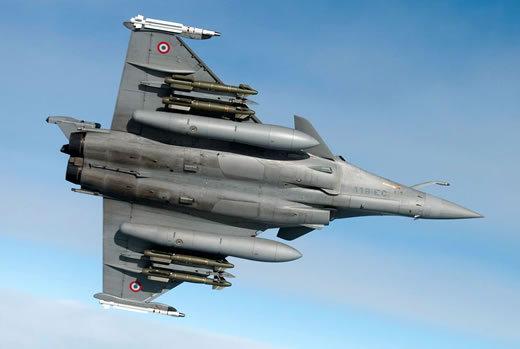
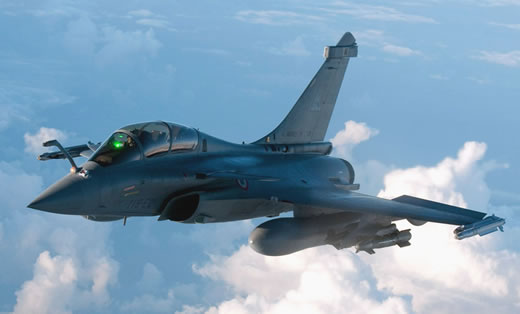
Rafale strike fighter carrying four ASAM guided weapons and two infra-red guided MICA air/air missiles. Photo: EMA, Armee de l'Air
A collection of photos released today by the U.K and French Ministries of Defense illustrate some of the armmament configurations used by tcoalition air forces. These configurations take advantage of the multi-role nature of the Rafale. The fighters deployed today by the RAF included Tornado GR4 which flew combat missions from the U.K., and Typhoons which began deploying from a forward location in Gioia Del Colle, operating with the 906 Expeditionary Air Wing.
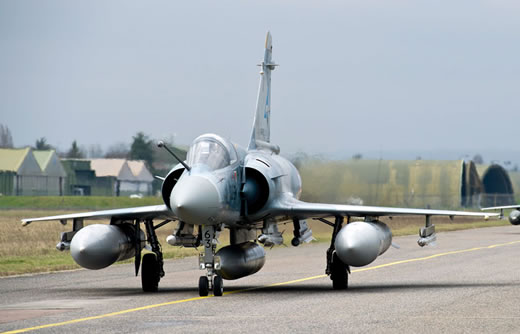
RAF Tornado GR4 takes off from RAF Marham on a sortie to Libya. This aircraft is armed for ground attack, carrying three Brimstone missiles, two GPS enhanced laser guided bombs, ASRAAM air/air missiles and a Litening targeting pod. Photo: UK MODAnother view of the Tornado GR4 on route to Libya with the same ordnance. This configuration is suitable for close air support, with the Brimstone (mmw guided) missiles used for attacking clearly recognizable targets such as T-72 tanks, rocket launchers and armored personnel cariers. Targets having less distinctive shape would be targeted by the LGB using laser designation to clearly mark the target for high precision. Target acquisition is performed by Litening pod mounted forward of the Brimstone pack. .The two ASRAAM missiles are carried for self defense. Photo: UK MOD.A Tornado GR4 from Marham carrying taxi for takeoff on a combat mission to Libya. Note the full complement of Cerberus self defense EW system. A different pod under each wing carries different countermeasures system releasing chaff, flares, electronic deception and jamming . Photo: UK MOD.Rafale strike fighter carrying four AASM guided weapons (Armament Air-Sol Modulaire (AASM) and two infra-red guided MICA air/air missiles. The AASM used on this plane are most likely GPS-guided versions. Infra-red guided version is also available. Photo: EMA, Armee de l'AirThis two-seater Rafale is also participating in the combat missions over Libya. The aircraft carries a similar weapon configuration - four AASM guided weapons and two IR MICA air/air missiles. Photo: EMA Armee de l'Air.French Air Force Mirage 2000-5 prepares for take off on a combat air patrol mission over Libya, armed with four MICA RF guided missiles and two infrared guided short range MICA-IR missiles. Photo: EMA Armee de l'AirEurofighter Typhoon takes off from RAF Coningsby on a combat air patrol over Libya. Air/air ordnance carried by this Typhoon includes four AMRAAM medium range BVR missiles and two ASRAAM short range missiles. Photo: UK MOD
Rafale F3 fighters line up on the deck of the French Aircraft Carrier Charles de Gaule. Photo: EMA Marine Nationale
Coalition air forces today deployed additional naval aviation and air forces units to bases near Libya, enabling highet operational tempo and faster response to development on the ground.
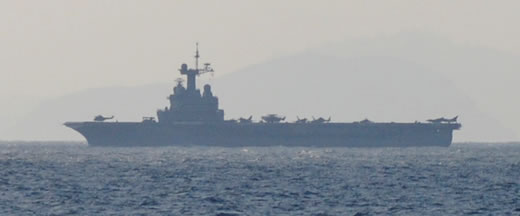
French aircraft carrier Charles de Gaulle (R91) photographed from USS Mount Whitney on March 21, 2011, in the Mediterranean Sea. Charles de Gaulle was operating in support of the coalition led operations in response to the crisis in Libya. Mount Whitney is operating in support of Joint Task Force (JTF) Odyssey Dawn. Photo: U.S. Navy by Petty Officer 2nd Class Daniel Viramontes
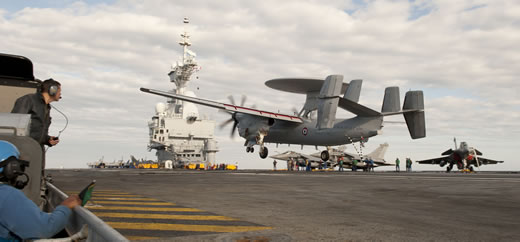
A French E-2C Hawkeye lands on the Charles de Gaule during final training exercise held on board the carrier yesterday. Phoro: EMA / Marine nationale
The French aircraft carrier Charles de Gaulle has deployed to its area of operation with its full air group including F3 Rafale, Upgraded Super Etendard attack aircraft, E-2C airborne warning and control aircraft and EC-735 SAR helicopters. Part of the carrier group are the frigates Dupleix and Aconite and naval replenishment/tanker vessel Meuse. Two additional frigates the Forbin andJean Bart are already deployed in theater, supporting the coalition effort surface and aerial surveillance assisting the enforcement of the ‘No Fly Zone’. From its planned position in the Southern Mediterranean, the French aircraft carrier will provide coalition air forces a forward operating bans close to the Libyan coast, improving the response capability of coalition air power. The French carrier has recently completed a four month deployment in the Indian Ocean.
Rafale F3 fighters line up on the deck of the French Aircraft Carrier Charles de Gaule. Photo: EMA Marine Nationale
While the Navy aircraft areto assume operations from the aircraft carrier at sea, aircraft of the Air Force were initially operating from the French air bases in Avord, Nancy, St Dizier, Dijon. Air bases at Istres, and Evreux Orleans for supported logistical and refueling flights. Rafale fighters arrived today at the Solenzara air base in Corsica, supporting the intensive operation of coalition fighters in enforcing the ‘No Fly Zone’.
French Rafale F3 takes off from on a mission to Libya, March 19, 2011. The aircraft carries the Thales AREOS Reco NG, in addition to six MICA air/air missiles. This configuration enables the Rafale to perform both th ebattlefield recce and air defense role as part of the enforcement of the No Fly ZOne' over Libya. Photo: EMA ECPAd
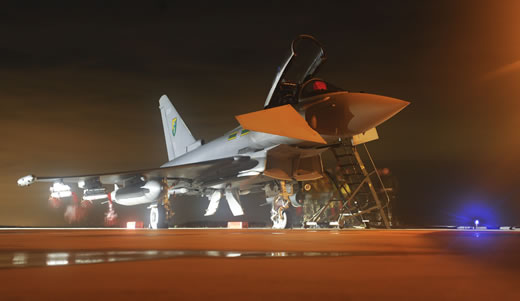
RAF Typhoons have also deployed to a forward base in Gioia Del Colle in southern Italy. The Typhoons flew today their first operational sortie from a Deployed Operating Base. The aircraft, pilots and ground crew arrived here late on Sunday.
Op ELLAMY Royal Air Force (RAF) Typhoon deployed to Gioia Del Colle base in southern Italy. The fighters flew their first mission from the forward base on Monday 21. Tornado strike fighters which flew from RAF Marham on combat patrols over easter Libya have joined the Typhoons at the forward base upon completing their mission. Photo: MOD, Crown Copyright
Paveway-II on its first flight test in 2009. Photo: Lockheed Martin
Lockheed Martin has been awarded a $34.5 million contract from the U.S. Air Force for production of paveway II Plus Laser Guided Bomb (LGB) GBU-12 kits. The majority share contract includes deliveries to both the U.S. Air Force and U.S. Navy and is scheduled to begin the second quarter of 2011.
Paveway II Plus LGB guidance kits significantly improve weapon accuracy and reduce risk to U.S. and allied ground forces when compared to legacy paveway LGBs through implementation of a newly integrated combined hardware and software solution.
Paveway-II on its first flight test in 2009. Photo: Lockheed Martin
In October 2010, the U.S. Air Force completed a Force Development Evaluation Program at Eglin Air Force Base, FL, for paveway II Plus LGB that included GBU-10 and GBU-12 weapons released from F-15 Eagle and F-16D Viper aircraft. Operational test scenarios evaluated system performance compared to legacy paveway II LGB weapons. The paveway II Plus LGB is supported through the U.S. Air Force 53rd Test Wing fielding recommendation for full/unrestricted operational employment of both GBU-10 and GBU-12 configurations incorporating the MAU-209C/B paveway II Plus system.
The new system does not require upgrades or modifications to aircraft, ground handling equipment or logistics support, and continues the same basic paveway II concept of operation for employment by converting conventional gravity weapons into precision-guided munitions. Each kit consists of a MAU-209C/B computer control group containing the electronics guidance system and an air foil group, which provides lift and stability.
Lockheed Martin’s LGB kits can be carried on U.S. Air Force, U.S. Navy and most international aircraft platforms currently authorized to carry and release LGBs. Paveway II and paveway II Plus kits are compatible and interoperable with existing inventory paveway II equipment, handling procedures and aircrew operations.
For many years Brazil’s military relied on surplus equipment acquired from the leading powers. In the 1980s the country shifted to depend on domestic capabilities, developing local manufacturing of armored vehicles, trucks, and aircraft. In recent years, the country is transforming this manufacturing base, through strategic cooperation agreements, directing major investments towards modernizing systems.
In the 2000s, Brazil’s current defense procurement programs drive major orders to local industry, through foreign contractors establishing domestic manufacturing facilities in Brazil. These include the Italian company Iveco, French shipbuilder DCNS and helicopter manufacturer Eurocopter, Israel’s defense electronics company Elbit Systems and UAV prime Israel Aerospace Industries.
In the past decade Brazil’s non-aligned foreign policy drove the country closer to Russia and France and further away from the U.S. The first ‘strategic alliance in 2005 between Brazil and the Russian Federation was signed, and reiterated in 2008 during the visit of President Dmitry Medvedev to Brazil, where the two presidents signed cooperation agreements related to aerospace, nuclear and defense industries.
But the more significant strategic agreement signed with France in 2008, formalized Brazil’s procurement of military equipment from that country, at a total investment of more than US$16 billion. With this agreement Brazil signed orders for a nuclear powered submarine, four additional Scorpène class diesel-electric powered submarines and 50 EC725 helicopters – all produced by French companies. These contracts along with significant technology transfer, production and participation by local Brazilian industry spurred significant growth for the home industry. The next phase would have been the purchase of 36 Rafale fighters, for about $4 billion. However, after the election of new president the decision was delayed for 2012 and Brazil is apparently backing off from these exclusive understandings.
Other parts of the agreement are already underway; Eurocopter is manufacturing the new helicopters at its Brazilian Helibras subsidiary, while the four submarines are being built at a new shipyard being constructed by Odebrecht and DCNS in Itaguaí, Rio de Janeiro. Following yea, the two countries announced a joint venture between Agrale and Renault Trucks to produce military transport vehicles.
Two years later, with a new president at the helm, further agreements are brought to the table, opening the local market for new competition. In April 2010 Brazil and the U.S. signed a defense cooperation agreement, paving the way for closer ties between the two countries, and repositioning U.S. offerings in Brazil’s future fighter acquisition plans. The U.K. followed with a similar agreement in September, aiming at Brazil’s next generation frigate acquisition. In December 2010 Israel stepped in with the signature of bilateral defense cooperation agreement with Brazil, elevating the country as a trusted partner, opening the door for the sale of a broader range of classified defense and homeland security technologies, addressing programs which could potentially be worth billions of dollars.
Several major programs signed between Israel and Brazil are already worth close to one billion US$. The most significant is the sale of IAI Heron I medium altitude long endurance (MALE) Unmanned Aerial Vehicles to the Brazilian federal police. This program also bolstered land- surveillance capabilities along the borders at specific sectors, gained by ground radar systems, electronic fences, electro-optical surveillance equipment and satellite communications. Two other programs that following through, include the development and production of unmanned 30mm gun turrets for Brazil’s future medium armored vehicle, and delivery of Hermes 450 UAV units to the Brazilian Air Force. Both programs are to be fulfilled by local subsidiaries established by Israel’s Elbit Systems.
Based on its ‘multi-domestic’ management strategy, establishing subsidiary operations in strategic markets, Elbit Systems carved its position in the Brazilian market well ahead of other Israeli companies, establishing cooperation agreements with Brazil’s leading aerospace manufacturer Embraer, Elbit and Embraer are cooperating on multiple avionic modernization programs for Brazil’s EMB-312 Tucano trainers, F-5BR, and, more recently AMX fighters. Earning a successful track record with the Brazilian prime, Elbit is likely to cooperate in future programs as well – C-390 being one such opportunity.
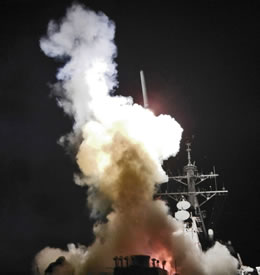
The Arleigh Burke-class guided-missile destroyer USS Barry (DDG 52) launches a Tomahawk missile in support of Operation Odyssey Dawn. This was one of approximately 110 cruise missiles fired from U.S. and British ships and submarines that targeted Libya's air defense sites. Photo: U.S. Navy
Last night the joint task force ‘Odyssey Dawn’, comprising U.S. Navy and Royal Navy surface ships and submarines launched a massive attack on Libya, firing 112 Tomahawk sea-launched cruise missiles. The missiles were fired from U.S. and British attack submarines and U.S. Navy surface ships. An airstrike with Storm Shadow cruise missiles was also launched by RAF Tornado GR4, flying straight from Marham airbase in the U.K., a 3,000 mile return flight. The attack targeted about 20 radar and anti-aircraft sites along Libya’s Mediterranean coast.
Mirage 2000-5 takes off on a combat air patrol protecting a strike force of French Mirage 2000D. Insert: Loading GBU-12 laser guided bombs on the Mirage 2000D. Photos: EMA - Armee de l'AirThe Arleigh Burke-class guided-missile destroyer USS Barry (DDG 52) launches a Tomahawk missile in support of Operation Odyssey Dawn. This was one of approximately 110 cruise missiles fired from U.S. and British ships and submarines that targeted Libya's air defense sites. Photo: U.S. Navy
In addition to the cruise missiles, the United States will provide command and control and logistics. American airmen and sailors will also launch electronic attacks against the Libyan systems.
The United Kingdom, France, Italy and Canada already have announced that they are part of the coalition. Officials expect that some Arab countries may publicly announce their participation soon. Qatar is one of the Arab countries willing to send its airpower to take part in the operation.
Tha attack was part of the enforcement of United Nations Security Council Resolution (UNSCR) 1973 by implementing a ‘No Fly Zone’ over Libya. In preparation for this Resolution, NATO air forces have assembled air assets to southern Europe. Fighter aircraft, reconnaissance and surveillance planes, electronic attack, airborne early warning, aerial refueling and transport planes are all gathering here to assist and support the strike aircraft, attacking the Libyan air defenses, securing the airspace for NATO fighters enforcing the no fly zone act at relative security.
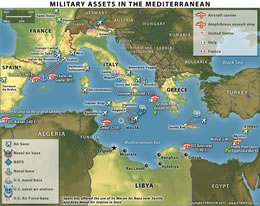
A map prepared by STRATFOR depicting coalition military assets in the Mediterranean, March 2011
Before the current turmoil began Libya had an air defense network comprising SA-2 (GUIDELINE), SA-3 (GOA), and possibly SA-5 (S-200 GAMMON) protecting the main coastal air bases near Tripoli, Bengazi, Sirte and Tobruk. The Libyan military also operates mobile air defense assets, including SA-6 (GAINFUL), SA-9 (GASKIN / 9K31), SA-8 (GECKO / 9K33M3 Osa) and French Crotale air-defense missiles. Large numbers of MANPADS (SA-7), ZSU-23/4 and towed 23mm anti-aircraft cannons remain effective against low-flying aircraft, operated by Libyan government forces as well as by the rebels. Assuming these threats persist even after the static missile sites and their supporting assets (radars, command and control and reload missiles) are destroyed, these mobile and light air defenses will undoubtedly drive NATO fighters to operate and attack from high altitude, where identification of target could become an issue.
RAF Tornado GR4 strike fighter carrying two Storm Shadow cruise missiles flew 3,000 miles from RAF Marham and back making this the longest range bombing mission conducted by the RAF since the Falklands conflict. This attack was part of an air raid by 112 Tomahawk cruise missiles, targeting the Libyan air defenses. Photo: MOD
Libya’s air force is headquartered at Okba Ben Nafi Air Base, east of Tripoli. This airfield used to be the home of Libya’s MiG-25 interceptors. Many of these aircraft were seen in the open, mmostly as scrap. Few months ago the aircraft were moved elsewhere, along with some trainers previously positioned at the base. In satellite photos taken by mid-March 2011 only four MiG-23 fighters can be seen on the tarmac.
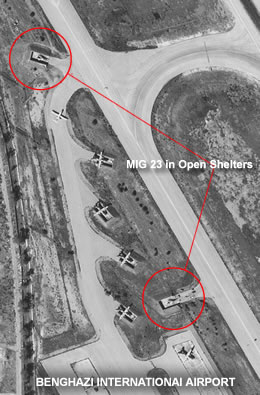
A large airbase at Sirte is colocated with a civil airfield. The military section at this base accomodates two squadrons of Su-22 based in individual hardened shelters and a helicopter squadron. These two airfields remained within Qadaffi’s forces control. Rebels have probably seized the large air base located at Benghazi International Airport, where MiG-23 were stationed. One of these aircraft flown by a pilot who joined the opposition was shot down by rebels on March 19, 2011. A third military base located southwest of Tobruk, (Gamal Abdul Nasser Air Base), is operating Mirage F1. Two air bases are located in the Sahara desert – at Al Kufrah Oasis and at Jabal al Uwaynat in the far south.
These Libyan Air Force MiG-23 fighters parked at an open shelter at Benghazi airfield seem to be operated by the rebels. Photo: EROS_B by Imagesat
The Libyan air force is believed to operate about 370 mostly obsolete combat aircraft, including MiG-23s, MiG-25s, Su-22, Su-24 ‘Fencer D’s, Su-27s and Mirage F.1EDs. A squadron of Tu-22 bombers is believed to be posiytioned Okba Ben Nafi Airbase in the Sahara. Libya’s air force is organized into one medium bomber squadron, three fighter interceptor squadrons, five forward ground attack squadrons, one counterinsurgency squadron, nine helicopter squadrons, and three air defense brigades.
NATO has scrambled Spanish F/A-18s and Belgian F-16 fighter planes are also due to arrive in Italy. Six F-16s of the Danish Air Force are already positioned in Sigonella airbase in Sicily, where the U.S. Air Force has already stationed a Global Hawk unmanned Aircraft unit since September. The Italian air force has dispatched Tornado and Eurofighter aircraft to its Trapani air base in western Sicily in readiness. Aviano Air Base in Northern Italy is also suporting the operation, operating F/A-18s, C-17s and C-130 cargo planes. The British RAF deployed tonight about 20 Tornado GR4 strike fighters from Marham and Typhoon strike fighters from Coningsby. Four fighters from the Qatar Air Force are expected to join the task force soon, representing the first active Arab support for the operation.
This SA-2 missile site is protecting the benghazi armor barracks and airfield, southeast of benghazi. Photo: EROS B satellite image by Imagesat.
A preliminary phase of Operation Odyssey Dawn was conducted by the French Air Force, which launched a ‘pre-strike’ at 17:45 on Saturday March 19, 2011 against Libyan military vehicles near in the Benghazi. This attack may have served as a ‘stimulation’ action bringing Libyan radars online, thus identifying them for the follow-on attack by the cruise missiles.
According to news reports, the French jets destroyed several tanks, believed to be operating with Lybian Army forces. The strike force included some 20 French Air Force aircraft, including six Rafale strike fighters from Saint-Dizier Air Force Base, two Mirage 2000D from Nancy and three Mirage 2000-5 from Dijon. Other support elements in the strike force included C-135 tankers from Istres and E-3F Airborne Warning and Control Systems (AWACS) from Alvor. These AWACS planes have been patrolling the southern Mediterranean off the Libyan coast for days, collecting intelligence and monitoring Libyan air activity in the area.
At sea, 25 ships from the U.S., Italy, Canada, the United Kingdom and France are taking part in the operation. Among these vessels are several ‘Los Angeles’ class submarines USS Prominence, Stranton, and Florida and Royal Navy Trafalgar class attack submarines, French aircraft carrier Charles de Gaulle had also deployed to the area wit Marine Rafale strike fighters and helicopters on board. The Royal Navy has two frigates in the area.
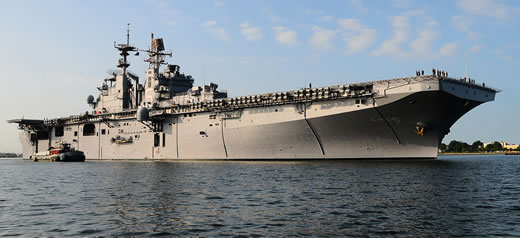
The U.S. Navy has deployed the Mediterranean ARG and is sending the Battan ARG to the Mediterranean, to join the JTF operating in the area. The Bataan ARG will deploy March 23 as part of U.S. maritime forces supporting U.S. and international contingency planning associated with the crisis in Libya. Photo: US Navy
The U.S. Navy has deployed the Mediterranean ARG commanded by the amphibious assault ship USS Kearsarge which deployed to the area by early March, and is sending another group to the Mediterranean, to join the JTF operating. The Bataan ARG will deploy March 23 as part of U.S. maritime forces supporting U.S. and international contingency planning associated with the crisis in Libya. The Bataan ARG is made up of amphibious assault ship USS Bataan (LHD 5), amphibious transport dock ship USS Mesa Verde (LPD 19) and dock landing ship USS Whidbey Island (LSD 41). These vessels are typically carrying AV-8B attack aircraft, as well as attack, assault and transport heliopters.
the ARG and the Marine Expeditionary Unit (MEU) on board are prepared to conduct a variety of missions, including forward naval presence, maritime security operations, theater security cooperation, humanitarian assistance and disaster response, as directed by fleet and joint task force commanders.
Joint Task Force Odyssey Dawn is the U.S. Africa Command task force established to provide operational and tactical command and control of U.S. military forces supporting the international response to the unrest in Libya and enforcement of United Nations Security Council Resolution (UNSCR) 1973. This is the first combat operation to be commanded by the newly established Africa Command. JTF Odyssey Dawn is commanded by U.S. Navy Adm. Samuel J. Locklear aboard the command ship USS Mount Whitney.
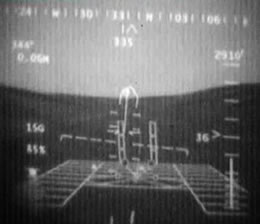
The LVL generates 3D cues representating the landing zone, the cues remain 'attached' to the real landing zone, as the pilot approaches for landing and provide the necessary cues for landing even if the landing zone is obscured by the dust. Photo: MOD.
The British Ministry of defence (MOD) Defence Science and Technology Laboratory (Dstl), in conjunction with industry partners, today showcased the development of world leading technology designed to help helicopter pilots land more safely and efficiently in Afghanistan.
RAF Chinook lands in brownout condition in Afghanistan. Brownout poses a major safety risk to helicopter operations in Afghanistan which the new Low Visibility Landing (LVL) system could solve. Photo: MOD
A Low Visibility Landing (LVL) system developed by Scientists from the British Defence Science and Technology Laboratory (Dstl), could offer a solution for ‘helicopter brownout’ a situation that occurs when a pilot loses visual references due to dust or sand re-circulating during take-off or landing. Brownout poses a major safety concern and problem when operating helicopters in desert conditions.
“Brownout is a dangerous problem faced daily by UK helicopter crews in Afghanistan,” said Major John Peters of Army Air Corps, lead test pilot for the LVL programme, “when you come in to land the amount of dust blown up can completely obscure all visual references. This makes landing more difficult and dangerous and increases the risk of damage. The development of the low visibility landing system will allow helicopter crews to land much more safely in these conditions, giving them references when they would otherwise be blind.”
A large-scale dust chamber utilizing an inflatable hangar was erected at DSTL’s at Porton Down facility to assess various sensor’s performance in dust conditions, and how reliable these sensors could be in advising aircrew of unseen obstructions. Typical landing site obstructions were put inside the chamber and it was filled with known concentrations of commercially-sourced dust specifically chosen for its similar characteristics to Afghan soil.
The LVL generates 3D cues representating the landing zone, the cues remain 'attached' to the real landing zone, as the pilot approaches for landing and provide the necessary cues for landing even if the landing zone is obscured by the dust. Photo: MOD.
The solution proposed by the development team uses a small helmet-mounted display to provide a virtual 3D representation of the landing zone that stays fixed to the earth as the pilot approaches. Ferranti Technologies, an Elbit-Systems subsidiary, provided the display system, based on an operationally proven display, which proved to be the most promising short-term solution to address the specific problem in Afghanistan. The displays’ uses symbology designed to augment the real world picture but also to provide flight critical information in a clear format allowing the crew to assess the height, speed and drift during the final landing approach. When the real-world cues are obscured by the dust they are seemlesly replaced with the system’s cues. The display can be fitted to night vision goggles, supporting day and night operations.
The team developed the system and tested the concept over a six months period, in simulator trials, using front-line Merlin helicopter crews to refine the solution and conduct a large number of helicopter take-offs and landings to show that the system did indeed make these safer. The system was recently demonstrated in successful flight trials on a Lynx helicopter demonstrating effective 3D conformal symbology. Follow-on development is nearing completion and subject to normal approval procedures the production system is expected to be deployed to front-line helicopters in Afghanistan. Research continues into ways to allow pilots to operate more safely and effectively in low visibility conditions; civil applications could include the emergency and rescue services operating in adverse weather such as fog and mist.
The industry/MOD team comprised members of Dstl, the helicopter manufacturer Agusta Westland of the Finmeccannica group and Ferranti Technologies, a subsidiary of Elbit Systems.
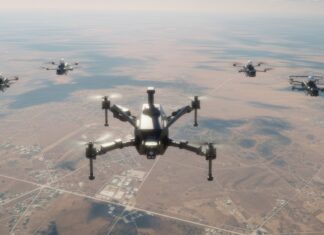
Lockheed Martin Skunk Works® and XTEND have achieved a major milestone in JADC2 by integrating the XOS operating system with the MDCX™ autonomy platform. This technical breakthrough enables a single operator to simultaneously command multiple drone classes, eliminating the friction of mission handoffs. From "marsupial" drone deployments to operating in GPS-denied environments, explore how this collaboration is abbreviating the data-to-decision timeline and redefining autonomous mission execution.
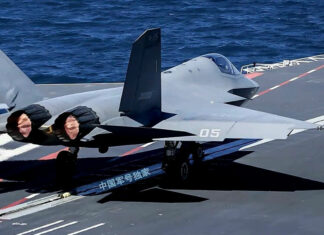
As traditional defense primes face mounting competition from agile “neoprimes” such as Anduril, Palantir and Helsing, the balance of innovation is shifting toward software-defined warfare and scalable, dual-use technologies, while global industry consolidation—marked by Boeing’s integration of Spirit AeroSystems and other strategic mergers—signals an intensified race to secure control over the defense technology value chain. Our Defense-Tech weekly report highlights these trends.
In early October 2025, a coordinated wave of unmanned aerial system (UAS) incursions—widely attributed to Russia—targeted critical infrastructure across at least ten European nations. The unprecedented campaign exposed the fragility of Europe’s air defenses...
Executive Summary
The past week (September 18-25, 2025) represents an inflection point where strategic defense concepts have transitioned from doctrine to tangible reality. An analysis of global events reveals four primary, interconnected trends shaping an...
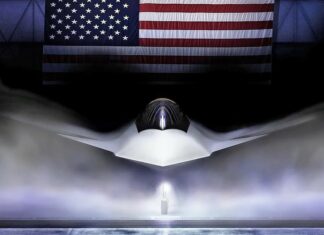
At the 2025 Air, Space & Cyber Conference, U.S. Air Force and Space Force leaders unveiled major updates on next-generation fighters, bombers, unmanned systems, and space initiatives, highlighting both rapid innovation and critical readiness challenges as the services race to outpace global competitors. A short version is available here, with a more detailed version for subscribers.
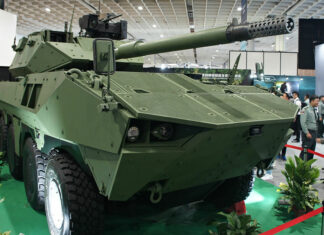
The Taipei Aerospace & Defense Technology Exhibition (TADTE) 2025 crystallized around four dominant strategic themes that collectively illustrate Taiwan's comprehensive approach to defense modernization amid escalating regional tensions. Based on a detailed report by Pleronix (available upon request). Includes a Podcast discussion on TADTE 2025's highlighting Taiwan's four strategic themes beyond the post's coverage.
Israel’s Iron Beam 450 high-power laser system has completed final testing, marking a major leap in air defense. Developed by Rafael, it offers precise, cost-effective interception of rockets, UAVs, and mortars, and is set for IDF deployment by 2025.