
Friday, December 19, 2025
More
    Home Blog Page 42

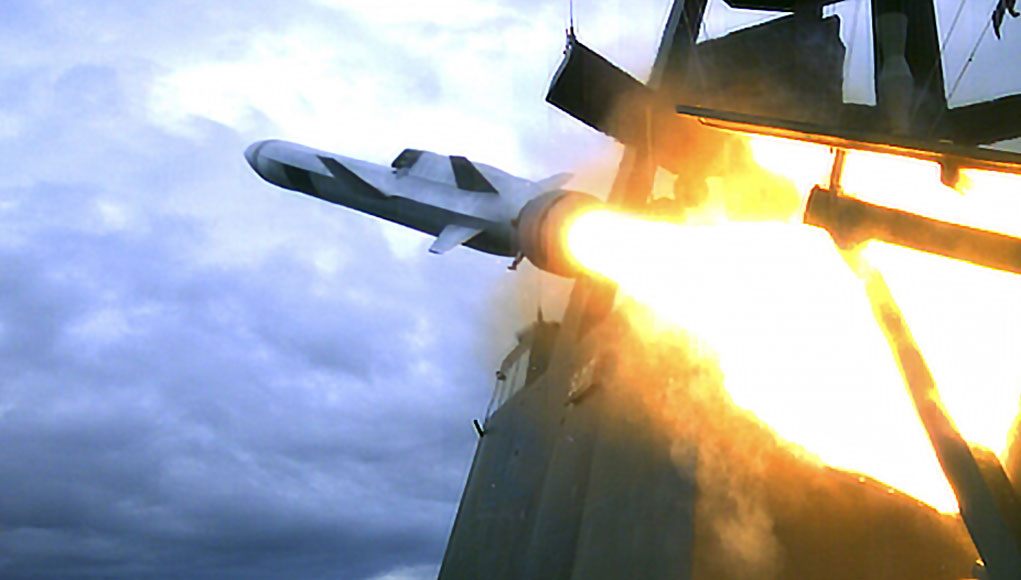
    NSM Extends LCS Firepower Over The Horizon

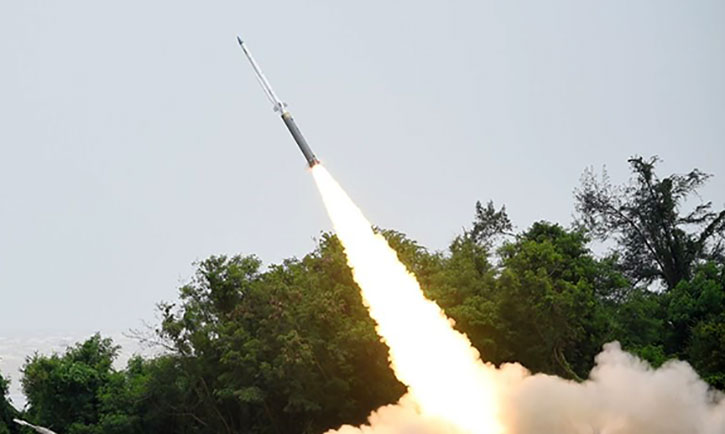
    The NSM anti-ship missile launched from a Norwegian Navy Skjold corvette. Photo: Kongsberg via Raytheon

    Last week the U.S. Navy selected the Norwegian Naval Strike Missile (NSM) developed by Kongsberg Defense & Aerospace to provide the fleet of Littoral Combat Ships (LCS) of the U.S. Navy with an Offensive Anti-Surface Warfare (OASuW) capability engaging hostile ships and land targets at ranges of 200 and beyond.

    The current award worth US$14.8 million funds the procurement of missiles, launchers and control systems for the first ships of the classes. Acquisition of follow-on sets will be procured as part of options, potentially bringing the contract value to $847.6 million. Designed and built by the Kongsberg Group in Norway, the NSM has been fielded at sea in 2012 on the Norwegian Navy Skjold corvettes and by the Polish coastal defense forces.

    Raytheon plans to manufacture missiles and their components in the USA and has already begun production of the missile launchers at its factory in Louisville, Kentucky. “Raytheon and Kongsberg are providing the Navy with a proven, off-the-shelf solution that exceeds requirements for the over-the-horizon mission,” said Dr. Taylor W. Lawrence, president of Raytheon Missile Systems. “Because it is operational now, NSM saves the United States billions of dollars in development costs and creates new high-tech jobs in this country.”

    Adding an offensive over-the-horizon capability is essential for the LCS to address the US Navy’s Distributed Lethality (DT) strategy. The Navy defines DT as the capability to strike from any ship and at any place in the world. The Navy considers that deploying offensive weapons on as many U.S. ships as possible would complicate an enemy’s ability to attack.
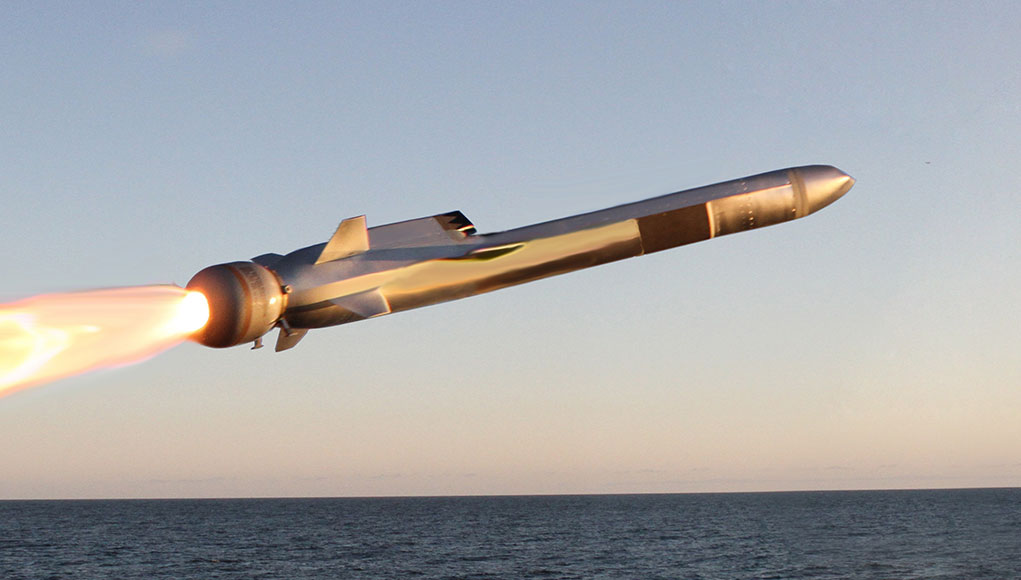
    The 407 kg Naval Strike Missile (NSM) uses a low-observable design to minimize its radar signature, through the use of low-observable shapes made of composite materials, eliminating detection from long range. Its cruising speed is 0.7 Mach, accelerating to 0.95 Mach in the terminal phase of the flight. Photo: Raytheon
    The NSM cruises at sea level (sea skimming) at a speed is 0.7 Mach, accelerating to 0.95 Mach in the terminal phase of the flight. Photo: Raytheon

    The missile will deploy on the two classes of LCS in service – the Freedom and Independence. Both classes were designed as modular vessels that can be prepared for multiple missions by quickly changing mission packages (MP) that come in kits of vehicles, sensors, and weapons, and contained in standard ISO containers carried in the aft.

    The littoral combat ship was designed to carry out multiple missions in littoral areas, assuring maritime access for other forces. As such, its tasks were to search and engage diesel submarines, locate sea mines, combat piracy and repel attacks by fast attack boats. But the vessel was not designed to face large combatants of any kind. Its surface warfare (SUW) MP relies on short-range weapons, including the Longbow/Hellfire missiles that can be launched from the MH-60R armed helicopter operating on board, or from containerized missile launchers (this capability is expected to become operational in 2019). Two Mk 48 30mm guns turrets are also part of the SUW-MP, along with the 57mm deck gun that is a standard issue for that ship. With these weapons, the LCS has a limited offensive capability to face more challenging threats over the horizon.

    The lack of offensive capability for the LCS was obvious when the DT strategy was introduced brought the U.S. Navy to study possible enhancements for the vessel. Based on the successful evaluation of the Norwegian missile in 2014 under the Foreign Comparative Test Program, when Raytheon teamed with Kongsberg demonstrated the NSM on the LCS USS Coronado. As part of these enhancements, the evaluated several missiles, including a surface-launched variant of the Long Range Anti-Ship Missile (LRASM) and advanced version of the Harpoon. Unlike the two U.S. systems that required significant developments (that also offered many advantages) the Norwegian missile was based on a mature product that promised to have the lowest risk meeting the tight schedule for fielding with the LCS fleet.

    The 407 kg missile uses a low-observable design to minimize its radar signature, through the use of low-observable shapes made of composite materials, eliminating detection from long range. Its cruising speed is 0.7 Mach, accelerating to 0.95 Mach in the terminal phase of the flight. The enhanced high explosive warhead weighs 227 kg (500 Lb.), over half of the weight is the explosive charge. The titanium casing, perforated steel fragmentation layers, and programmable fuse make the rest of the weight. The missile uses an advanced seeker and automatic target identification technology to assure a high probability of mission success. Highly accurate INS provides precise navigation in a satellite-denied environment. Through the terminal phase of flight, the missile flies a low-altitude sea-skimming flight profile to evade enemy detection.

    The missile uses a high-resolution infrared seeker to ensure a high probability of target detection and identification, its high maneuverability enables effective evasion techniques even at the terminal phase of flight. The use of an imaging seeker enables the user to designate specific hit points on the target. Through the testing phases, the missile has demonstrated the capability to hit anywhere within two feet of the designated target.

    A unique feature embedded in the NSM its the scalable effect. Prior to launch, at the mission planning phase, users can determine the effect they want to inflict on the target. Such setting will determine the location of the hit, fusing delay, attack angle and other parameters that contribute to determining the weapon’s lethality and effect.
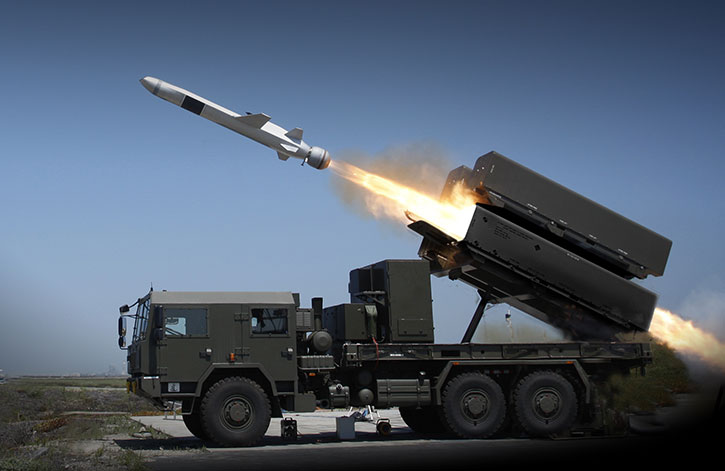
    In 2015 Poland became the second operator of the weapon, as the NSM was inducted with the Polish Offshore Squadron as a coastal defense asset. Photo: Raytheon

    Carmor Debuts Light, Highly Protected Tactical Combat Vehicle at Eurosatory

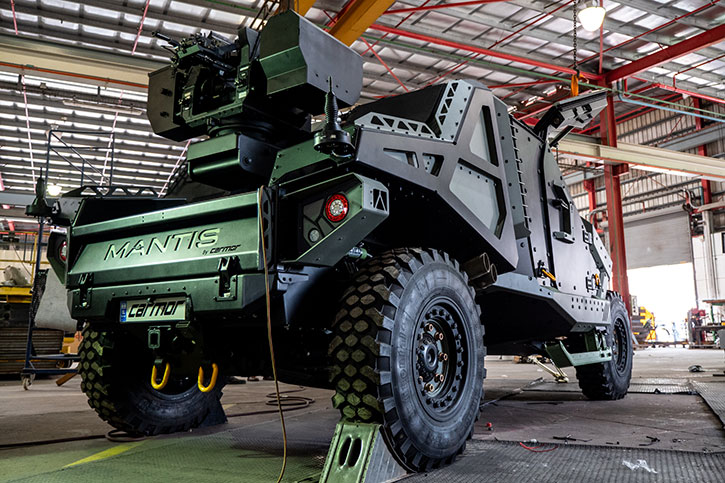
    Carmor Mantis light armored vehicle debut at Eurosatory 2018. Photo: Carmor

    Israel’s specialty and combat vehicle producer Carmor unveils the Mantis at Eurosatory 2018. The vehicle to be displayed at the defense exhibition in Paris next week is the first variant of a new family of vehicles designed to perform combat and combat support missions.

    To meet higher levels of protection required by the users the company optimized the design to provide both ballistic and blast protection while maintaining high agility and retain adequate payload capacity at a gross vehicle weight below eight tons. The vehicle’s size and weight enable tactical air mobility in C-130 Hercules and A-400M transport aircraft. With such characteristics, Carmor positions the Mantis to offer JLTV class performance at an affordable cost.

    “Unlike the heavier vehicle models developed by Carmor and its predecessor ‘Hatehof’, the Mantis, based on a clean sheet design is lighter, more agile and modular.” Eitan Zait, Carmor CEO explained, “We have designed, developed and built thousands of vehicles, in dozens of configurations, all were designed to meet specific requirements set by the customer.” Zait explained, “Mantis comes from a clean sheet design, that reflects the best Carmor’s designers could offer.”

    Mantis Family Variants

    The family consists of a common monocoque capsule that provides the chassis and protected cab for the different variants. The chassis eliminates the need for a traditional frame and enables the flexibility to extend the vehicle by up to 150 cm, to meet specific configurations.

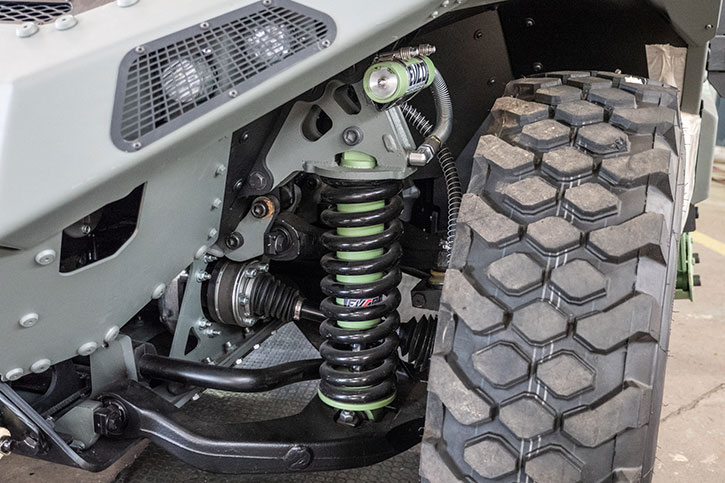
    While the vehicle design is not based on a commercial chassis, Mantis uses commercial components, designed for heavy duty and racing applications to maintain high mobility off-road. Photo: Noam Eshel, Defense-Update

    All variants use common subsystems and parts. The powerpack consists of a 6.8 liter 360 horsepower Cummins turbo-diesel coupled to a 6-gear Allison automatic transmission is centrally located, adding to the vehicle’s stability. The cooling system is also located at the rear, fed by air ducts on both sides and on the roof. The engine accelerates the eight-ton Mantis to a maximum road speed of 120 km/h. Using automotive systems and parts certified for commercial and racing, the 4×4 wheel is designed for off-road mobility and versatility.

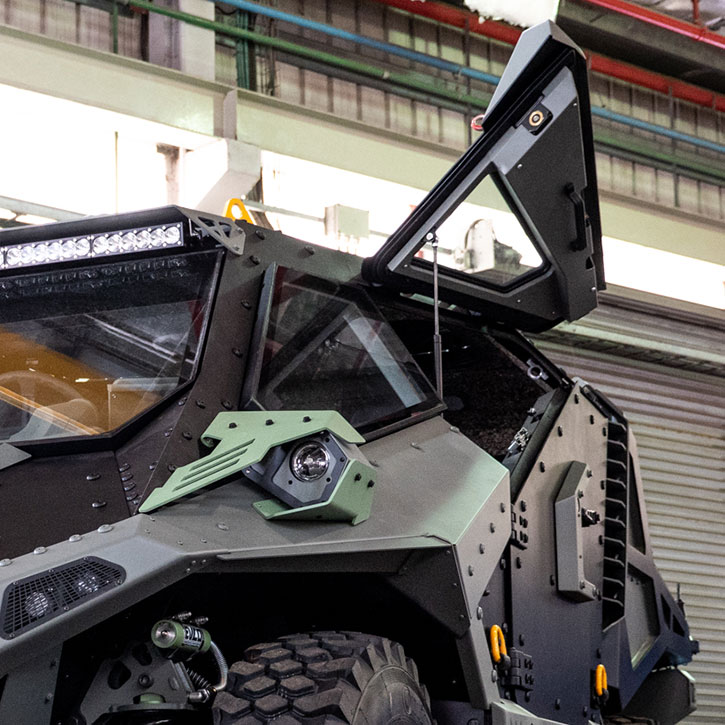
    The gullwing style protected window is a characteristic design feature of the Mantis. Photo: Noam Eshel, Defense-Update

    The vehicles include a versatile double cabin troop carrier that carries five soldiers and a full cabin version that accommodates eight. Some of the designs incorporate an elevated platform that mounts payloads up to 150 kg weight, such as remotely controlled weapon stations shown on the prototype displayed at the Eurosatory. A single cabin pickup variant that seats three soldiers has a larger flatbed while a variant of the full cab is configured as an ambulance, accommodating a small crew and ample space for stretchers and medics. Carmor also considers an open buggy style fast and light assault vehicle variant that will utilize the same structure and offer underbelly protection.

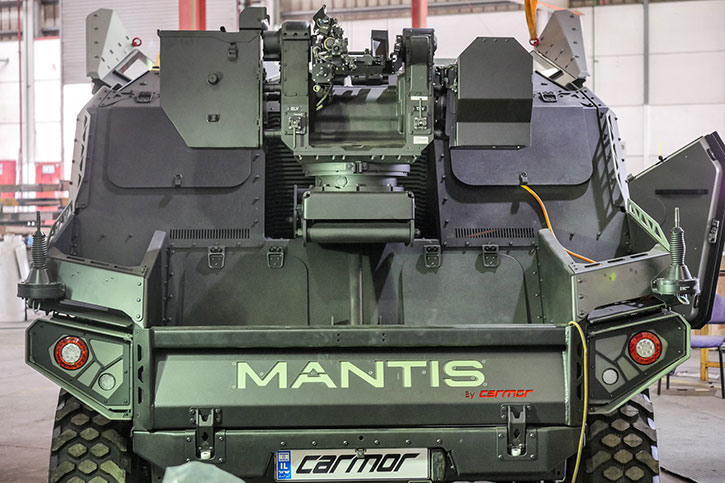
    A view of the folding platform carrying the Mantis’ weapon station. Photo: Noam Eshel, Defense-Update

    These variants can support a wide variety of applications carrying different weapons such as mortars, missiles, machine guns and remote weapon stations, along with scout and reconnaissance equipment, including payloads telescopic masts, ground and aerial robotics, tactical radars and counter-UAV equipment

    Mantis comfortably seats five combatants in the protected cabin. The vehicle also has a small pickup flatbed that can be equipped with a folding platform that lifts up to 150 kg of payloads, such as this remotely controlled weapon station. Photo: Noam Eshel, Defense-Update

    Balanced Agility and Protection

    Carmor designers achieved a high level of protection at relatively low height, by using an advanced belly design that maintains a low center of gravity with excellent blast protection, results in an overall vehicle height below 2.20 meters. Superior off-road mobility is achieved by a short wheelbase, ground clearance of 0.65 meters, and approach and departure angles exceeding 50 degrees, all critical factors for good off-road mobility. The powerful engine and transmissions sustain movement over 70% gradient, 40% side slope, up to 0.5-meter obstacle climb and trench crossing and fording through water one meter deep.

    According to the vehicle designer Amos Boaz, Mantis maintains an optimal balance of agility, protection, and comfort. Placing the engine at the center, between the cab and the flatbed, cleared six cubic meters of a protected cabin, comfortably seating five soldiers in individual seats. These blasts protected seats, made by Mobius-PS, are specially designed to attenuate the blast effects of underbelly explosions, as they act with the ‘floating floor’ and specially designed belly shape to minimize the effect of IED and mine blasts.

    Despite its low signature and relatively lightweight, Mantis offers high baseline protection meeting ballistic, IED and mine protection. At a gross vehicle weight of six tons Mantis provides ballistic protection at a STANAG 4569 Level 3, with minimal mine protection (Level 1); adding modular armor replacement plates, Mantis can face much heavier threats with ballistic protection upgraded to Level 4, and blast protection to Level 2A/3B. Using relatively small transparent armor modules the cabin provides excellent viewing to the front and sides, Boaz told Defense-Update.

    The Mantis protection is not addressing only ballistics and blast but also the vehicle’s mobility. Using Run-flat inserts, Mantis maintains mobility even after suffering multiple hits in the tires; 105 liters of fuel are stored in dual, independent fuel tanks to support mission autonomy of 700 km with internal fuel.

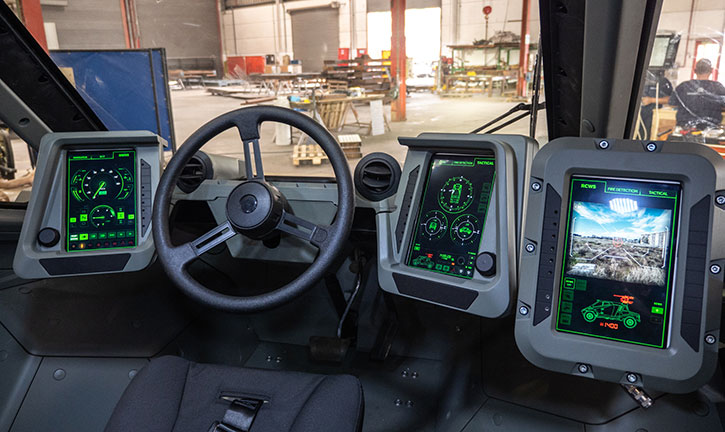
    The Mantis’ ‘cockpit’ style driver’s position provides enhanced field of view, better forward view, particularly at close range (for efficient off-road driving) and ample dashboard space for the three crew members. Photo: Noam Eshel, Defense-Update

    Ergonomic Design

    Each of the crew members has a multi-functional display while other positions have individual communications consoles and electrical charging sockets to support electronic devices.

    The three seats at the front accommodate the gunner, driver, and commander. The centrally located driver ‘cockpit’ is a unique design feature of the Mantis family. “Locating the driver in the center offers many advantages – fewer obstructions for better situational awareness, market adaptability and more flexible seating arrangement and dashboard utilization,” Boaz said. Seating the driver close to the windshield (in the absence of the hood in front) the windshield area can be reduced while maintaining a wide field of view for the driver while the trapezoidal side windows provide peripheral viewing angles for the crew. Improved situational awareness is maintained by high power LED lights illuminating in visible and infrared light all around the vehicle, in addition, the crew monitors the vehicle’s surrounding using panoramic cameras covering the sides and the back. The side doors provide quick access and dismount on both sides. Two crew hatches located at the ceiling provide alternative egress when necessary.

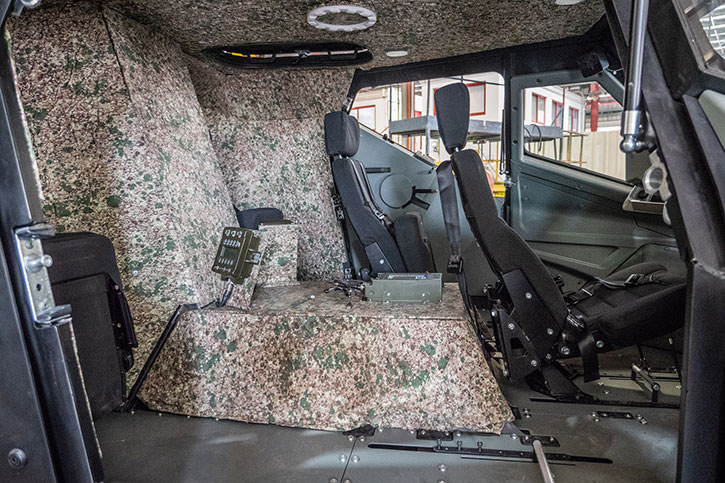
    Spall liners are used inside the capsule to minimize the behind-armor effect, in case of penetration. The prototype on display also uses VATEC multispectral concealment material to reduce radio-frequency leaks. The same material can be used externally, acting as a mobile, multispectral camouflage (MCS), minimizing the vehicle’s visual, infrared and radar signature. In addition to the high level of protection, the prototype displayed at Eurosatory is also equipped with an acoustic gunshot detection system, air condition, and CBRN filtration system form Bethel.

    As a modern combat vehicle, Mantis comes with ample electrical power, to feed multiple electronic systems. Generating up to 300 Amp of electrical power the vehicle supports independent 12/24 Volt power systems.

    The monocoque armored capsule provides a spacious ballistic and blasts-protected
    cabin accommodating five combatants seated on blast-attenuating seats. The flat, floating floor adds additional protection from blast effects. Armored glass windows provide good panoramic visibility for the crew and even to the passengers in the rear seats. One of the two escape hatches can be seen on the roof, along with the cabin and individual lightings and personal intercome and communications consoles.  Photo: Noam Eshel, Defense-Update

    Plasan Introduces 4GEN Sandcat at Eurosatory

    Plasan expands the Sandcat family with the introduction of the 4 GEN Sandcat. The new generation of the vehicle uses a modular design that enabled Plasan to configure the vehicle for different requirements and tailor the protection suite to meet higher threat levels. The first variant to be introduced under the new generation is the blast protected Sandcat that utilizes a monocoque hull, that eliminates the need for the traditional frame. The use of a monocoque hull enabled designers to improve the vehicle’s blast protection while retaining the overall vehicle’s weight below nine tons.

    The new generation vehicle maintains the Sandcat’s overall design, thus making it almost distinguished from earlier Sandcats. In the new generation, Plasan introduced a modern, modular architecture enabling easy design, modification, and configuration of the vehicle to address customer needs. Such configurations include meeting different protection levels, improved mine protection, and integration of specific mission packages.

    The first generation Sandcat vehicles were based on the Ford F550 and were sold mainly in Europe. The second generation was the first to be fielded in Israel, by Israel’s border guards. This variant was also produced overseas. Renamed ‘Stormer’, the third generation was sold to more customers worldwide and was the first to be configured for different applications, including missile and mortar carriers. The 4 gen being launched at Eurosatory looks similar to existing models but introduces a complete redesign of the vehicle, making it much easier to configure to meet specific applications. This modular approach enabled designers to tailor the vehicle protection suite to meet different threats. For example, the blast protected variant that debut at Eurosatory offers much higher underbody blast protection.

    This new generation has extra built-in modularity, allowing Plasan to more easily address customer requirements, from police and paramilitary and up to full military requirements. The overall concept of the Sandcat utilizes commercial off the shelf chassis, and upgrading the vehicle to an armored vehicle, using composite materials. Employing Plasan’s unique kitted hull method allows designers to optimize the vehicle’s weight and performance to address user requirements with specific configurations and mission systems.

    Among the vehicles to be displayed at Eurosatory 2018 are the lightweight Yagu that made its international debut in Mexico last month, as well as a new, light tactical armored vehicle that fits between the Yagu and Sandcat in the Plasan lineup. Plasan has not disclosed the manufacturer of the vehicle but said it patrol vehicle for up to six occupants, based on a 4-5 ton weight category, based on a very durable and reliable chassis that we are using within its weight limit. a lot of the smaller armored vehicles are based on lighter chassis that are stretched beyond their weight limits, the one we are launching at Eurosatory sits well within the weights.

    India Tests Solid Fuel Ducted Ramjet for Future AAM/SAM Propulsion

    The Solid Fuel Ducted Ramjet (SFDR) test vehicle launched on its first test flight in May, 2018. The The propulsion system is accelerated by a solid booster, to accelerate the missile to supersonic speed where the ramjet operates more effectively.

    The Indian Defense Research & Development Organization (DRDO) completed a first test flight of an advanced propulsion system that promises to enhance the range and agility of air-to-air (AAM) and surface-to-air missiles (SAM). The Solid Fuel Ducted Ramjet (SFDR) developed under a joint Indo-Russian R&D project achieved a speed of Mach 3 on its first flight. SFDR uses a ramjet propulsion system to react with the solid propellant as air, that acts as oxidizer flows through a solid propellant duct. The design of the SFDR propulsion allows for throttling up and down, enabling the missile to increase the speed as it reaches the terminal phase of the flight, or when sharp turns are required in pursuit of highly maneuvering targets.
    Compared to conventional rockets that must carry a propellant and oxidizer – Ramjet, like a jet engine, uses the air as an oxidizer thus eliminates the weight of that fuel. Therefore, such missile can carry more fuel or use a smaller propulsion unit. With more fuel stored on board, longer burn time is achieved, resulting in higher velocity, that enabling missiles to fly farther and maintain good kinematic performance through the endgame, being able to chase a target through a series of high G maneuvers. Relying on solid propellant the system avoids flameout risk through such maneuvers, that jets engines or ramjets are subjected to.
    SFDR propulsion is a key technology for the development of extended range missiles such as surface-to-air and long-range air-to-air missiles. Typical weapons utilizing such propulsion are the MBDA Meteor, Chinese PL-12D and the US Triple Threat Terminator (T-3) missile developed by Boeing as a possible AMRAAM successor. The introduction of ramjet propulsion enabled designers in Europe, Russia, and China to extend missile range from 100 km to 200 km, and achieve a maximum speed of Mach 3 – 4, without significantly increasing the missile’s diameter and length. In some applications, ramjets were also used to accelerate hypersonic vehicles.

    Possible uses for the Indian SFDR are in future variants of missiles, including an advanced version of the ASTRA beyond visual range AAM (BVRAAM) expected to extend the Astra Km 1 75 km range to 150 km in the Mk-3 version. According to the DRDO, the SFDR has a range of 120 km with a speed range of 2.3-2.5 Mach. Unbound by the diameter of aerial weapons, a ground-launched SFDR would accelerate a missile over 250 km. A potential application of the Indo-Russian SFDR is extended range SAM – such as the futuristic Indian SAM-X.

    As the Ramjet is most effective at supersonic speed, this engine is often used in combination with strapped boosters (particularly in SAM) or integrated boost phase (AAM), accelerating the missile to supersonic speed where the ramjet kicks in. The variant tested recently in India was launched from a ground-based test rig using a booster.

    Australians Integrate Nano UAVs at Squads, Troop Level

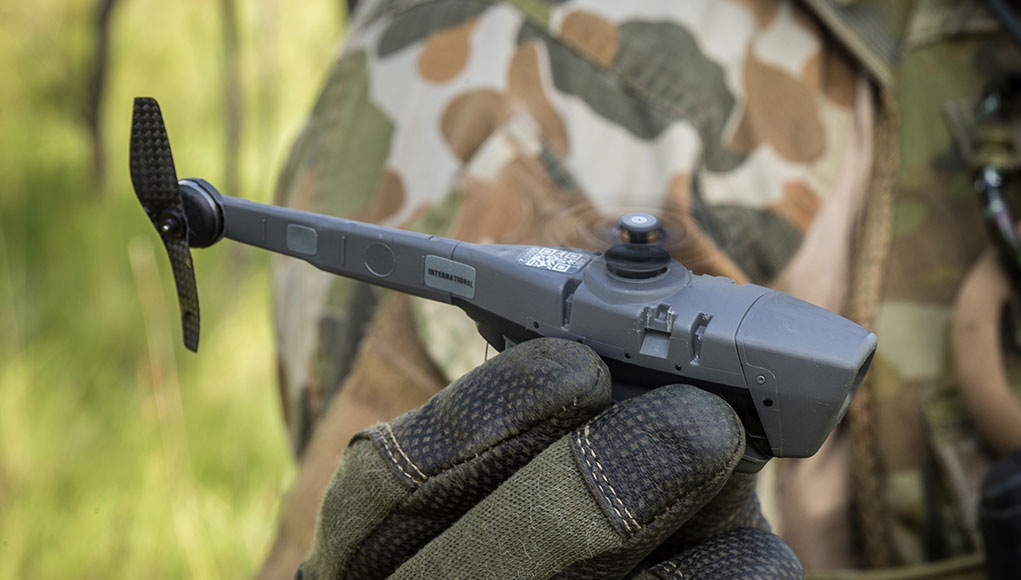
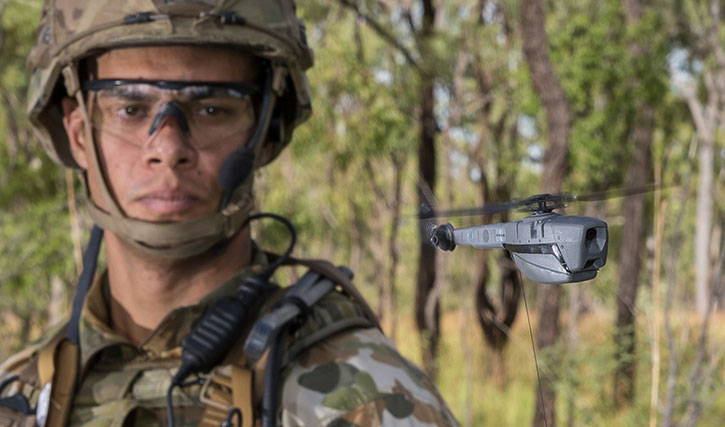
    Black Hornet PD-100 nano UAV being fielded with the Australian 7th Combat Brigade. Photo: Australian Defence
    An 18 gram personal Reconnaissance System, Black Hornet is the smallest unmanned sensor currently available for use by troops. Photo: FLIR Systems

    Since the acquisition of the Norwegian Prox Dynamics company in 2016 FLIR Systems scored several important sales of Prox’s Black Horner PD-100 Personal Reconnaissance System (PRS). Over the years the companies delivered over 5,000 PRS units to 20 customers worldwide, mostly counter-terrorist and special weapons and techniques (SWAT) teams and special forces. At present FLIR continues to manufacture the PRS in Norway.

    So far, the regular military was not too receptive to the miniature drone, considering it too delicate and expensive for field operation by non-specialists. But this perception is changing. In the recent months, the Black Hornet has been fielded with two new customers – the Australian and Dutch armies, while an enhanced system – Black Hornet III is undergoing testing with the US Army and Marine Corps, toward an acquisition of dozens of systems by the U.S. Army, for fielding with an entire infantry brigade.

    The PD-100 was first deployed by the Norwegian and British forces in 2013, when Prox received their first orders, under an urgent operational requirement (UOR) worth £25 million. At the time the Brits wanted to improve situational awareness for their troops in Afghanistan and the PRS was called to provide remote surveillance to improve force protection and counterinsurgency. Upon their return to their homeland, in 2015 the Black Hornet program was discontinued.

    More recently, other countries began evaluating these nano drones as personal surveillance capability organic to infantry squads and platoons. The Australians pioneered this approach, deploying a large number of drones for testing with troops. Following extensive evaluation, the Australian Defense allocated A$18 million by the end of 2017 to field the flying sensors as an organic surveillance and reconnaissance supporting the combat brigades at the platoon and troop level.

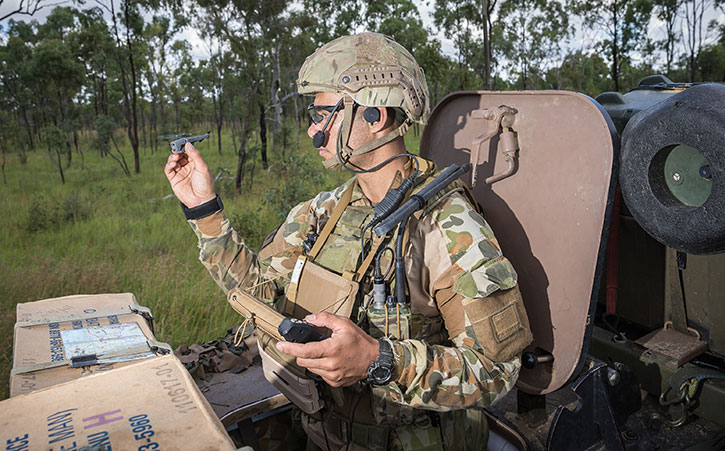
    Australian Army soldier Trooper Sam Menzies with a PD-100 Black Hornet Nano unmanned aircraft vehicle during training exercise at Shoalwater Bay Training Area, Queensland. Photo: Australian Defence

    “UAS are a game-changer for the Army, providing enhanced situational awareness for better mission execution for Australian soldiers,” Commander 6th Brigade, Brigadier Susan Coyle said. Currently, the 6th Brigade operates the Australian Army’s only UAS unit – the 20th Surveillance Target Acquisition Regiment. By the end of the year, the PRS will be deployed with the 7th Combat Brigade down to Platoon level, becoming the first Army fielding such capabilities with the regular force. Deploying with every squad in the brigade’s reconnaissance units. “The Australian Army is now the biggest user of Nano UAS in the world. It is also the first in the world to proliferate this technology to the conventional forces down to combat platoon level,” Brigadier Coyle said.

    The US Army also plans to deploy the PRS at the squad level. Although the acquisition of 61 Black Hornet III small unmanned aerial systems was approved this year, the U.S. Army plans to evaluate other soldier borne sensors from different vendors in October 2018 by the by Soldiers from 7th Infantry Division.

    At a weight of 1.3 kg, the nano-UAS system packs two Black Hornet flying sensors stored in a docking station that also includes the display console, batteries, charger and the communications terminal. Weighing only 18 grams, each miniature helicopter can fly for 20-25 minutes, at a speed of 18 km/h, out to a distance of 1,500 meters (line of sight) from the user. Preparation to flight is intuitive and takes about 60 seconds. Two cameras The miniature helicopter operates two cameras, one taking live video and the other shooting stills. Images and live video are streamed simultaneously, to the user’s monitor, over an encrypted data link. The system is also equipped with thermal imaging, which gives it night vision capability.

    Similar to the modern miniature multirotors, at such a low weight the nano-drone is vulnerable to wind conditions although it can withstand gusts below 12 m/s. The Black Hornet III variant developed for the US Army employs a dedicated, encrypted datalink and includes three nano drones, enabling users to extend the missions to 2.5 hours (150 minutes).

    The Black Hornet is not designed for long-term surveillance. Each system comprises two micro UAVs, (the U.S. bound Black Hornet III carries three) to sustain continuous operation for 2.5 hours, since, as one Black Hornet is aloft, another battery can be charged and ready when it returns. Although the operation of the system is intuitive, it takes about 16 hours to fully train a soldier to pilot, use and maintain the system and achieve effective operational use said According to Capt. WaiWah Ellison, the assistant program manager for Soldier Borne Sensors, at the US Army PEO Soldier.

    According to information released by FLIR Systems, the Black Hornet III helicopter weighs 32 grams, slightly more than previous models. It offers several improvements over previous versions, such as improved speed and distance, with the ability to fly two kilometers at speeds of over 21 km/h. Its sensors support sharper imaging processing, featuring the FLIR Lepton thermal microcamera core and a visible sensor, allowing greater image fidelity. An improved encrypted military-approved digital datalink supports beyond line-of-sight (BLOS) and operations indoors. The system supports the military standard ‘Android Tactical Assault Kit’ (ATAK), to interface with battlefield networks and distribute information to anyone on the network.

    The nano helicopter flies autonomously to follow waypoints marked by the user on an aerial map, or controlled manually using an intuitive handle that comes with the kit. The system has a low acoustic signature and is virtually inaudible even from a short distance. At such a low weight it is inherently safe to fly near people, therefore, it can operate almost anywhere at any time without prior airspace coordination. As these miniature aerial vehicles have a minimally audible signature and visual profile, they are virtually undetectable, even from extremely short distances.

    FLIR Systems offers the Black Hornet as a vehicular integrated system, where the crew operate the nano drone directly from the vehicle’s displays. Photo: Australian Defence

    Iron Dome Defeats Mortar Attacks from Gaza

    Israel's Iron Dome was used yesterday, for the first time, to repel a massive mortar attack on Israel's front line villages. This picture, shot from the Palestinian side, shows the Tamir missile trails fan out from the launcher, to chase the 25 bombs fired by the Palestinian Islamic Jihad terror group.
    Aero-india was the world debut for the Iron Dome missile - the real thing
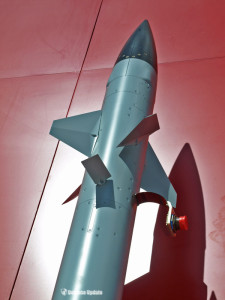
    Aero-india was the world debut for the Iron Dome missile – the real thing, just unarmed and defuelled. The photo clearly shows the ogive that blows off when the missiles nears its target, exposing the seeker that is responsible for the missile’s terminal effect that has demonstrated over 500 kills in recent months. Tamir Eshel, Defense-Update

    Israel’s air defenses that were busy in recent weeks repelling rocket attacks from Syria and the Gaza strip succeeded yesterday, for the first time, to defeat mortar attacks that targeted border villages. Among the targets intercepted yesterday by the improved version of the Iron Dome were dozens of rockets and, for the first time, mortar bombs (likely 81mm) fired by the Islamic Jihad terror organization.

    As a short-range weapon with typical high ballistic trajectory, the mortar’s accuracy and lethality make it a practical and dangerous weapon which is challenging to locate and defeat. That’s what makes the Iron Dome’s achievement remarkable.

    Iron Dome relies on a radar that detects ballistic threats such as rockets, artillery projectiles, and mortar shells, as they appear over the radar horizon. The radar tracks each threat, plotting the launch and projected impact point for each projectile, to enable the battle management system to determine which of them is a potential risk – those who would hit populated areas would be prioritized for intercept, over others that are projected to hit open spaces.

    The firing event included several mortars firing a coordinated and condensed salvo of mortar bombs, aimed to achieve full surprise and maximum damage on the Israeli side.
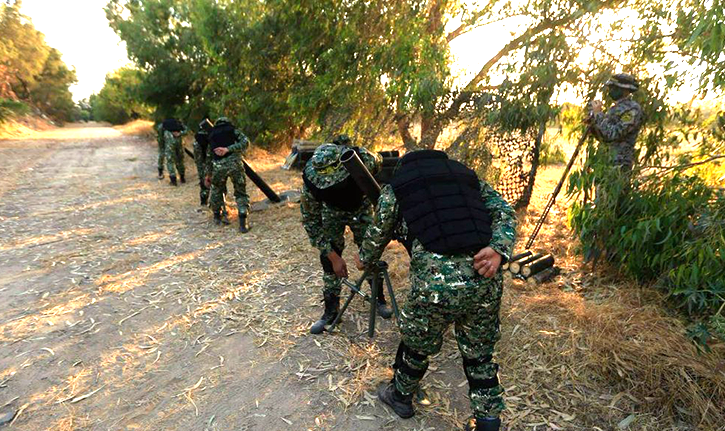
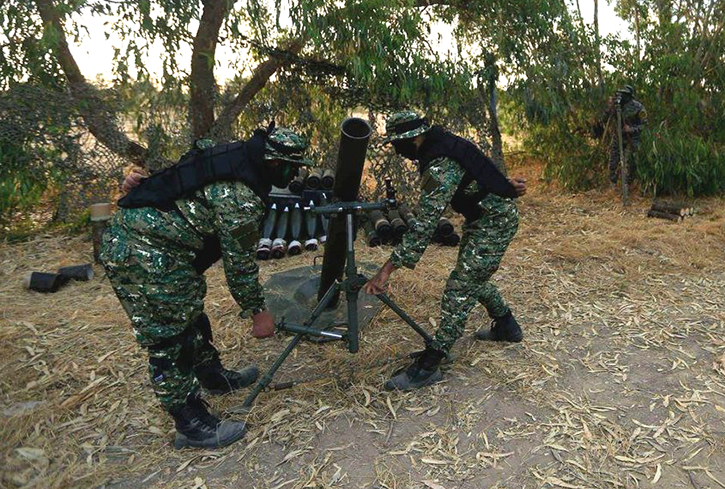
    A mortar team from the Palestinian Islamic Jihad prepares an 81mm mortar for firing. Note the fire observer in the background.

    When the system engages rockets with a flight time of tens, even hundreds of seconds, it has enough time to process all that data and optimize the intercepts. But when facing mortars with a short flight time of 10-30 seconds, time is the most critical factor for intercept.

    In the four years since operation ‘Pillar of Defense’, the last conflict that erupted between Israel and the Palestinians in Gaza, Iron Dome went through several spiral developmental cycles to expand the system’s capabilities against new threats, such as unmanned aerial vehicles and mortars. Yesterday, the system demonstrated for the first time, in combat conditions, its capacity to defeat a barrage of mortar bombs.

    Existing C-RAM assets cannot intercept mortar bombs, as they mostly provide an alert enabling the people at risk to take cover. Directed energy defensive approaches to C-RAM, based on high-energy lasers have yet to mature to achieve readiness levels for operational use, while other Short-Range Air Defenses (SHORAD) that are optimized against aircraft and air-launched precision-guided weapons lack the quick response to react and engage such ground-launched threats.

    Among the improvements introduced with the Iron Dome were new surveillance modes for the radar, improving the detection and tracking speed, accelerated battle management processing addressing counter-mortar capabilities, and adaptation in the Tamir interceptor missiles to address these specific threats. All these improvements enable the system to safely destroy most of the bombs before they hit their targets.

    Turning Riflemen into Sharpshooters

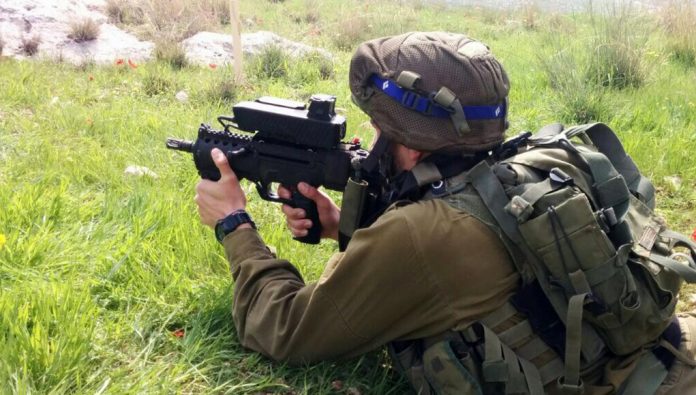
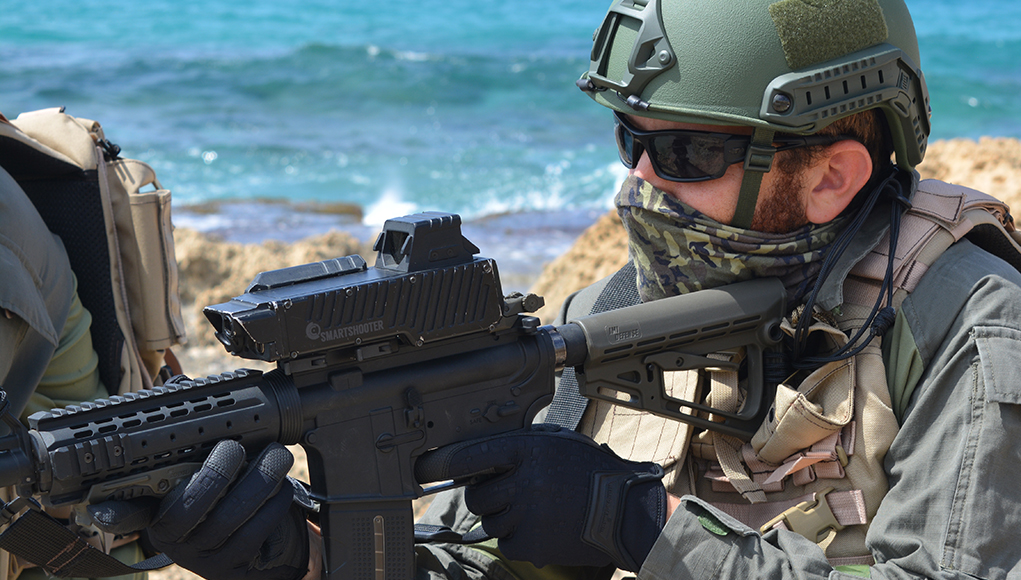
    SMASH smart weapon sight undergoing testing with the IDF Givati brigade. The sight is seen here installed on a Micro Tavor bullpup assault rifle. Photo: SmartShooter

    Similar to a weapon delivery system in fighter planes, or tank fire controls, soldiers nowadays rely on technology to become lethal and accurate but avoid risks of friendly fire or collateral damage to non-combatants. Unlike aircraft or ships that employ guided weapons, the lethality of a soldier is in the tools he operates with his hands – assault rifles, machine guns, grenade launchers and other sidearms. The effectiveness of such weapons depends mostly on the soldier’s skills, proficiency, and varies between soldiers. Gaining top performance requires long practice – in training, and through combat.

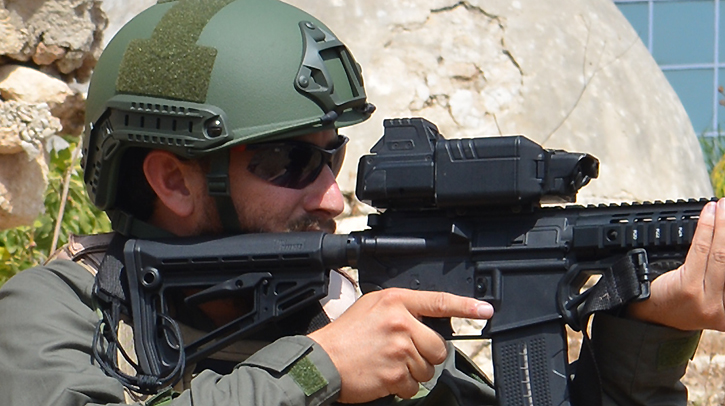
    With simple modifications SMASH can be adapted to any weapon, dramatically improving fire efficiency, accuracy. Photo: Smartshooter

    Developers of weapon sights and accessories have long been searching for the ultimate accessory, one that would provide the weapon with a ‘smart trigger,’ enabling the soldier to shoot only when the gun is aimed to hit the intended target. The ‘smart trigger’ would avoid a shot, when the weapon is likely to miss the target, or worse – hit the wrong one which could be a friend or an innocent bystander.

    Such systems would involve more than the firing mechanism, as they integrate optics and cameras to enable automatic event recording, including pre-shot and post-shot clips that can be stored on the weapon for debriefing and assure the soldiers had legal justification for fire events (such a function could also minimize the chances of weapon abuse.)

    While such a device sounds imaginary, it is real. The Israel Defense Forces (IDF) has recently completed certification of the SMASH weapon sight, following a successful operational testing phase with an elite infantry battalion. The Israel Army has recently contracted Smart Shooter to launch serial production of few hundreds of sights, as part of procurement of 2,250 systems.

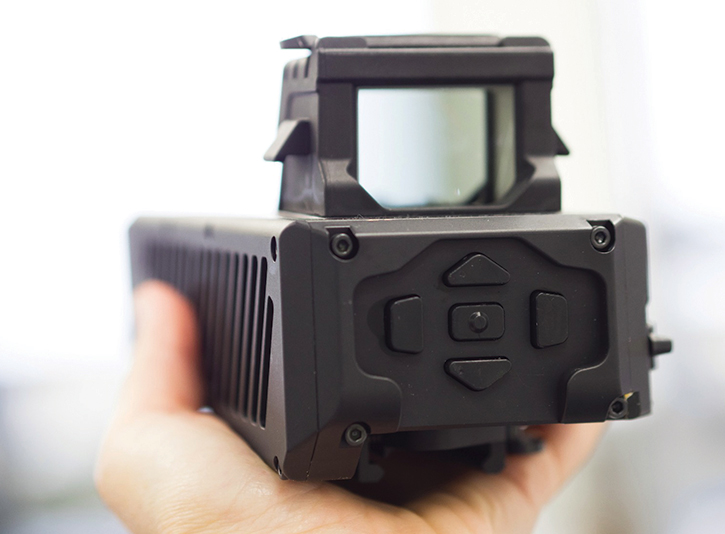
    Based on a patented design, SMASH was developed and is manufactured by Smart Shooter, as an add-on device on any firearm using MIL-STD 1913 accessory rail; weapon integration also requires simple modifications to the weapon, which include adding trigger control and pushbuttons on the forward grip.

    SMASH provides the shooter with a clear view, as the illuminated crosshair and target markers indicated superimposed on the optical view. The sight is operated with a pushbutton placed on the forward grip. Photo: Smartshooter

    Once installed, SMASH dramatically improves the warfighter’s shooting accuracy and efficiency, ensuring the first shot hits the intended target, even in high-stress conditions and following extensive physical effort. The new sight system enables the shooter to designate any target (such as a person, vehicle or object, like a vehicle’s wheel) and hit it with high probability, from the weapon’s maximum effective range. Through four years of testing the sight has demonstrated significant improvement in marksmanship, enabling ordinary riflemen to score the first hit on target with the first shot, compared to 8-10 shots they needed with standard sights. The system operates with standard rechargeable batteries that can sustain operation for up to 72 hours.

    Target acquisition is made with a press of a forward handgrip button. Photo: Smartshooter

    Acting as an independent weapon control system, SMASH processes input from multiple sensors to determine the shooter’s aiming relative to the designated target. Such data includes range measurement, weapon inclination, and tracks target motion, to calculate aiming lead for a precise shot. The sight system also monitors the target situation and visibility with real-time image processing, to alert shooters with ‘no fire’ indication when they are likely to miss the shot or hit objects other than the intended target. When an automatic mode is selected, the user pulls the trigger when having the target designated in sight, but a shot is released only when the target is most likely to be hit. When needed, the user can bypass the system with a flip of a button, to use the weapon in manual mode.

    A significant advantage of the SMASH is the ability of squad riflemen to hit targets with high probability, at ranges of 100 yards and beyond, thus performing as marksmen. With such performance they can engage targets more efficiently, from relatively long range, thus increasing the lethality, survivability and overall efficiency of the squad.

    Earlier this year the Israel Defense Forces (IDF) completed certification of the SMASH weapon sight, following a successful operational testing phase. An earlier version of the sight is seen here during testing on a Tavor assault rifle. Photo: SmartShooter

    Yagu – An Ultralight Special Ops Armored Vehicle

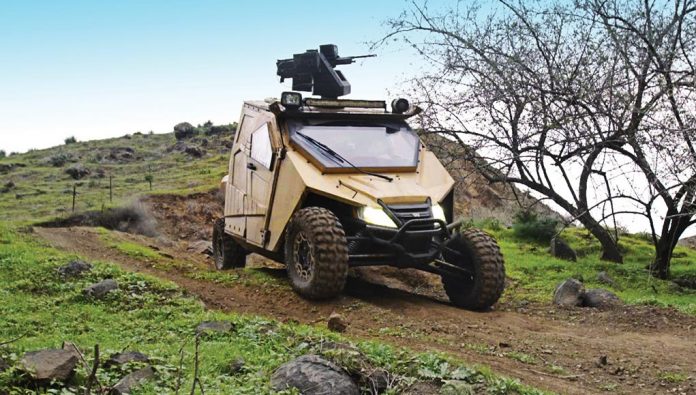
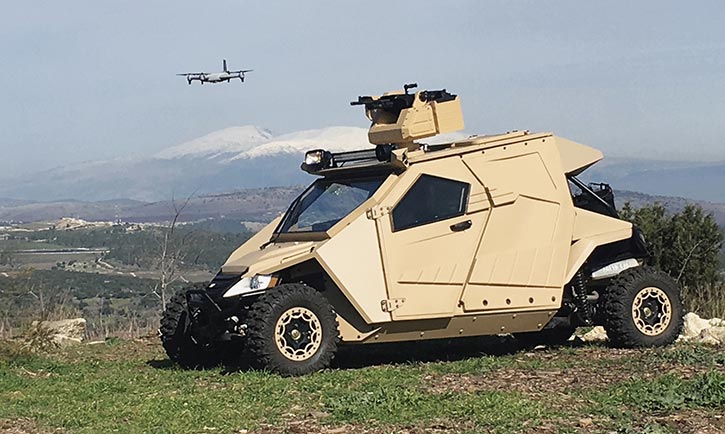
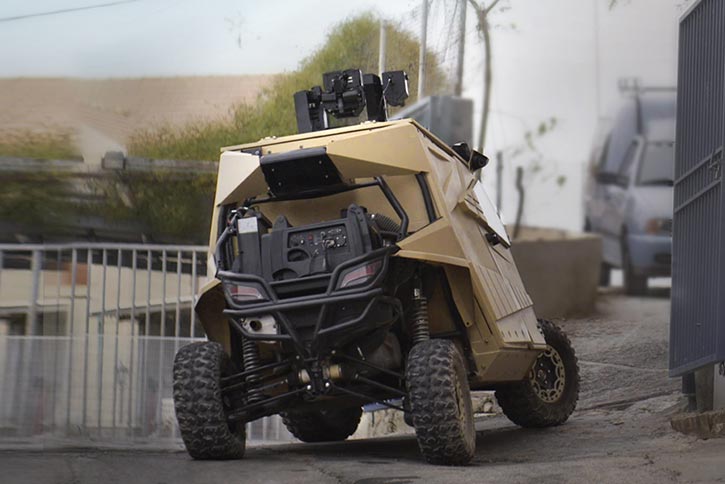
    Plasan's new all-terrain ultralight armored vehicle -Yagu. Photo: Plasan

    Plasan unveiled today it’s all-new, lightweight protected vehicle – Yagu at Expo Seguridad event in Mexico City this week. In fact, plasan transformed the 767 kg commercial Arctic Cat Wildcat 4 1000 four-seat all-terrain vehicle into a 1.48-ton (dry weight) fully-protected assault vehicle.

    The vehicle is designed to behave like an All Terrain Vehicle (ATV) but offers its crew of three persons the all-around 360 ballistic protection at a level of B6+ (similar to STANAG 4569 Level II) effective against 5.56X45, 7.62X39 and 7.62×51 threats. WIth front and side windows and all-round cameras the protected capsule provides excellent situational awareness and response, using an overhead ultra-light remotely operated weapon, that mounts a 5.56 or 7.62 machine gun and EO sensors operated by the crew from within the air-conditioned, armored capsule. The vehicle can also be equipped with a drone launching system, that can operate airborne for 27 minutes. With automatic target tracking features the drone provides enhanced situational awareness for the crew.

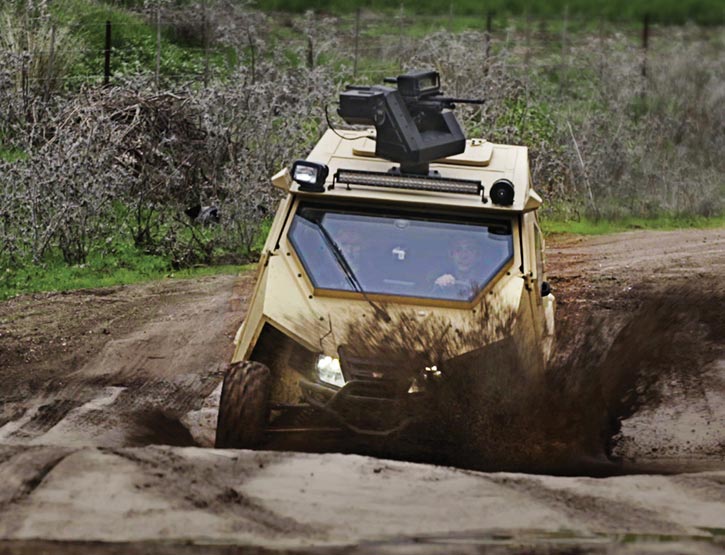
    The air-transportable Yagu is positioned to meet the needs of special operations, border patrols, urban warfare as well as special missions in crime-fighting, where light and agile platforms are required. According to Plasan, Yagu provides such high protection level at an exceptionally low weight. As its outdoors sibbling, Yagu can move on rocky and muddy terrain, on sand dunes and in forest environments, climbing extreme sloping roads. In urban scenes Yagu’s compact size comes handy, as it is able to move through narrow passages (its width is merely 162 cm), crossing jammed or blocked roads on sidewalks and stairss.

    One of the Yagu advantages is the use General Robotics Pitbull – an ultralight remotely operated weapon station,integrating hostile fire and anti-drone, ‘point and shoot’, and remote control functions. Photo: Plasan
    Plasan’s new Yagu ultralight Armored Vehicle has all around protection, including belly and roof protection, providing effective protection in an urban environment and counter IED. The wheels use larger tires, compared to the light civilian version of the Wildcat. Approach and departure angles are exceptionally high, enabling the driver to negotiate steep obstacles. The belly is extremely low, adding to the vehicle’s road stability but with adverse off-road and blast countering effects. Given Plasan’s excellent knowhow in this field, Yagu is likely to have other blast protection measures to protect the crew. Photo: Plasan

    Even with full armor, three fully equipped troops and 350 kg payload (a gross vehicle weight of more than five tons!), Yagu maintains a power/weight ratio in excess of 53 HP/Ton, thus maintaining much of the agility and mobility of the Wildcat. The platform retains the original 1000 H2 V- Twin, S0HC 4 – stroke, 4 – valve w/EFI 951cc engine with electronic fuel injection, coupled to an automatic transmission with HI/LO gear, 2 or 4 wheel drive and the long-travel front and rear suspension used in the original Wildcat. To support the added weight and improve mobility, Yagu uses bigger tires (28 X 10r14 instead of the civilian version’s 26x9R14 and 26x11R14).

    In addition to the powerful 95HP engine Yagu also has an independent power generator and integral air condition systems, maintaining continuous electrical power for the mission systems and comfortable climate inside the protected crew capsule. Photo: Plasan.

    Plasan to Introduce an Ultra-Light and Protected Vehicle for Special Ops

    A glimpse of the new Yagu - from Plasan. Photo: Plasan

    Plasan plans to unveil an all-new, lightweight protected vehicle dubbed Yagu. Known for its armor protection legacy with the MRAP, M-ATV, JLTV, and its own Sandcat armored utility and personnel carriers, Plasan’s Yagu positions its protected vehicles to meet the needs of special operations, border patrols, urban warfare as well as special missions in crime-fighting, where light and agile platforms are required. According to Plasan, Yagu provides such high protection level at an exceptionally low weight. Plasan will unveil Yagu at the Expo Seguridad event in Mexico City this week.

    Plasan provided a sneak preview of its new ultralight protected vehicle prior to its official debut on April 24. The photos provide some hints of the vehicle’s design – all around protection, including belly and roof protection, providing effective protection in an urban environment and counter IED. Small wheels with long travel suspension characteristic of modern ATV. The approach and departure angles are exceptionally high, enabling the driver to negotiate steep obstacles. The belly is extremely low, adding to the vehicle’s road stability but with adverse off-road and blast countering effects. Given Plasan’s excellent knowhow in this field, Yago is likely to have other blast protection measures to protect the crew. Photo: Plasan

    The vehicle is designed to behave like an All Terrain Vehicle (ATV) but offers its crew of three persons the all-around protection against high-velocity threats that troops are accustomed to with much heavier protected vehicles. The protected capsule provides excellent situational awareness and response, using an overhead remotely operated weapon, operated by the crew from within the air-conditioned, armored capsule.

    DEFEXPO 2018 – Aerospace Highlights

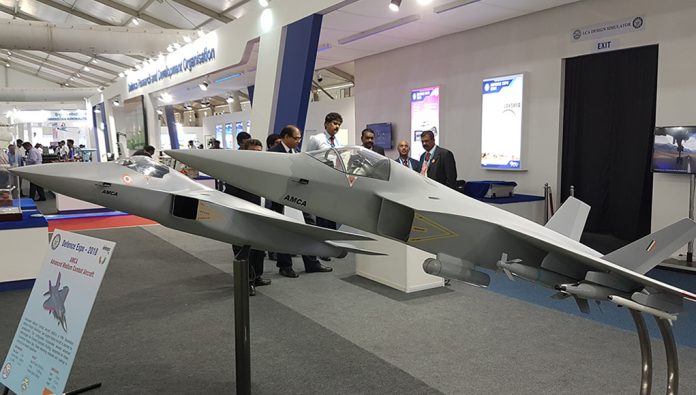
    Two models of the Indian Advanced Multi role Combat Aircraft shown by DRDO at DEFEXPO 2018 outline the moderate stealth configuration and standard mission configuration carrying under wing stores. Photo: Tamir Eshel, Defense-Update.
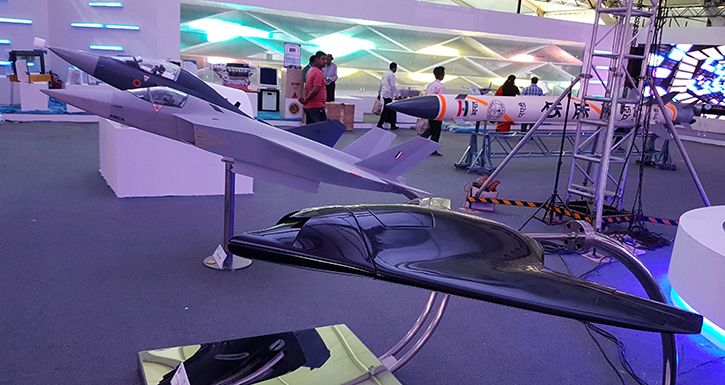
    Models of India’s future hope for indigenous airpower: Ghatak stealth combat UAV and Advanced Medium Combat Aircraft (AMCA) on display at DEFEXPO 2018. The Advanced Air Defence missile, part of India’s strategic missile defense network, can be seen in the background. Photo: Tamir Eshel, Defense-Update
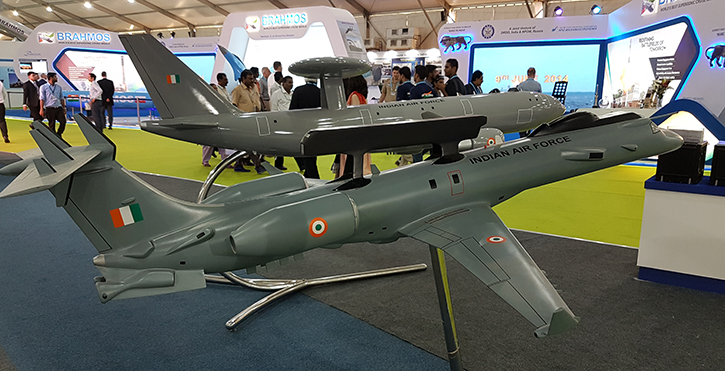
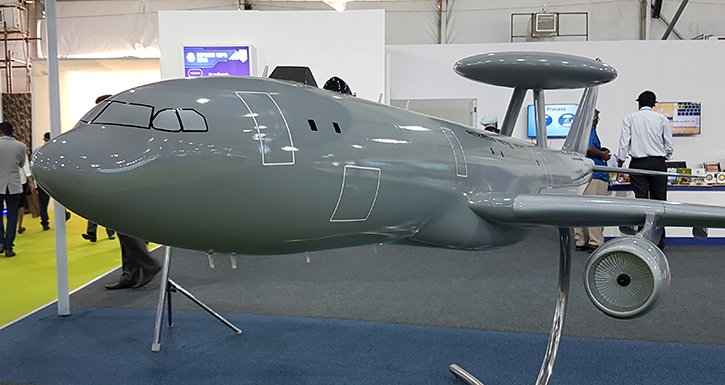
    The Centre for Airborne Systems (CABS) displayed at DEFEXPO 2018 two types of airborne early warning aircraft developed at the center, a medium range AEW&CS installed on a highly modified Embraer ERJ-145 and a future, larger platform utilizing a static dish AESA radar design. Photo: Tamir Eshel, Defense-Update
    That larger platform carrying a static dish AESA radar design, similar to the IL 76 currently used by the IAF, was shown here on an Airbus 330 class aircraft. shown here for the first time. Photo: Tamir Eshel, Defense-Update
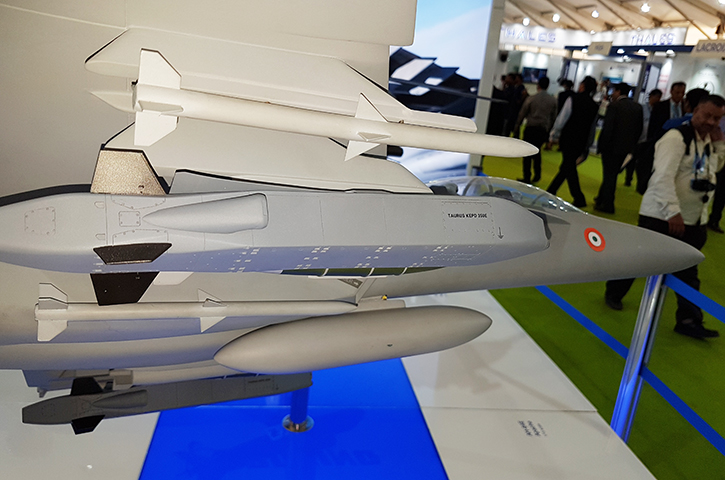
    Boeing also displayed at DEFEXPO the F/A-18E/F carrying two Taurus KEPD 350 standoff attack weapons. The Indian Air Force was interested in this weapon in the past, and the addition of the Taurus to the Super Hornet’s weapons load could make it more attractive to India. Photo: Tamir Eshel, Defense-Update
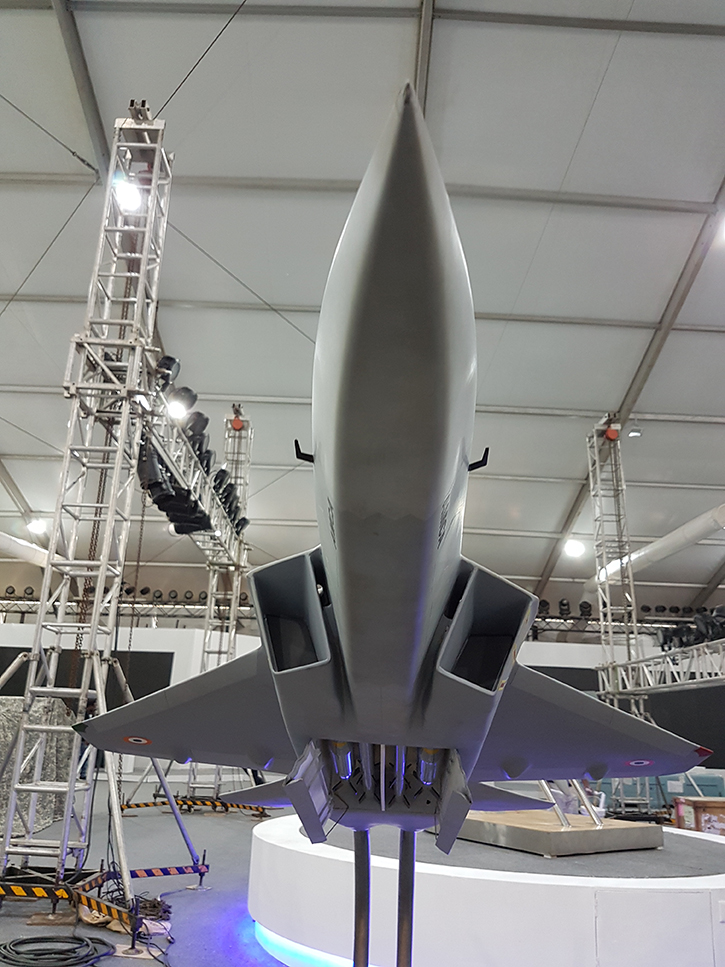
    The AMCA is shown here with a single, large weapon bay designed to carry both air/air and air/surface weapons. The AMCA survivability philosophy relies on stealth, electronic warfare, performance, and sensors. The stealth part reflected in the design employs serpentine air intake and internal weapon bay.  Photo: Tamir Eshel, Defense-Update

    DEFEXPO 2018 HIGHLIGHTS – Armored Vehicles

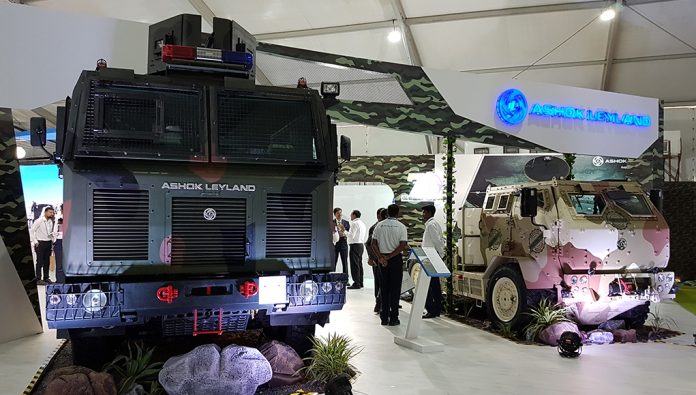
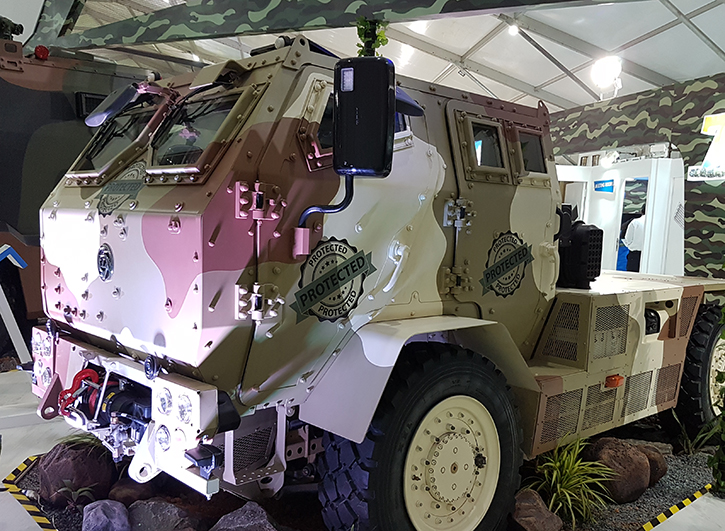
    Ashok Leyland displayed at DEFEXPO 2018 two new armored trucks - the MBPV 10 ton GWV troop carrier and the new LSV - a 5 ton GWV advanced utility vehicle designed for all-terrain mobility.
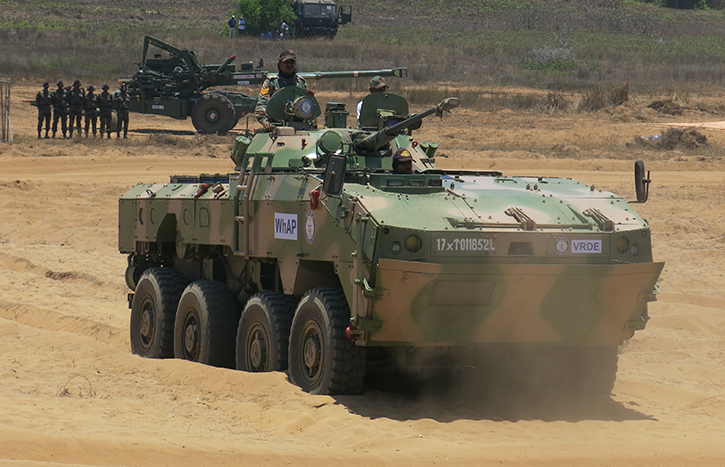
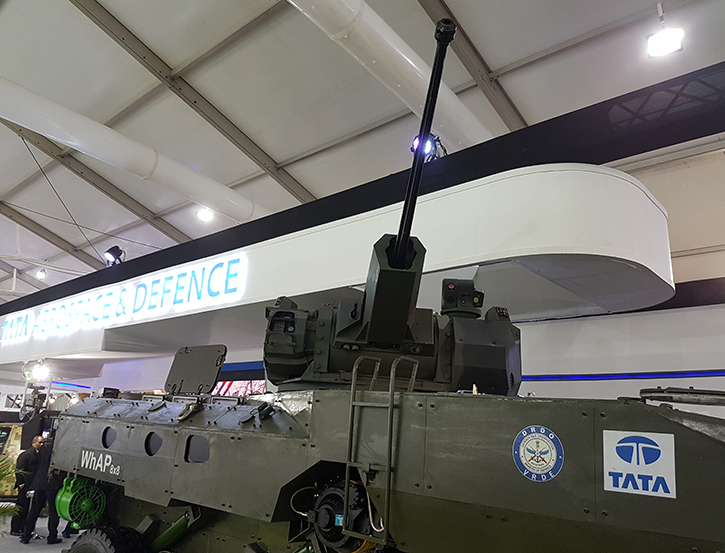
    Tata Motors displayed at DEFEXPO 2018 two types of its new 8×8 Wheeled Amphibious Platform (WhAP). The familiar version unveiled at DEFEXPO in 2014 participated in the live demonstration, This variant has a manned turret utilizing the weapon system of the BMP-2, that mounts a single 30 mm cannon (2A42) a 7.62 mm PKT coaxial machine gun and a missile launcher (AT-4 Spigot). A 600 hp diesel engine powers the 25-ton vehicle to a maximum road speed of 100 km/h. At sea, power is diverted to move two hydro jets that enable WhAP to sustain a speed of 10 km/h in water. Currently shown in the APC variant, WhAP will be configured in different variants including ICV, CBRN, Light Tank, Ambulance, Repair and Recovery, Command Post etc. Photo: Tamir Eshel, Defense-Update.
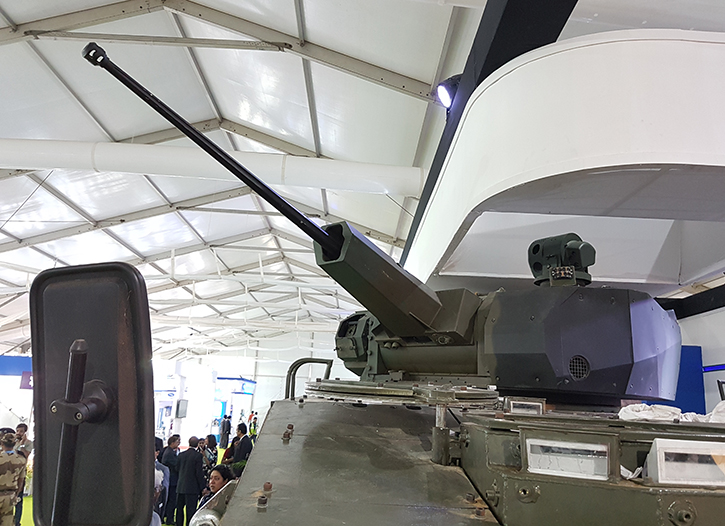
    Tata unveiled at DEFEXPO 2018 a new variant of its WhAP – equipped with the Elbit UT-30 Mk.2 remote controlled turret. This turret mounts a 30mm Bushmaster cannon and 7.62mm coaxial gun. It is fitted with separate optronics for the commander and gunner, employing ‘hunter-killer’ capability and panoramic cameras providing situational awareness to the crew. Photo: Tamir Eshel, Defense-Update
    Another view of the UT-30 Mk.2 remote controlled turret showing the different optronic units, threat warning sensors, 7.62 coaxial machine-gun. Photo: Tamir Eshel, Def.ense-Update
    This side view clearly shows the hydro jet, firing ports on the side and the rearview camera, which is part of the panoramic camera system providing situational awareness to the crew. Double floor V-Hull for mine protection, with blast-protected seats and footrests.  Photo: Tamir Eshel, Defense-Update
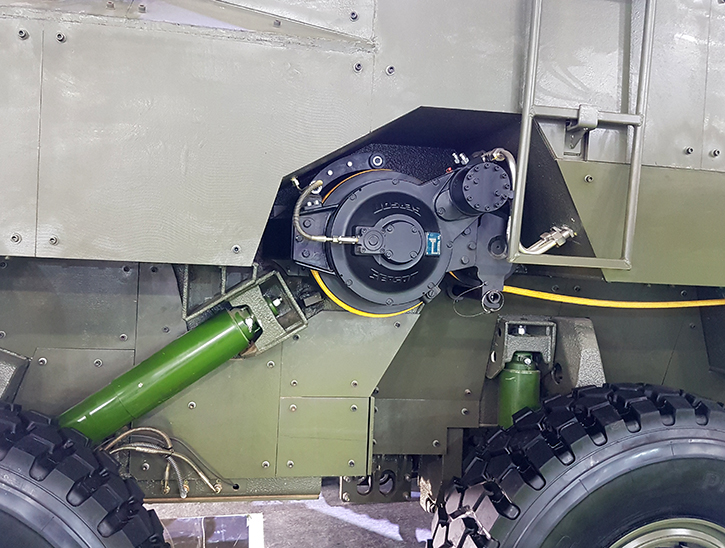
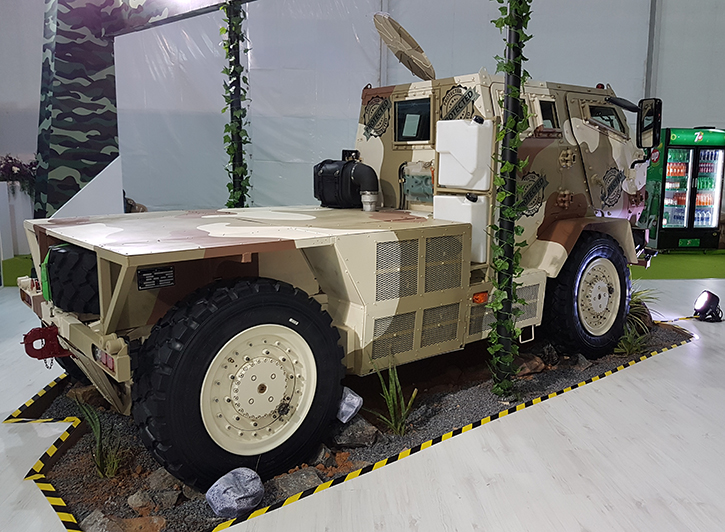
    Tata’s WhAP offers improved platform stability and ride comfort due to the use of hydro-gas suspension. The vehicle is fitted with central tire inflation system (CTIS), it also uses a winch mounted on the right side. Also seen in this image are the modular armor panels that can be replaced to upgrade protection, to tailor the vehicle for new threats. Photo: Tamir Eshel, Defense-Update
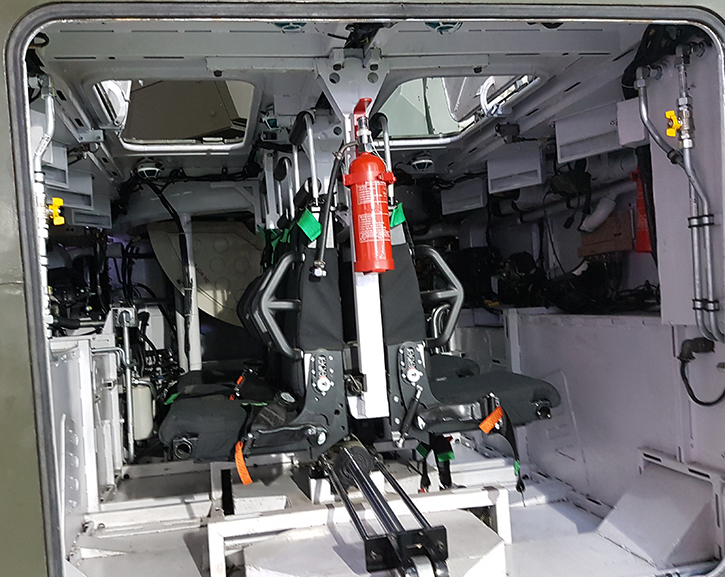
    An internal view into the WhAP shows back-to-back seating arrangement for six soldiers. Each position is provided with an individual blast protected seat, a periscope, and firing hatch. Crew positions at the front. Soldiers can also operate outside the vehicle, using the two roof hatches. Access to the vehicle is via a ramp (the ramp lowering mechanism seen on the floor). Photo: Tamir Eshel, Defense-Update
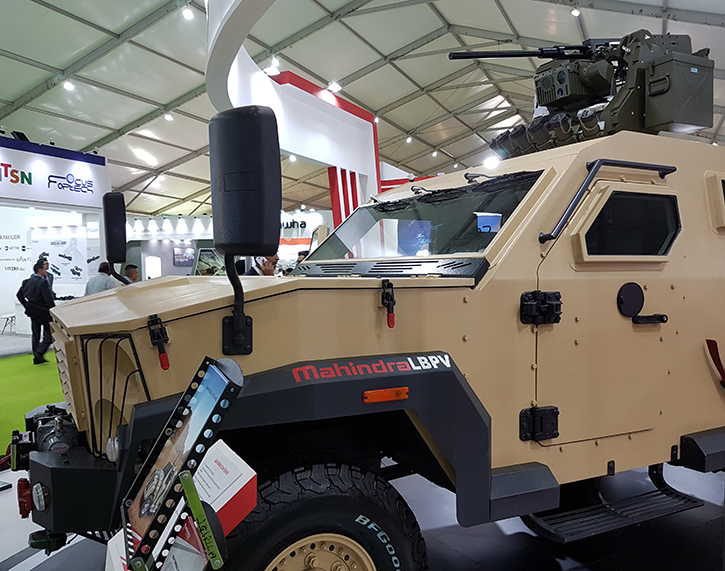
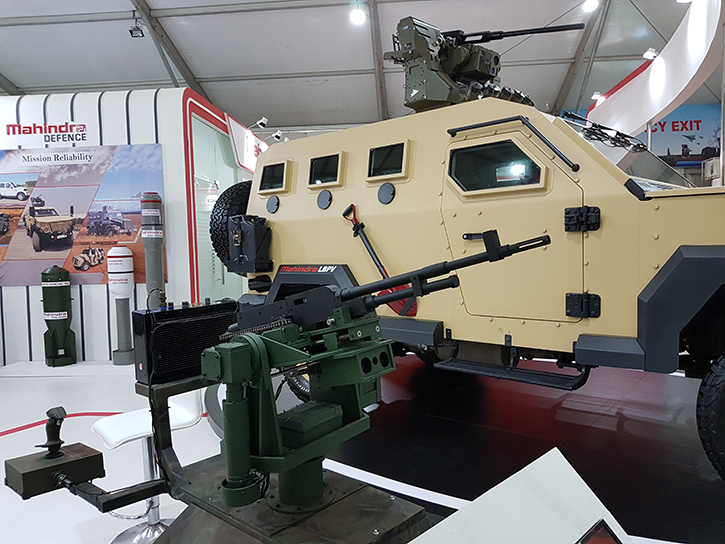
    Mahindra introduced the Light Bulletproof Vehicle (LBVP), at a gross vehicle weight of 5.5 tons LBPV passenger and engine compartments are protected to STANAG level 2 (7.62×51, 7.62×39, and 5.56×45 ball ammo). Underbelly protection is also provided, (36M/DM51 grenades). The vehicle supports an overhead remotely controlled weapon station, shown here with 12.7 heavy machine gun. Photo: Tamir Eshel, Defense-Update
    Mahindra’s LBPV uses an independent suspension, central tire inflation system and run flat tires, capable of travelling up to 100 km on damaged tires. Its high ground clearance enabling it to effectively move on the road at a speed of 110 km/h, as well as offroad, with a gradient up to 60 percent. It can ford up t half a meter of water without preparation. Seating arrangements are for a crew of two plus 4 or 6 passengers. LBPV is fitted with a forward winch for self-recovery. Photo: Tamir Eshel, Defense-Update.
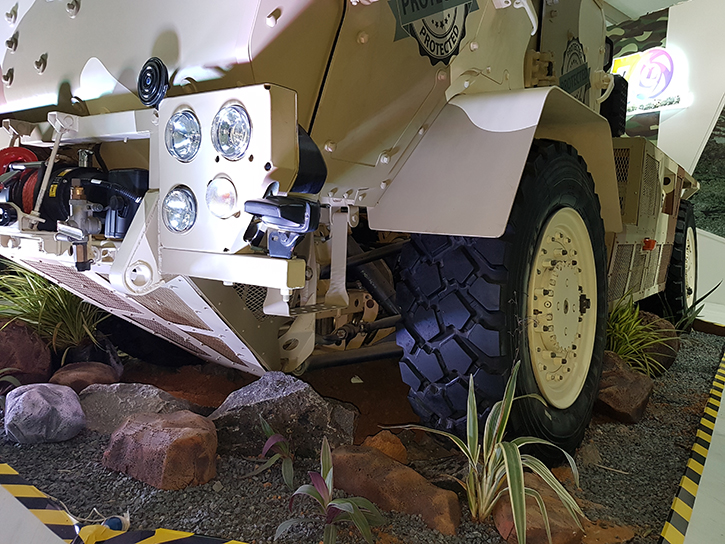
    Ashok Leyland Defense Systems (ALDS) displayed at DEFEXPO 2018 the new Light Specialist Vehicle (LSV) developed with Lockheed Martin, based on LM’s High Mobility Vehicle or Common Vehicle Next Generation (CVNG) concept. With the LSV Ashok Leyland plans to pursue Indian Armed Forces requirements for Light Specialist Vehicle (LSV) and Light Armored Multipurpose (LAM) vehicles. The 5 ton GWV, (upgraded to eight tons), 4×4 advanced utility vehicle designed for all-terrain mobility, moving troops and equipment over rough terrain and under adverse conditions. The vehicle has an armored cab protected to STANAG Level 1. LSV is configured to carry four soldiers – two crew members and two passengers. Photo Tamir Eshel, Defense-Update.
    The LSV is designed with a flatbed mounting different loads, including mission-module shelters. The vehicle is shown here carrying water tanks, and elevated air intake provided as options with the LSV. Photo: Tamir Eshel, Defense-Update
    The LSV is fitted with 180 hp H6 engine, driving a five-speed gearbox with two-speed auxiliary gear, and independent, collapsible suspension enabling the crew to reduce the vehicle’s ground clearance to 25 cm, to meet specific travel conditions. Maximum road speed is 100 km/h, and the turning diameter is 7.4 meters. Photo: Tamir Eshel, Defense-Update.
    The Indian T-72 BLT Bridge Layer Tank was designed and developed by CVRDE and R&DE (Engineers). Photo: Tamir Eshel, Defense-Update
    The Indian T-72 BLT Bridge Layer Tank carries either a 20-metre MLC 60 scissors bridge or a 22-metre 70 MLC scissors bridge, that can span an obstacle within 10 minutes. Photo: Tamir Eshel, Defense-Update
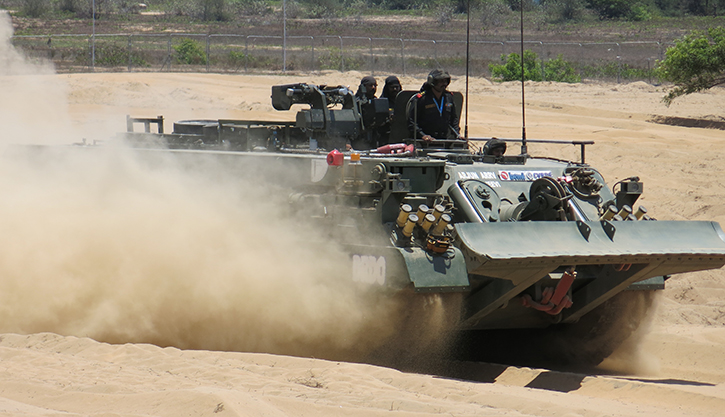
    Arjun Armored Recovery and Repair Vehicle (ARRV) shown on the live demonstration at DEFEXPO 2018. ARRV is equipped with a dozer blade, a winch system designed for 50 ton pull and a crane that lifts up to 20 tons. The vehicle is fitted with remotely controlled weapon station. Photo: Tamir Eshel, Defense-Update.
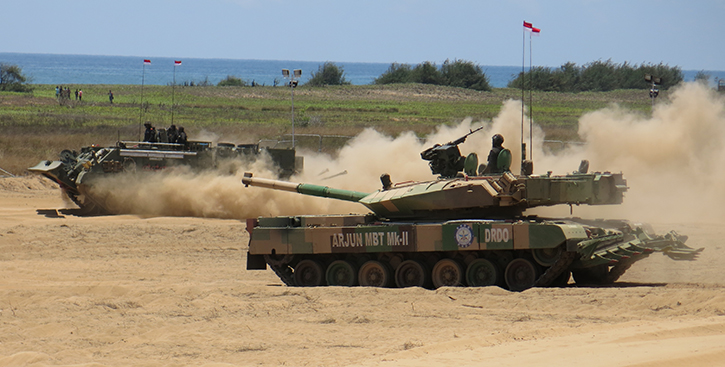
    Arjun MkII and Arjun Armored Recovery and Repair Vehicle (ARRV) shown on the live demonstration at DEFEXPO 2018. Arjun MK II has a 120mm rifled cannon, that fires anti-tank FSAPDS, high explosive (HESH), Thermobaric (TB) and gun-launched missiles. Other weapons include 12.7mm heavy machine gun and 7.62 coaxial machine gun. Powered by a 1400 hp diesel engine, automatic transmission and hydrogas suspension, Arjun Mk II can travel on road at a maximum speed of 58 km/h, and 35 km/h offroad. The tank uses the KANCHAN armor suite, an indigenous lightweight, compact protection comprising composite armor and explosive reactive armor. Laser sensors and soft kill countermeasures are also used, along with mine protection measures that include Magnetic Signal Duplicator (MSD) and Lane-Width Mine Plough (LWCS), designed to combat magnetic and pressure activated mines. Photo: Tamir Eshel, Defense-Update.
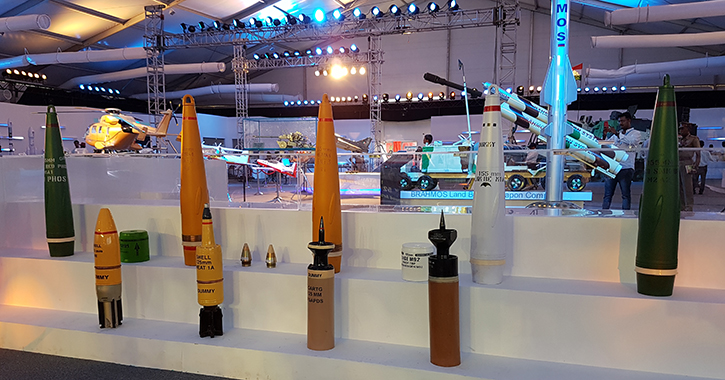
    The Indian Army’s urgent need for ammunition is attracting foreign suppliers such as Techmash, the primary manufacturer of ammunition for tanks and artillery. The company displayed at DEFEXPO a wide range of rounds, two of the primary types of 125mm tank guns are shown here in cutaways. Photo: Tamir Eshel, Defense-Update
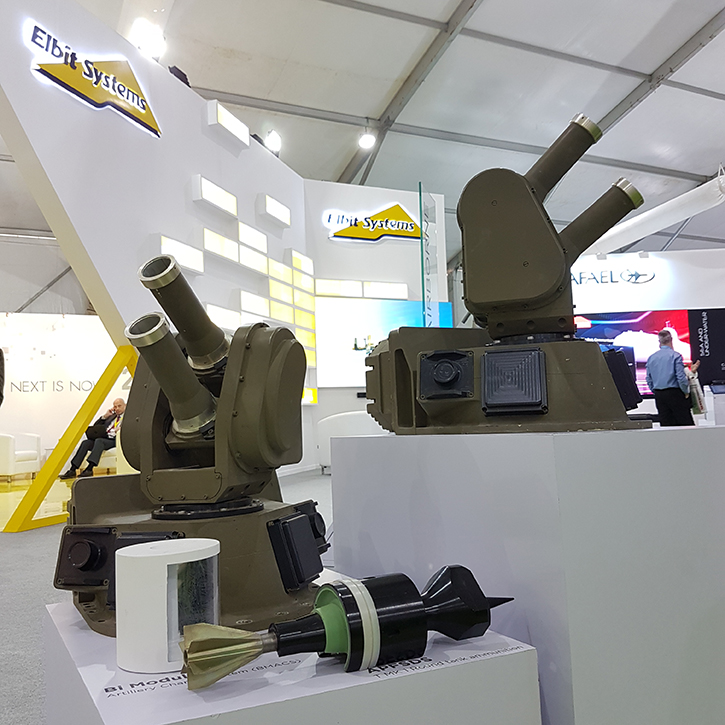
    Since IMI has been blacklisted in India for corruption charges, Elbit Systems with allowed to market some of the solutions that had interest for the Indian. Now, with Elbit cleared to acquire IMI from the Israeli Government, the company could further accelerate its offering, particularly as the IMI’s blacklisting could be removed as it is fully absorbed by Elbit Systems, that maintains a spotless record in India and abroad. Given the thirst the Indian market has for land systems of the types IMI was involved with in the past (Arjun, Pinaka, ammunition systems and more), Elbit Systems could gain a significant upside from its acquisition that has not been fully addressed before, to the speculative nature of these prospects. Among the systems displayed by Elbit Systems at DEFEXPO were the Bi-Modular Charge Systems for 155mm artillery, tank ammunition developed by IMI for the Russian 125mm tank gun and the Iron Fist active protection system currently undergoing advanced development at IMI Systems. Photo: Tamir Eshel, Defense-Update.
    RAFAEL unveiled at DEFEXPO 2018 a new configuration of the Trophy APS designed for the Indian Brishna (Russian T-90 tank). This design utlizes an integrated APS module combining the effectors, loaders and one sensor, with another mounted at the front of the turret. This configuration replaces stowage boxes installed on the original tank. Photo: Tamir Eshel, Defense-Update
    RAFAEL displayed another Trophy configuration at DEFEXPO, showing a hybrid protection solution comprising passive, reactive and active protection systems, design for armored personnel carriers and armored infantry fighting vehicles such as the American M2/M3 Bradley. The US Army selected another solution for the Bradley, (provided by IMI Systems) that mounts the APS systems on the turret. Photo: Tamir Eshel, Defense-Update

    DEFEXPO 2018 HIGHLIGHTS – Unmanned Systems

    Aeronautics' Orbiter 4 is proposed by a JV established between Aeronautics and Mahindra for the Indian Navy requirement for future on-board UAV. Photo: Tamir eshel, Defense-Update
    Boeing is pursuing the Indian Navy shipborne UAV opportunity with the RQ-21 Blackjack from its UAS subsidiary Insitu. Based on Insitu’s Integrator. Maritime based systems are operated with the US Marine Corps and the Canadian Navy. The armies of the Netherlands and Poland use it in land-based operations. Boeing displayed the Integrator on its DEFEXPO 2018 display. Photo: Tamir Eshel, Defense-Update.
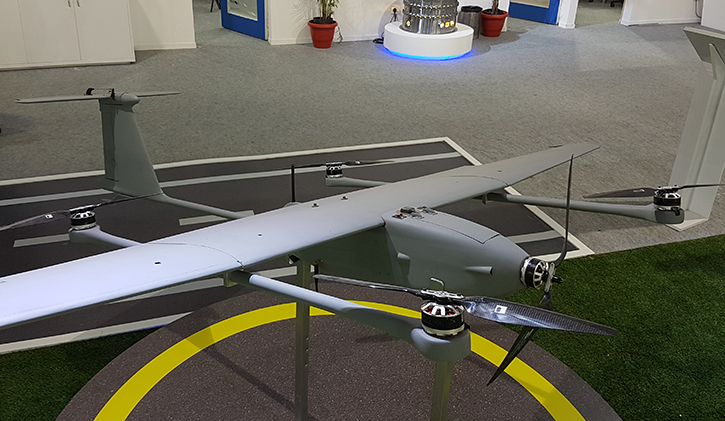
    TATA displayed at DEFEXPO 2018 its latest Vertical Take-Off and Landing (VTOL) mini-drone, that combines an electrically powered quadrotor for vertical lift, with aerodynamic lift generated by the wings and tail and a large propeller driven by an electrical motor for the forward flight. The drone that weighs 12 kg has a mission endurance of 45-60 minutes, depending on mission profile (number of hovers determine the length). It can climb to a ceiling of 3,000 meters above sea level. Photo: Tamir Eshel, Defense-Update.
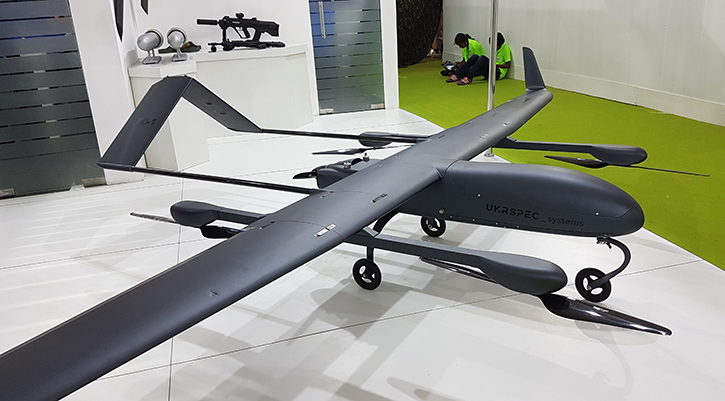
    The Ukraine company UKRSPEC Systems displayed at DEFEXPO 2018 the VTOL module developed for its PD-1AF fixed-wing drone. The VTOL module can be installed on the standard PD-1 drone in the field, to enhance its operability at locations that cannot support operations from runways. Added with the VTOL kit the PD-1 has a wing-span of five meters, (compared with four meters for the PD-1). Mission endurance remain the same 10 hours while payload weight is slightly reduced (7 kg vs 8kg). Take-off and landing processes are controlled by autopilot and done in fully automatic mode. Photo: Tamir Eshel, Defense-Update.
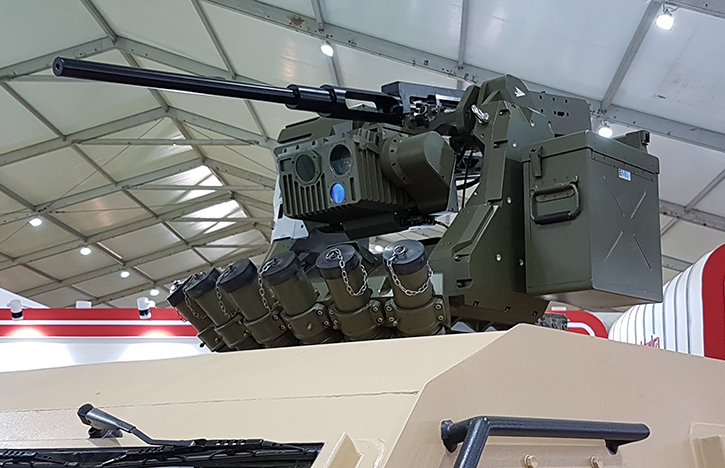
    Mahindra Defence displayed at DEFEXPO 2018 two types of remotely operated weapon stations. This overhead RWS mounts a 12.7 mm heavy machine gun, an integral EO system and smoke canisters. Photo: Tamir Eshel, Defense-Update.
    A smaller remotely controlled weapon station (RWS) from Mahindra mounts a 7.62mm machine gun. Photo: Tamir Eshel, Defense-Update.
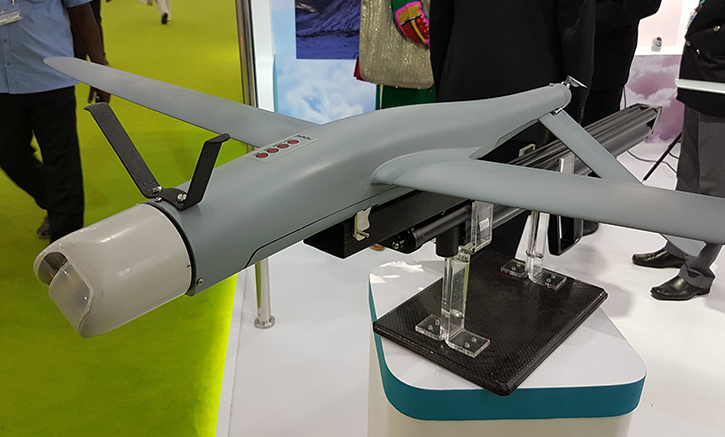
    BlueBird Aero Systems unveiled at DEFEXPO 2018 its latest variant of MicroB, a small, lightweight UAV system deployed by a single operator using a gun-like telescopic rail. The new MicroB is slightly larger than the previous model, its efficient wing design and longer, slender fuselage that provides more space for batteries enable users to more than double the mission endurance. Other systems displayed here were the ThunderB small tactical UAV and SpyLite mini UAS. The company has already conducted field trials in India, that successfully demonstrated the SpuLite’s performance in a tactical surveillance role at high altitude and in extreme weather conditions.The unveiling of the new variant in India comes with the announcement of a Joint Venture between CYIENT and Bluebird, that aims to indigenize, manufacture and assemble BlueBird’s UAVs for the Indian market. Photo: Tamir Eshel, Defense-Update.
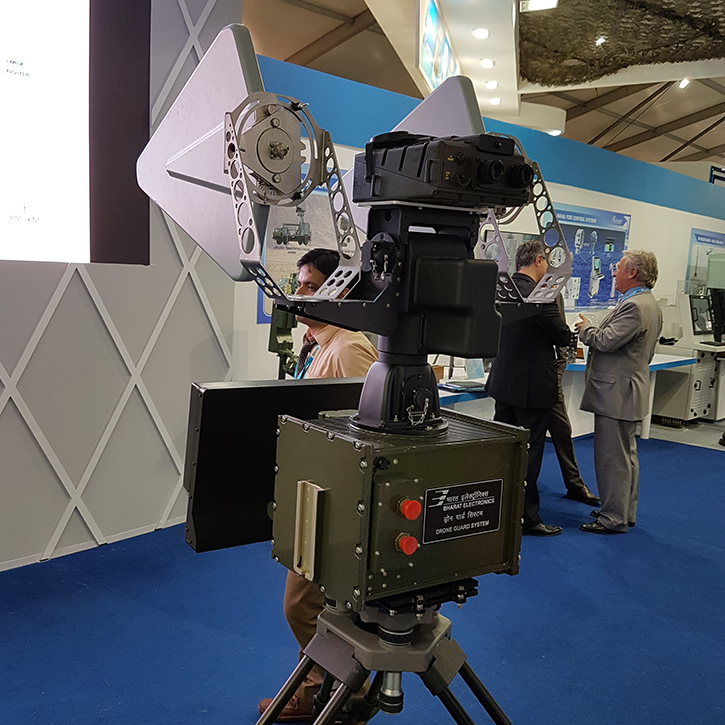
    The Indian civil and military authorities have great interest in drone detection and interception capabilities, which several companies have addressed at DEFEXPO 2018. Among the systems displayed were the Drone Guard System (DGS) developed by Bharat Electronics (BEL), which detects, intercepts, classify and neutralizes radio controlled drones by means of electronic countermeasures. The system detects the radio links associated with the drone’s remote control from a distance of eight km, and uses EO sensors and RF neutralizers to track and defeat the target. The system can operate in fully automatic or manual control mode. Photo: Tamir Eshel, Defense-Update.
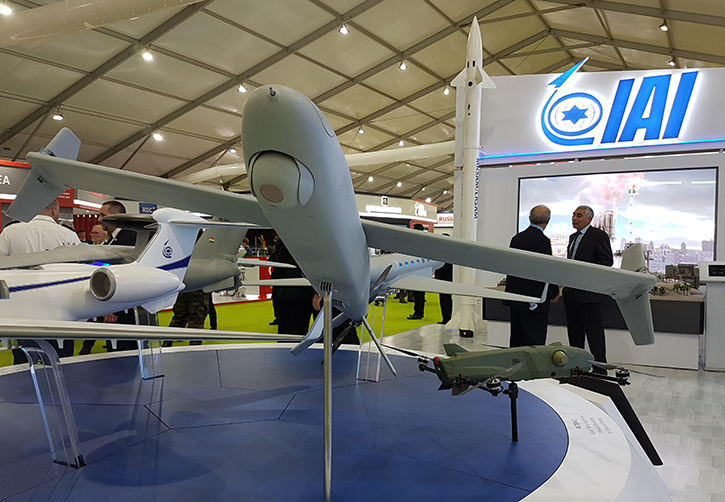
    India was one of the first users of IAI’s loitering munitions, as it became an early adaptor of both the Harpy autonomous radar suppression autonomous loitering system and Harop systems, extending the system’s capability to semi-autonomous weapons with man-in-the-loop control. The Harop is currently offered for integration on surface vessels, operating as a stand-off surface attack providing selective attack capability. Two new designs – Green Dragon and Rotem-L were displayed at DEFEXPO 2018. Photo: Tamir Eshel, Defense-Update.
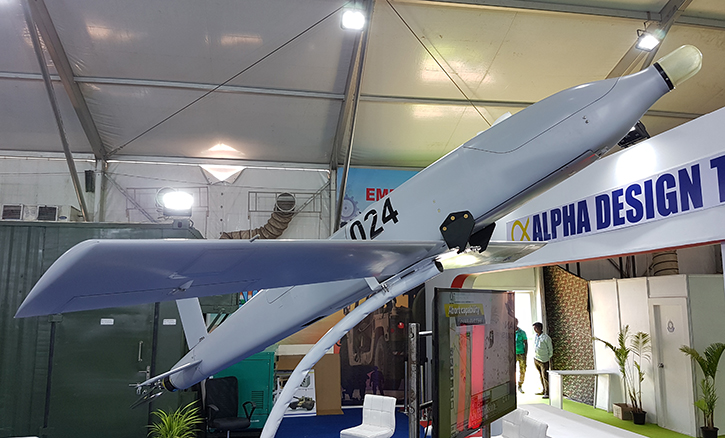
    The Indian interest in loitering systems brought new players to pursue opportunities for such systems. Among these is Alpha-Elsec, a joint venture between Elbit Systems of Israel and Alpha Design Technologies of India. At DEFEXPO 2018 the JV displayed the Sky-Striker, an electrically powered optionally recoverable loitering weapon that performs autonomous or manually controlled attack missions. As a compact, electrically powered drone, Sky-Striker can operate quietly at a range of 20 km from its launch point, where it loiters on patrol or over a target area for two hours, carrying a day/night electro-optical payload and a single warhead weighing five kg. (a larger 10 kg warhead can be used, with shorter loiter time). Once a target is locked and attack being approved, the drone dives, at a speed up to 300 knots. Its unique capability is operation at an adverse weather, at wind level of up to 40 knots. In case the mission did not develop an attack opportunity the Sky-Striker can be brought to a safe landing and recover for another mission. Photo: Tamir Eshel, Defense-Update
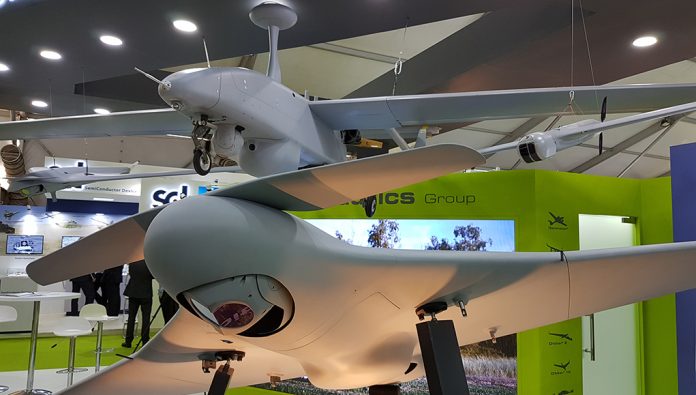
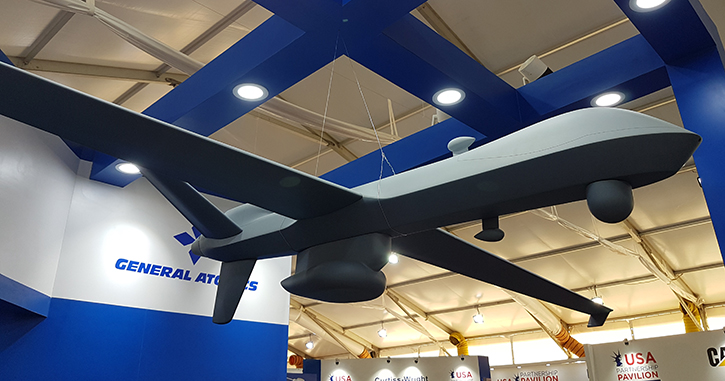
    General Atomics displayed at DEFEXPO a scale model of its Guardian UAS, a variant of the Predator B designed primarily for maritime surveillance missions. It carries multiple sensors and is operated remotely over very long distances via satellite link. India expressed interest in acquiring 22 of these drones, in a deal expected to be worth around US$2 billion but hasn’t placed an order yet. If such deal materializes it will be the first major sale of unmanned systems in India. Until now India relied on Israel and on local production for all its unmanned systems. In parallel to the interest in Delhi’s US drones, India’s DRDO is developing a Medium Altitude Long Endurance (MALE) drone, and the sale of 10 Heron TP drones to India is held in a similar status. Photo: Tamir Eshel, Defense-Update

    DEFEXPO 2018 HIGHLIGHTS – Artillery

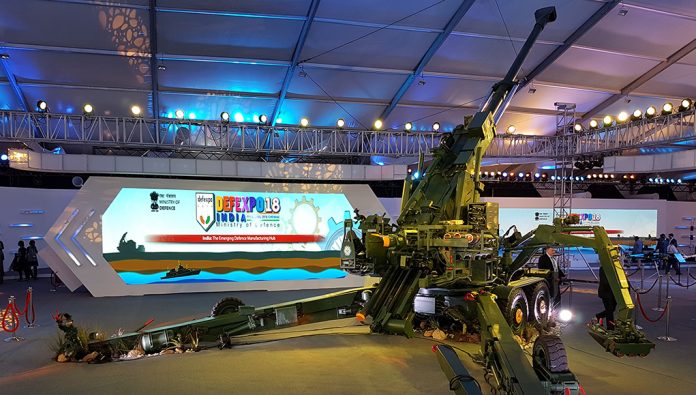
    155X52 CAL Advanced Towed Artillery Gun System (ATAGS) displayed at DEFEXPO 2018 by DRDO Armmament Research & Development Establishment (ARDE). ATAGS achieved the longest range of tube artillery among Indian manufactured guns, scoring 45km. Is uses all-electric servo drives for laying, breech, ramming and crane operation, supporting a rate of fire of five rounds per minute. Photo: Tamir Eshel, Defense-Update
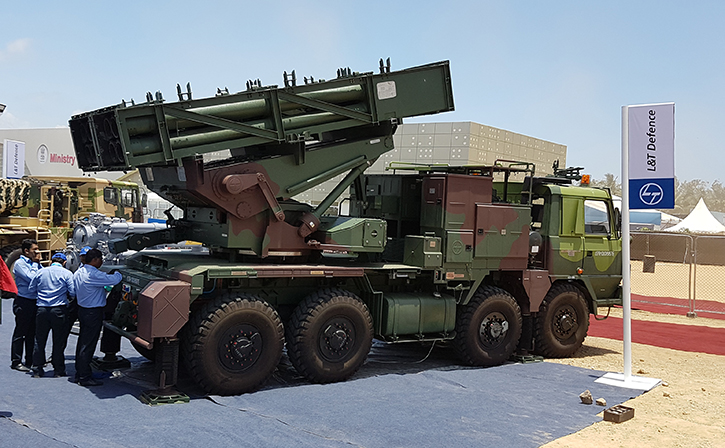
    The Pinaka Multi Barrel Rocket Launcher (MBRL) was designed by the DRDO with development and production partners from the private sector – Larsen & Turbo (L&T) and Tata Power SED. The first variant was fielded in the year 2000 using unguided rockets reaching a range of 42 km in ballistic flight. By mid 2020s India plans to field 22 regiments armed with various variants of Pinaka. The latest is Mk II, launched in 2013 by the DRDO. Pinaka II, that is slightly longer and is designed to reach 75 km, this new version (Pinaka Mk-II) uses improved positioning and navigation systems thus reducing the fire dispersion of the salvo. The rockets that carry four types of warheads – fragmentation high explosive, Incendiary, Anti-Tank and Anti-Personnel minelettes and anti-tank bomblettes. Photo: Tamir Eshel, Defense-Update
    Pinaka Mk-III is currently in advanced development. This enhancement of the Pinaka system turns the ballistic rocket into a precision weapon, using guidance, navigation, and control (GNC) placed in the empty ogive section of the warhead. The system uses INS (MEMS-based) and three-level satellite navigation support – GPS, GAGAN, and GLONASS. The system employs vector explicit guidance algorithms to guide the rocket using aerodynamic canard controls that increase the rocket precision, providing hit accuracy of less than 30 m at its maximum range. The Indian Army plans to use Pinaka Mk III to replace the 26 long-range artillery rocket battalions currently using the Russian BM-30 Smerch 300mm rocket launchers. According to DRDO the system, likely to complete development in 3 years. Each rocket has a length of 5.175 m and a diameter of 214 mm. Weighing 325 kg, Pinaka Mk III has an effective range of 20-80 km. It carries a warhead of 100 kg (including the 23 kg guidance system). Photo: Tamir Eshel, Defense-Update
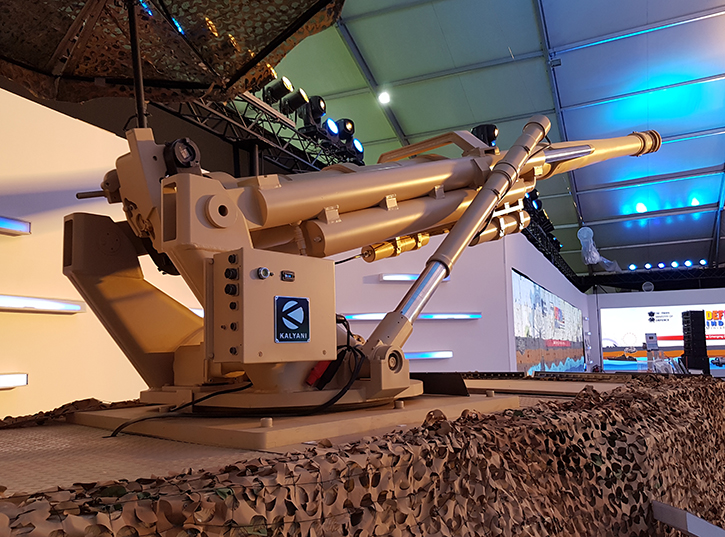
    The Ultra Light Howitzer (ULH) developed and built by Kalyani defence group represents one of the recent Indian defense programs built by the private sector. Based on the soft recoil system developed for the Garuda 105 system, this 155×39 mm caliber gun system that weighs less than 4.5 tons, thus being able to mount on medium trucks. In a recent firing test series the ULH the gun successfully proved firing pressures. The ULH fires standard 155mm ammunition at a rate of 4 rounds per minute in intense firing or 1.25 RPM in sustained fire. The mount can traverse 360 degrees and elevate from -3 to +70 degrees. Photo: Tamir Eshel, Defense-Update
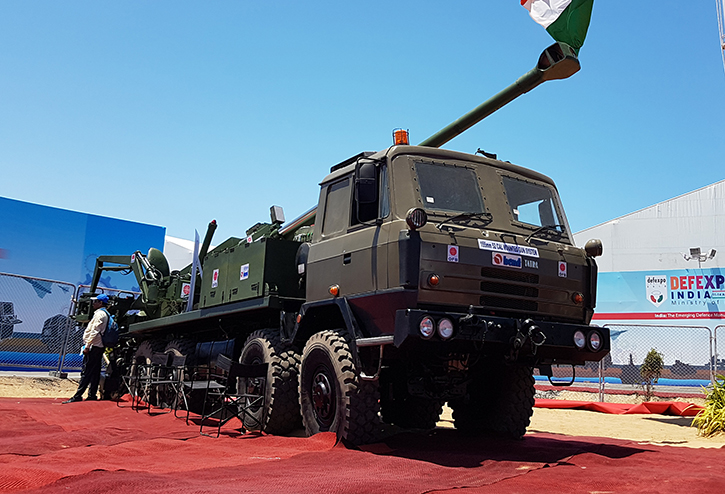
    The 155×52 Caliber Mounted Gun System is an example for the indigenously designed, developed and manufactured defense systems developed and built by the Ordnance Factory Board (OFB). This 52 CAL 155mm gun common with towed guns, is mounted on a BEML TATRA 8×8 truck, designed to move the gun and 18 ammunition sets (projectiles and propelling charges) on roads and offroad, and place the gun in position and lay the gun for firing without external support. The unit uses integral navigation and positioning systems using INS and GPS, as well as a muzzle velocity measurement system, enabling auto laying and improved fire precision at distances of 38 km and more. An auxiliary power unit is used to provide operating power for the gun operations and electronic control even when the engine is shut off. Photo: Tamir Eshel, Defense-Update
    The procurement of 100 K9 VAJRA-T Self-Propelled Gun (SPG) was the largest Indian private sector defense order (US$ 710 million) won in a global competition. The K9 developed by the Korean Hanwha Techwin. The first lot of 10 K9 VAJRA-T guns is currently being delivered to the Indian Army. The remaining will be gradually produced in India under the JV signed with Larsen & Turbo (L&T), with the Korean company acts as the technology partner. All 100 guns will be supplied in under 42 months from the signing of the contract. The JV will also transfer maintenance technology to the army shops that will provide technical support for the systems. The Indian K9 is based on the Korean Thunder SPG, that has recently been selected by several users worldwide. The tracked, armored SPG mounts a powerful 155mm/52 howitzer capable of handling Enhanced Range Full Bore (ERFB) ammunition common with all NATO forces. Photo: Tamir Eshel, Defense-Update.
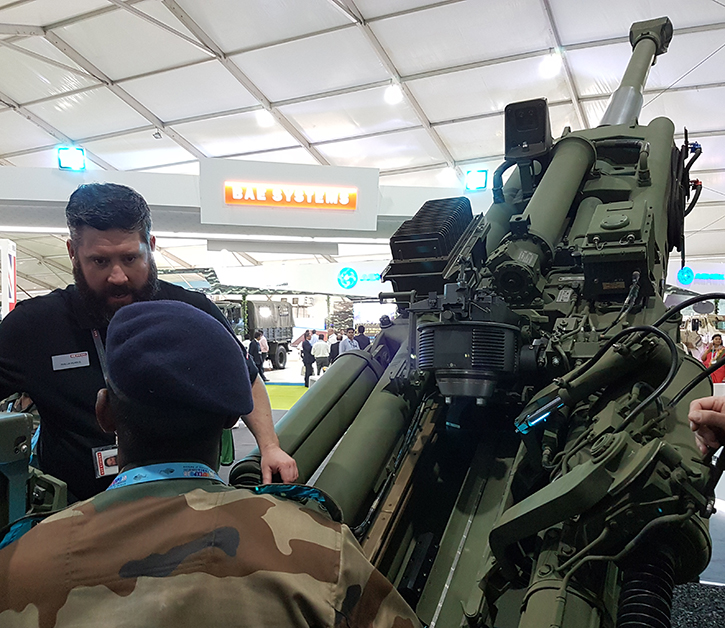
    Despite the extensive local development and production of tube artillery, the endless Indian appetite for big guns opens many opportunities for overseas vendors, to sell and co-manufacture gun systems in India. The M-777 light howitzer is one example, BAE Systems was is supplying 145 such guns under a US$750 million deal. The guns were delivered in 2017 and are undergoing testing in India. Photo: Tamir Eshel, Defense-Update
    Although India’s OFB produces a line of 155 and 130 mm artillery ammunition as well as 125 and 120mm tank rounds. The Indian Army suffers short supplies of ammunition, particularly new and advanced types. To improve logistics and performance India intends to induct Bi-Modular Charge Systems (BMCS) technology it once planned to license from IMI. Current possibilities include licensing the technology from Elbit Systems, once the sale of IMI Systems is concluded, or from Nexter, that recently established a JV with Premier Explosives of India. Both companies displayed these technologies at DEFEXPO 2018. Photo: Tamir Eshel, Defense-Update
    Kalyani has launched another JV with IAI, for the production of guided rocket and artillery systems, based on IAI’s Topgun – a low cost, add-on fuze that screws on to standard 155mm rounds and transforms it into a precision-guided weapon, at a fraction of the cost of missiles or loitering weapons. The TopGun fuze performs two-dimensional correction of the ballistic trajectory to reduce dispersion in both range and deflection, enabling fire mission to be accomplished at a shorter time and lower cost. Photo: Tamir Eshel, Defense Update

     

    DEFEXPO 2018 – Photo Highlights

    Following are our first photographic impressions from DEFEXPO 2018 that was held south of Chennai, in South India this week. Follow-up reports will highlight specific areas including combat aircraft and weapons, unmanned systems, armor and artillery.

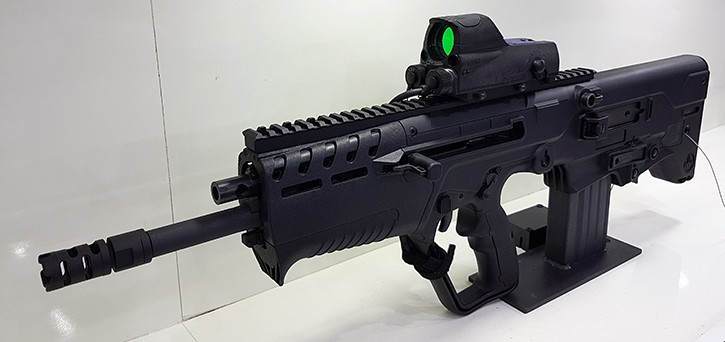
    IWI displayed here the brand new Tavor 7, an assault rifle chambered to fire potent 7.62X51mm ammunition utilizing the Tavor bullpup configuration, that has a rear center of gravity that enables a rapid acquisition of the target and providing the ability to fire the weapon with only one hand. Photo: Tamir Eshel, Defense-Update
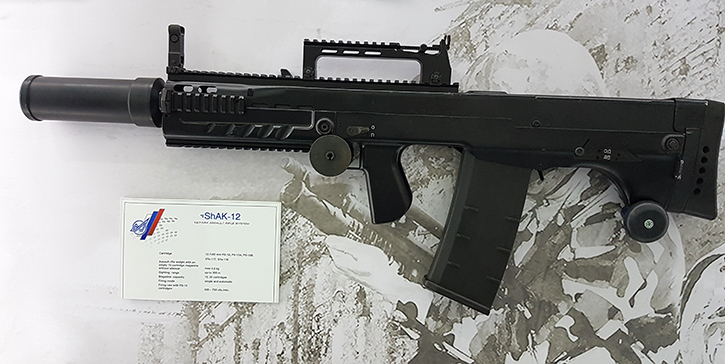
    The Russian ShAK 12 heavy assault rifle silenced bullpup unveiled by KBP late last year follows a brand approach utilizing the 12.7mm ammunition for a compact, powerful weapon capable of defeating human targets wearing body armor, protected inside light armored vehicles. The 5.2 kg weapon uses a 10 or 20 cartridge magazine loaded with 12.7×55 sub- and supersonic rounds in automatic (500-750 rounds per minute) or semi-automatic modes, to an effective range is up to 300 meters Photo: Tamir Eshel, Defense-Update
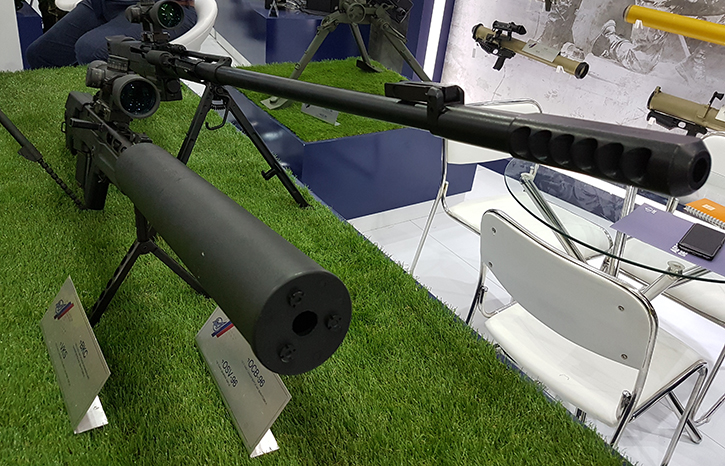
    VKS and OSV-96 are two heavy sniper rifles produced by KBP. Introduced in 1990, the OSV-96 seen on the right is an improved version of the Russian V-94 heavy sniper rifle. The 12.9 kg weapon It fires 12.7×108 mm cartridges to a maximum range of 1,800 meters. An equivalent to the Amerian Barret M82, OSV-96 is in use with the Russian government agencies and Indian naval special forces. VKS, shown on the left, is a silenced sniper rifle (uses an integral suppressor) that fires 12.7×55 rounds. The shorter ammunition and bullpup design offer a more compact size. Typical targets for the VKS are combatants in heavy body armor or behind cover. The weapon’s length, including the suppressor, is 1,120 mm and the total weight is 7 kg. Photo: Tamir Eshel, Defense-Update
    WEM an Indian private company displayed at DEFEXPO 2018 the lightweight, man-portable AsiBal, a fire and forget anti-tank missile that has dual-mode day/night imaging infrared (I2R) seeker. Although it is still in early stage of development, AsiBal already won a significant success denying the Israeli Spike MR missile from winning a major contract to supply thousands of missiles to the Indian Army. (The Indian Army could eventually get the Spike as a near term replacement of the Milan, through a Government to Government sale, but this may not stop AsiBal from becoming the indigenous ATGM the Army would have to buy. AsiBal promises to be lighter and cheaper, compared to the Israeli design, but as a smaller missile, offers a shorter range (2,500m – same as Milan) although the Indian designer claims a 4,000 m variant is already in the making. The system comprises a disposable launcher and reusable fire control unit equipped with CCD, I2R and laser rangefinder, pointing the target to the missile’s seeker in a lock-on before launch (LOBL) mode. The system is designed to engage both stationary and moving targets in direct and top-attack modes, with a tandem warhead that can penetrate 750-850 mm of armor. The entire system with control unit weighs 18.5 kg. Photo: Tamir Eshel, Defense-Update
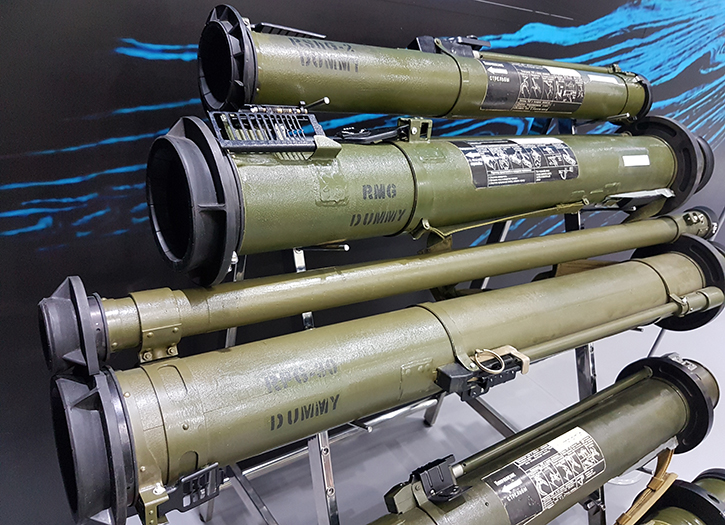
    Techmash displayed several types of shoulder-fired, unguided anti-tank weapons, including the 105mm RMG multi-purpose disposable rocket launcher (second from top) carrying a tandem warhead with a thermobaric warhead. The effect of this warhead is breaching a 0.5 square meter hall in a 500 mm thick brick wall, or 0.4 square meter hall in a 300 mm thick reinforced concrete wall. The thermobaric effect defeats 700mm sandbag protected targets or 50mm of homogenous steel. Third from top is the RPG-30, an anti-tank rocket configured with a two launchers – a ‘stimulator’, 42mm rocket fired before the main charge and designed to trigger the active protection system, rather than penetrate the target. The RPG-30’s main rocket fires in quick succession, timed to reach the target before the APS recharges. thus defeating the 600 mm of homogenous steel target using its tandem HEAT warhead. Photo: Tamir Eshel, Defense-Update
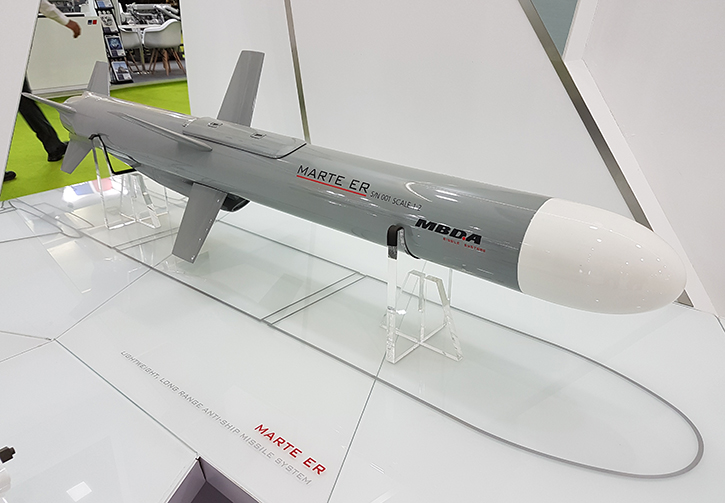
    MBDA displayed at DEFEXPO 2018 the Marte ER, a modernized variant of the Marte anti-ship missile designed for carriage by helicopters and surface ships. Powered by a turbojet engine, the ER has a range of 100 km. Photo: Tamir Eshel, defense-Update
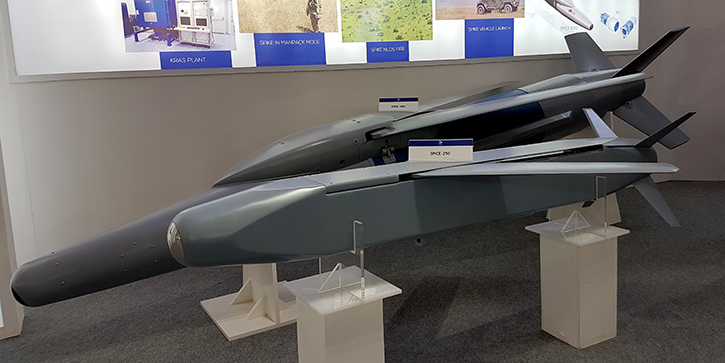
    Israel’s RAFAEL and Kalyani Defense group have established the Kalyani Rafael Advanced Systems (KRAS) joint venture that already has manufacturing facilities in Hyderabad Hardware Park designed to produce the Spike MR missiles RAFAEL was selected to produce for the Indian Amry. The JP plans to expand to another site in Hyderabad, where various mechanical, electronic, and electro-optical subsystems will be produced, for Spike, as well as for other precision-guided weapons such as the aerial Spice 1000 and 250. Photo: Tamir Eshel, Defense-Update
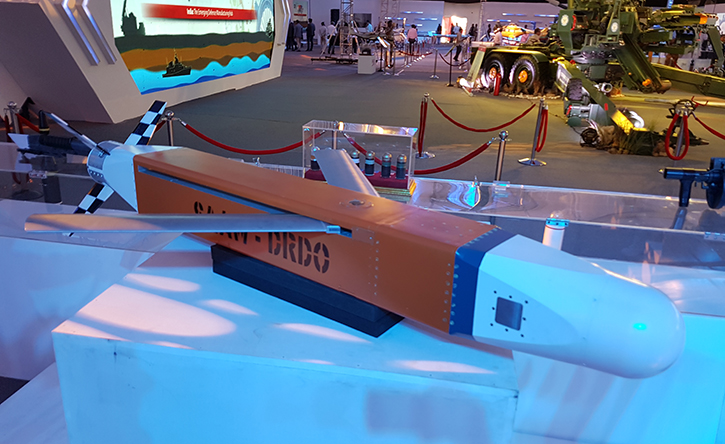
    A 120kg class smart aerial weapon developed by DRDO, SAAW is released from the aircraft at high altitude, enabling the glide weapon to hit targets at distances of 100km. Designed to hit fixed hardened targets and area targets SAAW can be used for airfield denial and attack missions targeting runways, hangars, and aircraft parked at protected shelters. Photo: Tamir Eshel, Defense-Update
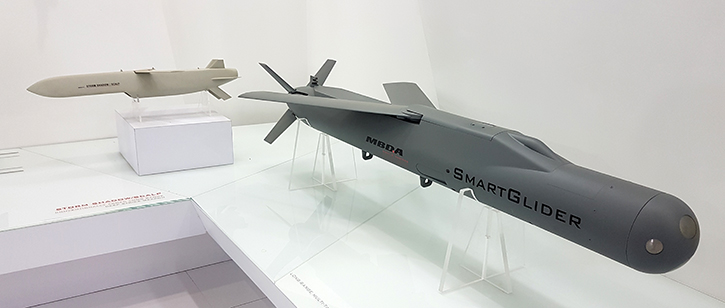
    MBDA displayed the SmartGlider, an unpowered, unitary, guided glide weapon designed for current fighter jets such as rafale and Typhoon. With six weapons carried on each smart rail (three of four could be carried on Rafale and Typhoon), each jet fighter will be able to carry a load of 18-24 weapons, each pre-programmed to hit a specific target and receive updates and retargeting throughout its free flight. Photo: Tamir Eshel, Defense-Update.
    The Indian renewed interest in long-range strike brought Saab and Boeing to devote parts of their display to this German-Swedish Taurus KEPD-350. While the F/A-18E/F proposed to India is not cleared to use the weapon, the C/D variant do carry it and, according to Boeing, there are no expected obstacles to equip the Super Hornet with the missile. Grippen is also designed to carry the Taurus. Photo: Tamir Eshel, Defense-Update
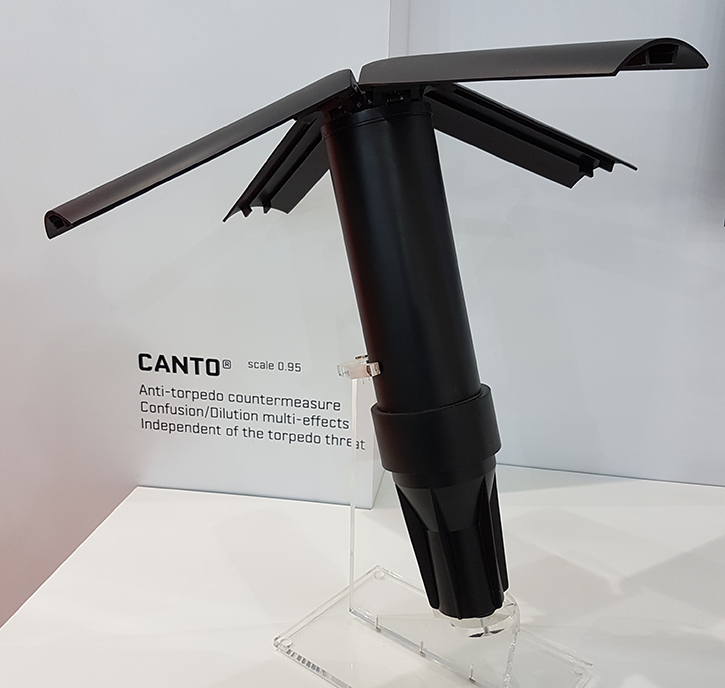
    The French Marine Group (formerly DCNS) was one of few domestic and foreign companies that displayed here anti-torpedo countermeasures, indicating the growing interest in such systems among the Indian Navy, that is equipped with several types of attack submarines. Photo: Tamir Eshel, defense-Update
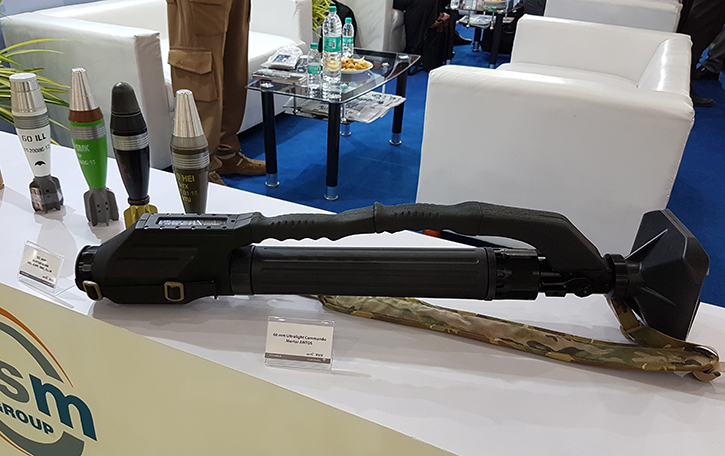
    The Czech ANTOS mortar developed by the VOP company is an extremely light weapon (4.5 kg) designed for use by paratroops and special forces. The lightweight is achieved by using mostly parts made of aluminum alloys and plastics. The handgrip with trigger allows easy carrying and firing in oval and flat trajectories, using a trigger type mechanism with a fixed striker. The mortar is set by using a liquid level against a scale that shows the range the bomb would reach at the set elevation. Phooto: Tamir Eshel,defense-Update
    The Antos mortar uses modular charges. The minimal (basic) charge embedded in the tail would reach 80 meters at a minimum, and, with a full charge would reach 1,200 m. Augmenting charges placed between fin pairs can double the range. The mortar can fire enhanced blast (high explosive), illumination, and smoke bombs. Photo: Tamir Eshel, Defense-Update.
    Kalyani has launched another JV with IAI, for the production of guided rocket and artillery systems, based on IAI’s Topgun – a low cost, add-on fuze that screws on to standard 155mm rounds and transforms it into a precision-guided weapon, at a fraction of the cost of missiles or loitering weapons. The TopGun fuze performs two-dimensional correction of the ballistic trajectory to reduce dispersion in both range and deflection, enabling fire mission to be accomplished at a shorter time and lower cost. Photo: Tamir Eshel, Defense Update
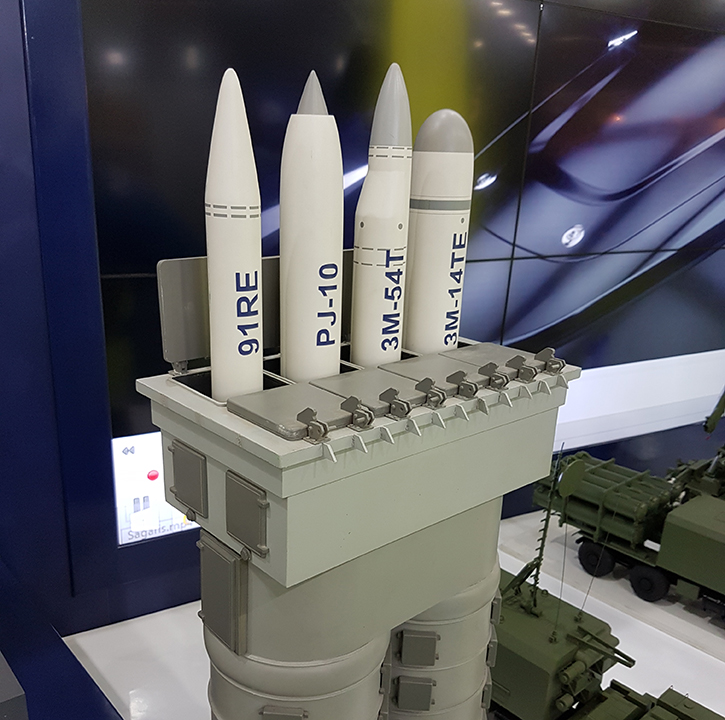
    Cruise missiles have become an important part of the armament of modern vessels. To support those weapons on existing or newly constructed ships the Ship General Purpose Firing System (SGPFS) was developed by the Russian Agat Concern. The system comprises a fire control system, universal vertical under-deck launchers and missile loading set. Each unit holds two separate, airtight magazines equipped with fire extinguishing ventilation and water drain systems that simplify the installation compared of previous VLS systems. Each magazine contains four or eight missiles, weighing 7500 or 15000 kg. Missile types supported are 3M-54T, 3M-54TE1, and Brahmos PJ-10 antiship missiles, 3M-14TE and Brahmos PJ-10 land attack cruise missiles and 91RTE2 torpedo missile for standoff anti-submarine engagement. The use of containerized systems eliminates the need to construct special magazines on board. Photo: Tamir Eshel, Defense-Update
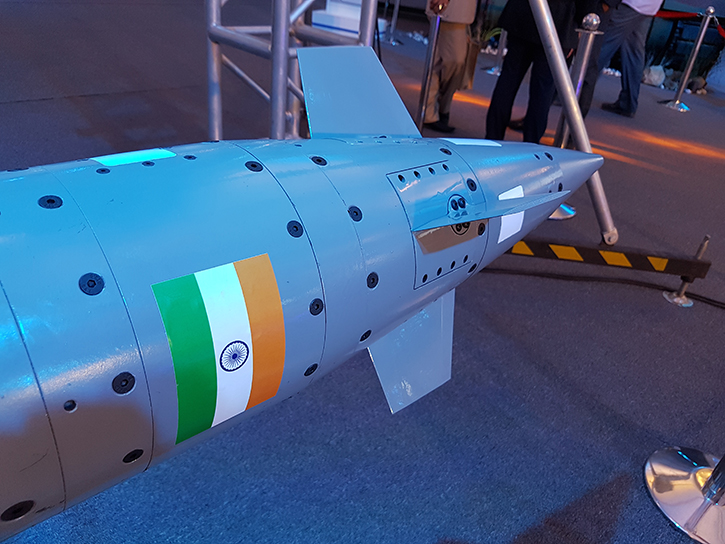
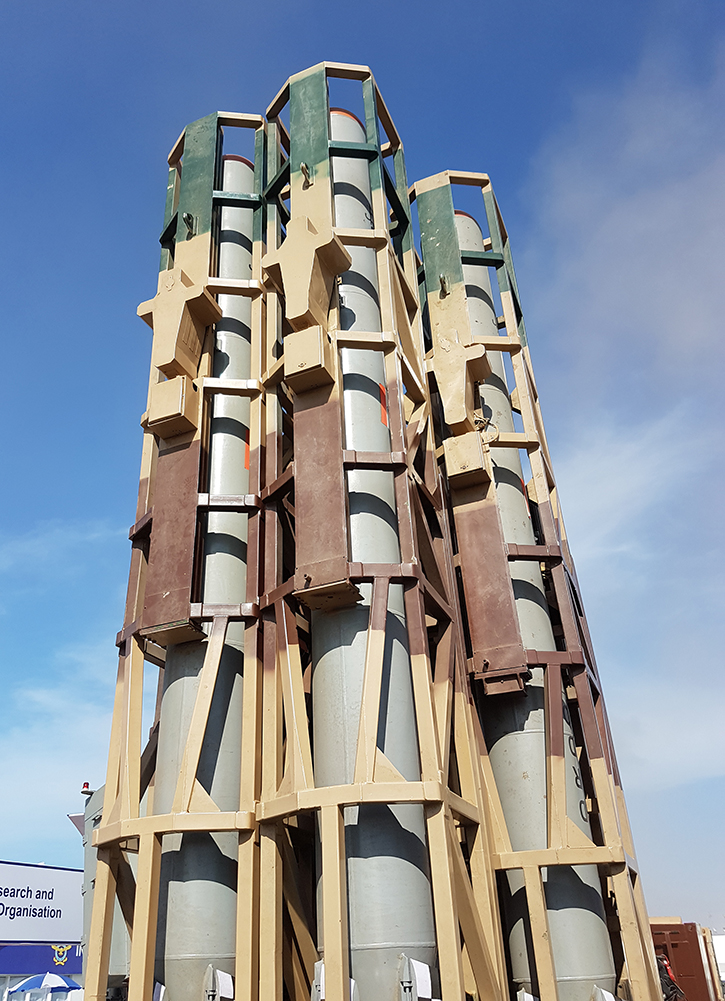
    The Indian indigenous Nirbhay long-range (1000 km) cruise missile The missile that weighs 1000 kg carries a warhead that weighs 300 kg. It is launched from aircraft or from vertical launchers, such as this three-rail launcher. After clearing the launch rail Nirbhay uses a thrust controlled boost to convert to horizontal flight, cruising at a subsonic (0.7 Mach) speed and low altitude, to evade radar, using precise waypoint navigation to hit targets accurately. Photo: Tamir Eshel, Defense-Update

    Skunk Works and XTEND Simplify Multi-Drone Command

    0
    Lockheed Martin Skunk Works® and XTEND have achieved a major milestone in JADC2 by integrating the XOS operating system with the MDCX™ autonomy platform. This technical breakthrough enables a single operator to simultaneously command multiple drone classes, eliminating the friction of mission handoffs. From "marsupial" drone deployments to operating in GPS-denied environments, explore how this collaboration is abbreviating the data-to-decision timeline and redefining autonomous mission execution.

    From Ukraine to Taiwan: The Global Race to Dominate the New Defense Tech Frontier

    0
    As traditional defense primes face mounting competition from agile “neoprimes” such as Anduril, Palantir and Helsing, the balance of innovation is shifting toward software-defined warfare and scalable, dual-use technologies, while global industry consolidation—marked by Boeing’s integration of Spirit AeroSystems and other strategic mergers—signals an intensified race to secure control over the defense technology value chain. Our Defense-Tech weekly report highlights these trends.

    Europe’s “Drone Wall”

    0
    In early October 2025, a coordinated wave of unmanned aerial system (UAS) incursions—widely attributed to Russia—targeted critical infrastructure across at least ten European nations. The unprecedented campaign exposed the fragility of Europe’s air defenses...

    Weekly Defense Update & Global Security Assessment

    0
    Executive Summary The past week (September 18-25, 2025) represents an inflection point where strategic defense concepts have transitioned from doctrine to tangible reality. An analysis of global events reveals four primary, interconnected trends shaping an...

    U.S. Air and Space Forces Push Next-Gen Programs at the AS&C 2025 Conference and...

    0
    At the 2025 Air, Space & Cyber Conference, U.S. Air Force and Space Force leaders unveiled major updates on next-generation fighters, bombers, unmanned systems, and space initiatives, highlighting both rapid innovation and critical readiness challenges as the services race to outpace global competitors. A short version is available here, with a more detailed version for subscribers.

    TADTE 2025: Reflecting Taiwan’s Strategic Themes

    0
    The Taipei Aerospace & Defense Technology Exhibition (TADTE) 2025 crystallized around four dominant strategic themes that collectively illustrate Taiwan's comprehensive approach to defense modernization amid escalating regional tensions. Based on a detailed report by Pleronix (available upon request). Includes a Podcast discussion on TADTE 2025's highlighting Taiwan's four strategic themes beyond the post's coverage.

    Iron Beam 450 Completes Testing, Soon to Join With Operational Air Defense Units

    0
    Israel’s Iron Beam 450 high-power laser system has completed final testing, marking a major leap in air defense. Developed by Rafael, it offers precise, cost-effective interception of rockets, UAVs, and mortars, and is set for IDF deployment by 2025.