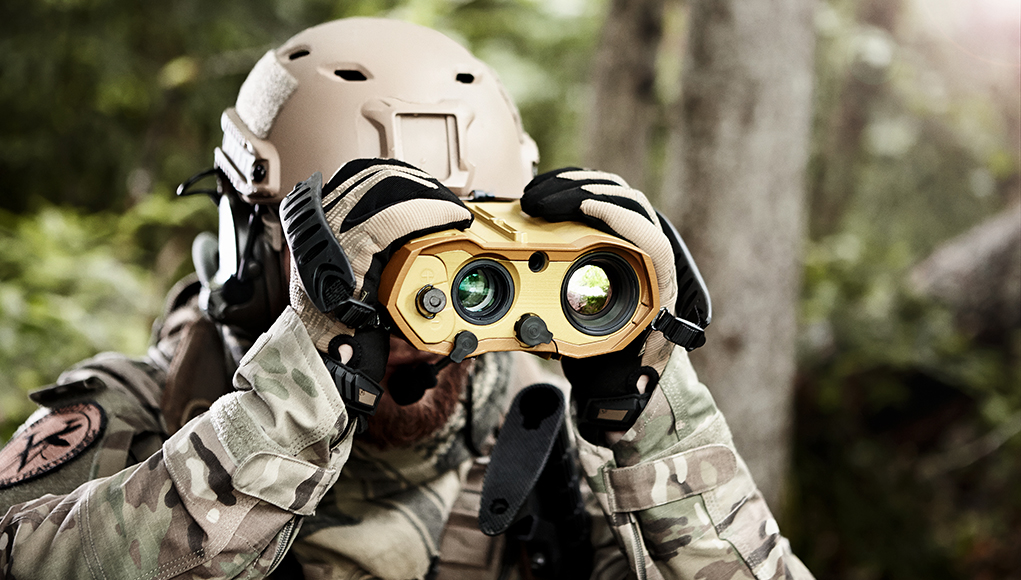
Safran Vectronix AG, Switzerland was selected to provide MOSKITO TI lightweight uncooled thermal imaging and targeting systems for the Dutch military. Photo: Safran Vectronix
The Defense Material Organization (DMO) of the Netherlands announced the selection of Vectronix AG, Switzerland (a subsidiary of Safran Electronics & Defense) to supply 1,266 handheld thermal imaging targeting systems to the Dutch Army.
The lightweight optronic systems use uncooled thermal imaging for target acquisition. The new sights will equip various Army and Special Forces components of the Dutch militry, as part of the ‘Thermal Handheld Imaging System’ (THIS) program. The new equipment replaces the LION systems that have been used by the Defence organization since the mid-1990s.
The systems selected for the program are the MOSKITO TI, a lightweight (1.3 kg) handheld ‘all in one’ optronic system combining several high-performance sensors and modules including an uncooled thermal imager, high-grade direct view optics (DVO), Low Light TV (LLTV) channel, a laser rangefinder (LRF), a digital magnetic compass (DMC) and a Global Positioning System (GPS) receiver.
The system fulfills a broad range of operational needs, including day and night observation, target acquisition, artillery and fire correction, forward observer and Joint Tactical Air Controller, in all-weather environments.
First deliveries are scheduled for November 2018. The agreement also includes repairs, user training programmes, and maintenance for a 10-year period.
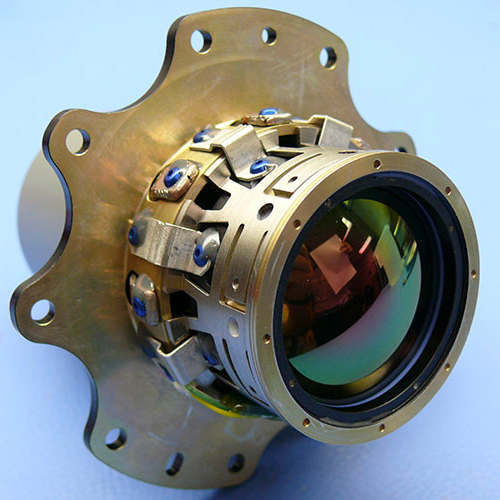
DAS optical assembly manufactured by Rockwell Collins in Australia.
DAS optical assembly manufactured by Rockwell Collins in Australia.
Lockheed Martin selected Raytheon to develop and deliver the next generation Distributed Aperture System (DAS) for the F-35 fighter jet. The selection is part of the cost reduction initiative by the aircraft prime contractor, to reduce costs.
As part of this plan, Lockheed Martin conducted a competition among several manufacturers to offer a more competitive alternative to the original AAQ-37, developed and manufactured by Northrop Grumman. The Raytheon-built DAS will be integrated into F-35 aircraft starting with Lot 15 aircraft, expected to begin deliveries in 2023. By that time Lockheed Martin is expected to deliver 900 F-35s, equipped with the original system. To date, Northrop Grumman has supplied well more than 2,000 DAS cameras.
The new system is expected to achieve 45 percent reduction in unit recurring cost and as much as half the operations and sustainment cost, bringing the total savings to more than $3 billion over the life cycle of the program. The DAS collects high-resolution from six infrared cameras positioned around the aircraft, to provide the pilot real-time 360 degrees imagery, displayed to the pilot’s helmet, allowing pilots to see the environment around them – day or night. As a state of the art system, the new DAS will be much more reliable (x5 improvement) and offer improved performance (x2).
“The supply chain competition for the next generation F-35 Distributed Aperture System resulted in significant cost savings, reliability and performance improvements,” said Greg Ulmer, Lockheed Martin vice president and general manager of the F-35 program. “We are aggressively pursuing cost reduction across the F-35 enterprise and this initiative is a clear demonstration of our unrelenting commitment to reduce costs and deliver transformational capabilities for the warfighter.”
The new system will also indirectly benefit aircraft readiness and service manpower requirements “Raytheon’s solution delivers next-generation capability for the fifth generation F-35,” said Roy Azevedo vice president of Intelligence, Surveillance and Reconnaissance Systems at Raytheon Space and Airborne Systems. “Our focus is on providing pilots every tactical advantage imaginable while ensuring taxpayers receive the best value possible.”
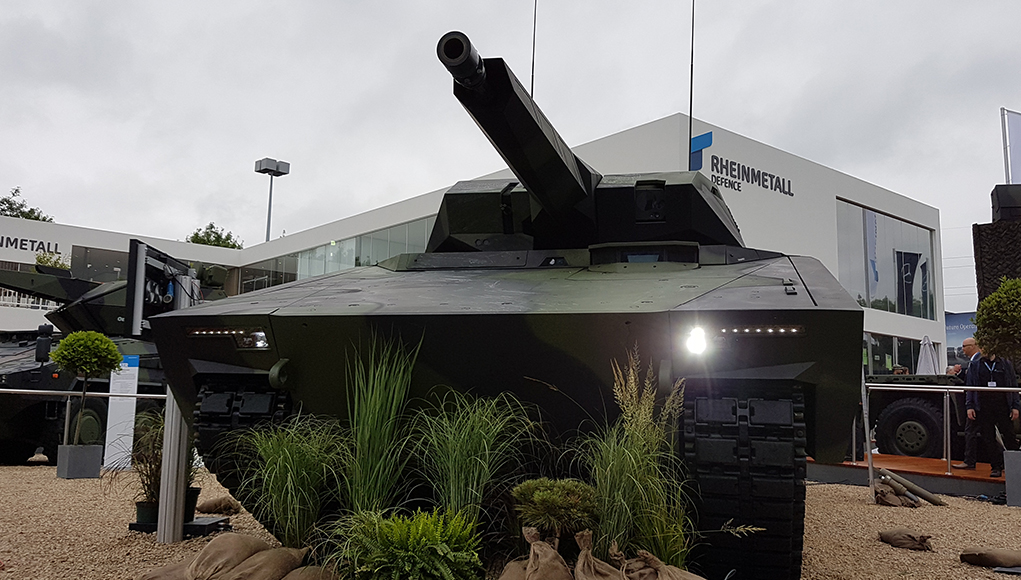
Rheinmetall displayed today a new configuration of the KF41, unveiled at Eurosatory yesterday. The turreted combat vehicle that was displayed yesterday was reconfigured overnight, adding a high top roof and replacing the two-men 35mm gun turret with a remotely controlled .50 Cal machine gun.
Photo: Tamir Eshel, Defense-Update
The reconfigured vehicle weighs 42 tons, 3 tons less than the turreted one. The internal space is 175 cm high, enabling relative comfort for standing operation. The command vehicle shares the KF41 mobility and high protection and offers a wide internal protected space for C3 work.
Rheinmetall unveiled yesterday the KF41 Lance, a new design reflecting on the Lance concept vehicle that was presented publicly in 2016. KF41 is designed for a GVW of 44 tons, protected to STANAG 4569 Level 6. Photo: Tamir Eshel, Defense-Update
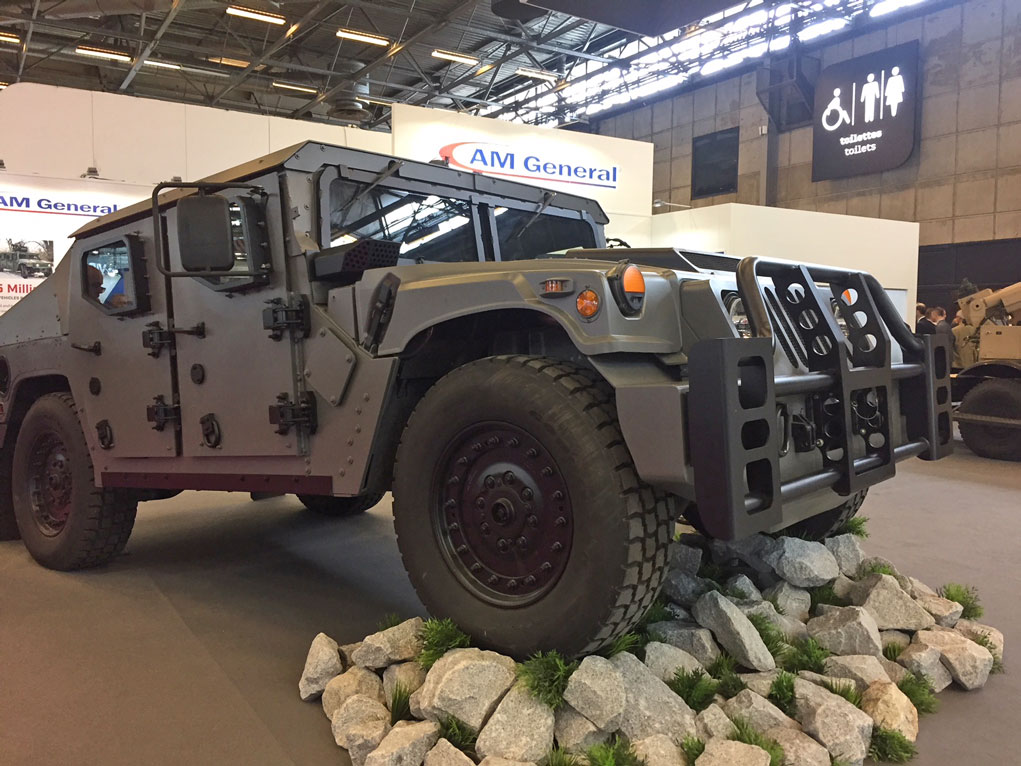
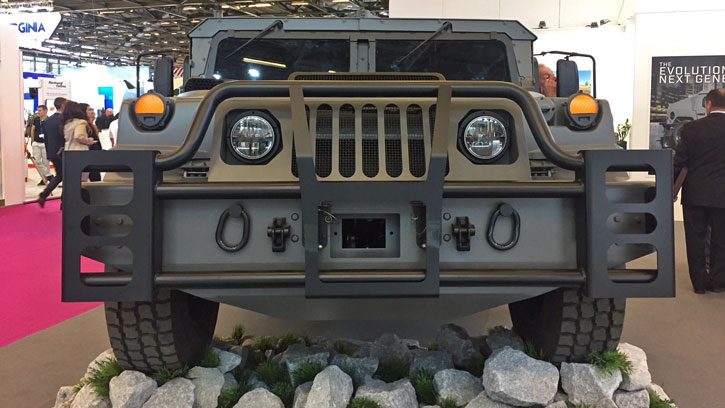
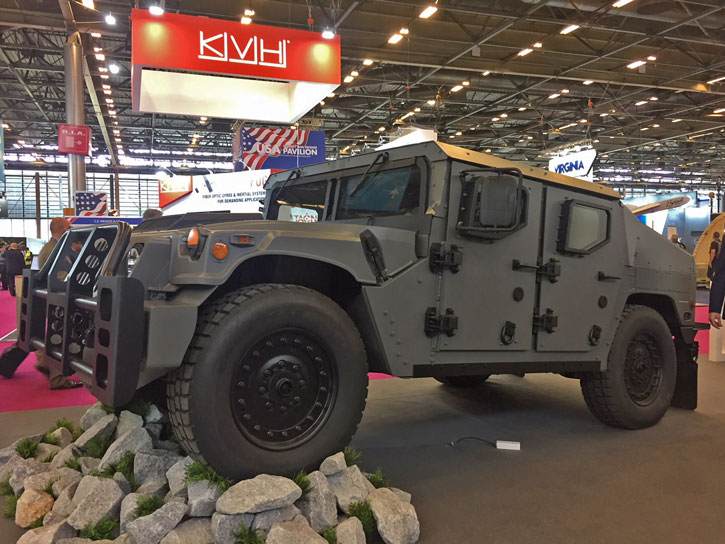
AM General, the manufacturer of the legendary HMMWV introduced at Eurosatory 2018 the next 360, a new vehicle it offers in light tactical vehicle segment. This new product highlights evolutionary changes from the HMMWV. The NXT 360 represents the next generation of the HMMWV platform – an evolutionary design that evolved from HMMWV customer feedback asking for more power, higher GVW, better ride and handling and better overall protection. “The NXT 360 provides added protection, payload capacity, and superior handling performance to perform in any rugged or urban environment,” said Andy Hove, AM General President, and CEO.
Photo: Tamir Eshel, Defense-Update
In terms of survivability, NXT 360 offers basic protection levels conforming to B7 (covering 360 degrees), and Blast protection conforming to STANAG 4569 Kevel 2A at the front wheels and Level 1 at the rear axle. Blast seats and mats are also used, along with transparent armor that also meets B7-ballistic protection level threats.
MXT-360 retains the HMMWV offroad mobility, and adds some new features, introducing quick transition time between soft and paved roads, using enhanced central tires inflation system (CTIS) with dual air compressors). Typical higher ground clearance and wheel travel, along with larger tires all contribute to increased traction and reduced ground pressure, providing significant ride improvement, Increased approach and departure angles. The suspension upgrade facilitates maximum upgrade in Gross Vehicle Weight (GVW) to a maximum weight of 17,100 kg (7 tons). This added weight required the use of a more powerful bakes, MXT-360 uses an Anti-Lock Brake System (ABS), Electronic Stability Control (ESC), Traction control and an autonomous break control interface.
Photo: Tamir Eshel, Defense-Update
The new vehicle uses the P400 Electronically controlled 6.5L V8 turbocharged Engine that develops up to 250 HP (186 kW), 460 ft/lbs (624 N•m) @1700 rpm with 6L85e 6-speed automatic transmission
According to AM General, the NXT 360 can be delivered as a complete, new vehicle that can be incorporated into new missions, or as an upgrade kit that can be integrated into existing vehicle fleets to gain the same advanced capabilities.
Rheinmetall unveiled today the KF41 Lance, a new design reflecting on the Lance concept vehicle that was presented publicly in 2016. KF41 is designed for a GVW of 44 tons, protected to STANAG 4569 Level 6.
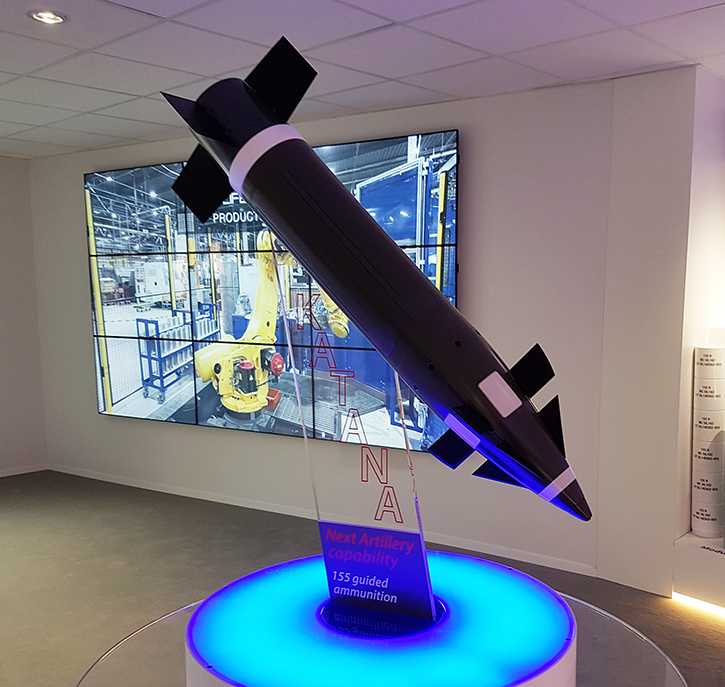
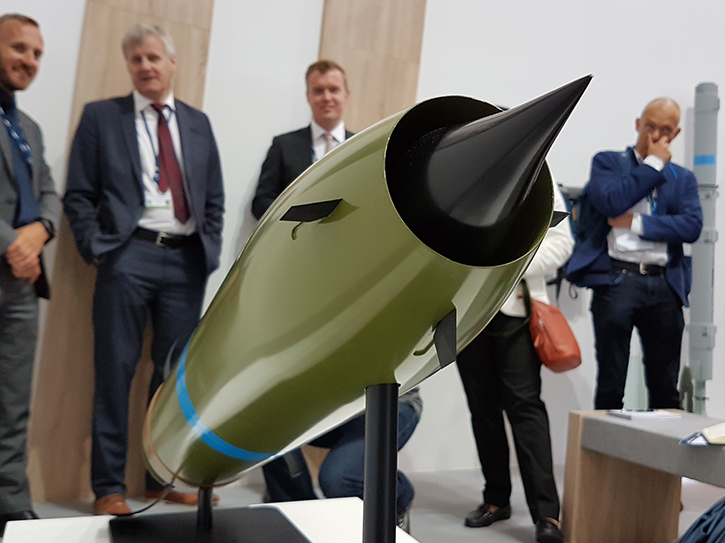
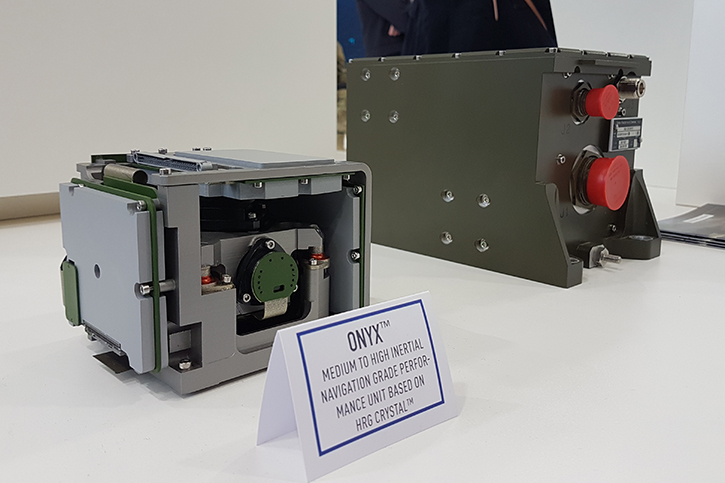
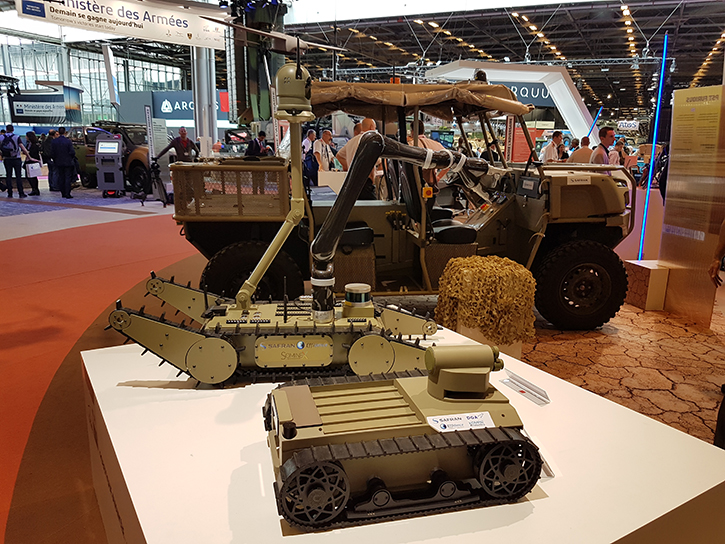
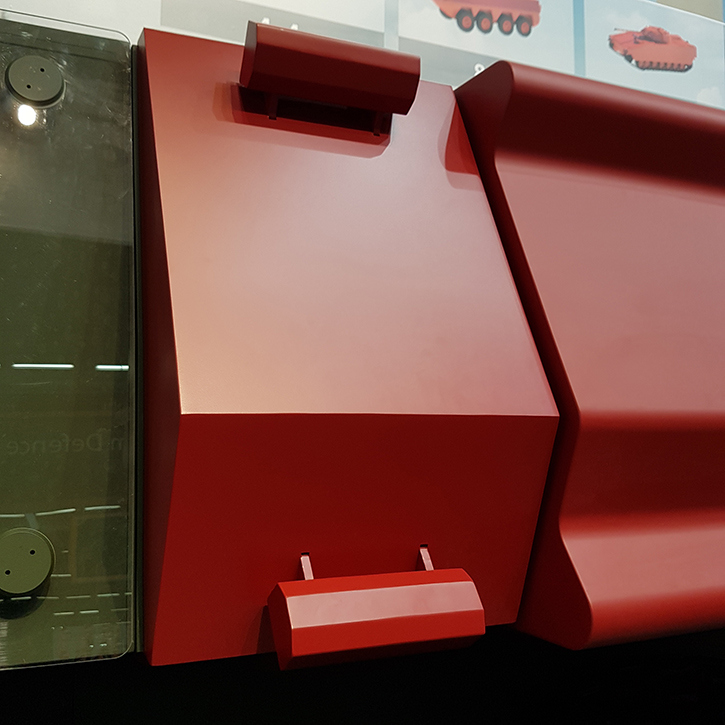
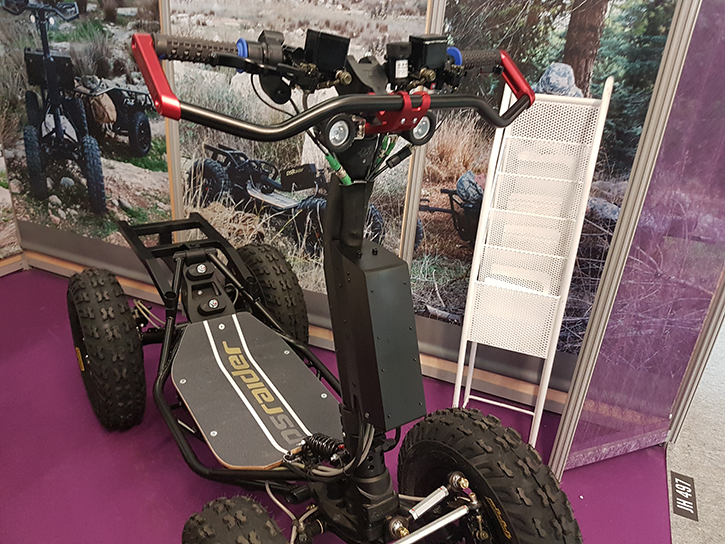
Thales unveiled at Eurosatory a mockup of its latest target acquisition system – Sophie Ultima, equipped with an integral augmented vision enabling the user to view data layers on top of the video displayed by the systemNexter presented the Katana guided 155mm munition latest, enabling the artillery to deploy smart, precision-guided projectiles.Nammo unveiled a concept of ramjet powered projectile that can extend artillery range beyond 100 km, The 155mm projectile will use a ramjet solid-rocket engine that maintains the speed of the round at over Mach 3 throughout the flight, offering enough space to carry about five kilograms of explosives. The nose cone could include the seeker and guidance electronics, driving four canard finsSagem introduced a new generation of compact gyros employing rotating gyro principles that enables a platform to navigate autonomously in GPS denied environments.Three of the robots being employed by the French Felin dismounted warrior units include a small ATV based robot, an all-terrain vehicle configured for surveillance, reconnaissance and EOD and the small robot at the forefront represents the mini scout, the smallest in the group.IBD presented at Eurosatory its latest Protech Smart protection modules designed to defeat advanced, tandem warheads. The operating principle triggers the system only in the case of a shaped charge hitting the vehicle, the event would trigger one of the directional charges located above and beyond, which will hit the projectile, and disable its main warhead. First small charge in the tandem, a sensor late anywhere on the side, firing an explosive charge that destroys the threat, leaving the passive armor to deal with the small (precursor) part of the tandem warhead.DSRaider displayed at Eurosatory their first, electrically powered 4×4 ‘raider; a tactical vehicle that carries a fully loaded soldier and his full gear over a range of 80 km, at a speed of 40km/h. (The DS Rider can g up to 75 km/h).
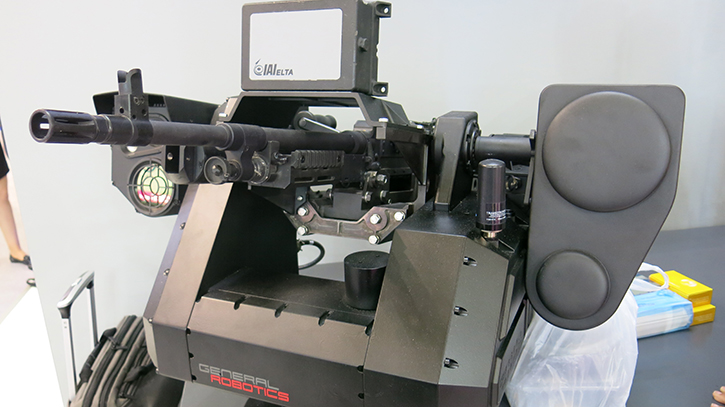
General Robotics Pitbull remote weapon station was displayed at Eurosatpry 2018 in a new Counter-UAV configuration that mounts a radar, and integrates both soft and hard kill countermeasures. c
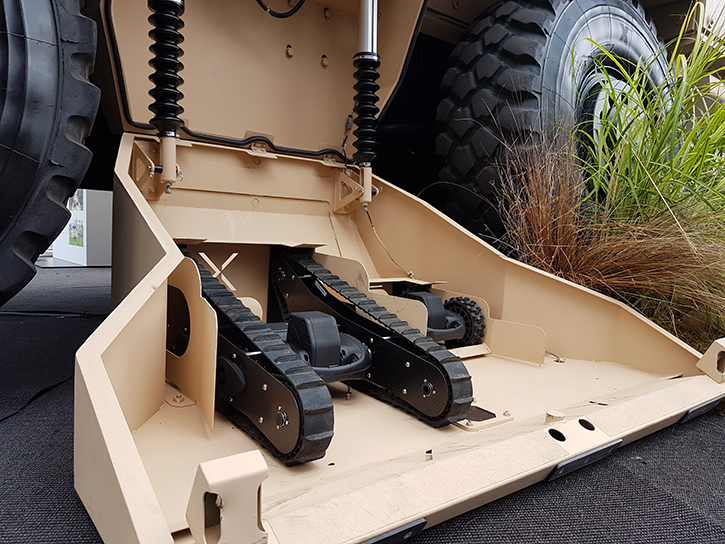
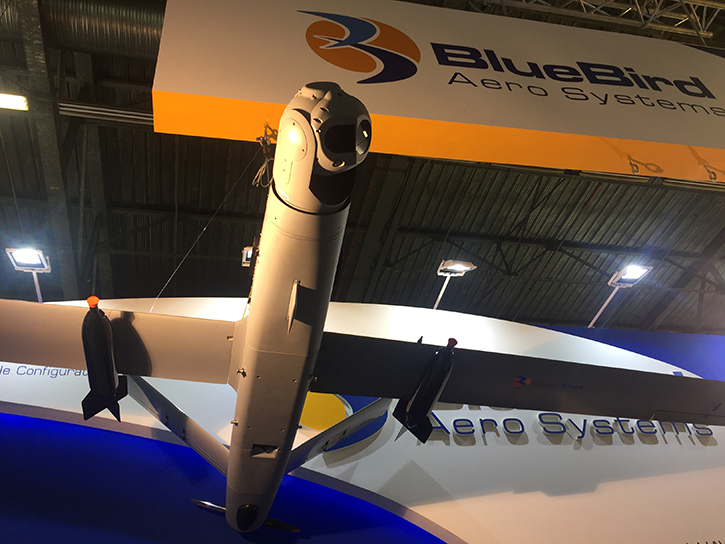
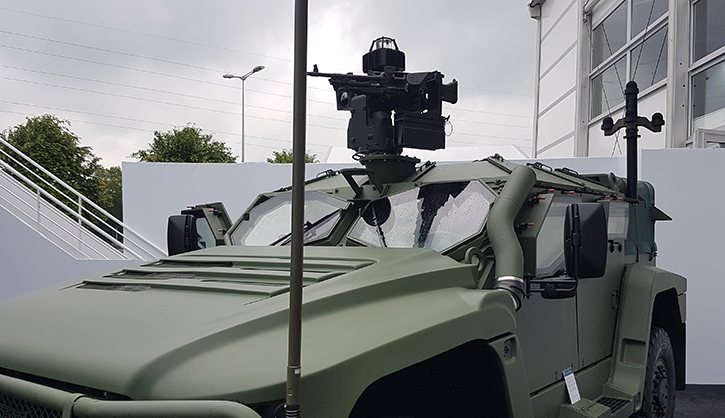
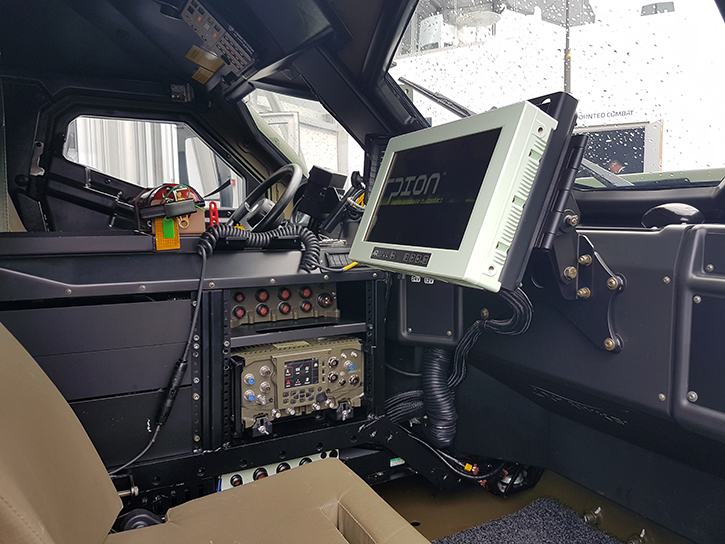
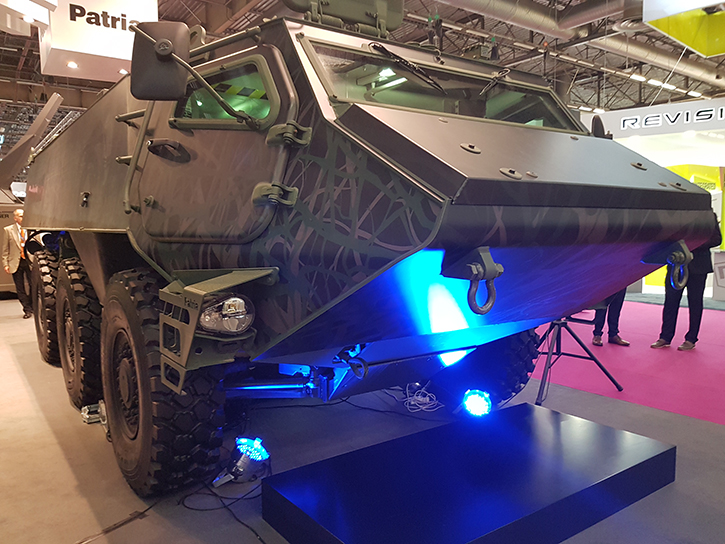
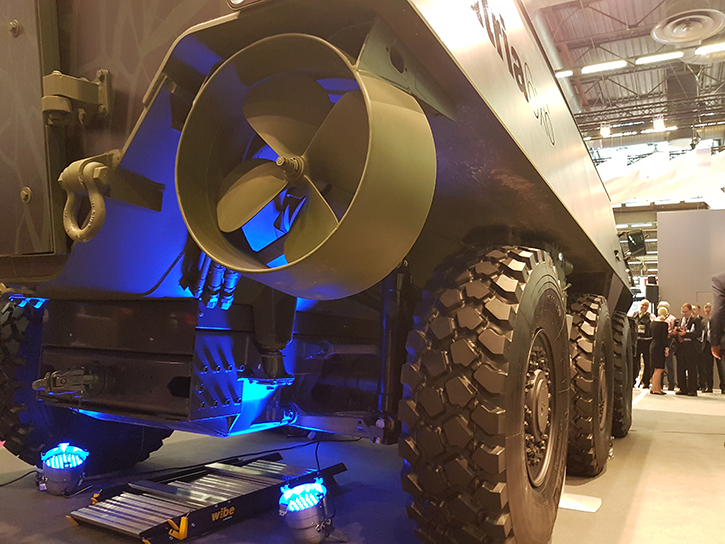
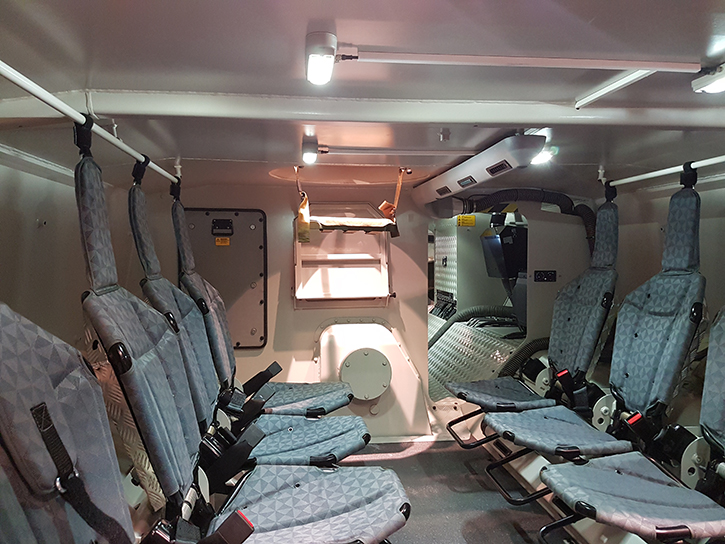
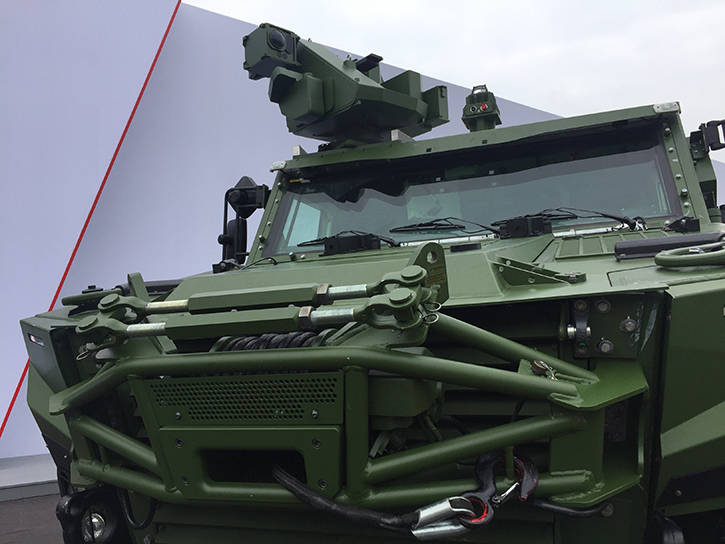
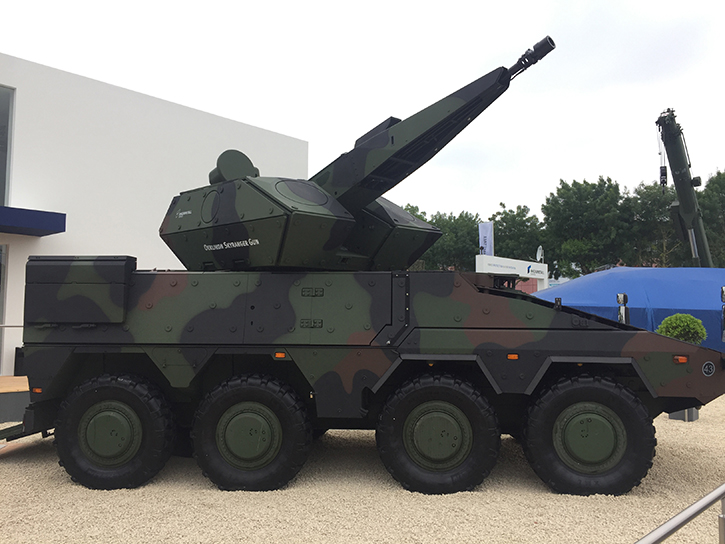
General Robotics Pitbull remote weapon station was displayed at Eurosatpry 2018 in a new Counter-UAV configuration that mounts a radar and integrates both soft and hard kill countermeasures. Photo: Tamir Eshel, Defense-Update.The Titus, seen at the Nexter display has a special side ramp enabling robots to disembark from the vehicle without operator involvement. It enables the crew to dispatch robots from inside the vehicle, without being exposed to enemy fire. The robots seen here are two types of the Nerva robots from Nexter. Photo: Tamir Eshel, Defense-Update.The Turkish company STM displayed at Eurosatory 2018 the Kargu, an autonomous rotary quadrotor attack drone that is carried and controlled by a single operator. Kargu uses real-time image processing and machine learning to enable the operator to use autonomous or manual flight modes to target stationary or moving targets in daylight or at night. The drone can be used for surveillance or attack missions, as the warhead can be loaded in the field for attack missions. It supports multiple warhead configurations (the photo shows a type of claymore explosive fragmentation charge). When targeting personnel in the open or behind defilade, the platform can be programmed to explode at a certain hight to achieve maximum lethality against soft targets. Photo: Tamir Eshel, Defense-UpdateRheinmetall launched today the Oerlikon Skyranger gun turret mounted on the Boxer 8×8 chassis. The turret that weighs about four tons mounts the 35mm cannon that fired AHEAD rounds, an array of AESA radars providing hemispheric 360 coverage, and radar and EO target acquisition systems. The gun is employed against manned and unmanned aircraft at a range of three kilometers. Photo: Tamir Eshel, Defense-Update.Bluebird shows the ThunderB with a new capability to carry and release external stores. Photo: Tamir Eshel, Defense-Update.Thales is proposing the Hawkei armored tactical vehicle to the French Army, in a configuration that includes some of the Scorpion program systems and electronics, including the CONTACT VHF/UHF radio and SICS command and control application, Metravib acoustic gunshot location system and Thales Antares panoramic surveillance system. Photo: Tamir Eshel, Defense-Update.An inside view of the Digital Hawkei Thales proposes to the French Army. Scorpion program electronics include the SICS radio and interfaces and multifunction display employed with all the programme’s vehicles – including Leclerc tank, Jaguar, Grifon armored vehicles and the VBMR-L light APC. Photo: Tamir Eshel, Defense-Update.Patria unveiled a 6×6 armored personnel carrier that continues the tradition of Patria’s XA-180 origins (Pasi). The new vehicle draws on the experience gathered by Patria in the 8×8 AMV vehicle design, offering an affordable amphibious with full amphibious capabilities, and payload and growth potential of eight tons. Photo: Tamir Eshel, Defense-Update
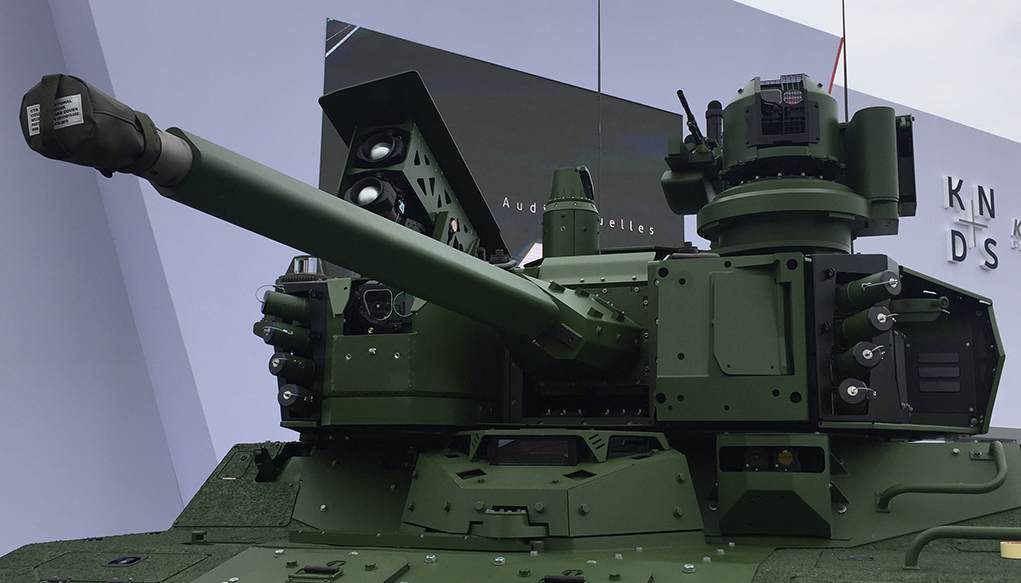
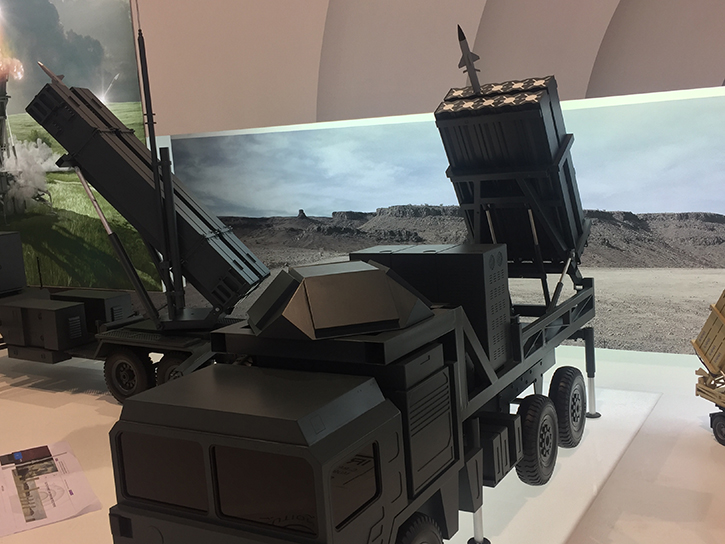
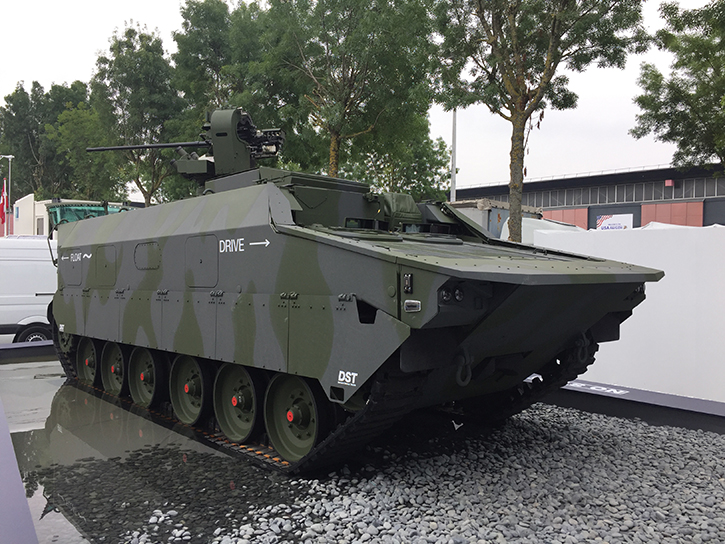
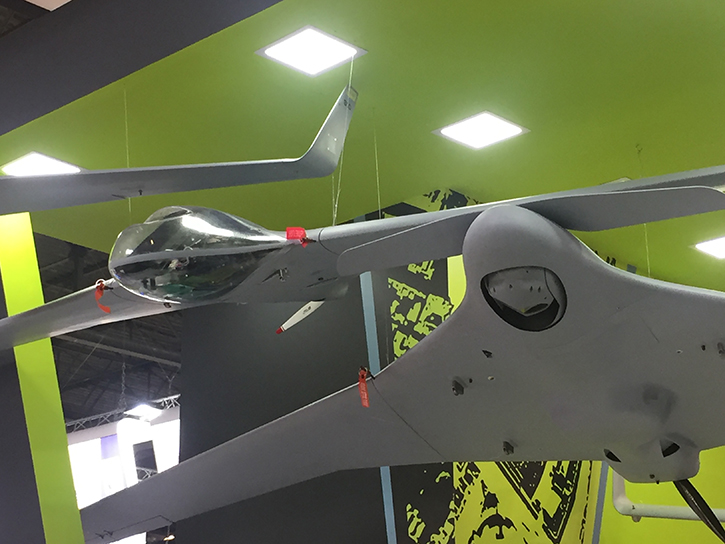
First look at the JaguarSide by side with the Grifon, the two vehicles make the core of the French Scorpion.Rheinmetall shows its latest air defense Boxer variant – SkyrangerAt Rafael’s booth, you can see a model of the I-Dome – a mobile SHORAD variant of the Iron Dome, employing the IAI ELM-2138 mobile C-RAM radar, also designed for operation on the move. The radar is also displayed at IAI’s booth.APVT – a new amphibious vehicle using rubber tracks to move on land and water, from KNDS. The light armored vehicle, designed by KMW, uses a modified Puma chassis.Aeronautics shows the Orbited 3 configured to carry an internal cellular COMINT payload
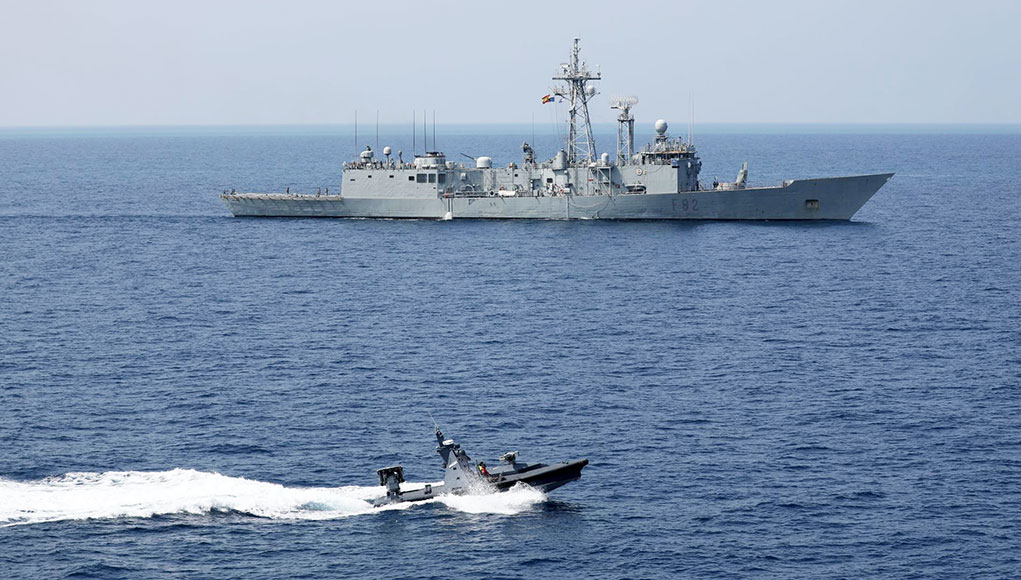
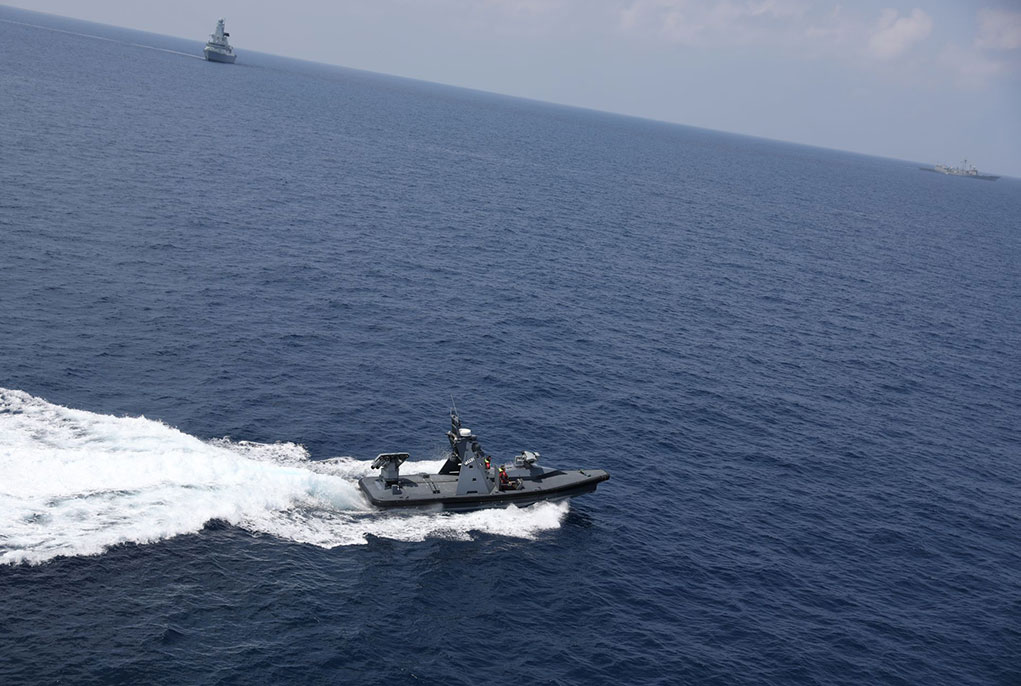
The ESPS Victoria assisted by an Israel Navy Protector unmanned surface vessel taking part in a joint exercise to defeat a simulated swarm boat attack off the Israeli coast. Photo: RAFAEL
Last month, after a short port visit at Haifa, two NATO warships joined with the Israeli navy on an exercise that involved the ‘Protector’ Unmanned Surface Vessel (USV) that demonstrated how such unmanned boats can assist large vessels in repelling attacks by swarms of fast boats.
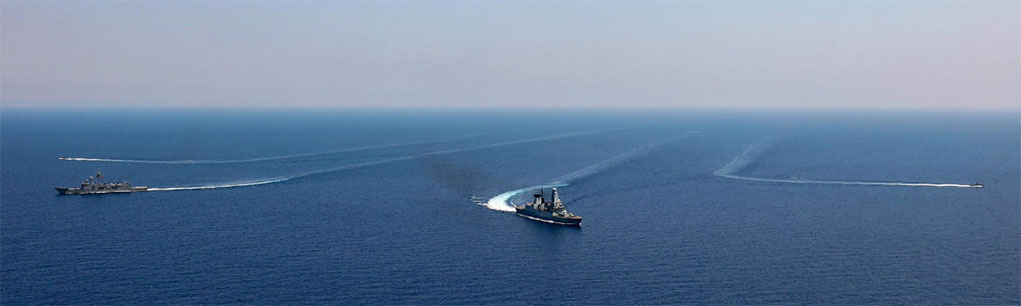
Standing #NATO Maritime Group Two (SNMG2) ships exercise with Israeli counterparts conducting maritime surface maneuvers as they depart Haifa after a port visit. Israeli Navy deployed Fast Patrol Boats (FPB) to simulate the swarm, and the Protector USV was deployed against those boats. Photo: SHAPE
The vessels were Royal Navy destroyer HMS Duncan (D37) and Spanish navy frigate ESPS Victoria (F82). The ships are part of Standing NATO Maritime Group 2 operating in the Eastern Mediterranean. The exercise took place along the shores of Israel was part of an operational demonstration of the capabilities of the USV against fast boats swarm threats. The demonstration included a simulated firing of Spike electro-optically guided missiles to neutralize the threat from extended range.
As the exercise unfolded, the NAT vessels spotted a large number of hostile vessels rapidly advancing towards it. The ship determined the threat to be a swarm attack and communicated the situation to headquarters, which scrambled the Israeli USV. The Protector raced from the shore at high speed and was able to identify the threat from a long distance. Once targets were prioritized an order was given to neutralize one of the threats, and the Protector crew followed with a simulated firing of a SPIKE missile.
The protector maneuvers ahead of HMS Duncan and ESPS Victoria during a joint exercise between part of the Standing NATO Maritime Group 2 and the Israeli Navy exercise. Photo: RAFAEL
“This scenario emphasizes the need to handle the threats emanating from terror and criminal activity, that naval forces are facing around the world'” said Moshe Elazar, EVP and Head of the Land and Naval Systems Division at Rafael. “The demonstration illustrated some of the capabilities that can be applied by the Protector in a wide range of operational scenarios, including defeating swarm attacks. These capabilities are a significant force multiplier for the naval forces, from the stage of detection, deterrence and, if necessary, neutralization of the threat, as was seen in the demonstration.”
Rafael’s “Protector” is in operational use with the Israeli Navy and a number of foreign naval forces. The Protector has been in use since 2004, allowing its developers and engineers to accumulate vast experience to continue its spiral development.
In March 2017, Rafael completed a series of successful tests in which a number of SPIKE ER missiles were launched from the Protector and hit simulated enemy targets. This was the first-ever missile firing from an operational, remote-controlled USV. This new capability allows pin-point attack of land or naval targets, enabling safe vessel operation from, with no risk to the operating force, from a remote command and control room or from aboard other naval platforms.
That test finalized the operational integration process of Protector’s entire suite of mission components to form four mission modules, including force protection and anti-terror, by employing a stabilized weapon station – Mini-Typhoon, a water cannon, non-lethal means, EW systems for protection and escort of naval vessels, Mine Counter-Measures to deal with the spreading threat of mines against sea lines of communication, Toplite electro-optical long-range detection and tracking systems, as well as Rafael’s Spike missiles, all remotely-operated.
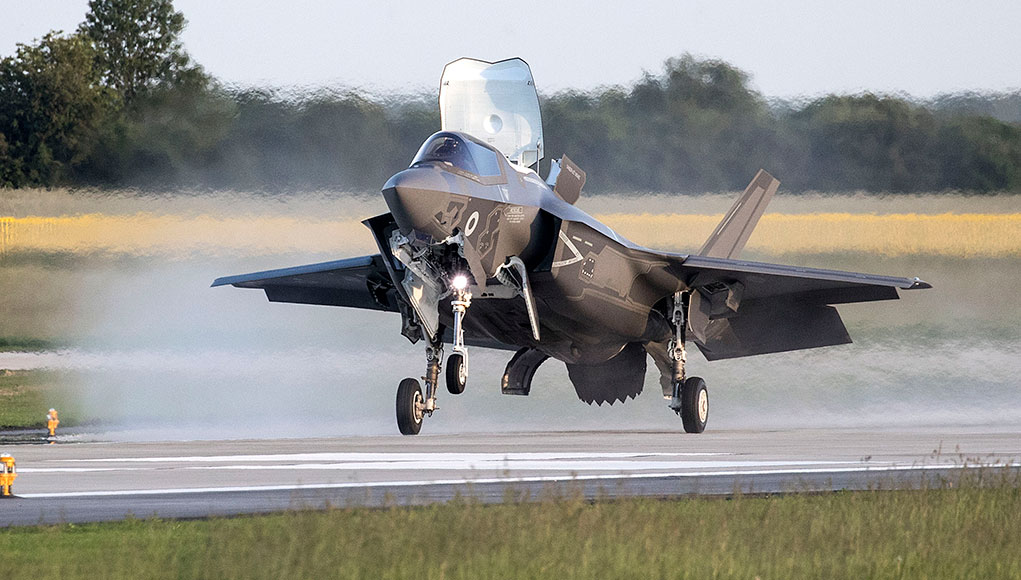
F-35B landed today for the first time at their home base at RAF Marham in Norfolk, after crossing the Atlantic Ocean. Photo: UK MOD, Crown Copyright
The first of Britain’s next-generation fighter jets have arrived home two months ahead of schedule in a major milestone for the Royal Air Force and Royal Navy. The first of Britain’s new cutting-edge aircraft arrived into RAF Marham their new home in Norfolk.
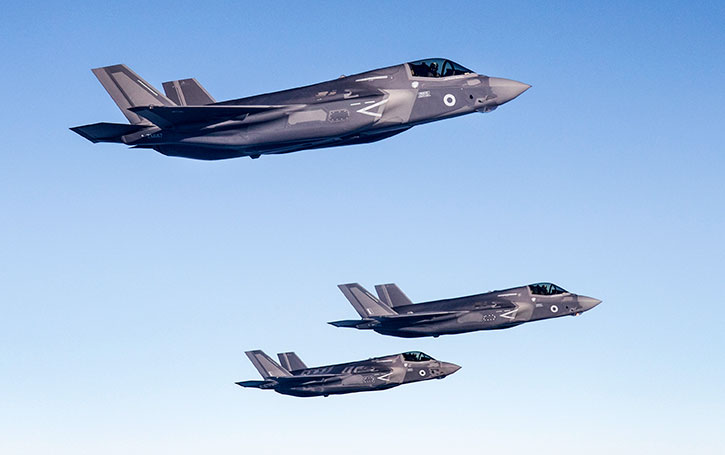
They touched down this evening after a trans-Atlantic flight from the United States, where Britain has more of the jets and 150 personnel in training. This is the first tranche of F-35s to arrive, with RAF Voyager aircraft providing air-to-air refuels on their trans-Atlantic journey. More jets are due in Britain later this year, and there is an overall plan to procure 138.
Around £550m has been invested in RAF Marham as part of a major change programme to get the base ready to house the new jets. The base has seen an upgrade in facilities, resurfaced runways and the addition of new landing pads to accommodate the jet’s ability to land vertically.
The F-35 will be jointly operated by the Royal Air Force and the Royal Navy and can operate from land and sea, forming a vital part of ‘carrier strike’, the use of the aircraft from Britain’s new Queen Elizabeth Class aircraft carriers.
This was the first tranche of F-35s to arrive, with RAF Voyager aircraft providing air-to-air refuels on their trans-Atlantic journey. Photo: UK MOD, Crown Copyright
This autumn, the first landing of the F-35 will take place on HMS Queen Elizabeth in the next phase of trials. Having both ship and aircraft operating together for the first time will be another significant moment for the Armed Forces.
The F-35s took off from Marine Corps Air Station Beaufort earlier today and were flown by British pilots of the newly-reformed 617 Squadron, which was immortalized by the famous Dambusters’ raid of World War II.
More jets are due in Britain later this year, and there is an overall plan to procure 138. Photo: UK MOD, Crown Copyright
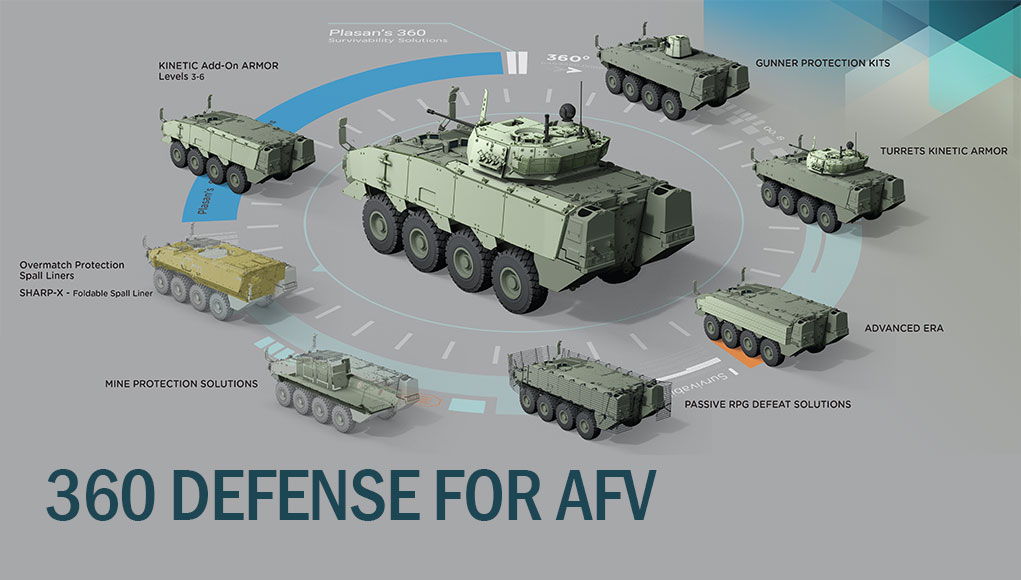
Israel’s armor specialist Plasan showcases broadened product line at Eurosatory, introducing a blast-protected model of the SandCat along with several light armored vehicles. In the heavier weight classes, Plasan provides a peek into the advanced protection technologies being integrated into newly designed combat vehicles.
“Along with the four new vehicles presented in our outdoor display, our indoor display showcases our philosophy of vehicle survivability and protection, using a technology demonstrator that employs Augmented Reality (AR) to depict how the different armor technologies are implemented in new and retrofitted armored vehicle designs.” Shahar Kedem, Director, Combat Vehicles Survivability at Plasan told Defense-Update.
These elements include passive and advanced reactive armor, and various structures designed to defeat RPGs, or blast deflecting shapes, energy absorbing crushing structures and a floating floor, minimizing the underbelly or side attack blast effects. Inside the vehicle, energy attenuating seats, and various spall liners that minimize the risk to occupants in case of mine blast, IED explosion or overmatching threat penetration.
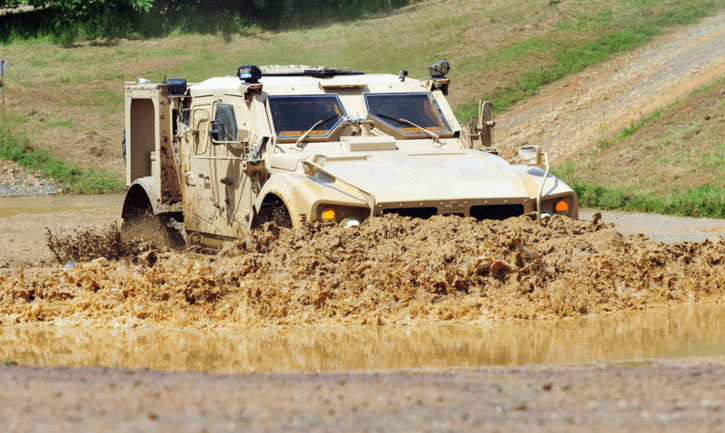
An Oshkosh M-ATV on the dynamic display at the DVD 2014. Photo: Bedfordshire News
As a provider of survivability and protection solutions for light and medium combat vehicles, Plasan became famous as the provider of armor suits for the up-armored HMMWV, MTVR, MRAP and M-ATV, veterans of the wars in Iraq and Afghanistan. Through these activities, the company specialized in the design and manufacturing of armor kits for modern tactical vehicles, including the Australian HAWKEI, and the American JLTV, to name a few. In these projects, the company implemented the patented ‘kitted hull’ approach, which enables armored vehicle manufacturers and users to obtain the armor kits and assembles them onto their vehicles in the country.
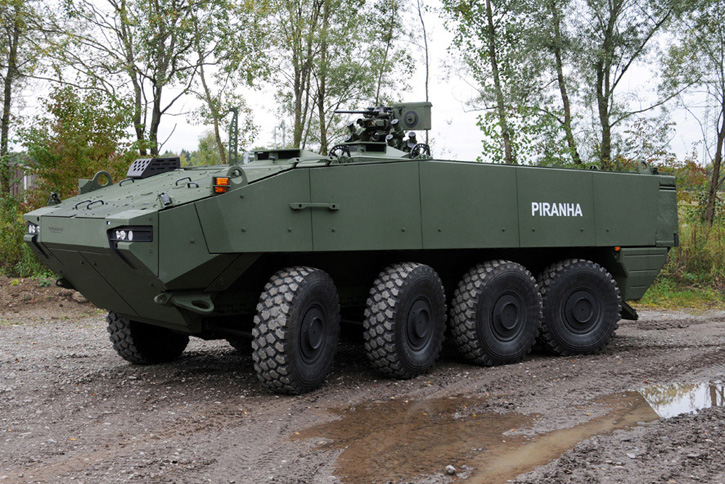
In recent years Plasan expanded its activity to heavier armored combat platforms, including 6×6, 8×8 and tracked fighting vehicles at weight levels up to 45 tons. Typical 8×8 vehicles that weigh around 17 tons are designed for a high level of ballistic and blast protection against mines, IED and EFP threats. To face higher threats add-on armor is used, to enhance protection levels to specific threats and extend coverage to more than 95% of the vehicle. To address vehicle protection at the highest levels Plasan developed a new range of armor recipes to defeat STANAG 4569 Vol.1 Levels 4, 5 and 6 threats. Photo: GDELS.
In recent years Plasan expanded its activity to heavier armored combat platforms, including 6×6, 8×8 and tracked fighting vehicles at weight levels up to 45 tons. Such armored vehicles are required to withstand medium caliber cannon threat levels and maintain functionality. According to Kedem, Plasan is already involved in the development of major AFV acquisition programs where its protection solutions are integrated at the vehicle design phase, where they offer the best advantages. Some of the countries the company is currently involved in new AFV developments include Denmark, Spain, Romania, and Israel. “Although all modern armored vehicles are prepared to receive modular armor add-ons, our involvement early in the design phase provides better overall protection, in a solution that is superior to the applique approach used in upgrades,” Kedem said.
The company’s involvement in the early phase of the vehicle’s design enhances the solution’s efficiency, by maximizing protection level, improving ergonomics and augmenting the vehicle’s protection coverage within the gross vehicle’s weight, or providing more payload capacity for the user.
Such armor solutions employ advanced composites and ceramic materials that, unlike steel and aluminum, could degrade their ballistic properties by repeated physical impacts and environmental effects. “As part of our investment in new technologies, we established sophisticated laboratories and ballistic and environmental testing facilities that enable us to explore, test and optimize advanced armor solutions to ensure they meet the user operational profile throughout the entire vehicle’s life-cycle,” Kedem noted.
As part of its armor upgrading solutions, the company also provides enhancements for existing armor, augmenting protection levels to meet threats conforming to STANAG 4569 Vol.1 Level 4, represented by the Russian KPV heavy machine gun series (14.5mm) as a standard – a threat that became a popular weapon with insurgents.
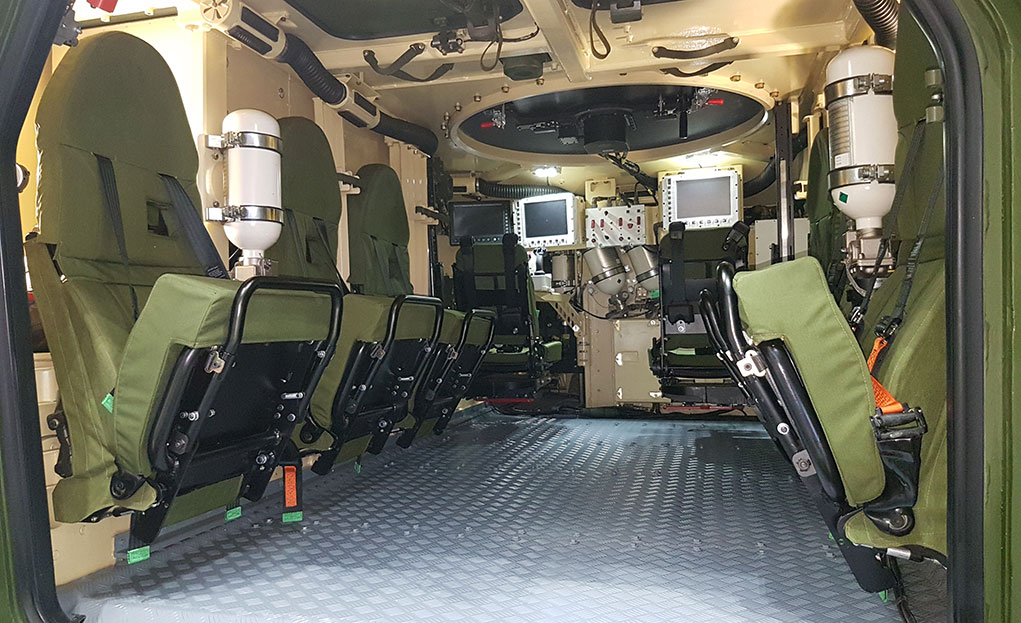
Plasan’s TERRA energy attenuating seats are employed with T-BAR footrests that minimize the possibility of shock being transferred from the floor to the limbs. Other measures include underbelly deflector made of light composite materials, that channels the blast effect away from the vehicle’s crew. A floating floor is also used, to buffer the remaining blast impact. Photo: Plasan
In recent conflicts, Improvised Explosive Devices (IED) and mines proved as a potent weapon against lightly protected vehicles. Such threats have increased the belly protection benchmark for combat vehicles, from the minimum defined by STANAG 4569 Vol.2 Level 1 to Levels 3 or 4, defined by an explosion of a large anti-tank mine anywhere under the vehicle, or even higher. Protection against such threats requires extensive ballistic and blast protection that Plasan is uniquely positioned to meet. To comply with such challenging requirements the company developed advanced underbelly protection structures that retain the capsule’s integrity, augmented by energy attenuating seats that together restrain accelerations and forces to meet the required dynamic response levels (DRI) allowed for the human body to sustain without injuries.
One of the innovative concepts for future armor is the use of sensors to monitor the integrity of the armor. While the technology is applicable for today’s armor suits, users have not yet decided what data they want to monitor and measure, and what useful insights they should obtain. “Our technology demonstrator provides customers a peek into such future capabilities and helps Plasan and its customers assess the potential applications of smart armor for the next generation of combat armored vehicles,” Kedem explained.
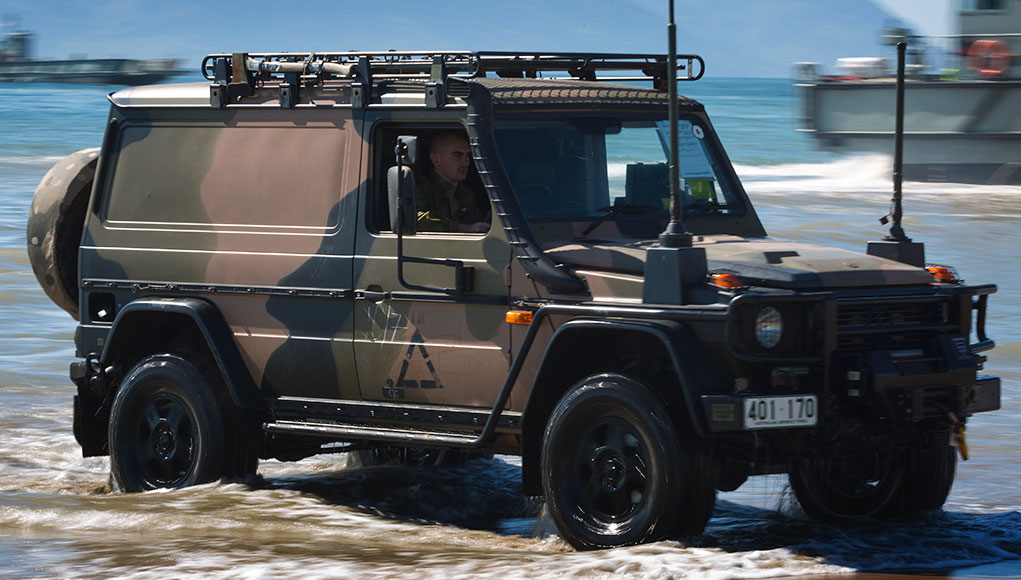
Kissling Service is demonstrating at Eurosatory a complete command post configuration based on a Mercedes Benz G-Wagon 'Command Post Concept SUV' that comprises multiple VHF/UHF-radios, a Satellite-Telephone, a C-IED-Jammer, Reconnaissance systems, a smoke grenade launcher and an IP-based intercom system. A clean energy solution based on high power density Li-Ion battery from Epsilor supports many hours of extensive operations, without running the engine at high RPM. Photo: Australian Defence
Military operators often use military versions of Sports Utility Vehicles (SUV) for various missions such as field deployed workshops, command posts and communications nodes, where such vehicles are required to provide extensive energy supply.
The integration company German Kissling Service is demonstrating at Eurosatory a complete Command Post (CP) configuration based on a Mercedes Benz G-Wagon SUV. Parked at the Mercedes Benz outdoor display, this CP Concept Vehicle comprises multiple VHF/UHF-radios, a Satellite-Telephone, a C-IED-Jammer, Reconnaissance systems, a smoke grenade launcher and an IP-based intercom system. Most of the systems are being configured and reached through a ruggedized tablet.
Supporting all users with a continuous, simultaneous supply of energy for long hours, Kissling turned to Israel’s battery expert Epsilor for a clean energy solution that will be able to support long hours of extensive operations without running the engine at high RPM. Such a solution requires a new generation battery that offers high power density and small size. The battery selected for the task was ELI-52526 Lithium-Ion battery from Epsilor – a drop-in replacement of the NATO standard 6T format.
“Our cooperation with Kissling Service at Eurosatory will provide us with an opportunity to present the most advanced battery products together with a leading vehicle system integrator, in action,” said Ronen Badichi, President of Epsilor. “With its high power density, our Li-Ion vehicle battery provides all the power needed to support multiple users on board for long hours, within a small volume and weight footprint,” he added.
The new 6T battery offers four times more energy, in just half the weight of modern lead-acid 6T batteries. Claiming the highest energy density in the world and 1,000 discharge cycles, Epsilor’s 6T type batteries offer an optimal energy storage solution for a wide variety of new armored and military vehicles as well as for drop-in replacement in existing vehicle fleets. “Epsilor’s 6T batteries are currently being tested and evaluated by a number of leading defense vehicle manufacturers and military customers, for various missions such as a long-shift silent watch, start-stop applications, high power mission applications and more,” Badichi added.
Realizing that modern armies need to store and generate more energy in lighter and smaller batteries, Epsilor is also offering an innovative line of 12V Lithium vehicle batteries. The company’s lithium Iron Phosphate Vehicular Battery family of products offers 100% more energy than similar Lead Acid batteries. Offering over 3,000 duty cycles, this technology is designed to serve a wide range of vehicle, marine and industrial applications and is designed to fit military vehicles and marine vessels, where service conditions are tough, volume and weight are important, and clean reliable energy is required.
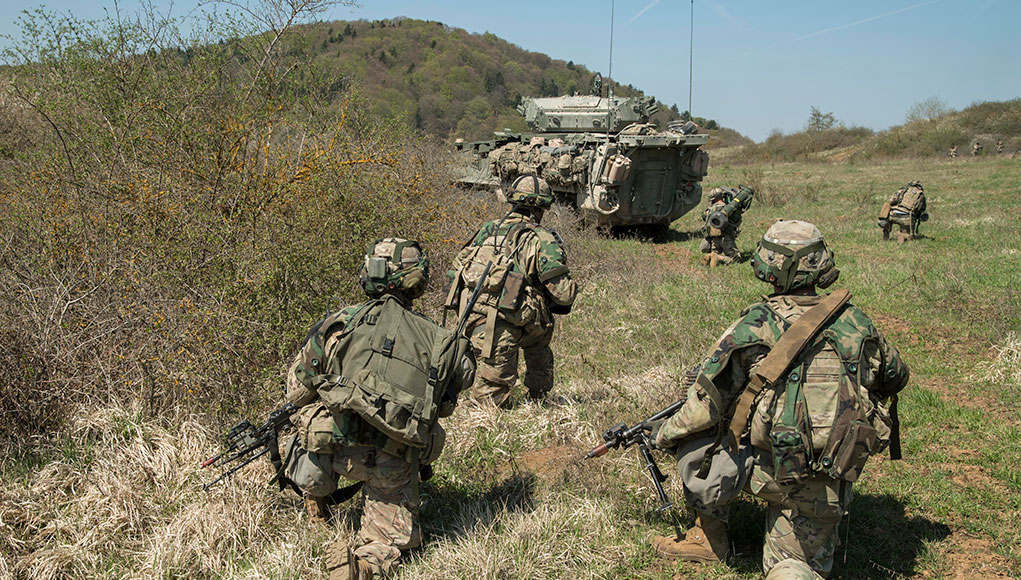
An Infantry Carrier Vehicle Dragoon (ICVD) from Ghost Troop, 2nd Squadron, 2nd Cavalry Regiment, over watches the engagement area from its battle position during the ICVD/Common Remote Weapons Station mounting a Javelin missile (CROWS-J) Operational Test at the Joint Maneuver Readiness Center (JMRC), Hohenfels, Germany. (Photo: US Army by Tad Browning.
In a first operational test conducted by the U.S. Army in Europe, troops from the 2nd Cavalry Regiment (2CR) Scouts demonstrated advantages gained by the force, using new variants of the Stryker 8×8 combat vehicles.
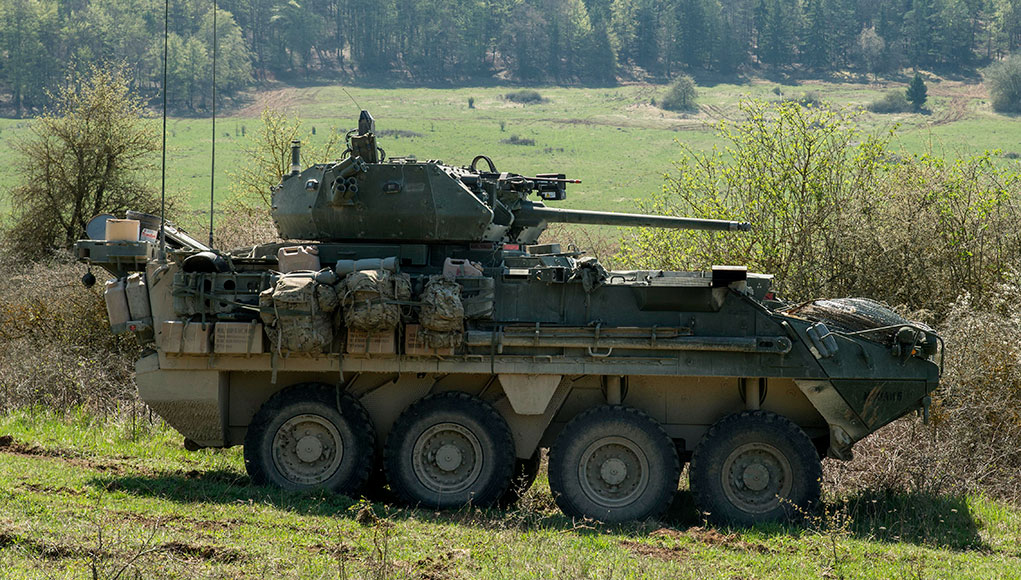
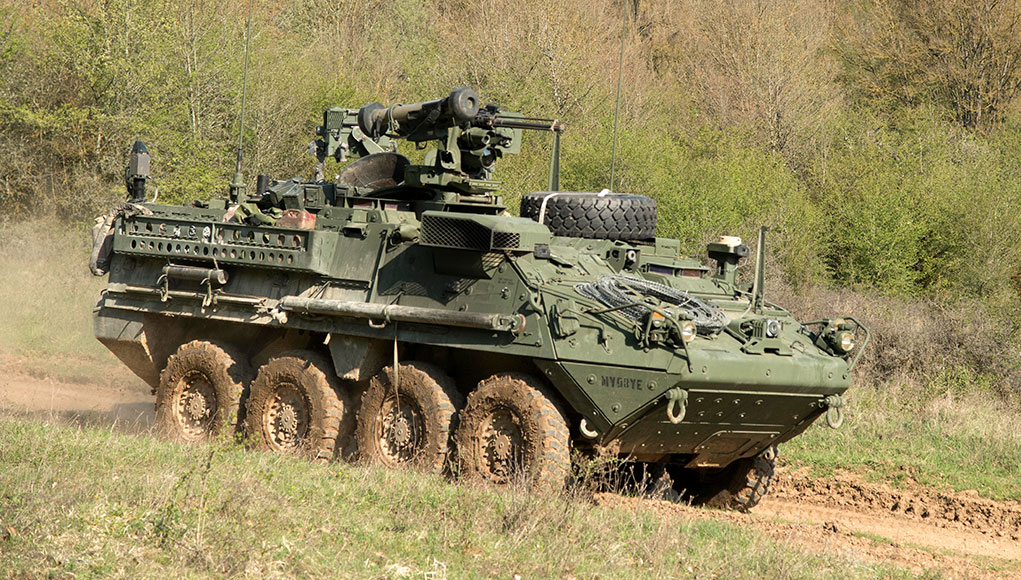
The test was held at the at the Joint Maneuver Readiness Center (JMRC), Hohenfels, Germany. The new vehicles were equipped with two new weapon systems. The Infantry and Recon Stryker variants were fitted with the Common Remotely Operated Weapon System-Javelin (CROWS-J), with a mounted Javelin capability. The second variant was the Infantry Carrier Vehicle — Dragoon (ICVD) was equipped with an unmanned turret housing a 30mm cannon with enhanced optics.
One key question at each AAR was how the platforms impacted the mission. The CROWS-J also received applauds, for providing the scouts the capability to fight enemy armor much more dynamically, allowing for the repositioning of anti-armor capabilities quickly across the battlespace.
The experiment was managed by the Army Operational Test Command (USAOTC) based at Fort Hood, Texas, which enabled other Army units to learn from the experience the 2CR has gathered with these new capabilities as they train in a realistic environment.
the Infantry Carrier Vehicle –Dragoon (ICVD) variant of the Stryker uses a new remotely operated turret mounting a 30mm cannon. Photo: Photo US Army by Tad Browning)A Common Remote Weapons Station mounting a Javelin missile (CROWS-J) from Palehorse Troop, 4th Squadron, 2nd Cavalry Regiment, performs bore sighting prior to the first mission during the Infantry Carrier Vehicle Dragoon (ICVD)/CROWS-J Operational Test at the Joint Maneuver Readiness Center (JMRC), Hohenfels, Germany. Photo: Tad Browning)
“The ICVD provides an all-weather, limited visibility, long-range target acquisition with long-range fires capability that is challenging and changing the way we fight; we are maneuvering to avoid them,” said Capt. Brandon J. Shorter, commander of the OPFOR’s Blackfoot Company that, as an opposition force, had to face the new assets in mock combat. Blackfoot Company provided operated a hybrid threat formation composed of Motorized Rifle Company and a squad of irregular forces. Part of the test’s goals was to provide information contributing to a Capabilities and Limitations Report (CLR) of the two new Stryker variants.
“The CLR is important because it lets the commander know what the vehicles can and can’t do and will influence how he employs the systems,” said Ron Thomas, the MTD test officer.
To achieve this, 2CR units conducted eight missions — four days and four nights –enabling them to operate their new systems in different conditions against a myriad of OPFOR formation threats.
“We gained knowledge of the new systems during the New Equipment Training but we are gaining experience through employing them during the operational test,” said Staff Sgt. Nathan F. Dragovich. To capture this Soldier test feedback on what works and what does not, the MTD test team created a data harvest method which administered surveys and After Action Reviews (AAR) after each mission. Data harvests immediately following a mission is crucial to the operational test, Thomas added. “It allows us to get the data while the fight is still fresh in Soldiers’ minds,” he said.
An F-35B short takeoff/vertical landing aircraft flies behind a tanker on a mission over Edwards Air Force Base, Calif., in September 2013.
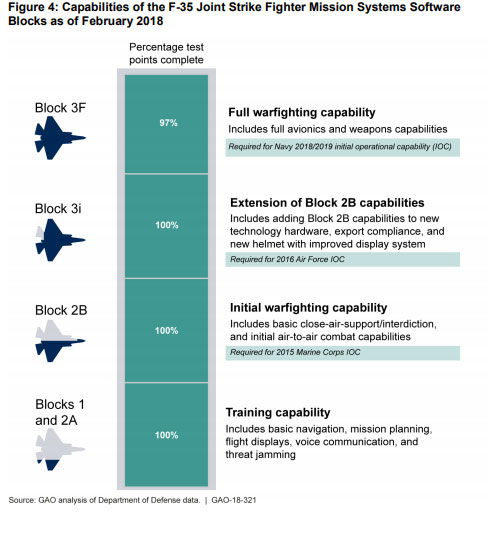
In 2019, DOD will decide whether to enter full-rate production for the F-35 aircraft. From the next year onwards, the Pentagon plans to invest about $10 billion annually for two decades acquiring F-35s – the most expensive and ambitious weapon acquisition program in U.S. military history. By the time the program moves into full-rate production, 500 aircraft will be procured and will need fixes and resolving deficiencies found during the testing. Bringing those aircraft to full capability could cost $1.4 billion. The F35 program office will hold a summit later this year to determine who will be responsible for the costs associated with resolving the remaining deficiencies.
In the recent years, the program made significant progress to bring the aircraft to maturity, reduce cost and improve operability. Alas, a recent report prepared by the Government Accountability Office (GAO) recommends DOD to hold that decision until all critical deficiencies found in testing are resolved. Specifically, GAO recommends Congress to limit the funding of the upcoming upgrade of the aircraft (known as ‘Block 4’) until DOD provides a sound business case for the effort. – Subscribe to read the full version of this post –
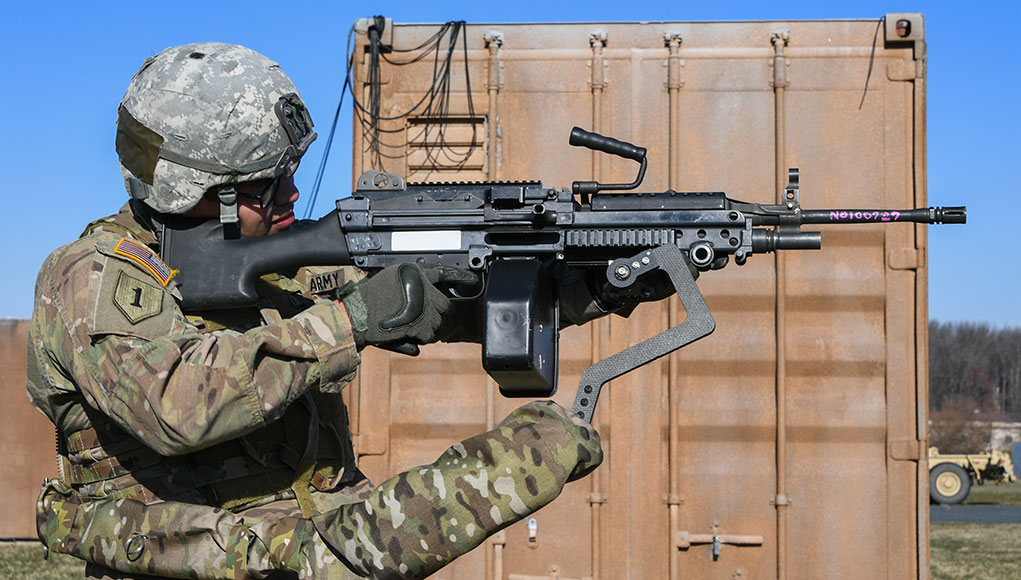
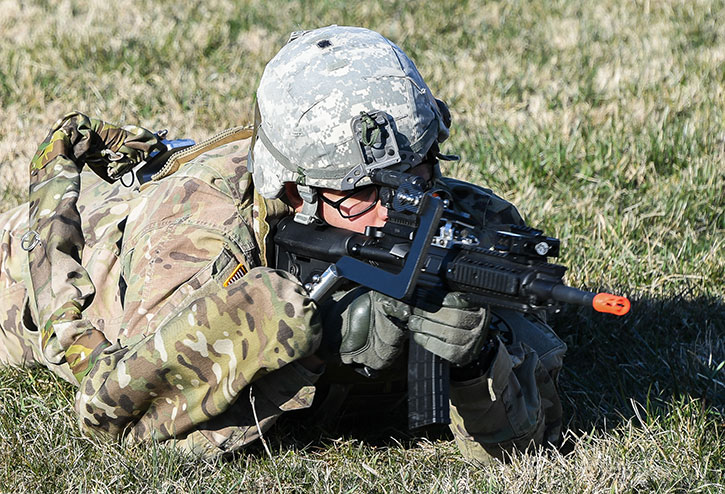
Army Sgt. Michael Zamora assumes a prone fighting position using a prototype Third Arm exoskeleton device during testing at Aberdeen Proving Ground, Maryland. Photo: U.S. Army by Conrad Johnson
Engineers are working diligently to reduce the weight Marines and soldiers carry in action, but engineers at the U.S. Army Research lab took a different approach – adding limbs to improve soldier lethality. Dan Baechle, a mechanical engineer at the lab constructed a device that better distributes the weapon’s load, stabilizing the weapon when entering fire positions, enabling the soldier to aim and shoot as quickly and accurately as possible. Unlike other, complex exoskeletons, the device produced by Baechle is made of composite materials that are lightweight and does not requires batteries to operate.
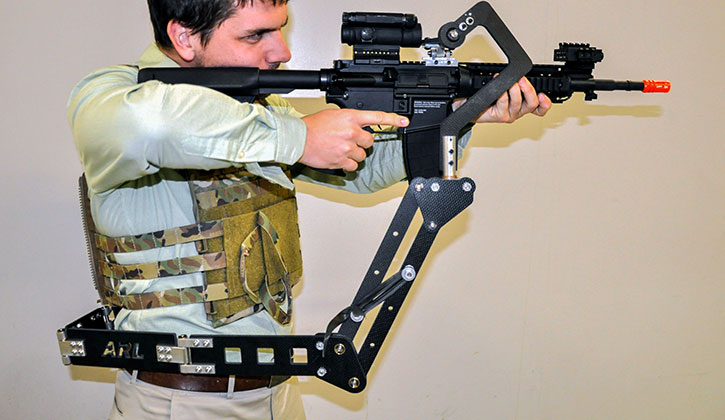
Called the ‘Third Arm’, the 4 pound (1.814 kg) device helps to reduce the weapon’s weight off of the Soldiers’ arms and better distribute it through the skeleton. The weight of the apparatus is less than four pounds.
“It can help stabilize the weapon and take the load off of their arms,” he said. “It’s made from composite materials to make it as light as possible, but also to ensure the range of motion that Soldiers need. We’ve actually tested it with the M249 and M240B machines guns. The M240B weighs 27 pounds (12.25 kg), and we were able to show that you can take the weight of that weapon completely off of the Soldiers’ arms,” Baechle said, adding that they also look at heavier weapons. In 2017, the lab conducted a small pilot study of active-duty troops using Third Arm in live-fire trials. The results showed the device can improve marksmanship, reduce arm fatigue and muscle activation for some Soldiers.
The device is designed to ensure the range of motion that Soldiers need, operating a wide range of heavy and light weapons. Photo Credit: U.S. Army photo by Conrad Johnson)
Baechle was able to improve the design by testing it with soldiers using the Third Arm prototype with various weapons and in different positions. At a recent test with a Soldier at the Military Operations in Urban Terrain site at the Aberdeen Proving Ground, a sergeant wore the device with an M-4 type weapon and dove into a prone fighting position from a sprint. The Third Arm provided immediate stabilization to improve marksmanship for the Soldier.
Baechle said that the Army modernization priorities include “Soldier lethality that spans all fundamentals — shooting, moving, communicating, protecting and sustaining.” Further documentation specifically mentions the fielding of “load-bearing exoskeletons. The Third Arm falls in line with the direction that the Army wants to be heading in the future,” Baechle said. “We get comments from Soldiers who tell us different things about the way it feels on their body about the way it redistributes the load. Some like it, some give us tips about the ways it could be improved, and we’re using that input to improve the device and improve the design so that it not only works well, but it also feels good.”
“We’re using that small study to motivate a larger study this year with more Soldiers taking a look at dynamics, shooting scenarios,” Baechle said. “We’re still refining the device. ”
The device is made from composite materials to make it as light as possible, but also to ensure the range of motion that Soldiers need. Photo Credit: U.S. Army Research Laboratory (ARL)
Lockheed Martin Skunk Works® and XTEND have achieved a major milestone in JADC2 by integrating the XOS operating system with the MDCX™ autonomy platform. This technical breakthrough enables a single operator to simultaneously command multiple drone classes, eliminating the friction of mission handoffs. From "marsupial" drone deployments to operating in GPS-denied environments, explore how this collaboration is abbreviating the data-to-decision timeline and redefining autonomous mission execution.
As traditional defense primes face mounting competition from agile “neoprimes” such as Anduril, Palantir and Helsing, the balance of innovation is shifting toward software-defined warfare and scalable, dual-use technologies, while global industry consolidation—marked by Boeing’s integration of Spirit AeroSystems and other strategic mergers—signals an intensified race to secure control over the defense technology value chain. Our Defense-Tech weekly report highlights these trends.
In early October 2025, a coordinated wave of unmanned aerial system (UAS) incursions—widely attributed to Russia—targeted critical infrastructure across at least ten European nations. The unprecedented campaign exposed the fragility of Europe’s air defenses...
Executive Summary
The past week (September 18-25, 2025) represents an inflection point where strategic defense concepts have transitioned from doctrine to tangible reality. An analysis of global events reveals four primary, interconnected trends shaping an...
At the 2025 Air, Space & Cyber Conference, U.S. Air Force and Space Force leaders unveiled major updates on next-generation fighters, bombers, unmanned systems, and space initiatives, highlighting both rapid innovation and critical readiness challenges as the services race to outpace global competitors. A short version is available here, with a more detailed version for subscribers.
The Taipei Aerospace & Defense Technology Exhibition (TADTE) 2025 crystallized around four dominant strategic themes that collectively illustrate Taiwan's comprehensive approach to defense modernization amid escalating regional tensions. Based on a detailed report by Pleronix (available upon request). Includes a Podcast discussion on TADTE 2025's highlighting Taiwan's four strategic themes beyond the post's coverage.
Israel’s Iron Beam 450 high-power laser system has completed final testing, marking a major leap in air defense. Developed by Rafael, it offers precise, cost-effective interception of rockets, UAVs, and mortars, and is set for IDF deployment by 2025.