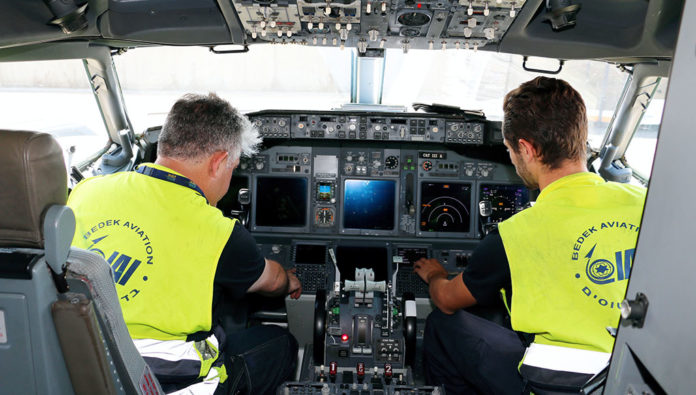
IAI technicians perform maintenance, repair and overhaul (MRO) on customer's aircraft. Photo: IAI
Israel Aerospace Industries (IAI) announced today is strengthening its commercial aviation activities by forming a single, business-oriented group that unifies six business lines currently distributed in different corporate activities. The activities that will be included in the new group currently contribute to about 25 percent of IAI’s turnover. Yossi Melamed, Executive Vice President & General Manager of Bedek Aviation Group was named General Manager of the new group.
The new structure will enable IAI to focus its activities to meet the unique challenges and opportunities of the commercial aviation market. The transformation is implemented at a time in which many countries bring home their manufacturing operations and are fighting aggressively for market shares, challenging IAI to sharpen its offering in defense and commercial aviation alike.
Currently, IAI is structured in six independent groups, each with a turnover of several hundreds of million dollars. The structural transformation establishes a single aviation group for all of IAI’s aviation businesses that will focus on four business lines:
1. Development and manufacturing of commercial and business aircraft;
2. Development and production of aviation assemblies and aerostructures;
3. Aircraft conversion and enhancement;
4. Aircraft maintenance.
The new structure will be organized according to business lines, as customary in similar leading corporations. Under the new structure, IAI will be better positioned to reinforce existing synergies between its various operations and will lead to significant operational streamlining, including coming out of existing unprofitable lines of business.
“IAI is undertaking a structural change process into a business-line-oriented structure that will strengthen our edge in the fiercely-competitive global markets in which it competes against giant multinationals.” Harel Locker, IAI’s chairman, said, “IAI has some of the world’s best human capital and technological capabilities and is well positioned to win more markets by focusing on our relative edge and clear business lines. The initiative approved today does exactly that.”
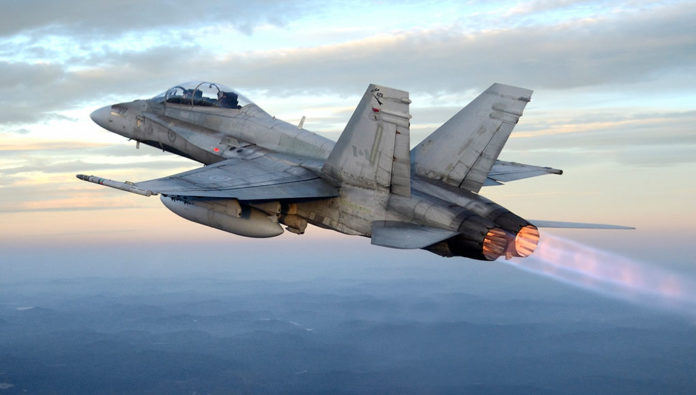
Canada plans to buy 18 used F/A-18 Hornet fighter planes from Australia to fill the air forces’ fighters shortage. On 13 December 2017, Australian Minister for Defence Marise Payne confirmed the sale of 18 F/A-18A/B Hornets and associated spare parts to Canada. The purchase is regarded as a stopgap measure as Ottawa moves forward with a more permanent selection of a future replacement for the CF-18.
Prior to that decision, Canada had given serious consideration to buying 18 Super Hornets from Boeing, after rejecting its planned buy of F-35. But then Boeing filed a trade complaint against rival Bombardier, alleging that the Canadian manufacturer was relying on government subsidies to sell its C-series jets at unfairly low prices. In response, the U.S. government said it would impose a 220-percent duty on C-series jet sales.
The Canadian CF-18 is not identical to the Australian F/A-18A/B model, but the two are similar models. The Australian Air Force plans to phase out the first of its 71 F/A-18A/B Hornets to be replaced by 72 fifth-generation F-35A Lightning II aircraft beginning in 2018. The first two Australian Hornets are scheduled to be transferred in early 2019. The timeframe for handing over the other 16 aircraft will be dependent on progress with introducing the F-35 into Australian service.
When those aircraft are transferred to Canada, it is likely they will be operated by a single unit, to simplify operations, maintenance and support the Canadian Air Force plans to keep all the Hornets to be bought from Australia in two units, stationed at Bagotville (3 Wing) and Cold Lake (4 wing), Alberta. Modifications required to the Australian aircraft are expected to be minimal as the supplemental jets are of similar age and design to the CF-18, the Canadian Department of National Defence (DND) said.
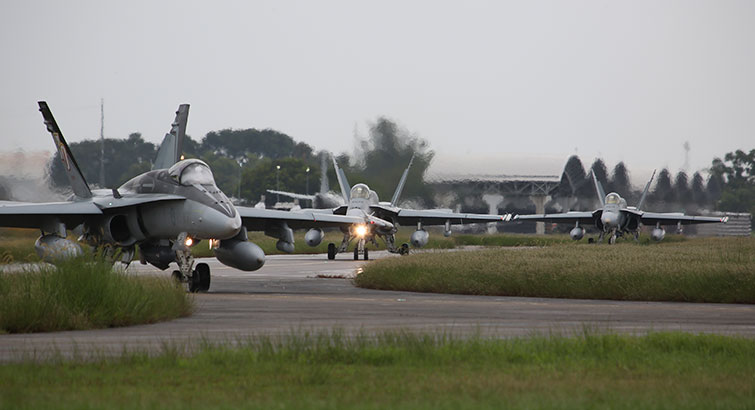
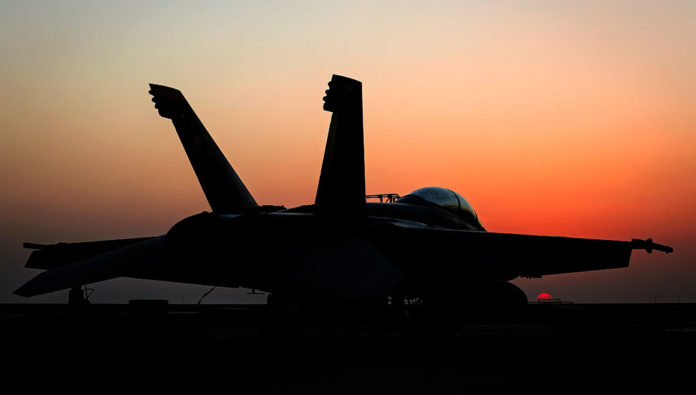
“Highway to the danger zone”. Three Royal Australian Air Force 77 Squadron F/A-18A Hornets taxi towards the take off area at Royal Malaysian Air Force Base Butterworth during Exercise Bersama Lima 16. Photo: Australian Defence, by Andrew Eddie
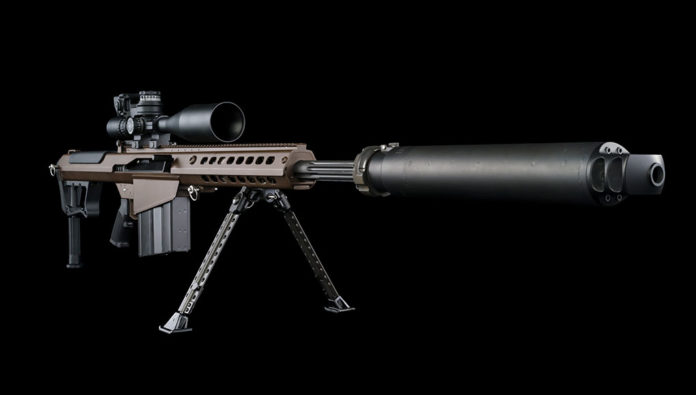
Ukraine will receive from the USA an unspecified number of Barrett M107A1 Long Range Sniper Rifles (LRSR) worth US$41.5 million. Effective at a range of 2,000 meters, these rifles proved highly effective in counter-sniper operations in open or urban warfare. Photo: Barrett.
The U.S. administration plan to support Ukraine reached an important milestone this weekend as President Donald J. Trump approved a support plan to Ukraine, which, for the first time since the U.S. began its assistance plan in 2014. The total value of U.S. military support to Ukraine, since 2014 is estimated at more than US$750 million. The FY2018 budget allocates $350 million for military assistance to Kiev. The situation in Eastern Ukraine Donbass region continues to be tense since the Russian side has left the Joint Centre for Control and Coordination that has been stabilizing the region. This was followed by outbreaks in several spots across the Donbas, Ukraine’s Defense Ministry reported.
The newly approved support package includes the supply of lethal weapons. The military aid package worth $47 million comprised of FGM-148 Javelin multipurpose guided missiles. The US also approved financing for the deal.
Since its debut in the Middle East in the second Iraq war in 2003, the Javelin demonstrated high effectiveness in combat but has not been proven against the latest Russian tanks such as the T-90s. The Javelin weapon system is comprised of missiles stored in disposable containers, and reusable Command-Launch Units that are used for target acquisition and battlefield surveillance. Until recently the U.S. exported mainly the second-generation Raytheon BGM-71 TOW missiles but has recently approved the Javelin for export to former Eastern Bloc countries, including Ukraine and Georgia.
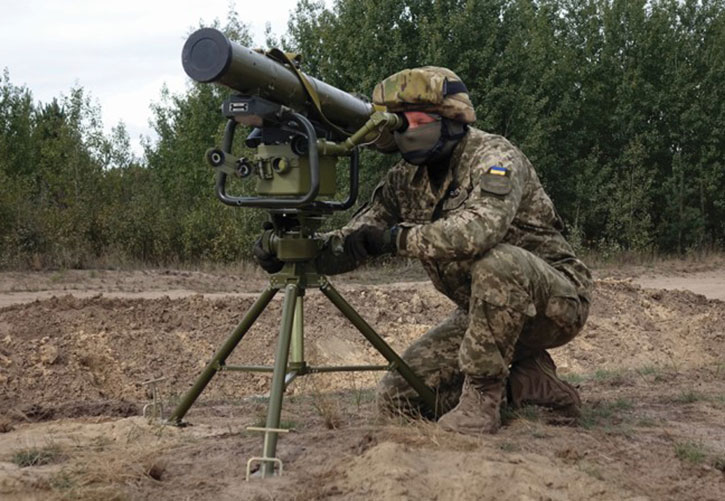
Designed by the Luch engineering bureau in Kyiv, over 50 missiles and an undisclosed quantity of Corsar launchers have already been delivered to the Armed Forces of Ukraine. Photo: UkrOboronProm
The sale of western weapons is important for the security of Ukraine, but even more critical as a symbolic backing the West gives Kiev. Ukraine already has the capability to produce ’s its own anti-tank missiles, for example, the Corsar and Stunga-P. Corsar is a man-portable, laser-guided Anti-Tank Guided Missile effective against main battle tanks at ranges up to 2.5 km. Stunga-P is a laser-guided weapon with an effective range of four kilometers. According to local media, about 50 Corsar missiles have been delivered to the Ukrainian military recently.
Another arms package approved last week by the State Department includes the export of Barret M107A1 semi-automatic long range sniper rifles (LRSR) and 0.50 cal ammunition at a value of $41.5 million. These rifles are effective at ranges up to 2,000 meters, exceeding the effective range of other sniper rifles and are therefore highly effective for counter-sniper operations in open or urban terrain. Canada has opened the door for sales of Automatic Firearms to Ukraine by adding Kiev to the Automatic Firearms Country Control List. This act will enable Canadian arms exporters to sell firearms to Ukraine, pending approval from the Canadian Foreign Ministry.
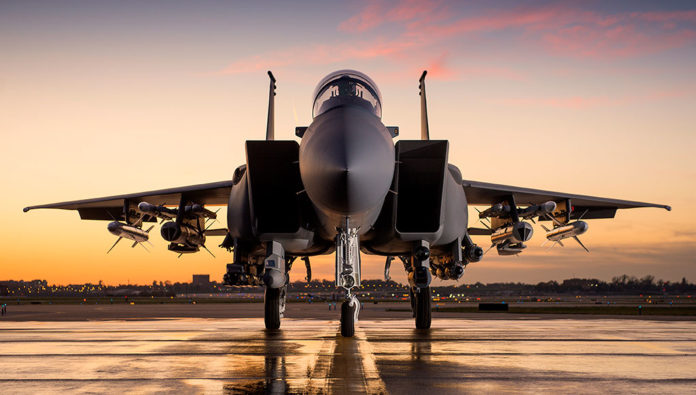
Boeing offered Qatar an advanced, multirole variant of the Eagle, designated F-15QA. Photo: Boeing
Qatar continues its race for air power. The U.S. Department of Defense awarded Boeing Defense, Space, & Security company a $6,173,500,000 undefinitized contract action contract for the F-15 Qatar program. FMS funds in the amount of $3,019,750,000 are being obligated at the time of award. This sole source contract provides for the foreign military sales (FMS) requirement to procure 36 new F-15QA aircraft for the Qatar Emiri Air Force. Work will be performed in St. Louis, Missouri, with an expected completion date of Dec. 30, 2022. Qatar has already finalized contracts for the procurement of 36 Rafale fighters from France and 24 Typhoons from the UK. The 36 F-15QA will bring the fighter fleet of the Qatari Emiri Air Force to 96 aircraft by the mid-2020s.
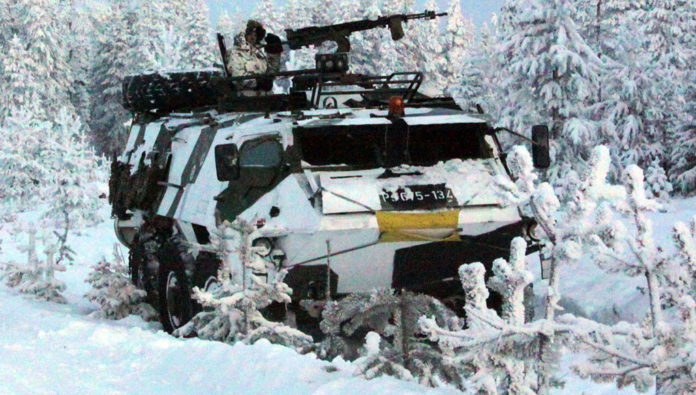
Patria Land Systems will modernize 65 XA-180 PASI 6×6 armored personnel carriers for the Finnish Army. This modernization that will take place in the next two years (2018-2020) at a cost of 16 million euros, will sustain the vehicle’s operations through the 2030s. Among the systems undergoing refurbishment are electrical systems, power transmission components, suspension and external coating. Modern seating with security belts will also be installed in the vehicles.
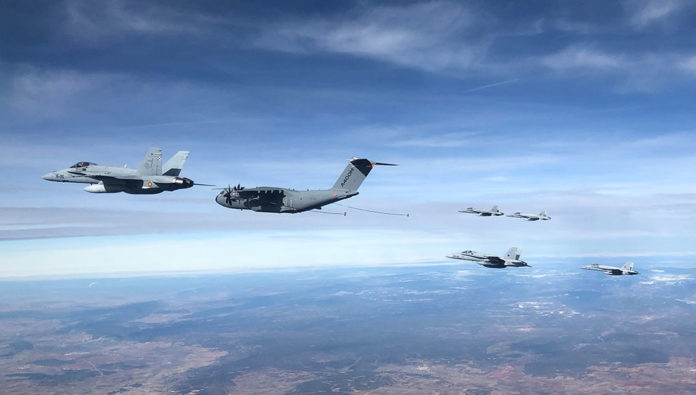
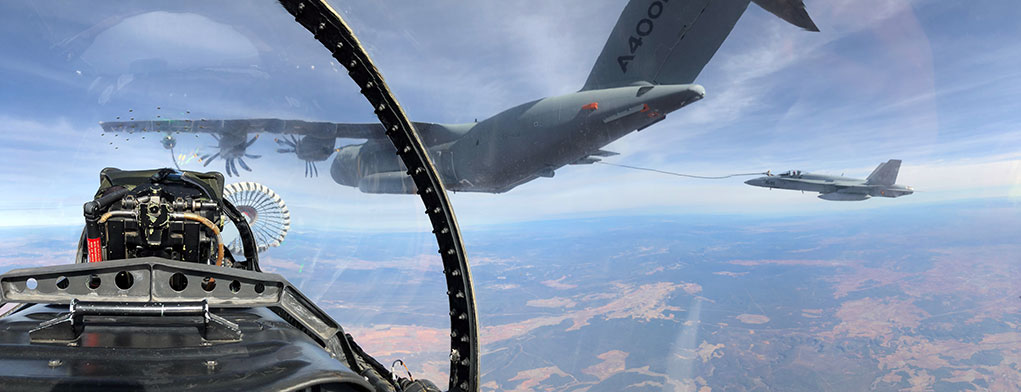
On a recent test an Airbus A400M refueled six F/A-18 of the Spanish Air Force. A total of 11.4 tonnes of fuel was dispensed using both the underwing pods and the center hose refueling unit. Certification authorities on board confirmed good results and the flight validated the A400M two-crew cockpit concept for tanker missions. Photo: Airbus
An Airbus A400M has successfully refueled six Spanish Air Force F-18 fighters in a single mission as part of an air-to-air refueling (AAR) human factors certification flight. The 13 December mission featured a complex series of AAR scenarios such as changes of area, receivers with unknown priorities, and unexpected increases in numbers of receivers. Through multiple contacts, the six aircraft simulated a fleet of eight. The F-18s included the first Spanish operational fighters to be refueled by the A400M and belonged to the Spanish Air Force Test Centre (CLAEX) and the 12th Operational Wing based at Torrejón. A total of 11.4 tonnes of fuel was dispensed using both the underwing pods and the center hose refueling unit. Certification authorities on board confirmed good results and the flight validated the A400M two-crew cockpit concept for tanker missions.
Through multiple contacts, the six aircraft simulated a fleet of eight. The F-18s included the first Spanish operational fighters to be refueled by the A400M and belonged to the Spanish Air Force Test Centre (CLAEX) and the 12th Operational Wing based at Torrejón. Photo: Airbus
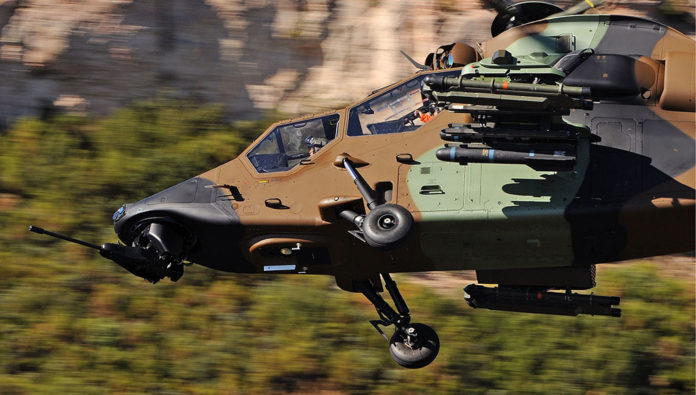
Tiger HAD completes retrofit of first of 36 helicopters. Photo: Airbus Helicopters
Airbus Helicopters has delivered the first Tiger helicopter retrofitted into the HAD version of the French Army Aviation, after having previously completed its formal acceptance process with the French Defence Procurement Agency (DGA). The retrofit from the HAP to the HAD version involves performing over 100 airframe modifications and installing over 1,500 new parts and 250 electrical cables. This retrofit program covers 36 helicopters. Airbus Helicopters has set up a new industrial organization for this Tiger retrofit program, combining personnel from its Military Support Center France and its Tiger serial production Final Assembly Line.
Compared with the previous HAP version, the HAD Tiger benefits from an increased maximum take-off weight (MTOW) and is equipped with two new enhanced MTR 390 E engines and with a new STRIX roof-mounted sight system complete with a laser designator that allows the Hellfire II air-to-ground missile to be fired. The Tiger HAD is Airbus Helicopters’ multi-role attack helicopter which also performs armed reconnaissance, air or ground escort, air-to-air combat, ground firing support, and anti-tank missions in day, night and in adverse conditions. The Tiger attack helicopter has proven its capabilities during operational deployments in Afghanistan, the Central African Republic, Libya, and Mali. In service with the armed forces of France, Germany, Spain, and Australia.
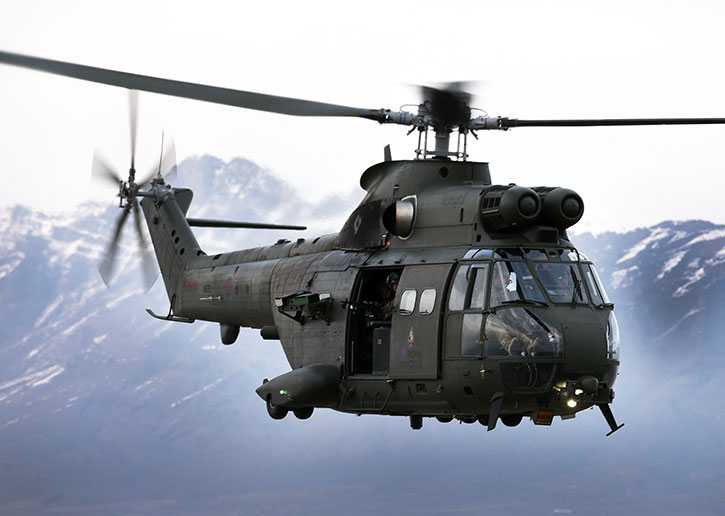
Airbus Helicopters has recently entered another support agreement in the UK, under follow-on Support to the Royal Air Force Puma 2 fleet. The contract, awarded by the British MOD, is worth an initial £100 million. As part of the company’s support offering, Airbus Helicopters will provide repair and overhaul services in addition to a parts-by-the-hour programme to sustain the Puma-2 fleet. The single-source contract also includes the provision of training to all Puma avionics and mechanical technicians as well as engineering managers. The first phase provides full technical support and logistics until March 2022. with optional extension through 2025. It follows an interim Support Arrangement, that was in place since the first upgraded Puma 2 entered service in 2012. The upgraded Puma 2 fleet recently logged 20,000 flight hours.
Airbus to sustain The RAF Puma 2 helicopters under support agreement awarded by MOD. Photo: Crown Copyright
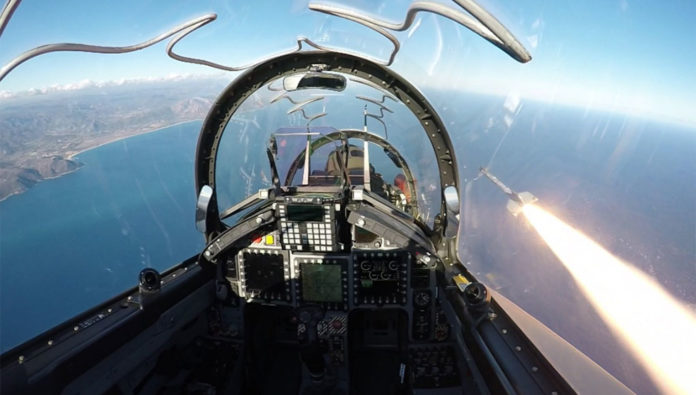
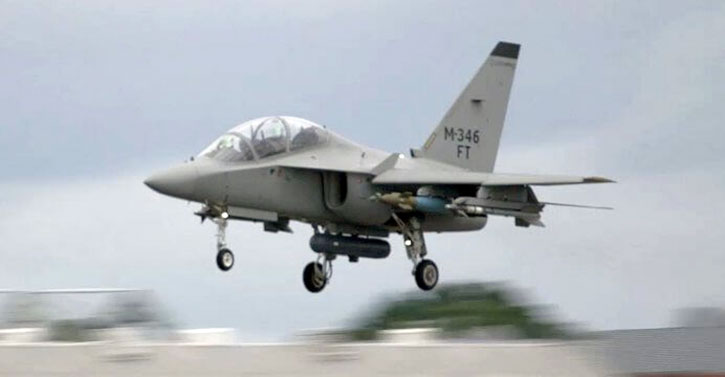
M346FT launching AIM-9L Sidewinder missile over Salto del Quirra test range in Sardinia. Photo: Leonardo
As part of the expanded weapon’s capability of the M-346 Master aircraft, the Leonardo Group tested the fighter/attack trainer with air-to-air capability launching Raytheon’s AIM-9L Sidewinder air-to-air missile (AMM). The test, performed at the Salto del Quirra test range in Sardinia this week, also included releases of laser-guided bombs (LGB). Rafael Litening targeting pod was used to guide the LGB. The M-346FA is a fighter/attack variant of the Master. It has additional hardpoints carrying ordnance and fuel tanks, and wingtip rails for AAM. This type also uses the Grifo-346 radar. The goals of the missile launch were to measure the effects of missile plume on engine air-intake and aircraft structure, evaluate store management system (SMS) the functionality and safety interlocks and assess handling quality during missile launch. Two combat capable variants of the M-346 – the FT (Fighter Trainer) variant is a dual-role aircraft that keeps both advanced trainer and Lead-In Fighter Trainer functions. As an evolution from the M-346FT, the FA (Fighter Attack) is designed to provide combat capabilities to a wide range of operational needs.
The M-346FT takes of on a test flight carrying Sidewinder AAMs, laser guided bombs and a Litening targeting pod.
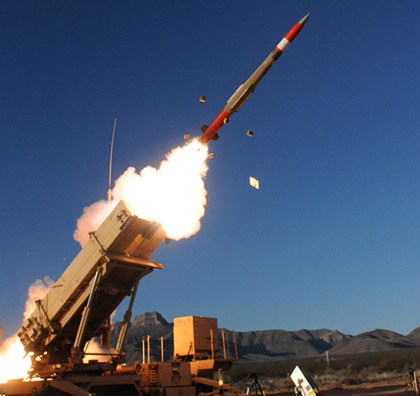
The first PAC-3 MSE missile launch in Februar, 2010. Photo: Lockheed Martin
The United States and allied military forces will upgrade their missile defense capabilities under a new $944 million contract awarded to Lockheed Martin, for production and delivery of Patriot Advanced Capability-3 (PAC-3) and PAC-3 Missile Segment Enhancement (PAC-3 MSE) interceptors and launcher modification kits for the U.S. Army, Romania and other foreign customers. The PAC-3 is a high-velocity interceptor that defends against incoming threats, including tactical ballistic missiles, cruise missiles, and aircraft. Building on the combat-proven PAC-3, the PAC-3 MSE uses a two-pulse solid rocket motor that increases altitude and range to defeat evolving threats. PAC-3 currently provides missile defense capabilities for the U.S., Germany, Kuwait, Japan, the Republic of Korea, Taiwan, the Netherlands, the United Arab Emirates and others.
The Air Task Group (ATG) comprises six RAAF F/A-18F Super Hornet fighter aircraft, an E-7A Wedgetail airborne command and control aircraft, and a KC-30A Multi-Role Tanker Transport aircraft. Additionally, the ATG has personnel working in the Combined Air and Space Operations Centre, and embedded with the ‘Kingpin’ US tactical Command and Control Unit. Photo: Australian DOD, by Brenton Kwaterski
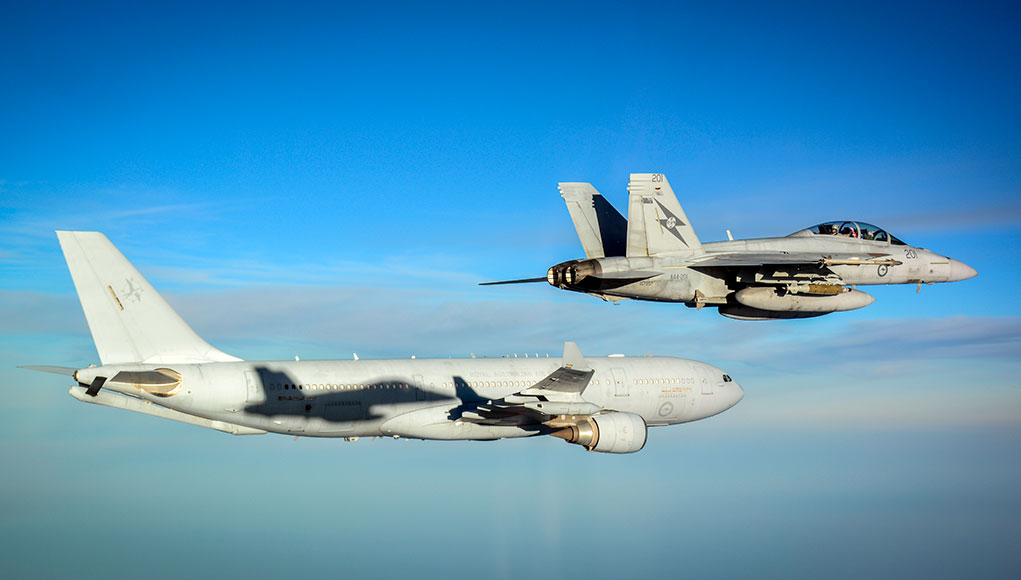
Australia is set to pull out six F/A-18F Super Hornets currently operating as part of Operation Inherent Resolve. Australian Air Task Group flying Super Hornets was part of the allied forces since 2014, supporting the Iraqi forces in their battle against the Islamic State. The strike aircraft deployed as part of the Air Task Group conducted more than 2,700 sorties against Daesh targets in both Iraq and eastern Syria. Australia’s E-7A Wedgetail and KC-30A refueling aircraft will continue to support counter-Daesh coalition operations. Australia will also continue its training mission in Iraq, which involves around 300 personnel at Task Group Taji and around 80 personnel in a Special Operations Task Group.
The return home in January marks the end of Australia’s successful air strike operations in Iraq and Syria. “Australia had reviewed our contribution with our Iraqi and Coalition partners following the announcement of Iraq’s liberation from Daesh by Prime Minister of Iraq Haider al-Abadi earlier this month.” said Minister for Defence, Senator the Hon Marise Payne, “The battlefield success against Daesh means our own Operation OKRA has now reached a natural transition point and our strike aircraft will begin returning home early in the New Year,” Minister Payne said. A Belgian Air Force contingent of F-16 fighters is also returning from the Middle East soon.
A KC-30A Multi Role Tanker Transport and F/A-18F Super Hornets, all from the RAAF, return to base post a mission in support of Operation OKRA. The aircraft are part of the Australian Task Group that fought with other coalition nations to defeat the Islamic State in Iraq and Syria. Photo: Australian DOD
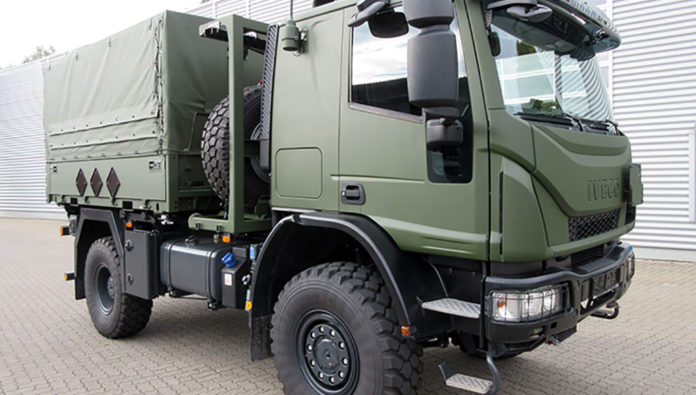
Iveco Defense Vehicles Eurocargo MLL 150 E 28 WS 4x4 for the German Army. Photo: Iveco DV
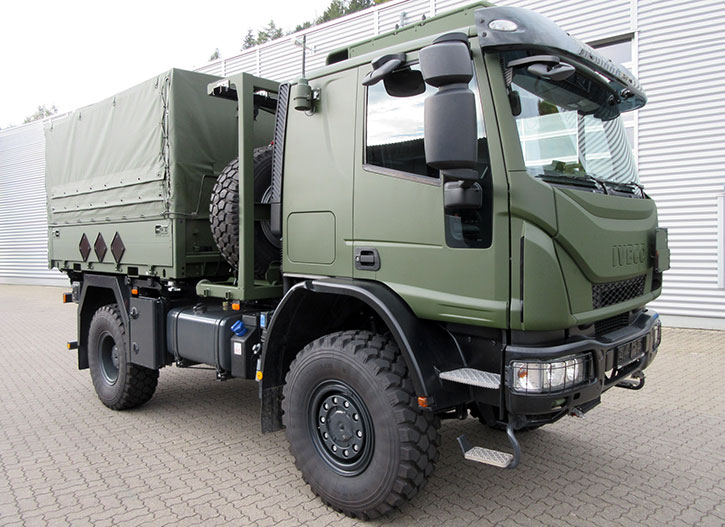
Iveco Defense Vehicles to supply 280 militarized Eurocargo MLL 150 E 28 WS 4×4 to the German Army in 2018. Photo: Iveco DV
Following two years of intensive market evaluation and field trials with a demonstrator vehicle, the German Ministry of Defense ordered 280 Eurocargo military medium multipurpose 4×4 trucks from Iveco Defense Vehicles (DV). The order was made by German BwFuhrpark Service GmbH on behalf of the German Army will be delivered in 2018. Over the last decade, Iveco DV has delivered nearly 1,000 vehicles to the German Army. Recent contract awards with the Bundeswehr also include 133 armored Trakker-8×8 trucks.
The MLL 150 E 28 WS vehicles to be delivered under the current order will be supplied with an unprotected long-distance-driver cab with a highly comfortable new seating arrangement, flexible storage for radio systems and soldier equipment, off-road single tyres, a roof hatch, a NATO-blackout-light, trailer version, a spare wheel carrier and an innovative multipurpose swap-body-frame to support multi-mission-operations outside Germany. All vehicles will be fully Euro 6 emission compliant, including full single-fuel-operation-capability and offer a best-in-class payload.
Norway is expecting to stand-up an artillery battalion with 24 new self propelled 155/52 K-9 Thunder howitzers made in Korea. Photo: Norway Forsvaret
The Norwegian Defence Materiel Agency and Hanwha Land Systems yesterday signed a contract for the procurement of 24 K9 Thunder self-propelled 155mm L/52 Artillery Systems. The total worth of the arms package is about 1.8 Billion NOK. (US$287 million). Pre-series of the artillery system will be delivered for initial trials in 2019 with the remaining batches delivered through 2020, forming a combat-ready artillery battalion in 2021.
The contract comprises 24 self-propelled guns combined with designated ammunition resupply vehicles, with the option for another 24 self-propelled guns. These guns will replace two the battalions of M-109A3GN currently in service. Norway will become the third operator of this weapon; the K-9 Thunder is already in service with the armies of South Korea and Turkey. India and Finland have also selected the K-9 along with Estonia that still negotiates their procurement.
The K-9 Thunder SP howitzer is produced in the Republic of Korea by Hanwha Land Systems. According to the Norwegian agency, the SP gun system that was acquired ‘off-the-shelf’ has satisfied the specific requirements and needs of the Norwegian Army. In addition, Hanwha Land Systems has demonstrated the ability to deliver in compliance with stated time and cost requirements. “Hanwha Land Systems was the Competitor with the greatest degree of compliance with the Norwegian Army’s requirements. The artillery system will become an important contribution to the Armed Forces’ operational ability,” Head of Norwegian Defence Materiel Agency’s Land Systems Division, Brigadier General Morten Eggen stated.
A contract for logistic support, during the useful life of the materiel, together with a contract for the establishment of a Center of Excellence at Bjerkvik Technical Workshop were also signed. Under this agreement, Hanwha Land Systems will provide test equipment and training material and share technical knowledge to support the systems at the Bjerkvik Technical Workshop. The center will offer support services to other military users of the K-9 system.
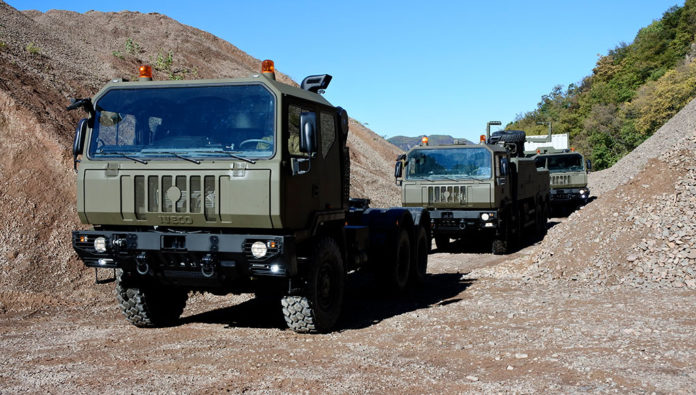
The Romanian Ministry of National Defence awarded Iveco Defence Vehicles (Iveco DV) a contract for the supply of 173 military trucks to be supplied within 2018. The delivery includes specially designed 6×6 military logistic vehicles from Iveco DV’s high mobility truck range. Designed as troop and transport the trucks are equipped with a self-recovery winch, and Central Tyre Inflation System (CTIS) the vehicles offer exceptional mobility and fording capability.. The trucks are C-130 air transportable. This is the second batch of Iveco-DV trucks Romania orders. In 2015 Iveco delivered 57 vehicles to the Romanian MOD, This previous batch included high mobility trucks in 6×6, tractor 6×6, 8×8, 8×8 with hook lift, 8×8 with trans container configurations, these vehicles have already been fielded with the Romanian forces.
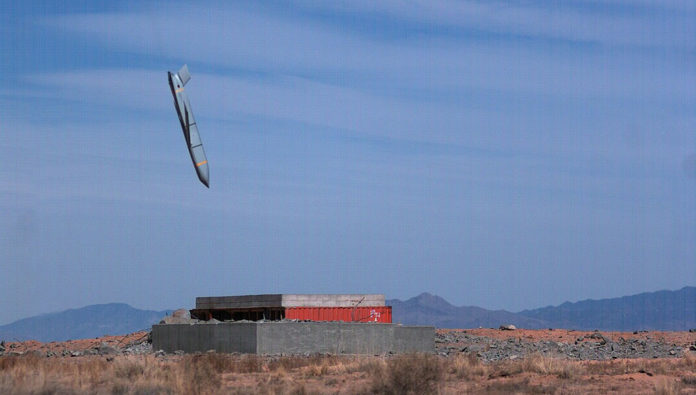
Joint Air/Surface Standoff Missile (JASSM) performs a precision attack on a target test. Photo: Lockheed Martin
The U.S. Air Force Research Laboratory (AFRL) munitions directorate awarded two science and technology experimentation contracts for the first phase of development of a new cruise missile designed to defeat modern, integrated air defense systems (IADS). Under the Gray Wolf technology demonstration program, AFRL awarded $3 million to Lockheed Martin, and $2.8 million to Northrop Grumman to support research and development efforts over the next 18 months. Each company could receive up to $110 million to demonstrate its design – the total funding allocated for the Gray Wolf experiment over the next four to six years.
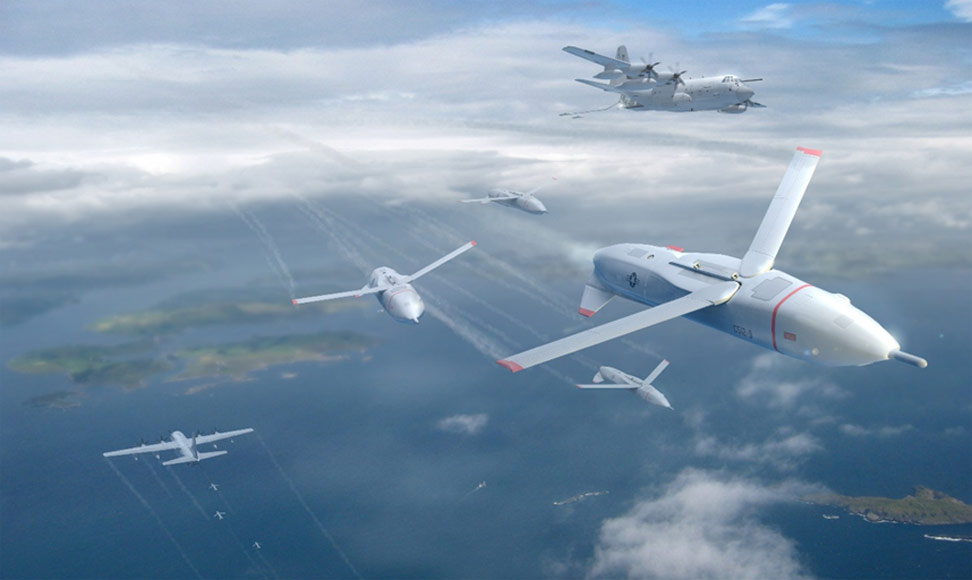
The unmanned Gremlins would be deployed from support aircraft, and carry a mixture of mission payloads capable of generating a variety of effects. They will be operated in a distributed and coordinated manner, providing greater operational effectiveness and flexibility, compared with current, monolithic platforms. Artist concept: DARPA
The secretive program, known as Gray Wolf, seek to demonstrate an affordable sub-sonic cruise missile platform that will employ networked, autonomous operation to enable such weapons to carry out swarm-like operations in highly contested environments (anti-access or area denied – A2/AD) when launched from long stand-off distances, away from the coverage of modern, advanced Integrated Air Defense Systems. IADS are characterized by the use of different types of anti-aircraft and missile defense weapons to the enemy an access to a protected airspace. Typical systems include long range Surface to Air (SAM) units such as the S-400 and S-500. Relying on vehicular assets those air deployable units can defend any location, as was clearly demonstrated in their deployment to Syria in recent years. The S-400 and its successor, S-500 can defeat aerial targets at ranges of hundreds of kilometers, and ballistic missiles fired from ranges of 2,500 – 3,500 km.
For self-defense, these long-range missile systems rely on other supporting elements that form an IADS. These include radars, datalinks, and command centers that form the operational unit, and self-protection systems, such as electronic warfare, decoys, and short-range air-defense (SHORAD) assets designed to defeat guided munitions (SA-15, SA-22). Protection of maneuver forces is also provided by the use of mobile or deployable air defenses systems (SA-15, SA-17, SA-22, S-350) along with associated radars and command elements.
Those formidable arrays create an airspace too risky for the operation of conventional air power and the support elements necessary for operations. Current techniques used to defeat IADS employ attacks by conventional aircraft, launching guided weapons employed from standoff range, and packs of decoys and cruise missiles used to saturate the defenses. Some of these weapons are designed to fly in coordinated groups, to simulate aircraft formations or deny enemy radars from spotting each individual target. These techniques require massive use of expensive, advanced weapons that can be used only in extreme circumstances.
The Gray Wolf experiment will introduce new, affordable cruise missiles that will be able to operate in an autonomous, networked fashion, and hit targets even in the presence of IADS or challenge those IADS with a cheaper yet effective weapon than those existing today. At their terminal phase, the weapons could employ a variety of means, from decoy and electronic attack to kinetic effects to deny, disable, or destroy specific elements of the air defense networks – fire units, radars and sensors, communications links or command and control sites.
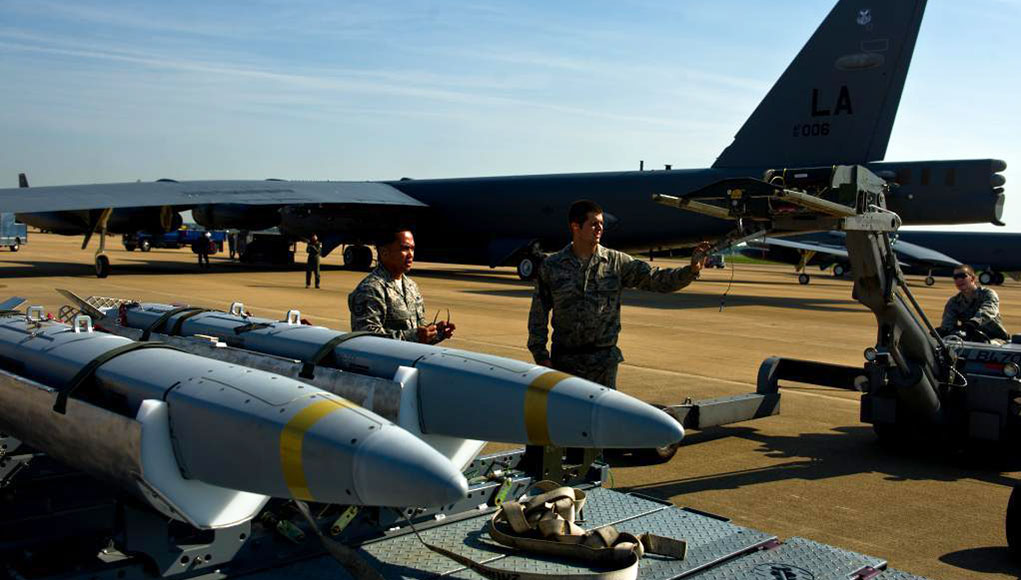
The Miniature air-launched decoy jammer (MALD-J) seen here loaded to a B-52 bomber, is a powered aerial vehicle that mimics real aircraft, luring enemy surface to air missiles to spend their interceptors on false targets while exposing their radars and command nodes to attack. Photo: US Air Force
The program is managed as a spiral program that includes the first phase that consists of rapid prototyping elements and follow-on phases that gradually expand the platform and its capabilities. Designed from the outset as an affordable weapon, developers of new cruise missile will employ modern approaches to automated, low-cost manufacturing of the air vehicles, sub-systems, and payloads, enabling the massive use of such weapons, as decoys or in scenarios expected to yield high attrition ratios. Other efforts are also being with decoys or reusable autonomous air vehicles (Gremlins) developed under parallel experiments by the Air Force and Strategic Capabilities Office. The two companies that have won awards have already developed cruise missiles for similar applications. Lockheed Martin developed the AGM-158 Joint Air/Surface Standoff Missile (JASSM) while Northrop Grumman developed the AGM-136 Tacit Rainbow in the 1980s – a standoff weapon designed for air defense suppression. Another design the Air Force considered in the late 2000s was a downsized JASSM – the Low-Cost Miniature Cruise Missile (LCMCM), designed by Lockheed Martin in the past decade.
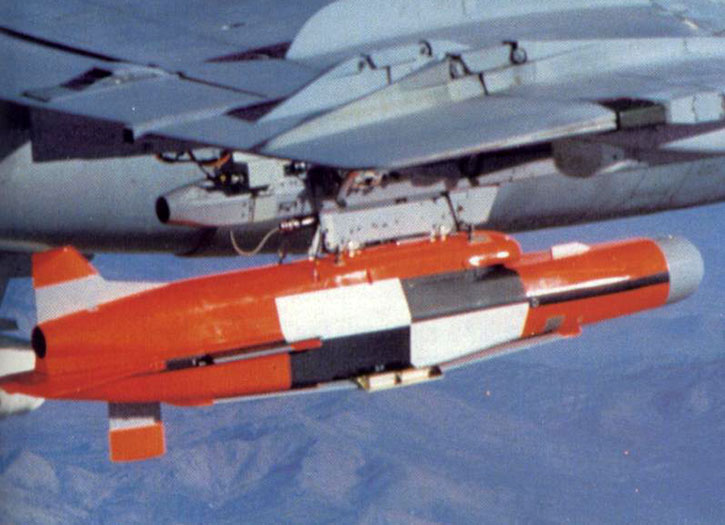
Northrop developed the AGM-136 Tacit Rainbow as a weaponized, jet-powered drone designed to defeat air defense systems. The program was canceled in 1990 before moving to production. Photo: Northrop Grumman.
Lockheed Martin Skunk Works® and XTEND have achieved a major milestone in JADC2 by integrating the XOS operating system with the MDCX™ autonomy platform. This technical breakthrough enables a single operator to simultaneously command multiple drone classes, eliminating the friction of mission handoffs. From "marsupial" drone deployments to operating in GPS-denied environments, explore how this collaboration is abbreviating the data-to-decision timeline and redefining autonomous mission execution.
As traditional defense primes face mounting competition from agile “neoprimes” such as Anduril, Palantir and Helsing, the balance of innovation is shifting toward software-defined warfare and scalable, dual-use technologies, while global industry consolidation—marked by Boeing’s integration of Spirit AeroSystems and other strategic mergers—signals an intensified race to secure control over the defense technology value chain. Our Defense-Tech weekly report highlights these trends.
In early October 2025, a coordinated wave of unmanned aerial system (UAS) incursions—widely attributed to Russia—targeted critical infrastructure across at least ten European nations. The unprecedented campaign exposed the fragility of Europe’s air defenses...
Executive Summary
The past week (September 18-25, 2025) represents an inflection point where strategic defense concepts have transitioned from doctrine to tangible reality. An analysis of global events reveals four primary, interconnected trends shaping an...
At the 2025 Air, Space & Cyber Conference, U.S. Air Force and Space Force leaders unveiled major updates on next-generation fighters, bombers, unmanned systems, and space initiatives, highlighting both rapid innovation and critical readiness challenges as the services race to outpace global competitors. A short version is available here, with a more detailed version for subscribers.
The Taipei Aerospace & Defense Technology Exhibition (TADTE) 2025 crystallized around four dominant strategic themes that collectively illustrate Taiwan's comprehensive approach to defense modernization amid escalating regional tensions. Based on a detailed report by Pleronix (available upon request). Includes a Podcast discussion on TADTE 2025's highlighting Taiwan's four strategic themes beyond the post's coverage.
Israel’s Iron Beam 450 high-power laser system has completed final testing, marking a major leap in air defense. Developed by Rafael, it offers precise, cost-effective interception of rockets, UAVs, and mortars, and is set for IDF deployment by 2025.