
Saturday, December 20, 2025
More
    Home Blog Page 45

    Russian Forces in Syria Repelled Massive Drone Attack on Hmeimim and Tartus

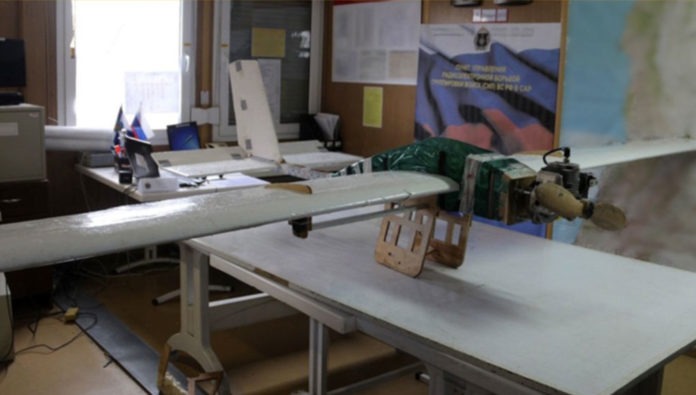
    An improvised drone captured by the Russian forces at Hmiemim, Syria. Photo: Russian MOD

    Sryrian militants began using drone attacks in Syria; following repeated strikes against Russian ground forces operating in the country, Russian and Syrian forces repelled a massive attack on Saturday night, downing and capturing 13 improvised, armed suicide drones. The recent attack included ten drones directed against the Russian forces at the Hmeimim airbase near Latakia; another strike targeted the Russian maritime logistical base at Tartus with three drones.

    The identity of the faction responsible for these attacks has yet to be disclosed, but the frequency of attacks and rapid growth in the number of drones used in each strike indicate the high level of maturity and know-how acquired by the perpetrators.

    According to Russian and Syrian media reports, several drone attacks occurred in the past week. On the night of December 31th, 2017 two Russian service members were killed in what was described as a mortar attack on the Hmeimim airbase. Syrian insurgents claimed several Russian aircraft were damaged in the attack, but the Russian Ministry of Defense denied this despite that some photos aired on Southfront.org clearly showed the damage. Rebel sources later said that drones were also used in that attack but provided no evidence to their claim.

    Armed drones were used two days later, as improvised armed drones attempted to attack a Russian mine clearing operation near Homs, on January 2nd. Another drone strike followed two days later, as improvised drones dropped small mortar bombs on the Syrian town of Qardaha, east of Latakia, and on the village of Jableh near the Russian airbase at Hmeimim. Both drones were downed by Syrian machine gun fire, although it is not clear if this incident was supported by the Russians.

    The largest and most recent attack happened two days ago, on January 6th, as 13 improvised armed drones were launched against two Russian bases – the air force contingent at Hmeimim and the naval logistical base in Tartus. This time some of the drones managed to reach the base’s perimeter, three of them were downed by Pantsir anti-aircraft fire along with heavy and medium machine gun fire.

    Russian government sources confirmed the news, claiming all drones were detected, tracked and neutralized – downed or captured by counter-UAV and air defenses. Russian operated Electronic Warfare assets managed to defeat six of the drones, and take control and land three of them. Three of the drones penetrated the base perimeter but did not cause damage or casualties, Russian sources confirmed. The official report said Russian electronic surveillance detected the attacking drones ‘at a considerable distance from the objectives’.
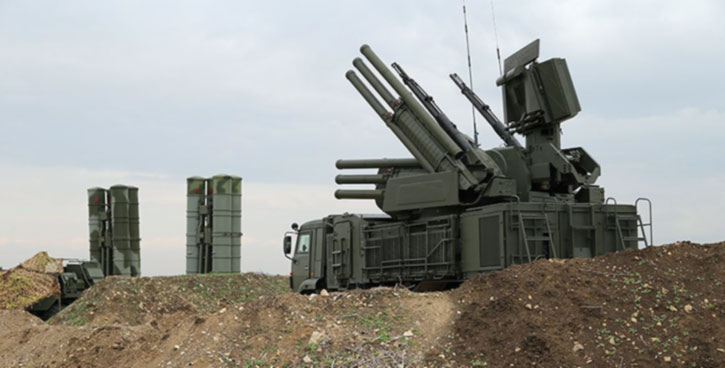
    One of the first assets deployed by the Russian forces to Syria was the Pantsir-S1 mobile air defense system. The truck-mounted unit provides highly efficient firepower against ground and aerial targets, including drones.

    The remaining seven were shot down by  Pantsir-S1 (NATO Reporting name: SA-22) Short Range Gun/Missile air defense systems and Syrian heavy machine guns. Since arriving in Syria Pantsir demonstrated its capability against larger drones. The Russian and Syrian forces claimed kills of not less than six drones by the system, including three ‘Heron’ type drones of unknown origin (Turkish? Israeli?), one RQ-21 (operated by the US Marine Corps) and one Baykatar (a Turkish tactical UAV).

    The Russian report said the improvised drones that attacked Hmeimim were launched from a range of 50 km. They were detected and tracked for a large part of their flight, at a distance from their objective, enabling the forces defending the bases to prepare and carry out a defense plan that successfully captured some of the drones and destroy the rest.

    It is not clear whether the attack was simultaneous or coordinated, but, given the low tech of the drone devices, it was unlikely a ‘swarm attack’ (a dynamic attack conducted by multiple drones that autonomously coordinate their actions according to preset mission parameters), but could have employed simultaneous approaches from different directions using catapult launches, that followed preset flight paths.
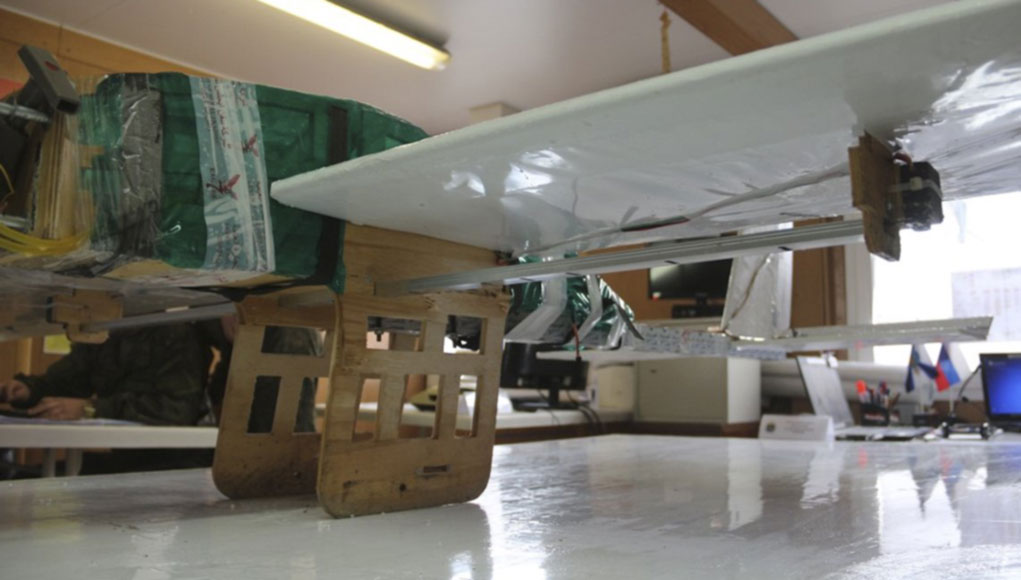
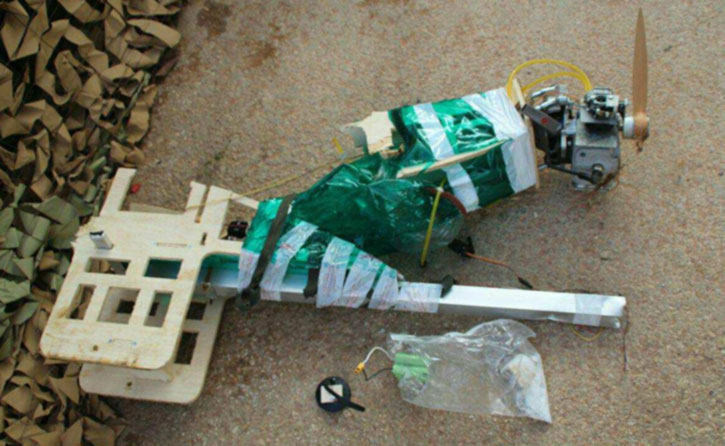
    The fuselage is made of a wooden box that includes a simple mount, providing a grip for catapult launch. A plastic boom connects the tail assembly. The wing is strengthened by an aluminum rail that maintains stiffness and supports the weight of the bombs. The rail has two ejectors (likely electromagnetic) that releases the weapons upon command. Adhesive band wrapped around the wooden fuselage provides the skin. Photo: Russian MOD
    An improvised UAV that crashed near Homs while targeting Russian troops in the area show similar design features to those captured at Hmeimim a few days later.
    Preliminary Technical Evaluation

    A technical examination determined that the drones were not used at their maximum range – and could easily be launched from 100 km. The captured drones revealed the aircraft are made of wood, Styrofoam, plastic, and aluminum profiles. The drone implements basic, commercially available Radio Controlled aircraft components. It is powered by a small diesel engine and uses GPS navigation for guidance, with autopilot control using pressure transducers for altitude control and servo actuators to move the control surfaces. Russian analysts indicated that each of the drones carried two bomblets containing ‘professionally assembled explosives’ activated by fuses derived from mortar of foreign origin. The Russians are performing a forensic investigation to determine the explosives’ origin. Since these UAVs do not have a camera they aren’t likely controlled from the ground and thus used as one-way ‘suicide drones’. Bombs release is likely autonomous, using GPS control. It is possible that a third explosive charge would be carried inside the fuselage box.
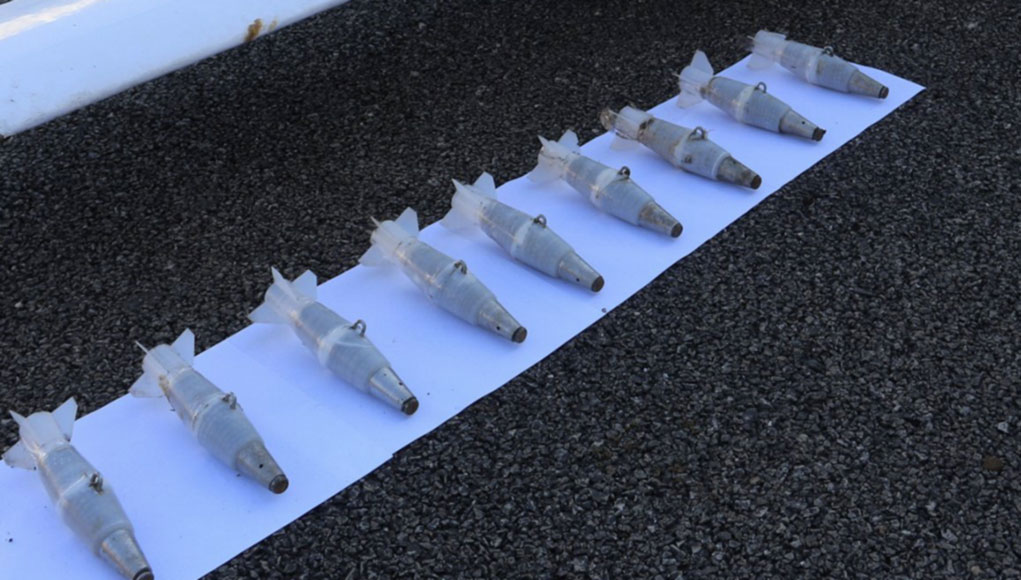
    Each drone carried two small, improvised bombs fitted with fuses taken from mortar bombs. Each bomb has a single hook suspended by the load ejector mounted underwing. Photo: Russian MOD

    The first attack reported by the London-based Syrian Observatory for Human Rights was attributed to an unnamed ‘Islamic faction’ and ‘Islamic Extremists’. A day later the ‘Free Alawite Movement’ claimed responsibility for the two attacks that targeted the Russian forces at Hmeimim airbase. The group said the attack damaged an S-400 air defense unit and seven Russian aircraft at the base.

    Pro-government sources contradict the Alawite movement claim saying the perpetrators were the Ahrar al-Sham Movement or Hay’at Tahrir al-Sham (HTS), a Syrian El Qaida affiliated group. HTS has the resources and motivation for attacks of this type. They may have received assistance form ex-ISIS experts that practiced drone attacks in the past, in Syria and Iraq. Palestinian Hamas Movement has also used similar concepts in Gaza.
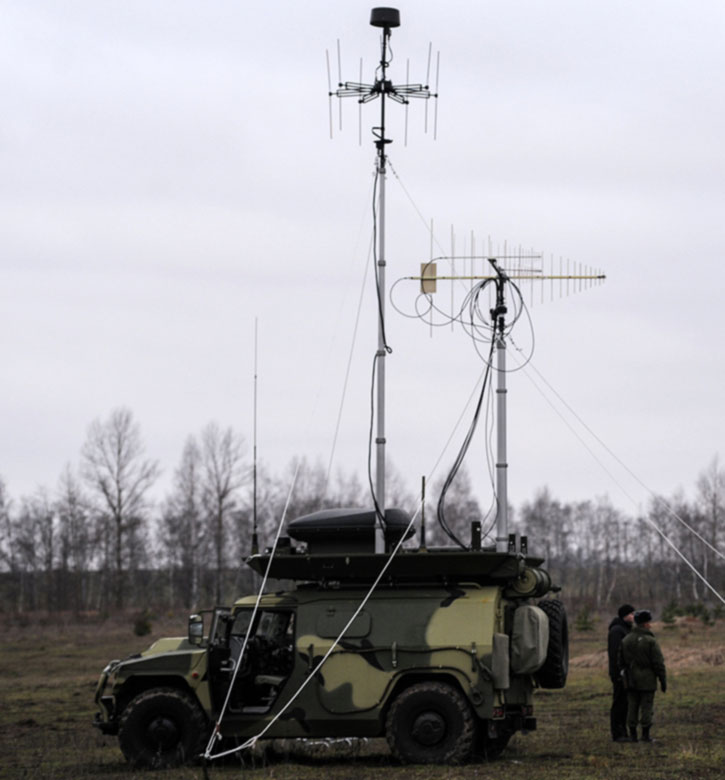
    Russian forces operate the LEER-2 SIGINT/EW vehicles in Syria and Abkhasia. These tactical units are used in electronic surveillance, jamming and have a secondary counter-UAV role. Photo: Russian MOD
    Electronic Combat VS Counter UAVs

    Aware of the drone threats in the region the Russian forces deployed several C-UAV systems to Syria. According to Defense-Update C-UAV Study 2018, the Russian forces deployed mobile C-UAV assets, including the LEER-2 system, an EW system developed by KERT and mounted on Tiger light armored vehicles. LEER-2 detects and localize multi-rotors, drones, and mini-UAVs and uses dedicated jamming systems to disable such drones.

    Another Russian system reportedly sent to Syria is Repellant, a truck-mounted system specially designed for counter-UAV missions, equipped with passive UAV detection and active jamming suppression capabilities. The system comprises two surveillance systems and two jamming systems with sensors and emitters mounted on elevated masts, to enable simultaneous engagements of multiple targets, over a frequency range of 200-1000 MHz and 1-14 GHz. Operating multiple jammers at up to one kilowatt of power, Repellant-1 can jam simultaneously over 12 frequencies, targeting satellite navigation systems such as GPS, Galileo, and BeiDou, telemetry, and uplinks in line-of-sight, at ranges up to 30 km. The system employs several jamming protocols, including pseudo-random sequence and frequency-aimed phase manipulation.
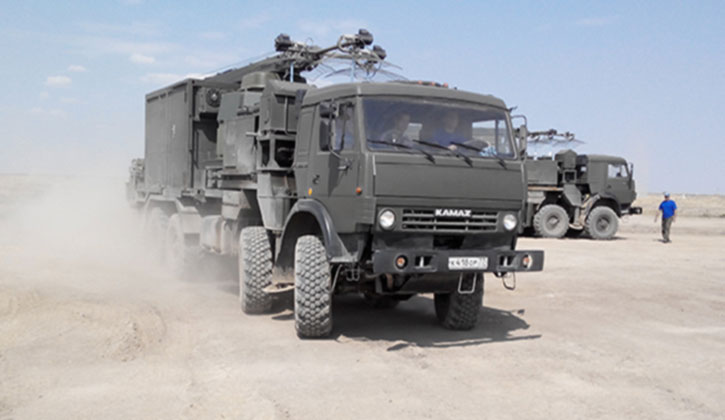
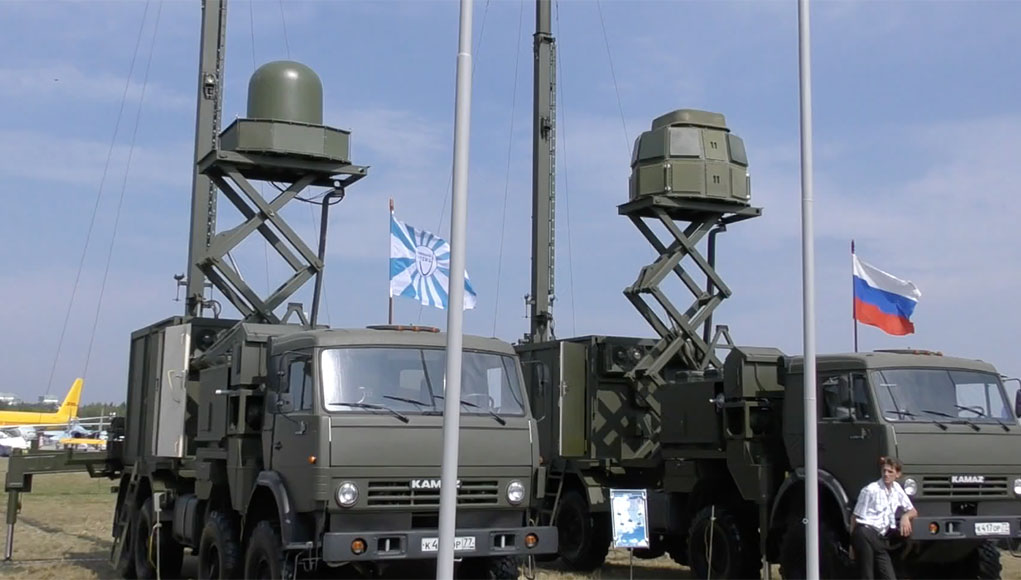
    The Russian Repellant-1 counter-UAV system from STC-EW is capable of jamming 12 targets simultaneously. Photo: STC-EW
    Vehicles comprising the Repellant-1 system on display at MAKS-2015 airshow. Photo: Tamir Eshel

    The Russian forces also deployed to Syria the Krasukha-4, a powerful, highly sophisticated electronic surveillance and jamming system. Krasukha-4 was used extensively to mask the Russian air deployment to Syria in the initial phases of Russian deployment, and later, jammed datalinks of coalition forces attempting to disrupt certain attacks. These systems can also conduct electronic surveillance of the entire region but are considered an ‘overkill’ to the improvised drones used by the rebels.
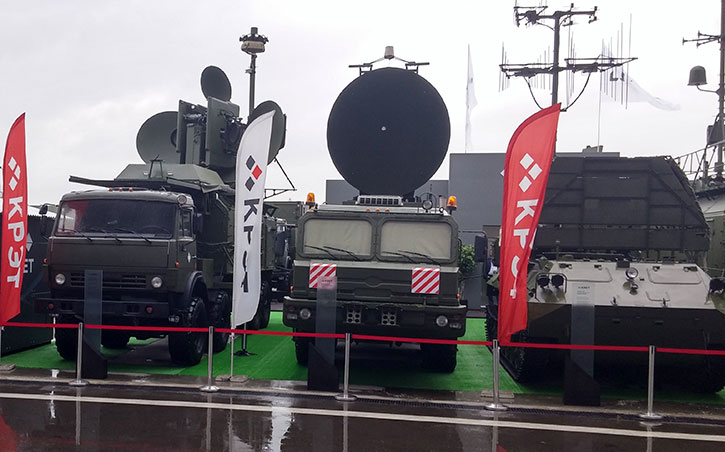
    The family of mobile Krasukha EW units on display at Army 2017.

    Global Hawk’s New Optical Sensor to Use AlBeMet Metal Matrix Composites

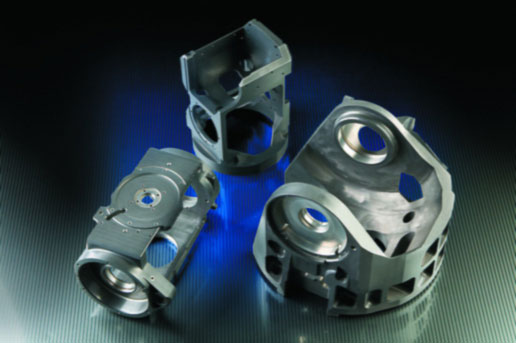
    Metallic beryllium and AlBeMet materials are used in the optical targeting systems of military fighter jets. (the parts shown are not related to the MS-177 project)

    Materion Corporation (NYSE:MTRN) has been awarded a contract by UTC Aerospace Systems for AlBeMet metal matrix composite parts for its MS-177 long-range, multi-spectral imaging (MSI) sensor. The sensor is currently undergoing integration testing and qualification for the Northrop Grumman RQ-4B Global Hawk Unmanned Aircraft System (UAS). AlBeMet is an aluminum beryllium composite, which combines the high modulus and low-density characteristics of beryllium with the fabrication and mechanical property behaviors of aluminum.

    This material offers significant performance advantages in certain applications when compared to steel, aluminum, and common aluminum metal matrix composites. Its properties allow for greater design flexibility and specific stiffness, for applications in aviation electronics, inspection equipment for semiconductor assembly, and optical and satellite structures. In such applications, AlBeMet improves line-of-sight distance and reduces jitter in optical structures. Its properties allow designers to reduce system size, minimize stress from vibrations and increase the fatigue life of electronic packages while improving performance.

    Finland Arms Stealth Boats with New Swedish Torpedoes

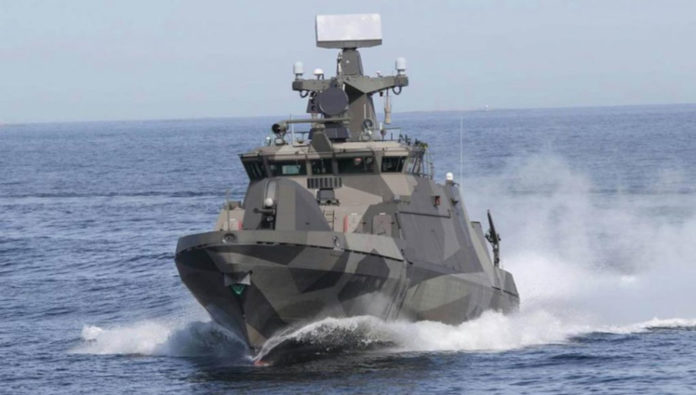
    Hamina Class FAC in Finnish Navy service.

    Finland is upgrading four Hamina-class fast attack missile crafts operated by Squadron 2000, preparing these vessels to assume the mission currently done by the Hamina boats and four Rauma class Fast Attack Crafts that will retire in 2020, after 30 years of active service.

    The project will deliver the boats with their new lightweight Anti Submarine Warfare (ASW) torpedoes in 2023-2025, and extend the service life of Hamina-class vessels until 2035. Following this mid-life upgrade and overhaul, Torpedo-armed Haminas will serve in the FAC role until the larger corvettes will be deployed by the mid-2020s as part of Squadron 2020 program.

    Patria will be the prime contractor for the EUR 170 million upgrade. As part of the upgrade, the Hamina’s current Combat Management System (CMS) will be replaced by Saab 9LV CMS, integrated with 9LV Fire Control System (FCS) and the Ceros 200 fire control director (radar and optronic tracking fire control director). The upgrade will also include the TactiCall integrated communications system. Each combat system also integrates the Trackfire Remote Weapon Station (RWS). The FACs will be equipped with Saab Dynamics’ new lightweight ASW torpedoes currently in development. These weapons are optimized for operation in littoral conditions. The technical work associated with the midlife overhaul and installations of new systems will be performed by Oy Western Shipyard Ltd. in Finland.

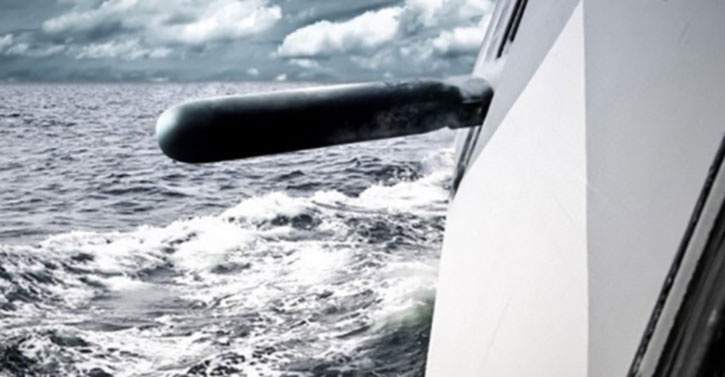
    The new lightweight torpedo is currently in development and will be available for platform verification in 2019. It is expected to be fully operational by 2023-2025. Photo: Swedish FMV
    The Hamina class currently uses a centralized CMS designed by EADS, its ASW systems comprise two types of sonars and rails laying mines or depth charges. It is also armed with RBS-15 MK3 anti-ship missiles, Umkhonto IR surface-to-air missiles and a single Bofors 57mm automatic cannon. In the future, the Hamina class is likely to replace the RBS-15 with a new missile – currently known as ‘Surface Warfare Missile 2020’. This new anti-ship missile system will be selected by the Finnish Defense later this year, for use in coastal defense role and as the main surface warfare weapon for the new corvettes.

    Patria will act as the prime contractor, designer and lead system integrator having the overall responsibility for the project. The delivery includes a number of sensor, weapon and communication systems, system upgrades, as well as ship technical modifications and overhauls. The upgraded Hamina crafts will also receive an ASW Training Target system to facilitate anti-submarine warfare training.

    Three Philippine’s Assault Crafts to Receive Israeli Missiles Soon

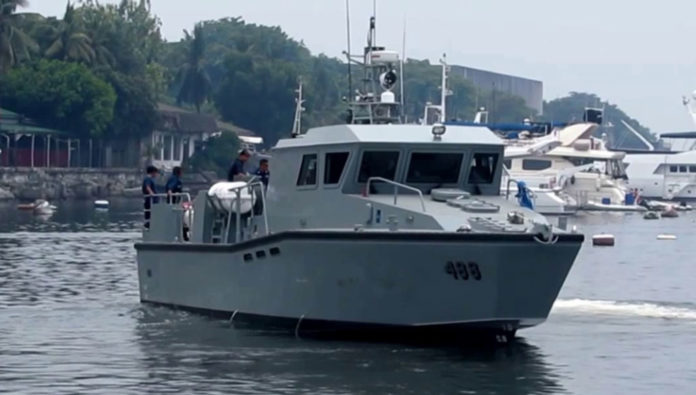
    The first MPAC MKIII (BA488) was commissioned in May 2017.

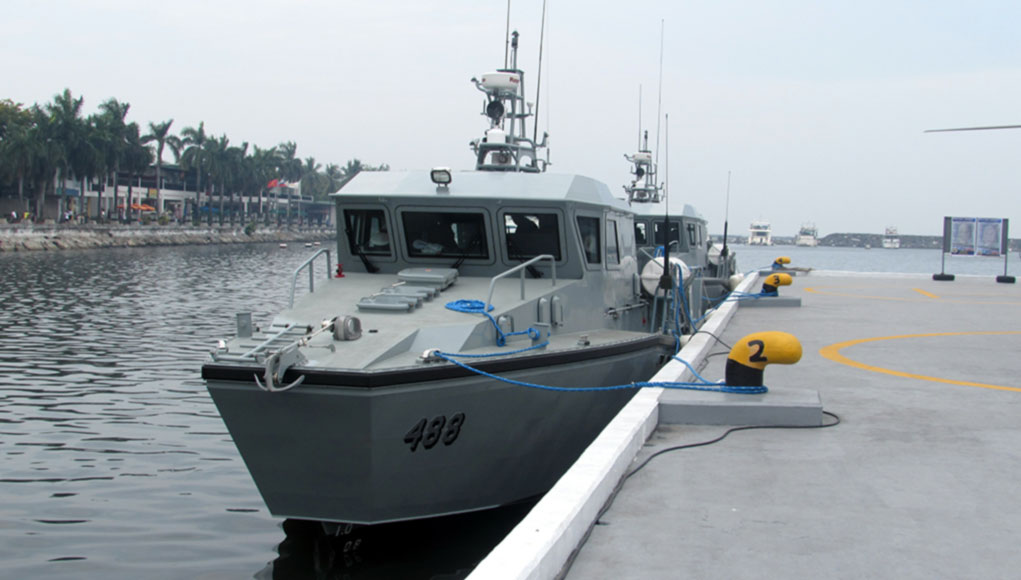
    Three newly commissioned Multi-Purpose Assault Crafts (MPAC MKIII) of the Philippines Navy will soon be equipped with Spike ER multi-purpose missiles, the local Department of National Defense (DND) said. The missiles are expected to arrive in country during the first quarter of 2018. Israel’s Rafael Advanced Defense Systems company is providing three Mini Typhoon weapon systems for the new boats, that were commissioned into service in May 2017. Each will receive the remotely controlled weapon mount also fitted with missile launchers.

    will receive three locally built Multi-purpose Attack Crafts (MPAC MKIII) constructed by the new boats are constructed by a joint venture between Philippine shipbuilder Propmech Corporation and Taiwanese builder Lung Teh Shipbuilding Corporation. The boats will be equipped with Mini Typhoon remote weapon stations mounting 12.7mm heavy machine guns and Spike-ER missile launchers. The missiles enable the boat to extend effective engagement to eight kilometers. The operators will be able to use the weapon either against targets that are in sight by the electro-optical system on board or against targets that are ‘beyond line-of-sight’, employing the missile’s camera for target engagement.

    The Philippine Navy already operates six MPACs of earlier models that are not receiving the missiles. Three are the 15-meter MPAC MKI and three 17-meter MKII, both types were built by Propmech. The MPAC MKIII is longer than the previous models and is the first to carry missiles. The Philippine Navy also considers buying a fourth version of the MPAC.

    Three MPAC MKIII boats are in service with the Philippine Navy

    UK Army Cadet Force Get New Manpack Radios

    The U.K. Army completed the induction of a new, tactical radio system known as the Mercury Radio System, which recently achieved Full Operational Capability (FOC). The new radio is now in service with the UK Army Cadet Force (ACF). The Mercury Radio is based on Elbit Systems’ PRC-710 and -720 sets. The ACF received 2,452 PRC 710 VHF handheld radios, 418 PRC 715 VHF Amplifier sets and 150 PRC 720 MICOM Pathfinder HF man-pack radios to enable practical field-craft and signals training and a command and control capability. The contract delivers a comprehensive solution designed to provide military-style radio equipment to the ACF for the next ten years. Elbit Systems delivered the radio systems and ancillary equipment with British system engineering house Drumgrange Ltd.; the initial support package is provided through the General Dynamics Mission Systems LSSP contract.

    New OPV Joins the Cypriot Navy

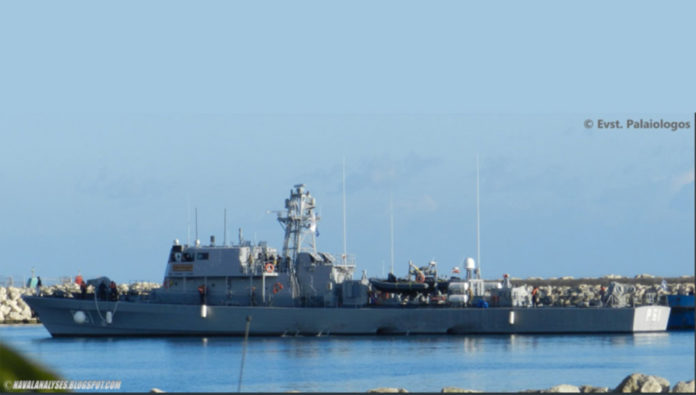
    The P61 Saar 62 class OPV built for the Cypriot Navy. Photo: EvstPalaiologos

    The new Offshore Patrol Vessel of the Cypriot Navy ‘Commodore Andreas Ioannides’ arrived in Larnaca, Cyprus Naval Analysis reported on Twitter. Cyprus ordered the OPV from Israel in December 2015, the vessel was built by Israel Shipyards Ltd. in Haifa. There is an option for a second boat while some days ago the Cypriot MoD announced that Cyprus will purchase two more offshore patrol vessels.
    The mission of the OPV is to protect the Exclusive Economic Zone (EEZ) of Cyprus. Based on the SAAR 4 design the Cypriot OPV has a displacement of 430 tons, an overall length of 62 meters. The vessel is operated by 30 crewmembers and has accommodations to carry additional personnel or rapid response force. The OPV has advanced electro-optical and radar sensors and is armed with two Typhoon remotely operated guns.

    Britain to Transfer its Last Helicopter Carrier to Brazil

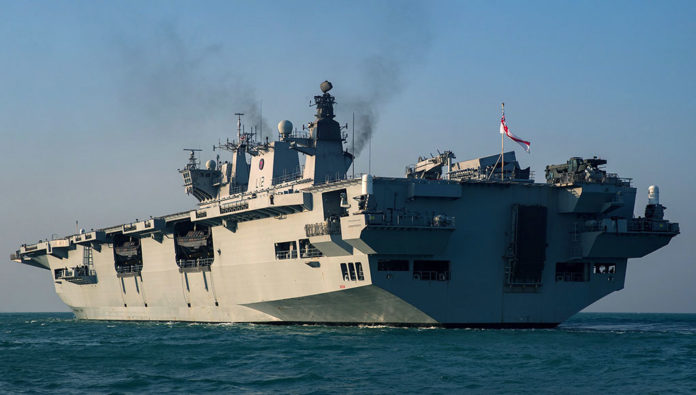
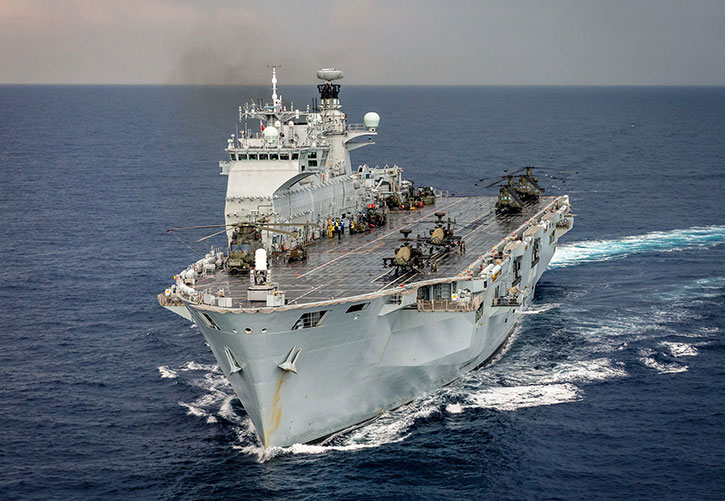
    In 2016 HMS Ocean (L12) carried the UK’s Joint Expeditionary Force (Maritime) Task Group on deployment to the Mediterranean and Gulf. Photo: Crown Copyright, UK MOD

    Brazil has purchased Royal Navy ship HMS Ocean, the helicopter carrier about to be retired from the Royal Navy service later this year. The UK Ministry of Defense (MOD) is selling the Ocean for £84 million. The vessel will remain in the UK until the autumn of 2018, UK Defence Journal reports.

    HMS Ocean is the UK’s only helicopter carrier and the fleet flagship of the Royal Navy. She will retire after completing its planned operational lifespan of 20 years at sea, having completed a world tour this year. HMS Ocean is designed to support amphibious landing operations and to support the staff of Commander UK Amphibious Force and Commander UK Landing Force.

    The Ocean was constructed in the mid-1990s and commissioned in September 1998. In November 2015, the MoD confirmed that HMS Ocean is to be decommissioned in 2018, as the new aircraft carriers of the QE II class become operational.

    In 2016 HMS Ocean (L12) carried the UK’s Joint Expeditionary Force (Maritime) Task Group on deployment to the Mediterranean and Gulf. This Amphibious Task Group included HMS Bulwark, HMS Ocean, Ministry of Defence Strategic Ro-Ro vessel, MV Eddystone and 42 Commando. In her role as a helicopter carrier and amphibious assault ship, Ocean is designed to deliver troops by helicopter or by landing craft – the ship has six helicopters and carries four Mk5 landing craft vehicle and personnel (LCVP). Photo: Crown Copyright, UK MOD

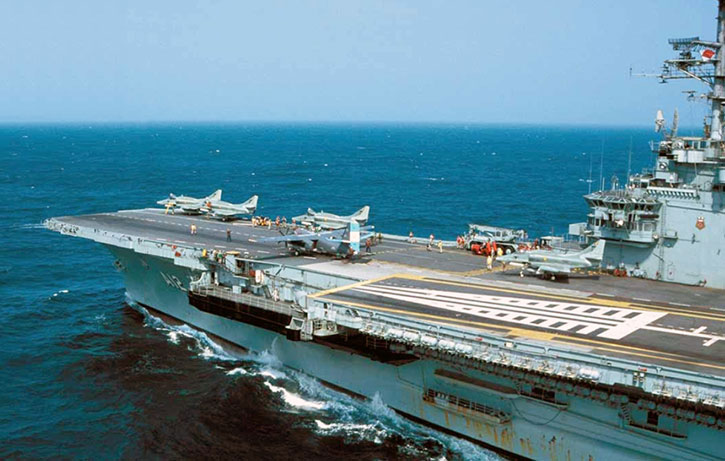
    The Brazilian Navy operates a single aircraft carrier – São Paulo, a Clemenceau class vessel commissioned in 1963 and acquired from France Navy surplus in the year 2000. Once operated AF-1/1A (Skyhawk) attack fighters and KC-2 (C-1 Trader) flying tankers, the fixed wing fleet operated by the Brazilian Naval Aviation (Aviação Naval Brasileira; AvN) has shrunk to three aircraft, thus rendering the operation of a dedicated aircraft carrier unfeasible. Absent of a carrier deck to train on, this small component is likely to retire or converted to operate from land. Once accepted into service, the Ocean will be able to carry the growing fleet of rotary-wing aircraft operated by the AvN, which includes Super Lynx, Sea King, S-70B, and EC-725.

    A file photo from 2003 showing the forward flight deck of the Brazilian aircraft carrier São Paulo (A12), in 2003. Four McDonnell Douglas AF-1 (A-4) Skyhawk fighters and an Argentine Navy Grumman S-2T Tracker are visible.

    Russia to Introduce Prometheus, a Successor to S-400 in 2020

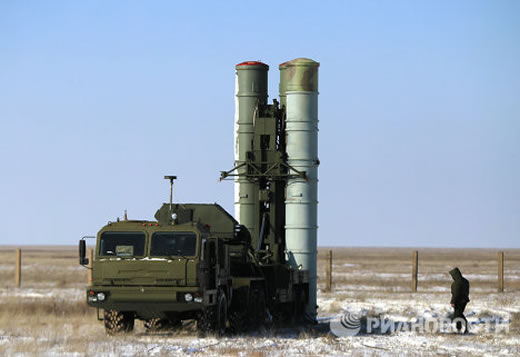
    Russia will begin deploying the new S-500 air defense systems in 2020. They will replace the S-400 (in picture) currently used in 19 air defense divisions. Photo: RIA-Novosti

    Amid growing demand for its current S-400 system, Almaz Antey continues development of a successor to the ‘Triumf’. Known as ‘Prometheus’, the S-500 is a more advanced air and missile defense system originally scheduled for deployment by the Russian air defense forces by the end of the decade. A navalized version could follow in 3-5 years. According to Russian officials, testing of the new interceptors is said to be on schedule for fielding by 2020, three years later than the original schedule.

    The new system employs two new interceptors – 77N6-N and 77N6-N1, both are designed to perform at hypersonic speed (above 5,000 meters/second), using ‘Hit-To-Kill’ (HTK) effect. In their HTK capacity, the new Russian air defense system will be similar to the latest U.S. interceptors, such as THAAD and Patriot PAC-3, but the speed and range of the Russian system are expected to exceed the performance of the American systems. The interceptors of the current S-400 system that excels in medium and long-range performance uses proximity fusing. The S-500 system is reported to be able to cover a radius of to 600km defending against ballistic missiles that are launched from a range of up to 3,500 km. It will be able to engage aircraft, at a range up to 400km.

    Other new elements in the S-500 system are four types of radars – a battle management radar (91N6AM) and 96L6-TsP acquisition radar, 76T6 multimode engagement radar and anti-ballistic engagement radar 77T6. According to Russian sources, the S-500 has an operational radius of 600 kilometers, and the capability to simultaneously engage 10 targets, including aircraft, ballistic missiles, and even high speed hypersonic aerial targets.

    The S-500 system employs specialized transporter/erector/launcher (TEL) vehicles that will enter developmental engineering this year (2018). The vehicle is based on a BAZ-69096 10×10 truck. The Almaz Antey Corporation began development of the new SAM system in 2011 and is currently proceeding with developmental testing. The new missile will be able to operate as part of Integrated Air Defense Systems (IADS), along with existing assets such as the S-400, S300, S-350, Buk-2M and short-range SA-11 or SA-15 units.

    The S-500 is positioned to become the successor of the S-400 Triumf currently deployed throughout Russia and offered for export. Comparable to the Terminal High Altitude Air Defense (THAAD) system (the Russians claimed it will be superior), S-500 is superior to the S-400in intercepting air-breathing targets (aircraft and cruise missiles) at longer ranges, and ballistic missiles flying at higher velocities. With a response time of three seconds, S-500 is three-times faster to respond to new threats, over the S-400. Since it will be able to intercept targets at altitudes of 200 km above the earth atmosphere, S-500 is also considered to become an anti-satellite weapon.

    S-400, also known under the designation S-300 PMU-3 is currently the heaviest air defense asset in the Russian air defense array. 19 systems are currently deployed throughout Russia, with an undisclosed number of S-400 units being exported to China, and Algeria. The sale of such system to Turkey has been confirmed. Russia also negotiates the sale of S-400 with India, and Saudi Arabia, with no results yet.

    The S-400 comprises four types interceptors, covering different segments of the airspace protected by the unit. The system can operate four 40N6 interceptors able to hit large targets at ranges of up to 400 km (namely strategic platforms such as airborne warning and control – AWACS, Signals Intelligence (SIGINT) or aerial tankers). Alternatively, four 48N6 interceptors can be stored in the same canisters, providing long-range intercept capability at a range of up to 250 km. Two types of shorter-range interceptors can be used, four of these smaller interceptors are stored in each canister that carries the larger missiles. These smaller interceptors are designated 9M96E2 and 9M96E, they cover the medium (120 km) and Short (40km) range. Those shorter-range missiles are also employed in smaller, individual canisters in tactical air defense systems, such as the S-350 Vityaz.

    Amphibious Ships Transformed Into Aircraft Carriers Debut in Asia-Pacific

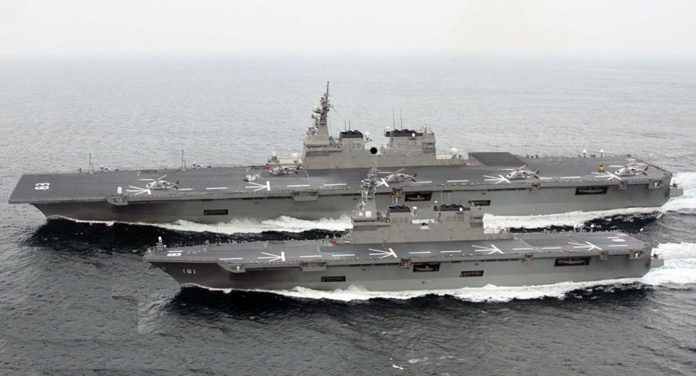
    Two Japanese navy helicopter carriers, JS Hyūga in front and Izumo in the back.
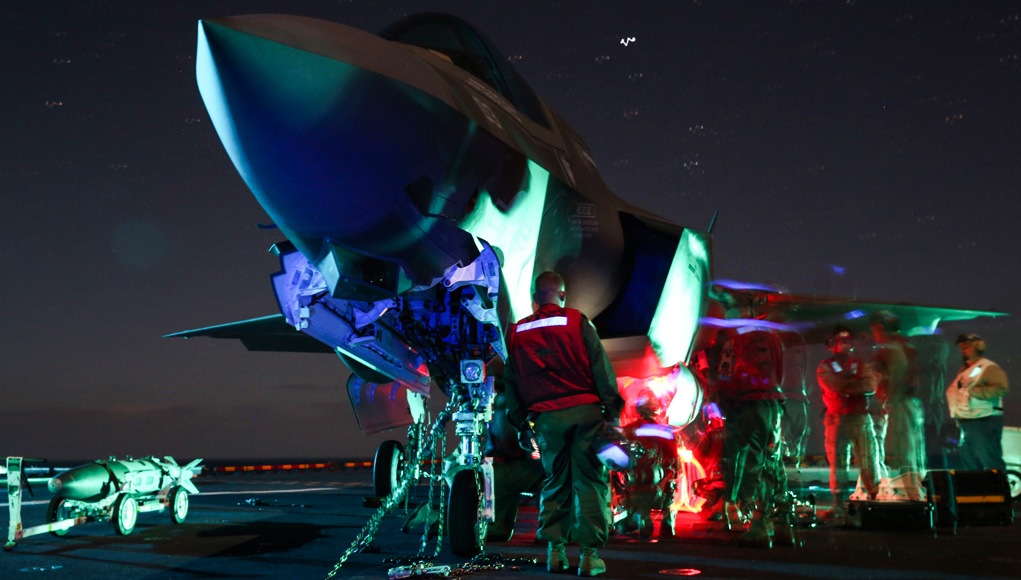
    F-35B prepared for a mission on the deck of the Wasp.

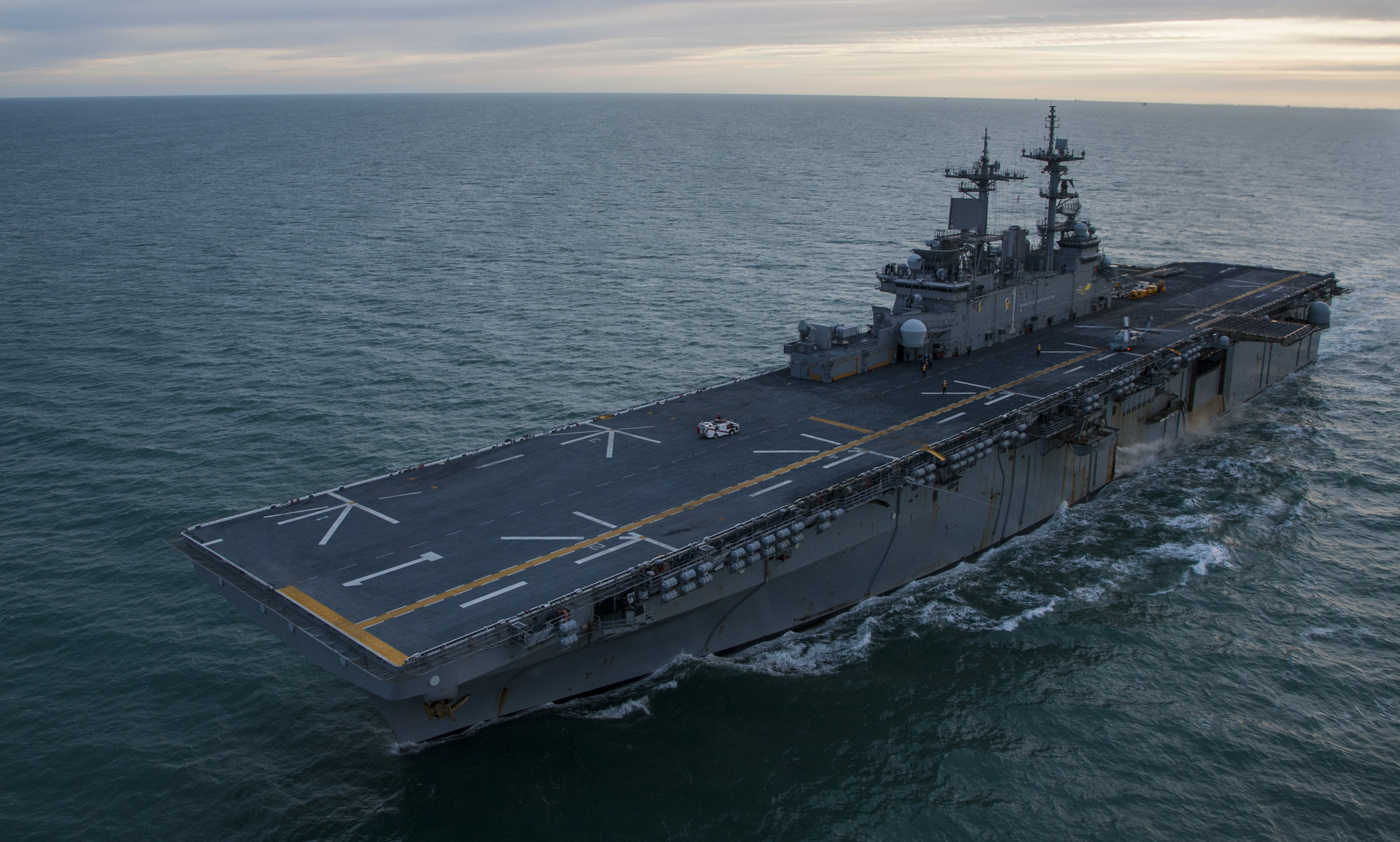
    With the planned arrival of amphibious support ship USS Wasp (LHD-1) in the Pacific Ocean, the Wasp will replace USS Bonhomme Richard (LHD 6) as the forward-deployed flagship of the amphibious forces in the U.S. 7th Fleet area of operations. Wasp is leading the Up-Gunned Expeditionary Strike Group (ESG), a beefed-up naval force comprising three amphibious support ships, 2,200 personnel strong Marine Expeditionary Unit (MEU) and some Fifth Generation F-35B stealth fighters. This ESG enhances the U.S. rapid response capabilities and power projection in the volatile region of the Western Pacific.

    The amphibious assault ship USS Wasp (LHD 1) transits the Strait of Magellan, December 10, 2017. Wasp is transiting to Sasebo, Japan to conduct a turnover with the USS Bonhomme Richard (LHD 6) as the forward-deployed flagship of the amphibious forces in the U.S. 7th Fleet area of operations. Photo: US Navy by Levingston Lewis.

    Apart from the American 40500 ton LHD that has already been modified to operate the F-35B, both Japan and South Korea are interested in the new potential mating STOVL fighters with flat-deck helicopter carriers. Both countries already acquired the conventional take-off variant (F-35A), and consider operating the Short Take-Off / Vertical Landing (STOVL) B version from ships.

    On its current mission in the Pacific Ocean Wasp will perform its first operational mission with F-35B ship-based joint strike fighter capability. Wasp will operate in the Sea of Japan, in the region that includes North Korea and China. Wasp is transiting to Sasebo, Japan, to conduct a turnover with the USS Bonhomme Richard as the forward-deployed flagship of the amphibious forces in the Western Pacific.

    The Marine Corps’ Marine Fighter Attack Squadron (VMFA 121) that operates F-35B from Marine Corps Air Station Iwakuni in Japan since January will provide the aircraft deployed on the Wasp as she arrives in Japan. Wasp is the centerpiece of the ESG, which also includes the amphibious transport dock ship USS Green Bay and one of two forward-deployed amphibious dock landing ships, the Navy said. The 31st Marine Expeditionary Unit (MEU) will also join the task group with more than 2,200 Marines aboard.

    The ESG and MEU are the premier crisis response U.S. force in the western Pacific, able to respond at a moment’s notice to any contingency. “Our capabilities, paired with the F-35B Joint Strike Fighter, increases our Navy’s precision strike capabilities within the 7th Fleet region. Wasp commander Capt. Andrew Smith said.

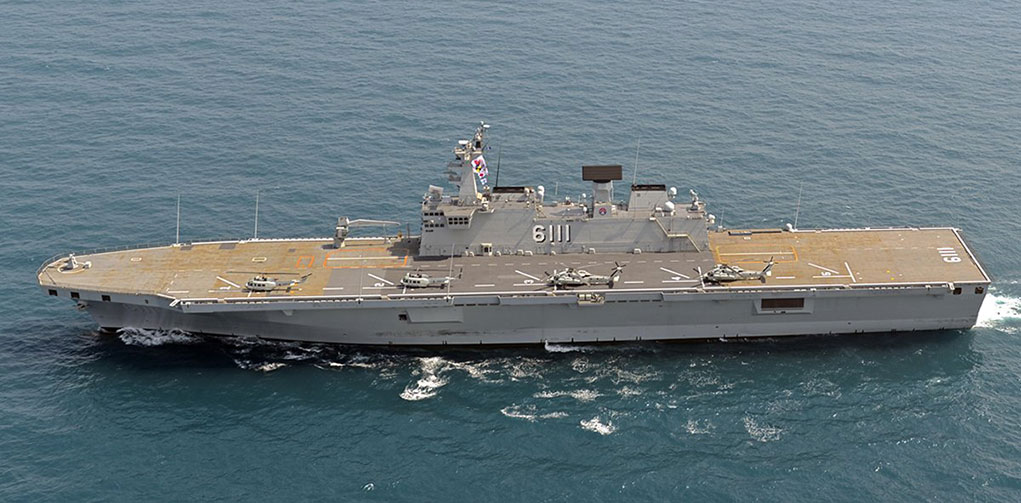
    LPH-6111 Dokdo – the lead ship of the Dokdo class amphibious support ship entered service with the Republic of Korea Navy in 2007. The second ship of this class, ROKS Marado (LPH-6112), is currently under construction, scheduled for commissioning in 2020.

    Last week it was announced that South Korea considers buying additional 26 F-35s, in addition to the 40 they already ordered. Six of those 26 are likely to be F-35B STOVL variants, that will be able to operable from the Marado – the Korean Navy second Dokdo class assault ship currently under construction. This 14,000 ton vessel can be modified through the remaining construction phase, to operate F-35s as it is commissioned around 2020. Korea expects to begin deploying the first F-35As in 2018, and all 40 planes are slated for delivery by 2021 and open to receive the second batch of 20-26 starting in 2023.

    Japan is also evaluating the possibility to deploy F-35B on naval vessels, specifically, the 20,000 ton Izumo Class helicopter carriers Izumo (JS183) and Kaga (JS184). The size of the Japanese ships is 30 ft (nine meters) shorter than the wasp (814 vs 844 ft – 257 vs 248 meters), This will practically transform Izumo into an aircraft carrier with limited offensive capability. This modification enables the Japanese naval forces to improve control of remote islands, employing the modified carrier as a ‘floating island’ refueling and rearming jet fighters operating far from shore. For its size, Izumo will be able to operate up to 10 aircraft on board. Japan also has two smaller helicopter carriers – JS Hyūga and Ise.

    Japan does not necessarily have to buy the STOVL F-35B to benefit from such refit, as the modified carrier will be able to improve interoperability with the United States Navy and Marine Corps. Like the USS Wasp, the converted Izumo will be able to support F-35B on forward deployment or as a ‘floating refueling station ’The US Marine Corps is operating from bases in Okinawa.

    While these developments are aimed to provide Tokyo with some deterrence against North Korea, it should also be a concern for China, as sources in Beijing immediately commented criticizing the Japanese move.

    Following a defensive-oriented policy since the end of World War II, Japan does not pursue investments in strategic weapons such as long-range ballistic missiles, bombers, or aircraft carriers with attack capabilities. Following the North Korean aggression and proliferation of regional threats, Japan has bolstered its defense capabilities and is opening to expand military investments, and the Japanese government has already included funding for the introduction of long-range cruise missiles in its 2018 budget.

    By possessing an aircraft carrier, even though not a large one, Japan could expand the flight range of fighter jets heading to attack North Korea’s territory, thus boosting the capability to strike an enemy base. Japan will review the National Defense Program Guidelines at the end of 2018, and whether to possess offensive capability will be a focal issue.

    RSM-56 Bulava Submarine Launched Ballistic Missile

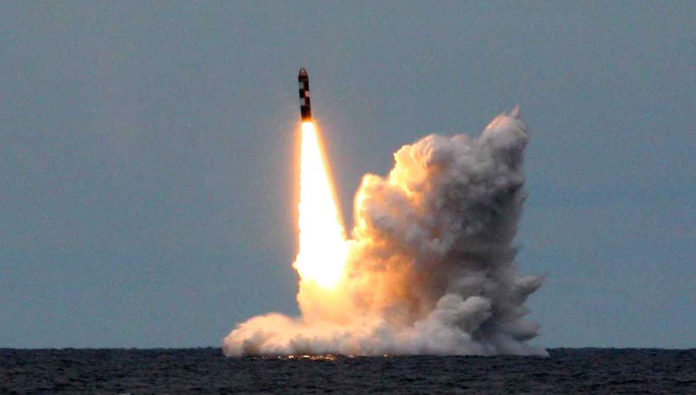
    Bulava RSM-56 missile launched underwater from a submerged submarine

    The RSM-56 Bulava (NATO Reporting name: SS-N-32) is a Submarine Launched Ballistic Missile (SLBM) currently deployed on three Borei class strategic, nuclear-powered missile submarines (SSBN). The missile weighs 36.8 tons and is capable of attacking targets at 8,300 km, employing 1-6 independently targeted warheads (MIRV) each carrying a thermonuclear device of 100-150 kiloton yield.

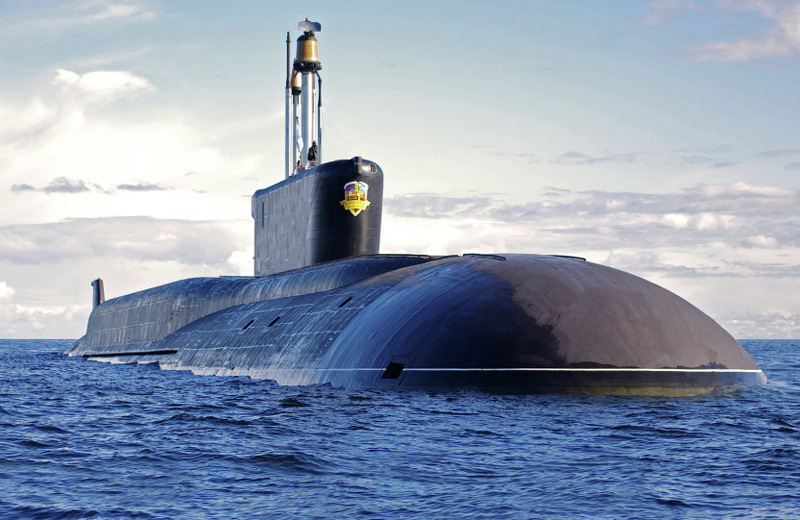
    The Russian Navy operates Bulava with three of its latest missile submarines, although the operational capabilities of those units have been questioned following repeated failures of missile tests, through its long development and first few years of operational deployment. The three submarines currently equipped with RSM-56 are all Borei class SSBN, named Yury Dolgorukiy, Alexander Nevsky, and Vladimir Monomakh. The first submarine of the class, Yury Dolgorukiy, performed most of the test launches through the development phase and initial operational deployment, of 22 Bulava tests performed by Yury Dolgorukiy – about half ended in failures.

    Following its official induction into the Russian fleet Bulava missiles failed three of seven test flights, in 2013, 2015 and 2016. Two of the failed tests consisted of a salvo launch of two missiles, considered as a highly difficult task.

    In 2013 a test terminated two minutes after launch. Three follow-on tests in 2014 verified the missile was back on course. But in 2015 a salvo of two missiles failed again, one of the missiles exploded on ascent while the other missed its designated target. In 2016, two missiles were launched again, one veered off its course immediately after takeoff and exploded. The second missile successfully hit its target in Kamchatka. On June 2017 the missile submarine Yuri Dolgoruky, successfully test-fired an RSM-56 Bulava Intercontinental Ballistic Missile (ICBM) from a submerged position in the Barents Sea, off the northern coast of Russia. The warhead impacted the designated target at the Kura practice range in Kamchatka, 3,600 miles away.

    More Reading:

    The second Borei class submarine Alexander Nevsky, in service with the Russian Navy strategic force.

    Toward an All-New Russian ICBM Force

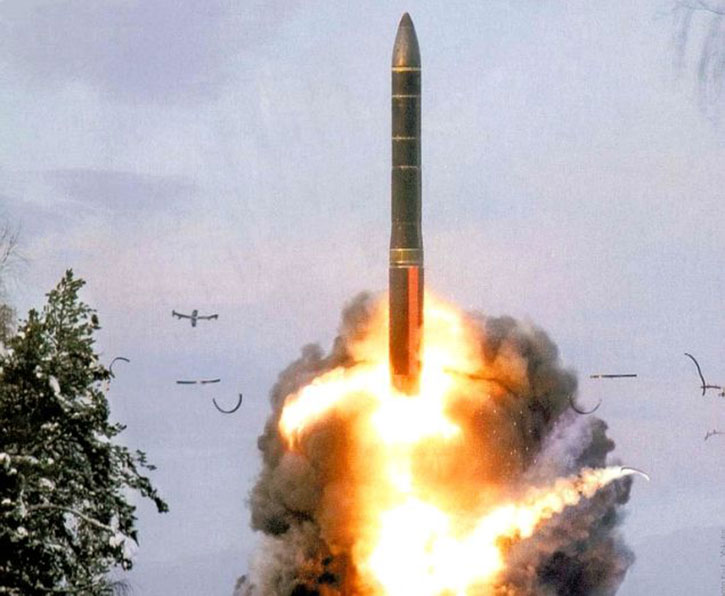
    The Topol and Topol-M intercontinental ballistic missiles are being replaced by the Yars, that looks similar but represent more advanced capabilities, particularly against missile defenses.
    Topol RS-12EM seen on a test launch. The 30 year RS-27 Topol was designed for deployment in silos or mobile launchers and is being replaced by modern RS-24 Yars ICBM.

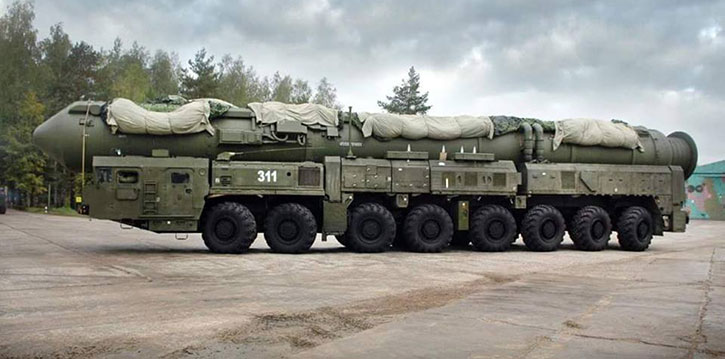
    The RS-24 is a three-stage solid-fuel missile that can be launched from silos or from mobile launchers. Yars can carry a payload of 1.2 tons, including three independently targeted warheads (MIRVs), each carries a thermonuclear device with a yield of 150-200 kt or a single thermonuclear device with a yield of one megaton. This new missile offers several advantages over the Topol and SS-19, – for example, its accelerated pre-launch procedure that takes only seven minutes, thus significantly improving survivability.

    Yars also employs different countermeasures and decoys designed to enable the MIRVs to better evade enemy missile defenses, employing different maneuvers through its flight trajectory and evasive maneuvers in the terminal phase, and deployment of active and passive decoys, thus improving their penetration of adversary missile defenses.

    Yars was first deployed in 2010 and, along with 30-year old Topol and Topol-M makes more than 80 percent of the Russian strategic missile force. In 2018 twenty additional RS-24s will be deployed and by 2020 the new missile is expected to replace all the UR-100 (NATO Reporting name: SS-19 Stiletto) liquid-fueled ICBM currently based in silos.

    A derivative of the RS-24 is the RS-26 Rubezh (SS-X-31) that is designed with a lighter, more energetic propulsion optimized for missions over shorter-range. Rubezh carries a single warhead or four MIRVs with a total weight of 800 kg. Compared to Yars, Rubezh is lighter and shorter missile and is designed for deployment from mobile launchers only. While officially this missile maintains the Yars’ range it was tested over shorter ranges – from 2000 to 5,800 km.

    This fact brought Washington to complain about its violation of the Intermediate-range Nuclear Forces (INF) treaty, that bans the development or deployment of missiles that can carry warheads of 500 kg over 5,500 km. This could be the reason for the delay in the deployment of Rubezh missiles, that completed their final test series in 2016. Missiles were reportedly supplied to a first operational unit in 2016 but this has not been officially confirmed.

    More Reading:

    RS-24 Yars ICBM

    A Stronger, More Powerful Satan-2

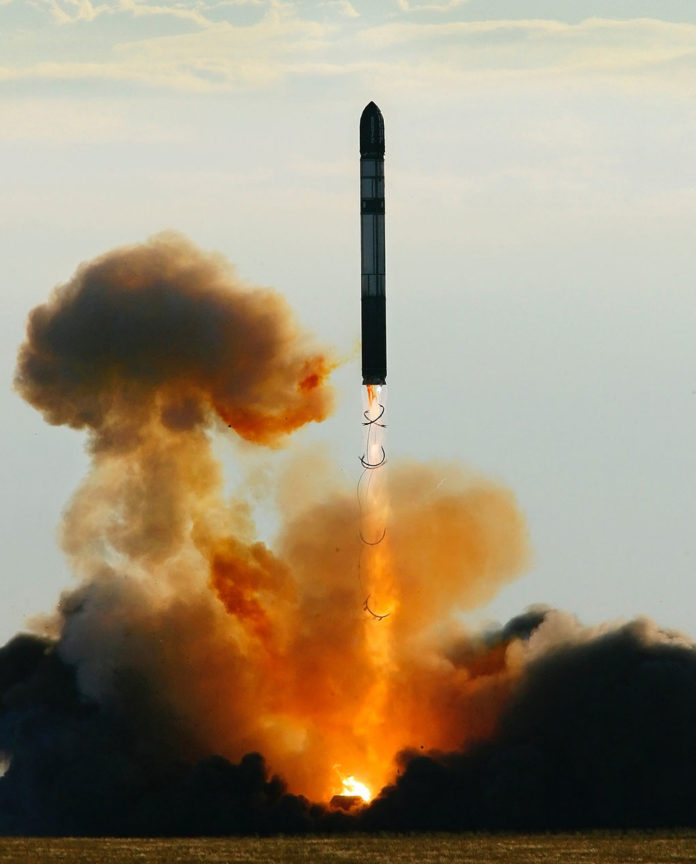
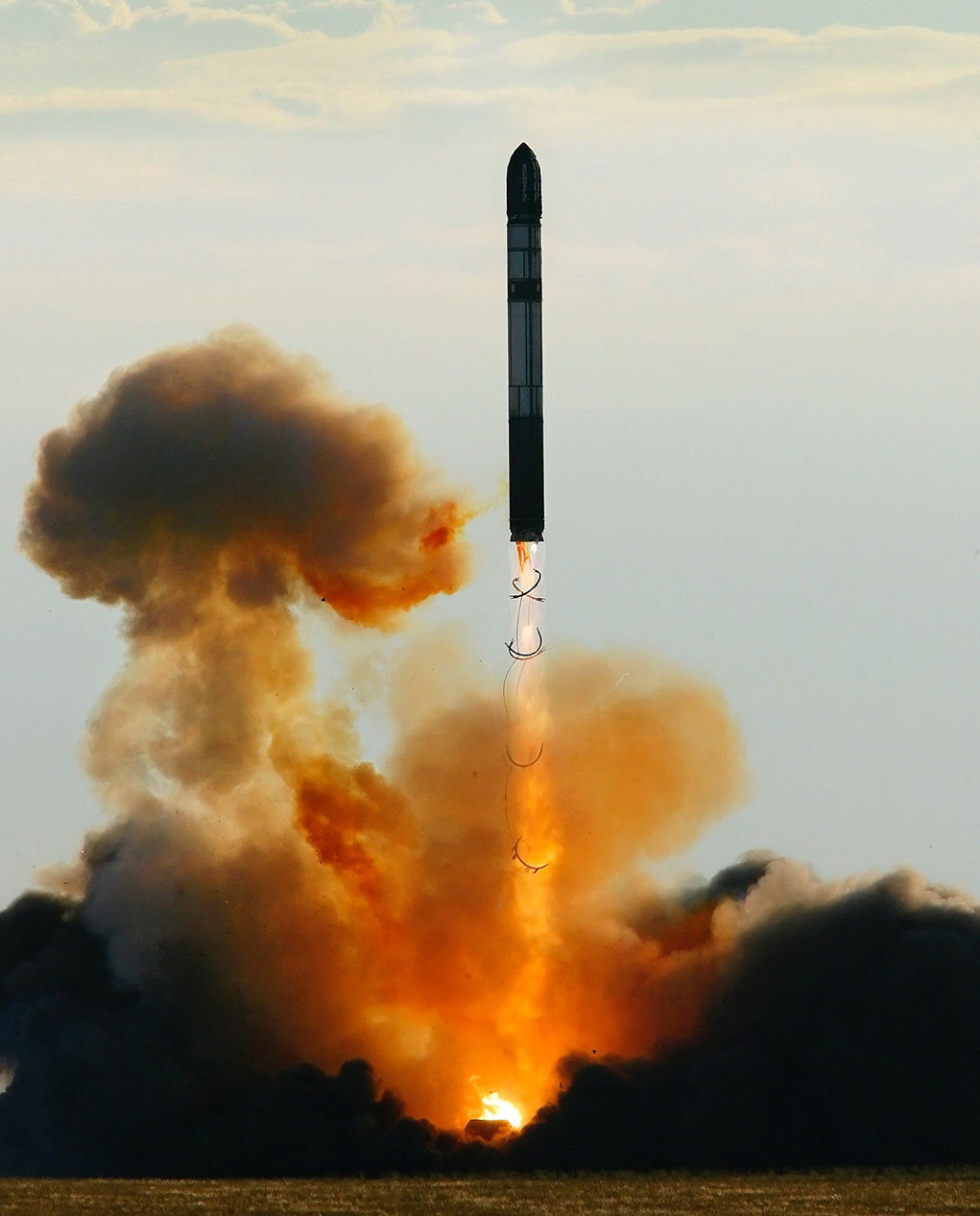
    SS-18 Satan missile launch.

    Moscow is moving to replace its heaviest strategic missile – the R36M2 Satan, with a new liquid-propelled ICBM – RS-28 Sarmat. The need for a new missile is evident since its predecessor, the R-36 (SS-18) Satan that uses a liquid propulsion system designed and produced in Ukraine, that cannot be relied upon to support the weapon. Russian currently has 50 SS-18 Satan ICBM in service, all are R-36M2 (Voevoda) that can carry 10 independently targeted warheads (MIRVs), each with up to 1 megaton thermonuclear device. A single warhead variant with a yield of 20 megatons was retired under the New START nuclear disarmament agreement.

    According to schedule, Sarmat should fully replace the Satan by 2020, but 2022 would be a more realistic milestone, given the delayed testing of the missile. The missile has yet to make a full launch. PDU-99, the propulsion system of the first stage was tested for the first time in October 2016, a year later, on December 28, 2017, a prototype of Sarmat performed a successful ejection test from a silo in the Plesetsk test range. An ejection test is not a full launch but limits the firing to the ejection gas generator pushing the missile from the silo to a height of about 30 meters above ground, where the missile’s rocket propulsion will fire to accelerate the missile on its course.

    The silo-based Sarmat has a throw weight of 10 tons, enough to carry up to 24 individual bodies over a distance of up to 12,000 km – these can include up to 10 – 16 MIRVs of various types and yields. The actual number of MIRVs is determined by the composition of the missile’s load between actual warheads and decoys. Each of these warheads can maneuver to evade missile interceptors. There are indications that the Sarmat is also designed to carry its nukes in hypersonic glide vehicles, a new type of powered or unpowered reentry vehicles that can maneuver at hypersonic speed (above 5000 m/sec), while evading enemy interceptors and hit their target at much higher precision, compared with current reentry vehicles. Another advantage of Sarmat is its accelerated pre-launch procedure.

    More Reading:

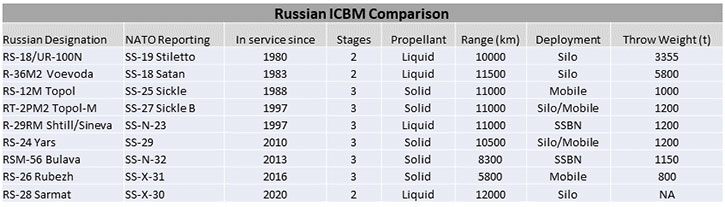
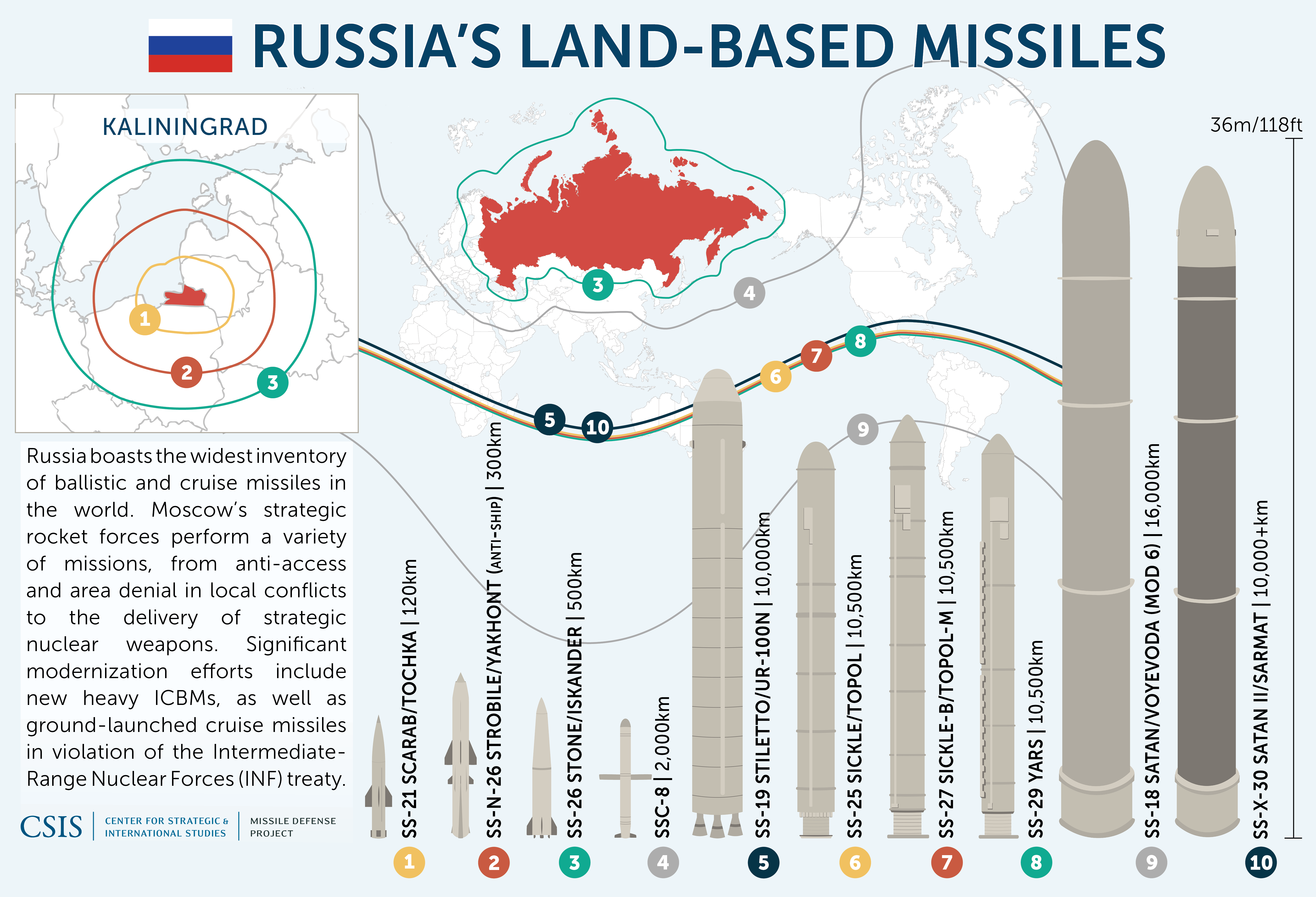
    Comparison of current Russian missiles – tactical and strategic ballistic missiles are included. Source: CSIS/
    MissileThreat.Org

    New Weapons Initiatives Violating Strategic Arms Control Treaties

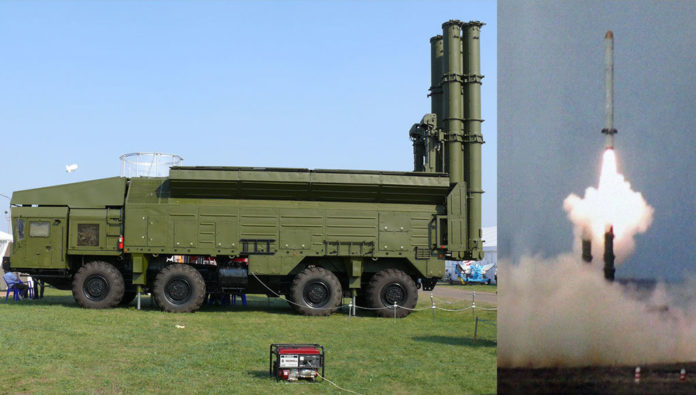
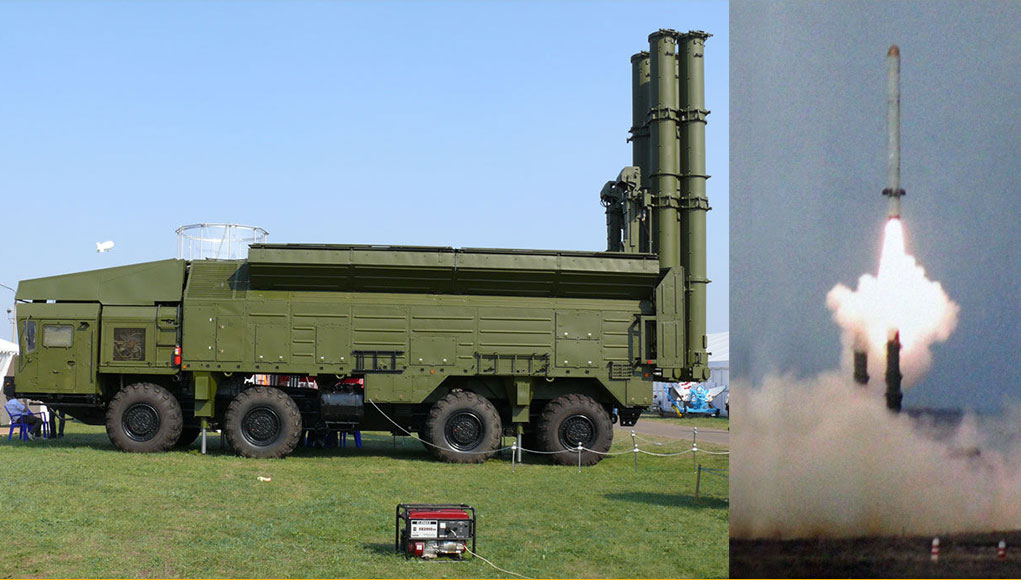
    Iskander missile systems are offered for export with either with two ballistic missiles or two or four cruise missiles.

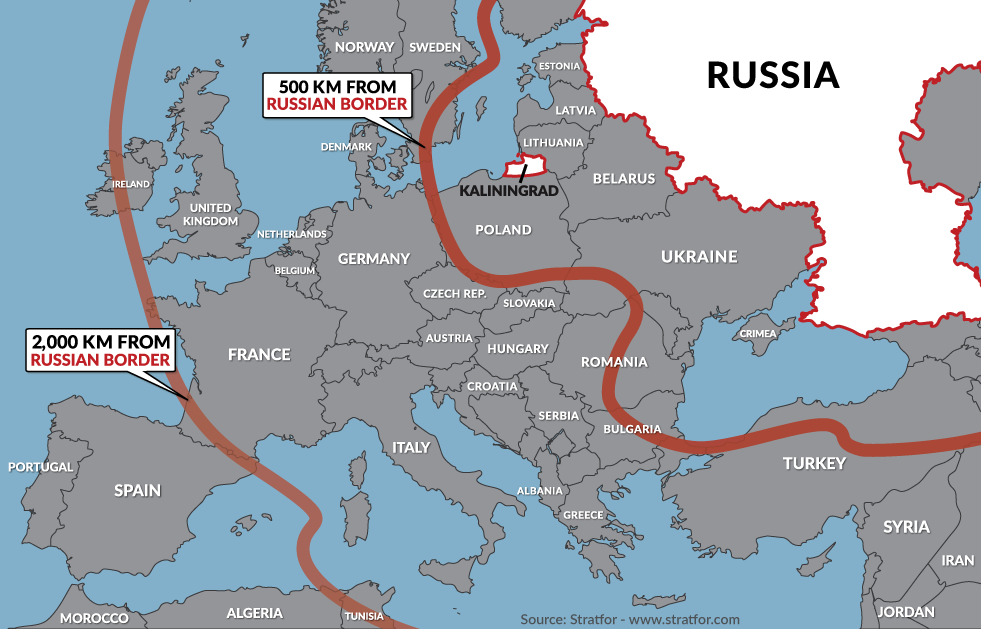
    As Russia continues the modernization of its strategic forces, Moscow is testing the limits of compliance to arms reduction treaties it is committed to. The United States complained about two Russian weapon categories that allegedly violate the Intermediate-range Nuclear Forces (INF) treaty – the RS-26 Rubezh and 9M729 Iskander-K.

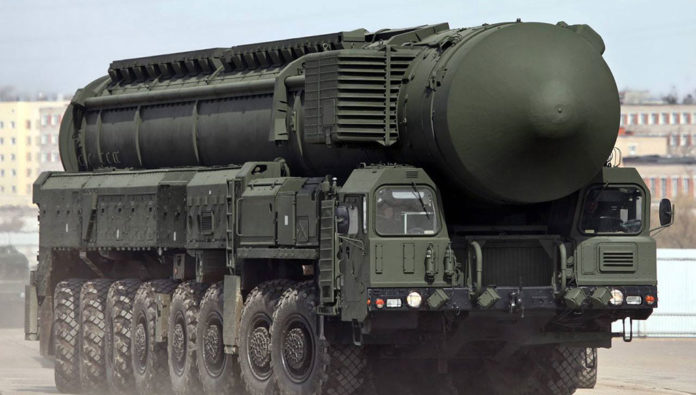
    Rubezh (NATO reporting name SS-X-31) was referred by the Russians as an Intercontinental Ballistic Missile (ICBM), a derivative of the three-stage RS-24 Yars. A shorter and lighter than the three-staged Yars, Rubezh is designed for deployment on road-mobile launchers. Rubezh carries a total payload of 800 kg which consists of a single warhead or four Multiple, Independent Reentry Vehicles (MIRVs). While officially Rubezh’s range exceeds 6,000 km, four of the test flights carried out so far have demonstrated flight parameters banned by the INF treaty.

    Its first successful test flight reached a distance of 5,800 km, positioning Rubezh in compliance with INF limitations but the next three flights reached only 2,000 km, demonstrating the true purpose of the weapon was to hit targets at intermediate range (such as Western Europe), rather than intercontinental. Following only four test flights Rubezh completed its development and was expected to enter service in 2017 (although such status has not been officially confirmed). The serial production of this missile could seriously change the Russian-US balance of power in nuclear forces – either with the INF or with New START disarmament treaties. That may be the cause of this missile to ‘disappear’ from Russian military leaders unexpectedly stopped talking about the Rubezh. Any mention of the RS-26 has disappeared from all official statements. Some experts believe that by temporarily suspending the production and deployment of the RS-26, Moscow wants to “close the question” of a possible violation of the INF Treaty.

    Moscow is also accused to be in violation of the INF treaty by the development of a new ground-launched cruise missile on 9K720 Iskander tactical missile system (NATO reporting name SS-26 Stone). This versatile system can carry a number weapons – tactical, ballistic missiles or cruise missiles, capable of hitting targets at ranges up to 415 – 500 km, but, according to several sources, a new type of cruise missile designated 9M729 was tested with that system, extending its operational strike range far beyond the parameters allowed by the INF treaty. That cruise missile thought to be a derivative of the 3M14 Caliber cruise missile (widely used in its sea-launched variant in the war in Syria) with strike range between 480 – and up to 5,470 km (300 to 3,400 miles).

    The United States said it was taking military and economic measures against Moscow in response to this violation. Moscow claims these allegations are ‘absolutely unfounded’. The U.S. state department said their response could include a review of military concepts and options, including options for conventional, ground-launched, intermediate-range missile systems, which would enable the United States to defend itself and its allies, should the Russian Federation not return to compliance.”

    The treaty does not ban development work on weapon classes banned by the INF until the point that prototypes missiles are built and flight tested, therefore, the technology development would be within the limitations of the treaty. The U.S. response could also impose sanctions against Russian companies that provided the technologies for the new cruise missile. A military response could also include withdrawal from the treaty, that has been in effect for 30 years.

    “The Alliance has united in its appreciation that effective arms control agreements remain an essential element to strategic stability and our collective security,” NATO announced, urging Russia to address these concerns in a substantial and transparent way, and actively engage in a technical dialogue with the United States.

    Moscow flatly denied the existence of such land-based cruise missile and said the 9M729 refers to a different weapon whose range comply with the INF treaty. Russian Deputy Foreign Minister Sergey Ryabkov has warned that “if the US chooses to withdraw from the treaty, we will be forced to give a ‘mirror response’ to that.”

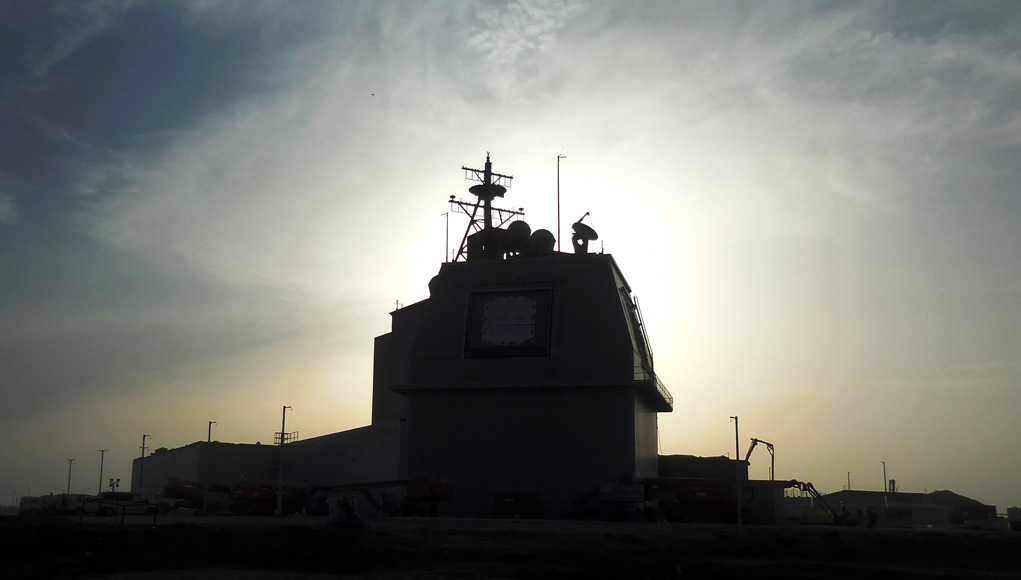
    The first land-based AEGIS missile site will become operational in Romania in 2016. Photo: MDA

    On its side, Moscow denied the accused violation claiming the American MK-41 Vertical Launch Systems (VLS) used with the new AEGIS Ashore sites in Romania, Poland, and Japan in the future, are violating the treaty, in its ability to launch Tomahawk cruise missiles. President Vladimir Putin message was also clear: “Russia is going to comply with its (INF) terms, providing our partners do so. If they decide to abandon it, however, our response will be instant and symmetrical.” Putin said.

    The U.S. denied this accusation saying the Aegis Ashore does not have an offensive ground-launched ballistic or cruise missile capability, as the AEGIS Ashore system lacks the software, fire control hardware, support equipment, and other infrastructure needed to launch offensive ballistic or cruise missiles such as the Tomahawk. “Aegis Ashore has never contained, launched, or been tested for launching a missile that is prohibited by the INF Treaty.” the State Department responded, “The U.S. acknowledged the AEGIS Ashore uses some of the structural components as the sea-based Mk-41 VLS, it is not the same launcher and, as a result, the system is not a prohibited launcher.”

    Russian analysts claim the VLS launchers used by AEGIS Ashore do not show observable differences from those used on missile destroyers, as required by the INF treaty, just as the alleged Iskander-K does. The Russians also claim that Medium Altitude Long Endurance drones (such as the MQ-9 Reaper) are also in violation of the INF treaty, in their capacity to carry heavy weapon loads over long distances. These arguments are flatly denied by the US, since the treaty relates only to missiles, being ‘one-way’ delivery systems, and not reusable delivery systems such as drones.

    More Reading:

    Russia Continues Modernizing its Strategic Missile Force

    RS-24 Yars is gradually replacing older RS-12M Topol, due to phase out of service by the early 2020s

    In his recent strategic review, U.S. President Donald J. Trump introduced his administration’s defense strategy. The majority of the review addresses the evolving threats by terrorism, non-state organizations, and economic competition with major world powers, but part of that strategy also addressed the challenges posed by ballistic missiles and nuclear weapons, not only those developed and tested by North Korea and Iran, but the large Chinese and Russian nuclear arsenals being modernized, and enhanced with new capabilities that pose significant new challenges to American missile defenses.

    The impressive progress of Russian nuclear forces is the topic of this article. Russia is modernizing all three ‘legs’ of its nuclear triad. This modernization includes the introduction of new strategic missile submarines armed with new RSM56 Bulava missiles, restarting the production line of strategic bombers – the old-new Tupolev Tu-160M2, to be equipped with air-launched derivatives of the Kaliber naval cruise missiles. This modernization also includes a complete replacement of the Russian land-based strategic missile fleet, with the development and deployment of hundreds of new Intercontinental Ballistic Missiles (ICBM). Accelerated testing of these new strategic missiles highlights the importance and fast pace of this thrust, as Moscow transforms its strategic force to better cope with the U.S. evolving missile defense capabilities.

    Topol RS-12EM seen on a test launch. The 30 year RS-27 Topol was designed for deployment in silos or mobile launchers and is being replaced by modern RS-24 Yars ICBM.

    According to the U.S. state department, Russia currently has 1,765 deployed warheads, deployed on 523 missiles, submarines and bombers, while the U.S. maintains 1,411 US warheads deployed on 673 platforms. The disparity in warheads and platforms is within the limits set by the New Strategic Arms Reduction Treaty (START) treaty, which allows some limits both sides to maintain 700 platforms that carry up to 1,600 warheads, but enables the number of warheads to slightly exceed those levels due to different counting methods for each platform type. While the agreement is due to expire in 2021 the two sides haven’t begun negotiations an extension of this treaty and are at odds on each side’s compliance with current arms control agreements.

    Read post: New Weapons Initiatives Violating Arms Control Treaties

    The Russian strategic arsenal is undergoing modernization that will totally replace the Russian Strategic Missile Force (RSMF), deploying new types of missiles and submarines, modernized bombers and cruise missiles to carry its nuclear weapons. While Russia is invested in all three ‘legs’ of its strategic triad, the core of this modernization is the replacement of no less than four Intercontinental Ballistic Missiles (ICBM) types – RS-36M2 Voevoda (SS-18 Satan), UR-100 (SS-19 Stilleto), RS-12M Topol (SS-25 Sickle) and RT-2PM2 Topol-M (SS-27 Sickle) with three new ICBMs – RS-28 Sarmat (SS-X-30), RS-26 Rubezh (SS-X-31), and RS-24 Yars (SS-29) which has already been deployed. Topol will mark 30 years of service in 2018; the missile entered service in 1988 and is expected to remain in service until 2022 (see comparison table below).

    Comparison of current Russian missiles – tactical and strategic ballistic missiles are included. Source: CSIS/
    MissileThreat.Org
    SS-18 Satan missile launch.

    For 2018 12 flight tests are scheduled, twice the number of missile tests in 2017, but less than the record year of 2016 (16). The most recent was the first ejection test of the mighty RS-28 Sarmat ICBM, the heaviest type of Russian ICBMs. This new, liquid-propelled missile will replace the RS-36M2 Satan, the heaviest Russian missile currently in service.

    RS-24 Yars is the most mature Russian ICBM currently in production. It is propelled by a three-stage solid-fuel rocket system designed for launch from silos or from mobile launchers. Yars can carry up to three MIRVs, each carries a thermonuclear device with a yield of 150 – 200 kt to 1 megatons in a single warhead. Yars began deployment in 2009 and today, Yars and Topol-M make more than 80 percent of the Russian strategic missile force. It is expected that, by 2022, Yars will replace all Topol and SS-18 units in the RSMF. A derivative of Yars is the two-stage RS-26 Rubezh (SS-X-31), a smaller missile that carries a single warhead or four MIRVs with a total weight of 800 kg.

    Read post: Toward an All-New Russian ICBM Force

    As for the Rubezh – the missile is officially referred to as an ICBM (as it reached a range of 5,800 km in a flight test), although its test profile indicates it is more suitable for medium range attack, a category banned by the INF treaty.

    Moscow is also accused to be in violation of that treaty by the development of a new cruise missile that can launch from the 9K720 Iskander tactical missile system (NATO reporting name SS-26 Stone). This versatile system can carry a number weapons – tactical, ballistic missiles or cruise missiles, capable of hitting targets at ranges up to 415 – 500 km, but, according to several sources, a new type of cruise missile designated 9M729 was tested with that system, extending its operational strike range far beyond the parameters allowed by the INF treaty. That cruise missile thought to be a derivative of the 3M14 Caliber cruise missile (widely used in its sea-launched variant in the war in Syria) with strike range between 480 – and up to 5,470 km (300 to 3,400 miles).

    More Related Posts:

    Iskander missile systems are offered for export with either with two ballistic missiles or two or four cruise missiles.

    Skunk Works and XTEND Simplify Multi-Drone Command

    0
    Lockheed Martin Skunk Works® and XTEND have achieved a major milestone in JADC2 by integrating the XOS operating system with the MDCX™ autonomy platform. This technical breakthrough enables a single operator to simultaneously command multiple drone classes, eliminating the friction of mission handoffs. From "marsupial" drone deployments to operating in GPS-denied environments, explore how this collaboration is abbreviating the data-to-decision timeline and redefining autonomous mission execution.

    From Ukraine to Taiwan: The Global Race to Dominate the New Defense Tech Frontier

    0
    As traditional defense primes face mounting competition from agile “neoprimes” such as Anduril, Palantir and Helsing, the balance of innovation is shifting toward software-defined warfare and scalable, dual-use technologies, while global industry consolidation—marked by Boeing’s integration of Spirit AeroSystems and other strategic mergers—signals an intensified race to secure control over the defense technology value chain. Our Defense-Tech weekly report highlights these trends.

    Europe’s “Drone Wall”

    0
    In early October 2025, a coordinated wave of unmanned aerial system (UAS) incursions—widely attributed to Russia—targeted critical infrastructure across at least ten European nations. The unprecedented campaign exposed the fragility of Europe’s air defenses...

    Weekly Defense Update & Global Security Assessment

    0
    Executive Summary The past week (September 18-25, 2025) represents an inflection point where strategic defense concepts have transitioned from doctrine to tangible reality. An analysis of global events reveals four primary, interconnected trends shaping an...

    U.S. Air and Space Forces Push Next-Gen Programs at the AS&C 2025 Conference and...

    0
    At the 2025 Air, Space & Cyber Conference, U.S. Air Force and Space Force leaders unveiled major updates on next-generation fighters, bombers, unmanned systems, and space initiatives, highlighting both rapid innovation and critical readiness challenges as the services race to outpace global competitors. A short version is available here, with a more detailed version for subscribers.

    TADTE 2025: Reflecting Taiwan’s Strategic Themes

    0
    The Taipei Aerospace & Defense Technology Exhibition (TADTE) 2025 crystallized around four dominant strategic themes that collectively illustrate Taiwan's comprehensive approach to defense modernization amid escalating regional tensions. Based on a detailed report by Pleronix (available upon request). Includes a Podcast discussion on TADTE 2025's highlighting Taiwan's four strategic themes beyond the post's coverage.

    Iron Beam 450 Completes Testing, Soon to Join With Operational Air Defense Units

    0
    Israel’s Iron Beam 450 high-power laser system has completed final testing, marking a major leap in air defense. Developed by Rafael, it offers precise, cost-effective interception of rockets, UAVs, and mortars, and is set for IDF deployment by 2025.