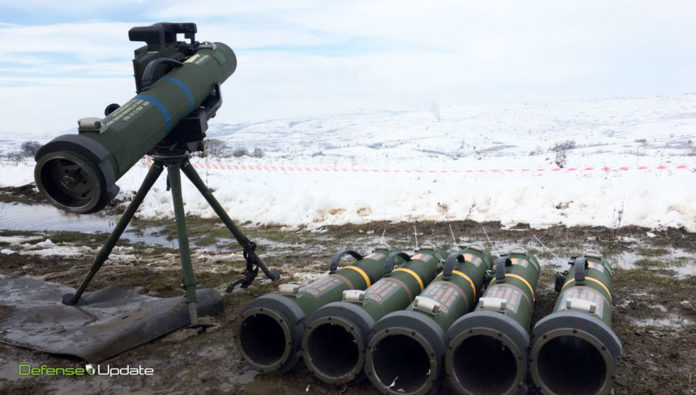
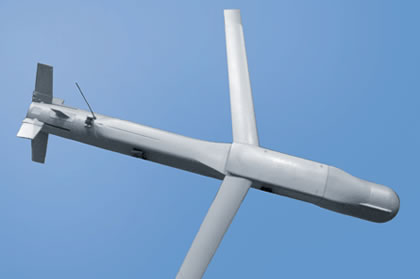
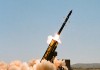
10 Spike-LR missiles were fired during the Romanian qualification testing for the man portable configuration of the weapon, all scored target hits. Photo: RAFAEL
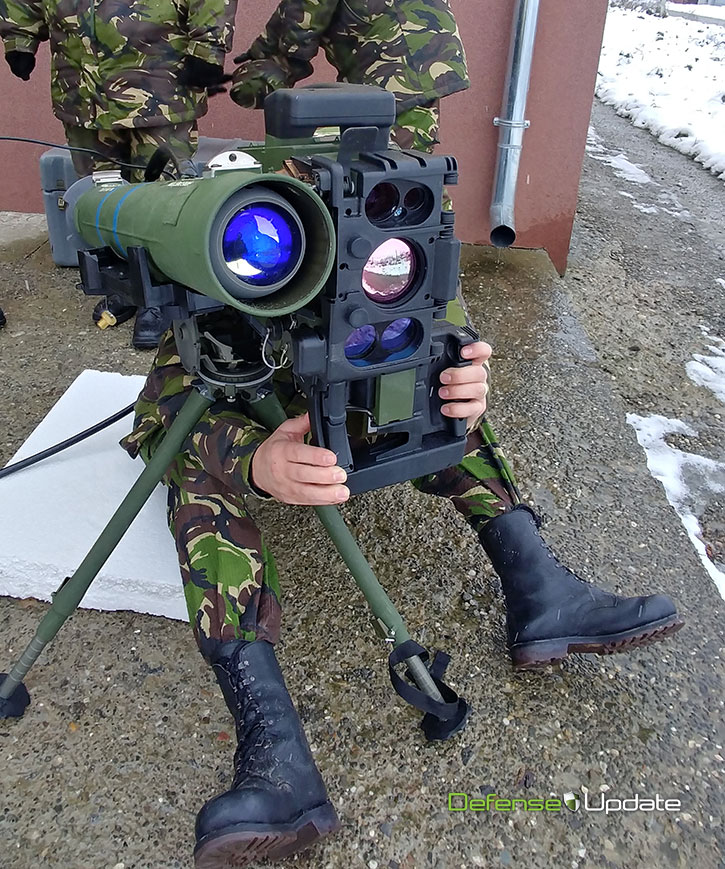
Integrated Control Launch Unit (ICLU), which is the new modern digital launcher for SPIKE missiles. This unit enables target acquisition at longer range and integration of the missiles into a tactical network. Photo: Rafael
The Romanian Army has completed testing of SPIKE LR (Long Range) missiles as part of the Romanian Army evaluation of man-portable Spike-LR in dismounted operations. The Romanian army is already using SPIKE family missiles on armored vehicles and helicopters, the new acquisition extends the use of the missile to dismounted operations. In the recent evaluations ten missiles were fired, nine by Romanian gunners that completed gunnery qualification process. The multi-purpose missile system was tested in different firing scenarios, including day and Infrared mode, fired against tanks and APC targets at different ranges. All ten missiles scored target hits.
The LR version is deployed as a vehicle-mounted armament, on a 30 mm RCWS on the BMP Platform, while SPIKE ER missiles are used with Puma (SOCAT) helicopters.
The new acquisition signed in 2015 with EuroSpike GmbH is for an infantry launcher configuration of the Integrated Control Launch Unit (ICLU), which is the new modern digital launcher for SPIKE missiles. This unit enables target acquisition at longer range and integration of the missiles into a tactical network. The acquisition of man-portable SPIKE-LR systems will run through 2019 to equip the infantry, reconnaissance, mountain troop brigades and artillery regiments of the Romanian Land Forces.
Two SY-400 missile carriers and two loaders were on display.
Two SY-400 missile loaders were also displayed.
Qatar is fielding a short-range ballistic missile with a range of 480 km, an act that further expands the country’s reach and deterrence amidst raw with neighboring UAE and Saudi Arabia. The first units of SY-400 missile, to be displayed on the national parade, was seen publicly for the first time during the rehearsals yesterday.
The SY-400 is a short-range, precision-attack ballistic missile introduced in China in 2008, as an export-oriented alternative to the Russian Iskander-E. The SY-400 system has eight containers carrying ballistic missiles propelled by solid fuel. The missiles have a maximum range of 400 km. They are preloaded with a number of warheads and are launched vertically from their sealed containers.
The SY-400 system seen in Qatar is configured with two pods containing the heavier DF-12A missiles (formerly known as M20), a downgraded export version of the DF-12 ballistic missile, used by the Chinese military. The exportable missile carries a warhead weighing 480 kg to a distance of 280 km to meet the Missile Technology Control Regime (MTCR) rules. The missile carrier can be configured flexibly to carry four SY-400 missiles in one pod, and a single BP-12A on the other. The SY-400 is mounted on a Wanshan 8×8 carrier-launcher vehicle, supported by a reloading vehicle of a similar type, fitted with a crane and missile containers.
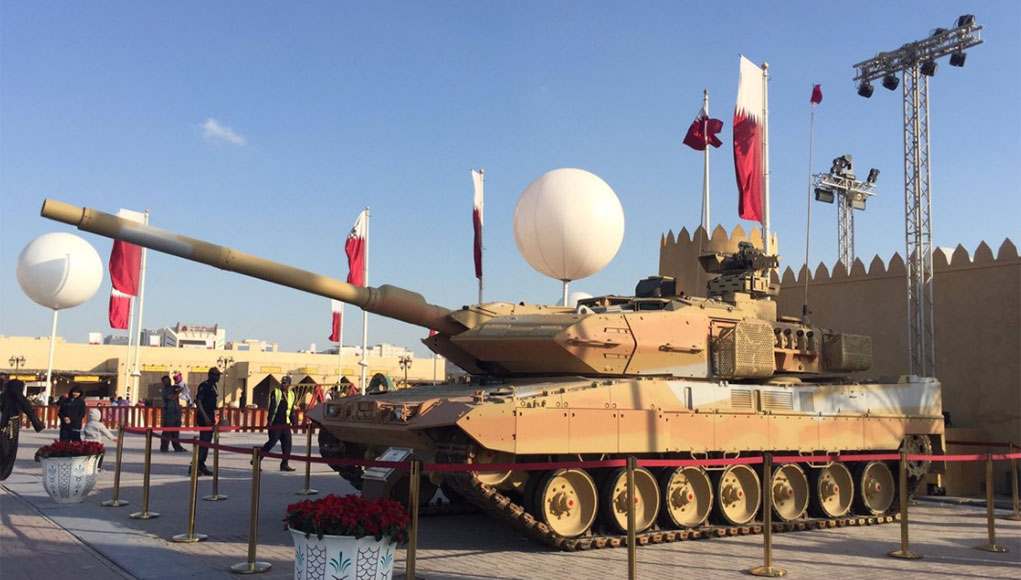
The German Leopard 2A7 tank was also on display at Qatar’s National Day. Photo via Twitter, Abdulmois
Other equipment displayed in the rolling parade was the German-made Leopard 2 A7 main battle tanks and SPH2000 self-propelled guns. (In the past tanks paraded on their transporters, but this year 14 were rolling on tracks along the Corniche. Qatar bought 62 Leopards and 24 Self-Propelled Guns from Germany. The Emiri has also ordered 490 VBCI 8×8 armored vehicles from France.
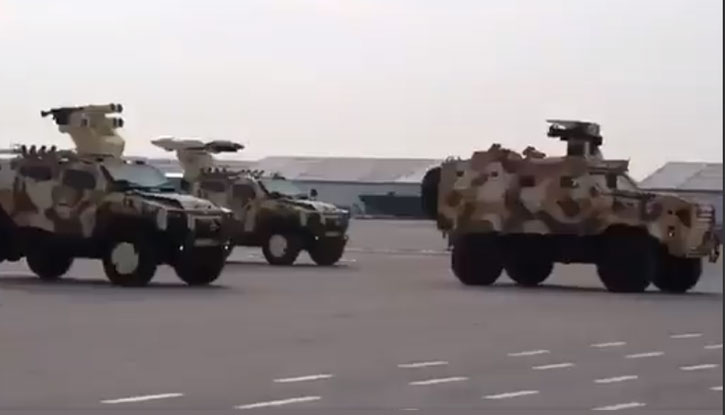
Another Qatari acquisition is hundreds of armored vehicles from Turkey. The Turkish-made Edjer Yalcin armored vehicles will take part in the parade for the first time. The acquisition of hundreds of armored vehicles from Turkey is part of a larger defense export package signed between the two countries. Within the scope of the contract, approximately 400 Ejder Yalçın 4×4 armored combat vehicles produced by Nurol Makina Sanayi (NMS), and are equipped with Aselsan’s SARP-DUAL remotely controlled weapon stations. The deal with Turkey also includes the delivery of more than a hundred NMS 4×4 light armored vehicles that carry guided missiles or man-portable short-range air defense missiles.
Ejder Yalçin vehicles (leading) are armed with the Stabilised Advanced Remote Weapon Platform (SARP) Dual, sourced from Turkish company Aselsan. This comprises a .50 cal machine gun, a second 7.62mm machine gun and advanced optics. The NMS 4×4 vehicles (on the left side) on display were spotted with the IGLA launching system for short-range air defense, and an anti-tank launching system, both also supplied by Aselsan. Photo: Twitter, Grant Turnbull, Shephard
The special police unit in Saxony received the Survivor R transport vehicles today, equipping its counter-terror special unit. A second vehicle will follow next week. The acquisition of armored vehicles was part of an extensive €15 million anti-terror package. The “Survivor” was presented last summer at a trade fair for police equipment in Leipzig. The Berlin State Police have also ordered the vehicle. Survivor R is produced by Rheinmetall MAN Military Vehicles (RMMV) in cooperation with Austrian vehicle maker Achleitner.
Saxony’s two Survivor R vehicles feature an armored monocoque cabin that provides the crew with all-around protection from multiple threats. The equipment package includes special signaling system; an integrated, remotely controlled observation turret with optronics and effectors; a high-performance loudspeaker; and a hydraulically operated rear ramp for rapid entry and exit. A powerful 340 HP engine with a torque of 1,250 Nm gives the 17-tonne vehicle an outstanding mobility. Moreover, the environmentally friendly Survivor R meets the latest Euro 6 emission norms.
Saxony’s two Survivor R vehicles feature an armored monocoque cabin that provides the crew with all-round protection from multiple threats. Photo: Rheinmetall
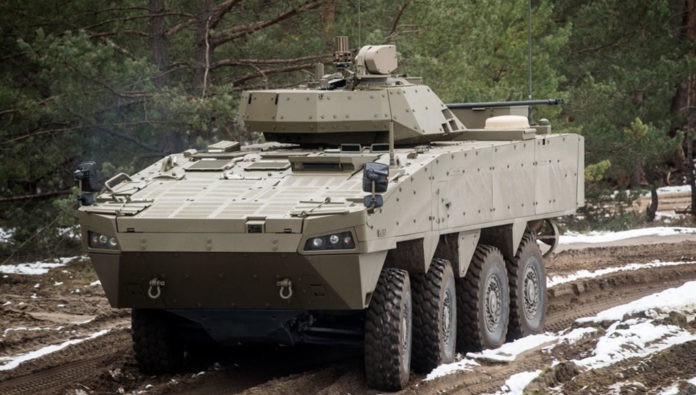
The prototype 8x8 Slovak-Finnish armored vehicle based on Patria AMVXP, mounting the Slovak Turra weapon system, undergoing testing in extreme winter conditions in Finland. Slovak Army trials are expected to continue through March. Photo via SME
A new version of an amphibious AMVXP integrated with Turra weapon system is undergoing winter testing in Finland, under a joint development program with Slovakia. Slovak Army trials are expected to continue through March. Slovakia plans to procure up to 81 IFVs as part of a military modernization program. Deliveries are expected to commence in 2018-2024.
The Slovak and Finnish Ministries of Defense have agreed on a joint 8×8 infantry fighting vehicle (IFV) development program. The development will establish a new version of an amphibious AMVXP integrated with Turra weapon system, fulfilling requirements of both Slovakian and Finnish Defense Forces. The Slovak Konstrukta Defence will be the prime contractor, vehicle OEM Patria Land Systems will provide the vehicle platform and Slovak EVPU will be responsible for the weapon system.
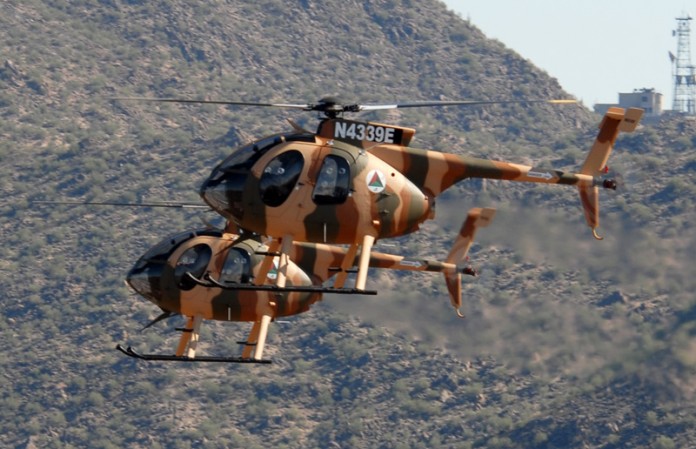
Lebanon will soon receive military hardware and support worth $120 million from the US Department of Defense under the DOD “Building Partner Capacity” program. During a visit in Lebanon, the commander of US Central Command, General Joseph Votel announced a planned transfer of six MD 530G light attack helicopters and six Scan Eagle unmanned aerial vehicles along with communications equipment, electronics equipment, night vision devices, and training. The U.S. has provided more than $1 billion in military assistance to Lebanon since 2006. According to the US Defense Security agency, in past years the Pentagon transferred to Lebanon six A-29 Super Tucano light attack aircraft, two were delivered in October and four will follow next year. UH-1H Huey helicopters, Hellfire and TOW-2A missiles.
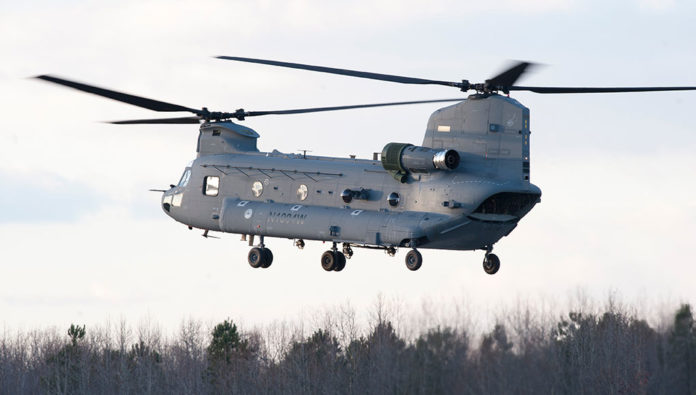
Seeking to establish commonality through its Chinook fleet, the Royal Netherlands Air Force (RNLAF) awarded Boeing company a contract to upgrade six CH-47D to the latest F-model configuration, bringing the Dutch fleet to 20 F-model Chinooks. The Netherlands acquired 14 CH-47F Chinooks through the U.S. Department of Defense’s Foreign Military Sales program in 2016.
Deliveries of the six modernized Chinooks are planned to begin in 2021. A key feature of the upgrade includes the integration of Common Avionics Architecture System cockpit with an integrated Digital Automatic Flight Control System. The common avionics architecture system provides for advanced operational capabilities and aligns with the U.S Army and other allies, improving worldwide interoperability, flight-handling characteristics, and long-term sustainability.
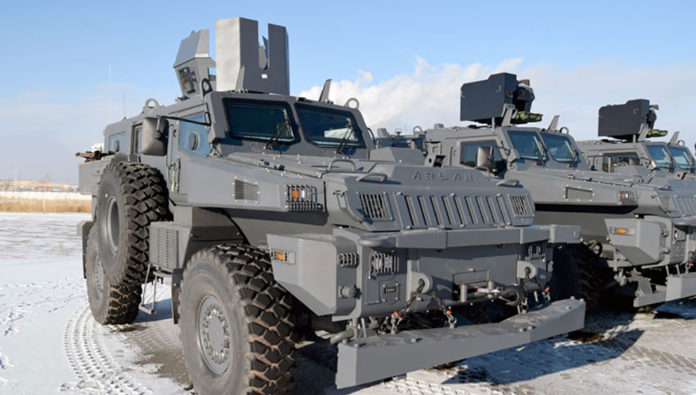
Winterized Arlan MRAP is
produced in Kazakhstan. Photo: Paramount Group
Kazakhstan Paramount Engineering (KPE) is ramping up production of Arlan armored vehicles at its new facility in Kazakhstan. The first vehicles were delivered in August 2016. The latest batch was recently delivered to the Kazakh Special Forces as the next batch, due to be delivered in 2018, is already in production. Arlan is the localized version of the Marauder MRAP that was modified to meet the harsh winter conditions in the region.
Arlan has a high mine protection equivalent to STANAG 4569 Level 3A/3B – which is equal to the blast of 8kg in TNT equivalent under each wheel and same under the hull, 50kg in TNT equivalent at a distance of 5m. Ballistic protection meets STANAG 4569 Level 3, withstanding shots from any small arms with 7.62mm caliber armor-piercing rounds, Dragunov sniper rifle, and 12.7mm caliber NATO standard rounds. The winterization included additional heating of the crew cabin, changing specifications of all fluids, lubricants, and fuels to an all-season type covering a range of 100 degrees Celsius from minus 50 to plus 50 Degrees Celsius, and installation of heated ballistic windows.
The Arlan delivered to the Kazakh Special Forces is equipped with various auxiliary equipment including navigation, computing and communication suite, night vision and IR sensors, roof mounted wire cutting blades, hydraulically operated barricade breaker blade mounted to the front of the vehicle.
The new 15,000m2 armored vehicle factory KPE established in Astana has a capacity of more than 200 vehicles per year. It is the largest armored vehicle factory in Central Asia and the first defense manufacturing plant of such scale of capability in Kazakhstan. KPE is expected to deliver such vehicles to the Ministry of Defense, Special Forces, and other law enforcement agencies in Kazakhstan. Uzbekistan is also interested in the vehicle, as well as Jordan.
Kazakhstan Paramount Engineering (KPE) is the joint venture between the government-owned and Kazakhstan Engineering and South African Paramount Groups. According to Ivor Ichikowitz, Paramount Group Chairman, the new facility was erected in Kazakhstan in less than two years. “We have built a new state-of-art armored vehicle factory from the ground up, we transferred skills to establish a highly efficient local workforce, we industrialized a new vehicle, and now we are ramping up production as we further increase deliveries to our customers.” According to Ichikowitz, this achievement proves his company’s ‘portable production model’ vision. “It shows that our portable production model works. It shows that with the right partners we can set up production anywhere in the world and deliver world-class technologies to our customers in a fast and efficient way.”
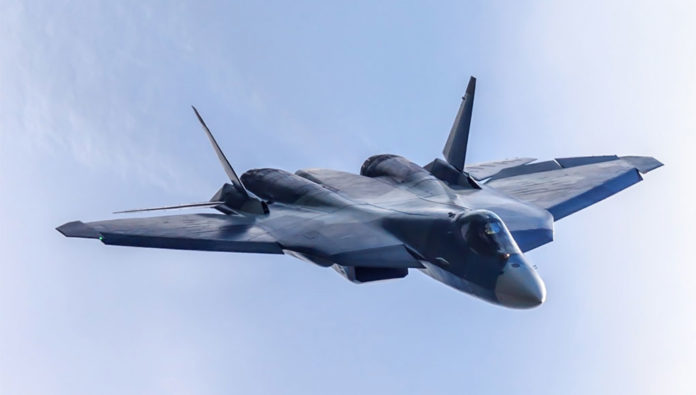
The first production aircraft of the Su-57 Fifth Generation fighter will be delivered in 2018. Photo: UAC
Initial assembly of the Su-57, the Russian fifth generation fighter, is slated to begin next year at the Gagarin Aircraft-Building Enterprise in Komsomolsk-on-Amur, in the Khabarovsk Region in the Russian Far East.
The Russian Aerospace Force will begin receiving the first batch of production Su-57 fighters next year (2018). The first production batch of Su-57, also known as prospective frontline aircraft system (PFAS) includes 12 fighters, 2-3 of them will be delivered within the first year of production. The Su-57 was formerly known as T-50 or PAK-FA made its first flight in January 2010. The developer hopes the Russian Air Force will field about 220 such aircraft between 2020 and 2030 but currently, the only secured order is for 12 low-rate production aircraft.
As a true fifth-generation fighter Su-57 introduces advanced low observable technologies and advanced avionics, but it also needs a more powerful engine to perform in supercruise. To achieve that the aircraft will be powered by a pair of Saturn Izdeliye 30 engines specially developed for the 5th Generation aircraft.
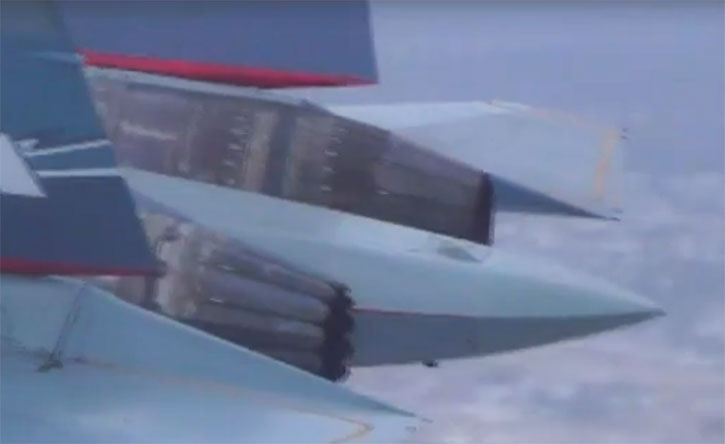
The second T-50 prototype is the first to test the Saturn Izdeliye 30 engine. The new engine is seen here installed on the port side, along with the interim powerplant – Saturn AL-41F1 (117S) turbofan engine. The new engine features improved thrust, better fuel efficiency, and fewer moving parts, resulting in improved reliability and lower maintenance costs.
The new engine features improved thrust, better fuel efficiency, and fewer moving parts, that, with subsequently improved reliability and lower maintenance costs will improve the aircraft performance and reliability. The second prototypes (T-50-2) fitted with the new engine on its port nacelle, made its first flight at the Gromov Flight Research Institute on December 5th, 2017 and is expected to be available for integration in production aircraft by 2025.
If Su-57 will enter serial production soon, by the time the new engine is available 60 aircraft will already be built and powered by interim 117S engines – derivatives of Saturn AL-41F1 turbofans. Each 117S develops only 32,500 lbs of thrust in afterburning (wet) mode, compared to the Izdeliye 30 that delivers 24,054 lbs dry – enough to fly the Su-57 in supersonic speed, (when lighting the afterburner new engine develops up to 39,566 lbs. of thrust).
Following an extensive technical evaluation by the Slovak military, the MOD is opening a tender for the procurement of 404 light, multipurpose tactical armored vehicles for the Slovak armed forces. The evaluations included nine vehicles – from the Czech Republic, Turkey, Switzerland, and France. Three Turkish vehicles were evaluated – the Aligator Master II from Kerametal, Ejder Yalcin from Nurol Makina and Cobra II from Otokar. Two models from the Czech Republic were the Ajban proposed by Czech MoD-owned VOP CZ teamed with Nimr and Patriot 4×4 from Tatra Defence. Other vehicles included were the German Dingo 2 from KNDS, the Swiss Eagle V from GDLS Europe Mowag and French Sherpa, by Renault.
Lockheed Martin successfully fired production-configuration Long Range Anti-Ship Missiles from a U.S. Air Force B-1B bomber. Photo: U.S. Navy. via Lockheed Martin
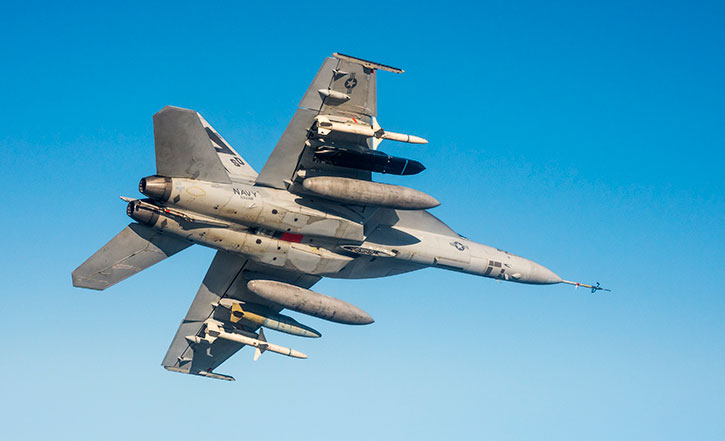
Lockheed Martin successfully launched production-configuration AGM-158C Long Range Anti-Ship Missiles (LRASM) from a U.S. Air Force B-1B Lancer bomber. During the test over the Sea Range at Point Mugu, California, B-1B aircrew simultaneously launched two LRASMs against multiple maritime targets, meeting the primary test objectives, including target impact. The air-launched variant that was tested will provide an early operational capability for the U.S. Navy’s The Offensive Anti-Surface Warfare (OASuW) Increment I requirement, to be integrated onboard the U.S. Air Force’s B-1B in 2018 and on the U.S. Navy’s F/A-18E/F in 2019.
LRASM is a precision-guided, anti-ship standoff missile based on the proven Joint Air-to-Surface Standoff Missile-Extended Range (JASSM-ER) developed by Lockheed Martin for the US Air Force. It is designed to meet the needs of U.S. Navy and Air Force, in contested environments.
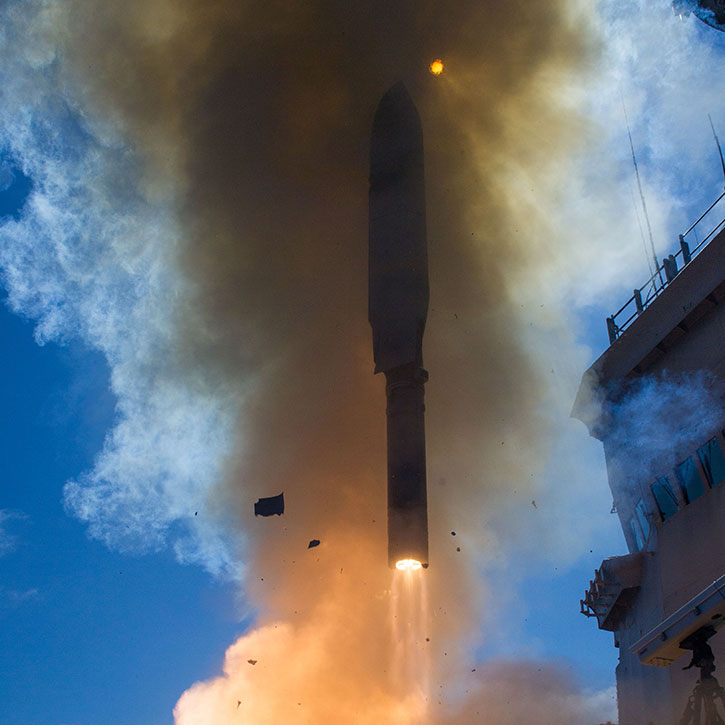
LRSAM began as a DARPA program at the 2009 request of U.S. Pacific Command to rapidly field a modern air-launched, anti-ship weapon. The Air Force is scheduled to field the missile with the B-1B in 2018, and the Navy expects to add it to the F/A-18E/F armament by 2019, enhancing the carrier air group attack capability. A booster-strapped variant is also in development, equipping Mk-41 vertical launchers on surface ships.
F/A-18E/F will also receive LRASM missiles by 2019, adding organic, extended and improved anti-ship capability to the carrier air groups. Photo: US NavySurface launched LRASM will also deploy in Mk-41 vertical launchers as part of the Navy’s follow-on phase, offensive anti-surface warfare Increment II. Photo: Lockheed Martin
LRASM is designed to detect and destroy specific targets within groups of ships by employing advanced technologies that reduce dependence on intelligence, surveillance and reconnaissance platforms, network links and GPS navigation in electronic warfare environments. Relying on an advanced, long-range sensor LRASM attacks targets within a group of enemy ships protected by sophisticated enemy air defense systems.
By its ability to discriminate and conduct tactical engagements from extended ranges LRASM will be most suitable for operations against heavily protected naval groups, as well as against enemy hidden in congested waters, where targets are masked by civilian or other military vessels of smaller value.
Adding disruptive capabilities to the weapon, the Pentagon also plans to equip the same JASSM-ER stealthy airframe with Counter-Electronics High Power Microwave (CHAMP) effectors developed by Boeing, to enabling the non-kinetic electronic attack.
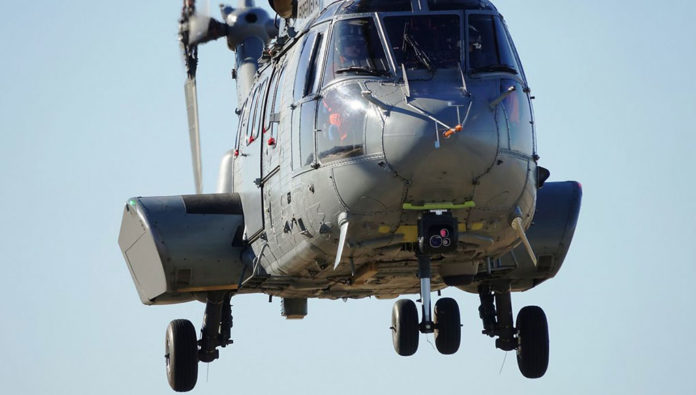
The EAGLE vision system installed on this H225 helicopter flying testbed improves situational awareness and reduces the pilot’s workload by automating and securing approaches, take-off and landing. Photo: Airbus
Airbus Helicopters has begun in-flight experimentation with its ‘Project Eagle’, an innovative onboard image processing system aimed to perform automatic approaches and landing in challenging conditions.
The EAGLE codename that stands for ‘Eye for Autonomous Guidance and Landing Extension’ represents an optronic system that federates the entire helicopter’s image processing functions and feeds them into the avionics system, thus improving the crew’s situation awareness and reducing the pilot’s workload by automating and securing approaches, take-off and landing in degraded visibility environment (DVE). gyro-stabilized optronics package, which includes three high-resolution cameras and state-of-the-art processing units, as well as onboard video analytics providing advanced functionalities such as object detection and tracking, digital noise reduction as well as deep learning. The system is designed to be integrated on a variety of existing and future Airbus vertical take-off and landing (VTOL) vehicles.
Initial test flights performed on an H225 flying testbed have demonstrated the system’s ability to select a small ground “target” from ranges of up to 2 miles (3.2 km) and to automatically track it during the approach performed by the pilot. The flight tests have also validated Eagle’s architecture and main components, such as the gyrostabilized optronics package and the processing unit. The next steps of the testing campaign will focus on coupling Eagle with the automatic flight control system to fully automatize the approach to a selected landing area.
“While existing missions such as search and rescue and offshore transportation will benefit from Eagle’s capabilities, the system will also help address future requirements for operations in urban environments”, said Tomasz Krysinski, Airbus Helicopters Vice-President Research & Technology. “Ultimately, thanks to its ability to provide increased situational awareness, Eagle will also contribute to improving the safety, autonomy, and performance of future unmanned vehicles.”
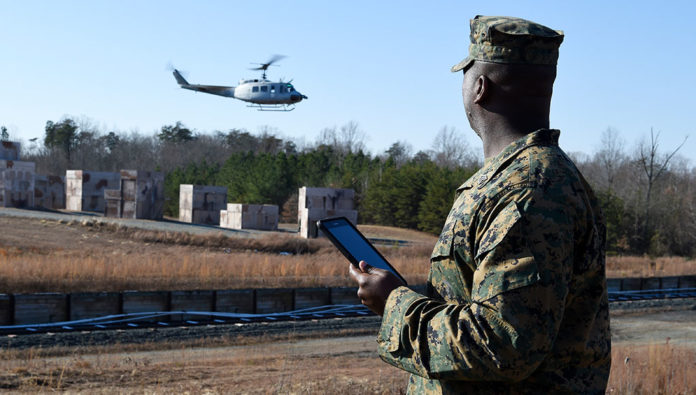
Sgt. Dionte Jones watches as a UH-1 Huey equipped with the Office of Naval Research-sponsored Autonomous Aerial Cargo/Utility System (AACUS) autonomy kit departs the landing zone following a resupply mission he requested using a handheld tablet at Marine Corps Base Quantico. Photo: US John Williams, ONR
The Marine Corps examined an innovative autonomous flying capability that enables troops to safely and reliably control helicopters from the ground, even in difficult weather conditions. The demonstration flight took place this week at the Marine Corps Base Quantico, Va., as the Office of Naval Research (ONR) announced the successful conclusion of the Autonomous Aerial Cargo/Utility System (AACUS) program.
The need for this capability surfaced during Marine Corps operations in Afghanistan and Iraq, experts say. Cargo helicopters and resupply convoys of trucks bringing fuel, food, water, ammunition and medical supplies to the front lines frequently found themselves under fire from adversaries—or the target of roadside bombs and other improvised explosive devices.
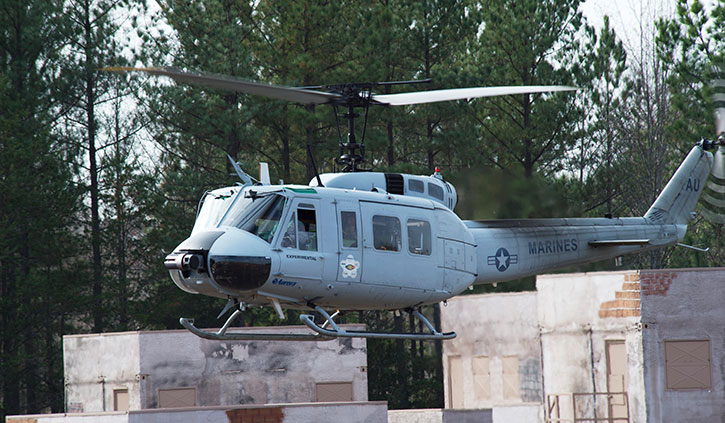
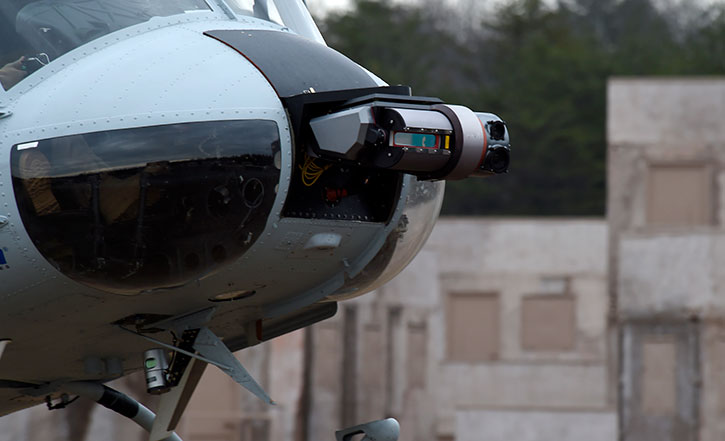
The AACUS-Enabled UH-1H (AEH-1) conducted multiple flights, showcasing its ability to autonomously execute re-supply missions in relevant and austere settings. The system consists of lidar and camera sensors and software package that detects and avoids obstacles and evaluates the landing zone. The system processes this information to perform onboard mission, route, and path planning to enable autonomous mission execution. The autonomy kit can be integrated into any manned or unmanned rotary-wing aircraft to detect and avoid obstacles (like telephone wires, other vehicles or large ground objects) in unfavorable weather conditions, or to facilitate autonomous, unmanned flight.
AACUS is designed for simple use; an operator with minimal training can call up the supplies needed and order the flights using only an intuitive handheld tablet. During the Dec. 13 demonstration tests at Quantico, a Marine with no prior experience with the technology was given a handheld device and 15 minutes of training. Photo:
The AACUS suite enables a Marine on the ground to request a supply delivery via helicopter from a handheld tablet, requiring no advanced training to operate the system. “The Marines’ vision for the future of vertical lift operation and support is optionally-piloted aircraft,” said AACUS Program Manager Stephen Chisarik. “Aurora’s system enables any rotary-wing aircraft to detect and react to hazards in the flight path, and make appropriate adjustments to keep the aircraft safe.”
“This is more than just an unmanned helicopter,” said Dr. Walter Jones, ONR executive director. “AACUS is an autonomy kit that can be placed on any rotary-wing platform and provide it with an autonomous capability. Imagine a Marine Corps unit deployed in a remote location, in rough terrain, needing ammunition, water, batteries or even blood. “With AACUS, an unmanned helicopter takes the supplies from the base, picks out the optimal route and best landing site closest to the warfighters, lands, and returns to base once the resupply is complete—all with the single touch of a handheld tablet.”
A UH-1 Huey equipped with AACUS autonomy kit that includes cameras and Lidars (forward and bottom). The kit can be applied to any manned or unmanned rotary wing aircraft to enable autonomous flight, obstacle avoidance, automatic approaches, landings and takeoffs. (U.S. Navy photo by John F. Williams, ONR
“It can be used as a pilot aid to operate in GPS- and communications-denied arenas, or allow fully autonomous flights in contested environments—keeping our pilots and crews out of harm’s way.” Dennis Baker, AACUS program manager explained. Aurora has developed multiple technologies under the AACUS program: the digital flight control system which enables the UH-1 to fly autonomously; and the Tactical Autonomous aerial LOgistics System (TALOS) autonomy technology.
While previous demonstrations have showcased the system’s autonomy capabilities and interactions with trained operators, this was the first demonstration in which the aircraft performed cargo and utility missions in an operationally-relevant training environment with Marine interaction. As part of the demonstration, Marines loaded supplies for the aircraft before clearing the autonomy system for autonomous takeoff.
The AEH-1 was granted a Special Airworthiness Certificate by the Federal Aviation Administration (FAA) in October, allowing the aircraft to operate autonomously with only a safety pilot onboard to monitor the controls. Having completed the third and final phase of the program, AACUS will now transition to the Marine Corps for experimentation and potential acquisition.
As the SDB II program is nearing completion of developmental testing Raytheon has completed the first production lot of the Small Diameter Bomb II (designated GBU-53/B) at its fully-automated manufacturing facility in Tucson, Arizona. The U.S. Air Force has already contracted with Raytheon to produce Lots 2 and 3.
The SDB II bomb is a gliding precision weapon with a one-of-a-kind tri-mode seeker that uses millimeter wave radar, uncooled imaging infrared guidance and semi-active laser guidance to find its targets. The weapon’s two-way datalink allows it to receive in-flight target updates. Once fielded, SDB II will enable pilots to engage more targets at ranges greater than 40 miles using fewer aircraft. “SDB II does much more than hit GPS coordinates; it detects, classifies and engages targets when it is integrated on the F-35A, this weapon will also help the world’s most advanced fighter jet reach entirely new targets,” said Mike Jarrett, Raytheon Air Warfare Systems vice president.
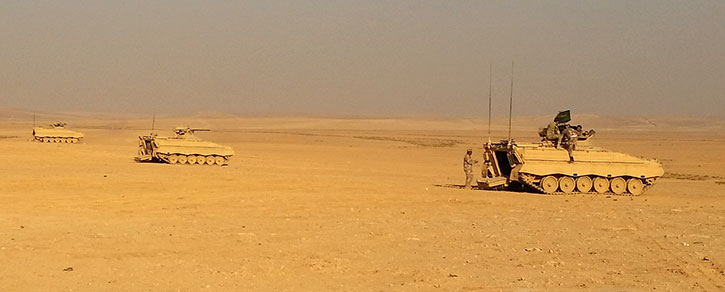
The Jordanian Army has already received 25 German Marders in 2017 and is slated to get 25 more in 2018. Photo: Rheinmetall
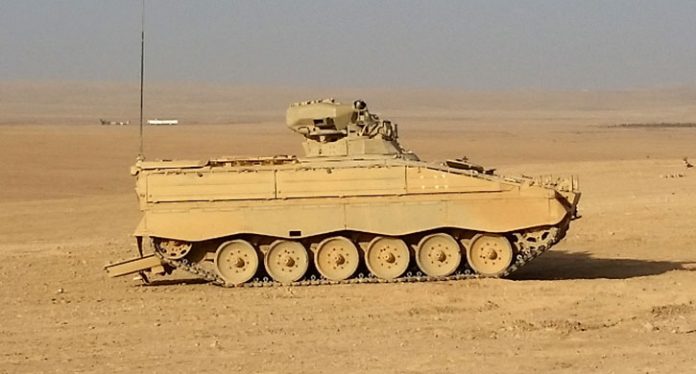
The German government has contracted with Rheinmetall to upgrade 25 Marder 1A3 Infantry Fighting Vehicles (IFV) from Bundeswehr surplus stocks. The first order for 25 Marders was received in 2016 and delivered to Jordan in 2017. The new vehicles will be delivered at the beginning in the first quarter of 2018. The €17 million order for the Marders was booked in October 2017. Chile and Indonesia have also received Marders from Bundeswehr German surplus. The Marder 1A3 IFV weighs about 35 tons. It is powered by a 600 HP-engine enables a top speed of around 65 km/h. The vehicle is armed with a turret mounting a 20mm RH-202 automatic cannon and has a fighting compartment seating nine soldiers. serves as the vehicle’s main armament.
Jordanian Marder IFVs lined up at a desert range. Photo: Rheinmetall
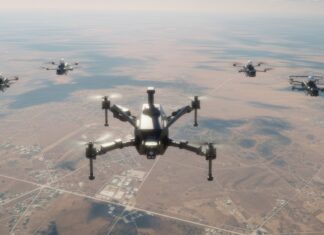
Lockheed Martin Skunk Works® and XTEND have achieved a major milestone in JADC2 by integrating the XOS operating system with the MDCX™ autonomy platform. This technical breakthrough enables a single operator to simultaneously command multiple drone classes, eliminating the friction of mission handoffs. From "marsupial" drone deployments to operating in GPS-denied environments, explore how this collaboration is abbreviating the data-to-decision timeline and redefining autonomous mission execution.
As traditional defense primes face mounting competition from agile “neoprimes” such as Anduril, Palantir and Helsing, the balance of innovation is shifting toward software-defined warfare and scalable, dual-use technologies, while global industry consolidation—marked by Boeing’s integration of Spirit AeroSystems and other strategic mergers—signals an intensified race to secure control over the defense technology value chain. Our Defense-Tech weekly report highlights these trends.
In early October 2025, a coordinated wave of unmanned aerial system (UAS) incursions—widely attributed to Russia—targeted critical infrastructure across at least ten European nations. The unprecedented campaign exposed the fragility of Europe’s air defenses...
Executive Summary
The past week (September 18-25, 2025) represents an inflection point where strategic defense concepts have transitioned from doctrine to tangible reality. An analysis of global events reveals four primary, interconnected trends shaping an...
At the 2025 Air, Space & Cyber Conference, U.S. Air Force and Space Force leaders unveiled major updates on next-generation fighters, bombers, unmanned systems, and space initiatives, highlighting both rapid innovation and critical readiness challenges as the services race to outpace global competitors. A short version is available here, with a more detailed version for subscribers.
The Taipei Aerospace & Defense Technology Exhibition (TADTE) 2025 crystallized around four dominant strategic themes that collectively illustrate Taiwan's comprehensive approach to defense modernization amid escalating regional tensions. Based on a detailed report by Pleronix (available upon request). Includes a Podcast discussion on TADTE 2025's highlighting Taiwan's four strategic themes beyond the post's coverage.
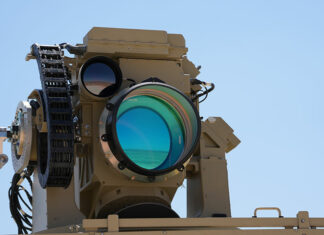
Israel’s Iron Beam 450 high-power laser system has completed final testing, marking a major leap in air defense. Developed by Rafael, it offers precise, cost-effective interception of rockets, UAVs, and mortars, and is set for IDF deployment by 2025.