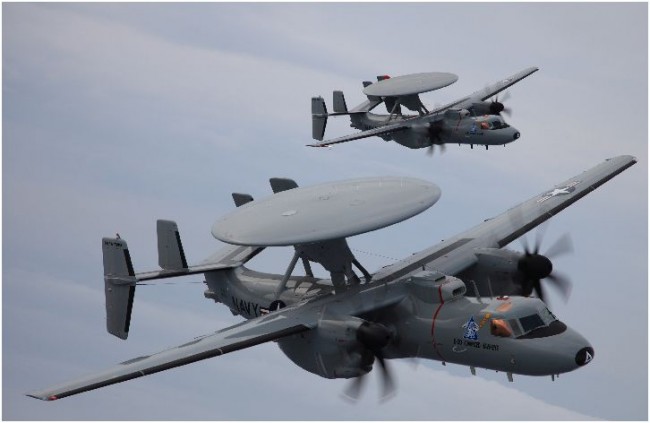
Northrop Grumman is highlighting some of the key technologies of its E-2D Advanced Hawkeye at Aero-India 2013, India as part of its focus on Intelligence, Surveillance and Reconnaissance (ISR) capabilities that are becoming critical to effective homeland security. According to Mary Petryszyn, vice president, International, Northrop Grumman Aerospace Systems, India is among the first countries for which the Advanced Hawkeye capability has been approved by the U.S. government. Such capability would significantly enhance the surveillance coverage, and security of India’s future catapult-equipped aircraft carriers which will be capable of launching such aircraft at sea. The display features the E-2D Advanced Hawkeye crew workstation and flyable cockpit simulator demonstrating military and civil applications.
Elbit Systems at Aero-India
The E-2D Advanced Hawkeye programme couples a newly designed electronically scanned radar with a matching suite of sensors, avionics, processors, software and displays to provide the most technologically advanced command and control capability available worldwide. The AN/APY-9 radar, with a two-generation leap in capability, is the backbone of this aircraft and provides greater flexibility and significantly improved detection and tracking over all terrains. To date, Northrop Grumman has delivered nine E-2D Advanced Hawkeye aircraft to the U.S. Navy. The programme completed Initial Operational Test and Evaluation in 2012 and Initial Operational Capability in the U.S. Navy fleet is on schedule for 2015.
Northrop Grumman is also displayng airborne surveillance capabilities will be highlighted with the MQ-4C Triton unmanned aircraft and the lighter-than-air Long Endurance Multi-Intelligence Vehicle (LEMV).
Triton is a maritime version of the combat-proven Global Hawk unmanned aircraft system. Developed for the U.S. Navy, Triton can fly missions for 24 hours at altitudes more than 10 miles, allowing the system to cover vast areas of ocean and coastal regions. The US Navy developed its future concept for maritime patrol using Triton in conjunction with the P-8 Poseidon, a manned surveillance platform that has also been purchased by the Indian Navy.
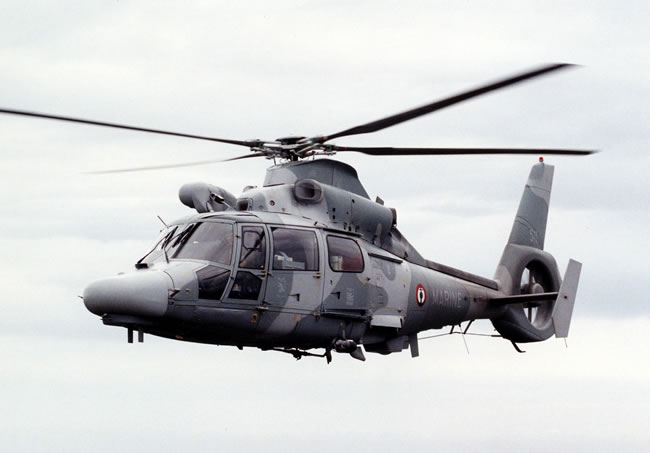
Eurocopter is proposing the AS565 MBe Panther to the Indian Navy’s planned acquisition of utility helicopters and the Indian Coast Guard’s anticipated purchase of ship-based light/medium helicopters. The Panther naval helicopter is displayed equipped with full armament complement.
“Eurocopter has made major investments in building up its product portfolio, which positions us to offer products that meet India’s mission requirements in bolstering its defense capabilities,” said Eurocopter President & CEO Lutz Bertling. “At the last Aero India event, we showcased the AS550 C3 Fennec, which was presented as the ideal replacement for India’s aging Cheetah and Chetak fleet. This time, we are bringing the combat-proven AS565 MBe Panther with a complete set of armament, which is in service in many military forces around the world.”
Eurocopter considers India as a key market, and has a long-established presence in the country. Its relationship with Hindustan Aeronautics Limited (HAL) during more than five decades has seen hundreds of Eurocopter helicopters built in India under license, along with the production of composite assemblies for AS550/AS350 helicopters as part of Eurocopter’s global supply chain. In 2010, the company became the first helicopter manufacturer to establish a full-fledged subsidiary with the creation of Eurocopter India.
The AS565 MB Panther is a militarized version of Eurocopter’s Dauphin family. According to Eurocopter, it has demonstrated its abilities in India – as one of this helicopter type’s largest civilian operators is the country’s Pawan Hans Helicopters, with a significant AS365 N3 Dauphin fleet. The AS565 MBe is a combat and utility helicopter suitable for both ship-borne and shore-based operations, and also serves as a highly capable search and rescue system for both day and night operations. Accompanying the helicopter’s display at Aero India will be a comprehensive armament suite for use in sea and ground warfare – including an anti-submarine warfare (ASW) torpedo, ASW depth charge, gun and rocket pods, and a 0.5-in. sniper rifle.
For naval missions, the Panther comes with a fully-certified 4-axis digital Automatic Flight Control System (AFCS) incorporating search and rescue modes, which enables search patterns to be flown automatically, along with automatic transitions to/from hover and automatic hover, as well as the ability to adjust the helicopter’s position from the hoist operator’s joystick.
Available for customer flights at Aero India 2013 will be an AS350 B3e from Davangere Sugar – the enhanced version of the single-engine AS350 B3, with exceptional lifting capability, extended range, fast cruise speed and great endurance in hot climates and high altitudes.
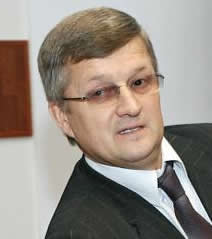
Deputy General Director of Russia’s state arms exporter Rosoboronexport, Viktor Komardin
Reflecting continued and rapid growth year over year, Aero India is hosting over 700 exhibitors this year, many of them foreign. International pavilions at the show highlight the growing interest from aerospace and defense industries from the US, Israel, Russia, France, the UK and Germany, as well as from many smaller countries, seeking to become second and third level suppliers and join the big party. 78 countries have sent official delegation, representing a significant increase in the international footprint of the airshow, reflecting the growing role of the Indian market in the international aerospace industry.
Visit IAI at Aero-India
The reasons for that are obvious. In contrast to other defense markets maintained stagnant at best, New Delhi has increased its defense spending by 13% from last year, spending 1.93 trillion rupees ($36 billion) for defense in the financial year through March 2013. Almost half of this budget is allocated to buying more weapons. Russia, still India’s biggest weapons supplier, is making up to 70% of the equipment used by Indian armed forces, but as New Delhi diversifies its sources of supplies, the US, France, Israel and Italy the UK are grabbing growing share of the pie. “Defense sales [between India and the U.S.], which have risen from just over $200 million in 2001, have increased to over $14 billion today,” said Ron Somers, president of the U.S.-India Business Council, in a statement. “This remarkable growth in defense sales translated to thousands of high-skill jobs being created both in India and the U.S., making it a win-win for both countries.”
Visit Elbit Systems at Aero-India 2013
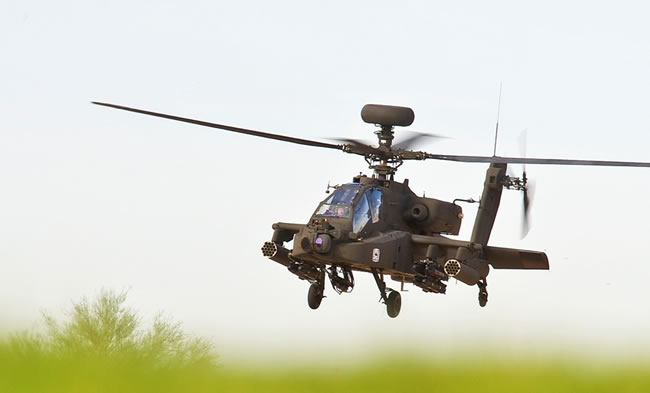
As western suppliers gain more business, the Russians are suffering. Last year Russian arms exporters suffered two painful losses at Indian tenders. Russia did not win the contract to supply 22 helicopters to India, which preferred the US AH-64D Apache to Russia’s Mi-28N. During the Medium Multi-Role Combat Aircraft (MMRCA) tender announced by the Indian Air Force to replace the aging MiG-21s, the Russian MiG-35 did not even make it to the finals, where the Eurofighter Typhoon twin-engine multirole fighter lost a contract worth at least $10 billion to France’s Dassault Rafale.
Nevertheless, Russia remains a key supplier of weaponry to India with good prospects for future military-technical cooperation. Last year alone, Russia concluded more than $3.5 billion’s worth of new arms export agreements with India, including the purchase of 71 Mi-17B-5 Hip helicopters and the delivery of assembly kits for 42 Su-30MKI Flanker fighters, while the current portfolio of Indian contracts is worth more than $7 billion. Future procurement of the planned stealth, fifth generation FGFA will also contribute to the Russian future portfolio with India. As for near future prospects, Russia would like to take another pass on selling the Be-200 amphibious plane, and hopes to win the Indian tender for 197 scout and surveillance helicopters with its new, lightweight Ka-226T model.
Deputy General Director of Russia’s state arms exporter Rosoboronexport, Viktor Komardin, told RIA Novosti on an interview yesterday that Russia must be ready to battle with foreign competitors over its share of the Indian arms market using advanced forms of military-technical cooperation. “We have abandoned the practice of simple selling, seeking more of joint programs to produce defense equipment, including for third parties. This gives us a chance to keep slightly ahead of our key rivals,” he said. An example of such cooperation is the development of the Russian-Indian Multi-Role Military Transport Aircraft (MTA), which is expected to fly for the first time in 2017 and enter production both in Russia and India in 2019. “We expect Rosoboronexport to annually ship at least $3 billion’s worth of weapons and material under the contracts that have already been signed with the Indian state clients,” Komardin said. An agreement to set up a joint venture to develop and produce the plane was signed between India’s Hindustan Aeronautics (HAL) and Russia’s United Aircraft Corporation (UAC) in New Delhi in September 2010.
According to the official, prospective agreements in the area of military-technical cooperation could be even more lucrative for Russia. “We are talking over plans to upgrade the country’s fleet of Ka-28 antisubmarine helicopters and Su-30MKIs, and to supply a batch of Mi-17V-5 to the Indian Interior Ministry. There are some other promising projects, too, and not just in aviation,” Komardin said.
Elbit Systems is promoting a range of helicopter-related products in a move that would tap the growing opportunities the company identified in the Indian market, both for foreign built, locally made or upgraded platforms. Over the years Elbit Systems has established a number of partnerships and cooperation in India, paving its way into many defense sector’s programs.
“Advanced avionic systems, particularly those related to helicopter modernization would fully comply for India’s needs “explains Bezhalel (Butzi) Machlis, until recently the General Manager of Elbit Systems’ Land and C4I Division. Machlis said such systems could also include instrumented landing systems (for operating in brownout conditions), obstacle avoidance, sensor payloads, communications and networking, integrated cockpit and helmet displays, defensive aids and DIRCM, for which the company is actively promoting its new MUSIC system for military and civil applications. “The increase in India’s helicopter and transport aircraft fleets, both of domestic and foreign designs, ope
Visit Elbit Systems at Aero-India 2013
n significant opportunities for us, both for our partners and for us, as original system manufacturers (OEM). We expect our long-term cooperation with HAL, as well as other partnerships would fit well to this trend.” Machlis added.
Local cooperation is part of Elbit Systems DNA, and is also part of its activity in every strategic market, including India “We already have an excellent cooperation with HAL, providing training and simulation systems, other partnerships are underway in other areas.” Machlis told Vayu.
“Our portfolio is big and diversified and not necessarily suited for one partner that can cover all. We are evaluating different opportunities and structures of cooperation and partnerships.” Machlis added, saying, “Gaining market position is what we look for. Seated close to your customer, your partner can better understand the requirements, be more flexible and responsive for evaluation and testing, or addressing specific issues.” Machlis explained. Elbit Systems has recently established a partnership with Bharat Forge, addressing the manufacturing, modernization and support of artillery systems.
Machlis was recently nominated to become the president of Elbit Systems, beginning in the second quarter of 2013, succeding Joseph (Yossi) Ackerman who served in this position for the past 16 years.
Elbit Systems of America has recently been awarded a contract from Boeing for the design and future upgrade of an enhanced mission computer for the US Army newest combat helicopter – AH-64E.
With annual sales of over US$3.4 billion, and orders backlog exceeding nine billion US$, IAI is ranked among Israel’s top five industries. As Israel’s largest aerospace and defense exporter, and an important supplier for India’s military services, IAI is involved in major programs that implements most advanced technologies.
New opportunities and growing competition are driving IAI to expand its Indian operations over a wider spectrum, entering new fields where it wasn’t present before. Carrying the company into the next decade, IAI’s President and CEO Joseph Weiss defines several pillars for IAI’s activities, including missiles, unmanned systems, special mission aircraft and network centric warfare – all are considered to be IAI’s primary growth engines.
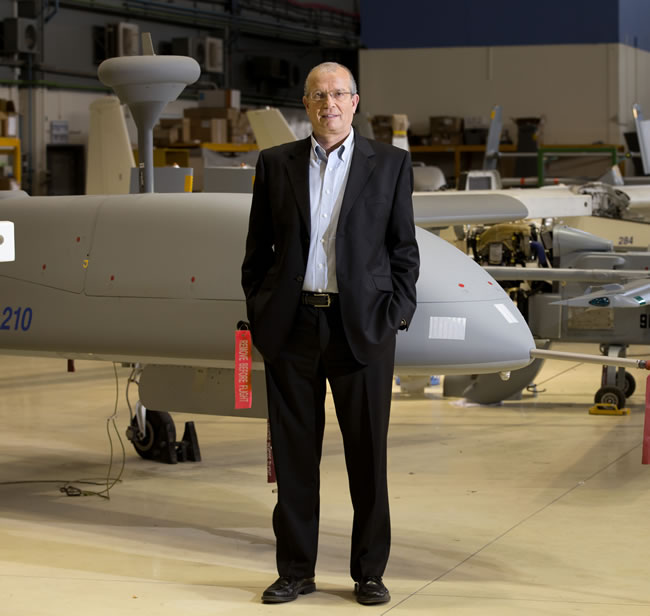
IAI’s President and CEO Joseph Weiss at the company’s HERON UAV production line
Fuelling the anticipated growth IAI has recently raised about US$317 million in public offering of bonds issued in the Tel Aviv Stock Exchange. The amount issued is impressive, since it is the largest offering conducted during 2012 in the Israeli capital markets. It was also IAI’s third and largest bond issuance. According to Weiss, it demonstrated the investor’s confidence in the company and its ability to maintain its competitive advantage over the long term, despite the challenges.
Visit IAI at Aero-India 2013 – Hal 6
In recent years India has become a strategic market for IAI, one that has the volume, requirements and sustainment to maintain long-term growth. Activities currently underway and also in the making are covering the broad areas of activities at IAI. To bring the corporate to focus on this strategic market IAI’s board of director nominated Eli Elfasi as VP for India. Before joining IAI Elfasi served as the Israeli Defense Attaché in New Delhi. He is expected to focus the company’s activities currently running in parallel lines, improving the synergy between the different divisions, plants and activities. The new function is expected to leverage new opportunities and better face growing competition.
“IAI is expanding its cooperation with local Indian companies, in the public and private sector alike.” Weiss told Defense Update, “Through this cooperation we seek to establish local production, service, and support for our products, as well as offering the necessary technology transfer and training for successful induction into service”. According to Weiss, through this continuous process local partners have successfully established and sustained domestic operations, a process that has also contributed to increasing IAI’s footprint in this important market.
Four Pillars for Growth
As for IAI’s pillars of growth, in the missiles domain, IAI sees the air and missile defense as an important growth opportunity. IAI’s leading edge in this area is the comprehensive network-centric integration of such systems, as reflected in the Barak 8 program currently underway for Israeli and international customers. In the UAS area IAI’s Heron family of Medium Altitude Long Endurance (MALE) is already positioned as a world leading UAS in terms of number of operators and operational hours.
Operating in Asia, Europe, North and Latin America and the Middle East, Herons are proving themselves on a daily basis as reliable, flexible and efficient combat-proven unmanned platforms, suitable for a wide range of missions. Of a particular value to India is the maritime surveillance version of the Heron UAS; its wide range of sensors has proved highly effective in supporting naval, maritime surveillance as well as homeland security missions.
IAI is investing much effort to further develop the Heron system, its ground segment, payloads and performance. Offering higher operating altitude, longer endurance and heavier payload capacity than most drones currently available on the world market, Heron TP is positioned to become a platform of choice for many European and Asian air forces.
IAI is optimistic about the prospects of Heron TP in international markets, particularly in Europe, where Heron TP is being considered for a number of strategic procurement programs and endorsed by domestic industrial partners in each market. These include Germany, where Rheinmetall Airborne Systems; France, where France’s largest aerospace company Dassault Aviation promotes the drone, promotes Heron TP. The Heron TP is also considered for a similar program in Poland.
In the segment of special mission aircraft IAI’s systems are already operational with a number of customers worldwide with maritime surveillance, intelligence gathering (SIGINT), and Aerial Early Warning (AEW).
IAI expects commercial aviation business line to continue and thrive, reflecting an expected recovery in the global economic market and specifically in commercial aviation. The company has recently completed Federal Aviation Administration (FAA) certification of the G280 medium-size business jet built for Gulfstream.
Space is another growth area for IAI. The company currently has several satellite programs underway, for communications and surveillance satellites. Of special importance for India is the Amos-4 satellite, built for Spacecom, it is scheduled for launch in June 2013 from Baikonur, Kazakhstan. Once positioned at 65°E It will cover Russia, India and the Middle East with multiple Ku and Ka transponders creating a powerful platform, enabling a wide range of cross-band, cross-beam connectivity options.
IAI has also commenced the construction of Amos 6 – the next generation communications satellite, offering new capabilities unavailable before. Other satellite projects currently on the horizon including various reconnaissance satellites based on the latest Opsat 3000 platform.
Oron Oriol, RAFAEL's VP Marketing & Business Development
In recent years RAFAEL has won significant orders from India and, anticipating more business in that country, the Israeli company is preparing to expand its sourcing and cooperation in India assuming more offset obligations resulting from those orders. “RAFAEL is interested in establishing partnerships and cooperation where we can transfer some of our technologies and production capabilities.” Oron Oriol, Rafael’s VP for marketing and Business development told Defense Update and Vayu on a recent interview; “India is not exceptional in this strategy, we have followed these lines in our business in Europe and the USA and we expect this proven practice to be successful in the Indian market” Oriol added. In his previous position Oriol has lead RAFAEL’s business in the USA, paving close partnerships with US primes like Northrop Grumman and General Dynamics.
RAFAEL is already working with several companies in India, including Bharat Dynamics Limited (BDL), which will assume local support for RAFAEL’s missile systems delivered to India. “I am confident we’ll reach similar cooperation concerning future prospects.” Oriol said, RAFAEL is not limiting its cooperation to the public sector units, and have discussed various terms of partnership and joint ventures with a number of companies in India – including private sector enterprises. “At this stage we haven’t concluded such terms but I am confident we shall reach an understanding when the time comes.”
One of RAFAEL’s strengths in international cooperation is its flexibility in adhering to local conditions. “As a design authority, we know what requirements should be maintained and what could be eased slightly, thus opening a window of opportunity for local subcontractors and suppliers, particularly those qualified to produce for the commercial market, thus having the high quality levels required for such products” Oriol added that military qualifications are not necessarily mandatory in every product, since it is up to the prime contractor to ensure the entire system meets the necessary requirements as specified by the customer. “To remain competitive against tough competition you must know how to adjust to your customer’s local environment and not demand him to adjust to you,” Oriol explained.
Part of this adjustment is Rafael’s proven ‘Design to Cost’ approach, selectively implemented in major programs in recent years has also become a critical advantage when facing growing competition. “We embraced this concept in several successful programs, the most recent was ‘Iron Dome’, where a complete weapon system was developed and fielded in record time, within budget, following methodical ‘design to cost’ principles.” Oriol said. This system was not only economical; it proved itself in combat beyond expectations, scoring over 80 percent success in over 500 successful interceptions of enemy rockets and missiles. According to Oriol, Iron Dome demonstrated that our design to cost process works. “We could create an interceptor that will deliver 5 percent more, but that would cost five times more.” He said this concept can also be implemented in other areas, including Electro-optics, NCW and C4I.
RAFAEL will be displaying Iron Dome at Aero India 2013, along with other air defense systems, offering the system as an active defense against rocket attacks as well as a Very Short Range Air Defense System (VSHORAD).
Israel launched a rare airstrike inside Syria, U.S. officials said Wednesday, targeting a convoy believed to contain SA-17 anti-aircraft missile systems bound for Hezbollah militants in Lebanon. AP reported from Lebanon.
Israel has constantly monitored the deterriorating situation in Syria, and has openly expressed its determination to attack and destroy military assets seeping from Syrian military to Lebnon or extremist terror groups. Such strategic assets include chemical weapons, coastal defense, air defense and ballistic missiles.
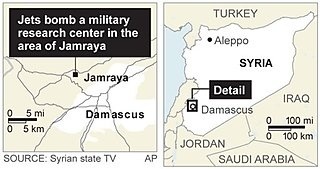
The attack that occurred overnight Tuesday, targeted a Syrian site near the Lebanese border; a Syrian military statement said the Israeli attack destroyed a military research center northwest of Damascus. The Syrians denied a shipment of such weapons taking place. They appeared to be referring to the same incident. The strike destroyed the center and damaged a nearby building, killing two workers and wounding five others, the Syrian statement said.
Sophisticated Russian-made SA-17 anti-aircraft missiles, if acquired by Hezbollah, would be “game-changing” weapons, enabling the militants to threaten Israeli jets at medium and high altitudes as well as helicopters and surveillance drones flying at medium to low altitudes.
In a statement, the Syrian military denied the existence of any such shipment and said a scientific research facility in the area of Jamraya, outside Damascus was hit by the Israeli warplanes.
The Israeli military declined to comment. However, many in Israel worry that as Syrian President Bashar Assad loses power, he could strike back by transferring chemical or advanced weapons to Hezbollah, which is neighboring Lebanon’s most powerful military force and is committed to Israel’s destruction.
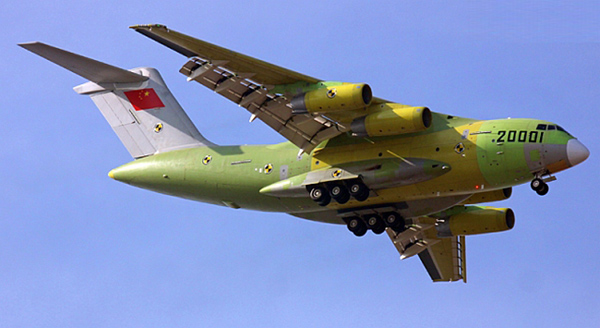
The Xian Y-20 is expected to be displayed at this year's Zuhai airshow, along with China's new stealth fighter - the J-31, bot are currently in flight testing.
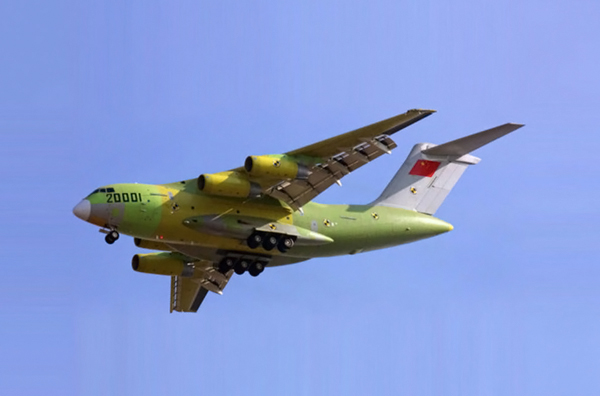
The highly anticipated first flight of China’s new Y-20 four-engined heavy cargo jet completed successfully today. (video)
The Xian Y-20 approaching landing on its first flight.
The Y-20 (Yun-20 or Transport-20) is the culmination of China’s long quest to domestically manufacture a large “strategic airlifter”. A product of the Xi’an Aircraft Industrial Corporation, only two prototypes of the 100,000 kg (220,400 lb), 50 meter wingspan jet have been produced to date. The plane is powered by four Russian-built Soloviev D-30KP-2 engines. Regular production Y-20 jets will carry Chinese-built WS-20 turbofan engines instead.
Since December of 2012 the Y-20 has been conducting ground-based testing including runway taxi tests. Operated by a crew of three, the Y-20 is designed to carry up to 60 tons of cargo up to 4,400 km (2,734 miles) at a cruise speed of Mach 0.75 and with a service ceiling of 13,000 meters (42,700 ft).
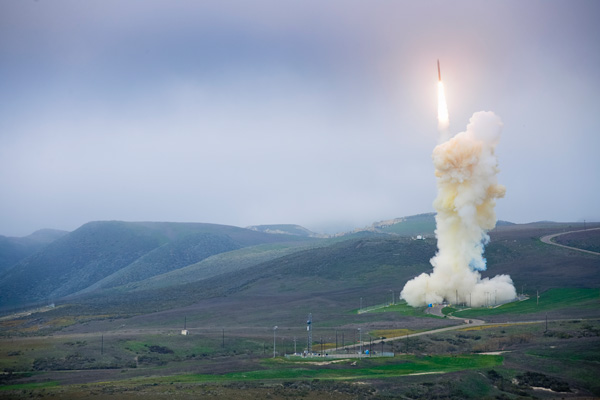
Ground-based Midcourse Defense (GMD) system Launch, 26 January 2013. Photo: MDA
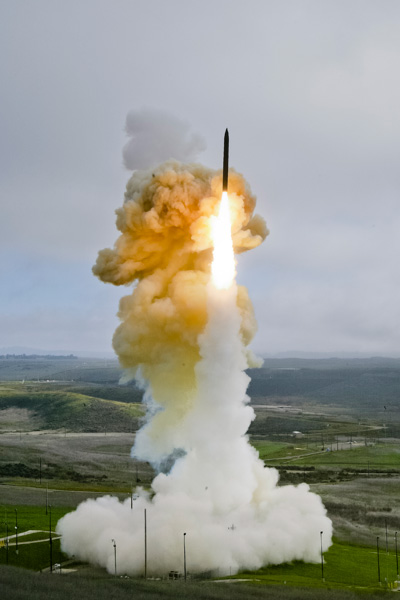
The U.S. Missile Defense Agency (MDA) resumed testing the Ground-based Midcourse Defense (GMD) system yesterday, launching the GMD interceptor on a successful flight. The missile GMD is the United States’ only defense against long-range ballistic missile threats. GMD flight testing was halted in early 2011 after a guidance error resulted in a failed intercept in a December 2010 test.
Ground-based Midcourse Defense (GMD) system Launch, 26 January 2013. Photo: MDA
On the recent flight the GMD Ground-Based Interceptor (GBI) carried a next-generation Exoatmospheric Kill Vehicle (EKV), measuring the conditions it was subjected to through the various phases of the flight. According to Wes Kremer, Raytheon Missile Systems’ vice president of Air and Missile Defense Systems, the EKV performed as planned During the test, maneuvering the interceptor to the appropriate altitude and closing velocity required for an intercept. Data gathered during the test will be used to validate the EKV’s design. “This test allowed us to challenge the EKV in a series of realistic outer-space environments, which gives us a broad range of data prior to moving toward an intercept scenario,” said Kremer. “This test moves us one step closer to an intercept flight test in 2013.”
“Returning to flight has been the top priority for the GMD program. We have used industry and government’s combined expertise to solve a complex technical issue related to what the interceptors’ EKV experiences in space,” said Norm Tew, Boeing vice president and GMD program director. “Today’s success is an important step toward our next goal of a successful intercept test.” Boeing is the prime contractor for the GMD system.
The test, designated Ground-Based Midcourse Defense Control Test Vehicle (GM CTV)-01, is part of an extensive test series initiated after the Flight Test Ground-Based Interceptor (FTG)-06a failure in December 2010. The Exoatmospheric Kill Vehicle flown during GM CTV-01 was modified based on findings from the FTG-06a Failure Review Board. This test is the critical first step in returning GMD to successful intercept testing.
Photo: MDA
The EKV is designed to destroy incoming ballistic missile threats by colliding with them, a concept often described as “hit to kill.” To achieve an intercept the EKV uses an advanced multi-color sensor used to detect and discriminate incoming warheads from other objects. The EKV has its own propulsion, communications link, discrimination algorithms, guidance and control system, and computers to support target selection and intercept. EKV has had eight successful intercepts throughout the life of the program.
GMD is an integral element of the United States’ layered ballistic missile defense architecture. With interceptors deployed at Vandenberg and at Fort Greely, Alaska, the program consists of command-and-control facilities, communications terminals and a 20,000-mile fiber-optic communications network that interface with ballistic missile defense radars and other sensors. Boeing has served as prime contractor since 2001 and works with industry partners Northrop Grumman, Orbital Sciences Corp. and Raytheon.
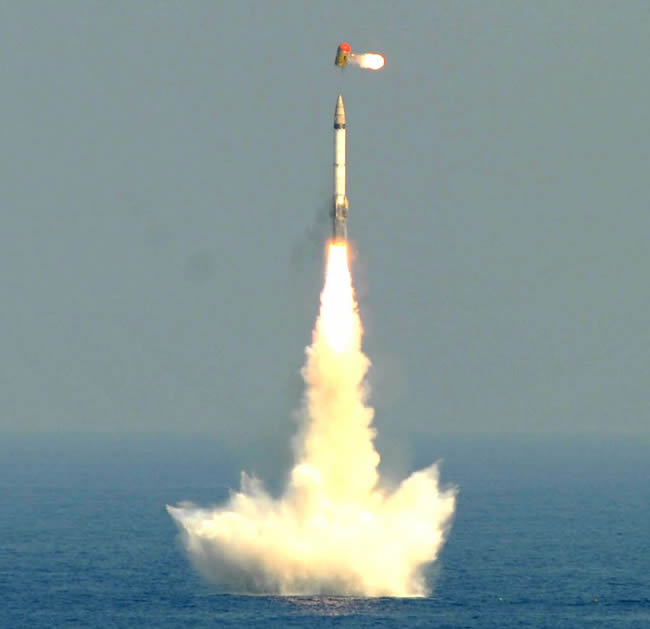
Moving a step closer to completing its nuclear triad, India today successfully test-fired a submarine launched ballistic missile, with a strike range of around 750 kilometres. The K-15 Sagarika missile was launched from an underwater pontoon simulating a submarine launcher, in Bay of Bengal. Defence Research and Development Organization (DRDO) chief VK Saraswat told the Indian press that all the test parameters of the test firing were met.
According to Saraswat, the test concludes the development phase of the K-15 missile, and the missile is now ready for deployment on various platforms including the indigenous nuclear submarine INS Arihant which is under development.
So far, India had the capability of delivering nuclear weapons from land and aerial platforms only. The missile-equipped submarine will provide the third leg of the strategic TRIAD nuclear deterrence India has been seeking to establish. India has a no-first-use policy for nuclear weapons and the development of an SLBM boosts its retaliatory strike capability, experts said.
K-15 is part of the family of underwater missiles being developed by the DRDO for the Indian strategic forces’ underwater platforms. DRDO’s Hyderabad-based Defence Research and Development Laboratory (DRDL) have developed this ballistic missile. This is the first missile in the underwater category to have been developed by India. Officials said more than 10 trials of the missile have been performed earlier. Today’s was the last development trial of K-15. India is also developing three additional underwater missiles for its submarines, including K-4/5 (3,500 km range), the two-stage, subsonic Nirbhay loitering cruise missile reaching 1,200 km and the Brahmos super-sonic cruise missile 290 kilometres respectively. The Nirbhay was reportedly being prepared for a test flight in February 2013.
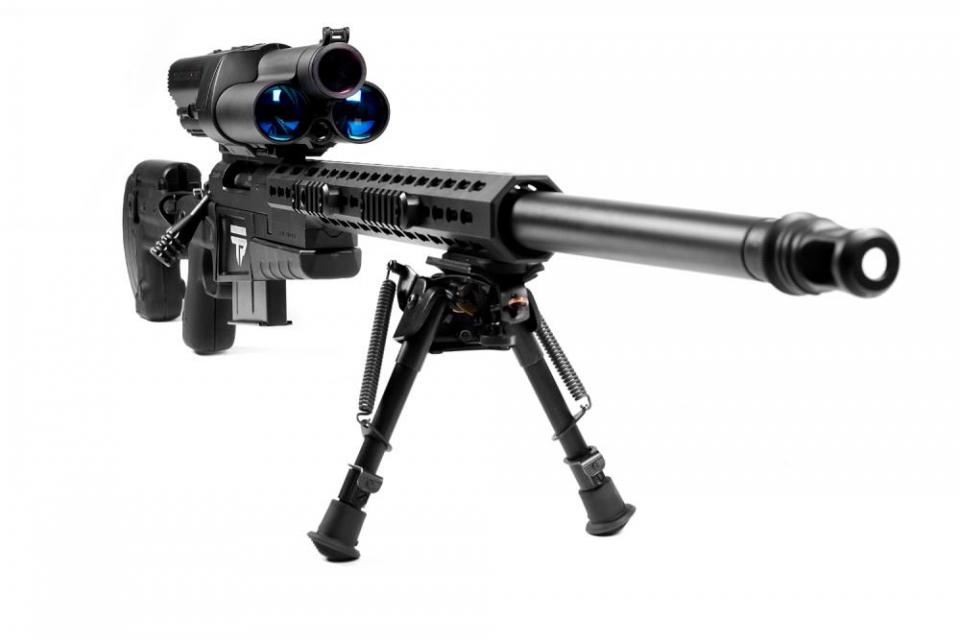
XS3 is the smallest PGF version, mounted on the .300 Winchester Magnum Surgeon rifle
TrackingPoint has introduced an accurate long-range shooting system at the Shot Show taking place this week in Las Vegas, Nevada. Defense-Update reports.
The new system called ‘Precision-Guided Firearm’ (PGF) system is based on patent-pending innovations in optics and fire control that enables a shooter to excel in long-range shooting. “The PGF will completely change the game for traditional long range shooting competitions,” said TrackingPoint President Jason Schauble. The product in its present form aims at the competition and sports and hunting markets, but it could also have applications in military and law enforcemnet as well. “because of its exceptional long-range accuracy, we plan to develop a whole new set of competitions and championships to challenge the PGF-enabled shooter” Schauble added.
Typical elements included in the ballistic calculation are range to target, wind speed (manually set by shooter), shot angle, rifle cant, pressure and temperature. All elements and more are displayed in the HUD along with reticule marks and target movement cues. In addition to aiming assistance the TrackingPoint PGF also records each shot taken for debriefing. It also and includes a microphone to capture voice recordings. Recorded shots can be downloaded to popular smartphone models.
For the military, the PGF has the potential to provide squad overmatch capability, particularly in asymmetric combat, enabling the warfighter to engage targets at stand-off ranges. “We expect the TrackingPoint PGF innovation to change doctrine and tactics, and it has the potential to act as a deterrent to war,” Schauble added. For military applications, the PGF will enable a shooter to become effective at ranges longer than they are currently qualified for. “PGF collapses target engagement times from minutes to seconds, and increases success rates dramatically” Schauble added that the PGF reduces training time, enables mastery persistence (since follow-up training is minimal).
A similar system employing even more advanced measurement of atmospheric conditions has been developed under the DARPA ‘One Shot XG’ program since 2007. This system accurately measures the range to the target, the atmospheric and geodetic conditions and the crosswind velocity down range, utilizing an invisible laser beam. The Marine Corps Warfighting Lab expects to get the first eight XG systems in December 2013 to proceed with test firing and user evaluation (read more about the One Shot system).
Tracking Point Networked Tracking Scope – a Precision Guided Firearm
To execute the perfect shot with TrackingPoint’s exclusive Tag-Track-Xact technology, the shooter tags a target with a simple point-and-click, automatically setting up the shot and persistently tracking the static or moving target. Over 20 ballistic variables including range, wind, target velocity, shot angle, rifle cant, temperature, pressure, and coriolis are instantly calculated into a perfect firing solution. The shooter simply realigns the reticle with the tag point and pulls the trigger. The PGF’s guided trigger is connected to the tracking optics, and if the shooter is misaligned, the PGF-guided trigger increases in weight, pushing back on the shooter to defer firing until the shooter is perfectly aligned.
Three PGF products will be available in May 2013, all will include a networked tracking scope, rifle and advanced precision loaded ammunition, as well as a companion iPad mini. The three types include TrackingPoint XS1, with a 338 Lapua Magnum with 27″ barrel, effective up to 1,200 yards firing 300 grain Sierra Match King ammunition; The XS2, with 300 Win Magnum with 22″ barrel, firing 220 grain Sierra Match King ammunition to 1000 yards and the XS3, also a 300 Win Magnum – a McMillan A5 with adjustable cheek piece and 22″ barrel, firing 190 grain Barnes LRX™ ammunition to 750 yards.
The XS1 is the largest-caliber Precision Guided Firearm (PGF) available today. It offers the longest Tag Track Xact effective range of any PGF. Photo: TrackingPoint
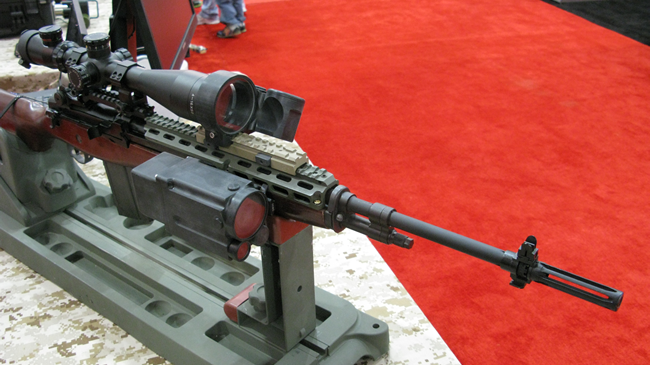
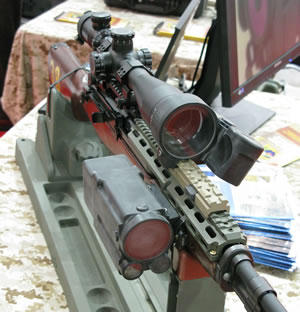
Because of interest expressed by services, One Shot XG is being developed to create a sniper fire control system significantly smaller than the original model. The One Shot XG will be “clipped-on” directly to the weapon, eliminating the need for a spotter/observer in future sniper operations. Photo: Tamir Eshel, Defense-Update.
Snipers have become a determining factor in asymmetric combat, for their capability to gain measured and surgical effects with minimum collateral risk. However, where snipers are called to engage targets at extended ranges (1-2 km), their capability to get ‘one shot – one kill’ is eroded. Training, weapon improvement or optics cannot bridge this gap.
Military snipers may only get one chance to hit their target. The One Shot program seeks to enable snipers to accurately hit targets with the first round, under crosswind conditions, day or night, at the maximum effective range of the weapon. A commercial system providing similar capabilities (tough not as advanced in down-range measurement as the DARPA system) was unveiled by TrackingPoint at the Shot Show 2013.
DARPA has demonstrated that an integrated approach that corrects the major causes for error, can improve sniper performance dramatically, when used as an integrated, ergonomically engineered system. The program began n 2007 and has currently reached an advanced stage with size, weight and power reduced into a man-portable sized systems.
One Shot XG developed by Cubic Defense Applications under a $6 million DARPA contract incorporates lessons learned and the user input received during the program developmental testing cycles. Integrated on the sniper scope, or the observer’s telescope for conventional two-man operation, DARPA’s One Shot XG system aims to increase the first round hit probability of the sniper team, thus reducing target engagement time by reducing the number of rounds spent to score the first hit. The system is also designed for application on the sniper’s scope, for individual use. One Shot XG accurately measures the range to the target, the atmospheric and geodetic conditions and the crosswind velocity down range utilizing an invisible laser beam. Calculating all this data into a ballistic solution, One Shot displays a corrected aim point on the sniper scope’s reticule. The system has demonstrated 400 percent improvement in first hit probability and reduced rounds to first hit by 230 percent. Overall, engagement time has been reduced by 35 percent.
The initial OneShot system was designed to be operated by the spotter, assisting multiple snipers with more accurate ballistic solutions. Photo: via DARPA
Through the development since 2007 the system’s weight has been reduced from 5.7 kg day-only solution for a two-man team to 1.4 kg day/night system operated by a single sniper. The system’s volume has also diminished from 8.6 litres to 1.2 litres.
The new version – One Shot XG represents the next-generation of the system. The program should complete Phase 2E in spring 2013, which will reduce system size, weight and power and extend the engagement range. The Phase 2E system will mount on a conventional spotting scope, and prototypes are expected to be available for field evaluation in spring 2013. The Marine Corps Warfighting Lab expects to get the first eight XG systems in December 2013 to proceed with test firing and user evaluation.
This next-generation One Shot envisions a compact observation, measurement, and ballistic calculation system mountable on either the weapon or spotting scope. If proven successful, One Shot XG would lead to limited rate production with the military services taking on the requirement and acquisition role for future procurement.
One Sot XG developer Cubic previously received DARPA funding to develop a two-way optical communication system called the dynamical optical tags (DOTs), that led to the delivery of retro reflection tags and laser interrogators. Cubic is currently a subcontractor to prime contractor Teledyne for the EXACTO guided .50 caliber bullet, another DARPA program. System-level live fire testing of the EXACTO technology were scheduled for late 2012.
In a company funded test series conducted in December 2012 Raytheon said it has validated the maturity and accuracy of its Quick Kill Active protection System (APS), in anticipation for further evaluation of APS systems by the US Army, as the service evaluate means to protect its combat vehicles from shoulder-fired and tube-launched Rocket Propelled Grenades (RPGs),
In a recent test, held in December 2012, Raytheon said its Quick Kill APS demonstrated its protective capability by successfully defeating an extended set of threats, including one of the most lethal RPG threats by destroying it in mid-flight. All testing is in preparation for formal government evaluations in early 2013 to demonstrate the system’s unique RPG-defeat capabilities.
The Quick Kill system consists of a multi-mission, fire-control radar that detects and tracks incoming threats, combined with hard-kill countermeasures that serve as a hit avoidance system, enabling multi-tracking and multi-engagement of enemy fire for vehicle and squad protection. The system’s vertical launch countermeasure is unique in its ability to engage threats fired from any angle or elevation, providing all weather, full 360 degree hemispherical vehicle and crew protection with each countermeasure. In previous tests, the system demonstrated its ability to defeat multiple threat types both from a stationary and an on-the-move platform – and it showed its multi-threat capability by defeating two simultaneous threats.
“Raytheon’s APS is based on the same radar technology deployed to perform sense and warn operations at active Forward Operating Bases. It has been extremely successful in providing timely warning against rocket and mortar attacks,” said Jeff Miller, vice president of Combat and Sensing Systems for Raytheon’s Network Centric Systems business. “With Quick Kill,” he added, “Raytheon has matured a highly advanced system, offering our forces an unprecedented force protection capability that is essential to the future survivability of combat vehicles. This technology is ready and could begin fielding within a year.”
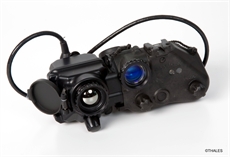
Lucie night vision viewing and information display system. Photo: Thales Group
Under the initial order, a total of 900 soldiers (90 infantry sections or squads) will be outfitted with the new equipment. German infantry units due to deploy to Afghanistan in 2013 and 2014 will be the first to be equipped with Gladius. Rhenmetall received the first contract in June and has awarded Thales a subcontract for the supply of 30 unit systems (with provisions 300 soldier systems) including 310 night vision goggles (Lucie II D and 16 IR modules) and 300 SOLAR 400 EG-E UHF soldier radios. The order also includes option for the second lot of remaining 600 goggles, 192 IR modules and 600 radios.
Lucie II D, a modular NVG is providing a standard night vision goggle of the Bundeswehr. In addition to the optical performance enhancement of the night vision component as compared to the base model, the newly developed goggle for the IdZ 2 has an integrated OLED technology based data and video display. The system has a wide field of vision covering 51 degrees. The new Lucie II DIR features an image overlay over the IR image, enhancing the reconnaissance performance and night-combat capabilities for the soldier’s mission. It provides the interface to the soldier’s “Body Net” in the IdZ 2, enabling the display of images, terrain layout, maps or map sections, in a full image or mixed-image modes, by superimposing night vision images with tactical and status information in the upper or lower display area.
SOLAR 400 UHF group radio provides the communications segment for the “Gladius” project. This IP radio supporting three separate channels – the UHF team / squad network, the vehicle intercom and VHF lead radio, connecting the squad leader to the platoon. SOLAR 400 supports data transfer rates of 384 kbit/sec on wireless radio communications, while the SOLAR 400 EG-E supporting three separate networks intra-squad operating full-duplex voice over data communications, over distances of 2000 meters in open area or 700 mw in urban area. Solar 400 EG-E covers the entire UHF spectrum of 225-400 MHz,
Using an optimized antenna located behind the soldier’s shoulder, ensuring optimal coverage at the maximum range while also adhering to applicable health regulations. The wave form is implemented by software, is adaptable to changing requirements and, if needed, can also be ported to SVFuA, the German Software Defined Radio.
Two Li-Ion batteries with integrated SM bus provide the central, uninterruptible power supply of the control and communications system on the soldier’s body. The batteries are equipped with a charge status indicator, and can be exchanged during operation due to the redundant design.
Lockheed Martin Skunk Works® and XTEND have achieved a major milestone in JADC2 by integrating the XOS operating system with the MDCX™ autonomy platform. This technical breakthrough enables a single operator to simultaneously command multiple drone classes, eliminating the friction of mission handoffs. From "marsupial" drone deployments to operating in GPS-denied environments, explore how this collaboration is abbreviating the data-to-decision timeline and redefining autonomous mission execution.
As traditional defense primes face mounting competition from agile “neoprimes” such as Anduril, Palantir and Helsing, the balance of innovation is shifting toward software-defined warfare and scalable, dual-use technologies, while global industry consolidation—marked by Boeing’s integration of Spirit AeroSystems and other strategic mergers—signals an intensified race to secure control over the defense technology value chain. Our Defense-Tech weekly report highlights these trends.
In early October 2025, a coordinated wave of unmanned aerial system (UAS) incursions—widely attributed to Russia—targeted critical infrastructure across at least ten European nations. The unprecedented campaign exposed the fragility of Europe’s air defenses...
Executive Summary
The past week (September 18-25, 2025) represents an inflection point where strategic defense concepts have transitioned from doctrine to tangible reality. An analysis of global events reveals four primary, interconnected trends shaping an...
At the 2025 Air, Space & Cyber Conference, U.S. Air Force and Space Force leaders unveiled major updates on next-generation fighters, bombers, unmanned systems, and space initiatives, highlighting both rapid innovation and critical readiness challenges as the services race to outpace global competitors. A short version is available here, with a more detailed version for subscribers.
The Taipei Aerospace & Defense Technology Exhibition (TADTE) 2025 crystallized around four dominant strategic themes that collectively illustrate Taiwan's comprehensive approach to defense modernization amid escalating regional tensions. Based on a detailed report by Pleronix (available upon request). Includes a Podcast discussion on TADTE 2025's highlighting Taiwan's four strategic themes beyond the post's coverage.
Israel’s Iron Beam 450 high-power laser system has completed final testing, marking a major leap in air defense. Developed by Rafael, it offers precise, cost-effective interception of rockets, UAVs, and mortars, and is set for IDF deployment by 2025.