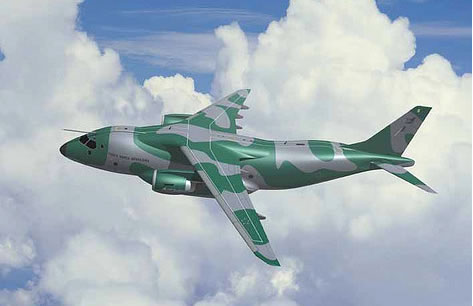
In last week of August the Brazilian Air Force (FAB) and Embraer Defense and Security concluded the preliminary design review (PDR) of the military transport jet aircraft KC-390 development project.
“We are quite pleased with the results and we are sure that the project is on the right track”, said Colonel-Engineer Sergio Carneiro, Project KC-390 Manager at FAB. “We checked all the main aspects of the aircraft’s project and the KC-390 meets the Brazilian Air Force’s expectations.” The next review, the Critical Design review (CDR) is scheduled in seven months, in March 2013, will freeze the final configuration of the aircraft, enabling the company to release production drawings, the last phase before the construction of prototypes.
[wzslider info=”true”]
Embraer presented to the Air Force Command the technical characteristics of the project’s solutions adopted for structural and aircraft systems, including the definitions of the main components and their interfaces, demonstrating that the project has reached its expected maturity at the current phase. The discussion included an evaluation of the cockpit’s ergonomics. Equipped with advanced mission and flight systems, the KC-390 is the largest aircraft ever built by the Brazilian aircraft industry and will establish a new standard for mid-sized military transport aircraft, in terms of performance and load capacity.
If all goes well, the C-390 will make its maiden flight in 2014 with first deliveries to the FAB scheduled in 2016. The KC-390 will replace the C-130 Hercules for transport and in-flight refueling missions.
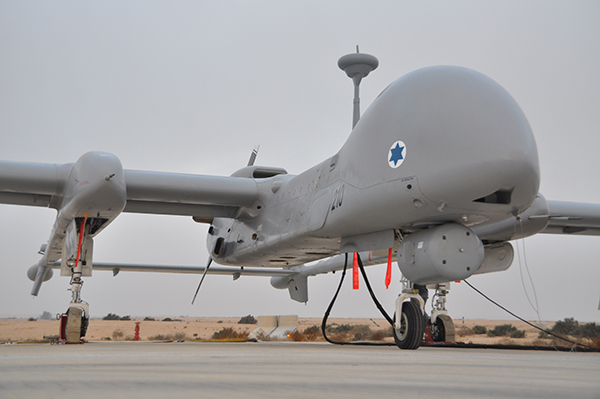
The Eitan (Heron TP) returned to the sky yesterday after completing a test flight validating the aircraft safety, following eight months investigation that followed a crash of one of the aircraft, due to a wing failure that occurred on a test flight, January 2012. (Photo: IAF)
The Eitan (Heron TP) returned to the sky yesterday after completing a test flight validating the aircraft safety, following eight months investigation that followed a crash of one of the aircraft, due to a wing failure that occurred on a test flight, January 2012. (Photo: IAF)The Israeli air force has resumed operations with its Israel Aerospace Industries Heron TP (“Eitan”) unmanned air systems, after lifting a grounding order imposed following a 29 January mishap. The decision came after a successful test conducted in the south, clearing the aircraft safety.
For the near term Eitan flights will be restricted, until the completion of evaluation of the entire flight envelope. The aircraft, the largest unmanned system in the IAF inventory, crashed on January 26 after taking off from Tel-Nof air base on a test flight. A combined investigation conducted by the air force and IAI concluded that the crash was caused by a structural failure in the wing, probably due to a manufacturing process. The new conclusion counters initial notions that the UAS had come down after exceeding the limitations of its flight envelope due to excessive payload or pilot error.
Returning to flying routine, the squadron will conduct careful inspection and perform two test flights on each of its Heron TP UAVs, before returning the UAVs to operational status. THe IAF and Eitan manufacturer IAI plan to isolate the cause of the failure and develop methods to prevent its occurrence in future production aircraft. In addition, an inspection process is being developed to prevent such mishape in the future. The aircraft’s composite fuselage is designed to accommodate large volume payloads, with the type having a service ceiling above 45,000ft (13,700m) and an estimated maximum endurance of more than 70h.
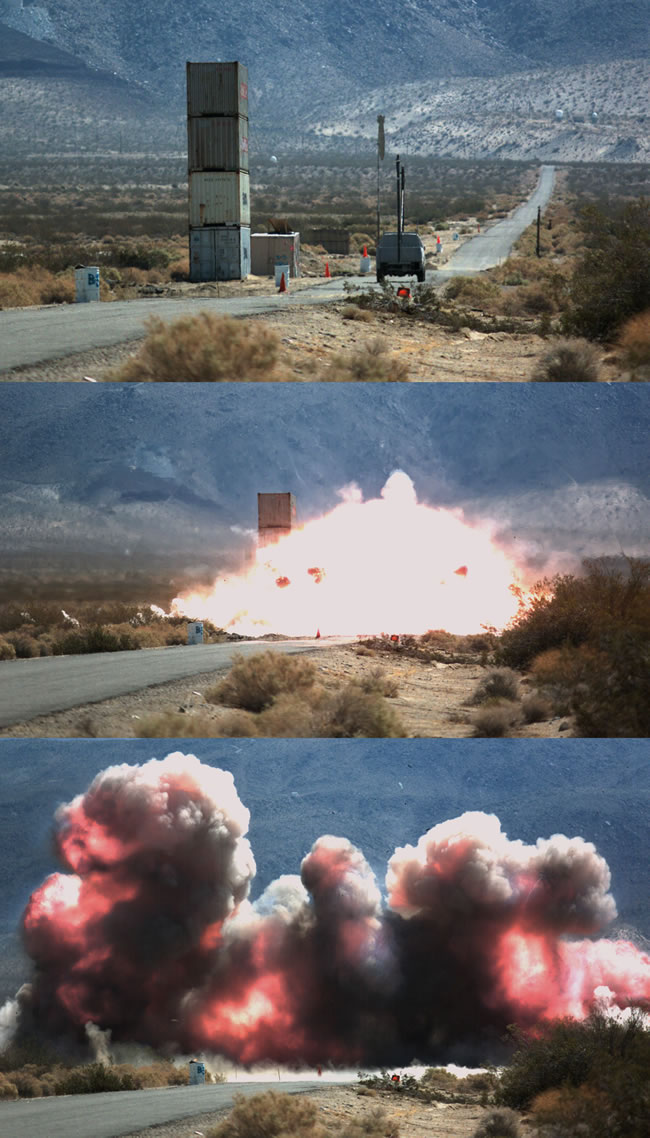
Laser JDAM destroys a target during testing at the China Lake Naval Weapons Station, Calif. in August. 2008 Photo: NAWCWD
Laser JDAM destroys a target during testing at the China Lake Naval Weapons Station, Calif. in August. 2008 Photo: NAWCWD
The US Navy recently awarded Boeing $23 million on the first full-rate production contract for the Laser Joint Direct Attack Munition (Laser JDAM), after successfully completing integrated test. Under the modified contract, Boeing will deliver 2,384 precision laser guided sets by February 2014. Previous contracts awarded by the Navy were three Low Rate Initial Production (LRIP) order amounting about 2,500 kits. The sets will be available for field weapons assembly, expanding the capability of basic JDAM tail kits, by providing a dual-mode, Global Positioning System aided Inertial Navigation System (GPS/INS) and laser guided weapon.
When employed, these weapons have proven highly accurate and can be delivered in any flyable weather. JDAM can be launched from more than 15 miles from the target with updates from GPS satellites to help guide the weapon to the target. Laser JDAM has been integrated with the GBU-38. Follow-on integration with the GBU-31 and GBU-32 is planned. The U.S. Navy’s first Laser JDAMs were delivered in October 2008. In March 2010, the Navy selected Laser JDAM to satisfy its Direct Attack Moving Target Capability (DAMTC) requirement.
The Air Force has been using the laser JDAM since its combat debut in Iraq, 2008. The Marine Corps VMA-513 in Kandahar, Afghanistan became the first land-based Marine Corps Harrier squadron to employ the weapon in combat in July 2011. “This guided bomb gives the Harrier pilots both the capability to target fixed positions, like an insurgent stronghold, with GPS technology; as well as the ability to provide precision strikes on moving enemy targets, by using the bomb as a laser-guided weapon” Chief Warrant Officer 2 Rich Karren explained.
“The weapon’s modification provides the naval and joint warfighters with a lethal, interoperable and cost-effective precision strike weapon system,” said Capt. Carl Chebi, Precision Strike Weapons program manager (PMA-201), who oversees the Laser JDAM program. “It has the capability to operate more effectively in adverse weather conditions and combat ground targets in motion.”
The Laser JDAM has become part of the Department of the Navy and Air Force standard conventional armament, and combined, have more than 800 combat expenditures. Since its initial delivery, the modified weapon has accumulated more than 20,000 flight hours for the Navy and Marines. It provides the fleet tactical flexibility for use on all F/A-18 and AV-8B aircraft. It has been successfully employed in combat in Iraq, Afghanistan and Libya.
“Laser JDAMs are being used more and more by the U.S. Navy and Air Force,” Kristin Robertson, director, Boeing Direct Attack Weapons added. “The laser variant has been incredibly effective in attacking moving targets accurately and reliably, with minimal collateral damage. Adding the laser sensor to a conventional JDAM kit is an affordable option that’s easy for ordnance crews to install and very straightforward for pilots already familiar with JDAM.”
The Canadian Safety and Security Program (CSSP) has issued the first call for proposals for innovative science and technology (S&T) project for homeland security applications. The call for proposals process is administered by Public Works and Government Services Canada, on behalf of Defence Research and Development Canada (DRDC). Subscribe for more information
For this call, up to $15 million will be available as of April 1, 2013, for new projects under the CSSP. The call for proposals will be open from September 5, 2012, closing on December 5, 2012. The selected projects will be announced by March 2013.
“Science and technology investments are becoming increasingly important in the ever-changing risk environment,” said the Honorable Vic Toews, Minister of Public Safety. “The solutions delivered through the Canadian Safety and Security Program will help broaden Canada’s preparedness and response to threats.”
Since 2006, Defence Research and Development Canada – Centre for Security Science (DRDC CSS) has been the focal point in coordinating a shared approach to the delivery of three public safety and security S&T programs, the Chemical, Biological, Radiological-Nuclear, and Explosives (CBRNE) Research and Technology Initiative (CRTI), the Public Security Technical Program (PSTP) and the Canadian Police Research Centre (CPRC), through partnerships with all levels of government, industry and academia. The harmonization of these three programs provides the foundation of the new Canadian Safety and Security Program (CSSP).
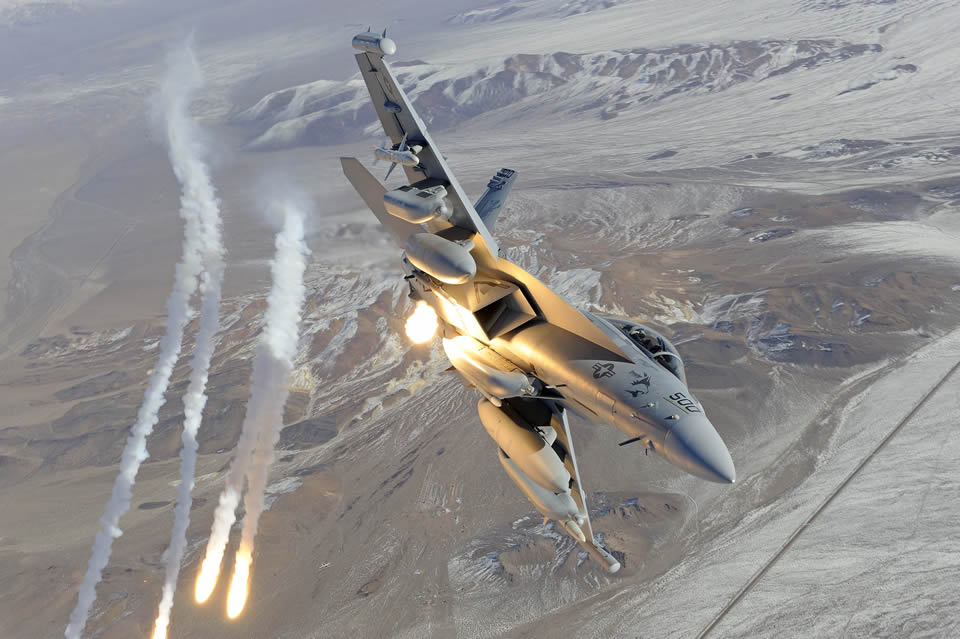
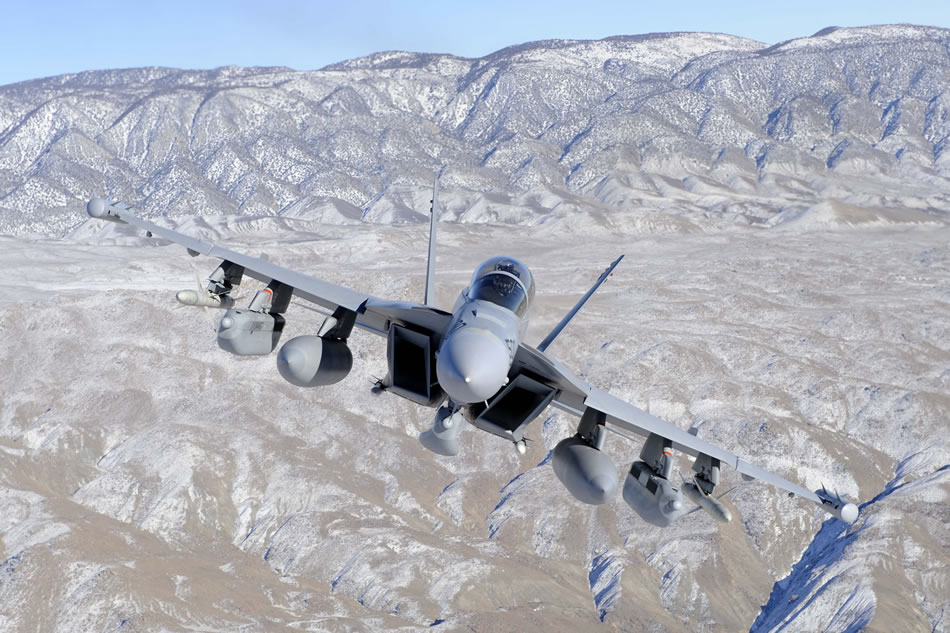
Now that Australia has decided to convert a total of twelve of the Royal Australian Air Force’s (RAAF) Boeing F/A-18F Block II Super Hornets to EA-18G Growler electronic warfare configuration, the RAAF aircrews assigned to fly the Growler can look forward to a long period of transition training before they’re qualified to manage the Growler’s unique idiosyncrasies.
The RAAF currently operates a fleet of twenty-four Super Hornets half of which were prewired for modification to the Growler configuration. The cost of the deal is estimated to be $1.57 billion. This agreement includes conversion kits, spare parts, training, and support equipment. The procurement was negotiated through the United States’ Foreign Military Sales (FMS) program.
The US Navy accepted delivery of its first operational EA-18G Growler for fleet service in 2008 and the US Department of Defense (DoD) authorized Full Rate Production (FRP) in late 2009. So far, Boeing has delivered 66 Growlers to the Navy. The Growlers experienced their first taste of combat in the skies over Libya between late-2010 and mid-2011.
As an Airborne Electronic Attack (AEA) aircraft, the EA-18G is capable of being operated from both aircraft carriers and land-based airfields. The aircraft was developed as a replacement for the US Navy’s aging fleet of EA-6B Prowlers. The EA-6B Prowlers first entered active service in 1971 and are quickly nearing the end of their operational lifecycle.
The Growler design is a specialized version of the veteran combat F/A-18F Super Hornet fighter attack aircraft. The primary missions envisioned for the Growlers are Electronic Attack (EA) and Suppression of Enemy Air Defenses (SEAD). With nine hardpoints capable of carrying a total of 8,050 kilograms of external fuel and/or ordnance, the Growlers can be armed to perform strike missions should dedicated strike aircraft be unavailable or when time is a critical consideration.
The EA-18G Growlers are slated to become the United States’ sole electronic warfare attack aircraft. The last remaining US Air Force EF-111 Ravens were retired in 1998 and the EA-6B Prowler airframe has reached its operational limits. Although the Prowlers are showing their age, they continue performing sterling service with the US Navy and the Marine Corps. Despite performance limitations, the EA-6Bs are still called upon to escort combat air strikes, engage in electronic jamming operations, and are used to interdict enemy Improvised Explosive Device (IED) attacks against American ground forces.
Other electronic warfare aircraft types are in service, such as the EC-130H, but they are much too slow to be employed in the tactical jamming role. The EA-18G Growler does overcome many of the weaknesses inherent in the EA-6B and other electronic warfare aircraft, but it brings some unique weaknesses of its own to the airborne warfare environment.
The Growler shares 90 percent commonality with the Super Hornet and has a similar flight performance giving it the ability to deliver escort jamming along with more traditional standoff jamming. Because of its flight characteristics, the Growler is expected to accompany F/A-18s throughout the duration of assigned attack missions.
The Super Hornet and the Growler have a shared airframe; both carry the Raytheon AN/APG-79 Active Electronically Scanned Array (AESA) radar and the AN/AYK-22 stores management system. Most of the Growler’s airborne electronic attack components are housed in the space reserved for the 20 millimeter gun mounted in the Super Hornets and on the wingtip rails.
The wingtip rails are designed to carry AN/ALQ-218 wideband receivers. The nine external hardpoints can accommodate additional weapons or jamming pods to include as many as five ALQ-99 high and low-band tactical jamming pods. A typical combat load would also include two AIM-120 AMRAAM (Advanced Medium-Range Air-to-Air Missile) or AGM-88 HARM (High-speed Anti-Radiation Missile) missiles. The Growler is also equipped with the INCAS Interference Cancellation system that makes it possible for Growler crews to retain voice communication while actively jamming enemy communications, a capability not available on the EA-6B Prowlers.
Despite the promise of superiority the Growler appears to bring to the airborne battlefield, some reliability and performance issues are still a significant concern. In April 2006, the US Government Accountability Office (GAO) released a report that raised concerns about the Growler’s electronic warfare systems. The GAO report said that the agency believed that these systems were not fully “mature” and this would likely result in long-term cost increases and production delays. A 2008 GAO report quoted the director of DoD’s Department of Operational Test and Evaluations (DOT&E) as citing concerns that the Growler’s two-person crew would be overworked and would experience difficulty performing as effectively as the four-man Prowler crews were able to perform.
A March 2010 GAO report also cited a difference of opinion between DOT&E and US Navy evaluators as to the operational performance and capabilities of the EA-18G. The Navy declared the Growler effective and suitable for operational use while the DOT&E considered the aircraft “to be operationally effective for most missions, but not all, due to the excessive time required to make reactive jamming assignments.” The difference of opinion centered on the unreliable performance of the ALQ-99 jamming pods and frequent failures of the system’s built-in self- test (BIT) feature.
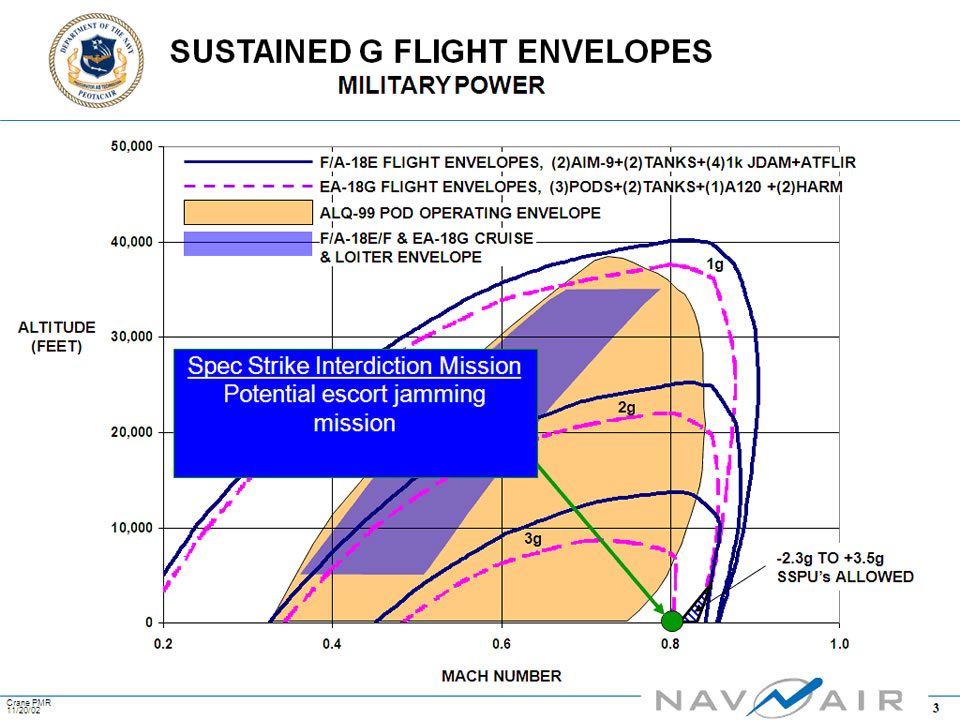
Comparison of the Super Hornet and Growler flight envelopes with and without the ALQ-99 pod. Chart: NAVAIR
The ALQ-99, as part of the aircraft’s electronic warfare suite, was also responsible for degrading the Growler’s AESA radar performance.
Although Navy testers identified only one deficiency in their evaluations of the Growler, the ALQ-99 failures, they did not consider the ALQ-99 problems to be critical deficiencies because operating guidelines at the time called for independent, vice integrated, operation of the AEA and AESA systems. DOT&E identified seven deficiencies in the aircraft and concluded that the ALQ-99 problems placed an excessive burden on the aircrews and negatively impacted their confidence in the aircraft’s AEA electronics. The report also determined that the addition of external jamming pods, weapons, and external fuel tanks reduced the aircraft’s speed to the point where it might be unable to keep pace with the strike aircraft it was designed to support.
Subscribe to Defense-Update premium services to see more images and charts for this article
DOT&E also expressed the view that a two-man crew could successfully handle the workload common to some missions, but missions involving intense radar and communications jamming would likely task the crew to the limit of their abilities increasing a strike mission’s vulnerability to enemy action.
Boeing and the Navy are continuing their work on development of the Next Generation Jammer (NGJ), a system that uses AESA technology to more-accurately focus jamming transmissions, to equip the EA-18Gs as a replacement for the failure-prone ALQ-99 jamming pods, but the NGJ is not expected to be available until 2018.
Good or bad, the EA-18G is the western world’s only AEA aircraft of the future as no alternative platform exists. For Australia, adding the Growlers to the RAAF’s fleet of Super Hornets is viewed as a necessary step in strengthening the nation’s airborne defense capability. The question to be answered is, can the American and Australian flyers learn to overcome the challenges they will face in handling the EA-18Gs known deficiencies? In modern aerial warfare combat comes fast and furious, far greater than anyone living has ever experienced. Will the aircrews be ready and can they do all that they must do to stay alive and return home successful?
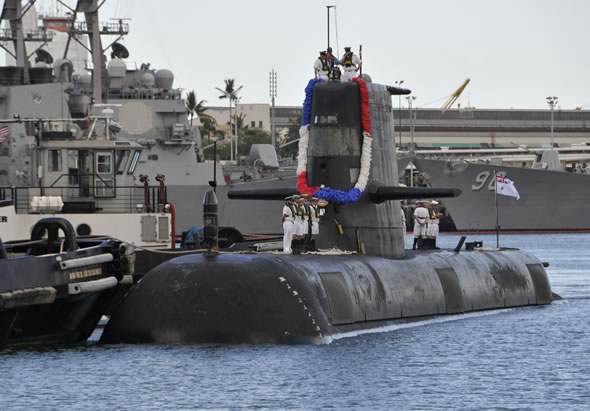
Australian Navy Collins-class submarine HMAS Farncomb (SSG 74). US Navy photo by Daniel BarkerAustralian Minister for Defence Stephen Smith announced today that the Government is committed to acquiring 12 new submarines to be assembled in South Australia. He added that this commitment will be reinforced as part of the 2013 Defence White Paper. Smith said the Future Submarine project will be the largest and most complex Defence project ever undertaken by Australia. The project will involve hundreds of companies and thousands of workers, as well as Federal and State Governments, Defence, Industry and Universities.
Four options are being considered for the Future Submarine fleet, Smith said, these options range from military off-the-shelf to a wholly new design. Defence is undertaking a wide range of studies into these four options before returning to Government for First Pass approval around late 2013/early 2014.
Australia’s Future Submarine Systems Centre will be based in Adelaide. The Systems Centre will be the home of the Future Submarine program. It will be formally established this year and over the next few years will expand to include hundreds of Defence personnel from Navy, the Defence Materiel Organisation (DMO), the Defence Science and Technology Organisation (DSTO) and the Australian and international Defence Industry. The center continues the strong relationship that has been formed between South Australia and the Commonwealth in support of Australia’s maritime sector. The first Systems Centre staff are already working in Adelaide, and are temporarily based at ASC. Mr David Gould was appointed as General Manager Submarines at the Department of Defence, Gould’s responsibility will include the oversight of the maintenance of the current Collins Class fleet and the Future Submarine Project.
The Systems Centre is a similar facility to the one that was established for the Air Warfare Destroyer project. It will undertake a variety of tasks including evaluation of options, design work, program management, engineering, logistics and production planning.
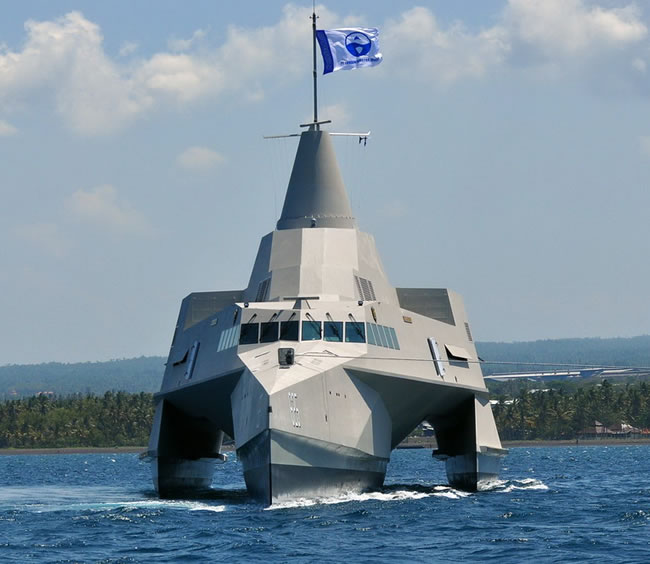
The trimaran hull shape is intended to permit high speeds to be maintained and thus maximize crew operational capability in the short, steep seas characteristic of the coastline around the Indonesian Archipelago.
The trimaran hull shape is intended to permit high speeds to be maintained and thus maximize crew operational capability in the short, steep seas characteristic of the coastline around the Indonesian Archipelago.
North Sea Boats launched the first of four advanced, stealthy, 63 meter trimaran patrol boats for the Indonesian Navy on August 31, 2012. Following the completion, extensive sea trials and testing commencing next month, the KRI KLEWANG is is expected to be fully operational 2013. All four vessels are scheduled for delivery by 2014.
Unfortunately, Klewang was destroyed by a fire tree weeks after its launching, while moored at the naval port in Banyuwangi, East Java for maintenance. No casualties have been reported but the new vessel was lost.
The new vessel to be named KRI Klewang (after a traditional Indonesian single edged sword) was launched at Banyuwagni, in Indonesia. Following the official launching the vessel will be fitted with mission systems and weapons, including a remotely controlled gun turret and anti-ship missiles. The four vessels are built at the PT Lundin shipyard in East Java.
Premium subscribers can read the full version of this article, including the new photo gallery. Interested?
The vessel is powered by four MAN V12 diesel engines, driving multiple MJP 550 water jets, located on the three for maximum propulsive thrust and maneuverability. The vessel can develop a ‘sprinting’ maximum speed of 35 knots. Cruising speed is 16 knots and the stated operational range is over 2000 nautical miles.
The Klewang is armed with concealed gun turret, missile launchers and small arms posts. Trimarans offer very stable weapons platforms, and can carry various Missile systems; including Type 705 (up to 8), RBS15, Penguin or Exocet, and 40-57mm Naval Guns, or a CIWC (Close In Weapon System). These can be mounted high on the superstructure, giving better range and firing arc. Sensors can also be installed high up without concerns for stability. This first ship will carry a turnkey system delivered by CSOC and CPMIEC China, including rapid fire CIWS, combat control and missile systems. The exact configuration of this system is still classified.
Accommodation is provided for a complement of twenty nine (officers and crew) on three internal decks (including bridge and combat control centre), with facilities and equipment also provided for deployment of special forces troops, including an 11m high speed 50 knot RIB, also manufactured and supplied by North Sea Boats.
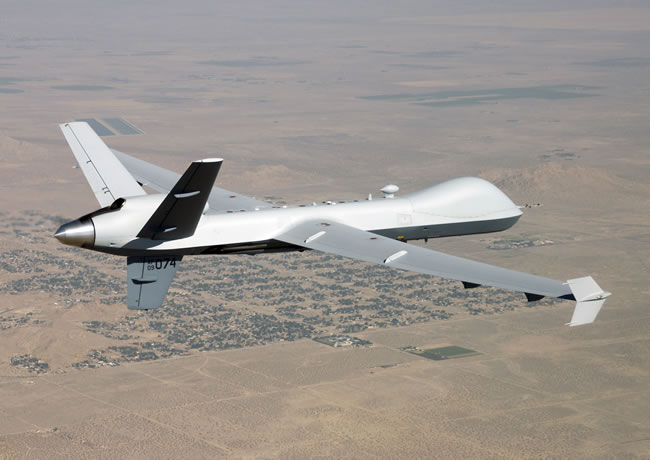
new communications capabilities also will be available in the Block 5, including dual ARC-210 VHF/UHF radios with wingtip antennas, allowing for simultaneous communications between multiple air-to-air and air-to-ground parties. Photo: GA-ASI
new communications capabilities also will be available in the Block 5, including dual ARC-210 VHF/UHF radios with wingtip antennas, allowing for simultaneous communications between multiple air-to-air and air-to-ground parties. Photo: GA-ASI
A new version of the General Atomics Aeronautical Systems Inc (GA-ASI) Predator B/MQ-9 Reaper has been flying since May 2012. The new version known as the Block 1-plus, made its first flight on May 24 at the manufacturer’s Gray Butte Flight Operations Facility in Palmdale, Calif., with no discrepancies. GA-ASI has upgraded the Predator B and Block 1 versions of the drone that have been in production since 2003. The MQ-9 Block 1-plus test flight occurred on May 24. With the completion of development, testing, and expected Milestone C decision this fall, follow-on aircraft to the MQ-9 Block 1-plus configuration will be designated “MQ-9 Block 5.”
The MQ-9 Block 1-plus is a capability enhancement over the Block 1 configuration, which has amassed more than 420,000 flight hours across all customers. Block 1-plus was designed for increased electrical power, secure communications, auto land, increased Gross Takeoff Weight (GTOW), weapons growth, and streamlined payload integration capabilities.
Featuring a new high-capacity starter generator, the aircraft offers an increase in electrical power capacity over the current Block 1 design. This increased power provides the aircraft with significant capacity for growth. In addition, the upgraded electrical system includes a backup generator which is sufficient to support all flight critical functions. This vastly improves the reliability of the electrical power system by providing three independent power sources.
New communications capabilities will also be available in the Block 5, including dual ARC-210 VHF/UHF radios with wingtip antennas, allowing for simultaneous communications between multiple air-to-air and air-to-ground parties; secure data links; and an increased data transmission capacity.
Additionally, the new trailing arm main landing gear will be included in Block 5, enabling the aircraft to carry heavier payloads or additional fuel. This “heavy-weight” landing gear increases the aircraft’s landing weight capacity by 30 percent and its gross takeoff weight by approximately 12 percent, from 10,500 lb to 11,700 lb. (from 4,762 to 5,307 kg). The new landing gear will also be available as a field retrofit to operational Predator B systems.
“We continue to enhance the capabilities of our aircraft, improving their performance to meet emerging customer requirements,” said Frank Pace, president, Aircraft Systems Group, GA-ASI. “The first flight of the MQ-9 Block 1-plus follows in the footsteps of the aircraft’s combat-proven Block 1 configuration and is an important technological achievement that will provide increased effectiveness, increased multi-mission flexibility, and even greater reliability.”
“We’ve designed field retrofitable capabilities–lengthened wings, wing-borne fuel pods, and new heavy-weight landing gear–that greatly extend Reaper’s already impressive endurance and range while further increasing its operational flexibility.”
The strengthened landing gear was one of two capability enhancements proposed by GA-ASI in April 2012, following a study the company conducted, exploring potential improvements to the aircraft. Taking advantage of the increased GTOW increase, the Predator B ER (Extended Range) will be able to carry additional payloads, including two external fuel tanks, extending typical Intelligence Surveillance Reconnaissance (ISR) mission endurance from 27 hours to 37 hours. To further increase multi-mission flexibility and capacity, GA-ASI proposed to replace the current 66 ft (20.11 mw) wings with 88 ft wings (26.82 m’), and adding two fuel pods, along with the heavy-weight landing gear, thus increasing mission endurance from 27 hours to 42 hours on ISR-only missions.
Predator B is currently operational with the U.S. Air Force and Royal Air Force as MQ-9 Reaper and the Italian Air Force as MQ-9, with NASA as Ikhana, and with the U.S. Department of Homeland Security as Predator B/Guardian. The aircraft is designed to perform multi-mission ISR and “Hunter-Killer” missions over land or sea, with more than 130 vehicles delivered to date. In August 2012 GA-ASI was awarded $87 million US Air Force contract to upgrade up to 80 Reapers delivered in the past two years.
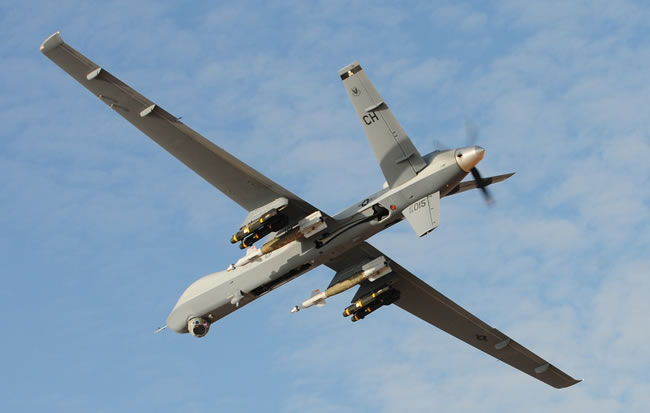
Fully armed MQ-9 takes off on a mission in Afghanistan. Photo: US Air Force
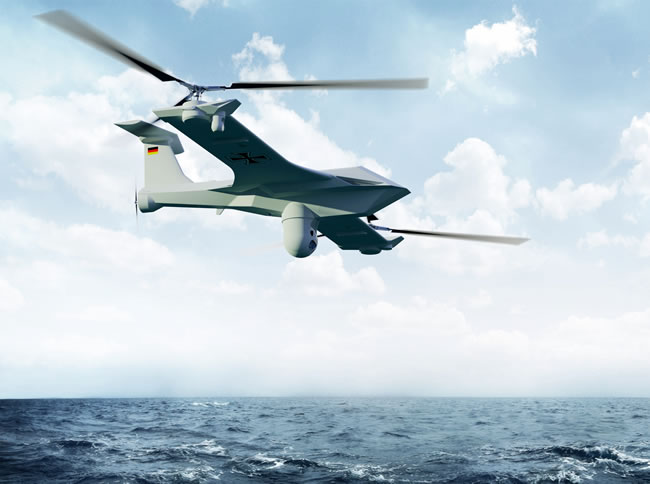
The X1 Hybrid Unmanned Aerial Vehicle combines the capabilities of an aircraft and helicopter to provide a wide range of missions. This innovative design is currently at a concept development phase, by Suisse UAV and Rheinmetall Airborne Systems (RAS). Photo: Rheinmetall
The TU-150 Hybrid Unmanned Aerial Vehicle combines the capabilities of an aircraft and helicopter to provide a wide range of missions. This innovative design is currently at a concept development phase, by Suisse UAV and Rheinmetall Airborne Systems (RAS). Photo: Rheinmetall
On its first public debut since the formation of the joint venture with Cassidian, Rheinmetall Airborne Systems (RAS) unveils a tactical unmanned hybrid aerial vehicle at the ILA Berlin Airshow 2012. The TU-150 is still in the concept phase, developed in cooperation with Swiss UAV. The hybrid airborne system will combine the capabilities of a helicopter and a fixed-wing aircraft, thus lending itself to a wide variety of missions. According to RAS, the TU-150 will join the company’s existing airborne platforms, creating a product family that blends extensive operational experience with cutting edge technical innovation.
ILA 2012 takes place 11-16 September at the Berlin ExpoCenter Airport.
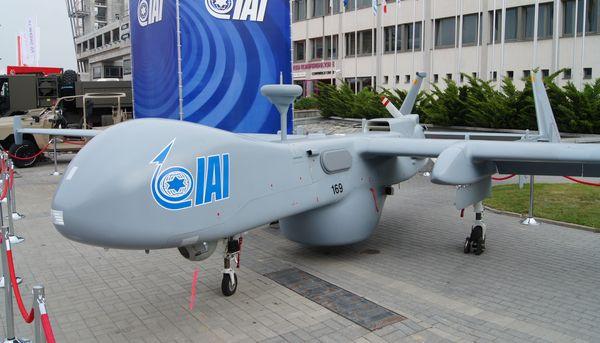
RAS is also displaying the Heron I, currently supporting the German forces in Afghanistan. The same platform is also displayed by IAI across the border in Poland, at the MSPO Aerospace and Defense expo, Tomasz Basarabowicz reports.
Heron I on display at the MSPO Aerospace and defense expo in Poland. Photo: Mariusz Cielma, Dziennik Zbrojny
The EC725 operated by the Brazilian Army. Photo: Photo: Eurocopter, by Anthony Pecchi
The EC725 operated by the Brazilian Army. Photo: Photo: Eurocopter, by Anthony PecchiThe Government of Thailand has reportedly ordered four EC725 helicopters for Search and Rescue (SAR) missions. The €100 million deal was announced by Thai deputy prime minister Yutthasak Sasiprapa on 29 August, quoted by the French media. The French built aircraft are expected to replace the Bell UH-1H SAR helicopters currently flying with the Royal Thai Air Force’s (RTAF).
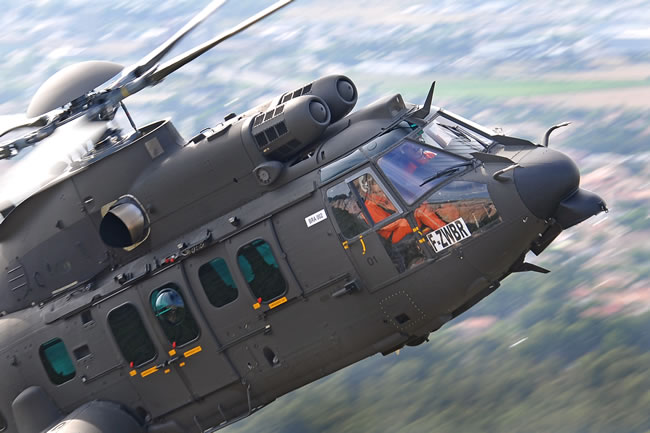
Eurocopter is demonstrating the helicopter in its CSAR configuration at the MSPO Aerospace and Defense expo in Poland. As the latest and most advanced member of Eurocopter’s 11-ton military product line, the EC725 has become a rotorcraft of choice in the modernization of military forces’ helicopter fleets worldwide. Customers include France, Brazil, Mexico, and Kazakhstan– with negotiations underway for acquisitions by additional countries.
Thailand joins an increasing number of South East Asian nations using the EC725, including the Vietnamese Navy, the Malaysian Air Force, which has ordered 12 examples of the EC725 for use in a range of missions including SAR. In April, the Indonesian Air Force purchased six EC725s for the CSAR role.
Asia has become a growing market for the civilian version of the helicopter – EC225. The Air Force of Taiwan has recently commissioned three EC-225 helicopters for SAR operations. Two EC-225 helicopters geared for SAR and firefighting missions are operating with the South Korean ‘119 Rescue’ civil defense service while three are operating with Japan’s Coast Guards. The EC225 is also a popular choice for offshore operations, supporting the booming oil and gas explorations in the region; eight are already operating in Malaysia by commercial operators MHS Aviation and Awan Inspirasi, with four more operated by the VNH company in Vietnam.
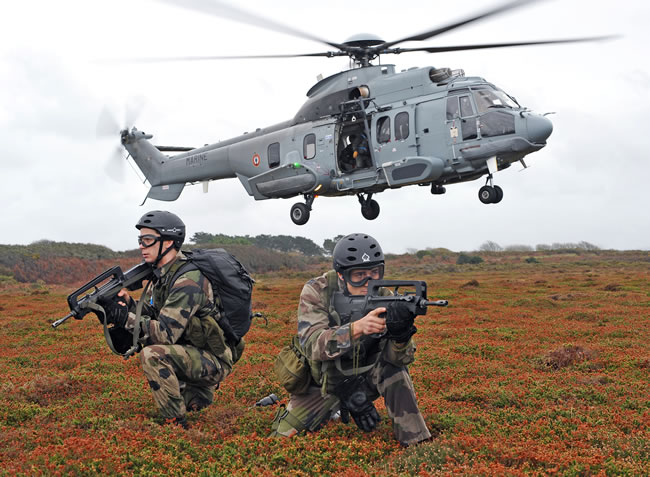
The Frenc Navy operates two Eurocopter EC225 Super Puma helicopters in Search and rescue operations. Photo: Eurocopter, by Anthony Pecchi
Demonstrators near Aleppo waive Syrian Opposition and Kurdish flags in protest against the Assad regime. (Photo: reuters)
Demonstrators near Aleppo waive Syrian Opposition and Kurdish flags in protest against the Assad regime. (Photo: reuters)
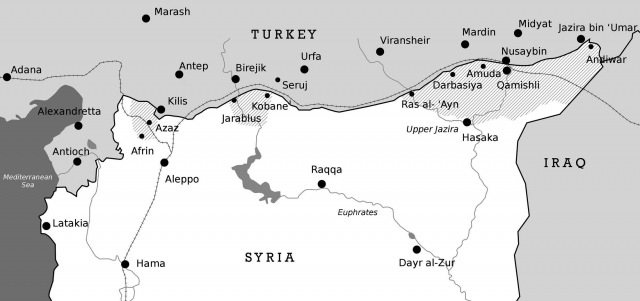
In the wake of the steady disintegration of the Assad regime, Syrian opposition activists reported that several towns, such as Amouda and Qabani in Syria’s Kurdish populated north eastern region had passed in mid-July 2012 without a fight into the hands of a local group called the Free Kurdish Army. Thus emerged for the first time in modern Kurdish history the nucleus of an exclusively Kurdish-controlled enclave bordering the predominantly Kurdish areas of Turkey. After largely sitting on the sidelines of the Syrian revolution, political groups from Syria’s Kurdish minority in the northeastern region appear to have moved decisively to claim control of the Kurdish-populated towns.
The Turks, who have been at war with the Kurdish PKK for decades, have been monitoring developments in Syria with increasing concern. As Arab borders and the integrity of Arab states look shakier than they have at any time in living memory, Turkey faces the possibility of sharing long-term borders with two semi-sovereign Kurdish entities. The specter of eventual Kurdish sovereignty and Turkish fear of this are also discernible in the air. Thus a columnist for the Turkish daily Hurriyet wrote in late July: “Only a week ago we had a 400-kilometer ‘Kurdish border.’ Now, 800 kilometers have been added to this.” Turkish Prime Minister Recep Tayyep Erdogan has made clear that Turkey sees intervention against rebel bases in northern Syria as its “most natural right.”
The spike in the PKK’s terrorist activity in Turkey comes amid mounting concerns in Ankara that the PKK and its affiliates are gaining ground in Turkey’s southern neighbor. Particularly alarming was the capture of several towns along the Turkish border by the PKK’s Syrian offshoot, the Party of Unity and Democracy (PYD). Turkey watched nervously as Kurdish groups took control of the towns after the withdrawal of Assad forces and hoisted the Kurdish flag over Syrian government buildings. The takeover of Syrian Kurdish towns along the border with Turkey by armed Kurds of the PYD, confronts Turkey with a challenging dilemma for which, unlike in Iraq, it has no ready answers.
Turkish fears of Syrian Kurdish areas developing into a springboard for attacks on Turkey may also present the real reason for Ankara’s proposal to create a “humanitarian” bufferzone on the Turkish-Syrian border to counter Syrian and neighboring Kurd’s intentions. Indeed the Turkish government has already quite bluntly warned: “We will not allow a terrorist group to establish camps in northern Syria and threaten Turkey.” Prime Minister Recep Tayyip Erdogan has made clear that Turkey would take any step that is necessary against a terrorist group, in his real meaning Kurdish fighter presence in northern Syria.
Ankara is not alone to declare such a “buffer zone” in Syria. Foreign Minister Laurent Fabius of France, which backs Turkey’s idea, said in an interview last Wednesday on France-Inter radio that setting them up without an internationally imposed no-fly zone to protect civilians is impossible. Naturally, only Turkey has sufficient forces available to act within such a contingency without presenting a major problem. All it needs, is for someone to take the decision and call for action, which is already much too late in coming.
For now the Syrian Kurds are hedging their bets. Their takeover of Syrian Kurdish towns while remaining on the side lines of the effort to topple Assad, gives them leverage irrespective of who emerges victorious from the battle for the future of Syria. In a post-Assad Syria that will probably remain volatile and unstable with ethnic and religious groups fighting one another, Syrian Kurds are likely to learn from the success of Iraqi Kurds in carving out a relatively stable enclave of their own while the rest of Iraq tore itself apart. In preparation, Iraqi Kurdish forces have already started training Syrian Kurdish fighters.
Turkish observers have commented that the geopolitics of the Middle East is already being reshaped, with the emergence of a “Greater Kurdistan” no longer a remote possibility. This is posing enormous challenges for all the states hosting large Kurdish populations: Turkey, Iraq, Syria, and Iran. Kurdistan is a potential land bridge for many of the conflicts currently erupting in this part of the region. It provides a ground route for Iraqi Kurdistan to supply the Syrian Kurds as they seek greater autonomy from Damascus. But its use will depend on which power dominates the tri-border area between Iraq, Syria, and Turkey. For Turkey a Kurdish ruled Kurdistan presents a strategic challenge, which has to be averted by all means, in order to maintain its national sovereignty. And the challenge is both strategic and demographic.
Presently, Turkey’s population is approximately 75 million. Kurdish sources claim there are as many as 25 million Kurds in Turkey, but some Turkish demographers estimate that the real number could actually reach as high as 37 million, becoming almost half of modern Turkey’s population.
Despite enjoying wide-spread popular support in Kurdistan, Kurdistan’s politicians have been slow to throw their support behind Syria’s 11 month long popular uprising. In January 2012 Massoud Barazani, The president of the autonomous region of Kurdistan first openly voiced his support. (kurdishrights)
In Syria, ethnic Kurds account for roughly nine percent of Syria’s population, reaching a total of nearly 1,6 million, making it the largest ethnic minority in this country. Kurdish fighters, although sofar not willing to align fully with the Free Syrian Army, are already sizably involved in the insurrection. Some even assess that they might hold the key to the final fate of this struggle, toppling the Alawite Assad Regime. And Syrian Kurdish leaders are already feeling their way towards their Kurdish neighbors. Massoud Barzani, president of the Kurdish Regional Government in northern Iraq, has recently invited the Syrian Kurdish parties to a meeting in Erbil, Iraq, on 28 January 2012. The purpose of the meeting was to call for the overthrow of the Assad regime, against the advice of Iran and the PKK, with whom the KRG are at loggerheads. Meanwhile the Kurdish Regional Government in northern Iraq is training Syrian Kurdish fighters to help defend their territories within Syria. But matters are far from easy, as a decade long political rift exists between various Kurdish factions. In this Barazani has also managed to achieve some breakthrough. He has played an important role in brokering a reconciliation agreement between the two main Syrian Kurdish factions, the Kurdish National Council (KNC) and the People’s Council for Western Kurdistan (PCWK) and also persuaded anti-Turkish Syrian Kurdish factions to stop fighting against Turkey, at least for the time being and concentrate their efforts against the Assad regime.
It remains to be seen if Ankara will manage to persuade it’s NATO allies to join in creating a so-called humanitarian Buffer Zone along the Syrian northern border, or even decide to act alone, if matters get too rough on its volatile borders, which eventually could then embrace the entire region, spreading from Turkish Hatay on the coast (formerly Alexandretta) and the tri-border zone to the east. Then sooner or later as the fighting spreads and more and more displaced refugees will flock into the safe area, the Turkish Army will have to intervene to “restore order” in the ensuing dangerous chaos. Once deployed there in force, it will require some decisive action to get them out again. As matters stand right now, judging by recent performance of an indecisive world leadership, Ankara stands a good chance to get away with such move and even improve its deteriorating political situation along its unstable southern border.
International Armoured vehicles Conference and Exhibition 2013
February 5 – 8, 2013 – Farnborough, UK
The International Armoured Vehicles conference and exhibition (IAVs) offers a unique combination of high-level briefings from senior international military; technical sessions from key experts in C-IEDs, Future Armouring, Simulation, Weapons Stations Integration and Situational Awareness; and a high-impact, focussed exhibition hall dedicated to the armoured vehicles community.
As the flagship of Defence IQ’s global armoured vehicles series, IAVs is the largest, most prestigious and best-attended; last year alone, the event gathered 600+ conference attendees and over 2,000 visitors to the exhibition. This year’s event introduces a special Industry Day, a second G6 Panel – focusing on International Markets, new specialised streams and a “Ride and Drive” at the Long Valley Test Track for test track exhibitors.
Entrance to the IAVs Exhibit is free upon access approval (Conference entrance fees will apply). Register online at www.internationalarmouredvehicles.com.
Defence IQ is delighted to invite Defence Update members to attend the main conference at a special discount rate of saving 20% off the standard conference price. Email [email protected] or call +44 (0)20 7368 9300 with code IAVs2013_DU for more information.
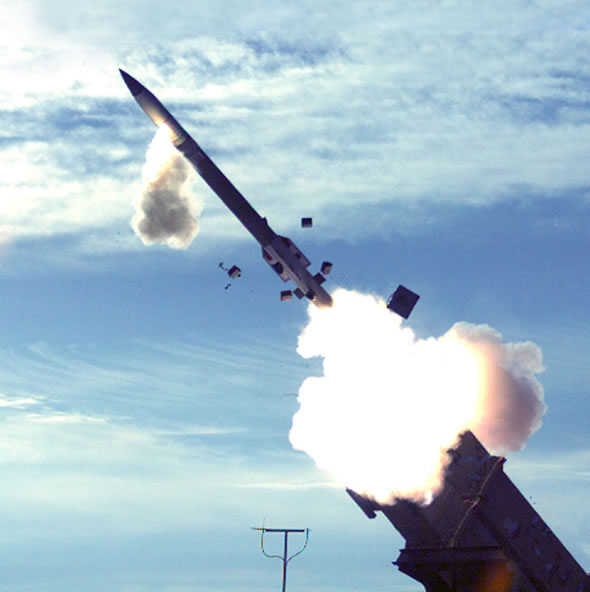
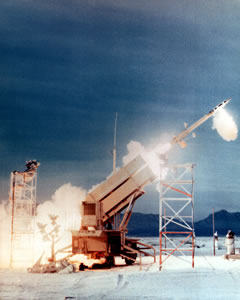
Lockheed Martin’s PAC-3 Missile successfully destroyed a tactical ballistic missile (TBM) target today at White Sands Missile Range, N.M., in an Operational Test conducted by the U.S. Army Test and Evaluation Command. The test involved three incoming targets; two Patriot-As-A-Target TBMs and one MQM-107 drone.
A ripple launch of two PAC-3 Missiles successfully engaged the second TBM. Preliminary data indicate all test objectives were achieved. Three additional PAC-3 tests are scheduled for the second half of 2012, including flight tests that will demonstrate the Missile Segment Enhancement (MSE) capability in both the Patriot and MEADS systems.
“The PAC-3 Missile continues to perform as expected under very stressing conditions,” said Richard McDaniel, vice president of PAC-3 Missile programs in Lockheed Martin’s Missiles and Fire Control business. “This was our third consecutive successful PAC-3 Missile flight test this year. With each successful test, the PAC-3 Missile adds to its legacy of proven performance.”
At present, the Patriot PAC-3 represent the main defenses US forces and several Persian Gulf states have against a potential Iranian missile attack, should hostilities erupt in the Persian Gulf region. The recent test series underlines this missile defense capability while assuring the way forward in the development of the Patriot as an air and missile defense system.
Lockheed Martin Skunk Works® and XTEND have achieved a major milestone in JADC2 by integrating the XOS operating system with the MDCX™ autonomy platform. This technical breakthrough enables a single operator to simultaneously command multiple drone classes, eliminating the friction of mission handoffs. From "marsupial" drone deployments to operating in GPS-denied environments, explore how this collaboration is abbreviating the data-to-decision timeline and redefining autonomous mission execution.
As traditional defense primes face mounting competition from agile “neoprimes” such as Anduril, Palantir and Helsing, the balance of innovation is shifting toward software-defined warfare and scalable, dual-use technologies, while global industry consolidation—marked by Boeing’s integration of Spirit AeroSystems and other strategic mergers—signals an intensified race to secure control over the defense technology value chain. Our Defense-Tech weekly report highlights these trends.
In early October 2025, a coordinated wave of unmanned aerial system (UAS) incursions—widely attributed to Russia—targeted critical infrastructure across at least ten European nations. The unprecedented campaign exposed the fragility of Europe’s air defenses...
Executive Summary
The past week (September 18-25, 2025) represents an inflection point where strategic defense concepts have transitioned from doctrine to tangible reality. An analysis of global events reveals four primary, interconnected trends shaping an...
At the 2025 Air, Space & Cyber Conference, U.S. Air Force and Space Force leaders unveiled major updates on next-generation fighters, bombers, unmanned systems, and space initiatives, highlighting both rapid innovation and critical readiness challenges as the services race to outpace global competitors. A short version is available here, with a more detailed version for subscribers.
The Taipei Aerospace & Defense Technology Exhibition (TADTE) 2025 crystallized around four dominant strategic themes that collectively illustrate Taiwan's comprehensive approach to defense modernization amid escalating regional tensions. Based on a detailed report by Pleronix (available upon request). Includes a Podcast discussion on TADTE 2025's highlighting Taiwan's four strategic themes beyond the post's coverage.
Israel’s Iron Beam 450 high-power laser system has completed final testing, marking a major leap in air defense. Developed by Rafael, it offers precise, cost-effective interception of rockets, UAVs, and mortars, and is set for IDF deployment by 2025.