
Tuesday, December 30, 2025
More
    Home Blog Page 177

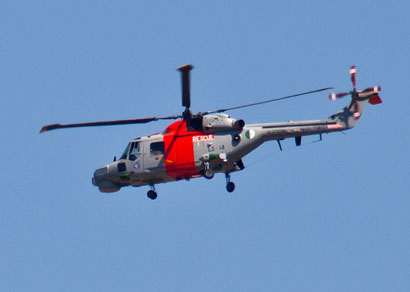
    Super Sea Lynx for Algerian Meko Frigates

    The Algerian Air Force currently operates four Super Sea Lynx 130 in Search and rescue missions, along with AW101 (Merlins) used for the same role. The navy is planning to deploy a larger version - Super Sea Lynx 300 with its modernized Meko frigates. Photo: Kingvarg/Flickr
    The Algerian Air Force currently operates four Super Sea Lynx 130 in Search and rescue missions, along with AW101 (Merlins) used for the same role. The navy is planning to deploy a larger version – Super Sea Lynx 300 with its modernized Meko frigates. Photo: Kingvarg/Flickr

    The Algerian Navy is believed to have ordered six AgustaWestland Super Lynx 300 helicopters for its new Meko A200 class frigates, Defenseweb reports. In its results for the second quarter of 2012, Finmeccanica stated that, “the most important new orders of the period in the military-government line include the contract to supply six AW Super Lynx 300 helicopters to a key customer in the southern Mediterranean area…”. Algeria has requested that its helicopter deals with AgustaWestland remain confidential and the Finmeccanica company does not comment on any Algerian acquisitions. However, it is believed that Algeria is acquiring at least 80 helicopters from AgustaWestland. These will be used by its armed forces, paramilitary forces and emergency forces and are being procured through the Algerian Ministry of Defense.


    The new helicopters are expected to operate from the Algerian Navy’s two Meko A200 frigates, which were ordered from ThyssenKrupp Marine Systems (TKMS) on March 26 this year. TKMS will supply the two frigates and six Super Lynx helicopters under the initial contract worth around €400 million.

    Algerian crews were trained in Cornwall in the UK, with the first Lynx flying by February 2010 and the first Merlin commencing training flights in May. All the aircraft from this deal are believed to have been delivered and are fully operational. The fourth and final Super Lynx Mk 130 was delivered in January this year, after the first two were delivered in September 2010, followed by the third in February 2011.

    The Algerian Super Lynx 130 are operating with six AW101 Mk 610 in Search-and-Rescue missions.  Finmeccanica is also believed to have signed multiple additional contracts with Algerian government agencies, including 15 AW109s and 10-15 AW101s for the Gendarmerie and 27-32 AW101s and 15 AW109s to be assembled locally. In addition, the first two of five AW139s ordered by Algires were delivered to the Protection Civile in February this year.
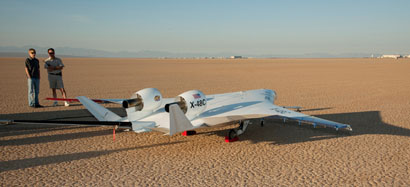
    First Flight of the X-48C Blended Wing Body Experimental Unmanned Plane

    X48C Blended Wing-Body experimental unmanned scaled aircraft prepared for the first flight August 7, 2012 at the Dryden flight test center in Edwards AFB, California. Photo: NASA
    X48C Blended Wing-Body experimental unmanned scaled aircraft prepared for the first flight August 7, 2012 at the Dryden flight test center in Edwards AFB, California. Photo: NASA

    Boeing conducted the first flight of the remotely piloted X-48C experimental Blended Wing Body (BWB) unmanned aircraft yesterday at the NASA’s Dryden Flight Research Center at Edwards Air Force Base in California. The flight lasted 9 minutes and the aircraft climbed to an altitude of 5,500 feet before landing back on the dray lakebed.


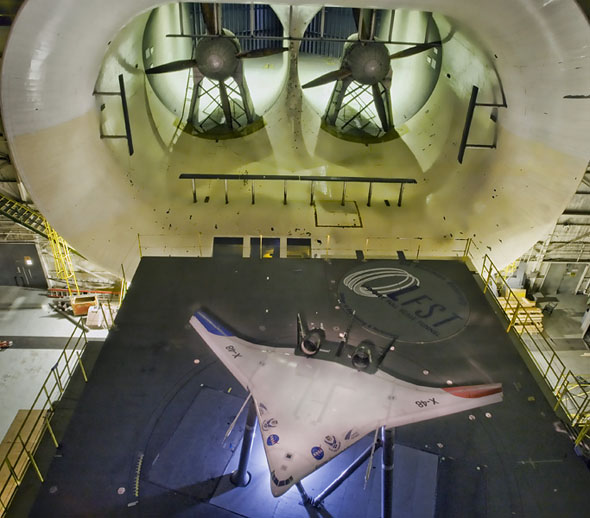
    The X-48C is a scale model of a heavy-lift, subsonic vehicle that forgoes the conventional tube-and-wing airplane design in favor of a triangular aircraft that effectively merges the vehicle’s wing and body. Boeing and NASA believe the BWB concept offers the potential over the long-term of significantly greater fuel efficiency and reduced noise. The X-48C is an 8.5 percent scale model of an aircraft with a 240-foot wingspan that possibly could be developed in the next 15 to 20 years for military applications such as aerial refueling and cargo missions.

    The X-48C is a modified version of the X-48B aircraft, which flew 92 times at NASA Dryden between 2007 and 2010. The X-48B’s flight test program proved that a BWB aircraft can be controlled as effectively as a conventional tube-and-wing aircraft during takeoffs and landings, as well as in other low-speed segments of the flight regime. Primary changes to the C model from the B model were geared to transforming it to an airframe noise-shielding configuration. “With the X-48C, we will be evaluating the impact of noise shielding concepts on low-speed flight characteristics,” said Bob Liebeck, a Boeing Senior Technical Fellow and the company’s BWB program manager. The modified test vehicle was designed by Boeing and built by Cranfield Aerospace Ltd., in the United Kingdom, in accordance with Boeing requirements.

    The newer version has a 21-foot wingspan and its weight is 500 pounds. It is configured with two 89-pound thrust turbojet engines, instead of three 50-pound thrust engines on the B-model; and wingtip winglets have been relocated inboard, next to the engines on the C-model, effectively turning them into twin tails. The aft deck also was extended about 2 feet at the rear. The vehicle has an estimated top speed of about 140 miles per hour and a maximum altitude of 10,000 feet.

    Engineers from Boeing Research & Technology, the company’s central research, technology and innovation organization, will be working closely with NASA engineers during flight tests of the X-48C, which are expected to continue throughout 2012. As handling qualities of the X-48C will be different than those of the X-48B, the project team developed flight control software modifications, including flight control limiters to keep the airplane flying within a safe flight envelope.

    The X-48C project team consists of Boeing, NASA, Cranfield Aeropace, and the U.S. Air Force Research Laboratory.

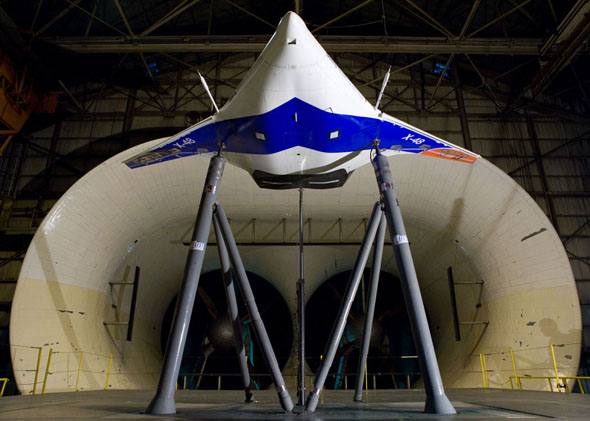
    An X-48C experimental aircraft is mounted in a full-scale wind tunnel on Aug. 31, 2009 at Langley Air Force Base, Va. The tunnel provided a controlled test environment to measure aerodynamic forces on vehicles. Since this test this facility has been dismantled. (U.S. Air Force photo by Staff Sgt. Barry Loo)
    X48C undergoing wind-tunnel tests at Langley AFB, VA. Photo: NASA

    Two US Minehunters Join Taiwan Navy

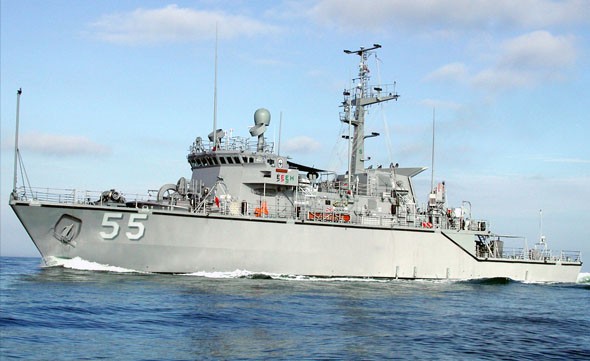
    Port side view of the US Navy (USN) Osprey Class minehunter, USS Oriole (MHC 55).

    Two refurbished US coastal minehunters were delivered to the Republic of China (Taiwan) Navy on 2 August as part of an overall arms deal valued at $6.4 billion. The two Osprey-class minehunters, the former USS Oriole (MHC-55) and USS Falcon (MHC-59), were decommissioned by the US Navy in 2007 and were approved for sale to Taiwan at a cost of approximately $105 million in 2010.

    Measuring 188 feet in length and weighing in at 893 tons loaded, the Osprey-class coastal minehunters are the second largest vessels of this class in operation. The USS Oriole entered service in 1995 and the USS Falcon began its career in 1997 as part of a twelve ship contingent built by Northrop Grumman Ship Systems (formerly Litton Avondale Industries) and Intermarine USA for the US Navy. The Osprey-class vessels proved their value in US service and are expected to give the ROC Navy a significant boost in mine-hunting operations.

    Port side view of the US Navy (USN) Osprey Class minehunter, USS Oriole (MHC 55).

    The two minehunters were delivered to the ROC Navy following a three year refit that included a comprehensive regimen of crew familiarization and operational training. The two ships will join Taiwan’s existing fleet of eight minesweepers/minehunters, some of which date back to the mid-1950s.


    The ROC Navy currently operates a fleet of amphibious landing ships, destroyers, submarines, frigates, and the aged minesweepers/minehunters. Although the 38,000-man force is relatively small, it is considered to be well-trained and capable.

    Osprey-class minehunters were designed to locate, classify, and destroy naval mines in coastal waterways, harbors, and littoral areas. These ships are equipped with an array of mine-hunting devices including Raytheon AN/SQQ-32 sonar, AN/SLQ-48 Mine Neutralizing Vehicles (MNV), video sensors, remotely-controlled mine detonators, cable cutters, and two .50 caliber machineguns. The minehunters have a cruising speed of 10 knots and mission endurance of 15 days.

    With these two ships, the ROC Navy will have a much improved warfighting capability and will be much better equipped to protect vital sea lanes, critical coastal areas, and maritime trade routes.

    The overall defense package negotiated with the United States, valued at $6.4 billion, also includes UH-60 Black Hawk helicopters, upgrades to Taiwan’s fleet of 146 F-16 fighters, and Patriot missiles. When announced in 2010, this agreement drew an angry response from Beijing that temporarily suspended US-Chinese military exchanges and diplomatic talks related to Pacific security issues.

    Taipei has scheduled a formal commissioning ceremony for 10 August to officially induct the two minehunters into active service. Admiral Tung Hsiang-lung, Chief of the ROC Navy, is scheduled to preside over the ceremonies at the Zuoying Military Harbor in the southern port city of Kaohsiung.

    Florida Based Company Obtain New Zealand’s Remaining A-4s to Support Military Training Missions

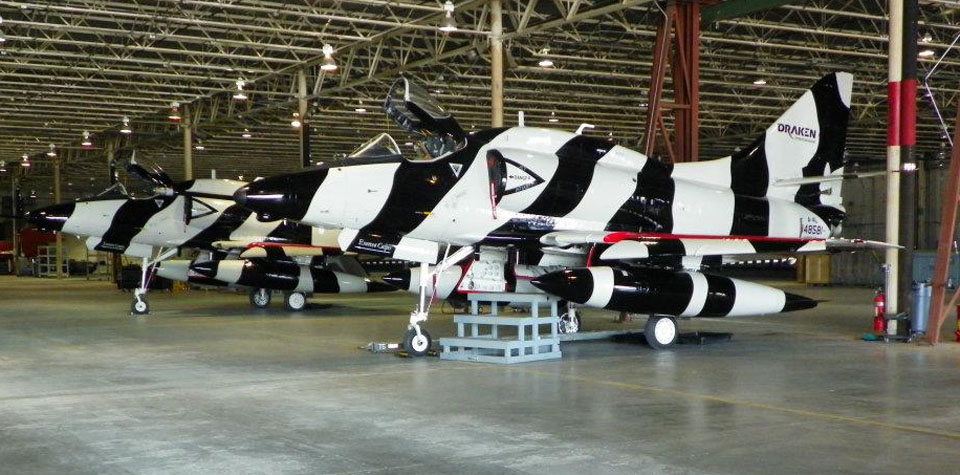
    Draken already operates a number of A-4Ns obtained from US Navy surplus. The A-4K represents a better equipped platform with F-16A class avionics. Photo: Lakeland Airport, FLA.
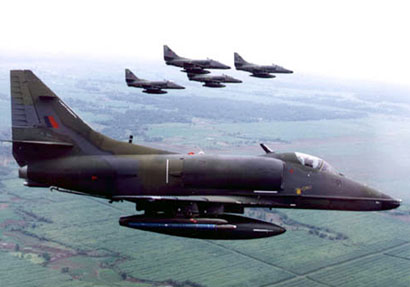
    The A-4Ks are grounded since New Zealand disbanded its strike force in 2001.

    Draken International has signed an agreement with the New Zealand government to purchase eight Douglas A-4K Skyhawk strike fighters formerly used by the Royal new Zealand Air Force. Draken has already received the necessary approval from the US State Department and expects to have the aircraft operational by the first quarter of 2013. In the 1990s these planes formed the New Zealand strike force. They flew until 2001, when the unit was disbanded and its aircraft put for sale.


    Draken plans to refurbish the aircraft, to be operated in support of US Department of Defense training initiatives. According to Draken, the aircraft bring unique capabilities to the Contract Air Services (CAS) industry, with features such as an APG-66 radar, Heads-up-Display, HOTAS, Multi-Function Display and the NATO standard 1553 bus.

    Draken already operates a number of A-4Ns obtained from US Navy surplus. The A-4K represents a better equipped platform with F-16A class avionics. Photo: Lakeland Airport, FLA.

    The aircraft will operate up to 6 buddy-store aerial refueling systems, formerly used by the US Marine Corps and Navy. The refueling system will support long-range Draken fleet deployments as well as provide tanker support to other probe equipped aircraft. Given these capabilities, providing realistic training and threat simulation environments for a variety of roles including Air-to-Air, “Red Air,” Air to Ground, JTAC/CAS, aerial refueling, research and other mission sets that demand the latest in aircraft technology.

    According to Draken International CEO Jared Isaacman these Skyhawks Draken acquired represent the final and most capable evolution of the A-4 platform. “We are all very confident in the long-term supportability, advanced avionics capabilities and economic efficiencies these aircraft will bring to the Department of Defense and the overall defense contracting industry.” Isaacman said. Draken also obtained over 20 spare J-52 jet engines and the entire inventory of spare parts stored in the NZ, along wit the associated maintenance gear that came with the aircraft. Draken also managed to get two flight simulators for cockpit procedural training and nav/attack system familiarization formerly used by the NZ pilots.

    Draken International already operates |A-4N formerly used by the US Navy. Draken is a provider of contract air services based out of the Lakeland Linder Regional Airport in Lakeland, FL. Providing contract air services, the organization sets a new standard in airborne adversary support, flight training, threat simulation, electronic warfare support, aerial refueling, research, testing, as well as other missions uniquely suited to their fleet of aircraft.

    Aging aircraft are increasingly used in training services, including the Israeli IAI Kfir, Northrop F-5 and Hawker Hunter and Swedish Saab Draken to name a few. The Duglas A-4 (this plane was produced before the Douglas Aircraft Company merged with McDonnell Aircraft, later becoming Boeing…) is also operational with few air forces, including the Brazilian Navy and Argentinian Air Force. The Israel Air Force is using the A-4N for lead in training, and expects to phase out these planes in 2014, as it receives the first Italian Alenia Aermacchi M346 trainers.

    First Raptor Supersonic AIM-9X Launch

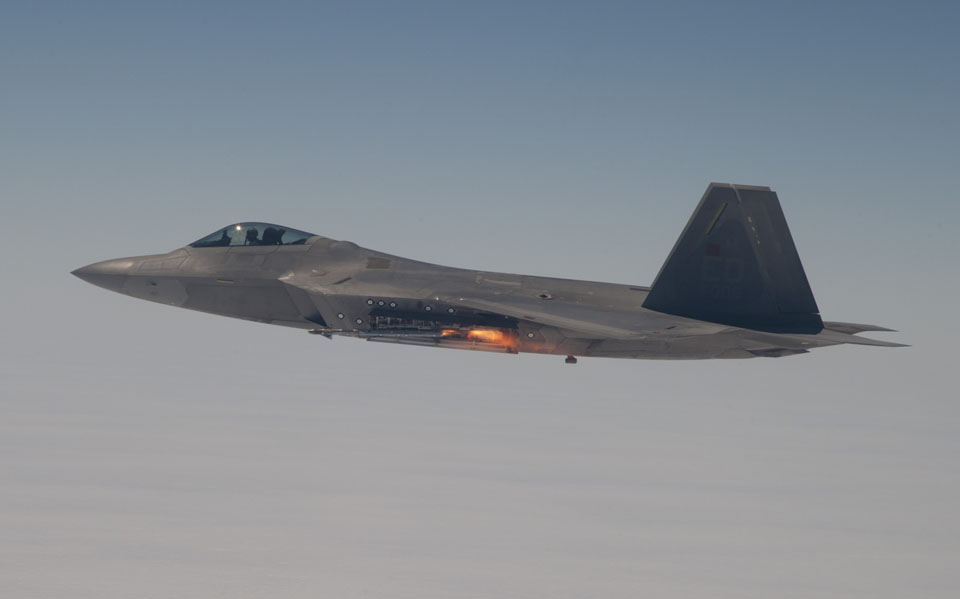
    F-22 from the Combined Test Force (CTF) at Edwards AFB performs the first supersonic launch of an AIM-9X from an F-22 in supersonic flight. Maj Howland Ryan is at the control, cruising at 1.2 Mach. Photo: Lockheed Martin
    F-22 from the Combined Test Force (CTF) at Edwards AFB performs the first supersonic launch of an AIM-9X from an F-22 in supersonic flight. Maj Howland Ryan is at the control, cruising at 1.2 Mach. Photo: Lockheed Martin

    The first AIM-9X Sidewinder air-to-air missile launch from an F-22 Raptor traveling at supersonic speeds was carried out on July 30, 2012, over the Sea Test Range at Point Mugu, Calif. Maj. Ryan Howland of the F-22 Combined Test Force at Edwards AFB, California, was at the controls. The first launch of an AIM-9X from the F-22 was carried out in May 2012. This test firing was part of the flight testing and integration of the AIM-9X on the Raptor, expected to run through 30 August 2013.


    Despite being the world’s best fighter, the integration of short range heat seeking air/air missile was a low priority, given the Raptor’s superb long-range capability in engaging hostile aircraft without being seen, due to its stealth advantage. Therefore, the weapon of choice for the F-22A Raptor is the Raytheon AIM-120C – six are carried in the internal weapon bay, along with two AIM-9M Sidewinders. On strike missions the Raptor can carry four missiles (Two AMRAAM and two Sidewinders), along with two 1,000 pound JDAMs or eight 250 pound Small Diameter bombs (SDB), both produced by Boeing.

    When the AIM-9X will replace the AIM-9M on the F-22A it will bring a full sphere seeker, and Lock-On-After-Launch mode, providing more efficient launch from the weapon’s bay. Yet, even when armed with the latest Sidewinder, the Raptor will still lack advantage of the helmet-mounted display sight, which, by now, has been a standard issue with all US fighter jets. Without the helmet, Raptor pilots must point their missile’s seeker at the hostile aircraft to verify the missile is locked on the right target. The helmet would enable the pilot to slave the seeker to their line of sight, hence locking on by simply looking at the target, without having to turn the aircraft.

    Originally designed to excel in BVR engagement, the Raptor faces quite a challenge battling Gen 4.5 fighters Within Visual Range (WFR). Indeed, close-in combat has been the ‘Achilles heel’ of the Raptor; despite the high maneuverability, as demonstrated in airshows, derived by high thrust to weight ratio and thrust vectoring, the stealth fighter tend to lose energy and slow on tight turns, as it maneuvers to lock on the target, offering opportunities to enemy fighters to close in.

    Nightlighter to Spot IEDs at Night

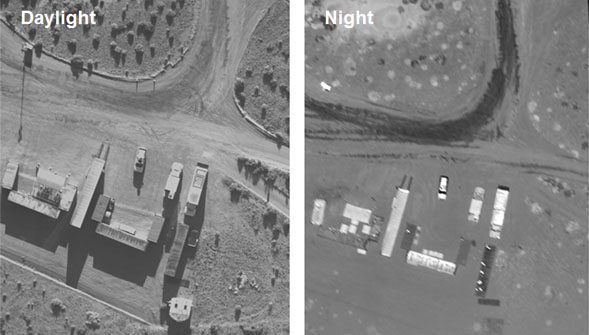
    Scene is the Assembly Area at Olympus test site, Cactus Flats, China Lake, Calif., Sept. 2011. Images provided by the Nightlighter in the recent test show differences between day and night imagery. Night imagery contains no shadows, and NIR has different reflectivity than the Visible. The dark tire marks in the night imagery (curved shape at the top-center) is moist soil, which strongly absorbs the laser energy at 880 nm. Photo: GA-ASI
    The scene of an Assembly Area at Olympus test site, Cactus Flats, China Lake, Calif., Sept. 2011. The images provided by the Nightlighter show differences between day and night imagery. Night imagery contains no shadows, and NIR has different reflectivity than the Visible. The dark tire marks in the night imagery (curved shape at the top-center) is moist soil, which strongly absorbs the laser energy at 880 nm. Photo: GA-ASI

    A prototype system designed to detect improvised explosive devices (IED) in day and night, from high altitude was successfully flight tested by General Atomics General Atomics Aeronautical Systems, Inc.,. In addition to its primary IED detection capability, the system also provides wide-area 3D relief terrain mapping supporting intelligence gathering and mission planning.

    Nightlighter delivers around-the-clock, ultra high-resolution imagery and is derived from GA-ASI’s proven daylight-only, Highlighter electro-optic sensor system. Developed in 2005, Highlighter recently completed a very successful six-year deployment to Operation Iraqi Freedom. Highlighter is a specialized 1600 pound (724 kg) ultra-high resolution payload flown on special mission aircraft collecting color and monochrome imagery of wide areas. The system is supported with on-board automated image processing to enable rapid airborne image acquisition , analysis and dissemination, in spotting and identifying hard to detect targets such as IEDs planted on roadsides or under the surface.


    GA-ASI plans to conduct a series of additional flight tests under both daylight and nighttime conditions to validate the effectiveness of the Nightlighter platform further. In the recent test the system was demonstrated on a Twin Otter aircraft, during the Olympus Flight Test sponsored by the Joint Improvised Explosive Device Defeat Organization (JIEDDO) at China Lake, Calif. GA-ASI is currently developing a program to deploy the system on King Air 350 aircraft.

    Under development since 2010, Nightlighter is a high-altitude airborne imaging system designed to detect Improvised Explosive Devices (IEDs) and other implanted devices along roads and other routes of travel. The system uses both standard cameras for operation in daylight and advanced night imaging technology to collect imagery under darkness.

    Pyros Demonstrates Lethality, Low Collateral Damage in End-to-End Test

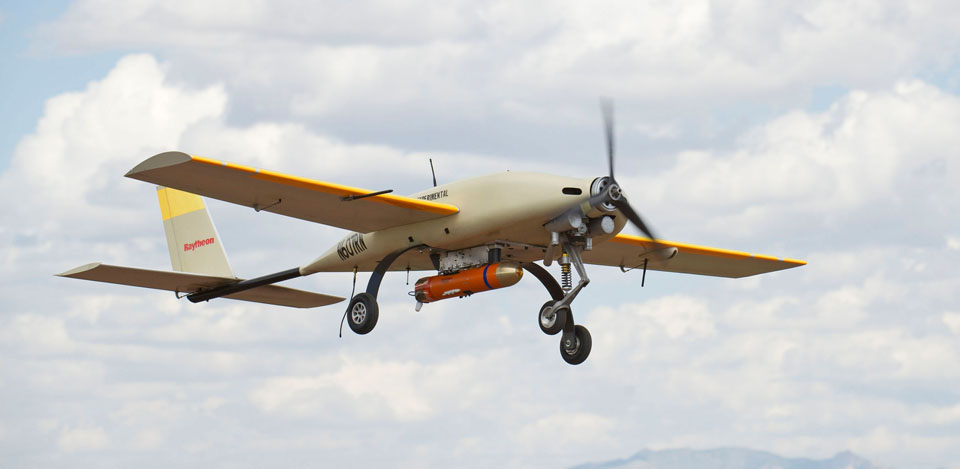
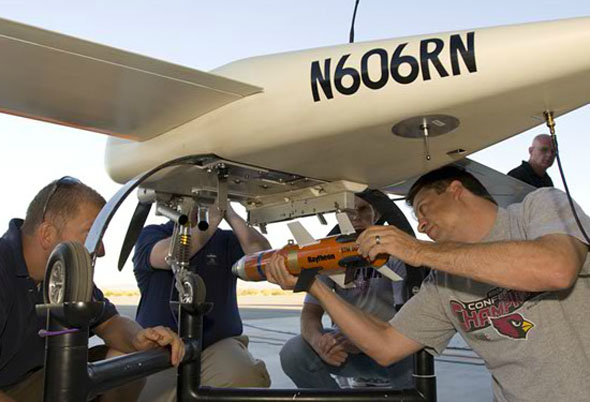
    A Cobra unmanned aircraft system (UAS) carries a Small Tactical Munition Phase II during the weapon's first captive carry test on Sept. 16 at Yuma Proving Grounds, Ariz. STM Phase II is a new 12-pound, 22-inch long, precision-guided, gravity-dropped bomb specifically designed for employment from UAS and manned aircraft. (PRNewsFoto/Raytheon Company)
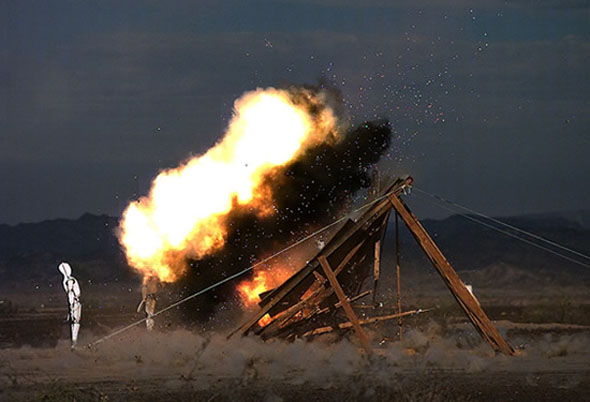
    Warhead test of the Pyros Small Tactical Munition (STM Block II) demonstrates the weapon’s lethality and low collateral damage. To achieve low collateral damage Pyros has three fusing options – height of burst, time delay and impact. Photo: Raytheon

    Raytheon completed a successful warhead and guidance system test of its Pyros Small Tactical Munition (formerly known as STM). This end-to-end test validated the weapon’s guidance modes – digital semi-active laser and global positioning system (GPS), its height-of-burst sensor, electronic safe and arm device, and multi-effects warhead. During the test, Pyros was dropped from a Raytheon Cobra unmanned aircraft in parameters closely approximating those typically seen in current contingency operations. The target simulated insurgents planting an improvised explosive device. While directly over the target, the warhead detonated at a predetermined height following inputs from the weapon’s height-of-burst sensor. Raytheon developed the Pyros as a weapon for Shadow-class UAS and counterinsurgency aircraft such as the AT-6 and A-29.

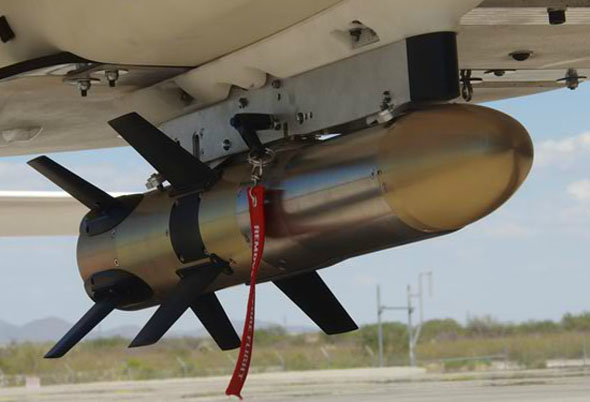
    Pyros is the smallest air-launched weapon in the Raytheon portfolio. Photo: Raytheon

    “This test demonstrated the technical maturity of Pyros, which is designed from the ground up with small, tactical unmanned aircraft systems in mind. Our next step is to complete ongoing integration work on fielded platforms and prepare for production.” said Tom Bussing, vice president of Advanced Missile Systems for Raytheon Missile Systems.

    While the weapon is unpowered, it retains high degree of maneuverability using large foldable fins for stabilization and steering. Photo: Raytheon.

    At a weighs 13.5 pounds (6.12 kg) and length of 22 inches (56 cm), Pyros fits most small and medium unmanned aerial systems fitted to carry such payload individually, or two Pyros stored in tandem in a common launch tube. Pyros can also be dropped from small scout helicopters or light attack aircraft. This gravity dropped guided weapon is the smallest air-launched weapon in the Raytheon portfolio. While the weapon is unpowered, it retains high degree of maneuverability using large foldable fins for stabilization and steering.

    The warhead makes about half the weapon’s weight (7 pounds) and is optimized for high lethality and low-collateral damage. To contain the lethal effect in a narrow envelope the operator can select one of three guidance modes – Hit a target at a given GPS coordinates, guided by inertial navigation and GPS, or home in on a laser designation. To maximize kinetic effects and lethality, there are also three options for engaging the target: height-of-burst, point-of-impact or fuse-delay detonation.

    A Cobra unmanned aircraft system (UAS) carries a Small Tactical Munition Phase II during the weapon’s first captive carry test on Sept. 16 at Yuma Proving Grounds, Ariz. STM Phase II is a new 12-pound, 22-inch long, precision-guided, gravity-dropped bomb specifically designed for employment from UAS and manned aircraft. (PRNewsFoto/Raytheon Company)

    Royal Jordanian Air Academy to Teach Iraqi Technicians

    The Pentagon announced today the award of a $370 million contract to the  Royal Jordanian Air Academy, Amman, Jordan, for the training of Iraqi aviation technicians. This outsourcing contract provides for one year of training which will also include teaching the Iraqis to speak English… The contract was awarded a by the US Air Force.

    Indian Navy Warships Conclude Israeli Visit

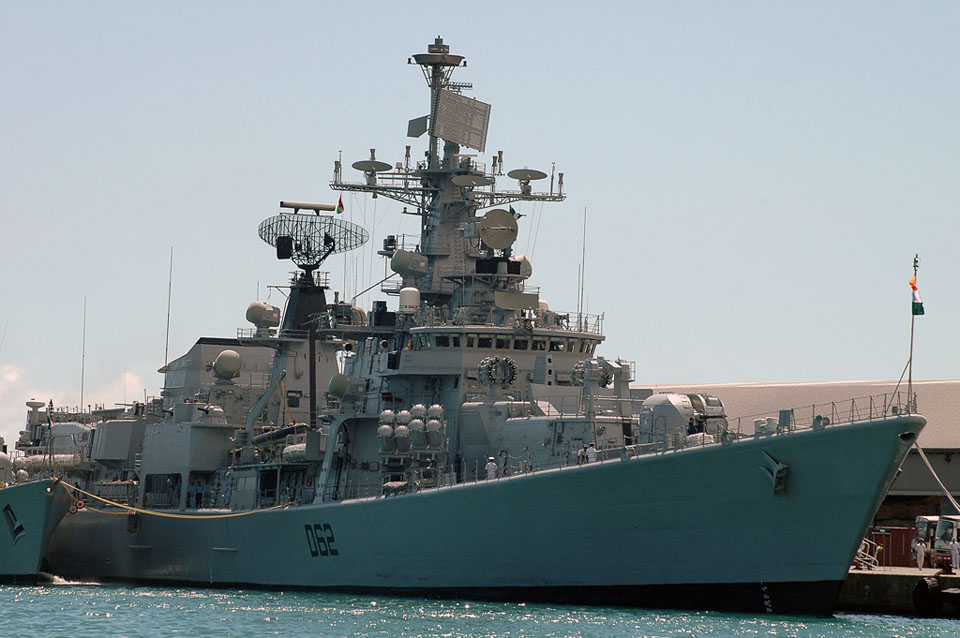
    INS Mumbai is one of three Indian built Delhi Class guided missile destroyers currently serving in the Indian navy.
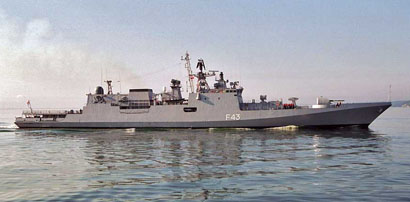
    INS Trishul is the second ship of the Talwar Class guided missile frigates (Krivak III, Project 11356) built in Russia for the Indian Navy. the vessel is armed with Club-N anti-ship cruise missiles. In later models the Club-N was replaced by the supersonic BrahMos missile.

    An Indian Navy group comprising four vessels deployed in the Mediterranean Sea visited the Israeli port of Haifa last week, as the two countries celebrate 20 years of diplomatic ties this year. The vessels include the Indian built Delhi Class guided missile destroyer INS Mumbai (D62), the Russian built Talwar Class (Krivak III) class guided missile frigate INS Trishul (F43), Indian built Godavari-Class (Project 16) frigate INS Gomti (F21) and Russian built INS Aditya replenishment and repair ship (A59).
    INS Mumbai is one of three Indian built Delhi Class guided missile destroyers currently serving in the Indian navy.

    The vessels are part of the Indian navy’s western fleet. The Mediterranean tour of the four warships is being headed by Rear Admiral A R Karve.

    Indian warships have regularly paid visits to ports in the West Asia and East Africa, reaffirming their peaceful presence and solidarity with countries in the region; the four-day visit in Israel reaffirms the growing Indo-Israeli relations and continued cooperation between the two countries” Indian officials said.

    In recent years the Indian Navy has expanded the use of Israeli systems on the new classes of ships. Among the visiting ships, only the Gomti carries Israeli Barak anti-missile systems, however, almost all new Indian built classes of warships currently fielded or under construction in India, are loaded with Israeli systems, primarily defensive electronics, radars and missile and Barak systems. The Indo-Israeli Barak 8 counter-air system is scheduled for deployed on the lead ship of the P15A class, INS Kochi, following completion of the system’s testing, currently underway in India and Israel. Barak 8 and its associated IAI Elta EL/M-2248 radar provide the Indian Navy an AEGIS-class weapon system, extending its active air defense capability far beyond current capabilities.

    South Korean F-16 Upgrade Contract Confirmed by BAE

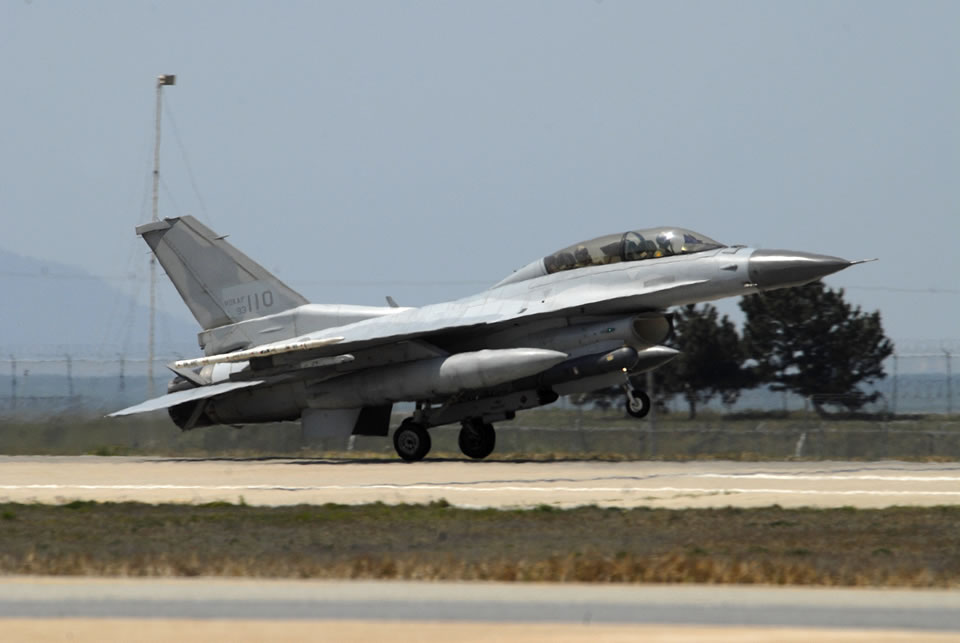
    RoKAF F-16B landing at Kunsan AFB, South Korea. Photo: US Air Force

    On 6 August, BAE Systems confirmed that an agreement was reached with South Korea to upgrade 130 of the Republic of Korea Air Force’s (ROKAF) F-16 fighter jets.  The deal calls for an upgrade package that will include enhancements to the aircraft’s avionics and electronics. Although Seoul has not submitted a formal Letter of Request (LoR) yet, BAE expects the request to be delivered soon with BAE named as the sole source integration contractor.  

    The contract will be administered through the US Department of Defense (DoD) via the Foreign Military Sales (FMS) program. Dave Herr, president of BAE Systems Support Solutions, is quoted as saying that this agreement “is a strategic international win for us, significantly expanding our aircraft upgrade and modification business” and emphasized that BAE Systems has “extensive capabilities that span across BAE Systems, and I am confident that our team offers the best value to the customer.” Vice President and General Manager of Support Solutions’ Aerospace Solutions branch, Gordon Eldridge, added that this contract is further evidence that BAE is the “leading provider of integration, avionics and mission computers for F-16s, and we will continue to offer our capability to customers across the globe.” The South Korean upgrade agreement calls for BAE to deliver a broad range of improvements to include software enhancements, electronics engineering, integration software, logistical support, and obsolescence management.  


    The bulk of the actual work is scheduled to be performed at BAE facilities located in Texas, Florida, and Georgia. BAE Systems currently services upgrades on 270 US Air National Guard F-16s and 50 Turkish Air Force Fighting Falcons.  The Worldwide F-16 upgrade market is estimated to be valued at as much as $3 billion covering more than 3,000 aircraft.

    Next on BAE’s agenda is locking-up a deal to provide an upgrade package for Taiwan’s 146 F-16A/B Block 20 aircraft, a contract worth $3.7 billion. BAE faces severe competition from Lockheed Martin for this deal. Lockheed is considered the front-runner given its long-term relationship with Taiwan’s Aerospace Industrial Development Corporation (AIDC) and friendly association with the Republic of China Air Force (ROCAF). Lockheed and the AIDC signed a Memorandum of Understanding (MoU) back on 11 July to establish a strategic partnership to give Lockheed an edge in the contract negotiations.

    Japanese Self-Defense Force to Station Liaison Officers with Key US Military Commands

    For the first time ever, the US Department of Defense (DoD) is planning to station Japanese Self-Defense Force (JSDF) liaison officers with key US military commands in the Washington, DC area.  Currently, JSDF officers are periodically assigned liaison duties with the US Marine Corps Combat Development Command in Quantico, Virginia and routinely work with US military research organizations dedicated to the study of land, air, and sea warfare.  During the Iraqi War, JSDF officers served side-by-side with US military leaders within the US Central Command in Florida as well.

    In establishing a permanent Japanese liaison structure within existing US commands, the planners hope to improve bilateral cooperation, enhance response to emergency situations of mutual interest, and assist Japanese military officers gain firsthand experience in the decision-making process exercised by US military organizations.
    US military leaders wish to strengthen ties with Japan as part of the Obama administration’s plan to focus attention on the Asia-Pacific region.  The strategic shift of US military forces to the Pacific has become increasingly important with China’s aggressive behavior in the South China Sea and elsewhere in the Pacific appearing to escalate in recent weeks.


    American leaders also hope to develop a structure that can respond more rapidly to natural disasters, humanitarian emergencies, piracy, and threats to maritime trade.  In the past, no formal US-JSDF liaison structure was manned in peacetime.

    In contrast, Australian and British officers have been assigned to key US commands to enhance cooperative efforts, coordinate joint activities, and streamline communications for quite some time.  This arrangement has helped these two long-term allies gain valuable insight into the thinking driving US strategy.

    The proposal calls for detailing Japanese officers from the Air Self-Defense Force (JASDF) and Maritime Self-Defense Force (JMSDF) to serve with the Office of the Chief of Naval Operations and the Chief of Staff of the Air Force.  No timetable or schedule to complete this arrangement was announced.

    MLB/AAI Team to Build Long-Endurance Vertical Takeoff And Landing (VTOL) Tier II-Size UAV for the US Air Force

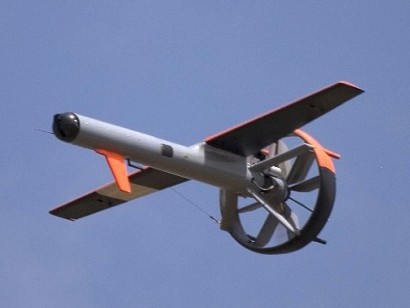
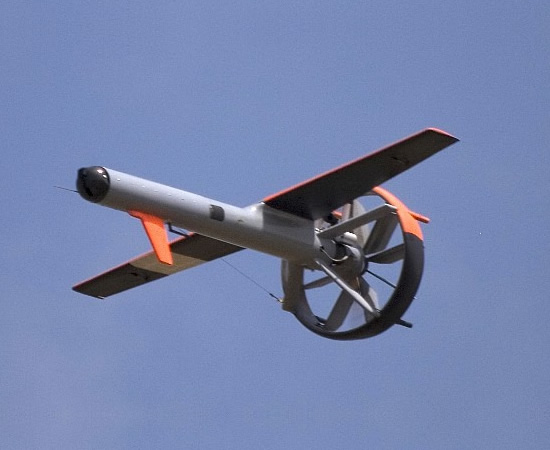
    V-BAT demonstrates fast forward flight, after transition from vertical takeoff and hover. Photo: MLB

    The US Air Force selected a team headed by UAV makers MBL, AAI, and Brigham Young University, to develop a vertical take-off and landing unmanned aerial vehicle meeting Tier II size, weight and performance (SWAP). They vehicle will have an 8 ft. wingspan, 10 hour endurance, 55 lbs. gross take-off weight, and 70 mph cruise speed. The unique design will enable the warfighter to gain situational awareness over urban and complex areas, while operating UAVs from confined areas.


    According to MLB, the design pursued by the team will be based on its V-Bat VTOL UAV. The development is performed under an Air Force Phase II SBIR award. The Design combines the operational flexibility of VTOL, with the safety provided by the shrouded fan. On the other hand, extended mission endurance is achieved by the fixed wing configuration, extending the platform’s mission endurance beyond that of much larger platforms.

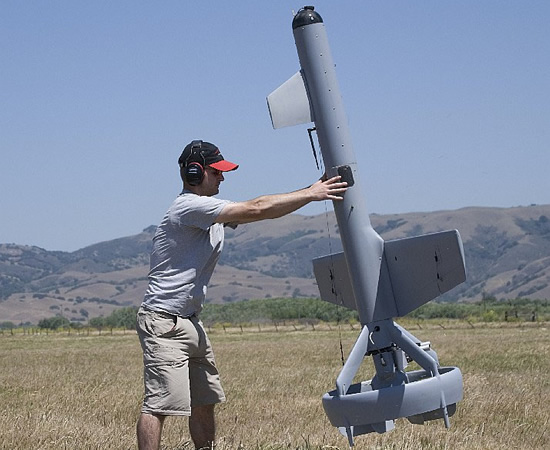
    V-BAT in vertical takeoff position. The drone can sustain missions of up to 10 hours carrying five pounds of payload. Photo: MLB

    Last year, under a DARPA contract, MLB demonstrated precise emplacement of small payloads from the V-Bat operating in hover mode under a vision-based control system. Under the Phase II SBIR award, MLB will build vehicles and conduct a comprehensive flight test program for the V-Bat through all phases of flight, culminating in fully autonomous operational demonstrations. Brigham Young University will develop control algorithms and support flight tests.

    AAI Unmanned Aircraft Systems will focus on preparing the system design for low-rate initial production and refine requirements through customer engagement.

    According to the V-BAT designer MLB there is a growing interest in unmanned platforms among military and homeland security customers. The V-Bat design was originally solicited by a commercial customer for aerial mapping. More recently, the company has been approached by potential customers in several government agencies and by commercial groups seeking an anti-piracy solution.

    Vigilant Stare Launch Airborne Wide Area Persistent Surveillance (WAPS) Service

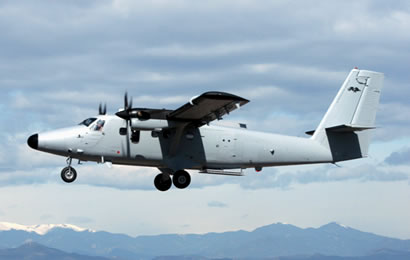
    DHC 6 Twin Otter operated by SNC was used for the testing of the Vigilant Stare persistent surveillance sensor package. Photo: SNC

    Sierra Nevada Corporation (SNC) and ITT Exelis are nearing completion and testing of Vigilant Stare, a manned aircraft-based Wide-Area Persistent Surveillance (WAPS) concept demonstrator. The system will achieve initial operational capability in August 2012, with the planned launch of services providing customers with airborne wide-area persistent surveillance on a fee-for-service basis.

    In recent system testing by SNC, the Vigilant Stare system carried on a Twin Otter aircraft delivered imagery directly to users in real time, via a WIMAX/4G LTE dissemination channel. Imagery was displayed on the ground stations using common off-the-shelf hand-held devices.

    “The Vigilant Stare system offers unprecedented WAPS capability to a previously unserviced market, in an affordable and flexible package,” Dave Bullock, vice president for SNC’s ISR Persistent Surveillance Systems said. “The civil and commercial applications of this operations-proven technology are many and varied. We’re excited about the successful completion of our concept demonstrator flight test phase and look forward to a busy demonstration and exercise schedule this fall.”


    Operated as a partnership between SNC and Exelis, Vigilant Stare provides WAPS capabilities with various manned aircraft platforms such as the Twin Otter, Bombardier Q200, Dornier 328, King Air 350, and Pilatus PC-12.

    “With the completion of initial flight tests, we remain on track to make Vigilant Stare available for operations by the end of the year,” said Danny Rajan, director of airborne and emerging solutions at ITT Exelis Geospatial Systems. “We are currently in discussion with customers regarding specific operational scenarios, ranging from persistent wide-area airborne surveillance for major public events to supporting border security operations.”

    Derived from operationally proven systems created from SNC and Exelis technology and engineering, Vigilant Stare’s integrated EO/IR sensor collects synoptic, day/night motion imagery of city-sized fields of regard with multiple sub-views of the full field of view. In addition, best-resolution tactical chip-outs are provided in real time to both centralized command centers as well as to dispersed users employing commercial devices, including tablets and phones. This diversified dissemination capability optimizes situational awareness across multiple echelons simultaneously.

    In addition to support of military contingencies of force protection and intelligence collection, typical WAPS services could also support border security surveillance, surveillance of areas suspected of illegal activity, national security at special or sporting events, port security surveillance, as well as natural disaster response and search and rescue efforts.

    Lockheed Martin Unveils New Unmanned Quad Rotor VTOL UAV

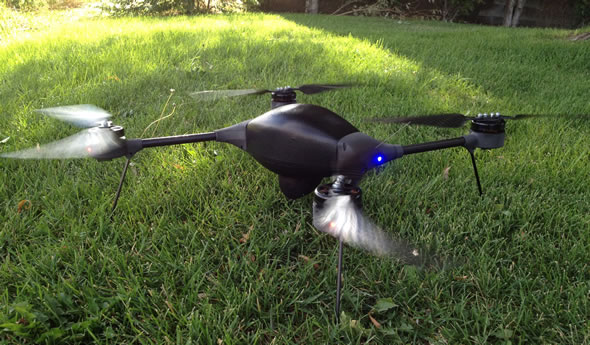
    Lockheed Martin Procerus Technologies’ new small vertical take-off and landing (VTOL) unmanned aircraft system gives warfighters, first responders and others in small, cluttered, urban environments an eye-in-the-sky in just minutes. Photo: Lockheed Martin

    Lockheed Martin Procerus Technologies is launching today a new quad-rotor small UAV at AUVSI 2012. The new vehicle is a rugged, five-pound VTOL quad rotor has mission endurance of up to 40 minutes, including extended extended hover, perch and stare missions. Typical missions support military, law enforcement and civil or commercial aerial reconnaissance in crowded areas, unreachable by fixed-wing unmanned aircraft systems. The system uses a gimbal mount providing continuous 360-degree panning capability, carrying daylight video and infrared sensors, augmented with laser illuminator.


    According to Todd Titensor, senior manager of Lockheed Martin Procerus Technologies, the new system is quiet, can operate day or night in challenging weather conditions and has longer operating time than other VTOL platforms. The collapsible VTOL platform folds into a man-packable unit that requires no tools for assembly.

    The system utilizes the Kestrel 3 autopilot developed in-house at Procerus. The system is controlled via wireless hand controller, which provides an easy-to-use interface for intuitive, untethered vehicle operation. For full ground control station capabilities, the Virtual Cockpit v3.0 features a user-friendly 3-D map interface, powerful mission planning tools, in-flight re-tasking and full waypoint navigation.

    At the AUVSI exhibition Procerus Technologies’ provided more details about its new miniature payload – ‘Perceptor’. This lightweight™ dual-sensor gimbaled payload was designed to provide high-quality video surveillance for small and micro unmanned aircraft systems. Perceptor is equipped with electro-optical and infrared imaging sensors and an optional laser illuminator, the 200-gram (7-ounce) Perceptor provides continuous 360-degree panning and high-definition video imagery day or night in all weather conditions. The payload package also includes a high-speed, high-bandwidth digital internet protocol data link that delivers video and high-resolution imagery more affordably and eliminates the need for multiple data links.

    Skunk Works and XTEND Simplify Multi-Drone Command

    0
    Lockheed Martin Skunk Works® and XTEND have achieved a major milestone in JADC2 by integrating the XOS operating system with the MDCX™ autonomy platform. This technical breakthrough enables a single operator to simultaneously command multiple drone classes, eliminating the friction of mission handoffs. From "marsupial" drone deployments to operating in GPS-denied environments, explore how this collaboration is abbreviating the data-to-decision timeline and redefining autonomous mission execution.

    From Ukraine to Taiwan: The Global Race to Dominate the New Defense Tech Frontier

    0
    As traditional defense primes face mounting competition from agile “neoprimes” such as Anduril, Palantir and Helsing, the balance of innovation is shifting toward software-defined warfare and scalable, dual-use technologies, while global industry consolidation—marked by Boeing’s integration of Spirit AeroSystems and other strategic mergers—signals an intensified race to secure control over the defense technology value chain. Our Defense-Tech weekly report highlights these trends.

    Europe’s “Drone Wall”

    0
    In early October 2025, a coordinated wave of unmanned aerial system (UAS) incursions—widely attributed to Russia—targeted critical infrastructure across at least ten European nations. The unprecedented campaign exposed the fragility of Europe’s air defenses...

    Weekly Defense Update & Global Security Assessment

    0
    Executive Summary The past week (September 18-25, 2025) represents an inflection point where strategic defense concepts have transitioned from doctrine to tangible reality. An analysis of global events reveals four primary, interconnected trends shaping an...

    U.S. Air and Space Forces Push Next-Gen Programs at the AS&C 2025 Conference and...

    0
    At the 2025 Air, Space & Cyber Conference, U.S. Air Force and Space Force leaders unveiled major updates on next-generation fighters, bombers, unmanned systems, and space initiatives, highlighting both rapid innovation and critical readiness challenges as the services race to outpace global competitors. A short version is available here, with a more detailed version for subscribers.

    TADTE 2025: Reflecting Taiwan’s Strategic Themes

    0
    The Taipei Aerospace & Defense Technology Exhibition (TADTE) 2025 crystallized around four dominant strategic themes that collectively illustrate Taiwan's comprehensive approach to defense modernization amid escalating regional tensions. Based on a detailed report by Pleronix (available upon request). Includes a Podcast discussion on TADTE 2025's highlighting Taiwan's four strategic themes beyond the post's coverage.

    Iron Beam 450 Completes Testing, Soon to Join With Operational Air Defense Units

    0
    Israel’s Iron Beam 450 high-power laser system has completed final testing, marking a major leap in air defense. Developed by Rafael, it offers precise, cost-effective interception of rockets, UAVs, and mortars, and is set for IDF deployment by 2025.