
Saturday, December 27, 2025
More
    Home Blog Page 248

    Raytheon Awards More Contracts for Mobile Centurion Subsystems

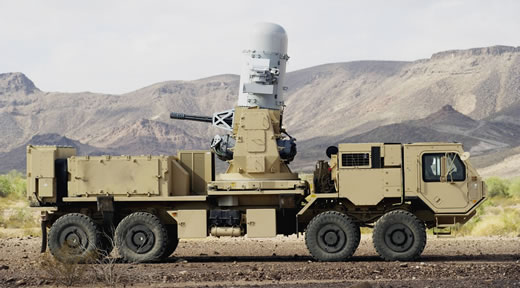
    Centurion weapon system mounts the Phalanx Block 1B weapon mounted on an Oshkosn HEMTT A3 truck. Photo: Raytheon

    Raytheon has awarded Curtiss-Wright Controls, Inc. a subcontract worth US$5.7 million providing for rugged single board computers (SBC), digital signal processors (DSP) and buffer memory cards to be used with the Centurion Counter-Mortar and Rocket Weapon System destined for the U.S. Army. Raytheon also has options to buy additional batches the systems this year, at a total cost of $5 million. The system will utilize Curtiss-Write’s SVME-412 DSP, SCP-122 SBC, SPMC-230 StarLink module and MM-6790F/8M Flash Module. The new systems will drive the Centurion’s target tracking system radar and perform fire correlations in the main system computer. The advanced search and track radar uses closed-loop spotting technology that enables autonomous target detection and engagement. Phalanx can be interfaced with other sensors and systems to provide overarching protection of high-value sites on the ground.

    Centurion weapon system mounts the Phalanx Block 1B weapon mounted on an Oshkosn HEMTT A3 truck. Photo: Raytheon

    This contract follows another order worth a $17 million, awarded two months ago by Raytheon to General Dynamics Armament and Technical Products (GDATP), for the production of 20mm Gatling gun systems for the Phalanx Block 1B Close-In Weapon System (CIWS) and the new  Mobile Land-Based Phalanx Weapon System (MLPWS) – Centurion.

    The Phalanx Block 1B CIWS is the most recent upgrade of the naval Phalanx CIWS. The upgrade adds enhanced fire-control capability, optimized gun barrels and an integrated Forward Looking Infrared (FLIR) system. In the Centurion configuration, a Phalanx Block 1B CIWS is mounted on a stabilized platform utilizing an Oshkosh Heavy Expanded Mobility Tactical Truck (HEMTT) A3.

    HEMTT A3 uses the Oshkosh ProPulse hybrid diesel-electric drive technology to deliver 100 kW of exportable military-grade power and 20 percent improved fuel economy. The HEMTT A3 delivers greater efficiency and exportable power capabilities without compromising the vehicle’s payload and protection. In addition to powering an airfield, hospital or command center, the vehicle can also be used to mobilize and power weapon systems, IED-suppression technologies and radar systems. By eliminating the need for extra support equipment, such as trailer-mounted generators, the vehicle offers the Army leaner, more mobile fleets and a reduced logistics footprint.

    Late last year The MLPWS completed a proof of concept demonstration at Yuma Proving Grounds and met all demonstration objectives. During a live-fire demonstration the system successfully tracked, engaged and destroyed nine inert mortars. The vehicle also maneuvered more than 28 miles on paved and off-road conditions without any damage to the system.

    Indian Labs Demonstrate Mission-Ready Akashdeep Aerostat at Aero-India 2011

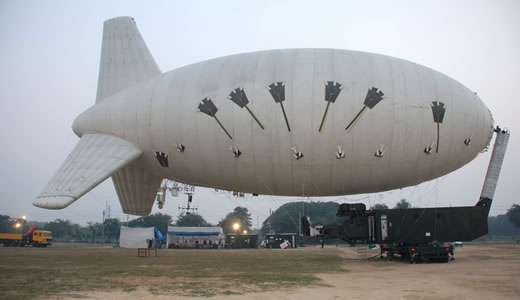
    Akashdeep, developed by the DRDO and and Aerial Delivery Research & Development Establishment (ADRDE) will be one of the largest flying objects at Aero-India 2011.

    Aerostats are becoming popular in India, for their simple and reliable operation, extended persistence on missions and low operating cost. India has already deployed several aerostat-borne radar systems, used as ‘gap fillers’ in regions where ground-bound radar coverage is incomplete or in high priority areas requiring continuous radar coverage.

    India has reportedly deployed several IAI/Elta EL/M-2083 air surveillance radar systems in such application, carried on  large aerostats. In 2004 the Indian Air Force received the first of six EL/M-2083 radar aerostat from Israel. Each of these radars is capable of covering a three-dimensional volume (including look-down low-altitude coverage) equal to 30-40 ground-based radars. deploying them along the border in Kutch region and Punjab. The total requirement of the IAF is projected at 13 Aerostat radars. In 2009 the Indian Navy ordered two additional such aerostat-radars, to improve coastal protection.

    Akashdeep, developed by the DRDO and and Aerial Delivery Research & Development Establishment (ADRDE) will be one of the largest flying objects at Aero-India 2011.
    Airshow-Live sponsor: IAI

    At Aero-India 2011 Defence Research and Development Organisation (DRDO) and Aerial Delivery Research & Development Establishment (ADRDE), will be demonstrate the indigenously developed Akashdeep aerostat, designed to carry a different payload optimized for ground surveillance missions.

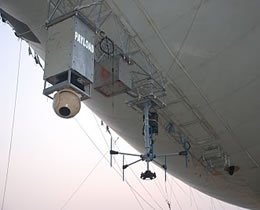
    The stabilized EO payload (front) and SIGINT antennae complex (rear position) for the Akashdeep aerostat payload.

    During the airshow operational demonstration spanning on all show days, Akashdeep will be equipped with a full mission system including payloads, designed to support anti-terror and security aerial surveillance. Akashdeep aerostat carries an gyro-stabilized electro-optical day/night (thermal) payload an integrated with Communications Intelligence (Comint) payloads.

    Another, smaller aerostat to fly at Aero-India is the SkyStar 300 from Aeronautics. The Israeli company is demonstrating at Aero-India an operational, aerostat-based persistent surveillance system based on the rapidly deployable Skaystar system, equipped with the Speed-A electro-optical payload developed by Controp. This sensor is optimized for aerostat operations. Speed-A uses five axis stabilization, offering maximum stability necessary for the employment of high resolution, long focal plane telescopic cameras.

    Another Israeli company highlighting aerostat sensor platforms is Rafael, one of the prime contractors for such systems in Israel.

    Public Debut for HAL’s Light Combat Helicopter at Aero India 2011

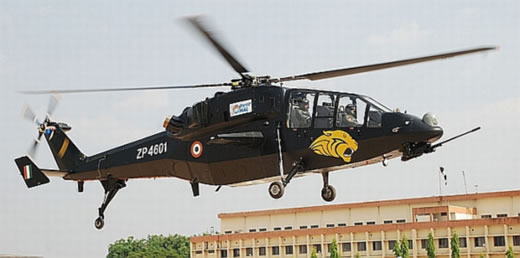
    The first LCH on its first test flight, March 2010. Since this event the first prototype performed over 20 test flights. A second prototype is set for the upcoming weapon testing phase. Both will also be shown at Bangalore. Photo: HAL
    Hindustan Aeronautics (HAL) will display its new indigenous attack helicopter for the first time at the upcoming Aero-India airshow in Bangalore next month.
    Airshow-Live Sponsor: RAFAEL

    The first prototype of the Light Combat Helicopter (LCH) developed by HAL and due for induction into the Indian Air Force by 2012-13, will make its first flight during the airshow. LCH made its first test flight was in March 2010 and has  since performed over 20 test flights, paving the way for the upcoming weapon testing phase on the second prototype, which will also be shown at Bangalore in the static display. Two more prototypes are under construction. HAL commenced work on the LCH in 2006. The helicopter is an attack variant of the HAL Dhruv, which is already operational with the Indian armed forces. HAL has tentative orders to deliver 65 LCHs to the IAF and over 100 to the Army.

    The first LCH on its first test flight, March 2010. Since this event the first prototype performed over 20 test flights. A second prototype is set for the upcoming weapon testing phase. Both will also be shown at Bangalore. Photo: HAL


    Video: New Indian C-130J expected at Bangalore for Aero-India 2011

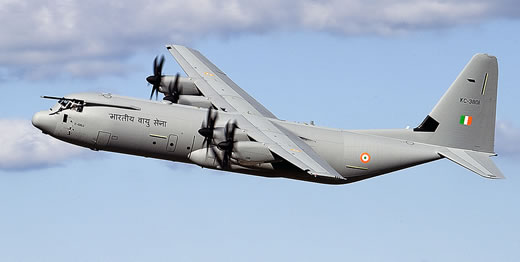
    The first Indian C-130J in flight. The aircraft’s distinctive air-to-air refueling probe can be seen over the left side of the cockpit. Photo: Lockheed Martin
    The first Indian C-130J in flight. The aircraft’s distinctive air-to-air refueling probe can be seen over the left side of the cockpit. Photo: Lockheed Martin
    Sponsor ad: Rada

    The first C-130J arriving in New Delhi this week is planned to deploy to Bangalore for  Aero-India 2011 show. These planes will support India’s special forces’ operations, and operate from Hindan Indian Air Force (IAF) base near New Delhi. When fully operational, the C-130J will dramatically increase the rapid deployment of India’s special forces from the capital to other regions in India and abroad.


    Presently, 18 pilots, nine load masters and nine combat system operators are being trained in the US. The aircraft will be able to perform precision low-level flying, air drops and landing in blackout conditions. Aerial refueling capability, advanced radar warning receivers and countermeasure dispensing system for extended range and survivability over hostile areas, will be available.This unique configuration aircraft introduces such special-operations air-transport capability for the first time in India. Following the induction of the first six aircraft India has already expressed interest to buy six additional aircraft to establish a full squadron of 12 transport planes.

    ‘Operational Capable’ Tejas to Fly Again at Aero-India 2011

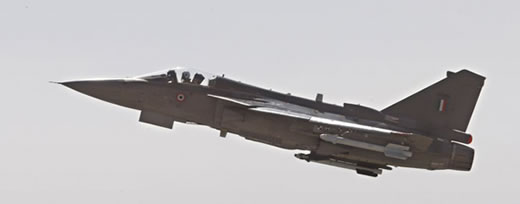
    India's indigenous light combat aircraft - Tejas will be flying at the upcoming Aero-India 2011 airshow. Photo: IAF
    Our Sponsor: Elbit Systems

    The Tejas Light Combat Aircraft (LCA) is expected to fly again at Aero India 2011, this time not as a prototype or test aircraft but an ‘operational capable aircraft’ of the Indian Air Force. Both the single seat and two-seat versions will be displayed. While Tejas is far from ready for operational capability, it will symbolize India’s technological capability to meet that challenge and progress toward flying a more advanced, indigenous combat aircraft in the future.

    India’s indigenous light combat aircraft – Tejas will be flying at the upcoming Aero-India 2011 airshow. Photo: IAF


    MMRCA Competitors Set for Aero-India Showdown

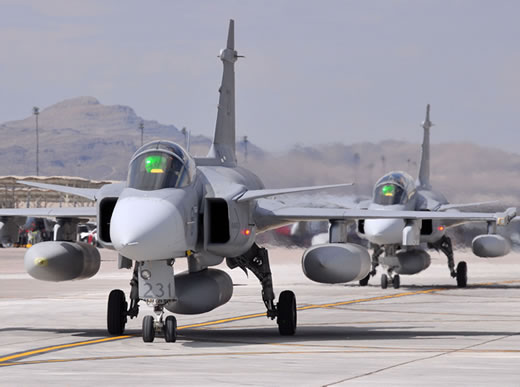
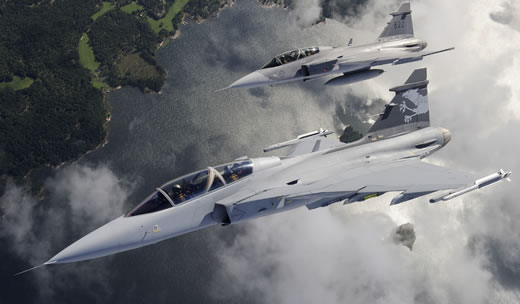
    A pair of Swedish Air Force Gripen fighters arrive at Red Flag - July 2008. Three Gripen fighters are expected to participate at the Aero-India 2011 airshow. Photo: USAF

    The ongoing tender for the selection of the future Medium Multi-Role Combat Aircraft for the Indian Air Force is fuelling a fiery competition between the world’s leading aircraft manufacturers. Competitors include, the U.S., European Dassault and Eurofighter, Saab from Sweden and Russian Rosoboronexport representing the MiG corporation.

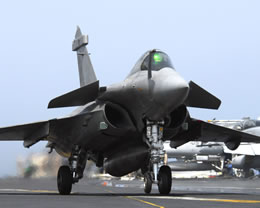
    All contenders are expected here, with some of the competing fighters expected to take part in daily flight displays, promising a breathtaking show for spectators. France is sending two Rafale fighters to India airshow. For the first time.

    A pair of Swedish Air Force Gripen fighters arrive at Red Flag – July 2008. Three Gripen fighters are expected to participate at the Aero-India 2011 airshow. Photo: USAF
    Dassault is scrambling two Rafals to Bangalore, to meet the competition nose-to-nose on the tarmac at Yelahanka. Photo: U.S. Navy
    Sponsor ad: Elbit Systems

    Rafale is a strong contender for the MMRCA and Dassault is bound to do its best to strengthen its position. Arriving at Bangalore, the Rafales will meet their direct competitors – Eurofighter is flying two Italian Air Force Typhoons to attract the Indian eyes at this critical time. Sweden is sending three Gripen fighters while the U.S. will fly a F-16 and Russia is sending to MiG-35 –launched on its international debut in 2007.

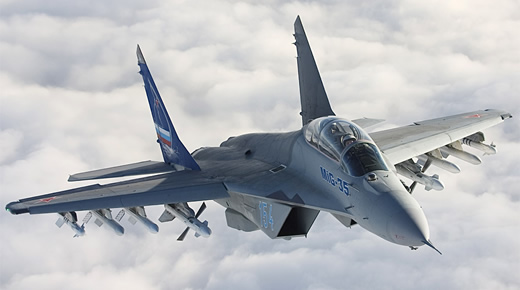
    The Russian MiG-35 is expected again at Aero-India 2011, four years after its international debut here in 2007. However, this year it will not participate in the flight display. Photo: MiG Corporation.
    Saab is offering the winner of the ‘Gripen Topgun Challenge’ a chance to fly the real Gripen. Photo: USAF

    Of all MMRCA contenders, Gripen was the most creative in generating pre-show buzz. The company has launched a special website ooffering Indian nationals to take the ‘Gripen Topguns Challenge’. According to Edvard de la Motte, campaign director, Gripen International India, the challenge filters the amateur beginners through a series of short quizzes. Those passing this level proceed to a higher tier, reserved for ‘professional grade’ players, required to test their skills in a Gripen flight simulator played on Microsoft flight simulator on PC, XBOX or PSP. The top five rated on the video game will proceed to ‘graduate’ on a real Gripen flight simulator at the airshow, only one ‘pilot’, the best of the best, will get to fly in a two-seat JAS 39 Gripen.

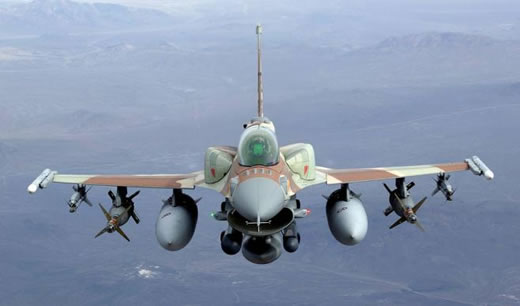
    In contrast to selecting an unknown computer wiz, Lockheed Martin is betting on gaining mass media attention through the traditional ‘Celebrity Ride’ on its F-16. Past F-16 rides at Aero-India hosted Tata Industrial Group Chairman Ratan Tata in 2007, and Delhi-based journalist Abhinav Bindra, becoming the first Indian woman to fly the F-16 in 2009. Boeing is also likely to display the F/A-18E/F, – as the second U.S. contender for MMRCA.

    Lockheed Marting is expected surprise again with ‘celebrity flight’ on its F-16. Photo: IAF

    Navy Awards $1.6 Billion for the Production of Six Poseidon P-8A

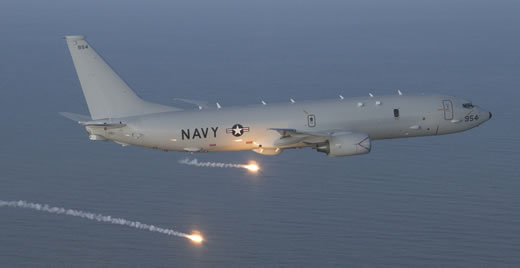
    Three of the six flight test aircraft, built as part of the P-8A System Development and Demonstration contract awarded to Boeing in 2004, are in various stages of testing at Naval Air Station Patuxent River, Md. The Integrated Test Team has conducted sonobuoy releases and countermeasures deployments (as shown in the photo). Photo: U.S. Navy

    The U.S. Navy announced awarded Boeing $1.6 billion contract for the production of six P-8A Poseidon under the Low-Rate Initial Production (LRIP) phase of the P-8A multi-mission maritime aircraft (MMA) program. This first LRIP contract also includes spares, logistics and training devices. Production of the first LRIP aircraft will begin this summer at Boeing’s Renton, Washington facility. The 737 fuselage and tail sections will be built by Spirit AeroSystems in Wichita, Kan., then transferred to Renton where all structural features will be incorporated in sequence during fabrication and assembly.

    Update: February 25, 2014: The U.S. Navy exercised options to procure 16 P-8A Poseidon Multi-mission Maritime Aircraft full rate production Lot I aircraft and 16 Ancillary Mission Equipment kits for the U.S. Navy. The Boeing Company was awarded $2.070 Billion in award modification to fulfil the delivery by April 2017.

    Three of the six flight test aircraft, built as part of the P-8A System Development and Demonstration contract awarded to Boeing in 2004, are in various stages of testing at Naval Air Station Patuxent River, Md. The Integrated Test Team has conducted sonobuoy releases and countermeasures deployments (as shown in the photo). Photo: U.S. Navy

    According to Capt. Mike Moran, PMA 290 Maritime Patrol and Reconnaissance Aircraft Program Manager, Poseidon is on track to meet the original 2013 Initial Operational Capability (IOC) at Naval Air Station Jacksonville, Florida. The U.S. Navy plans to purchase 117 production P-8A aircraft to replace its P-3 Fleet with a Navy version of the Boeing 737 jetliner. Three of the six flight test aircraft, built as part of the System Development and Demonstration contract awarded to Boeing in 2004, are in various stages of testing at Naval Air Station Patuxent River, Md. The Integrated Test Team has conducted sonobuoy releases and counter measures deployments.

    Recently, one of two static test planes completed full scale testing on the P-8A airframe. The first static test aircraft underwent 154 different tests with no failure of the primary structure. The second aircraft will begin fatigue testing this year.

    The P-8A’s flight management system and the stores management system has been developed by GE Aviation Systems in Grand Rapids, Mich. (formerly Smiths Aerospace). The cabin has as many as seven operator consoles. The Poseidon’s mission systems include MX-20HD digital electro-optical and infrared (EO/IR) multi-spectral gyro-stabilized sensor turrets provided by from L-3 Communications Wescam in Burlington, Ontario. The radar used on board is an upgraded APS-137D(V)5 maritime surveillance radar integrated with signals intelligence (SIGINT) system, both provided by Raytheon. This radar supports synthetic aperture radar (SAR) operating mode, for imaging stationary ships and small vessels and for coastal and overland surveillance, and high resolution imaging synthetic aperture radar (ISAR) for imaging surfaced submarines and fast surface vessels operating in coastal waters. Also supporting the anti-submarine warfare mission is the integrated magnetic anomaly detection (MAD) System developed by CAE Inc. The Navy plans to arm the P-8A with the MK 54 lightweight anti-submarine torpedo. The Electronic Warfare Self-Protection (EWSP) suite integrated by Northrop Grumman integrates the AN/ALQ-213(V) electronic warfare management system (EWMS) from Terma, directional infrared countermeasures (DIRCM) set with radar warning system and BAE Systems countermeasures dispenser.

    Bolivia Orders K-8 Karakorum Jet Trainers from China

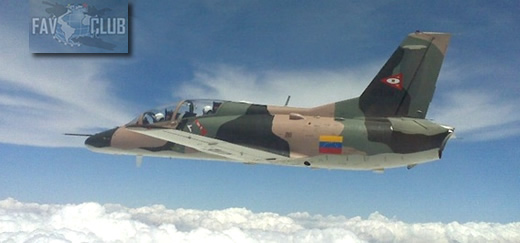
    K-8W of the Venezuelan Air Force. The aircraft is produced by Hongdu Aviation Industry Corporation in China, the main operators are China, Egypt and Myanmar. Photo: Aviación Militar Venezolana

    Following the footsteps of Venezuela, Bolivia is becoming the second operator of the Chinese K-8 Karakorum jet trainer. Bolivia announced it is buying six jets at a cost of US$58 million. The aircraft will be modified into a light fighter/attack aircraft, joining the fight against drug trafficking in the country. According to General Tito Gandarilla, Bolivian Air Force (FAB) commander, the K-8 Karakorum jets are scheduled to be delivered in April 2011 augmenting the combat elements of the FAB currently assigned for this role (PC-7 and T-33). Bolivia is financing the acquisition through a loan from China.

    K-8W of the Venezuelan Air Force. The aircraft is produced by Hongdu Aviation Industry Corporation in China, the main operators are China, Egypt and Myanmar. Photo: Aviación Militar Venezolana

    According to General Gandarilla, the new aircraft will be able to intercept illegal aircrafts invading Bolivian airspace without authorization; the aircraft will be used mainly around Cochabamba in central Bolivia, where there is heavy production of coca plants used to make cocaine.

    The K-8W is already operating with the Venezuelan Air Force. Of 36 aircraft ordered 18 were delivered in 2010. one aircraft was crashed in June last year. Other major operators are China, Egypt and Myanmar (Burma).

    Defense Update ‘Airshow-Live’ at LAAD 2011

    aero-india 2011 airshow live - from defense-update.com

    Defense Update is introducing its latest online project – Airshow-Live, providing on-site coverage of major airshows and defense exhibitions and conferences. Airshow-Live will debut at LAAD 2011 providing fresh reports from  the airshow, including news highlights and ‘buzz’ from the exhibition halls, press conferences and national pavilions.

    Airshow-Live for LAAD 2011 will be launched February 25 and will be updated with reports focusing aerospace business and news highlighting Brazil and Latin American defense issues.  On April 12 our releases will shift to live, daily releases, available online, via email, or by smartphone, through our new ‘Mobile Edition’. We recommend readers interested in the event or in the Asian market in general to subscribe to our RSS or our regular email service to receive the updates in a timely manner.

    Following the LAAD event in Rio de-Janeiro Airshow-Live is set to cover the Paris Airshow (Paris, June), AUVSI (Washington DC, August), DSEi (London, September) and AUSA (Washington, October). Our Aero-India coverage is already available online.

    Sponsorship and News Distribution

    Airshow Live is provided free online and is optimized for smartphones including iPhone, Android, Blackberry, Palm and iPad. If you would like to join our sponsors, or use Airshow Live to distribute news prior or at the show, please contact us ASAP.

    Aero-India Edition Will Include:

    Show preview
    Published January 2011, and updated twice a week, covering aerospace highlights, international tenders, modernization plans etc.

    • On-site News

    Published daily, and updated streight from Rio de-Janeiro, bringing you the insight on current developments

    • National Pavilions

    Reporting from the main national pavilions

    • Featured Exhibits

    Highlighting new products, interesting trends etc in short photograpic reports

    • Business Highlights

    Announcements, joint ventures and alliances, roumors etc.

    • Event Summary report

    Summary report to be published on Defense-Update.com, providing a wrap-up insight into the trends, developments and impressions from the show, including photos, images etc.

    Subscribe now to Defense-Update Airshow-Live

    Your news link at LAAD 2011

    Modified Puma, Hybrid Armored Vehicle up for U.S. Army GCV Selection

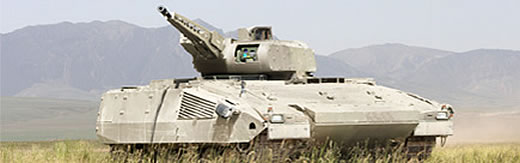
    SAIC led team is proposing a vehicle based on the German Puma, developed by KMW and Rheinmetall Defence for the German Army. "It is the only production-ready IFV designed from the ground up since Sept. 11, 2001, and incorporates the lessons of the wars in Iraq and Afghanistan." the team said. Photo: KMW
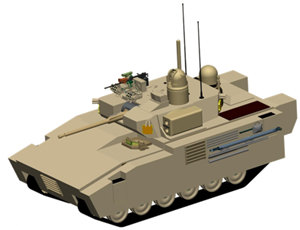
    Three teams, led by General Dynamics, SAIC and BAE Systems are competing for U.S. Army $450 million technology demonstration contracts to demonstrate vehicle platforms that could  evolve in 7 years into the Ground Combat Vehicle, the U.S. Army future infantry carrier.

    The GCV Infantry Fighting Vehicle will provide a highly-survivable platform for delivering a nine-Soldier infantry squad to a position of advantage on the battlefield in the conduct of combined arms maneuver and wide area security. It is also the first vehicle designed and developed to operate in an improvised explosive device (IED) environment. Nine years of combat experience — ranging from major combined-arms maneuver and close combat action, to stability operations and security force assistance missions — have underscored these needs and informed the requirements. Current and product-improved infantry fighting vehicles don’t provide the protected mobility required to operate across the spectrum of conflict or the growth potential required to incorporate advances in protection, network capabilities, size, weight, power or cooling.

    SAIC led team is proposing a vehicle based on the German Puma, developed by KMW and Rheinmetall Defence for the German Army. "It is the only production-ready IFV designed from the ground up since Sept. 11, 2001, and incorporates the lessons of the wars in Iraq and Afghanistan." the team said. Photo: KMW

    Team ‘Full Spectrum’ led by SAIC also includes Boeing and two team members from Germany – Krauss-Maffei Wegmann and Rheinmetall Defence. The SAIC-led team submitted a revised proposal for the technology development phase of the Infantry Fighting Vehicle (IFV) being developed under the GCV effort to the U.S. government and the Puma IFV developed for the German Army. The Puma is the only production-ready IFV designed from the ground up since Sept. 11, 2001, and incorporates the lessons of the wars in Iraq and Afghanistan.

    “GCV is of vital importance to our nation as it will be the first combat vehicle designed to be adaptable to the full range of military operations, while protecting our soldiers from current and emerging threats,” said Deborah Alderson, SAIC group president. “Our offer continues to focus on delivering a newer, highly survivable, more lethal, off-road IFV than previous offerings we know of.” The team represents a combined know-how of the world’s leading armor developers with experienced system integration team.

    The U.S. Army is seeking to maximize affordability and performance risk to the program by placing a great reliance on the use of mature technology. GCV is also the first vehicle designed and developed to operate in an improvised explosive device (IED) environment.

    The second team is led by BAE Systems with Northrop Grumman as its partner, offering a hybrid-electric driven platform, a technology already developed with the Future Combat Vehicle. This propulsion system allows the team to offer exceptional force protection and mobility in a lower weight vehicle while provisioning for growth in power requirements as new technologies are matured and integrated into the platform. Other team members include QinetiQ North America, iRobot Corporation, MTU and Saft.

    As the prime contractor, BAE Systems will lead the overall program management, systems integration, vehicle design, structure and logistical support as well as readiness and sustainment of the platform.  Northrop Grumman will serve as the C4ISR lead. QinetiQ North America will provide the electric drive propulsion system or E-X-Drive™ for Ground Combat Vehicle.  The E-X-Drive is the key component of the hybrid electric drive system.  iRobot will serve as the unmanned ground vehicle integrator and enhance the capability to detect pedestrians and obstacles of interest.  MTU will provide the engine and power generation for GCV and Saft will provide the battery and energy storage system.

    A third team led by General Dynamics, comprises GD Land Systems and GD C4, Lockheed Martin, responsible for the turret, and Raytheon. The GD led team has not released any information about its proposal. General Dynamics Land Systems was one of two companies sharing part of the Manned Ground Vehicle program, part of the terminated Future Combat Systems. The company is current providing upgrades for M-1 Abrams main battle tanks and Stryker wheeled armored vehicles, and has been awarded a contract to produce up to 800 Israeli Namer Infantry Fighting Vehicles in the U.S.

    Three Industry Teams Submit Proposals for the U.S. Army Future Ground Combat Vehicle (GCV)

    The U.S. Army is seeking to maximize affordability and performance risk to the program by placing a great reliance on the use of mature technology. GCV is also the first vehicle designed and developed to operate in an improvised explosive device (IED) environment.
    The U.S. Army is seeking to maximize affordability and performance risk to the program by placing a great reliance on the use of mature technology. GCV is also the first vehicle designed and developed to operate in an improvised explosive device (IED) environment.

    Three tag teams are in for yet another round of wrestling for future armored vehicle championship. As always, the teams are the same. As before, the championship prize is the Ground Combat Vehicle (GCV), with competing teams leaders are General Dynamics, BAE Systems and SAIC.

    According to COL Andrew DiMarco, Project Manager, Ground Combat Vehicle, until the selection process is completed the Army is prohibited from disclosing any contractor bid, proposal information or source selection information. Contracts award is expected during the third quarter of Fiscal Year (FY) 2011.

    All three finalist teams submitting proposals for the future vehicle have participated in the past development of the family of Manned Ground Vehicles, the armored vehicle foundation of the terminated Future Combat Systems program. All three teams have already participated in the previous phase of the GCV program which was cancelled last spring. Delivery of the first vehicle is scheduled seven years after TD contract award.

    After evaluating the proposals submitted today, the Army is expected to award Technology Development (TD) contracts to two or all thee teams, awarding each team up to $450 for the 24 month technology development. The demonstrator will integrate all necessary subsystems and components to reduce technical risk and balances affordability while meeting system performance requirements. Each of the proposed technology solutions will have to pass Preliminary Design Review (PDR) after 18 months from the TD award. Although the development is capped at $450 million, financial incentives are offered to teams that would be able to save upon this costs. Teams will have six months past the PDR to further refine their systems before submitting them for the follow-on Engineering and Manufacturing Development (EMD), and final Production and Deployment phase (PD).

    The goal of the TD phase is to reduce overall risk for entering into the EMD phase by developing an affordable, feasible and operationally effective preliminary design.

    According to DODBuzz, in the final selection the service will choose a winner to build 1,874 IFVs. Those vehicles are currently projected to cost $9 million to $10.5 million apiece, not including the cost of spare parts and other support items. The Army also wants the vehicles to cost $200 per operating mile. This falls between the $100 per mile of the Bradley and the $300 per mile of the M1 Abrams tank.

    7th Boeing C-17 for Royal Air Force Arrives in United Kingdom

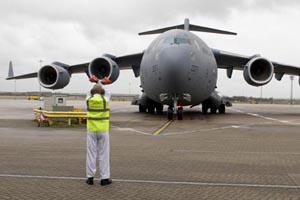
    The arrival of the Royal Air Force's seventh C-17 Globemaster III airlifter at RAF Brize Norton in Oxfordshire, England. Photo: UK Ministry of Defence

    Boeing has delivered the 7th C-17 Globemaster III airlifter to the Royal Air Force. The aircraft landed at RAF Brize Norton in Oxfordshire, England. The aircraft was officially delivered on Nov. 16 from Boeing’s facility in Long Beach, Calif., and underwent modifications at the company’s San Antonio facility before flying to the United Kingdom, arriving on the 21st of January.

    Assigned to 99 Squadron at RAF Brize Norton, the UK fleet of C-17s provides critical airlift capability for the nation’s Joint Rapid Reaction Force and has supported humanitarian and disaster-relief missions to Pakistan, Haiti and Chile. 99 Squadron’s C-17s are equipped with upgraded software and avionics, as well as additional fuel tanks that extend the aircraft’s nautical mile range to over 4,000 miles. In normal operations, the aircraft carries a crew of three — two pilots and one air-loadmaster.

    The arrival of the Royal Air Force's seventh C-17 Globemaster III airlifter at RAF Brize Norton in Oxfordshire, England. Photo: UK Ministry of Defence

    According to Boeing UK C-17 Program Manager Liz Pace, “The RAF uses its C-17s more than any other service today, which is why it has surpassed 60,000 flight hours with just six aircraft.” Boeing delivered the seventh C-17 to Britain 11 months after the UK announced tits plan to acquire an additional C-17.

    Boeing supports the RAF’s C-17s through the C-17 Globemaster III Sustainment Partnership, a performance-based logistics program operating from RAF Brize Norton. The arrangement provides the RAF with the benefits of complete “virtual fleet” access and an extensive support network. The virtual fleet concept enables C-17 customers, especially those with smaller numbers of aircraft, to benefit from worldwide parts availability and economies of scale when purchasing materials.

    Reevaluation of Brazil’s FX-2 Fighter Program Could Help Saab

    The Swedish Gripen NG was though to be more affordable than its competitors for the Brazilian FX-2 Tender - the French Rafale and U.S. Super Hornet. Photo: Saab Defence

    Brazilian new President Dilma Rousseff is apparently pushing back the decision on the acquisition of the new fighter aircraft for Brazil’s Air Force sometime to 2012. Local reports are citing reduced government expenditure as the reason for the delay. While the Rafale produced by France’s Dassault Aviation SA, was though to be the forerunner of Brazil’s FX-2 program, favored by former president Lola and the government the Swedish Gripen NG was though to be more affordable at 10 billion reals (US$6 billion) and having better export potential in Latin America, a fact that could contribute to Brazil’s aerospace industries advantages. President Dilma was reportedly in consultation with Embraer and the Air Force Commander, Gen. Juniti Saito, both supported the selection of Saab’s Gripen NG over the Rafale, strongly endorsed by former Defense Minister Nelson Jobim.

    The Swedish Gripen NG was though to be more affordable than its competitors for the Brazilian FX-2 Tender - the French Rafale and U.S. Super Hornet. Photo: Saab Defence

    Another contender, the Boeing F/A-18E/F Super Hornet was also among the three fighters considered, but the probability of its selection was considered lower, given the U.S. attitude toward technology transfer to Brazil. More time could help Boeing’s potential customer gaining more acceptance in Washington. Sofar Congress has approved Boeing’s proposal to Brazil, but it may wield vetoes in the future. The US proposal was said to be 12.9 billion reals ($7.7 billion) As for the Rafale, although the French offer was considered the most expensive, at 13.3 billion reals ($8 billion) although Jobim claimed to have reduced the cost by $2 billion. Related posts:

    ONR Team Demonstrates Source for Future 100KW FEL Laser

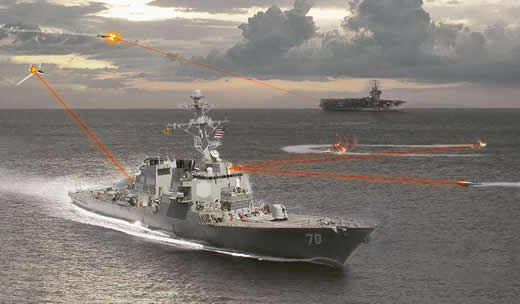
    In future shipborne applications the laser will be powered by the ship’s main generator, creating virtually unlimited ammunition. It will provide ultra-precise, speed-of-light defensive weapon capability necessary to meet emerging threats, such as hyper-velocity cruise missiles.

    The Free Electron Laser (FEL) program is undergoing Office of Naval Research’s (ONR) preliminary design review (PDR) this week, following the successful critical demonstration of an injector capable generating the electron flow for the megawatt-class FEL laser. “Until now, we didn’t have the evidence to support our models” Dr. Dinh Nguyen, senior project leader for the FEL program at the lab said, confirming that the injector performed as predicted. The team is currently working to measure the properties of the continuous electron beams, in hope to set a world record for the average current of electrons.

    In future shipborne applications the laser will be powered by the ship’s main generator, creating virtually unlimited ammunition. It will provide ultra-precise, speed-of-light defensive weapon capability necessary to meet emerging threats, such as hyper-velocity cruise missiles.

    The electron laser is generated by passing a beam of high-energy electrons through a series of powerful magnetic fields, generating an intense emission of laser light that can disable or destroy targets. In future shipborne applications the laser will be powered by the ship’s main generator, creating virtually unlimited ammunition. It will provide ultra-precise, speed-of-light defensive weapon capability necessary to meet emerging threats, such as hyper-velocity cruise missiles. Each vessel carrying this weapon will operate a single FEL source feeding up to 10 beam directors, engaging multiple targets simultaneously at different directions, altitudes and ranges.

    ONR’s FEL project began as a basic science and technology program in the 1980s and matured into a working 14-kilowatt prototype. In April 2009, the Boeing Company was awarded an Office of Naval Research contract valued at up to $163 million to develop and demonstrate a 100-kW class FEL weapon system. “Two unique attributes of FELs are the ability to tune the wavelength to maximize transmission of the laser through the marine atmosphere, and the ability to aim for a single small spot on the target,” said Ed Pogue, FEL program manager for Boeing. “The combination of these two effects allows the system to destroy the target in the minimum time.”
    According to Quentin Saulter, FEL program manager for ONR the team is nine months ahead of schedule to achieve its goals for 2011. The FEL weapon system is set to pass critical design review phase in the fourth quarter of this year, to be followed by additional task orders for fabrication and testing in a laboratory environment. ONR hopes to test the FEL in a maritime environment as early as 2018.

    Boeing is partnering on FEL with U.S. Department of Energy laboratories, academia and industry. The laboratories include the Thomas Jefferson National Accelerator Facility in Newport News, Va., the Los Alamos National Laboratory in Los Alamos, N.M., and the Argonne National Laboratory in Chicago. Major industrial partners include Advanced Energy Systems, Niowave Inc. and SAIC.

    Related posts: High Power Laser are Maturing into Weapons Grade Systems

    Skunk Works and XTEND Simplify Multi-Drone Command

    0
    Lockheed Martin Skunk Works® and XTEND have achieved a major milestone in JADC2 by integrating the XOS operating system with the MDCX™ autonomy platform. This technical breakthrough enables a single operator to simultaneously command multiple drone classes, eliminating the friction of mission handoffs. From "marsupial" drone deployments to operating in GPS-denied environments, explore how this collaboration is abbreviating the data-to-decision timeline and redefining autonomous mission execution.

    From Ukraine to Taiwan: The Global Race to Dominate the New Defense Tech Frontier

    0
    As traditional defense primes face mounting competition from agile “neoprimes” such as Anduril, Palantir and Helsing, the balance of innovation is shifting toward software-defined warfare and scalable, dual-use technologies, while global industry consolidation—marked by Boeing’s integration of Spirit AeroSystems and other strategic mergers—signals an intensified race to secure control over the defense technology value chain. Our Defense-Tech weekly report highlights these trends.

    Europe’s “Drone Wall”

    0
    In early October 2025, a coordinated wave of unmanned aerial system (UAS) incursions—widely attributed to Russia—targeted critical infrastructure across at least ten European nations. The unprecedented campaign exposed the fragility of Europe’s air defenses...

    Weekly Defense Update & Global Security Assessment

    0
    Executive Summary The past week (September 18-25, 2025) represents an inflection point where strategic defense concepts have transitioned from doctrine to tangible reality. An analysis of global events reveals four primary, interconnected trends shaping an...

    U.S. Air and Space Forces Push Next-Gen Programs at the AS&C 2025 Conference and...

    0
    At the 2025 Air, Space & Cyber Conference, U.S. Air Force and Space Force leaders unveiled major updates on next-generation fighters, bombers, unmanned systems, and space initiatives, highlighting both rapid innovation and critical readiness challenges as the services race to outpace global competitors. A short version is available here, with a more detailed version for subscribers.

    TADTE 2025: Reflecting Taiwan’s Strategic Themes

    0
    The Taipei Aerospace & Defense Technology Exhibition (TADTE) 2025 crystallized around four dominant strategic themes that collectively illustrate Taiwan's comprehensive approach to defense modernization amid escalating regional tensions. Based on a detailed report by Pleronix (available upon request). Includes a Podcast discussion on TADTE 2025's highlighting Taiwan's four strategic themes beyond the post's coverage.

    Iron Beam 450 Completes Testing, Soon to Join With Operational Air Defense Units

    0
    Israel’s Iron Beam 450 high-power laser system has completed final testing, marking a major leap in air defense. Developed by Rafael, it offers precise, cost-effective interception of rockets, UAVs, and mortars, and is set for IDF deployment by 2025.