
Saturday, December 27, 2025
More
    Home Blog Page 249

    Lockheed Martin Awarded $218 to Test Six New Anti-Ship Missiles

    AGM-158 Joint Air-to-Surface Standoff Missile. Photo: Lockheed Martin
    AGM-158 Joint Air-to-Surface Standoff Missile – Extended Range (JASSM-ER) will provide the platform for testing the air-launched version of the Long Range Advanced Anti-ship Missile (LRASM) under the current DARPA capability demonstration program. Photo: Lockheed Martin

    Lockheed Martin continues toward demonstrating the Long Range Anti-Ship Missile (LRASM) weapon capability under the Defense Advanced Research Project Agency’s (DARPA). The company has received two contracts worth $218 million for the rapid development and demonstration of both variants – a stealthy air-launched variation and a high-speed ship-launched missile. Both weapons will utilize a common sensor system developed by BAE Systems.

    “Both of our LRASM solutions will deliver extraordinary range, willful penetration of ship self defense systems and precise lethality in denied combat environments,” said Rick Edwards, vice president of Tactical Missiles and Combat Maneuver Systems at Lockheed Martin Missiles and Fire Control. “The maturity of these weapons and technologies allows near term transition to Navy magazines at an affordable price. These are low risk, practical options with the Navy initiating studies of anti-surface warfare capability.”

    Two separate teams at Lockheed Martin are working on the two missiles – One team is using the Joint Air-to-Surface Standoff Missile – Extended Range (JASSM-ER) to demonstrate the stealthy air-launched ‘LRASM-A’ variant. This team has received $60.3 million in cost plus fixed fee contract to execute two air-launched demonstrations from Navy and Air Force tactical aircraft.

    The second team focused on the ship-launched LRASM-B weapon received a $157.7 million to complete four Vertical Launch System (VLS) demonstrations, proving applicability to Navy surface combatants. According to the company,  both LRASM-A and LRASM-B designs plan to support air-launch and VLS-launch configurations.
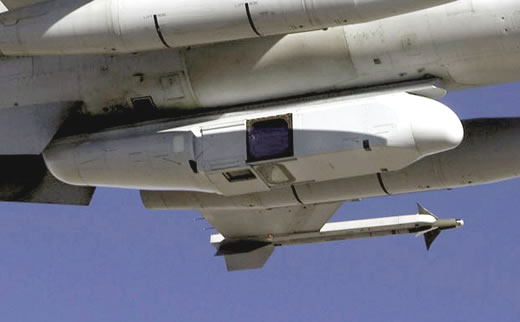
    Pakistan’s Falcons to Fly Five New Recce Pods

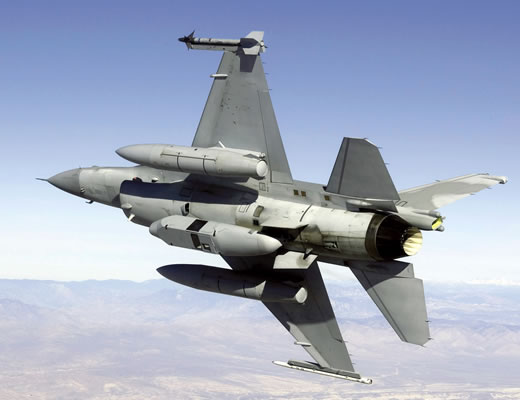
    The Goodrich DB-110 recce pod is operational with the Polish and Hellenic NATO Air Forces. Recent sales were approved for the UAE, Egypt, Morocco, Pakistan and Oman.

    Goodrich Corporation has been awarded a US$72 million contract to equip Lockheed-Martin F-16 fighters of the Pakistan Air Force with five DB-110 dual-band (visual/IR) reconnaissance pods. The systems will be delivered with two fixed ground stations and one mobile ground station, each equipped with one datalink receiving system (a total of four ground receiving datalinks will be delivered).

    The Pakistan Air Force plans to augment the new capability by establishing a ‘reconnaissance fusion center’, the current contract funds the initial study of such facility to be provided by Goodrich. The U.S. Air Force is assigning a private U.S. company to train Pakistani operators and technicians in supporting the new systems.

    The Goodrich DB-110 EO/IR reconnaissance pod operating on Poland Air Force F-16 aircraft. Photo: Goodric

    The Pakistani air force is already operating two similar recce pods, which will now be modified with suitable datalinks to match the new ground stations. According to the U.S. Defense Security Cooperation Agency ex-U.S. Air Force F-16A/B fighters transferred to the Pakistani Air Force in 2008 were prepared to operate reconnaissance pods. No such capability was mentioned for the new F-16 Block 52 aircraft although it is likely that the pods will also be employed by these fighters.

    The Goodrich DB-110 recce pod is operational with the Polish and Hellenic NATO Air Forces. Recent sales were approved for the UAE, Egypt, Morocco, Pakistan and Oman.

    The DB-110 operates autonomously on the F-16, controlled by the pod’s reconnaissance management system. Imagery can be viewed on the F-16’s cockpit video display, enabling the pilot to verify targets and conduct tasks such as battle damage assessment. The real-time display also gives the pilot or aircrew more flexibility selecting alternate route to a selected target or seeking out targets of opportunity.

    Goodrich’s DB-110 pod has become a standard reconnaissance pod for the F-16, included in almost every new sales package of this aircraft. The pod is operational with the Polish and Hellenic NATO Air Forces, Recent sales were authorized for the UAE, Egypt, Morocco, Pakistan and Oman. The pod is also operated in its original ‘Raptor’ configuration, on Tornado GR4 and Japanese P-3C maritime patrol aircraft. Saudi Arabia has also been offered 10 DB-110 pods, yet to be integrated on their F-15SA Eagle as part of the latest multi-billion shopping spree of U.S. arms.

    More recently the DB-110 system has also been modified to operate on unmanned aerial vehicles (UAV) such as the Reaper – demonstrating the capability to operate simultaneously with other UAV sensor systems, including full motion video short range imaging payloads, radars and weapons.

    EADS, Russia’s UAC Compete on Delivering Six new Tankers to the Indian Air Force

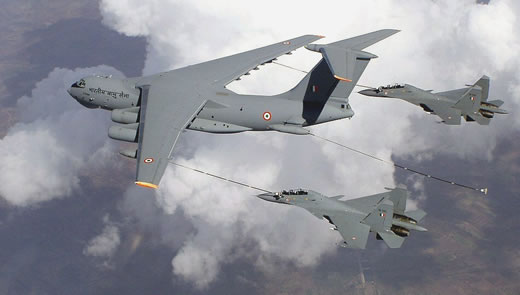
    India is already operating IL-78MKI, and in the current tender the IAF was aiming to improve its current capabilities with more reliable, operationally economic platform.
    Airshow-Live sponsor: IAI

    The Indian Air Force (IAF) is seeking to buy six new flying tankers to augment its existing aerial refueling capability. The two companies are competing on this tender, expected to cost around 9,000-crore (US$2 billion) include Russia’s United Aircraft Corporation (UAC) and EADS. Both offers include the planes they put forward for the first tender.

    U.S. aircraft maker Boeing considered its new-generation 767 model as a possible contestant, but missed the January 12 deadline to submit its bid. Boeing cited uncertainty with the U.S. Air Force’s order for 179 aerial tankers as a reason for not entering the competition for the Indian order, which is estimated at $2 billion. (read more…)

    Two years ago the Indian Air Force selected the Airbus A-330 MRTT for its future tanker but failed to win support for the program from the ministry of finance. The current round is expected to increase the cost by 15-20 per cent . Photo: EADS-Airbus
    India is already operating IL-78MKI, and in the current tender the IAF was aiming to improve its current capabilities with more reliable, operationally economic platform.

    Bring Back the F-22!

    Only two years after Secretary of Defense Robert Gates’ decision to end production of the F-22 Raptor at 187 aircraft, the program may be poised to rise like a phoenix from the ashes. When Gates made his decision, it was on the assumption that other countries — notably Russia and China — would not develop their own fifth-generation fighters for at least another decade or more. Yet, even as the Secretary met with his counterparts from the Chinese military, that institution announced the first test flight of the J-20, their entrant into the fifth-generation fighter competition. In addition, Russia has announced a cooperative program with India to build a similar aircraft, currently known as the T-50. Today, Secretary Gates’ threat projections look woefully wrong.


    The emergence of the J-20 is but one example of China’s broad and deep investments in advanced military capabilities. Admiral Willard, Commander of U.S. Pacific Command, recently informed the world that China’s anti-ship ballistic missile system had reached its initial operating capability. This is a system with no parallel in the world; the U.S. has nothing like it. In addition, the defense department’s annual report on China’s military activities paints a darkening picture of increasing investments in nuclear and diesel-electric submarines, mine warfare, advanced surface-to-air missile systems, ballistic missiles, space surveillance and cyber warfare.

    In his January 6 announcements of the results of the Department of Defense’s efficiency drive, the Secretary spoke about shifting much of the money saved into new programs clearly intended to counter the growing Chinese threat. He made particular mention of the funding of development of a new strategic bomber, one necessitated by the growing “anti-access” threat. This is a code word for China. He also called for additional deployments of missile defense interceptors both abroad and in the continental United States. This clearly reflects concerns about the ballistic missile programs in China, North Korea and Iran.

    In view of the new appreciation of the threat it is time to bring back the F-22. Recent war games by Western think tanks have concluded that the projected U.S. tactical fighter force would be overwhelmed by the sheer number of less capable third and fourth-generation Chinese fighters. Add in the J-20 and the outlook for the U.S. military becomes decidedly bleak. Even when the F-35 Joint Strike Fighter is deployed this will not provide the U.S. with enough offensive capability given the limited number of F-22s that will be combat capable.

    The F-22 has capabilities unlike any other fighter in the world. Its stealthiness allows the F-22 to engage hostile aircraft before it is even detected. The F-22’s high operational ceiling and speed creates a kinematic advantage that allows for engagements at the maximum range for its AMRAAM missiles. The combination of supercruise and stealth allows the F-22 to evade ground defenses and to escape air-to-air threats.

    Ultimately, war has always been a numbers game. At some point, technologically inferior but numerically superior opponents will simply overwhelm the side with the better weapons. In conflicts between technologically equal adversaries numbers will determine the winner. While the F-22 is likely to be a better airplane than the J-20, 187 are not going to be enough to deal with a Chinese Air Force that is numerically superior and closing the technology gap with the U.S. Air Force. Before it is too late, the Obama Administration needs to resurrect the F-22 program and buy a couple hundred more.

    This analysis originally published by Daniel Goure, Ph.D. of the Lexington Institute

    New Meta-Material Could Render Submarines Invisible to Sonar Detection

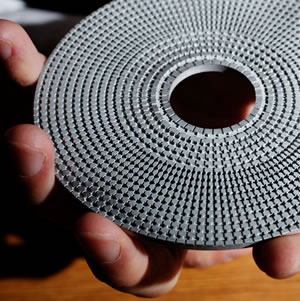
    Fang’s team designed a two-dimensional cylindrical cloak made of 16 concentric rings of acoustic circuits structured to guide sound waves. Each ring has a different index of refraction, meaning that sound waves vary their speed from the outer rings to the inner ones. Photo by L. Brian Stauffer

    A research team from the University of Illinois, led by mechanical science and engineering professor Nicholas Fang, have demonstrated a technology that renders underwater objects invisible to sonar and other ultrasound waves.

    This kind of an ‘acoustic cloak’ could be used in the future to mask submarines from enemy sonars.

    New meta-material could conceal future submarines from sonar detection.
    Fang’s team designed a two-dimensional cylindrical cloak made of 16 concentric rings of acoustic circuits structured to guide sound waves. Each ring has a different index of refraction, meaning that sound waves vary their speed from the outer rings to the inner ones. Photo by L. Brian Stauffer

    While materials that can wrap sound around an object rather than reflecting or absorbing it have been theoretically possible for a few years, a prototype demonstrating such process was never realized – until now. In a paper accepted for publication in the journal Physical Review Letters, Fang’s team describe the principles used in constructing such prototype.

    The cloak is made of metamaterial, a class of artificial materials that have enhanced properties as a result of their carefully engineered structure. Fang’s team designed a two-dimensional cylindrical cloak made of 16 concentric rings of acoustic circuits structured to guide sound waves. Each ring has a different index of refraction, meaning that sound waves vary their speed from the outer rings to the inner ones.


    “This is not just a single wavelength effect. You don’t have an invisible cloak that’s showing up just by switching the frequencies slightly,” Fang said. The acoustic cloak demonstrated its ability to cover a broad range of sound wavelengths, from 40 to 80 KHz, although with modification could theoretically be tuned to cover tens of megahertz.

    “Basically what you are looking at is an array of cavities that are connected by channels. The sound is going to propagate inside those channels, and the cavities are designed to slow the waves down,” Fang explained. “As you go further inside the rings, sound waves gain faster and faster speed.” Since speeding up requires energy, the sound waves instead propagate around the cloak’s outer rings, guided by the channels in the circuits. The specially structured acoustic circuits actually bend the sound waves to wrap them around the outer layers of the cloak.

    Illinois professor Nick Fang developed a two-dimensional acoustic cloak that makes objects in the center invisible to sonar and other ultrasound waves. Photo by L. Brian Stauffer

    The researchers tested their cloak’s ability to hide a steel cylinder. They submerged the cylinder in a tank with an ultrasound source on one side and a sensor array on the other, then placed the cylinder inside the cloak and watched it disappear from their sonar. Curious to see if the hidden object’s structure played a role in the cloaking phenomenon, the researchers conducted trials with other objects of various shapes and densities. “The structure of what you’re trying to hide doesn’t matter,” Fang said. “The effect is similar. After we placed the cloaked structure around the object we wanted to hide, the scattering or shadow effect was greatly reduced.” The geometry is not theoretically scaled with wavelengths.

    Cobham Acquires German EOD-Robot Specialist Telerob

    Telerob's Observation, Surveillance, Clarification And Reconnaissance Robot (OSCAR). Photo: Telerob Group

    U.K. based Cobham plc announced today the acquisition of Telerob GmbH, a German-based manufacturer of bomb disposal robots. Cobham is paying EUR 78 million for full ownership of the German company. Privately owned Telerob is manufacturing Explosive Ordnance Disposal (EOD) robots and threat response vehicles. Following the acquisition Telerob will become part of Cobham’s Mission Equipment business unit, broadening the Group’s portfolio addressing the fast-growing homeland security markets. The acquisition is being funded from Cobham’s existing cash resources. Cobham has acquired two businesses in the US and Europe worth a total of US$150m in the past month, both serving homeland security markets.

    Telerob's Observation, Surveillance, Clarification And Reconnaissance Robot (OSCAR). Photo: Telerob Group

    Cobham expects to benefit from the synergy of Telerob with other capabilities of the group, including communications equipment and sensors that it already provides for the EOD market along with specialist cameras manufactured by RVision. “Telerob brings distinctive EOD technology and international routes to market that are highly complementary to ours. ” Andy Stevens, Cobham Chief Executive Officer, commented, “this acquisition will enable us to enhance the product range we can offer to homeland security markets.”

    Telerob manufactures medium and heavy-weight Explosive Ordnance Device (EOD) robots and response vehicles designed to deal with nuclear, biological and chemical threats primarily for homeland security markets. The company has more than 700 systems in 55 countries, with many systems in operation in Asia and the Middle East where it has established itself as a market leader. The German company employs 80 staff, half of whom are engaged in R&D.

    Wescam Provides a New EO/IR Payload for the Camcopter

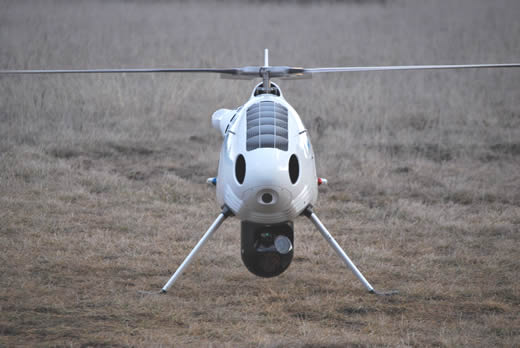
    S-100 Camcopter Vertical take-Off and Landing (VTOL) Unmanned Aerial System (UAS) equipped with L3's Wescam MX-10 EO/IR payload. Photo: Schiebel Group

    Schiebel and L3 have tested the S-100 Camcopter Vertical take-Off and Landing (VTOL) Unmanned Aerial System (UAS) equipped with L3’s Wescam MX-10 EO/IR payload. The first flight was performed in Austria. According to Paul Jennison, Vice President Business Development, L-3 Wescam, the MX-10 offers an integrated vibration mounts allowing for even more compact integration into an ‘all-in-one’ design.

    S-100 Camcopter Vertical take-Off and Landing (VTOL) Unmanned Aerial System (UAS) equipped with L3's Wescam MX-10 EO/IR payload. Photo: Schiebel Group
    Sofar the standard EO/IR payload of the S-100 was the IAI/Tamam POP system. Photo: Schiebel Group


    “Adding sensors like MX-10 with outstanding stabilization and HD capability will further increase UAV utility.” Jennison added.

    Schiebel offers the S-100 as a versatile multi-mission platform. This Psychological Warfare configuration includes an EO/IR payload for situational awareness, public address (loudspeakers) and remotely controlled magazine for dropping leaflets on demand. Photo: Schiebel Group

    According to Neil Hunter, Sales Director, Schiebel, the CAMCOPTER S-100 is generating a great deal of interest around the world and we see the addition of the MX-10 as another high-performing payload for our customers to choose from. Standard EO/IR payloads for the Camcopter were versions of the lightweight, modular POP-300 family, developed by IAI/Tamam.

    The introduction of an alternative non-Israeli EO/IR payload will improve Schiebel’s access to inaccessible for the Israeli product. However, being a U.S. company, L-3 will also be limited by self imposed International Traffic in Arms Regulation (ITAR) limiting the marketing of certain technologies to non U.S. customers.


    Camcopter S-100 flys with the Wescam MX-10 EO/IR payload. Photo Schiebel group

    More Hermes-450 UAVs to Brazil

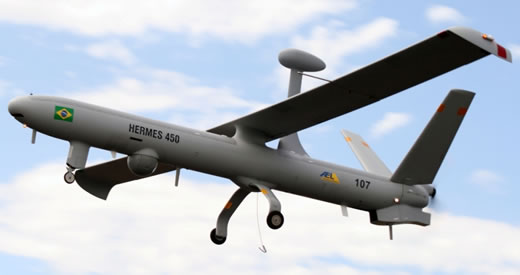
    Brazil's new Hermes 450 will be delivered and supported by Elbit Systems' local subsidiary Aeroeletrônica Ltda. (AEL). Photo: Elbit Systems

    Elbit Systems’ Brazilian subsidiary Aeroeletrônica Ltda. (AEL) has won a contract to supply additional Hermes 450 unmanned aerial systems to the Brazilian Air Force (FAB). The contract follows one year Brazilian operation of two Hermes 450 unmanned aircraft and one ground station under lease for one year.

    Through this evaluation phase the Brazilian Air Force and Navy were defining their operational requirements for unmanned vehicles. It is assumed that the current order will comprise two additional systems fielding operational capabilities with the Air Force, bringing the total systems operated by the Brazilian forces to three. Further units are expected to be added in the future, as the FAB expands the services provided by unmanned systems. According to Elbit Systems, the project is a part of the Brazilian Air Forces’ objective to establish independent UAS capabilities, allowing for self-reliant operation and development of UAS in Brazil.

    Brazil's new Hermes 450 will be delivered and supported by Elbit Systems' local subsidiary Aeroeletrônica Ltda. (AEL). Photo: Antonio Riciere Biasus via Elbit Systems

    Sagem Wins French Contract for Long-range thermal Binoculars

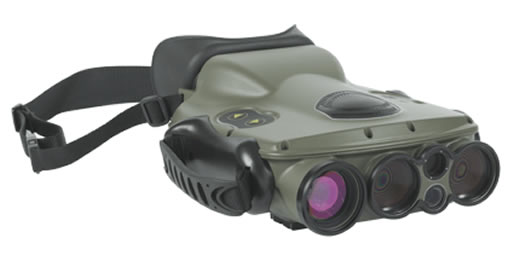
    JIM LR 2 is a portable all-in-one unit based on operational experience gained with the Sagem JIM LR (Long Range). It offers target detection, identification and designation longer range, as well as the capability to perform 'image fusion' between visible (daylight) and thermal imaging channels for better deal with smoke, dust or camouflage. Photo: Sagem

    The French defense procurement agency (DGA) has selected Sagem to deliver 1,175 JIM LR2 ‘new generation’ long range multi-function infrared binoculars and 500 remote-control tactical terminals for the French Army. The contract is part of DGA’s “JIR-TTA-NG” infrared binocular acquisition program for all French military services.
    As an integral part of the digital battlefield, JIM LR 2 will be interoperable with the command and coordination systems used in the FELIN (Fantassin à Equipements et Liaisons Intégrés (or Dismounted Soldier System) integrated suite for dismounted soldiers.

    JIM LR 2 is a portable all-in-one unit based on operational experience gained with the Sagem JIM LR (Long Range). It offers target detection, identification and designation longer range, as well as the capability to perform 'image fusion' between visible (daylight) and thermal imaging channels for better deal with smoke, dust or camouflage. Photo: Sagem

    JIM LR 2 binoculars are designed for threat detection, precision target designation and intelligence gathering for front-line and command units.

    The new model is based on operational experience gained with the Sagem JIM LR (Long Range). It also relies on the existing logistical network established to support the JIM LR in service. This latest contract now brings the total number of JIM LR units in service or on order by armed and security forces to 4,500, including more than 2,000 by French armed forces.

    The LR 2 model is designed as a portable all-in-one unit, JIM LR 2 combines day/night (thermal) vision, rangefinding, laser pointer, compass, GPS and data transmission. Both systems share common ergonomic design, with the LR 2 model offering several improvements such as increased detection and identification range, increased target designation range, enabled by a more powerful target illuminator, and an image-fusion mode, combining visible (daytime) and infrared channels enabling the observer to ‘see through’ obscurant smoke, haze, dust or camouflage. The system also integrates in-line recorder and the ability to download images via USB port. The system can be operated by compact, remote control systems.

    Reflecting the combined expertise of Sagem and its Swiss subsidiary Vectronix, JIM LR are already deployed by several NATO countries.

    U.S. Navy Awards Lockheed Martin Continued Submarine Sonar Upgrade through ARCI Program

    Since 1998, Lockheed Martin’s proven performance and depth of experience has enabled the U.S. Navy’s Submarine Force to affordably outpace the growing ASW threat. Photo: U.S. Navy

    Lockheed Martin has won a U.S. Navy contract to continue supporting all sonar systems for U.S. submarines through the ARCI program. The current contract worth $84 million contains options bringing the total potential contract value to $2.1 billion. Under this contract the company will continue to develop, produce and support all sonar systems for U.S. submarines, through the Acoustic Rapid Commercial-off-the-Shelf Insertion, (ARCI) program which has been underway since 1998. The current contract funds the delivery of initial systems for Virginia Class submarines currently under construction as well as the modernization and upgrading for all in-services submarines.

    Since 1998, Lockheed Martin's ARCI program has enabled the U.S. Navy’s Submarine Force to affordably outpace the growing ASW threat. Photo: U.S. Navy

    ARCI was developed as a method enabling continuous enhancement and improvement of systems in an affordable and efficient way. Under ARCI, the submarine force is provided with a common sonar system, more capable and flexible than earlier designs. In addition, the system is built around a Modular Open Systems Architecture (MOSA), exploiting modern commercial processing development permitting the use of complex algorithms that could not previously be accommodated. Commercial Off The Shelf (COTS) based processors and MOSA technology and systems allow onboard computing power to grow at the same rate as that of commercial industry. This facilitates regular updates to both software and hardware with minimal impact on submarine scheduling. Typical ARCI system upgrades are fielded in 18 to 24 months increments, allowing the Navy to take advantage of commercial information technology ensuring the submarine fleet’s sonar systems are up-to-date and outpace the growing ASW threat. “By adapting commercial technology in an open architecture environment, the program rapidly delivers capability to the submarine fleet at a lower cost than a unique custom-built development,” said Jack Gellen, Lockheed Martin vice president of anti-submarine warfare and integration programs. “As a result, we’re able to help the Navy affordably outpace growing undersea warfare threats.” The U.S. Navy embarked on the ARCI program in 1996 as a multi-phase development initiative providing sonar system upgrades on every submarine class in the U.S. Navy. The program manages 23 unique configurations across 71 submarines. New configurations are introduced at a rate of about 12-15 per year. Transitions to ARCI-fielded systems occur in an 18 to 24 month period, compared to legacy systems requiring as much as 6 years.

    IMI to Merge into Rafael?

    Israel’s Globes business daily newspaper reports tonight that the Ministry of Finance and Ministry of Defense have agreed on a plan to merge Israel Military Industries Ltd. (IMI) with Rafael Advanced Defense Systems Ltd. The plan is also endorsed by IMI’s union representatives. A formal announcement is expected by the end of the month.

    In the past the ministry of Finance insisted IMI should be privatized, a procedure that was not accepted by the unions nor by the ministry of defense, which supported merging the company with one of the country’s two government owned companies – IAI or Rafael. Merging of IMI with privately held Elbit Systems also encountered opposition on privatization grounds.


    Both IAI and Rafael companies expressed interest in acquiring IMI, whose portfolio closely matches both company’s activities. It is anticipated that by merging IMI’s activities within Rafael, IMI could become financially stable.

    Based primarily of land systems, IMI’s portfolio includes armored vehicles design, integration, and modernization. In recent years the company was associated with some of the world’s largest main battle tank, artillery and rocket systems modernization programs, in Turkey, several Asian countries, and Eastern-Europe. These areas are synergistic to Rafael’s lines of activities. However, IMI is also producing a range of passive, reactive and active protection systems, countering IEDs, RPGs and anti-tank threats. IMI Wave remote weapon systems line also conflicts with Rafael’s RCWS products.

    In the field of countermeasures, both companies have complementary activities, with Rafael developing aerial DIRCM while IMI is leading the field in expendable countermeasures (chaff and flares). In these areas, both companies are fierce competitors, a bitter fight is raging between the two on the development of an active protection system for the Namer. IMI is also a provider of aerial weapons and bunker penetration warheads for Rafael’s Spice precision guided aerial weapons family.

    But again, in the associated field of missile and rocket propulsion, both companies have competing operations. IMI is also sole source subcontractor for large solid-fuel propulsion systems, for the Arrow II missile interceptor, as well as other rocket propulsion systems at IAI.
    Despite the company’s past difficulties, IMI has an order backlog of over $1.3 billion. IMI is also a major supplier of weapon systems for the IDF land forces, and many foreign armies. IMI has also developed close relations with many foreign military establishments, through the integration of large scale modernization programs, primarily with land systems.

    U.S. Air National Guard to Test Northrop Grumman’s Guardian DIRCM on KC-135

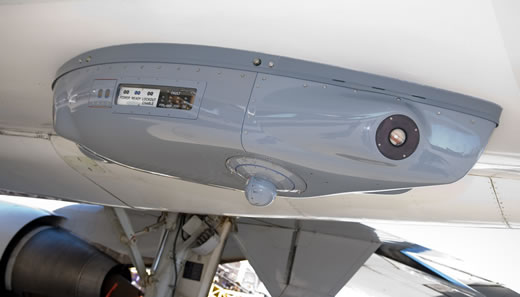
    Guardian consists of a multi-band laser pointer/tracker and an ultraviolet missile warning sensor. The system is contained almost entirely in a single pod that mounts to the underside of the fuselage. Photo: Northrop grumman

    The Air National Guard have initiated modifications to a KC-135 air refueling aircraft in preparation for the Operational Utility Evaluation of the Guardian directional missile countermeasure system developed by Northrop Grumman Corporation.

    The Guardian development addressed a homeland security requirement to protect civil aircraft from man-portable air defense systems(MANPADS). said Carl Smith, vice president of infrared countermeasures for Northrop Grumman’s Land and Self Protection Systems Division, since the Guardian is designed as an ‘add-on’ system, it is also suitable for protecting more than 400 such legacy aircraft currently in servcie. The pod can be transferred from one aircraft to another in about 30 minutes, making IRCM protection a role-fit option, with fewer systems required to protect the fleet. Smith added that the first phase of the evaluation will determine the suitability of the pod for the mission. Modifications to the aircraft to accommodate the Guardian system commenced on Nov. 11, 2010 at Forbes Field in Topeka, Kan. Ground testing began on Jan. 12, 2011 and according to the test schedule, flight testing will begin in two days, with operational utility evaluation spanning over two months.

    Guardian consists of a multi-band laser pointer/tracker and an ultraviolet missile warning sensor. The system is contained almost entirely in a single pod that mounts to the underside of the fuselage. Photo: Northrop grumman

    Guardian consists of a multi-band laser pointer/tracker and an ultraviolet missile warning sensor. The system is contained almost entirely in a single pod that mounts to the underside of the fuselage. Guardian operates by detecting launched missiles and then directing a non-visible, eye-safe laser to the seeker head of the incoming missile, disrupting its guidance signals. The system incorporates the AN/AAQ-24(V) operationally proven infrared countermeasures (defensive aid system) packed in a pod-based configuration. AN/AAQ-24 is currently installed on over 500 fixed and rotary wing platforms for the U.S. military, foreign heads of state and allied countries.

    3rd Annual Military Health Conference

    Military health concerns span beyond the medical care of services, to the long-term post implications of the long war. The cases of signature wounds continue to rise, and just in the last year the numbers of suicide attempts and deaths has increased. But while the wounds continue to grow, so do the treatments and therapies to help our troops.

    This conference addresses issues including PTSD, TBI and suicide prevention, facing the military today, in order to prevent or cure warfighters of these injuries.

    Conference Date: March 1-3, 2011

    Location: San Antonio, TX

    Conference Contact: David, [email protected], 312-540-3000 ext. 6583

    Organizer: Marcus Evans

    6th Annual Military Energy Alternatives Conference

    Operations expenditure is one of the largest spending items on the military budget. In an effort to reduce operations expenses, DOD plans to increase the use of renewable/alternative energy sources.

    Marcus Evans’ 6th Annual Military Energy Alternatives Conference will address key topics in alternative energy, including recent battery and fuel cell technology, energy storage, energy and fuel conservation, power grid capabilities, and application of available alternative energies.

    The event will also discuss strategies for bolstering the existing energy infrastructure, advancing energy security, creating portable and lightweight alternative power options, and improving energy efficiency to compliment mission objectives.

    Conference Location: Four Points Sheraton | Washington, D.C.
    Conference Date: February 23-25, 2011

    Organizer: Marcus Evans
    Conference Contact: David, [email protected], 312-540-3000 ext. 6583

    Skunk Works and XTEND Simplify Multi-Drone Command

    0
    Lockheed Martin Skunk Works® and XTEND have achieved a major milestone in JADC2 by integrating the XOS operating system with the MDCX™ autonomy platform. This technical breakthrough enables a single operator to simultaneously command multiple drone classes, eliminating the friction of mission handoffs. From "marsupial" drone deployments to operating in GPS-denied environments, explore how this collaboration is abbreviating the data-to-decision timeline and redefining autonomous mission execution.

    From Ukraine to Taiwan: The Global Race to Dominate the New Defense Tech Frontier

    0
    As traditional defense primes face mounting competition from agile “neoprimes” such as Anduril, Palantir and Helsing, the balance of innovation is shifting toward software-defined warfare and scalable, dual-use technologies, while global industry consolidation—marked by Boeing’s integration of Spirit AeroSystems and other strategic mergers—signals an intensified race to secure control over the defense technology value chain. Our Defense-Tech weekly report highlights these trends.

    Europe’s “Drone Wall”

    0
    In early October 2025, a coordinated wave of unmanned aerial system (UAS) incursions—widely attributed to Russia—targeted critical infrastructure across at least ten European nations. The unprecedented campaign exposed the fragility of Europe’s air defenses...

    Weekly Defense Update & Global Security Assessment

    0
    Executive Summary The past week (September 18-25, 2025) represents an inflection point where strategic defense concepts have transitioned from doctrine to tangible reality. An analysis of global events reveals four primary, interconnected trends shaping an...

    U.S. Air and Space Forces Push Next-Gen Programs at the AS&C 2025 Conference and...

    0
    At the 2025 Air, Space & Cyber Conference, U.S. Air Force and Space Force leaders unveiled major updates on next-generation fighters, bombers, unmanned systems, and space initiatives, highlighting both rapid innovation and critical readiness challenges as the services race to outpace global competitors. A short version is available here, with a more detailed version for subscribers.

    TADTE 2025: Reflecting Taiwan’s Strategic Themes

    0
    The Taipei Aerospace & Defense Technology Exhibition (TADTE) 2025 crystallized around four dominant strategic themes that collectively illustrate Taiwan's comprehensive approach to defense modernization amid escalating regional tensions. Based on a detailed report by Pleronix (available upon request). Includes a Podcast discussion on TADTE 2025's highlighting Taiwan's four strategic themes beyond the post's coverage.

    Iron Beam 450 Completes Testing, Soon to Join With Operational Air Defense Units

    0
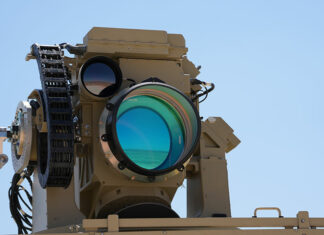
    Israel’s Iron Beam 450 high-power laser system has completed final testing, marking a major leap in air defense. Developed by Rafael, it offers precise, cost-effective interception of rockets, UAVs, and mortars, and is set for IDF deployment by 2025.