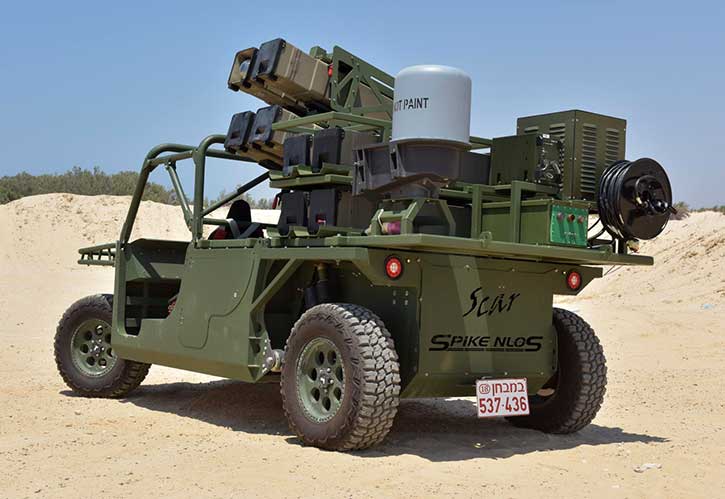
RAFAEL has carried out qualification firing tests of the Spike NLOS Lightweight launcher mounted on the brand new Tomcar TE6. Photo: RAFAEL
RAFAEL has tested a new lightweight launcher for its Spike NLOS missile system, designed for integration on light offroad vehicles. For the launcher qualification testing the system was integrated into the Tomcar TE6 all-terrain, hybrid-electric powered vehicle, demonstrating unique operational capabilities for the system. RAFAEL developed this application to meet a specific customer requirement, making it the 47th vehicular configuration of the Spike missile family.
At a weight of 1,350 kg, the launcher and eight missiles are mounted on the small vehicle, enabling the small crew to attack ground targets with pinpoint precision from 30 km away. The basic system carries four ready to launch missiles and four spares. The system can change the configuration and number of missiles used to meet the space and size constraints of small ATVs. While the first installation was tested on the Tomcar, the system can also be mounted on other all-terrain vehicles such as the Flyer, GMV-1.1 and similar ATVs.
TOMCAR is an Internally Transported Vehicle (ITV) able to carry a payload more than its curb weight, making it an optimal platform transporting vehicles, equipment, and soldiers in the same aircraft. The new TE6 version has three seats, and large front and aft cargo decks for use as a mule, or as an assault vehicle supporting weapon platforms. The Spike NLOS uses the new tactical tomcar TE6 platform, a hybrid-electric powered, ultra-quiet platform that has two electric motors and four-wheel drive, a payload carrying capacity (1475 kg).
At just over 1,780 kg, the air transportable Tomcar TE6 and lightweight launcher pack eight missiles, enabling the small crew to attack ground targets with pinpoint precision from 30 km away. Photo: RAFAEL
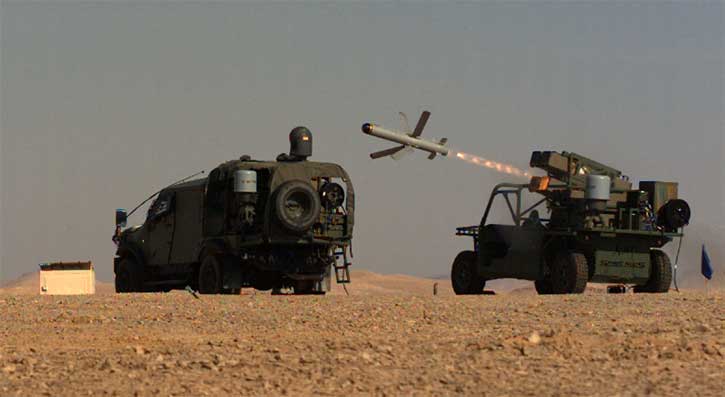
Supported by RF video datalink, Spike NLOS missiles can engage targets that are hidden from direct line of sight, or those that relocated since their initial acquisition. Spike NLOS missiles can engage different target types, including Main Battle Tanks, artillery units, logistical centers or surface-to-air missiles. Such attacks are highly precise, can use passive ‘fire and forget’ or man-in-the-loop ‘fire and update’ operating modes that, unlike GPS-based weapons, are not susceptible to jamming.
Mounted on an ultra-quiet hybrid-electric powered vehicle Spike NLOS can be inserted by helicopters or V-22, deep in the enemy area, far from their assigned targets. They can travel 15 minutes (about 25 miles) on battery power, or use the diesel generator for charging.
For internal carry in a V-22 the lightweight launcher is removed from the vehicle, and is quickly mounted again upon disembarkation. The vehicle has two dismountable control panels for he commander and missile operator, enabling remote control of the missiles up to 500 meters away. This capability improves the survivability of the crew, as it enables operation from inside buildings, bunkers or simply away from the launch site.
Until now the Spike NLOS was integrated on larger vehicles, such as the Plasan Sandcat, M-113 APC and M-60 tank. The integration on light, all-terrain vehicles enables Special Forces a low-weight, highly maneuverable and air deployable precision attack capability, that can be inserted deep into enemy territory using CH-47 and CH-53 helicopters using sling loads or internal carriage, or V-22 Osprey tilt-rotor aircraft.
During the launcher qualification process, SPIKE NLOS was fired from the Tomcar at targets more than 25 km away, using various firing trajectories (both very low and very high), defined according to the mission, scenario, and target type. Photo: RAFAEL
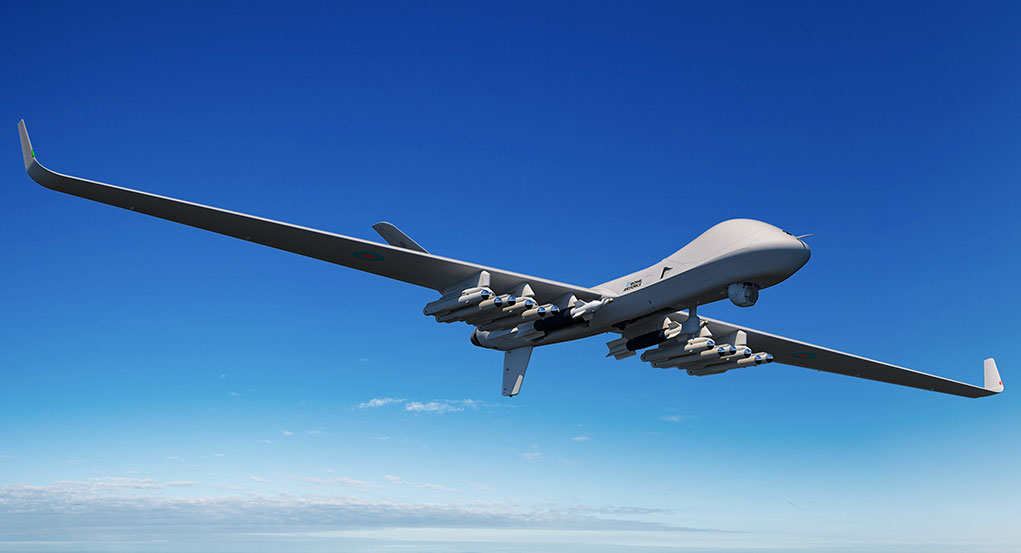
The Protector RG Mk1 has nine underwing weapon stations, each can carry three Brimstone missiles, thus offering a much higher loadout than the Reaper platform it will replace. Photo: MBDA
MBDA and BAE Systems have received contract supporting the future operational capability of the future Royal Air Force’s (RAF) Protector RG Mk1 remotely piloted aircraft (RPA) as it enters service towards the mid-2020s. MBDA will provide integration of the Brimstone precision guided strike missile onto the drone. Company officials are confident that the integration will be completed in time for the Protector’s planned entry to service. The team will have at least five years for this task, as the induction of the new drone is not expected before 2024. BAE Systems signed a contract to support RPA’s airspace integration required to allow the drone flying over populated areas in UK and Europe.
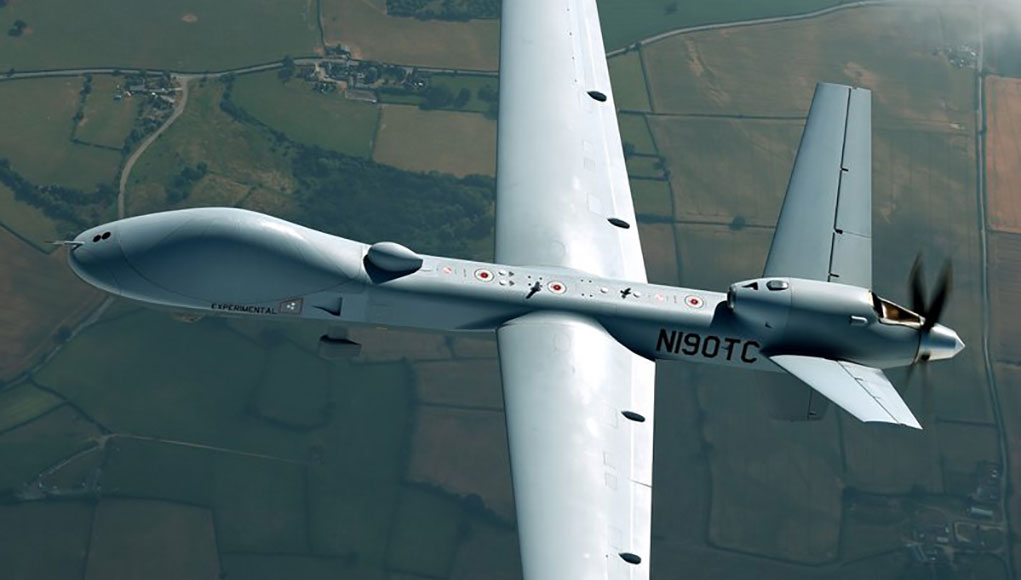
SkyGuardian features endurance of more than 40 hours, rapid integration of new payloads, nine wing hardpoints, all-weather capability with lightning protection and de-ice systems, “self-deployment” using satellite communications (SATCOM) commanded Automatic Takeoff and Landing, Lynx Multi-mode Radar, large-aperture EO/IR HD-video sensor, and a Detect and Avoid (DAA) system for collision-avoidance.
Protector RG Mk1 is the new, weaponized variant of General Atomics’ SkyGuardian, an RPA based on the MQ-9B Reaper redesigned as a certifiable RPA. Protector was initially intended to enter service in 2018 to replace the MQ-9 Reaper currently in RAF service. However, the service entry date was postponed to 2021 and then pushed back further. The number of aircraft procured also dropped from 20 to 16 aircraft.
The Brimstone missile is a lightweight (50 kg) strike missile with an advanced dual-mode mmW/SAL seeker offering a unique capability of engaging a wide range of target types, including fast moving vehicles on land and at sea in both direct and indirect modes. Apart from the Brimstone missiles Protector will also be cleared to carry Raytheon’s Paveway IV Laser/GPS guided bombs.
The Protector RG Mk1 has nine underwing weapon stations, each can carry three Brimstone missiles, thus offering a much higher loadout than the Reaper platform it will replace. The integration of Brimstone onto Protector RG Mk1 follows a series of successful firing trials of Brimstone from the Reaper/Predator B aircraft in the United States that demonstrated the advancement in the performance that Brimstone offers.
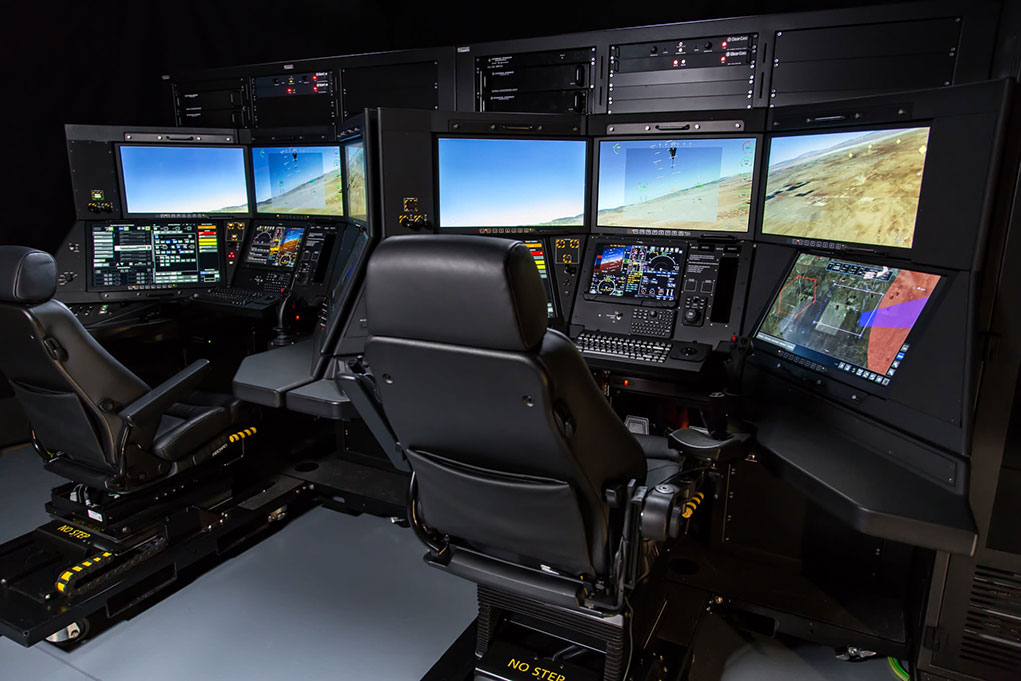
Protector RG MK1 will be supported by a new synthetic training environment provided by CAE Defence. The ground control station design features an additional, commercial avionic module in the center console, part of General Atomics’ Certifiable Ground Control Station, supporting operation in civil controlled airspace. Photo: CAE Defence
The new RPA was designed to comply with national and international airspace and safety regulations, a requirement most current RPAS do not meet. Redesigned as a ‘certifiable’ aircraft that airworthiness requirements under NATO STANAG 4671. Once completed, this certification will enable the RAF to operate the drones from their designated home base, RAF Waddington, transit the unmanned aircraft without the restrictions currently limiting training over the UK and Europe, and access remote areas of operation anywhere in the world. Current RAF drones operate from remote bases and in theaters of operations where they fly under military airspace control. Offering the certification roadmap for the SkyGuardian helped General Atomics win sales in recent competitions in Europe, such as in Belgium and Spain, customers which raised concern about the use of RPA in their countries.
The RPA features endurance of more than 40 hours, rapid integration of new payloads, nine wing hardpoints, all-weather capability with lightning protection and de-ice systems, “self-deployment” using satellite communications (SATCOM) commanded Automatic Takeoff and Landing, Lynx Multi-mode Radar, large-aperture EO/IR HD-video sensor, and a Detect and Avoid (DAA) system for collision-avoidance.
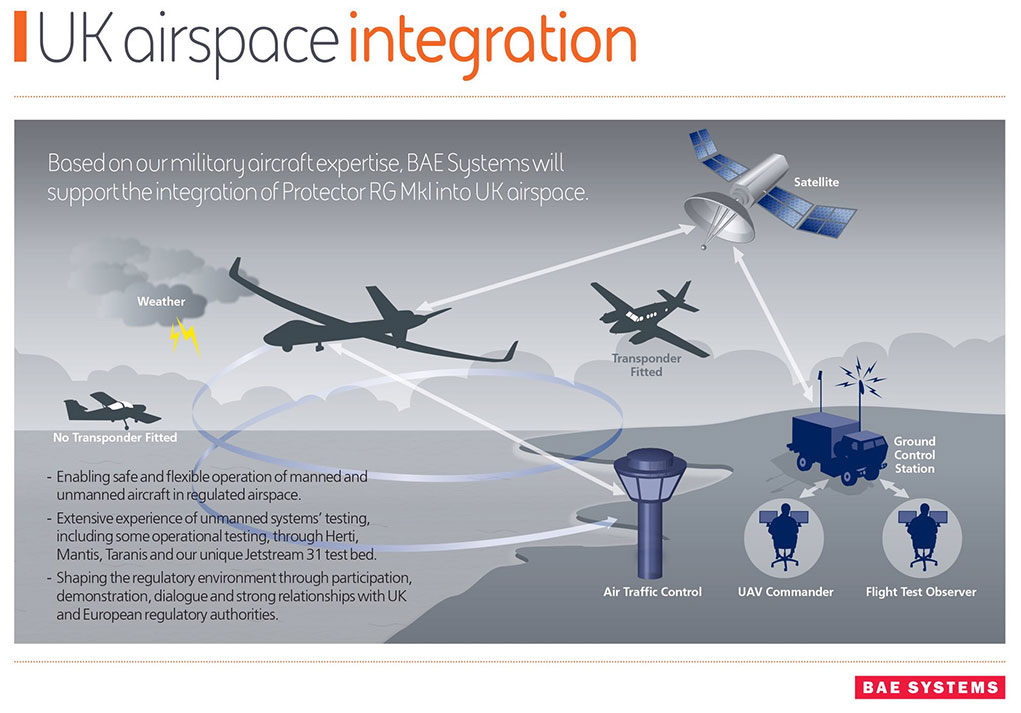
BAE Systems has joined the team supporting the UK airspace integration process. While the RPA will be certifiable to meet civilian flight regulation, the lack of on-board due regard radar that provides autonomous air-traffic detection capability limits the drone’s autonomous flight capability. BAE Systems will implement other Concepts of Operations (CONOPS) required for operations in UK airspace, within the capabilities made available for the system. SkyGuardian has the space, power and cooling for a due regard radar but such a system was not included in the Protector RG Mk1 project. Such device could be added in the future.
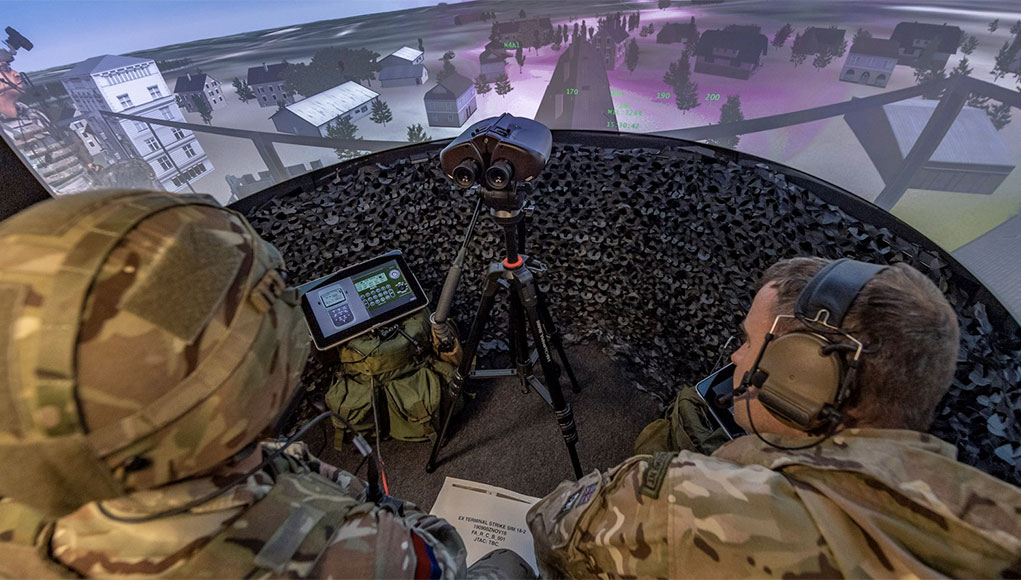
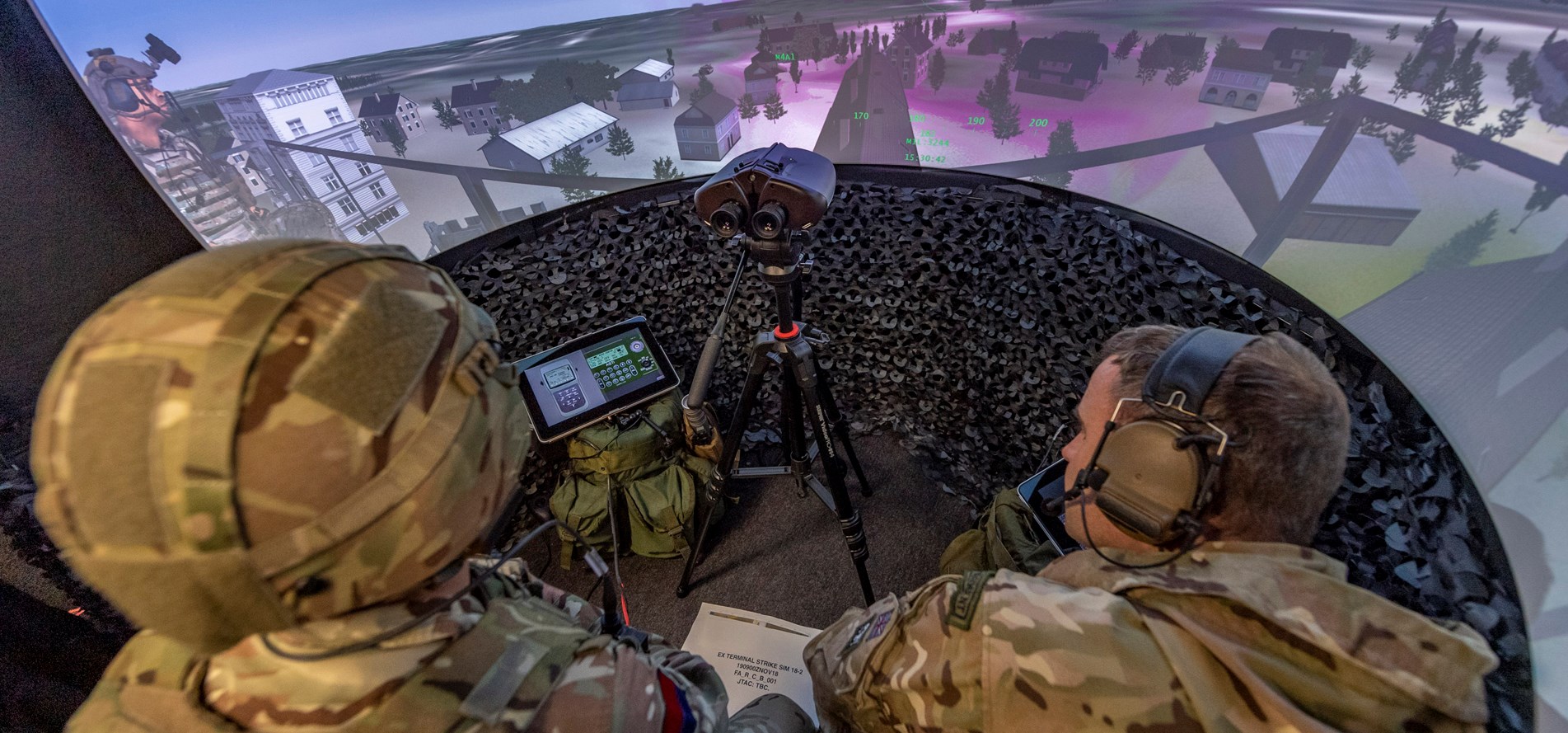
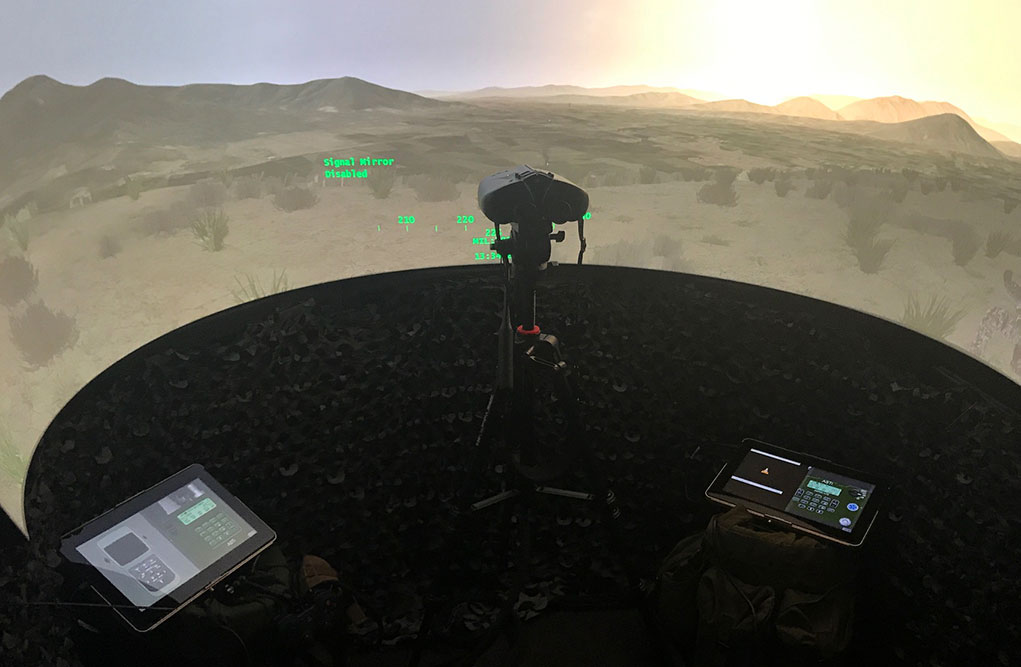
The Image Generation is multi-spectral allowing the use of in-service Night Vision Devices in conjunction with a range of emulated equipment, such as laser designators, radios, and binoculars providing trainees with a high fidelity “train as you fight” experience. Photographer:
Cpl Nick Johns RLC/ MoD Crown
The British Army began operating a mobile Close Air Support (CAS) and Joint Fires simulator, a bespoke solution was built to satisfy the military requirement for mobile, on the job training for personnel of the 1st Artillery Brigade personnel. The Joint Fires Mobile Trainer (JFMT) is now in active service, training Joint Terminal Attack Controllers (JTAC) and Fire Support Teams (FST) within the brigade.
The JFMT is accredited to simulate all controls currently allowable (types 1, 2, and 3, Full Motion Video, Rotary Wing, Night/IR, Remote Observer, and Laser Target Designation). Through the qualification process completed in August last year with UK Joint Air Land Organisation (JALO), JFMT successfully met all US and NATO requirements to deliver simulated CAS training.
The simulator was developed and produced by Elbit Systems UK Ltd. (#ESUK) and QuantaDyn Corporation. Under the contract, Elbit Systems UK supplied the JFMT as a fully serviced training package, all contained within a versatile 20ft trailer able to be deployed and recovered by vehicles within short time frames. The concept supports training at the training centre or in the field, as part of refresher courses.
A member of the Royal Artillery conducts his checks in a simulator in Kinloss to keep his qualifications in date. Army and RAF team up to train in the Highlands 1st Artillery Brigade, based in Tidworth and troops from RAF Honington in Suffolk combined to perform their largest exercise this year. Photographer: Cpl Nick Johns RLC/ MoD CrownThe system comprises a trainee station, an instructor/operator station (IOS) and a pilot station console. Visuals are provided within a high-resolution dome configuration coupled with a powerful and intuitive Computer Generated Force (CGF) and Semi-Autonomous Force (SAF) application. Photo: Elbit Systems UK
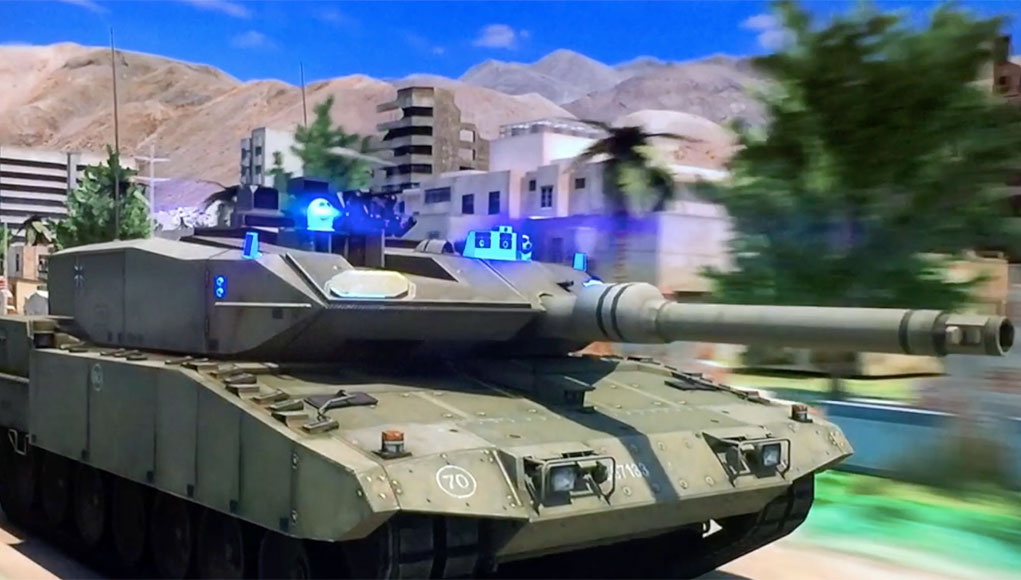
Rafael to equip German Leopard II tanks with Trophy APS systems. The illustration depicts RAFAEL's suite for future armored vehicles, that enables capabilities envisaged for the Future Combat Vehicles. Photo: RAFAEL video via Defense-Update
Germany plans to equip one tank company with Rafael Trophy Active Protection Systems (APS) to better protect a rapid reaction force it plans to deploy as part NATO’s Very High Readiness Joint Task Force (VJTF). German officials confirmed the news at the International Armored Vehicles forum (#IAVevent) in London this week.
The unit is expected to receive the Trophy systems in 2022, is expected to join the VJTF in 2023. The Bundeswehr operates 328 Leopard II tanks of three types – the 2A6, 2A6M, and 2A7 types, currently being upgraded. As the German Army (Bundeswehr) has not yet designated the unit, therefore, the type of Leopard II tank to receive Trophy is yet to be determined.
Trophy has yet to be integrated with the Leopard II tank. Previous work was done on Leopard II tanks few years ago. The Bundeswehr has experience with Trophy and Iron Fist, as both systems were evaluated for the Leopard II in the past. The Bundeswehr also examined the locally developed ADS from Rheinmetall, but determined it will not be mature to support the upcoming deployment. Leopard tanks have been used in combat in Aghanistan and Syria, where they suffered heavy losses from anti-tank guided missiles, a challenge that brought the Turkish Army to rush APS to protect the tank.
Trophy APS has already been selected to equip four brigades of US Army M-1A2 SEP2 Abrams tanks, at least two are destined to deploy in Europe. The Dutch military also forsee APS as a priority and has contracted BAE Systems to integrate the Iron Fist Light Compact (IF-LC) system on its CV9035NL.
According to the planned schedule initial trials of Trophy on Leopard II are expected to begin this year with integration and testing completed by 2021, fielding 17 tanks (a company of 13 plus four spares) to equip the selected company in 2022. The unit will train and qualify to operate with the system in 2022, thus becoming combat ready for its VJTF deployment in 2023. The procurement is limited at this stage to the 17 systems and is not committing the Bundeswehr to a future APS solution.
The brigade size VJTF is part of 40,000 personnel strong North Atlantic Treaty Organization (NATO) Response Force (NRF). VJTF was formed to better respond to the changing security environment to the east and south of the Alliance’s borders. The force comprises a small combat element and deployable Command and Control (C2) element and Joint Task Force HQ. It also combines an initial follow-on forces group comprising other high-readiness forces that can deploy quickly following the VJTF, in response to a crisis. The VJTF will be able to deploy at short notice when tasked, between two to seven days, to combat threats against alliance sovereignty.
A multinational
brigade of approximately 8,000 troops forms the VJTF. Last year, the lead
brigade was provided by Italy. In 2019 Germany assumed command of VJTF with the 9th Panzerlehrbrigade,
part of the 1st Panzer Division, (a multinational German and Dutch
formation). Germany is expected to contribute more forces in 2023.
Partners in this
rotation also include the Netherlands and Norway, which will provide
capabilities such as aviation and mechanized infantry while France, Belgium,
Luxembourg, the Czech Republic, Latvia and Lithuania will provide troops. The NRF for this year
was certified during Exercise Trident Juncture 18, which mainly focused on NATO’s
ability to move personnel and armor quickly across Europe.
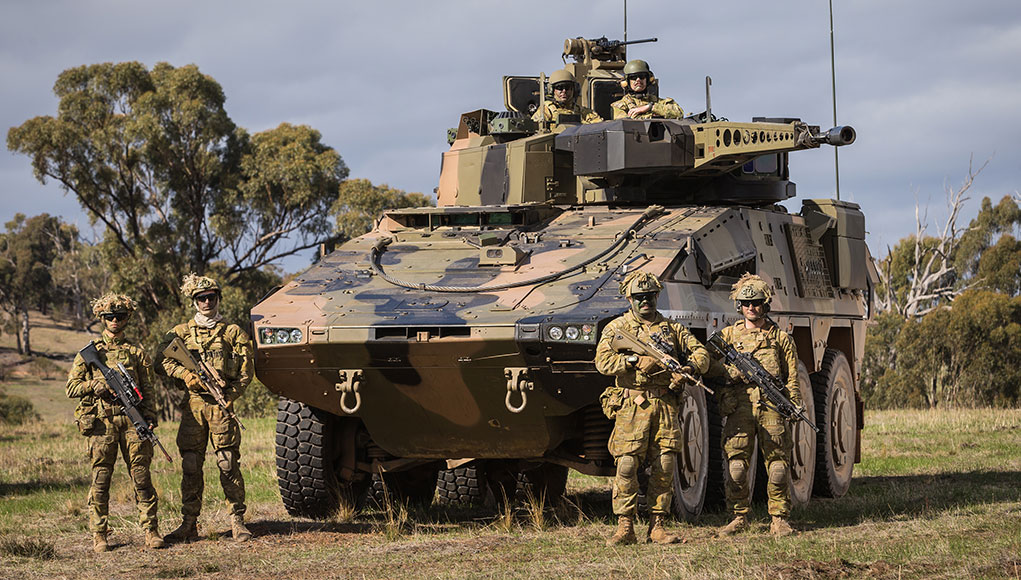
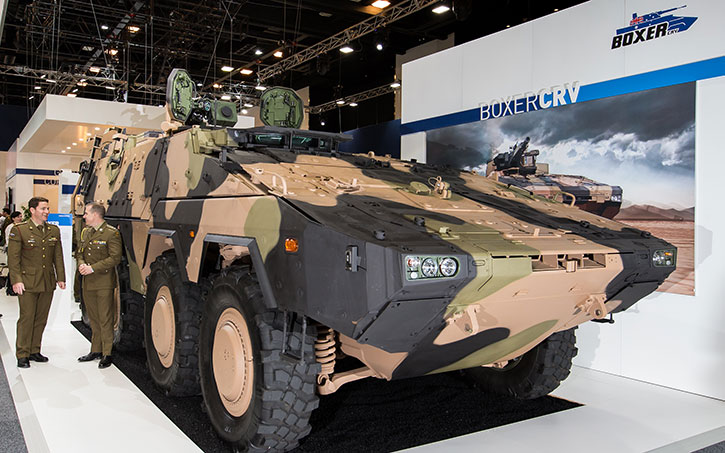
Australia was the first country outside NATO to select the Boxer RCT30 infantry fighting vehicle for the Combat Reconnaissance Vehicle role. Photo: CPL Nunu Campos, Australian defence
The Australian Defence Force has asked Rheinmetall Defence to evaluate Israel’s Iron Fist Active Protection System (APS) developed by Elbit Systems’ IMI. Brigadier Greg McGlone, Australian Army Director General, Armored Fighting Vehicles, broke the news at the International Armoured vehicles 2019 conference (#IAVevent) in London today. According to Brig. McGlone the evaluation will include only the Iron Fist as it was the only mature APS that meets the Boxer’s weight requirement (38.5-ton combat weight).
Following the current assessment, Australia plans to contract Rheinmetall to integrate Iron Fist on the Lance turrets being used on the 121 of the Block II (improved reconnaissance vehicles) Australia is buying under the Land 400 Phase 2 program.
The Australian army plans to conduct live fire testing of the system as part of the Block II improvements of the Australian Boxers. Australia will locally assemble 197 Boxers in this Block II phase, the vehicles include 121 combat reconnaissance vehicles (CRV), 10 recovery vehicles, 15 command vehicles, 29 joint fires surveillance vehicles and 11 repair APCs. The Australians also have options to buy 11 Boxer ambulances, all under the Block II tranch. The first 25 CRVs and engineer vehicles will be delivered by 2020 from Germany under Block I.
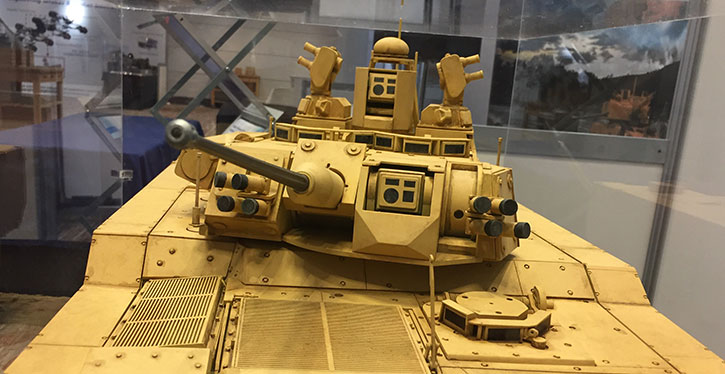
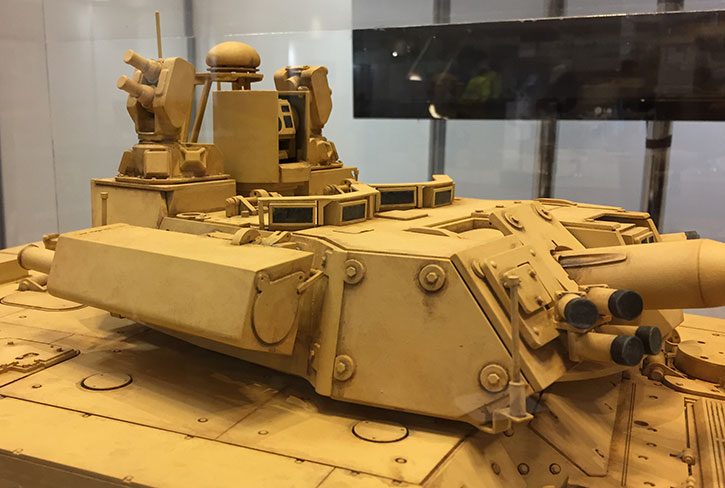
IF-LC is also included in the AJAX based tracked vehicle General Dynamics Land Systems UK (GDLS-UK) propose to the Australian Land 400 Phase 3, intended to replace the M113s in the future. A model of that vehicle was also unveiled by GDLS at the #IAVevent. Photo: Defense-UpdateThe AJAX proposed for Land 400 Phase III uses a manned GDLS turret that mounts an ATK 30mm cannon and a missile launcher. In addition to the two IF-LC active protection units the turret also uses dual, multi-sensor EO targeting system (note the protected, rotating commander sight) and the acoustic sensor behind it. Photo: Defense-Update
The Australian Army studied using APS during the evaluation of Land 400 Phase 2 but did not require such capability from the competitors. Rheinmetall proposed the Boxer with its own ADS system. The Australians requested Rheinmetall, the Boxer manufacturer, to evaluate the scope of integration of the Iron Fist – Light, Decoupled (IF-LD) APS – the same system selected by the US Army to protect the Bradley Armored Infantry Fighting Vehicle (AIFV). The study could also consider the compact variant of Iron-Fist (IF-LC) which was selected to protect the Dutch CV-9035NL AIFVs.
IF-LC was proposed for two of the platforms that were not selected by the Australians – AMV-35 and Terrex III. It is now part of the AJAX-based tracked vehicle offered by General Dynamics Land Systems UK (GDLS-UK) to the Australian Land 400 Phase 3. A model of that vehicle was also unveiled by GDLS at the #IAVevent. This vehicle is intended to replace the M113s in the future. One of the competitors in the program is KF31 from Rheinmetall.
Boxer Block II procurement will also include 64 vehicles configured in four non-turreted variants, as this command and control vehicle displayed at the Australian Land Forces 2018 exhibition. Photo: Nunu Campos, Australian defence.
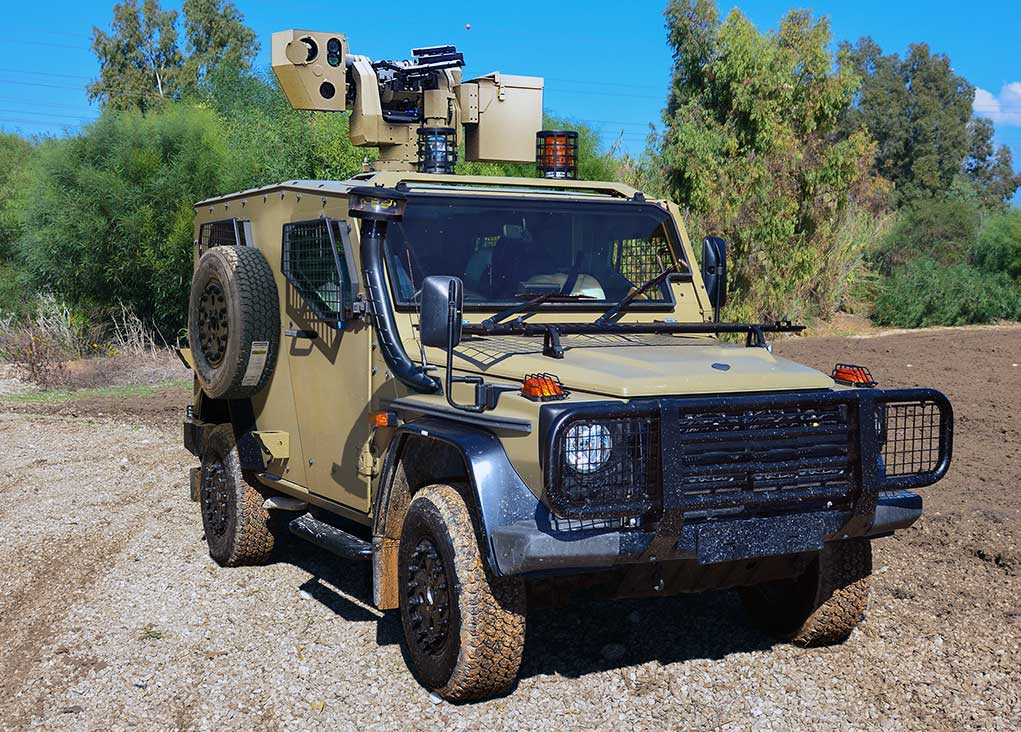
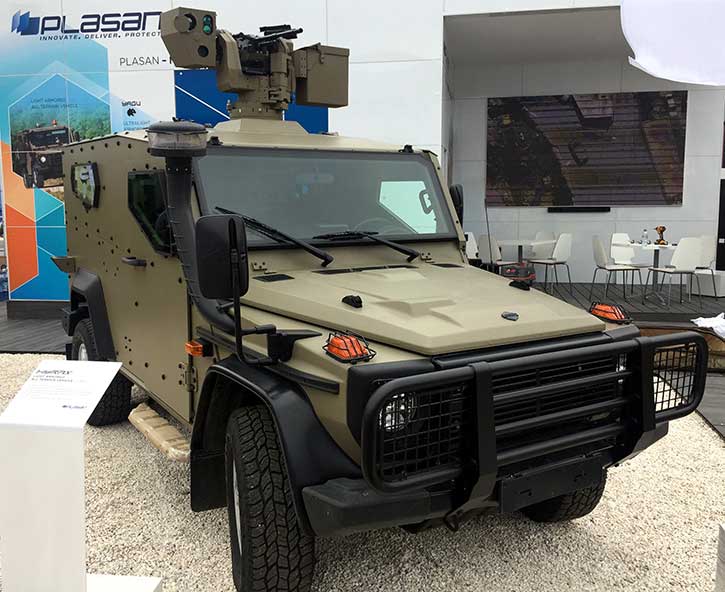
Plasan's Hyrax is a new light armored patrol vehicle based on Mercedes Benz G-Class chassis, and designed to meet the military requirement for a modern and reliable high mobility vehicle, capable of operating in urban areas as well as rugged mountainous terrain, operating as a light armored patrol vehicle. Photo: Plasan
Since its introduction in 1979, the G Wagon is in production and evolving. From hundreds of thousands of vehicles produced many are operated by military users. New models are designed to meet the requirements of special operations and military security worldwide. Photo: Mercedes Benz
Since its introduction in 1979 Mercedes Benz G Class (or G-Wagen, by its popular German name) has become a popular vehicle with government organizations and military forces that sought the brand’s dependable operation and off-road mobility. Winning important contracts, and prospecting new markets, on its 40th anniversary this vehicle continues to evolve. Two new vehicles, Mercedes’ own Multi-Role Vehicle (MRV) and Israel’s Plasan Hyrax are two of the new vehicles recently introduced in this class.
A four-wheel drive sports utility vehicle (SUV) Mercedes-Benz G-Class is produced by the Graz based Steyr company in Austria. With over 300,000 vehicles produced, and numerous updates through the years, the vehicle and still in production – the longest produced Mercedes-Benz vehicle in Daimler’s history.
The original design was modified into more than 70 variants used by military and security forces in 34 countries. The main operators include Australia, Canada, Denmark, Germany and Norway, each operating thousands of vehicles. Beyond the versatile utility role, armies also use the G-Class in combat-ready configurations. Bulgaria, Canada, Egypt, Finland, Germany, Hungary, Indonesia, Malaysia, Netherlands, and Norway are some of the users of those armored and armed variants.
The Australian military forces acquired the G Wagon as the 4×4 under the Land 121 land vehicles modernization program. Both 4×4 and 6×6 variants are used as utility and long range reconnaissance vehicles. Photo: CPL Nunu Campus. Australian Defense Forces.Enok 5.4 was introduced in 2007 as the lightest armored member in the new family of armored vehicles fielded by the German military. Photo: Bundeswehr
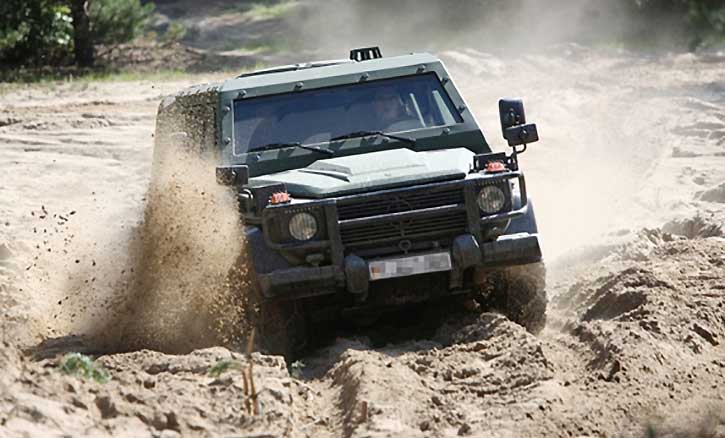
Developed as a military vehicle since the 1990s, it entered service with the German Army, first as the ‘Wolf’ and later as ‘Enok’, an improved Light Armored Patrol Vehicle (LAPV). When it entered service in 2007 it was the lightest category of a new family of German armored vehicles (GFF). Enok is currently used in three armored versions – a pickup closed van and MedEvac vehicle, as well as an unprotected van.
Designed and built by ACS of Germany, Enok uses a ballistic steel cabin that provides good mine and IED protection. At a weight of 5.4 tons the protection level selected by the Germans exceeds the original vehicle’s permitted weight, and, therefore required special modifications. Powered by the 184 HP OM642 engine, Enok carries up to 930 kg of payload and develops 95 km/h road speed.
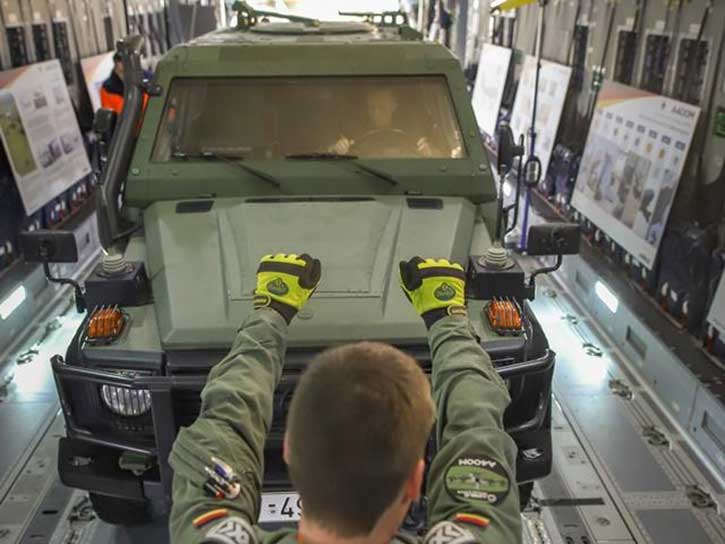
At a gross vehicle weight of 5.4 tons Enok measures to fit into the A-400M tactical transport plane for air mobility. Photo: Bundeswehr
In a recent upgrade, the gross vehicle weight (GVW) was further increased to 6.1 tons, extending payload capacity to 1.3 ton. To improve mobility this model uses height-adjustable suspensions and upgraded axles resulting in much higher ground clearance. An even heavier variant is in development, maximizing GVW up to seven tons. Another growth option is the six-wheeled G 300 CDI was displayed in September 2019 at the recent DVD military event in the UK. The G 300 6×6 is designed to carry increased weight with improved off-road mobility.
Multi-Role Vehicle (MRV)
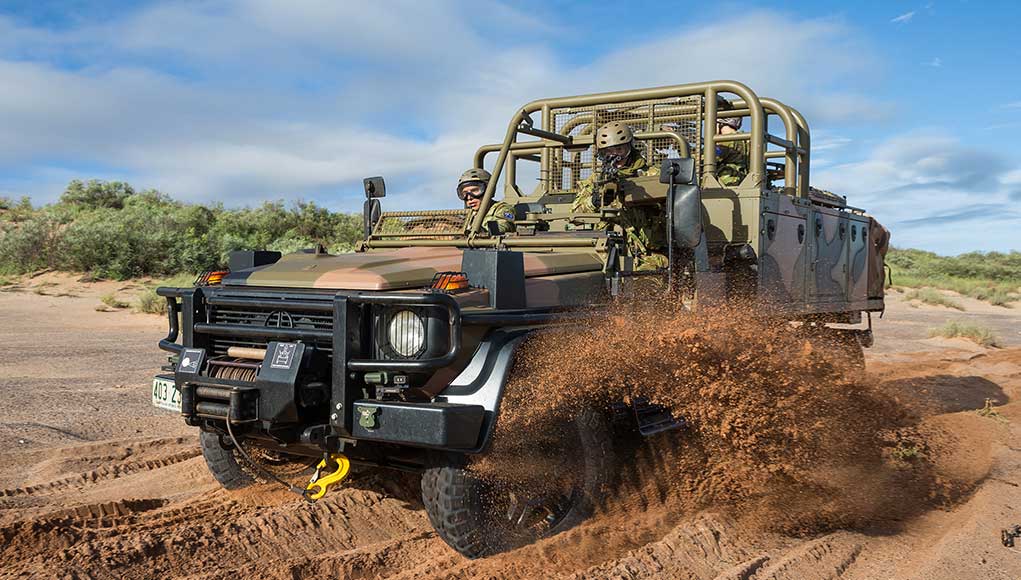
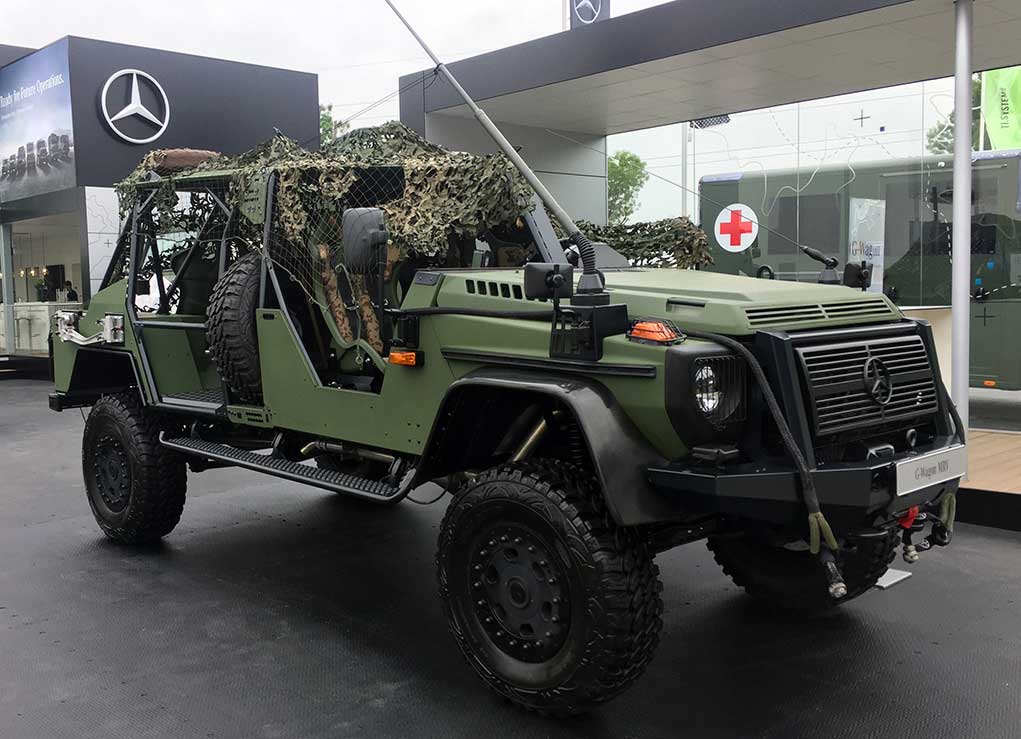
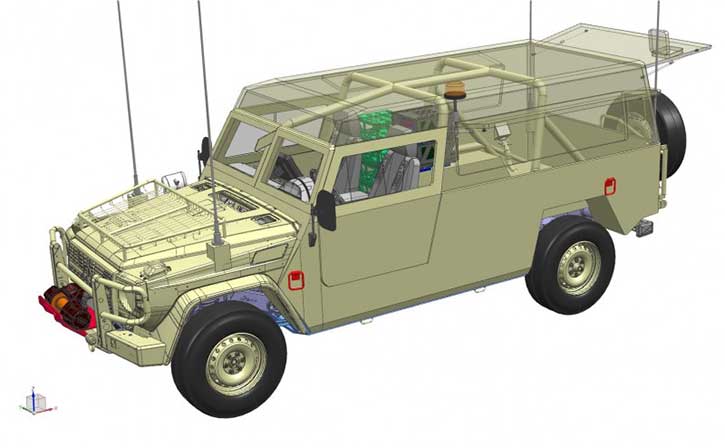
Addressing the needs of airmobile and special forces, Mercedes Benz developed a lightweight all-terrain multi-role platform based on the G-Class. The MRV’s uses a tubular frame to provide a lightweight and agile all-terrain platform that carries up to 3 tons of payload on and off road, at a top speed of 120 km/h. Mission autonomy is extended over 800 kilometers thanks to the large tank and low fuel consumption. 412mm of ground clearance ensures optimal off-road mobility and stability. Water crossing is also enhanced with the fording of one-meter deep obstacles.
The MRV utilizes the G Class chassis with modifications that reduce weight and improve all-terrain mobility. Note the tubular frame with integral attachments for sling loading by helicopters. The MRV can be lifted internally or externally by Chinook and CH-53 helicopters. Photo: Defense-Update
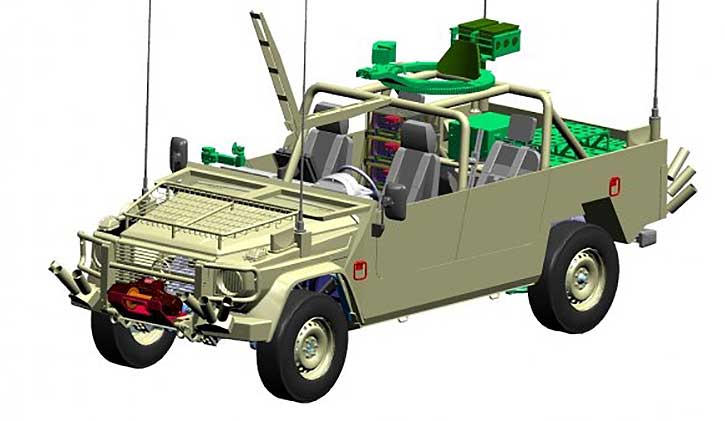
Another important factor is air mobility – the MRV can be transported inside the CH-53 and CH-47 helicopters and even be sling-loaded under those helicopters using hooks embedded into the roll cage. Several Special Forces use G class vehicles, the most recent to adopt the platform was the Dutch military that will soon receive over 500 air assault vehicles (AASLT). This vehicle is a unique, lightweight configuration designed for the airborne brigade. The brigade will eventually operate over 1,000 such vehicles, configured for assault, transport, and ambulance roles. They will replace 20-year old G-Wagon vehicles that operated until now, will be designed to seat five combatants, carry 1.2 tons of equipment and be carried inside or sling-loaded under a CH-47 helicopter.
A CAD view of the open AASLT variant. Illustration: Daimler AG.A CAD view of another AASLT prototype – a closed utility vehicle. Photo: Daimler AGPlasan’s Hirax was unveiled at the Eurosatory 2018. It was the first armored vehicle to utilize the new rolling chassis introduced by Mercedes Benz in 2017. Photo: Defense-Update
Plasan HYRAX
At the Eurosatory 2018 Israel’s armored vehicle expert Plasan unveiled the Hyrax – a lightweight, high performance armor protected vehicle, based on Mercedes Benz’ new G300 CDI Rolling Chassis. The Hyrax is the first vehicle utilizing this chassis, introduced by Mercedes Benz in 2017.
Powered by 183 horse powers developed by
a Mercedes’ G300 CDI 6V Euro-3 engine coupled to a five-speed automatic
transmission, that delivers 400 Nm of torque, Hyrax has a power to weight ratio
of 38 HP/T, thus maintaining the class’ agility, acceleration and power braking.
This aspect is becoming essential not only on highways, but also ascending or climbing
mountainous dirt roads with full armor and combat load. At the Gross Vehicle
Weight of 4,800 kg Hyrax carries up to 810 kg of payload when fully manned and
loaded for a mission. As for air mobility, the vehicle is sized for
transportation in C-130 aircraft.
The All-Wheel Drive (AWD) driveline uses
a central differential locking system that includes electrically operated front
and rear locks that enable all four wheels to overcome harsh terrain
conditions. With a wheelbase of 2,850 mm and ground clearance of 245 mm Hyrax
can climb a 400 mm vertical step, cross trenches 600 mm wide, and ford 600 mm of
water, using its integral, elevated air intake. It safely negotiates 80% slope
and 54% side slopes. The AWD maintains high stability and safety on and off
road, moving on dirt, mud, snow and paved roads. Hyrax maintains all the G
Class’ safety features, including power steering, ABS, ESP, BAS, EBD, and
airbags for the front seats.
The AWD has three differential lock modes enabling optimal traction over all types of obstacles. Photo: Mercedes Benz
A major advantage of the Hyrax’ is its
reliance on a commercial rolling chassis rated for 4.5-ton gross vehicle weight.
Unlike other vehicles that require extensive modification to meet payload
requirements, the robust frame and automotive system is ready to support the armored
cabin, sustaining the vehicle’s dynamics through the full operating envelope,
even in the fully combat loaded configuration. Built in cooperation with the
original manufacturer (OEM), Hyrax is approved under the manufacturer’s
warranty and is fully supported through the manufacturers’ worldwide service
network.
As an armor protected vehicle Hyrax
utilizes Plasan’s battle proven kitted hull technology. This modular design employs
advanced, light armor that defeats small arms, fragments and armor piercing
rounds, meeting EN1522 B6, B7 and STANAG 4569 Level 1 in the basic configuration
and is upgradable to B7 and STANAG Level 2. The armor is made of composite
materials and includes a large transparent windshield and side windows on all
sides.
Plasan’s Hyrax is a new light armored patrol vehicle based on Mercedes Benz G-Class chassis, and designed to meet the military requirement for a modern and reliable high mobility vehicle, capable of operating in urban areas as well as rugged mountainous terrain, operating as a light armored patrol vehicle. Photo: Plasan
The spacious protected cabin can be configured
in two or four door design and several seating arrangements, including 2+3,
2+4, 2+1+1 and 2+2+1. The armored capsule’s roof is built to support a
protected gunner position or remotely operated stabilized weapon stations (RWS)
mounting a light or heavy machine gun and optronic package. Such weapon systems
enable the crew to track and engage stationary and moving targets while from
inside the Hyrax’ protected capsule.
Hyrax
has recently completed operational and road testing with the Israel Defense
Forces (IDF) and is now certified for use with the IDF. Developed by Plasan in
cooperation with the OEM Mercedes Benz, the 4.8-ton Hyrax is positioned as a
candidate to replace hundreds of ‘David’ light armored patrol vehicles that were
based on modified Land Rover Defender 110 vehicles. Ten years after entering
service the lighter (3.5 ton) David have worn out following extensive combat
service.
Location: Millennium Gloucester Hotel London Kensington
Dates: 28-30 January 2020
Organizer: IQPC Event Website Link
The Surface Warships conference has become established as the premier meeting ground for the higher naval commands of the NATO alliance and partner states, attracting over 150 senior officials including navy commanders, directors of materiel, heads of strategic programs, capability planners, shipyard directors, as well as leading solution providers. Over the course of 3 days, the event will center on future capability development for an information-centric operating environment, focusing on the nature of Future Operations, the required Future Technologies, and the makeup of the Future Force Structure.
Treat Yourself to a Discount on airfare with CheapOair
Location: Rosen Shingle Creek Hotel, Orlando, FL, USA
Dates: 26-28 February 2020
Organizer: AFA Event Website Link
AFA’s Air Warfare Symposium is a premier event for the aerospace and defense industry geared toward the professional development of Air Force officers, enlisted members, civilians, retirees, and veterans.
The symposium harnesses the Air Force’s innovative spirit through sessions focussed on innovation and exhibits that highlight the next generation of air, space, and cyber power.
The symposium brings together the top leadership of the Air Force as well as leaders in industry, academia, and government officials to discuss the issues and challenges facing our Air Force today and in the future.
Location: Tel Aviv Expo Center, Pavillion #2
Dates: 28-30 January 2020
Organizer: Cybertech Event Website Link
From Tel Aviv and Rome to Tokyo, Singapore, Panama, and more, Cybertech is the cyber industry’s foremost B2B networking platform conducting industry-related events all around the globe. Cybertech events feature top executives, government officials, leading decision-makers from a wide range of sectors including critical infrastructure, insurance, retail, health and government, defense, R&D, manufacturing, automotive, and more! Multinational corporations, startups, private and corporate investors, venture capital firms, experts, and clients—come and meet all the key players from the cyber industry and be immersed in everything there is to offer.
Treat Yourself to a Discount on airfare with CheapOair
Location: Hilton Alexandria Mark Center, VA
Dates: 29-3 January 2020
Organizer: IDGA Event Website link
The Operational Energy Summit 2020 will provide the community with over-arching reviews from DoD, DLA and all branches of the military, as well as tactical and operational points of view from across the Services. With that in mind, our sessions will cover top priorities to align with the three pillars of the DoD OES. The Summit will discuss current programs and future priorities in support of logistical and operational energy solutions; emerging technologies, renewable solutions, disruptive innovation and allocating as well as resourcing and developing plans to ensure mission effectiveness.
The Focus Day will open the program with commentary from the top leaders of the sustainment, installations and operational energy community, providing strategic reviews and policy updates, thus setting the tone for the two days to follow with their extensive learning opportunities, over 10 hours of networking time with the key stakeholders and unique opportunities for you to deepen your footprint in the domain.
Treat Yourself to a Discount on airfare with CheapOair
Location: The Vox Conference Centre, Birmingham, United Kingdom
Dates: 25-27 February 2020
Organizer: DefenceIQ Event Website Link
The premier forum for AM users, R&D experts, and industry partners within the aerospace and space industry returns for its sixth edition taking place in Birmingham.
As the leading conference platform for AM in the aerospace industry, the event provides an exclusive opportunity to visit the Siemens/Materials Solutions advanced manufacturing site in Worcester.
Location: Hilton Alexandria Mark Center, Alexandria, VA
Dates: 29-31 January 2020
Organizer: IDGA Event Website link
The ongoing proliferation of next-generation missile and hypersonic threats, to include increasing examples of UAV and UAS threats, leadership across the Armed Services is poised to leverage advanced radar and sensor solutions that address these future challenges. The current buildup of radar technologies along the Pacific AOR illustrates a need to rapidly bolster our current technological standing to keep at pace with threats, and IDGA’s senior-level faculty will speak to how ongoing radar and sensor technology developments will meet these emerging threats.
Leadership across the Services have routed radar development to focus on advancing small target detection, sensor fusion, cognitive radar, SWAP-C, autonomous assets, survivability and resiliency to enable improved mission success. Our previous iteration offered senior-level understanding across these trends, and our 2020 summit will revisit and update them, while also focusing on new areas such as AI and ML for improved radar, ongoing service-wide sensor efforts, hypersonic detection and more.
Available Hotel Accommodations for the Event Days and Vicinity
Location: Copthorne Tara Hotel London Kensington, London, United Kingdom
Dates: 25-27 February 2020
Organizer: DefenceIQ Event Website Link
The Combat Support Week address the logistics challenges Military Engineers and Logisticians are facing in ensuring mobility is maintained and capabilities are able to be effectively deployed by the modern combat force.
Assessing the critical requirements for the deployment and maintenance of a combat force in theatre will feature throughout the program this year along with a clear focus on enabling mobility, momentum, and capability by identifying innovative, cost-efficient solutions to modernize operational capabilities.
The opening week of 2026 has been defined by a singular, paradigmatic shift in modern warfare: the "catastrophic failure" of Venezuela's integrated air defense network during a U.S. special operation. The operation succeeded not through brute force, but by rendering Venezuela's Russian S-300VM and Chinese "anti-stealth" radars effectively blind, validating the supremacy of advanced electronic warfare over legacy kinetic defenses. This failure has sent shockwaves through the global defense market, underscoring why nations like Spain and Germany are rushing to modernize their air defense architectures with Western alternatives, while massive procurement programs exceeding $301 billion signal an accelerated transformation toward unmanned systems, directed energy weapons, and indigenous production capabilities.
Turkey's defense industry transformation extends far beyond its celebrated drones. Now ranking 11th globally in defense exports, Turkey is executing a comprehensive strategy to become a top-tier arms supplier. With 75% of exports flowing to Western markets and five firms in Defense News' Top 100, Turkey is methodically building a complete defense ecosystem through combat-proven systems, integrated defense diplomacy, strategic self-reliance, and real-world R&D in active conflict zones.
Lockheed Martin Skunk Works® and XTEND have achieved a major milestone in JADC2 by integrating the XOS operating system with the MDCX™ autonomy platform. This technical breakthrough enables a single operator to simultaneously command multiple drone classes, eliminating the friction of mission handoffs. From "marsupial" drone deployments to operating in GPS-denied environments, explore how this collaboration is abbreviating the data-to-decision timeline and redefining autonomous mission execution.
As traditional defense primes face mounting competition from agile “neoprimes” such as Anduril, Palantir and Helsing, the balance of innovation is shifting toward software-defined warfare and scalable, dual-use technologies, while global industry consolidation—marked by Boeing’s integration of Spirit AeroSystems and other strategic mergers—signals an intensified race to secure control over the defense technology value chain. Our Defense-Tech weekly report highlights these trends.
In early October 2025, a coordinated wave of unmanned aerial system (UAS) incursions—widely attributed to Russia—targeted critical infrastructure across at least ten European nations. The unprecedented campaign exposed the fragility of Europe’s air defenses...
Executive Summary
The past week (September 18-25, 2025) represents an inflection point where strategic defense concepts have transitioned from doctrine to tangible reality. An analysis of global events reveals four primary, interconnected trends shaping an...
At the 2025 Air, Space & Cyber Conference, U.S. Air Force and Space Force leaders unveiled major updates on next-generation fighters, bombers, unmanned systems, and space initiatives, highlighting both rapid innovation and critical readiness challenges as the services race to outpace global competitors. A short version is available here, with a more detailed version for subscribers.












 SECUREX South Africa 2019





















 Location: Hilton Alexandria Mark Center, Alexandria, VA