Location: Abu Dhabi National Exhibition Centre (ADNEC), Abu Dhabi
Dates: 23-25 February 2020
Organizer: IDEX Event Website Link
the fourth edition of UMEX highlights the growing unmanned systems segments, showcasing the leading UAS industries in the MENA regions.
UMEX provides a professional platform for manufacturers from within and outside the region, to meet operators and establish lucrative business relationships while promoting the defense, environmental, civil and humanitarian benefits of unmanned systems. The event is expected to attract 12,000 visitors and 150 delegations that will visit 120 international exhibitors from 34 countries.
UMEX is co-located with the Simulation and Training Exhibition and Conference (SimTEX) featuring an insight into simulation and training technologies.
Location: San Diego Convention Center, San Diego, CA
Dates: 2-3 March 2020
Organizer: AFCEA Event Website Link
WEST is the premier Sea Services event focused on operations in the Asia-Pacific region. The conference is a showcase of emerging systems, platforms, technologies and networks that will impact all areas of current and future Sea Service operations.
Senior military, DOD and government officials will discuss the challenges they face and how the industry can help address them. WEST is The place for the makers of platforms and the designers of technologies to network, discuss and demonstrate their solutions in a single locale.
WEST is uniquely timed to take place immediately after the defense budget roll-out.
Available Hotel Accommodations for the Event Days and Vicinity
From the strategic level down to the tactical, efficient and clear communications are key to operational success. The fast pace of modern warfare requires agile, highly adaptable forces capable of rapid movement whilst maintaining consistent communication and situational awareness capability. Interoperability is also becoming increasingly important to ensure seamless command and control within a multinational coalition, especially given the rising operational tempo across Eastern Europe.
Supported by the Polish Army, the Mobile Deployable Communications conference is designed to bring together leading program managers, strategic decision-makers, industry experts and thought leaders from Eastern Europe and further afield to explore the latest developments in communications technology. MDC is the only conference that focuses on CIS in the Eastern European operational environment through briefs from key regional partners and their international allies.
Location: Parma Payne Goodall Center, San Diego, CA
Dates: 29-30 January 2020
Organizer: DSI Event Website Link
The DoD’s current communications infrastructure is sprawling, including over 15,000 networks, 17,000 SATCOM terminals, and 10,000 operational systems. Advancing technology has surpassed the DoD’s hardware-based infrastructure and the military’s piecemeal efforts to update this infrastructure have led to challenges with interoperability between updated COTS systems and legacy systems. In the current era of Great Power Competition our peer competitors, Russia and China, pose a serious threat: cyberattacks and information warfare have become a constant challenge, and a technology arms race has led to a DoD-wide push for network modernization and continued investment in new technologies, including space-based networks.
The 4th Annual Joint Networks Summit will convene leaders to discuss the current state of the DoD’s communication networks, the challenges facing them, and future requirements as technology continue to advance and the threat landscape evolves.
Treat Yourself to a Discount on airfare with CheapOair
Available Hotel Accommodations for the Event Days and Vicinity
Location: Hilton London Canary Wharf
Dates: 29-31 January 2020
Organizer: IQPC Event Website
CDANS 2019 has been designed to focus on this key question, developing a response to defending the most vulnerable component of cyber operations: the human operator. Examining new weaknesses uncovered by the rapid growth of social media, the connected world, and new offensive capabilities, join leading decision-makers from the UK MoD and government alongside leading NATO and US Cyber Commanders at CDANS 2019 to bring the conversation back to the key aspect of any defensive operation: Protecting People and Platforms.
Treat Yourself to a Discount on airfare with CheapOair
Location: Campus No. 805, Huntsville, AL
Dates: 15-16 January 2020
Organizer: DSI Event Website Link
DSI’s 2nd annual Military Aviation & Air Dominance Summit provides a ‘Town-Hall’ type discussion on the strategic priorities and operational needs required across the various military services to ensure global air dominance, as well as aid the U.S. Military in leveraging advanced technologies to improve overall aviation platforms for operational success.
Treat Yourself to a Discount on airfare with CheapOair
Available Hotel Accommodations for the Event Days and Vicinity
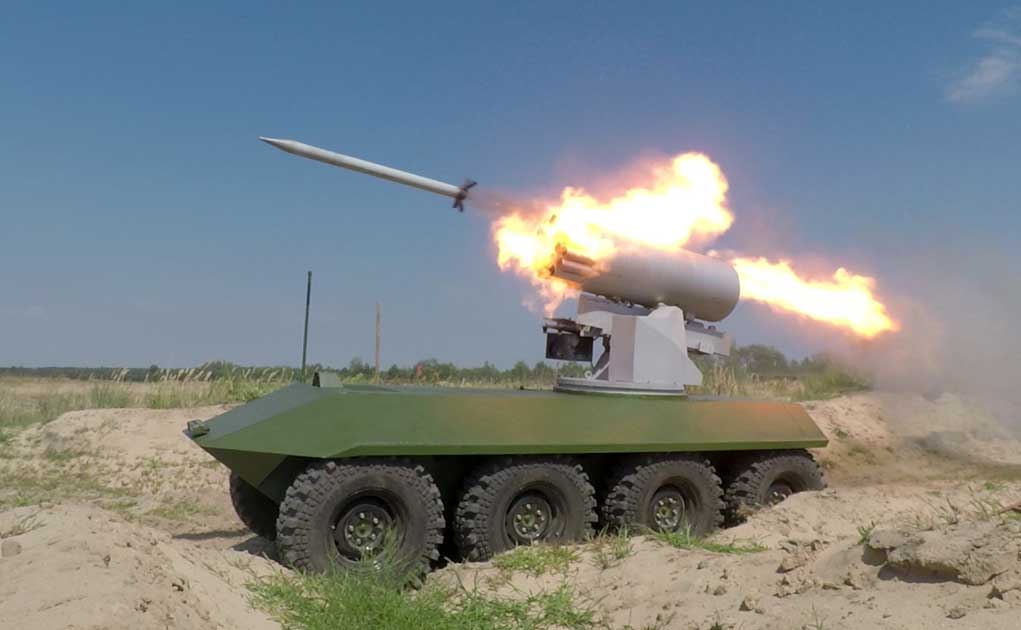
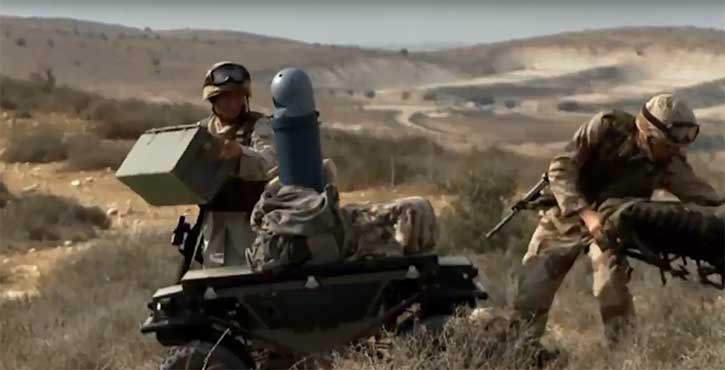
Test firing of a rocket pod carried on an Ukrainian Fantom 8x8 UGV.
In response to the hybrid warfare with the Russian Republic, industries across Ukraine were called to improve the warfighting capabilities of the Army by improving existing hardware and producing innovative concepts that could meet the current and future hybrid challenge. Remotely operated systems and capabilities were high on the agenda, with several remotely controlled weapon stations, turrets, and robotic ground vehicles.
Two types of combat robots have evolved in Ukraine in recent years – the Phantom and Ironclad. Both are configured with radio and fiber-optic links to ensure operability in EW contested environment and maintain operability under radio silence. Both support flexible configurations to support dismounted operations, either as load carriers or remotely controlled weapon carriers.
Supporting mesh network communications, the Ironclad may be more suitable for close-in integration with troops, in a ‘forward command’ style operation while the Phantom is designed to provide fire support commanded from few kilometers back. With the rapidly evolving combat UGV class of weapons on both sides, it is likely that Ukraine could become the first robotic battlezone, where robots could engage each other as they support government forces on one side and paramilitary forces on the other.
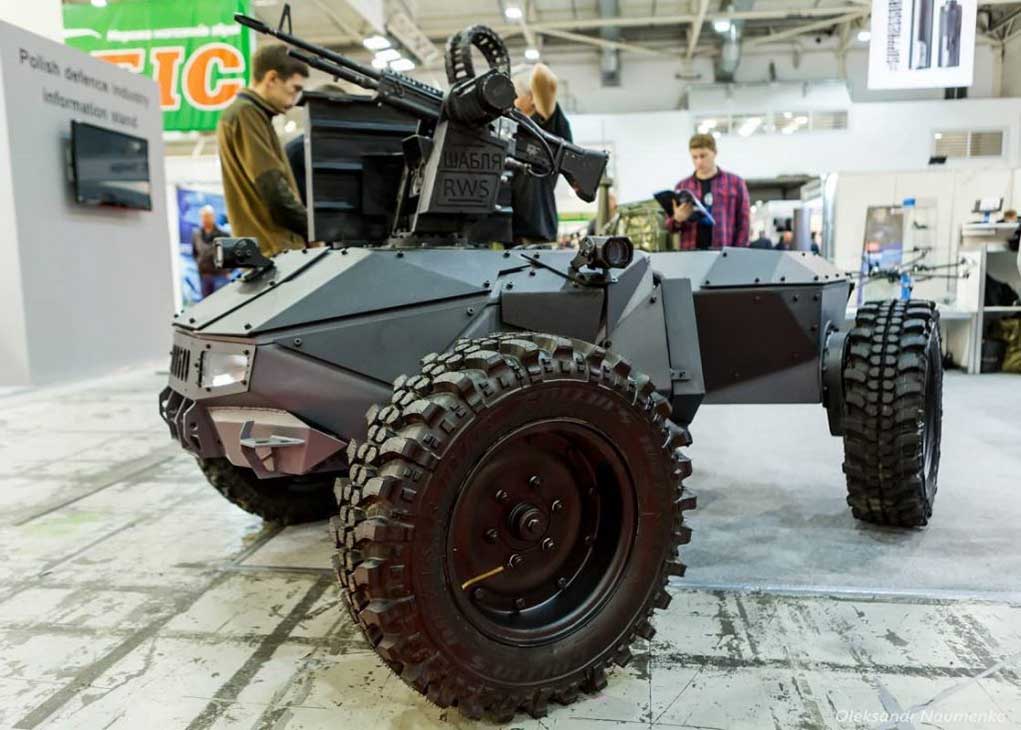
The Ironclad articulated robotic vehicle was unveiled by Global Dynamics from Ukraine on October 2018. Photo: Photo: Aleksandr Naumenko, Defense-Blog
Ironclad Robot UGV
Global Dynamics – Ironclad (first displayed in the Security Expo in Kiev in October 2018). A reconnaissance robot that weighs 1,100 kg, GVW, carrying 200 kg of payload. The wheeled robot comprises two sections, each using two wheels. The front carries the Shablia lightweight weapon station that mounts a 7.62/12.7 mm machine gun and two guided missiles. At a dry weight of about 100 kg, this maximum load configuration takes most of the payload capacity. Alternatively, users may opt to unload the RWS and carry loads on the rear module on logistical support missions. This articulated design enables the vehicle to cross obstacles. The robot is powered with a 12kW diesel generator that charges the batteries and power the four drive motors. The system sustains up to 10 hours or 130 km, traveling at a road speed of up to 20 km/h, or one hour of operation on battery power.
Ironclad uses an advanced radio link that supports mesh networking, to automatically extend radio coverage in areas where multiple users operate such radios. This capability provides better resilience and resistance to jamming and electronic warfare to the network as a whole, and to each subscriber. Fiber-optic control is also provided to enable operation under radio silence.
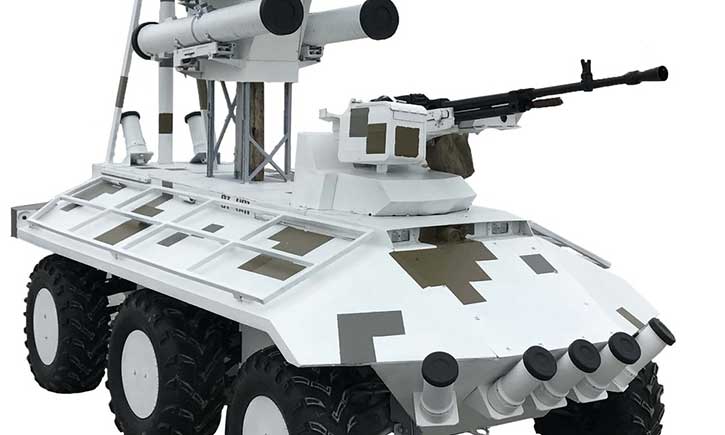
The Fantom 6×6 robot can carry remotely controlled weapon complement comprising four Barrier missiles and a machine gun.
Fantom II UGV
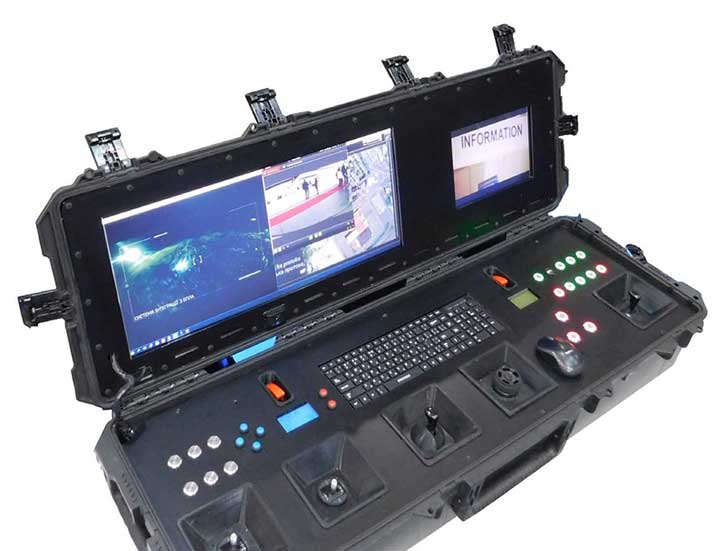
A wheeled 6×6 tactical multipurpose vehicle, the Fantom (a.k.a Phantom) was developed in Ukraine and unveiled in 2016 at the Arms & Security Expo in Kiev, Ukraine. At a combat weight of just over one ton, the Phantom uses a 30kW diesel-electric hybrid system to accelerate to a maximum speed of 38 km/h. The vehicle can be used to assist forward guard positions, providing protection, firepower and fire support to manned guards, assist in reconnaissance missions and provide energy support for forwarding troops. The system uses a radio control channel with a distance of 20 km, or fiberoptic link spanning five kilometers. The vehicle is equipped with a stabilized, remotely operated weapon station mounting a 12.7mm heavy machine gun and Barrier guided missiles
The Fantom 2 control unit commanding the vehicle and its payloads and weapon systems by remote.
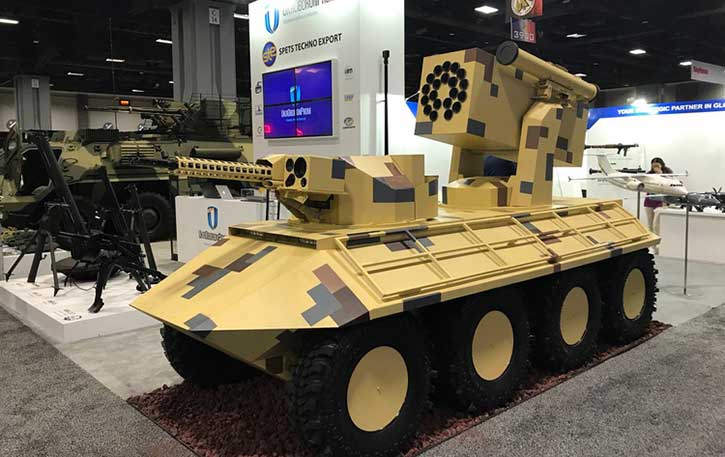
The latest variant of the Phantom, the 8×8 Fantom 2, was displayed by SpetsTekhnoExport at the Unmanned Systems Exhibition and Conference) in Abu Dhabi in October 2017. This vehicle weighs 2.6 ton GVW. It can travel to 130 km powered by an 80kW hybrid propulsion system accelerating the platform to a speed up to 60 km/h. It operates a secure radio control link extending up to 20 km range, of jam-proof fiber optical link that extends to five kilometers. As a longer platform, the 8×8 Phantom 2 can carry bigger weapons such as a full RS-80PO rocket pod or a twin-barrel 23mm cannon and four Barrier anti-tank guided missiles with an effective combat range of up to 5,000 meters.
A model of the 8×8 Fantom 2 was unveiled at the IDEX defense show in February 2017. In October of that year it was displayed at the US AUSA expo in Washington.
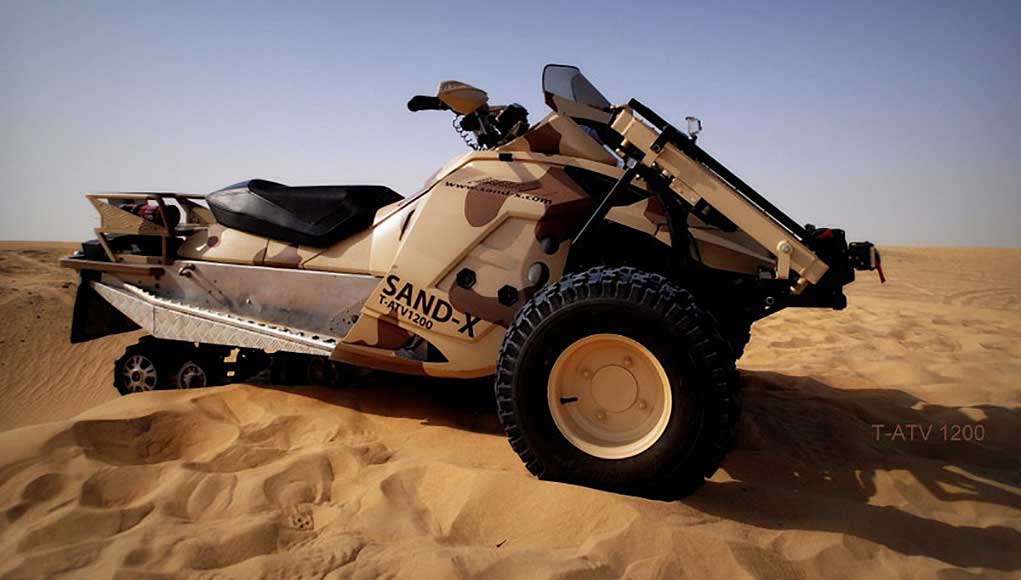
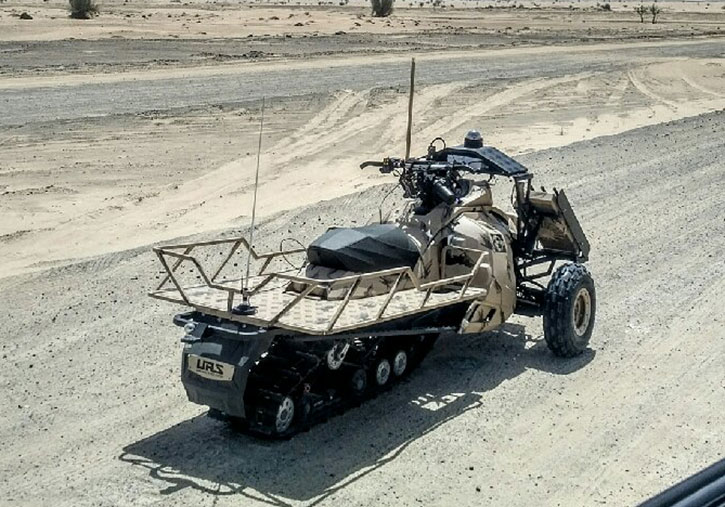
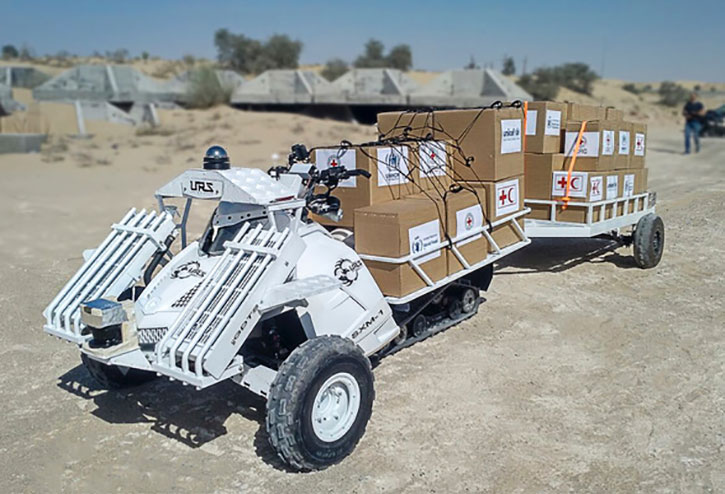
T-ATV 1200 can be used in manned or unmanned operation, after Sand-X Motors introduced remote and autonomous control functionality to the vehicle. Photo: Sand-X Motors
Sand-X Motors and URS Laboratories Switzerland have launched an unmanned version of its Tracked All-Terrain Vehicle (T-ATV 1200). The vehicle has demonstrated excellent mobility in all terrain, from sand dunes, snow and ice to mud and rocks, the combination of low center of gravity, that minimizes the risk of rollover. With a curb weight of less than 250 kg, T-ATV has a maximum payload of 450 kg (1,000 lbs).
In service with more than 40 countries the T-ATV can replace different vehicle families such as snowmobiles and ATVs with a common platform that offers improved performance, capable of travelling over rough terrain and operate reliably in all year and on all terrains.
The ground pressure of T-ATV is much lower than human on foot or vehicles – Whereas a wheeled ATV or quad bike has 0.73 km/cm2, and human male 0.55, a ground pressure of T-ATV is merely 0.04 kg/cm2. This makes it particularly useful for mobility over snow and sand, where it races to a maximum speed of 180 km/h.
Moreover, unlike wheeled or double-tracked vehicles, T-ATV does not need any ground clearance, as it practically crawls on the obstacles with the Kevlar-rubber tracks. In fact, T-ATV in cross-country movement, T-ATV can travel to its destination in a straight line, overcoming most obstacles that would hinder the mobility of other SUV or ATVs that need circumventing most obstacles.
With the combined wheel-track propulsion it can safely move on roads at high speed, without restrictions Sand-X Motors introduced unmanned operation for T-ATV using the SMART URS Labs remote control system. Integrated with the basic vehicle configuration, SMART uses enable remote control using three-axis cameras, GPS tracking, two-way communications (voice and radio) and headset enabling the remote driver to control the vehicle remotely. SMART can establish a link between convoy vehicles and the unmanned lead formation, connect manned and unmanned systems with UGV and UAV and integrate several segments shared by different units in the same operating zones.
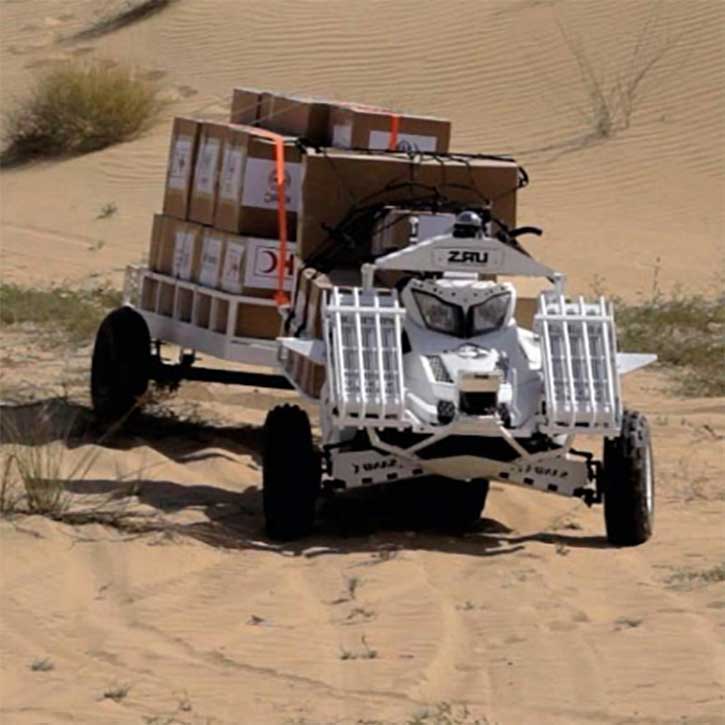
Used as a robotic mule the autonomous T-ATV 1200 can carry 450 kg of on the vehicle itself and on a trailer, as seen in this picture. Photo: URS Labs Switzerland
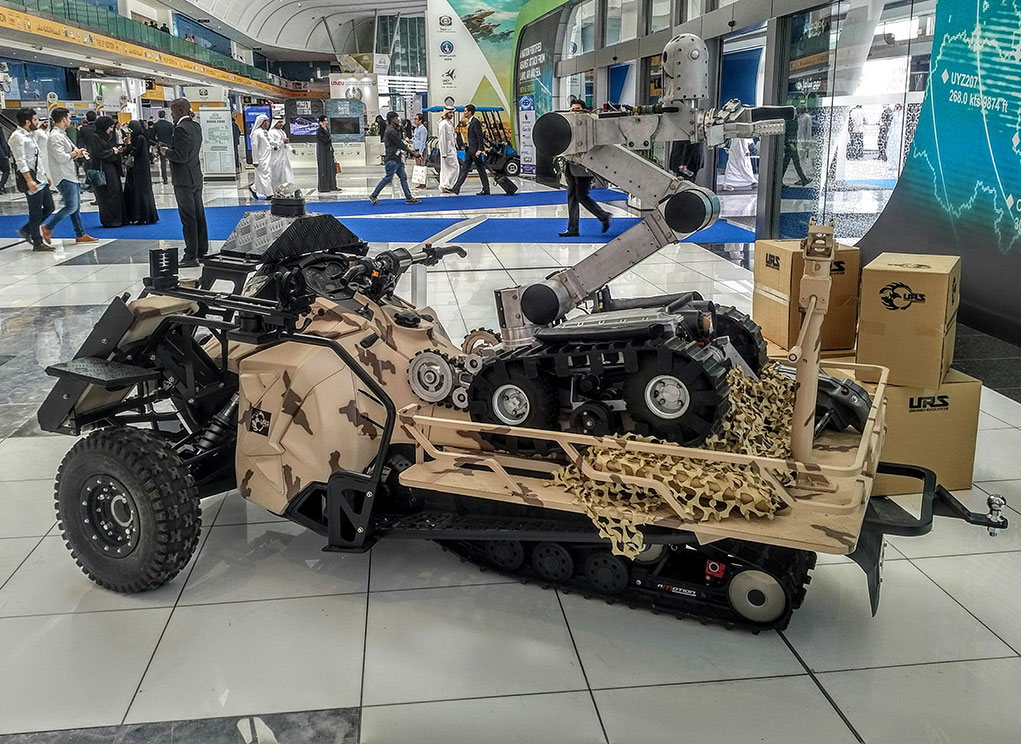
th On such missions, T-ATV can be used as an unmanned platform carrying smaller mission-specific UGVs (such as counter-IED), conduct route clearing as it moves ahead of a manned formation, operating ground penetration radars, and other IED sensors. It can also assist in logistic missions using the T-ATV itself and a trailer that doubles the payload carried by the system. and casualty evacuation in rough and dangerous terrain. Ballistic protection can be added to protect that injured person evacuated from a battle zone. Using its high maneuverability and cross-country mobility It can also be used to deploy smoke screens covering force movements.
T-ATV with URS Labs package is planned to be used as part of a border and critical infrastructure security system incorporating a Distributed Fibre Sensing (NG-DFS) system that detects smallest acoustic vibrations, including pipeline leaks, created by people or machinery working on or near a pipeline or fens. The sensors send the coordinated of the suspected incident to a sector control center where a manned or unmanned T-ATVs will be automatically dispatched to assess the situation.
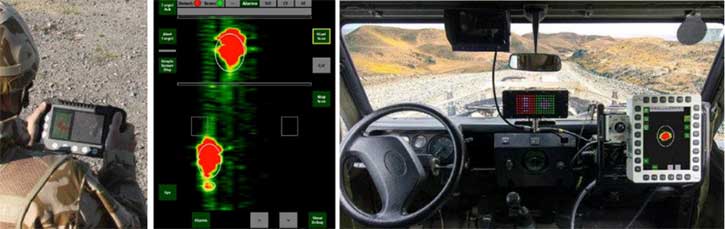
The remote control display shows mines detected on the vehicle’s path. Photo: Cobham Antenna Systems
The SMART kit controls the vehicle remotely in line-of-sight communications from a distance of up to 10 km, or Non-line of sight communications range is 4 km. Up to 10 vehicles can be intelinked providing repeater services to each other, extending control over 100 km. Alternatively, repeaters can be dropped from the vehicle (by operator command) to enable the range extension without committing T-ATVs. Unmanned T-ATVs can also operate autonomously using pre-programmed missions and navigation waypoints, with automatic ‘return home’ and ‘follow me’ functions.
If one unit is losing contact it automatically returns to the last point of contact using built-in low-level autonomy functionality relying on obstacle avoidance by LIDAR.
T-ATV providing an unmanned platform deploying an EOD robot. Photo: URS Labs An unmanned T-ATV 1200 undergoing testing in the UAE. Photo: URS Labs T-ATV demonstrating an unmanned cargo transportation configuration. Photo: URS Labs
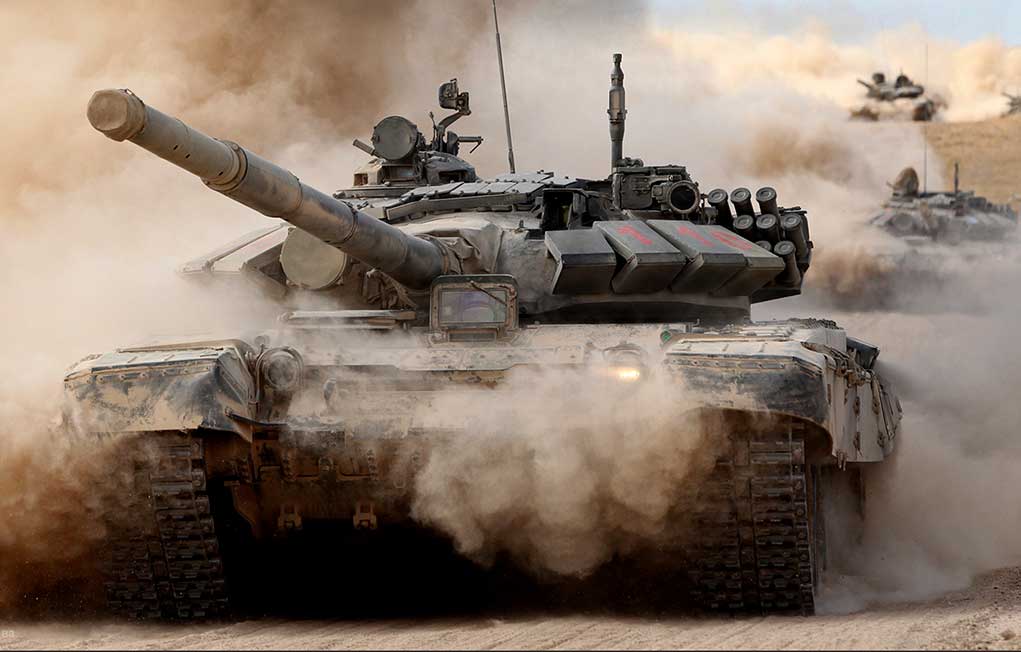
The Russian Ministry of Defense plans an evaluation of an innovative robotic tank formation concept that will enhance the operational capabilities of mechanized formations in urban areas. The ‘Storm’ concept will employ a robotized T-72B3 tank in at least five configurations, to create a semi-autonomous ‘robotic vanguard’, coordinated and controlled by human operators from few kilometers away.
The project is being developed for the Moscow based 3rd Central Research Institute (3rd CRI), by Nizhny Tagil based tank manufacturer UralVagonZavod (UVZ). A proof of concept demonstrator has been completed, to test mobility functions of the robotic tank. The new concept differs from other robotic tanks such as the Uran-9 that gained its first combat experience in Syria, and the ‘wingman’ tank concept evaluated by the US Army, as these platforms were often teleoperated from a control vehicle positioned close to the weaponized robot.
UVZ has implemented a significant amount of automation in the manned version of the T-14 Armata tank and has taken the technology further, to explore an unmanned version of the tank. However, due to the lower cost and availability of platforms, the T-72B3 offers a more affordable robotized tank.
The ‘Storm’ project comprises four types of vehicles – a T-72B3 tank. The unmanned vehicles will employ robotic functions for autonomous mobility, communications, self-protection, and situational awareness, with high-level mission supervision maintained from a distance by remote operators. Each of the robotic vehicles will be equipped with active protection, dozer blade and remotely controlled 7.62 PKTN machine gun, that will provide the vehicle autonomous mission capabilities such as detect enemy actions, defeat anti-tank attacks, overcoming obstacles and return fire for self-defense.
A robotic platoon differs from the use of a single robotic vehicle as such unit operates similarly to a manned tank platoon. In urban operations, where radio communications are severely degraded, as the Russians experienced with their Uran-9 robotic platforms in Syria. The presence of several connected platforms establishes a more robust link to remote controllers while providing mutual coverage and continuity in the face of enemy resistance.
The level of autonomy for the vehicles has not been detailed publicly but according to analysts, it is likely that the robotic vehicles will have autonomous functions for movement and maneuverability (considered low-level autonomy). Higher level autonomous functions could include obstacle avoidance using movement planning and tools (the dozer blade, for example).
Self-protection should also be automatic, relying on active defense sensors and defeat mechanisms, threat detection, localization and defeat (using active protection and remotely controlled machine guns) can be used. The robotic tanks will also be equipped with means for navigation, and self-orientation to interpret blue-force tracking (BFT) situational pictures to report their status and positions and avoid fratricide. Other functions are likely to be controlled by manned operators.
Mission autonomy could also be employed, to enable tactical moves, such as movement on a route marked by predefined waypoints, and secure or engage enemy designated locations. Other missions could also include deployment of smoke screens in the flanks of the main force.
Optimized for operations in urban terrain the robotic vehicles are equipped with advanced protection (for cost considerations this protection is likely reactive armor), enabling the tank to continue its mission even after absorbing 10-15 from RPGs, mines and improvised explosive charges. Threats of Anti-tank missiles and kinetic tank rounds are less likely in those scenarios. A dozer blade would improve mobility, breach obstacles and shape the terrain to secure positions for the robotics team and the manned elements that will follow.
The robotic squad will comprise four robotic variants, including a 50-ton Main Battle Tank that mounts a 125mm cannon with a truncated barrel, improving the tank’s maneuverability in urban terrain. Other modifications will include a 22-round autoloader. Modern multipurpose high-explosive projectiles with delay fusing, enable such guns to penetrate typical urban targets, like buildings and bunkers protected by concrete and brick walls. The truncated barrel, use of lower charges, and, possibly, reshaping the turret layout, enable designers to increase the 125mm gun elevation up from +14 to +20 degrees, improving the tank’s capability to engage targets above street level.
Another variant designed primarily for close-range fire support is a T-72 chassis loaded with a stack of RPO-2 multi-effect rockets. The RPO-2 also known as Shmel-M or Bumblebee entered service in 2004 as a man-portable weapon. It has seen extensive use in recent combat operations (particularly in Syria) where it was used to clear out the enemy in closed terrain, without having to risk close quarters combat. Shmel-M packs a firepower of a 152mm high-explosive artillery projectile using 3kg of thermobaric filler to create the overwhelming blast effect.
A robotic variant of the Terminator fire support vehicle will use a turret mounting two 2A42 30mm cannons, each loaded with 500 rounds. Unlike the manned Terminator, the robotic fire support vehicle will not use anti-tank missiles but use the RPO-2 thermobaric rockets instead. The twin-gun turret offers gun elevation up to +25 degrees, engaging targets at rooftops and high floors.
A fourth variant will be a robotic version of the TOS-1A, a T-72 chassis mounting a launcher stacking 16 NURS 220mm thermobaric rockets (the same used on the manned TOS-1A vehicle).
The unit will be controlled by a manned mission command vehicle, also utilizing a T-72 heavy APC configuration similar to the current BMO-T flamethrower. This vehicle could be remodeled to accommodate a two men crew and six mission controllers. It will also be fitted with an active protection for improved battlefield survivability. This vehicle is expected to be positioned at a distance up to three kilometers from the leading robotic formation.
The datalink connecting the vehicles and command unit is critical, particularly due to the high level of interference experienced in urban areas.
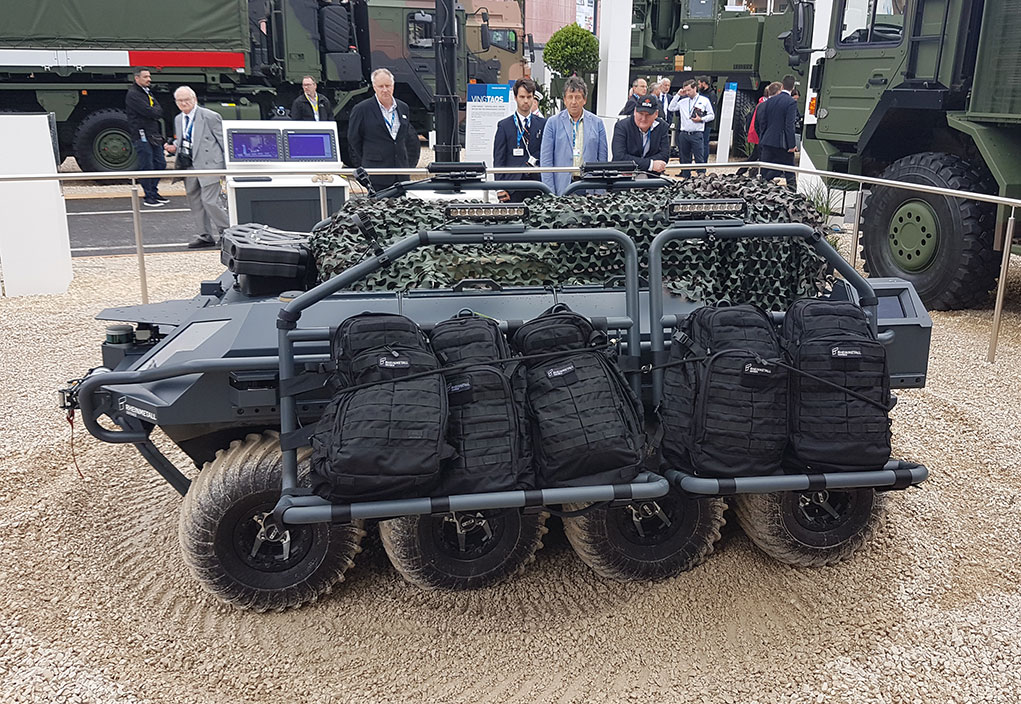
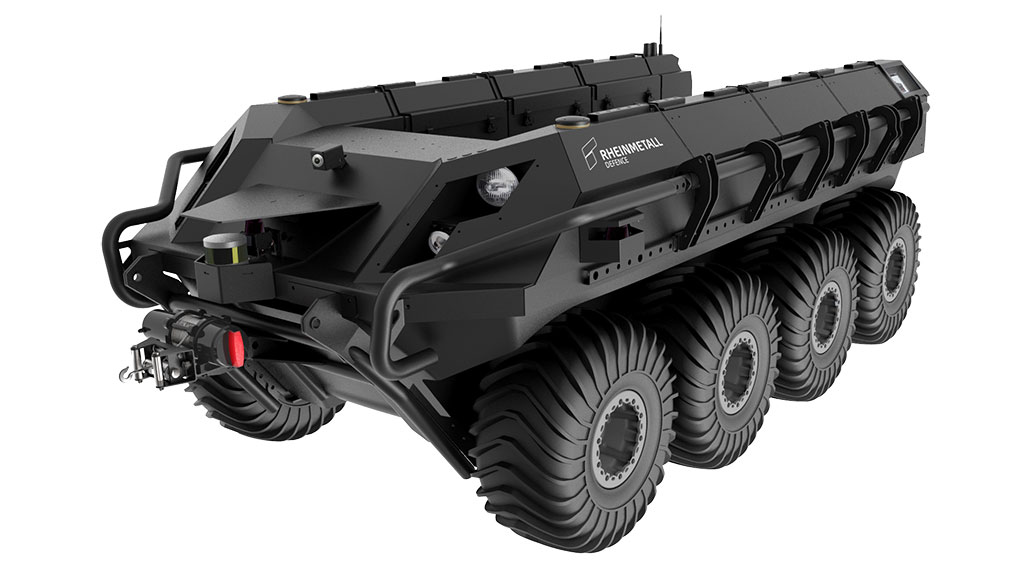
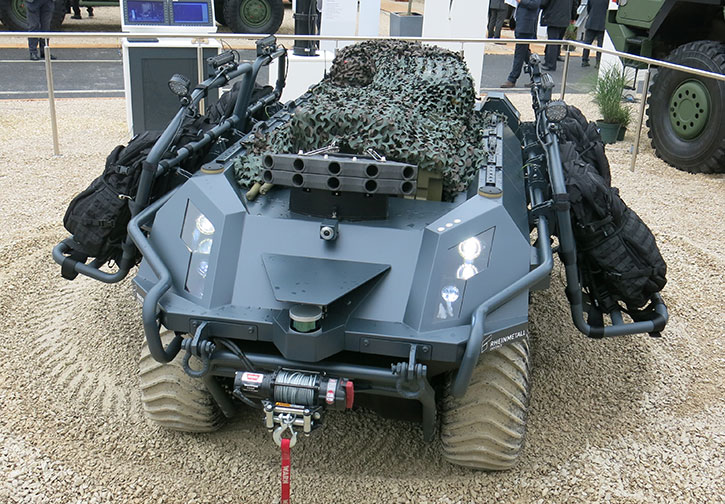
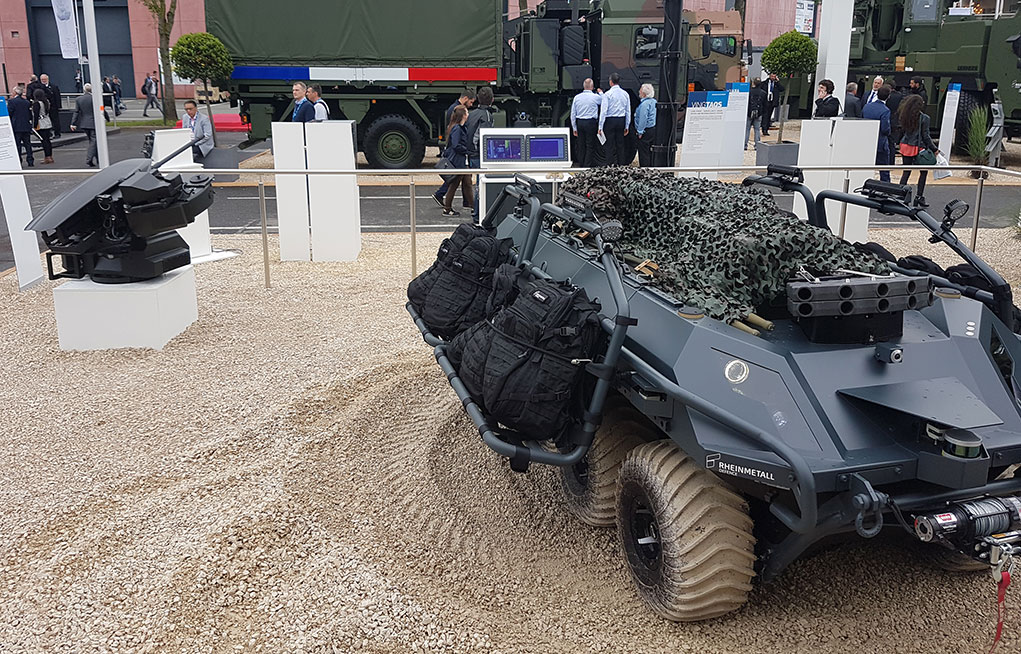
Rheinmetall Mission Master UGV (MMUGV) uses the 8×8 Avenger manufactured by Argo of Canada as a wheeled platform, designed to support troops on dismounted operations, providing logistic transport, surveillance, protection, medical evacuation, fire suppression, CBRN detection, and communication relay.
“we recognized the need for a new type of asset that would free up troops to focus on more important tasks,” states Stéphane Oehrli, President and CEO for Rheinmetall Canada. “With Mission Master, Cargo, soldiers can leverage artificial intelligence and robotic muscles for the dull, dirty, and dangerous parts of the mission and, most importantly, safely accomplish their tasks on the field”.
Proven in operations in extreme outdoor conditions, the MMUGV perform long endurance missions and silent operation, the Mission Master uses a hybrid electric drive powered by an onboard generator to sustain up to 8 hours of autonomy. The fully amphibious robot is designed with modular containers and large loading area to carry mission payloads at a total weight of up to 600 kg. The UGV can be teleoperated within line of sight or use semi-autonomous ‘follow-me’ or convoy modes on operations in other conditions. It can travel on and off road at a speed of 40 km/h.
The vehicle is air transportable inside heavy helicopters (CH53, CH47) and slung loaded on other helicopters with adequate lift capacity. On amphibious operations, it can carry half its regular payload (300 kg) moving in water at 5 km/h. In such roles, the vehicle can also carry soldiers to support river crossing operations.
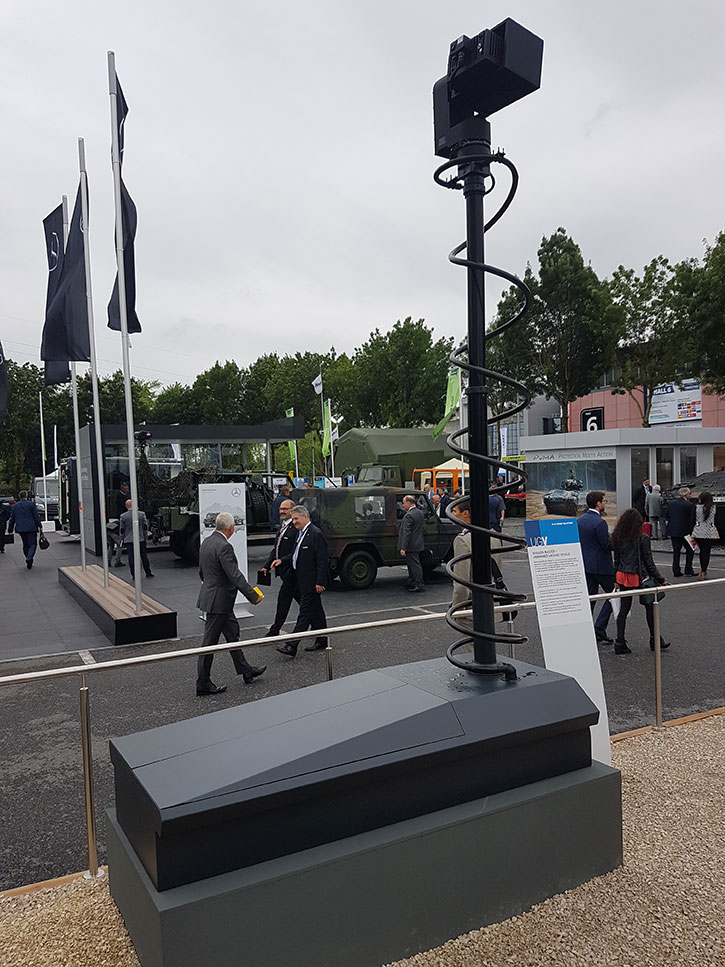
MMUGV is shown here at Eurosatory 2018 with the basic infantry support cargo configuration. The basic configuration includes 360 vision, driving cameras, and LIDAR for obstacle detection and area scanning. The vehicle also shows a ROSI self-defense smoke dischargers that can be activated remotely upon detection the of a threat or masking other units. Photo: Defense-UpdateThe MMUGV can be fitted with different mission payloads, including a remotely controlled weapon station (seen on the top left side) and telescopic mast mounted ISR sensor pack (below). Photo: Defense-Update
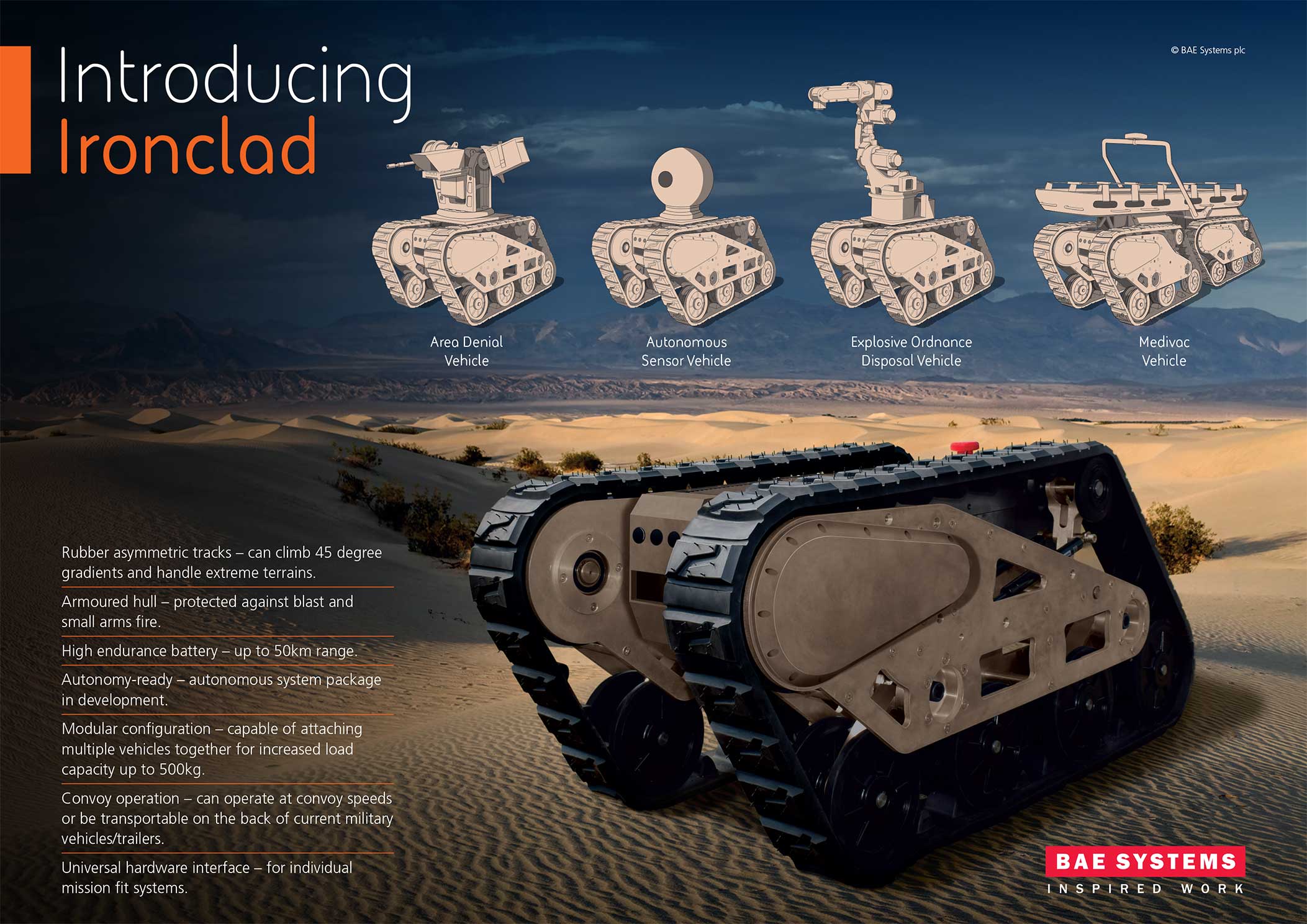
BAE Systems’ Ironclad UGV was unveiled at DSEI 2017. This tracked robot is designed to be small enough to negotiate tight urban environments and maintains the mobility needed for cross-country operation. It can be carried on a trailer or pickup truck or join other vehicles in a convoy.
The UGV uses rubber tracks designed in an asymmetric formation that improves mobility in gradients up to 45 degrees. It can operate on silent missions at ranges up to 50 km, relying on battery power. It has an armored hull protecting the vital systems and payload against ballistic threats and blast effects.
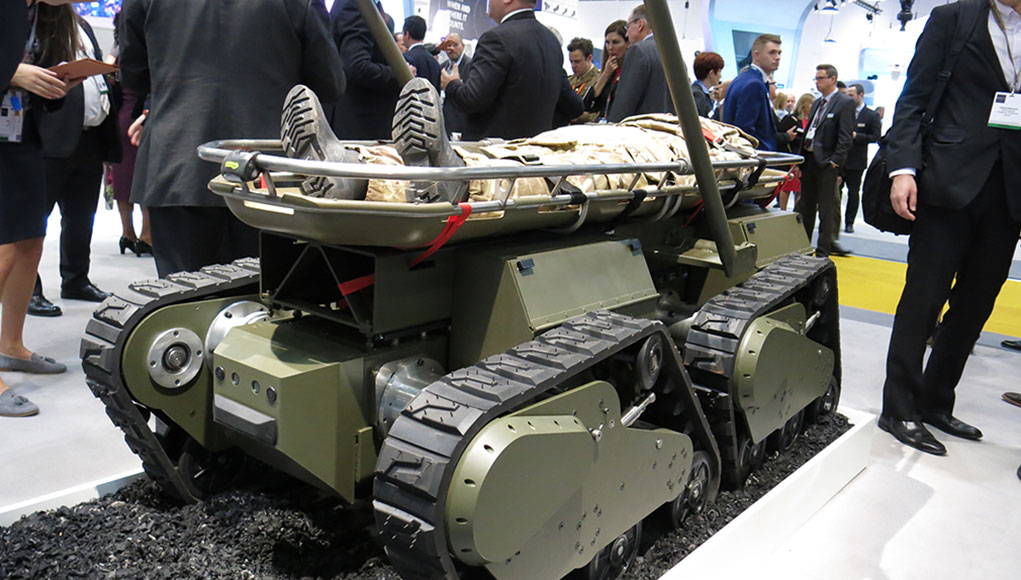
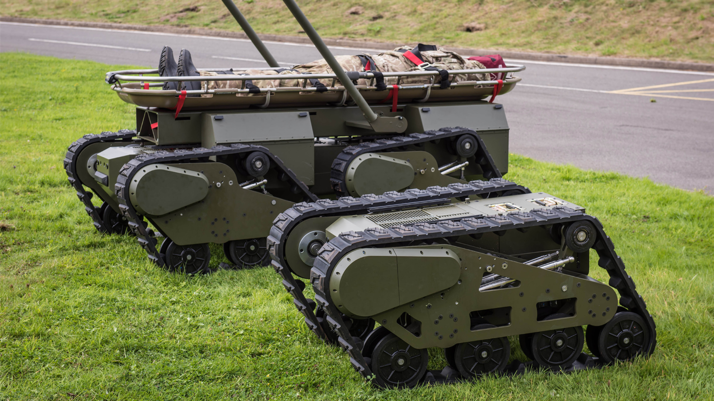
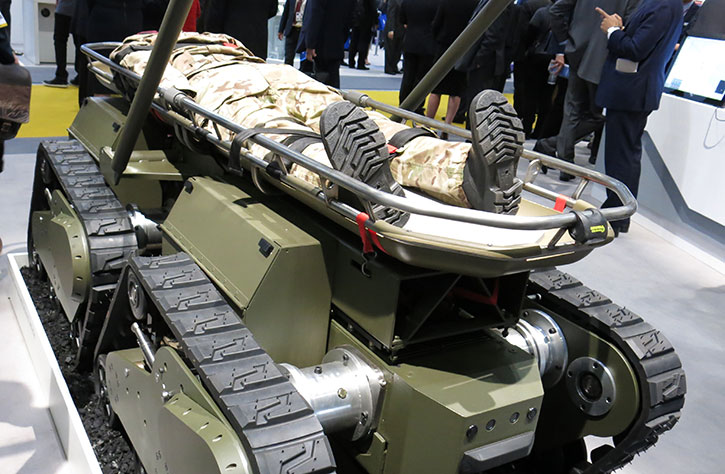
One of the unique features is the ability to connect two Ironclads, to form a longer UGV that carries up to 500 kg of payload or a patient on a specialized stretcher, freeing up at least two soldiers who would otherwise be needed to carry the casualty.
Two variants of the Ironclad UGV – a single unit and two units coupled into a longer UGV
The vehicle is currently teleoperated by a human operator, but BAE Systems is developing autonomy functions to enable it to operate as part of a battlegroup, interact with other UGVs and ground troops and follow mission objectives. Among the missions currently supported by teleoperation functions are remotely controlled area denial, utilizing a weapon station combined with imaging and audio sensors, and Explosive ordnance disposal, operating a manipulator arm and disruptors.
Two Ironclad UGV can link to form a longer UGV that can carry more cargo or a stretcher. Photo: Defense-Update
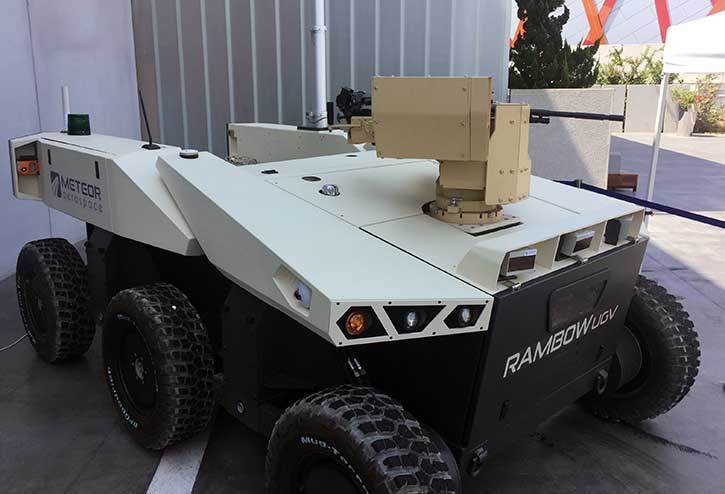
Meteor Aerospace has developed the Rambow UGV as part of an unmanned systems solution for land, air and sea applications. An electrically driven 6×6 robotic platform, of 3.5 tons gross vehicle weight, Rambow can carry payloads and cargo weighing over 1,000 ton, at a speed of 50 km/h on and off-road. The vehicle can travel 50 km on battery power, or 300 km charging its batteries with the internal diesel generator.
The vehicle uses ‘supervised autonomy,’ allowing the vehicle to travel autonomously along a preplanned route, automatically avoiding as a leader or follower in a convoy mode, or use teleoperation in more complex situations that require human attention. Rambow can travel on a gradient of 60 percent, and 40 percent side slope.
Each of the six wheels uses an electrical in-hub motor and hydraulic independent suspension to establish efficient traction, even in rough terrain, ensuring the vehicle remains stable and level to facilitate reliable payload operation.
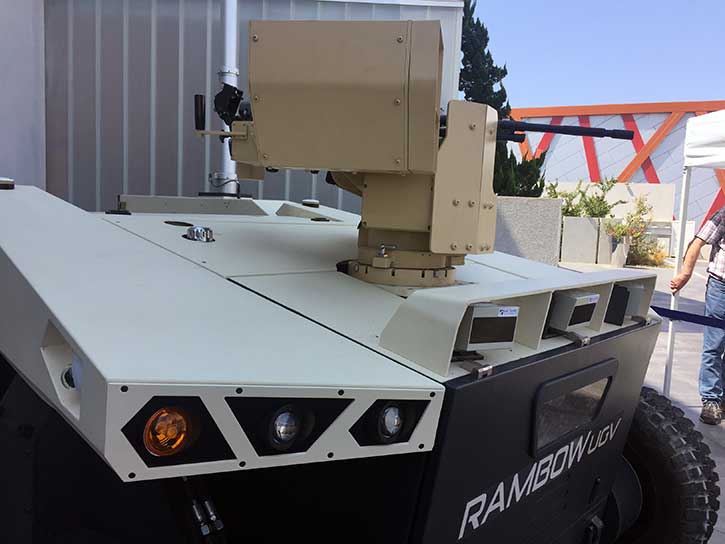
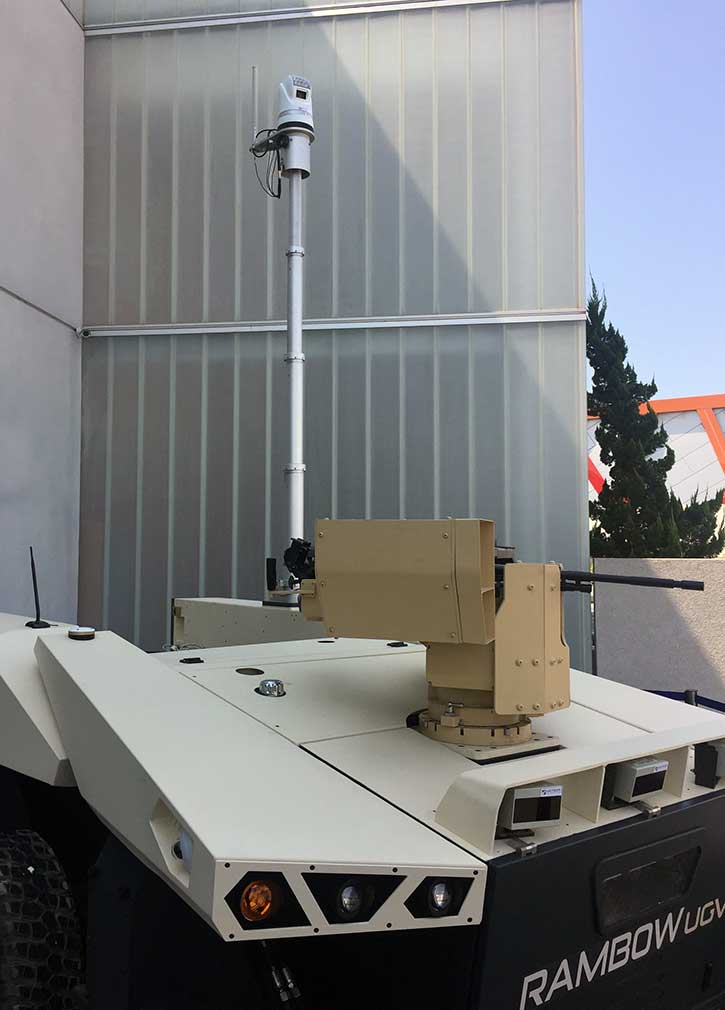
The basic configuration that is used for security and patrol uses a mast-mounted an EO payload and weapon station equipped with its target acquisition cameras. This configuration leaves a large area of the flat deck for an additional 700 kg of cargo.
Rambow is equipped with remotely operated weapon station and telescopic mast mounted EO/IR observation payload. Photo: Defense-Update
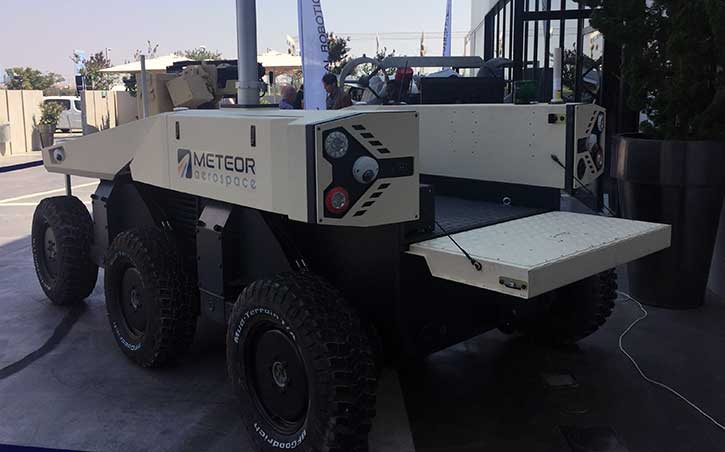
This platform can operate a small drone or UGV, loaded with a rear ramp. These unmanned systems can be used for close inspection of objects, relevant for IED and mine detection.
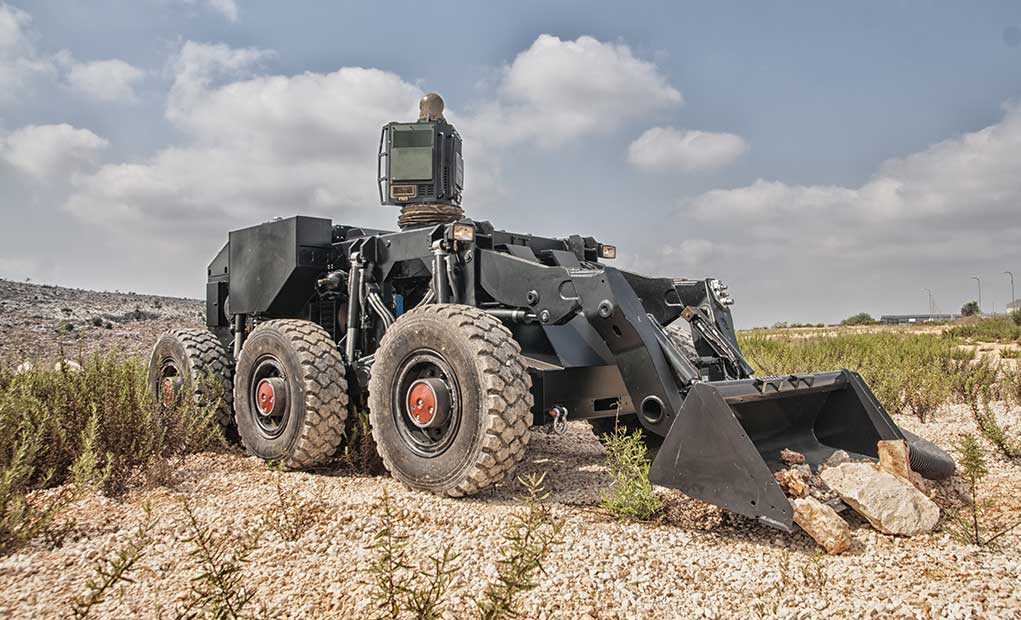
In such role, Rambow can be used for autonomous patrol or advanced guard, an armed scout and establish a fire support base in urban warfare. The vehicle is big enough to assume specialist roles such as combat engineering (CEV) using and dozer blade or other obstacle removal gear. Meteor Aerospace also offers a Rambow variant configured for fire support, loaded with six Marlow loitering missiles sealed in canister-launchers.
The Rambow UGV was unveiled in public at the AUSR 2017 unmanned systems expo in Israel. Photo: Defense-UpdateA view of the mast mounted observation sensor and weapon station mounted on the Rambow. Photo: Defense-UpdateThe installation of the two payloads leaves the cargo bay free for other loads, including smaller robotic vehicles or multirotor UAVs and loitering weapons the company also develops. Photo: Defense-Update
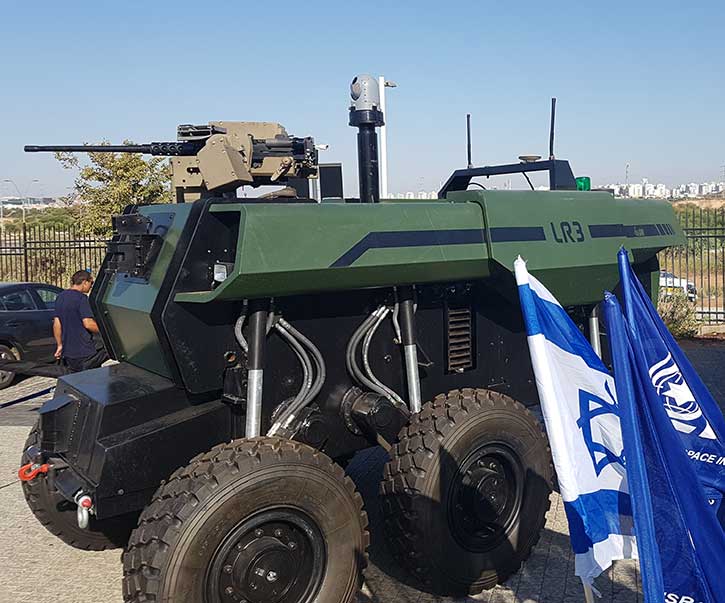
IAI's Robattle LR-3 6x6 heavy wheeled robot. Photo: BLR
With autonomous vehicles rapidly maturing and expected to become part of our daily life in five to ten years, it is only logical that military robotics will follow. But, according to Meir Shabtai, General Manager of Robotic Systems Division at Israel Aerospace Industries (IAI), the military robots are already here now. “The systems are ready, technologies are mature, but the troops have yet to accept them as part of the combat team. Shabtai told Defense-Update. “Military robotics are different from commercial autonomous vehicles as the main requirement is not moving people safely but replace the human in dangerous missions thus reduce the risk to human crewmembers” Shabtai explained.
To earn the soldier’s trust military robots are required to carry loads as quietly and stealthily as a trained soldier. They must operate sensors and weapons effectively under fire and deliver supplies to the front line. They should survive battlefield hardship, defeat enemy attacks and overcome countermeasures. Robots should also be able to do what few or no human soldiers can – deal with explosive devices before they go off; sense and manipulate tools in hazardous environments where humans cannot live.
IAI offers several groups of military robots. The lightest is a small vehicle designed to closely support a squad of warfighters, carry loads and conduct basic combat support tasks, reducing the dependence on dismounted troops for load carrying. Driverless trucks that can follow each other to form an autonomous convoy are used to push logistics to support combat units. IAI also offers semi- or fully autonomous robotic systems based on multirole wheeled or tracked vehicles, that can be configured to assume specific missions utilizing specific mission kits.
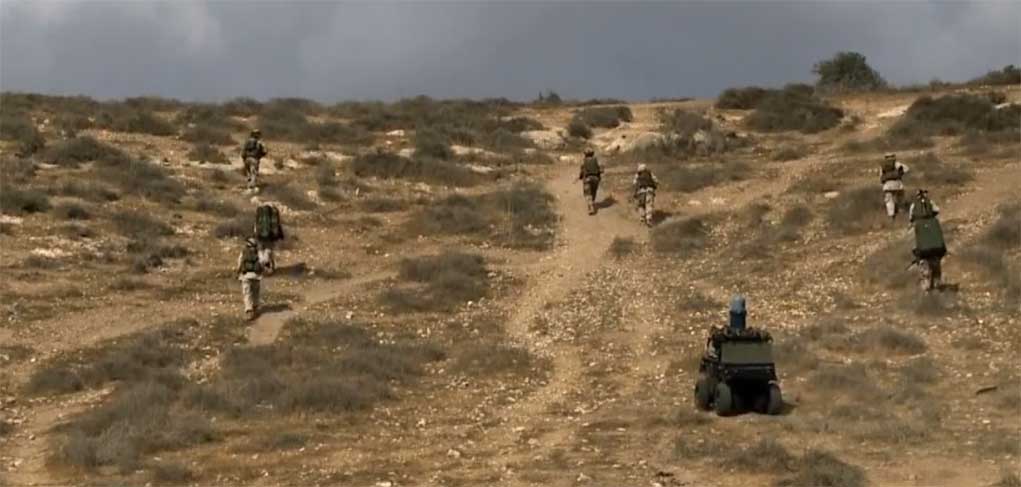
REX, a small squad support robot is used primarily as a cargo porter for the infantry squad. Secondary missions can also support surveillance and fire support. Photo: IAI Video
Small robotic mules are designed to operate close to the soldiers, but impose minimum burden on management and control, as they follow the soldiers and obey voice commands and gestures. Other, larger combat robots can move autonomously and act as a ‘wingman’ that operate in support of other elements or grouped with few robots that carry out independent missions, such as an advanced guard.
“Each family has specific parameters, but they all share common functions,” Shabtai explained. IAI’s Robotic Kit that addresses those common tasks, transforms every vehicle into an autonomous platform. This robotic kit is a collection of electro-mechanical, electronic hardware assemblies and the software applications required to operate and manage a robotic platform. The kit can be installed on all types of vehicles, including APCs and trucks, and bulldozers, transforming manned vehicles to optionally manned (dual use) or driverless platforms.
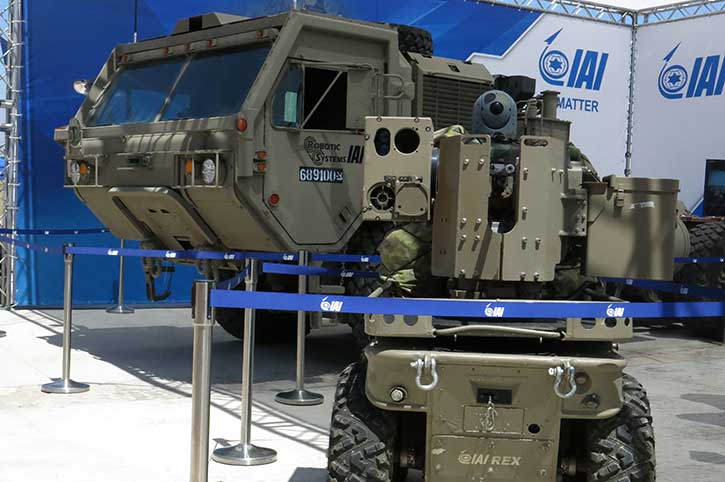
IAI has designed a generic ‘robotic kit’ that can be integrated into numerous vehicles transforming standard vehicles into robotic ones. The photo shows a 5-ton truck converted with the robotic kit into an autonomous truck, capable of joining a driverless convoy. A REX carrying a remotely controlled weapon station is seen in front of the truck. In the front Photo: Defense-Update
Many of the tasks pose significant challenges for developers – autonomous control of a robot in an unknown terrain is not like moving in clearly marked lanes, or teleoperated operation in areas that are familiar to the machines and controllers. Planning a mission, assessing traversability and operating mission sensors become very challenging off-road, and while moving in complex terrain such as mud, sand, deep snow, boulders, shrubs or in an urban or rugged area. Detecting, avoiding and maneuvering around obstacles and terrain features. Affordability is another challenge. “Larger platforms generally offer better mobility, but are more expensive and need expert operators,” Shabtai added. “Our goal at IAI is to bring the performance and usability of those platforms to enable soldiers to operate them with minimal training and expertise.”
“The types of platforms we support address the user need. We know to robotize and automate all vehicle types.” Shabtai said. Tracked and wheeled platforms of different weight and sizes are available to meet those needs. Depending on the type of terrain, mobility independence, and expected obstacles, IAI utilizes platforms as dedicated robotic platforms such as the wheeled Robattle UGV. “We enable the precision of movement, sensor handling and weapon control for robotic platforms to carry out diverse missions and maintain the operational tempo in complex terrain,” Shabtai added.
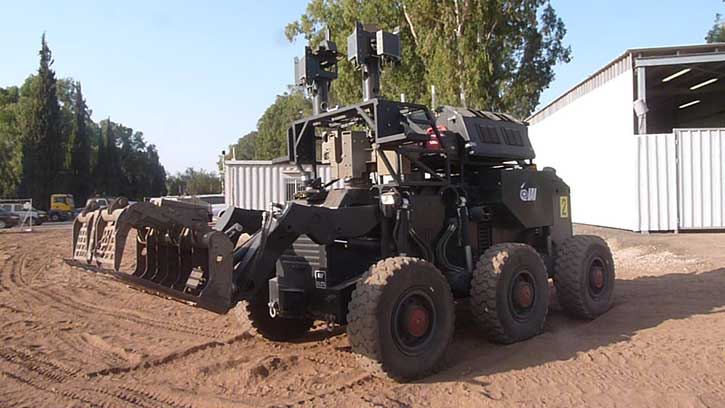
IAI’s Robattle LR-3 heavy wheeled robot is seen here at the AUS&R exhibition in 2016. It has since delivered to the IDF and has entered field testing with the Israeli military as a heavy comber engineering and counter-IED robot. Photo: Defense-Update
Robotic War Machines
Combat Unmanned Ground Systems (UGS) represent the next phase in military robotics, introducing platforms that can move and operate sensors autonomously and operate weapons autonomously or under human supervision. They are designed to conduct missions independently, or as part of the tactical formation (company, battalion).
Such vehicles are designed with adequate mobility, power generation, and autonomy to sustain extended missions, and deliver intelligence and firepower to become a viable element in the future combat team.
Successful fielding of robotic systems requires changes of the human side. To fully embrace robotics, soldiers must accept them as trusted teammates. To earn that trust robots should be used extensively in training and embed training capabilities within their operating systems. Such training aids should engage the user by challenging the user with synthetic threats, and obstacles adding realism to exercises. This will help develop troops’ confidence in the robotic system.
A different solution addresses the challenge of logistical supply to frontline troops. Today, long convoys of trucks and security vehicles are employed, forcing the military to commit significant forces to secure convoys and schedule resupply operations at long intervals. Employing unmanned trucks operating independently or in convoys of fewer vehicles, that enable more frequent resupplies, and require less escort. The combinations with other manned or unmanned vehicles. In these applications, conventional trucks are equipped with robotic kits, enabling them to travel primarily on roads. Carrying supplies to forward deployed units, without risking drivers, logisticians and security guards.
IAI offers such capabilities as full solutions, and as individual systems meeting specific user needs, maintaining resilient communications, movement and operation in a GPS-denied environment. IAI’s robotic logistics, for example, include the installation of a robotic applique kit on every vehicle, manned or unmanned, to enable users to configure the logistical operations to meet operational requirements. With advanced sensors and smart processors, the kit’s processors run advanced algorithms and artificial intelligence to deliver smarter, more agile operation.
Such convoys should be able to complete their mission in a reliable and safe manner, under all visibility and weather conditions, including day, night, rain, dust, ice, smoke and countermeasures. They must be able to operate with many vehicles and bypass obstacles, without communications and GPS. This will enable the user to move a convoy as fast as possible over friendly and familiar territory but opt to follow a leader or drive autonomously in areas where the vehicles may be exposed to enemy attack. These applique robotic kits are designed to be affordable and easy to install, to enable armies to keep existing vehicle fleets in the future, by introducing optionally manned operation.
REX carries about 200 kg of equipment, enough to support an infantry squad. Once unloaded it can utilize a sensor mount or a remotely controlled, lightweight weapon mount for surveillance or fire support. Photo: IAI Video
Robotic Porters – More than a Mule
Delivering supplies from the forward site to the troops is the task of another class of machines – the robotic mules. Handling this ‘last mile challenge’ requires robotic vehicles that operate autonomously, semi-autonomously or under human supervision, carry loads, and support the troops on extended missions by offloading some of the loads carried by the troops and provide energy for battery recharging. Some can also mount a stretcher to evacuate the wounded back to safety. When equipped with additional sensors, they can provide surveillance and overwatch and securing tactical movements and field deployments.
Such a mule is IAI’s REX, a compact and lightweight 4×4 wheeled platform that can be transported on vehicles or in helicopters, deploy wherever soldiers operate and move with the troops at a speed up to 12 km/h. Rex can carry a payload of 250kg, enough to support a dismounted infantry squad. As the squad’s loads are unpacked, REX can carry a pedestal mounting an electro-optical sensor to continue supporting the unit. The vehicle operates in remote control mode or in ‘follow-me’ mode (‘leashed’ to one of the squad members to follow close behind). These modes require minimal attention and at from the operator. The robotic mule adapts to specific missions by applying mission-specific ‘Jackets’ that configure the REX with different combinations of equipment and weaponry. For example, a logistics jacket comprises a flatbed with hooks and attachments for backpacks, containers, ammunition boxes and stretchers. An intelligence jacket adds an EO payload mounted on a pedestal, and a tripod, control system and energy source to support the sensor on a dismounted operation.
Integrating Air and Ground Robotic Operations
IAI is exploring the enhanced use of robotic systems in combined air-ground operation. “The synergy between the different domain platforms allows us to use the advantages each platform provides delivering a superior whole solution.” Shaul Shahar, IAI EVP and General Manager of IAI’s Military Aircraft Group said. IAI considers such a solution for border patrol, reconnaissance and surveillance operations at remote areas, using hybrid ground and air robotic system. Managed as an integrated solution, the system allows continuous operation under complex and challenging terrain at long range and non-line of sight (NLOS). The system integrates three robotic platforms from IAI – the Robattle UGV, BirdEye 650D Unmanned Aerial Vehicle (UAV) and communications network that establishes NLOS connectivity.
Closely collaborating, Robattle carries sensors such as the Black Granite, that conduct persistent surveillance. It can also mount a remotely operated weapon station to deliver an actionable response. Small drones can be launched from the vehicle to investigate an area of interest while the UGV maintains a position at a defilade, just like a manned scout would. Flying high above the area, the UAV enables an elevated view of the area, provides early warning on enemy activities beyond the land elements’ line of sight and establishes a reliable communications relay linking the command post to the UGV on the ground, even when the vehicles are far beyond the line of sight. On such missions, Robattle can operate autonomously, without resupply, for 72 hours.
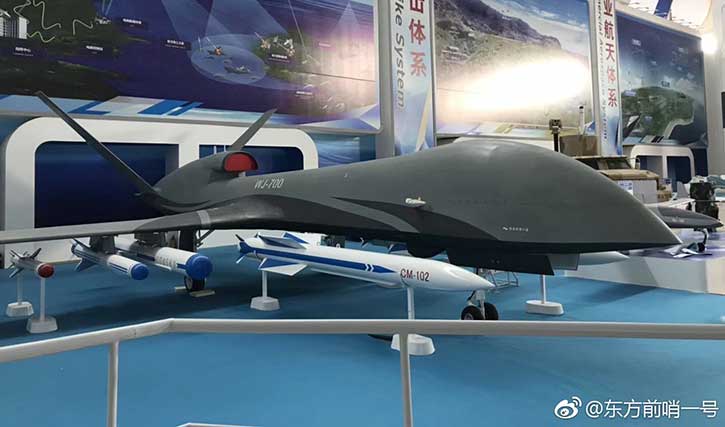
The Chinese Aerospace Science and Industry Corporation (CASIC) unveiled at AirshowChina a new jet-powered, long-range UAV called WJ-700. This drone is designed for reconnaissance and attack missions over land and sea. The drone has an endurance of 20 hours. At a maximum takeoff weight of 3,500 kg, it carries weapons and payloads on four underwing hardpoints, two for each wing. Unlike other MALE UAVs that are limited to relatively light weapons, this drone carries standard air to surface attack weapons, such as the CM-102 anti-radiation missile, C701, and C-705KD anti-ship missiles. Other loads include early warning and electronic warfare equipment.
The WJ-700 drone carries standard air to surface attack weapons, such as the CM-102 anti-radiation missile, C701, and C-705KD anti-ship missiles.
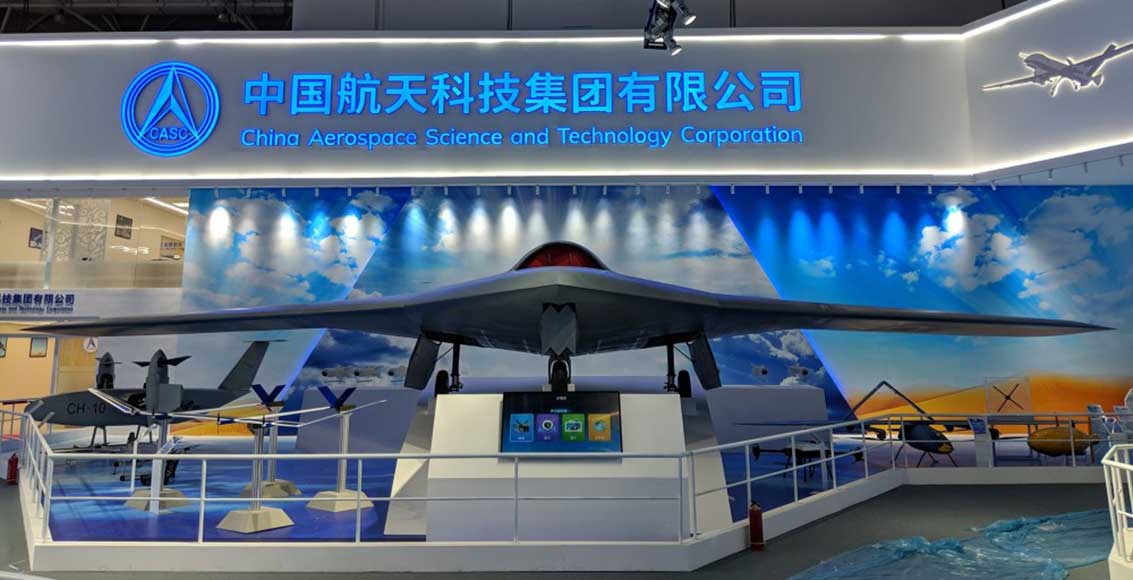
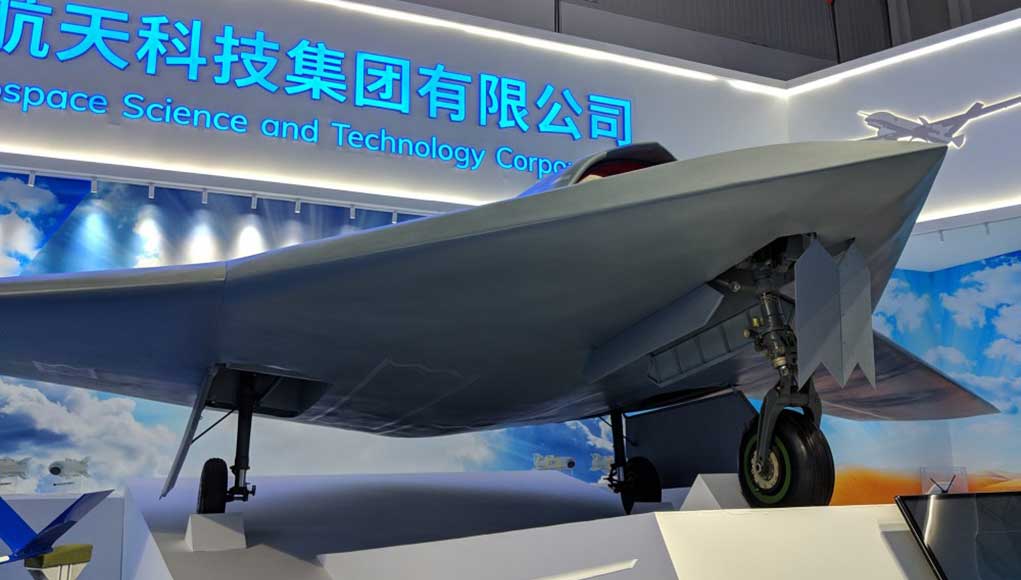
Another combat drone (UCAV) unveiled in AirshowChina this year is the stealthy Rainbow CH-7. The tailless flying-wing shaped aircraft displayed by the Chinese is similar to American designs, such as X-47 and X-45. Despite its large size – a wingspan of 22 meters and length of 10 meters, and a maximum takeoff weight of 13 tons, CH-7 is stealthy due to the smoothly curved shapes and use of radar absorbent materials. Designed for operation at subsonic speed and high altitude, CH-7 can reach a maximum speed of 0.75 Mach, cruising at an altitude of 30,000 – 43,000 ft. Its cruising speed is slower though, Mach 0.5 – 0.6, depending on the mission configuration. The drone is powered by a turbofan engine of an unknown type. The drone carries weapons in two internal weapon bays that maintains its low observable characteristics throughout the mission.
Like other drones of the ‘Rainbow’ family, CH-7 supports fully automatic operation, with mission control provided by a universal ground station. Stealth enables the drone to sustain operations in airspace dominated by enemy defenses, radars, and sensors. It can penetrate conduct reconnaissance missions or attack strategic radars, ships, missile sites, command centers, and other key assets.
Another view of the CH-7.
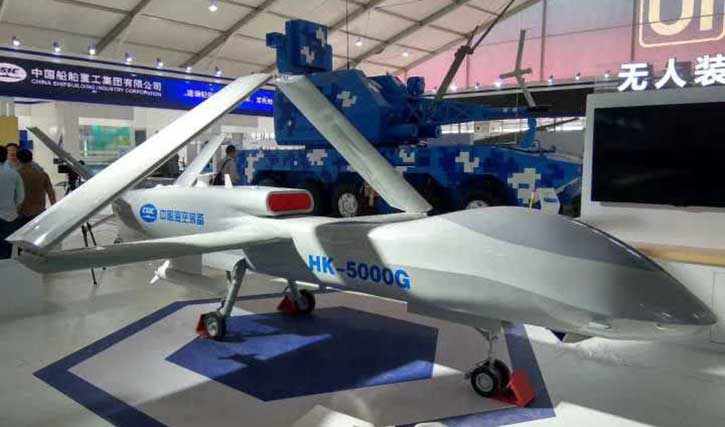
HK-5000G is designed for operation from aircraft carriers
The Chinese Navy is interested in unmanned aircraft for its new aircraft carrier fleet. China currently has one carrier, another is undergoing sea trials, and a third is under construction. Operating unmanned aircraft from the carrier would extend the surveillance and strike range of the surface fleet and improve its ability to maintain persistent surveillance, reconnaissance and strike missions without the need for aerial refueling.
The Chinese consider using such drones either independently, or in coordination with fourth-generation combat aircraft. The current CH-7 is designed with fixed wings for operation from a runway, but the developers already explore its use from aircraft carriers, with folding wings.
Another fixed-wing drone proposed for operation from aircraft carriers is the HK-5000G. A model of this UAV designed with folded wings was on display at AirshowChina 2018 by the Aeromarine Intelligent Equipment Company, a subsidiary of China Shipbuilding Corp. The drone is designed for maximum takeoff weight of five tons and use launch catapult, as the other aircraft on board. The drone can be used for reconnaissance and strike missions from aircraft carriers. It has an integral ER/IR payload, with weapons carried on two underwing hardpoints.
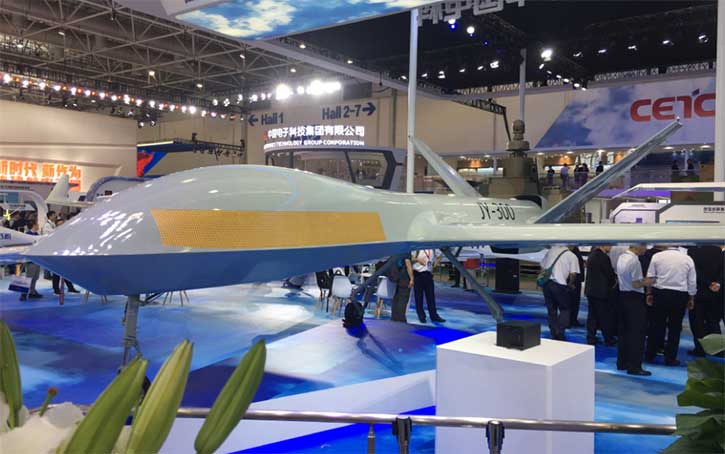
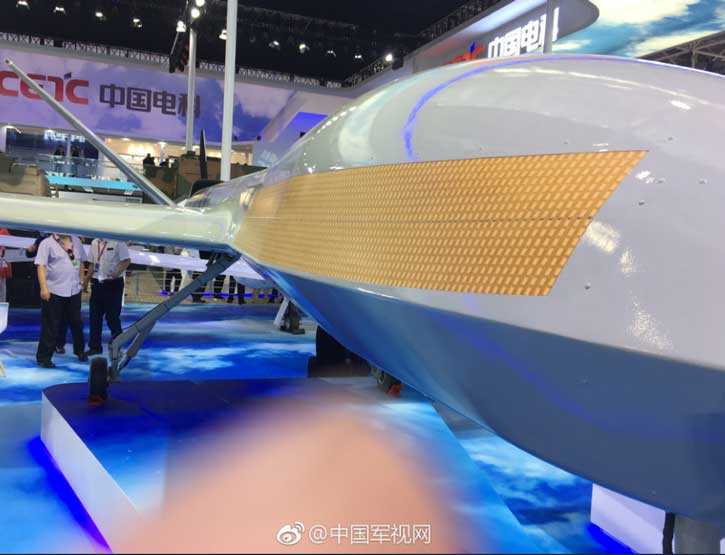
The JY-300 drone was modified to carry AESA radar arrays embedded in its skin and wing leading edges. Photo via Henri Kenhmann, East Pendulum
Another mission that could be assumed by those drones is Airborne Early Warning and Surveillance (AEW&S), utilizing an innovative radar array developed as a proof of concept and demonstrated by the 38th Institute of the CETC Group. Such a radar was recently flown for the first time. The JY-300 drone called ‘Tian Shao,’ a 1,300 kg MTOW drone designed to carry 400 kg of payload. Currently, the JY-300 is designed to operate for 15-hour missions, fly at a speed of 200 km/h and altitude of 25,000 ft., from a runway on land. The JY-300 can be configured with several AESA arrays, on both sides of the fuselage and wing leading edges.
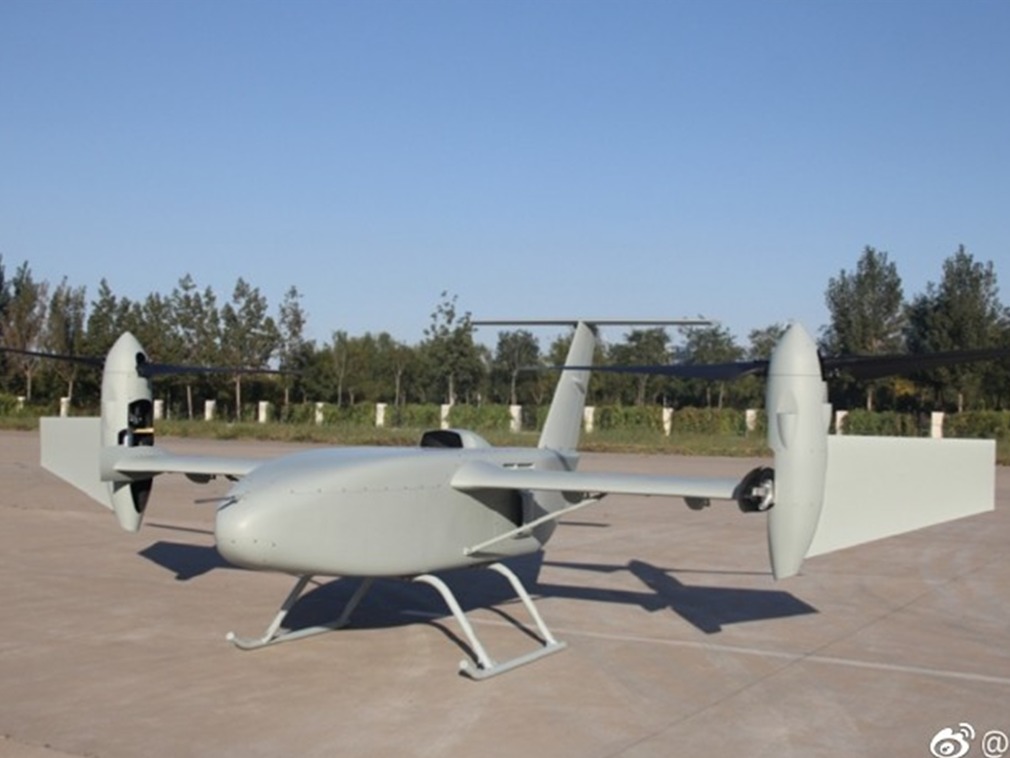
The CH-10 tilt-rotor VTOL drone was unveiled few days before Airshow China.
Other naval applications are also considered for another member of the Rainbow family – Vertical take-off and landing is one path, already reflected by the CH-10 tilt-rotor drone unveiled at the airshow. With VTOL capability CH-10 is useful for military, law enforcement, and civilian uses, as it can operate from small islands and small maritime platforms.
Future Chinese drones are expected to include platforms that will offer extended range and endurance, aircraft that will operate at high-altitude as well as high-speed, supersonic drones.
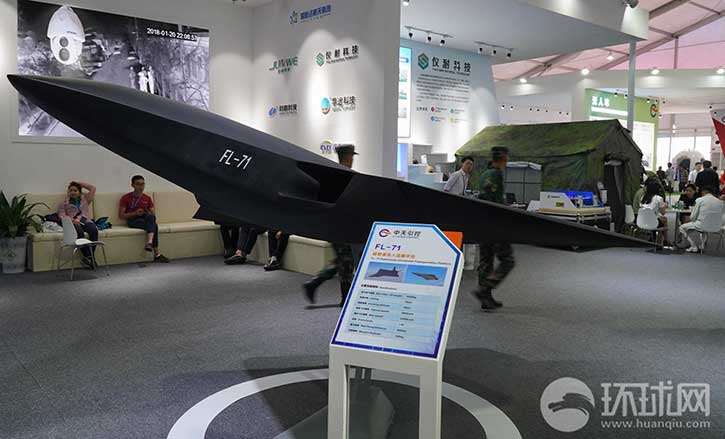
FL71 high-speed drone. Photo: via Huanqiu
Some of these designs were shown in scale models at the exhibition. For example, the FL-71 platform depicts a high-speed unmanned aircraft designed for a maximum takeoff weight of three tons, designed for maximum speed of 2,200 km/h (Mach 1.8) at 50,000 ft or high subsonic cruising at 850 km/h. (0.71 Mach) at 30,000 ft, which enables the drone to carry a payload of 100 kg over 800 km on a single mission lasting about one hour, with a mission profile that could include a short supersonic dash.
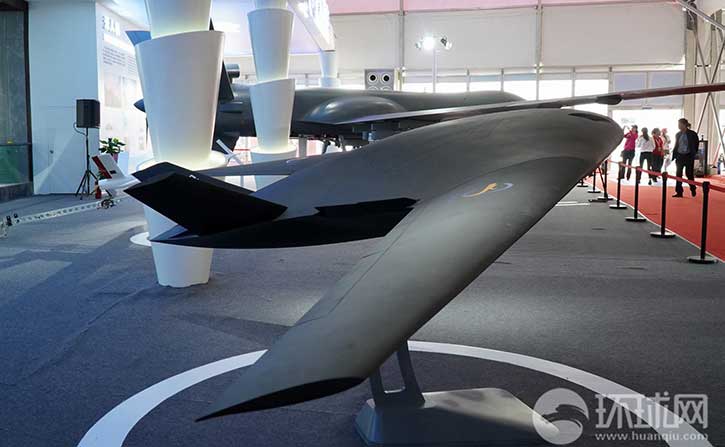
FL-2 is another drone design optimized for transportation of heavy loads at high speed. At 22-ton MTOW it can fly autonomously up to 900 km/h (0.73 Mach) to a distance of 7,300 km.
The FL-2 will be able to deliver heavy cargo to a distance of 7,500 km. Photo via Huanqiu
A full-size mockup of Tengden TW-365 display at Airshow China 2018 Photo: Defense-Update
The Tengden company displayed a full-size mockup of the TW-356 twin-engine unmanned aerial system designed for the transportation of heavy cargo. TW356 can be configured to carry cargo on four underwing hardpoints, as payloads configured in pods, including cargo delivery, remote sensing, or electronic warfare packages. The company also develops a variant of the drone designed for operation at very high altitudes. The largest variant, TW-765 will be able to carry 22 tons of payload up to 7,500 km.
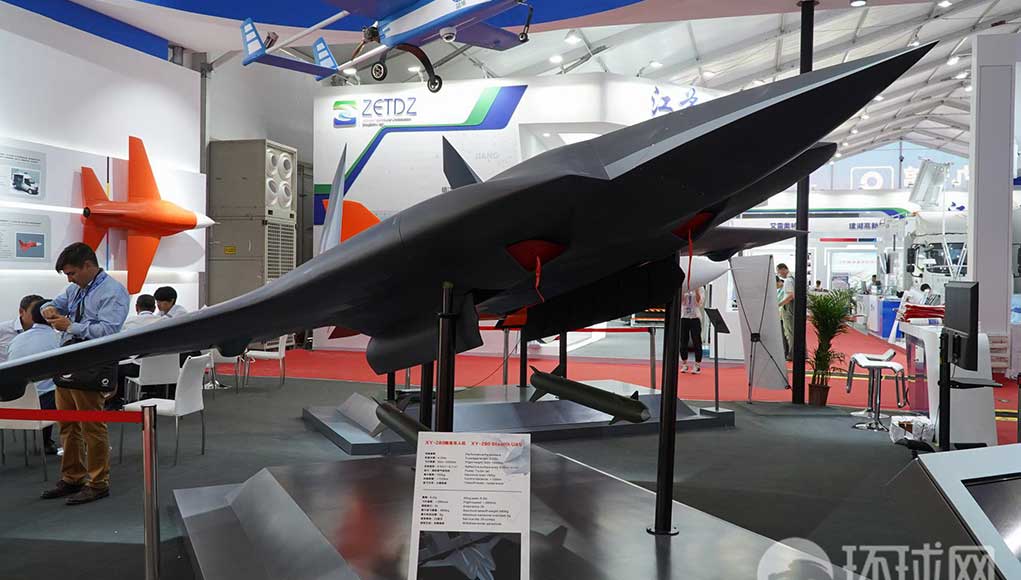
XY-280 stealthy target drone. Photo by Huanqui
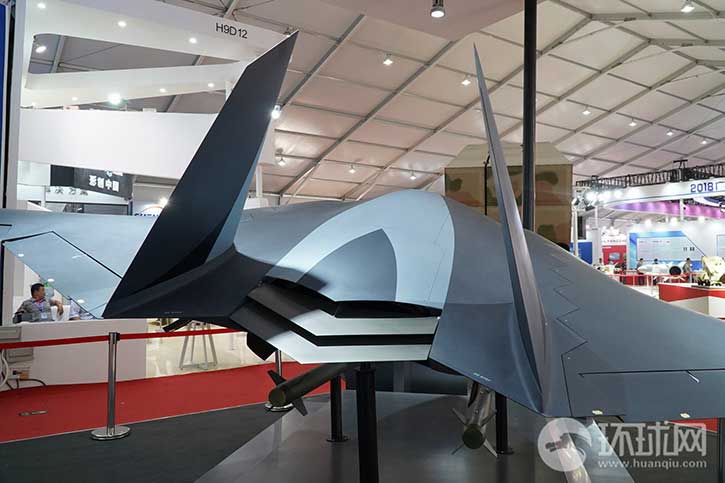
A third drone displayed was the XY-280, claimed to be a highly maneuverable (6G), subsonic target drone designed to simulate adversary F-22/F-35 fighters. It is preprogrammed to fly a fully autonomous flight that mimics the maneuverability and flight characteristics of enemy aircraft. In this capacity it offers realistic training for naval forces and air defense missile units, To maintain the low observable characteristics (0.05-0.1 m2 radar cross-section) of those platforms XY-280 uses stealth design, including two integral payload bays that hint on its potential combat use as a stealthy strike drone. As many other target-drones, the XY-20 is launched from the ground with a rocket booster and is powered by a turbojet engine to a maximum speed of 860 km/h (Mach 0.72). Its length is 4.33 meters, and its wingspan is six meters. At an MTOW of 650 kg, it can carry up to 150 kg of payloads, including sensors and weapons, for missions up to 2 hours. The target drone is designed to sustain up to 25 sorties.
The canted tail and engine exhaust are designed with extensive low observable characteristics minimizing the XY280 radar and thermal signatures. Photo via Huanqiu
The opening week of 2026 has been defined by a singular, paradigmatic shift in modern warfare: the "catastrophic failure" of Venezuela's integrated air defense network during a U.S. special operation. The operation succeeded not through brute force, but by rendering Venezuela's Russian S-300VM and Chinese "anti-stealth" radars effectively blind, validating the supremacy of advanced electronic warfare over legacy kinetic defenses. This failure has sent shockwaves through the global defense market, underscoring why nations like Spain and Germany are rushing to modernize their air defense architectures with Western alternatives, while massive procurement programs exceeding $301 billion signal an accelerated transformation toward unmanned systems, directed energy weapons, and indigenous production capabilities.
Turkey's defense industry transformation extends far beyond its celebrated drones. Now ranking 11th globally in defense exports, Turkey is executing a comprehensive strategy to become a top-tier arms supplier. With 75% of exports flowing to Western markets and five firms in Defense News' Top 100, Turkey is methodically building a complete defense ecosystem through combat-proven systems, integrated defense diplomacy, strategic self-reliance, and real-world R&D in active conflict zones.
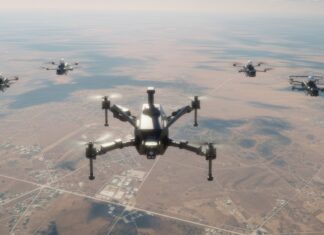
Lockheed Martin Skunk Works® and XTEND have achieved a major milestone in JADC2 by integrating the XOS operating system with the MDCX™ autonomy platform. This technical breakthrough enables a single operator to simultaneously command multiple drone classes, eliminating the friction of mission handoffs. From "marsupial" drone deployments to operating in GPS-denied environments, explore how this collaboration is abbreviating the data-to-decision timeline and redefining autonomous mission execution.
As traditional defense primes face mounting competition from agile “neoprimes” such as Anduril, Palantir and Helsing, the balance of innovation is shifting toward software-defined warfare and scalable, dual-use technologies, while global industry consolidation—marked by Boeing’s integration of Spirit AeroSystems and other strategic mergers—signals an intensified race to secure control over the defense technology value chain. Our Defense-Tech weekly report highlights these trends.
In early October 2025, a coordinated wave of unmanned aerial system (UAS) incursions—widely attributed to Russia—targeted critical infrastructure across at least ten European nations. The unprecedented campaign exposed the fragility of Europe’s air defenses...
Executive Summary
The past week (September 18-25, 2025) represents an inflection point where strategic defense concepts have transitioned from doctrine to tangible reality. An analysis of global events reveals four primary, interconnected trends shaping an...
At the 2025 Air, Space & Cyber Conference, U.S. Air Force and Space Force leaders unveiled major updates on next-generation fighters, bombers, unmanned systems, and space initiatives, highlighting both rapid innovation and critical readiness challenges as the services race to outpace global competitors. A short version is available here, with a more detailed version for subscribers.




 Location: San Diego Convention Center, San Diego, CA