Mobile mortars and their applicationin the modern battle
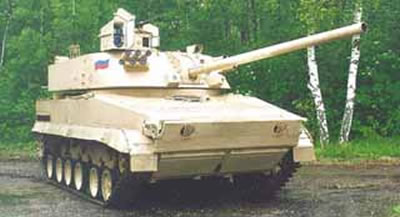
One of the most original 120mm Russian mobile mortar systems, was, and still is, the 120mm 2S9 Nona-S howitzer/mortar system. designed as airborne artillery support vehicle, the Nona is mounted on a modified turret BMD airborne combat vehicle, which can be dropped from tactical transport aircraft. Armed with the 120mm breech-loaded rifled tube 2A60 mortar, it renders both indirect high trajectory and direct point fire capabilities.
Through its semi-automatic loading mechanism, 6-8 rpm firing rate is normal, with 30 seconds action readiness. Another Russian system is the 2S23 120mm SP howitzer/mortar. This model is mounted on a modified BTR-80 platform. In 1996 the Russian Motovilikha Plants Corporation fielded the latest of its Nona family, the 2S31 Vena, an automated self propelled mortar, with a longer barrel, (Russian 120mm 2A80) also firing the Gran laser-guided bomb against point targets to 13km range. The known version was mounted on a BMP-3 chassis and has 70 rounds on board storage (about twice as much as the former). A similar version was developed by the Chinese Army, designated WZ-551 6×6 mounted on an armoured personnel carrier. The Russians seem to love super-big guns, they have designed the mammoth 420mm SP Oka mortar system, which was originally intended to fire tactical nuclear rounds. Fortunately it was never commissioned.
Recent conflicts demonstrated the decisive role of precision attack in modern warfare. Precision engagement systems were available in air forces’ arsenals since the mid 1970s, using laser guided bombs and TV guided missiles. Today’s systems differ from Vietnam era hardware in their sophistication, accuracy, autonomous all-weather operational capability and – most importantly – by networking with intelligence, command and control and “effectors” creating a tight, self improving sensor-to-shooter loop. Better integration and communications between the elements in this loop contribute to improved situational awareness, reflecting on eased operating restrictions set in the past, to avoid fratricide.
While aircraft, sensors and weapons are still limited in their networking, all-weather capability and standoff range, further developments are in place to overcome these limitations and introduce truly integrated advanced battlespace control and effects capability. The force of the future will employ multi-mission aircraft systems, with multi-spectral, fused sensors and robust, all-weather weapons delivery with increased standoff capability. Using less over longer distances will require reduced logistics tails, while covering more targets, with more diversified means of attack. These assets will be supported by new generations of satellites which will provide better responsiveness to ground, naval and airborne forces. The fully integrated force of manned, unmanned and space assets will be able to communicate at the speed of light, on the machine-to-machine level, rather than today’s man-to-machine, with a capability to conduct near-instantaneous global attack against a wide range of threats and targets.
With better, more immune GPS and better guidance systems, weapons are placed precisely where planned, requiring targets to be exactly identified and located before the attack. Air Forces can rely on precision for all the parameters of the strike – hitting the target at the right location, angle and speed, even at a specific aimpoint. The actual physical effect caused by the weapon can be planned to the last detail, by determining the explosive type, shape, fusing and weapon’s casing. Conventional high explosives bombs will detonate in a surface blast or, deep inside an underground bunker, creating a destructive blast wave explosions or a long overpressure thermobaric fireball detonated inside a building, without damaging the structure. Such precision requires gathering many details about the target prior to the actual attack. If a certain target cannot be identified, intelligence must provide other “indicators,” which will enable pilots and targeting assets to look for the objective in a certain battlespace and rapidly locate it as it appears. Such indicators cannot rely solely on satellite imaging. While satellites provide useful pictures, they do not always tell the whole story and are also susceptible to deception.
Mobile mortars and their applicationin the modern battle Development Trends in Russian Mobile Mortars
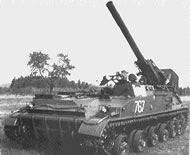
Russian 2S4 Tulpan type 240 self propelled mortar
The first serious development in mobile mortar systems came from the Soviet Union, in the immediate post WW2 era. During the war years, the Russinas showed little interest in mobile mortars, in fact, on dedicated SP artillery, the main focus being on ad-hoc anti-armour solutions against the overhelming German panzers. But painful battlefield experience placed self propelled artillery high on the Russian national priority and the results were some interesting solutions, which remain significant technological highlights even today. The traditional smooth-bore barrels mounted on recoil-absorbing baseplates and relatively uncomplicated supports have limited the size, which a mobile platform could support, without collapsing. The German Wehrmacht actually fielded the first mobile mortar, mounting an 8cm infantry mortar on a its SdKfz 250-7 which saw action in Russia in WW2.
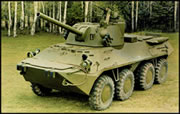
The 2S23 version of the Russian 2S9 Nona, self propelled howitzer/mortar is mounted on a BTR-80 wheeled APC.
First to enter service in the early Sixties, was the huge SM-240 (2S4Tyulpan) mechanised mortar system, mounting a breech-loaded 240mm heavy mortar, firing a power assisted loaded 130kg shell at 1-2 rpm to 12.5km range. The weapon was fired to the rear, the base plate lowered hydraulically from by special device. Another breech loaded mortar, was the Russian 2B9 82mm Vasilyek Automatic Mortar system, which represented a clear break-through in post-war mortar technology. The Vasilyek was recoil operated, munitions fed by four-round clips into the breech, achieving cyclic rate of fire 40-60 rpm in two seconds mounted on a tracked MT-LBu light armoured vehicle. Several derivatives were modified by foreign armies, one of the most interesting, an Iraqi version mounting four rear firing 120mm mortar tubes on a common rear-lowered base.
The first Low Intensity Conflict exhibition and conference held in Tel Aviv during 22-25 of March, 2004 was an excellent opportunity to learn about the intensive advances in LIC related developments in doctrinal, training technological fields. Facing a prolonged conflict for over three years, the IDF had to transform in combat, from an heavy army based on armored formations, prepared primarily for high intensity conflict to a more flexible infantry oriented force, better trained to for LIC and urban warfare, characterized by net-centric employment of forces at various sizes, from squads to brigades. LIC 2004 provided an exciting first view of many new systems, as well as to the insights of the IDF Ground Forces Command weapons and Doctrine, which, due to the circumstances, became one of the world’s leading authorities on LIC.
Defense Update has covering the event focusing on the following topics:
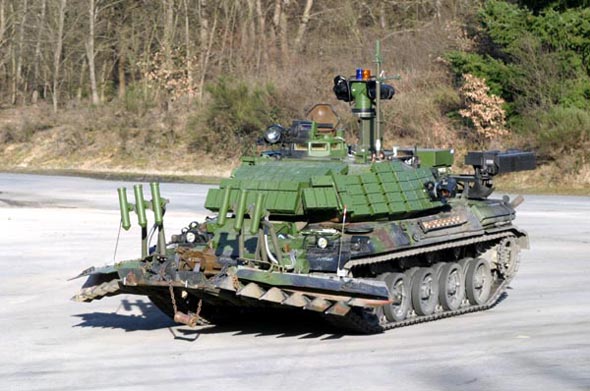
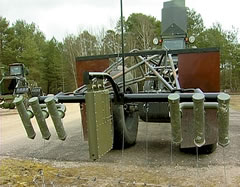
Dedale magnetic decoy device can activate magnetically fused mines at a safe distance from the carrying vehicle. A battery of six Dedale decoys mounted in front of the tank’s maintain a safe arc up to three meters in front of the vehicle. Magnetic signatures are pre-programmed into the Dedale during mission planning, to ensure that the decoy is effective even against the most sophisticated mined. Dedale is also used with other mine clearing systems, including the EBG mine clearing tank.
Adeve is a lightweight magnetic decoy transmitting a vehicle’s magnetic signature at a distance of four meters ahead and to either side of the vehicle. The system is based on the Demeter system and can be activated or deactivated from the vehicle, and can be used on light vehicles.
The DEFEXPO Defense exhibition held early February 2004 at the New Delhi convention center in India, demonstrated an impressive range of weapon systems and technologies originated in India, both from local R&D as well as cooperation with international partners.
Companies participating in this event highlighted systems they expect to promote in the near future for Indian procurement plans. These included the acquisition and modernization of submarines, submarine and surface launch torpedoes and torpedoes countermeasures and submarine launched cruise missiles.
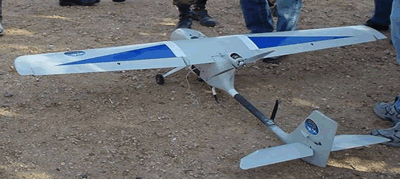
BirdEye 500 mini UAV aimed provides real time airborne surveillance, reconnaissance and over the hill intelligence for forward units at battalion level and below. The system is equipped with a gimbaled payload, which provides sharp pictures at a range of several hundred meters, as required for close range operations.
The aircraft’s takeoff weight is 5 Kg, wingspan is 2 meters and its length is 1.5 meters. A system is comprised of three electrically powered unmanned aircraft and a portable Ground Control Station (GCS). The back packable system is carried in two backpacks and can be operated by a crew of two soldiers. The system can be assembled and ready for its mission within a few minutes. Operation is simple, no special skills are needed and training time is short. After a quick assembly in the filed, Spy There can operate on a 60 minute mission, flying autonomously toward a designated waypoint assigned by the mission control system. The system can operate at a range of 10 Km.
Israel Aircraft Industries (IAI) recently unveiled a new family of miniature UAVs designed for military, paramilitary, security and civilian applications. The family comprises the Bird-Eye 100 and Bird-Eye 500 low cost miniature UAV weighing 1.3 and 5 kg respectively. Both MAVs are designed for operation at a very low altitude, and are launched by hand or bungee. Both unmanned aircraft went through a series of tests recently. Bird-Eye went through a thorough evaluation by the Israel defense Forces, while Bird-Eye 500 was demonstrated in the Netherlands, to the local police. Flight demonstrations in the Netherlands were carried out by Condor UAV B.V, IAI’s newly assigned European distributor for miniature UAVs. During the flight demonstrations the UAVs were operated over farmland area on highway and monitoring and fire watch missions, which also provided introduction and orientation prior to safety approvals required for the final phase – flying over the Amsterdam metropolitan area, within the Control Tower Region (CTR) airspace controlled by the Schipoll airport.
The IAI team demonstrated the system’s silent operation, its ability to operate in high winds, and the minimal logistic footprint required for its operation. Using a high resolution gimbaled color camera, and flying dedicated flight patterns using an autonomous auto-pilot system, Bird-Eye 500 equipped with a typical gimbaled 850gr optical payload was flying at a speed of 25 – 45 knots, at an altitude of 500 feet above the ground, enduring strong winds. The mission included the monitoring of rail tracks in the vicinity of the Amsterdam central train station, mobile vehicle tracking, crowd control, waterway monitoring, and other missions performed to the complete satisfaction of the Amsterdam police. The performance of the MAV were compared to performance of manned aircraft and were reported as superior in all aspects. Chief-Commissioner of the Amsterdam Police, who attended the demonstration said that the police is interested in the new technology and see the opportunities to use mini UAVs in their police work. Condor UAV B.V., the Haarlem based Netherlands’ distributor of IAI/MALAT’s Mini-UAVs for civilian applications will be responsible for the marketing and customer support in several European countries.
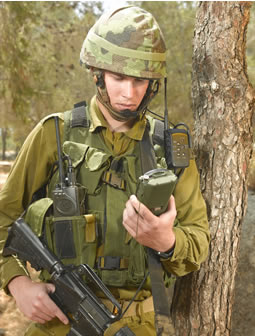
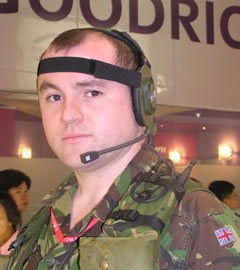
PRR is a short range radio operating independently of any infrastructures. Currently available systems are functioning in the 2.4GHz and High UHF bands, offering effective short range communications with low interference and adequate bandwidth utilization. Most systems are offering duplex conference operating modes, and selective one-to-one (peer to peer) communications. PRR communicators rely on a network concentrator unit (which could be one of the radios) to communicate with all systems and act as system synchronization unit. Some systems are designed to operate without synchronization, enabling truly independent communications.
Modern intra-squad specialized Personal Role Radios (PRR) offer effective communications within the squad and between combat teams, enabling effective dismounted infantry operations at a level previously reserved only for Special Forces.
Current PRRs offer conference operating mode, when the commander can speak to all soldiers and get their responses) or in peer-to-peer (one on one). Systems utilize full duplex communications which is mimics natural voice communications. PRRs support line of sight communications at ranges of few hundred meters, and sustain continuous operation for 10 – 12 hours (sufficient for overnight activity). Systems support mainly voice but some can also transfer data at low bit rate, to distribute reports, preset messages etc. As PRRs operate at very low power and high frequencies, there are significant difficulties in communications in urban terrain, mountainous area and densely wooded (jungle) environments. Another limitation is the absence of data communications, and low data rate offered by those sets that do support data communications. Future systems, currently under development in the USA, are part of the Soldier Level Integrated Communications Environment (SLICE) program, which will be part of the Future Force Warrior infantry combat system.
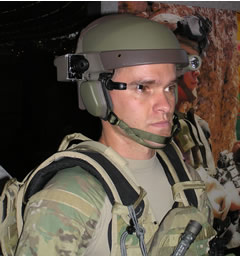
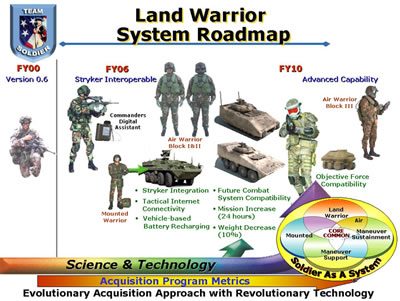
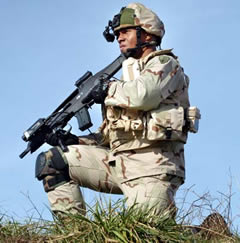
The basic Land Warrior suit includes weapons,sensors such as laser rangefinder and day/night cameras, clothing, protection system integrated with load carrying equipment, and headgear, based on a helmet, equipped with integrated speaker, microphone and optical display. The system’s hub is the mission computer which interfaces with all system’s components via a 10 port hub. The computer links directly with the squad communications and ‘leader communications’ systems; it also manages the system’s sensors and displays, runs various navigation and situational display functions and as well as display and power management. The system is powered by rechargeable batteries with mission endurance of 6 – 10 hours. The initial systems were designed with dual processor architecture, but following initial trials, shifted to a simpler, single processor system. Another improvement included the shift from Windows based operating systems to Linux, which proved to be more reliable.
Land Warrior Electronic Gear
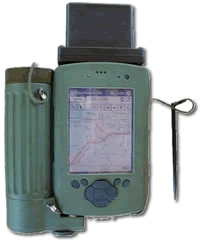
The intra-squad radio uses a helmet mounted antenna, operating a wireless local area network, covering up to 1,000 meters with line-of-sight communications. The Land Warrior system operates in a soldier-to-soldier wireless network, for short-range data and voice transmissions. The current system uses the Multi-band Intra-/Inter-Team Radio (MBITR). The helmet also mounts an Active Matrix organic light emitting display providing a field of view equivalent to two 17-inch computer monitors placed in front of the soldier’s eyes. It presents the Daylight Video Scope (DVS) and Thermal Weapon Scope (TWS), as well as text messages, maps and satellite images which can be downloaded in about 8 minutes. Maps are displayed to all team members. Display control and interface are provided by a mouse and weapon mounted programmable switches. Each member of the team is identified by an individual Subscriber Identity Module (SIM) card. The SIMcard also determines the echelon and role of the user – team, squad or company, commander, sniper, support team, rifleman etc. Individual members will have access to a different set of assets and capabilities and automatically get specific “packages” of information. Commanders can also use the Commander’s Digital Assistant (CDA) package, which is already fielded with combat troops on a ruggedized PDA. The system is equipped with 5 channel GPS receiver tracking the soldier’s position with approximate 10 meter resolution. A pedometer augments the GPS and tracks the movement of the soldier in locations where GPS coverage is unavailable. The location of each soldier is refreshed every 30 seconds, and transmitted over the intra-squad network for situational pictures updates. Two rechargeable batteries are currently provided for each suite, to power the sensors and systems for 4 – 6 hours. Batteries are located on the right and left sides of the soldier’s belt. Alternative primary batteries can also be used for extended missions of up to 10 hours.
Land Warrior Weapons
The current Land Warrior suits utilizes the M4 Carbine, equipped with picatinny rail mount for the thermal sight, daylight video scope (x1.5 – 6 zoom available) and a multifunction laser, providing target marker, azimuth and rangefinder. The new XM-8 rifle could replace M-4 as initial suits are deployed in 2006. Day and night sights render aiming crosshairs superimposed on the helmet mounted sight to enable effective non-line of sight weapon’s aiming and target acquisition behind coverage. The weapon has three programmable buttons for push to talk (PTT), switching screens on the helmet mounted display and saving snapshot pictures as displayed on the viewer. The weapon is connected to the hub via an umbilical cable.
The goal of Land Warrior is to enhance a soldier’s mobility, situational awareness (command and control and communications), lethality, sustainability and survivability. According to its original schedule the US Army planned to field the Land Warrior Initial Capability (IC) systems in 2004. According to the revised schedule, only test items will be deployed in October 2004 with initial systems supplied only Special Operations and Ranger battalions but even these are not being delivered and the entire program is shifted to start in 2006. Operational testing of improved, more mature Land Warrior suits will be with mechanized Infantry Stryker brigades, redesigned as Upgrade I, or Stryker Warrior systems. Such testing is currently planned toward 2006. Despite the delays, the program is maintained at a high priority, and is now managed in a faster spiraling development path, pushing subsystems to the field as soon as they mature. Among the near term applications resulting from this process included issue of personal protection body armor improvements, lighter-weight helmets and the Commander’s Digital Assistant (CDA).
The integration and optimization of Land Warrior components and suits focusing on Upgrade I phase, optimized for the infantry teams operating with the Stryker APC. Future Stryker infantry teams will be able to utilize their Stryker Warrior combat suits for mounted, as well as dismounted operations. Through 2015, the U.S. Army is expected to procure up to 34,000 Land Warrior suits at a total program cost of around $8 billion.
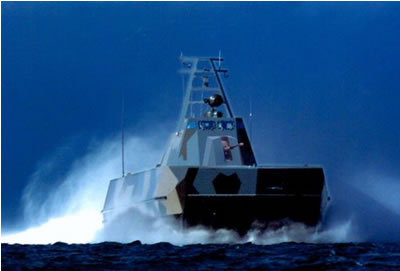
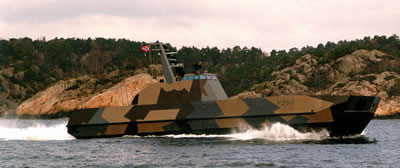
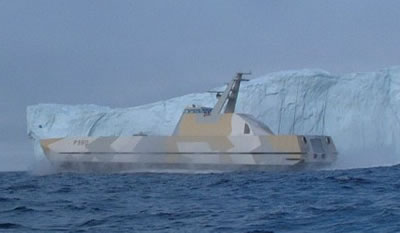
The Norwegian Navy has an operational requirement for operations over a long coastal line, in the Economic Exclusion Zone (EEZ) and in support of international operations. The Navy requires to operate a large number of vessels, equipped with relatively large weapons load. One of the systems that will take the challenge is the new 270 tons Skjold Surface Effect Ship (SES). In November 2003 the Norwegian Navy ordered five Skjold class boats to join the first boat, in service since 1999, which is currently undergoing reconstruction.
The Skjold class boat utilizes an an advanced GRP (glass reinforced composites) construction, designed as an air cushion-integrated catamaran design, that offers excellent cruising speed, high transit speed, and high agility in open sea and shallow-water operability. The deck area, parts of the bulkheads, superstructure and hull areas are constructed of hard composite foam (Polymethacrylimide or PMI), which serves as structural sandwich for demanding structures offering superior strength-to-weight ratio and high resistance to temperature. The weight savings achieved by utilizing the foam is approximately 2000 kg.
The stealth design uses extensive Radar Absorbing Materials (RAM) construction in the load carrying structures. Specific attention has also been made to develop special doors and hatches for reduced radar cross section. Other signature reduction techniques are applied to reduce thermal and magnetic signatures. The missiles are integrated inside the GRP hull, to further reduce signature and streamline the external envelope.
The first Skjold prototype built in 1997 is powered by two main engines – Rolls Royce Allison 571 KF 6000kW (2×8160 Hp) gas turbines driving two kaMeWa 80SII waterjets. The cushion is pressurized by lift fans, powered by two MTU 12V TE92 735 kW engines. The combined propulsion offers the boat to accelerate and maintain top speed above 47 knots, at sea state 3, and 55 knots in calm water. The boat can also travel at 8 knots by diesel power. In January 2004 Pratt & Whitney Marine Systems, Inc., was contracted by the Norwegian shipyard Umoe Mandal, to supply gas turbine propulsion for COGAG configuration (combined gas turbine and gas turbine) systems for the six Skjold boats (five new, one reconstructed). Each gas turbine propulsion system will feature two ST18M marine gas turbines and two ST40M marine gas turbines. The ST18M and ST40M are free turbine turboshaft engines derived from Pratt & Whitney Canada’s PW100 and PW150A aviation turboprop powerplants respectively.
Skjold will be equipped with Kongsberg surface missiles, currently under development, and an Oto Melara 76mm super rapid gun mount or an 57 mm or 76 mm gun will be installed on the fore deck. and integrates eight Mistral anti-aircraft missiles, for self defense. The first Skjold class fast patrol boat prototype became operational in 1999, as part of the Norwegian Navy modernization of its Missile and Torpedo boat units. Five more boats was are on order.
The Skjold design provides a basis for the proposed US Navy future Littoral Combat Ship (LCS), proposed by the Raytheon-led Team LCS.
Skjold SES prototype shown during sea trials and voyage to the USA.
Specifications:
Length 47 m
Beam 13.5 m
Draft 0.9m on cushion, 2.2m off cushion
Displacement 270 tons fully loaded
Speed at SS3 47 knots
Range 800 nautical miles
Crew 15 – 18
CODOG Propulsion:
2×6,000 kW gas turbines and 2×350 kW diesel
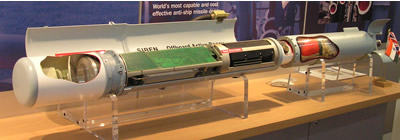
Siren is an active jammer deployed from standard RBOC decoy launcher on board the surface ships. The reaction time of the decoy is 7 seconds, which are required for the downloading of the threat’s identification profile, flying a rocket assisted trajectory over a distance of 10 miles, where the decoy is suspended under a parachute, and prepares a repertoire of deception and jamming signals tailored for anticipated specific threat. Utilizing a mirror like directional reflector, Siren scans the area for targets and when the target is located, it focuses its transmission at a narrow arc where the incoming threat is detected. Since the decoy is fired remotely from the ship, a home on jam countermeasures will also deviate the missile from its target.
Information Management Network Implemented in F-16I Squadrons
The Negev Squadron will be the first unit to deploy the new Squadron Information Management Network (SIM Net), an advanced information recording and management network available for training and debriefing available at the squadron level. A network based mission debriefing system designed by RADA. SIM NET is composed of the Ground Debriefing Station (GDS), for aircrew debriefing, and the Maintenance Debriefing Station (MDS), for maintenance debriefing. Comprised of commercial PC-based system, GDS processes the flight data and operation parameters recorded during the flight and reproduce a graphic display of the actual air combat situation including all participating aircraft. This reproduction is fully synchronized with the video and audio recordings. The system can be used for multiple aircraft training, operational tactics training and safety events debriefing, as well as air-to-air and air-to-ground mission debriefing.
F-16I Maintenance Debriefing Systems: system incorporates two elements, one embedded in the flight data recorder, which tracks all the databus data flows, and the other – which process reconstructs, interprets the data and displays it to the maintenance teams, for evaluation of events and malfunctions experienced during the flight. The performance analysis is provided by the use of the data MARS flight data analysis software developed by Ampol Technologies. The system synchronizes and concurrently displays data from up to four video channels, four audio channels and four Mil1553 databus channels. The system will be integrated into all the operational aircraft and will also support the flight testing phase, and acceptance process of the first F-16I aircraft in Israel. Similar systems are also used for flight testing, on US Army helicopters and some USAF aircraft.
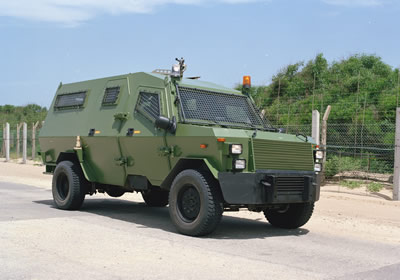
The Wolf, designed by RAFAEL and Hatechuf, is a common platform designed with an “open protected space” concept, which allows for a high degree of flexibility and configuration for a variety of missions. The Wolf was proposed as a protected troop carrier and command vehicle, designated logistics vehicle, rescue vehicle and protected ambulance. The vehicle offers a high level of protection and is approved by the Israel Defense Forces. The armor protection envelope can be built independently of the vehicle, and can be easily reinstalled on other vehicles of the same model.
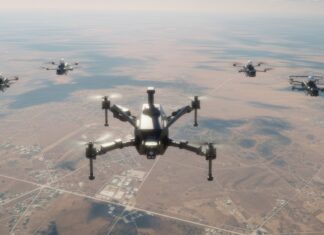
Lockheed Martin Skunk Works® and XTEND have achieved a major milestone in JADC2 by integrating the XOS operating system with the MDCX™ autonomy platform. This technical breakthrough enables a single operator to simultaneously command multiple drone classes, eliminating the friction of mission handoffs. From "marsupial" drone deployments to operating in GPS-denied environments, explore how this collaboration is abbreviating the data-to-decision timeline and redefining autonomous mission execution.
As traditional defense primes face mounting competition from agile “neoprimes” such as Anduril, Palantir and Helsing, the balance of innovation is shifting toward software-defined warfare and scalable, dual-use technologies, while global industry consolidation—marked by Boeing’s integration of Spirit AeroSystems and other strategic mergers—signals an intensified race to secure control over the defense technology value chain. Our Defense-Tech weekly report highlights these trends.
In early October 2025, a coordinated wave of unmanned aerial system (UAS) incursions—widely attributed to Russia—targeted critical infrastructure across at least ten European nations. The unprecedented campaign exposed the fragility of Europe’s air defenses...
Executive Summary
The past week (September 18-25, 2025) represents an inflection point where strategic defense concepts have transitioned from doctrine to tangible reality. An analysis of global events reveals four primary, interconnected trends shaping an...
At the 2025 Air, Space & Cyber Conference, U.S. Air Force and Space Force leaders unveiled major updates on next-generation fighters, bombers, unmanned systems, and space initiatives, highlighting both rapid innovation and critical readiness challenges as the services race to outpace global competitors. A short version is available here, with a more detailed version for subscribers.
The Taipei Aerospace & Defense Technology Exhibition (TADTE) 2025 crystallized around four dominant strategic themes that collectively illustrate Taiwan's comprehensive approach to defense modernization amid escalating regional tensions. Based on a detailed report by Pleronix (available upon request). Includes a Podcast discussion on TADTE 2025's highlighting Taiwan's four strategic themes beyond the post's coverage.
Israel’s Iron Beam 450 high-power laser system has completed final testing, marking a major leap in air defense. Developed by Rafael, it offers precise, cost-effective interception of rockets, UAVs, and mortars, and is set for IDF deployment by 2025.