
A digital mobile ground C4I system, developed by Ness technology, provides tactical units and maneuver forces with access to images, maps etc, via ruggedized computers and hand held PDAs. The system enables field commanders to locate enemy targets and identify friendly forces in real time. Ness introduced special algorithms for decision support, including assessment of optimal forces for rapid response, and prediction of shortest rout. The system can be employed in command vehicles and with dismounted troops. The system utilizes a powerful mapping and graphic tool developed by Ness, navigation (GPS) and orientation module, rout planning and display and auto-centered moving map.
ShockRounds Electrical Shock Ammunition
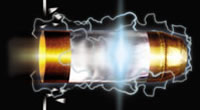
ShockRounds will pack a miniature electric shock mechanism into standard 37mm, 9mm and 12 gauge ammunition, including rubber or frangible bullet, offering non lethal capability at an effective range of 100 meters. The electrical shock is generated by the impact energy, which excites a piezoelectric crystal to deliver a shock of up to 175 joules (x6 more than conventional “electric fences”. This shock has enough energy to temporarily incapacitate the threat. The new ammunition could be tuned to generate for various degrees of shock upon impact, ranging from lower level jolt for riot deterrence, to a discharge designed to cause immediate and temporary incapacitation by disrupting the offender’s nervous system. The program is currently in a pre-prototype phase, after validating the technology and demonstrating the concept. According to plans, the system could mature within two years (end of 2007).
ShockRounds are being considered to be inserted into standard non lethal ammunition of various calibers from 37 to 9mm, fired from standard weapons, including multiple shots and automatic fire. The 37mm application could be compatible with police 37mm launchers. These munitions are non-penetrating and could be used for “behavior modifying” applications. Another application is the 12 gauge police-caliber rubber bullet. Since this bullet is designed to produce decreased wound, electrical shock effect could decrease the number of shots required to incapacitate a threat. 9mm or 10mm standard police-caliber bullets are both lethal munitions. They could be modified into less-lethal versions by using electrical shock effect. Since the stopping power of the new ammunition will not rely primarily on the pain or damage caused by a high velocity impact, but on the high voltage discharge, their velocity of the bullet could be reduced to optimal level that guarantee effective stabilization and performance at the required range.
Tactical C4ISR (RTC)
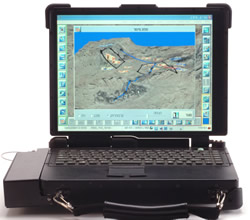
The RAFAEL Tactical C4ISR (RTC) system provides tactical units with independent support for mission planning, navigation, situational awareness and target acquisition and engagement. Employed with mobile and dismounted forces, including Special Forces, the system can also interface with other systems in a wide area to establish large scale networking. The RTC links to standard combat net radios to access the network and transfer data between the network’s units. RTC provides battle management support including target acquisition, allocation and management of all firing assets under the commander’s control, as well as fire management and control of individual firing units such as anti-tank missiles. This application was formerly known as Spike C4I and was tested with Spike equipped units where it demonstrated how it can simplify the communications between different element in the group, increases the agility and precision of the supported forces, and accelerate the sensor-to-shooter cycle between reconnaissance and assault forces while minimizing the risk from fratricide “friendly fire”. The system can also integrate various sensor platforms including individual sights of the anti-tank weapons, UAVs and other airborne sensors, acoustic sensors and observation posts.
Spider Unattended Ground Sensor
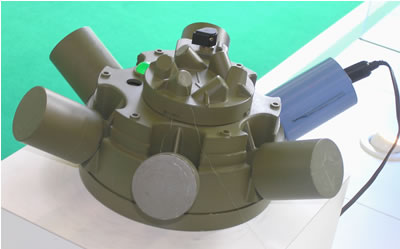
Spider is under development at Textron Systems and ATK under the Objective Force anti-personnel component program. The system is designed to protect friendly forces and shape the battlefield while minimizing risk to friendly troops and non-combatants. In January 2005 the US Army decided to accelerate fielding of the Matrix remote munitions control system, which is a lead-in version to the Spider. The Army awarded ATK Twenty-five Matrix systems to be delivered to U.S. forces and deployed in Iraq by June 2005. Matrix is a portable, reusable, soldier-in-the-loop system that can be used in either a lethal, or a non-lethal mode. The program is managed by Project Manager Close Combat Systems and the U.S. Army Armaments, Research, Development and Engineering Center (ARDEC).
The Spider’s Munition Control Unit (MCU) is a pedestal fitted with six munitions launchers each covering a sector of 60 degrees, and a communications module which links the Spider with its remote operator. The MCU communicates with the Remote Control Unit (RCU) by direct wireless link, or via field communications repeaters. On operator command, the Spider autonomously deploys trip wires corresponding to each sector. When a trip wire is activated, a signal is sent from the sensing MCU to the Remote Control Unit (RCU).
Based on that signal, the operator’s own observation of the field, and other situational awareness and guidance from the chain of command, the operator can direct the detonation of the grenades associated with the trip wire detection. The operator may delay this action, to allow more intruders to penetrate further into the kill-zone and deploy multiple charges for maximum effect. Munitions include self-activated grenades, operator activated claymores or various non-lethal munitions. The MCU is powered by a replaceable battery and can sustain continuous operation for 30 days. The system can be recovered and replenished with new grenades after an engagement. The Spider can be deactivated on command, to enable safe recovery or passage of friendly forces. The RCU uses a rugged laptop computer equipped with a touch screen to provide full control of an area up to 1,500 meters deep. Each RCU enables the monitoring and activation of a single or multiple charges.
SPICE Aerial EO Weapon’s Guidance Kit
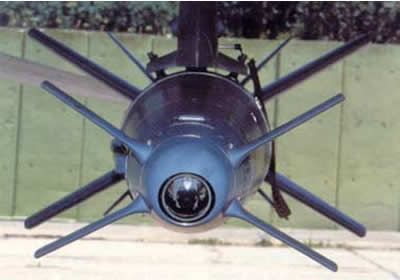
SPICE precision guidance kit, is designed for the Mk-83 and Mk-84 type bombs, including IMI’s PB-500 and enhanced penetration bombs. The 4.2 meter long SPICE equipped bomb is capable of precision strike from a standoff range of up to 60 kilometers, when launched by F-16 class aircraft from an altitude of 42,000 feet. Target acquisition is relatively simple, as the pilot has to fly to a predestinated launch area, where he can select the specific target to be attacked from the SPICE memory. After launch, the weapon is navigated by means of GPS and Inertial Navigation System (INS) (Ring-Laser Gyro), to the target area, where the imaging sensor is activated, and adding scene matching to the weapon’s navigation.
The SPICE locates various reference points and correlates them to find the predicted location of the target even without GPS input. At the terminal homing phase, the weapon is guided exclusively by the electro-optical sensor, to overcome target location error and GPS jamming. Since SPICE is not dependent on laser designation, at close-in distances, the weapon recognizes the exact shape of the target, correlated with the 3D model stored in its memory, which was based on intelligence information.
SPICE’s attack profile can be set to dive steeply onto the target. As the target image gets larger, the weapon selects the exact aimpoint to assure high precision minimizing collateral damage. RAFAEL also offers an optional data-link to provide attack verification and initial battle damage assessment. Unlike many PGMs, the SPICE does not rely exclusively on 1760 bus, and therefore, can be employed on various types of aircraft. Several targets can be preloaded on each weapon. Targets data, flight path and scene details are stored on a detachable memory unit, which can be loaded on the weapon before takeoff. Prior to weapon release, the pilot selects the specific targets. As SPICE is independent of the aircraft data bus, it is autonomous from the aircraft software update cycles, and can enhance the operational capability of operational forces without special preparations and aircraft modifications.
ROEE Light Tele-Operated Robotic Weapon ATV Platform
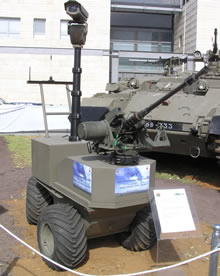
ROEE, a light weight tele-operated unmanned ground vehicle is being developed by the Israeli Technion Land Systems Division.
This radio controlled system operational system demonstrates high cross-country mobility and payload carrying of up to 500 kg, including a TV camera and weapons mount, such as the 0.5″ machine gun as demonstrated at LIC 2004.
The platform uses an All Terrain Vehicle (ATV) chassis and carries a remotely controlled weapon mount and sensor payload. Both payloads can be separately controlled by the operator, or slaved to the camera line of sight. ROEE can rapidly deploy firing elements and sensors to positions located at high risk, exposed locations, thereby reducing the risk to soldiers without risking the mission. The robot can be integrated in a security system, as a part of perimeter defense system, or be deployed as an ambush platform, to monitor, and secure enemy susceptible movements paths.
Spectra composite armor modules
Materials based on the Honeywell Spectra fiber are also used in various vehicular protection applications. Spectra Shield PCR designed from the Spectra fibers offers a floatable protection module, which almost does not absorb moisture – an important consideration for amphibious vehicle and floatable protection. The Spectra high strength polyethylene based fibers were introduced in the 1980s. It is 10 times stronger than steel, these are 40%, stronger than aramid fibers. The Spectra Shield is constructed from parallel strands of fibers held in place with a resin, every new layer is cross plied at right angles and the entire structure is fused into a composite structure under heat and pressure. The 3rd generation Spectra Shield uses an integrated Ceradyne ceramic face plate, defeating high velocity AP rifle rounds. This type of protection is widely used in the Small Arms Protective Insert (SAPI) used with modern body armor.
Self Recharging Packages
The US Army is funding development of photovoltaic technology by Konarka Technologies, providing lightweight, flexible and scalable source of renewable power. These new developments are utilizing nanotechnology and conducting polymers to convert sunlight as well as indoor, artificial light into direct current electrical power. The company uses unique, proprietary low-temperature production methods to put the photovoltaic cells onto flexible, lightweight plastics.
Cold-sintering process used in the production of the new cells, allows photovoltaic cell material to be coated onto flexible plastics, rather than on glass or silicon. Therefore, the product’s shell could be transformed into a renewable power source. Under the current program, Konarka will supply prototypes of modules that will demonstrate their ability to re-charge internal batteries and operate military equipment. Future implementation of these technologies include various self-powered electronics, structures and soldier’s uniforms that will generate power.
SPAR Gun Launched Beam-riding Anti-Tank Missile
Diehl Munitionsysteme is developing a semi-autonomous beam-rider guided ammunition for tank guns, at caliber 105 / 120mm. The guidance will improve the hit probability of the SPAR and make it effective at ranges up to 5.5km. It will use a tandem shaped charge warhead with high penetration performance.
SPATEM – Active Protection System Suite from GIAT
The French Department of Defense has awarded a technical evaluation study and R&D contract to GIAT, Thales and the Institute de Saint Louis to develop an active defense system for French future armored vehicles. The system is designed to detection threats at a distance of 50 meters, by electro-magnetic and IR sensors. Upon detection of a threat, the system launches a Rampe splinter charge, detonated at a close proximity to the incoming threat, destroying it at a distance of at least five meters from the protected platform. Sepatem is scheduled for demonstration by 2006 and subsequently will be installed on Leclerc and AMX-30B2 tanks, AMX-10RC and EBRC APCs.
Taser Anti-Personnel Munitions (TAPM)
TAPM non-lethal area denial system. The TAPM is an autonomous self-actuating device that utilizes the TASER X26 Shaped Pulse Technology and conducted energy cartridges for military area denial. TASER International and General Dynamics Ordnance and Tactical Systems, a business unit of General Dynamics have signed a teaming agreement to develop market, and produce, a family of non-lethal conducted energy devices such as the TAPM and other similar area denial devices are supporting the US Army’s Hand Emplaced Non-Lethal Munition (HENLM) program.
Special Operations Tactical Suit (SOTCAS)

The demands for Camouflage technology has Camouflage (SAAB) Barracuda offers several types of camouflage systems, including the Shadecam static multi-spectral camouflage system, used in fixed installations. The company also offers a multi-spectral, Personal Camouflage System (PCS) developed for special operations units. The kit comprises a screen, poncho and Special Operations Tactical Suit (SOTACS). The lightweight (200gr/m2) effectively conceals the wearer in the visual, and near IR wavebands, blending the soldier with the background. The suit provides thermal concealment as well, which blocks up to 80% of the body heat The suit withstand continued operations in wet weather conditions. The entire SOTCAS suit weighs 2.9 kg.
Laminated Metal Deposition Armor
Solidica, Inc. is developing a new armor concept for the US Navy, which could be used to retrofit existing military vehicles with ballistic protection that can easily be applied in the field. The new armor uses ceramic armor plates with embeded fiberoptic sensors that can detect threats and activate appropriate response. Solidica’s laminated metal deposition technologies could be applied on the armor, and diffuse impact energy similar to composite layered structures, but at reduced cost. Through the use of Solidica laminated metal deposition process, called Form-ation, a platform combines the ability to quickly “grow” dense metal objects or features with the option of embedding fibers, electronics, armor and sensors.

Skunk Works and XTEND Simplify Multi-Drone Command
Lockheed Martin Skunk Works® and XTEND have achieved a major milestone in JADC2 by integrating the XOS operating system with the MDCX™ autonomy platform. This technical breakthrough enables a single operator to simultaneously command multiple drone classes, eliminating the friction of mission handoffs. From "marsupial" drone deployments to operating in GPS-denied environments, explore how this collaboration is abbreviating the data-to-decision timeline and redefining autonomous mission execution.

From Ukraine to Taiwan: The Global Race to Dominate the New Defense Tech Frontier
As traditional defense primes face mounting competition from agile “neoprimes” such as Anduril, Palantir and Helsing, the balance of innovation is shifting toward software-defined warfare and scalable, dual-use technologies, while global industry consolidation—marked by Boeing’s integration of Spirit AeroSystems and other strategic mergers—signals an intensified race to secure control over the defense technology value chain. Our Defense-Tech weekly report highlights these trends.

Europe’s “Drone Wall”
In early October 2025, a coordinated wave of unmanned aerial system (UAS) incursions—widely attributed to Russia—targeted critical infrastructure across at least ten European nations. The unprecedented campaign exposed the fragility of Europe’s air defenses...
Weekly Defense Update & Global Security Assessment
Executive Summary
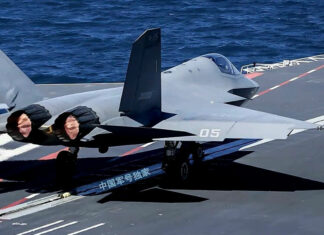
The past week (September 18-25, 2025) represents an inflection point where strategic defense concepts have transitioned from doctrine to tangible reality. An analysis of global events reveals four primary, interconnected trends shaping an...

U.S. Air and Space Forces Push Next-Gen Programs at the AS&C 2025 Conference and...
At the 2025 Air, Space & Cyber Conference, U.S. Air Force and Space Force leaders unveiled major updates on next-generation fighters, bombers, unmanned systems, and space initiatives, highlighting both rapid innovation and critical readiness challenges as the services race to outpace global competitors. A short version is available here, with a more detailed version for subscribers.
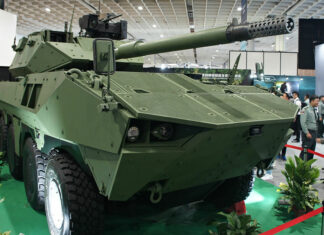
TADTE 2025: Reflecting Taiwan’s Strategic Themes
The Taipei Aerospace & Defense Technology Exhibition (TADTE) 2025 crystallized around four dominant strategic themes that collectively illustrate Taiwan's comprehensive approach to defense modernization amid escalating regional tensions. Based on a detailed report by Pleronix (available upon request). Includes a Podcast discussion on TADTE 2025's highlighting Taiwan's four strategic themes beyond the post's coverage.
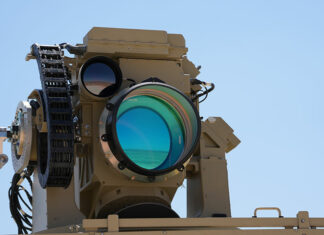
Iron Beam 450 Completes Testing, Soon to Join With Operational Air Defense Units
Israel’s Iron Beam 450 high-power laser system has completed final testing, marking a major leap in air defense. Developed by Rafael, it offers precise, cost-effective interception of rockets, UAVs, and mortars, and is set for IDF deployment by 2025.