Soldier Vision is also developing advanced information systems that could be integrated into Future Force warrior programs. The systems are designed specifically for the mounted, dismounted infantry as well as and tank crews. The software packages provide enhanced situational awareness, combat identification and discrimination between friend and foe, assists routing and navigation around combat obstacles and improves coordination and target hand-off with fire support teams. The system uses Soldier Vision’s developed battlefield management framework (BMF) and sensor grid facilities. Recent applications of the system were demonstrated on COTS based computers, using Intel XScale 500 Mhz processor running the Microsoft Windows 2000 operating system.
Universal, Modular, and Adaptive SATCOM Terminal – UMAST
DARPA is developing the next generation satellite communication terminal (Universal, Modular, and Adaptive SATCOM Terminal – UMAST) technology demonstrator which will support the evolving 3-D military global information infrastructure. UMAST is expected to be smaller, lighter, and cheaper than current terminals and will be designed for deployment on ground mobile or airborne platforms. The terminal will have integrated seamless interface with terrestrial wired and wireless systems thus provide warfighters with secure, range-independent communications gateway into the global information networks.
Total Area Control System (TACS)
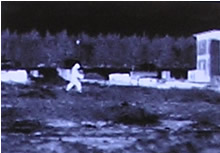
RAFAEL’s TACS system, which is already deployed along the northern border with Lebanon is currently proposed for operation along the Israeli Buffer Zone. New additions to the TACS include more compact aerostats, such as the Mini TAOS mobile tactical aerostat for area surveillance and observation. The Mini TAOS carries a stabilized payload that can detect and recognize a walking person at a range of 3.8 – 4.5 km in day and night. The Mini-TAOS uses special stabilizing sails enabling operation at winds of up to 90 knots. RAFAEL also developed a tracking system for troops, which maintains constant track of all security forces in the area, including covert elements, reporting their status, and condition. The system provides essential, real-time information over the status of all friendly forces, and contributes to rapid engagement and reducing of potential blue-on-blue engagements risk.
Scene Matching – Precision Targeting System
This guidance technique is used primarily for autonomous navigation over well charted terrain. The sensor scans the ground, to identify and specific objects used as navigation aids, providing orientation and navigation updates enroute to the target. As this technique usually relies on multiple orientation points and 3D imaging of objects, throughout the area, Scene Matching techniques provide very high immunity to deception and countermeasures.
SAMP/T Land Based Air Defense System
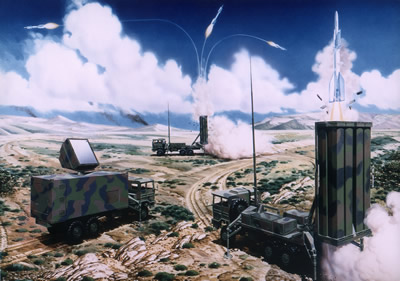
SAMP/T is a land based air defense system incorporating the Aster 30 missile, designed to provide area defense and point defense for land forces and sensitive sites. The missile is effective against emerging threats, including aircraft, UAVs, helicopters and also the new generation of high speed stealthy stand-off missiles. Aster is a modular family of vertically launched air defense missiles, designed initially for naval use.
The missiles were developed by MBDA for the Franco – Italian Future Surface-to-Air Family (FASF) program, endorsed by the armed forces of both countries. Under the SAMP/T medium range area defense system, both armies, as well as the French Air Force, are expected to field the Aster 30, covering the range of 120km. Evolved Block 1 version of Aster 30 also includes missile engagement capability, intercepting Tactical Ballistic Missile of the 600 km class. MBDA is also planning to offer Aster 30 Block 2 missiles in the future, with engagement capability of ballistic missiles with much longer range.
Thales is responsible for the Arabel fire control system. The Arabel multifunction, electronic scanning radar which already equips the French Navy Charles de Gaulle aircraft carrier, is capable of detecting all types of threat in the harshest environments and provides high-precision guidance in the missile’s initial phase, until the onboard seeker takes over and guides the missile onto its target. The system’s ability to counter ballistic threats will be made possible by the later addition of a multi-function air defense radar incorporating the new M3R technology.
The firing units comprise of truck mounted firing units, equipped with vertical launcher. Each army will use local trucks for its systems – the Italians will use Astra/Iveco and the French – the Renault TRM-1000 trucks. Each firing unit will be able to fire eight missiles in rapid succession to counter saturation attacks. The system is in development since 1997. Two systems were produced under Phase 2 contract, one for each country. Qualification tests were carried out at the end or 2003 and followed by Phase 3 contracts, covering Block 1 missiles was signed in November 2003, including 12 systems for the French Air Force and Army and six for Italy. MBDA is also offering SAMP/T system for export.

Typhoon Tactical Mine Protected Vehicle
A new tactical armored and mine protected air transportable vehicle, optimized for urban warfare and low intensity conflicts was recently unveiled by TSG (April 2004). The Typhoon offers very high protection level, against typical urban warfare threats, higher than the level implemented by the Cougar. The added protection is achieved through the introduction of advanced armor with improved ballistic performance, and additional side-blast protection protecting against roadside bombs (IEDs). The Typhoon retains its high level of protection against landmine. According to TSG, Typhoon will be ready for production by the third quarter of 2004.
Unattended Ground Sensor (UGS)
The Seraphim UGS is designed to operate for up to 9 months on a single battery, and report back to the control station over long range, non-line of sight communications. The UGS monitors a remote site or critical path by detecting movement and visual verification of an intrusion. The system can be concealed in the field, and be positioned by Special Forces inside enemy area, well beyond a protected perimeter, therefore providing enhanced situational awareness even in locations that cannot be penetrated by other means, such as in forests and jungle area. The system is widely used by the IDF and has been recently tested by the US Air Force.
RhinoWeb vehicle armor protection Modules
A special combination of composite fibers and plastic materials providing protection up to Level IV NIJ, at low weight (4.7 pounds/square foot). Since the density of this material is lower than water, RhinoWeb offers a floatable armor, where required.
Twaron Fiber
Twaron Fiber produced by Teijin is a Para aramid fiber (also known as Kevlar) which has high impact resistance (it is five times stronger than steel), maintaining high tenacity and excellent energy absorption properties.
Umkhonto – Air Defense System
The vertically launched missile high velocity IR homing missile was designed for all-round defense against simultaneous air attacks from multiple combat aircraft, helicopters and missiles. Up to eight targets can be engaged by the naval system. The truck mounted land based system is equipped with a quad missile group, fitted with all associated subsystems. The missile is fired according to targeting data provided by the system’s 3D radar. As the missile is launched, it flies to a lock-on point, using an on-board inertial navigation. At the designated point, the IR seeker is activated and the missile intercepts the target under seeker control. Throughout the flight, the missile is updated with the target’s course, via datalink. Umkhonto IR has a range of 12 km and ceiling of 30,000 feet. Intercept time from launch to impact at 9 km range is 16 seconds. An extended range version – Umkhonto-NG, is under development at Kentron. This version will be equipped with a rocket booster, and will employ an RF seeker head. In 2002 Umkhonto IR missiles were selected to equip six new patrol crafts of the Finnish Navy, as part of the new Haima class stealth fast attack crafts of Fleet 2000 program. The missile was also selected for the protection of the South African Navy Meko A-200 patrol corvetes.
Vertical Launch Autonomous Attack System (VLAAS)
Vertical Launch Autonomous Attack System (VLAAS) developed by LM for the US Navy can provide naval ships with surf zone bombardment during operations in littoral regions. Navies currently possess limited stand-off capabilities to defend against fast patrol boats and to deliver time-critical, precision-strike ashore. VLAAS would perform both missions. The new weapon would give ship commanders an urgent-attack capability and establish an umbrella of loitering munitions to protect ships when threatened by fast-attack patrol boats. The vertical launch payload delivery system will launch the missile in any direction, without the ship maneuvering to provide 360-degree engagement radius. The system will use the vertical launch ASROC rocket motor and guidance system to boost LOCAAS into a ballistic flight, extending the range of the onboard munitions for surface attack and ship protection. With its guidance system and maneuverability, LOCAAS munitions would select high-value targets to attack. LOCAAS can fly a distance of 100nm, or loiter over a 25-nm flight pattern at a speed of 215 knots.
Tripoint RF Ku/Ka SATCOM Terminal
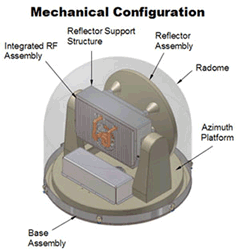
The TriPoint RF Ku/ka band uses full-motion, remote controlled terminal to offer high-bandwidth voice and data communications over satellite. The terminal is designed as a ruggedized package, for use by military forces, mounted on a wide variety of tactical vehicles. Operating at Ku-band or higher frequencies, the system can provide data rates as high as 512 kbps.
TRC 5010 Personal Role Radio
Produced by Thales, The TRC 5010P is a Personal Role Radio (PRR) designed for inter-squad communications and urban warfare. The lightweight (150 gr) radio set is operating in the 420-450 MHz UHF frequency band offering short range communications – 150 m in urban areas and up to 800 m in open terrain. The system has 20 pre-selected channels and has special features to enable intra-squad communications, including a squad leader pre-emption capability. The unit is operated by a remote finger PTT or by pushbuttons placed on the radio itself. A specially designed lightweight headset are provided for the system, for added Autonomy. The radio can operate for 16 hours with NiMH rechargeable battery or for more than 24 hours, with standard high power AAA alkaline cells. Low cost system
Commander’s Digital Translator
Phraselator is a truly mobile PDA based translator which can be used by foot patrols and combat teams, developed by VoxTech. The system uses a Intel XScale 400 PXA255 processor running Windows CE powered pocket PC, loaded with 1,000 spoken English phrases and their local language equivalents. US troops in Afghanistan and Iraq have used this device for humanitarian assistance, in medical, security, travel, and law enforcement assignments.
Another translation application adapted to combat use is the Forward Area Language Converter (FALCon), an Optical Character Recognition and machine translation system integrated on a portable computer (laptop PC) for translation foreign languages documents. the system was designed and developed by the Army Research Laboratory, based on National Security Agency (NSA) know-how. It provides the Military Intelligence Community a quick and reliable way to translate and analyze captured documents. FALCon can translate up to 47 languages including Arabic and Asian languages and is being used in both Iraq and South West Asia.