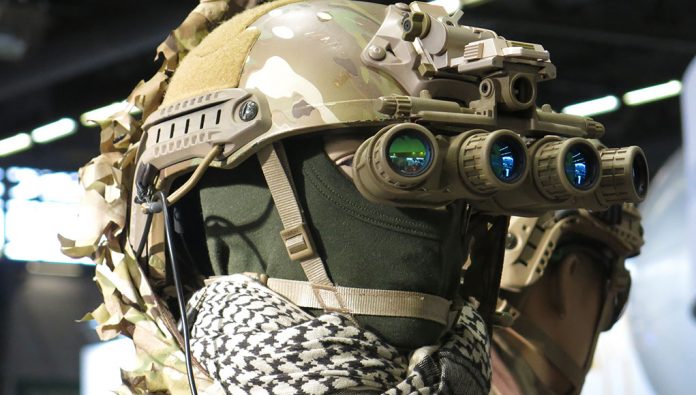
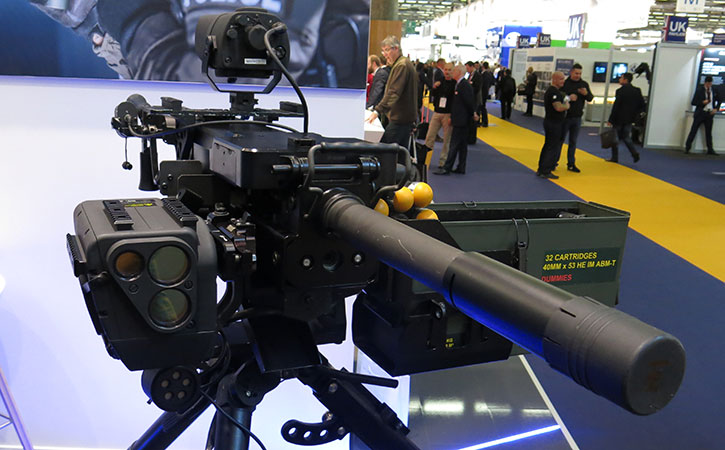
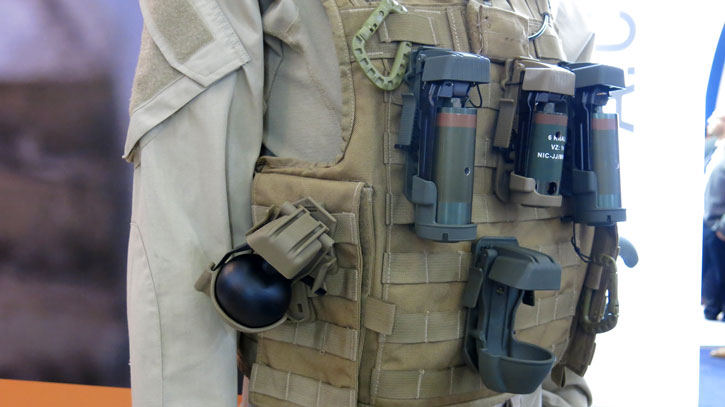
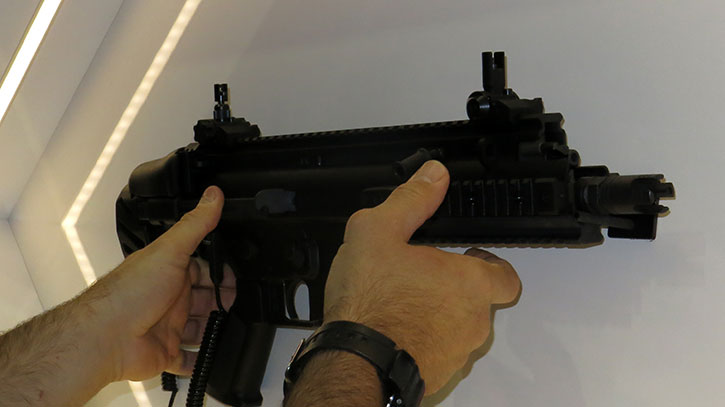
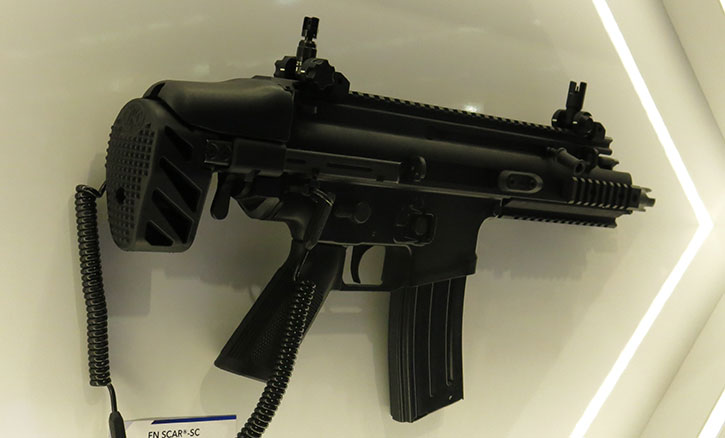
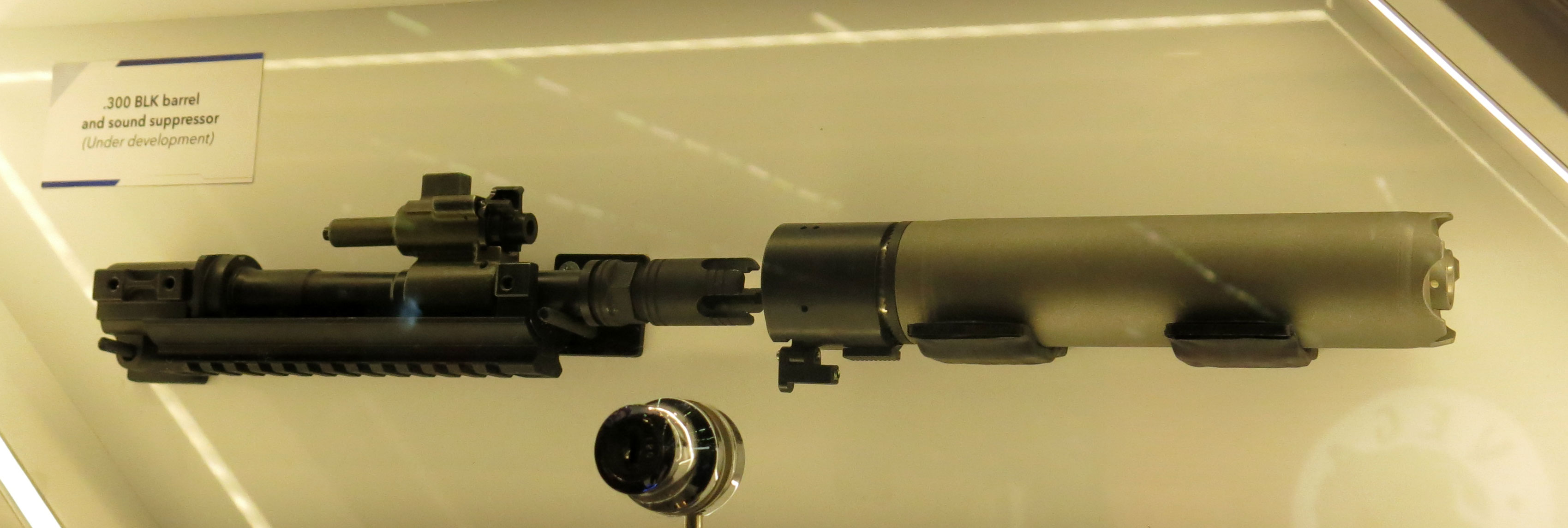
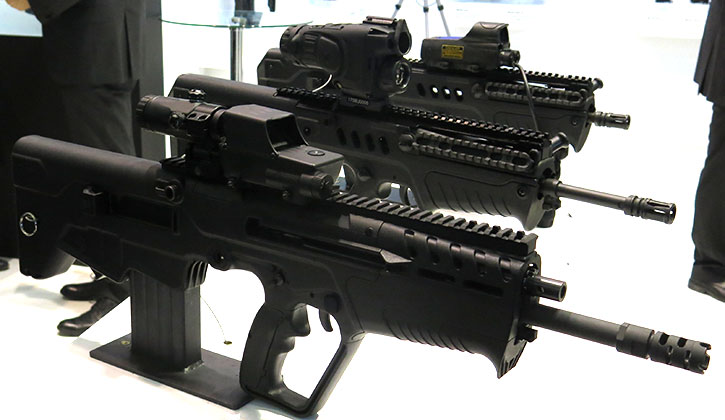
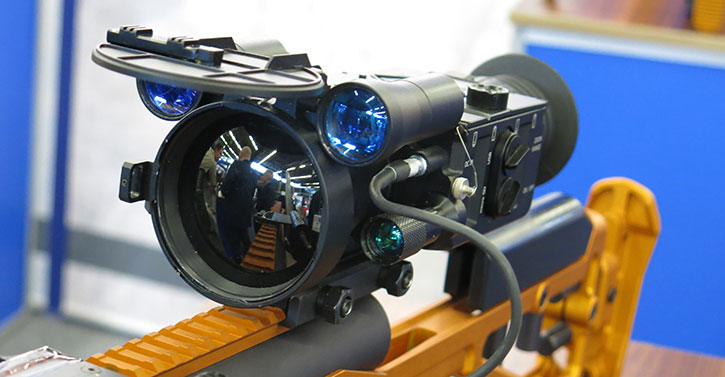
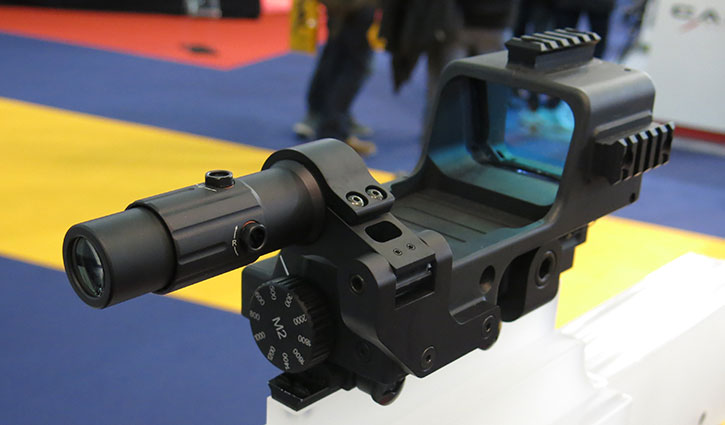
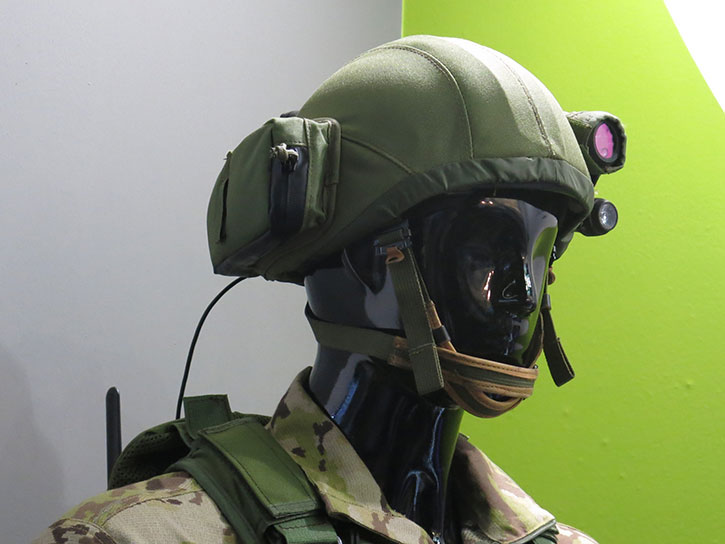
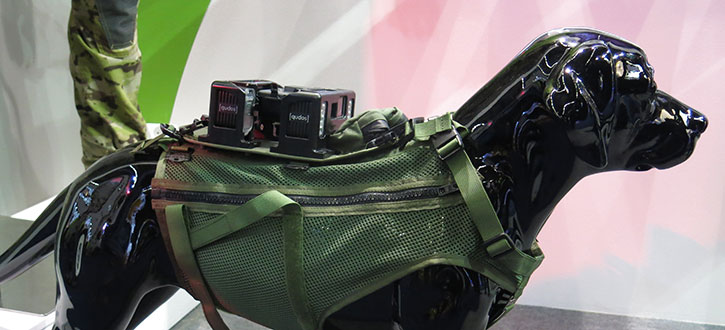
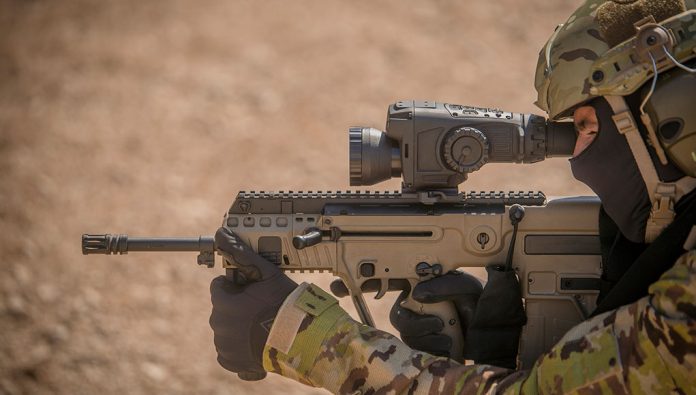
The German gun manufacturer Heckler & Koch has recently delivered the first batch of HK416F 5.56x45mm assault rifles to the French Army. The new gun was chosen to replace the French FAMAS weapon which has been in service since the late 1970s. France intends to buy more than 102,000 rifles for the Army, Navy, Air Force and Special Forces, under the under the future personal weapon program worth €168 million (U.S. $184 million). The contract also covers the procurement of 10,767 grenade launchers The rifles in the photo are designated the future sidearm or “Arme Individuelle Future (AIF)”. The HK416F-S is shown above, with a 14.5 inch and the HK416F-C, with an 11-inch barrel, below. Both were displayed at MILIPOL 2017. The HK416 is also in service with the Norwegian military. Photo: Tamir Eshel, Defense-UpdateRheinmetall displayed at MILIPOL 2017 an Automatic Grenade Launcher set with a fire control (with a rangefinder, ballistic computer), driving a display on the gunner’s sight above the weapon. Below the sight, IR setter can be seen. It communicates with the time fused grenades, upon firing, to create the airburst effect. Photo: Tamir Eshel, Defense-Update.Rheinmetall’s 40x53mm Airburst Munition (ABM) grenades loaded into an Automatic Grenade Launcher. Photo: Tamir Eshel, Defense-UpdateThe trigger pouch developed by ACS is designed to maintain grenades in a safe, yet quick to handle body mount. the trigger pouch is compatible with M-26/M-67 fragmentation grenades, Rheinmetall flash-bang, CTS/CTI mini Grenades and Safariland low roll II grenades. Photo: Tamir Eshel. Defense-UpdateFN SCAR rifles are known as the weapon of choice used by the US Special Forces. The new SCAR-SC 5.56x45mm (.223) caliber carbine offers an extremely compact design matching the requirements of homeland security operations. The weapon has semi-auto only or selective fire capabilities, non-reciprocating charging handle and a wide range of add-ons. This includes a red dot sight, tactical light, a variety of foregrips and a sound suppressor. Photo: Tamir Eshel, Defense-Update. Technical Specifications: Length: 536mm (21.10”) when fully retracted / 653mm (25.71”) when fully extended Weight: approx. 3.150 kg (approx. 6.94 lb) Barrel length: 190.5mm (7.5”) Magazine capacity: 30 rounds Cyclic rate of fire: 550-650 rounds per minuteFN SCAR-SC Unveiled at MILIPOL 2017 comes with a telescopic buttstock as standard. Optional buttstocks include fixed, foldable, adjustable (length and height) with either concave or convex butt plate and a foldable offset buttstock for aiming and shooting with anti-riot or bulletproof helmet visor. Photo: Tamir Eshel, Defense-Update.FN is developing a sound suppressor for the SCAR-SC subcompact carbine. Photo: Tamir Eshel, Defense-Update.New versions of the Tavor assault rifles equipped with three of the latest sights from IWI’s sister company Meprolight were on display at MILIPOL 2017. At the front, the 7.62X51mm TAVOR 7 assault rifle. It is seen here fitted with the new M5 Red Dot Sight, with a Bullseye reticle, that allows extended operating time while using a large display window. The second AR is the 5.56x45mm Tavor, fitted with the MYX200 multi-spectral sight. The third is the X95 equipped with the MEPRO MOR, a reflex sight combined with tritium sight and a green or red laser pointer, used primarily by special forces. Photo: Tamir Eshel, Defense-Update.
Meprolight unveiled at MILIPOL 2017 three new sights for assault weapons. The MOR red dot sight, seen at the front, NYX200 in the middle – a multi-spectral thermal sight that combines a day or night channel, laser rangefinder and ballistic computer that compensates the aiming solution based on one of for four ballistic tables adapting the sight to individual weapons. The third device is MOR, combining a tritium light source and green or red laser aiming light into a single device. Photo: Tamir Eshel, Defense-Update.ODINN Mk2 60 multifunction robotized thermal sighting system from IR&D is a weapon sight combining target acquisition, range and atmospheric parameters measurement, and full ballistic calculation and wind compensation forecast. The sight is powered by a compact LINUX based computer providing ballistic computation and location (GPS based) measurement. OFDINN weighs 850 grams without batteries. The device can operate for four hours on four lithium/lithium-ion batteries. The range measurement is performed at ranges of 6 to 2,000 meters. Photo: Tamir Eshel, Defense-Update.The Machine Gun Reflex Sight (MGRS) is a non-magnified optical sight that mounts to machine the M2 heavy machine gun or M240 machine gun. The sight provides rapid target acquisition and engagement that allow the gunner to keep both eyes open from a natural shooting position. Accuracy is enhanced by using machine gun range dials that set range ballistic tables to ranges up to 2000 meters.The x3 flip-to-the-side magnifier enables the gunner to achieve one shot accuracy at long range. Photo: Tamir Eshel, Defense-Update.Bertin’s FusionSight combines a low light color and thermal vision cameras that can be used separately or in a ‘smart fusion’ mode. This vision system is useful to unveil objects hidden under camouflage, as well as IEDs. Photo: Tamir Eshel, Defense-UpdateRevision displayed its future Sensys line of helmet-mounted near-eye displays, providing the warfighter with intelligence and real-time information. Photo: Tamir Eshel, Defense-UpdateNVISOL offers a combat headcam kit combining a camera, illumination and energy pack, and video transmission relaying real-time surveillance video captured as the soldiers move on patrol. Photo: Tamir Eshel, Defense-UpdateSimilar to the combat camera used in the soldier’s headgear, the NVISOL K9 combat camera is fitted into the dog harness, as a kit including the forward and back view cameras, power pack, and radio. Photo: Tamir Eshel, defense-Update.
The combination of thermal channel and digital day camera (DDC) enables the soldiers to use the sight for both day and night operation, eliminating the need to change sights/devices between day and night, and allowing soldiers to move between dark and light environments, such as entering dark places also during daytime. Photo: Meprolight
The sight’s digital night vision is optimized for Close Quarters Battle (CQB), face recognition. Photo: Meprolight
Warfare in complex terrain demand soldiers to be prepared to operate in open areas and enclosures, in the higher levels of the built-up urban area, or in the underground. The varying scenes are demanding not only to the warfighter but to the sensors used for situational awareness and targeting.
To be able to cope with different situations, and maintain readiness and fighting ability on missions that may span daylight and night time, soldiers often carry multiple sighting systems suitable for each scenario. Additional equipment means more carrying weight and space for devices and the energy they consume, and the cost for redundant sensors.
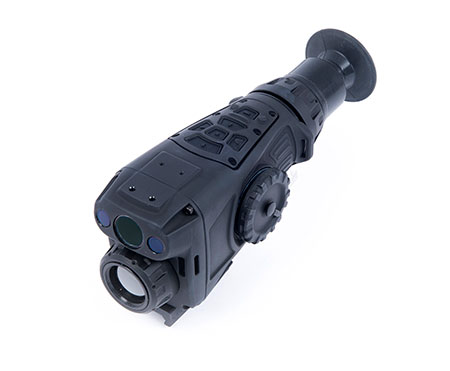
Electro-optics sight expert Meprolight is introducing the MEPRO NYX-200 at the Milipol exhibition taking place in Paris this week. The device is designed as weapon mounted or handheld ‘all in one’ sighting system that offers military users a common, multi-spectral EO weapon sight that combines an uncooled thermal channel with a sensitive, high-resolution digital day/night camera to provide the user effective situational awareness under all visibility conditions, including total darkness encountered in operations underground.
The new multispectral NYX-200 is available in two configurations: the thermal channel with digital night camera or thermal channel with digital day camera. The main channel is the thermal one, using a 640×480 microbolometer core sensor based on 17-micron pixel size technology for high resolution. The secondary channel comprises a low-light camera or day camera, with 1280×640 resolution. The sight is available in two versions, the x1 magnification weighs about 750 grams or an x2 magnification, weighing about 900 grams. NYX200 can run for up to seven hours on four AA batteries.
In addition to the vision channels, the device also includes an infrared pointer and digital video recorder to improve team coordination and post-mission debriefing. “This solution replaces at least four different systems currently carried by the average soldier.” Assaf Shimron, CEO of Meprolight said.
The combination of thermal channel and digital day camera (DDC) enables the soldiers to use the sight for both day and night operation, eliminating the need to change sights/devices between day and night, and allowing soldiers to move between dark and light environments, such as entering dark places also during daytime.
The combination of thermal channel and digital night camera (DNC) enables enhanced situational awareness with a maximum view at any level of darkness in any environment. The thermal channel can be used in total darkness and through the fog, camouflage, etc. The sight’s digital night vision is optimized for Close Quarters Battle (CQB), face recognition, and more.
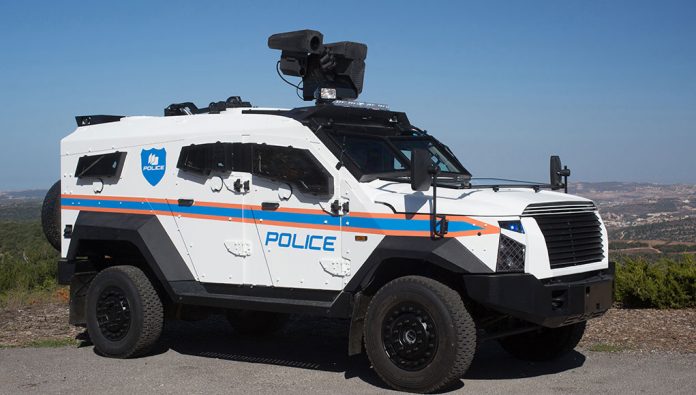
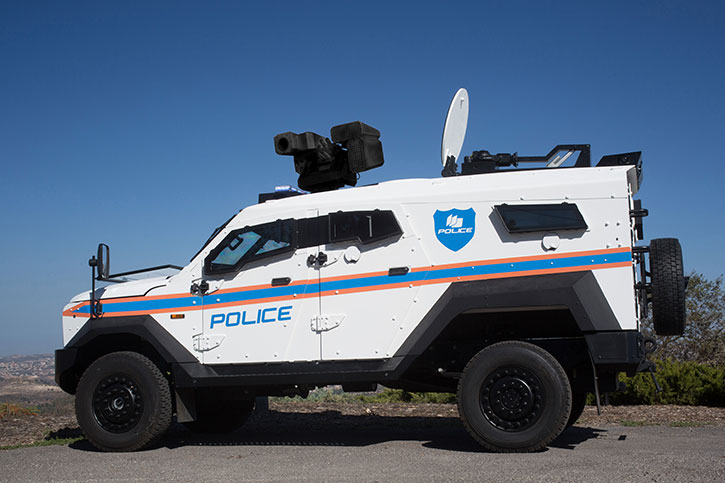
The SandCat can stop threats including AK47 7.62x39 AP and Dragunov 7.62x54 AP. Its floor protects against two DM51 hand grenades. Photo: Plasan
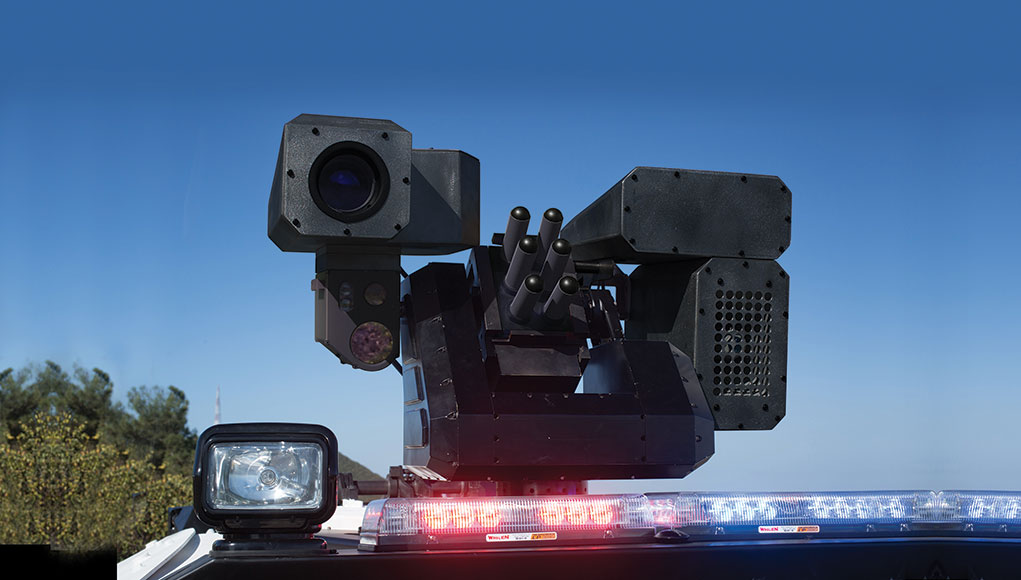
The SCAT is a roof-mounted Non Lethal RCWS integrating day and night Imaging systems, command and control system, dazzler, multi-shot 40mm smoke/gas grenade launcher, Long Range Acoustic Device (LRAD). The system also has an optional mount for 7.62/5.56 mm machine gun. Photo: Plasan
Plasan showcases a new variant of its Sandcat Stormer armored vehicle designed as an SUV for police, anti-terror/anti-riot rapid response, and security forces. The vehicle is equipped with remotely controlled overhead sensor and weapon system dubbed ‘SCAT’, designed specifically to address violent crowds using non-lethal means.
Designed to operate in violent, yet low-intensity conflict, SCAT facilitates effective crowd control by precise and proportionate measures, preventing civilian casualties, and with no risk to the system operators. The system is designed as a roof-mounted RWS integrating non-lethal effectors and day and night Imaging systems, command and control system, dazzler, multi-shot 40mm smoke/gas grenade launcher, Long Range Acoustic Device (LRAD), and optional 7.62/5.56 mm machine gun.
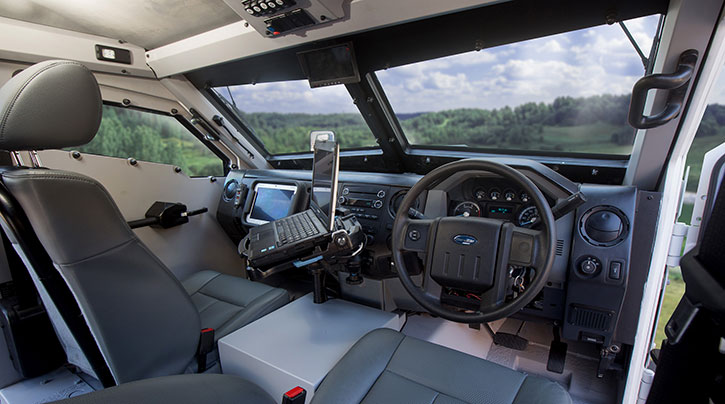
Plasan SandCat Stormer is the lightest tactical armored vehicle providing such a high protection level. It is designed to serve in various mission profiles requiring a highly maneuverable and protected vehicle, such as urban law enforcement, peacekeeping, homeland security and border patrol. It has a low cost of ownership by using a reliable commercial Ford F550 Super Duty chassis with a powerful engine and four-wheel-drive and staying safely within the Ford certified GVW. The armored cabin comfortably accommodates up to 10 passengers with great attention to the design and ergonomics to allow the team to fulfill their missions safely.
The SandCat optimizes between protection, payload, and cost, by using composite materials to defeat threats once only encountered in war zones, but now seen in attacks on city streets. This includes B6/B7 protection + AK47 7.62×39 AP + Dragunov 7.62×54 AP, a floor protected against two DM51 hand grenades, and more.
The vehicle is available on left or Right Hand Drive (RHD) configurations. The company plans to unveil the new variant at the upcoming MILIPOL exhibition in Paris, France.
At MILIPOL 2017 Plasan is showing the Sandcat anti-riot/anti-terror variant in Right Hand Drive configuration.
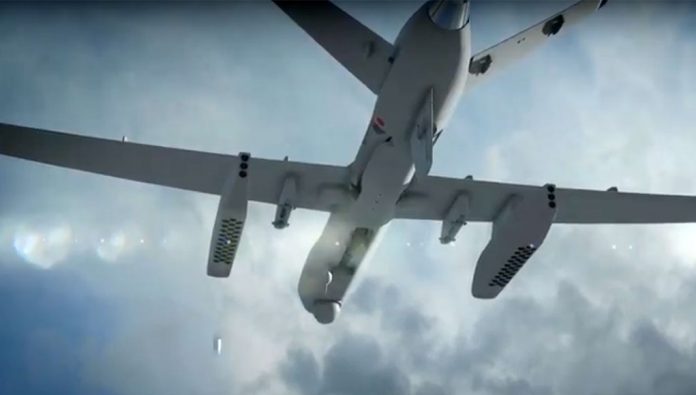
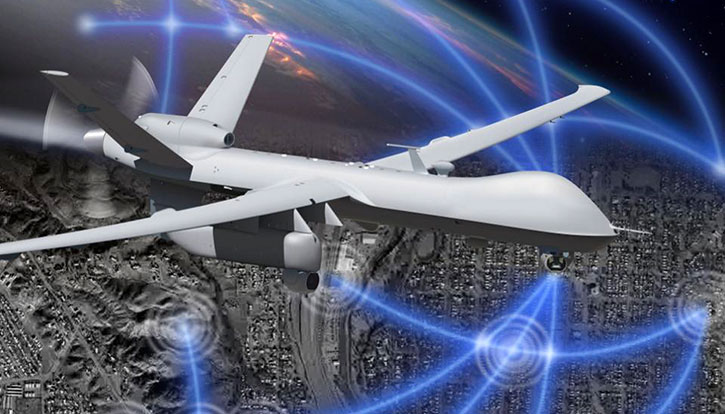
A simulation showing an MQ-9 drone dropping miniature sonobuoys on an Anti Submarine Warfare mission. Photo: Ultra Electronics
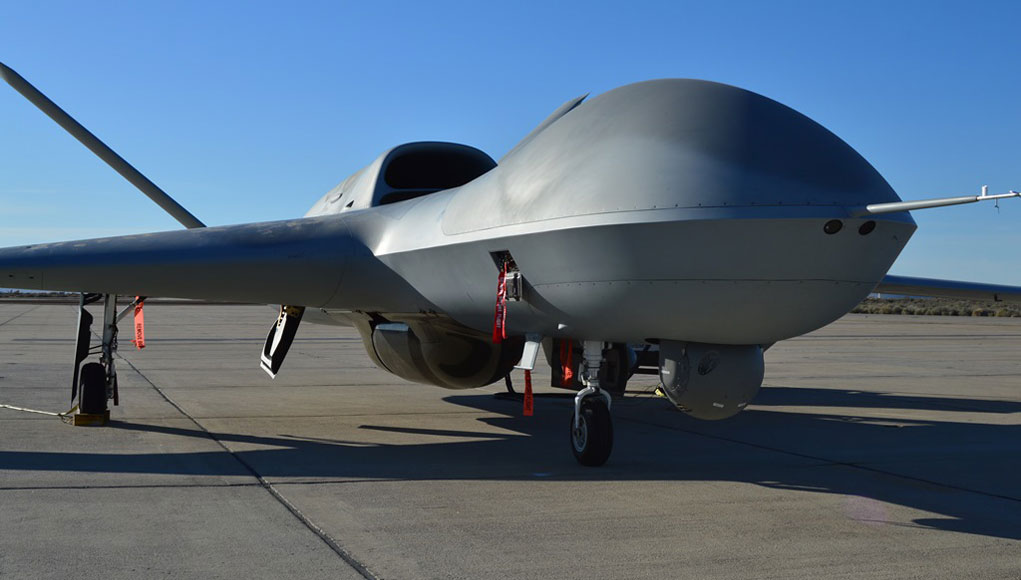
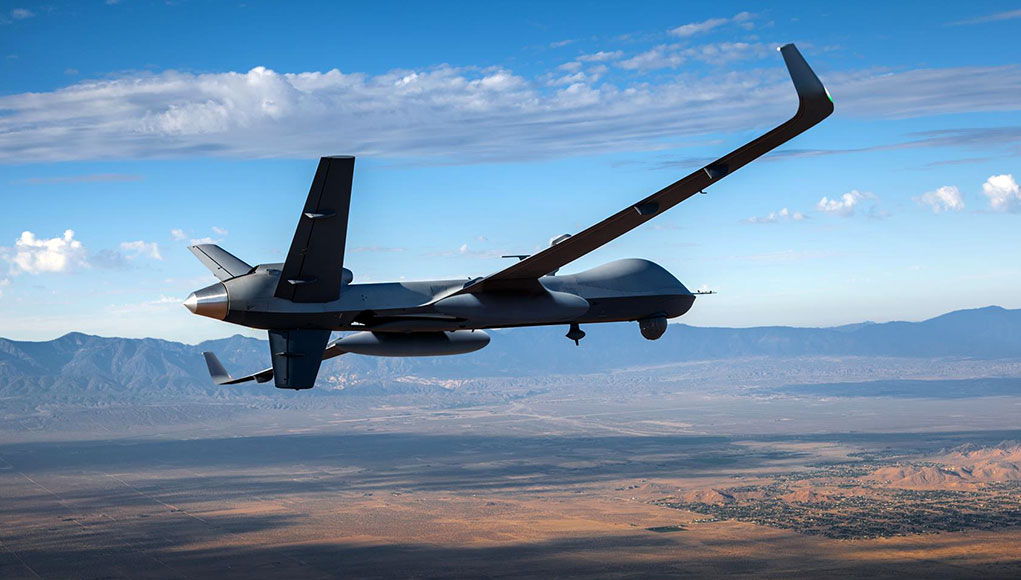
The remote detection and tracking of submerged contacts, such as submarines, was demonstrated using an MQ-9 Predator B Remotely Piloted Aircraft (RPA) during a U.S. Naval exercise on October 12th. The flight test was conducted over the Southern California Offshore Range (SCORE) west of San Clemente Island. General Atomics Aeronautical Systems, Inc. (GA-ASI) participated in this successful demonstration of new maritime patrol capabilities that included anti-submarine warfare. The test demonstrated the ability of medium altitude, long endurance drones such as the MQ-9 Reaper to detect submarines and provide persistent tracking of submerged targets.
On this demonstration, sonobuoys were deployed by U.S. Navy helicopters and acoustic data gathered from the sonobuoys were used to track underwater targets. The data was transmitted to the MQ-9 and processed onboard, then relayed to the MQ-9’s Ground Control Station (GCS) several hundred miles away from the target area.
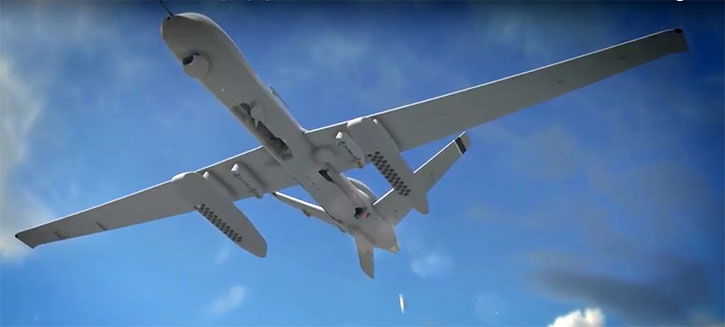
The event successfully paired sonobuoy receiver, supplied by Ultra Electronics, and data processing technology, provided by General Dynamics Mission Systems-Canada, onboard the MQ-9. A track solution was calculated and transmitted from the aircraft to the Ground Control Station (GCS) via SATCOM. This technology will provide long-range patrol and relay capabilities to the MQ-9 to augment maritime mission sets. Ultra Electronics has also developed special pods enabling autonomous deployment of sonobuoys by the drone itself, enabling naval forces to cover larger sea areas more rapidly.
On this mission the MQ-9 also demonstrated maritime surface surveillance functions, using the Lynx Multi-mode Radar operating in the Maritime Wide-area Search (MWAS) mode, designed to detect maritime surface targets over a wide area, employing Inverse Synthetic Aperture Radar (ISAR) for surface target classification. The aircraft’s Electro-optical/Infrared (EO/IR), high-definition Full-motion Video (FMV) camera also supported the identification of surface vessels. These sensor contacts are correlated with the Automatic Identification System (AIS) to verify target identity. Additionally, the MQ-9 can be fitted with a centerline pod that can house a longer-range, 360-degree field of regard maritime surface search radar for enhanced surveillance over water.
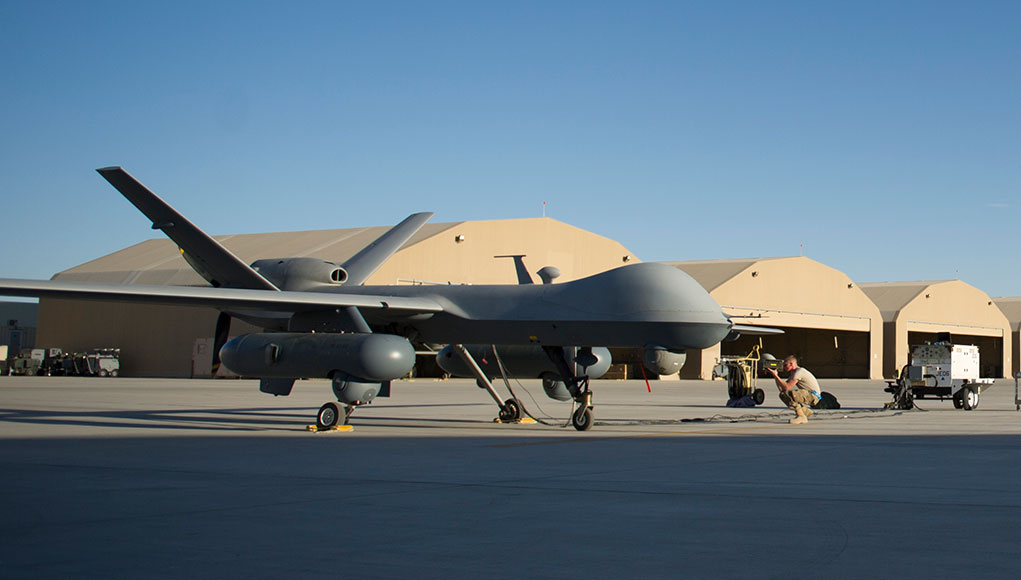
The MQ-9 drones are employed primarily on missions over land, with a special configuration known as Guardian designed for maritime missions. The recent test employed a standard Predator B configured with avionics and sensors to meet the maritime and anti-submarine mission.
Ultra Electronics has also developed special pods enabling autonomous deployment of sonobuoys by the drone itself, enabling naval forces to cover larger sea areas more rapidly. Photo: Ultra Electronics
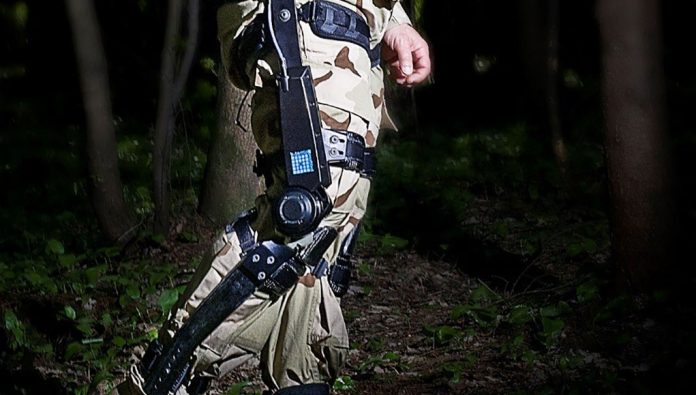
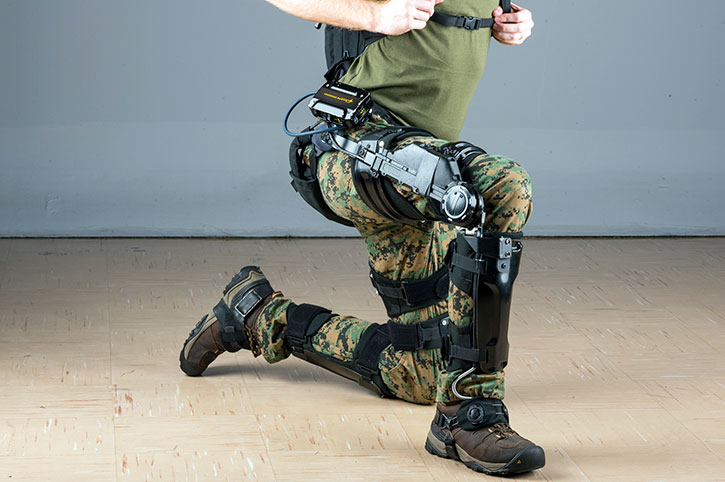
The Knee Stress Relief Device (K-SRD) system assists its wearer in completing repetitive or physically demanding tasks, such as repetitive or continuous kneeling or squatting, walking with load, walking up or downhill, and using stairs while carrying loads. Photo: D-TEMIS.
A recent study conducted by the University of Michigan Human Neuromechanics Laboratory suggests that motion assisting exoskeleton utilizing the Knee-Stress Relief Device (K-SRD) can help battle-equipped soldiers to better perform in inclined terrain. K-SRD is part of the FORTIS system, the latest exoskeleton developed by on inclined terrain.
The independently funded study held by the University of Michigan indicated that K-SRD consistently decreased the cost of transport of walking up an incline with a load. Through the study, four trained participants used the exoskeleton carrying 40-pound backpacks while walking at various speeds on a treadmill inclined to 15 degrees. The tests results show all participants conserved energy using the K-SRD, reducing overall exertion.
“The study results show K-SRD’s potential to increase mobility for dismounted troops,” said Keith Maxwell, exoskeleton technologies program manager at Lockheed Martin Missiles and Fire Control. “By reducing the effort in walking and climbing, there’s less fatigue. This technology can literally help our fighting men and women go the extra mile while carrying mission-essential equipment.” More testing is anticipated and will be expanded to reflect urban scenarios, including ascending and descending stairs with weight to assess the potential for first responders.
Built of a combined assembly of rigid and flexible elements K-SRD employs sophisticated sensors and motion algorithms to predict and assist the wearer’s motions. Photo: Lockheed Martin
K-SRD uses Dermoskeleton technology licensed from Canadian developer B-TEMIA. The system assists its wearer in completing repetitive or physically demanding tasks, such as lifting or dragging heavy loads, holding tools or equipment, repetitive or continuous kneeling or squatting, walking with load, walking up or downhill, and using stairs while carrying loads.
Built of a combined assembly of rigid and flexible elements K-SRD employs sophisticated sensors and motion algorithms. The system understands and predicts user motions, particularly in repetitive movements on inclined terrain. According to Maxwell, soldiers that tested the system could run, climb and squat, take cover, crawl and change position like combat soldiers do. The system assists troops in most situations, but if required, it can be turned off with a flip of a switch.
The powered assistive device uses a robotized mechatronic structure to generate computer-controlled active support to the lower extremities to counteract overstress on the lower back and legs and provide additional power to the knee. The lightweight and flexible device is sized and integrated with combat fatigue and individual equipment systems worn by the user.
The K-SRD does not initiate any movement but waits for the user’s lead. Once the user makes the first move, the device assists according to the activity, relieving stress from the knee or by generating additional biomechanical energy on the lower extremities. The system includes a controller box that contains sensors that collect information about the user’s body’s kinematics and the kinetics, software that recognizes the user’s mobility intentions and actuators that transfer biomechanical energy to assist those motions. The system is powered by a lithium-polymer battery.
Exoskeletons are part of the Pentagon’s Third Offset Strategy, which seeks to use robotics and artificial intelligence to enhance humans on the battlefield, rather than to replace them. The U.S. Army and Marine Corps are seeking new solutions to lighten the loads carried by soldiers, or otherwise, augment the human ability to carry heavy loads using robotic mules or exoskeletons.
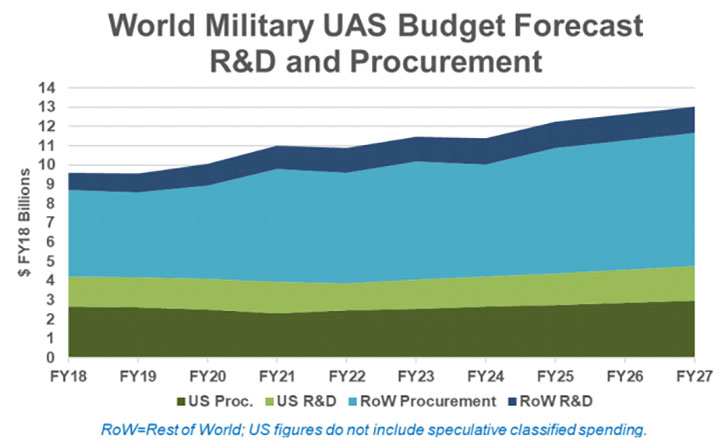
Unmanned Aerial Vehicles (UAVs) will be the most dynamic growth sector of the world aerospace industry this decade, more than tripling in the next decade, a new market research by the Teal Group predicts. According to Teal analysts, the soaring demand for the next generation of unmanned combat aerial vehicles (UCAVs) and worldwide military adoption of Remotely Piloted Aircraft Systems (RPAS) are two major factors driving this growth. The study reflects the rapid growth of interest in the UAV business by covering almost 60 U.S., European, Asia-Pacific, and Israeli companies, and reveals the fundamental reshaping of the industrial environment as UAV technology proliferates worldwide.
Teal Group’s 2017 market study estimates global spending within the next decade at over $100 billion. UAV production will more than double, from current worldwide annual UAV production of $4.2 in 2017 to $10.3 billion in 2026, totaling a spending of $80.5 billion in the next ten years. Military UAV research spending would add another $26 billion over the decade.
“The UAV market continues to soar,” said Philip Finnegan, Teal Group’s director of corporate analysis and an author of the study. “Increasing trade in costly high-altitude, long-endurance systems, demand for armed UAVs, the development of the next generation of unmanned combat systems, and potential new applications such as missile defense continue to drive the market.”
“The Teal Group study predicts that the U.S. will account for 57% of total military worldwide RDT&E spending on UAV technology over the next decade and about 31% of the military procurement,” said Teal Group senior analyst Steve Zaloga, another author of the study. The larger, higher value systems procured by the United States help drive the relative strength of the US market over the decade, but other areas such as Asia-Pacific are growing more rapidly.
Apart from the U.S., Asia-Pacific represents the second largest market, followed by Europe. In contrast, Africa and Latin America are expected to be modest markets for UAVs.
As part of the market coverage, the study estimates the demand for payloads will more than double in overall value from $3.6 billion in FY17 to $7.5 billion in FY26. Steady growth will occur in the “default sensor” EO/IR market, following up-and-down funding in recent years as several legacy endurance UAV sensor programs ended. Teal forecasts a near-term rise from $1.17 billion in FY17 to $2.0 billion in FY22, led by funding for adding U-2 sensors to Global Hawk, by HD upgrade programs for Reapers and Gray Eagles, and by new production for classified UCAVs and mini/nano-UAVs.
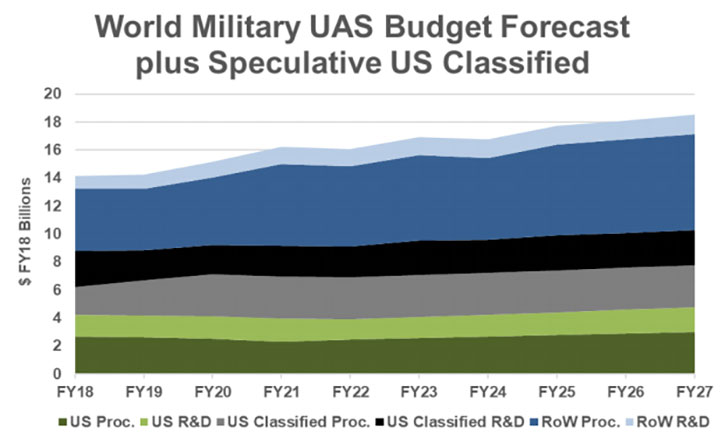
UAV payloads including Electro-Optic/Infrared Sensors (EO/IR), Synthetic Aperture Radars (SARs), SIGINT and EW Systems, and C4I Systems. According to Dr. David L. Rockwell, Teal’s lead electronics analyst, many of these payloads fall under classified programs that are rarely covered in market reports. Over the next decade, these programs will add up to $30 billion that will make up more than half the UAV sensor market.
“It is vitally important to forecast these programs, as they make up more and more of the available market, even though they are in none of the documents or online sources.” Rockwell said, adding that speculative ‘available’ forecasts – totaling more than $30 billion for payloads through FY26 – are intended to give early warning of programs that are not yet in DoD budgets or under public discussion. “We’ve put this together through my 23 years at Teal Group, and it’s just not available online.” Rockwell concluded.
Along with EO/IR, comprehensive coverage of the sea change in the radio frequency (RF) market also is included, with UAV radars forecast to grow from $825 million in FY17 to $2.1 billion in FY26, and SIGINT and Electronic Attack (EA) markets to grow from $750 million to $1.7 billion (with a 27.7% EA CAGR from FY17 to FY22 to begin major UCAV systems). The emphasis on – and funding for – different sensor types is already changing as geopolitics evolve back to A2/AD threats and near-peer opponents in Asia and Eastern Europe, according to Teal’s study.
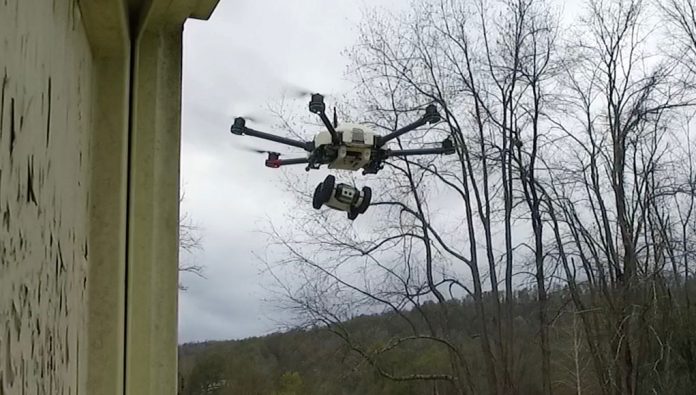
An IRIS mini-UGV dropped by a multirotor drone. Tis combination dubbed 'Rooster' is designed to enable small robots to 'hop' and deploy quickly to sites where they can carry their missions. The airborne segment can maintain overwatch, assist in communications support and retrieve the robot upon mission completion. Photo: Roboteam
For the long-term, as machines become intelligent and autonomous, human-machine and machine-machine teaming will become the norm in military operations, a trend that military planners already address in their forecast, research and development roadmaps.
Robotic platforms already team to cooperate on specific missions, such as surveillance indoors, where groups of ground vehicles and aerial robots cooperate on a common goal to scan an indoor space as quickly as possible using the least number of assets and time. Similar cooperation begins to appear in certain search and rescue operations. These applications highlight efficiency and are suitable primarily for security, intelligence gathering, surveillance and reconnaissance (ISR) missions on the military, homeland security and civilian applications.
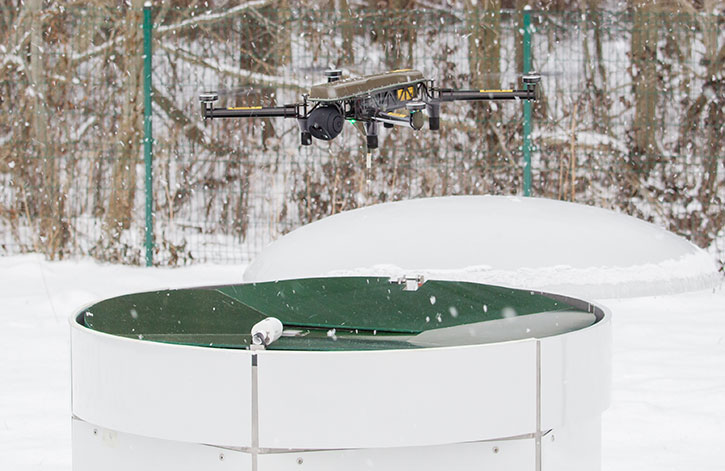
Multirotor drones are not too efficient in energy consumption, and their endurance is often measured in minutes. When persistence is a requirement, swarm operations can rely on rapid power replenishment in the field, in the form of autonomous rapid charging pads or docking stations scattered in the area. Such products are already available commercially, for example, from the German company SkySense, Estonian Eli Airborne Solutions and Israel’s Airobotics.
In addition to charging pads that can rely on solar panels, these companies provide ‘droneports’ or docking stations that contain a charging pad and shelter, enabling storage of the drone in high readiness under all weather conditions. A different concept recently demonstrated in testing is D-NEST, developed in Israel by SafeNet. D-NEST is a rapidly deployed landing mat that is equipped with localization, communications, and electrical charging elements – all necessary to sustain continuous drone activity in rural or urban areas. The system is foldable, carried by a single person and can be deployed in minutes on a flat surface or a roof and is able to autonomously support any drone compatible drone, thus relieving soldiers from the need to exit a protected location to service those drones. Such system would be highly suitable for operation in an urban war zone is, where the forces require constant UAV support that often exposes drone operators in the open area.
Another concept being explored by the US Marine Corps is the deployment of a robotic unit acting as an organic element with the platoon. The Study of Autonomy prepared in 2016 by the Defense Science Board recommended that such drone ‘squadrons’ will comprise between 10 and 40 aircraft of several different types: Some will carry sensors (visual, thermal, or even acoustic are suggested), some will have jamming or communications payloads, others will carry weapons. Using EW payloads carried closer to their designated targets, drones will be able to deploy jammers, spoofing transmitters, and digital radio frequency memory (DRFM) transceivers closer to the enemy, becoming powerful electronic attack weapons.
Such units will leverage the drone’s autonomous capabilities to support the platoon without relying on specialist operators controlling the drones. Operators will interface with the drones using standard tablets or smartphone like devices, or by hand gestures or voice commands. The drones will share the blue force tracking (BTF) network to maintain situational awareness of the battlespace, they will perform routine surveillance and overwatch, to deliver breaking alerts to the squads that could be threatened. In addition, warfighters would have access to relevant video streams or request certain services. Drones that will be armed with weapons could be ordered to prosecute targets under human supervision. However, for all remaining tasks they will be autonomous, and may not be in constant communication with the operator or each other, thus they can work where communications are jammed or intermittent.
Such squadron would be launched at the start of a mission and would remain overhead until it was completed, therefore, such aircraft should be able to loiter overhead up to 12 hours on a shift. In practice, individual drones could be replaced by fresh ones, while those low on juice return to replenish. Such a method could maintain persistence over the battlespace practically indefinitely According to the report, a three-person ground crew should be enough to launch, recover, refuel and re-arm the drones.
Drones could be operated individually or as cohesive formations – or “swarms”. The report emphasizes that the swarm should be omnipresent and able to respond instantly without the usual delay associated with calling up air support. In fact, the first the squad members may know about a threat is when the drones alert them to its presence and request permission to engage. Other types of action, such as jamming or spoofing enemy communications, may be entirely automated. Autonomous UAS support will provide immediate response to unit ISR, EW, and strike needs. In addition to these core capabilities, heterogeneous autonomous UA can further improve unit effectiveness by providing blue force communications, PNT, and blue force tracking.
Heterogeneous autonomous UAS squadrons that are capable of performing missions without reliable communications will enable missions in denied environments or when stealth requires a communications blackout. The drone swarm will be able to maintain a resilient command and control network facilitated by the use of an ad hoc, delay and disruption tolerant network that will allow each UAS to work with local cliques of peers and users when end-to-end connectivity is unavailable, and to use temporary local communications links to coordinate asynchronously. Such service will also share a common operating picture in an asynchronous, ad hoc and decentralized process enabling sensor fusion and delay tolerant information exchange.
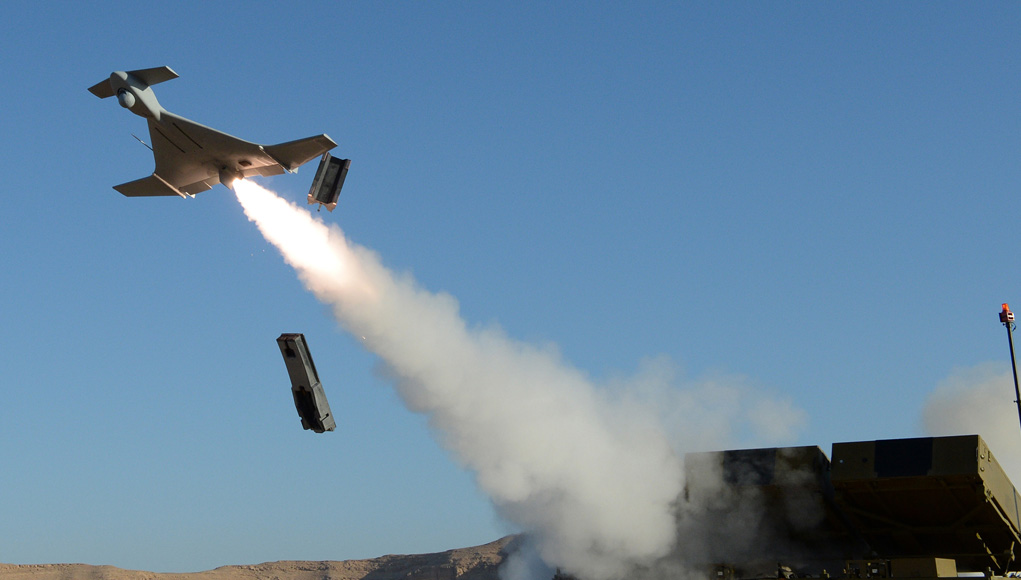
IAI’s Green Dragon is a loitering weapon launched from canisters mounted on board land vehicles or vessels. Each platform carries multiple launchers. The weapon functions as a drone for the majority of its mission, and transforms into a missile by operator command, once a target is detected. Photo: IAI
Launched and recovered from a central base or ship, 10 to 40 medium-sized heterogeneous, autonomous UA could provide a persistent cover to small units operating over large areas. The UAS squadron would provide services to line units on patrol or locate in forward outposts, at speeds unattainable by human-piloted aircraft by accepting tasking from and providing services directly to the frontline user.
Other applications using a large number of drones exploit the overmatch such swarm offer over a conventional adversary. While people often think about swarms as simply being large collections of robots, swarms, in fact, have five defining characteristics: number, agent complexity, collective complexity, heterogeneity, and human-swarm interaction.
Swarms could employ many identical drones (homogeneous swarms) or different types of vehicles (heterogeneous drone swarms), in which individual robots carry out different roles – pathfinder, sensor, communicator, leader, and striker. Each member of the swarm has basic intelligence and collaboration, with a standard set of skills or specific ones, in heterogeneous swarms, of role-playing robots.
SWARMs consist of mini-robots that operate autonomously, where missions are lead either by some of the drones or under human supervision. Launching such a drone swarm is an operational challenge that requires specially prepared logistics – using airborne dispensers, cargo munitions, launch tubes from surface launchers or subterranean or undersea launchers. Once the drones are airborne, they should be able to execute their mission as quickly and efficiently as possible, given the limited energy resources they have on board. Harnessing the swarm to carry out missions under an operational plan is a major challenge currently explored in series of ‘Swarm Challenge’ wargames managed by DARPA, the US armed forces, research and academic institutions.
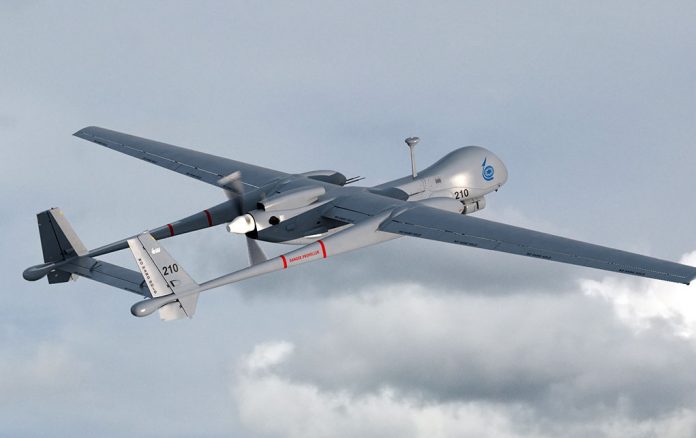
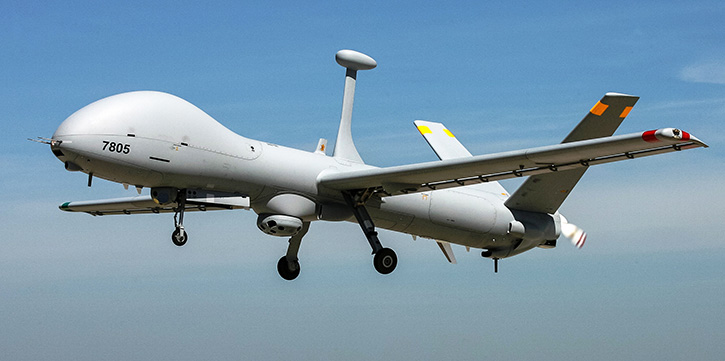
The Israel Air Force is operating the turboprop powered Heron TP as its largest UAS. As other aircraft of its class, this large, highly capable aircraft is required to be equipped with self protection systems that would secure its freedom of operation in contested airspace. Photo: IAI
The freedom of action that characterized drone operations in the past decades is diminishing quickly, with the introduction of advanced electronic warfare techniques, communications jamming, and counter-UAV capabilities. The air forces that pioneered the use of UAVs in the 1990s and early 2000s have already experienced adversary exploitation of unprotected datalinks, which lead to failure of combat missions and loss of lives.
Military planners assume the current generation of unmanned systems would be unable to carry out the missions they are now performing in uncontested environments. Therefore, major changes are needed in current UAs, to prepare them for operations in anti-access and area denied (A2/AD) environments. Such changes attribute to three principal areas:
Integration of protected, more robust navigation aids, hardened datalinks, and smarter autopilots would prepare UAS for operation in contested airspace, but it will not make them survivable against anti-access enemy assets such as advanced surface to air missiles (SAM) and hostile fighters.
Drones must transform to be able to survive and function in such high threat environment. They must be stealthy, much more autonomous, and operate either as from standoff range or as expendable or redundant systems. Following are some of the improvements considered to enable future drones to survive and succeed in the A2AD environment:
Sensors Unlimited’s SYRES family MS-177 EO/IR multi-spectral reconnaissance payload was installed on General Atomics (GA-ASI) ‘Predator C’ Avenger stealthy drone for flight tests in January – February 2016. Photo: GA-ASI
Stealth
To survive in denied access airspace, aerial platforms must maintain the lowest radar, thermal and electronic signatures. Unrestricted by life support for human beings, unmanned platforms could be shaped and managed to minimize signatures in all those domains. For example, the semi-stealth drone could maintain minimized signature flight path, to evade detection at long range, Maintaining autonomous mission control would enable limited datalink activity using a low probability of intercept (LPI) communications.
Survivability
Using electronic countermeasures (ECM) for self-protection, drones can suppress their own signature using relatively low power ECM. Autonomous operation and robust cyber protection could be employed to defeat adversary attacks against the drone’s avionics and mission systems.
Standoff
In a linear battlespace, the ability to conduct remote sensing would keep drones away from SAM and enemy attack. These same attributes would enable drones to assist operational missions with synthetic aperture radar, maritime surveillance and signal intelligence (SIGINT) gathering while keeping a safe distance from adversary air defenses.
Expendability
Providing the platforms for future transportation, commercial uses and popular entertainment toys, drone technology is becoming cheaper, and more powerful with platforms, avionics, sensors, processors, and energy sources becoming more powerful and smarter with new algorithms providing sophisticated functionalities. As the cost of technology is reduced, drones will become expendable, thus function as smart and autonomous ‘loitering weapons’ to disrupt or destroy key enemy targets. Such weapons are already operational today, in small numbers, mostly on human-controlled or supervised missions.
HAROP, an expendable drone produced by IAI is designed as a loitering weapon that can loiter for hours over the target area and strike within seconds of detection of a target. Photo: IAI
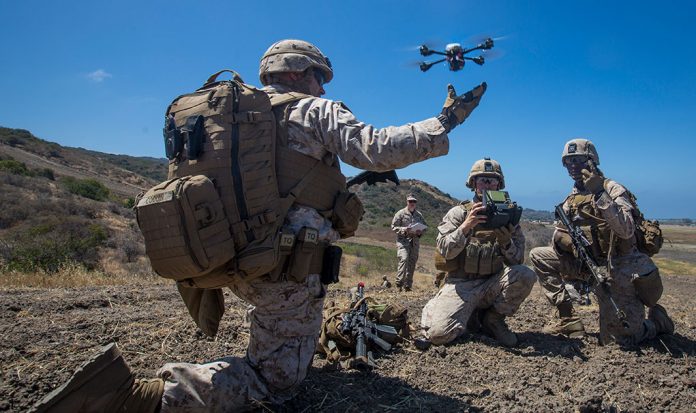
U.S. Marine Lance Cpl. Benjamin Cartwright, an infantry Marine with Kilo Company, 3rd Battalion 5th Marine Regiment, launches the Instant Eye MK-2 Gen 3 unmanned aerial system during an exercise for Marine Corps Warfighting Laboratory's Marine Air-Ground Task Force Integrated Experiment at Camp Pendleton, CA. (U.S. Marine Corps photo by Pfc. Rhita Daniel)
To excel in tactical use,mini-drones are designed to be ‘soldier proof’, allowing for simple, intuitive operation even under pressure and stressful situations, where autonomy would be most valuable. This means quick boot up, calibration, position setting and communications pairing to bring the drone online as soon as possible.
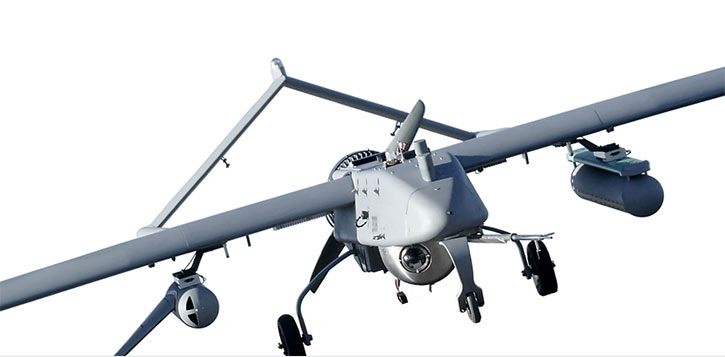
The US Army plans to equip the individual warfighter with drone-based autonomous Soldier Based Sensors (SBS) by 2018 and is evaluating different solutions for such applications. Requirements include weight of 150 grams (about 5 ounces), 15 minute flight time and wind tolerance of up to 15 knots. The Army has used the PD100 ‘Black Hornet’ from FLIR Systems, other new nano-drones also available include the Snipe from AeroVironment and a small, foldable version of PSI’s InstantEye system.
The multirotor revolution emerged as a disruptive capability rooted in technology developed for hobbyists’ toys in 2010. Today’s commercial drone technology, merged with sensors, image processing, and communications capabilities outpace the investments and capabilities that defense industries can invest in technology, as they define the future of transportation world. Autonomy, that is a critical factor in all these commercial systems, is also important for military drones to perform longer missions, have better communications and perform smarter functions – all at affordable cost.
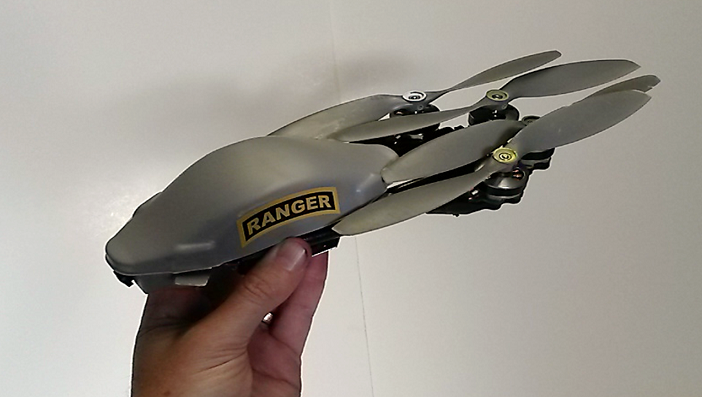
Aerovironment’s miniature Snipe multirotor drone is one of the likely candidates for the US Army’s next generation soldier Based Sensor. Photo: AerovironmentA folded InstantEye bot can be stowed in a pouch and is unfolded into a ready-to-fly drone in 10 seconds. Photo: PSI.The commercial Spark drone from DJI offers many of the advanced, semi-autonomous capabilities the military is seeking for its Soldier Borne Sensors.
Despite the big investments and high hopes, the most advanced autonomous flight modes are not available with military drones but with the microdrones designed for recreational videography. For example, the latest drones made by DJI already include obstacle avoidance based on deep learning artificial intelligence autonomy, enabling drones to safely follow a target, object (or operator) while flying in cluttered environments such as woods, sea surf or urban terrain, while tracking a moving target on the ground. Such tracking can use tags, object or face recognition, offering powerful options for uses in military and security applications. Using the Spark nano drone, designers can program the vehicle and interact with the drone through intuitive flight control gestures, or view the mission straight from drone’s camera using virtual reality goggles. These capabilities are far more advanced than those used in military and security operations.
The next wave of cameras that can better measure depth and motion are already here. The Spark 4K line of 940 nm Near IR cameras using QuantumFilm technology from InVisage is now available for use on smartphones and UAVs. Offering an alternative to standard CMOS sensors, QuantumFilm is optimally designed to do depth sensing, 3D mapping, and gesture tracking.
A critical advantage of the Spark is its processing speed. “In order to perform autonomously at a high flight speed of 20 meters per second, drones and other unmanned vehicles require at least half a second to recognize an upcoming obstacle and another half a second to change trajectory or decelerate in order to avoid it. This means accurate ranging at 20 meters is crucial,” said Jess Lee, InVisage President, and CEO. While ultrasonic sensors are effective at a range of five meters, Micro-LIDAR based on Spark are effective at 20 meters and, according to inVisage, with improved performance will soon function beyond 100 meters.
Cameras equipped with powerful image processors are becoming increasingly capable of performing depth perception using structured light, thus enabling to provide navigational cueing without dependence on GPS. Photo: Invisage
Today military forces use Unmanned Aerial Systems (UAS) in many roles, primarily for intelligence, surveillance and reconnaissance (ISR) supporting all echelons, from the strategic to the tactical level. Drones are also used for strike missions, particularly against time-sensitive targets (TST), where these persistent platforms, that carry the surveillance and communications equipment, also operate the strike weapons, providing the only means possible to deliver an attack in the shortest time possible. These capabilities enable combat forces or agencies engaged in clandestine operations to quickly strike high-value targets before they move out of range or out of sight.
An American MQ-9 drone shot down by Houthi air defense missile over Sanaa. The conflict in Yemen presents a significant challenge to coalition air powers, where Air Forces of the UAE, Saudi Arabia have lost several combat jets and the US forces lost several Reapers to Yemeni MANPADS in recent years.
Challenges to Drone Operations
Today, drone missions are typically conducted in low-intensity warfare, against insurgents in conflict zones or over lightly defended territory where the drones, relying on modern Position, Navigation and Timing (PNT) derived from Global Navigation Satellite Systems (GNSS), advanced communications and satellite links to enable remote control.
Large drones are also susceptible to anti-aircraft fire. Therefore, successful operations over hostile areas require operators to gain the freedom of action – maintain aerial and spectrum superiority and access to operating bases in neighboring countries.
Until recently such operations have primarily taken place in uncontested airspace, where the adversary did not have the means to threaten UAS above a minimum altitude. This situation is changing rapidly, with the proliferation of electronic warfare capabilities compromising drone’s navigation positioning and communications capabilities, as well as man-portable air defense missiles (MANPADS) and air defense artillery that can target larger drones at low to medium altitudes. These threats become even higher when drones are called on missions in high-intensity warfare. To enable efficient operation in current and future conflicts drone capabilities must transform to cope with anti-access and area denial (A2/AD) battlespace.
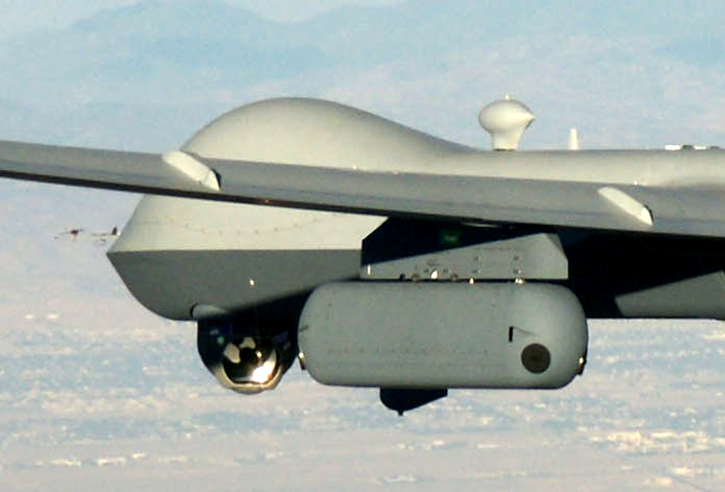
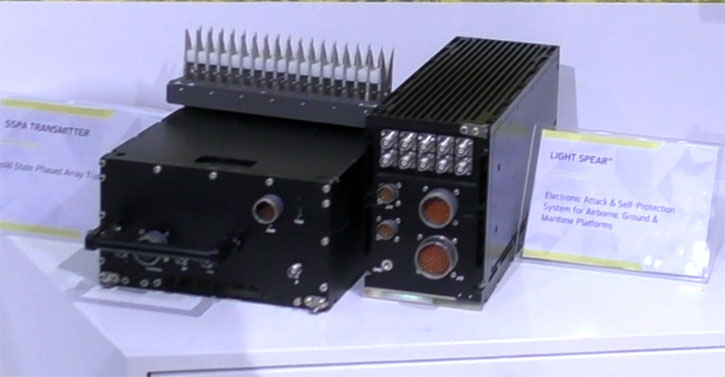
A near-term solution is equipping medium and large drones with autonomous countermeasure systems, comprising of jammers, electronic warfare systems, and countermeasures, such as flares and directional lasers. Such systems have been deployed in recent years by several manufacturers, such as the Light Spear pod from Elbit Systems’Elisra. Light Spear forms an autonomous and complete electronic attack and self-protection system that loads on the drone’s underwing pylon. Equipped with the system, a drone improves the ability to collect accurate intelligence in highly hostile environments and improve its survivability against advanced threats.
For the RWR demonstration, this B/MQ-9 Reaper Block 5 carried the Raytheon ALR-69A Radar Warning Receiver in a standard payload pod. Photo: GA-ASIElbit Systems’Light Spear is a self-contained, podded electronic combat/self-protection system that enhances drone’s survivability over the contested terrain. Photo: Noam Eshel, Defense-Update
Based on multiple Digital Radio Frequency Memory (DRFM) jamming channels working in parallel, the system can cover a wide spectrum range. The low Size, Weight, and Power (SWaP) consumption make it well suited for UAS platforms operating in hostile environments.
Drones and the Third Offset Strategy
Such transformation is likely to result in broader and more profound adoption of unmanned systems, far beyond today’s remote supervision, automated guidance and control functions. New capabilities that will aid, supplement and replace manned operations in roles considered too dangerous for humans to take. Integration of large masses of unmanned systems will also introduce concepts of operations (CONOPS) unimagined before, that will challenge and offset current or future military capabilities.
Such drones will be able to function without human interaction or supervision for the majority of their mission, thus remain silent throughout their missions. Many drones will be able to operate simultaneously as swarms – groups of tens, even hundreds of individual platforms, synched to act as a group, each and everyone pursuing different aspects of the common missions. Using such CONOPS drone swarms would be able to take out the enemy’s critical and most vulnerable nodes, such as early warning radars, advanced surface-to-air missiles, or command and control elements, overwhelming such targets by expendable mini-drones.
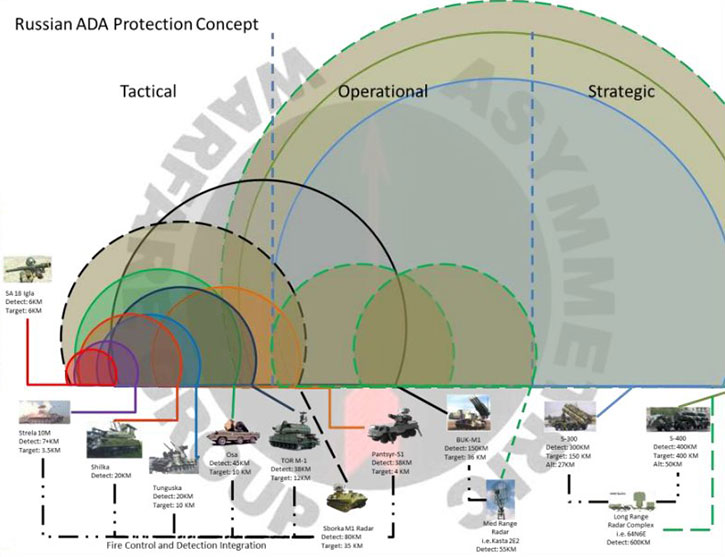
The Russian air defense network. Drawing Courtesy of Asymetric Warfare Group
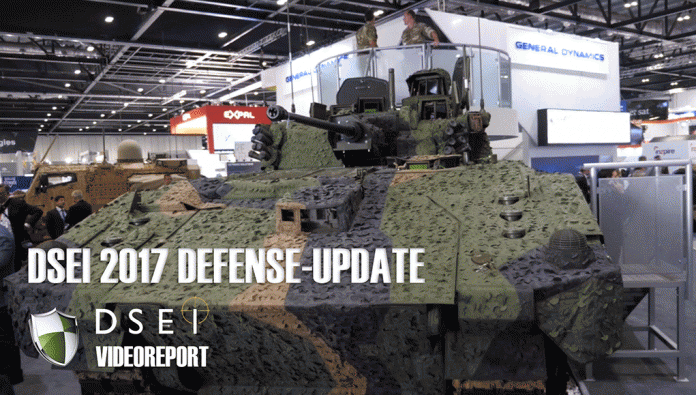
The biennial Defense Security Equipment International Exhibition (DSEI) held in London in September 2017 provided insight into British defense programs. The event attracted strong international participation, both visitors and exhibitors from 42 countries, many of which addressed UK and European defense and security requirements.
The exhibition considered the second largest of its kind in the west, covered aviation, maritime and land warfare, as well as defense electronics, training simulation, security and cyber. DSEI reflected the growing concern of the Russian threat among countries within NATO. At the backdrop of DSEI was ZAPAD-2017, the large-scale military exercise held along the Russian Army with Belarus, along with its border with Europe. Another concern reflected here was the terror threat, both to military and the homeland. Several exhibitors displayed here innovative solutions that address evolving threats, including land, marine and airborne IEDs and mines.
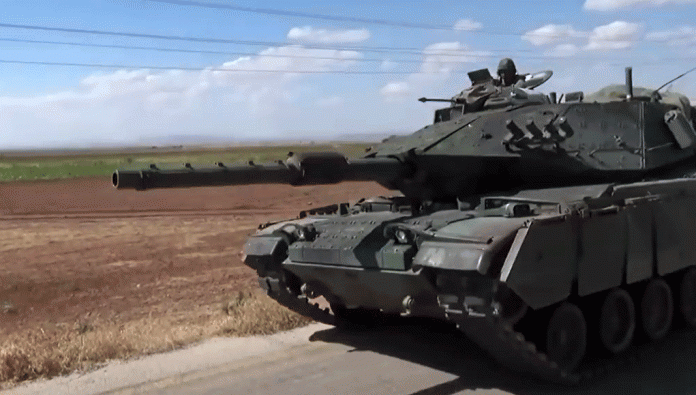
The Turkish M-60T was upgraded by Israel's IMI. 170 tanks of this type were produced, making it the largest upgrade of M-60 worldwide. The potential for future upgrades is substantial, especially with military forces in the Middle East, where thousands of M-60s are still maintained in service with Turkey, Saudi Arabia, Egypt and Jordan.
In the 1960s the M-60 series Patton tank was the main battle tank (MBT) of the US Army and Marine Corps. Mounting the powerful M68 105mm gun, and protected with heavier steel armor, in the 1960s the M-60 represented the most advanced tank of its generation, a combat vehicle that could face the most sophisticated Soviet tank of its time – T-55. In all, over 15,000 tanks of these models were built and supplied to 24 countries in addition to the U.S. Today, almost half that number are still operational, particularly with third world countries. While the M-60 was tested in battle since 1973, it was used in combat mainly by the Israelis, and, therefore, the combat lessons learned about its vulnerabilities and advantages were not disseminated to Arab M-60 operators.
The largest fleets of M-60 are in Egypt, and Saudi Arabia, where the M-60 is used alongside the M-1A1. these tanks are maintained in the original configuration, as they were produced in the 1970s.
In the recent years, these old warhorses are heavily used in combat operations, in Yemen and Sinai, where they face irregular but heavily equipped opposition (Iranian equipped Houthis in Yemen, ISIS in Sinai), where they displayed questionable performance.
Both Egypt and Saudi Arabia have suffered significant losses to anti-tank weapons (RPGs, ATGM etc). Turkey has also operated M-60, part of these were modernized M-60T that received major Israeli designed upgrades. These tanks have seen extensive combat service in the Syrian front recently, and seem to have fared much better than the Turkish Leopard 2A4 tanks. These 170 tanks were the first batch of upgraded M-60T tanks. An option for the supply of a second batch, that would have received much-improved armor and active protection and enhanced fire controls were not exercised by the Turks as diplomatic relations between Ankara and Jerusalem drifted apart. However, the modernization package developed by IMI for the M-60 is still available, as a whole or parts, to support other M-60 operators.
Other operators of the type include Greece, Taiwan, Thailand, Jordan, Morocco, Oman, Brazil and Bahrain, the later consider upgrading its fleet of 180 such tanks. Iran also maintains a fleet of about 150 of these tanks, some are cannibalized with Russian parts into Zulfikar, locally built tank based on the M60 drivetrain and suspension mated with a new turret mounting the Russian 2A46 125mm gun.
Both M-60 and its archrival, the Russian T-55 are considered obsolete but both are still used by many armed forces. While the M-60 continue to serve and fight, the tank must be modernized if to survive and continue to be in service. Among the upgrades recommended for the M-60 series (both A1 and A3) are enhancements in firepower, mobility, and survivability, plus the introduction of life support systems that are needed, particularly in the hot climate of the Middle East.
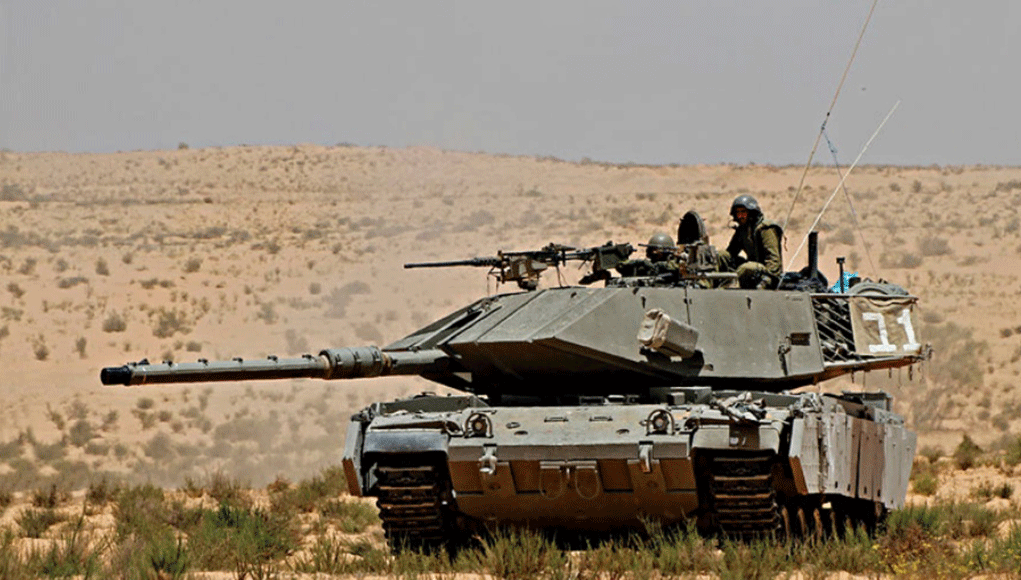
The first major upgrade of the M-60 was the Israeli upgraded ‘Magach 7’ introduced in the late 1990s. The project implemented new turret protection, the 105mm gun was retained but improved with electric drive and upgraded fire controls to greatly improve the tank’s lethality and survivability. The engine was uprated to from 750 to 950 hp to deal with the added weight. The Turkish M-60T is based on this design.As one of the largest operators of the M-60 at the time, Israel’s Defense Force (IDF) designed and continuously upgraded hundreds of its M60s into “Magach Model 7”, and some Model 8 variants, improving survivability by replacing the original hydraulic turret traverse and gun laying systems with electrical drives, as the hydraulic fluid used in the original systems was highly flammable, and often caused catastrophic fires when the tanks were hit. Although the IDF did not replace the 105mm main gun, improved fire control systems introduced enabled the IDF veteran gunners to score excellent hits at very long gunnery range, often defeating the younger crews that operated modern tanks.
While the IDF retired its M60s, other operators in the Middle East still use the tanks, and many are implementing similar upgrades to their fleets. In 2002 Turkey adopted the Israeli Magach design, fielding the M-60T designed by IMI Israel. In recent years these tanks were used extensively in combat operations in Syria. In this model, the 105mm cannon was replaced with IMI’s MG251 120/44mm gun. This gun was specially designed to replace 105mm cannons and, therefore, is equipped with recoil mechanism that reduces the loads transferred to the turret. However, all these additions increase weight and the M-60T gained over 12 tons, necessitated the use of a more powerful 1,000 hp MTU engine and the associated RENK transmission.
The growing conflicts in the Middle East and the wide availability of M-60 type tanks (both A1 and A3) by military forces in the region attracts integrators like Raytheon, L-3 and most recently the Italian group of Leonardo to offer modernization packages for the tank providing military forces in Egypt, Saudi Arabia, Bahrain and Jordan with affordable solutions to bring more of their tanks to par with modern threats. Such upgrades address the original tank’s known vulnerabilities (armor and hydraulics), replacement of aging turret, gun and fire controls, and provisions of modern night vision optronics for the driver and tank commander.
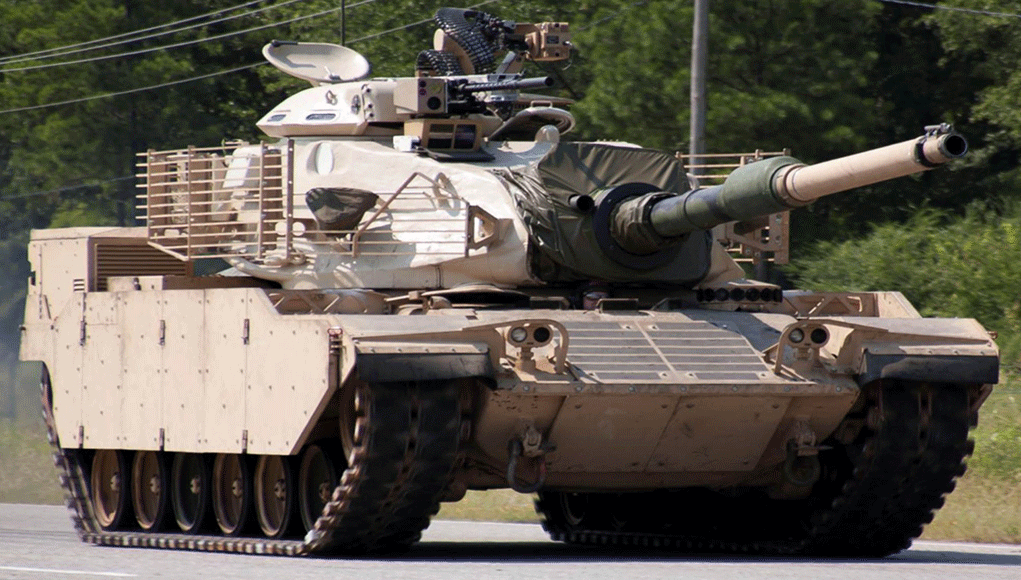
Raytheon and L-3 offer comprehensive life extension packages for the M-60. Among the notable changes are the new 120mm gun, and remotely controlled weapon station mounted on the left of the turret. Slat armor, and skirts protecting the sides, rear and engine compartment, and added frontal armor at the hull. Instananeous smoke discharging systems are also added. New optronics includes 360 vision systems, which also provide panoramic day/night driving system for the driver.In 2016 Raytheon introduced its own life extension program (SLEP) package for the M-60A3, that is offered for about a third of the price of a new tank. L-3, the producer of the Patton’s powerpack also offers an upgrade to Raytheon’s SLEP, under the ‘Destroyer’ brand. The Destroyer uses L3’s 1200hp diesel variant of the AVDS-1790, supporting all the tank’s current power needs and growth, including air conditioning and exportable electrical power.
This package swaps the 105 gun with a 120mm, uprated the 750 hp AVDS-1790 engine to a 950hp level and introduce electrical turret drives and modern fire control enabling the crew to fire on the move. The driver’s night viewer used in the prototype offers the driver a panoramic view, which is part of the tank’s 360 viewing system, improving driving autonomy, safety, and security.
One of the important additions was the use of Curtiss-Wright’s Electric Gun Turret Drive Upgrade Kit. This fully electro-mechanical system replaces the older, less accurate hydraulic and hybrid-based turret stabilization systems. The new turret drive and stabilization system delivers finer control and significantly improved reliability, acceleration, and audio noise reduction by replacing the hydraulic lines with electrical, digitally-controlled electric actuators. This allows the tank turret to rotate faster and accurately fire while the tank is on the move and is also lighter and safer, as a result of the removal of flammable hydraulic fluids in the turret.
Back in the early 2000s General Dynamics Land Systems (GDLS) offered a comprehensive upgrade package for the M-60, based on an M-60/M-1 hybrid dubbed M-60/2000. This version competed for the M-60T program in Turkey, where they lost to IMI. A proposal for an upgrade was also discussed with Egypt but didn’t come through.
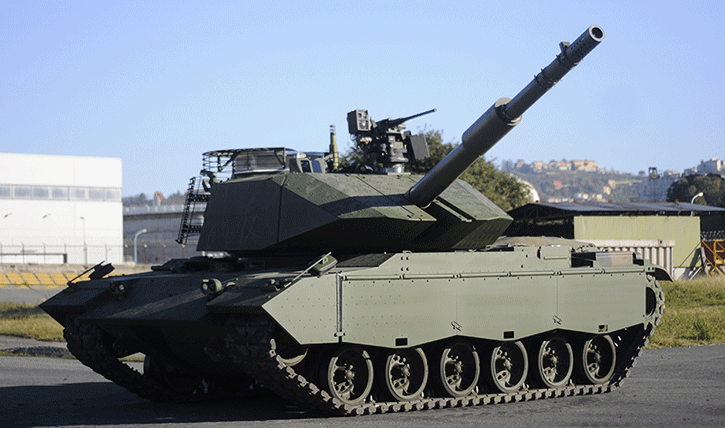
The M-60A3 upgrade from Leonardo is based exclusively on Italian subsystems. Notable changes include additional protection for the frontal arc (turret, hull, and skirts), 120/45 mm cannon and Hitrole Remotely controlled system replacing the commander’s HMG. Photo: Leonardo incorporatingThe low recoil 120/45 mm gun is designed to dramatically reduce recoil forces, for mounting in relatively light turrets such as the one used in the Italian Oto Melara HITFACT used on Centauro 2 ‘wheeled tank’ program. Photo: LeonardoLast week another player stepped into this market – The Italian Leonardo group unveiled its own upgrade for the M-60A3 in Bahrain, at the local, international defense exhibition (BIDEC). Leonardo’s modular solution integrates a 120/45 mm low-recoil force main gun, the same weapon used on the new Centauro II wheeled armored vehicle. According to the company, most of the subsystems included in the upgrade, including the Fire Control System (FCS), night vision and 120mm main gun are designed and manufactured by the group, as are the systems for improving turret performance.
The 120/45 mm gun is a low recoil variant of the smooth bore 120mm, it fires the same rounds but offers the advantage of reduced weight and low recoil force that reduces the structural stress on the hull and, therefore, eliminates integration risks with heritage platforms. The system uses a hydraulic, recoil-counter-recoil mechanism with multi-baffle, high-efficiency muzzle brake to minimize the recoil force and prevent any excessive stress on the turret structure.
The fire control system, which integrates day and night optronics, together with a high level of ballistic protection and modern onboard equipment, increases the probability of detecting potential threats, and neutralizing them during a full day and night operations.
A top view of the Italian modernized M-60A3 shows the Hitrole HMG mount and new gunner’s sight. The commander’s cupola was remover, introducing a better protected, low silhouette hatch rounded by slat armor. Photo: LeonardoA new feature included in the tank displayed in Bahrain was the Hitrole remotely controlled weapon system, that enables 360° panoramic surveillance from a secure position inside the tank. This system replaces the traditional HMG mount that is manually operated by the tank commander, adding a complete Fire Control System (FCS) solution consists of a modular sighting system including a Day TV camera, an Infra Red (IR) camera for night vision and an eye-safe Laser Range Finder (LRF). Leonardo’s proposal also includes the upgrading of the power pack, by uprating the engine to increase available power by 20%, thus achieving improved power-to-weight ratio despite the weight increase, without the replacement of the main engine. Increased armor protection with STANAG 4569 Level 6 protection plates to the frontal arc and side skirts and slat armor added to the bustle, protecting the rear of the turret from RPG attack. The installation of an Automatic Fire and Explosion Sensing and Suppressing system (AFSS) that improves soldier survivability and protects the engine compartment from taking fire.
After a promising entry to the M-60 upgrading market in the 2000s, Israel’s role in this market diminished, as bilateral relations between Israel and Turkey deteriorated and, since the majority of M-60 operators are in markets inaccessible by Israel’s defense industries. However, many subsystems developed by Israeli companies, including armor protection, fire controls, night vision systems, threat warning systems, engine upgrades etc., are available for such programs.
Active protection is a new area of interest for the British Army. During DSEI The Leonardo group announced it was selected by the MOD, to demonstrate APS technologies to counter evolving threats. As already reported here, Leonardo is also providing Israeli Trophy APSs to equip a full brigade of M-1A2 SEP2 Abrams tanks to be positioned in Europe.
Under the British £10 million Icarus technology demonstration program, the company will focus on the implementation of a ‘UK Sovereign’ electronic architecture for a Modular, Integrated Protection System (MIPS) that will enable MOD to pick and choose specific APS solutions for evolving threats and operational requirements. In the ICARUS program, MOD is taking a similar approach to the Generic Vehicle Architecture (GVA) that defines the electronic standards for military vehicles.
On this project, Leonardo is leading a group of UK based companies that include BAE Systems, Lockheed Martin UK, Ultra Electronics, Frazer-Nash, Brighton University, Abstract Solutions, Roke Manor Research and SCISYS. The program will culminate in a live-fire demonstration where the proposed APS solution will be subjected to real threat weapons, such as rocket-propelled grenades (RPG) and guided missiles.
The British MIPS seems to align well with the Modular APS architecture developed in the U.S., as deliverables from both programs will provide common controllers and other key subsystems that will enable the integration and fielding of affordable soft and hard kill APS solutions.
Combining several high-resolution sensors operating in parallel, SkEye provides continuous and simultaneous monitoring and recording of a wide area. With the entire area ‘captured’, several users at different control centers can independently look into several regions of interest, either in real time or ‘back in time’, via recorded imagery. Such performance prevent any event from going unnoticed. Photo: Elbit Systems
Airmen 1st Class Landon (left), 62nd Expeditionary Reconnaissance Squadron aircraft specialist and Tyler (right), 62nd ERS crew chief, preform preflight checks on an MQ-9 Reaper with Gorgon Stare for a sortie at Kandahar Airfield, Afghanistan, Dec. 5, 2015. U.S. Air Force photo by Tech. Sgt. Robert Cloys
Mission autonomy evolved parallel to the automation of piloting functions. Such capabilities are derived from mission payloads that become smarter to collect, process and fuse data with other sensor streams and store it on the platform. Persistent Wide Area Surveillance (PWAS) is an example of those capabilities that help military and security forces watch and control wide areas over a long time, using minimal intervention of forces.
Deployed on surveillance missions, drones ‘carpet’ wide areas to provide mission analysts streams of data from electronic surveillance, radar, and imagery, in multi- and hyperspectral sensors. Analysts use this data to detect ‘signatures’ and ‘anomalies’, indicating the presence of potential targets. To support such missions, drones are designed to carry multiple payloads, each gathering data in a specific discipline and spectral range. Often, the volume of data being collected is too large to transfer to the ground station using standard datalinks it in real-time. Therefore, requiring solutions to provide analyst access to information on board the drone itself. Such capabilities enable analysts to tap the most important and relevant events, investigate signature of objects and tracks in different spectral bands, mapping results geographically to explore relevant events in the present as well as the past, providing actionable information for intelligence gathering and time-sensitive targeting processes.
RAFAEL’s Reccelite aerial reconnaissance pod was developed for such missions. While the drone and pod sensors follow a pre-planned mission, they can also be updated in flight, changing the payload steering sequence, and camera direction to deliver the most effective coverage of specific locations and targets during the flight. The pod uses gimballed, high-resolution aerial reconnaissance cameras and integral inertial measurement system (INS), to automatically cover a wide area with high-resolution images, maintaining revisit rate to provide persistent surveillance of specific areas of interest. The pod has an integral mass storage and wideband data link designed to transfer high-resolution images to the ground control center, where images are processed and displayed to analysts.
The NanoSAR from the iMSAR company integrates several SAR systems packed in pods. Carried underwing by drones or manned aircraft, the pod comprises radar processing unit, Inertial Navigation System (INS), and antennae’s mechanical gimbals. The configuration shown here includes the NSP8D Ku-band SAR and Ultra-Wide Band NanoSAR that offers improved foliage penetration capability. Photo: IMSAR
For many years radar provided the primary sensor for wide area surveillance; among these, Synthetic Aperture Radars (SAR) provide a useful sensor that functions well in day and night as well as in adverse weather and limited visibility conditions. SAR also offers effective detection of objects hidden under camouflage or buried underground. In the past SAR systems were carried by large aircraft, while smaller systems stored in pods required dedicated fighter aircraft to go to battle.
Today, smaller systems are deployed on large Medium Altitude, Long Endurance (MALE) UAS, and even smaller ones, fitted into compact underwing pods, are used with tactical UAS, enabling such small platforms to carry multiple sensors on a mission. SAR relies on a synthetic aperture, synthesized over distance and time, as opposed to EO sensors that use real, physical aperture. This means that, although the physical footprint of the radar is small, it collects imagery with a high resolution as though it was much larger. As a microwave sensor SAR ‘illuminates’ the area under surveillance, thus can operate in day and night, the wavelength selected for operation penetrates atmospheric obstructions that scatter and diffuse visible light, such as fog, rain, haze or dust, to gain effective all-weather visibility. With each pixel in the SAR image represents data about that particular point of the target location, different processing can be applied to exploit this information, automatically generating complex services such as change detection (CCD), foliage penetration (FOPEN) and moving target indication (MTI).
MTI is an advanced capability of SAR radars, processing the same microwave signals generated by SAR with different algorithms to detect and track moving targets. Analyzing and comparing those signals for their doppler effect, multiple moving targets can be clearly displayed over a stationary background. This function enables operators to monitor large areas to instantly detect activities that can be associated with such movement.
A U.S. Air Force MQ09 carrying the Gorgon Stare Wide Area Persistent Surveillance payload.
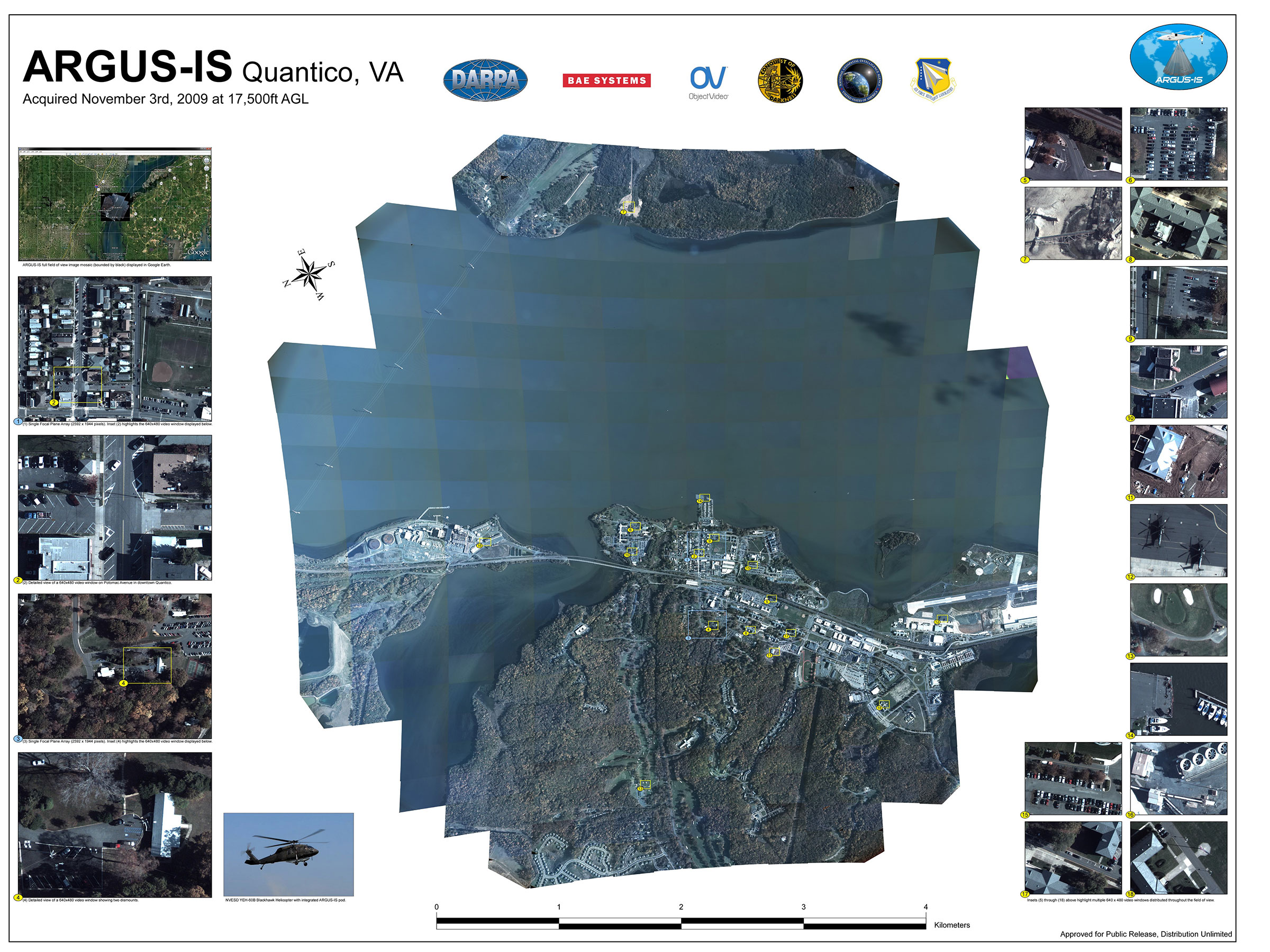
Other mission payloads like the Gorgon Stare were developed by Sierra Nevada Corp. (SNC) specifically for persistent wide area surveillance (PWAS). The system became operational with the US Air Force in 2011 on the MQ-9 Reaper drone, each carrying a twin-pod PWAS system. In its first iteration, the system covered an area of about 16 square kilometers. By 2014 the second generation was fielded with an improved sensor developed by BAE Systems under the DARPA ARGUS-IR program. This sensor array consists 368 cameras (daylight and infrared) to create an image of 1.8 billion pixels. In addition, four telescopic cameras enabling users to zoom in on objects of interest. The new version covers an area of 64 square kilometers with twice the resolution of the original system, both in day and night time.
The ARGUS payload was developed by BAE Systems to provide persistent coverage of a large urban area, providing simultaneous surveillance of the entire area through hundreds of individual live feeds. Photo: BAE SystemsSkEye uses a single payload integrating multiple cameras that together provides an image of one billion pixels in size. Photo: Tamir Eshel, Defense-Update
At the time, commercial systems were not available to meet the data processing and storage at the small size and low power consumption suitable for unmanned platforms. To handle to greater processing tasks involved with the new sensor BAE Systems developed an advanced processor capable of parallel processing of hundreds of individual cameras. To store this data the company built an ‘airborne big-data storage system’. These are the TeraStar systems that have since evolved into commercial products offering scalable, ultra-dense data storage systems that reduce the overall cost per terabyte of storage capacity.
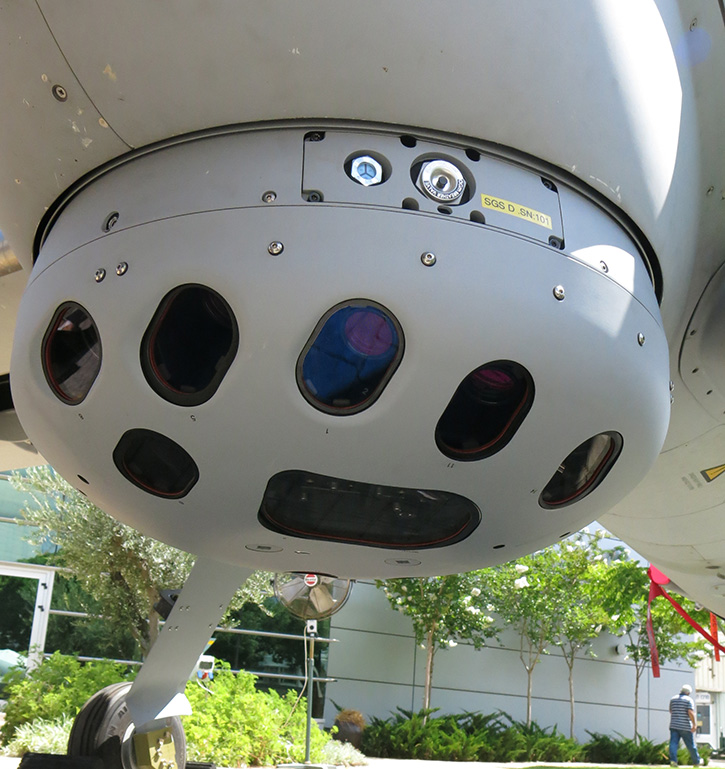
Unlike the podded Gorgon Stare, Elbit Systems SkEye is configured as a standard UAV payload, that can be integrated with standard UAVs such as the company’s Hermes 450, or 900 drones, as well as on various manned or unmanned aircraft. Cruising at the drone’s operational altitude, SkEye’s gigapixel payload integrates multiple staring cameras to cover an area of 80 square kilometers. As each sensor uses a high megapixel camera, can obtain close-up images of parts of the area, in real-time or from historic SkEye records. In addition, the drone can carry standard UAV payloads to obtain higher magnification views of specific areas.
Combining several high-resolution sensors operating in parallel, SkEye provides continuous and simultaneous monitoring and recording of a wide area. With the entire area ‘captured’, several users at different control centers can independently look into several regions of interest, either in real time or ‘back in time’, via recorded imagery. Such performance prevent any event from going unnoticed. Photo: Elbit Systems.
In addition to EO systems-wide area surveillance capabilities consist of Synthetic Aperture Radar (SAR) or communications surveillance (COMINT), accessible by users in real-time or ‘backtrack’ to view the same point of interest over time, to gain a better understanding of patterns of life or target behavior.
An evolving capability added to persistent surveillance is the Dismount Detection Radar (DDR), a pod-mounted sensor that functions similar to a ground surveillance radar, mounted on UAVs and covering a large area. Such sensors provide a UAV equipped with gimballed EO sensors the situation awareness that would attract the attention of payload operator to suspicious movements in their area of responsibility. It can also help track routine movements and assess patterns of life to enable surveillance systems to learn the mission area and avoid false alarms. Such capabilities could also have important uses in search and rescue and homeland security applications.
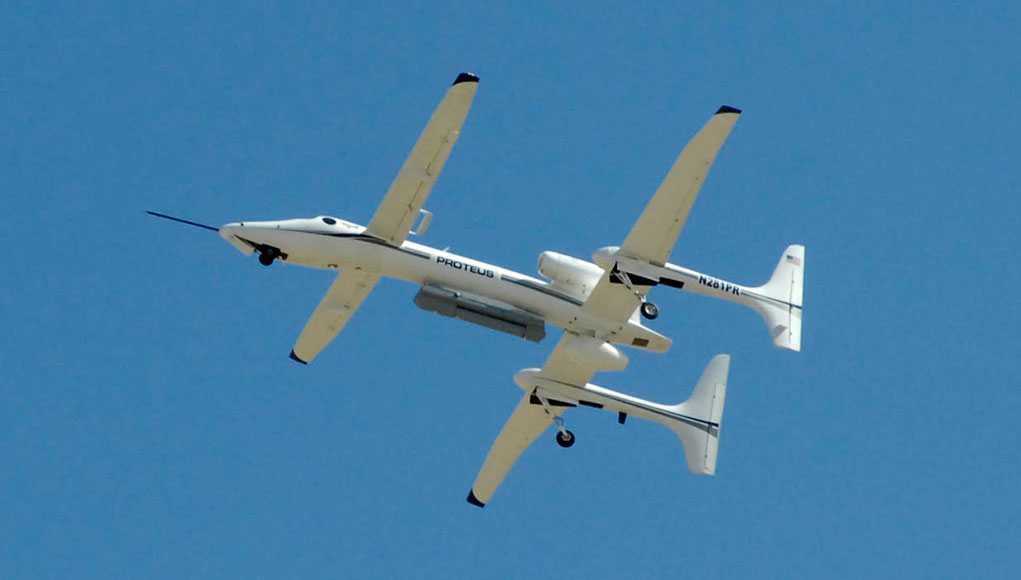
The Air Force Dismount Detection Radar pod is strapped to the underbelly of an experimental aircraft called the Proteus. The system underwent its first test flight April 22, 2014. An Air Force Life Cycle Management Center team based out of Hanscom Air Force Base, Mass., is the driving force responsible for the development and testing of the radar. (U.S. Air Force photo/1st Lt. Matthew Cook)
Drones can be equipped with wide band data links to send high definition sensor data but are not designed to support simultaneous, multiple streams, nor can they deliver the processing power, energy and cooling to facilitate such ‘flying data warehouse’ services. Some solutions already integrate the hardware necessary to provide such services. For example, SkEye architecture maintains all sensor data on the aircraft, providing mission analysts access to real-time and stored image data from their database. After the mission, historical data is downloaded and stored at the mission control enabling users to access historical mission records on demand.
To support similar capabilities the US Air Force contracted SRC to deliver the ‘Agile Condor’ high performance embedded computing architecture that enables high-performance embedded computing (HPEC) onboard remotely piloted aircraft (RPA). Each pod has an internal chassis carrying a supercomputer built of standard commercial off-the-shelf (COTS) units including single-board computers (SBCs), graphics processing units (GPUs), Field-Programmable Gate Arrays (FPGAs), and solid-state storage devices (SSDs). Currently, the chassis utilizes a modular, distributed network of processors and co-processors based on open industry standards to deliver more than 7.5 teraflops of computational power at better than 15 gigaflops per watt. The pod enclosure is based on an existing, flight-certified design specifically modified to use ambient air cooling for thermal management of the embedded electronics. This upgradeable architecture supports fast technology refresh, which decreases life-cycle costs, reduces system downtime, and assures continued usefulness of the system.
MQ-9 is equipped with multiple under wing hard points carrying armaments and payloads. These can be podded sensors and systems such as the Agile Condor high performance computing platform, or simply fuel tanks, extending mission endurance. Photo: GA-ASIThe Agile Condor high performance computing pod from SRC. Photo: SRC
Agile Condor can also enhance the drone’s situational awareness using ‘neuromorphic computing’ – a bio-inspired processing scheme that analyzes information similar to the human brain, improving situational awareness.
According to the SRC, the Agile Condor developer, such systems will become mission systems managers in the future, processing data from multiple sensors on board and use machine learning to selectively queue sensors for particular scenarios. Instead of surveying large areas with all sensors, the drone would conserve power by using only the sensors best equipped to detect specific anomalies over large areas. When a point of interest is spotted, the system will cue other sensors, like a camera, to collect more information and notify the human mission analyst for further review and inspection. This selective “detect and notify” process frees up bandwidth and increases transfer speeds while reducing latency between data collection and analysis. SRC is scheduled to deliver the first Agile Condor pod to the Air Force by the end of 2017.
Lockheed Martin Skunk Works® and XTEND have achieved a major milestone in JADC2 by integrating the XOS operating system with the MDCX™ autonomy platform. This technical breakthrough enables a single operator to simultaneously command multiple drone classes, eliminating the friction of mission handoffs. From "marsupial" drone deployments to operating in GPS-denied environments, explore how this collaboration is abbreviating the data-to-decision timeline and redefining autonomous mission execution.
As traditional defense primes face mounting competition from agile “neoprimes” such as Anduril, Palantir and Helsing, the balance of innovation is shifting toward software-defined warfare and scalable, dual-use technologies, while global industry consolidation—marked by Boeing’s integration of Spirit AeroSystems and other strategic mergers—signals an intensified race to secure control over the defense technology value chain. Our Defense-Tech weekly report highlights these trends.
In early October 2025, a coordinated wave of unmanned aerial system (UAS) incursions—widely attributed to Russia—targeted critical infrastructure across at least ten European nations. The unprecedented campaign exposed the fragility of Europe’s air defenses...
Executive Summary
The past week (September 18-25, 2025) represents an inflection point where strategic defense concepts have transitioned from doctrine to tangible reality. An analysis of global events reveals four primary, interconnected trends shaping an...
At the 2025 Air, Space & Cyber Conference, U.S. Air Force and Space Force leaders unveiled major updates on next-generation fighters, bombers, unmanned systems, and space initiatives, highlighting both rapid innovation and critical readiness challenges as the services race to outpace global competitors. A short version is available here, with a more detailed version for subscribers.
The Taipei Aerospace & Defense Technology Exhibition (TADTE) 2025 crystallized around four dominant strategic themes that collectively illustrate Taiwan's comprehensive approach to defense modernization amid escalating regional tensions. Based on a detailed report by Pleronix (available upon request). Includes a Podcast discussion on TADTE 2025's highlighting Taiwan's four strategic themes beyond the post's coverage.
Israel’s Iron Beam 450 high-power laser system has completed final testing, marking a major leap in air defense. Developed by Rafael, it offers precise, cost-effective interception of rockets, UAVs, and mortars, and is set for IDF deployment by 2025.