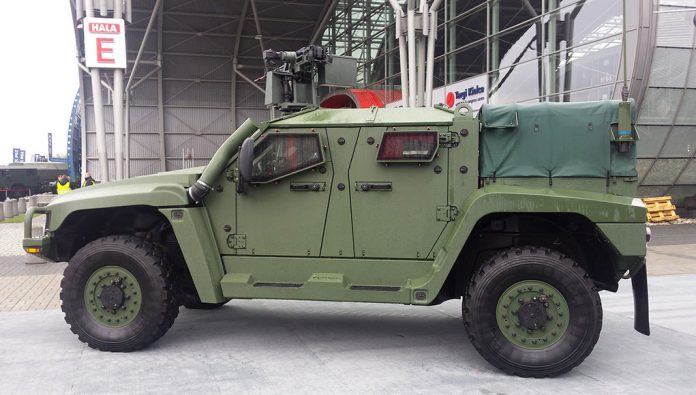
Cobham GD2049 ICE mounted on Thales Hawkeye tactical utility vehicle. The system interfaces two radios to a single antena, thus reducing the number of antennae on command and special mission vehicles. Photo: Cobham
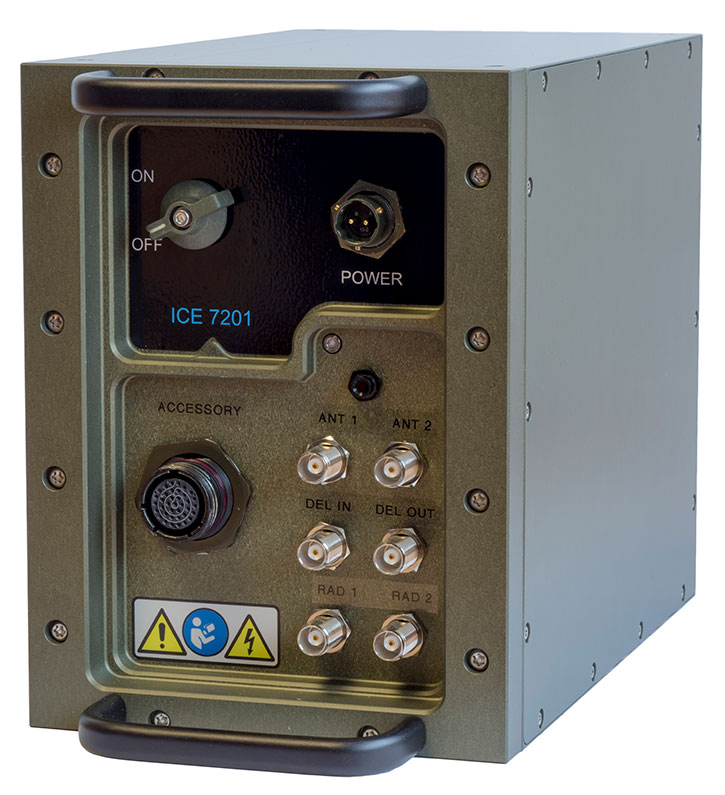
ICE 7201 interference cancellation system restores radio performance and operational range.In addition, it also facilitates enhanced frequency planning for operations, enabling, closer separation between channels. Photo: Cobham
Command and special mission vehicles are often required to operate multiple networks to coordinate operations and transfer information to multiple users and subscribers. Since each radio requires an individual antenna for operation, the vehicle is soon covered with a ‘forest’ of antennae, clearly identifiable as a priority target.
The integration of multiple radios and other communications systems on a single platform or in a congested environment causes Radio Frequency (RF) interference that reduces the effective communications range and causes significant interference between radios and electronic systems on board. The more radios and are on board, the heavier the interference.
Cobham introduced today an Integrated Communications Environment (ICE) product range to improve existing communications systems on platforms. The ICE includes a multi-radio interference cancellation system coupled to high-performance multi-port V/UHF antenna. The ICE allows for an optimized co-site integration of radios whilst reducing the number of antennas required on each platform. The result is a significantly improved communication effectiveness and a reduction in the cost and ‘real estate’ of the antennas required.
“Cobham’s new ICE products allow users to streamline their communications systems without affecting performance or range which makes a critical difference during operations.” David Bulley, VP and General Manager of Cobham Antenna Systems said.
The ICE 7201 interference cancellation system helps restore the radio performance and
the operational range of single sets, it also facilitates enhanced frequency planning for operations incorporating multiple networks and channels, enabling closer separation between channels resulting in a significantly greater number of usable radio channels for a given spectrum allocation.
As the system simultaneously interconnects antennae with multiple radios the GD2049 high-performance multi-port V/UHF antenna enables the overall number of antennae used on ground platforms to be reduced through the introduction of two VHF ports with high port-to-port isolation.
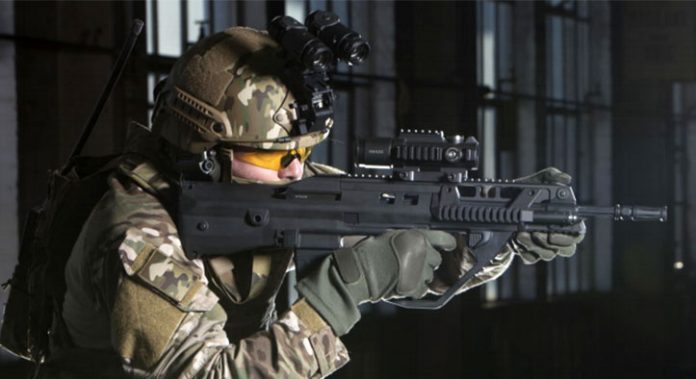
Thales' F90MBR is a Modular Bullpup Rifle, based on the proven F90, designed to support the modern integrated solider. Photo: Thales
Thales is launching the F90MBR – a new assault rifle at DSEI 2017. The weapon represents a new generation of the F90 currently in service with the Australian Defence Force. The Modular Bullpup Rifle is NATO interoperable and is suited to support the modern integrated solider systems. At a total weight of 3.25 kg it is one of the lightest weapons of its class. NATO compatibility is supported by the tri-rail system and magazine compatibility, that ensures interoperability with existing NATO weapons and ammunition. It is fitted with ambidextrous controls to enable fast reaction times and rapid target engagement.
As a modular weapon system, it is able to be packaged with multiple barrels, and compatible optics, accessories, and ancillaries with Grab Case, allowing an operator to quickly transition between different tactical employments of the weapon system. Designed for use by amphibious forces, soldiers can swim with the weapon, and fire immediately after emerging from the water. Both the F90 and F90MBR enable the soldier to reach up to 600m accurately.
availability in multiple barrel lengths, fully-ambidextrous forward bolt and magazine release controls, and a ‘drop free’ magazine release function to facilitate even faster magazine changes, regardless of the hand-dominance of the firer. The F90MBR safely accommodates off-handed shooting techniques through the use of a case deflector and can be easily modified by the operator without tools to a dedicated left or right handed ejecting weapon.
The COMINT payload adds to other Watchkeeper sensors that currently include electro-optical payloads and Thales I-Master Synthetic Aperture Radars (SAR) and communication relays. The drone can carry two payloads simultaneously. Both I-Master and AS3 provide hemispheric coverage while the EO payload covers a small target area with high definition.
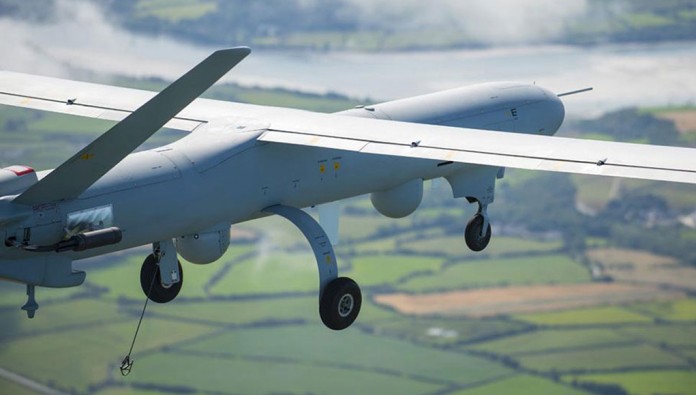
Britain’s electronics expert QinetiQ has developed a variant of its AS3 communications intelligence (COMINT) system designed specifically for unmanned aerial vehicles. Following an integration, with Thales’s Watchkeeper unmanned aerial vehicle (UAV) the AS3 is now ready for initial test flights.
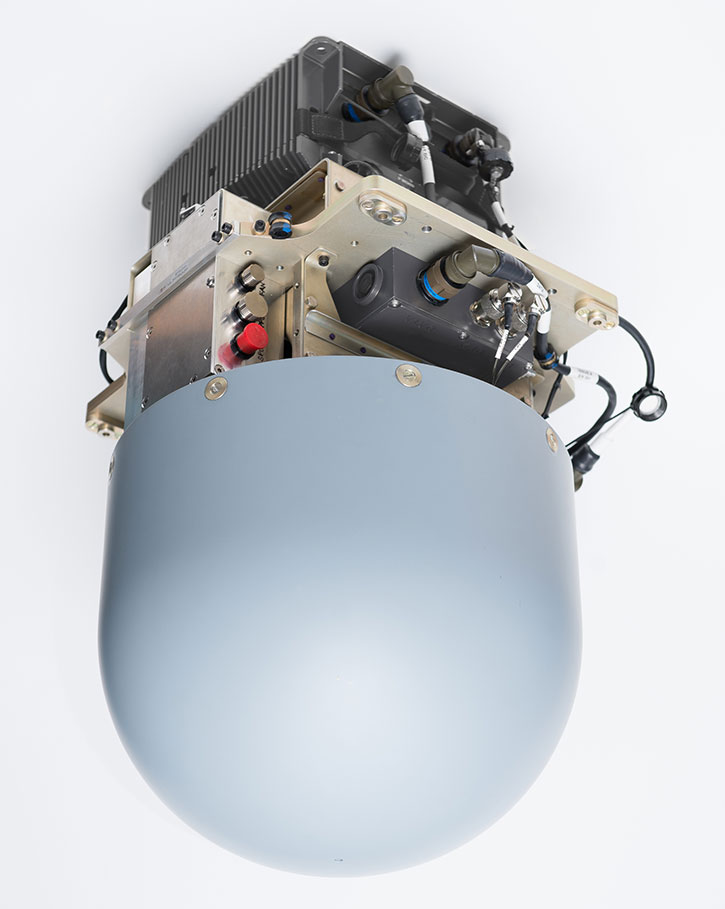
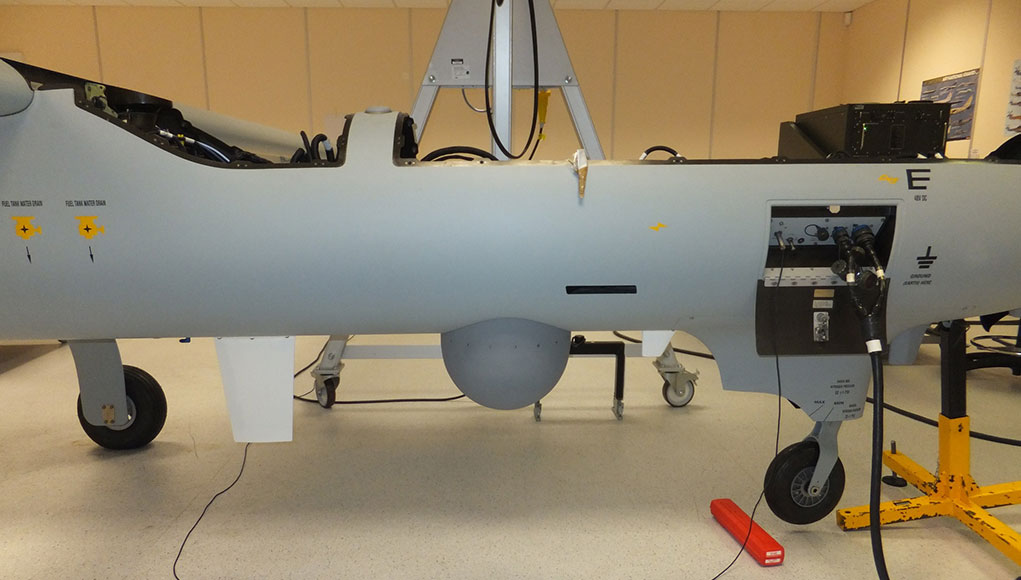
AS3 is part of QinetiQ’s ASX family of COMINT equipment, designed for UAVs and small manned aircraft. It enables the operator to detect signals from military communications devices and then locate, identify and listen to the individuals using them. Photo: QinetiQ
Fitted to Watchkeeper, AS3 is designed to increase the UAV’s sensor footprint and enable it to work with ground-based systems, such as QinetiQ’s MEWS, to locate military communications with greater precision. It allows the platform to undertake communications intelligence missions that would normally be carried out by larger more strategic platforms, such as multi-engine business jets.
AS3 is part of QinetiQ’s ASX family of COMINT equipment, designed for UAVs and small manned aircraft. It enables the operator to detect signals from military communications devices and then locate, identify and listen to the individuals using them.
The development and integration into Watchkeeper were done jointly by Thales and QinetiQ, Qunder a collaborative program supported by the Ministry of Defense Defence Science and Technology Laboratory (Dstl).
“Having combined our technologies and expertise to enhance the platform, we look forward to demonstrating the new capability in its first flight trials. By ensuring vital intelligence can be gathered, analyzed and distributed securely, we deliver proven advantage to customers.” Ian Fuller, Campaign Lead for Airborne Surveillance in QinetiQ said.
The COMINT payload adds to other Watchkeeper sensors that currently include electro-optical payloads and Thales I-Master Synthetic Aperture Radars (SAR) and communication relays. The drone can carry two payloads simultaneously. Both I-Master and AS3 provide hemispheric coverage while the EO payload covers a small target area with high definition.
The development and integration into Watchkeeper were done jointly by Thales and QinetiQ, Qunder a collaborative program supported by the Ministry of Defense Defence Science and Technology Laboratory (Dstl) Photo: QinetiQ
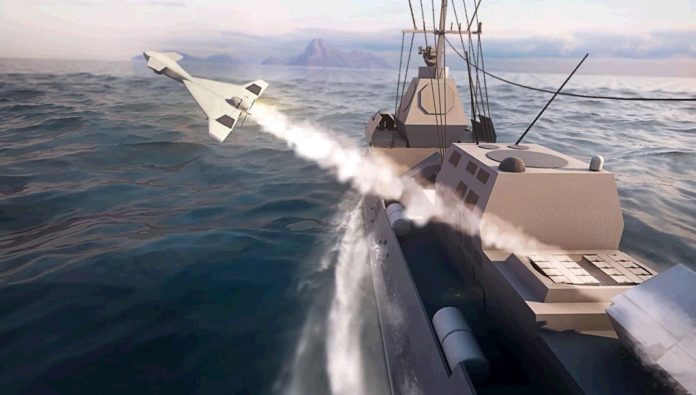
The Maritime HAROP uses the weapon system of the land based LM. The launcher was replaced by a maritime qualified launcher and communications channel was modified to meet operations in the maritime domain. Illustration: IAI
Israel Aerospace Industries (IAI) has developed a Maritime version of its Harop Loitering Munitions (LM) family. The company is displaying the weapon at the DSEI 2017 defense expo in London this week. The new marine capabilities of the HAROP extends the operational capability of surface ships, from offshore patrol vessels to naval frigates. The technological adjustments of the marine Harop include a launcher with new marine configuration and adjustments of the communication channel of the loitering munition.
In the past year, IAI unveiled several new types of LMs, including the New Generation Harpy autonomous anti-radiation weapon designed for air defense suppression missions (SEAD/DEAD) and Green Dragon, a smaller, tactical and affordable LM offering enhanced situational awareness and superior firepower for tactical land forces. The company also introduced a smaller killer drone – Rotem, a tactical LM based on a light multi-rotor platform that delivers outstanding capabilities against low signature enemy systems in urban and complex environments.
HAROP is a long endurance LM which can be launched from a variety of platforms. It combines the capabilities of a tactical UAV and guided missile as it is equipped to search, detect and attack high-value relocatable targets that are exposed for a very short time, thus becoming ‘time critical targets’. The weapon’s EO seeker comprises a high-performance FLIR/ color CCD with 360 degrees hemispherical coverage. In maritime operations, HAROP can be employed against targets on land as well as targets at sea.
Boaz Levi, Executive Vice President and General Manager of IAI’s Systems, Missiles & Space Group, commented: “The maritime HAROP is an operational weapon system which provides navies with a unique response and at a good cost-benefit ratio. As such, it has attracted the interest of different customers worldwide. When used on marine platforms, the HAROP provides an excellent operational alternative to sea-sea missiles as well as a range of additional uses such as intelligence gathering and allowing the operator to choose the precise timing of the attack. It is a welcome addition to IAI's solution offering for loitering munition missiles.”
Border and coastal security require military and security forces to maintain persistent surveillance and control over long stretches of land and coastal areas, holding the line with observation posts equipped with remotely controlled sensors, communications, and patrols.
On clear days outposts can cover tens of kilometers, but at night or in degraded visibility conditions, the line becomes porous and attracts unlawful or hostile activity. Until recently, electro-optical sensor and signal processing technology was not able to maintain effective coverage even under degraded visibility conditions but the new SPEED ER system developed by Israel’s Electro-Optics (EO) payload specialist CONTROP Precision Technologies Ltd. succeeded to expand such sensor coverage beyond 40 km, enabling security forces to deploy fewer observation towers while improving the coverage of long borders and coastal lines.
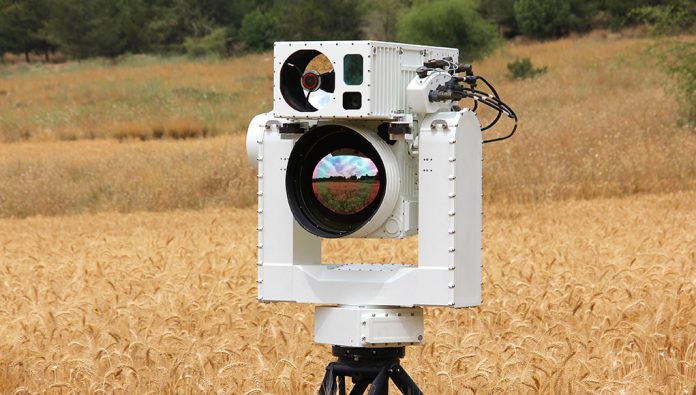
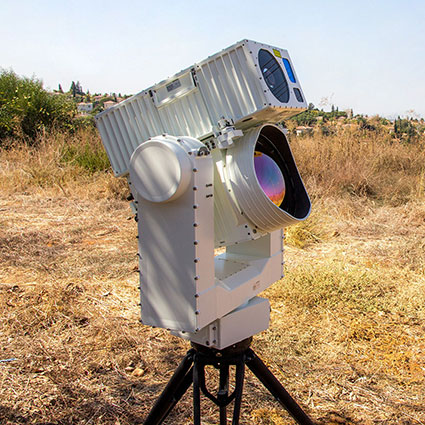
SPEED-ER is a long range, gyro-stabilized high definition ISR system designed for border protection and coastal protection. The system was developed to improve limited visibility conditions experienced in twilight hours and problematic weather conditions. Improved visibility is achieved by combining operating multiple sensors in four different channels – two Visible video cameras – one with a Wide Field-of-View (WFOV) and another with Narrow Field-of-View (NFOV), and two thermal cameras – a Mid-Wave InfraRed (MWIR) and Short-Wave InfraRed (SWIR). Each channel offers specific advantages and has certain limitations, but the combination of all three offers superior performance in all environmental and visibility conditions, including haze, dust, rain or high humidity.
SPEED ER, a gyro stabilized, long range multi-sensor observation system for homeland security applications. Photo: Controp
The system is fitted with powerful telescopes for all sensors, enabling the system to detect a standard NATO target from a distance exceeding 40 km. visibility at night and adverse weather are also extended using a 1,400mm lens for the MWIR thermal camera and 2,500mm telescope for the SWIR, both are equipped with continuous zoom function.
Controp’s SPEED family also includes two panoramic surveillance systems – SPEED-V and SPEED-ER, designed to monitor a wide area for intruder detection using automatic, panoramic intruder detection and recognition.
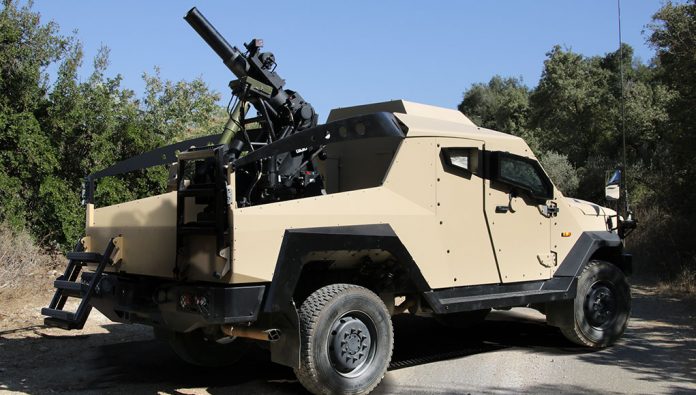
Spear Mk-2 mobile mortar system mounted on a Plasan 'Sandcat' (Stormer) armored utility vehicle. Photo: Elbit Systems
Updated 09/09/2017: In May 2017 Elbit Systems unveiled the Spear Mk2 120mm mobile mortar, a new version of the autonomous mortar system designed for Light Combat Vehicles. The new variant mounted on Plasan’s Sandcat is displayed this week at the DSEI exhibition in London. Spear addresses the need of small, rapid deployment light forces to quickly bring firepower and mobility to engage the enemy requiring minimal logistical footprint.
The new mortar system is adapted to suit lightweight vehicles enabling optimal recoil reduction; the system is displayed at the International Land Warfare and Logistics Conference in Latrun this week. Spear MK2 is an upgraded version of the operationally proven Spear mortar system – a fully autonomous, modular 120 mm mortar system. The Spear’s latest version has a high recoil reduction capability, making the system suitable for installation on light vehicles while maintaining the unique precision, autonomy, and agility of the Cardom mortar system. On the display, the Spear Mk 2 is installed on a Plasan Sandcat (Stormer) armored vehicle.
The upgraded system provides an improved field of regard, wider area coverage, quick deployment and has an autonomous or manual operation by 2-3 crew members. The system is prepared and ready to fire the first round in sixty seconds from a halt. The system uses an integrated command and control system enabling full mission autonomy and providing battlefield management and situational awareness capabilities, fire missions’ prioritization and monitoring of personnel assignments.
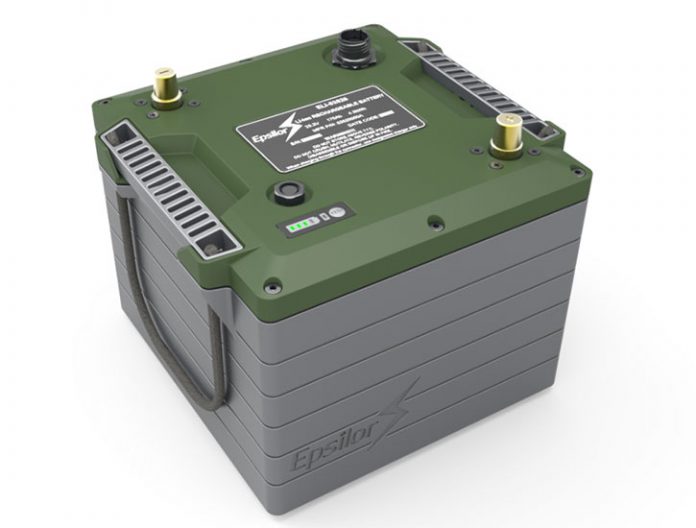
The new Li-Ion based vehicle battery triples the electrical energy stored in a standard 6T vehicle battery, extending the silent watch endurance. Photo: Epsilor
Israel’s battery specialist Epsilor has launched a new line of vehicle batteries with ultra-high energy density, packed in standard 6T form factor. The new lithium rechargeable military vehicle batteries offer triple time silent watch, high power and managed charging, as well as heater supported operation in extreme temperatures. The new 6T will be presented at DSEI 2017.
The new batteries were developed to meet the requirements of vehicle operators seeking to extend the energy storage available on combat vehicles. Israel’s Tank Development Authority is expected to begin field trials of these advanced, rechargeable lithium-ion batteries. Designed primarily for the next generation of armored vehicles these powerful batteries can be used today, as drop-in replacements for traditional lead-acid batteries.
“Our new 6T product family is designed to meet the needs of the fast developing market of modern armored vehicles with an extended silent watch and more efficient fuel consumption,” said Epsilor president Ronen Badichi. “These smart drop-in replacements for traditional batteries are a perfect solution for new vehicles as well as for retrofit and modernization programs of existing armored fleets in NATO and in other advanced land forces.
The line comprises two Lithium based chemistries – Li-Ion and LiFePO4. The first packs 4.3kWh (176Ah) – the highest energy density available in the market today. The second high-power battery is based on LiFePO4 chemistry which stores 2.0kWh (80Ah) in a super-safe design suitable for extended life cycle. The company also provides those batteries in customized configurations, such as fully sealed batteries for amphibious vehicles.
When used in combat vehicles, high power high energy batteries such as those 6T models offer unique tactical advantages, including an extended silent watch (extended silent operation with the main engine shut down and without the need for Auxiliary Power Unit (APU).
Designed with smart energy management on board the batteries can use all available energy, maintaining enough power for vehicle operation and engine start, even in extreme conditions. The new batteries are designed for more than 3,000 charging cycles and 10-year operational life, almost five times the average lifespan of current lead acid batteries.
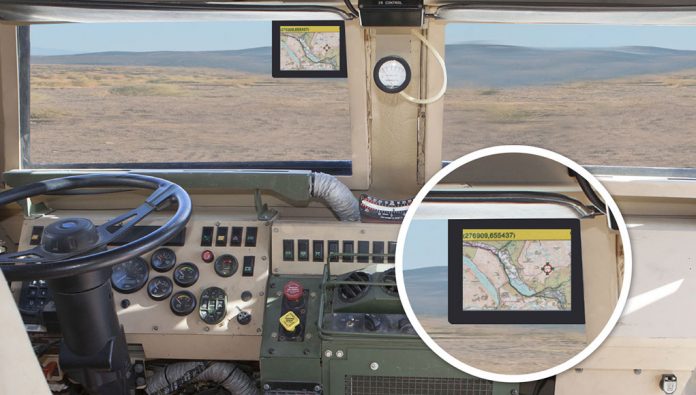
The ScreeneX display can be located anywhere in the windshield or side windows, within the field of view of the driver or passenger. Image: OSG
OSG is demonstrating at DSEI the latest edition to armored glass – ScreeneX. The product, developed by the Israeli transparent armor expert, is the world’s first armored windshield with a built-in LCD digital screen, enabling combat vehicle designers to use areas of the vehicle’s ballistic protected windows to display digital images, including information from the vehicle systems, command and control, on board sensors or digital maps.
The system can also enable the integration of advanced safety systems, with displays of obstacle detection, headway monitoring, blind spot warning and reverse camera systems embedded in the windshield.
ScreeneX technology for Defense and Security is the LCD display embedded inside the ballistic glass at any threat level. It’s suitable for use as a display for standard computing devices or night vision units used in military vehicles. Fully integrated into the vehicle’s window system, ScreeneX maximises the cabin space utilization, placing critical information in front of the driver or the vehicle’s commander.
Encased in the transparent window the ScreeneX’ casing uses a metal overlap made of ballistic steel that ensures no decrease in the protection level of the window of the vehicle. Screenex offers combat resilience and survivability even after multiple hits that will reduce the transparency of standard ballistic protected windows. The electronic display shows the forward view captured by the driving camera or driver’s thermal imager;
The unit can be located anywhere in the windshield or side windows, within the field of view of the driver or passenger, according to customer’s preference. Rear or side cameras can also connect to the screen, functioning as side and back mirrors on vehicles using opaque side armor or recessed driver’s position, to increased driver awareness. The display can also function as a vehicle display, replacing bulkier dashboard units.
Displaying images and graphics in high resolution, ScreeneX renders data, images, text, and video at high definition, displaying maps, delivered via the vehicle’s sensors, navigation system or command and control network. ScreeneX is maintained as a normal ballistic protected window and does not require any special installation or support as the electronics unit driving the display and connecting it to other computing devices is separated, to provide easy access for technical support.
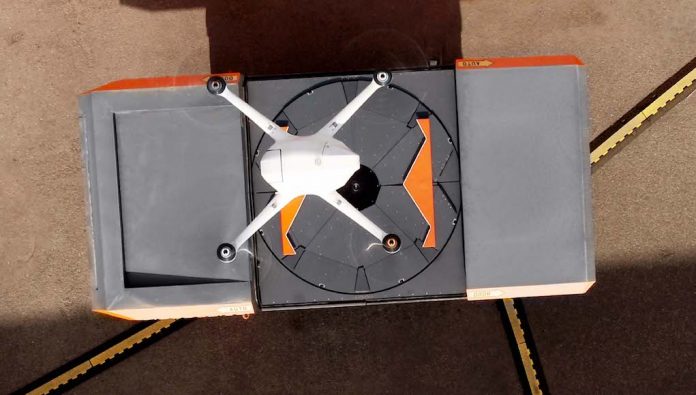
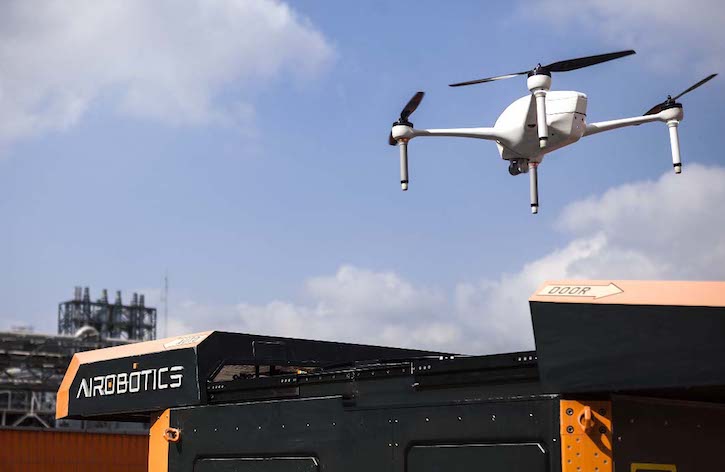
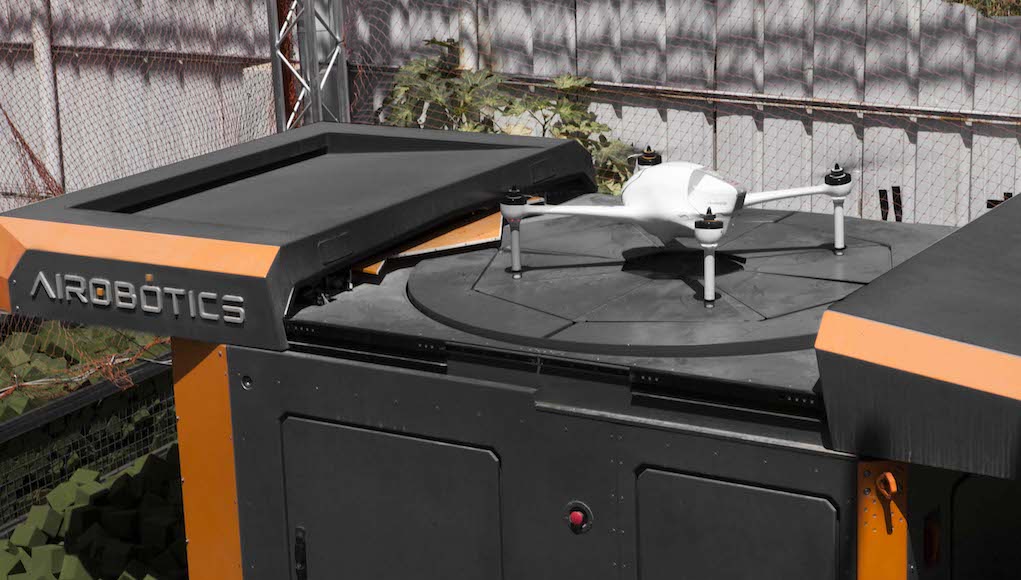
Optimus autonomous drone takes off from its 'airbase'. The drone is certified to operate autonomously on civilian missions, providing surveying, monitoring and security of industrial sites. Photo: Airobotics
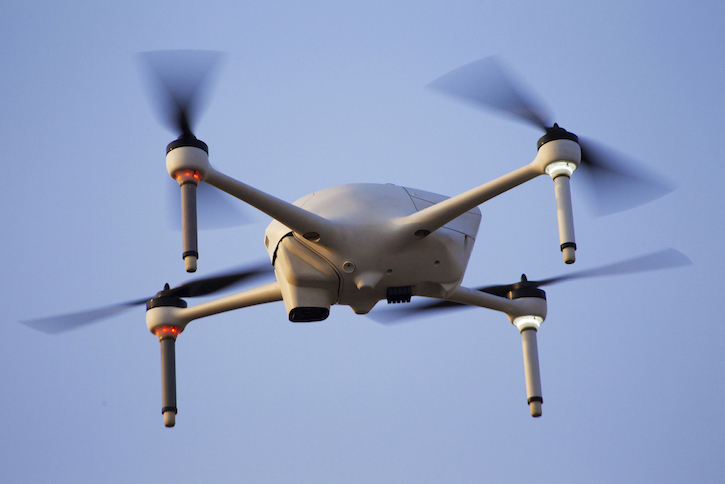
The Optimus UAV. Photo: Airobotics
Airobotics, an Israel based developer of automated industrial drone based systems completed an investment round raising $32.5 million to strengthen its industrial and mining solutions and expand into new applications.
“This fundraising enables us to continue to expand, within industrial facilities, and with our newly launched Defense division. Our next stop – automated drones in cities,” says Ran Krauss, CEO and Co-Founder at Airobotics. The company announced today its new division of Homeland Security and Defense, as well as its new “Airobotics Safe Cities” initiative: using fully automated drones to perform emergency critical applications in cities.
Airobotics has developed a fully automated end-to-end drone solution, used for collecting data and gaining aerial insights. The system uses the Optimus – a large, high capacity multi-rotor drone capable of flying 30-minute missions while carrying a one-kilogram mission specific payload and the Airbase– an automated base station from which the Optimus drone launches and lands on its own, without any human intervention.
This first of its kind solution reduces risks and costs associated with drone operations while improving efficiency. Its current solutions apply to industrial facilities such as mine sites, refineries, seaports, oil and gas facilities and more. Airobotics was the first company to be granted authorization to fly fully automated drones without a pilot, by the certification by the Civil Aviation Authority of Israel (CAAI).
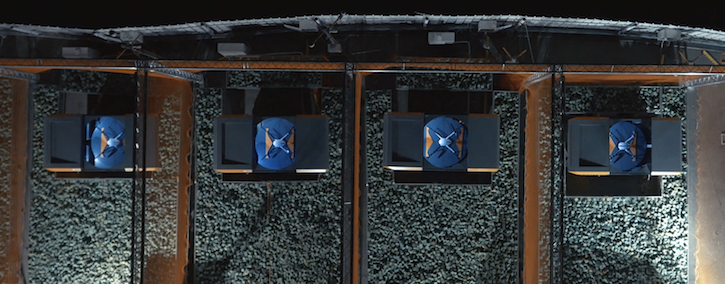
An optimus drone taking off from its ‘autonomous airbase’. Photo: AiroboticsAirobotics test site demonstrates how an operational site of Optimus UAVs operates completely autonomously, with drones operating from ‘airbase’ launch pads, from which drones take off, land and recharge automatically, with no human assistance. Missions are also performed autonomously, with mission data transferred to the control center in real time. Photo: Airobotics
The certification followed two years of preparations and inspections, as the system went through rigorous field testing and product verification processes, accumulating more than 10,000 flight hours and automated flight cycles. “This milestone has the potential to impact industries ranging from mining, security, and construction to agriculture and energy,” Krauss said, adding that fully certified autonomous drones will optimize processes such as surveying, inspections, and security of critical infrastructure.
While Airobotics’ Optimus drone system was developed initially for industrial use, the system’s certification opens applications beyond industrial ones, including live traffic analysis, real-time surveillance and reconnaissance in emergency response situations, and more.
“By offering an automated drone that launches, flies and lands on its own, collects and processes limitless data and even completes its own maintenance including battery changing and payload swapping in its protective air base, we’ve created an industrial multi-tool solution the likes of which the world had not previously seen,” Krauss explains.
One of the investors in the recent round was BlueRun Ventures China. “Airobotics is a game changer, which has successfully matched revolutionary drone technologies with real industrial needs.” says Jiajie Wu, Executive Director, BlueRun Ventures China. “we believe Airobotics will see substantial opportunities in Asia, which is one of the world’s largest industrial markets.”
Airobotics plans to apply for unmanned flight certification from a number of aviation authorities in nations worldwide, beginning with the Civil Aviation Safety Authority (CASA) in Australia. Airobotics is also expanding into the United States.
The airbase serving the autonomous Optimus drone provides a landing pad, recharging, inspection and protected storage for the system. Photo: Airobotics.
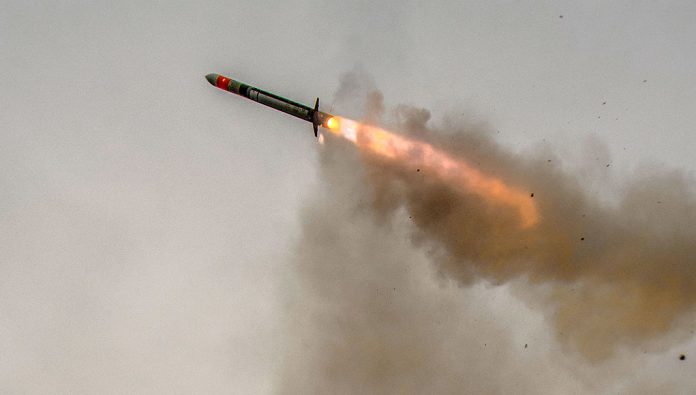
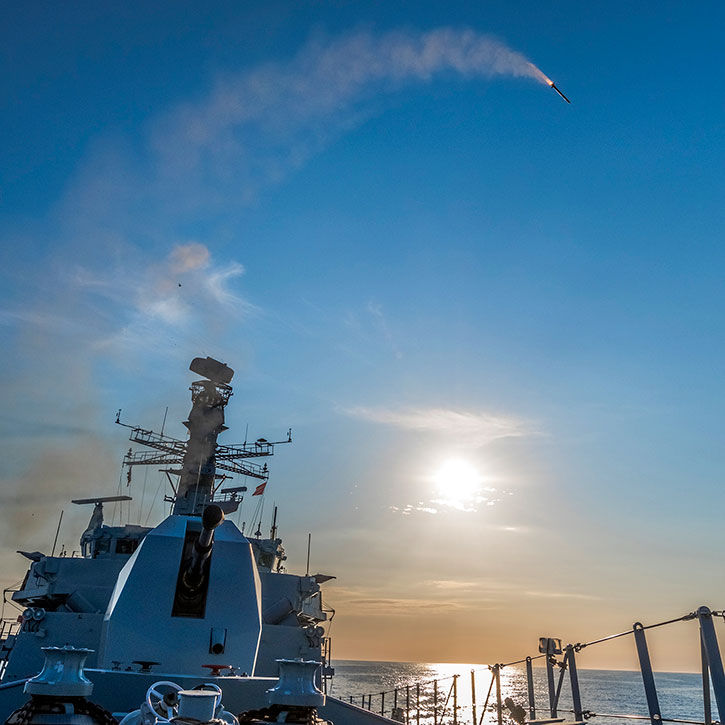
The CAMM missile is seen on its first flight from HMS Argyll. The missile’s clean aerodynamic design provides it with improved performance in the air, while also making it highly compact for installation onboard ship. Photo: MBDA
A CAMM missile is launched from the Sea Ceptor system on HMS Argyll. The Sea Ceptor system uses an innovative soft vertical launch system that significantly reduces the impact of a traditional “hot launch” missile on both the ship and the crew.
The Sea Ceptor weapon system recently completed its first successfully firings from HMS Argyll. The frigate is one of three Royal Navy Type 23 frigates being modified with the Sea Ceptor system, replacing the older Sea Wolf. The test is a major milestone for the life-extension program of Type 23 frigates.
HMS Argyll is the first Type 23 to undergo the life-extension program. She will conduct further firing trials of the Sea Ceptor system before deploying to Japan next year. Sea Ceptor will provide the Royal Navy with an improved shield against airborne threats such as the new generation of supersonic anti-ship missiles, fast jets, helicopters and unmanned aerial vehicles. Alongside providing robust self-defense, importantly Sea Ceptor defends escort vessels within a maritime task group, such as for the new Queen Elizabeth Class aircraft carriers.
Sea Ceptor uses MBDA’s next-generation Common Anti-air Modular Missile (CAMM), is being fitted to replace the Sea Wolf weapon system on these frigates, as well as the new Type 26 and, it may also be selected for the future Type 31 about to replace them in the Type 23s next decade. The Sea Ceptor development and integration was funded under contracts worth £639m contract and fit them to the Type 23 and Type 26 frigates.
Compared to Sea Wolf, CAMM is faster, has longer range, has a two-way data link, and has a much more advanced seeker, all of which enable the missile to intercept more challenging targets. The missile capable of reaching speeds of up to Mach 3 and will have the ability to deal with multiple targets simultaneously, protecting an area of around 500 square miles (1,300 square Km) over land or sea.
Traditional air defense systems utilize semi-active radar guidance, meaning they rely on a surface-based fire control radar to illuminate the missile’s target. The missile uses an active radar seeker and data link on the missile thus avoiding reliance on the ship’s radar for guidance. This technology enables the ship to employ multi-mission radars and intercept more targets simultaneously, across 360 degrees – something a semi-active system could not do. Its clean aerodynamic design yields improved performance and easier, more compact installation on board. The use of an innovative soft vertical launch system significantly reduces the impact of a traditional “hot launch” missile on both the ship and the crew.
Land Ceptor – the land-based derivative of Sea Ceptor – will replace Rapier in British Army service as the future generation Ground Based Air Defense (GBAD).
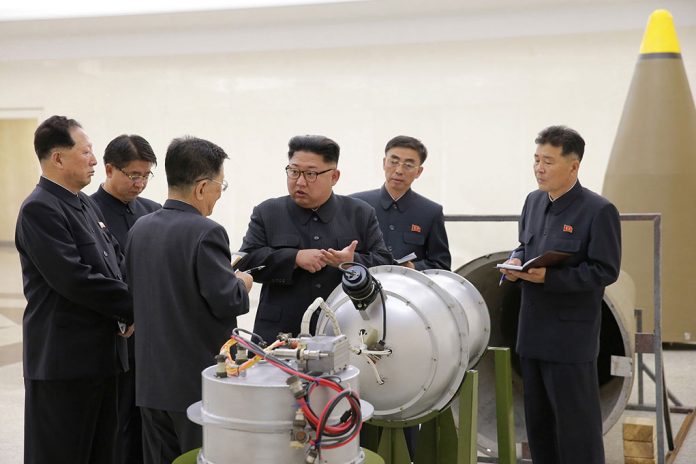
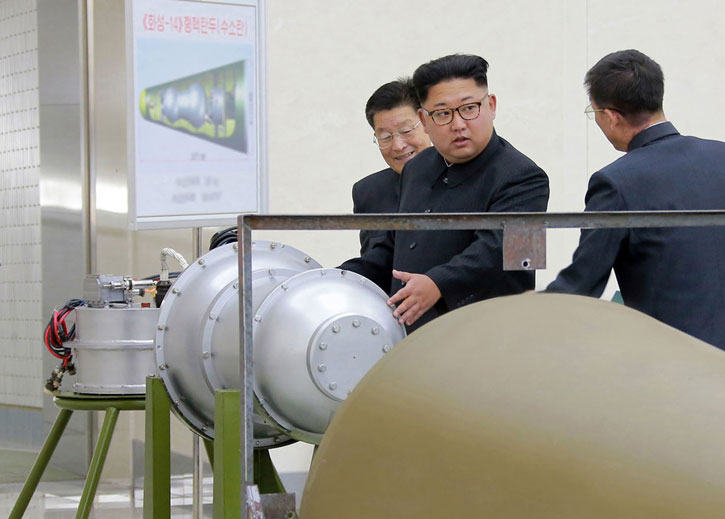
North Korean leader Kim Jong Un visits the Korean Nuclear Weapons Institute to inspect the new, miniaturized thermonuclear H-bomb developed at the institute for use in ICBM, as indicated by the yellow-tipped missile nose cone shown in the background. Photo: KCNA
Pyongyang confirmed today it successfully tested a hydrogen-bomb device. North Korea’s Korean Central News Agency (KCNA) earlier reported on a new miniaturized thermonuclear device developed by country’s Nuclear Weapons Institute. The shape of the instrument indicates the typical tandem design of a thermonuclear weapon, placed adjacent to an aerodynamic object likely to be the nose cone of Hwasong-14 ICBM, showing the new H-Bomb is sized to fit the country’s intercontinental ballistic missiles (ICBM).
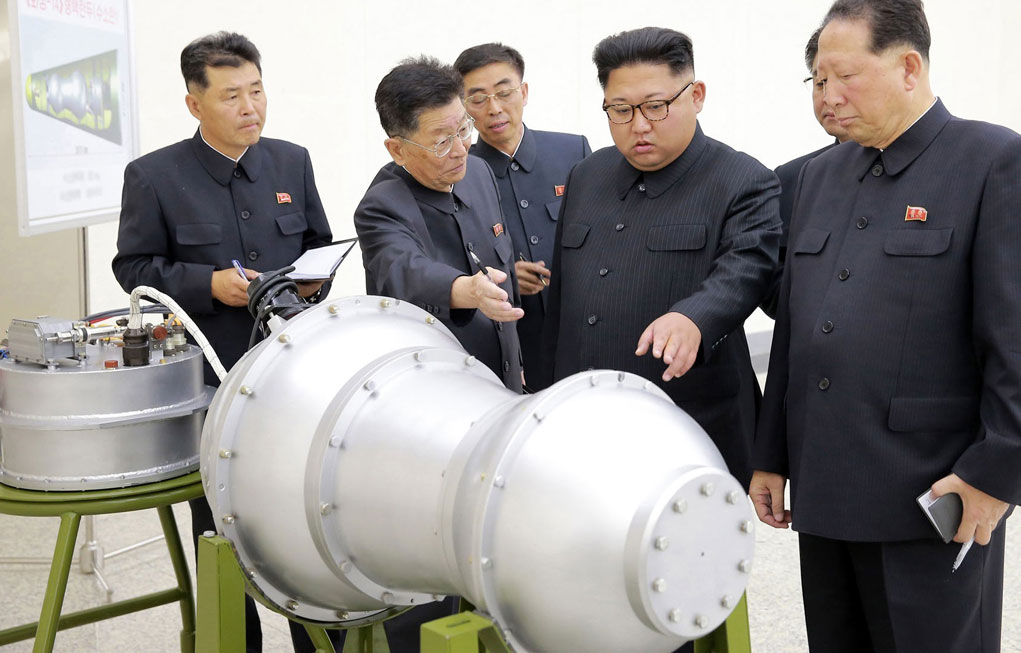
North Korean leader Kim Jong Un visits the Korean Nuclear Weapons Institute to inspect the new, miniaturized thermonuclear H-bomb device aligned with what looks like a missile nose cone. The device developed at the institute for use in ICBM, such as the Hwasong-14, as indicated on the poster on the wall. Photo: KCNAKCNA statement added the device is designed for adjustable yield, from tens kiloton to hundreds kiloton. By adjusting its yield this ‘multi purpose’ nuclear device can be used against specific targets or set to explode high in the atmosphere, causing an Electromagnetic Pulse (EMP) that devastates electronic circuits and electrical power grids over a large area. Previous tests of North Korean thermonuclear devices developed yields up to 20-30 kilotons.
A thermonuclear weapon represents the second generation nuclear weapon design using a secondary fusion stage in addition to the primary fission device. This secondary device is triggered by the fission stage causing a fusion reaction. Placed near each other in a radiation-reflecting package designed to contain x-rays for as long as possible , the fission bomb and fusion fuel make a powerful combination resulting in greatly increased explosive power, when compared to single-stage fission weapons.
A few hours later a massive seismic event of a 6.3 magnitude was recorded which was ten times stronger than previous nuclear tests that recorded a seismic event of 5.1 magnitude. The Korean Meteorological Administration reported an event likely an artificially triggered earthquake of 5.7 magnitude at a depth of 10 kilometers. The tremor was felt in China and was clearly detected on seismic sensors in South Korea, Japan and reported by the United States Geological Survey (USGS) earthquake monitoring service. A second quake on a scale of 4.6 was detected around the site, which could have caused as underground structures caved in after the first explosion.
The test occurred just under a year after North Korea’s fifth nuclear test on September 9, 2016 which North Korea claimed was its first hydrogen bomb test, and less than a week after a launch by North Korea of the Hwasong-12 ballistic missile over Japan and into the Pacific Ocean.
Analysts have been uncertain about the ability of Pyongyang to mount a warhead on a ballistic missile and get that warhead to survive the tremendous heat generated on the missile’s re-entry into the Earth’s atmosphere.
“Assuming Sunday’s test got what North Korean nuclear scientists set out to achieve, we can now expect a long-distance ICBM test in the short to medium term,” Chad O’Carroll, Managing Director the Korea Risk Group. “A successful full-distance range ICBM test into the Pacific Ocean would subsequently help North Korea show the U.S. that its long-range nuclear weapons capabilities are credible and ready for deployment,” O’Carroll noted.
North Korea has previously conducted nuclear tests in 2006, 2009, 2013, and two in 2016, with explosive yields of less than one kiloton, 2-4 kilotons, 6-9 kilotons, 7-10 kilotons, and 20-30 kilotons, respectively. Pyongyang claims it now masters the entire production process of nuclear devices, production of weapons-grade nuclear materials to the precision processing of components and their assembling, thus enabling the country an unlimited production of such weapons. This year North Korea also demonstrated the capability to build ICBMs able to carry such weapons over long distances.
The thermonuclear device uses a tandem-shaped layout of the fission device in front and fusion fuel in the rear. (Photo: KCNA)
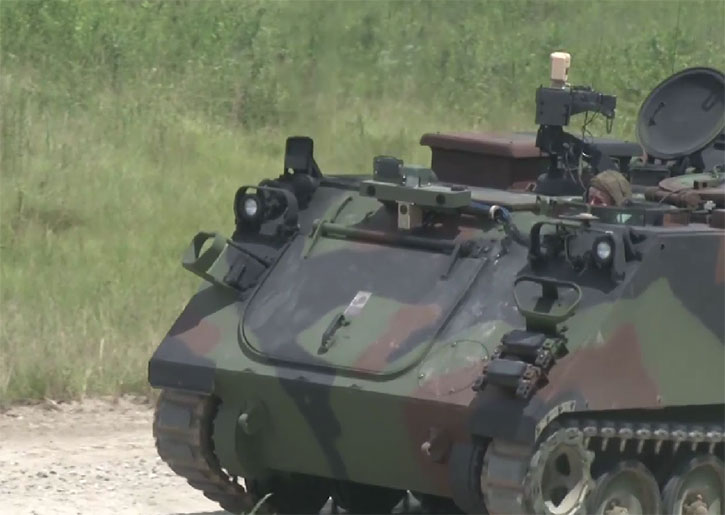
This ‘driverless’ M-113 is equipped to support automatic route identification and obstacle avoidance, using multiple sensors including Light Detection and Ranging (LIDAR), stereoscopic depth cameras and position location sensors. The driver was in the vehicle only as a backup for safety). Photo: US Army
The U.S. Army uses unmanned vehicles in many roles. Unmanned Aerial Vehicles (UAV) are used primarily for intelligence, surveillance, and reconnaissance (ISR). Others are used selectively in strike missions, launching guided weapons. UAVs are also used as loitering munitions, where the entire platforms are transformed into a guided weapon, upon the operator’s command.
Unmanned ground vehicles are employed as remotely controlled systems to dismantle and dispose of improvised explosive devices (IED) and unexploded munitions. Although the technology enabling UGVs to roam the battlefield and performing military significant missions is available today, such systems have yet to be trusted and accepted to join the warfighters in combat teams.
Following the retirement of the OH-58 Kiowa Warrior, the Army is already using the Shadow 200 unmanned aerial vehicles UAVs as the éyes and ears’ for AH-64 Apache helicopters. The Army sees a promising future extending manned-unmanned teaming (MUM-T) concepts to the ground maneuver forces, but this capability still needs years to mature.
A step in this direction was made earlier this month at the U.S. Army’s Maneuver Center of Excellence (MCoE) at Fort Benning, Georgia, where several Army labs demonstrated different some of the future concepts incorporating robotics with the fighting force.
The event demonstrated collaboration of manned and unmanned vehicles conducting a combat mission. The manned element included an M-1A2 main battle tank and M577 acting as a command unit controlling the unmanned systems.
THis Polaris all terrain vehicle (ATV) was modified to deploy a tethered UAV, deployed from the ramp mounted on top. Photo: US Army
Among the unmanned assets included in the demonstration was an all terrain vehicle (ATV) modified with a landing plate on top, to operate a tethered multi rotor UAV. The vehicle also carried communications systems, extending the network to enable the command post to control all unmanned assets from behind.
Another unmanned asset was an autonomous driven M-113 armored personnel tasked to carry out an advance scout, masking the route with smoke to conceal the movement of tanks. Using automatic route identification and obstacle avoidance, using multiple sensors including Light Detection and Ranging (LIDAR), stereoscopic depth cameras and position location sensors, enabling the APC was able to operate safely within the manned unit (the driver was in the vehicle only as a backup for safety).
The Automated Direct Indirect-fire Mortar (ADIM) demonstrated the conduct of autonomous fire support, relying on targeting received from a robotic forward observer. Photo: US Army
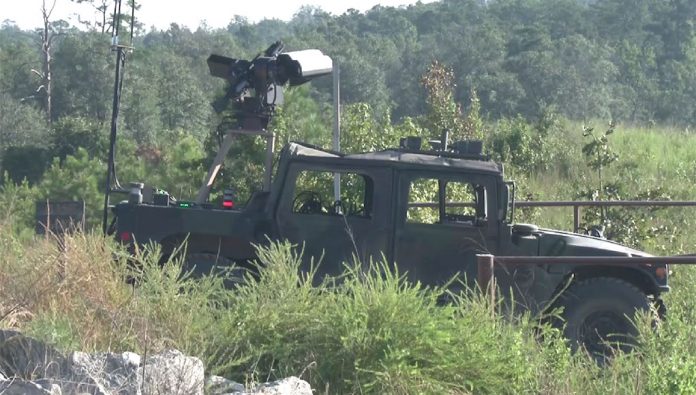
Two light platforms mounted on HMMWVs provided the ‘shooters’ for the team. One, acting as a ‘Robotic Wingman’, was a driverless HMMWV that can move autonomously in the field, in synch with its manned teammate. Remotely supervised via the tactical network, the Robotic Wingman provides the manned teammate and the larger unit with an enhanced situational picture, using an automated target tracking system. It also had a remotely operated weapon station, enabling target engagement when necessary. The second ‘shooter’ was the Automated Direct Indirect-fire Mortar (ADIM), that provided direct and indirect fire support for the team, using the robots as fire observers, thus establishing a robotic ‘hunter-killer’ team.
“Robotics and autonomous systems help provide a way to give us enhanced capabilities to the formation, and provide a greater range of operations,” said Dr. Robert Sadowski, Robotics Senior Research Scientist, TARDEC. “We can use robots to do those things they do well and offset those things that humans do well.”
“The intent of demonstrations, such as these, is to illustrate the realm of the possible often using repurposed experimental systems or technology available today,” said Maj. Alan Stephens, lead project officer for the MCoE’s Mounted Requirements Division. For instance, surrogates such as the Humvee and M113 Armored Personnel Carriers were used in this demonstration as low-cost mobility platforms. For example, future Robotic Wingmen could rely on optionally manned M-2 Bradley vehicles, thus utilizing existing assets with additional capabilities.
The event was the first of a three-year process in which scientists and developers from the at TARDEC (TARDEC), U.S. Army Armament Research, Development, and Engineering Center (ARDEC) and the Office of Naval Research (ONR), showcased progress made in designing and using robotic combat vehicles and unmanned aerial systems together in scenarios aimed at improving the effectiveness of ground combat formations.
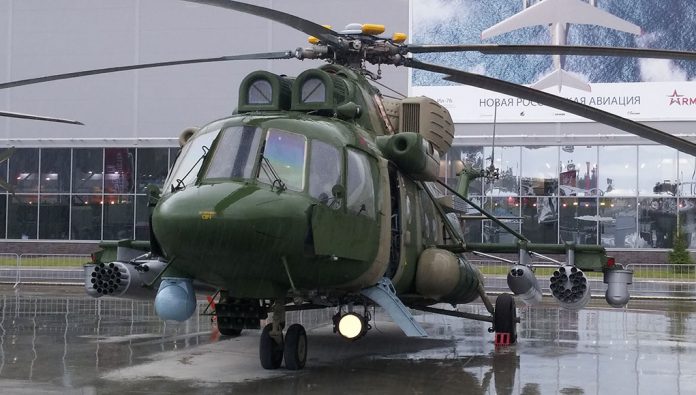
Mi-8AMTSh assault helicopter on display, Army 2017. Photo: Defense-Update
Since the break of the conflict in 2011 Syria Moscow stood by its Syrian Allay but refrained from an active intervention even after the Western coalition launched an aerial offensive against the Islamic State in August 2014. By September 2015, when the Syrian regime faced defeat from the rebels, Russia decided to act. Although the task force committed to the operation was limited, the choice of arms used included a variety of weapons from many disciplines, enabling different Russian elements – army, air force and naval units, to gain combat experience.
Russian Air Power in Combat
Russian forces deployed to several locations in Syria, including the port of Tartus and Hmeimim Air Base near Latakia. From the initial phase, these bases were protected by air defense assets including S-400 elements (surveillance radars communications nodes) and Pantsir S1 mobile air defense systems. Following the loss of Russian Su-24 to a Turkish Air Force F-16 the Russians deployed S-400 fire units to Hmeimim, completing a permanent air defense capability that covers a large part of Syria including most of the ingress and egress routes used by coalition air forces operating in Syria, as well as large area of the international airspace over the Eastern Mediterranean Sea. Su-30SM fighters were also deployed to provide air cover to the strike force, augmenting the ground-based air defense elements.
The Russian Air Force Russian committed representative platforms from all units and branches and extensively recorded these activities in video. These included the Tu-160 ‘Blackjack’ bombers, Tu-95 ‘Bear’ and Tu-22M3 ‘Blinder’ supersonic bombers. These elements deployed on long range missions from bases in Southern Russia, and, for a brief period, also operated from a forward base in Iran, demonstrating contingency operations with coalition partners. While such complex activities were not necessary operationally, the Russian forces took the opportunity to train and test their forces for such contingencies.
SU-34, the strike fighter recently delivered to the air force was widely used during the first months of the Russian involvement in Syria. The choice of this platform was its flexible armament carrying capability and high level of protection (the crew is seated side by side in an armored protected cockpit made of titanium). The Russians also deployed the brand-new SU-35 to Syria, to gather some combat experience and train its systems in a realistic environment that included Patriot and Italian Aster 30 SAMP/T air defense missiles.
The wide range of aerial weapons used in those air attacks represents the majority of weapon’s types used by the Russian Air Force, from standard unguided bombs to cluster munitions, incendiary and high explosive, precision laser guided and GLONASS/GPS guided weapons. Guided weapons also included cruise missiles of different variants – from the air launched KH-101 missiles launched by bombers that flew all the way from the arctic circle, to KH55 launched from Tu-95s from a range of 1,000 km. Cruise missiles were also launched from naval platforms – from frigates in the Caspian Sea, using brand new Kaliber systems, as well as missile destroyers and submarines hitting targets in Eastern Syria, some 1,500 km away from the Mediterranean Sea.
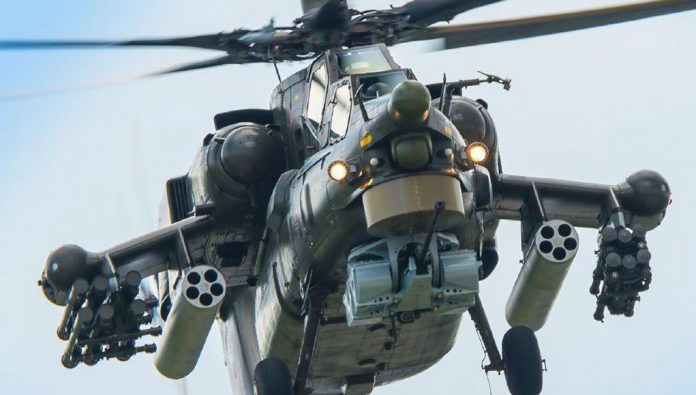
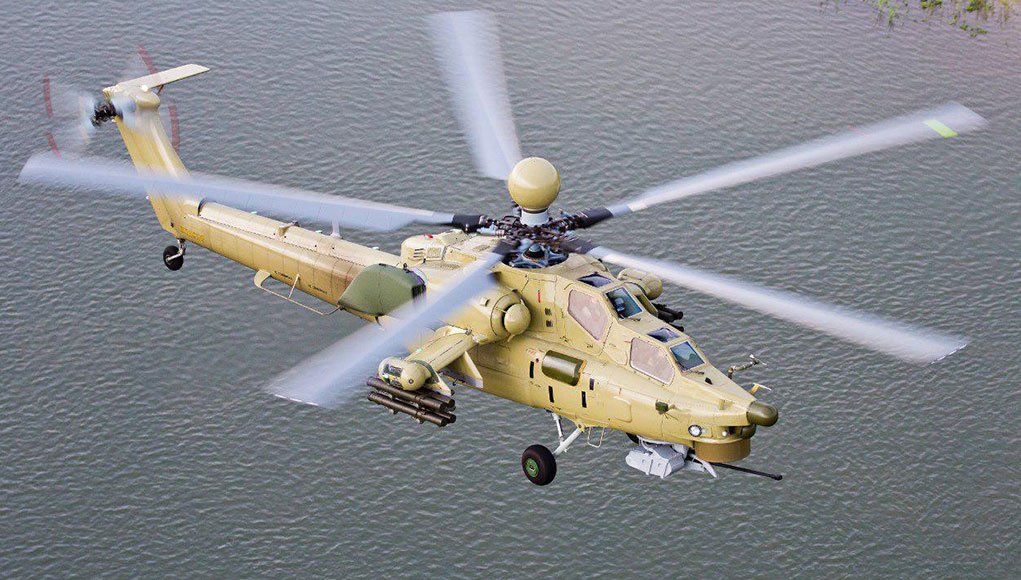
Mi-28UB is the new dual control version of the Night Hunter attack helicopter designed for pilot training. The helicopter retains full combat capability with all systems and weapons. Photo: Rostec, by Eric Romanenko
The Russian Rosvertol company completed production of the first newly modernized Mi-28UB ‘Night Hunter’ attack helicopter toward delivery to the Russian military. The production started at the Rostov plant in 2016 with against an order of Mi-28UB helicopter for the Russian Air Force; the first units are currently undergoing acceptance tests and the rest will be delivered by the end of the year.
Unlike the standard attack helicopter, the UB has dual controls in the front and back seats, to enable better training of flight personnel. The modernized helicopter also offers improved avionics, ergonomics and energy attenuating seats, improving crew survivability in case of crashes or hard landings. The helicopter possesses improved armor protection and is characterized by high tolerance to battle damage.
“The Mi-28 proved its efficiency, so we are expecting that its training version will be of great demand in armies. This dual control helicopter breaks new ground for training flight personnel for machines of this type,” said Andrey Boginsky, CEO of the Russian Helicopters holding.
The Mi-28UB retains the Night Hunter’s full combat capabilities in day or night and the full array of armaments originally designed for the Mi-28.
Mi-28UB is the new dual control version of the Night Hunter attack helicopter designed for pilot training. The helicopter retains full combat capability with all systems and weapons. Photo: Rostec, by Eric Romanenko
Lockheed Martin Skunk Works® and XTEND have achieved a major milestone in JADC2 by integrating the XOS operating system with the MDCX™ autonomy platform. This technical breakthrough enables a single operator to simultaneously command multiple drone classes, eliminating the friction of mission handoffs. From "marsupial" drone deployments to operating in GPS-denied environments, explore how this collaboration is abbreviating the data-to-decision timeline and redefining autonomous mission execution.
As traditional defense primes face mounting competition from agile “neoprimes” such as Anduril, Palantir and Helsing, the balance of innovation is shifting toward software-defined warfare and scalable, dual-use technologies, while global industry consolidation—marked by Boeing’s integration of Spirit AeroSystems and other strategic mergers—signals an intensified race to secure control over the defense technology value chain. Our Defense-Tech weekly report highlights these trends.
In early October 2025, a coordinated wave of unmanned aerial system (UAS) incursions—widely attributed to Russia—targeted critical infrastructure across at least ten European nations. The unprecedented campaign exposed the fragility of Europe’s air defenses...
Executive Summary
The past week (September 18-25, 2025) represents an inflection point where strategic defense concepts have transitioned from doctrine to tangible reality. An analysis of global events reveals four primary, interconnected trends shaping an...
At the 2025 Air, Space & Cyber Conference, U.S. Air Force and Space Force leaders unveiled major updates on next-generation fighters, bombers, unmanned systems, and space initiatives, highlighting both rapid innovation and critical readiness challenges as the services race to outpace global competitors. A short version is available here, with a more detailed version for subscribers.
The Taipei Aerospace & Defense Technology Exhibition (TADTE) 2025 crystallized around four dominant strategic themes that collectively illustrate Taiwan's comprehensive approach to defense modernization amid escalating regional tensions. Based on a detailed report by Pleronix (available upon request). Includes a Podcast discussion on TADTE 2025's highlighting Taiwan's four strategic themes beyond the post's coverage.
Israel’s Iron Beam 450 high-power laser system has completed final testing, marking a major leap in air defense. Developed by Rafael, it offers precise, cost-effective interception of rockets, UAVs, and mortars, and is set for IDF deployment by 2025.