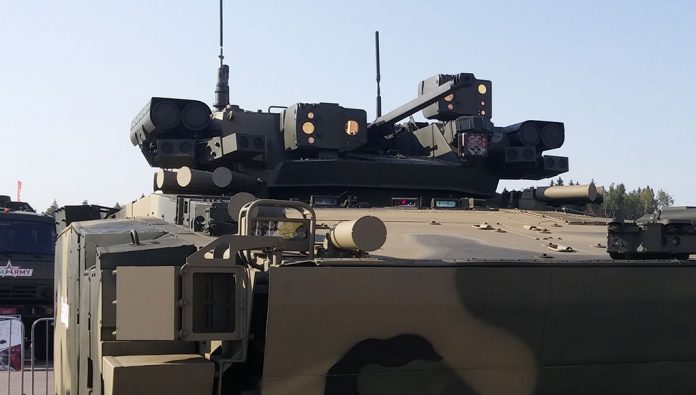
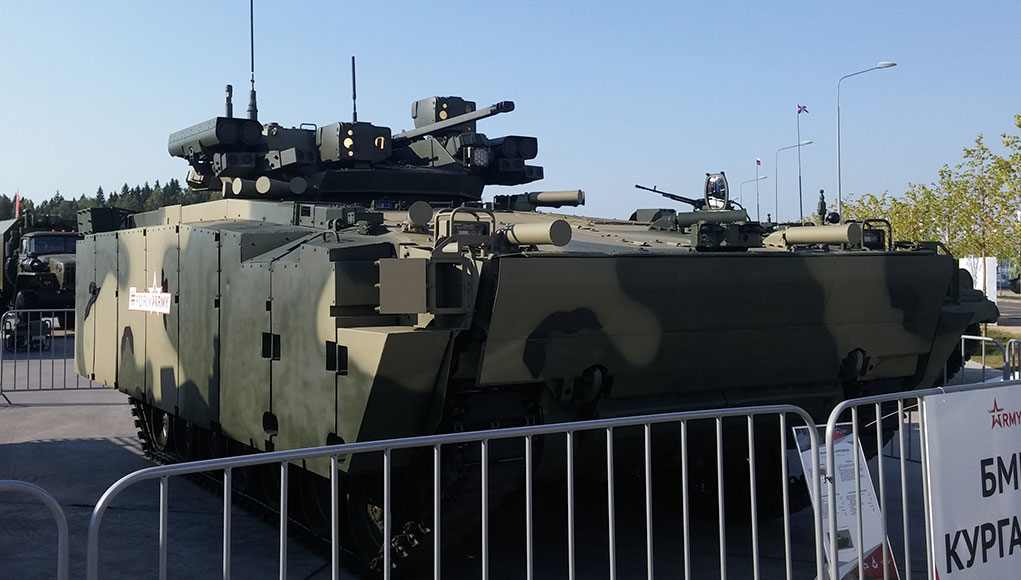
The Kurganets-25 IFV features the Bumerang-BM remote control turret with its 2A42 30 mm auto cannon, a 7.62 mm coaxial PKT machine gun and a bank of two Kornet-EM anti-tank guided missiles on either side. Photo: Defense-Update
Parallel to the development of the Armata family of heavy armored fighting vehicles the Russians are planning to replace some of their BMP medium personnel carriers and tracked utility platforms. The 25-ton platform known as Kurganets will gradually replace gradually replacing BMP and BMD and MT-LB and other types of tracked armored platforms currently in service, providing a more maneuverable and better-protected platform. An outstanding feature, compared to previous generations of Russian designed APCs is the spacious cabin and high level of ergonomic design, addressing the need to deploy troops in protected vehicles for extended missions.
The new 25-ton vehicle was unveiled publicly in May 2015. The manufacturer, Kurganmashzavod is expecting to launch serial production of the new family in 2021, following the conclusion of operational field tests. The revised schedule reflects a more realistic forecast, compared to previous announcements made when the Kurganets 25 was publicly unveiled in 2015, for the new family to enter production within the following year.
Several variants are being planned – an AIFV that carries 6-7 troops and mounts the Bumerang-BM turret identical to the one used on the T-15 AIFV (of the Armata family), this turret mounts the A42 30mm automatic cannon and four Kornet EM missiles. The vehicle has a full suite of defensive aids, including the Afganit active protection systems (APS). This variant is displayed this week at the Army 2017 event in the Patriot Expo Center near Moscow.
Three variants are being evaluated, an AIFV armed with 2A42 30mm cannon, four Kornet EM missiles, and active protection systems, that carries 6-7 troops. This variant is displayed this week at the Army 2017 event in the Patriot Expo Center near Moscow.
The family also includes an infantry carrier carrying 8-9 troops, armed with a smaller turret mounting a 7.62 mm PKT machine gun. An Anti-tank variant armed with 125mm cannon and anti-aircraft/anti-drone vehicle, mounting a 57mm automatic cannon are also in the making. An armored recovery vehicle (ARV) is also in development, along with mortar carrier, reconnaissance vehicle, and armored engineering vehicle.
Kurganets 25 AIFV displayed this week at the Army 2017 event in the Patriot Expo Center near Moscow. Photo: Defense-Update
Construction of Astute class submarines at Devonshire Dock Hall (DDH), at Barrow-in-Furness. Visible are the Anson, the fifth Astute-class submarine, next to sisters Artful and Audacious. Photo: BAE Systems
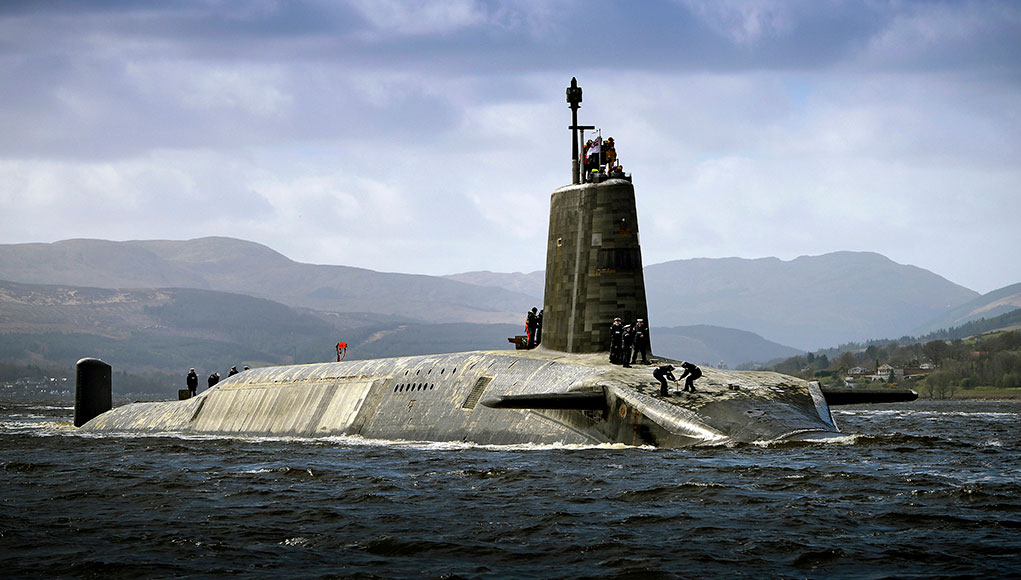
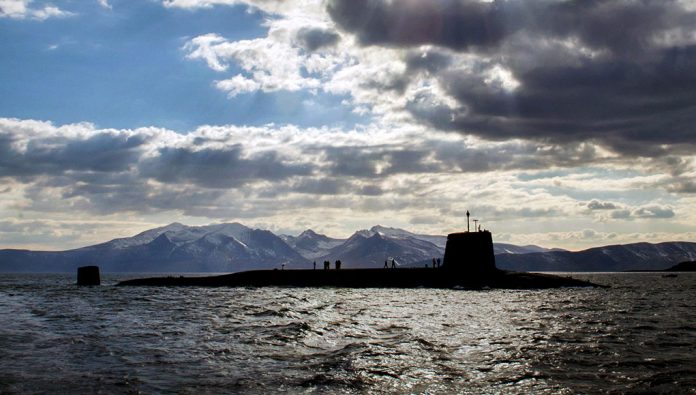
Royal Navy Vanguard Class submarine HMS Vigilant arriving at her base on the river Clyde, Scotland, following a patrol. Photo: MOD, Crown Copyright The future Dreadnought will replace the Vanguard ballistic missile submarines in the 2030s. Image: BAE SystemsThe Royal Navy currently operates maintains a small fleet of four Vanguard Class nuclear powered ballistic missile submarines (SSBN) carrying the Trident II D5 intercontinental ballistic missiles. the submarines are steam powered, their nuclear reactors converting water into steam to drive the engines and generate electricity.
These submarines maintain constant patrol cycle operating as part of the UK strategic nuclear deterrent force. Of the four subs, two are on patrol at all time, one undergoing short maintenance and the fourth undergoing deep maintenance that includes refueling or replacement of the reactor, and other deep maintenance work. This cycle has been unbroken since 1969, totaling more than 300 patrols and more than 43 years.
The submarine force is also being modernized. The Royal Navy maintains a fleet of ten nuclear-powered submarines, currently comprised of three types. The four Vanguard Class Strategic Ballistic Missile Submarines are carrying the Trident II D5 intercontinental ballistic missiles. These submarines are set for replacement in ten years, by the Dreadnought class, currently in preliminary design. About half of the £3.3 billion budget cleared Parliament for the program has been awarded.
The funding will enable BAE Systems to develop the design of the submarine, including the layout of equipment and systems, and to develop manufacturing processes, including the production of early prototypes. The new submarine will replace the Vanguard class subs in the 2030s. The main sub contractors include Babcock and Rolls Royce. Hundreds of potential suppliers, including many small and medium enterprises, throughout Britain will also take part in this program.
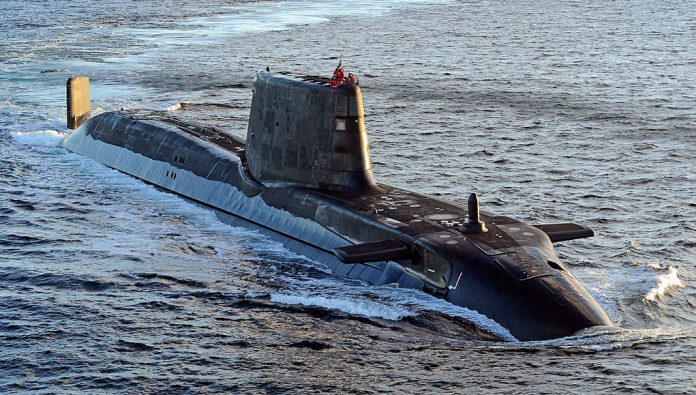
The second submarine of the Astute class – HMS Ambush entered service in 2012. Photo: MOD, Crown CopyrightThree Astute submarines and three Trafalgar class attack submarines make the conventional force. Both classes are nuclear powered with new Astute subs gradually replacing the aging Trafalgars. The construction of the fifth and sixth Astute class attack submarines is ongoing. In April MOD concluded negotiation of the contract to build the Agamemnon, the sixth boat, at the cost of £1.4 billion. As its sister subs, the submarine is built at the BAE Systems in Barrow-in-Furness, Cumbria. Construction of the Agamemnon is expected to complete in 2022; It will be followed by the seventh and final submarine of the class.
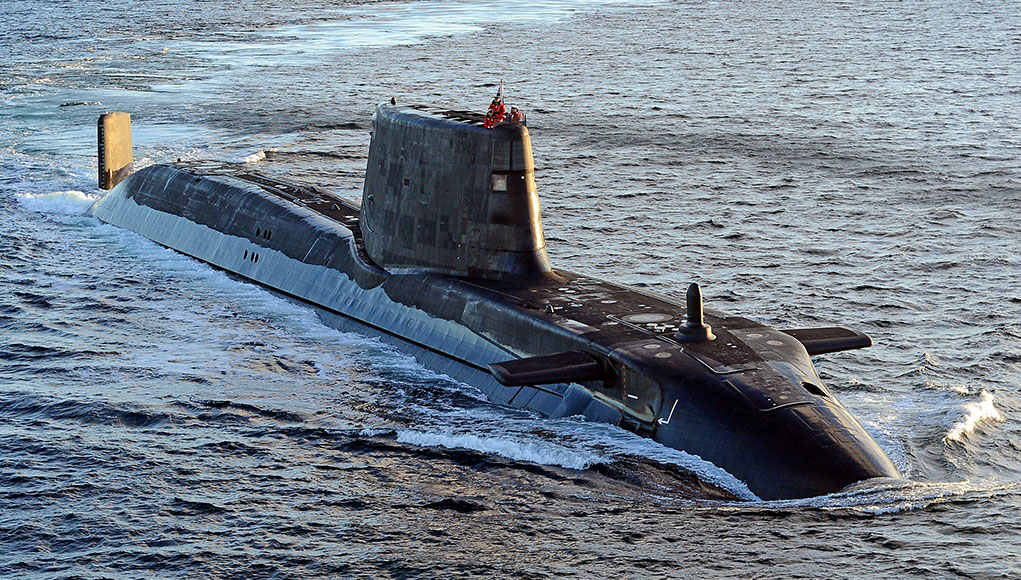
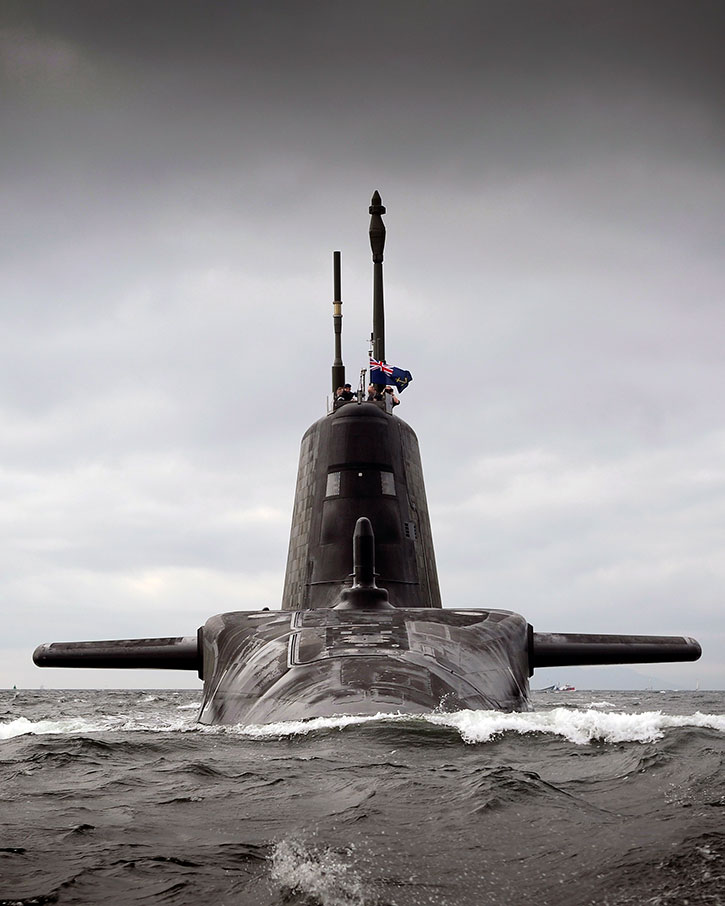
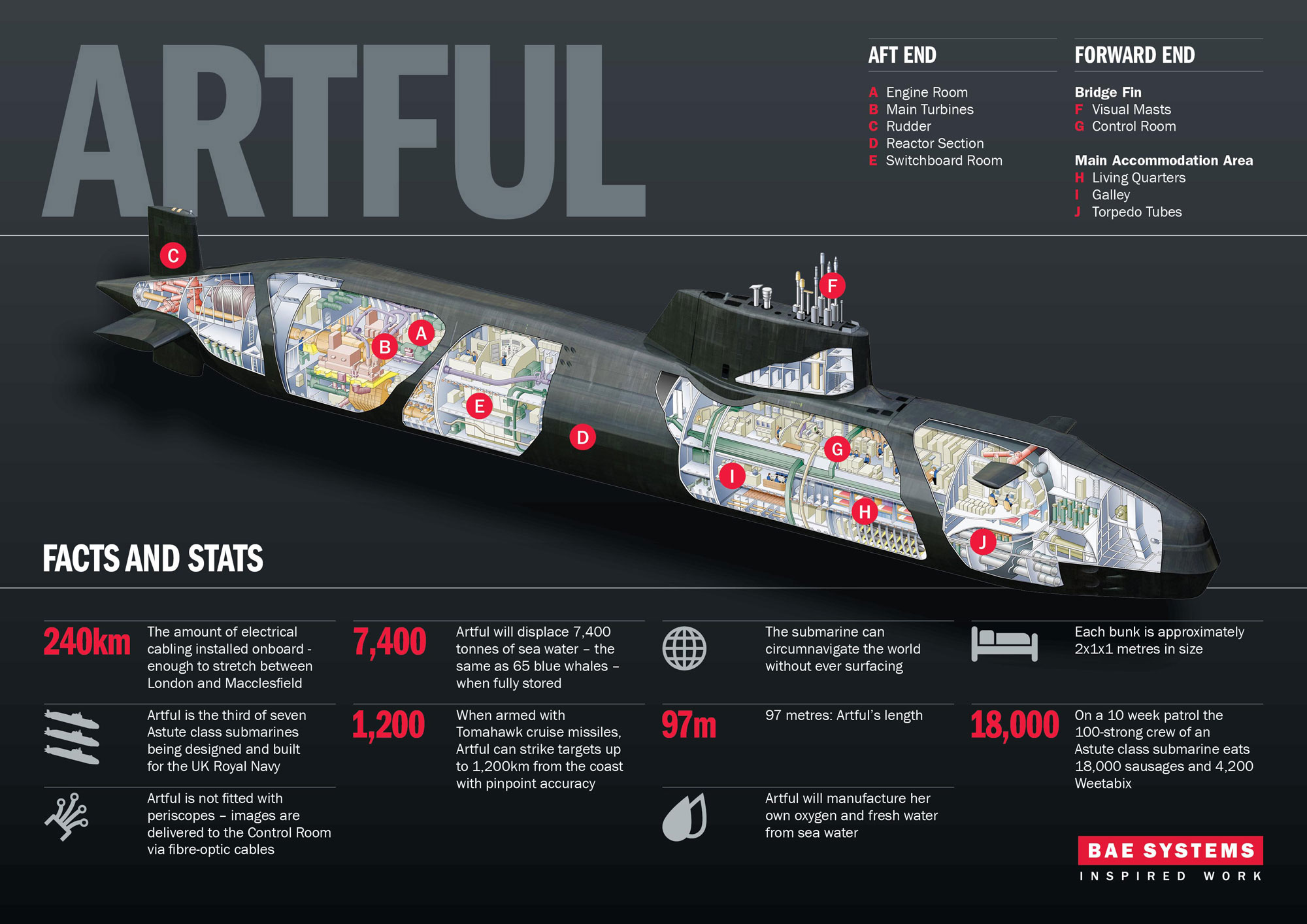
HMS Artful was the third Astute Class submarine to enter service with the Royal Navy. Photo: MOD, Crown CopyrightFeaturing modern nuclear-powered technology the Astute Class submarines can circumnavigate the world submerged, manufacturing the crew’s oxygen from seawater as they go. Although the Astute submarines are 50 percent larger than the 50 per cent bigger than the current Trafalgar Class submarines, they are quieter and have the capability to operate covertly and remain undetected in almost all circumstances.
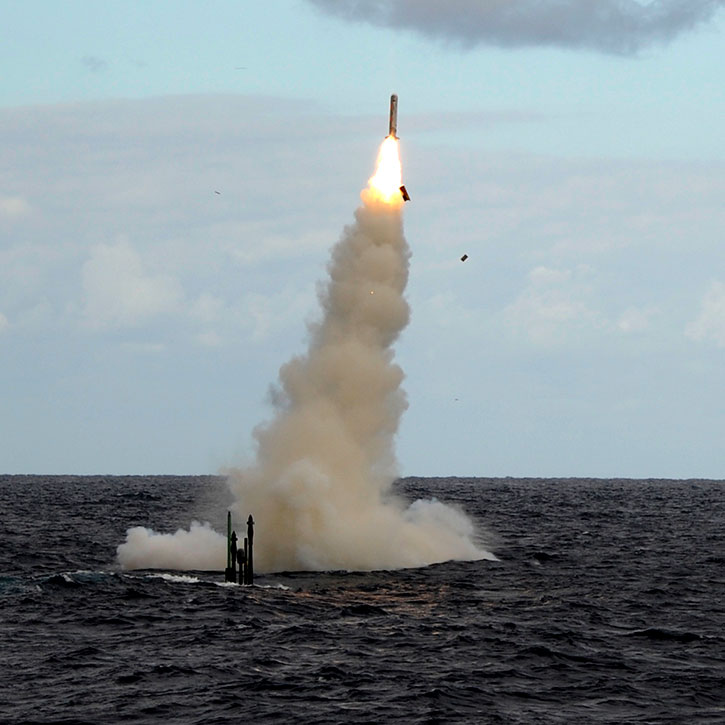
Royal Navy Attack submarine HMS Astute fires a Tomahawk cruise missile during a testing mission near the USA. Photo: MOD, Crown CopyrightThese submarines have six 21″ launch tubes designed to launch its weapons. The submarine carries 38 Spearfish Heavy Torpedoes and Tomahawk IV land attack cruise missiles (TLAM). Spearfish is designed to strike enemy submarines, surface ships at ranges of up to 30 miles. The Tomahawk attacks naval surface and land targets, at ranges more than 1,000 miles. As the torpedoes, the cruise missiles can also be updated in-flight and send back images of the area or target, seconds before impact.
Scotland has always been a center for submarine activity and in the next decade, these operations will increase, as the naval base at Faslane on the Clyde, to become the main submarine home port for the Royal Navy, creating a submarine center of specialization. An important boost to Britain’s anti-submarine capability will be the arrival of the first of nine Boeing P-8A Poseidon, expected to arrive at Lossiemouth by 2019. These aircraft will reinstate the maritime surveillance and anti-submarine capabilities lost with the termination of the Nimrod fleet a decade ago. The Neptune aircraft will operate with No 120 and No 201 Squadrons, to perform maritime surveillance and anti-submarine operations. Unlike their US and Australian counterparts, Britain does not have plans to operate unmanned aircraft with the P-8A at this stage. The £3 billion acquisition include £400 million investment in infrastructure development at Lossiemouth. The P-8A is designed for long ocean patrols.
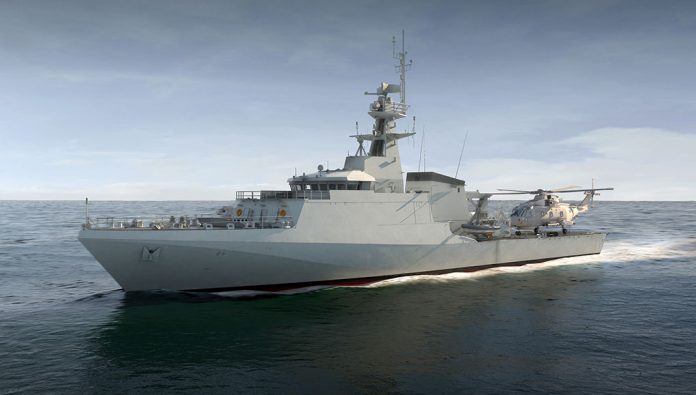
An artist concept showing the new River class OPV. Illustration: BAE Systems
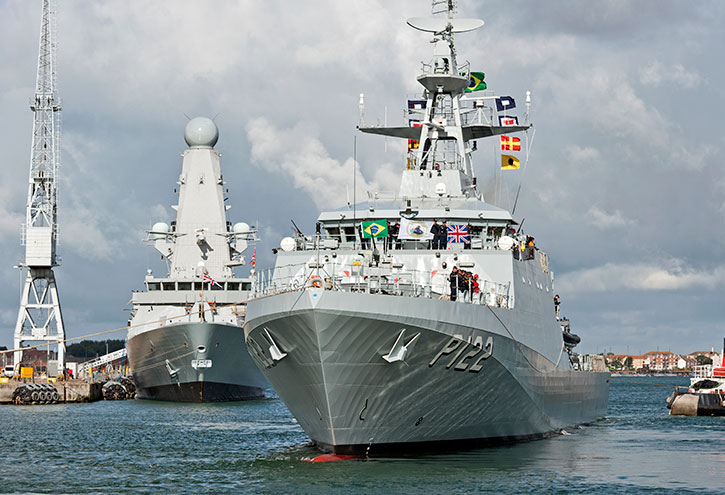
The Brazilian Amazon corvette Araguari. Photo: BAE Systems
Four River class Offshore Patrol Vessels (OPV) were built in the UK between 2002 and 2007 and are in service. They are expected to reach the end of their service by the end of the decade, replaced by five new ‘Batch 2’ boats.
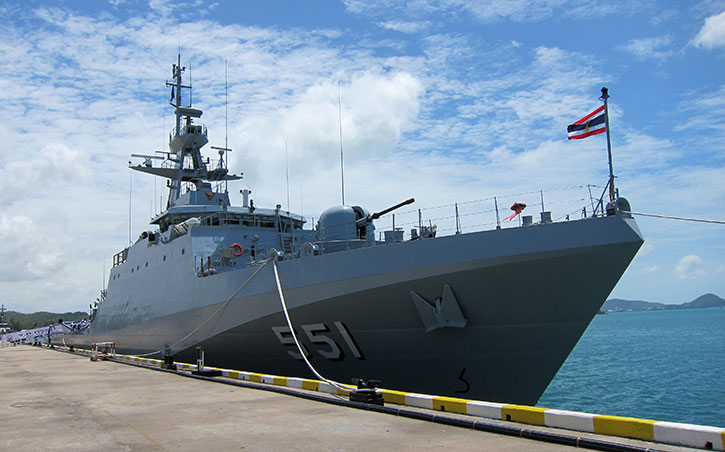
The first – HMS Forth will be delivered in 2018. HMS Spey, the fifth and final ship of the class will be in service by 2021. Unlike other military vessels built in the UK, the River Class recorded two export sales – the sale of three Amazon Class boats to Brazil and one, built in Thailand, to the Thai Navy that has recently ordered a second boat of this type.
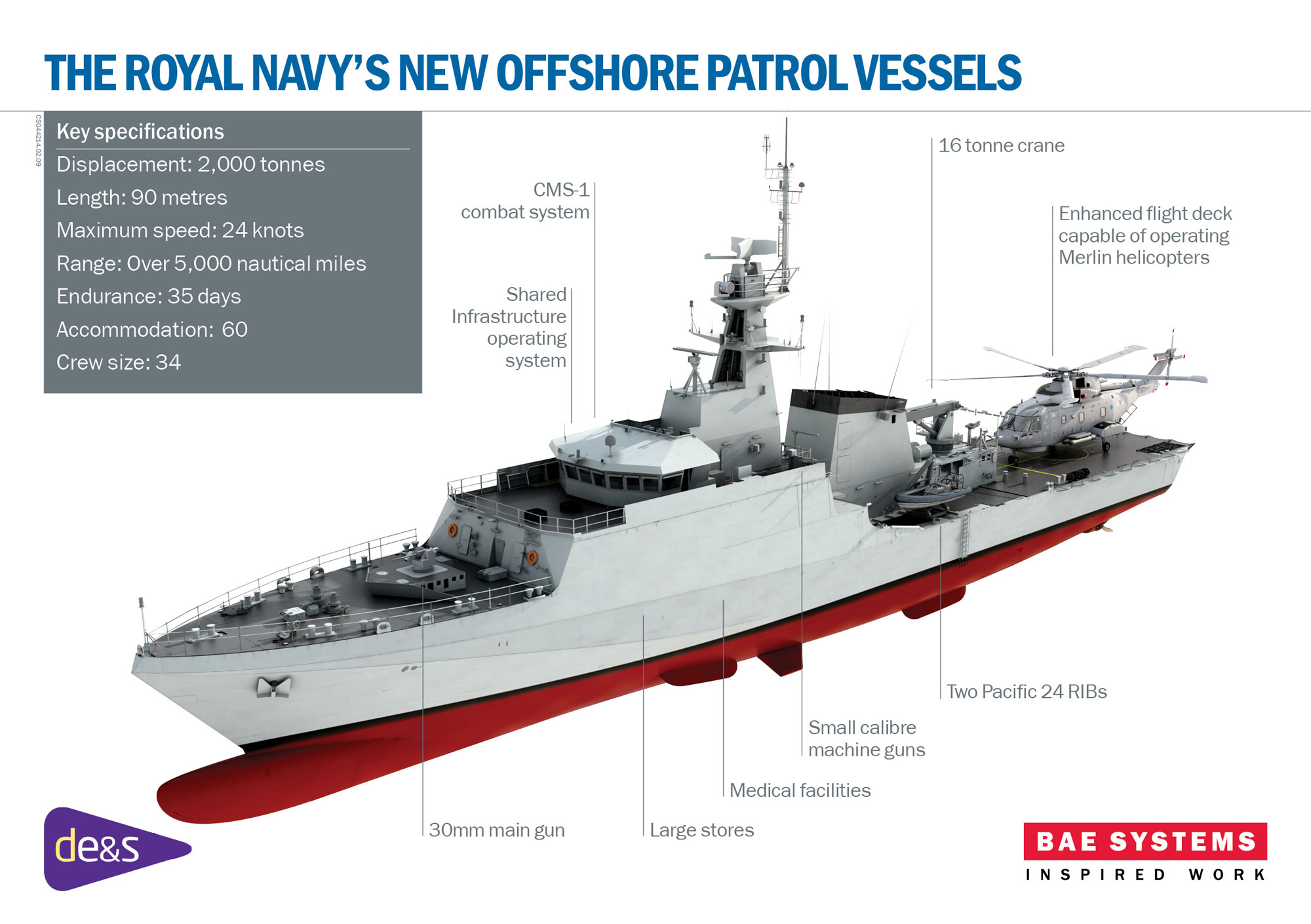
The 90 meter long, 2,000 tonnes OPV includes a modified flight deck capable of operating the latest Merlin helicopters, larger stores and more accommodation for embarked troops. As OPVs, these ocean-going boats have the size, capacity for mission endurance of 35 days, and operate at distance of 5,500 nautical miles from shore. It can develop a maximum speed of 24 knots. The ship’s flight deck supports medium helicopters up to a Merlin size, two RHIB boats and a 16-ton crane are also included. The vessel is armed with a gun turret mounting a 30mm cannon as its main armament.
HTMS Krabi is in service with the Royal Thai Navy. A second boat of this type was ordered in 2017. Photo: BAE Systems
HMS Forth is the first ship in the Royal Navy to employ the Shared Infrastructure architecture that integrates the sensors, weapons and management systems that operate on board. By replacing individual consoles and electronic racks designed specifically for each system, with common hardware, Shared Infrastructure will save space, reduces logistics complexity and cost and decrease through life costs streamline logistics and improve. The boat has a crew 34 and accommodation for up to 60.
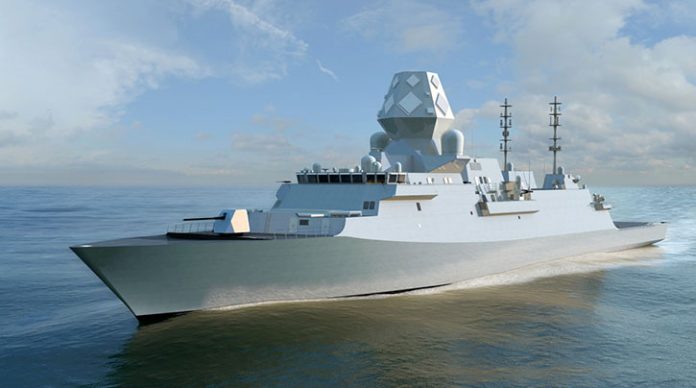
BAE Systems is offering the Global Combat Ship design for the future Australian submarine. A selection is expected in 2018. The frigates will be built in Adelaide, South Australia and will incorporate the Australian-developed CEA Phased-Array Radar. Image: BAE Systems
Australian Navy will introduce a new class of frigates in the next decade, under a program, known as ‘SEA 5000 Phase 1’. Facing the growing numbers of submarines in the Pacific and Indian Oceans, these new frigates are required, primarily, to increase the Australian Navy’s anti-submarine warfare capabilities. The new frigates are scheduled to enter service in the late-2020s.
Nine frigates will be built at a budget of A$35 billion, a fleet that will have sufficient range and endurance to operate effectively throughout maritime South East Asia and will be able to be deployed from forward bases, such as in the Middle East. The frigates will be equipped with a range of offensive and self-protection systems. The frigates will be built in Adelaide, South Australia and will incorporate the Australian-developed CEA Phased-Array Radar.
This project is one of a number of maritime projects to ensure Australia retains a sovereign capability to build and sustain its naval vessels and implement the Government’s commitment to a continuous build of naval surface ships in Australia.
Navantia is offering a version of the F100 design equipped with the CEA Phased-Array Radar. Image: Navantia
Three suppliers have been shortlisted through the preliminary evaluation – BAE Systems with the Type 26 Frigate, Fincantieri with the FREMM Frigate, and Navantia with a redesigned F100 have been working with Defence since August 2015 to refine their designs. Of the three contenders, Navantia has already delivered two amphibious support ships – HMAS “Canberra” and HMAS “Adelaide”, and HMAS “Hobart”, the first of three Australian Air Warfare Destroyers (AWD) which is also based on the F100 design. Navantia also builds landing crafts for the Australian Navy. Following the selection of the supplier, construction of the new frigates will begin in 2020, in Adelaide, South Australia.
The nine Future Frigates are part of the Government’s A$89 billion national shipbuilding endeavor which would see Australia develop a strong and sustainable naval shipbuilding industry.
HMS Queen Elizabeth made her first entry into her baseport of Portsmouth today, 16th August 2017. The aircraft carrier has been on contractor sea trials since first sailing from Rosyth just over seven weeks ago. Photo: MOD, Crown Copyright
2017 represents a turnaround year for the British Royal Navy. After years of budget cuts that resulted in diminishing the size and risk of obsolescence of maritime power, new investments, announced in the past two years are setting the pace for rebound. Construction of a new class of submarines, modern frigates, and ocean-going offshore patrol vessels are part of a £178 billion defense equipment plan recommended by the Strategic Defense and Security Review (SDSR) of 2015.
In addition to the new investments, two new aircraft carriers are being fielded, along with a wing of F-35B fighters and AEW helicopters, and nine P-8A maritime patrol anti-submarine aircraft – reinstating capabilities that were neglected in the lean years of the past decade. Improvements are also made in ship self-defense and counter-air capabilities, with the introduction of improved torpedoes and air defense systems.
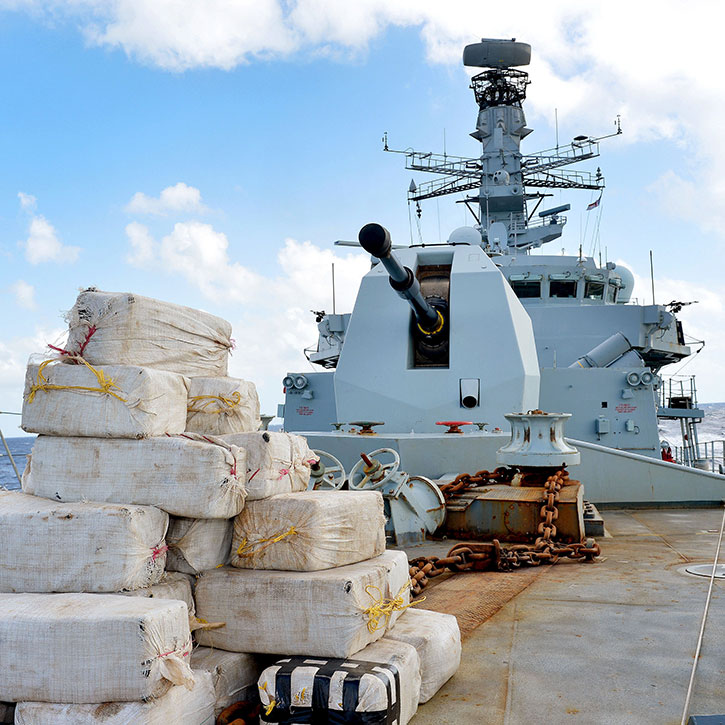
Fighting smugglers is one of the tasks of Royal Navy frigates when on patrols. When on patrol in the Caribbean, HMS Argyll, a Type 23 intercepted over 1.5 tons of Cocaine. Photo: MOD, Crown Copyright
With strategic interests vested in NATO, the Atlantic Ocean, Mediterranean Sea, the Arabian Gulf and the Indian Ocean, the Royal Navy flexes muscles across the seas to meet its responsibilities – keeping maritime security, counter piracy, stability and disaster response, operating as part of international and regional maritime forces.
As an island nation renewing its independent, international trading power, the Royal Navy is of critical value for Britain’s security, particularly following its departure from the European Union.
Political stability will be of utmost importance for this ambitious shipbuilding plan, as most of the investments in shipbuilding have been spent in Scotland, where aircraft carriers were built in Rosyth, and Offshore Patrol Vessels are under construction in Glasgow, where the future Type 26 will be built.
Construction of Astute class submarines at Devonshire Dock Hall (DDH), at Barrow-in-Furness. Visible are the Anson, the fifth Astute-class submarine, next to sisters Artful and Audacious. Photo: BAE Systems
The submarine building is done at Barrow-in-Furness in Cumbria, North West England, where the Astute submarines are built and next generation Dreadnought class will be built in the next decade. Other constructions of support ships are contracted competitively from smaller shipyards in the UK and shipbuilders overseas.
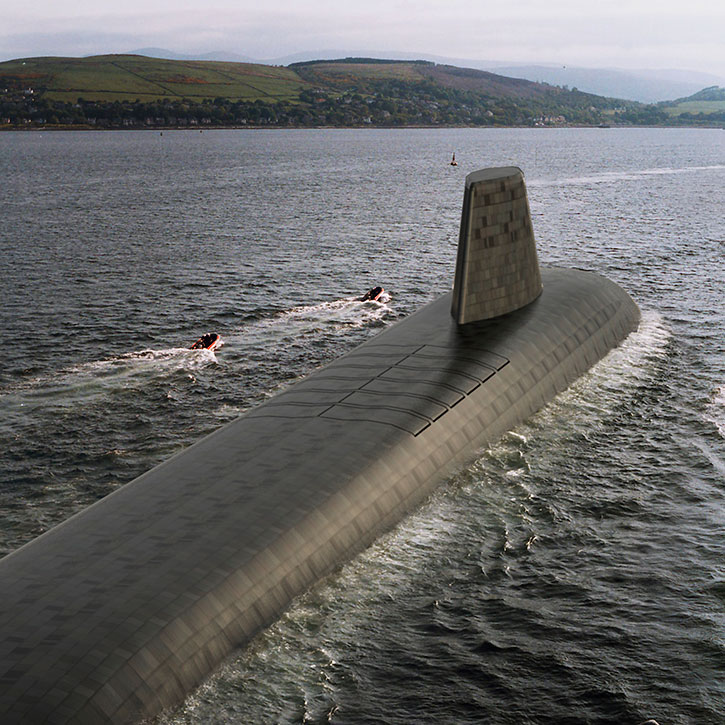
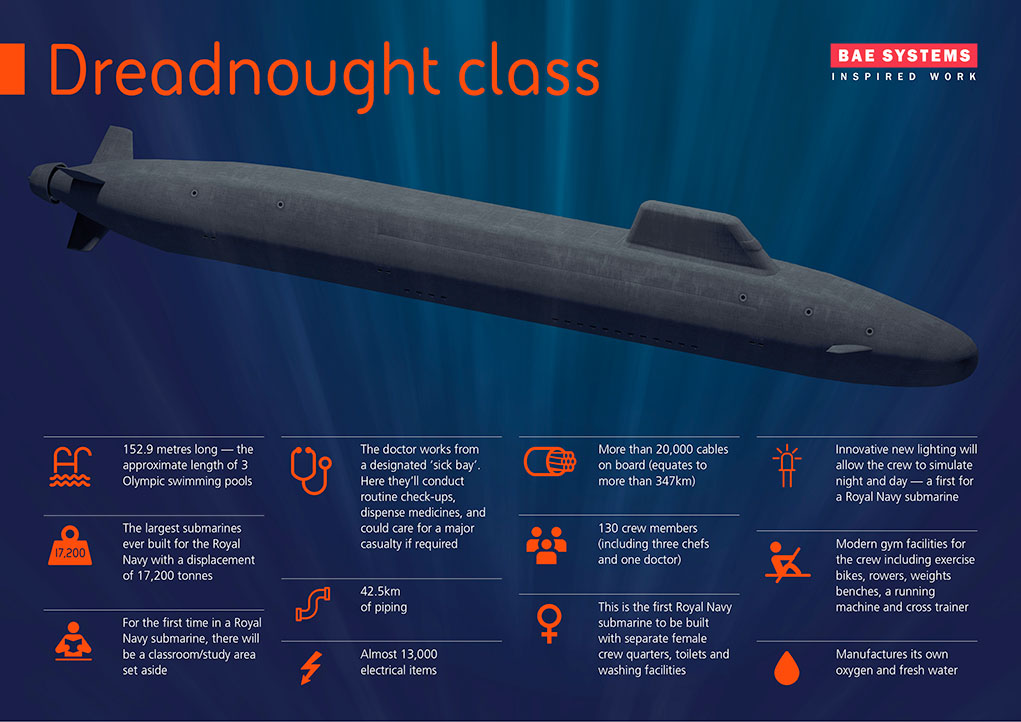
The future Dreadnought will replace the Vanguard ballistic missile submarines in the 2030s. Image: BAE Systems
The majority of military shipbuilding works is done at shipyards dedicated to military construction. Lack of competitiveness and lengthy procurement have led to increasing costs. An independent review of the UK shipbuilding strategy, published in 2016 recommends contracts for smaller vessels are also delivered to those shipyards, or competed internationally, to save costs. Critics in the UK recommend that some of the smaller vessels could also compete internationally, or with smaller shipyards in the UK, to save costs and improve efficiencies.
Following several acquisitions of local shipyards BAE Systems is the largest manufacturer of naval systems in the UK, the company designs build, repairs and upgrades surface ships, submarines, as well as torpedoes, radars, naval guns and command and combat systems. On different programs, the company established alliances with main subcontractors, for example, Babcock, Rolls Royce and Thales, to name a few.
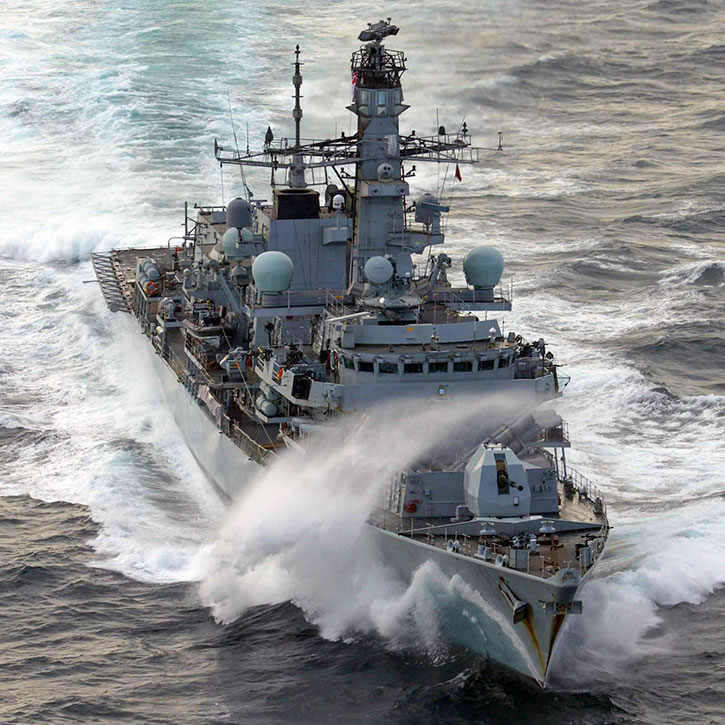
One of the largest shipbuilding programs in the coming years will be the construction of two new classes of frigates, to replace the current Duke Class (Type 23) multi purpose frigates. Seen here is St Albans, F83. Photo: MOD, Crown Copyright
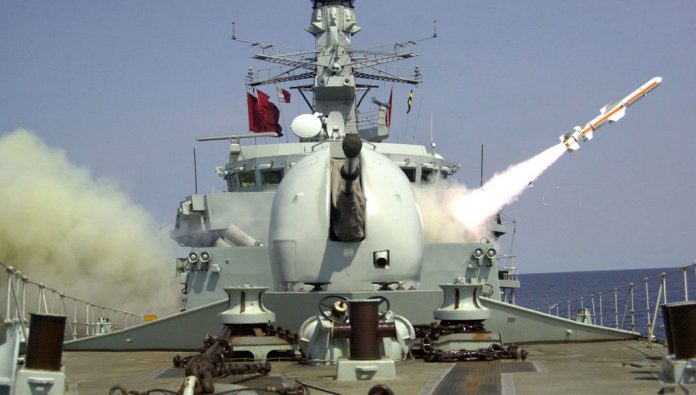
HMS Richmond Duke Class (Type 23) frigate launches a Harpoon anti-ship missile. Photo: MOD, Crown Copyright
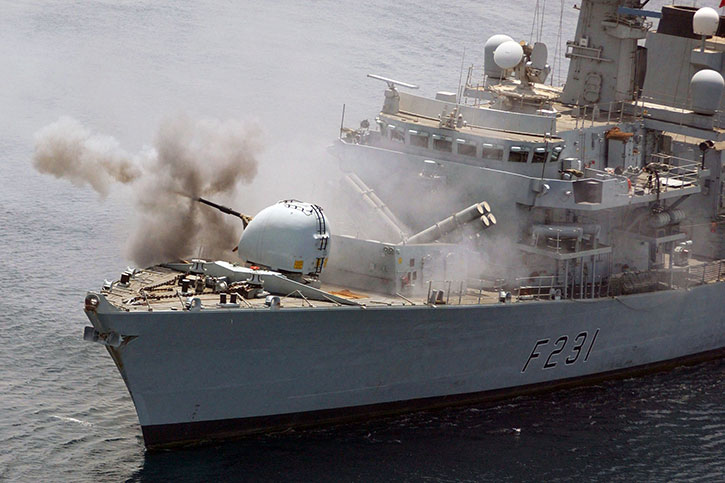
Type 23 frigate HMS Argyll firing her 4.5″ gun during an exercise in the Middle East. Photo: MOD, Crown Copyright
Even after downsizing in recent decades the Royal Navy remains one of the largest world navies. The most recent Strategic Defense and Security Review (SDSR) published in 2015 confirmed the British government intends to maintain the current sea power.
This commitment will require the modernization and replacement of the current anti-submarine fleet comprising 13 Type 23 Duke class frigates that will reach the end of their service life over the next decade. The new class selected for this role is based on BAE Systems’ ‘Global Combat Ship’ design.
As 1:1 replacement was ruled out by the SDSR the review recommended splitting the buy between eight fully equipped Type-26 multi-mission frigates at a cost of £8 billion, and five more modest ‘general purpose’ frigates (GPFF) to be designated Type 31. Type 26 will be dedicated primarily to anti-submarine warfare, supporting the carrier groups and strategic submarines while the lighter Type 31s will serve in other defense tasks and international deployments.
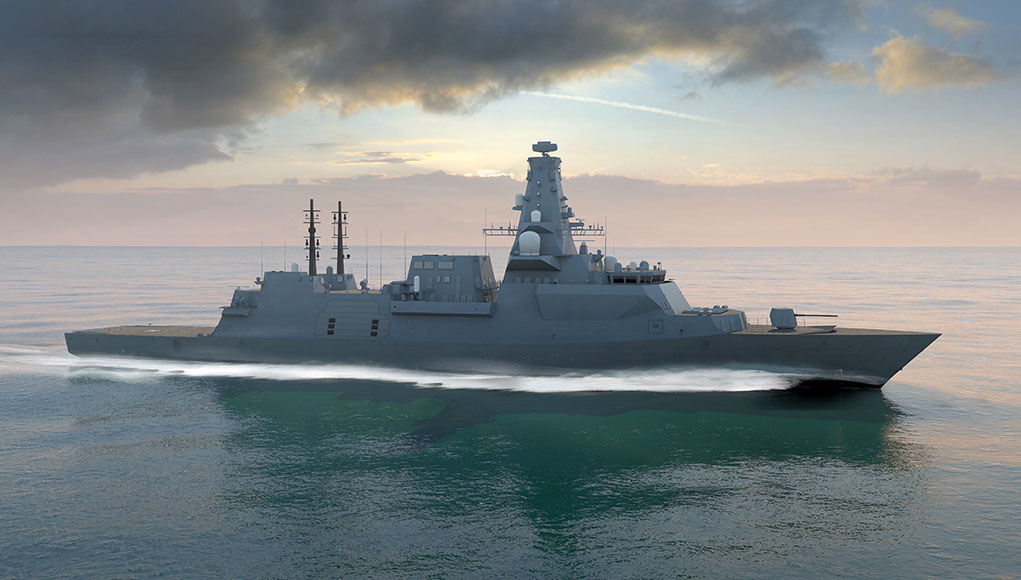
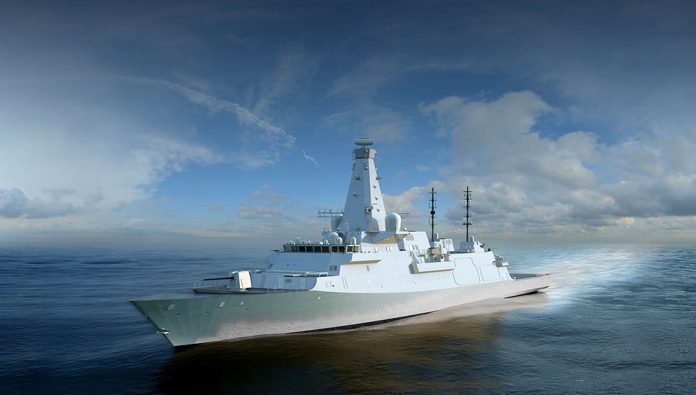
An artist impression of the new Type 26 Global Combat Ship. Image: BAE Systems
In July 2016, BAE revealed two General Purpose Ships designs, (Avenger-class and the Cutlass-class) to address the requirement but no decision was taken by MOD. To date, BAE Systems was awarded £3.7 billion to build the first three Type-26 boats. Work on the first frigate, HMS Glasgow, began in July 2017. According to schedule, the Glasgow will be commissioned in 2021 and the eighth of this class is expected to enter service in the mid-2030s.
It is yet unclear whether the new vessels will be ready in time to replace the older frigates as they reach the end of their service. The first Type-23 to be phased out in 2023, others will follow in 12 months intervals. If Type 26s will not be delivered on time, the fleet will reduce to a historic low in the coming decade.
Fighting smugglers is one of the tasks of Royal Navy frigates when on patrols. When on patrol in the Caribbean, HMS Argyll, a Type 23 intercepted over 1.5 tons of Cocaine. Photo: MOD, Crown Copyright
By the mid-2030, when all 13 frigates are delivered, the Royal Navy will return to the fleet size that meets its responsibilities. “This could enable a more frequent, or even a permanent, presence in parts of the world where we have admittedly been spread thin in recent decades, “ Burton added. According to Burton, the opening of a new naval base in Bahrain, HMS Jufair, in the next few years will ‘cement the Royal Navy’s commitment to the Gulf, and serve as a springboard for a more frequent presence in Asia-Pacific.’
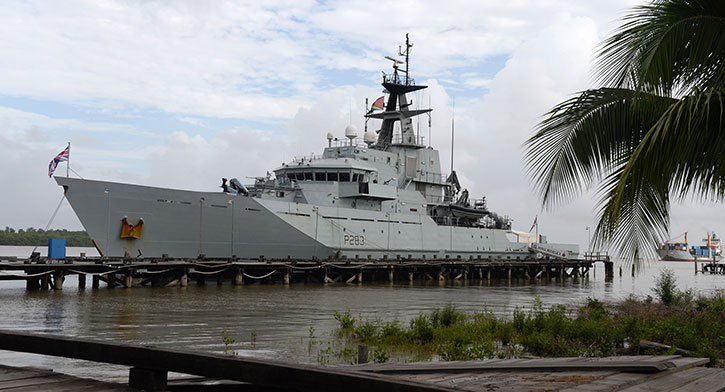
Another shipbuilding program currently undergoing is the construction of five River Class OPVs. The first will be operational next year. The Royal Navy currently operates four Batch 1 Offshore Patrol Vessels, one based in the Falkland Islands and three at HMNB Portsmouth, operating globally on tasks ranging from counter-narcotics operations to Atlantic patrols.
HMS Mersey, a River Class OPV during her visit to Guyana. Four boats of this ocean going patrol ship class are in use with the Royal Navy, performing maritime security, fishery enforcement, search and rescue and disaster relief. Photo: MOD, Crown Copyright
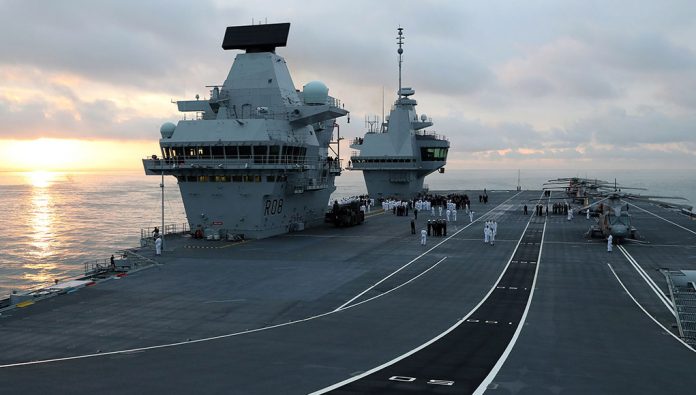
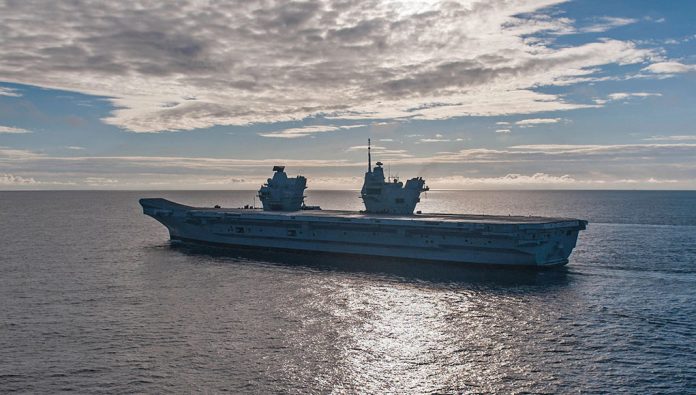
HMS Queen Elizabeth II at sea, during its sea trials. Photo: MOD, Crown Copyright
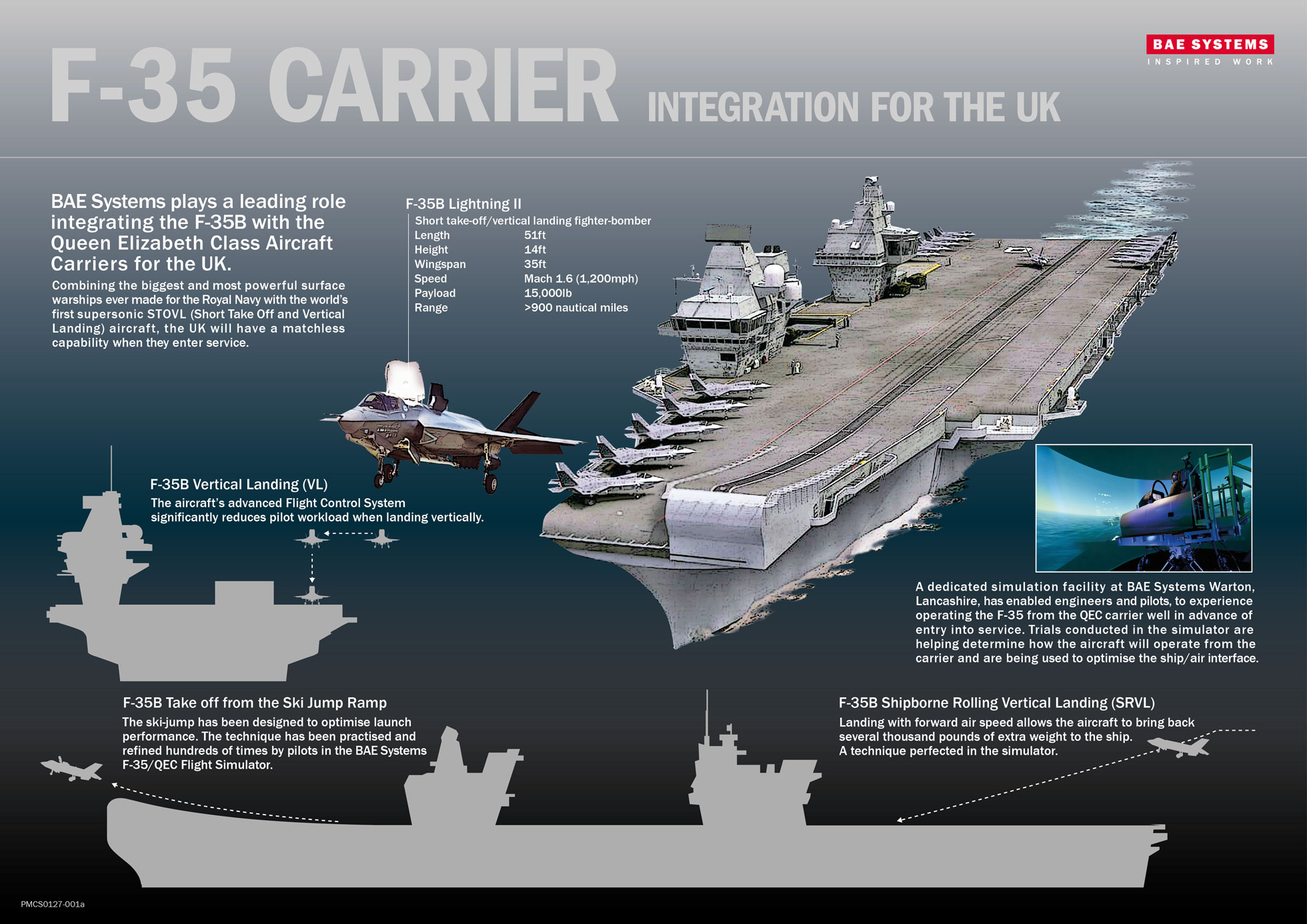
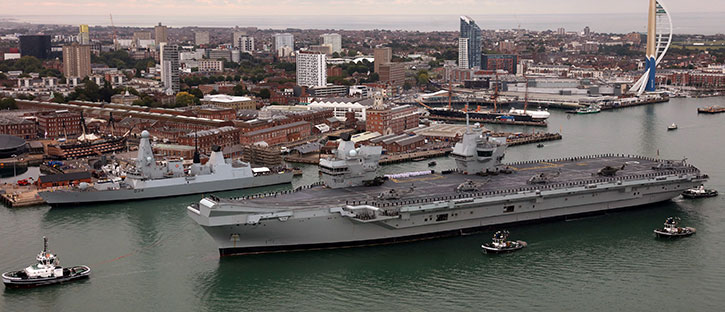
A major project currently reaching its climax is the induction of two 65,000 ton aircraft carriers – HMS Queen Elizabeth II and HMS Prince of Whales into service with the British fleet. The new carriers will become the centerpiece of the Royal Navy. QE II arrived today at its home port at Portsmouth, following its first sea trial last month; HMS Queen Elizabeth’s sister ship, HMS Prince of Wales, is structurally complete and is now in the outfitting phase. Queen Elizabeth will become the flagship of the Royal Navy, replacing HMS Ocean helicopter carrier in this role.
The introduction of two aircraft carriers will strengthen the Royal Navy commitment, particularly to the European defense that currently relies on US Naval super carriers and a single French carrier. The ship will operate with a crew of approximately 700, increasing to the full complement of 1,600 when aircraft are in operation.
As the two carriers become operational, 24 F-35B will arrive in the UK and, by 2023, earlier than planned, they will be ready to fly from those carriers. It will offer the largest dedicated air group of fifth generation fighters at sea, and the most potent Carrier Strike capability outside the United States. “It will endow the UK with the means to take our place alongside our closest allies – chiefly the United States and France, but others – in providing maritime air power in defense of shared interests around the world.” Rear Admiral Alex Burton, Royal Navy’s Commander UK Maritime Forces said at the Maritime Warfare Conference in Malaysia earlier this year.
“Given our long-standing defense relationships in the Middle East, it is certain that a Royal Navy strike group – centered on a Queen Elizabeth-class carrier – will regularly deploy East of Suez. And it will be perfectly possible, should we wish, for Type 31 frigates to permanently operate from the Gulf region or from Asia-Pacific in the decades ahead.” Burton added.
The Royal Navy has also been working with the Government of Oman to explore berthing options in the new commercial port of Duqm. Situated outside the Strait of Hormuz it gives immediate access to the Indian Ocean and beyond and capacity for aircraft carriers and nuclear-powered submarines. Under the Five Powers Defense Agreement, the Royal Navy also keeps berthing space in Singapore. These facilities provide the UK Government with the option, should it wish, to project power and influence beyond the Atlantic.
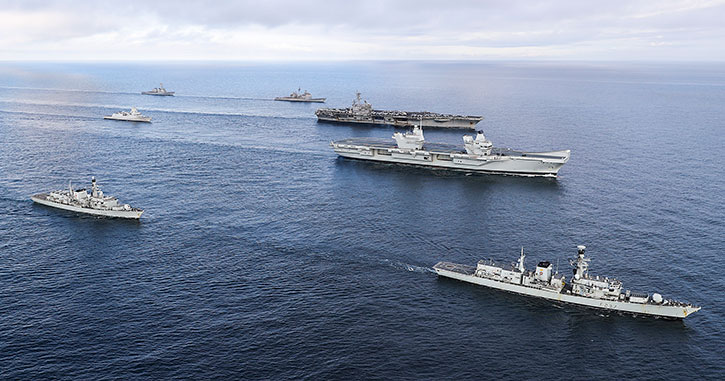
On its recent sea trials the new carrier joined the US Navy task force headed by USS Nimitz. Photo: MOD, Crown CopyrightHMS Queen Elizabeth II arriving at the Portsmouth seafront, passing on its way one of its intended guardian, HMS Diamond Type 45 destroyer. Photo: Crown Copyright
Protectors of the Queen and Prince
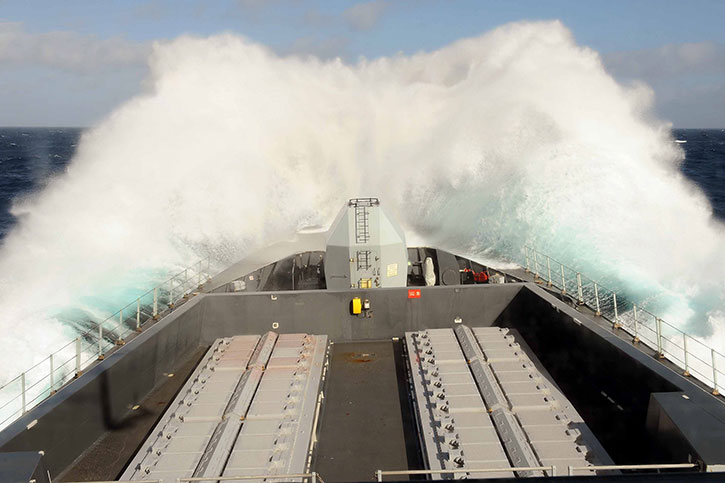
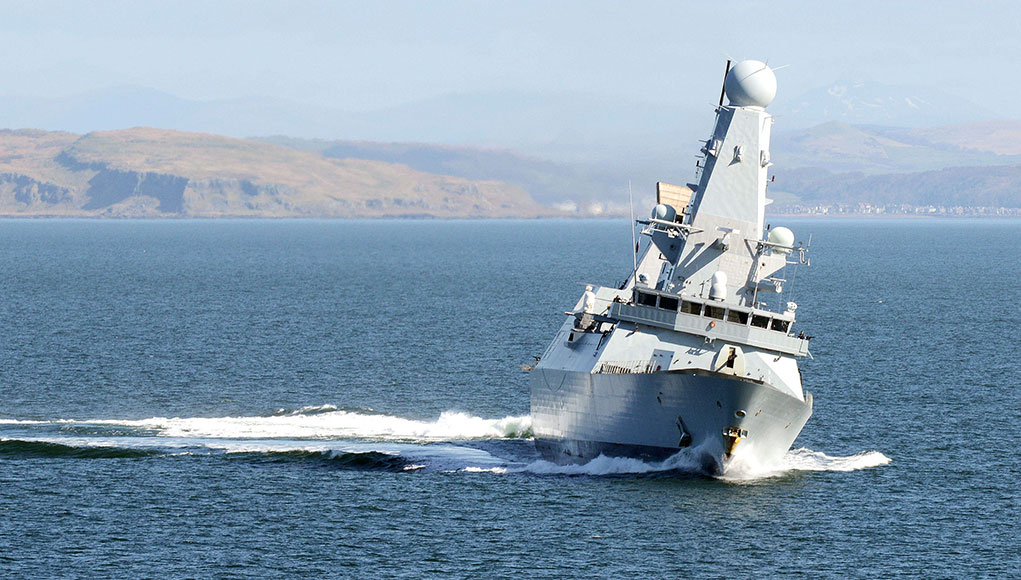
Type 45 destroyer HMS Dauntless cuts through rough weather in the South Atlantic during her deployment to the area. The gun and vertical launch silos of the Sea Viper missiles are clearly seen in the forehead. Photo: MOD, Crown Copyright
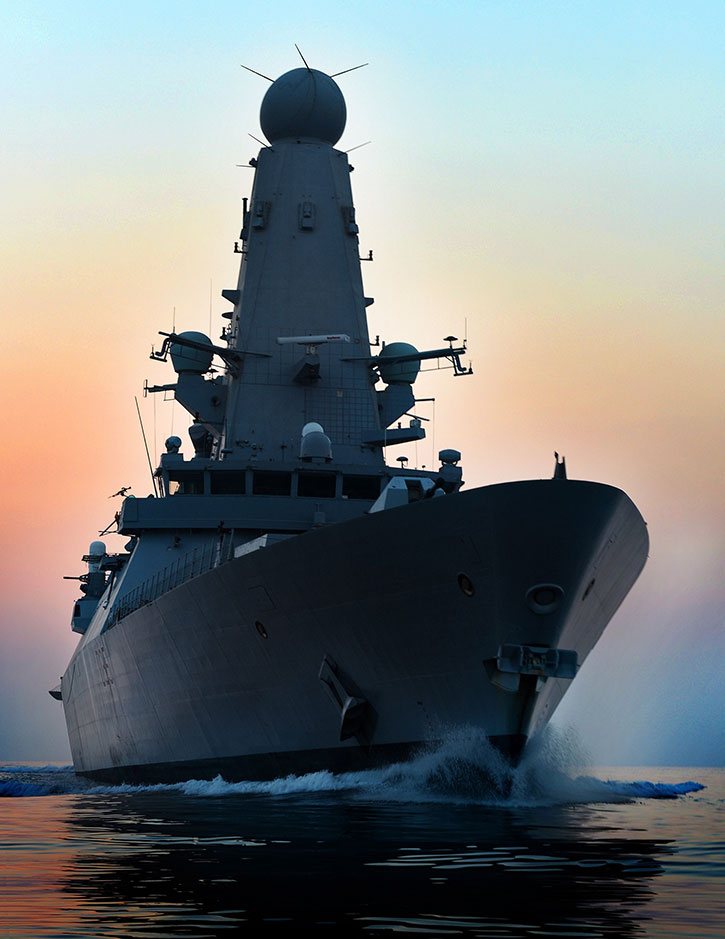
Six Daring Class Type 45 destroyers are deployed to protect those task forces against aerial threats. For this mission, they carry the PAAMS – Sea Viper air and missile defense system, comprising the multi-mission Sampson radar and Aster missiles. The rotating AESA radar is housed in a distinctive sphere seated on top of the huge mast, soaring above the sea to extend visibility over the horizon. The missiles are stored in six vertical launch stacks of eight launchers each, providing a total capacity of 48 ready to launch missiles. Both Aster 15 and 30 are used.
Type 45 destroyer HMS Dragon pictured in the Middle East during Operation Kipion 2013. Photo: MOD, Crown Copyright
Capable of launching eight missiles in about 10 seconds, the system simultaneously handles multiple targets. High flying aircraft and missiles flying at a speed up to Mach 4, can be intercepted up to 120 km away while low altitude targets and sea skimming missiles are engaged at the extended horizon – a distance of up to 25 km.
MBDA is currently developing a follow-on version of the Aster missile, known as Block 1NT. Italy and France are committed to this upgrading program for their naval and land-based Aster missile systems. Britain has shown interest but has not decided yet. The new weapon will receive a new RF seeker operating in the KA band and more powerful processor but retain the missile dimensions and guidance systems to maintain compatibility with existing systems. When completed, and if selected, Aster Block 1NT will provide a Type 45 destroyer limited missile defense capability against medium range ballistic missiles (missiles with a range of 1000 – 1500 km).
These destroyers also have the Mk8 medium turret with 4.5″ gun mounted in the forecastle. This weapon is common to all Royal Navy destroyers and frigates. One of the ships – HMS Duncan is also capable of carrying Harpoon anti-ship missiles.
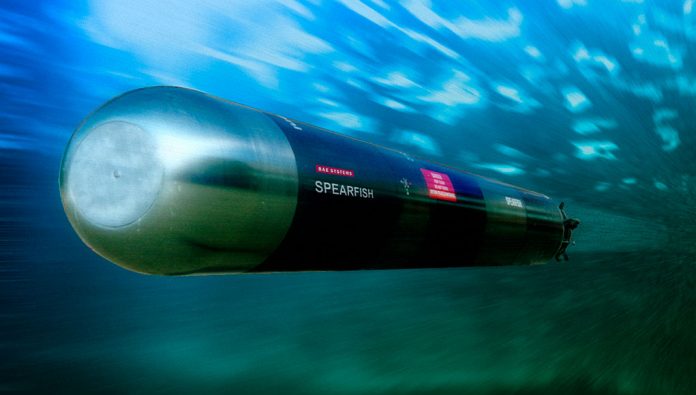
The Spearfish heavyweight guided torpedo is the primary anti-ship and anti-submarine weapon of Royal Navy submarines currently deployed with Trafalgar, Astute and Vanguard class submarines. It weighs two tons and measures five meters in length. Designed by BAE Systems Whitehead Division Spearfish is undergoing an upgrading phase expected to complete in 2020.
Relying on a complex transducer array of active and passive homing techniques to acquire, identify and prosecute naval targets, using advanced beam forming techniques to optimize performance in different environments. According to the manufacturer, the sophisticated acoustic processing and tactical software on board can defeat the most advanced countermeasures. The guidance section located in the mid-body of the torpedo comprises a powerful computer that handles all functions – from propulsion to homing, and attack techniques.
Spearfish swims toward its target while linked to the submarine via wire link, that exchanges commands and target data over long distance. In a typical engagement, Spearfish will run out of wire in the general vicinity of the target where it will conduct a covert passive search to acquire the target for the final phase. Spearfish can also operate autonomously from the time of launch.
Its propulsion system is based on a gas turbine with pump producing variable speeds across the entire performance envelope, including a fast sprint in the terminal stage of an attack. At full speed of 80 knots the Spearfish can strike targets at a range of 14 miles, and, at low speed, it increases the range to more than 30 miles.
Once at the close range, the torpedo accelerates to sprint speed and uses active sonar to classify and home in on its target. High power transmissions and sophisticated signal processing enable Spearfish to accurately discriminate targets from background noise and ensure high resistance to acoustic countermeasures and/or evasive maneuvers. Should Spearfish fail to hit the target on its first attack, it automatically selects an appropriate re-attack mode to conclude the engagement. The warhead has the lethality against double hull submarines and large displacement surface ships; it is programmed to detonate on impact, or by a proximity fuse when the torpedo passes under the target’s hull.
The weapon is currently undergoing an upgrade that improves its homing, warhead and tactical systems. The copper wire data link will also be replaced by fiber optical link. According to BAE Systems. The upgrade will also single fuel system, and the 660 lb warhead will be made of insensitive munition for additional safety. The upgrade will also to incorporate the latest developments in sonar technology, and introduce re-programmable software technology enabling frequent updates based on intelligence on the evolving threat characteristics. The fleet will begin receiving the improved torpedoes by 2020 and complete the upgrade in four years.
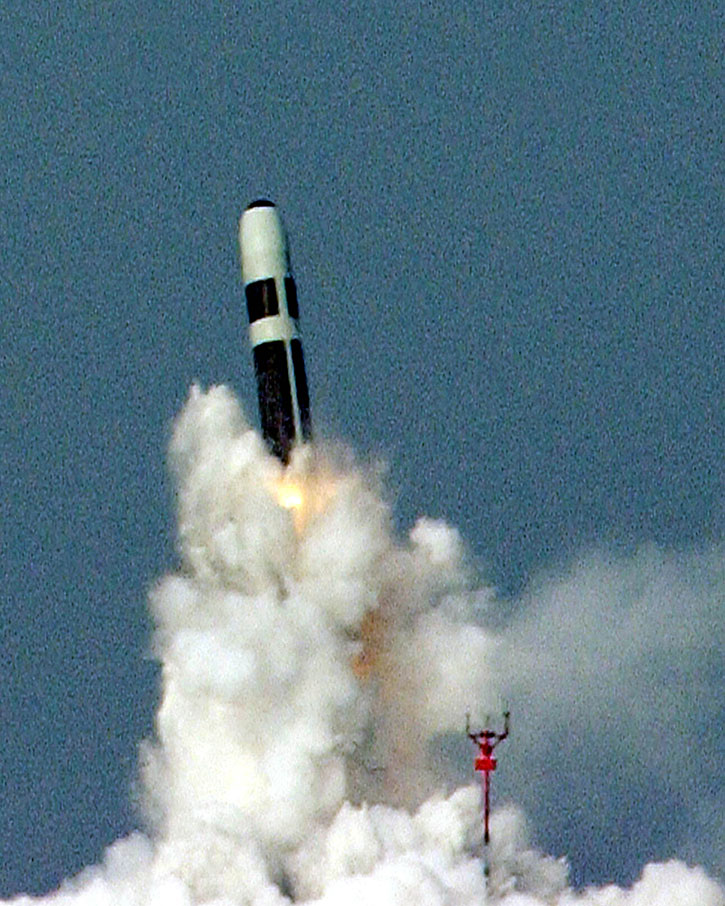
A Trident II D5 missile is fired from HM Submarine Vanguard during tests in the Western Atlantic in 2005. The submarine has 16 missile tubes, each missile can carry up to 12 arrowhead shaped independently targeted reentry vehicles carrying thermonuclear warheads. Photo: MOD, Crown Copyright
The Vanguard class submarines maintain the UK strategic nuclear deterrent force. Of the four subs, two are on patrol at all time, one undergoing short maintenance and the fourth undergoing deep maintenance that includes the refueling or replacement of the reactor, and other heavy maintenance work. This cycle has been unbroken since 1969, totaling in excess of 300 patrols and more than 43 years.
The Vanguard class is armed with Spearfish torpedoes and Trident nuclear missiles. A submarine-launched ballistic missile (SLBM), it has a range of 7,000 miles. At its fastest, it will travel at over 13,000 miles an hour. Each missile can deliver eight maneuverable, independently targeted warheads (MIRV).
The submarines currently in service are the four Vanguard class, which is set for replacement by the new Dreadnought class, currently in preliminary design. The new submarine will replace the current ones in the 2030s. About half of the £3.3 billion budget cleared Parliament for the program has been awarded. The funding will enable BAE Systems to develop the design of the submarine, including the layout of equipment and systems, and to develop manufacturing processes, including the production of early prototypes. The main sub contractors include Babcock and Rolls Royce. Hundreds of potential suppliers, including Small and Medium Enterprises, have also been identified across the country.
Royal Navy Vanguard Class submarine HMS Vigilant arriving at her base on the river Clyde, Scotland, following a patrol. Photo: MOD, Crown Copyright
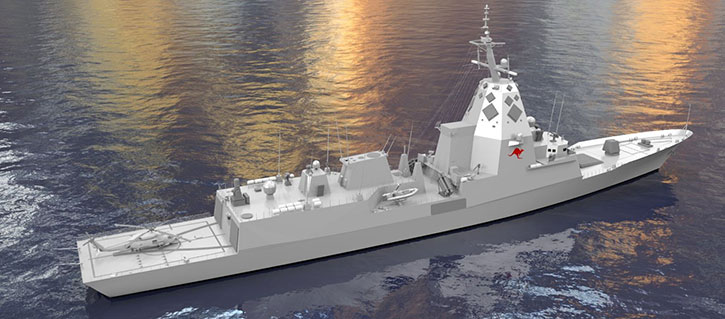
HMS Glasgow, the lead ship of a new class of eight Type 26 frigates will be based on BAE Systems' Global Combat Ship design, that will replace the current Type 23 frigates. Illustration Photo: BAE Systems
The new Type 26 ‘Global Combat Ship’ designed and built by BAE Systems is the new class selected for the replacement of eight anti-submarine frigates of the Duke class currently in service with the Royal Navy. Unlike previous designs that were exclusive to the Royal Navy, the designer is offering the vessel to international partners and local build and support. One of the prospects in Australia, where the Global Combat Ship is proposed for the future frigate, under Project SEA5000 phase I.
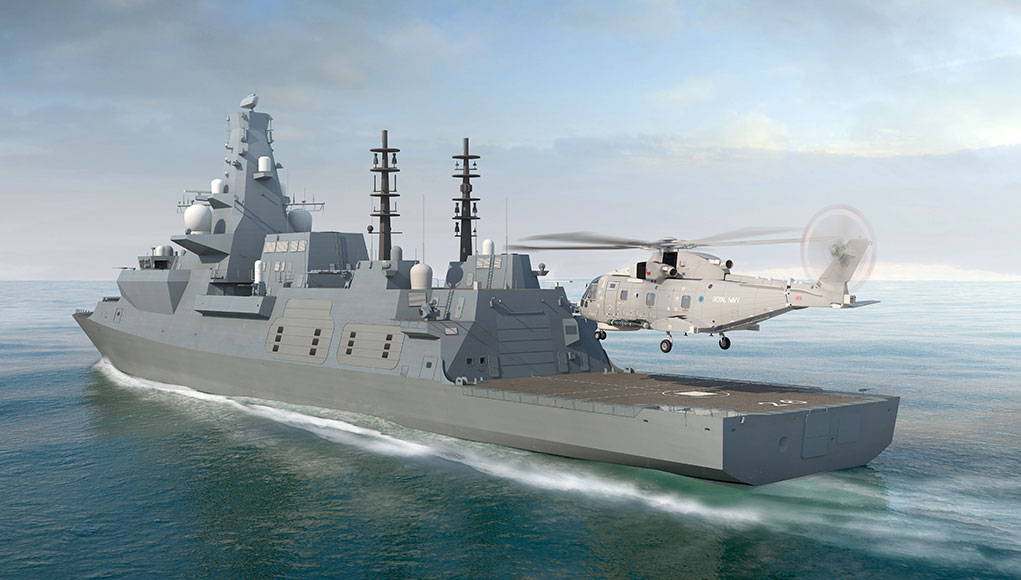
BAE Systems is offering the Global Combat Ship design for the future Australian submarine. A selection is expected in 2018. Image: BAE SystemsType 26 frigates have a large deck space supporting Merlin and Chinook size helicopters. Image: BAE Systems
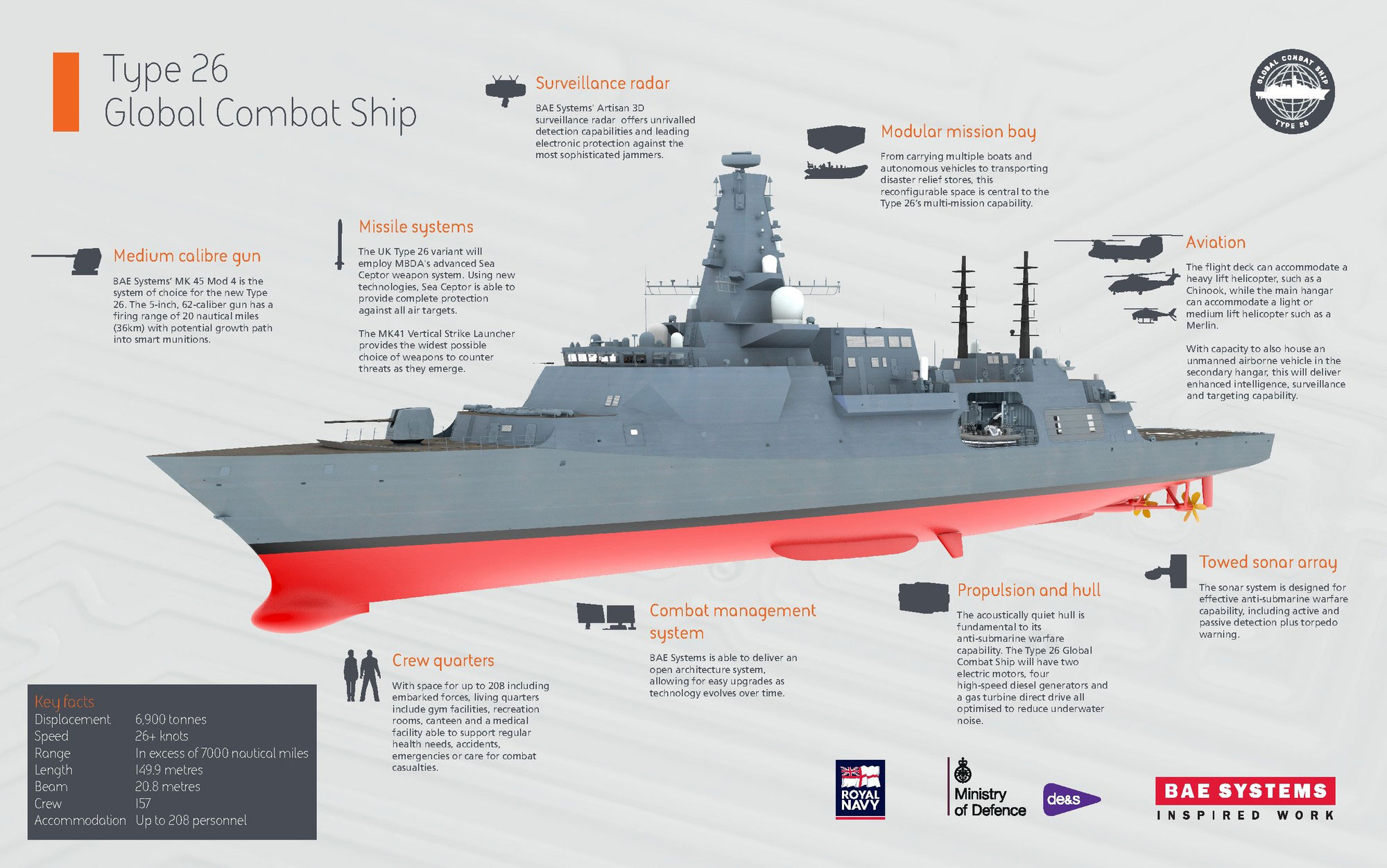
The ships with a displacement of 6,900 tons will be equipped with a vertical launch missile silo, part of the Sea Ceptor air and missile defense system, and 5-inch main gun – both of which offer improved capabilities and the potential for further development throughout the ships life. The ship’s flexible mission bay provides space, power and cooling for additional mission systems and work space. The ship is powered by a single gas turbine that develops a maximum speed of 26 knots. Two electric motors fed by and four high-speed diesel generators that deliver electricity for the ship’s system are used for continuous operation, extending the ship’s range in excess of 7,000 nautical miles.
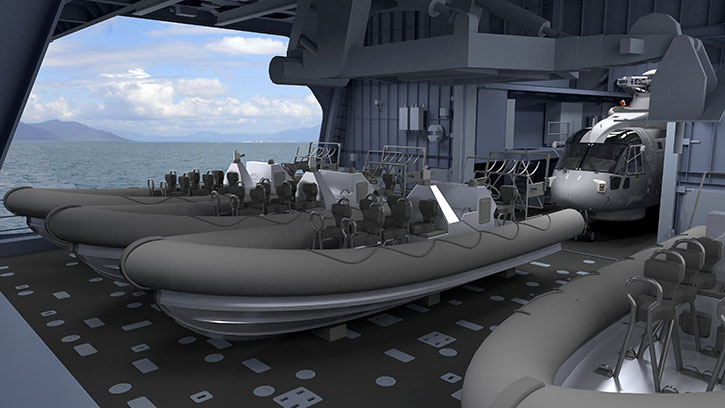
The modular mission bay accommodates multiple boats, autonomous vehicles and standard ISO containers and it also provides access to a hangar that can store a Merlin helicopter. Image: MOD, Crown Copyright
The bay will be able to house and deploy additional boats, unmanned vehicles (aerial, surface or underwater), or store standard ISO containers, allowing the ship to adapt to changing missions, ranging from disaster relief and humanitarian aid operations to embarking military forces or supporting diving operations. It’s large flight deck is able to accommodate helicopters up to the size of the RAF’s Chinooks.
The ship uses the combat management System (CMS), a derivative of the common CMS already supporting the Type 45 destroyers. Development of the weapon systems is underway. The vessel will integrate a Thales Artisan Type 997 3D medium range surveillance radar, Sonar 2087, Sea Ceptor anti-air missile system and new 5″ gun system. MBDA is at work under a £400 million contract to integrate the Sea Ceptor air defense system on Type 26 and -23 frigates, as well as the land based variant. Sea Ceptor uses the Common Anti-air Modular Missile (CAMM) to provide a common interceptor for the Royal Navy ships and ground-based air defense (GBAD) for the land force.
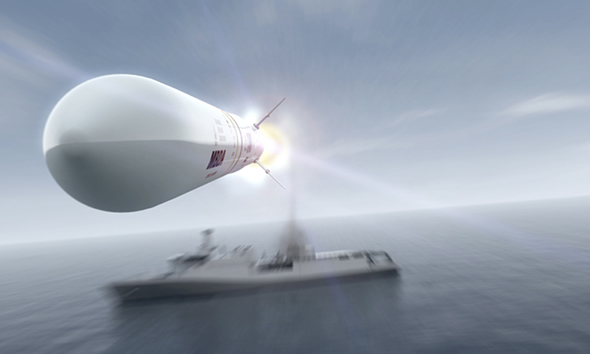
The new Sea Ceptor Mach 3 naval air defense missile will replace the Vertical Launch SeaWolf on Type 23 frigates and extend the vessel’s defense against supersonic attack missiles. Photo: MBDA
As part of the Sea Ceptor weapon system, CAMM will defend against all air threats, including aircraft and anti-ship cruise missiles, and other highly sophisticated threats. The new system will replace the Sea Wolf and Artisan 997 radar on the remaining Type 23 frigates, three of the vessels are currently being refitted with the system, to allow sea trials this year. The first Type 26 frigate will receive the new missile as they are inducted into service in the mid-2020s.
The new frigate will also get a larger gun, the 5-inch, 62-caliber Mk 45 Mod 4 Naval Gun System. As part of the vessels’ Maritime Indirect Fires System (MIFS), the system includes the autonomous gun turret, an automated ammunition handling system and gun fire control. BAE Systems will deliver the three guns for the first three frigates in 2020.
The second submarine of the Astute class - HMS Ambush entered service in 2012. Photo: MOD, Crown Copyright
Construction of Astute class submarines at Devonshire Dock Hall (DDH), at Barrow-in-Furness. Visible are the Anson, the fifth Astute-class submarine, next to sisters Artful and Audacious. Photo: BAE Systems
The construction of Astute class attack submarines is ongoing, in April 2017 MOD announced the conclusion of negotiation of the contract to build the Agamemnon, the sixth of seven Astute class attack submarines that will cost £1.4 billion. As its sister subs, the submarine is built at the BAE Systems in Barrow-in-Furness, Cumbria and is expected to complete in 2022.
Featuring the latest nuclear-powered technology, the Astute Class submarines can circumnavigate the world submerged, manufacturing the crew’s oxygen from seawater as they go. They also have the ability to operate covertly and remain undetected in almost all circumstances despite being 50 per cent bigger than the Royal Navy’s current Trafalgar Class submarines which are being replaced by the Astute Class.
Royal Navy Attack submarine HMS Astute fires a Tomahawk cruise missile during a testing mission near the USA. Photo: MOD, Crown Copyright
The third submarine of this class, Artful was the first to receive the Common Combat System (CCS) developed by BAE Systems, that controls the submarine’s sensors and weapon systems. The Artful tested the new system in February 2016 firing a torpedo. CCS integrates several systems, which previously would have needed their own consoles and processors, to operate under a single computer environment, save scarce space, power and cooling resources within the submarine’s hull. It also allows the Control Room to be used with greater flexibility. The system incorporates Dell COTS based computers from, running VMWare systems and sonar processing provided by Thales. The system also integrates the advanced Sonar 2076, which allows the submarine to detect and track the quietest of adversaries. The latest upgrade to the Sonar 2076 is Stage 5, introduced by Thales in 2010 to upgrade three Trafalgar-class and three Astute-class submarines. This sonar, made by Thales, is unique to Royal Navy submarines and is deployed across the submarine fleet.
The latest sonar and next generation command and control system will be integrated onto every Astute and Vanguard-class submarine now in service, and fitted to every new Astute class submarine coming into service in the future, ensuring consistency across the fleet. These systems will also be used on board the Royal Navy’s Dreadnought submarines.
Namer AIFV with the new unmanned 30mm gun turret and Trophy APS. Photo: Israel MOD
Following the evaluation of different overhead weapon stations and turrets designed by several Israeli defense companies, the MOD opted to follow an independent design optimized for a ‘Medium Turret’ for the next generations of combat vehicles currently under development. These include the tracked Namer and wheeled 8×8 Eitan platforms. The future Carmel multi-purpose combat vehicle now under development will also use an unmanned turret in its combat support vehicle, which will mount 30/40 mm automatic cannon and missiles.
The Namer AIFV currently has a single remotely operated weapon station (Rafael Samson) mounting the Browning 0.5 heavy machine gun. Adding a 30mm cannon firing armor-piercing and high-explosive rounds will add dramatic significant lethality to this vehicle.
The Orbital Mk44 30mm automatic cannon adds higher lethality, longer range over the 0.50 CAL machine gun currently used with Namer. Photo: Israel MOD
The fully armored unmanned turret prototype being its first test series recently on the Namer Armored Infantry Combat Vehicle (AIFV). The turret mounts a 30mm cannon (likely the Orbital Mk44 Bushmaster), and coaxial machine gun (likely 7.62mm). Other equipment pieces include four Windguard radar panels and two active protection launchers – parts of the Rafael Trophy APS. Two independent sights are also used, employing standard electro-optical payloads housed under protected covers.
The 30mm cannon uses dual ammunition feed supporting two types – for example, armor piercing and high explosives. optimizing target engagement. Photo: Israel MOD
The gunner’s sight is fixed and aligned to the gun’s line of fire while the commander’s sight uses the same payload in rotatable installation, enabling the commander to look around and search for targets while the gunner engages known targets. The turret being tested also has a 60mm mortar installed (similar to the Merkava MBT) but does not have the retractable Spike LR missile launchers expected to be included in the production series.
Some Israeli unmanned turrets provide access from within the vehicle, to maintain the weapon systems and overcome malfunctions under armor. It is not clear whether this new turret provides such access.
According to the IDF, the turret unmanned turret is designed with a low profile and does not need an opening for the turret ring, as it mounts on top of the vehicle’s armor. Attachment on top of the armor enables easier upgrading of existing vehicles. The main gun uses a double feed of 200 round ammunition chains while the coax MG loads 700. Four panels provide access to weapon systems and storage on the main turret, with additional panels can be seen on the flanks. The Namer turret also mounts six smoke canisters installed at the front of the turret. In addition, the AFV has 12 additional hull-mounted smoke canisters. All systems, weapons, and sensors are operated by the three crew members – driver, gunner, and commander – seated inside the vehicle.
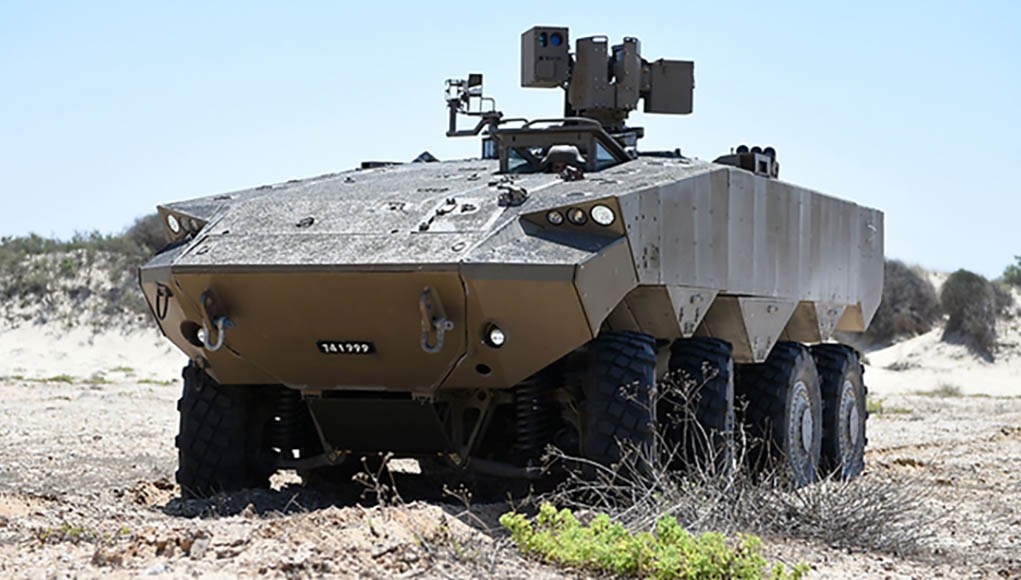
The 8×8 Eitan will also receive the new, unmanned Medium Turret. Photo: Israel MODIsraeli Namer AIFVs already have Trophy active protection systems (APS) installed. The turret will have integrated APS thus remove limitations to the angles of fire as seen in this installation. Photo Israel MOD.
The design of the ‘Medium Turret’ was weight conscious, to enable installation on the 8×8 Eitan wheeled armored vehicle whose weight load limit is significantly lower than Namer. The 30mm turret will be fitted to few of the Eitans, others will receive a lighter variant of the turret, mounting a 7.62mm or 0.5 Cal heavy machine gun. The use of standardized turret will augment the vehicle’s protection and optimize the integration of sensors, active protection and advanced situational awareness capabilities on new and existing vehicles.
The introduction of such turrets on Israeli armored fighting vehicles will improve the combat capabilities of infantry and mechanized units, particularly in urban areas, where they will improve organic firepower of the unit and minimize their dependence on combat support.
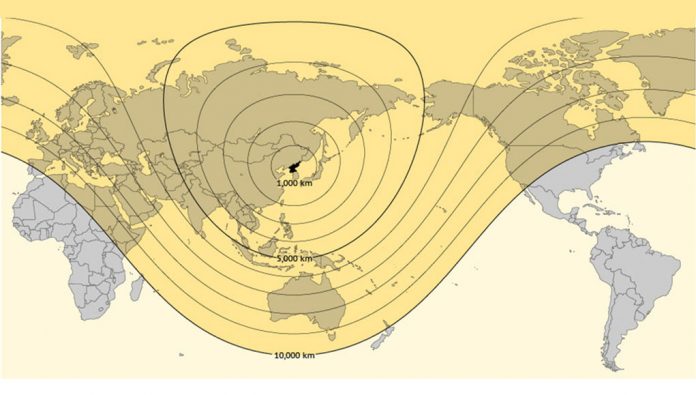
Theoretical attack range of North Korean missiles. The latest launch reached an altitude of 1,000 km, which represents a maximum range of 9,000 kilometers for an enhanced Hwasong-14 type ICBM.
North Korea conducted yesterday (July 28) a second flight test of an Inter-Continental Ballistic Missile (ICBM). The missile was launched at 23:41 local time (15:41 GMT) from an arms plant in Jagang province in the north of the country, the Pentagon said.
Pyongyang officially confirmed the event, adding the missile being tested was Hwasong-14, claiming now that it has the entire continental US within range. The missile flew 998 kilometer for about 47 minutes reaching a maximum altitude of 3,724.9 km. In terms of maximum range trajectory it could fly as far as 10,000 km.
It is unusual for North Korea to launch a missile at night – the significance is as yet unclear. It could have chosen to avoid surveillance by South Korean and the U.S. intelligence assets or for other reasons.
No missiles had been fired from Jagang province before, indicating a previously-unknown launch site is operational.
Using this new launch site North Korea may push to set up an intercontinental ballistic missile (ICBM) launch base and related infrastructures in the northern province of Jagang, where many armament industry facilities are located.
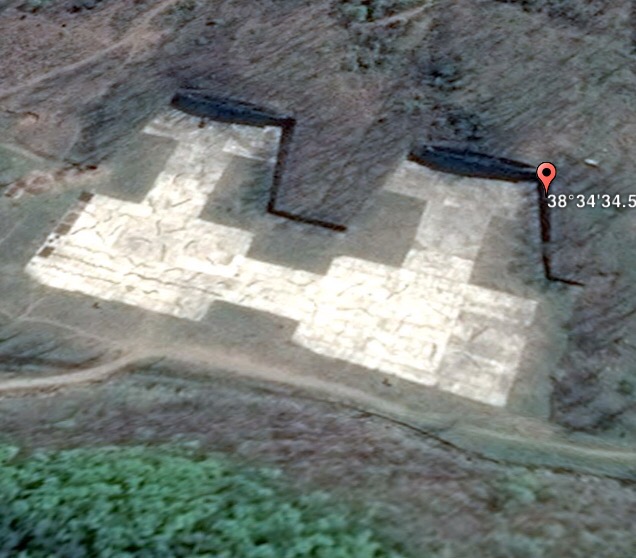
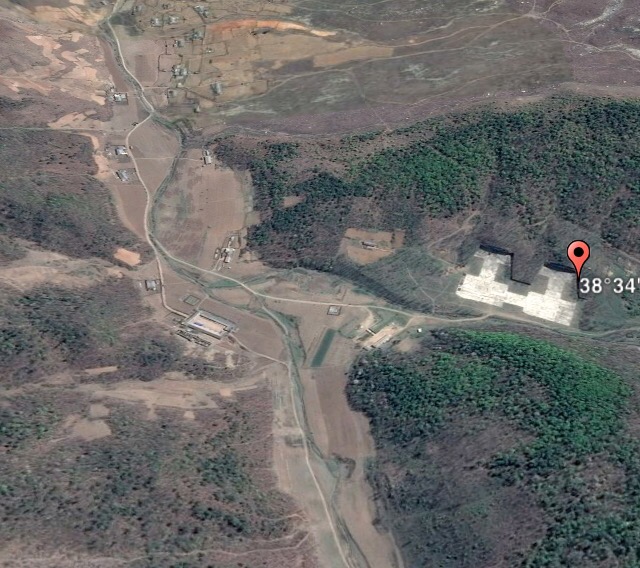
Sealed tunnel entries and launch pads are clearly visible at one of many missile hideouts scattered througout North Korea. Some tunnels can store ICBMs. Photo: CNES, Airbus via Google Earth.This specific site is located closer to the south. The launch site used yesterday was near Moopyong Li, near the Chinese border m. Photo: CNES vis Google Earth.
According to Michael Ellman, of 38north.org, on July 4, 2017, North Korea conducted its first test of a two-stage Hwasong-14 ballistic missile, which reached an apogee of about 2,800 km. If flown on a standard trajectory, this means the Hwasong-14 would have a maximum range in excess of 7,500 km—intercontinental ballistic missile (ICBM) range—and may be able to reach the US west coast if armed with a warhead weighing 650 kg or less. However, the Hwasong-14 tested on July 4 was not optimally designed to achieve maximum range. Instead, it appears to have been a prototype designed to maximize the probability of a successful maiden flight by relying on flight-proven stages.
The first Hwasong-14 tested on July 4 employed a first stage based on the Hwasong-12, but with a slightly larger diameter to carry more propellant. The second stage was similar to the third stage of North Korea’s satellite launch vehicle, the Unha. For an ICBM, however, the second stage was under-sized and underpowered, making it ill-suited for use on a ballistic missile. One would assume that future tests of the Hwasong-14 would require North Korea to reconfigure the second stage for a better performance.
On July 28, North Korea launched a ballistic missile that reportedly flew for 45 minutes, reaching a peak altitude of 3,000 km, and a slightly longer range than the previous test. While the type of missile tested is yet unconfirmed, these data, if accurate, are fully consistent with a Hwasong-14 tested with a larger second stage that is powered by a high-thrust engine. If flown on a flatter trajectory, this missile could reach as far as 9,000 to 10,000 km. More information, including videos and photographs, will help identify the new second stage engine and pinpoint its performance capacity.
However, if the above assessment is correct, North Korea seems to have made a logical step forward, as it tries to perfect the technologies to build and field an operationally-viable ICBM that can threaten the mainland United States. More tests are needed to assess and validate the reliability of the Hwasong-14, so North Korea is sure to follow this launch with much more.
Following the announcement, South Korean President Moon Jae-in ordered discussions to be held with the United States on deploying additional anti-missile defense units. Moon also called for stronger sanctions against the North.
Two Terminal High Altitude Area Defence (THAAD) launch systems are currently deployed in South Korea, along with the system’s AN/TPY-2 radar. Deployment of four additional was planned but delayed over concerns about their environmental impact. While Hwasong-14 does not put South Korea at risk, there are plenty other ballistic missiles within range. However, the THAAD positioned in South Korea is designed to intercept missiles as they descend to their target.
A Boost Phase Interception system is required to eliminate the North Korean ICBM missiles threat. Such a system could deploy air, ground or sea based missile interceptors relying on airborne sensors for early warning. The US Missile Defense Agency have tested such systems on MQ-9 Reaper drones and plans to deploy such sensors in the coming years. South Korea provides an operational base for such systems, which could shield the entire hemisphere from the rapidly growing missile threat from North Korea.
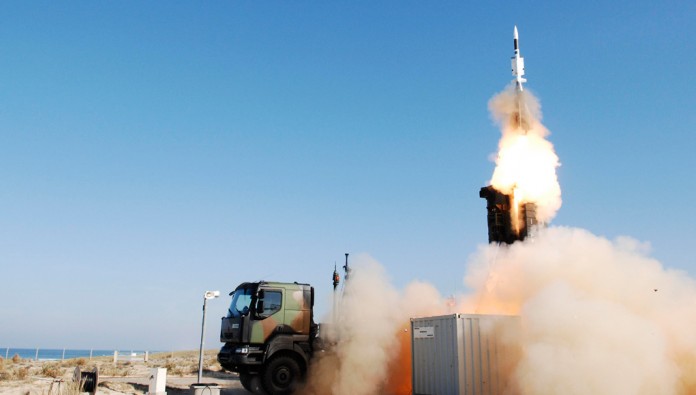
Aster 30 extended range air defense missile system (SAMP/T). Photo: DGA
Turkey is negotiating a mega deal worth billions of dollars in a ‘Turkish Bazar’ style, where the European Eurosam consortium faces a competing offer from the Russians, through their largest missile exporter Rostec, as Ankara opens its missile defense program to foreign bidders.
Until 2013 Turkey, a major NATO ally considered only the weapon systems produced by its allies. However, in 2013 Ankara broke this tradition favoring the Chinese FD-2000 air defense system over costlier US and European competitors that restricted Turkish work sharing in the development of the system, something the Chinese were happy to offer for the US$3.4 billion they asked for.
Turkey eventually backed off from its plan to buy the Chinese system, but Ankara continued interest in air and missile defense. The tightened relations with Moscow, that following the failed coup in July 2016, brought Ankara to negotiate on the procurement of the most sophisticated Russian air and missile defense system – the S-400 that Ankara could ‘see’ in the past two years, deployed in Latakia in Syria. Turkey reportedly agreed to pay $2.5 billion for the Russian system, significantly less than the Chinese one. While the technical aspects are cleared, the deal is yet to be finalized, its completion will have significant consequences for Turkey-NATO ties.
Turkey maintains its air defense under the NATO umbrella, with allies nations deploying Patriot and SAMP/T surface-to-air missile batteries, air defense radars, and airborne early warning aircraft on a regular basis since 2013. This plan continued successfully as long as the ‘neighborhood’ was predictable, with friendlies on one side and hostiles on the other. The situation got much more complex as Russia entered the fight in Syria. Russian forces are positioned and operating in Syria, where NATO-backed coalition air forces support Kurdish militias that are associated with Turkish Kurdish PKK rebel groups designated as terrorists by Ankara. NATO also operates from bases in Turkey, but some of these bases were under siege during the coup, as some of their occupants were suspected of supporting the rebels.
Apparently, Ankara is seeking more sovereignty over its military force. Buying the missiles from Russia will achieve such result. While Ankara maintains it can link the Russian system to the NATO air defense network by integrating a NATO compliant Interrogation Friend / Foe (IFF) system into the Russian radar and battle management system, it is likely the Turkish S-400 units will remain isolated, or act as an ultra expensive opposition force (OPFOR) during the annual Anatolian Eagle war games, just as the Greek S-300 system is operated by in Crete.
On the other hand, Turkey is still dependent on its alliance with NATO and will benefit greatly from continued cooperation. Choosing a European air and missile defense solution will achieve this goal.
The Turkish move closer to Russia brought the heads of European air defense missile consortium Eurosam to Turkey, where they were more lenient to invite Turkish companies to cooperate and get a more significant share of the development and production of Aster/SAMP/T missiles. The Heads of Agreement between Michel Vigneras, the head of Eurosam, Faik Eken of Aselsan and Selçuk Yaşar of Rocketsan, was signed last week in Ankara under the aegis of the Turkish Undersecretariat for Defence Industries (SSM). The HoA sets the work sharing agreements for a definition study with the SSM on a long-range air and missile defense system to be launched in the coming months.
According to the joint announcement, the future Turkish air and missile system will be based on the technologies and experience that Eurosam has built in the ground and naval systems, using the Aster missile over 25 years and EUR11 billion of collective investment. The Aster systems have been delivered to the naval and air forces of France and Italy. Most of the systems are naval-based, deployed with French, Italian, British Royal Navy and Saudi Navy, as well as the Singapore, Moroccan, Algerian, Egyptian, and Qatari navies. An Italian SAMP/T unit is currently deployed near the town of Gaziantep in Southern Turkey, as part NATO’s augmentation of the Turkish air defense. SAMP/T is able to defeat the most challenging of air threats, whether air breathing or ballistic. The future program will be managed in synergy with future evolutions of the Eurosam systems in France and Italy. The future evolution of the system, known as Aster 30 Block 1NT, that will be better capable of engaging short and intermediate range ballistic missiles (IRBM).
At the occasion of the HoA signature, Eurosam CEO Michel Vigneras said: “The Italian Army has deployed two Eurosam-built SAMP/T firing units since June 2016 as part of NATO’s contribution to the defense of Turkey and its people against potential missile threats from beyond NATO’s southeastern flank. Today’s agreement is a clear demonstration of the willingness and readiness of our 3 companies to build further on the strong defense cooperation commitments already in place and to work together as equal partners, towards a common goal and sharing full and entire responsibility vis-à-vis the Turkish authorities. I am confident that today, we have laid the foundation of a long term cooperation between Eurosam and the Turkish defense industry.”
Can Ankara do both? Possibly yes. More likely is that it will get the missiles they want much cheaper though.
Lockheed Martin Skunk Works® and XTEND have achieved a major milestone in JADC2 by integrating the XOS operating system with the MDCX™ autonomy platform. This technical breakthrough enables a single operator to simultaneously command multiple drone classes, eliminating the friction of mission handoffs. From "marsupial" drone deployments to operating in GPS-denied environments, explore how this collaboration is abbreviating the data-to-decision timeline and redefining autonomous mission execution.
As traditional defense primes face mounting competition from agile “neoprimes” such as Anduril, Palantir and Helsing, the balance of innovation is shifting toward software-defined warfare and scalable, dual-use technologies, while global industry consolidation—marked by Boeing’s integration of Spirit AeroSystems and other strategic mergers—signals an intensified race to secure control over the defense technology value chain. Our Defense-Tech weekly report highlights these trends.
In early October 2025, a coordinated wave of unmanned aerial system (UAS) incursions—widely attributed to Russia—targeted critical infrastructure across at least ten European nations. The unprecedented campaign exposed the fragility of Europe’s air defenses...
Executive Summary
The past week (September 18-25, 2025) represents an inflection point where strategic defense concepts have transitioned from doctrine to tangible reality. An analysis of global events reveals four primary, interconnected trends shaping an...
At the 2025 Air, Space & Cyber Conference, U.S. Air Force and Space Force leaders unveiled major updates on next-generation fighters, bombers, unmanned systems, and space initiatives, highlighting both rapid innovation and critical readiness challenges as the services race to outpace global competitors. A short version is available here, with a more detailed version for subscribers.
The Taipei Aerospace & Defense Technology Exhibition (TADTE) 2025 crystallized around four dominant strategic themes that collectively illustrate Taiwan's comprehensive approach to defense modernization amid escalating regional tensions. Based on a detailed report by Pleronix (available upon request). Includes a Podcast discussion on TADTE 2025's highlighting Taiwan's four strategic themes beyond the post's coverage.
Israel’s Iron Beam 450 high-power laser system has completed final testing, marking a major leap in air defense. Developed by Rafael, it offers precise, cost-effective interception of rockets, UAVs, and mortars, and is set for IDF deployment by 2025.





 The ship uses the combat management System (CMS), a derivative of the common CMS already supporting the Type 45 destroyers. Development of the weapon systems is underway. The vessel will integrate a Thales Artisan Type 997 3D medium range surveillance radar, Sonar 2087, Sea Ceptor anti-air missile system and new 5″ gun system. MBDA is at work under a £400 million contract to integrate the Sea Ceptor air defense system on Type 26 and -23 frigates, as well as the land based variant. Sea Ceptor uses the Common Anti-air Modular Missile (CAMM) to provide a common interceptor for the Royal Navy ships and ground-based air defense (GBAD) for the land force.