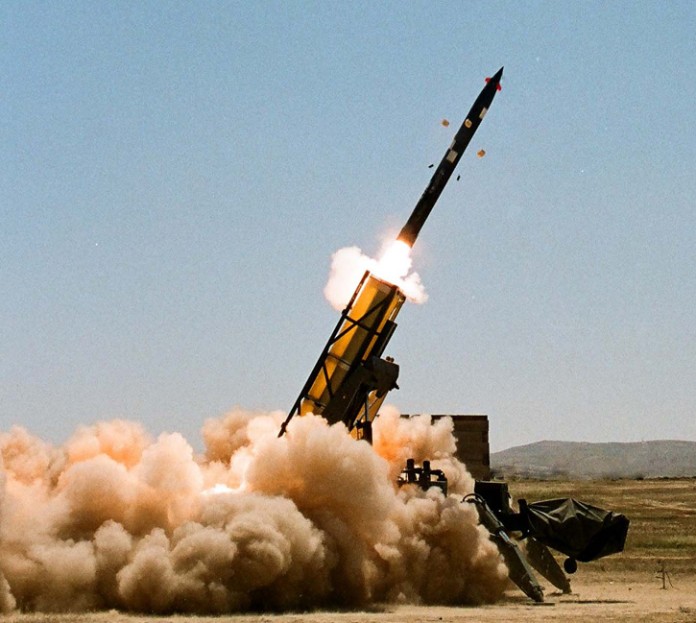
Fired from a range of 150 km, IMI Systems' 306mm Extra rocket can hit within less than 10 meters of a target. Photo: IMI Systems.
Yesterday (Wednesday, December 7, 2016) at 03:00 explosions shattered the night sky over Damascus, a fire that erupted at the military airport of Al Mezzeh, west of the Syrian capital continued to burn. By noon, the Syrian regime released a statement blaming the attack on Israel. As usual, no comment came from Jerusalem, but the Syrian statement added another bit of information. They claimed that surface-to-surface missiles were used in the attack, and claimed they were launched from a location west of Tel Avital (Tal Abu Nada) in the Golan Heights, about 56 km from the target. If the Syrian claim is correct, this incident is the first time that Israel’s Defense Forces (IDF) have used precision guided surface-launched missiles, a new type of weapon procured this year.
The type of weapon and the range to the target does not leave much for guessing. Examining Israel’s rocket arsenal, only one precision strike rocket could reach this range – the 306mm EXTRA. But, in fact, 50 km is less than a third of its maximum range – the EXTRA can strike with the same precision, at targets 150km away. It’s larger sibling – the Predator Hawk, can reach targets at 250 km with warhead twice as heavy as the EXTRA.
Although the weapon was developed more than a decade ago, EXTRA is relatively new in Israel’s arsenal. The IDF artillery corps fielded these weapons earlier in 2016. The IDF was not the first customer for this weapon. The designer and manufacturer Israel Military Industries (IMI) have sold these missiles to several countries in the past. In June 2016 Israel press reports mentioned the sale of Precision Guided 306mm EXTRA Rocket to the IDF.
Originally developed in collaboration with Israel Aerospace Industries, EXTRA moved under the sole responsibility of IMI. Employed as a precision weapon for operation over the horizon, the missile can be used against targets in fixed positions, guided over its trajectory using a combined sensor integrating Global Positioning System (GPS) satellites and Inertial Measurement (IMU). In this mode, the missiles can attack fixed targets based on known coordinates (exploited from aerial or satellite imagery). The rockets can also attack stationary targets, such as command posts, surface-to-air missiles, force concentrations or weapons in transit, relying on near-real-time intelligence delivering positioning data from various sources.
IMI has developed a family of precision-guided rockets, in calibers from 122 and 160mm to 306 and up to 600 mm. The largest variant is the new Predator Hawk missile, with a strike range of 250 km. All weapons have a strike accuracy of less than 10 meters (IDF officials have repeatedly determined an accuracy of 5 meters for some of these weapons).
Some analysts assessed the Israeli choice of weapon to reluctance to engage with the Russian Air Defense systems currently deployed in Syria. The Russian contingent along the Mediterranean coast (in Latakia and Tartus) currently includes a unit of S-400 air defense missiles and the Kirov class battlecruiser (Pyotr Velikiy) that carries air defense systems similar to the S-300. However, these assets are operational in Syria for months and have not prevented alleged Israeli attacks in the past.
The ground for Israel’s choice of weapon may be different – for many years Israel have used air-launched precision strikes, but the increasing threat and accuracy of adversary weapons could potentially hinder those capabilities. Both Syria and the Iranian-backed Hezbollah have tactical ballistic missiles with certain guidance capability, enabling them to concentrate effective attacks against Israeli air-force bases and other strategic targets, thus risking to limit the Israeli freedom of action. Maintaining precision strike capability by tactical surface launched rockets is a way to maintain a credible deterrence throughout the region – both against adversaries in the close range, as well as the long range.
If these new and precise weapons were used in the recent attack, the official Syrian announcement was, in fact, a conduit for Jerusalem to send its message to the region – Beware!
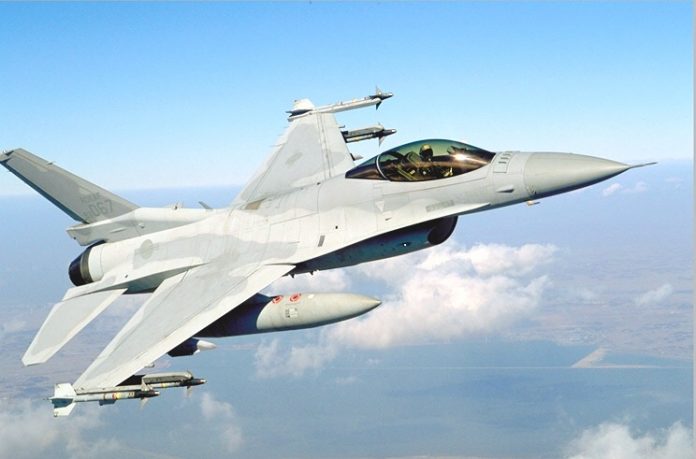
The U.S. Air Force awarded Lockheed Martin Aeronautics a contract worth over US$1.2 Billion for the upgrading of 134 South Korean F-16 fighters.
The Republic of Korea Air Force (RoKAF) plans to upgrade both the F-16C/D Block 50/52 fighter aircraft with brand new radar and avionics suite. The contracr negotiated is a fixed-price incentive-fee contract, managed under the foreign military sales program expected to cost about $2.5 Billion. The work will be performed by Lockheed Martin at ots Firt Worth TX plant. The upgrading is scheduled to complete in nine years, (November 2025).
Seoul initially picked BAE Systems for this upgrade, but in November 2014 terminated that contract following major price increased that incurred during the development phase, before the program reached production.
A year later, in December 2015 South Korea’s Defense Acquisition Programme Administration (DAPA) announced the formal selection of the original aircraft manufacturer Lockheed Martin to upgrade these Korean F-16s.
The upgrades are based on the advanced F-16V configuration. The main subcontractors for the program are Northrop Grumman’s AN/APG-83 scalable agile beam radar. A modern commercial off-the-shelf (COTS)-based avionics subsystem, a large-format, high-resolution center pedestal display and a high-volume and high-speed data bus. The new Modular Mission Computer (MMC) is a single high-performance computer that replaces the fighter jet’s three original computers, to deliver enhanced computing power to the aircraft’s avionics and weapon systems. Other avionic systems being upgraded include the JHMCS II helmet cueing display system, IFF, self protection, networking, and armament modernization.
The total program worth $2.5 billion also covers new weapons integration including GBU-39 small diameter bonbs, Harpoon anti-ship missiles, and laser JDAM.
“We truly appreciate the trust and confidence the Republic of Korea has placed in us with this contract,” said Susan Ouzts, vice president of Lockheed Martin’s F-16 program. “These upgrades are a critical piece of South Korea’s national defense and highlight Lockheed Martin’s commitment to the full lifecycle of the F-16, from production to through-life sustainment.”
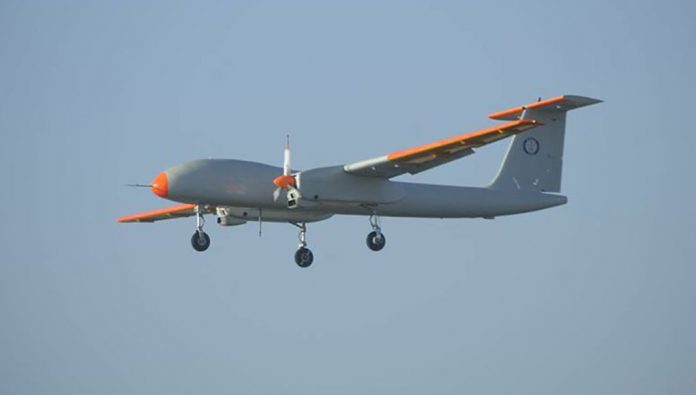
The Indian Tapas 201 (Rustom II) remotely piloted aircraft (RPA) made its first flight on November 16. Photo: DRDO
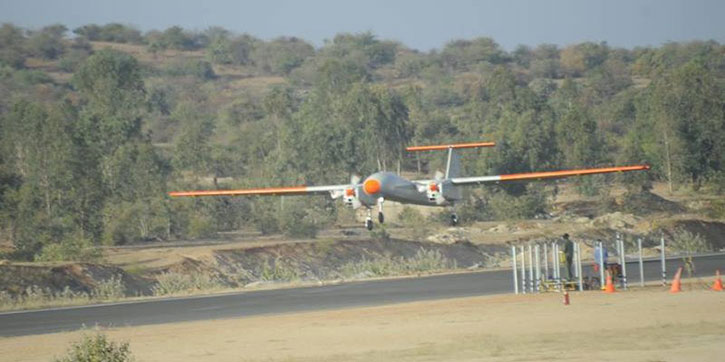
The Indian Tapas 201 remotely piloted aircraft (RPA) made its first flight on November 16, the Defense Research and Development Organization (DRDO) announced. The aircraft, formerly known as ‘Rustom II,’ was developed by the DRDO’s Aeronautical Development Establishment (ADE). The flight took place at the Aeronautical Test Range in Chitradurga, in the south of India.
Tapas 201 represents the first prototype of the Indian indigenous medium-altitude, long endurance platform designed for missions exceeding 24h. Once ready for operational use, Tapas-201 is expected to join active service with all Indian military services.
India currently uses large numbers of Searcher and Heron I unmanned systems bought from Israel Aerospace Industries. In addition to fielding its indigenous RPAS New Delhi is also seeking to import larger drones, namely the Israeli Heron TP, General Atomics MQ-9 and jet-powered Avenger.
India’s new Rustom II MALE drone takes off on its maiden flight from the Aeronautical Test Range in Chitradurga, in the south of India on November 16, 2016. Photo: DRDO
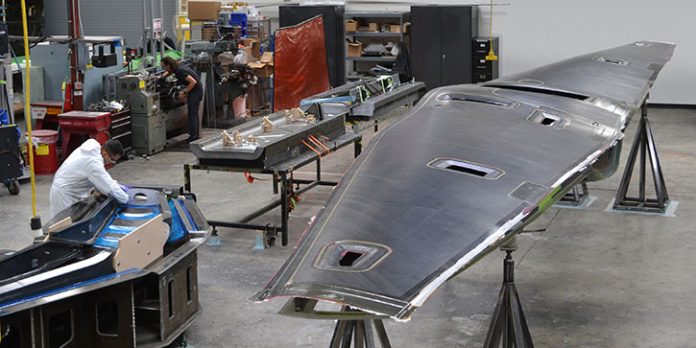
The manufacturing of the wing assembly of the TERN flight demonstrator - seen here at Northrop Grumman. Photo: DARPA.
With progress made with the fabrication of the first flight demonstrator of the Tactically Exploited Reconnaissance Node (TERN) program DARPA has funded a second TERN technology demonstrator. Since DARPA awarded Phase 3 of the TERN program to a team led by the Northrop Grumman Corporation, the program made significant advances on numerous fronts. Milestones included commencement of wing fabrication, completion of successful engine testing for its test vehicle and progress with the system integration. “DARPA has been thinking about building a second TERN test vehicle for well over a year,” said Dan Patt, DARPA program manager. “Adding the second technology demonstrator enhances the robustness of the flight demonstration program and enables military partners to work with us on maturation, including testing different payloads and experimenting with different approaches to operational usage.” According to the agency, TERN is making substantial progress toward scheduled 2018 flight tests of prototype unmanned air system for small-deck ships.
Tern is currently scheduled to start integrated propulsion system testing in the first part of 2017, move to ground-based testing in early 2018, and culminate in a series of at-sea flight tests in late 2018. Wind tunnel tests of a sub-scale model are underway at the 80’ x 120’ wind tunnel at the NASA Ames Research Center’s National Full-Scale Aerodynamics Complex (NFAC). Data collected during this test will be used to better characterize aircraft aerodynamic performance and validate aerodynamic models.
“We’re making substantial progress toward our scheduled flight tests, with much of the hardware already fabricated and software development and integration in full swing,” said Brad Tousley, director of DARPA’s Tactical Technology Office, which oversees Tern. “As we keep pressing into uncharted territory—no one has flown a large unmanned tailsitter before—we remain excited about the future capabilities a successful Tern demonstration could enable: organic, persistent, long-range reconnaissance, targeting, and strike support from most Navy ships.”
In the recent months, TERN has accomplished some significant technical milestones. Fabricating of wing and airframe components has been made with final assembly planned in the first quarter of 2017. Once complete, the airframe will house propulsion, sensors, and other commercial off-the-shelf (COTS) systems to make up the full-scale technology demonstration vehicle.
In Phases 2 and 3, Tern has successfully tested numerous modifications to an existing General Electric engine to enable it to operate in both vertical and horizontal orientations. TERN will use a proven engine already matured with multiple helicopter platforms currently in use.
TERN System integration is already underway at the Software Integration Test Station (SITS), part of the System Integration Lab that supports software development for the program. The test station includes vehicle management system hardware and software and uses high-fidelity simulation tools to enable rapid testing of aircraft control software in all phases of flight. The SITS is helping ensure the technology demonstration vehicle could fly safely in challenging conditions such as launch, recovery, and transition between horizontal and vertical flight.
The TERN full-scale technology demonstration program envisions a new medium-altitude, long endurance UAS that could operate from helicopter decks on smaller ships in rough seas or expeditionary settings while achieving efficient long-duration flight. To provide these and other previously unattainable capabilities, the Tern Phase 3 design is a tail-sitting, flying-wing aircraft with a twin contra-rotating, nose-mounted propulsion system. The aircraft would lift off like a helicopter and then perform a transition maneuver to orient it for wing borne flight for the duration of a mission. Upon mission completion, the aircraft would return to base, transition back to a vertical orientation, and land. The system is sized to fit securely inside a ship hangar for maintenance operations and storage.
A joint program between DARPA and the U.S. Navy’s Office of Naval Research (ONR), TERN seeks to greatly increase the effectiveness of forward-deployed small-deck ships such as destroyers and frigates by enabling them to serve as mobile launch and recovery sites for specially designed unmanned air systems (UASs).
DARPA and the Navy have a Memorandum of Agreement (MOA) to share responsibility for the development and testing of the Tern demonstrator system. The Marine Corps Warfighting Laboratory (MCWL) has also expressed interest in Tern’s potential capabilities and is providing support to the program.
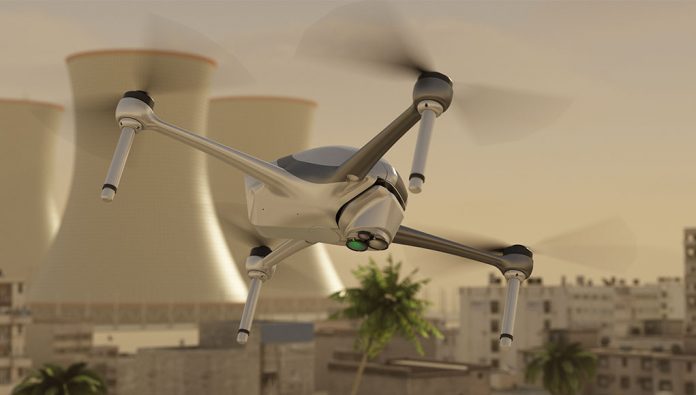
SpectroDrone is equipped with a laser based explosive detector, capable of detecting and identifying explosive materials, drugs and chemical compounds from a distance of few meters. Image: LDS
Following extensive testing in the laboratory and in the field, Laser Detect System (LDS) Ltd. is unveiling SpectroDrone – the world’s first drone-based explosive detection sensor.
Utilizing LDS’ laser-based explosive detection system, SpectroDrone detects explosives and other hazardous materials, in gas, liquid, powder or bulk form, at a distance of several meters from the threat. SpectroDrone can perform such missions over an operational radius of up to 3 Km. In addition to the detection of dangerous materials, SpectroDrone can remotely analyze different materials in real time, fulfilling essential role in mining and other industrial operations.
Until now, detection techniques required the user to bring the sensor within few millimeters of the inspected material. SpectroDrone employs LDS’s patented standoff gated laser spectroscopy techniques, using several laser wavelengths illumination, mainly via ultraviolet (UV) laser. This approach offers advantages in the detection of explosives, not available by any other means. The new development has proved to detect a wide range of materials at distances of several meters. The payload payload operates automatically, by aiming and activating the sensor via remote control. Scan results are displayed within few seconds on the operator control unit or at the control center, thus increasing user safety and providing higher efficiency when scanning large areas with remotely operated or autonomous systems.
LDS is unveiling the SpectroDrone this week at Israel’s HLS & Cyber Expo in Tel Aviv. At the exhibition, SpectroDrone is displayed integrated on the Airobotics Optimus drone – a high capacity multi-mission multi-rotor drone. In this new configuration SpectroDrone automatically detects and analyzes explosives materials and IEDs, hazardous compounds, and narcotics from a distance, in addition to its surveillance role, thus enhancing situational understanding and real-time response to emergency situations. The SpectroDrone payload can also be mounted on ground robots and in fixed operation such as LDS’ SPHERE vehicle inspection systems.
SpectroDrone implements LDS’ patented, laser-based detection technology. The payload comprises multiple electro-optical assemblies comprising a laser source emitting several wavelengths, laser range finder and high-resolution camera – all integrated with state of the art spectrometers which that operates LDS’s software package and proprietary algorithms.
This algorithm enables to achieve the sensitivity required for remote operation, increasing the probability of accurate detection while reducing false negative and false positive detection rates, bringing detection performance level to that of laboratory equipment.
“We are very excited to unveil this innovative solution for security and anti-terror applications at Israel’s HLS & Cyber, “said Eli Venezia, LDS founder, and President, “We are also encouraged by the great promise our technology offers for commercial applications.”
“When running security, emergency or surveillance missions in an industrial environment, the ability to dynamically and swiftly replace payloads, as well as introduce new innovative ones, is a real step forward,” says Ran Krauss, CEO, and Co-Founder of Airobotics. “The next generation of security lies in introducing unique technological capabilities, which I believe LDS and Airbotics bring jointly to market.”
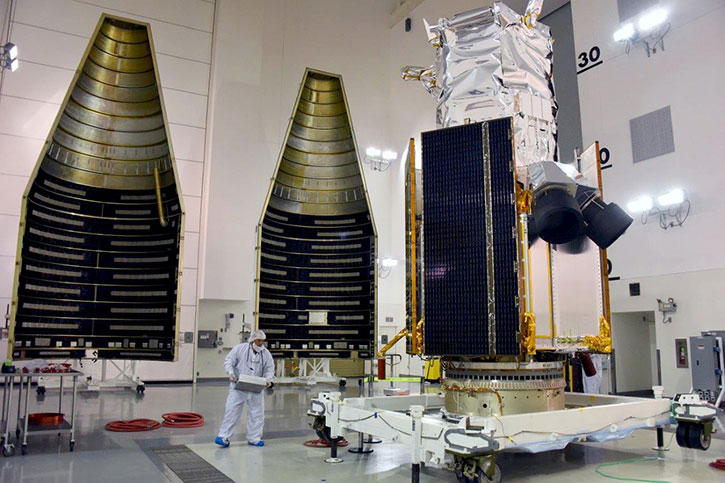
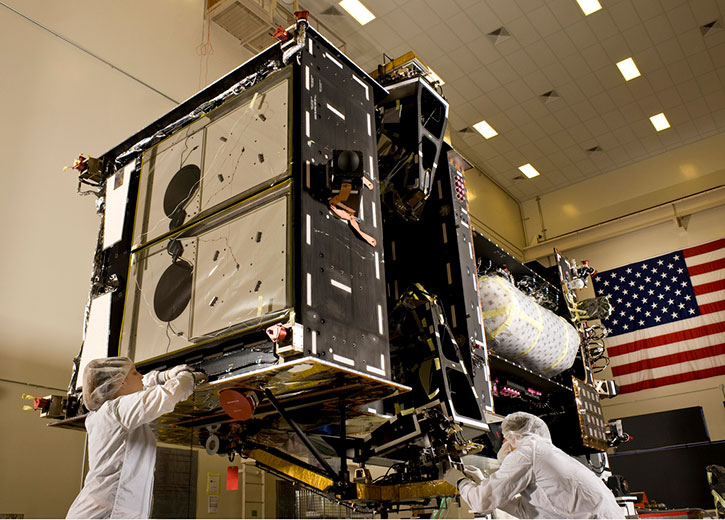
The Lockheed Martin-built WorldView-4 satellite will orbit the earth every 90 minutes capturing 600,000 square miles of imagery everyday. Photo: Lockheed Martin
Lockheed Martin has successfully launched today the WorldView-4 commercial remote sensing spacecraft for DigitalGlobe, Inc. An Atlas V 401 blasted off at 10:30 a.m. Pacific Standard Time from Space Launch Complex 3 East, placing the satellite in orbit for customer DigitalGlobe and marking the 137th consecutive successful Atlas launch to date.
The WorldView-4 satellite is the latest in a series of imaging and data satellites for customers around the world. The satellite will capture images so clear that they can distinguish between a sedan, van, and truck from nearly 400 miles in space. DigitalGlobe currently has five satellites in orbit – four Worldview series spacecraft and a single GeoEye satellite.
By leveraging DigitalGlobe’s advanced constellation scheduling system to operate in concert with WorldView-3 , WorldView-4 will more than double DigitalGlobe’s coverage of the world’s highest-resolution 30 cm commercial satellite imagery and increase the rate at which it grows its 16-year library of time-lapse high-resolution imagery.
WorldView-4 orbits Earth every 90 minutes, traveling 17,000 miles per hour and capturing as much as 680,000 square kilometers of the Earth’s surface daily (18 terabytes).
DigitalGlobe, Inc., provides satellite imagery services to the US government and defense services as well as foreign government and commercial customers. The company’s largest customer is the U.S. National Geospatial-Intelligence Agency (NGA) which has recently renewed the Global Enhanced GEOINT Delivery (Global EGD) program under the EnhancedView contract through 2022. Under this contract DigitalGlobe provides on-demand access to global high-resolution commercial satellite imagery. Users can access mission-ready satellite imagery in multiple classification levels via web browser or mobile device, typically within two to four hours after downlink.
Hundreds of thousands of U.S. Government users leverage Global EGD imagery, whether directly or through U.S. Government mobile devices and web portals. The imagery service provides essential mission planning data to warfighters, the intelligence community, and other U.S. Government users. New capabilities to be added to the service include the addition of shortwave infrared imagery (SWIR) and 8-band multi-spectral imagery, e-mail alerts of new collections over a user’s area of interest, and improved archive ordering.
Other products designed for the civilian market include the Basemap Suite that features 1.5 billion square kilometers of high-accuracy, high-resolution imagery – 10 times the land surface area of the Earth. In particular, Basemap +Metro covers over 500 population centers in at 30 cm resolution and 1,700 cities available at 50 cm or better resolution. The company also offers a free imagery servcie online, under the SpaceNet program, an online repository of satellite imagery and labeled training data that will advance the development of machine learning and deep learning algorithms that leverage remote sensing data. SpaceNet is a collaboration between DigitalGlobe, CosmiQ Works, and NVIDIA, and the imagery is now freely available as a public data set on Amazon Web Services, Inc. Spacenet aims to automatically detect and extract features in satellite imagery, fueled by the massive amount of information about our changing planet that DigitalGlobe collects every day, and that of emerging commercial satellite imagery providers.
The WorldView constellation enabled the company to expand its services abroad and the expectation from the WorldView-4 are high. In April and July DigitalGlobe received requests from several foreign governments for satellite capacity commitments from international defense and intelligence customers, seeking high-resolution imagery products from WorldView-4. The company already serves 12 such customers with Direct Access Program customers.
Today’s mission was launched by the United Launch Alliance (ULA) aboard an Atlas V 401 configuration vehicle, which includes a 4-meter-diameter large payload fairing. The Atlas booster for this mission was powered by the RD AMROSS RD-180 engine and the Centaur upper stage was powered by the Aerojet Rocketdyne RL10C engine.
Built by Lockheed Martin, DigitalGlobe’s WorldView-4 satellite is enclosed in the four-meter fairing that will then be placed atop an Atlas V 401 rocket. Photo courtesy of Lockheed Martin and United Launch Alliance. Photo: Lockheed Martin
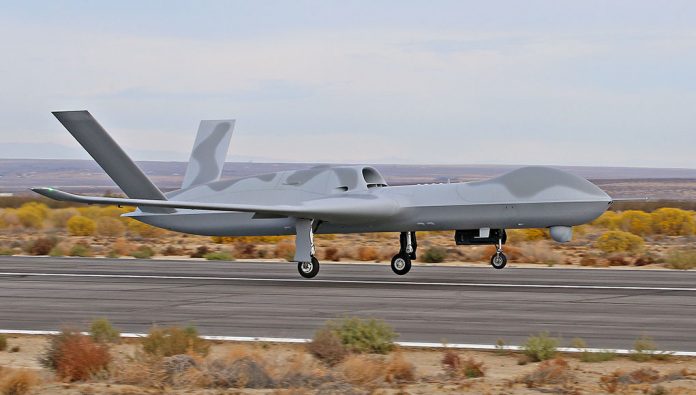
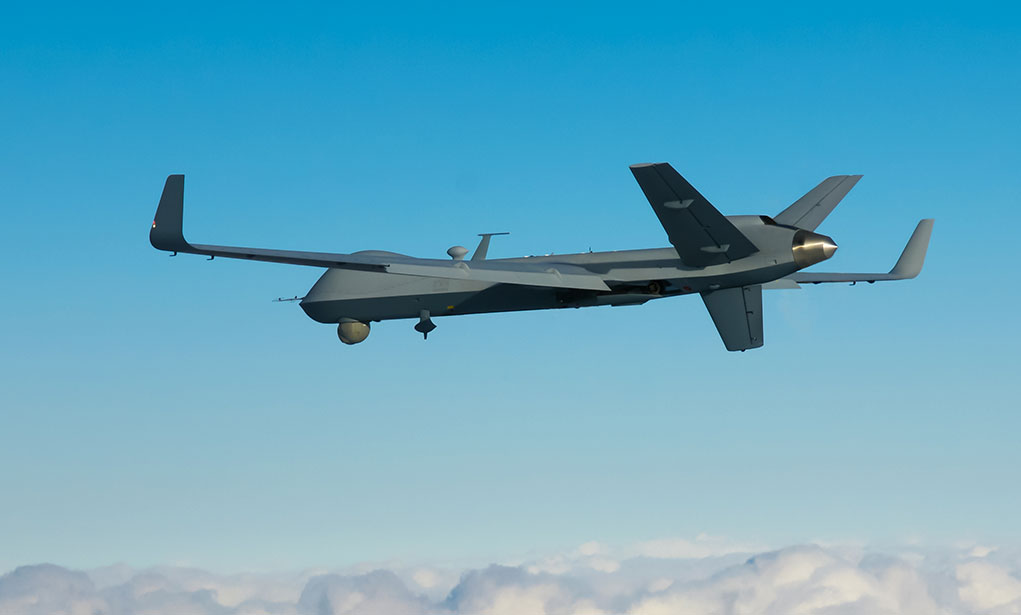
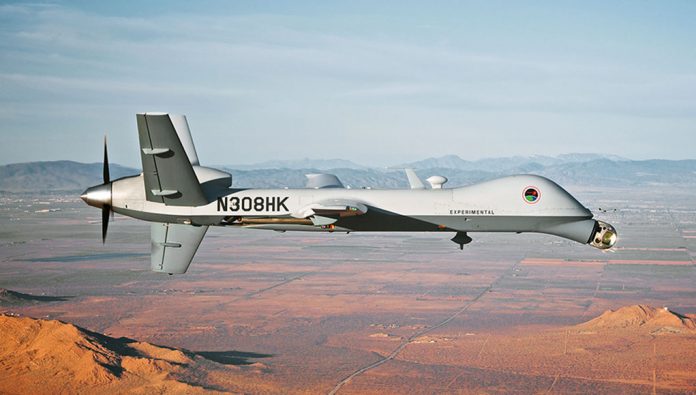
The Extended Range version of the Avenger has a wing span of 76 feet. With additional 2200 lbs of fuel it can carry missions of up to 20 hours. Photo: GA-ASI.
General Atomics Aeronautical Systems, Inc. (GA‑ASI), successfully performed the first flight of the Avenger Extended Range (Avenger ER) remotely piloted aircraft (RPA). The flight occurred on October 27th at the company’s Gray Butte Flight Operations Facility in Palmdale, Calif.
The Extended Range version of the Avenger has a wing span of 76 feet. With additional 2200 lbs of fuel it can carry missions of up to 20 hours. Photo: GA-ASI.
The ER wingspan was increased by 10 foot – to 76 feet (23.16 m’); also, the drone carries 2,200 pounds (1 ton) of additional fuel, extending the legacy Avenger’s endurance from 15 hours to 20 hours. The distinctive winglets which were also implemented in the MQ-9 ER are also used with the Avenger ER, designed to improve performance and improve fuel consumption. “The increased endurance and high payload capacity will deliver tremendous capability to our customers, who need persistent situational awareness and strike mission affordability,” said Linden Blue, CEO, GA-ASI. The Avenger flew its first flight in 2009 and was acquired by the US Air Force for evaluation in 2011. To date, the Avenger has accumulated over 13,000 flight hours to date, in both test and operational flights.
The new version has an extended range and endurance, Surveillance, and Reconnaissance (ISR) and precision-strike capability, supporting a wide array of sensors and weapons payloads to perform ISR and ground support missions. Like the legacy Avenger, Avenger ER features avionics based upon the combat-proven Predator B/MQ-9 Reaper, has a 44-foot (13.41 m’) long fuselage, 3,000-pound (1.36 ton) payload bay, and is capable of flying at over 400 KTAS (740 km/h). Avenger ER, along with its predecessor, is designed to carry payloads such as the all-weather GA-ASI Lynx Multi-mode Radar, the MS-177 Electro-optical/Infrared (EO/IR) sensor, and the 2,000-pound (907 kg) Joint Direct Attack Munition (JDAM).
While the Avenger platform is not operationally used by the US Air Force, a navalized derivative of the system is considered by the US Navy for its MQ-25 ‘Stingray’ carrier-based drone. On another demonstration planned for 2018, the Avenger could carry a powerful laser, demonstrating new missile defense capabilities.
GA-ASI developed Avenger on Internal Research and Development (IRAD) funds with the intent of making an RPA that has a quick-response, armed reconnaissance capability. First flown in April 2009, the aircraft’s fuselage was extended by four feet in 2012 to accommodate larger payloads and fuel. Avenger received an FAA-issued Experimental Certificate (EC) in 2016, enabling it to operate in the U.S. National Airspace System (NAS).
The ER variant of the Predator B (Reaper) flew in February 2016. It is equipped with longer wings and carries more fuel to extend mission endurance up to 40 hours. Photo: GA-ASI
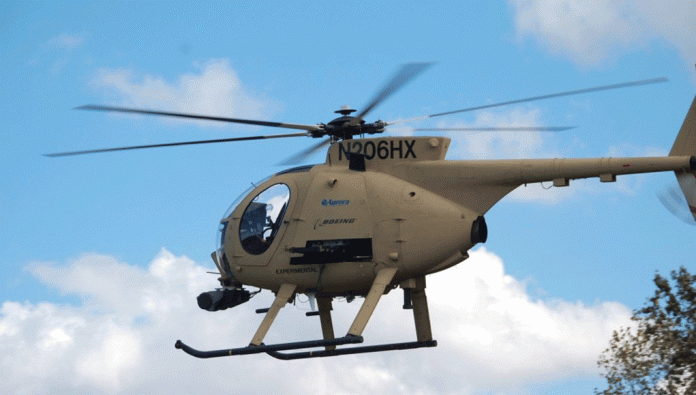
AACUS technology has been flown on a Boeing AH-6 Unmanned Little Bird and multiple Bell 206 variants. The final AACUS INP demonstrations will be on a Bell UH-1H in the
first half of FY18. Photo: Aurora Flight Sciences
Aurora Flight Sciences will integrate the Tactical Autonomous Aerial Logistics System (TALOS) on a UH-1H helicopter for capability demonstration to the US Navy and Marine Corps. TALOS was developed by Aurora under the Autonomous Aerial Cargo Utility System (AACUS) – a program the company runs for the US Office of Naval Research (ONR). Representing the final phase of AACUS program, the integration on the Huey will transition the TALOS system onto an autonomous UH-1H platform currently under development at Aurora, flight demonstrations are planned in 2017-2018.
The primary goal of the AACUS program is to enable rapid cargo delivery by unmanned, and potentially optionally-manned, Vertical Take-Off and Landing (VTOL) systems. AACUS encompasses the development and implementation of VTOL-based obstacle detection and avoidance, and allows for autonomous landings at unprepared, off-field, non-cooperative landing sites. AACUS also enables dynamic contingency planning to the point of landing, with goal-based supervisory control by any field personnel with no special training.
At the AACUS flight testing event held today in Northern Virginia, the AACUS program demonstrated on a manned Bell 206 the perception and planning capabilities required for autonomous takeoff, transit and landing. “We know how to make things fly, we’ve been doing it for over 100 years,” said Retired Brig. Gen. Frank Kelley, the Deputy Assistant Secretary of the Navy for Unmanned Systems. “What we don’t yet know how to do, is how to couple aircraft and autonomous systems together, but great programs like this are helping us get there.”
The old Huey will soon get the brand new Tactical Autonomous Aerial Logistics System (TALOS) unmanned operation and control suite, enabling the helicopter to fly unmanned. TALOS is transferable intelligence designed with both manned and unmanned aircraft requirements in mind. Developed for the US Office of Naval Research (ONR), Aurora also explores commercial applications for the TALOS technology. Photo: Aurora Flight Sciences
Aurora’s TALOS system has been demonstrated previously on a Boeing H-6U Unmanned Little Bird flown autonomously, and three different human-piloted Bell 206 aircraft. “The arrival of a Huey as our third test platform frames a key point for future customers – the TALOS system is platform agnostic; you’re not buying a new fleet of helicopters, you’re buying a capability set for your current fleet,” said John Wissler, Vice President of Aurora’s R&D Center in Cambridge, Massachusetts. “TALOS is not an aircraft, nor is it a robot flying an aircraft – TALOS is transferable intelligence designed with both manned and unmanned aircraft requirements in mind. The value of TALOS can be described in a few words – platform agnostic, scalable autonomy, onboard sensing of the environment, and on-board intelligence that no other system in the world can provide.”
Commercial applications for the TALOS technology are also being explored by Aurora. “Think of the civilian first responder pilot attempting to land in a remote, storm-ravaged area at night – TALOS senses and alerts to power lines and landing zone obstacles well before the pilot and informs the pilot’s maneuvers,” said Wissler.
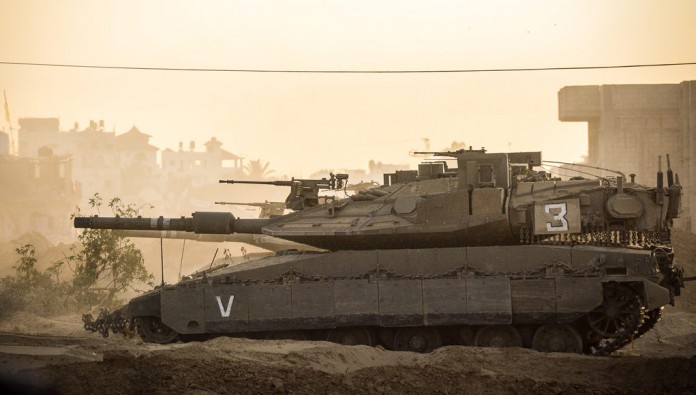
Merkava Mk4 with Trophy Active Protection System seen in Gaza - July 2014. Photo: IDF Spokesman
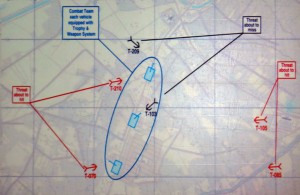
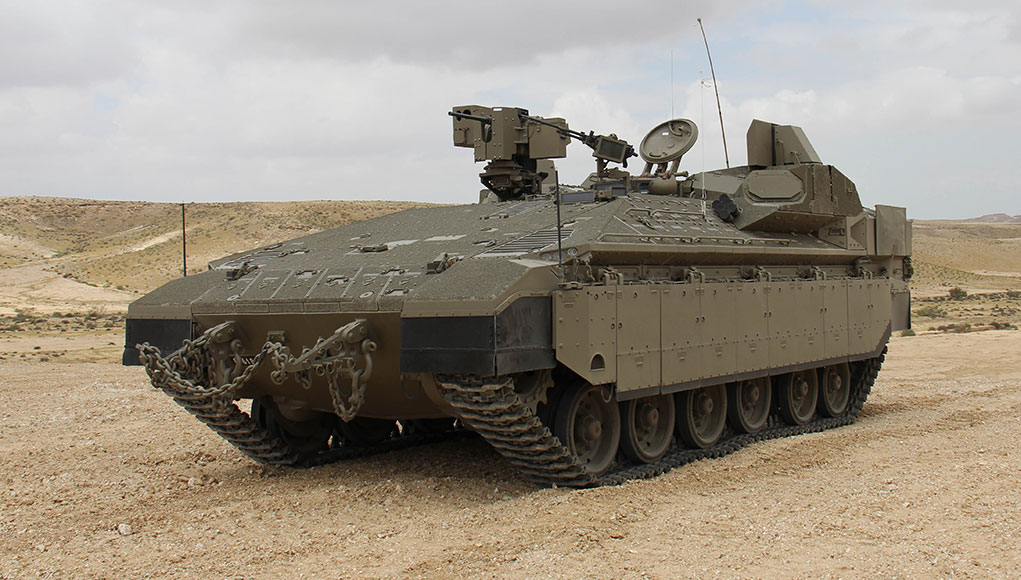
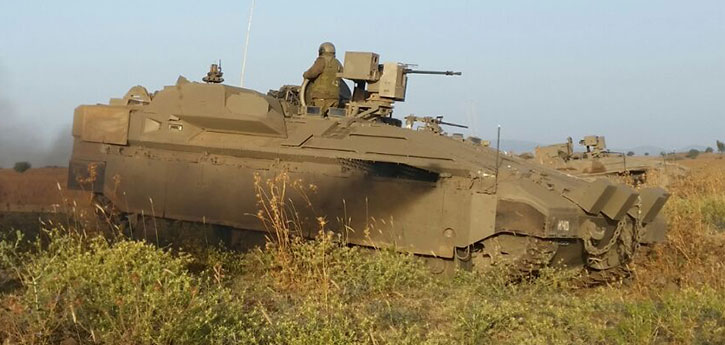
Israel’s Ministry of Defense (IMOD) plans to continue the acquisition of Trophy active protection systems (APS), to equip every new Merkava 4 tank and Namer Heavy Armored Personnel Carrier (APC) with active protection, providing significant additional protection for every tank and APC. MOD Director General, Gen. (res) Udi Adam, instructed the Directorate of Production and Procurement (DOPP) to purchase hundreds of additional from Rafael Advanced Defense Systems.
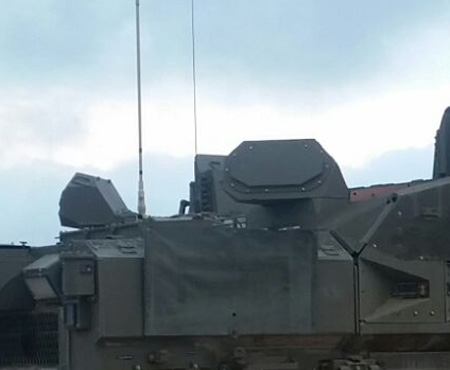
These two Windguard AESA radars are part of the 360 degrees sensor of the Trophy system. They provide the situational picture, threat detection and fire control cueing for the Trophy APS system. Photo: IMOD
Each Trophy system integrates an early warning and battle management radar covering 360 degrees,and the effectors, comprised of multiuple explosive-formed projectiles designed to defeat income threats at a stand-off distance. According to IMOD sources the cost of the APS acquisition will be in the ‘hundreds of millions of shekels’.
IAI’s ‘Windguard’ radar is part of Rafael’s Trophy APS. It is the ‘eyes and ears’ that triggers the active protection and also provides a critical situational awareness localizing threats around the combat formation. Photo: Tamir Eshel, Defense-Update
Fielded in 2011 the Trophy APS proved its lifesaving efficiency in numerous combat engagement, particularly during operation Operation ‘Protective Edge’ in Gaza in 2014. In recent months, the Tank Management Program at the Ministry of Defense, together with the IDF Ground Forces, conducted a series of successful tests on the Namer APC equipped with the Trophy System. Completion of the trials and the integration process allowed for the procurement and production of hundreds of additional Trophy systems. Apart from the Merkava and Namer tracked armored fighting vehicles the IMOD plans to integrate the Tropy (either in its current version or in a more compact configuration) on future wheeled APCs such as the Eitan, of which a prototype is currently in evaluation.
Trophy, the winner of Israel’s Security Prize, is considered the world’s leading, operational active protection system. Apart from the increased survivability, Trophy and its panoramic sensors add a significant benefit of increased situational awareness, providing indication and localization of the enemy’s active firing positions – information that can be transformed into rapid engagement by the combat force.
All new Namer heavy APC s rolling off the production line will be equipped with Trophy APS, along with all Merkava Mk 4 that began receiving the system since 2011. Photo: IMODUS-built kits represent more than 50 percent of the cost of the vehicles. The kits are assembled in Israel into several variants, including APC, combat engineering, technical support and command vehicles. All will receive APS to improve combat survivability. Photo: IDF Spokesman.
The Pentagon is harnessing its strategic missile warning system to conduct surveillance on a global scale, improving strategic situational awareness over the entire planet. A new Battlespace Awareness Center (OBA) that came online last month processes massive streams of satellite infrared immagery, generating Overhead Persistent Infrared (OPIR) that turns the pentagon’s ‘Space-Based Infra-Red Systems’ (SBIRS) into an all-seeing, unblinking eye.
This sophisticated and mostly classified satellite system is now proving to be a valuable intelligence asset in monitoring and supporting combat operations in remote theaters, where U.S. forces are involved – directly and indirectly. North Korea, Iraq, Syria, Libya, Yemen, Central and East Africa or Ukraine are only few of the hotspots such surveillance capabilities could make an effect.
Besides the detection of intercontinental ballistic missiles, the ultra sensitive infrared sensors operating on board SBIRS satellites are able to pick up the heat signatures of small explosions, large fires, and other signs of mass human activity – ranging from forest fires and factory explosions through to the clearing of crops and trees and conventional military conflict.
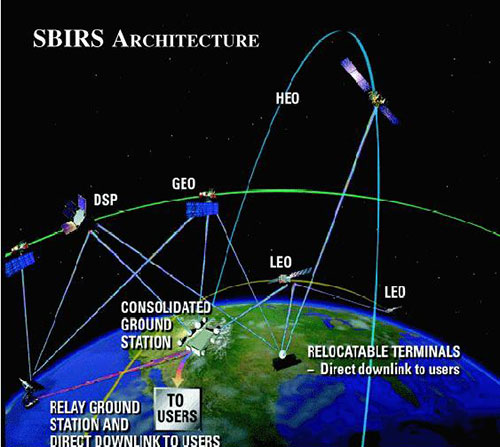
A constellation of satellites in multiple orbits, carrying different sensors is designed to satisfy missile defense and OPIR requirements.
SBIRS is a constellation of geostationary and high elliptical orbit strategic surveillance satellites originally designed to spot launch events of ballistic missiles. The primary role of these satellites is to detect a launch, identify what kind of missile or rocket was fired, determine its trajectory and, if necessary, cue a missile intercept. Air Force officials are careful not to describe the exact capabilities of OPIR, but current satellites’ sensors reportedly detect ‘significant heat event.’ by the hour. Each event represents a missile or rocket launch, or significant explosions. These strategic surveillance assets are enhancing combatant commanders with battlespace awareness by detecting non-launch-related infrared events.
The OBA that came online last month is operated by the U.S. Air Force’s Space and Missile Systems Center (SMC) and the 460th Space Wing at Buckley AFB in Aurora, Colorado, operates the SBIRS system. According to air force officials, In just a few months of operation, this multi-organizational center has improved missile warning mission and led to advances in surveillance and battlespace awareness operations in support of combatant commanders.
“The SBIRS sensors are the most capable infrared that we have ever produced,” said Colonel David Miller, U.S. Air Force, commander of Air Force Space Command’s 460th Space Wing. Each SBIRS GEO satellite in geosynchronous orbit has two main sensors: one that scans large areas and one that maintains constant surveillance of smaller areas to provide more timely warning of missile launches. In addition, legacy DSP satellites scan the globe once every 10 seconds. Air Force officials say SBIRS is even faster. “Our unique attribute is persistent global surveillance”, Miller noted, “the sensors provide an ‘unblinking eye’ that provide surveillance and warning of threats to the U.S. embassy and U.S. forces in Iraq.”
Lockheed Martin Space Systems Company, Sunnyvale, California, is the SBIRS prime contractor, and Northrop Grumman Electronic Systems, Azusa, California, is the payload integrator.
Current satellite-based missile warning capabilities evolved from the Defense Support Satellite (DSP) program of the 1970s. The capability gaps realized during the 1991 Persian Gulf War, after Iraqi short-range missiles were used against Saudi Arabia and Israel drove the U.S. Department of Defense (DOD) to expand theater missile warning capabilities. DSP was never designed to spot short-range missile launches, but follow-on sensors improved imaging capabilities to deliver timely warning of such events.
The SBIRS constellation is currently comprised of two satellites in geosynchronous orbits (GEO) and two payloads hosted on classified satellites in high elliptical orbits (HEO), providing infrared signatures of heat events across the world. These assets provide the primary and earliest means strategic early warning of missile launch events, covering countries like China, Russia, Iran, and North Korea. SBIRS satellites carry infrared sensors designed to detect ballistic missile launches. The sensitive detectors can instantly spot missile launches using the heat emanating from a missile’s engine as it launches from its silo or launch-pad. Upon detection, SBIRS sends that data to the ground-based processing center, where it is correlated with other data to plot exact position of the launch, type of threat and likely trajectory of the missile, thus providing early warning and targeting data for further action and response. Four new SBIRS satellites are currently in preparation – two are already produced and awaiting deployment to space and the other two are in production.
The prime contractor for SBIRS is Lockheed Martin. Northrop Grumman is the payload contractor. Photo: Lockheed Martin
With improved performance and matured sensors and payloads, Unmanned Aerial Systems (UAS) assume more missions, beyond the general intelligence, surveillance, reconnaissance (ISR) and attack roles they were used so far. Missile defense is one of the new applications explored for drones.
“A UAV-borne laser would be capable of acquiring, tracking and eventually destroying an enemy missile at a much lower cost than the existing BMDS.” Vice Admiral J.D. Syring, USN, Director, Missile Defense Agency said in his testimony before the House Armed Service Committee Subcommittee on Strategic Forces. “Beyond intercept, these UAVs will also support ascent and midcourse tracking and target discrimination, as an alternative targeting method to ground or ship-based radars, alongside space-based sensors.”
Remotely Piloted Aircraft (RPA) are already tested with Airborne Infrared (ABIR) sensors – performing forward picket to spot hostile missile launches and track them through their flight trajectory. In this role High-Altitude, Long Endurance (HALE) UAS can help defenders discriminate between warheads and decoys a few years from now, such platforms will also be able to intercept missile targets, zapping them on the ascent from hundreds of miles away using powerful lasers.
The U.S. Missile Defense Agency (MDA) already operates several General Atomics Aeronautical Systems Inc. (GA-ASI) Predator B (Reaper) RPA, equipped with the latest generation electro-optical Infrared turrets – the Raytheon Multispectral Targeting Systems-C (MTS-C) configured for ABIR missions. These drones have successfully performed missile tracks during the recent Pacific Dragon missile defense exercise held last June, off the coast Hawaii, at the Pacific Missile Range Facility in Kauai. Through the exercise, the drones conducted persistent monitoring of missile activity at the range. Overall, these sensors will ultimately improve the ability of missile defense sensors to track ‘cold body targets’ – the missiles flying in space, after rocket burnout. By tracking such targets through their time of flight, defenders could get better target discrimination, thus reducing reaction time, and increasing the probability of hit and reduce the overall cost per kill.
Almost 50 unmanned systems from the UK, USA, Sweden, Germany, France, Italy, and Austria participated in a month-long war game for robots, organized by the Royal Navy. Spanning air, surface and the undersea domain, ‘Unmanned Warrior 2016’ (UW16), has been in the making for almost two years, with dozens of players from different nations invited to take part in this unique operational demonstration, held as part of NATO’s Joint Warrior exercise.
The technologies tested in the exercise included anti-submarine warfare, minesweeping and countermeasures, intelligence gathering, including geospatial monitoring, meteorological, bathymetric and hydrological surveillance, reconnaissance and targeting (ISTAR) providing overwatch and persistent surveillance for coastal and maritime elements, and extended range ocean surveillance. Command, control, and communications were also an important factor supported by unmanned systems, enabling networking and collaboration of multiple systems performing collaborative missions.
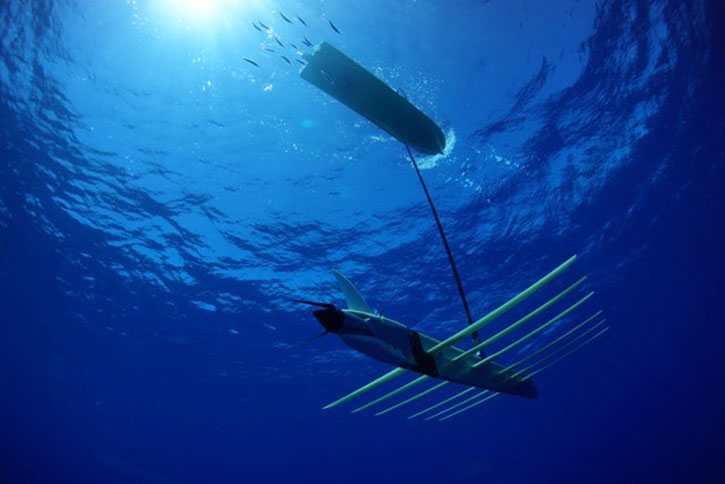
A system designed for long-endurance autonomous operation in the open sea is the ‘Sensor Hosting Autonomous Remote Craft’ (SHARC) from Boeing and Liquid Robotic. Four such crafts participated in Unmanned Warrior 2016. They were used to deliver continuous maritime intelligence, surveillance, and reconnaissance missions for up to a year without refueling or servicing. These crafts employ innovative wave- and solar-powered propulsion system, and carry a sensor suite provided by Boeing. Its ability to conduct continuous patrols using autonomous navigation gives SHARC unique access to undersea, air and space domains. Multiple SHARCs can be monitored and controlled by a single, shore-side operator. To date, more than 50 sensors have been tested and integrated on SHARC, including Automated Identification System (AIS), acoustic sensors, electromagnetic sensors, and imaging systems. SHARC’s onboard open architecture, commercial standards and modular configuration that allows rapid integration of advanced technologies and innovative payloads.
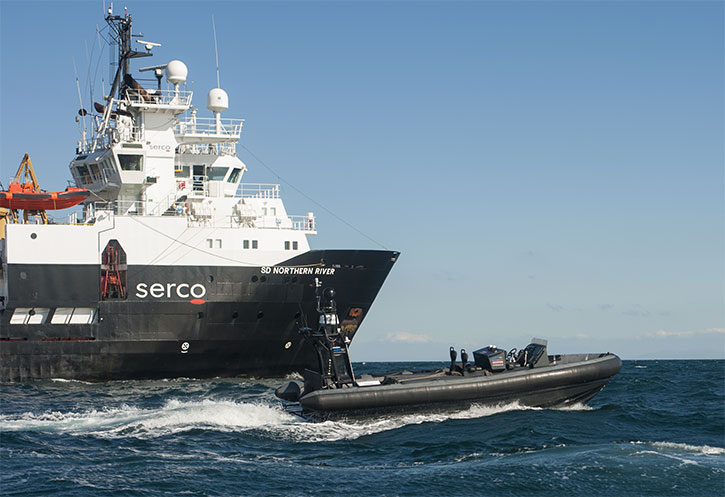
The Sensor Hosting Autonomous Remote Craft (SHARC) employ innovative wave- and solar-powered propulsion system, and carry a sensor suite provided by Boeing. Photo: Liquid Robotics The Halcyon USV from Thales, carries the T-SAS sonar to delivers live, high-quality sonar used for anti-submarine warfare. Photo: ThalesUnmanned Surface Vessels were the relatively new class evaluated at Unmanned Warrior 2016. Several models participated in the exercise, including the Halcyon from Thales, which carries the T-SAS sonar, that delivers live, high-quality sonar images to shore-based operators over long distances. In fact, the Halcyon is being developed as part of the Thales-led consortium solution for the first phase of the Anglo-French Mine Countermeasures program to assess the future mine warfare capabilities of the UK and French navies. Thales is the system integrator for the Maritime Autonomous Platform Exploitation (MAPLE) program, which also evaluates the command and control aspects of the system, through the Autonomous Control Exploitation and Realization (ACER) deployed on the vessel Northern River, which provided a warship command surrogate platform. Unmanned aerial vehicles such as the BlueBear Blackstart flew airborne relays linked the ACER with remote unmanned vessels at sea.
ACER also provided commanders with control over missions through the use of ‘collaborative autonomy’ of multiple unmanned, autonomous platforms and sensors cooperating on specific missions. In the third week of the exercise anti-submarine and counter-mine, missions scaled up to include ten different vehicles from three countries, operating in four squads operating across air, surface and underwater domains.
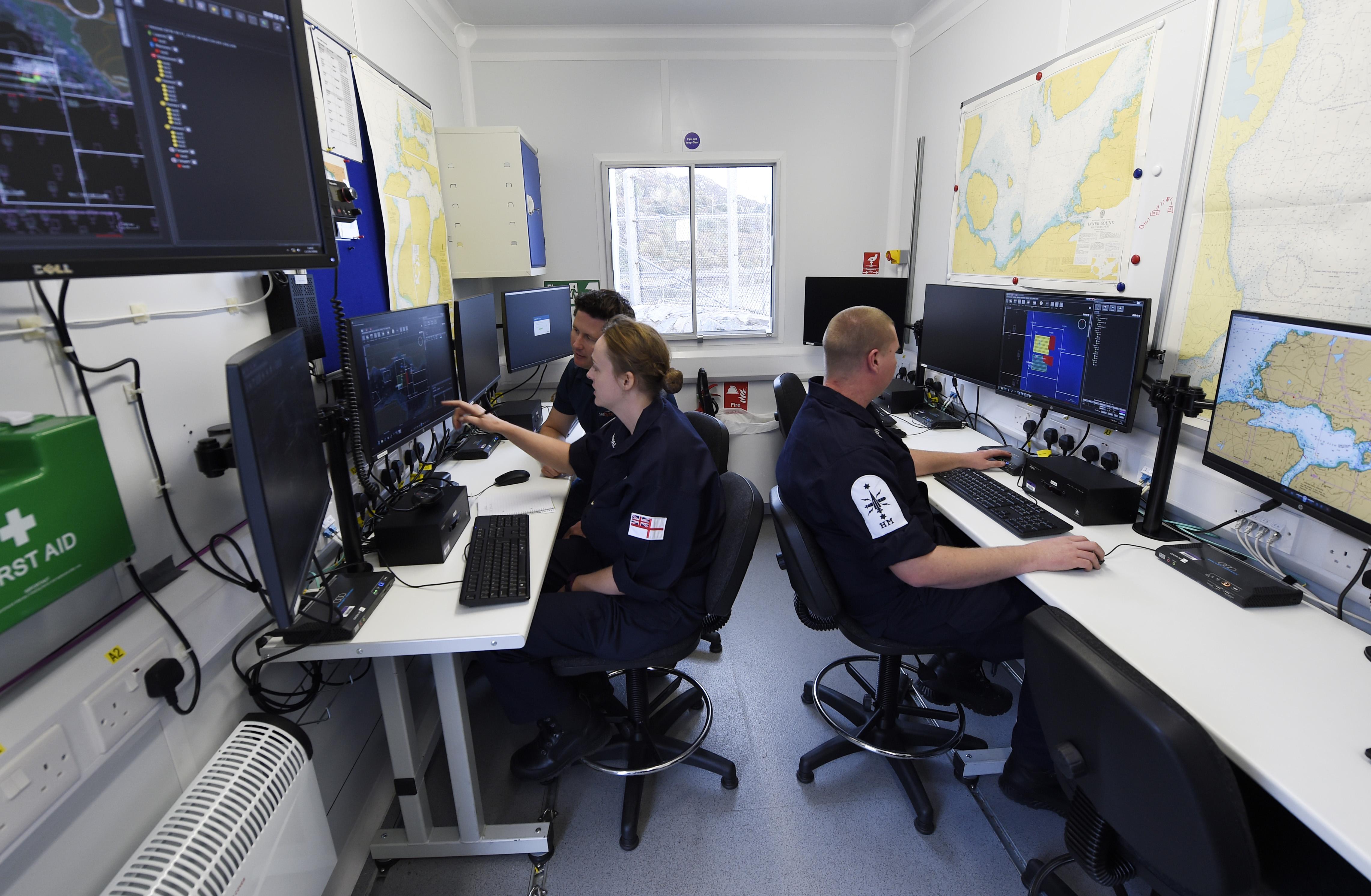
The system is based on BAE Systems’ Systems Combat Management System and includes enhancements to support planning and decision-making using off-board systems. Hosted within a transportable command and control center, ACER is capable of integrating several unmanned systems and platforms from multiple suppliers, minimizing the number of screens and controls operators need to conduct successful missions.
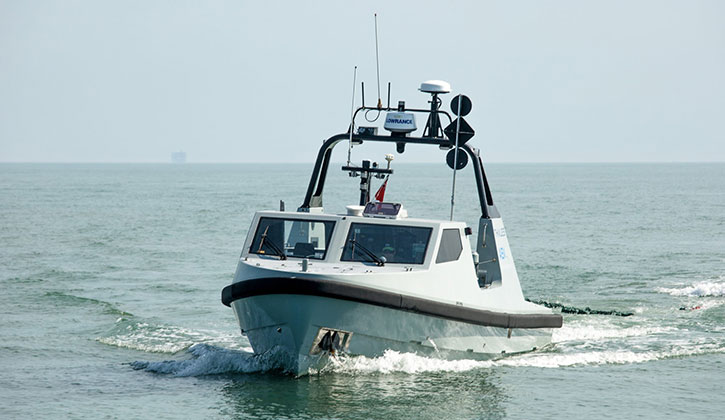
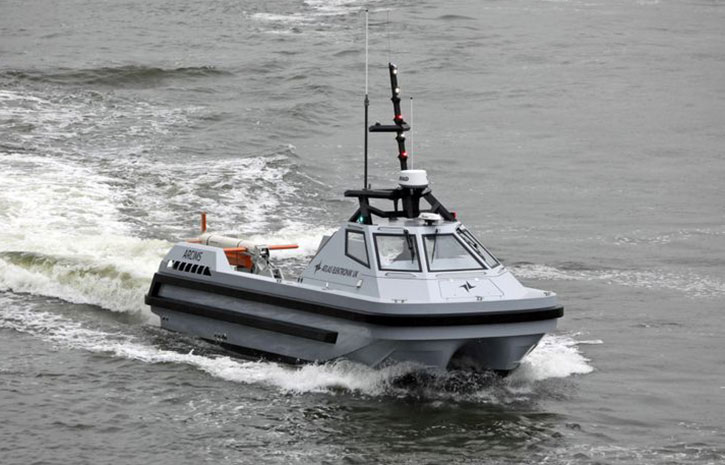
SD Northern River, a support ship operated by defense contractor Serco acted as a surrogate warship for the exercise providing at sea command and control functions. Also visible is the P950 unmanned RIB from BAE Systems. Photo via BAE Systems. The command operations module located at the British Underwater Test & Evaluation Centre (BUTEC) during Unmanned Warrior (UW) 2016 allows for the control and tasking of unmanned vehicles from multiple suppliers using a generic workstation. The first-ever UW is a research and training exercise designed to test and demonstrate the latest in autonomous naval technologies while simultaneously strengthening international interoperability. T(U.S. Navy photo by John F. Williams) The ARCIMS from Atlas Elektronik carries the AQS-24B Synthetic Aperture Sonar (SAS) made by Northrop Grumman Corporation. Photo: Atlas ElektronikAnother USV provider, Atlas Elektronik UK (AEUK) deployed its 11-meter long mine hunting USV ‘ARCIMS’ to Unmanned Warrior 2016. ARCIMS carries the AQS-24B Synthetic Aperture Sonar (SAS) made by Northrop Grumman Corporation. Although the system is currently undergoing final integration, the company has already received firm orders for two ARCIMS. In the weeks that preceded AW16, the ARCIMS received final tweaks at the Portland Harbor, undergoing integration testing of the AQS-24B, that included remote launch and recovery of the towed sonar at the. The AQS-24B is a towed mine hunting sensor used by the U.S. Navy, features the world’s only high-speed synthetic aperture sonar for mine detection, localization, and classification, and an optical laser line scan sensor for the identification mine.
A smaller unmanned naval platforms taking part in the exercise was BAE Systems’ Pacific Class 950 Unmanned Rigid Inflatable Boat (P950 RIB). This RIB is capable of traveling at up to 47kts for up to 12 hours at a time. Remotely controlled via ACER, the RIB can also operated autonomously, using technology developed by BAE Systems and ASV Ltd with support from suppliers including Deep Vision Inc and Chess Dynamics Ltd.
Those sonars often needed targets to detect and unmanned systems provided these services as well. Saab provided the AUV62-AT an acoustic target that replicates the active and passive signature of a submarine, delivering essential ASW simulation and training for the entire maritime force.
USV were also operating Mine Counter-Measures (MCM) missions, employing various sensors and countermeasures to defeat mines. Among these countermeasures was the Sea Wasp from Saab. This small, highly maneuverable waterborne counter-IED vehicle is remotely controlled to deliver a demolition charge close to a mine, enabling MCM operators to neutralize the target from safe distance. Yesterday Saab announced the acquisition of Nordic Defense Industries (NDI), a Danish manufacturer of mine disposal charges, thus expanding its MCM offering.
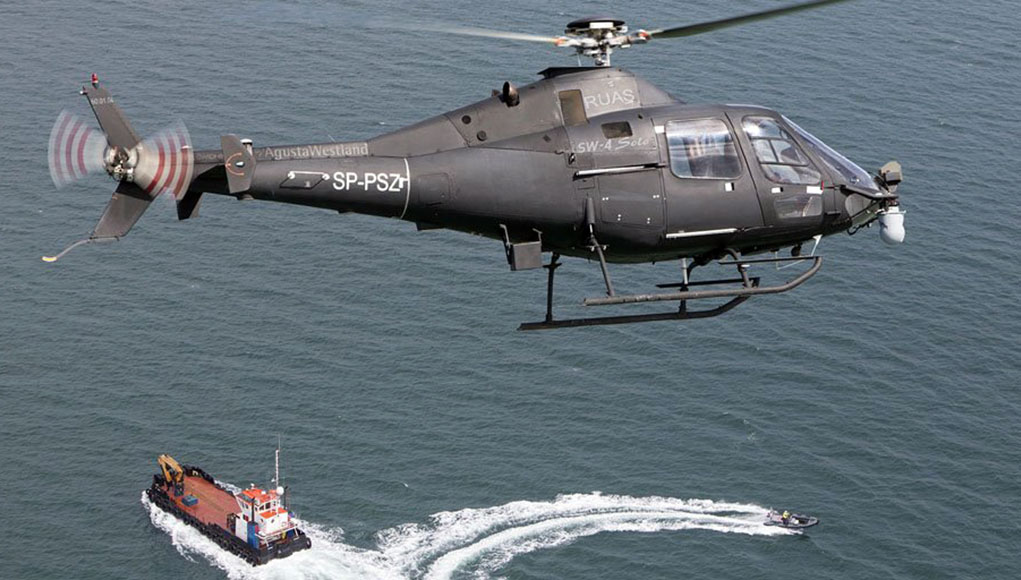
The AUV62-AT acoustic target that replicates the active and passive signature of a submarine is used for the training of ASW operations. Photo: Saab Leonardo’s SW4 Solo Optionally Piloted Helicopter. Photo: LeonardoOther systems participating at the UW16 demonstration were aerial vehicles of different sizes and types. Among the platforms being used were the familiar Austrian S-100 Camcopter from Shiebel, and American Scan Eagle from Insitu and Boeing, equipped with Visual Detection and Ranging system. Boeing hopes it can offer as a replacement to the Royal Navy’s ScanEagle, expected to be phased out of service in 2017. Other systems tested were the NRQ-21 and Indago quad rotor, from Lockheed Martin. UW16 provided the stage for the first maritime appearance of new platforms – the Thales Watchkeeper, operating the i-Master radar over the sea and the Leonardo SW-4 Solo optionally piloted helicopter on surveillance missions, carrying the Osprey flat-panel electronically scanned radar, EO/IR payload, and SAGE electronic support measures system.
“The technologies and concepts being demonstrated in Unmanned Warrior have the potential to fundamentally change the future of Royal Navy operations just as the advent of steam propulsion or submarines did for example.” Commander Peter Pipkin, the Fleet Robotics Officer, said. “By working closely with a wide range of system providers from defense, industry, and academia, Unmanned Warrior has also become the catalyst for a level of discussion and participation that sets the gold standard for collaborative projects.”
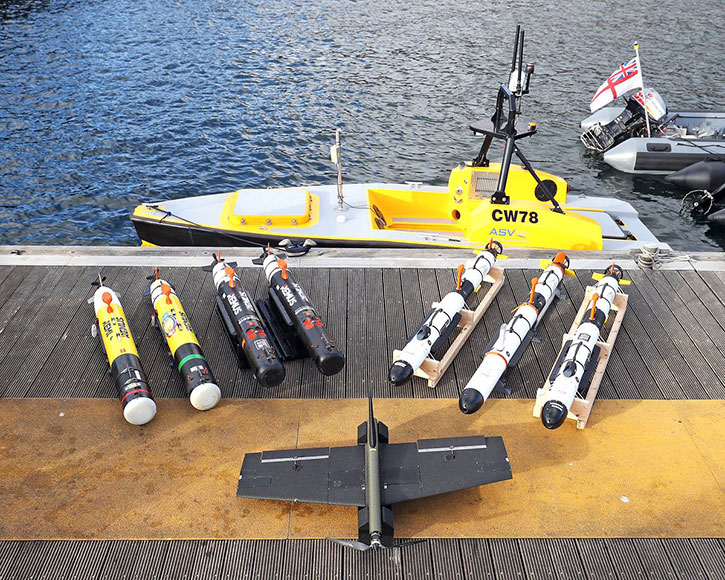
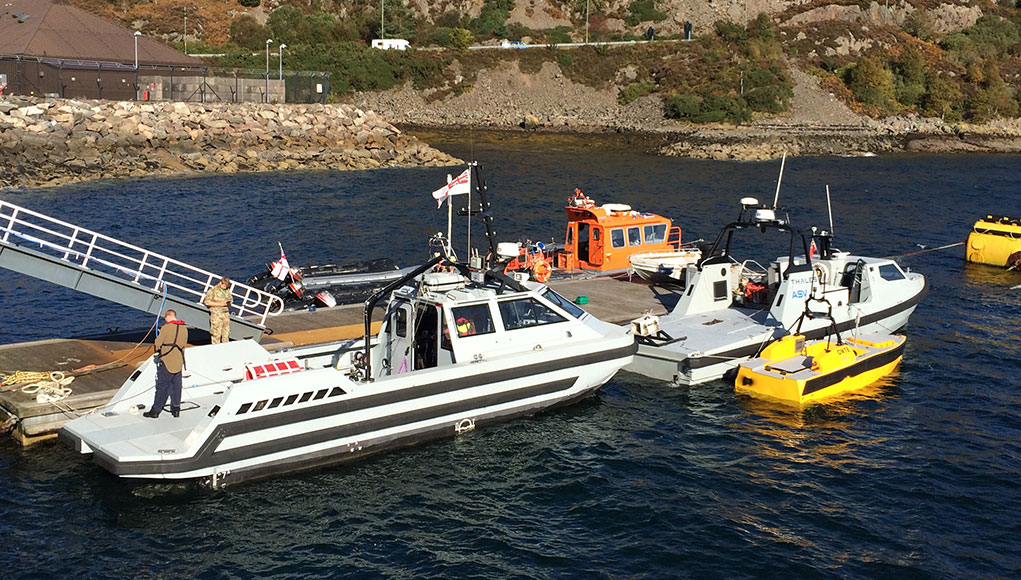
RN Maritime Autonomous Systems Trials Team pushed boundary integrating ten different unmanned vehicles collaborating simultaneously on mine-countermeasures (MCM) missions in the air, at sea and underwater. Photo: Royal Navy. Some of the autonomous surface vessels (ASV) that took part in Unmanned Warrior 2016 docking at the British Underwater Test & Evaluation Centre (BUTEC).
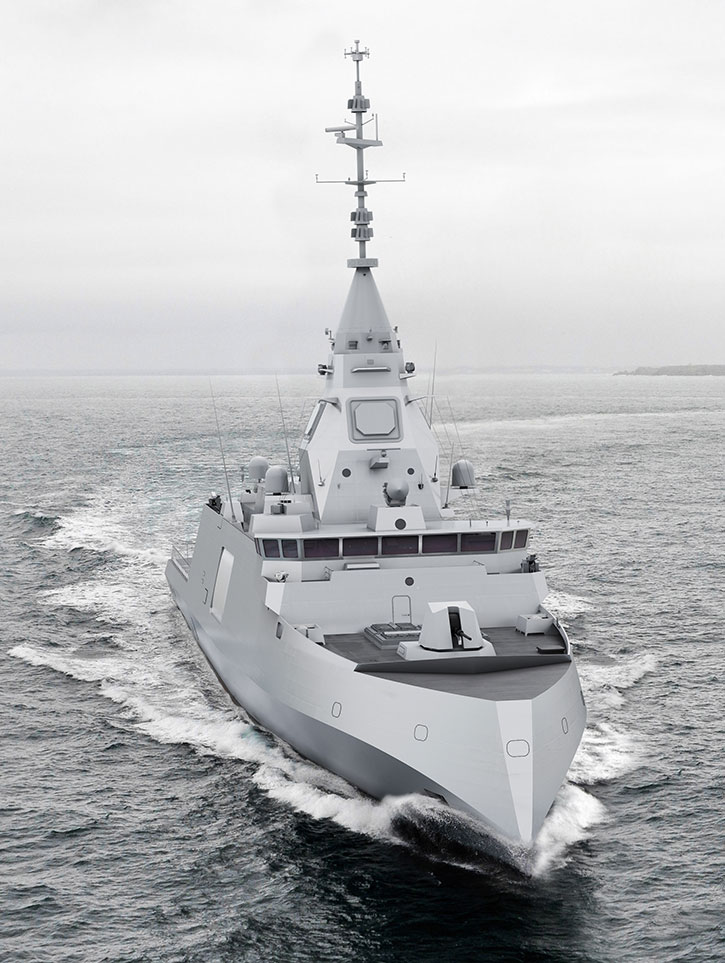
The French shipbuilder DCNS presented today the BELH@RRA frigate design – a new heavily-armed frigate made for the international market. The new design was unveiled today at the Euronaval Exhibition in Paris-Le Bourget. The new BELH@RRA class renews the heavily-armed 4,000-tonne frigate segment. It follows the company’s La Fayette-class frigates, of which over twenty units were built and are operational with four navies around the world.
The BELH@RRA design is positioned between the 6,000-tonne FREMM multi-mission frigate segment and that of the 2,500- to 3,000-tonne GOWIND corvettes. This size class is suitable for navies looking for a compact frigate, capable of ensuring long-range ocean-going missions, operating alone or embedded in a naval force on the high seas, or as part of coastal surveillance missions in a dense and hostile environment. Similar vessels currently available from other shipbuilders are the German Meko 200 class (3,600 ton) and Russian Project 22350 Gorshkov class (4,500 ton) and Chinese Type 054 light frigates (3,000-4,000 ton).
DCNS already offers a French-Navy version of the new class of frigate, known as the Frigate – Intermediate-Size frigate (Frégates de Taille Intermédiaire – FTI), a development program conducted by the French Procurement Agency (DGA) on behalf of the French Navy. For the French-Navy version, the BELH@RRA frigate is designed to meet specific requirements to be a front-line frigate for anti-submarine warfare of a displacement of 4,000 tons. To support this mission Thales will provide the compact version of its CAPTAS-4 towed-array sonar currently in service on the FREMM multi-mission frigates. According to Thales, the new, compact version provides frigate class vessels the ASW detection capabilities of much larger destroyers, as it delivers the same very long-range detection performance with 20% lower weight and a footprint almost 50% smaller.
The frigate also will be equipped with Sea Fire radar also made by Thales, and the Aster 30 air defense missile system from MBDA, to offer area self-defense. The Sea Fire is designed to perform in the complex conditions of the littoral or in heavily jammed environments to counter conventional, asymmetric or emerging air and surface threats. The new radar is suitable for all types of corvettes and frigates. The vessel will also support commando operations. Other systems from Thales include the Aquilon integrated naval communication system and the Sentinel – an ESM system for electronic warfare.
According to DCNS, BELH@RRA offers a modular design, robustness, and simplified use, along with a high degree of ‘operational intelligence.’ The company has based its design on significant operational experience gathered in various naval theaters, with the FREMM multi-mission frigate, DCNS’s latest frigate. It also relies on the architecture and versatility of DCNS’s SETIS combat management system, proven on the FREMM frigates and GOWIND corvettes. The ship’s design and command systems address mission compatibility with platform modularity, to increase the vessel payload or autonomy. Among the tasks to be performed by BELH@RRA are a submarine, and anti-air warfare, along with surface attack capabilities. Additionally, new capabilities are responding to new threats such as asymmetric warfare or cyber-defense.
Resolutely oriented towards future operators in command of vessels beyond 2020, the BELH@RRA frigate benefits from digital technologies. Among the ‘digital advantages’ offered by the new frigate is a greater performance for data processing and threat detection while at the same time allowing the crew to concentrate on tasks with the most added value. The digital architecture also enables the vessel to be upgraded throughout its life-cycle, supporting the incremental modernization of equipment, infrastructure, and system, to adapt to evolving operational conditions, future threats and the arrival of new capabilities.
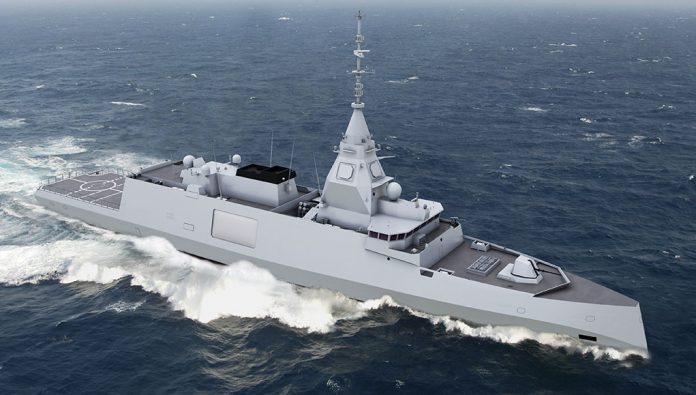
The French ship designer DCNS unveiled at Euronaval the Belh@rra, the new front-line digital frigate dedicated to the international market. DCNS also develops a French version of the vessel, designed as the future medium size frigate (FTI). The vessel renews the heavily-armed 4,000-tonne frigate segment, where it will follow DCNS’ La Fayette-class frigates, of which +20 units were built and operational with four navies around the world. Photo: DCNS
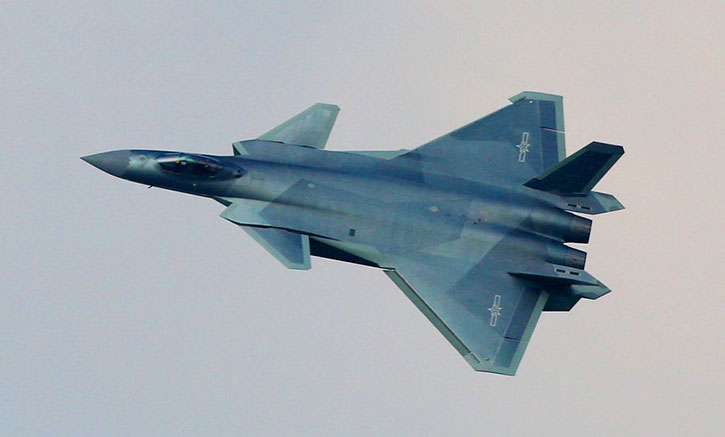
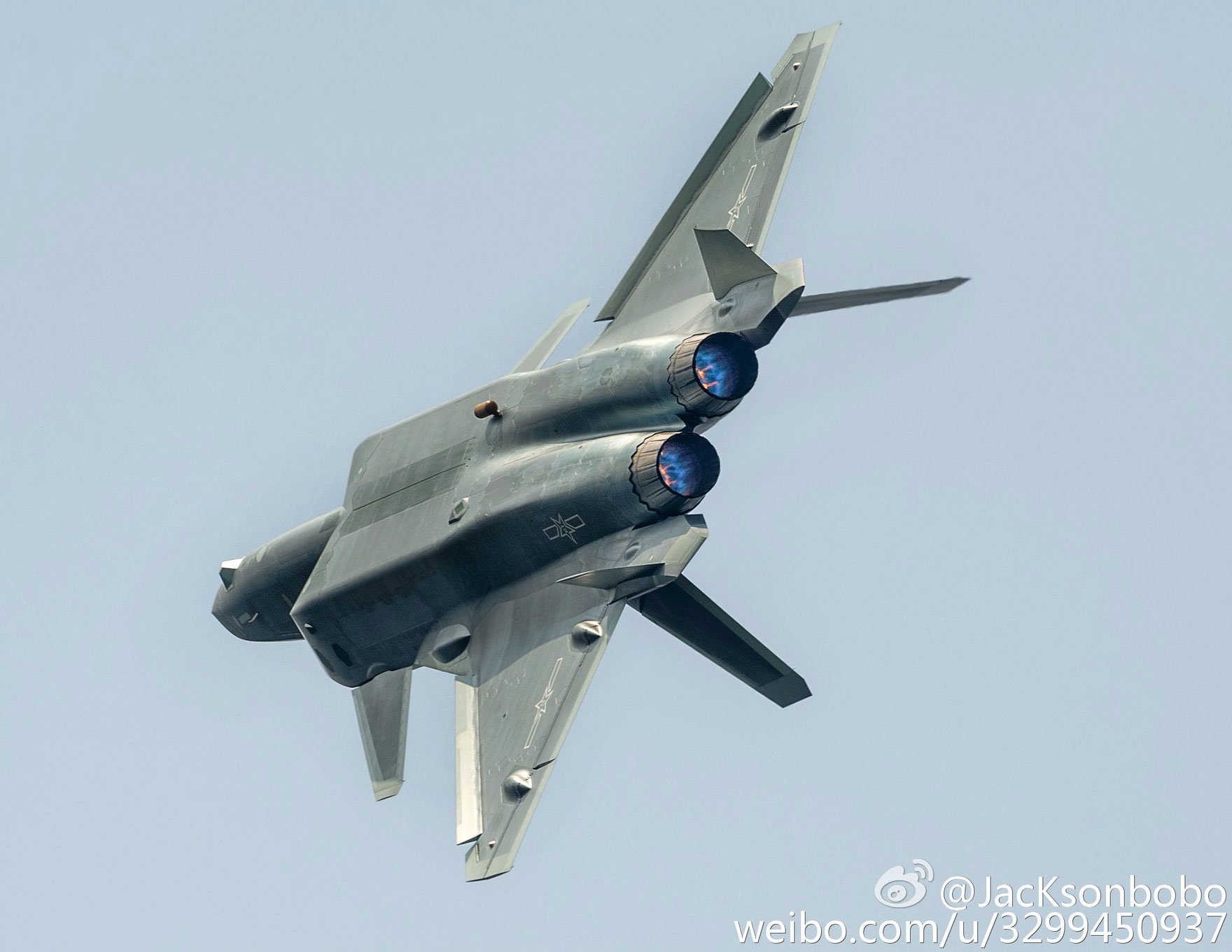
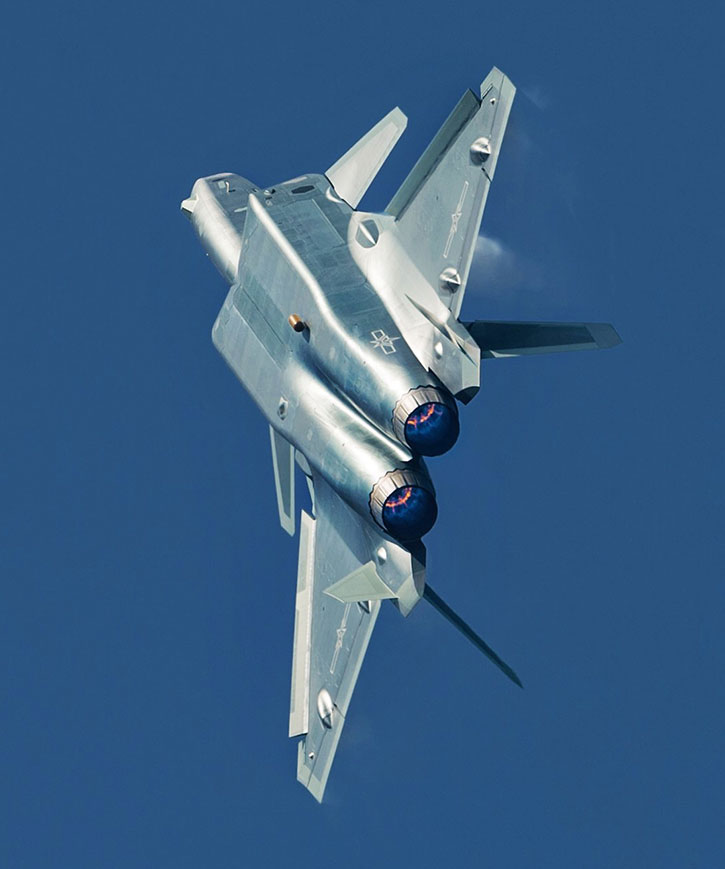
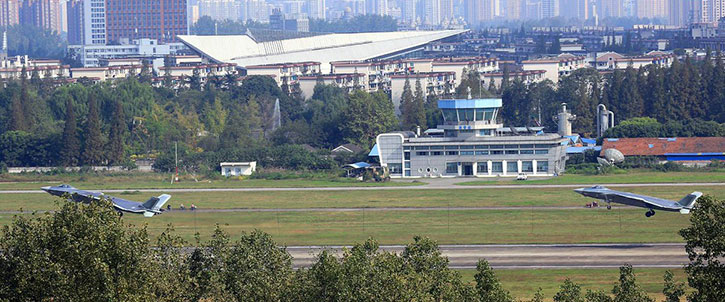
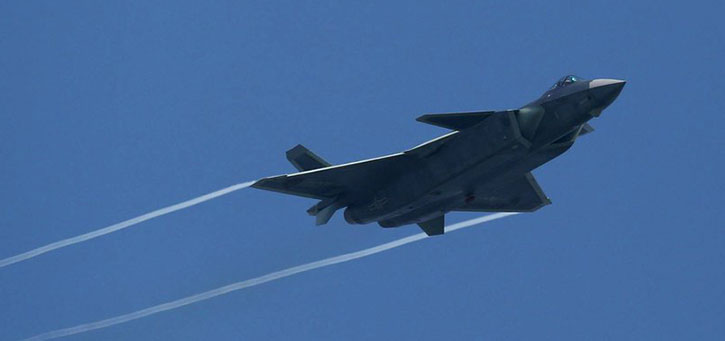
Two J-20 stealth fighters seen yesterday in Chengdu, China show a new camouflage paint that is likely to be used with the Low Rate Initial Production (LRIP) batch currently being delivered from the assembly plant in Chengdu. These photos aired today on Chinese websites and twitter. (images courtesy: @jacKsonbobo, @xinfengcao, @RupprechtDeino)
The new J-20 is expected to be on display at the China Airshow at Zhuhai this week. (images courtesy @jacKsonbobo, @xinfengcao, @RupprechtDeino)
Lockheed Martin Skunk Works® and XTEND have achieved a major milestone in JADC2 by integrating the XOS operating system with the MDCX™ autonomy platform. This technical breakthrough enables a single operator to simultaneously command multiple drone classes, eliminating the friction of mission handoffs. From "marsupial" drone deployments to operating in GPS-denied environments, explore how this collaboration is abbreviating the data-to-decision timeline and redefining autonomous mission execution.
As traditional defense primes face mounting competition from agile “neoprimes” such as Anduril, Palantir and Helsing, the balance of innovation is shifting toward software-defined warfare and scalable, dual-use technologies, while global industry consolidation—marked by Boeing’s integration of Spirit AeroSystems and other strategic mergers—signals an intensified race to secure control over the defense technology value chain. Our Defense-Tech weekly report highlights these trends.
In early October 2025, a coordinated wave of unmanned aerial system (UAS) incursions—widely attributed to Russia—targeted critical infrastructure across at least ten European nations. The unprecedented campaign exposed the fragility of Europe’s air defenses...
Executive Summary
The past week (September 18-25, 2025) represents an inflection point where strategic defense concepts have transitioned from doctrine to tangible reality. An analysis of global events reveals four primary, interconnected trends shaping an...
At the 2025 Air, Space & Cyber Conference, U.S. Air Force and Space Force leaders unveiled major updates on next-generation fighters, bombers, unmanned systems, and space initiatives, highlighting both rapid innovation and critical readiness challenges as the services race to outpace global competitors. A short version is available here, with a more detailed version for subscribers.
The Taipei Aerospace & Defense Technology Exhibition (TADTE) 2025 crystallized around four dominant strategic themes that collectively illustrate Taiwan's comprehensive approach to defense modernization amid escalating regional tensions. Based on a detailed report by Pleronix (available upon request). Includes a Podcast discussion on TADTE 2025's highlighting Taiwan's four strategic themes beyond the post's coverage.
Israel’s Iron Beam 450 high-power laser system has completed final testing, marking a major leap in air defense. Developed by Rafael, it offers precise, cost-effective interception of rockets, UAVs, and mortars, and is set for IDF deployment by 2025.