Israel’s Rafael Advanced Defense Systems and the Indian Reliance Defence company have signed today at Defexpo 2016 a joint venture (JV) that will provide the local content of major defense programs Rafael is already involved with and intends to compete in. The JV, one of the biggest joint ventures between an Indian company with a foreign OEM, addresses current and future programs, with potential value of more than US$10 billion (Rs 65,000 Crore) over the next ten year.
Among the areas of activity for the new JV are air/air and surface/air missile systems, in which Rafael is among the world’s leaders. Rafael is already involved in several Indian air-defense programs, including Barak-1, Barak-8 and Spyder. The company is also offering the Indian Navy the new C-DOME, a navalized version of the Iron Dome system, for shipborne air defense.
Another area of activity for the JV will be large aerostats, for which Rafael provides a range of combat-proven solutions. Rafael has already provided large aerostat systems to the Indian Air Force, meeting it’s surveillance, reconnaissance, communication and intelligence needs. The JV is positioned to compete for follow-on sales of such systems, required to tighten air surveillance and wide area coverage along the northern territory.
Private sector company Reliance Defence Ltd. is a wholly owned subsidiary of Reliance Infrastructure Ltd. Rafael Advanced Defence Systems Ltd is an Israeli company owned by the Israeli government. Reliance will have 51% holding in the JV with Rafael holding the remaining 49%, per the current guidelines of Government of India.
The Joint Venture will be located at Dhirubhai Ambani Land Systems Park, Pithampur, Indore in the state of Madhya Pradesh and will generate more than 3,000 highly skilled jobs. The project will have an initial capital outlay of more than Rs 1,300 Crore, ($200 million) excluding the cost of technology.
The two companies, through the Joint Venture will offer the entire range of products in these fields to the Indian Armed Forces. Rafael is also willing to offer solutions through the Joint Venture even for the ongoing “Buy Global” programs where it is currently competing, in line with “Make in India” initiatives of the Indian Government.
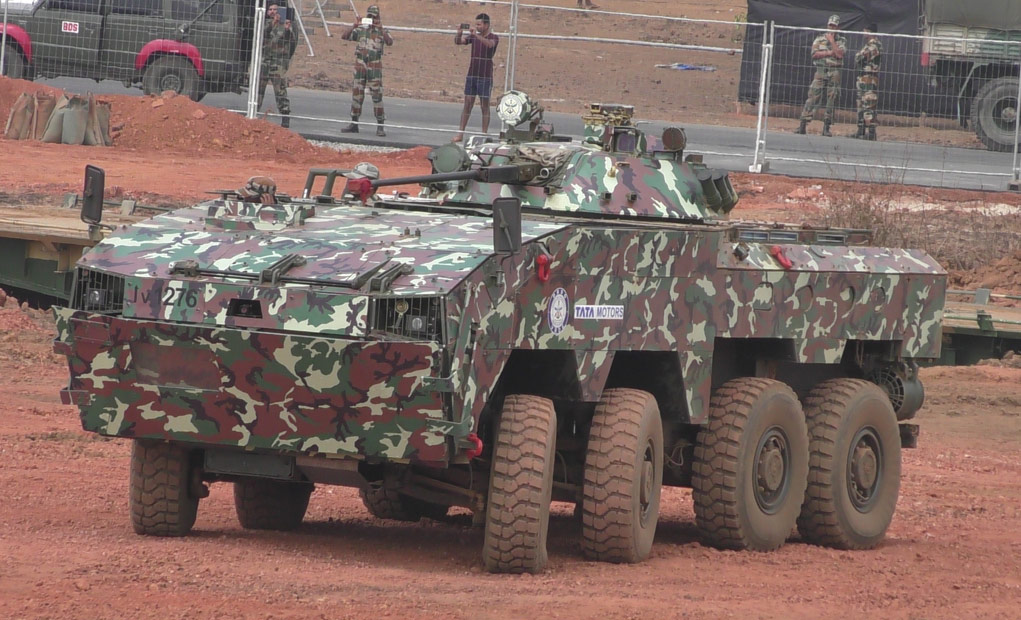
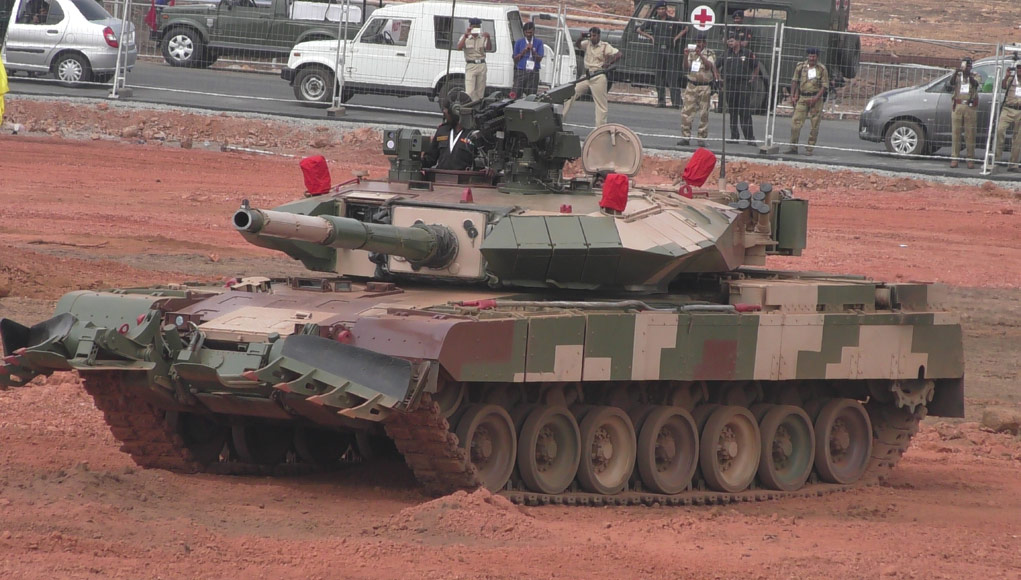
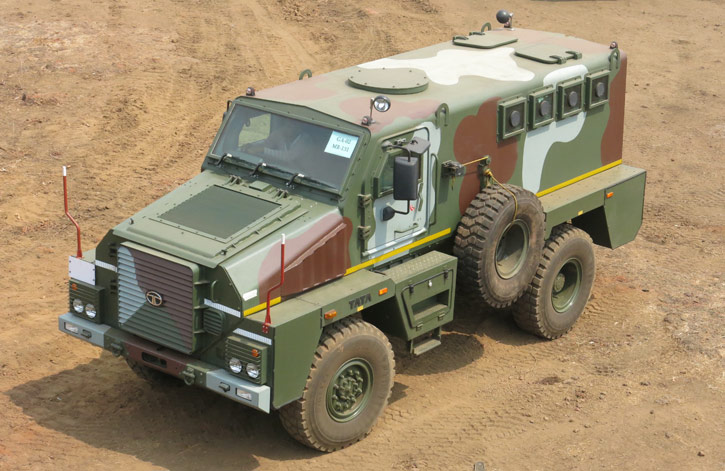
India’s Defense Research and Development Organization (DRDO) and Indian armored vehicle manufacturers displayed today for the first time a number of combat vehicles developed in India for the Indian armed forces. Among the new vehicles were Arjun Mk II, Kestrel Wheeled Armored Platform (WhAP) and 4×4 Armored Mine Protected Vehicle (MPV) developed by Tata.
WhAP, an 8×8 armored infantry carrier developed by Tata (based on Tata’s Kestrel design) was displayed at Defexpo 2016 by the DRDO. Note the two steerable axles at the front, improving the vehicle’s maneuverability in urban and rough terrain. Photo: Noam Eshel, Defense-Update
WhAP, an 8×8 armored infantry carrier developed by Tata (based on Tata’s Kestrel design) was displayed by the DRDO. The vehicle uses a modular design that adapts the platform to different configurations, including infantry carrier, various specialist and support vehicles. The variant on display included a manned turret mounting a 30mm cannon and 7,62 coaxial machine-gun. APC, CBRN, command post, ambulance, 105 light tank etc.
The 25-ton vehicle is powered by a 600 hp diesel engine, that accelerates the vehicle to a maximum speed of 100 km/h, (10 km/h in water). The vehicle has two propellers for amphibious operation. The vehicle uses hydropneumatic suspension and runflat tires to soften in rough terrain and retain mobility even after tires are damaged. Among the four axles two are steerable, improving the vehicle’s maneuverability in urban and rough terrain. Two years ago, at Defexpo 2014 the Kestrel was displayed with two remotely controlled weapon stations, mounting a 40mm cannon and 7.62 mm gun. For Defexpo 2016 the vehicle was fitted with a 30mm turret form the BMP-2.
Arjun Mk II is an improved version of the indigenous Arjun tank developed by the DRDO. The tank was presented on the static display at Defexpo 2014 and was shown in action, in public today at Defexpo 2016 in Goa for the first time. Photo: Noam Eshel, Defense-Update
Arjun Mk II is an improved version of the indigenous Arjun tank developed by the DRDO. The tank was presented on the static display at Defexpo 2014 and was shown in action, in public today at Defexpo 2016 in Goa for the first time. Arjun Mk II has a 120mm cannon that fires kinetic, high explosive rounds and LAHAT laser guided missiles.
The missile uses a tandem warhead, which is capable of defeating all types of modern armor, including add-on reactive armor. High penetration capability of the main warhead allows the missile to penetrate the armor of major armored vehicles at high impact angles. The Arjun Mk II can carry a total of 39 rounds in special blast-proof canisters. A 7.62 mm MAG machine gun is mounted coaxially to the main armament. Mounted on the top of the turret is a Remote Controlled Weapon Station (RCWS) armed with a 12.7mm NSVT machine gun and associated optronics. An independent sight for the commander is located at the turret, left of the commander’s cupola. The protection level has also been improved over Arjun Mk 1, adding reactive armor modules to the turret. The tank also has laser threat warning sensors mounted on four quadrants, along with eight launchers on each side, delivering smoke canisters deploying instantaneous smoke screen, to mask the tank from incoming missiles.
The MPV was developed by Tata Motors Defense unit, under the company’s strategic expansion of its defense solutions, from logistical and utility vehicles to the design shift to broader mobility solutions for the military, providing all types of platforms, from 4×4 to 12×12, including various all-terrain weapon carriers and armored vehicles and combat vehicles. Tata is intended to participate in the Future Infantry Carrier Vehicle (FICV).
The MPV has been developed at the company in the past 5 years. A 20 ton vehicle, the MPV can transport 2 crew members and 12 troops, at high level of safety from mines and other forms of attack, at a maximum speed of 80 km/h. The vehicle is protected against explosives, mines and small arms attack up to STANAG Level 3. All passengers are provided with blast mitigating seats and 4 point harness. All tires are fitted with Run-Flat systems to retain mobility under attack.
The MPV was developed by Tata Motors Defense unit, under the company’s strategic expansion of its defense solutions, from logistical and utility vehicles to the design shift to broader mobility solutions for the military, providing all types of platforms. Photo: Noam Eshel, Defense-Update.
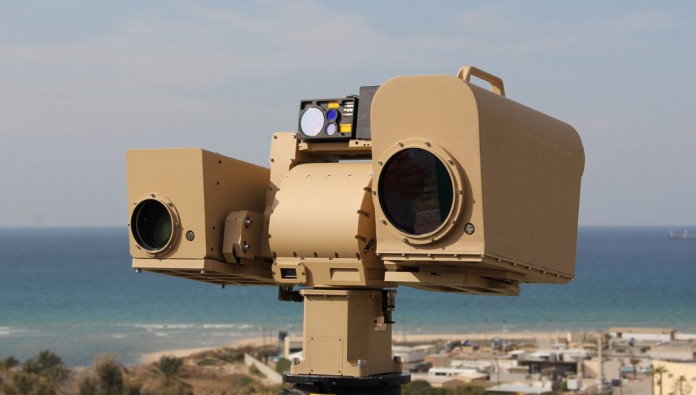
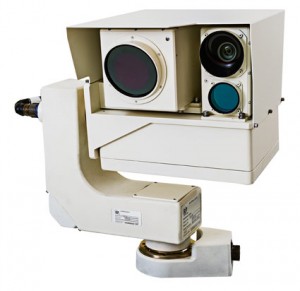
Modular Long-Range EO/IR Day/Night Observation System from Controp. Photo: Controp
A number of Israeli companies are displaying advanced technologies developed for military and security applications, that are made available for export to India.
Long Range Observation Systems:
Controp announced the sale of its Long Range Observation Systems (LOROS) equipment to an Indian customer, to be used as part of a security solution for critical sites in India. “We are confident that this purchase will encourage the additional procurement of such systems for use in important defense and HLS applications in India” said Johnny Carni, Controp’s VP Marketing.
The system, known as ‘MEOS’ (for ‘Modular Long-Range EO/IR Day/Night Observation System’) was procured by a large Public Sector Undertaking (PSU) for Indian Homeland Security (HLS) applications. The system provides wide area, passive, real time 24/7 EO/IR observation, with panoramic scanning and automatic target detection capabilities. The system combines a medium or long-range thermal imaging camera with continuous zoom lens and a medium range or a long-range day camera as well as an optional Laser Range Finder (LRF).
RP Optical multi-sensor observation system. Photo: RP Opticals
Multi-Sensor Observation System
Another EO solution is offered to India by Israel’s RP Optical Labs, displaying at Defexpo multi-sensor observation systems based on thermal imagers. Such systems are used for border and coastal surveillance. Each system consists of an Long-Wave InfraRed (LWIR) or Medium-Wave IR (MWIR), cooled thermal imagers – providing multiple zoom lens options, also included are day camera fitted a variety of sensor and lens types selected by the customer, and an accurate eye-safe laser range finder (LRF) unit, all mounted on a Pan/Tilt unit with various performance/ stabilization levels.
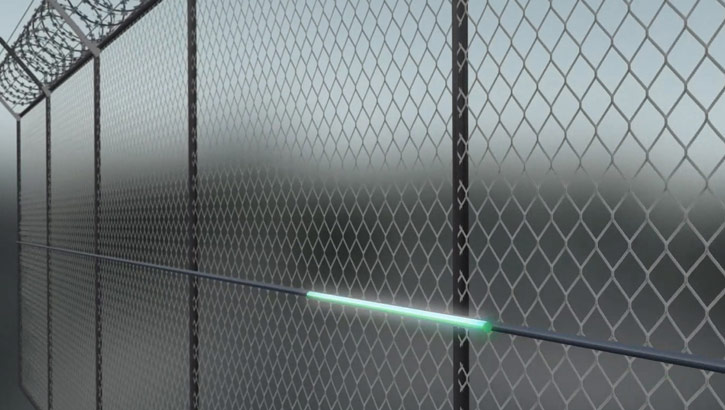
Magal’s FiberPatrol-PR sensor installed on a fence. Image: Magal
Fiber-Optic Linear Sensors: Magal Security Systems is featuring here the latest fiber-optic sensors variants of Magal’s FiberPatrol-PR family. These sensors are protecting fence, pipelines, and datalines. The solution protects linear infrastructures of pipes over long distances, from a single control point. With the sensor cable buried alongside the protected asset (pipes) a FiberPatrol-PR installation can protect over 70 kilometers against Third Party Interference (TPI) for buried pipelines. When used in perimeter applications, the coverage is 16 kilometers. The system detects the breaking point within an accuracy of 10 meters.
“The issue of Third Party Interference is significant, especially in large countries like India, which has thousands of kilometers of pipes, usually unmonitored.” Explains Hagai katz, Magal’s SVP Marketing and Business Development, “This situation causes millions of dollars in losses every year. Our solution addresses this issue, providing early warning regarding the precise location of events, helping responders to prevent costly damage. The solution is successfully installed in a number of locations around the world and is highly valued.”
The solution delivers a high probability of detection and a low Nuisance Alarm Rate (NAR). It accurately locates intrusions – including multiple simultaneous intrusions – and operates even in the presence of non-localized environmental noise that would overwhelm the location capability of other long-range fiber-optic sensors. Providing software-configurable detection zones, FiberPatrol-PR is invisible and undetectable as a buried sensor in pipeline applications.
IR Sensor Cores:
Semiconductor Devices (SCD) that develops the cores of thermal imagers and EO sensors is paving ways to make it in India. The company is introducing three new products at Defexpo: Cardinal 640 SWIR sensor, Pelican-D LW/MW FLIR and Uncooled, Vox micro-sensor. These systems are providing the cores for thermal optronics for armored fighting vehicles, unmanned aerial systems, observation systems, and fire controls. “India is one of the most important markets for us.” Baruch Glick, SCD’s CEO said. “We are working to bring our manufacturing, support, and maintenance capabilities to India, in collaboration with local companies and the Indian establishment.”
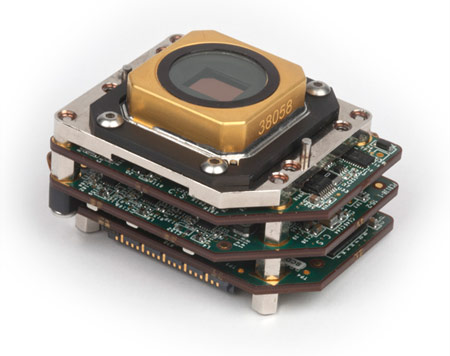
Cardinal SWIR sensor from SCD. Photo: SCD
Cardinal 640 is a SWIR (Short Wave Infra-Red) detector for long-range surveillance and observation systems, enabling visibility for dozens of kilometers in even the most difficult atmospheric conditions – including humidity, rain, dust, fog and smoke. Additional applications include an image intensifier replacement (for goggles, weapon sights, etc.) and enhanced night vision for driving sights. The Cardinal detector is fully operational and provides a unique, superbly clear picture. Cardinal includes a special function capability of Asynchronous Laser Pulse Detection (ALPD), which enables a “see spot” capability at a pixel level and in complex scenarios.
Israel’s Navy conducted a successful test firing of surface-surface missiles from a Saar 5 corvette. The test included the launch of missile RGM-84 Harpoon and a new weapon, assumed to be an indigenous surface-to-surface missile developed for the Israel Navy by Israel Aerospace Industries (IAI).
The blurred images shown on this video depict a missile longer and faster than the Harpoon, possibly driven by ram-air propulsion to achieve supersonic cruise and extended range. IAI has been known to continue the development of surface-to-surface missiles beyond Gabriel 3, the latest variant of the Gabriel family that entered service in the early 1970s.
One of the members of IAI’s advanced anti-ship missiles was described in open sources as part of IAI’s Skimmer maritime combat helicopter mission suit.
The existence of such missile was never confirmed but the fact that Israel hasn’t updated its Harpoon (RGM-84D) missiles into Block II configurations (RGM-84L), unlike most other Harpoon users which implemented this option.
Hints about a possible existence of a new Israeli surface attack weapon surfaced in the early 2000s, as IAI participated in an international tender to equip the new ‘Formidable’ frigates of the Singaporean Navy frigates. Eventually Singapore selected the Harpoon missile.
The Gabriel 5 was designed to be superior compared to most contemporary missiles, particularly when employed in littoral waters. It used an advanced active radar seeker backed by a sophisticated weapon control to optimize operational effectiveness in a target congested battlespace. The missile significantly improved target selectivity capability, especially in littoral waters, typically congested with marine traffic, and interference generating extensive and complex false target signals.
As an advanced attack missile Gabriel 5 could penetrate the target’s protection, both soft- and hard-kill defenses. It was designed with sophisticated electronic counter-countermeasures (ECCM) dealing with chaff, advanced decoys and active ECM.
Gabriel 5 and Barak 8 were described as part of a new offensive and defensive system suite under development at IAI’s Missiles and Space division.
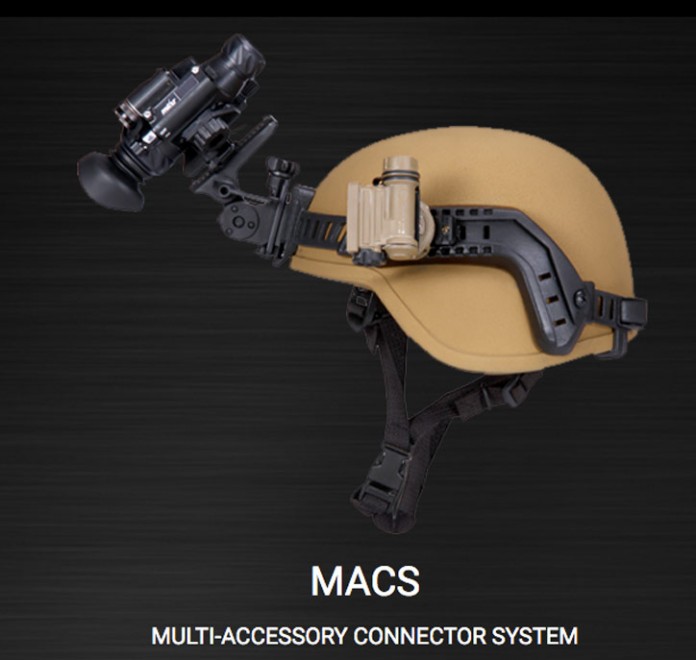
MUKUT helmet with the multiple accessory connector system (MACS) mounting system. Photo: MKU
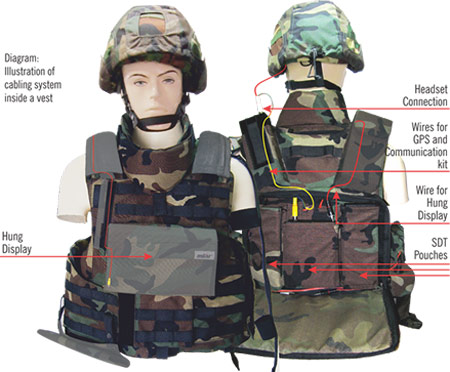
Indian military equipment manufacturer MKU is introducing at Defexpo the Network-centric Integrated Combat System for Soldiers (NICS) developed by MKU’s team in India and Germany. At the core of NICS is the Custom and Integrated Body Armour (CIBA), a body armor integrated with a health monitoring system that provides effective, lightweight protection and supports the combatants with connectivity, by integrating and connecting all wearable communications devices, including hand-held computers and displays, personal radios and battery packs.
MKU’s CIBA – Custom and Integrated Body Armor (Image: MKU)
CIBA is complemented by MUKUT helmet and multiple accessory connector system (MACS), interfacing with additional helmet mounted systems like NVDs (Night Vision Devices), microphone and headset, cameras and flashlights, and other battery powered systems.
The MUKUT helmet shell, developed by MKU, utilize the RHT Technology designed to increase both protection to soldiers in immediate (ballistic penetration) and long term (blunt trauma) effects. RHT reduces behind armor blunt trauma (BABT) of less than 10 mm, which is nearly 40 percent less in comparison to standard helmet.
“The effect of resultant trauma in helmets can be dangerous and can lead to serious types of head and skull injuries.” Said Neeraj Gupta, Managing Director; “It is a known and growing concern with armed forces worldwide. This revolutionary technology will contain the incidents of such injuries substantially.” he added.
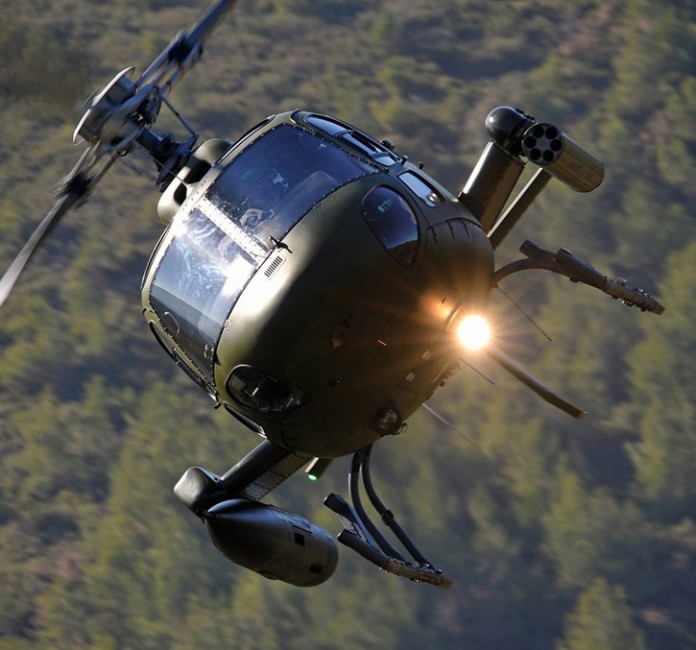
The Fennec H125 light, armed recce helicopter. Photo: Airbus Helicopters.
The Airbus Group has submitted the C295W light transport plane to the Indian AIr Force, as part of its teaming agreement with Tata Advanced Systems. The group also proposes different helicopters to be manufactured by Mahindra Defence. At Defexpo Airbus highlights three helicopter models competing to win different Indian programs – H125M Fennec, AS565MBe Panther and EC725 (marketed here as the H225M).
“We use Defexpo to present our plans to produce defense platforms in India and basically ‘build an industrial eco-system’ supporting it in collaboration with local partners. This would involve creation of thousands of local jobs, skilling people, technology absorption, etc.” said Pierre de Bausset, President & Managing Director, Airbus Group India.
The selection process for the C295W medium transport aircraft is ongoing. The aircraft is proven around the world as a tough, reliable and high-performance workhorse with outstanding lifecycle costs and excellent performance on short or unpaved runways. To date, 144 C295s have been delivered out of 165 on order and it is in service in 20 countries.
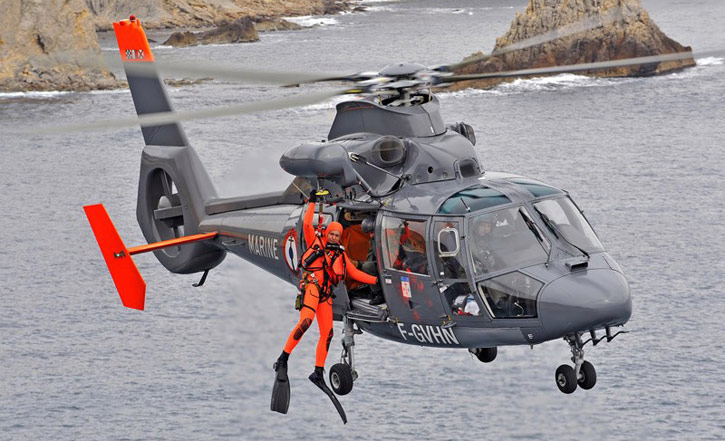
Panther AS565MBe Photo: Airbus HelicoptersAirbus is proposing Panther helicopter for the Indian Navy’s Naval Utility Helicopter (NUH) program calling for the deployment of around 100 all-weather capable helicopters on board ships and offshore, on maritime surveillance missions, search and rescue, casualty evacuation, vertical replenishment, offshore patrolling and counter-terrorism.
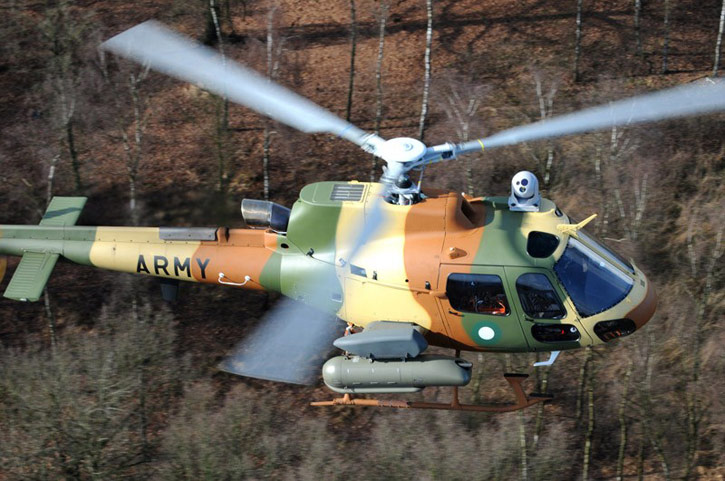
The H125M Fennec is foreseen for the Indian Army’s and Air Force’s Reconnaissance and Surveillance Helicopter (RSH) need of around 400 units. The H225M is under selection process for the Indian Coast Guard’s 14 shore-based helicopter tender. It will also answer the future requirement of the Indian Navy 120+ Naval Multi-Role helicopters under the (NMRH) program.
H-125 Fennec light, armed reconnaissance helicopter Photo: Airbus Helicopters
TATRA Force family models, 6x6, 8x8, 10x10 and 12x12 trucks. Photo: TATRA
TATRA is returning to India and is now introducing a range of new vehicles to address Indian military systems. The all-new TATRA FORCE is at the center of TATRA’s Defexpo 2016 display, highlighting the latest trend in 8×8 all-wheel-drive (AWD) trucks. This family will soon be expanded to replace all TATRA vehicle configurations from 4×4 to 12×12.
The Indian Army has more than 8,000 TATRA vehicles, making it one of the world’s largest operators of these vehicles. Between 2003 and 2012 almost 4,000 TATRA trucks were assembled in India, completed in different configuration to address different Indian military requirements. However, since 2012, following allegation of corruption charges against its previous Indian stakeholder, deliveries were stopped. The acquisition of TATRA Company in 2013, by Czech shareholders, enabled TATRA to return to India in 2015, with the establishment of distribution agreement with BEML, which will provide the completion services under agreement with the Indian Armed Forces.
Last year delivered 100 vehicles to India, mostly in the form of complete knocked down (CKD) sets; the company expects to deliver at least 250 vehicles in 2016, in different states of readiness for the final assembly. After-sales and support for the regional fleets will be provided by its TATRA India subsidiary.
The FORCE range of all-wheel drive trucks is built for customers outside Europe. They are characterized by a liquid-cooled engine from Deutz, Cummins or Caterpillar, mounted together with the Twin Disc automatic transmission integrated with torque distributor which is incorporated into the central load-carrying tube.
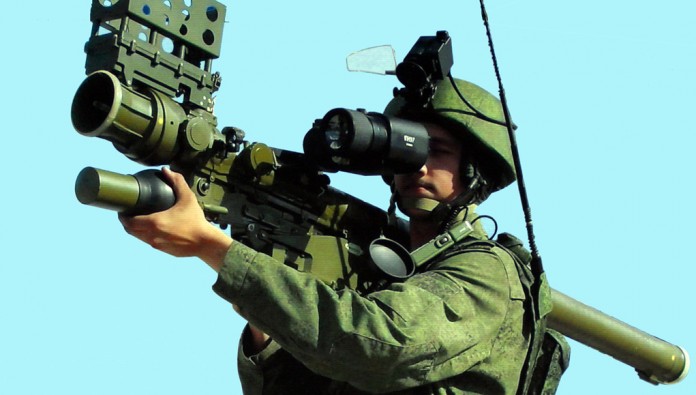
The Russian military began receiving the 9K333 Verba - a new man-portable air-defense systems that replaces the Igla 9K38 in army brigades and airborne divisions.
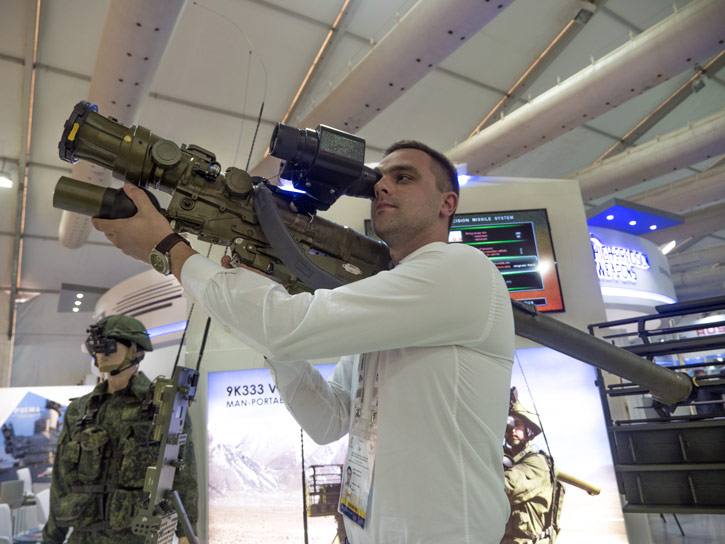
Pursuing the Indian requirement for a new very short range air defense weapon, the Russian arms exporter ‘Rosoboronexport’ debuts the latest Man Portable Air Defense System (MANPADS) 9K333 “Verba” at DEFEXPO-2016. The new weapon entered service with the Russian Army in 2014. It was first unveiled in public last year at Arms 2015 expo in Moscow. According to the Russian arms exporter, it is making its international debut this week.
“We are confident that the Verba will provoke interest of Indian militaries and our partners in South East Asia and other regions,” Sergei Goreslavsky, deputy director general of JSC Rosoboronexport said. Goreslavsky expects that, despite the introduction of the new missile, demand for its predecessor, Igla-S, will remain stable since it satisfies the requirements of armies in many countries. In November 2015 the system’s manufacturer KBM Scientific Production Concern completed the delivery of Verba equipment under the first contract awarded in 2013, including four brigade sets for the Army and four division sets for airborne troops.
The missile uses a new tri-band optical seeker, along with modern avionics and improved warhead activated by an adaptive contact/proximity fuze. The missile also uses a new solid rocket motor and heavier explosive charge, compared to its Igla-S predecessor. The missile can hit targets that move at speeds up to 500 m/s, at a distance of more than six kilometres, at altitude from ten to 4,500 meters.
The MANPADS boasts of enhanced capability of engaging small-size targets with low thermal signatures such as cruise missiles and unmanned aerial vehicles.
The Verba MANPADS can be also mounted on various land, maritime and airborne platforms. Joint employment of the 9M336 missiles of the Verba MANPADS, combat control set of equipment and launch modules makes it possible to build on their basis lightweight mobile close-in air defense missile systems, or to include these assets into existing air defence missile and artillery systems.
Verba is positioned to compete on the Indian Army requirement for Very Short Range Air Defence (VSHORAD) man-portable air defense (MANPAD) missile. The new missile looks like its predecessor, the Igla man-portable air-defense system (MANPAD) that is already used by Indian Army, but represents a major improvement in counter-countermeasures and engagement of small and illusive targets at low-level, such as cruise missiles, helicopters and drones.
The Verba missile demonstrated to defense-Update at Defexpo 2016. photo: Noam Eshel, Defense-Update
To succeed in their missions, military units must have a robust, multi-faceted picture of their operational environments, including the location, nature and activity of both threats and allied forces around them. Technology is making this kind of rich, real-time situational awareness increasingly available to airborne and other vehicle-assigned forces, along with a capacity to deploy precision armaments more safely, quickly and effectively. Dismounted infantry squads, however, have so far been unable to take full advantage of some of these highly effective capabilities because many of the technologies underlying them are too heavy and cumbersome for individual Soldiers and Marines to carry or too difficult to use under demanding field conditions.
To address this application lag, DARPA’s Squad X Core Technologies (SXCT) program aims to develop novel technologies that could be integrated into user-friendly systems that would extend squad awareness and engagement capabilities without imposing physical and cognitive burdens. The program, whose overarching goal is to ensure that Soldiers and Marines maintain uncontested tactical superiority over potential adversaries, recently awarded Phase 1 contracts to nine organizations.
“Our goal is to develop technologies that support a three-dimensional common operating picture leveraging input from integrated mobile sensors, as well as the ability to organically locate and identify friendly forces and threat locations in near real time,” said Maj. Christopher Orlowski, DARPA program manager. “The Phase 1 performers for SXCT have proposed a variety of technologies that, in the future, could provide unprecedented awareness, adaptability and flexibility to dismounted Soldiers and Marines and enable squad members to more intuitively understand and control their complex mission environments.”
DARPA has awarded Phase 1 contracts for SXCT to the following organizations:
Helios Remote Sensing Systems (Utica, N.Y.)
Kitware (Clifton Park, N.Y.)
Leidos (Huntsville, Ala., and San Diego, Calif.)
Lockheed Martin Corporation (Cherry Hill, N.J., and Grand Prairie, Tex.)
Raytheon Company (Tucson, Ariz.)
Scientific Systems Company, Inc. (Woburn, Mass.)
Six3 Systems, Inc. (Mclean, Va.)
SoarTech (Ann Arbor, Mich.)
SRI International (Menlo Park, Calif.)
SXCT is pursuing research in the following four technical areas:
Precision Engagement: Precisely engage threats out to 0.6 mile (1,000 meters), while maintaining compatibility with infantry weapon systems and without imposing weight or operational burdens that would negatively affect mission effectiveness. Capabilities of interest include distributed, non-line-of-sight targeting and guided munitions.
Non-Kinetic Engagement: Disrupt enemy command and control, communications and use of unmanned assets at a squad-relevant operational pace (walking with occasional bursts of speed). Capabilities of interest include disaggregated electronic surveillance and coordinated effects from distributed platforms.
Squad Sensing: Detect potential threats out to 0.6 mile (1,000 meters) at a squad-relevant operational pace. Capabilities of interest include multi-source data fusion and autonomous threat detection.
Squad Autonomy: Increase squad members’ real-time knowledge of their own and teammates’ locations to less than 20 feet (6 meters) in GPS-denied environments through collaboration with embedded unmanned air and ground systems. Capabilities of interest include robust collaboration between humans and unmanned systems.
“Through Squad X, we want to vastly improve dismounted squad effectiveness in all domains by integrating new and existing technologies into systems that squads can bring with them,” said Maj. Christopher Orlowski, DARPA program manager. “The squad is the formation with the greatest potential for impact and innovation, while having the lowest barrier to entry for experimentation and system development. The lessons we learn and the technology we create could not only transform dismounted squads’ capabilities, but also eventually help all warfighters more intuitively understand and control their complex mission environments.”
Squad X intends to combine off-the-shelf technologies and new capabilities under development through DARPA’s Squad X Core Technologies (SXCT) program, which was launched specifically to develop novel technologies that Squad X could integrate into user-friendly systems. SXCT shares Squad X’s overarching goal of ensuring that Soldiers and Marines maintain uncontested tactical superiority over potential adversaries by exploring capabilities in four areas: precision engagement, non-kinetic engagement, squad sensing and squad autonomy.
The U.S. Army, U.S. Navy and U.S. Marine Corps have expressed interest in future SXCT capabilities.
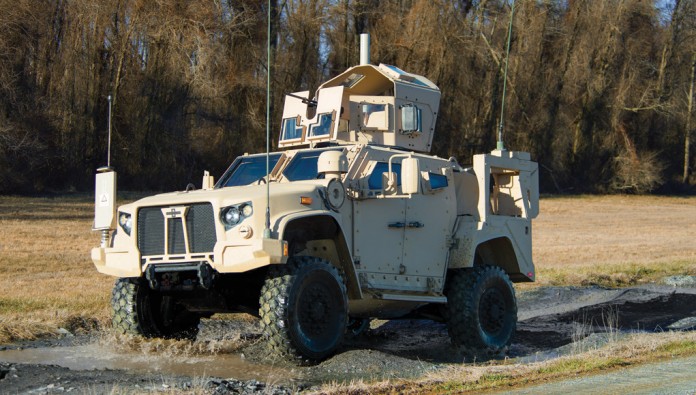
Oshkosh Defense has received the first production order for the 657 Joint Light Tactical Vehicle (JLTV) vehicles under the Low rate initial production (LRIP). Part of the JLTV LRIP/Full Rate Production(FRP) Base Award in August 2015 included delivery requirements for 201 JLTVs. Oshkosh Defense is scheduled to begin deliveries of these vehicles starting in October of this year.
The entire program includes 8 option years and in the new order the Army exercised one of these options. Oshkosh Defense is scheduled to begin deliveries of the 657 vehicles under the new order starting in approximately 10 months. The Full Rate Production (FRP) decision is scheduled for the first quarter of FY’19.
Faced with unique and persistent security challenges Israel has always nurtured smart defense and homeland security (HLS) solutions. The need created a large vertical market that ranges from mega-corporations to specialist subcontractors, OEMs and small startups addressing innovations of all types. Yet the evolution of smart ideas and startup ventures into solid solutions is tough, and only few of the ideas would eventually get through to become full fledged solutions that can meet the demand from local and international customers.
Israel’s Defense & HLS Startup Accelerator, recently launched by iHLS, is providing defense innovators the jumpstart they need to get their dream into reality. Itself a startup venture that brings together all the facilities, knowhow, services and connections needed to succeed, the accelerator has already won the support of major defense corporations and local authorities.
Tal Catran, one of of Israel’s accelerator pioneers and lieutenant colonel (res.) Avi Yariv, a veteran of the IDF C4I corps and a co-founder of iHLS are managing the program. Yariv has extensive background and experience in the field of security technology and international marketing. Catran is experienced in guiding and accompanying entrepreneurs and startups, and an international speaker on entrepreneurship and innovation.
A call for proposals to be released soon, will invite applicants to pitch new projects. Those that will be selected will join the program, due to start mid-year. Accepted teams will get workspace in a complex currently being prepared for the new venture. This complex provide an ecosystem that will include training and coaching by technological and professional mentors, exposure in professional and general media outlets and conferences, as well as networking and introduction to local and international companies, investors and delegations from across the globe that already expressed interest in the new venture.
Companies that already committed to the new initiative include Israel Aerospace Industries (IAI), and Elbit Systems’ ‘Incubit’ technology incubator, Verint and more. Defense-Update has joined as a consultant, in a supporting role. We congratulate i-HLS for their initiative and wish Israel’s Defense & HLS Accelerator the best success.
With more than 980 companies and 47 countries registering for the upcoming Defence Expo scheduled next week in Goa, the ninth ‘Defexpo India’ biennial exhibition for Land, Naval and Internal Homeland Security is showing significant growth.
India is among a handful of countries in the world with indigenous capabilities in the defence fields such as multi-level strategic deterrence, ballistic missile defence, nuclear powered submarines, main battle tank, stealth destroyers, aircraft carriers and 4th generation fighter aircraft. With the changes in government policies on defence acquisition and Make in India campaign, considerable impetus is being given to indigenisation in the defence sector.
According to the Ministry, till date 980 companies and 47 countries have registered for participating in the Expo. India will be the largest exhibiting country with 540 exhibitors. The largest international group of exhibitors will come from the USA (94), the Russian Federation (71), UK (46), Germany (39), Israel and France (each is represented by 38 exhibitors). Impressive growth in exhibitors is noted from South Korea (18) and Norway and Italy (16 each) signifying the marketing thrusts these countries are aiming at India. In contrast, the low presence of Spanish companies (only one is registered to exhibit). In total, the number of foreign companies increased 33 percent over defexpo 2014, a total of 490, up from 368 in 2014. The number of Indian doubled from 256 to 510.
Around 950 delegations against 511 in 2014 are expected to visit the exhibition this year providing great synergy in business to business (B2B) activities during the short span of 4 days. The exhibition will thus provide an excellent platform to enhance growth in the sector in the coming years. 204 official delegations from 44 countries and around 750 non official business delegations are attending the show.
The net area sold during this edition is 40725 square meters against 27,515 Square Meters in 2014. The gross area of exhibition has increased over three folds to 150,000 square meters against 45,000 Square Meters in 2014.Secretary (Defence Production) Ministry of Defence, AK Gupta said the success of Defexpo 2016 would not be gauged by the contracts signed, but by how effectively it would provide a business-to-business forum for Indian and foreign companies to tie up partnerships to benefit from the “Make in India” policy.
Underlining the new commitment to “Make in India”, Gupta stated that 90 per cent of the procurement approvals by the National Democratic Alliance government had been accorded under the “Buy Indian” and “Buy & Make (Indian)” procurement categories. He said DPP-2016’s new category of “Indian Designed, Developed and Manufactured” equipment would further add to indigenous production. “My suggestion is that now, the foreign OEMs will have to look towards partners in Indian companies because we will be issuing request for proposals (RFP) to the domestic companies under the new DPP increasingly.” Gupta said, adding that “if OEMs have to supply to the Indian forces, they will have to enter into collaboration with the Indian companies.”
Unlike last event in 2014, there is no bar on blacklisted companies from taking part in the expo. “Debarment is from the point of view of purchase by the Ministry of Defence. They can showcase their products to other countries and enter into collaboration,” Gupta said.
In February 2014, when the DefExpo was held in Delhi, the Defence Ministry had decided to keep 27 Indian and foreign firms, including those facing the CBI inquiries, out of the biennial military exhibition. Director of Defence Exhibition Organisation, Wing Commander MD Singh, confirmed one such company Finmeccanica is participating in the event. Other blacklisted companies such as Rheinmetall Air Defence, Singapore Technology Kinetic or IMI are not be participating.
In 2014, the Defence Ministry had kept AgustaWestland’s parent company Finmeccanica, which was under the scanner over the VVIP chopper scam, out of the show along with its other group companies including Selex, Alenia Aermacchi, Oto Melara and WASS. Finmeccanica was later allowed to participate in Aero India show last year.
For three decades Israel and India are maintaining close defense relations, the dialog is conducted at low key, but is ever growing, spanning all military services, government and local authorities and security services. Israeli defense systems operated in India include satellites in space, air-defense, avionics and aerial weapons, radars and other surveillance systems, special mission aircraft, unmanned vehicles, naval systems and coastal defense, electronic warfare, communications, equipment for special forces and more.
Israel established it’s position in the Indian defense market in the late 1990s, when India suffered from the international embargo that followed the Nuclear test in Pokhran in 1998. At that time, Israel and India did not establish formal relations, but under the initiative lead by former IMOD Director Generals Maj. General (Ret.) David Ivri, and his successors Ilan Biran and Amos Yaron, the expedited support for the Indian military during the Kargil War in 1999, created an unprecedented impact and convinced the Indian side that Israel is a true friend and dependable ally.
Israel established its position in the Indian market in a time of change, as India’s traditional ally – Russia, pressed with economic and technical issues, was unable to provide adequate military hardware to sustain the Indian needs, while US and European suppliers removed themselves from the market under the impact of international sanctions that also limited Indian access to advanced technology.
At the time acquisitions were typically based on Government-to-Government (G2G) agreements or other sole-source contracts. These processes seem to have taken less time to close, as the cost and general terms were negotiated at very high level, but the fine details may have taken years to fulfill.
Israel was quick to respond and developed close relations with the users and local partners, offering advanced defense systems and technologies as subsystems and know-how, to assist indigenous programs.
Since those days India have grown to become the world’s largest importer and producer of military hardware of programs. As the Indian market gradually matures with locally developed systems, improving Russian supply chain and introduction of American and European hardware, the Israeli companies are facing growing competition in India.
Transforming its traditional, unsophisticated and corrupt procurement system, India turned to a slow, ultra complex bureaucratic system that implemented lengthy international tenders with complex and inflexible offset system governed by the country’s Defense Procurement Policy (DPP) guidelines. This system limited the flexibility of foreign suppliers to establish footprint for local activities. The change of government in 2014 marked a new milestone in policy, aligning to Prime Minister Narendra Modi’s ‘Make in India’ policy.
The new MAKE policy, to be fully implemented around 2018, is bound to impact foreign companies as it drives more business, mainly to the local private sector. The Israelis are already preparing their stand in India. In recent months several Indian-Israeli Joint Ventures (JV) were established, others went through change in ownership according to the new rule. On the other side, Indian suppliers are scouting for Israeli partners, to establish new business models in view of the new regulation. However, regardless of the slogans released about Make-in-India, the detailed policy is yet unclear, lacking specific details to enable such business ventures to grow and prosper.
As the new policy permits such JVs to increase foreign ownership to 49%, the interests of foreign partners are assured, particularly when it comes to technology transfer and re-export to foreign markets.
This trend opens promising opportunities to technology driven companies like Elbit Systems, which has already invested in a number of JVs in India, with HAL, BEL and Bharat Forge, to name only a few. Elbit Systems’ position in the JV with Bharat Forge was recently increased to 49%. IAI already has several partnerships in India, the latest was established with TATA in 2014. In recent years Rafael has also established several JVs with public and private sector companies, supporting its missiles and armored vehicles offerings. Company executives expect this trend to continue, with 4-5 JVs in place by the turn of the decade.
Private companies in India now entering the defense market will undoubtedly leave their mark as well. For them, cooperation with foreign majors is considered a shortcut and cost saving market entry strategy, enabling them to bid on major programs without the having to invest in expensive infrastructure, research and development and workforce training. Through JVs they can provide all these trust their JV partners to deliver the knowhow.
But these JVs require significant investments that often come from the foreign partner, facing the long and complex procurement processes. For example, following its’s selection to provide the Indian Air Forces’ Future targeting Pod Rafael invested in the establishment of an assembly and integration line for the Litening targeting pods. The modern high-tech facility has been completed long ago but is idle for the past 12 months, as the formal order hasn’t been made so far. In fact, as of March 2016, there are outstanding Indian orders to Israeli suppliers worth US$3-5 billions still in the pipeline; some are idle for 2-3 years.
Senior Israeli officials complain that, unlike many foreign countries that rely on political leverages to promote their business, Israel’s defense establishment is not as helpful as it was in the early days, and is slow to respond to the changing reality.
Despite these delays, Israel is in good company in India. When Modi’s government came into power the government Defence Acquisition Council (DAC) has 395 procurement programs awaiting approval. Today, 314 cases are still open, only 86 are in the final stage of approval.
Israel is not alone; in fact, many major programs are awaiting approvals – the acquisition of 36 Rafale fighters in France, two IL-78 Airborne Early Warning aircraft from Israel, C-17s and P8s in the USA and helicopters in Russia are all sealed deals awaiting the final nod from the DAC.
As the Indian market shifts to MAKE, the majority of opportunities will be reserved to local companies, through their JVs with foreign ones. This trend means that a proportional share of research and development could also shift from government owned corporations and labs to the private sector. From slow and inconsistent development of indigenous technologies, some R&D is likely to shift to technology transfer and affordable, local development and manufacturing, facilitated through infrastructure modernization.
To make this change private sector enterprises are encouraged to move activities and investments to the defense sector and many show up in Israel, probing cooperation and business opportunities with Israel’s defense industry majors. Others directly invest in Israeli companies, in the fields of cyber, unmanned systems and electronics, to leverage on potential opportunities as they show up in the future.
“We see our activities here as a Marathon – long-term investments in a key growing market, positioned against the shrinking global defense market” a senior Israeli executive told Defense-Update.
SIBAT – the International Defense Cooperation Directorate at Israel’s Ministry of Defense – will present a record number of Israeli companies in the Israel National Pavilion at the upcoming Defexpo India exhibition, reflecting the strengthening technological cooperation between the two countries.
Twenty-eight Israeli companies will present a wide range of advanced technologies – many of them operational – including sophisticated sensors and systems protecting borders and sensitive facilities, robotic and automotive logistics, electro-optics for artillery and infantry, airborne satellite communications, fire control solutions, tactical medical equipment, and more.
According to SIBAT Director Brig. Gen. (Ret.) Mishel Ben Baruch, “Israel is working with India to enhance cooperation in various technological areas. India is a country with tremendous capabilities. Israel’s large presence at Defexpo reflects our desire to strengthen ties with Indian companies and increase local production of military technologies. Many of the Israeli companies at the exhibit are already working closely with Indian companies, creating local job growth through domestic production. We are confident that this relationship will result in the advancement of large projects for the Indian defense forces.”
He continued, “In the area of defense, Israel and India face similar threats, and the technological cooperation between the two countries will advance them both in their attempts to counter these threats, as well as contributing to their economic independence. At Defexpo 2016, the Israel National Pavilion will present a wide variety of proven technologies targeting the defense market. SIBAT provides official governmental support and backing to collaboration between Israeli and Indian companies.”
Lockheed Martin Skunk Works® and XTEND have achieved a major milestone in JADC2 by integrating the XOS operating system with the MDCX™ autonomy platform. This technical breakthrough enables a single operator to simultaneously command multiple drone classes, eliminating the friction of mission handoffs. From "marsupial" drone deployments to operating in GPS-denied environments, explore how this collaboration is abbreviating the data-to-decision timeline and redefining autonomous mission execution.
As traditional defense primes face mounting competition from agile “neoprimes” such as Anduril, Palantir and Helsing, the balance of innovation is shifting toward software-defined warfare and scalable, dual-use technologies, while global industry consolidation—marked by Boeing’s integration of Spirit AeroSystems and other strategic mergers—signals an intensified race to secure control over the defense technology value chain. Our Defense-Tech weekly report highlights these trends.
In early October 2025, a coordinated wave of unmanned aerial system (UAS) incursions—widely attributed to Russia—targeted critical infrastructure across at least ten European nations. The unprecedented campaign exposed the fragility of Europe’s air defenses...
Executive Summary
The past week (September 18-25, 2025) represents an inflection point where strategic defense concepts have transitioned from doctrine to tangible reality. An analysis of global events reveals four primary, interconnected trends shaping an...
At the 2025 Air, Space & Cyber Conference, U.S. Air Force and Space Force leaders unveiled major updates on next-generation fighters, bombers, unmanned systems, and space initiatives, highlighting both rapid innovation and critical readiness challenges as the services race to outpace global competitors. A short version is available here, with a more detailed version for subscribers.
The Taipei Aerospace & Defense Technology Exhibition (TADTE) 2025 crystallized around four dominant strategic themes that collectively illustrate Taiwan's comprehensive approach to defense modernization amid escalating regional tensions. Based on a detailed report by Pleronix (available upon request). Includes a Podcast discussion on TADTE 2025's highlighting Taiwan's four strategic themes beyond the post's coverage.
Israel’s Iron Beam 450 high-power laser system has completed final testing, marking a major leap in air defense. Developed by Rafael, it offers precise, cost-effective interception of rockets, UAVs, and mortars, and is set for IDF deployment by 2025.