Elbit Systems Ltd. announced today that it has signed an agreement to acquire NICE Systems Ltd.’s Cyber and Intelligence division for a total amount of up to $157.9 million. The deal closing is expected to take place in the third quarter of 2015. NICE’s Cyber and Intelligence division offers solutions which provide law enforcement agencies and intelligence organizations with tools for creating communication intelligence. The division’s yearly revenue in 2014 was about US$80 million, representing nearly eight percent of Nice’s annual revenues. “As we continue to execute our long-term strategic plan, we have arrived at a juncture where we believe it is in our best interest to divest Intelligence in order to focus on the company’s more synergetic, core businesses.” Barak Eilam, CEO of NICE said, adding that this divestiture will allow NICE to place greater focus on the execution of its long-term strategic plan and business model.
“The acquisition of NICE’s division is a significant milestone in our strategy to bring Elbit Systems cyber capabilities to the level of global leaders.” Bezhalel (Butzi) Machlis, President and CEO of Elbit Systems, said, “NICE is a well- known world leader in the cyber intelligence industry, and its business activities and capabilities are complementary to ours.
The Cyber and Intelligence division will be acquired by CYBERBIT LTD, Elbit Systems’ subsidiary, recently established in order to consolidate Elbit Systems’ existing activities relating to the Cyber Intelligence and Cyber Security markets. CYBERBIT will focus on both the emerging government and commercial cyber markets, leveraging Elbit Systems extensive and proven cyber experience and technologies.
“I believe that our combined technology synergetic forces, backed by on-going investment in the cyber field and the joint market position will lead CYBERBIT to success and a world leading position”. Machlis concluded.
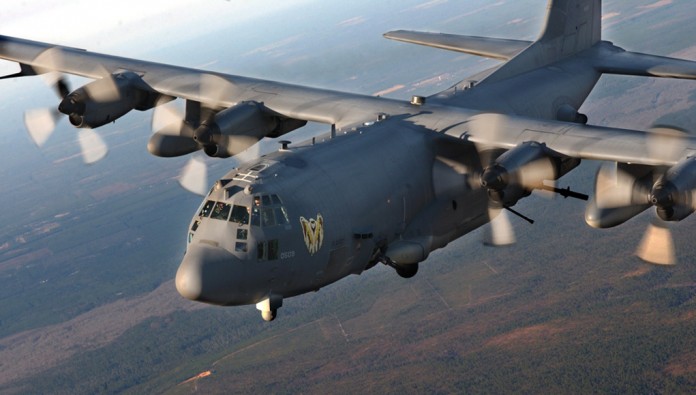
New helmet sights to be introduced on U.S. Air Force AC-130W Stinger II gunships in the next two years will improve situational awareness and responsiveness, and enable their pilots to better support ground forces and employ precision weapons from a safe distance. The upgrade is part of a system integration that also includes the re-installation of 105mm gun and introduction of Hellfire missiles.
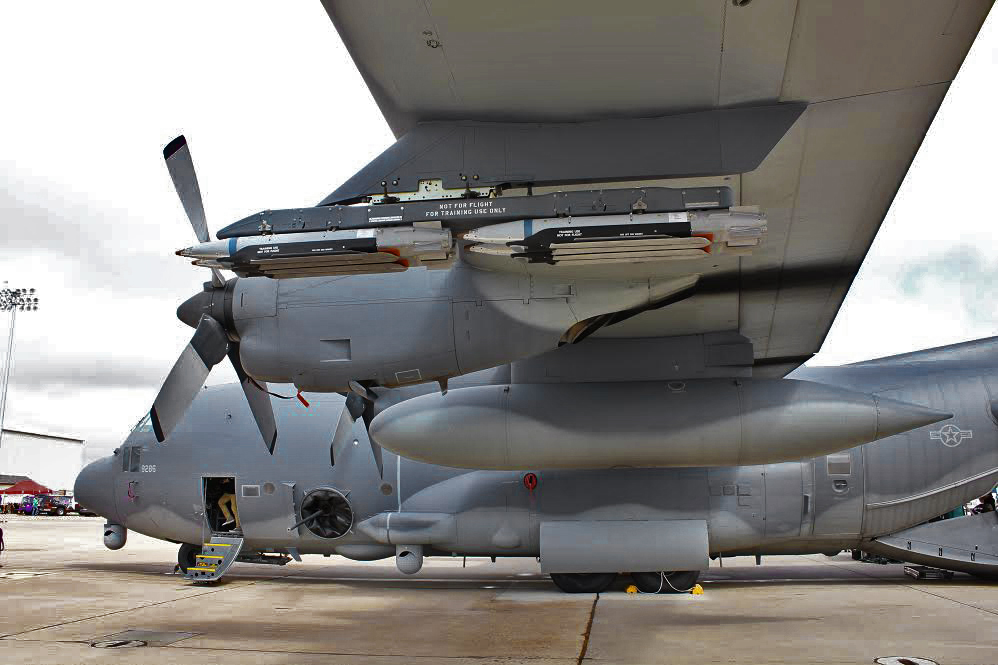
Lessons learned from overseas contingency operations have modified the near-term fire-support requirements of the U.S. Special Operations Command (SOCOM), resulting in a demand for more gunship aircraft. In May 2012 the MC-130 Dragon Spear II was renamed AC-130W Stinger II, representing a new effort to increase the gunship’s precision fire capability. Field-proven weapons such as the AGM-176 Griffin and the GBU-39 small diameter bomb (SDB) were added to the aircraft through an accelerated acquisition and integration process that took only 18 months. Currently there are 12 AC-130W aircraft in active service, supporting SOCOM operations worldwide.
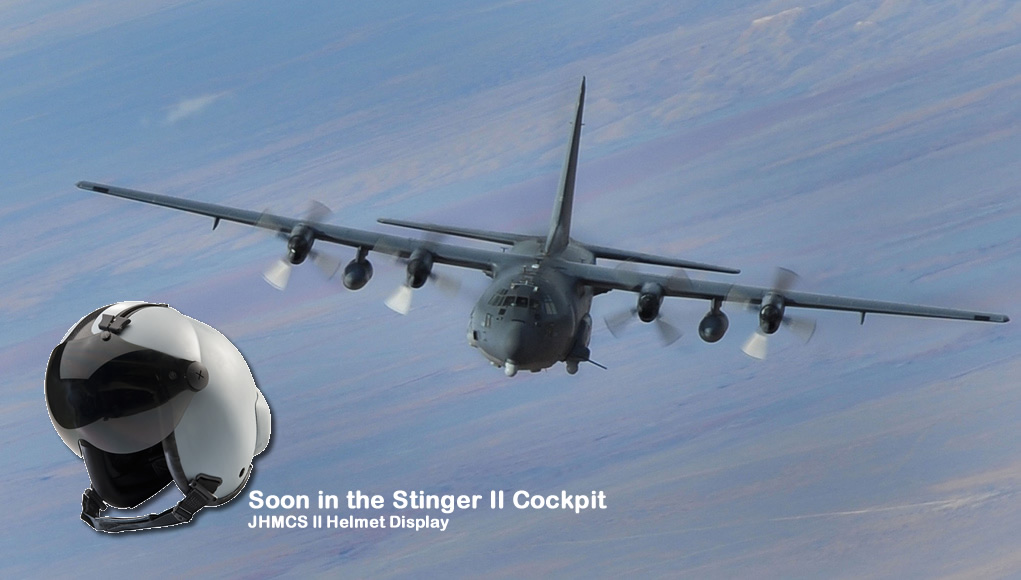
In two years the pilots of the AC-130W Stinger II gunship will operate the JHMCS II helmet mounted display, just like fighter pilots are using the helmet now. Photo: US Air Force & ELbit Systems
Over the next two years the AC-130W gunships will be equipped with helmet-mounted sights, to enable the gunship crew to control the weapons and avionics on board just by looking at targets. This capability has become the norm for fighter pilots, but has not yet been implemented in the military transport fleet. The AC-130W will be the first implementation of the Joint Helmet Mounted Cueing System (JHMCS), developed for fighter pilots, in a military transport plane.
The JHMCS helmet is lightweight and well balanced, to accommodate its integrated electronics. Its center of gravity is especially placed to reduce pilot fatigue, especially on the long-duration missions common to AC-130s. Designed to improve pilot situational awareness, JHMCS II uses a helmet-mounted display system to project color symbology on the visor, at an intensity level adjustable for day and night modes.
Head tracking provides accurate measurement of the line of sight, giving pilots increased situational awareness in any direction they are looking. The applications supported by the system enable immediate and accurate recognition of friendly, threat and unknown targets.
The first AC-130J lands at Hurlburt AFB for testing. This is the latest variant – AW-130J. As all J models, it is using Head Up Displays. In the future it could also be equipped with the latest helmet sights. Photo: US Air Force
The JHMCS developers – Elbit Systems of America and Rockwell Collins, will integrate the cueing system over the next 24 months. This first integration on the C-130J platform will open further opportunities to install similar systems on other C-130J derivatives. “With this awareness, AC-130 pilots flying with JHMCS II will have a decided advantage” says Raanan Horowitz, President & CEO of Elbit Systems of America.
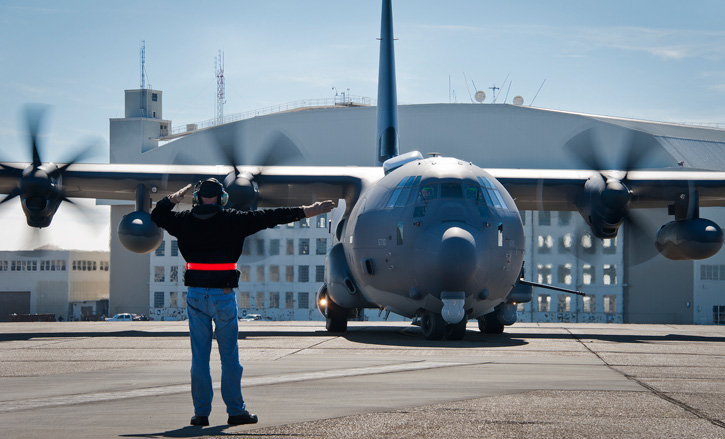
The AC-130W Stinger II is the latest, most advanced version of the AC-130 gunship operated by the U.S. Air Force under the Special Operations Command. Its primary missions are close air support and air interdiction. The aircraft is a highly-modified C-130H, featuring improved navigation, threat detection, countermeasures, and communications suites. All 12 AC-130W aircraft are modified with a precision strike package (PSP) to perform their gunship missions. Furthermore, 37 MC-130Js will be modified with the same package, enabling the unarmed Super-Hercules to convert into AC-130J gunships.
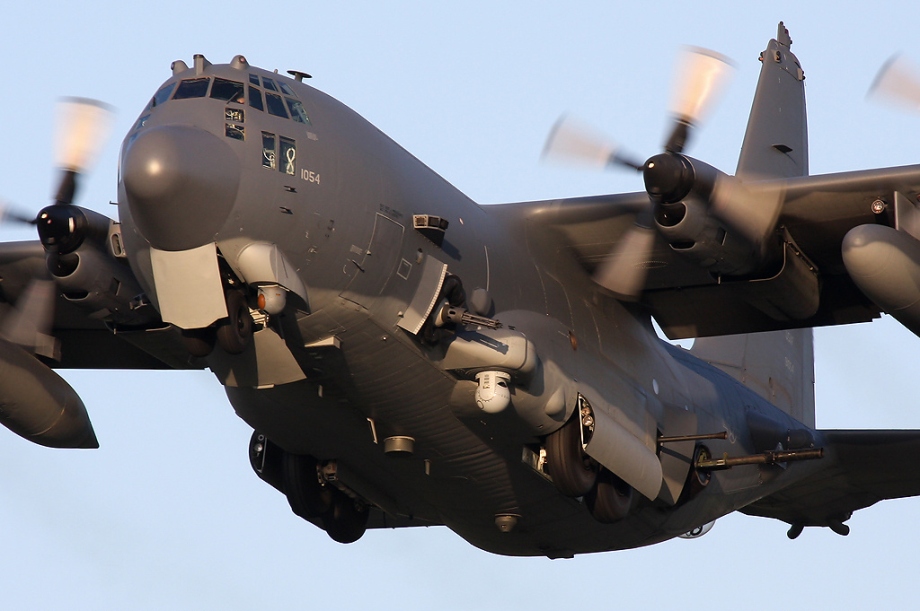
Modifications to the AC-130W include a mission-management console, a communications suite, two electro-optical/infrared sensors, fire control equipment, precision guided munitions delivery capability, and one side-firing, trainable, 30mm gun with tracer-less ammunition and an associated munitions storage system. These aircraft will also equip with the 105mm gun removed from the recent models; it will also be fitted to carry Hellfire missiles, in a similar way the US Marine Corps’ Harvest Hawk does.
The mission management system will fuse sensor, communications, environment, order of battle and threat information into a common operating picture. The AC-130W Stinger II Precision Strike Package modification provides ground forces with an expeditionary, persistent, direct-fire platform that delivers precision, low-yield munitions, ideally suited for urban operations.
The AC-130 can carry AGM-176 Griffin guided missiles internally, and GPS and laser guided Small Diameter Bombs packed on a multiple bomb rack carried underwing. The aircraft is also prepared to carry other precision guided weapons such as the Nemesis, stored in Common Launch Tubes (CLT).
The Defense Security Cooperation Agency delivered the required certification notifying Congress of this possible sale on May 18, 2015.
The majority of the weapons included in the announced package are Joint Direct Attack Munition (JDAM) Tail Kits built by Boeing. Israel requested 14,500 such tail kits (KMU-556C/B), fitted to general purpose bombs, enabling the fighter planes to target each bomb to a specific target, defined by GPS coordinates. The majority of tail kits are designed for 900 kg (2,000 lb) Mk-84 bombs. while 4,000 are designed to fit the smaller, quarter-ton class Mk-82 weapons (500 pounds).
The ordnance package also include 12,000 general purpose bombs associated with those kits – including Mk-82, Mk-83 and Mk-84 types. Israel is also producing those bombs in country, at the IMI heavy ordnance plant. The company developed the MPR-500 which has been type qualified by Boeing for the JDAM. The shipment will also include 500 DSU-38A/B Detector Laser Illuminated Target kits, enabling the JDAMs to engage laser-designated moving targets. These weapons can be carried by all of israel’s fighter jets, including the future F-35 expected to arrive in Israel by 2017.
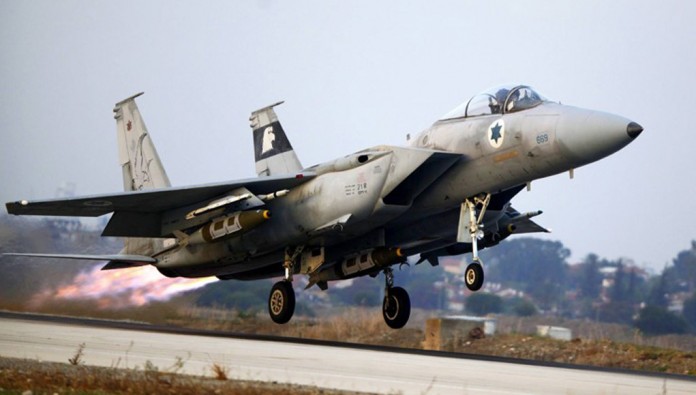
Israel will also receive 4,100 GBU-39 Small Diameter Bombs (SDB), a compact precision guided weapon produced by Boeing, and employed by Israel’s Boeing F-15I strike fighters. These aircraft will also receive 50 deep penetration bombs of the BLU-113 type (GBU-28) and 700 BLU-109 penetrating warheads. The BLU-113 5,000-pound ‘Bunker Busters’ carry 630 pounds of high explosives, encased in a hard steel shell that can penetrate 20 feet (six meters) of reinforced concrete. The BLU-109 packs 530 pounds (240 kg) of explosives, in a case weighing 1,927 pounds (874 kg) that can penetrate about six meters of reinforced concrete. These bomb shells are produced by the Ordnance Technical Systems division of General Dynamics (GDOTS)
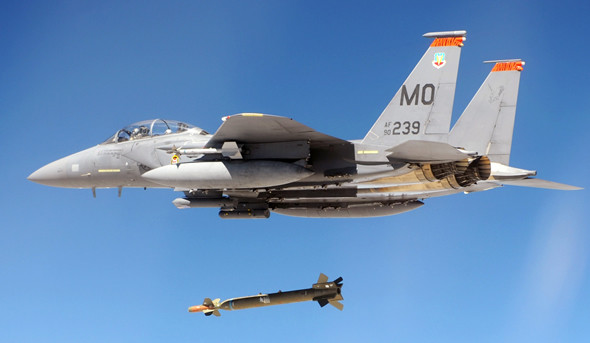
GBU-28 dropped from an U.S. Air Force F-15E. The Strike Eagle and B-2A are the only two aircraft in U.S. Air Force inventory capable of carrying this heavy weapon. Photo: USAF
The BLU-113 is often joined with a laser guidance kit enabling the weapon to strike stationary or moving targets with very high precision. The arms package includes 1,500 such kits, The BLU-109 is also coupled with a similar laser guidance kit. As part of the new package the IAF will receive 1,500 Mk-83 Paveway kits and 700 BLU-109 Paveway kits. It will also include the supply of 3,000 AGM-114K/R Hellfire missiles often used by the AH-64 Apache helicopter gunships, and 250 AIM-120C Advanced Medium Range Air-to-Air Missiles, providing the primary interceptor for Israel’s F-16s, F-15s and future F-35. These missiles are produced by Raytheon and Lockheed Martin.
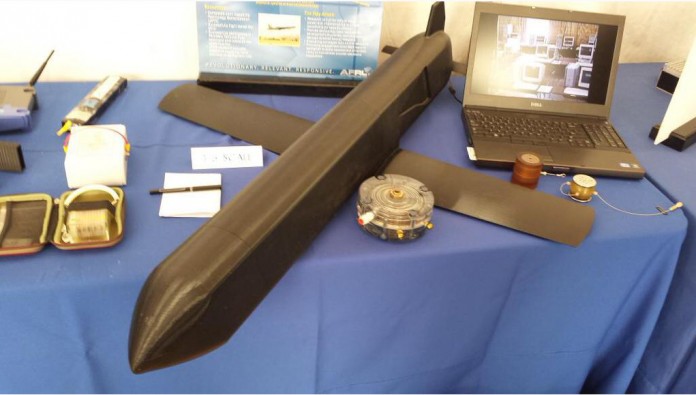
CHAMP payloads are scalable and can be packed in different types of delivery systems. The effector, a coil and capacitor, are designed to release very high electromagnetic peak power at a very short time, disabling electronic equipment without causing any damage to other infrastructure.
One of the displays at the Pentagon Lab Day yesterday was the Air Forces’ Electro-Magnetic Pulse (EMP) weapon developed by Boeing under the Counter-electronics High-powered Microwave Advanced Missile Project (CHAMP). AFRL has tested the weapon in 2012, using an AGM-86 Conventional Air-Launched Cruise Missile used as a surrogate vehicles the Air Force has now selected the stealthy, long-range Joint Air-to-Surface Standoff Missile (JASSM-ER) as the optimal air vehicle to carry the CHAMP weapon.
“The capability is real … and the technology can be available today…”
The research laboratory tested the counter-electronics device on the cruise missile at a military test range in Utah, where it successfully shut down a room full of computers. The effect similar to the electromagnetic pulse from a high-altitude nuclear explosion.
Major general Thomas Masiello says the technology, which fries electronic equipment with bursts of high-power microwave energy, is mature and will be miniaturised to suite the JASSM-ER.
“The capability is real … and the technology can be available today,” The Air Force Research Laboratory commander Maj. Gen. Tom Masiello said. “That’s an operational system already in our tactical air force,” Masiello says at the science and technology exposition held at the Pentagon yesterday.
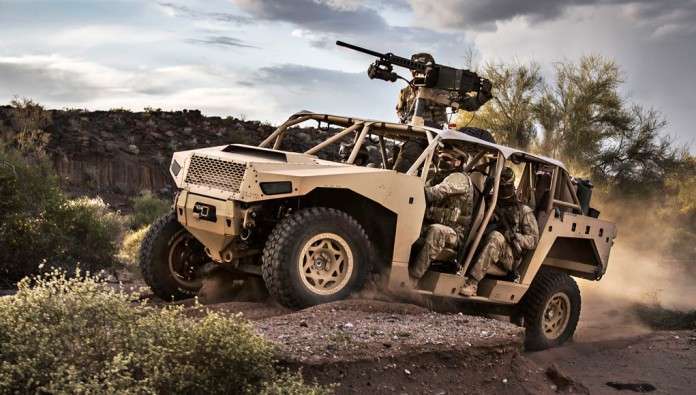
In recent years the military have increasingly been using light-weight all-terrain vehicles (ATV) for a number of applications: from utility transport within staging areas to air-mobile and light-forces support, infantry formations are required to sustain operations with minimal transportation support. Being light, agile and versatile, ATVs are available to support light-forces and special operations. Some were custom built for the military while others utilize civilian platforms, hardened and adapted for these missions.
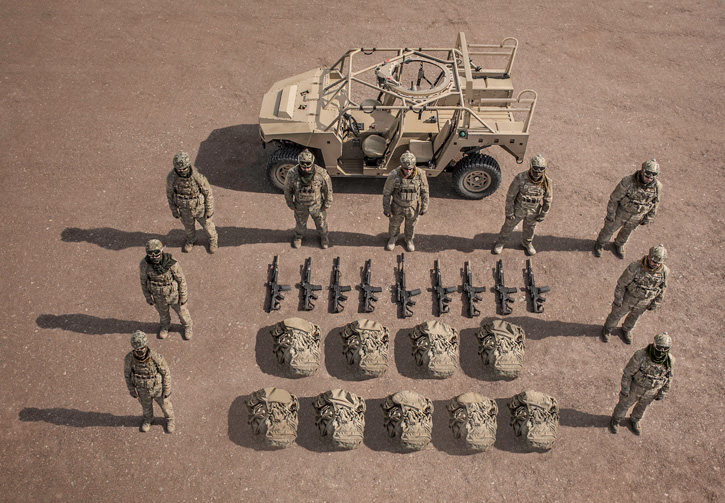
The DAGOR is designed to carry nine troops with their equipment. Five vehicles will carry a platoon. Photo: Polaris defense
Most of the vehicles were acquired under urgent operational requirements (UOR), as part of the War on Terror budget. As the deployment in Afghanistan winds down, military forces in the US, Europe and Asia-Pacific are assessing their way forward, acquiring and fielding those assets through a methodical, sustained approach.
“I need tactical mobility for the future, so we need to move toward mobility and figure out how we sustain survivability while increasing mobility.” US Army Chief of Staff Gen. Ray Odierno stated. The Army is addressing those directives with plans to equip select infantry and airborne forces with dedicated vehicles that will support reconnaissance, offensive security operations and move infantry units off-road thus increasing their security and survivability to enemy ambushes and IEDs.
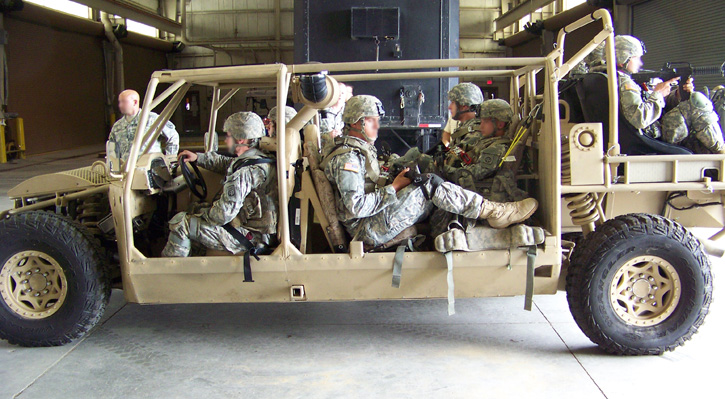
Nine troops from the 8snd Airborne are seated in the Vyper, configured as a troop carrier. Photo: Vyper Adams.
Supporting future ‘joint forcible entry’ missions, the Army intends to develop and field a family of specialized vehicles comprising three different platforms – the Ultra Light Combat Vehicle (ULCV) – general-purpose troop carrier, a light tank called ‘Mobile Protected Firepower’ (MPF) and a Light Reconnaissance Vehicle (LRV).
The ULCV, is the highest-priority vehicle, is slated to enter service in 2016. The Army has an initial requirement for 300 vehicles, at a cost of $150,000 per unit.
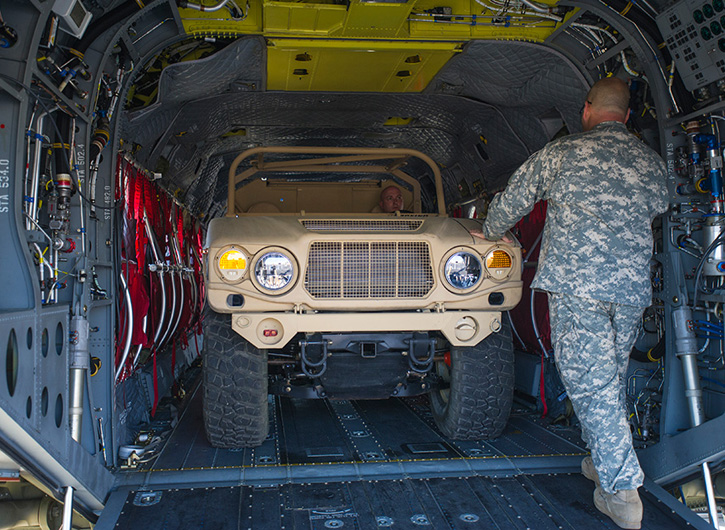
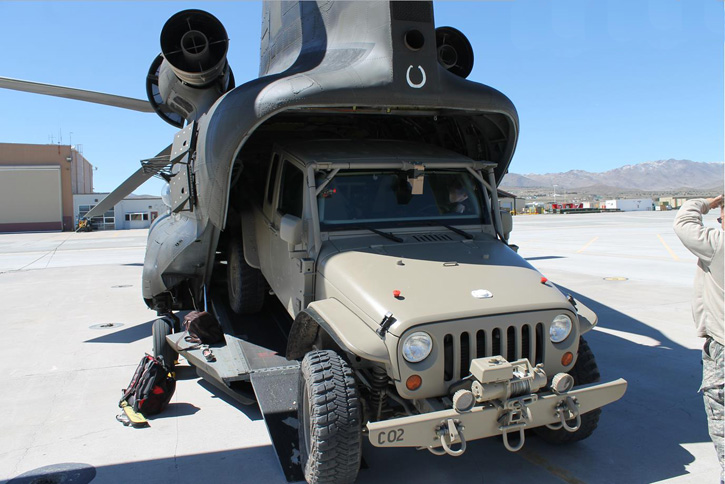
The special operations community has been searching for such an ‘all-terrain vehicle’ for years — a versatile platform that could fit into the cargo bay of the Chinook, and be light enough to allow each helicopter to carry three (two inside, one sling-loaded). One such vehicle could be carried (sling-loaded) by a UH-60 class helicopter (Blackhawk), providing ground mobility for a squad deployed on air assault operations.
.
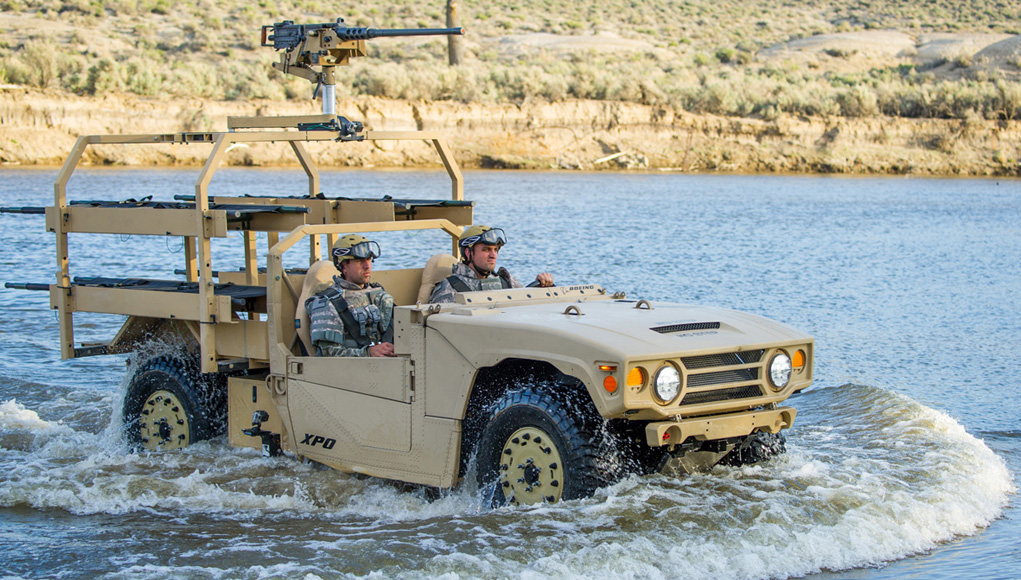
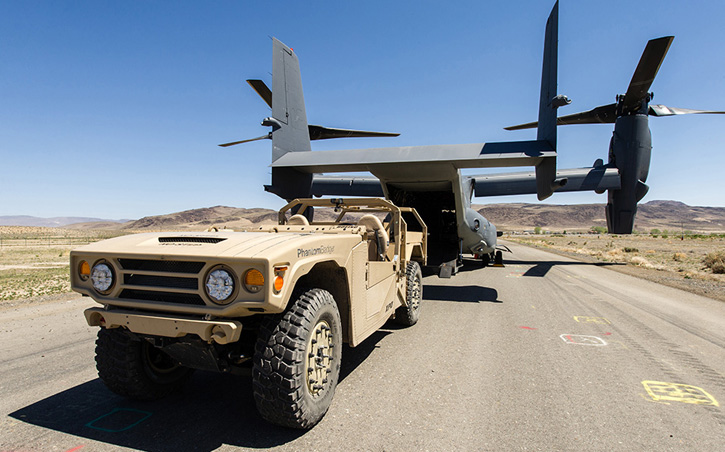
Boeing’s Phantom Badger all-terrain vehicle. Photo: BoeingDue to size limitations, ULCV will not fit into the cargo bay of the Osprey V-22. Photo: Boeing
Configuring vehicles for specific missions would be done in the field: ULCVs should be able to transform from troop carriers into weapon carriers, medical evacuation vehicles, or even unmanned robots, in minutes. However, due to size limitations, ULCV will not fit into the cargo bay of the Osprey V-22. The Marine Corps and SOCOM, both operating V-22 variants, are operating customized versions of ATVs.
Light and fast, the ULCV will transport soldiers from a remote landing zone (LZ), remotely from the objective, thus enabling to locate LZs far from enemy air defenses or indirect fire systems. Five vehicles would be needed to carry a light platoon including three rifle squads, a weapons squad and headquarters.
Specially customized version of the Phantom badger was proposed for SOCOM, to meet their Internally Transported Vehicle (ITV) requirement. Photo: Boeing
The ULCV should be fast, agile and safe to drive on and off road. Survivability and protection woutdoor be attained by gaining flexibility of movement, allowing forces to traverse more concealed and unpredictable routes over terrain usually traveled on foot. While no armor is currently required by the user, these vehicles will be safe to drive – fitted with roll cages protecting the entire vehicle. Threshold requirements identify the maximum curb weight of the vehicle at 4,500 lb. (about two metric tons) with a range of 250 mi (about 400 km.), utilizing an engine capable of running on a variety of fuels.
Several designers are pursuing this opportunity. The Army evaluated some of the candidates last year at Fort Bragg. Some of the vehicles were developed specifically for the military, others, adapted by these missions by experienced off-road and racing sports specialists.
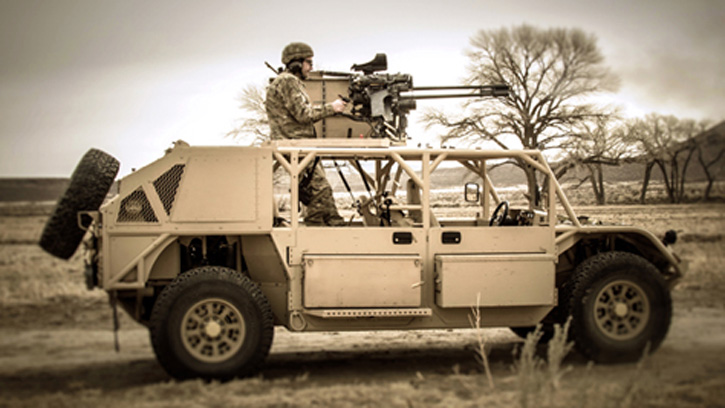
General Dynamics is proposing the Flyer 72 ASLV variant for ULCV. Photo: General Dynamics
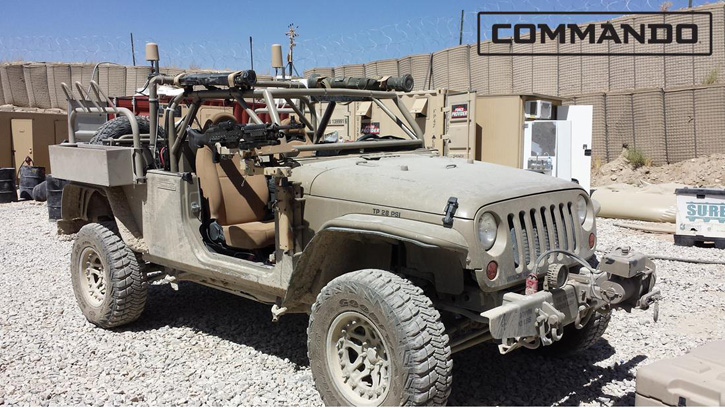
Among the vehicles tested were the Flyer-72 ASLV from General Dynamics, a vehicle designed by Flyer Defense for the Special Operations Command (SOCOM). The Phantom Badger developed by Boeing and MSI Defense was also evaluated. Lockheed Martin submitted a derivative of the British LRV 400, a fast reconnaissance vehicle based on the QT Wildcat from Supacat. Although the vehicle was successfull in testing Lockheed Martin decided to past this opportunity. Another specially modified vehicle considered by the Army is the Commando Jeep from Hendrick Dynamics. Other companies have recently announced that they had submitted final offers for the tender include Polaris Defense, offering the Dagor, and Vyper Adams, submitting their specially developed Vyper.
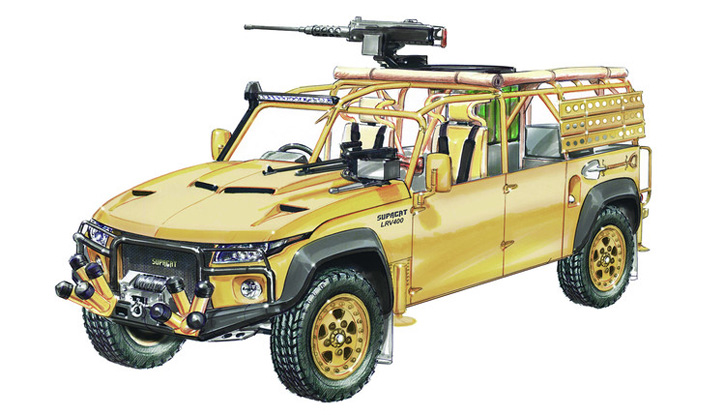
LRV-400 was developed by Supacat, based on the Wildcat from QT Systems. Photo: Supacat
“We came from the off-road business as opposed to the defense contractor business,” said Rich Haddad, general manager for Polaris Defense. Haddad noted his company brings game-changing resources to the military in the area of off-road mobility as part of a larger, commercial company. He added that DAGOR went from a design to a concept vehicle tested at the National Test Center in only nine months. “DAGOR looks to be a great natural fit for the ULCV requirements as they are provided today,” he added. “We’ve heard from our Special Forces customers that DAGOR gets them places they have not gone in a vehicle before,” said Haddad.
A different approach from Vyper Adams is introducing a high performance platform designed almost as a transformer – the Vyper VX4 has a maximum road speed of 120 mph (190 km/h) and excellent off-road mobility. Its unique advantage is the fact that the vehicle is designed around the modular POD area, enabling rapid reconfiguration with a number of mission-specific kits. “The Viper shows that the relationship between racing technology and industrial reliability is obtainable in a COTS form at reasonable cost effectiveness,” Vyper Adams CEO, Nicholas Chapman said. These interchangeable PODs simply slide into the vehicle platform, allowing the vehicle to be multi-functional and modular in construction, resulting in units that can be easily be mission-transformed or repaired.
Vyper Dynamics developed the pod system, enabling rapid configuration of the Vyper for different missions. This photo shows the POD frame designed to carry two litters for medical evacuation missions. Photos: Vyper Adams.
Another vehicle that proved itself in the racing world is the Light Reconnaissance Vehicle 400 (LRV 400) designed by Supacat, based on QT Services Wildcat off-road race car. According to the company this race proven design incorporates a tubular space-frame chassis with state of the art suspension providing superb performance, reliability and safety. The vehicle’s size and weight enables effective air portability, including tactical CH-47 internal loading. “Whilst primarily fulfilling light force reconnaissance and strike concepts of operation, low-weight armor solutions can also be fitted as an option” Supacat sources said.
The Phantom Badger from Boeing is a light truck designed for a top speed of 80 mph (130 km/h). While the vehicle itself was custom designed for the military, the company said 60 percent of its parts utilize commercial off-the-shelf automotive parts, including the engine, derived from the 2014 Jeep Grand Cherokee, thus keeping costs down.
Boeing partnered with MSI Defense, a company with years of experience in off-road racing, NASCAR and Formula 1. The Badger is also designed with mission modules that are interchangeable within minutes and are also compatible with the Phantom Badger trailer. Optional accessories can include a customized communication package, power inverters, additional storage and utility kits, a cold weather kit, a deep-water fording kit, hard/soft tops, etc.
Another Jeep platform that has already been supplied to the military and proposed for ULCV is the Commando Jeep developed by Hendrick Dynamics. The Commando Jeep has a low silhouette, special attachments and improvements to gain air-mobility, versatility, and rapid configuration required for the role.
All platforms (except the brand-new DAGOR) are already in service with unspecified DOD applications.
The Commando Jeep is designed to fit into the CH-47 for internal carriage as well as sling loading. Photo: Hendrick DynamicsCommando Jeep can be configured to different missions, using special conversion kits. Photo: Hendrick Dynamics
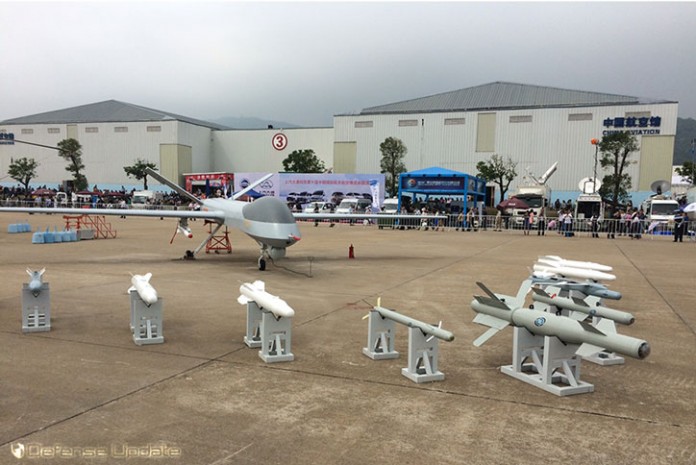
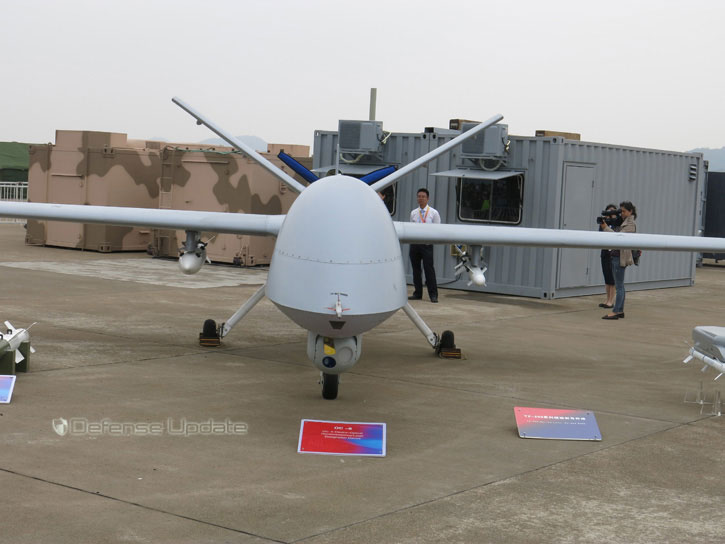
A full weapon complement of the Chineese Wing Loong I drone from AVIC. Photo: Tamir Eshel, Defense-Update
China is offering to sell Jordan missile-firing drones to fight the Islamic State terror army, Washington Times reports, quoting a U.S. congressman. “I am now aware that China is presently in Jordan to discuss operations, logistics and maintenance associated with the urgent sale of weaponized unmanned systems,” Rep. Duncan Hunter, California Republican, said in a letter on Thursday to President Obama.
The US administration denied Jordanian requests for unarmed Predator XP last October. Rep. Hunter (R. Ca) has been supporting the sale’s approval, allowing CA. based General Atomics sell its Predator unmanned surveillance aircraft to the kingdom and other Middle East customers. Jordan asked the armed drones in 2014, to help its air force fight the Islamic State in neighboring Syria and Iraq.
Among the drones now available for export are the Predator class Wing Loong or CH-4 drones are capable of carrying weapons. The Wing Loong I is already operational, capable of carrying 100 kg of aerial ordnance.
China has recently expanded its UAV offering to include armed versions. In the absence of alternatives from market leading suppliers in the USA and Israel, China and Turkey are both pursuing armed UAV requests from the UAE, Egypt, Jordan and Nigeria. According to press reports, some were already sold to Saudi Arabia in 2014.
Wing Loong I drone on display during the Zhuhai 2014 Airshow in China. Photo: Tamir Eshel, Defense-Update
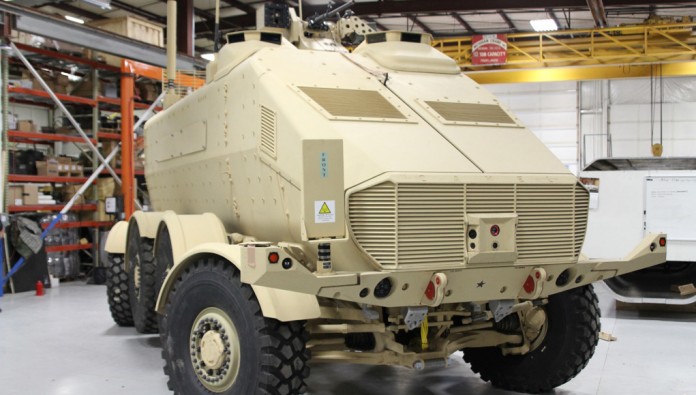
The US Army presented today a new concept vehicle designed to explore how to design current and future combat vehicles to better protect the warfighters riding in those vehicles to combat. The Concept for Advanced Military Explosion-Mitigation Land (CAMEL) vehicle designed by the Tank Automotive Research, Development & Engineering Center (TARDEC), demonstrates the ‘Occupant Centric Platform’ (OCP) concepts developed at the center. A 30-ton 8×8-class troop carrier, CAMEL is designed to safely and securely transport nine troops and two crew-members safely and securely. The goal is to reduce combat vehicle casualties well below 50 percent, compared to current combat vehicles.
This CAMEL demonstrator is ergonomically designed around the Soldiers and their gear, incorporating cutting edge technologies to increase comfort and efficiency while improving soldier safety, by diverting blast energy away from its occupants. TARDEC recently evaluated the vehicle with fully equipped active-duty troops, to gather feedback from soldiers who would use such vehicles in the future. The demonstrator is undergoing tests, including live fire, that are designed to evaluate its safety, comfort and blast resistance.
“This is a new concept in that we are designing the vehicle around the soldier,” said Steve Knott, the Associate Director of Ground Systems Survivability at TARDEC. “There are a lot of vehicles that, when you get in the back, it is tight. There are protrusions that could cause injury and loose gear that can be harmful in certain situations. These OCP demonstrators are designed around the occupant and offer a new level of survivability for our warfighters”.
The OCP Technology Enabled Capability Demonstrator (TECD) program aims to reduce casualties on legacy platforms by as much as 50 percent, using OCP concepts. The ultimate goal is to eliminate crew injuries for any occupant position.
Blast protection is the basic consideration for the design of the hull, seating and ergonomics. Two primary factors contribute to the dissipation of blast effect caused by an underbelly explosion – the distance (height) from the source and the shape of the hull. An OCP-designed vehicle uses a U-shaped hull, with a deflector shield that channels shock waves away from the vehicle’s hull and interiors.
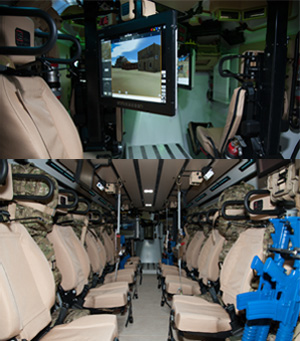
An internal view of the CAMEL demonstrator. Click to subscribe, to get enlarged more detailed photos.
OCP-designed vehicles are equipped with individual seating, fitted with harness straps and foot rests – their role is to isolate the passenger from the blast affecting the hull, while maintaining comfortable and ergonomic design. Seat angles are designed and shaped to prevent spinal injuries, and the ceiling contains impact-absorbing materials to reduce the chance of head injury. The hull is designed with protective trim on the top and sides, also reducing the danger of injury. 360-degree views with cameras capturing the surroundings outside the vehicle and beaming the video onto internal screens provide situational awareness inside, without exposing the crew to hostile fire.
The fighting compartment can be reconfigured to provide space for stretchers, carrying injured squad members. The litters are designed specifically for the vehicle and hang from straps attached to hooks on ceiling-mounted anchor tracks to isolate the wounded from the floor (preventing further injury from blast).
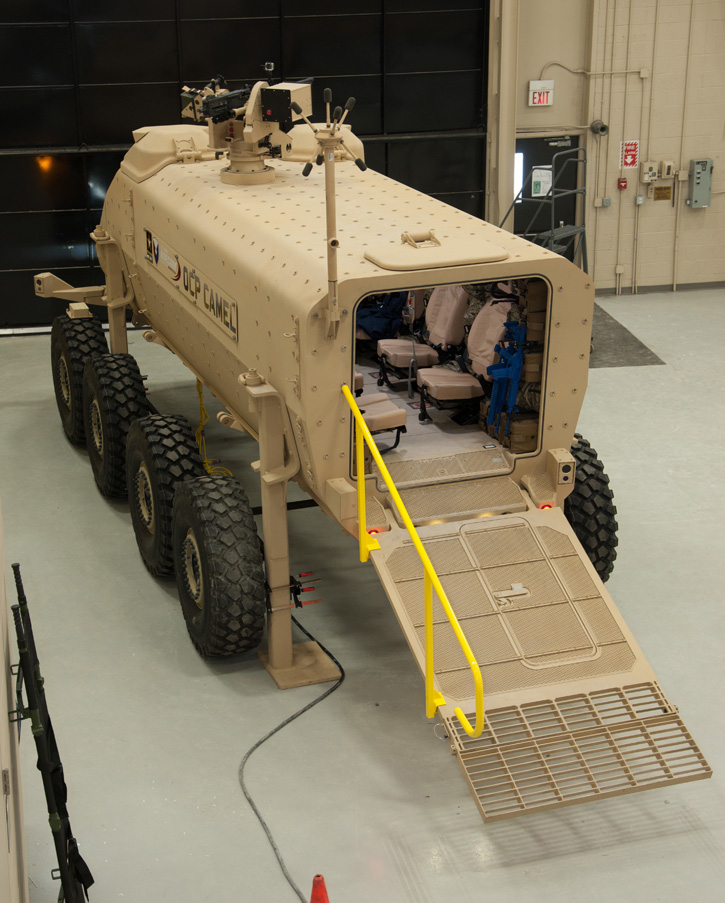
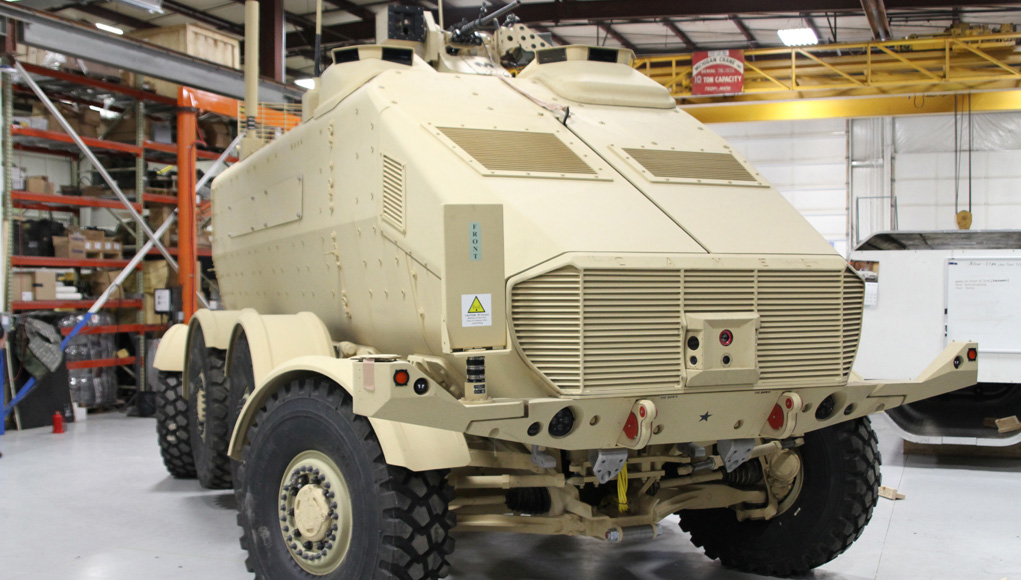
An image clearly showing how the passenger capsule will be separated from the carriage, contributing to the dissipation of explosion and survival of the crew. The wheels shown in this image represent the distance and position of the wheels, relative to the capsule. Photo: Tom Faulkner, US ArmyThe CAMEL concept vehicle demonstrator is shown here with its carriage, peripheral cameras, and C-IED devices adding to the vehicle’s protection. Photo: US Army
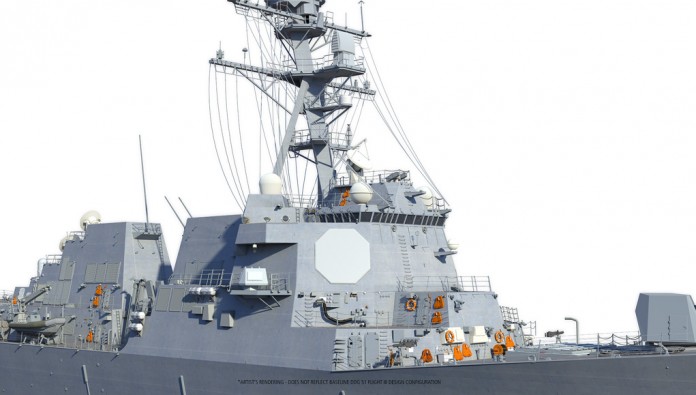
The Air and Missile Defense Radar provides greater detection ranges and increased discrimination accuracy compared to the AN/SPY-1D(V) radar onboard today’s U.S. Navy destroyers. Illustration: Raytheon
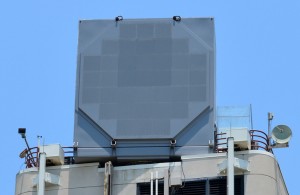
A partially-populated, full-sized AMDR array installed on an outdoor test bench. Photo: Raytheon
The U.S. Navy and Raytheon Company have completed the critical design review (CDR) of the AN/SPY-6(V) Air and Missile Defense Radar (AMDR). This radar will be installed on US Navy DDG-51 Flight III missile destroyers, improving their fighting and self-defense capabilities. The company said the Engineering and Manufacturing Development (EMD) phase of the program continues and is now more than 40 percent complete.
As a scalable radar, built with Radar Modular Assemblies (RMA) building blocks, AMDR can be grouped to form any size radar aperture, either smaller or larger than currently fielded radars. With much larger arrays, AMDR, is said to be at least 30-times more sensitive than radars configured on existing DDG 51 Arleigh Burke-class destroyers. The new radar can simultaneously handle over 30 times the targets than existing AN/SPY-1D(V), to counter large and complex raids. Using adaptive digital beamforming and reprogrammable radar signal/data processing functionality enables users to rapidly adapt to new missions or emerging threats.
The RMAs are leveraging Gallium Nitride (GaN) technology to optimize power in a smaller size and using less space, power and cooling than older technology would require for the same performance. The first Engineering Development Model production-representative Radar Modular Assembly (RMA) is currently undergoing testing in the risk-reduction pilot array at the company’s Near Field Range in Sudbury, Mass.
“With customer validation in hand, we will now advance production, driving toward the ultimate – and timely – delivery of this highly capable and much-needed integrated air and missile defense radar capability to the DDG 51 Flight III destroyer.” said Raytheon’s Kevin Peppe, vice president of Integrated Defense Systems’ Seapower Capability Systems business area. The first Flight III ship is scheduled to be the second of two destroyers to be funded in 2016.
Raytheon is developing the new radar under a $385.7 million cost-plus contract awarded by the Navy in 2013.
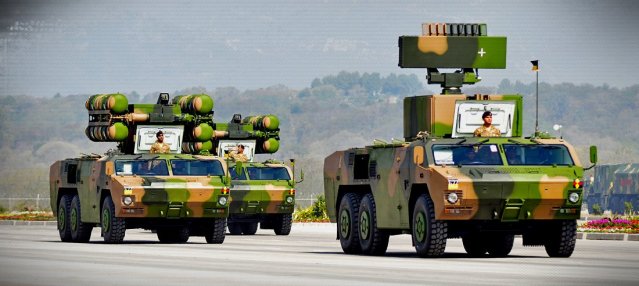
The new HQ-7B / FM-90 SHORAD systems Pakistan acquired from China were unveiled during the March 23, 2015 parade.
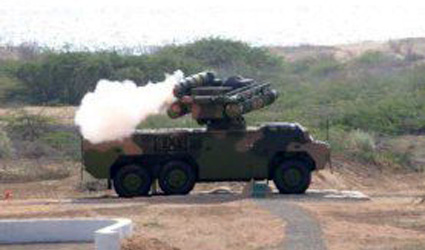
Pakistani FM-90 SHORAD system tested.
The Pakistani Army has inducted the Chinese HQ-7B short range air defense system. The Chief of Army Staff (COAS) General Raheel Sharif inspected the unit yesterday, witnessing training activity that included missile firing. The export system is designated FM-90 in Pakistan’s service can engage aerial targets including cruise missiles, drones and air-to-surface guided missiles under adverse electronic counter measure (ECM) environments, Pakistani sources said.
The system was unveiled earlier this year during the national military parade. The HQ-7B is a improved version of the HQ-7 (FM-80), itself, a Chinese copy of the French Crotale surface-to-air missile. The system is produced by by China’s National Precision Machinery Import & Export Corporation (CPMIEC).
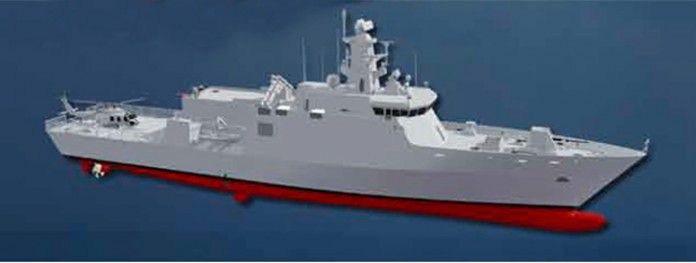
The German shipbuilder ThyssenKrupp Marine Systems (TKMS) has signed today a contract to build four patrol corvettes for the Israeli Navy. Israel will pay €315 million of the €430 million contract, the remaining €113 million will be subsidized by the German Federal Government. Israel plans to use the new boats to protect the expanded Economic Exclusion Zone (EEZ) in the Eastern Mediterranean, where recent explorations discovered major oil and gas resources. The first new boat will be delivered in 2019, to follow with the other three over the next three years.
The Israeli Government approved the procurement of the new boats as part of the security measures protecting those assets in the Eastern Mediterranean. Those security measures would include an array of unmanned systems surveillance and security systems operating in the air, above and under water. “This contract signed today is a significant event, representing a major increase in the defensive capability of the Israeli Navy, protecting offshore strategic sites located tens and hundreds of kilometers offshore” said Maj. General (ret) Dan Harel, Director General of the Israel MOD.
As part of the agreement, the German Thyssenkrupp concern, the owner of TKMS, will expand its procurement in Israel, buying goods worth at a value over €150 million.
TKMS is offering two versions of patrol vessels – the 1,500 ton Meko class 80 ‘Patrol corvette’ which is also available in 1,900 and 2,100 ton versions, and the 87 m’ long 1,800 ton Offshore Patrol Vessel (OPV). In comparison, Saar V, the largest boat class currently in service with the Israeli Navy is 85 meter long and has a fully loaded displacement of 1,275 tons. The new Israeli boat to be designated Saar 6, will be a version of the K-130, a 2,000 ton class in service with the German Navy.
Depending on the type of engine used (combined diesels or diesel-gas turbine), the Meko Patrol Corvette can develop a speeds of up to 26 knots, but is also equipped with electrically powered motors propelling the vessel at a highly economical speed of 12 knots. At a speed of 14 knots the Patrol Corvette has the autonomous mission range of 4,500 nautical miles, representing a two-week mission endurance. The vessel is operated by a crew of 65, and has accommodations for 23 more. The boat has a helicopter deck supporting helicopters up to ten tons.
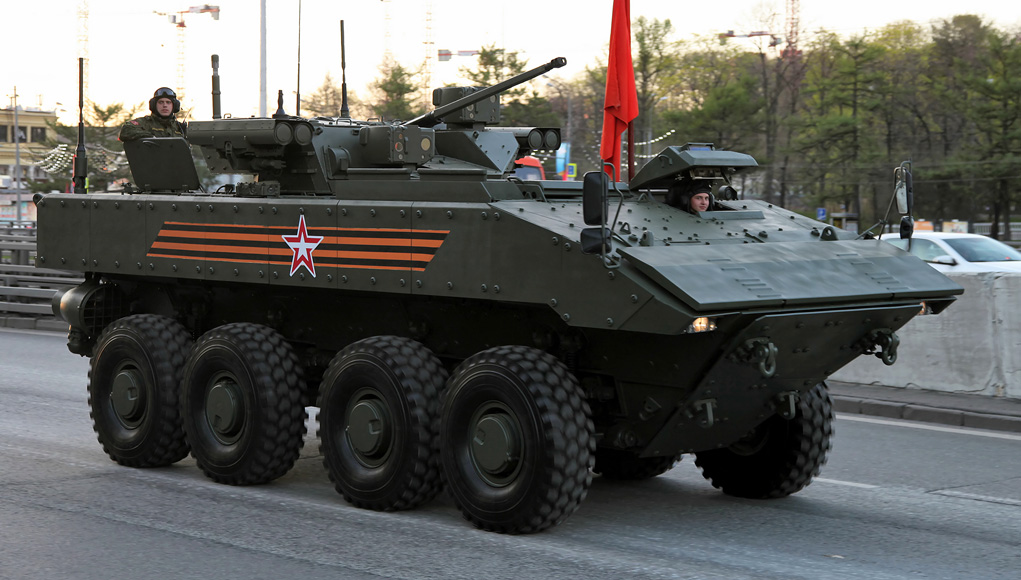
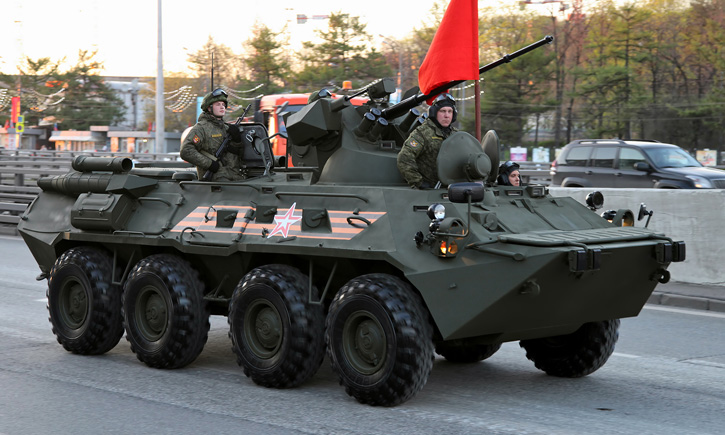
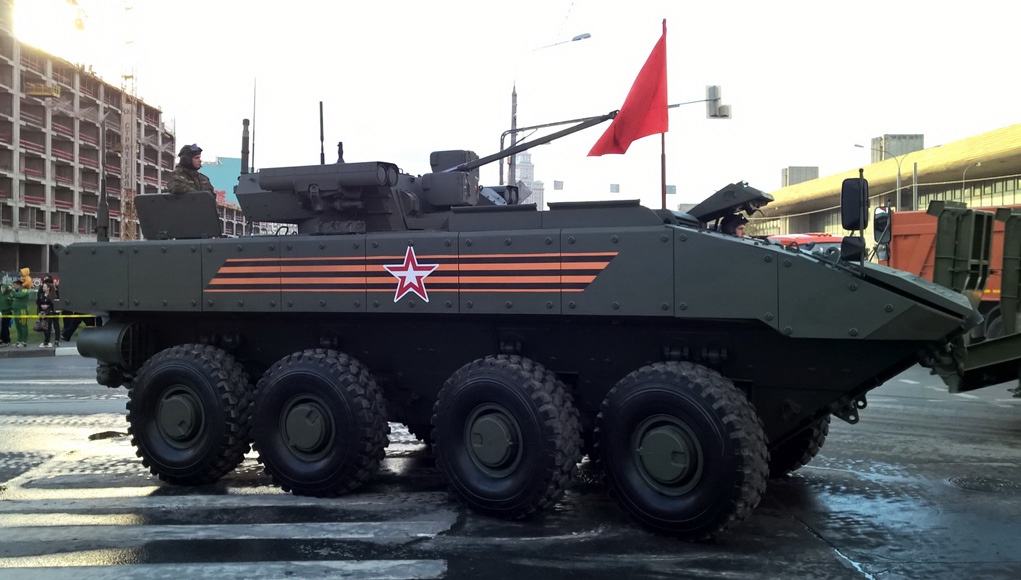
The Boomerang 8×8 armored infantry fighting vehicle is the latest wheeled armored vehicle developed in Russia. Its design introduces significant changes from that of the BTR-60, 70 and 80, which have been in service since the early 1960s. VPK, the designer and manufacturer of the Russian wheeled combat vehicles, preferred to invest in the BTR-90, a more powerful, well-armed version of the successful BTR-60-70-80, of which +25,000 were produced over the past 50 years. But the Russian military wanted something else. VPK shelved the BTR-90, modified the BTR-80 into the BTR-82 as a temporary solution, and began to design a new 8×8 platform to address the Russian military needs reflected by the official requirement issued in 2011.
Boomerang Infantry Fighting Vehicle moving toward Moscow red square prior to the 70th Victory parade – May 9, 2015. It was the first public appearance of this new Russian 8×8 combat vehicle. Photo: Vitaly Kuzmin.
The first prototypes of the Boomerang were delivered in 2013. The first pre-production vehicles delivered for operational testing were publicly displayed in 2015. Following those tests VPK is expecting orders for 2,000 such vehicles, in various configurations.
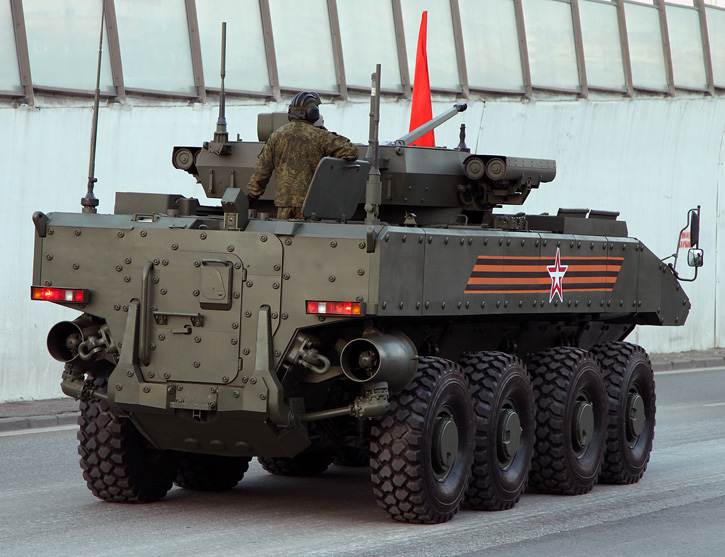
The Boomerang is operated by a crew of three, and has a carrying capacity of 9 troops. In line with other modern 8×8 APCs, its fighting compartment is more spacious than previous BTRs. Its engine, which is located on the right side and its turret, mounted on the deck, not penetrating the armor, do not obstruct its internal space. This layout enables the troops to exit from the rear ramp, similar to the tracked BMPs. Although common with western 8×8 APCs, it did not exist in earlier Russian 8×8 vehicles.
BTR-82 is the last version of the BTR-60-70-80 family of 8×8 vehicles produced by VPK since 1959. Photo: Vitaly Kuzmin
Their previous models – BTR-82, followed the same design introduced with the BTR-60, which used side doors for troop access, since the engines prevented access to the protected capsule from the rear, while the manned 14.5 mm gun turret blocked it in the front. The only way out was through a clamshell access door on the side, or personnel hatches on the top and side. This proved to be a major drawback in combat, as the troops had to dismount the vehicle exposed to enemy fire from the front and side. It also limited communications between the crew and squad during dismounted operation.
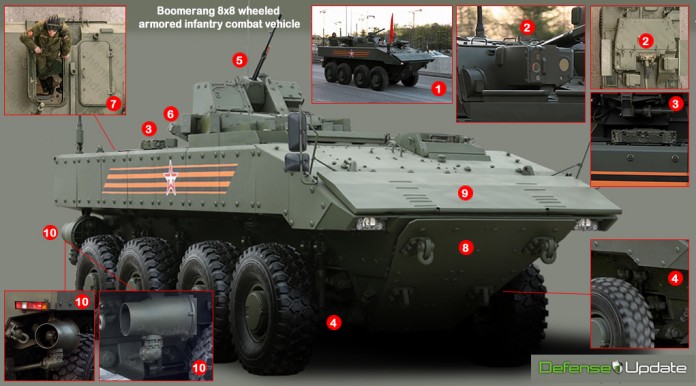
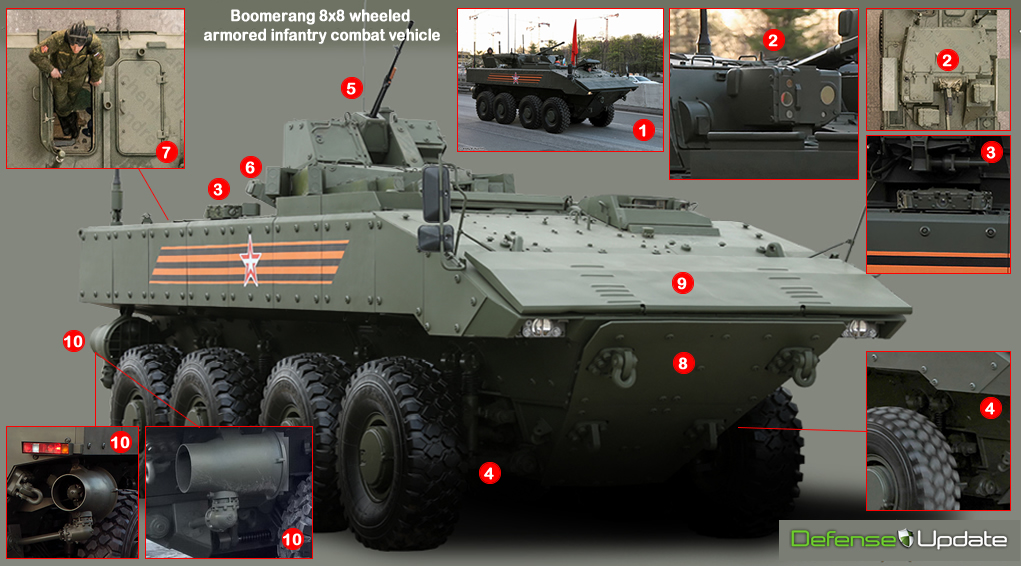
Also gone are the personal periscopes and firing ports which enabled mounted fighting for the troops. Instead, the Boomerang provides a panoramic view generated by video cameras covering the vehicles to a full 360 degrees (3).
Two hatches are mounted on top (7), retaining some functions for the troops. These hatches are likely blocked in models provided with active protection systems.
The Boomerang is built with a different approach – enabling protected mobility for an infantry squad, while providing fire support for them, both on the move and in stationary positions. It is a bigger platform than that of its predecessor, also heavier and more powerful. As opposed to its predecessor’s simple steel armor, the Boomerang has compound, modular armor, combining different materials and an optional (6) active protection system. (Such a system was not visible in the photos we have obtained thus far, but is shown one appears on the model released by the Russian Ministry of Defense).
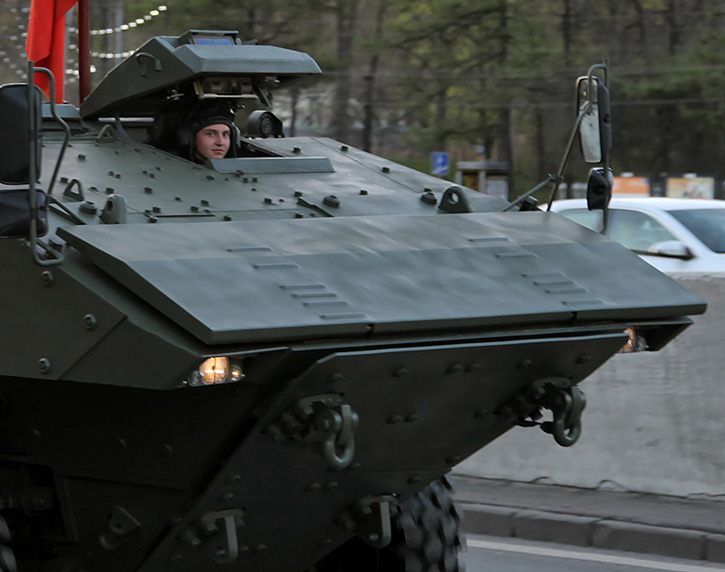
The vehicle is protected with additional, modular armor at the front, which could also be part of a belly protection plate (8). The V shaped hull is designed to deflect blast away from the floor, in case of a mine or IED explosion underneath the vehicle or under a wheel. Boomerang can be fitted with heavier armor, but such configuration is likely damage its floating ability.
Like the tracked Kurganets-25, the Boomerang comes in two basic models, differing from each other by the type of armament with which they are equipped – an armored infantry fighting vehicle (1) mounting the EPOCH (2) remotely-controlled weapon system (RWS) fitted with a single 2A42 30 mm cannon, 7.62 mm coaxial machine gun and four Kornet-EM guided missiles. These are significant improvement over the previous 14.5 mm heavy machine gun turret used on the BTR-82. The armored personnel carrier is armed with a smaller RWS, mounting a 12.7 mm heavy machine gun (5).
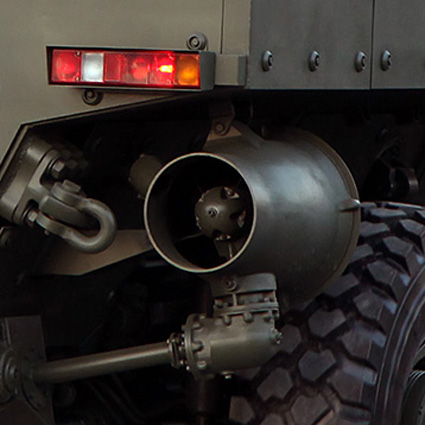
The Boomerang is powered by a 500 hp turbo-charged diesel engine. the vehicle has an all wheel drive plus extra propulsion for the two waterjets used for amphibious operations. Photo: Vitaly Kuzmin
The Boomerang is powered by a single turbo-charged diesel engine, the same type that powers the Kurganets-25 platform. It is an 8×8 vehicle, with steering on the two front axles. All wheels use MacPherson-type suspension (4), with both front and rear wheels fitted with double shock absorbers. The drive train also has two extensions powering the water jets for amphibious operation (10). A folding wave breaker (9) mounted above the front hull, extracted to is released to clear the deck while operating in water.
Other variants expected to follow include a self-propelled gun, a mortar carrier, a command vehicle and other combat support variants. An 8×8 vehicle called ‘ATOM’ was displayed at the ARMS 2013 expo in Nizhny Tagil, fitted with a 57mm cannon. At the time ATOM was presented as a collaborative effort between UralVagonZavod (UVZ) and Renault Defense Trucks of France, though to be a competing track to the Boomerang.
Unlike the BTR-82 Boomerang has a rear access ramp and door. The vehicle also has two hatches on the top deck, but unlike the BTR-82, it has no firing ports, except the rear port placed on the rear door. A set of peripheral cameras (two are seen above the door) are providing situational awareness for the crew and troops inside. Photo: Vitaly KuzminThe Boomerang has a wave breaker at the front, deployed when the vehicle enters the water. THe belly is also protected by an armor plate seen at the lower front. Photo: Vitaly KuzminThe 8×8 Boomerang uses all-wheel drive mechanism. This image clearly shows the two front axles are steerable. Photo: Bastion Karpenko.
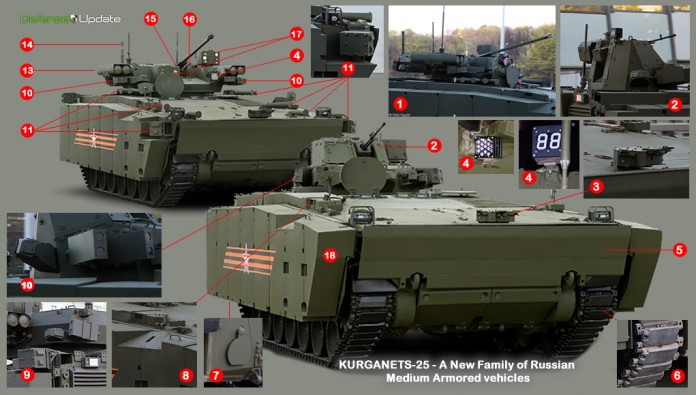
Kurganets-25 family of armored combat vehicles includes two members of a new family of medium- armored vehicles designed to replace the BMP-2 and MT-LB platforms in mechanized formations of the Russian army. Like their predecessors, the new vehicles have amphibious capability, enabling uninterrupted mobility across rivers. The Kurganets is manufactured by Kurganmashzavod, the plant that produced the previous generations of BMP-1, BMP-2 and BMP-3 vehicles.
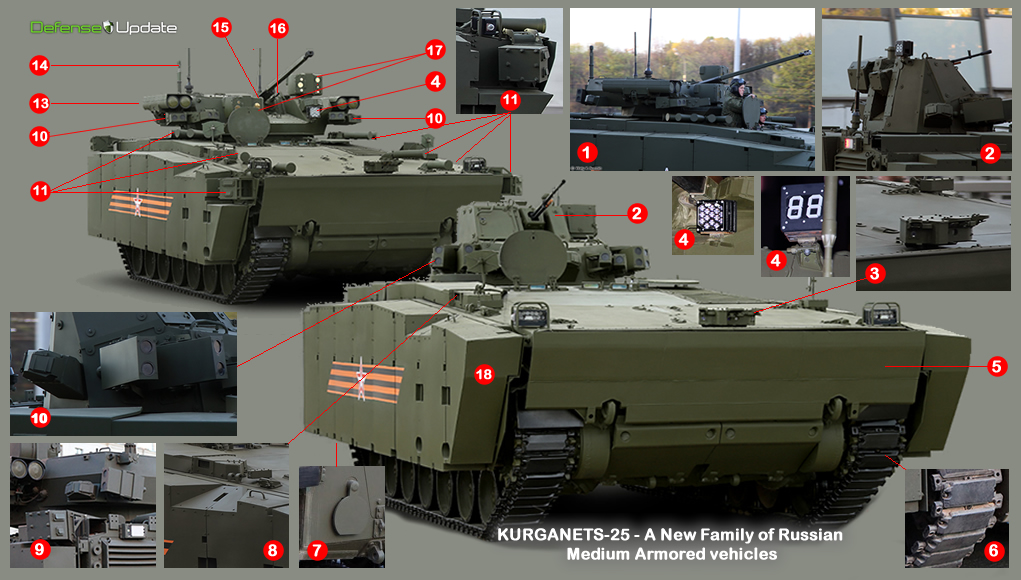
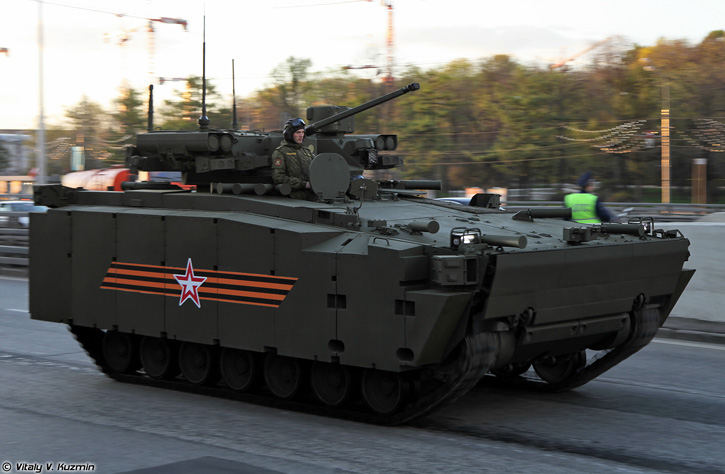
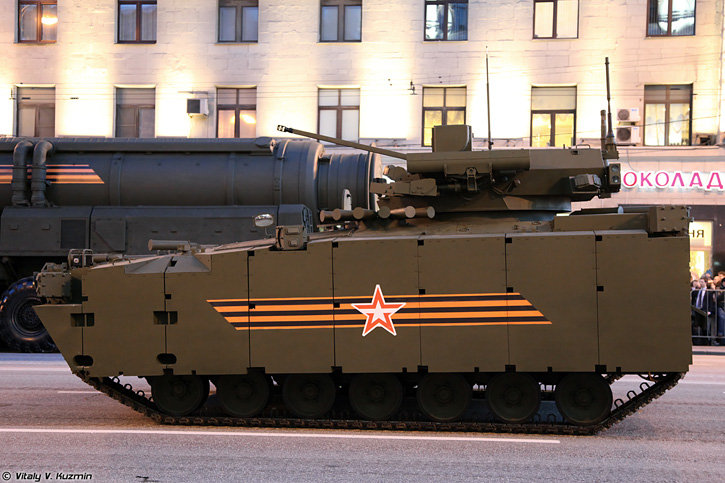
The new platform is significantly heavier and larger than its predecessors, primarily due to the increased level of protection it offers. The Russians have displayed two variants of the Kurganets – the armored infantry fighting vehicle (Object 695) and the armored personnel carrier (Object 693). The Kurganets-25 infantry fighting vehicle is currently undergoing trials in the Russian army, and mass production is expected to start in 2016. Following is an overview of the different elements visible on the vehicles shown in the May 9th parade in Moscow.
Both vehicles share the same hull, suspension and drive train powered by a 800 hp diesel engine, enabling mobility, as stated, both on land and in water. Their steel tracks are fitted with rubber pads (6), designed to reduce ground pressure and damage to roads, while retaining the capability of travelling at high speeds. Both can reach speeds of up to 80 km/h on land, and 10 km/h in water. When travelling in water the vehicle deploys its wave breaker (5) and water jets (7) for forward movement and steering.
The main difference between the two variants is the turret and active protection systems used. The thick armor covering (18) seen on both sides of the vehicle is designed to provide armor protection while retaining the floating capability necessary to enable the amphibious operation.
Due to the wide interest in the new Russian armored vehicles we are opening our analysis to all readers. This kind of analysis is regularly provided to subscribers on regular basis. You are invited to join our Gold membership today.
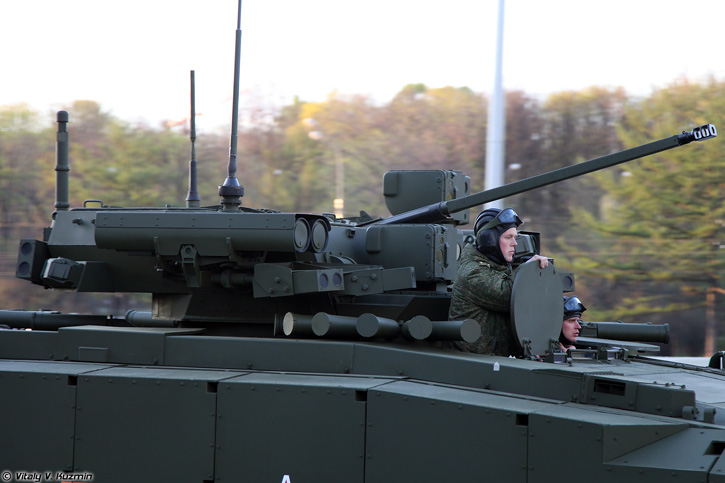
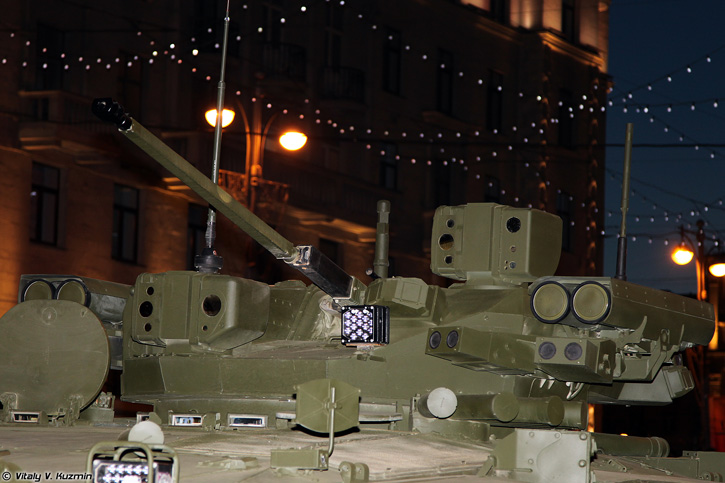
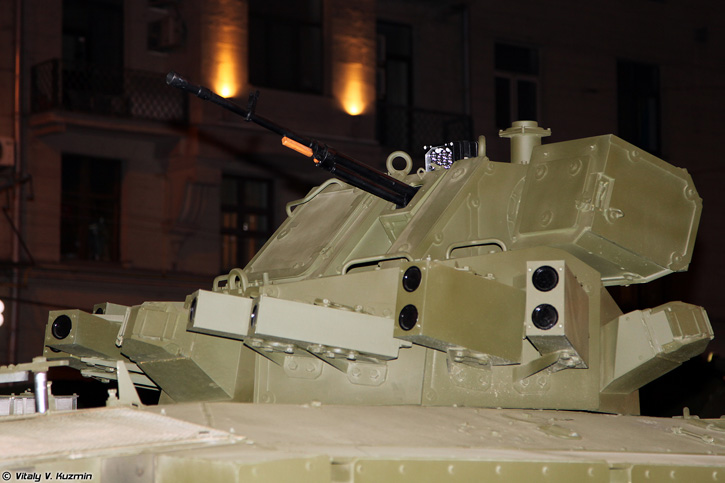
The Kurganets-25 infantry fighting vehicle is equipped with the KBP EPOCH turret (1), introduced as standard in all recent AFVs, such as the Armata T-15, Boomerang and Kurganets-25. This unmanned turret carries the 2A42 30mm cannon (15) with 500 rounds, a PKT 7.62 mm coaxial machine gun (16), four Kornet-EM guided missiles (two on each side – 13), two electro-optical target acquisition and missile guidance systems (17), and a meteorological mast (14). Also an array of sensors (9) and counter-measures, part of the vehicle’s active protection system ‘soft kill’ elements (10).
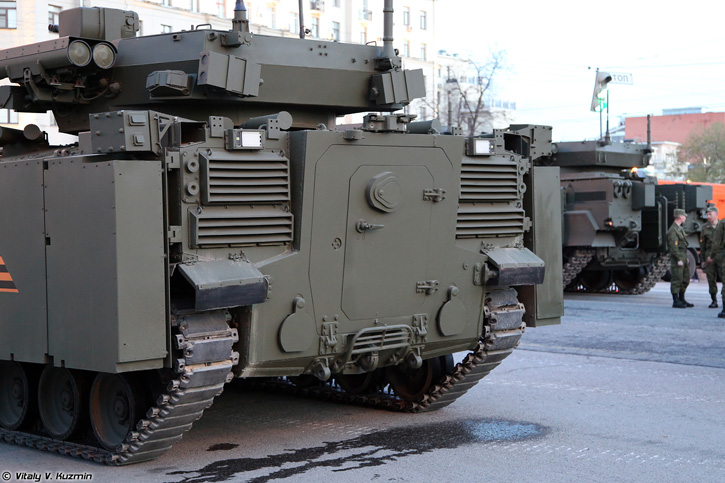
The hull also mounts 16 large tubes and four sensors (11) associated with the Afghanit ‘hard kill’ active protection system. A LED spotlight (4) located at the turret’s front end could also be part of the APS, acting as a decoy against 2nd-generation anti-tank guided missiles (ATGM).
The Kurganets-25 is equipped with several cameras, covering a full 360 degrees (3). Some of these cameras are stacked to cover wide fields of view. Others are tucked into the armor. For example, the side-looking cameras required special adaptation of the armor to clear their fields of view (8).
Unlike Russia’s previous armored personnel carriers, the Kurganets-25 lacks firing ports or personal hatches which would enable the infantry team to fight from within the vehicle. Part of the reasons for that could be the APS that fires automatically against incoming threats, creating flash and blast that could incapacitate exposed personnel nearby. Similar installations used on Israeli Merkava Mk4 tanks were equipped with blast deflectors, protecting the tank commander that could be exposed in his cupola.
Both variants are operated by crews of three. The infantry fighting vehicle is designed to carry six infantrymen. The armored personnel carrier (APC) variant can carry eight.
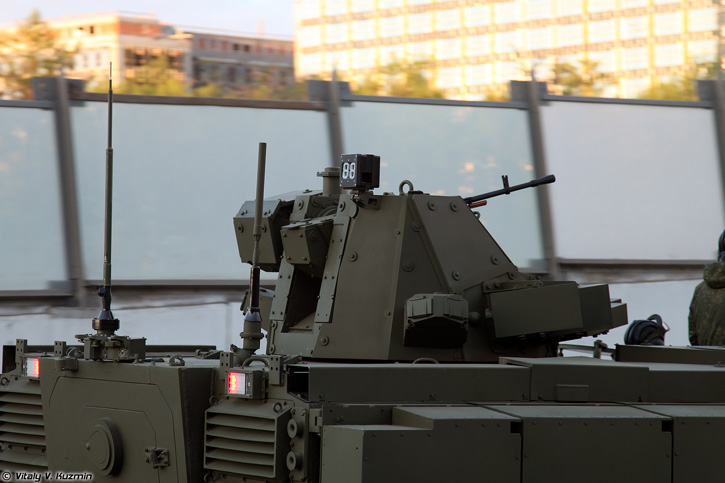
The APC carries a smaller remotely-operated turret (2), mounting a single 12.7 mm heavy machine gun. The vehicle retains the same active protection system ‘ring’ used on the BMP, but does not include the heavier Afghanit the BMP uses. Instead, it’s infra-red spotlight (4) is mounted at a higher level, and can serve both as a forward looking counter-measure and a signalling element, displaying numerical symbols backward, thus enabling communications with the infantry squad or other vehicles without relying on radio communications (similar to using flags). If coupled to the laser warning system on the vehicle, such a device could act as an unaided ‘blue force identification’ mechanism, responding to laser signals with a coded message. It would probably operate in visible and thermal bands, enabling both day and night operation.
Kurganets-25 armored infantry fighting vehicle (BMP – Object 695). The Kurganets-25 infantry fighting vehicle is currently undergoing trials in the Russian army and mass production is expected to start in 2016. Photo: Vitaly KuzminA close up view of the KBP EPOCH remotely operated turret – on the Object 695 Kurganets-25. Photo: Vitaly Kuzmin.Another view of the EPOCH turret, showing the active protection (soft-kill) elements and IR projector. Photo: Vitaly KuzminA rear view of Kurganets 25 BMP (Object 695) showing the access ramp, integrated door and firing hatch. Two covered exhausts of the waterjets are also visible. Also visible are the four rear-looking launchers of the Afghanit hard-kill APS and their associated sensors on the two edges. The soft kill elements of the APS are visible on the turret’s rear edges. Photo: Vitaly KuzminKurganets-25 BMP Object 695 – right side view. Photo: Vitaly KuzminKurganets-25 BTR (Object 693) troop carrier. This variant carries a troop of eight soldiers, three crew members.It is armed with a protected remotely operated turret mounting 12.7mm heavy machine gun. Photo: Vitaly Kuzmin.A close-up view on the 12.7mm heavy machine gun turret shows the IR projector, that also provides signaling in day and night. Photo: Vitaly KuzminAnother view of the remotely operated turret on the Kurganets-25 BTR. Photo: Vitaly Kuzmin
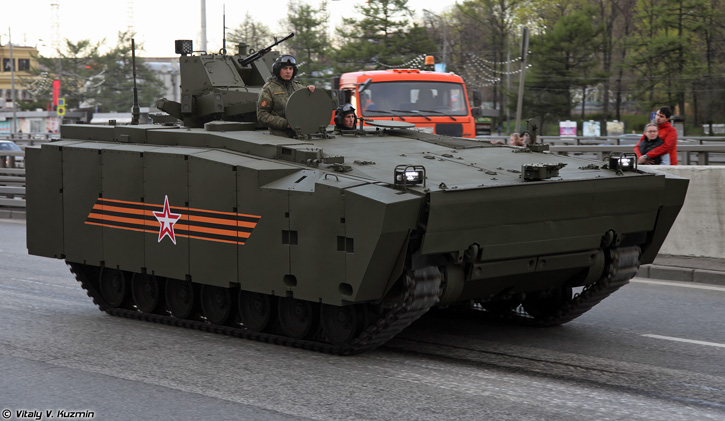
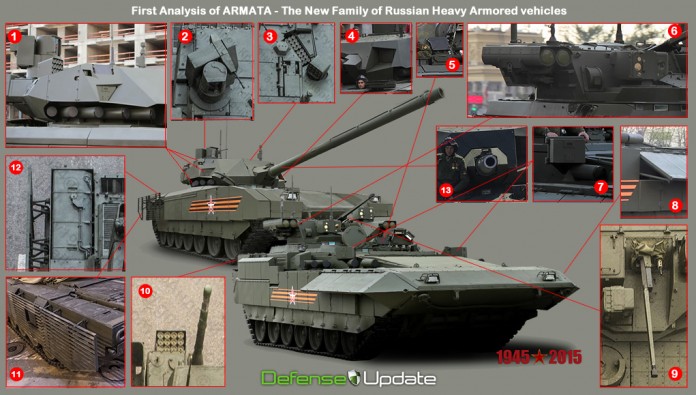
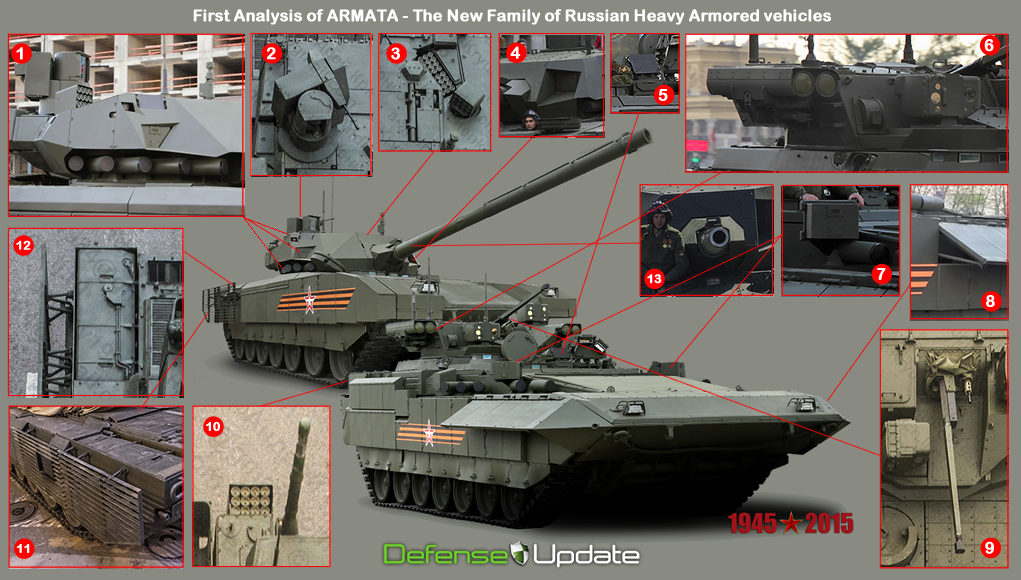
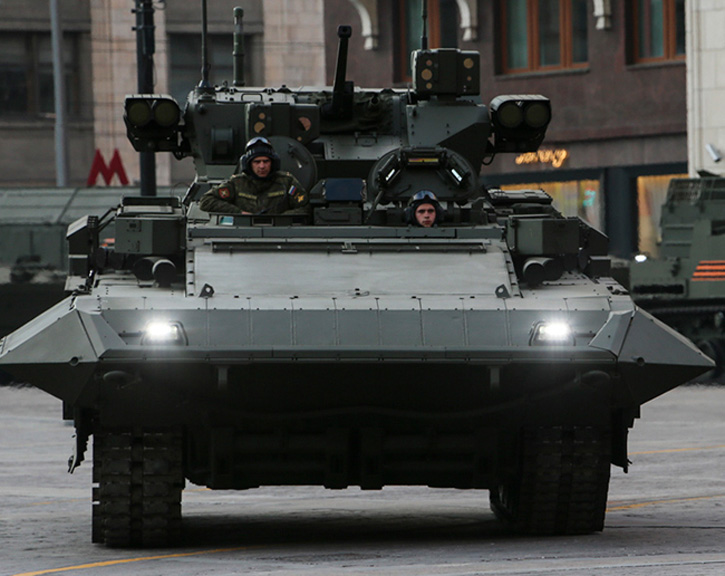
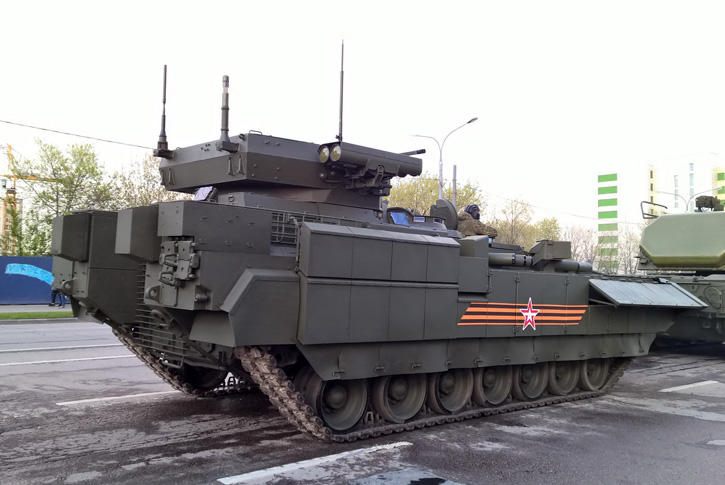
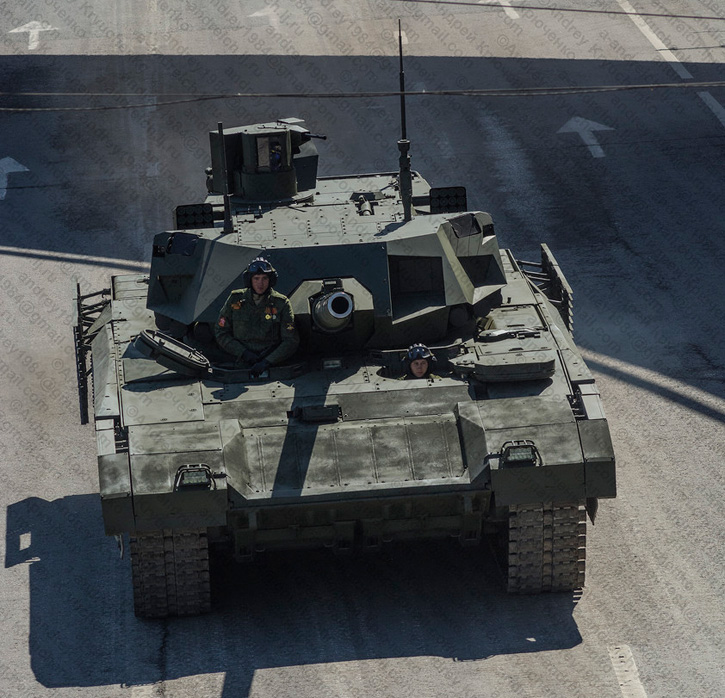
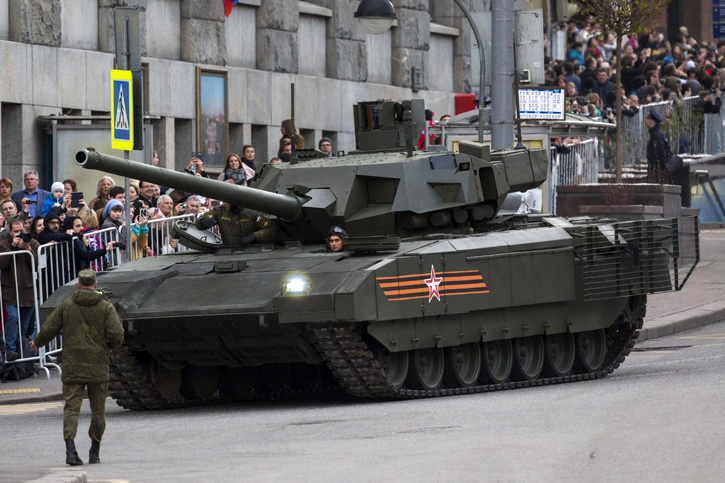
The Russian Ministry of Defense today publicly presented the first members of the Armata family of heavy armored fighting vehicles (AFV) – the T-14 Main Battle Tank (MBT) and T-15 armored infantry fighting vehicle (AIFV). The two vehicles are designated to become the spearhead of the armored formations of the Russian Army – replacing the T-72, BMP-2 and MT-LB-based platforms. In Armata-centered formations, these two combat vehicles will be augmented by additional variants that have not yet been unveiled, which could include a combat engineer and counter-mine vehicle (BREM), support platforms mounting automatic cannons, missiles (Terminator) and thermobaric rockets (TOS), self-propelled guns (Coalitzia), bridge layers (MTU), and armored recovery vehicles (ARV).
The 24 Armata platforms shown on the May 9th parade in Moscow are likely to be part of the early production series, some were especially prepared for the parade, according to a Russian MOD tender published in November 2014. Nevertheless, these models represent an innovative ‘clean sheet’ design of an armored vehicle. Although the two vehicles presented have different configurations they also have much in common, as their designers have used common subsystems to simplify training, improve field support and reduce life-cycle cost. These common elements include the suspension system, tracks, drivetrain, and some of the armor and active protection systems. Both vehicles use seven torsion bars with shock absorbers for the rubber-protected road wheels.
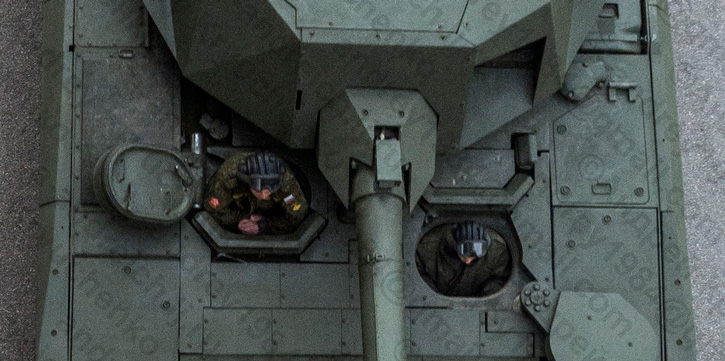
The optronics, however, are tailored specifically for each weapon system, and therefore differ considerably in each application. Seating arrangements are also similar, with two crew members seated side-by-side and a third in tandem with the driver in the T-14, and with the commander, in the T-15. According to some sources there are ‘dozens of cameras’ on the tank, providing full situational awareness around the tank and beyond, in day, night and under adverse weather conditions.
Due to the wide interest in the new Russian armored vehicles we are opening our analysis to all readers. This kind of analysis is regularly provided to subscribers on regular basis. You are invited to join our Gold membership today.
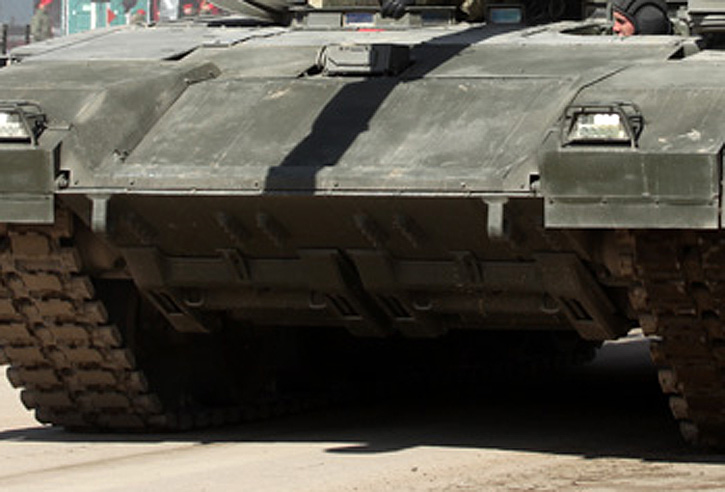
The armor suite used on the T-14 also seems to share some common elements with the T-15. Many of the passive armor modules are similar, if not identical, in some locations. Same concepts are also employed – steel, hybrid and reactive armor, mine countermeasures in front, bar armor protecting the engine compartment and dual active protection system. Both vehicles employ remotely-operated weapon turrets, separating the crew from the armament and ammunition. Both vehicles are operated by a crew of three. The T-15 can also accommodate an infantry squad in the passenger compartment. However, unlike the BMP-2, these soldiers do not have periscopes, firing ports or individual access hatches. Therefore, the infantry squad would come into effect only after dismounting.
The crew seating arrangement in the T-14. The commander is in the right side position, the driver in the left. In a ‘buttoned up’ driving position, the driver uses a reclining seat, looking out through the separate vision blocks positioned behind his hatch. The location of the gunner is unclear. The muzzle reference measurement unit is clearly seen on the barrel base. Photo: Andrey KryuchenkoThe Armata platform is configured with an active mine countermeasure system, designed to detect or trigger mines ahead of the tank. The system is mounted on the lower front edge of the vehicle. Photo: vitaly-Kuzmin
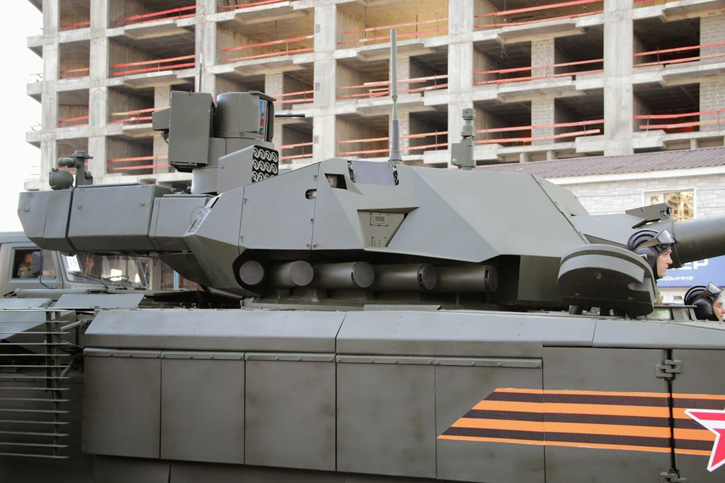
The current turret mounts a 125mm smooth bore cannon, without a coaxial weapon (previous reports indicated it had a 30mm coaxial gun and 7.62mm machine gun). While the turret has a distinctive shape dictated by the panels covering its various systems, its basic structure is likely to be thinner, providing a framework for a modular weapon system that could also support cannons of various calibers, automatic mortars or other support weapons.
The shrouded 125mm 2A82-1M cannon is different from previous models used on the T-90 and T-72. The main difference is the absence of a bore evacuator (since the gun compartment is separate from the crew compartment, extracting the combustion gasses from the gun is not necessary for crew safety.) A small box likely to be a gun reference system is located above the gun, providing exact measurement of barrel deformations for ballistic calculation (13). A meteorological mast is also located on the turret of the T-14, or the rear section on T-15 (10), feeding data to the ballistic computer. The cannon fires standard ammunition as well as gun-launched missiles, with a range of eight kilometers.
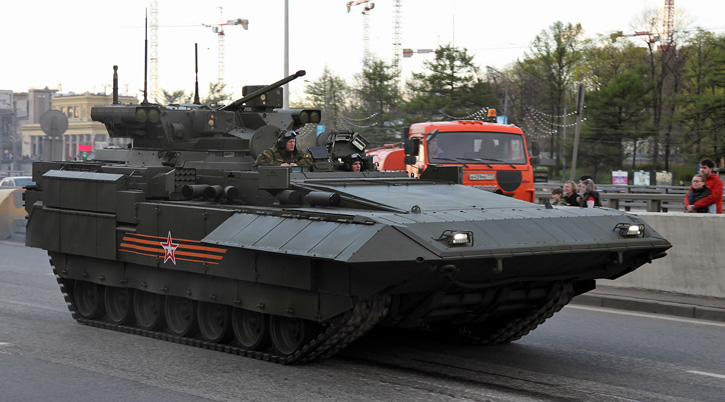
An elevated view of the new T-15 BMP, based on the Armata chassis. The mine countermeasures at the lower front area is clearly seen. Photo: Vitaly Kuzmin
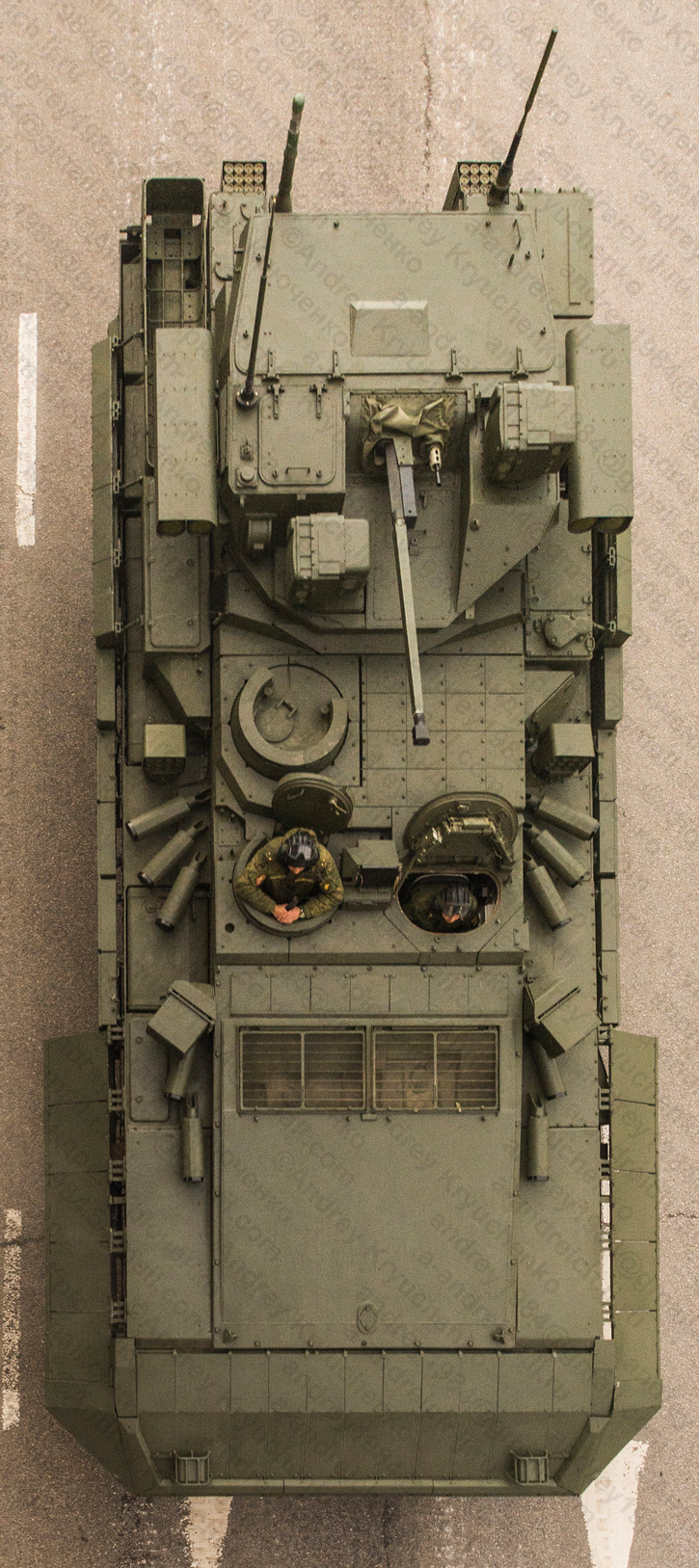
The T-15 uses an ‘off the shelf’ KBP EPOCH turret, also used on the Kurganets-25 BMP. This turret integrates a single 30mm cannon with 500 rounds (AP/HE), a 7.62mm coaxial machine gun, four Kornet-EM missiles (two on each side), and two fire control systems, integrating electro-optical sights, a laser rangefinder and laser guidance system (for the Kornets). The two systems are contained in ballistic protected modules, adding resilience to this combat vehicle. (6, 9)
A 7.62mm machine gun is mounted on the remotely-operated weapon station, integrated with what seems to be the independent, panoramic sight of the commander. (2) The gunner’s main sight (4) is located in a protected cell to the right of the main gun, enabling the gunner and commander to engage different targets.
Additional weapons could be introduced in an alternative turret design; the current one lacks the installation for such weapons. A compartment located above the gun could provide space for an additional weapon assembly mounted above the gun.
(1, 7) The T-14 turret also houses two active protection systems, comprising the Afghanit hard-kill APS (five launch tubes recessed at the turret base), and four soft-kill countermeasure launchers – two are positioned on rotating pedestals and two are pointing upwards (3, 10). These are likely to launch salvos of projectiles instantly creating a thick, multi-spectral smoke screens designed to defeat guided missiles, laser and targeting systems by blocking infrared, visible light and millimeter-wave radar radiation. These soft-kill countermeasures are designed to protect the vehicle from 3rd and 4th generation missiles such as direct attack Hellfire, TOW and BILL, or Brimstone, JAGM, Javelin or Spike missiles, approaching at high trajectory, as well as from nearly vertical top-attack by sensor-fused weapons (SFW).
A total of 10 Afghanit canisters are used, five on each side of the turret. When the turret points forward, they protect the forward arc (about 60 degrees on each side). When a threat coming from the sides or rear is detected, the turret will automatically slew toward the threat, enabling the APS to launch. Lacking this turntable function, T-15 uses the same five tubes in fixed positions, on both sides of the vehicle, covering only the forward arc. The tube objects are seemingly a smaller, more efficient evolution of the Drozd ‘explosive screen’. Afghanit is likely employing these countermeasures at close range, neutralizing incoming threats before they hit the tank armor. A previous version of APS from Russia, the Arena, employed an explosive ‘cassette’ launched above the incoming threat, firing a screen of blast and fragments downward.
Each of the APSs has its own sensors as well, mounted on each side of the turret, covering the rear and front quadrants left and right. The sensor (5) coupled with the pedestalled and upward pointing fixed countermeasures seems to be covered by a flat panel. Several sources indicated the Armata (T14 and T15) have the capability to detect, and simultaneously track and locate 40 land targets and 25 air targets. If this is indeed that sensor, it is likely to be AESA radar panels. There is no indication of such radar on the vehicle except those flat objects mounted on both sides of the turret. There are four such sensors on each vehicle (T-14, T-15), providing hemispheric coverage, thus detecting potential top attack threats before they enter a lethal zone (SFW).
Although the two designs share the same suspension and drive train, the layout of those systems is different. Both have seven road wheels, four suspension idlers and steel tracks. The T-14 has the turbo-charged diesel engine is mounted in the rear section, with a rear sprocket and front tension wheel. This design places the main weapon system in the center and the crew in the front for best visibility. The T-15 has its engine in the front, with the sprocket pulling its tracks also placed in the front and a tension wheel at the rear. This design clears space for the infantry squad at the rear and also adds some protection up front.
The engine develops 1,500 hp (moderated to 1,200 hp for optimal range). Serving the engine air intakes, cooling and exhaust require special armor adaptations. The T-14 uses a slat armor (11) to protect these elements and the engine compartment from RPGs, leaving the necessary space for air intake and exhaust. The T-15 uses a skirt (8) of oblique armor panels covering the exhaust from above, but these leave enough space to direct the exhaust gases away from the vehicle. The external fuel tanks (12) positioned on the engine’s sides also add protection. Unlike the jettisonable barrels used on the previous Russian tanks, these external tanks are fixed, and, therefore, are likely to be consumed first to reduce vulnerability in combat.
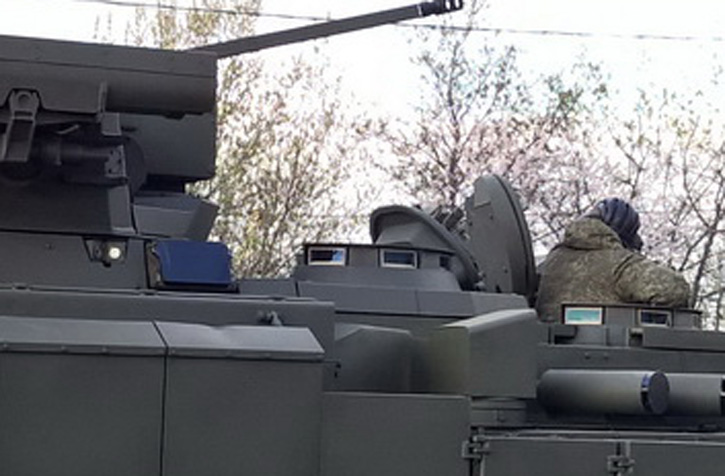
A front view of the T-15 showing the outer skirts protecting the engine exhaust and intakes.A rear view of the T-15 showing part of the bar armor protecting the rear ramp door. Photo: Bastion KarpenkoThe commander and weapon operator both have vision blocks surrounding their cupola, providing relatively good peripheral vision under armor. The T-15 driver has three vision blocks integrated in the cupola. For complete coverage, panoramic cameras are positioned around the vehicle. One pair of these cameras can be seen left of the flat sensor under the Kornet missile launcher tubes. The sensor is coupled with the ‘Soft Kill’ pedestal seen at the center, just behind the Afghanit APS Hard Kill tubes. system Photo: Bastion KarpenkoThe T-14 tank mounts two active protection assemblies on both sides of the turret. Covered by passive armor for ballistic protection, these modules integrate the Afghanit sensor (trapezoidal unit), five hard-kill launch tubes mounted at the turret’s base, two peripheral cameras and flat (possibly covered) sensor, likely radar coupled with the soft-kill system. Some sources indicate these sensors are derived from AESA radar technology developed and implemented on the Sukhoi T-50 stealth fighter jet. The rotatable soft-kill launcher containing 12 cartridges can be seen above, mounted on a rotating pedestal.A front view of the T-14. Note the driver has no vision blocks or other notable viewing devices on his position, although, when buttoned up, the driver may be using the vision system seen at the center of the tank. but a full set of fixed periscopes is placed behind his position. The two headlights use lensed LEDs providing different intensity of visible or infrared lighting on demand. Photo: Andrey KryuchenkoA forward left side view of the T-14 tank based on Armata platform preparing for the May 9th parade in Moscow.T-15 top view, Photo: Andrey Kryuchenko
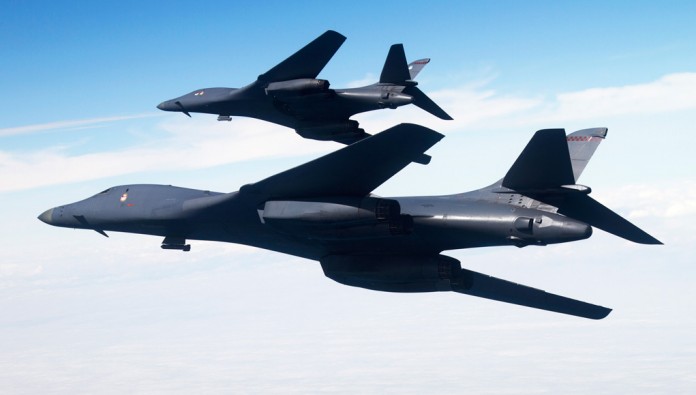
B-1B Lancers from the 337th Test and Evaluation Squadron soar over the Gulf of Mexico during a test mission near Eglin Air Force Base, Fla. The 337th is responsible for operational testing of all B-1 defensive/offensive systems and weapons upgrades. (USAF, Jake Melampy)
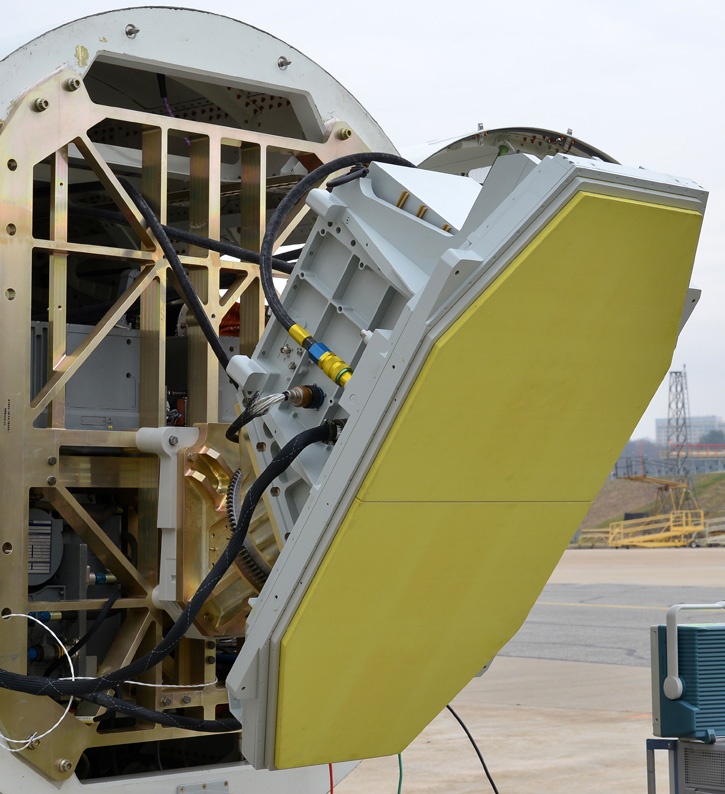
SABR-GS radar installed on a rack simulating the B-1B nose assembly. Photo: Northrop Grumman
Northrop Grumman Corporation is introducing an improved radar for the U.S.Air Force B-1B Lancer bomber. The new radar called Scalable Agile Beam Radar – Global Strike (SABR-GS) was presented by Northrop Grumman at the Lancer’s 30th Anniversary Reunion held at Dyess Air Force Base, Texas. Developed as an affordable, low risk radar retrofit solution, SABR-GS offers advanced operational capabilities and greater system reliability, compared with legacy APQ-164 passive ESA currently used on the bomber.
The new radar provides large synthetic aperture radar maps, advanced image processing and sensor integration that provides a significant advantage in situational awareness for the crew, enabling the B-1 powerful new capabilities for intelligence, surveillance, reconnaissance and targeting.
Northrop Grumman’s SABR-GS is a full performance, multi-function, active electronically scanned array (AESA) radar for the B-1. As a derivative of the AN/APG-83 SABR, SABR-GS takes advantage of hardware, legacy modes and advanced operating modes proven on the F-35, F-22 and F-16 aircraft.
Nearly three times the size of the F-16 SABR system, SABR-GS offers unprecedented target area detail and digital maps under all weather conditions. Open architecture standards have been used to integrate data from other onboard sensors, enabling continued innovation and affordability for the life of the system.
The IBS is a combination of three different upgrades, which includes a Fully Integrated Data Link, a Vertical Situation Display upgrade, and a Central Integrated System upgrade. PHOTO: USAF, Richard Ebensberger
“By developing SABR-GS, we’ve enabled capabilities now critical to the mission – a significant milestone for SABR technology and the B-1,” said Paul Kalafos, vice president, surveillance systems business unit, Northrop Grumman. “By leveraging the successes of the SABR for the F-16 fighter, we have activated cost savings for the U.S. Air Force’s B-1 program, proven that SABR AESA technology is scalable and extended the survivability of the aircraft for the next 25 years. The APG-83 version of SABR has been integrated into the F-16 and is part of the F-16A/B upgrade for Taiwan.
The development of SABR-GS took place under a $21 million risk reduction contract awarded in 2011 by the Air Force B-1 Systems Program Office. Northrop Grumman has demonstrated in flight, the advanced B-1 AESA and advanced sensor and fusion processing, readying the radar for the engineering, manufacturing and development phase.
The completion of this contract follows the successful Radar Modernization Improvement Program (RMIP), in which Northrop Grumman modernized the radar receivers and processors of the B-1. SABR-GS will replace the APQ-164 radar antenna currently deployed on all B-1 bombers.
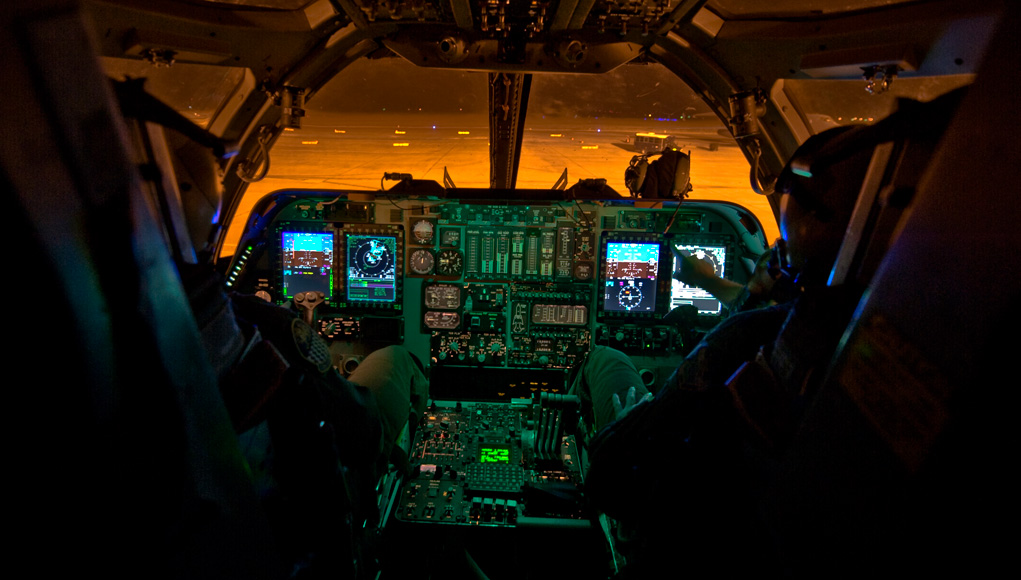
The current upgrade implemented on the bomber is part of Sustainment Block 16 (SB-16) – the largest and most comprehensive in the Lancer’s life cycle so far. SB-16 includes upgraded navigation and radar systems, modernized cockpit that the replaced the two monochrome pilot and co-pilot displays with four color MFDs (Multi Function Display); a Fully Integrated Data Link and a Central Integrated Test System (used to detect and troubleshoot anomalies) in the aft station; introduction of modern moving map and user friendly symbology.
These modifications are part of the Integrated Battle Station (IBS) initiative, which will be fully implemented by 2019.
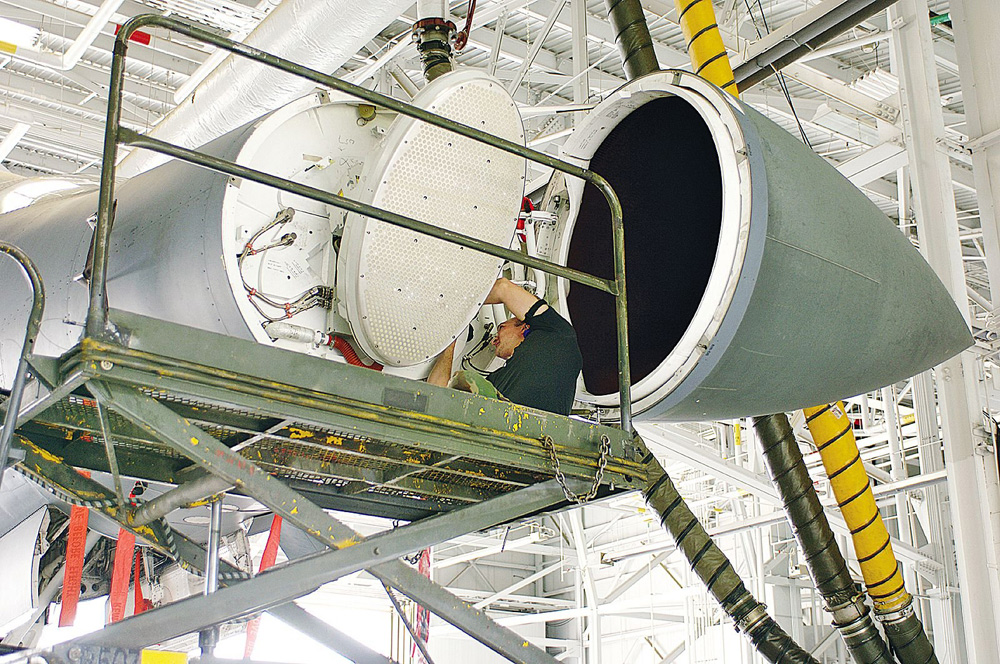
The B-1B is a modernized version of the B-1A Lancer supersonic strategic bomber of which only four were produced by the original manufacturer in the early 1970s. Serial production of the bomber began in 1986 with an order of 100 B-1B bombers, redesigned and revised into multi-mission bombers – a new variant of the original design, designed to evade enemy detection by flying at high subsonic speed at low level. To enable such flight it is using its APQ-164 multi-mode radar as a terrain following sensor. Built by Westinghouse (currently supported by Northrop Grumman), the APQ-164 radar employs passive electronically scanned array technology with electronic beam steering, enabling the fixed antenna to be pointed downward for reduced radar observability. Apart from terrain following, the radar also provided high resolution (10-foot to 160-foot resolutions) synthetic aperture radar (SAR) mapping and ground moving target indication (GMTI) for navigation and targeting of nuclear and strategic weapons in all weather conditions.
The B-1B’s current APQ-164 multi-mode radar employs passive electronically scanned array technology with electronic beam steering, enabling the fixed antenna to be pointed downward for reduced radar observability. Apart from terrain following, the radar also provided synthetic aperture radar (SAR) mapping and ground moving target indication (GMTI).
Lockheed Martin Skunk Works® and XTEND have achieved a major milestone in JADC2 by integrating the XOS operating system with the MDCX™ autonomy platform. This technical breakthrough enables a single operator to simultaneously command multiple drone classes, eliminating the friction of mission handoffs. From "marsupial" drone deployments to operating in GPS-denied environments, explore how this collaboration is abbreviating the data-to-decision timeline and redefining autonomous mission execution.
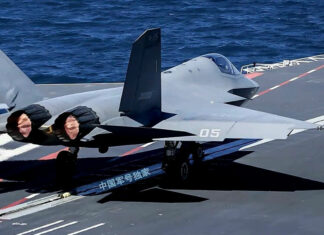
As traditional defense primes face mounting competition from agile “neoprimes” such as Anduril, Palantir and Helsing, the balance of innovation is shifting toward software-defined warfare and scalable, dual-use technologies, while global industry consolidation—marked by Boeing’s integration of Spirit AeroSystems and other strategic mergers—signals an intensified race to secure control over the defense technology value chain. Our Defense-Tech weekly report highlights these trends.
In early October 2025, a coordinated wave of unmanned aerial system (UAS) incursions—widely attributed to Russia—targeted critical infrastructure across at least ten European nations. The unprecedented campaign exposed the fragility of Europe’s air defenses...
Executive Summary
The past week (September 18-25, 2025) represents an inflection point where strategic defense concepts have transitioned from doctrine to tangible reality. An analysis of global events reveals four primary, interconnected trends shaping an...
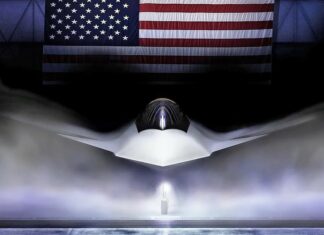
At the 2025 Air, Space & Cyber Conference, U.S. Air Force and Space Force leaders unveiled major updates on next-generation fighters, bombers, unmanned systems, and space initiatives, highlighting both rapid innovation and critical readiness challenges as the services race to outpace global competitors. A short version is available here, with a more detailed version for subscribers.
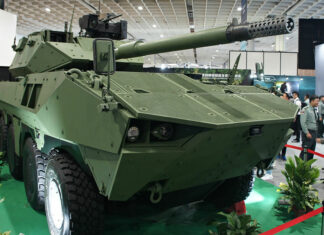
The Taipei Aerospace & Defense Technology Exhibition (TADTE) 2025 crystallized around four dominant strategic themes that collectively illustrate Taiwan's comprehensive approach to defense modernization amid escalating regional tensions. Based on a detailed report by Pleronix (available upon request). Includes a Podcast discussion on TADTE 2025's highlighting Taiwan's four strategic themes beyond the post's coverage.
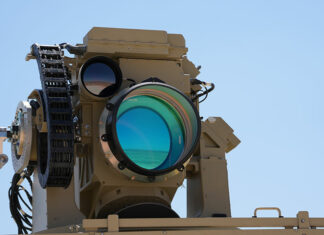
Israel’s Iron Beam 450 high-power laser system has completed final testing, marking a major leap in air defense. Developed by Rafael, it offers precise, cost-effective interception of rockets, UAVs, and mortars, and is set for IDF deployment by 2025.