
Tuesday, December 23, 2025
More
    Home Blog Page 87

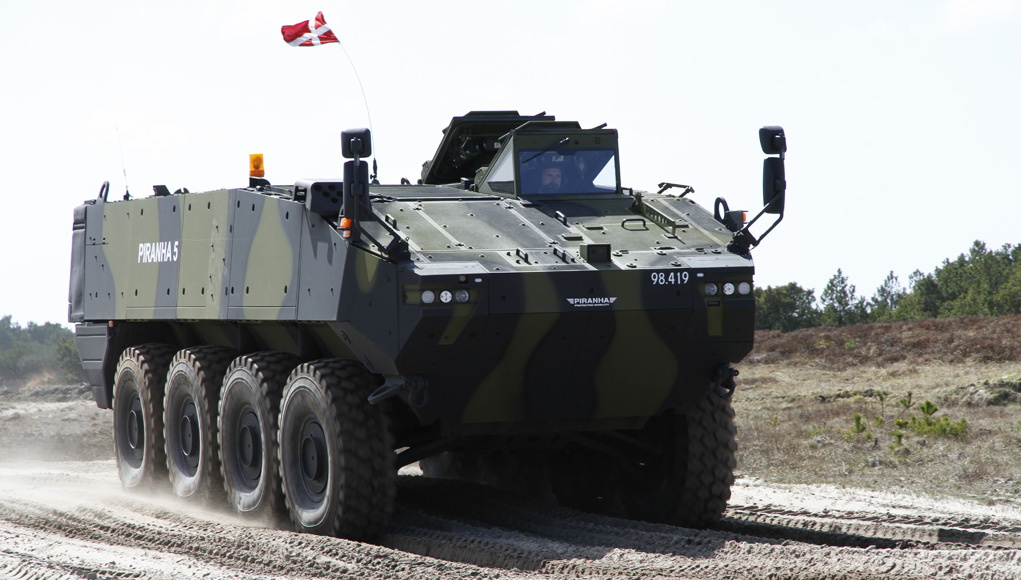
    Denmark to buy hundreds of Swiss Piranha 5 APCs to replace aeging M-113s

    GDELS Piranha 5. Photo: GDELS
    Piranha 5 undergoing evaluation in Denmark, 2013 - Photo: Lars Bøgh Vinther
    Piranha 5 undergoing evaluation in Denmark, 2013 – Photo: Lars Bøgh Vinther

    The Danish Ministry of Defense announced the selection of the Swiss Piranha 5 8×8 wheeled APC for the future armored personnel carrier of the Danish Army (Forsvaret).

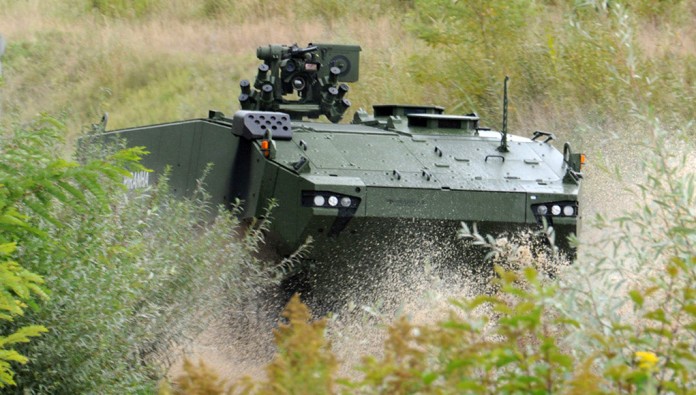
    Piranha 5, developed by Mowag GmbH, the Swiss subsidiary of General Dynamics Europe Land Systems (GDELS) was selected after a thorough evaluation of four candidates. In the final round the Swiss 8×8 APC has beaten the the tracked Swedish Armadillo CV90 from BAE Systems, GDELS ASCOD (recently selected for the British Scout SV program) and PMMC G5 modified M-113. Piranha 5 was one of two wheeled APCs evaluated – the other was its French rival, the 8×8 VBCI from Nexter.

    The Danish M-113 replacement program was considered one of the largest procurement of armored vehicles in Europe, evaluating both wheeled and tracked variants ‘head to head’.
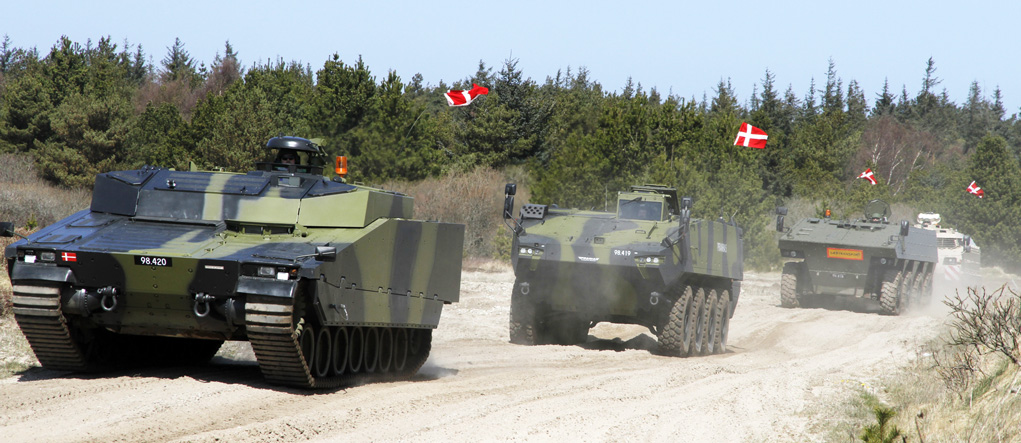
    danish_apc_tests_1021
    Four finalists lined up for the final Danish evaluations in 2013 – the CV90 Armadillo, Piranha 5, VBCI and PMMC G5. Photo: Lars Bøgh Vinther
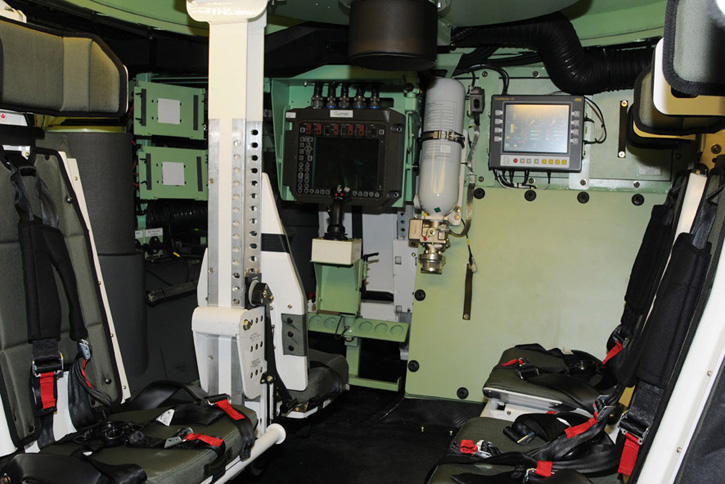
    An internal view of the Piranha 5 showing two blast protecting passenger seats, the gunner station remotely operating the Protector overhead weapon station, and the driver station in the far-left side. Photo: GDELS
    An internal view of the Piranha 5 showing two blast protecting passenger seats, the gunner station remotely operating the Protector overhead weapon station, and the driver station in the far-left side. Photo: GDELS

    Almost all candidates considered by the Danes were new vehicles. Except VBCI, which is in service with the French Army, the Piranha 5, Armadillo and G5 represent new designs. The ‘Protected Mission Module Carrier’ (PMMC) G5 is considered a ‘modified M113’ remanufactured into the G5, based on the design proposed by the German company FFG. However, all three represent model improvements of vehicles currently operational with the Danish Army (CV9035, Piranha IIIC and M-113). The M-113 replacement program was launched in 2011 with a procurement options for 206, 360 or 450 vehicles, in an armored personnel carrier, command vehicle, ambulance, mortar carrier, engineering and technical support variants. The Danish contract requires the supplier to bind to support the fleet over a period of 15 years.

    Denmark is planning to order at least 206 vehicles, but according to Danish Defense Minister Nicolai Wammen, the exact number is yet to be determined. Analysts forecast the total number could increase to 450. “With Piranha 5 we have found the armored personnel carrier that can best solve our defense tasks in the future” Wammen said.

    The defense department will cancel a planned tender for a new artillery system, thus clearing the necessary funding for the new APCs. Denmark is exploring options to rent or borrow artillery systems from another country to enable its military to retain proficiency operating modern artillery systems. Denmark is operating a battalion of M-109A3 self-propelled howitzers. Potential bidders for that program where Nexter of France, Samsung Techwin from South Korea and Israeli Elbit Systems Soltam.

    Full version available for subscribers
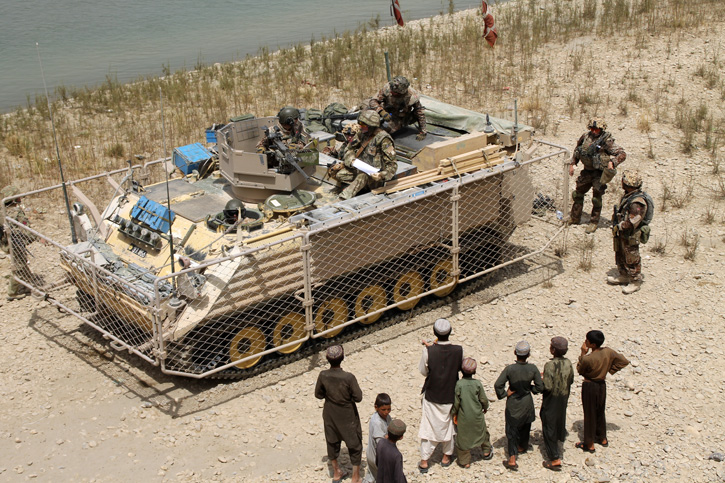
    m113G3afghanistan2011_725
    Danish M-113G3 on patrol in Afghanistan. Note this is the extended variant with six road wheels. Photo: Ronny Benjamin Vossen Rasmussen

    As the Danish government require significant offset buying for such significant military acquisitions, GDELS said it has already signed Industry Cooperation agreements with 40 Danish companies of all sizes and has already defined projects in excess of €0.5 billion (3,7 billion kroner) covering all of the technology areas defined in the Danish Government’s Defence Industry strategy.
    Qatar lines up as third International customer for Rafale

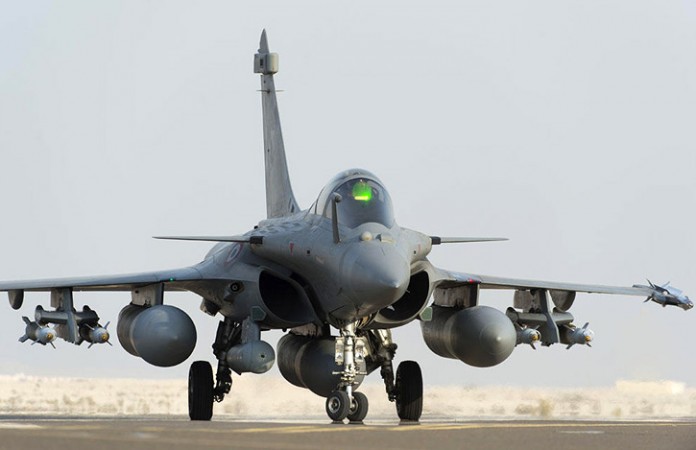
    The French Rafales performed the strike with GBU-12 laser guided, marking their targets with Damocles targeting pods. Photo: French Air Force, SIRPA

    Qatar has agreed to buy 24 Dassault Aviation-built Rafale fighter jets in a deal worth 6.3 billion euros ($7 billion), the French government said on Thursday.

    President Francois Hollande’s office said the deal was confirmed personally by  Sheikh Tamim bin Hamad Al-Thani, the emir of Qatar.  Hollande will travel to Doha on May 4 to sign the contract.

    France will start delivering Rafale fighter jets to Qatar from mid-2018 at the rate of 11 per year, the French Defense Ministry said.

    The contract — the third this year for Dassault after deals to sell Rafale jets to Egypt and India — also includes MBDA missiles, and the training of 36 Qatari pilots and 100 technicians by the French army, the French Defense Ministry said.  before heading to Saudi Arabia as an honorary guest at a summit of Gulf Arab leaders.

    The Rafale sales have lifted French arms exports this year to about 15 billion euros and have been a welcome boost for Dassault, which had been under increasing pressure to sell the plane overseas after years of failures.

    Other export prospects for the Rafale are still pending, after Dassault has resumed discussions over potential fighter sales to the UAE, where the French fighter is competing with the Eurofighter Typhoon on an order of 60 planes for the replacement of the Emirate’s Air Force’s Mirage 2000 fleet.

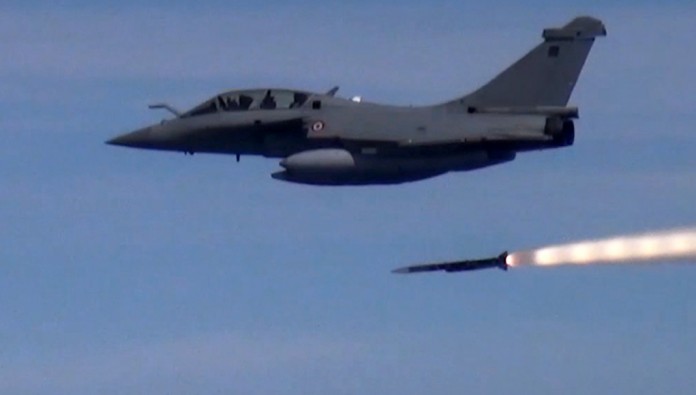
    First Meteor BVRAAM launched from Rafale

    France has performed the first launch and flight test of the 'Meteor' beyond visual range air-to-air missile from a Rafale combat jet. The missile is expected to be fielded in 2018 with the first batch of upgraded Rafale F3-R, which will also be fitted with RBE2 AESA radar and advanced Infrared Search Track system, enabling long-range engagement of hostile targets. Photo: DGA

    On 28th April 2015, teams from the French Ministry of Defence, Dassault Aviation and MBDA carried out the first guided firing of the long-range Meteor missile against an air target from a Rafale combat aircraft. The test flight followed earlier missile separation trials carried out on the rafale in 2013 and 2014. The recent firing was performed from a two-seat variant over the DGA missiles test range in Biscarosse near Bordeaux. The recent firing represents an important milestone in the integration of Meteor onto the Rafale in line with the development of the aircraft in the next Rafale F3-R standard. The first Meteor missiles will be delivered as of 2018 to equip the Rafales of the French Air Force and Navy.

    Subscribe to read the full text

    Updated: Russian Armata unveiled: a new family of armored combat vehicles

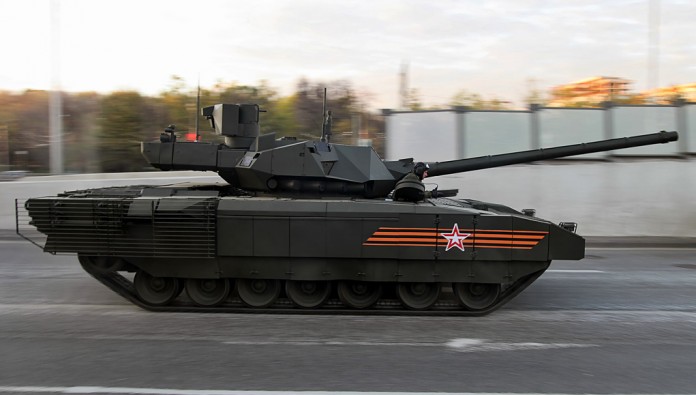
    The T-14 main battle tank is armed with a new model of the 125mm cannon, comprising a larger auto-loader packing 32 rounds. The weapon system is mounted on an unmanned turret with the two crew members seated in a protected cell in the hull. (Subscribers can click to enlarge) Photo: Vitaly Kuzmin
    The T-14 main battle tank is armed with a new model of the 125mm cannon, comprising a larger auto-loader packing 32 rounds. The weapon system is mounted on an unmanned turret with the three crew members seated in a protected cell in the hull. (Subscribers can click to enlarge) Photo: Vitaly Kuzmin

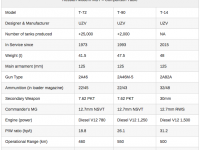
    The Russian Ministry of defense is lifting the veil on a new family of combat vehicles that has been under development in the past years. The new family scheduled to enter service with the Russian ground forces in the next years will be unveiled in public for the first time May 9th, 2015 on the traditional ‘Victory Day Parade’, marking the 70th anniversary of the victory over Nazi Germany.The new family of vehicles consists of the Armata, a new tracked platform that will replace existing platforms that have been used in the T72 and T90 tanks since the mid-70s. The platform provides a common chassis for some 13 different combat vehicles weighing below 50 tons.

    Subscriber content - click to enlarge
    Subscriber content – click to enlarge

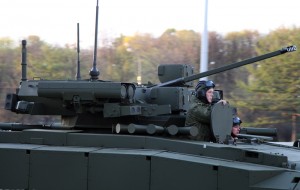
    These include the new T-14 main battle tank that weighs 48 tons and T-15 infantry carrier; a new variant of the tank support vehicle (Terminator), an armored recovery vehicle (ARV), MT-A bridgelayer, Combat Engineering Vehicle (CEV), BMO-2 support vehicle carrying multiple launchers of thermobaric rockets, and USM-1 minelayer. Another variant that could be added in the future is a self propelled artillery system (SPG). However, the new Coalitziya SM SPG displayed on the May 9 parade is still based on the T-90 chassis.

    An inspection of the T-14 tanks rehearsing for the May 9 parade shows a combination of layers of modular armor comprising active and hybrid protection. Adding protection beyond the frontal arc and sides is a common design feature today, adapting MBTs for combat in complex, urban terrain, where threats exist over 360 degrees.

    Subscribe to read the full version of this article
    Only $7.95 / month

    Additional slat armor is used to protect the engine compartment and enable easy access to the sprocket. The forward section of the belly mounts an active counter-mine protection. Countermeasure dischargers firing instant smoke obscurants are employed, on both sides of the turret as part of the overall protection system.

    T15AIFV_1021
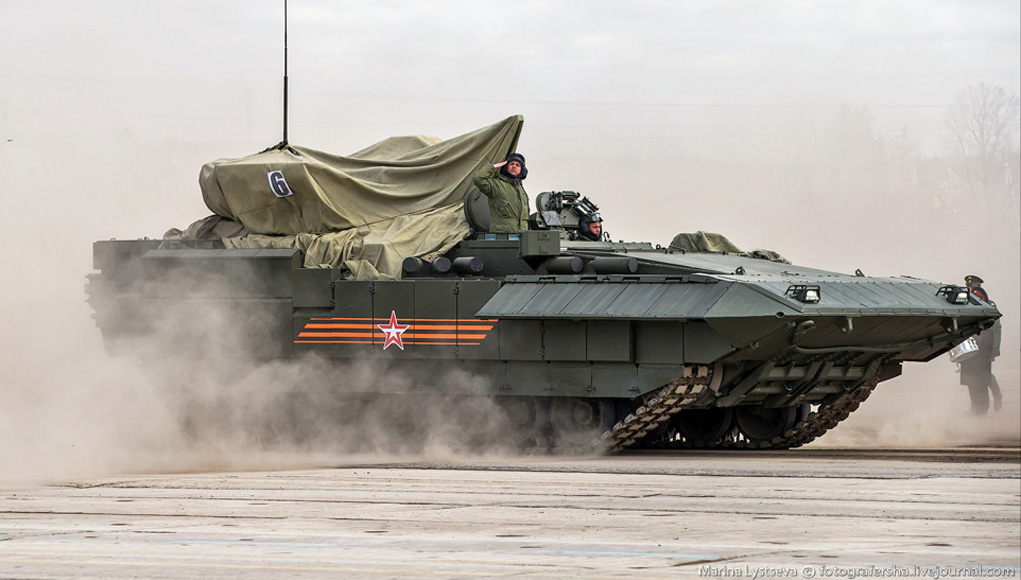
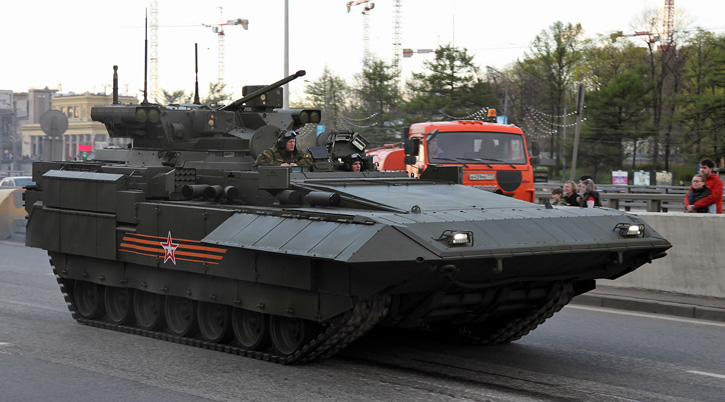
    The Armata-chassis based T-15 BMP uses a front-mounted engine. The vehicle is manned by a crew of three and carries a squad of eight soldiers. The vehicle is equipped with remotely operated gun turret mounting a 30mm cannon, 7.62 coax MG and four Kornet E guided missiles. Note the five canisters pointing outward, these are likely parts of the vehicle’s self-protection system.  Photo: Marina Lystseva
    The T-15 carries a complex remotely operated weapon system comprising the 30mm automatic cannon (with 500 rounds), 7.62 mm coaxial machine gun, four Kornet E guided missiles, optronic systems for target acquisition and missile guidance and hard and soft kill active protection systems.
    The T-15 carries a complex remotely operated weapon system comprising the 30mm automatic cannon (with 500 rounds), 7.62 mm coaxial machine gun, four Kornet E guided missiles, optronic systems for target acquisition and missile guidance and hard and soft kill active protection systems.

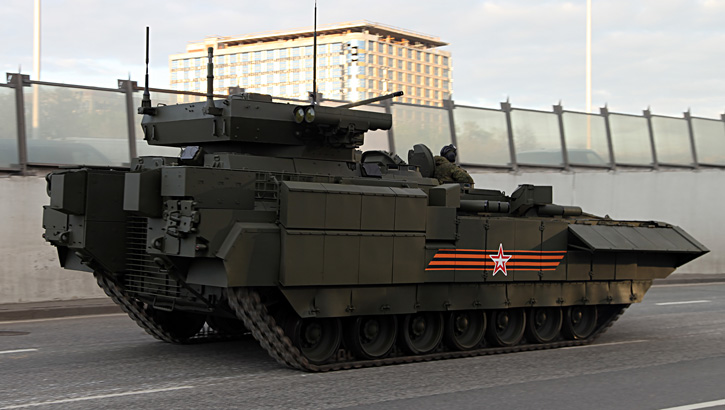
    The T-15 IVF (BMP) also shares the common Armata chassis. As a troop carrier, it will replace the current BMP-2 variants offering much improved mobility and protection although at a significant weight increase. The vehicle is operated by three crew members and accommodates eight troops. It is likely to be equipped with a new remotely operated weapon station designed by KBP. This turret mounts the 2A42 30mm cannon with 500 rounds, 7.62 coaxial machine gun and four Kornet-EM guided missiles (two on each side). The T-15 shares a protection system similar to that of Armata.

    An elevated view of the new T-15 BMP, based on the Armata chassis. Photo: Vitaly Kuzmin
    An elevated view of the new T-15 BMP, based on the Armata chassis. Photo: Vitaly Kuzmin
    A rear view of the new T-15 BMP, based on the Armata chassis. Note the bar armor protecting the ramp. Photo: Vitaly Kuzmin
    A rear view of the new T-15 BMP, based on the Armata chassis. Note the bar armor protecting the ramp. Photo: Vitaly Kuzmin

    Updated: Kurganets-25 – a new family of medium troop carriers from Russia

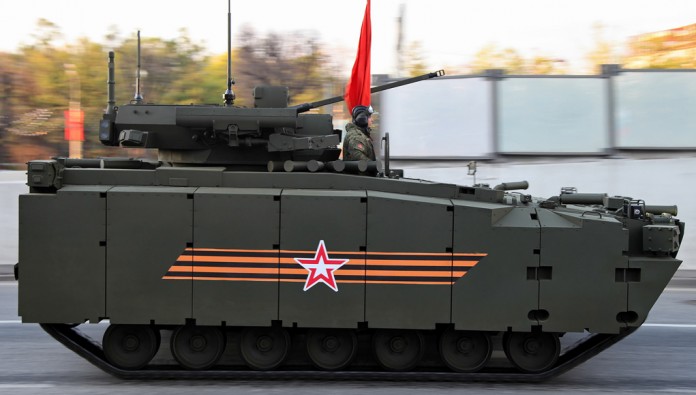
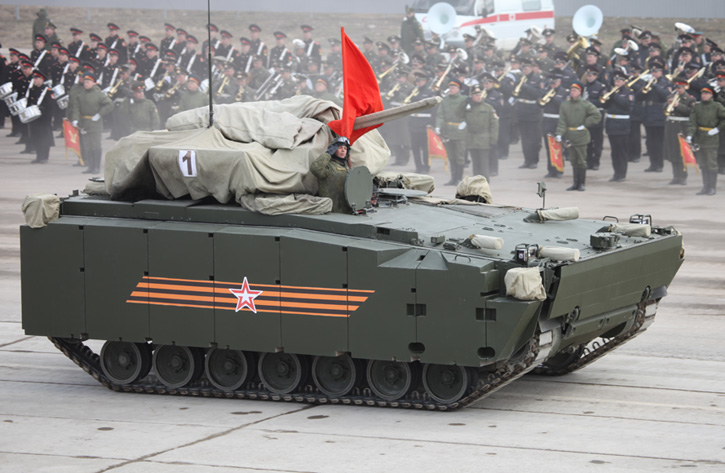
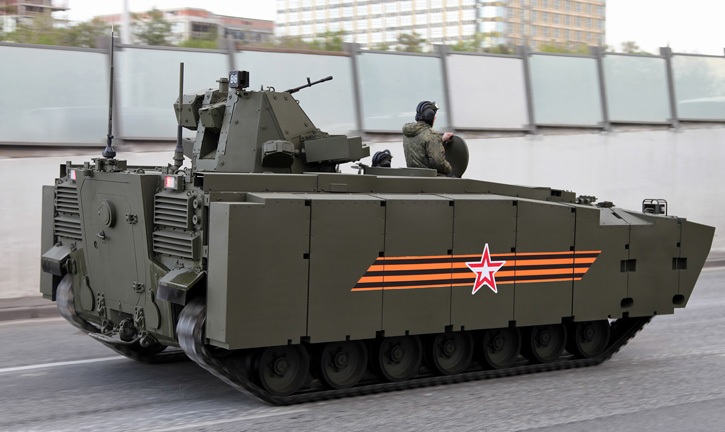
    This BTR variant of Kurganets 25 is equipped with a 7.62mm remotely operated weapon station. Photo: Vitaly V. Kuzmin

    The Russian army is displaying the first mechanized unit deployed with the new Kurganets-25 armored fighting vehicles during the May 9th parade in Moscow. This is the first public unveiling of the new armored vehicle, that has been in development in the past decade. The new family of vehicles was designed and produced by KMZ (Kurganmashzavod), the manufacturer of the BMP-2, BMP-3 and BMD vehicles.

    The new Kurganets-25 armored infantry fighting vehicle is designed to replace a number of combat vehicles currently used in mechanized divisions, such as BMP and MT-LB platforms. Kurganets-25 represents a distinctive change from the traditional Russian low profile design. The new vehicle is higher, thus better designed for mounted combat, rather than a troop carrier. Higher floor also means better IED and mine protection, better adapting the vehicle to asymmetric warfare.

    kurganets_25_ws_side725
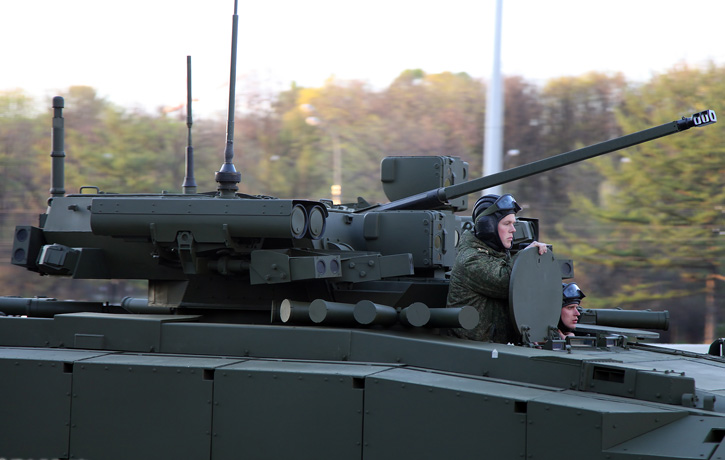
    KBP Epoch weapon station mounted on Kurganets 25 BMP. Photo: Vitaly V. Kuzmin
    kurganets_25_ws_side725
    KBP Epoch weapon station mounted on Kurganets 25 BMP. Photo: Vitaly V. Kuzmin

    Although some press reports indicated that Kurganets-25 has high commonality with the Armata platform, an external view does not show such similarity, except the KBP Epoch turret that is common to both Kurganets-25 BMP and T-15 BMP. The engine, tracks, armor modules seem to be different. The two vehicles are also unlikely to be deployed together, as the T-14 and T-15 are expected to deploy with armored formations while Kurganets-25 platforms will equip the mechanized units.

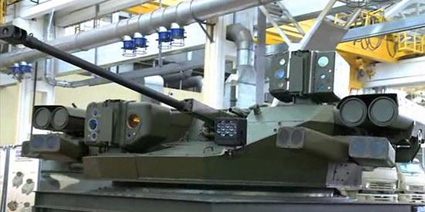
    Provided with a modular armor suite, Kurganets 25 offers an increased armor protection, compared to BMP-3 / BMD 4. As the BMP-3, it can also employ an active protection system. Similar to the T-15, Kurganets 25 mounts the KBP Epoch unmanned turret mounting a single 2A42 30mm cannon, 7.62 PKT coaxial machine gun and four Kornet EM guided missiles. Unlike previous manned turrets that occupied significant space in the fighting compartment, the Epoch is remotely controlled and does not penetrate the deck, thus simplifying the structural design and clearing more space for troops and supplies.

    Vetronics systems integrated as standard include a fire control system, a day/night sight for the gunner, a missile guidance system for the Kornets, and independent sight for the commander. The vehicle is also equipped with peripheral cameras providing visual situational awareness for the troops.

    kurganets-25_bmd4_comparison
    As can be seen from this image, Kurganets 25 is much bigger than the airborne capable BMD, and weighs twice as much.

    The 800 hp power pack is located at the front, clearing the space and access to an infantry squad of eight troops. Crew of three – commander, weapon operator and driver, operates the vehicle.

    As an amphibious vehicle weighing 25 tons, Kurganets 25 can swim in water at a speed of 10 km/h using two waterjet propulsion modules and a wave breaker that opens as the vehicle splashes into the the water. On land the vehicle can move off road at speed up to 80 km/h using the rubber padded tracks and suspension system comprising seven road wheels and torsion bars. Its maximum road speed is 80 km/h.

    kurganets_25_bmp_725
    Kurganets-25 BMP mounting KBP Epoch remotely operated turret. Note the covered sensors on each end and covered tubes, which could be part of the vehicle’s active protection system. Photo: VItaly Kuzmin
    Kurganets 25 BTR - APC equipped with 7.62mm remotely controlled weapon station. Photo: Vitaly V. Kuzmin
    Kurganets 25 BTR – APC equipped with 7.62mm remotely controlled weapon station. Photo: Vitaly V. Kuzmin

    Poland embarks on a $7 Billion Missile Defense System with the US

    The Polish MOD has selected the US company Raytheon to provide the Polish ‘NAREW’ future medium-range missile defense system. Poland has rejected the offer of the European consortium headed by the Thales Group. The program will include the procurement of eight batteries over 10 years, and is estimated to be worth 26 billion zlotys (about US$7 billion).

    Defense Minister Tomasz Siemoniak will also negotiate an offset agreement to guarantee the participation of Poland’s defense companies in the building of the system, the Polish defense ministry said.

    Last week Raytheon has announced it has received a contract worth $2 billion from an undisclosed international customer, for its Patriot air defense systems.

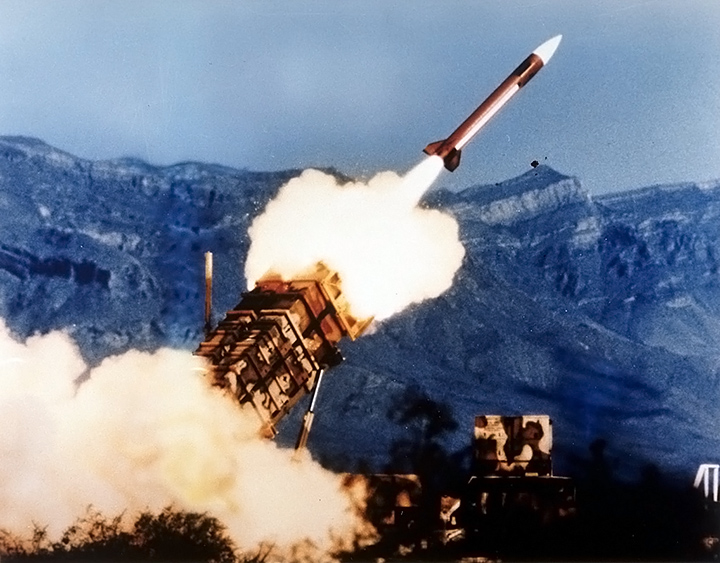
    Patriot_PAC-2_Launch_White_Sands

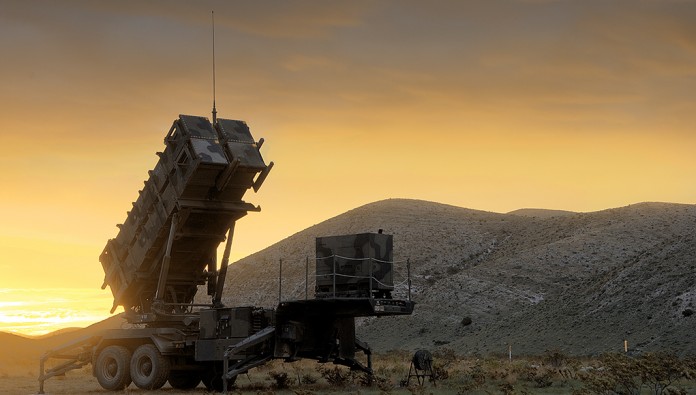
    Poland is seeking to deploy a medium-range air and missile defense system, based on existing technology. Raytheon’s proposed the Patriot Missile with optional Patriot PAC4 upgrade (utilizing the stunner missiles Raytheon is developing with Israel’s missile company RAFAEL.

    Last year the Poles rejected Israel’s David’s Sling system, as they insisted to consider only matured, operational system, while David’s Sling is still in development. David’s Sling is expected to reach operational capability in 2016.

    Advanced Technology Countering Terror Threats

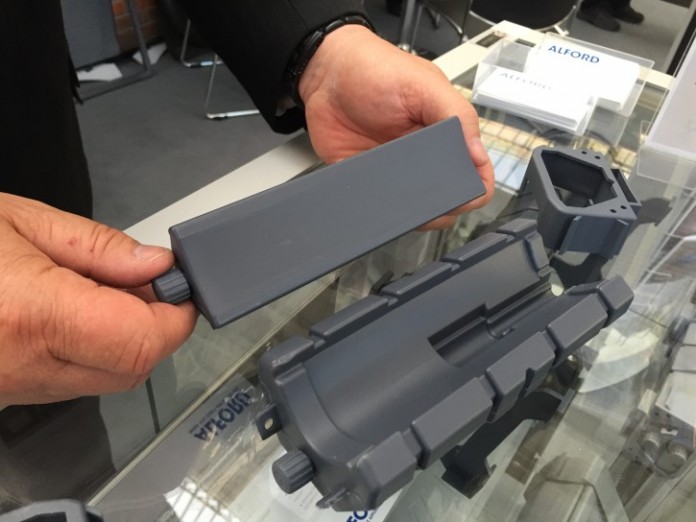
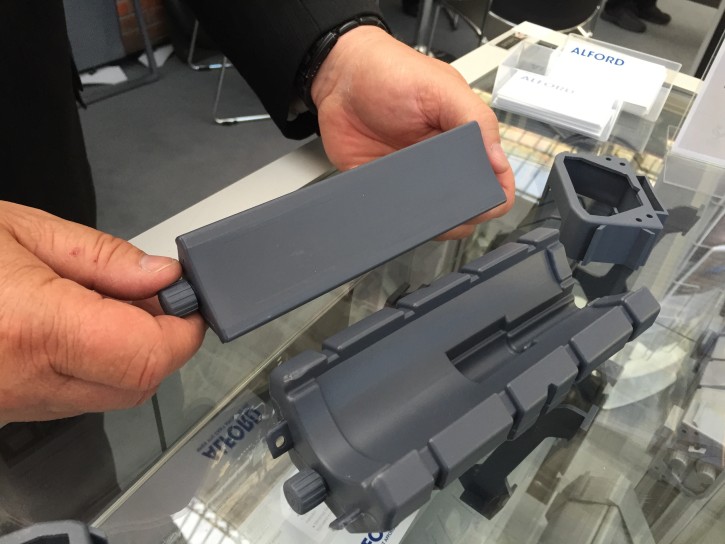
    Alford Technologies displayed a wide range of water projecting disruptors, for deployment against small and large IEDs, including vehicle borne IEDs (VBIED). The device is using a wate container surrounded by a linear shaped charge. When activated, the explosion forms a jet of water slicing through a suspected object at a speed of 1200 m/sec, devastating the target and disrupting its triggering mechanism. While devastating at a close range, the water jet rapidly dissipate at longer range, thus eliminating collateral damage. Photo: Tamir Eshel, Defense-Update.

    The following photos are part of Defense-Update coverage of breaking news at the Counter Terror Expo that opened today in London.

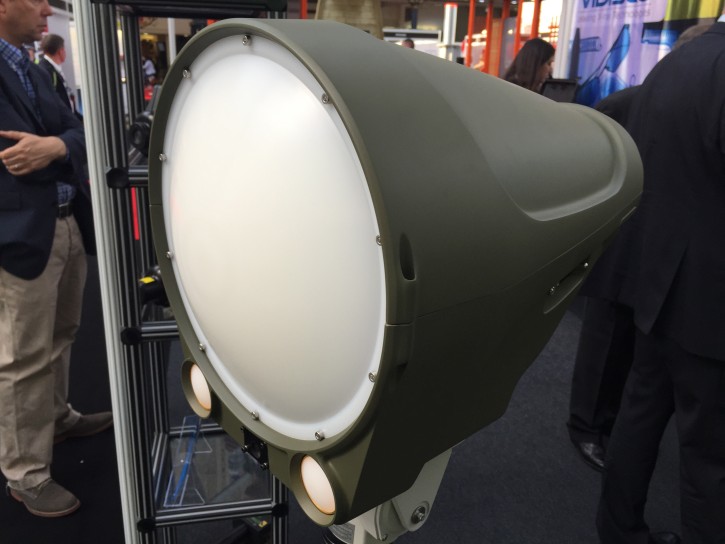
    Ultra Electronics Maritime Systems offers a communications device that can link 4Khz of digital voice or data to a diver or vehicle 50 meter underground, or submerged. Several such devices can be used to locate (triangulate) a and track vehicles underground, underwater or in tunnels and mines. Photo: Tamir Eshel, Defense-Update
    Ultra Electronics Maritime Systems offers a communications device that can link 4Khz of digital voice or data to a diver or vehicle 50 meter underground, or submerged. Several such devices can be used to locate (triangulate) a and track vehicles underground, underwater or in tunnels and mines. Photo: Tamir Eshel, Defense-Update
    Radio Physics displayed the polymeric Millimeter-Wave Radar Threat Level Evaluation (MiRTLE), a polymetric radaroperating at the 75-110 GHz wave band, that detects suicide bombers from a distanceof 30-40 meters. The tripod radar can detect various threats based on the composition of material, from a distance if 6-40 meters. A hand-held system weighing 2.8 k is also available, capable of detecting threats at range up to 10 meters. Photo: Tamir Eshel, Defense-Update
    Radio Physics displayed the polymteric Millimeter-Wave Radar Threat Level Evaluation (MiRTLE), a polymetric radaroperating at the 75-110 GHz wave band, that detects suicide bombers from a distanceof 30-40 meters. The tripod radar can detect various threats based on the composition of material, from a distance if 6-40 meters. A hand-held system weighing 2.8 k is also available, capable of detecting threats at range up to 10 meters. Photo: Tamir Eshel, Defense-Update
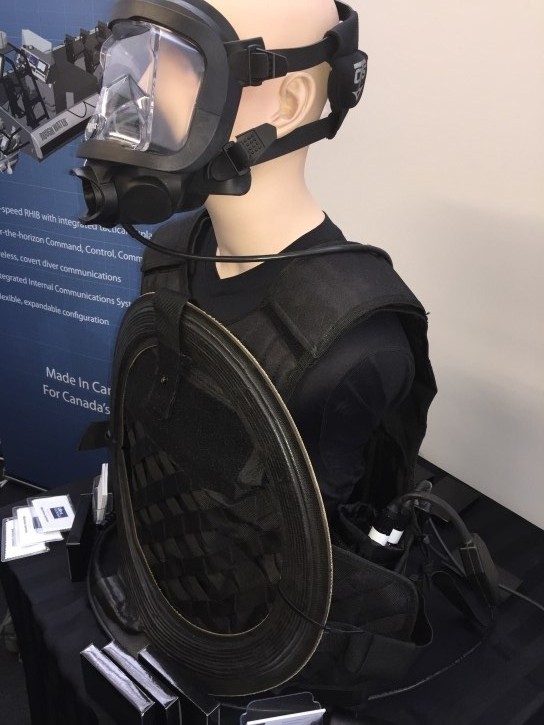
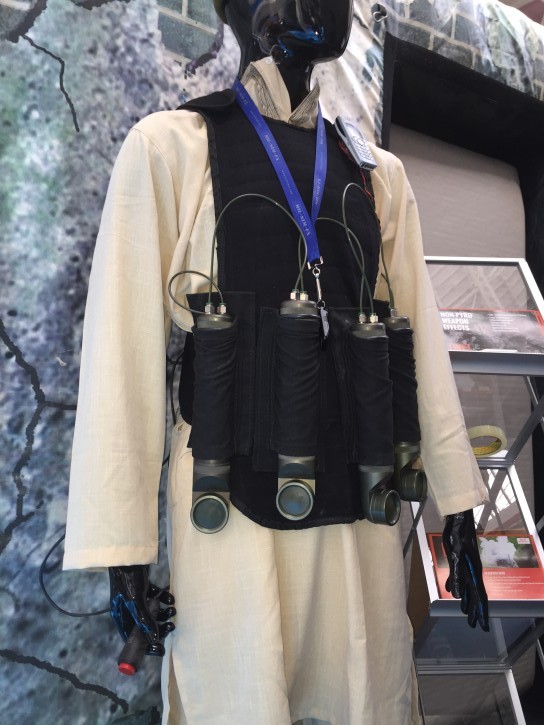
    WeaponsEffects (WE) has been offering military and law enforcement non-pyrotechnic weapon effects that realistically simulate threats, including this suicide vest kit, worn by insurgent opforce. to simulate the behavioral psychological effect of suicide bombers attacks . The charges are powered by compressed gas (CO2 ) and create a noise, flash/smoke effect. Photo: Tamir Eshel, Defense-Update
    WeaponsEffects (WE) has been offering military and law enforcement non-pyrotechnic weapon effects that realistically simulate threats, including this suicide vest kit, worn by insurgent opforce. to simulate the behavioral psychological effect of suicide bombers attacks . The charges are powered by compressed gas (CO2 ) and create a noise, flash/smoke effect. Photo: Tamir Eshel, Defense-Update
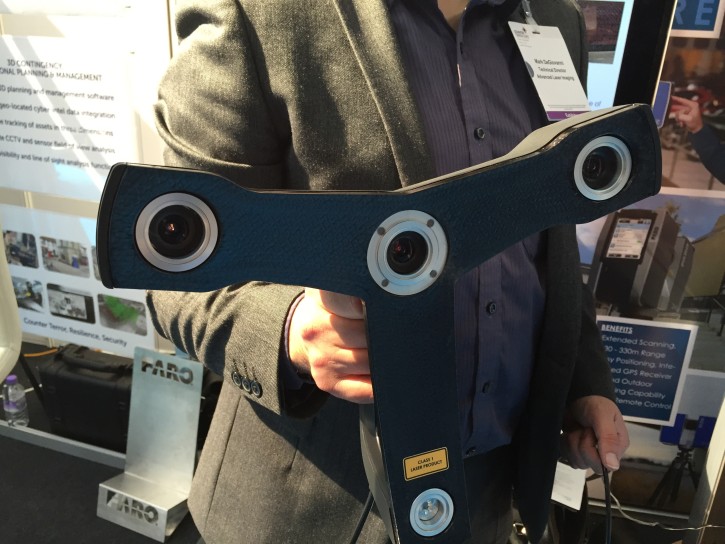
    Advanced Laser Imaging displayed a 3D laser scanner that can be mounted on tripod, robot or multirotor, providing rapid and accurate 3D model of a scene. For recording of a crime scene, the hand held Freestyle 3D scanner is used, providing accurate, simple and affordable solution for crime scene recording. Photo: Tamir Eshel, Defense-Update
    Advanced Laser Imaging displayed a 3D laser scanner that can be mounted on tripod, robot or multirotor, providing rapid and accurate 3D model of a scene. For recording of a crime scene, the hand held Freestyle 3D scanner is used, providing accurate, simple and affordable solution for crime scene recording. Photo: Tamir Eshel, Defense-Update
    Alford Technologies displayed a wide range of water projecting disruptors, for deployment against small and large IEDs, including vehicle borne IEDs (VBIED). The device is using a wate container surrounded by a linear shaped charge. When activated, the explosion forms a jet of water slicing through a suspected object at a speed of 1200 m/sec, devastating the target and disrupting its triggering mechanism. While devastating at a close range, the water jet rapidly dissipate at longer range, thus eliminating collateral damage. Photo: Tamir Eshel, Defense-Update.
    Alford Technologies displayed a wide range of water projecting disruptors, for deployment against small and large IEDs, including vehicle borne IEDs (VBIED). The device is using a wate container surrounded by a linear shaped charge. When activated, the explosion forms a jet of water slicing through a suspected object at a speed of 1200 m/sec, devastating the target and disrupting its triggering mechanism. While devastating at a close range, the water jet rapidly dissipate at longer range, thus eliminating collateral damage. Photo: Tamir Eshel, Defense-Update.

    Iran plans fielding Bavar 373 air & missile defense system this year

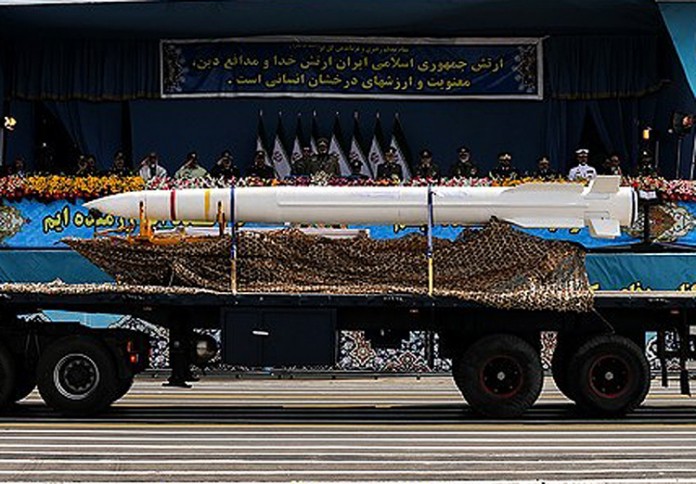
    Iranian Sayyad-3 missile is part of the new Bavar-373 air and missile defense system Iran has developed, to fulfil the role of the Russian S-300 that has been denied by the Russians since 2010. Photo: FARS News

    Iran unveiled yesterday the Bavar-373, an indigenous long-range air defense missile defense system employing Sayyad-3 (Hunter III) interceptor during the Army National Day parade. Iran launched the indigenous development program after the delivery of Russian S300 systems was suspended under the sanctions imposed on Iran by the UN in 2010. Immediately after the cancellation of the Russian sale Iran displayed a mockup of a similar weapon during a military march in Tehran, claiming it is developing its own version of the system.

    Tehran’s declaration was not an empty promise. In the recent years Iran has made significant progress in its air defense capabilities in recent years, with the modernization of obsolete systems such as the US MIM-23 Hawk and Standard Missile I supplied in the 1970s by the US, and the introduction of locally developed Ta’er (SA-11/17 equivalent) and Sayyad-2 missiles that are being integrated into existing air defense systems. Iranian officials have also announced that Bavar-373 could be deployed operationally this year, reflecting an accelerated development and testing process, since the system’s interceptor, Sayyad-3 missile was tested on its first launch only in August 2014.

    Iranian Sayyad-3 surface-to-air missile is developed as part of the Bavar-373 air and missile defense system. Photo: FARS News
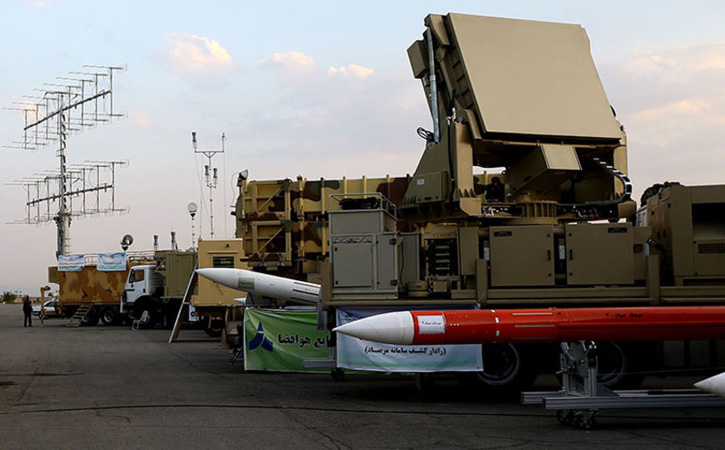
    Iranian Sayyad-3 (red, in the front) and Sayyed-2 (white in the back) surface-to-air missiles developed by Iran. The Sayyad-3 interceptor is part of the Iranian Bavar-373 air and missile defense system. The Mersad radar, associated with Sayyad-2 system is seen in the front.

    This rapid pace of development could be explained by Iranian access to S-300 subsystems. According to unconfirmed news reports, such systems were delivered prior and after 2010 from Russia, Belarus or Croatia. Last week Russian president Vladimir Putin said he approved the release of S-300 system to Iran. The first system could be delivered within a year.

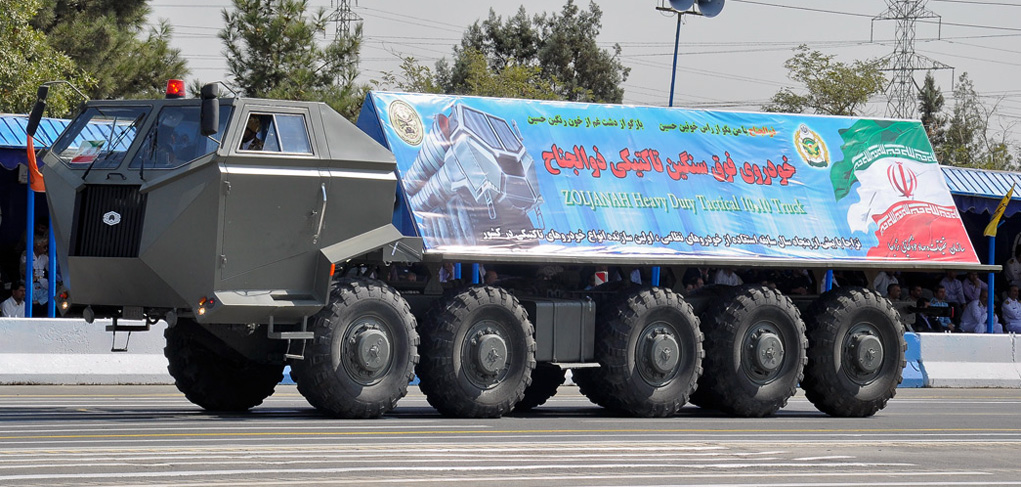
    The Iranians claim the Bavar 373 system is capable of handling 100 targets – just as the S-300 can, but the targeting capability of the Iranian system is superior over the S-300 they originally ordered from Russia a decade ago. The Iranians also claim their system can deploy faster and offers better mobility, compared to the original Russian system. The system could be deployed on a 10-wheel missile carrier, deploying four missiles in ready to launch canisters.

    If Bavar-373 proves to be as reliable and effective as the S-300, and its test program is completed in time, it is likely that Iran would limit the number of systems procured from Russia.

    THe Zoljanah 10x10 heavy duty truck was displayed for the first time in 2012. It is believed to be the platform carrying four Sayyad-3 missiles in sealed canister-launchers.
    THe Zoljanah 10×10 heavy duty truck was displayed for the first time in 2012. It is believed to be the platform carrying four Sayyad-3 missiles in sealed canister-launchers.

    X-47B demonstrates autonomous aerial refueling over the Atlantic Ocean

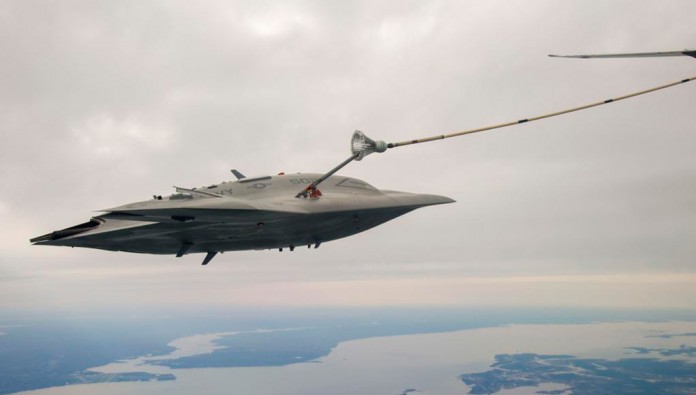
    A new milestone in the history of unmanned aircraft was made yesterday, as ‘Salty Dog 502’ the first drone designed to operate from US Navy carriers linked to adrogue of an Omega tanker off the coast of Maryland. Although an autonomous aerial refueling between two unmanned aircraft has already been demonstrated by DARPA in 2012, (involving two RQ-4 Global Hawk drones) the recent demonstration represented the first time such operation was performed with standard refueling assets regularly used for manned aircraft.

    The autonomous aerial refueling (AAR) tests performed by the Unmanned Carrier Air Vehicle demonstrator (UCAS-D) this month represent the finale of this ambitious program, Naval Air Systems Command said this week. Following these tests the two X-47B unmanned aerial vehicles built by Northrop Grumman will be sent to museums or rest at the boneyard at Davis Monthan Air Force Base, Ariz., as the Navy’s UAS section, PMA-268 is focused on the next generation program – the Unmanned Carrier Launched Surveillance and Strike (UCLASS). The contract funding these refueling tests will end in June 2015.

    Despite call in Congress to extend testing on the Northrop platforms, the Navy said the two programs are different and the costs involved in converting the UCAS-D to meet UCLASS requirements would be prohibitive, within the current program budget.

    Under the UCAS-D testing program the two jet-powered drones, named Salty Dog 501 and Salty 502 performed catapult launch and arrested recovery abroad the aircraft carrier George H.W. Bush (CVN-77) in 2013, and extended the mission to conduct autonomous aerial refueling tests in 2015.

    NAVAIR said the scope of the planned testing included the catapult launch and arrested recovery aboard a Navy aircraft carrier — both which occurred on the USS George H.W. Bush (CVN-77) in 2013 — as well as an autonomous aerial refueling test.

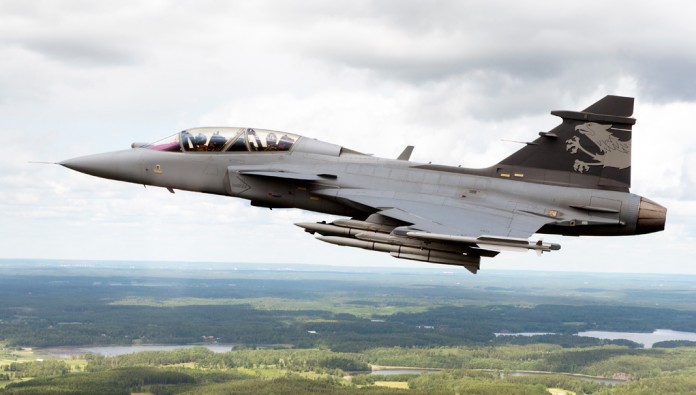
    IRST sensors, expendable Jammers for the Swedish Gripen-E

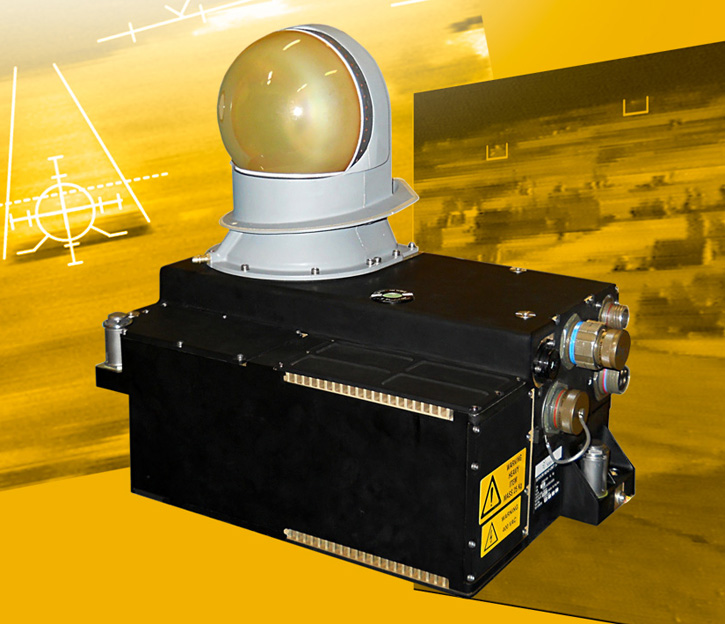
    skyward_725
    With the IRST a Gripen can detect and track enemy targets, including aircraft, naval vessels and ground vehicles. The system can also complement the radar by tracking the heat signatures of stealthy targets that are not visible or trackable by radar. Photo: Selex ES

    Selex ES announced it has signs contract with Saab for the supply of 60 Skyward-G InfraRed Search and Track (IRST) Skyward for Saab’s Gripen E. The new systems will equip the Swedish Air Force’s Gripen E fleet. Saab is developing the new version for the Swedish Air Force. Skyward-G can silently detect threats, at beyond-visual range without relying on active (radar) emissions that could betray the aircraft’s intentions and position to hostile forces. With the IRST a Gripen can detect and track enemy targets, including aircraft, naval vessels and ground vehicles. The system can also complement the radar by tracking the heat signatures of stealthy targets that are not visible or trackable by radar.

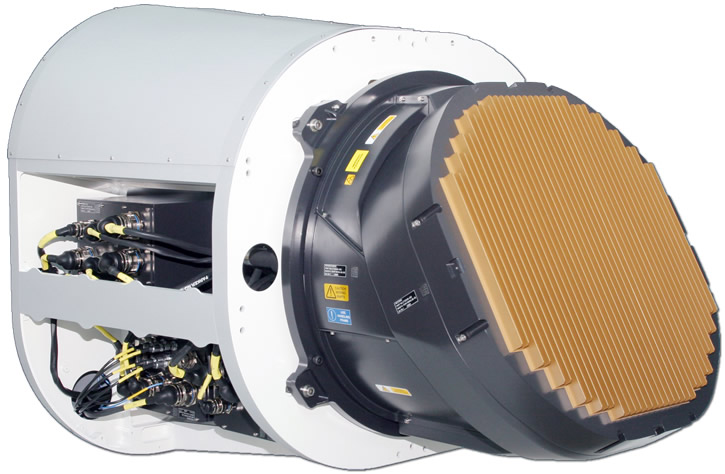
    Raven_ES_05_725f.jpeg
    The production contract for the production of Selex ES Raven ES-05 AESA radar for the Gripen E/NG was signed in July 2014. Photo: Selex ES

    Finmeccanica– Selex ES also provides the fighter aircraft with the Raven ES-05 AESA (active electronically scanned array). The production contract for the radar was signed in July 2014. Finmeccanica – Selex ES’s participation in the Gripen NG programme dates back to 2009, when an agreement was signed with Saab for the development of the Raven ES AESA radar. This was followed in 2010 by the selection of the Skyward-G IRST sensor and the IFF system. A production-standard Raven AESA radar is now installed on Gripen demonstration aircraft. Flight testing of the radar with the Skyward G IRST have been underway since March 2014, achieving excellent results and demonstrating the value of a passive sensor as an integral part of a weapons system. With the Raven ES-05 radar, Skyward-G and Mode 5 Identification Friend/Foe (IFF) systems Finmeccanica– Selex ES already provides about 30 percent of the next-generation Gripen’s electronics. In addition, Saab is also offering the BriteCloud Expendable Active Decoy (EAD) as an electronic warfare option for the Gripen E. In 2013 Saab teamed with Finmeccanica– Selex ES becoming the first partner to offer the new decoy as an electronic warfare enhancement option on all Gripen aircraft. (Continue reading)

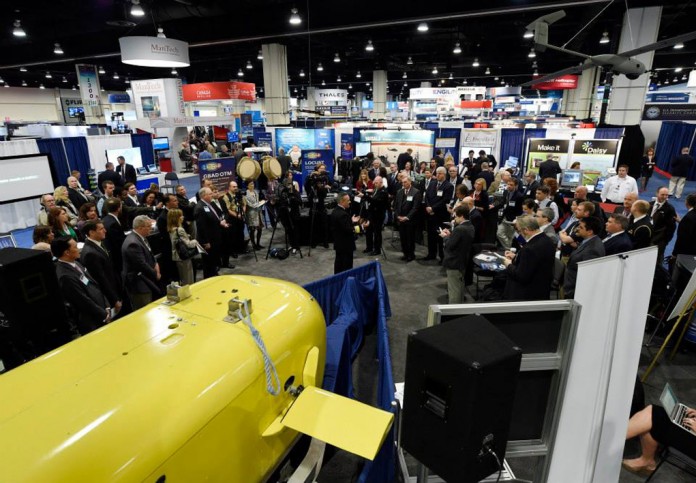
    Unmanned and autonomous – deep in the ocean and swarming in the air

    The US Navy Office of Naval Research (ONR) completed the first phase of flight testing of swarming unmanned aerial vehicles (UAVs), as part of the Low-Cost UAV Swarming Technology (LOCUST) program.

    The ONR demonstrations, which took place over the last month in multiple locations, included the launch of Coyote UAVs capable of carrying varying payloads for different missions. Another technology demonstration of nine UAVs accomplished completely autonomous UAV synchronization and formation flight.

    ONR has conducted in recent weeks several demonstrations of swarming unmanned aerial vehicles as part of the Low-Cost UAV Swarming Technology (LOCUST program). Photo: US Navy
    ONR has conducted in recent weeks several demonstrations of swarming unmanned aerial vehicles as part of the Low-Cost UAV Swarming Technology (LOCUST program). Photo: US Navy

    “The recent demonstrations are an important step on the way to the 2016 ship-based demonstration of 30 rapidly launched autonomous, swarming UAVs,” said ONR program manager Lee Mastroianni. According to Navy officials, LOCUST can launch swarming UAVs to autonomously overwhelm an adversary, providing Sailors and Marines a decisive tactical advantage.

    LOCUST consists of autonomous, unmanned aerial systems (UAS) launched from a tube-based launcher that can send UAVs into the air in rapid succession. On their mission these mini drones establish a communications network that utilizes information-sharing, enabling autonomous collaborative behavior in either defensive or offensive missions.

    Since the launcher and the UAVs themselves have a small footprint, the technology enables swarms of compact UAVs to take off from ships, tactical vehicles, aircraft or other unmanned platforms.

    The Coyote UAV developed by Advanced Ceramics Research in 2009 (the company was later acquired by BAE Systems and has recently been acquired by Raytheon). With an electrical propulsion that sustains missions for 90 minutes, Coyote carries an EO/IR payload and data transmitter on intelligence, surveillance, and reconnaissance (ISR) missions. Designed with foldable wings and tail, the tube-launched drone can deploy from standard sonobuoy container on maritime-patrol aircraft or anti-submarine warfare (ASW) helicopters, as well as ground or surface (naval) launchers.

    The original Coyote was designed to operate autonomously or interactively, under remote control, using VHF/UHF communications. The drones tested during the recent experiment represent new, autonomous capabilities. ONR officials note that while the LOCUST autonomy is cutting edge compared to remote-controlled UAVs, there will always be a human monitoring the mission, able to step in and take control as desired. “This level of autonomous swarming flight has never been done before,” said Mastroianni. “UAVs that are expendable and reconfigurable will free manned aircraft and traditional weapon systems to do more, and essentially multiply combat power at decreased risk to the warfighter.” At a takeoff weight of 5.9kg (13 pounds) Coyote flies a 60 minute mission, with a payload weighing 0.9 kg (1.9 pounds). Previously the entire weight was required for EO/IR payloads but today, as EO/IR payloads are becoming lighter and more affordable, some of the LOCUST swarm could be fitted with higher performance sensors, acting as ‘sensors’ while others carry less capable but lighter EO/IR payloads and lethal warheads, acting as ‘stingers’.

    According to the Chief of Naval Operations Adm. Jonathan Greenert, in 10-15 years “Unmanned systems in the air and water will employ greater autonomy and be fully integrated with their manned counterparts.”

    While UAVs and swarms are offering offensive operational advantages, they also represent significant new risks for the protection of our own forces. To address those risks the US Navy is enhancing Ground Based Air Defense (GBAD) with new sensors and high energy lasers. The land-based Ground-Based Air Defense On-the-Move is planned to enhance current systems protecting deployed marine corps forces. GBAD is a vehicle-based, mobile, high-energy laser that is a cost-effective defense against asymmetric threats like UAVs. GBAD’s evolution has mirrored that of other directed-energy programs sponsored by ONR, including the Laser Weapon System (LaWS) that is today operating aboard USS Ponce in the Arabian Gulf. On display at SAS were the Israeli made system’s Multi-mode Hemispherical Radar (MHR), and a model of the systems’ planar waveguide laser. (Continue reading)

    Gripen NG to become an aerospace growth engine for Brazil

    Following the Memorandum of Understanding announced on 11 July 2014, Saab and Embraer have signed today an agreement for the joint management of the F-X2 Project for the Brazilian Air Force. “The Brazilian Air Force sees with great enthusiasm this additional incentive to the Brazilian industry, through the companies of the defense sector. This new strategic partnership confirms that we are building a promising future. The defense industry needs to be increasingly strengthened as it is one of the main drivers of scientific and technological development of our country”, said Aeronautics Commander, Air Force Brigadier General Nivaldo Luiz Rossato.

    The sale of 36 Gripen NG aircraft to Brazil under a contract worth US$ 4.55 Billion provides for a complete, ‘turnkey weapon system’, with comprehensive logistic support that includes training, spare parts, support, planning and maintenance. The order comprises 28 single-seater Gripen NG aircraft (a configuration similar to Sweden’s Gripen E model). In addition, Brazil will partner with Sweden for the development and production or eight two-seater aircraft. Saab will deliver the aircraft over a period of five years, from 2019 until 2024.

    Beginning in the second half of 2015, a team of Embraer engineers and technicians will be based in Sweden to conduct initial training in the maintenance and development work for the Gripen NG. This skill and competence will subsequently be transferred to Brazil. Embraer and Saab will build an Engineering Centre at Embraer’s industrial plant in Gavião Peixoto, in the state of São Paulo, to support operations of the Gripen NG fighters with the Brazilian Air Force.

    LAAD 2015: Expanding Brazil’s wheeled armored vehicle family

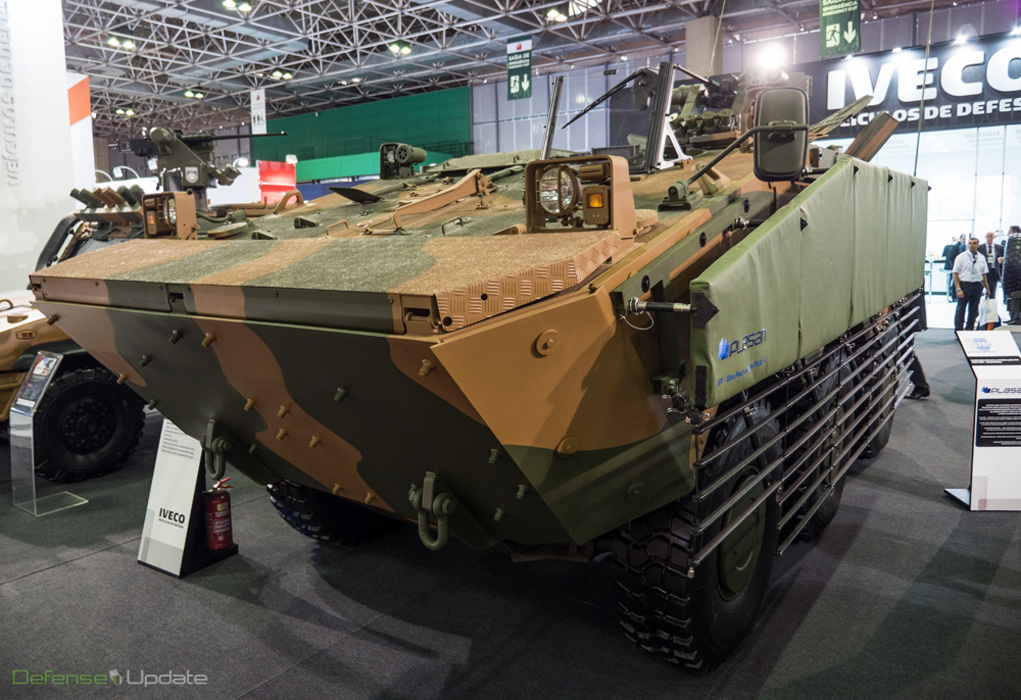
    The production of 2044 VBTP-MR Guarani armored personnel carriers for the Brazilian Army is one of the major military procurement programs currently underway in Brazil. An 18 ton 6×6 armored personnel carriers, developed by the Italian company Iveco Defense Vehicles (CNH) in partnership with the Brazilian Army and produced in Brazil at Sete Lagoas. Since the beginning of full rate production in 2013 Iveco has delivered 190 vehicles. These vehicles are gradually replacing the Urutu and Cascavel vehicles, produced by the Brazilian company Engesa in the 1970s.

    vbtp_mr_flex_1021
    The Iveco VBTP-MR was displayed at LAAD with two new add-on counter-RPG protection – the Flexfense and Hybrid, Hybrid Slat Fence (HSF) developed by Plasan. Photo: Noam Eshel, Defense-Update
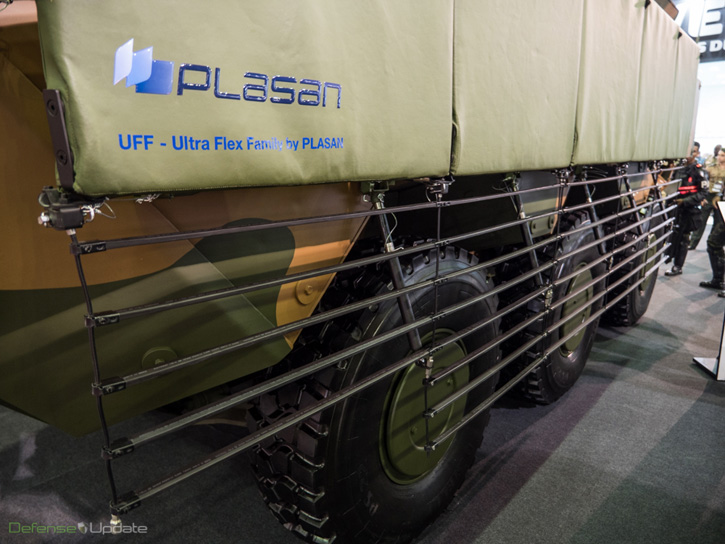
    Plasan's new Ultra Flex add-on armor includes the Flexible Slat Armor (HFS) skirts developed by Plasan. Photo: Noam Eshel, Defense-Update
    Plasan’s new Ultra Flex add-on armor includes the Hybrid Slat Fence (HSF) skirts developed by Plasan and produced in Brazil by All Tec composite materials. Photo: Noam Eshel, Defense-Update

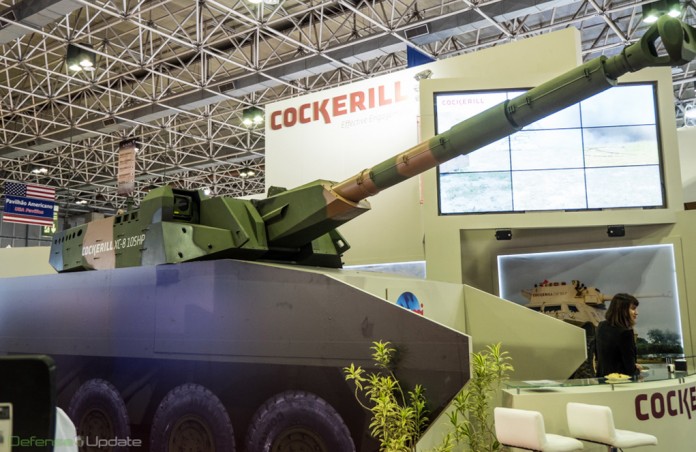
    In parallel to the ongoing production of the VBTP variant, the Brazilian Army plans to induct the VBR-MR – a ‘wheeled tank’, based on a heavier 8×8 platform to be armed with turreted 105mm cannon. LAAD provides an important opportunity for manufacturers of such turrets. One such company is the South African Denel, Land Systems showcasing the MT-105 turret weapon system, currently evaluated by the Brazilian army for its new VBR-MR. Other candidate turrets include the Oto-Melara and the from CMI.

    The Brazilian subsidiary of OTO Melara and local defense company ARES are also moving toward a partnership, to offer Oto Melara’s  105/120 mm modular HITFACT turrets for the VBR-MR program.

    ELbit Systems' CARDOM mortar system is marketed in Brazil by Elbit Systems' subsidiary ARES, as an optional weapon system for the VBTP-MR family. Part of these vehicles are already equipped with Elbit Systems' UT30 remotely controlled weapon system mounting the Bushmaster 30mm automatic gun. Photo: Noam Eshel, Defense-Update
    ELbit Systems’ CARDOM mortar system is marketed in Brazil by Elbit Systems’ subsidiary ARES, as an optional weapon system for the VBTP-MR family. Part of these vehicles are already equipped with Elbit Systems’ UT30 remotely controlled weapon system mounting the Bushmaster 30mm automatic gun. Photo: Noam Eshel, Defense-Update

    Another type of RPG and missile protection is provided by IMI’s Bright Arrow – an innovative remotely operated weapon station, integrated with situational awareness and passive and active protection systems, enabling light vehicles to be highly protected against RPGs and missiles. Bright Arrow is displayed on the company’s new ‘CombatGuard’, developed by IMI to support military operations in rough or urban terrain. CombatGuard has been configured to support military, counter terror and special security operations in complex terrain. A highly protected vehicle, the 4×4 CombatGuard carries six fully equipped combatants over extremely rugged terrain, crossing mud, sand dunes or dense urban areas.

    Technicae, a Brazilian subsidiary of the Singapore technologies (ST Kinetics) is showcased a number of upgrade and reset programs for Brazil’s older combat vehicles, such as the Urutu and Cascavel. For the 6×6 Urutu platform, Technicae offers a turnkey modernisation solution replacing the electrical systems, transmission and drivetrain, navigation systems and  firepower. The company also provides reset for M113 armored personnel carriers, upgrading the platform’s suspension, driver control station, introducing firing ports and bench seats. The conversion can also include ST Kinetics’ InfiniDrive HMX transmission powerpack, available with a choice of heavy duty engine types. Technicae also offers ST Kinetics’ ADDER family of Remote Weapon Stations (RWS), available in single and dual-weapon configurations.

    iveco_lmv_725
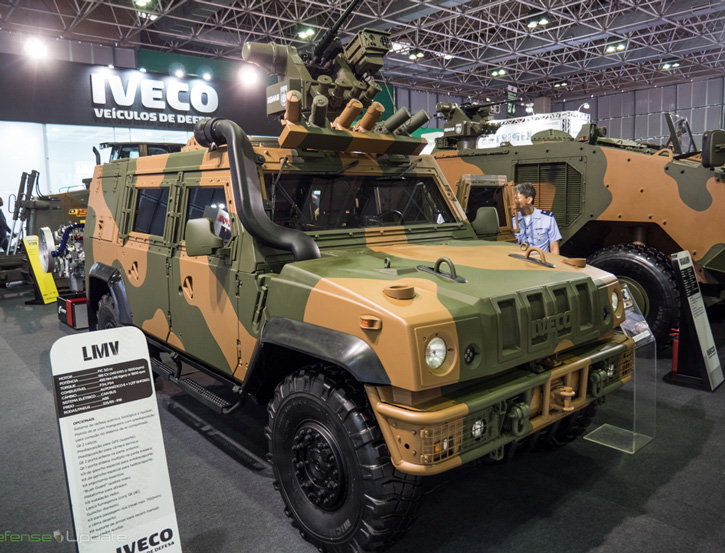
    Iveco is also promoting the LMV – a highly protected light vehicle used for utility and protected transport. Photo: Noam Eshel, Defense-Update


    IAI set to produce drones, radars in Brazil

    IAI Display at LAAD 2015

    Israel Aerospace Industries is expanding its activities in Brazil through the partnership with local, strategic defense partners. “IAI sees South America in general, and Brazil in particular, as a ‘growth engine’, and offers a large spectrum of products, backed by wide technological knowhow.” Joseph Weiss, IAI’s President and CEO said “Through working in Brazil extensively for the last few years, we have been exposed to the country’s unique needs and requirements. IAI plans to expand its activities in Brazil by means of cooperation with local companies.

    Radar that sees beyond the horizon

    Through its partnership with Iacit IAI is promoting comprehensive naval and homeland security capabilities, applicable to Blue Amazon Managing System (SisGAAz). One of these systems is the EZ-Guard ELM2270 Over the Horizon (OTH) radar project that broke ground last month at a coastal site in the South of Brazil. Backed up by transfer of technological knowhow from IAI-ELTA, the project is being conducted with the support of the Brazilian Navy.

    IAI is displaying at LAAD 2015 a comprehensive maritime security concept depicted in an interactive 3D model. Photo: IAI
    IAI is displaying at LAAD 2015 a comprehensive maritime security concept depicted in an interactive 3D model. Photo: IAI

    These advanced maritime surveillance features are combined with IACIT’s oceanic environmental HF capacities. IACIT has been developing an HF Radar solution since 2010 for oceanic environmental weather and sea surface surveillance, as well as pollution control and to assist prediction of environmental hazards such as storms and tsunamis.

    The radar system is developed with the support of the Brazilian Federal Funding Authority for Studies and Projects (FINEP) and with the technological cooperation of IAI’s ELTA Group.

    Operating in the High-Frequency (HF) band the new radar employs surface-wave propagation to provide continuous surveillance of the sea surface well beyond the horizon, up to 200 nautical miles (370km) range. The radar employs phased array technology and unique interference cancellation techniques which provide reliable and persistent coverage of the broader maritime area at all times, regardless of atmospheric conditions or sea state.

    “The technological development process requires time and considerable financial resources, depending on the complexity of the project. The expected assimilation of technology, including by the National Defense Strategic (END), provides a significant leap for technologies already tested outside Brazil with validated solutions. In the case of a Strategic Defense Company (EED) such as IACIT, transfer of technology and know-how are mandatory to ensure continuous production in Brazil. said IACIT president Luiz Teixeira. “The OTH development has propelled IACIT’s capabilities years forward and will provide a strategic advantage for the Brazilian Navy as well as important lifesaving information for environmental control agencies”.

    “We view this project as an important milestone towards persistent, affordable, reliable and efficient coverage of a broad Brazilian maritime area”, said Mr. Nisim Hadas, IAI Executive VP & ELTA president.

    IAI’s Heron turned into Caçadors

    Another UAV project in Brazil is “Caçador”, an evolution of the IAI Heron I into a Brazilian-made Medium Altitude Long-Endurance (MALE) UAV. Heron I is operational in Brazil since 2010, operated by the federal police. Caçador UAV is based on this operational experience, to meet the specific requirements of Brazil.

    Caçador will be equipped with an automatic takeoff and landing system (ATOL) and equipped to operate in civilian controlled airspace, as has already practiced with Heron I in Brazil and elsewhere. Caçador will carry multiple payloads for line-of-sight missions or beyond line of sight using satellite communications.

    The manufacturing will take place in Brazil. IAI has teamed with Avionics Services of Brazil which is currently inducting the maintenance and support of the system at Botucatu airfield in Sao Paolo. European Advanced Technology (EAT), an Israel Aerospace Industries’ (IAI) subsidiary, has acquired minority holding in the Avionics Services in 2014, as part of IAI’s strategic investment in the Brazilian defense market. The cooperation agreement’s main target markets are defense and public security projects primarily for the Brazilian market, which may potentially be extended to international markets in the future. Under the cooperation agreement between the two companies Avionics Services will provide marketing and manufacturing of aircraft systems, unmanned aerial systems, sensors supporting upgrades of aerial platforms.

    Skunk Works and XTEND Simplify Multi-Drone Command

    0
    Lockheed Martin Skunk Works® and XTEND have achieved a major milestone in JADC2 by integrating the XOS operating system with the MDCX™ autonomy platform. This technical breakthrough enables a single operator to simultaneously command multiple drone classes, eliminating the friction of mission handoffs. From "marsupial" drone deployments to operating in GPS-denied environments, explore how this collaboration is abbreviating the data-to-decision timeline and redefining autonomous mission execution.

    From Ukraine to Taiwan: The Global Race to Dominate the New Defense Tech Frontier

    0
    As traditional defense primes face mounting competition from agile “neoprimes” such as Anduril, Palantir and Helsing, the balance of innovation is shifting toward software-defined warfare and scalable, dual-use technologies, while global industry consolidation—marked by Boeing’s integration of Spirit AeroSystems and other strategic mergers—signals an intensified race to secure control over the defense technology value chain. Our Defense-Tech weekly report highlights these trends.

    Europe’s “Drone Wall”

    0
    In early October 2025, a coordinated wave of unmanned aerial system (UAS) incursions—widely attributed to Russia—targeted critical infrastructure across at least ten European nations. The unprecedented campaign exposed the fragility of Europe’s air defenses...

    Weekly Defense Update & Global Security Assessment

    0
    Executive Summary The past week (September 18-25, 2025) represents an inflection point where strategic defense concepts have transitioned from doctrine to tangible reality. An analysis of global events reveals four primary, interconnected trends shaping an...

    U.S. Air and Space Forces Push Next-Gen Programs at the AS&C 2025 Conference and...

    0
    At the 2025 Air, Space & Cyber Conference, U.S. Air Force and Space Force leaders unveiled major updates on next-generation fighters, bombers, unmanned systems, and space initiatives, highlighting both rapid innovation and critical readiness challenges as the services race to outpace global competitors. A short version is available here, with a more detailed version for subscribers.

    TADTE 2025: Reflecting Taiwan’s Strategic Themes

    0
    The Taipei Aerospace & Defense Technology Exhibition (TADTE) 2025 crystallized around four dominant strategic themes that collectively illustrate Taiwan's comprehensive approach to defense modernization amid escalating regional tensions. Based on a detailed report by Pleronix (available upon request). Includes a Podcast discussion on TADTE 2025's highlighting Taiwan's four strategic themes beyond the post's coverage.

    Iron Beam 450 Completes Testing, Soon to Join With Operational Air Defense Units

    0
    Israel’s Iron Beam 450 high-power laser system has completed final testing, marking a major leap in air defense. Developed by Rafael, it offers precise, cost-effective interception of rockets, UAVs, and mortars, and is set for IDF deployment by 2025.