

Wednesday, December 24, 2025
More
    Home Blog Page 103

    AUSA 2014 – Arming drones

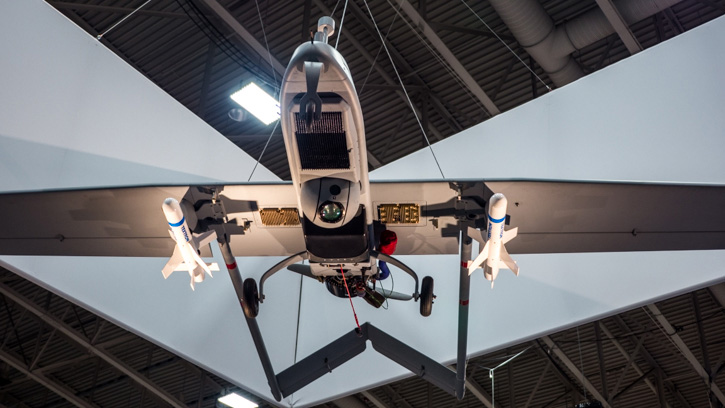
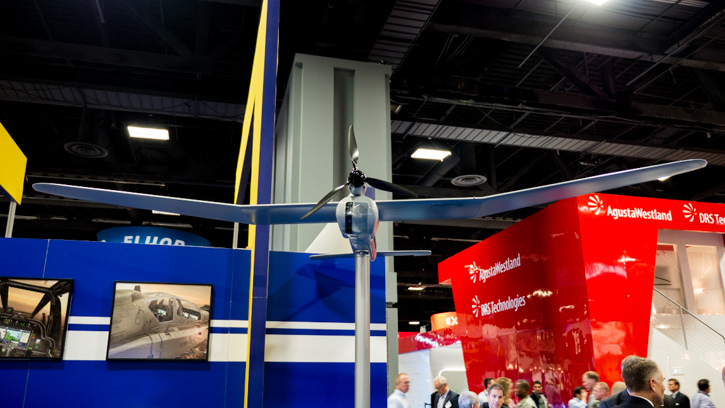
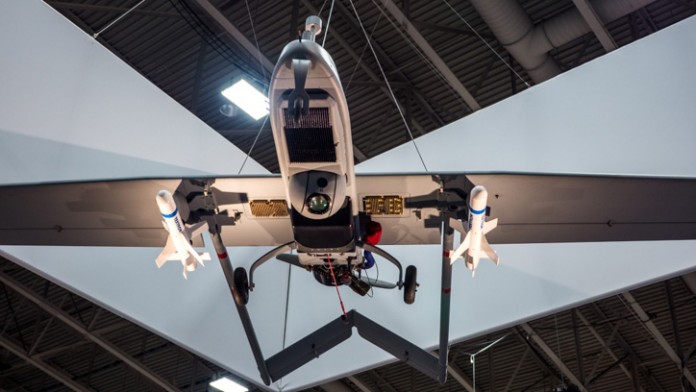
    The Shadow 200 was displayed at AUSA 2014 carrying two guided missiles developed by Thales. Photo: Noam Eshel, Defense-Update
    The Shadow 200 was displayed at AUSA 2014 carrying two guided missiles developed by Thales. Photo: Noam Eshel, Defense-Update
    The Shadow 200 was displayed at AUSA 2014 carrying two guided missiles developed by Thales. Photo: Noam Eshel, Defense-Update
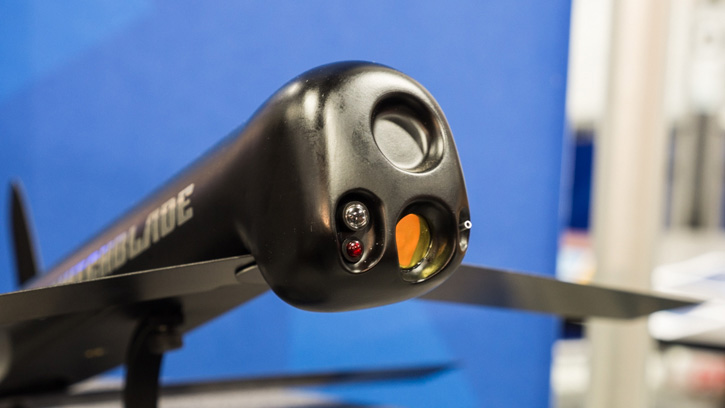
    Aerovironment displayed the Switchblade, offering ground forces the ability to hit ground targets with these small, expendable drones. As the military is seeking active countermeasures against hostile drones, SRI is proposing to couple cues from their TPQ-50 radar that can detect and track UAVs, enabling the use of Switchblades to attacking those drones as they are within range of the miniature Switchblade. Photo: Noam Eshel, Defense-Update
    Aerovironment displayed the Switchblade, offering ground forces the ability to hit ground targets with these small, expendable drones. As the military is seeking active countermeasures against hostile drones, SRC is proposing to couple cues from their TPQ-50 radar that can detect and track UAVs, enabling the use of Switchblades to attacking those drones as they are within range of the miniature Switchblade. Photo: Noam Eshel, Defense-Update
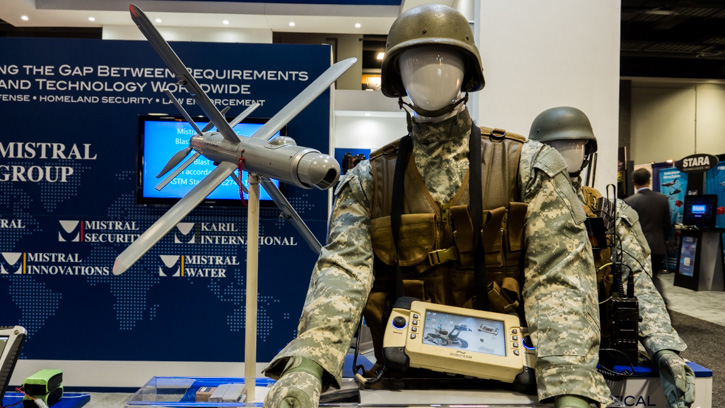
    Another miniature, expendable drone is the Israeli UVision Hero 30 shown at AUSA 2014 by the Mistral Group. Photo: Noam Eshel, Defense-Update
    Another miniature, expendable drone is the Israeli UVision Hero 30 shown at AUSA 2014 by the Mistral Group. Photo: Noam Eshel, Defense-Update
    Deploying laser designators on small drones flying below clouds will also enable the use of laser guided weapons under weather conditions that sofar have restricted their use. Photo: Noam Eshel, Defense-Update
    Deploying laser designators on small drones flying below clouds will also enable the use of laser guided weapons under weather conditions that sofar have restricted their use. Photo: Noam Eshel, Defense-Update
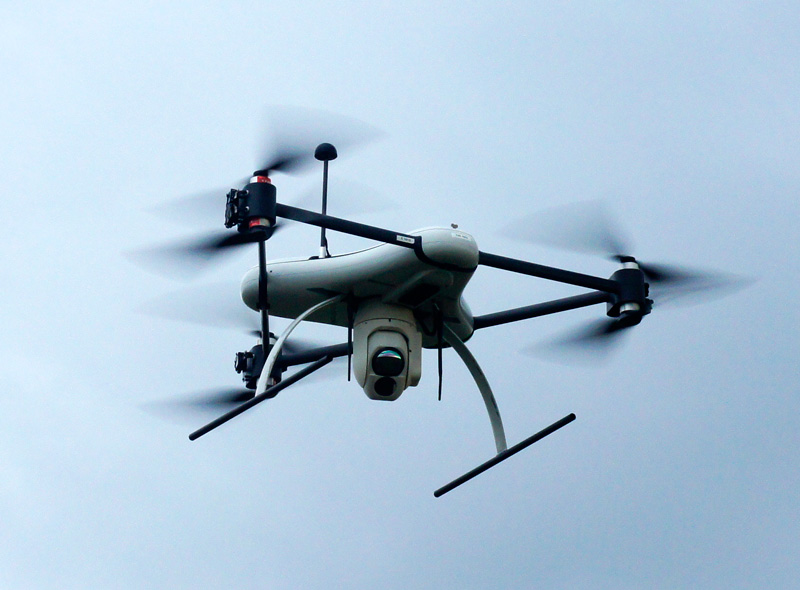
    This miniature EO payload designed for Elbit Systems' Skylark small UAS is equipped with the company's groundbreaking laser designator, enabling a miniature drone like the Skylark to designate targets for attack by laser guided weapons. The new designator weighs about 100 grams and can designate targets at a range of several kilometers. This breakthrough will enables the deployment of miniature designators into compact observation devices and sights, enabling more users to get fire support in close range. Photo: Noam Eshel, Defense-Update
    This miniature EO payload designed for Elbit Systems’ Skylark small UAS is equipped with the company’s groundbreaking laser designator, enabling a miniature drone like the Skylark to designate targets for attack by laser guided weapons. The new designator weighs about 100 grams and can designate targets at a range of several kilometers. This breakthrough will enables the deployment of miniature designators into compact observation devices and sights, enabling more users to get fire support in close range. Photo: Noam Eshel, Defense-Update
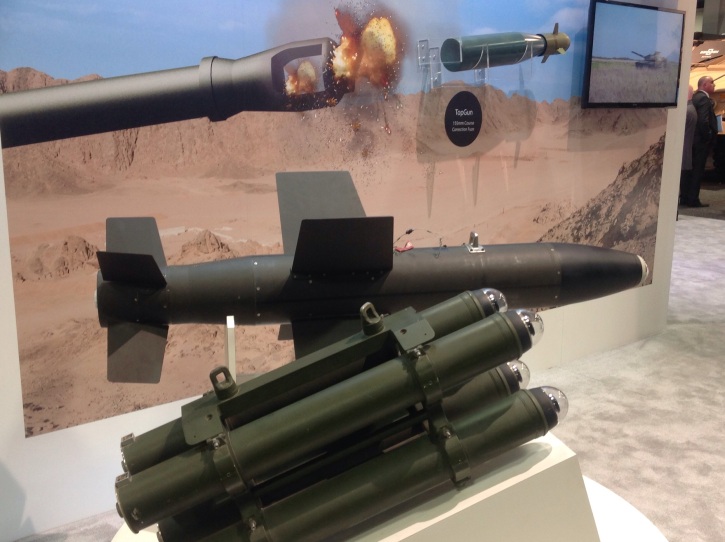
    Three types of precision weapons on display at IAI's AUSA 2014 display - the Lahat, a compact laser guide bomb and Topgun, an GPS-based guidance system for artillery projectiles.
    Three types of precision weapons on display at IAI’s AUSA 2014 display – the Lahat, a compact laser guide bomb and Topgun, an GPS-based guidance system for artillery projectiles.
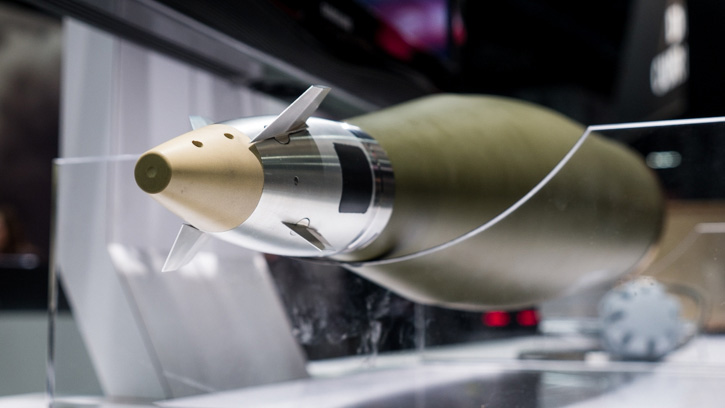
    BAE Systems Israeli subsidiary Rokar have recently demonstrated the Silver Bullet GPS guidance fuse kit it has developed for the artillery can bring a standard artillery projectile to impact within less than 10 meters or less from its designated target. This high precision will enable artillery fire to be more precise, thus becoming more relevant in modern dense battlefields and in close support to friendly ground troops. Photo: Noam Eshel, Defense-Update
    BAE Systems Israeli subsidiary Rokar have recently demonstrated the Silver Bullet GPS guidance fuse kit it has developed for the artillery can bring a standard artillery projectile to impact within less than 10 meters or less from its designated target. This high precision will enable artillery fire to be more precise, thus becoming more relevant in modern dense battlefields and in close support to friendly ground troops. Photo: Noam Eshel, Defense-Update
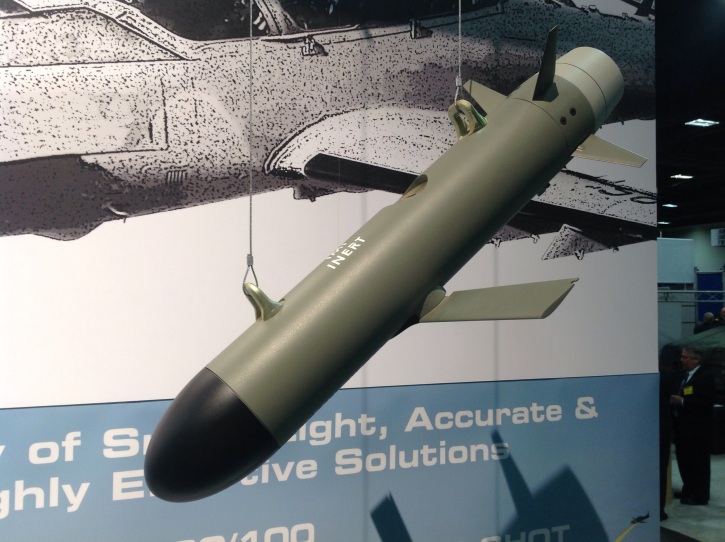
    The WhipShot from IMI is a compact guided weapon designed for deployment from small aerial platforms.
    IMI has unveiled a full scale model of its new, unpowered Fastlight guided weapon designed for deployment from small aerial platforms.
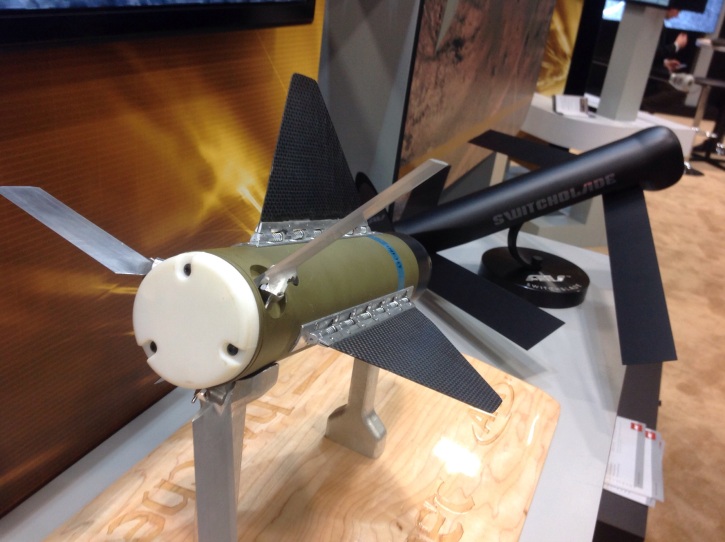
    Switchblade and Hatchet, two lightweight precision weapons designed for UAVs - displayed at ATK's booth at AUSA 2014.
    Switchblade and Hatchet, two miniature precision weapons designed for UAVs – displayed at ATK’s booth at AUSA 2014.

    Bell unveils the V280 Valor Tilt Rotor Aircraft at AUSA 2014

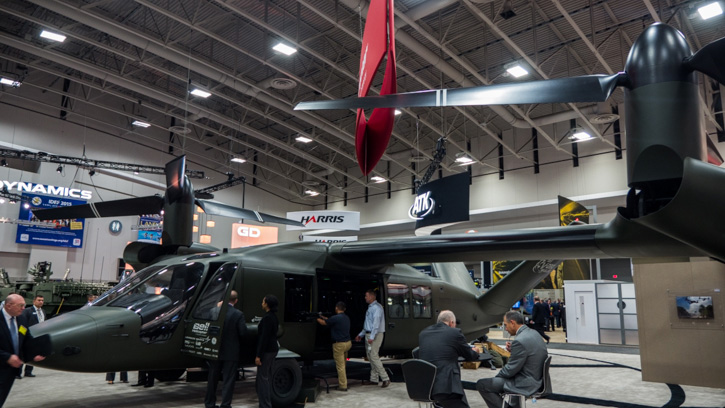
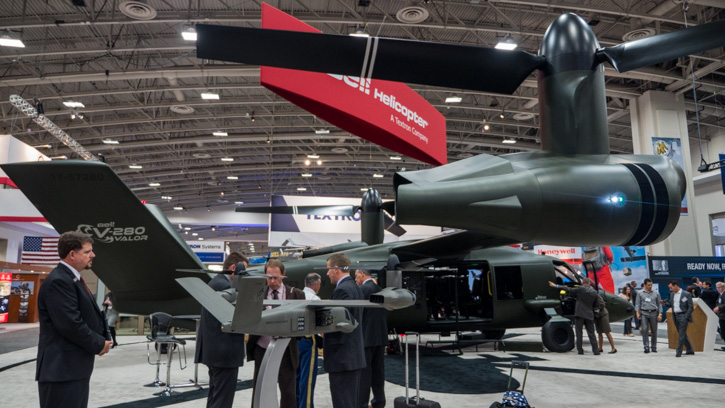
    Bell has unveiled a full scale model of the next generation tilt-rotot - V280 Valor
    Bell has unveiled a full scale model of the next generation tilt-rotot - V280 Valor
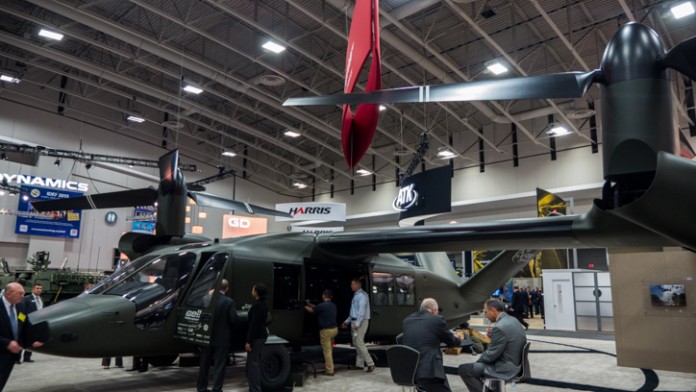
    Bell has unveiled a full scale model of the next generation tilt-rotot – V280 Valor. Photo: Noam Eshel, Defense-Update
    The man difference between the V-22 and V280 designs is the absence of engine rotation in teh Valor, where only the rotors are rotated up or down. The nacelles will be built by IAI, which yesterday has joined the industry team building the future tilt-rotor aircraft. Photo: Noam Eshel, Defense-Update
    The main difference between the V-22 and V280 designs is the absence of engine rotation in the Valor, where only the rotors are rotated up or down. The nacelles will be built by IAI, which yesterday has joined the industry team building the future tilt-rotor aircraft. Photo: Noam Eshel, Defense-Update:

    Bell unveiled here a full-scale model of its V-280 Valor, the next generation in tiltrotor aircraft the US Army is considering as a future UH-60 Black Hawk replacement for the 2030. Larger than the current UH-60 Black Hawk, but smaller than the V-22 Osprey Bell and Boeing have supplied the Marine Corps and SOCOM, V-280 represents a third-generation tiltrotor aircraft designed for the Joint Multi-Role demonstrator and Future Vertical Lift programs.

    Unlike the V-22, where the entire engine and rotor are rotated up for takeoff, landing and hovering, the V-280 is designed with rotating rotors, maintaining the two engines in fixed positions on the win tips.

    The V-tail showing the V280 team sign
    The V-tail showing the V280 team sign. Photo: Noam Eshel, Defense-Update

    The V-280 Valor will be able to fly twice the range of current helicopters, cruising at 280 knots it will cover a combat range of 500 to 800 nautical miles, enabling ground forces to control much larger areas of operation. The V-280 will be able to fly 14 troop transport missions, medical evacuation, carry supplies and deliver loads more effectively using two sling loads and large six-foot wide doors.

    Bell has gathered a team to build and fly test the Valor demonstrator. The company is in the detailed design phase of the V-280’s development, and the aircraft is expected to be ready for flight testing in September 2017.
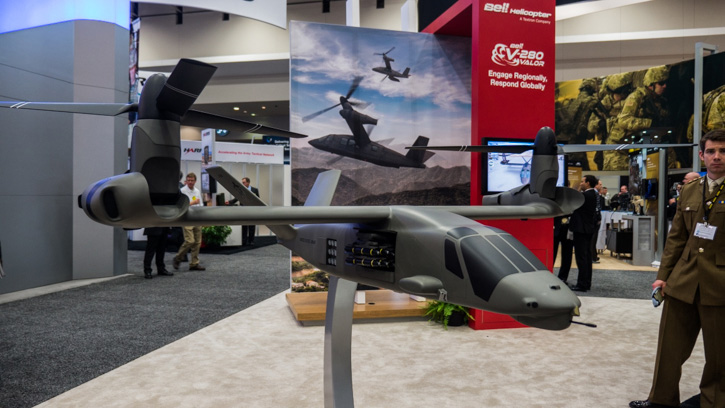
    Along with the assault transport tilt rotor aircraft offered to the Army, the Valor team is also suggesting an attack variant equipped with internally carried missiles, including side launching common launchers (deploying weapons sideways or to the rear, similar to aircraft gunships,  as well as forward launched guided missiles. Photo: Noam Eshel, Defense-Update
    Along with the assault transport tilt rotor aircraft offered to the Army, the Valor team is also suggesting an attack variant equipped with internally carried missiles, including side launching common launchers. Photo: Noam Eshel, Defense-Update
    v280attack_725
    The attack version of the Valor could be deployed with weapons tubes launching sideways or to the rear, similar to aircraft gunships, as well as forward launched guided missiles. Photo: Noam Eshel, Defense-Update

    AUSA 2014 photo report – Upgunned AFVs

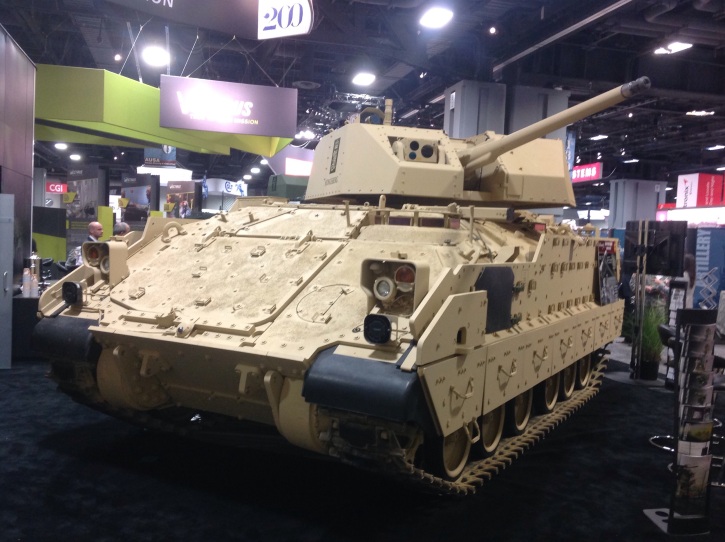
    The MCT30 turret from Kongsberg mounted on the Bradley Fighting Vehicle. As a remote controlled turret the overhead installation frees much needed space in the protected fighting compartment, while leaving the commander and gunner adequate operating space below. The turret is accessible from the hull and the gun can be reloaded manually if required; the turret could also have a hatch to enable the vehicle commander to lok out if necessary.
    The MCT30 turret from Kongsberg mounted on the Bradley Fighting Vehicle. As a remote controlled turret the overhead installation frees much needed space in the protected fighting compartment, while leaving the commander and gunner adequate operating space below. The turret is accessible from the hull and the gun can be reloaded manually if required; the turret could also have a hatch to enable the vehicle commander to lok out if necessary.
    The MCT30 turret from Kongsberg mounted on the Bradley Fighting Vehicle. As a remote controlled turret the overhead installation frees much needed space in the protected fighting compartment, while leaving the commander and gunner adequate operating space below. The turret is accessible from the hull and the gun can be reloaded manually if required; the turret could also have a hatch to enable the vehicle commander to lok out if necessary.
    image
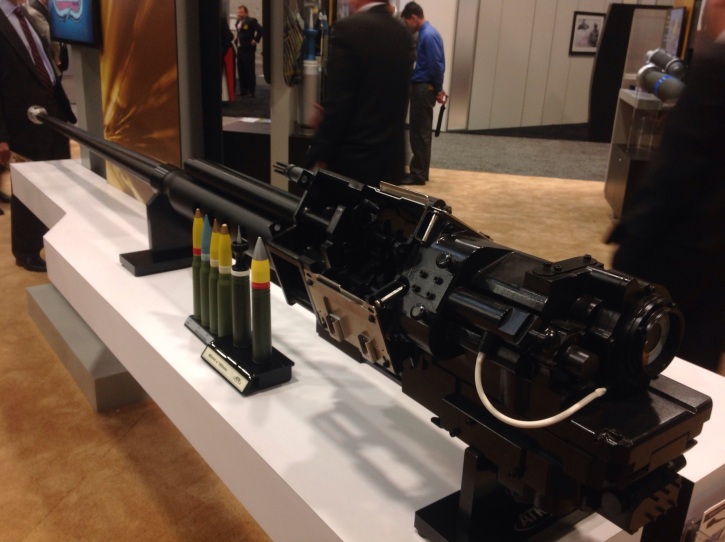
    The turret mounts the XM-813 automatic gun from ATK, a linkless, automatic dual feed system that can fire two types of rounds. The gun was developed for the Future Combat Systems (FCS) program and was considered for fielding with the GCV. The canon is interchangable with either 30 or 40mm barrels, having only six caliber-specific parts to replace.
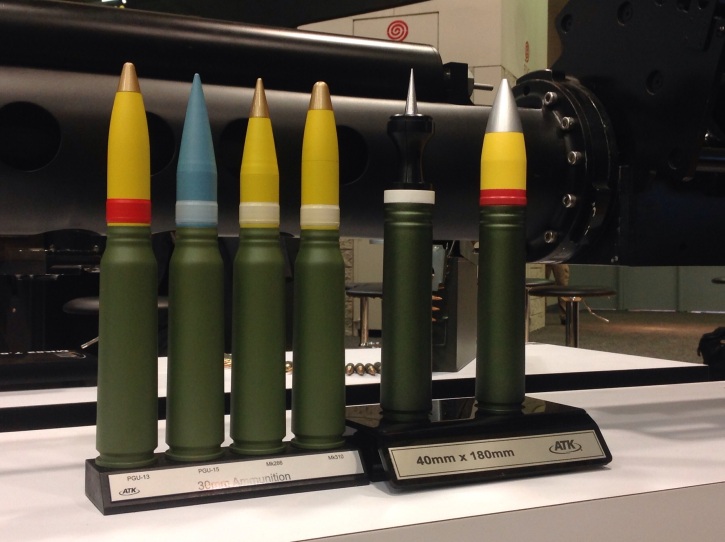
    While the 30mm family already has four ammunition types - HE-Incindiary, practice, HE with delay/impact fuse and HE airburst with time setting adjustment. In, the 40 mm family has only two - HE/airburst and APFSDS. ATK is in theprocess of migrating all types to both calibers.
    While the 30mm family already has four ammunition types – HE-Incindiary, practice, HE with delay/impact fuse and HE airburst with time setting adjustment. In, the 40 mm family has only two – HE/airburst and APFSDS. ATK is in theprocess of migrating all types to both calibers.
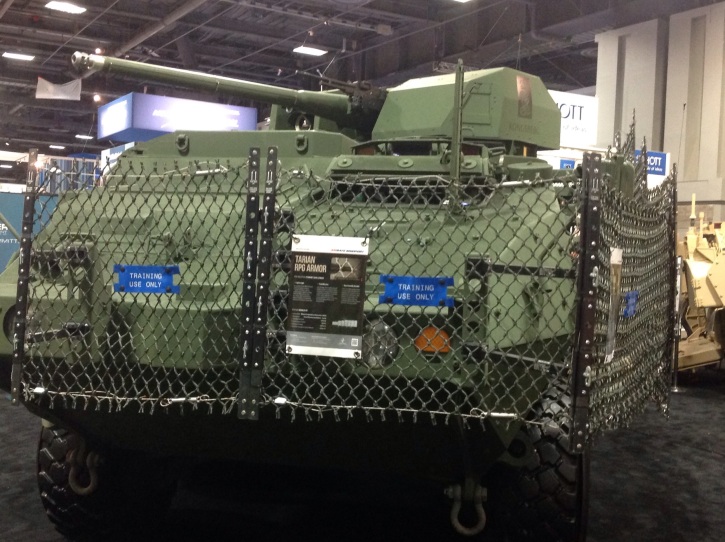
    The MCT30 turret has also been installed on a Doube V Hull Striker (DVH).
    The MCT30 turret has also been installed on a Doube V Hull Striker (DVH). It is seen here applied with Tarian anti-RPG nets.


    A view from the past, a look into the future

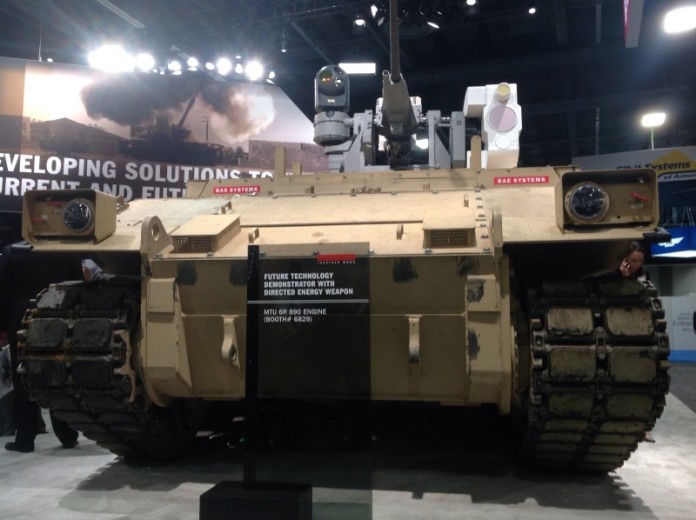
    A view from the past, provides a look into the future. BAE Systems developed this 70 ton hybrid-electric powered vehicle for the U.S. Army Ground Combat Vehicle; after the GCV program was cancelled the company has utilized the vehicle to demonstrate how the same platform could turn into a 40 ton combat vehicle, using next generation technologies that are already available today. Photo: Tamir Eshel, Defense-Update
    A view from the past, provides a look into the future. BAE Systems developed this 70 ton hybrid-electric powered vehicle for the U.S. Army Ground Combat Vehicle; after the GCV program was cancelled the company has utilized the vehicle to demonstrate how the same platform could turn into a 40 ton combat vehicle, using next generation technologies that are already available today. Photo: noam Eshel, Defense-Update
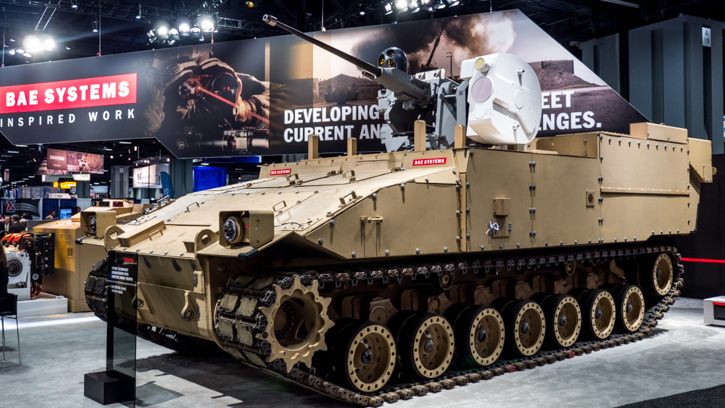
    A view from the past, provides a look into the future. BAE Systems developed this 70 ton hybrid-electric powered vehicle for the U.S. Army Ground Combat Vehicle; after the GCV program was cancelled the company has utilized the vehicle to demonstrate how the same platform could turn into a 40 ton combat vehicle, using next generation technologies that are already available today. Photo: Noam Eshel, Defense-Update

    BAE systems is displaying at AUSA the prototype it has built for the cancelled Ground Combat Vehicle (GCV) program few years ago. In its current incarnation as technology demonstrator, this impressive vehicle has reduced weight, trading off the large and heavy armored turret for a surrogate unmanned turret based on the company’s Mk 38 B2 unmanned turret (a U.S. version of Rafael’s Typhoon) augmented with a high power laser weapon. At a weight of about 40 tons the vehicle will be powered by a single 6R 890 turbocharged diesel engine developing over 600 kW of power at 4250 RPM, this engine is charging a high capacity Li-ion battery that has been tested and proven safe and reliable for military use.
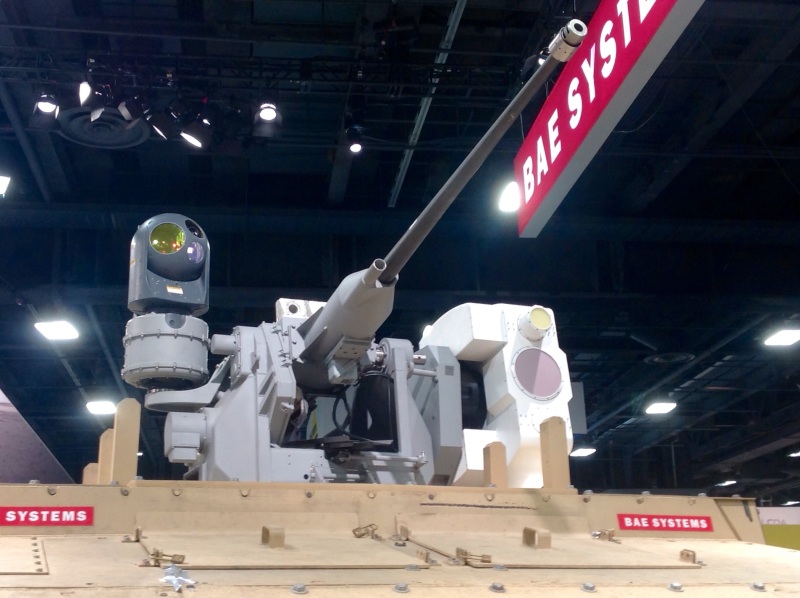
    BAE systems displayed at AUSA it's vision for the 2025 armored mobility. The platform on display is the vehicle BAE developed for the cancelled US Army Ground Combat Vehicle program. The vehicle on displayed was stripped of its original turret, carrying the Company's Mk 38 remote weapon station BAE is producing with Israel's RAFAEL for the U.S. Navy. The white module on the right side represents a high power laser weapon that can be operated by the vehicle, relying on the vehicle's powerful hybrid propulsion drive system. The laser unit comes with integral target acquisition and beam director while the turret mounts a 25 chain gun and uses the Toplite EO system for ISR and target acquisition. Photo: Tamir Eshel, Defense-Update
    BAE systems displayed at AUSA some of the innovations it is recommending the US Army could include in it’s Force 2025 Vision. The platform on display is the vehicle BAE developed for the cancelled US Army Ground Combat Vehicle program. The vehicle on displayed was stripped of its original turret, carrying the Company’s Mk 38 remote weapon station BAE is producing with Israel’s RAFAEL for the U.S. Navy. The white module on the right side of the turret represents a high power laser weapon that can be operated by the vehicle, relying on the vehicle’s powerful hybrid propulsion drive system. The laser unit comes with integral target acquisition and beam director while the turret mounts a 25 chain gun and uses the Toplite EO system for ISR and target acquisition. Photo: Tamir Eshel, Defense-Update
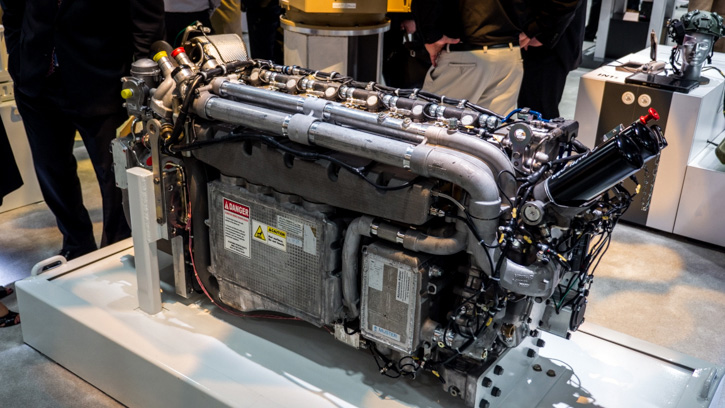
    This engine, developed by MTU provides constant charging for the hybrid drive. Two engines were necessary to drive enough power for the 70 ton GCV, but a more modest 49 ton future vehicle will require only one such engine, delivering enough power for propulsion, systems and the laser weapon.
    This engine, developed by MTU provides constant charging for the hybrid drive. Two engines were necessary to drive enough power for the 70 ton GCV, but a more modest 49 ton future vehicle will require only one such engine, delivering enough power for propulsion, systems and the laser weapon. Photo: Noam Eshel, Defense-Update
    This high capacity Lithium ion battery pack is storing the electrical energy to power two drive engines. This power source feeds all electronic systems on board, and it also packs enough energy for bursts to drive the high energy laser weapon.
    This high capacity Lithium ion battery pack is storing the electrical energy to power two drive engines. This power source feeds all electronic systems on board, and it also packs enough energy for bursts to drive the high energy laser weapon. Photo: Noam Eshel, Defense-Update

    Force 2025 Vision

    In 2014 the US Army began the process of development and refinement of the view of how Army forces will be shaped in 2025 and beyond. Entitled Force 2025, the Army is discussing force employment; science and technology and human performance optimization; and force design. In force employment the Army defined how decentralized, distributed, and integrated operations will be conducted 10 years from now.

    For the next decade the Army plans to reshape, optimise its combat units into Brigade Combat Team 2025, equipped and trained to increase their expeditionary capability these units will be globally responsive, downsized and manpower and vehicles, these elements will also be tailored to best perform as part of joint task forces in specific areas.

    The vehicle is driven by two electrical engines running on AC current provided by the li-ion battery through the distribution unit seen on the right. The advantages of electrical propulsion is there is no need to run the engines when the vehicle is idle, while power bursts are managed through the regulator, when needed for performance, therefore running the diesel charger at optimal speed for maximum fuel economy. Photo: Noam Eshel, Defense-Update
    The vehicle is driven by two electrical engines running on AC current provided by the li-ion battery through the distribution unit seen on the right. The advantages of electrical propulsion is there is no need to run the engines when the vehicle is idle, while power bursts are managed through the regulator, when needed for performance, therefore running the diesel charger at optimal speed for maximum fuel economy. Photo: Noam Eshel, Defense-Update

    Among the contingencies they will be prepared for will be homeland defense, counter-proliferation operations and ability to counter advanced threats.

    To meet these goals combat elements of 2025 must maintain overmatch of any opponent, forces should be modernised in mobility, protection and firepower, providing improved lethality, longer range precision and reduced footprint, size and power consumption.

    Integration of robotics, particularly in manned-unmanned operations is considered a priority, as also the extension of range, particularly with aviation assets. Regardless of robotics advancements, optimisation of combat systems will also address human performance – in cognitive load engineering and performance enhancement.

    Currently, TRADOC is working with Science and Technology stakeholders to identify additional technologies that can mature and be fielded to BCTs by 2025 to set the conditions that will fundamentally change the way the Army fights in the far-term.

    Such technologies are assessed by their ability to maintain or increase overmatch, increase the unit’s capability above the current level and improve the unit’s self sustainability in expeditionary deployment, reducing the logistical tail required for continued operation.
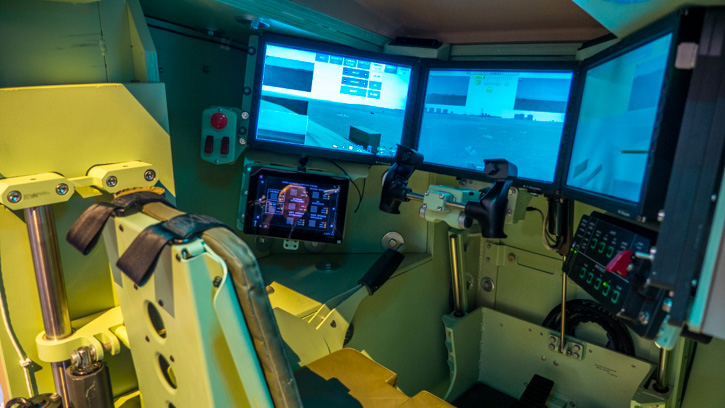
    This driver's position displayed at BAE Future Technology Demonstrator for the Army Force 2025 Vision at AUSA 2014 shows the drivers' display consoles, proving 120 degrees coverage, in addition, live images from side and rear cameras provide 360 vision to the driver and commander. direct vision blocks augment this indirect view with periscope vision. Five blocks are positioned just below the raised hatch line, providing 180 degrees coverage.
    This driver’s position displayed at BAE Future Technology Demonstrator for the Army Force 2025 Vision at AUSA 2014 shows the drivers’ display consoles, proving 120 degrees coverage, in addition, live images from side and rear cameras provide 360 vision to the driver and commander. direct vision blocks augment this indirect view with periscope vision. Five blocks are positioned just below the raised hatch line, providing 180 degrees coverage. Photo: Noam Eshel, Defense-Update

    Da-Vinci tri-copter is built for urban warfare

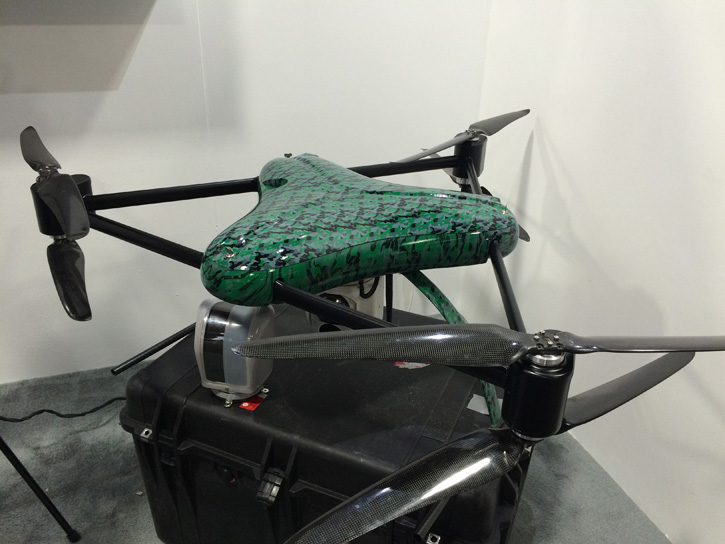
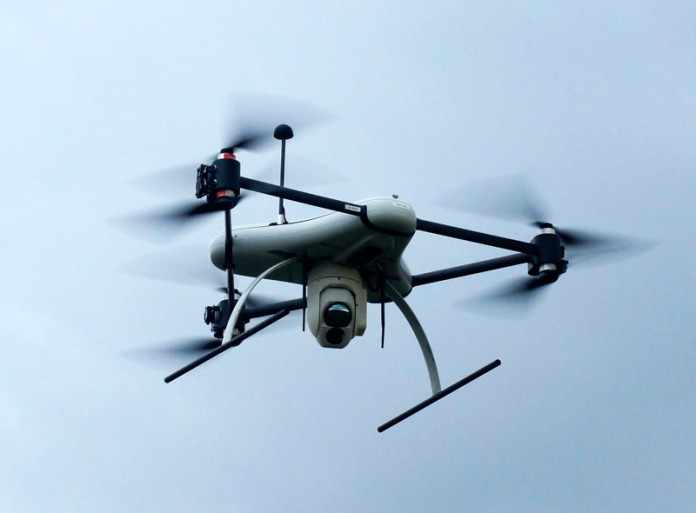
    Da-Vinci multi-rotor tricopter unveilled by Flying Productions at AUSA is a tricopter designed and optimized for operations in urban environment. Photo: Flying Productions
    Da-Vinci multi-rotor tricopter unveilled by Flying Productions at AUSA is a tricopter designed and optimized for operations in urban environment. Photo: Flying Productions
    Da-Vinci multi-rotor tricopter unveilled by Flying Productions at AUSA is a tricopter designed and optimized for operations in urban environment. Photo: Flying Productions

    Da-Vinci, a Compact, lightweight VTOL multi-rotor UAS Platform is launched today at the AUSA 2014 in Washington DC. The developer is Flying Productions, a young Israeli company that has developed the vertical take-off and landing (VTOL) drone for military and law enforcement missions in urban areas.

    To gain the necessary lift and propulsion Da-Vinci uses six rotors arranged in three counter-rotating pairs. Designed to operate at low altitude, urban warfare observation missions, includes a Portable Ground Control Station and Dual Sensor EO/IR Payload. The entire avionic package and Payload are stored around the center of gravity, providing a stable platform even at low altitude and gusty winds. To simplify operation by a single soldier the drone is designed to be lightweight, and uses automatic vertical take-off and landing, and autonomous mission control modes. The system can operate reliably in urban areas, even where line-of-sight communications are not available.

    The Ground Control Station, Astronomy, is designed as an ‘all-in-one’ box integrating power, data, communication, and control, supported by custom designed software that enables advanced control modes, such as target sharing, multi-drone control, and an obstacle warning alerts.

    Da-Vinci carries a dedicated, compact EO payload called Galileo. This stabilized dual-sensor payload comes at a low weight (1.2 kg) and packs a FLIR with continuous zoom lense, HD video camera, electronic processing for video encoding, and low-light observation capability. The system includes multiple display and streaming features, real-time HD streaming, and Dual-Axis stabilization.

    According to Tal Shahar, CEO: “Da-Vinci is designed for operation in the dense environments typical of urban warfare” according to Shahar, Da-Vinci has already won orders from a launch customer in Eastern Europe and is currently being tested by additional customers.”
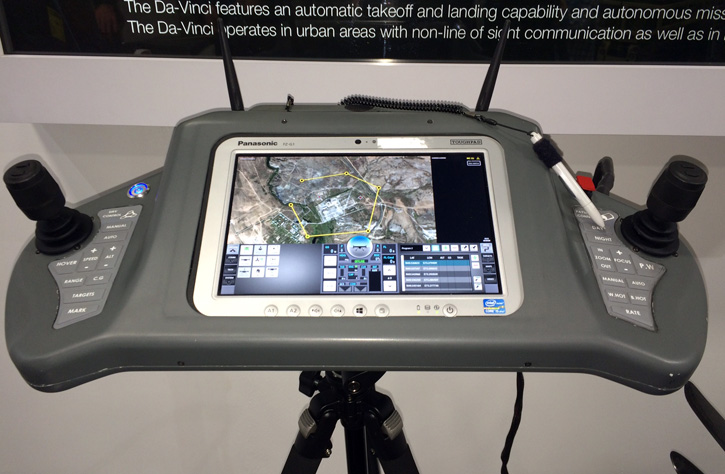
    The Ground Control Station, Astronomy, is designed as an 'all-in-one' box integrating power, data, communication, and control, supported by custom designed software that enables advanced control modes, such as target sharing, multi-drone control, and an obstacle warning alerts. Photo: Tamir Eshel, Defense-Update
    The Ground Control Station, Astronomy, is designed as an ‘all-in-one’ box integrating power, data, communication, and control, supported by custom designed software that enables advanced control modes, such as target sharing, multi-drone control, and an obstacle warning alerts. Photo: Tamir Eshel, Defense-Update
    Da Vinci uses six rotors laid out in three tandems to provide a compact yet powerful platform carrying a payload of 1.2 kg even in confined areas. Photo: Tamir Eshel, Defense-Update
    Da Vinci uses six rotors laid out in three tandems to provide a compact yet powerful platform carrying a payload of 1.2 kg even in confined areas. Photo: Tamir Eshel, Defense-Update

    Visual profiler accelerates target processing from aerial, satellite imagery

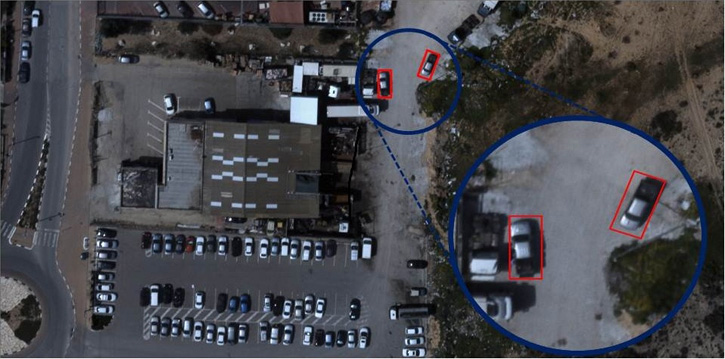
    An image showing multi-type processing of the system, showing a specific vehicle type among other targets spotted on the roofs. Photo: VideoInform (from screen).
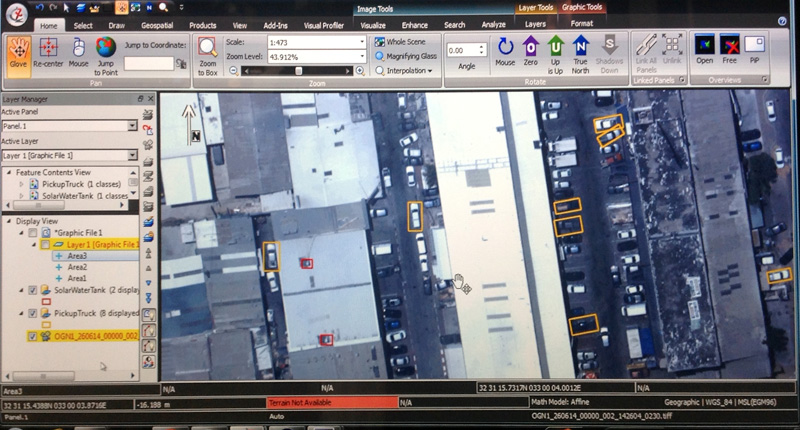
    Visual Profiler, developed by Video Inform and operationally deployed for automatic analysis of aerialimages can scan large image databases, real-time or historic, to detect targets of interest. This example shows the systems spotting pick up truck shapes vehicles using automatic detection. The system can further recognize even finer details, such as specific distinguishable details such as color, make, and unique, distinctive characteristics through automtaic-processing
    Visual Profiler, developed by Video Inform and operationally deployed for automatic analysis of aerial images can scan large image databases, real-time or historic, to detect targets of interest. This example shows the systems spotting pick up truck shapes vehicles using automatic detection. The system can further recognize even finer details, such as specific distinguishable details such as color, make, and unique, distinctive characteristics through automatic processing. Photo: Video Inform.

    Video Inform is introducing an advanced target detection and acquisition capability at the AUSA 2014 event, unveiling the  ‘Visual Profiler’, a cutting-edge cognitive vision technology extracting intelligence information from aerial or satellite imagery. The system can be used as a stand-alone solution or as an add-on to an existing Geographical Information Systems (GIS) and imagery management system.

    The Visual Profiler is empowered by a proprietary visual search engine developed by the company, providing automatic detection and profiling of targets from aerial or satellite images in real time. This capability enables the rapid delivery of intelligence information to forces in the field, thus shortening the sensor-to-shooter cycle. Unlimited by the number of target-object definition and profiling objects, the Visual Profiler can be trained to recognize specific vehicles, infrastructure and foundations. A unique interactive and intuitive user feedback mechanism continuously trains and improves the level of precision, further adapting the system for the user’s needs.

    “Our Visual Profiler represents a novel approach to image understanding.” said According to Yoram Sagher, CEO, “Based on a unique cognitive vision and profiling methodology, we have tried to imitate the human object recognition process, and to achieve breakthrough performance. The solution provides extremely rapid results,enabling the delivery of intelligence data to the battlefield in real time, thus impacting the outcome while the battle is actually underway.” According to Sagher, the system has been adopted by a leading Air Force, and has received high praise.”
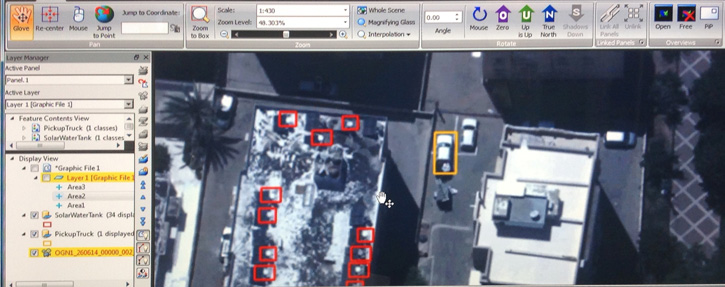
    An image showing multi-type processing of the system, showing a specific vehicle type among other targets spotted on the roofs. Photo: VideoInform (from screen).
    The system has spotted a water tank on a pickup tuck, ready to transport. Although the typical target (water tank) is mounted on roofs, the system can be taught to detect those targets even in non standard situations, thus highlighting anomalies to analysts. Photo: VideoInform (from screen).
    Multiple vehicles of a specific type detected by the system in a parking lot. Video Inform photo, from display
    The combination of two target types is demonstrated here, indicating specific vehicle types and their cargo.

    Better situational picture with TacSA

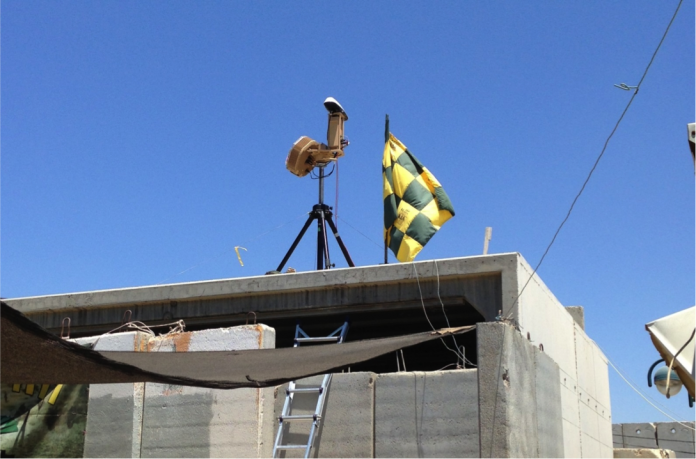
    Roboteam unveiled at AUSA a persistent, unattended surveillance unit that provides 360 degree surveillance of a location of interest, ensuring a site inspected to be safe remained clean of hostile activity. The system integrates multiple sensors of different disciplines, with wireless communications and adequate power to remain persistent over an entire mission duration.
    Roboteam unveiled at AUSA a persistent, unattended surveillance unit that provides 360 degree surveillance of a location of interest, ensuring a site inspected to be safe remained clean of hostile activity. The system integrates multiple sensors of different disciplines, with wireless communications and adequate power to remain persistent over an entire mission duration.

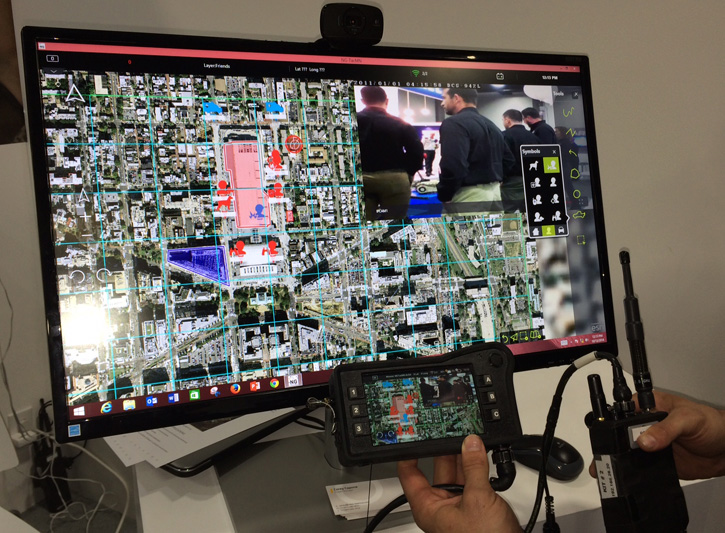
    Roboteam has introduced new systems designed to assist dismounted forces in inspection and security of urban and complex areas, using networked robotic, unmanned and unattended systems. In addition the company unveiled the TacSA command and control system it is developing, enabling small units to link multiple sources of video, imagery, situational sensors, intelligence and operational information and share this information accross multiple users in the group.

    The system can stream up to 4 video channels simultaneously, providing a complete live picture of the operational area in a server-less system using a distributed network with no single point of failure.

    The Tactical Situational Awareness (TacSA) system was developed in partnership with the Combating Terrorism Technical Support Office (CTTSO) for several Department of Justice and Special Operations Forces users, to meet the challenges of reliable tactical situational awareness while connecting and managing multiple dismounted forces, first responders, and systems working in the same area.

    TacSA’s capabilities include real-time geo-location tracking of all operators, as well as the accessibility of the program to all users – who can all communicate with each other, and individually view ISR feeds. Users can instantly send on-map annotations, capture and share chats, pictures, and files, as well as navigation and reference points. The system also supports information sharing, including live video feed, to be shared immediately among all users, thus removing communication delays. Tailored for Roboteam’s ROCU 5 personal handheld controller – the TacSA is also configured to operate on other smart platform running Windows and Android operating systems.
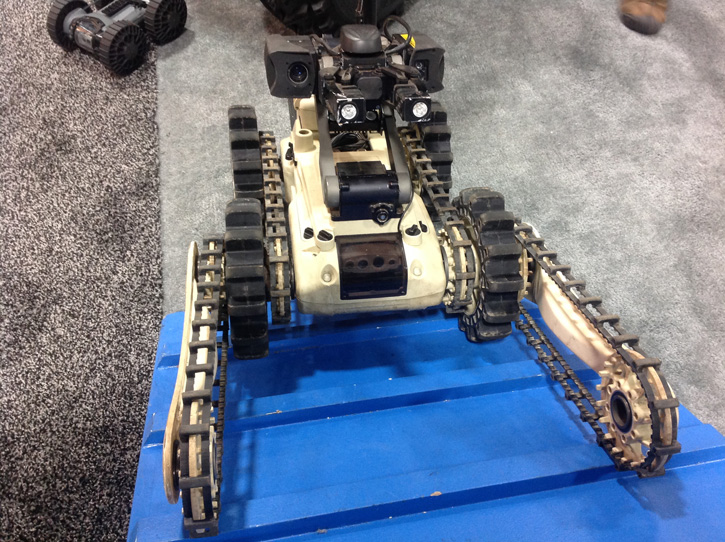
    Roboteam also displayed this version of MTGR robot adapted to inspect confined spaces in search for IEDs. Photo: Tamir Eshel, Defense-Update.
    Roboteam also displayed this version of MTGR robot adapted to inspect confined spaces in search for IEDs. Photo: Tamir Eshel, Defense-Update.

    The TacSA system works on a secure, closed, self-healing, server-less mesh network that is ideal for operating in any environment – from open desert to complex subterranean locations.

    According to Shahar Abuhazira, CEO of ROBOTEAM North America, “the unique advantage of the new system is in its delivery of a complete and live picture of the arena – supporting up to four different video channels simultaneously. This capability provides unprecedented situational awareness to forces operating in the arena”.
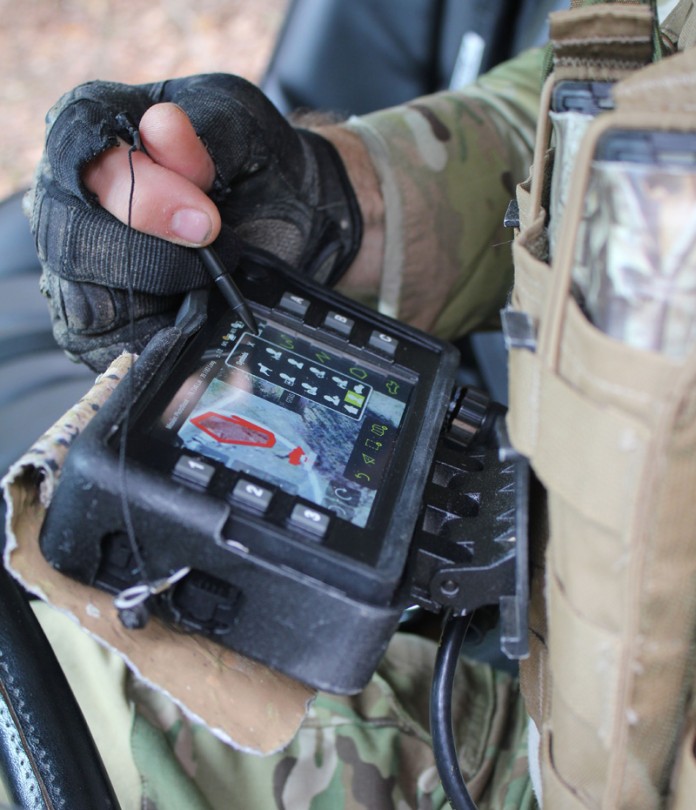
    tacsa_display_device-725
    The TacSA is seen here shows full situational display on a large screen, and a subset or full display shared via wireless radio link with tactical users on a ROCU 5 hand held device. It can also operate on any Android smart device. Photo: Tamir Eshel, Defense-Update

    Compact tactical radars for the modern manoeuver force

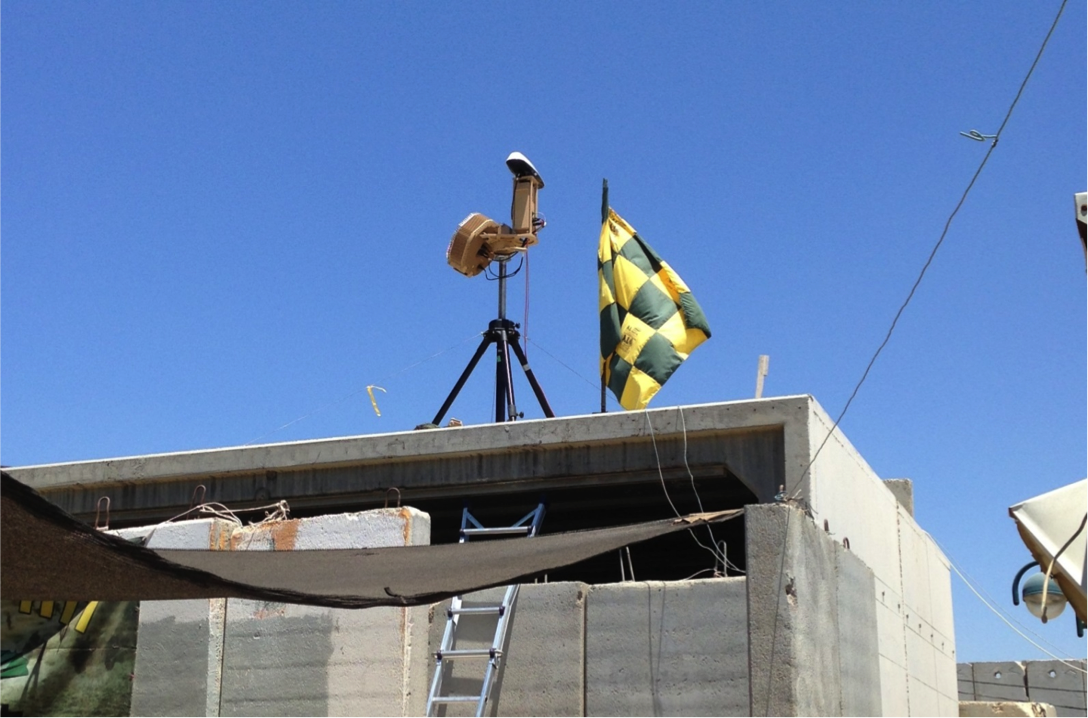
    RADA's new MHR radar was deployed operationally during Israel's recent conflict with Gaza, during Operation Protective Edge.
    RADA's new MHR radar was deployed operationally during Israel's recent conflict with Gaza, during Operation Protective Edge.
    RADA’s new MHR radar was deployed operationally during Israel’s recent conflict with Gaza, during Operation Protective Edge.

    ‘Hybrid Warfare’ insurgency rely on the integration of advanced capabilities (precision effects, command, control and coordination) while negating the military forces’ superiority in Intelligence, Surveillance and Reconnaissance. By denying the military the ISR producing target locations for standoff precision attacks, insurgents force a superior military power to strip out of most of its advantages, to fight the insurgents in high attrition, close-in battles, which would take a toll in time, casualties, financial cost and morale.

    Facing such hybrid warfare, modern military forces are relying on small and agile elements of military or special forces to carry our the fight. These teams are often providing the coordination and target acquisition elements controlling and guiding powerful, precision effects delivered from stand-off distance by aerial or fire support. When regular combat units that are required to fight in such hybrid warfare they must be equipped with the tactical means improving their capabilities to operate in terms of uncertainty and quickly respond to surprise attacks.

    New technologies are key to achieving tactical superiority, by improving force protection, regaining the manoeuvring capability necessary to generate the ‘friction’ that would draw insurgents to respond and fight, thus giving away their main advantage – stealth and surprise. Taking advantage of such ‘friction’ tactics require adequate sensors and intelligence, providing the combat forces at the lowest combat echelons with real-time situational awareness, through the use of advanced sensors, and reliable networking enabling rapid and accurate response to defeat the threats, using smart and precise weapon systems, deployed with the forward most elements and controlled by those units.

    Airborne and forward deployed sensors were considered a must for such tactics, but they require complex coordination and assured air supremacy which cannot be guaranteed everywhere. While EO sensors offer an excellent capability detecting visible targets, they are quite limited in persistently covering large areas to provide early warning on incoming attacks. Radars are providing these services much more effectively, but in the past, analog-only radars could carry out those tasks one by one, as often they were tailored for specific tasks.

    Air surveillance radars, even those designed to detect and track fast jets or helicopters at low altitude are not well equipped to detect small, slow flying targets such as drones, ultralight aircraft (ULA) or gliders. In contrast, ground surveillance radars, designed to detect personnel or vehicles on the ground are not capable of alerting on enemy direct or indirect fire coming at them. These services are provided by yet another type of radar – Counter-Rocket, Artillery and Mortars (C-RAM) radars, that provide effective early warning from such attacks, but are often quite bulky and heavy, require complex networking to distribute early warning on imminent attacks, and are often useless protecting tactical units attacked from close range by mortars or direct fire.

    With digital, phased arrays becoming smaller and lighter, ‘multi-mission’ radars are reaching the field – Elta’s Multi Mission Radar (MMR), Giraffe AMB from Saab and Northrop Grumman’s G/ATOR are all examples of tactical radars that are powerful and capable of supporting combat forces from a stand-off distance. To be affordable these systems utilise common, commercial off the shelf (COTS) hardware enabling the military to deploy such systems at corps and division level, and in support of contingency operations.

    Their multi-mission capability is derived by advanced signal-processing and algorithms enabling automated performance. As relatively large systems, these assets are often deployed on trucks, positioned at stationary sites to support the division area of responsibility.

    While those assets are providing essential support for the division level, there is still a need for similar support provided integrally to the tactical level, particularly when operating in complex terrain where line of sight and other obstacle impair the coverage by stand-off sensors. These capabilities are now becoming available, with the appearance of radars for the manoeuvre forces.

    Such tactical radars operated as an organic asset with the combat element are required to deliver threat warning in real time, enabling the troops to take cover, evade the attack or respond with effective counterstrike. To support these functions the system should be able to detect direct fire and ballistic threats, calculate the location of the source of fire and projected impact point, determining the relevance to the protected units. These radars are designed to operate on the move, and perform a multitude of missions automatically, exclusively by software control.

    Israel’s defense electronics manufacturer RADA has developed a full line of such ‘manoeuvre radars’ comprising of two basic families: the Compact Hemispheric Radars (CHR) and Multi-mission Hemispheric Radars (MHR) Families. As a manoeuvre tactical radar, the CHR can be used for vehicle active protection, while some of the MHR variants provide ground based air defense, supporting VSHORAD missiles, and providing C-RAM early warning for mobile forces. Operating in static deployments MHR provides short range C-RAM alerts, conduct perimeter security applications or be used as a sectorial gap filler. Both families are based on identical, interchangeable subsystems, thus simplifying support and reducing cost.

    Employing modern Active Electronically Scanned Array – AESA antennae technology, these radars provide extremely fast volume coverage performing target search, classification and tracking. Innovative angular measurements techniques are used to overcome the small antenna size, along with Pulse-Doppler processing, and digital, adaptive beam forming, enabling a single radar to monitor a wide range of threat velocities.

    By electronically stirring multiple beams the radar performs track while scan over a full hemispheric coverage, including very high elevations angles, required for ballistic trajectory calculations of typical RAM targets. It also provides real-time range and angle measurement required to support APS.

    These software controlled radars are offering beam forming to control the spatial coverage, order of beams and their waveform, to tailor the radar for multiple missions either as a dedicated system or an ‘all in one’ sensor, interleaving several missions over certain periods of time. Switching between missions can be programmable, predefined, upon real-time events or manual.
    Stark Aerospace offers tethered hovering sensor to CTTSO

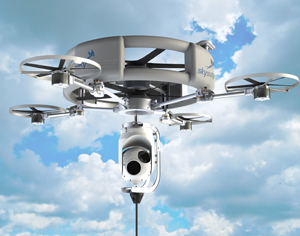
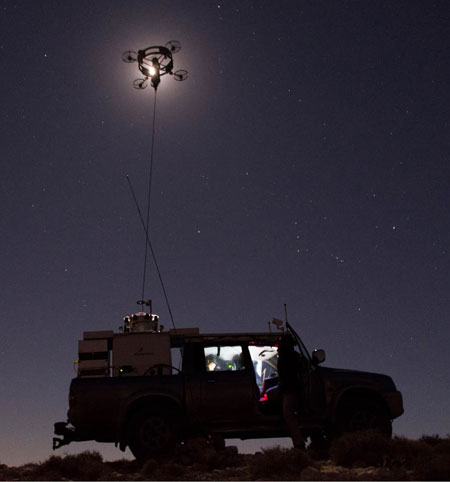
    The Hovermast 100 carries 6 kg of payload, including the Controp T-STAMP  multi-sensor EO payload, weighing 2.8 kg. The images collected by the payload are displayed in real time at the ground station, and can be transmitted via wireless link to other users. Photo: Sky Sapience
    The Hovermast 100 carries 6 kg of payload, including the Controp T-STAMP multi-sensor EO payload, weighing 2.8 kg. The images collected by the payload are displayed in real time at the ground station, and can be transmitted via wireless link to other users. Photo: Sky Sapience

    Stark Aerospace is offering the HoverLite tethered hovering platform developed by the Israeli SkySapience, for evaluation by sponsored by the US Combatting Terrorism Technical Support Office (CTTSO). HoverLite provides exceptional asymmetric observation and surveillance capabilities supporting military, homeland security and civilian missions for pop-up surveillance, border patrol, crowd monitoring, and emergency rapid response missions.

    StarkAerospace has already introduced several unmanned system platforms in the US market, the latest was the ArrowLite supplied to the US military through CTTSO.

    Rising to a height of 165 ft. in ~ 15 seconds, HoverLite is secured by a tether providing power and bi-directional signals to and from the aerial platform and its sensor. HoverLite can be operated on the move and broadcasts ISR products to users on the network or local with no signature.

    The platform is capable of carrying any payload of up to 13.2 lbs. HoverLite is suitable for a wide range of small platforms including pick-up trucks, ATVs, UGVs/USVs (unmanned ground /surface vehicles), boats, communication vehicles, etc.
    Stark Aerospace introduces a new, lightweight armor

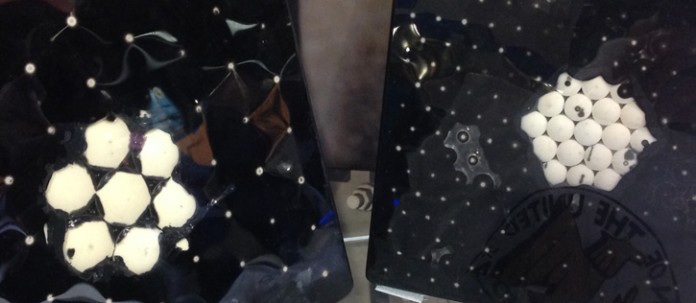
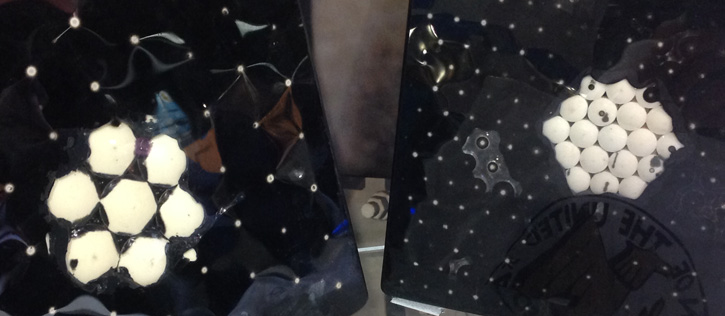
    LIBA based ProtectLite from Stark Aerospace. Photo: Tamir Eshel, Defense-Update
    LIBA based ProtectLite from Stark Aerospace. Photo: Tamir Eshel, Defense-Update
    LIBA based ProtectLite from Stark Aerospace. Photo: Tamir Eshel, Defense-Update

    Stark Aerospace is introducing a new, lightweight armor called ‘ProtectLite’ at the 2014 AUSA Annual Meeting & Exposition. Comprising a matrix of ceramic cylinders, based on the Israeli LIBA method patented by Mofet Etzion, ProtectLite armor offers a cost effective lightweight, highly resilient, survivability solution for vehicle armor. As a flexible, multi-hit bullet proof material, ProtectLite is up to 50% lighter in weight than armor steel with comparable ballistic protection with ~80% reduction in thickness. Its resilient nature allows application over curved surfaces and sharp angles. Due to the unique layout and structure of the panel cylinders, ProtectLite has multi hit capability. A hit to ProtectLite armor is local and does not influence neighboring elements.

    “We are pleased to be offering this proven product to the U.S. military,” said Robert Foglesong, Chairman & CEO of Stark Aerospace . “ProtectLite Armor has protected hundreds of tracked and wheeled vehicles, civilian and military armored jeeps, armored helicopters, trucks, buses, ambulances, and private vehicles all over the world.”
    New LIDAR for the TALON

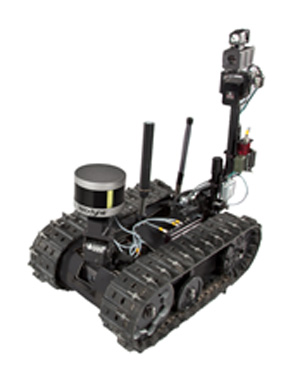
    A TALON robot carries the VPL-16 LIDAR Puck from velodyne.
    A TALON robot carries the VPL-16 LIDAR Puck from velodyne.
    A TALON robot carries the VPL-16 LIDAR Puck from velodyne.

    QinetiQ North America is unveiling the new TALON V robot at the AUSA exposition next week in Washington DC. Designed as a man transportable robot system (MTRS), TALON V is designed to provide open architecture, increased performance, flexibility and satisfy MTRS requirements. According to QinetiQ, the new robot is designed for interoperability with third party components that gives the soldier more flexibility and options to carry out the mission at hand.

    Smaller size and high performance motor allows for faster speeds, stair climbing and improved obstacle negotiationsOther improvements were made to the operating console, with user-defined graphical interface and support for HD video of 1080i. The manipulator arm has also been strengthened, with increased lift capability and third party equipment interoperability (IOP).

    One of the new payloads integrated with the platform is a new miniaturised LIDAR the VLP-16 Puck from Velodyne, which will be displayed next week at the RoboBusiness convention in Boston.

    Velodyne is offering its new VLP16 at an affordable cost, making the new sensor applicable to many robotic applications that were previously prohibited from using LIDAR due to their cost.
    Velodyne is offering its new VLP16 at an affordable cost, making the new sensor applicable to many robotic applications that were previously prohibited from using LIDAR due to their cost.

    “Velodyne’s VLP-16 LiDAR Puck is a perfect match for the TALON platform,” said Daniel Deguire, Director of Unmanned Systems for QinetiQ North America. “Its field of view, light weight, low power consumption and low cost promise to bring a host of new opportunities to deploy autonomous TALON robots, easing the burden on our soldiers and first responders.” The TALON robot system includes an array of specialized models, modules, and attachments, and can be configured for many applications, including IED defeat, CBRNE/hazmat identification, route clearance, reconnaissance, combat engineering support and SWAT/MP unit assistance.

    Measuring 3D in real time, Velodyne’s VLP-16 is part of a growing family of solutions built around the company’s Light Detection and Ranging (LiDAR) technology. The target range for the VLP-16 is 150-200 meters. Velodyne’s LiDAR Puck provides 16 channels, delivering point measurements of about 300,000 per sec. It operates over 360° horizontal field of view and a 30° vertical field of view, with ±15° up and down. The Velodyne LiDAR Puck has a protective design, making it highly resilient in challenging environments.

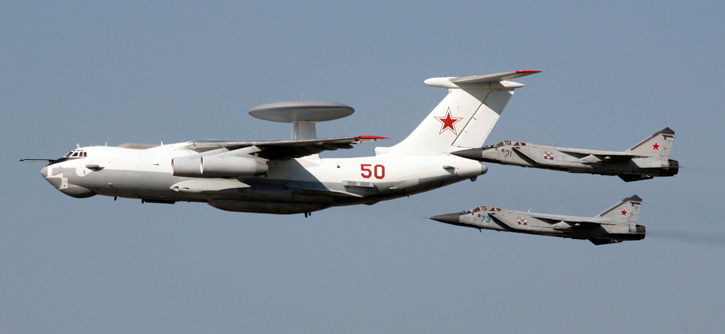
    Russia is developing a follow on to A-50 AEW based on the IL76MD-90A

    The IL-476 seen here on its maiden flight.
    A Bereyev A-50 AEW Mainstay aircraft escorted by two MiG 31 interceptors, both operating with the Russian Air Force. The A-50, based on the IL-76 is scheduled to be replaced by the A-100, based on the new IL-476 platform, bot designed by Ilyushin.
    A Bereyev A-50 AEW Mainstay aircraft escorted by two MiG 31 interceptors, both operating with the Russian Air Force. The A-50, based on the IL-76 is scheduled to be replaced by the A-100, based on the new IL-476 platform, bot designed by Ilyushin.

    The Russian Beriev company is developing a new Airborne Early Warning (AEW) platform to replace the A-50 ‘mainstay’ in service since 1984. The new aircraft designated A-100 is expected to become operational in 2017.

    The new platform utilize the latest, improved version of the Ilyushin Il-76MD-90A military transport plane, also known as Il-476). The first aircraft of this type has recently completed its maiden flight at Ulyanovsk, Russia.

    Concern Vega, which is part of the United Instrument Corporation, is developing the powerful surveillance radar to be housed in a rotating dome mounted on the aircraft. T his new-generation Active Electronic Scanned Array (AESA) provides electronic scanning in elevation while horizontal scanning is provided by the rotation of the antenna, at a constant rate of 12 RPM. The former A-50 radar used mechanical scanning in both elevation and rotation.

    Another version of the IL-76 modified with a static dome is the A-50E/I, operating with the Indian Air Force, carrying the with Israeli EL/W-2090 AESA airborne surveillance and early warning radar developed for the Indian Air Force.

    The Il-76MD-90A has been built at Aviastar-JV and will be transferred to A-100 AEW model by the G.M. Beriev Aviation R&D and Production Complex in Taganrog for fitting out and conversion to prototype of A-100.

    The radar will be scanning the airspace for hundreds of kilometers, identifying targets and sending complete targeting data to anti-aircraft and anti-missile defense systems enabling them to shoot down those targets. In addition, the aircraft is equipped to operate as an airborne command post,  air, ground and naval task forces.

    The IL-476 seen here on its maiden flight.
    The IL-476 seen here on its maiden flight.

    LCS to get unmanned mine-sweeping boats, drones

    cusv_left800
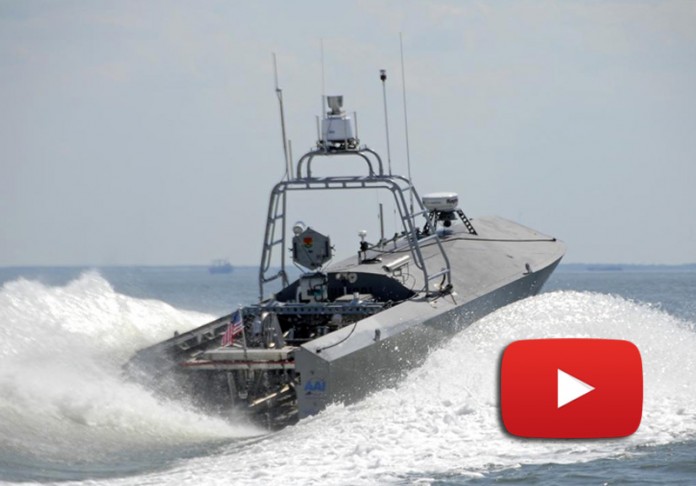
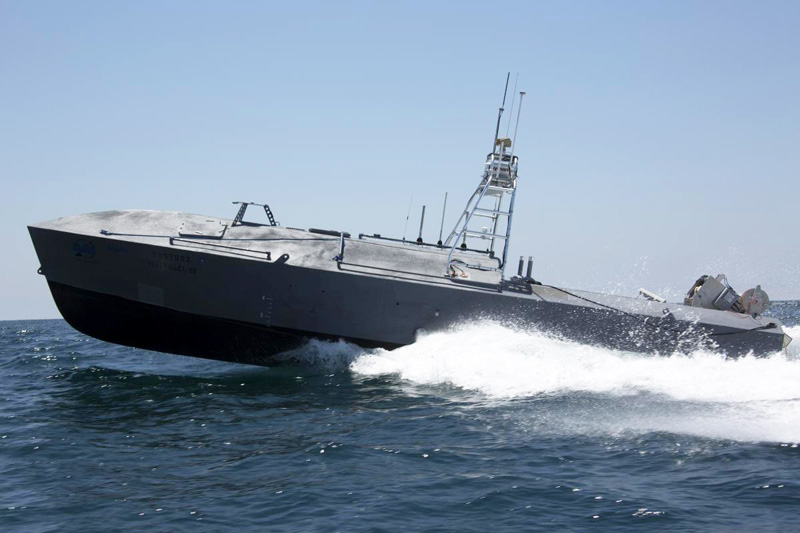
    Textron Systems CUSV unmanned surface vessel. Photo: Textron Systems

    Textron Systems has won a $33.8 million US Navy contract for the production of the Common Unmanned Surface Vessel (CUSV) to be used as the carrier platform for the Unmanned Influence Sweep System (UISS). The unmanned boats will be used as part of the LCS’ Mine Countermeasure (MCM) mission package. The first increment of the MCM package — designed to find and neutralize less complex but more plentiful contact mines — is slated to be tested onboard USS Independence (LCS-2) next year.

    Other counter-mine payloads could include side scan sonar and unmanned underwater vehicles (the Sea Fox UUV), operating in concert on two different USVs. Both are depicted in the video below, taken during the Trident Warrior experiment in 2012.
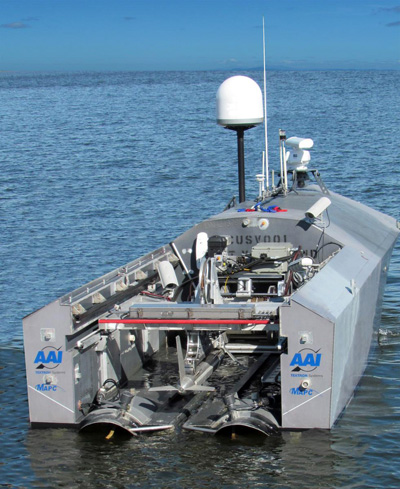
    The mine countermeasure systems will be carried in the CUSV's rear payload bay. Photo: Textron Systems
    The mine countermeasure systems will be carried in the CUSV’s rear payload bay. Photo: Textron Systems

    The UISS will be part of the mine countermeasures mission module for the LCS. The mine module is one of three — the others are for surface warfare and anti-submarine warfare.

    The UISS will be deployed from the LCS when the vessel enters mine-infested waters. The boats will deploy and tow the countermeasure system which emits acoustic and magnetic signals that would trigger influence mines, deceived by the magnetic and acoustic signals transmitted by the cable, triggering the mines to explode at a safe distance from the protected vessel. While sweeping, the unmanned surface vessel will also be far enough away so that it will not be damaged by a detonating mine.

    Currently, minesweeping is a task for manned ships and helicopters like the Avenger-class mine countermeasures ship and the MH-53 helicopter. Following the successful demonstration of the UISS prototype in tests during summer 2011 the the US Navy plans to deploy 52 UISS systems to equip 24 planned countermine modules (each comprised of two USVs), plus six for training and replacements.
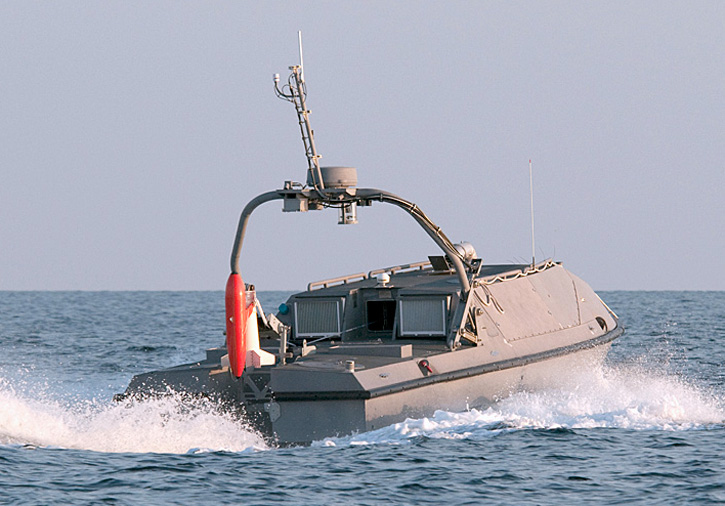
    The Unmanned Influence Sweep System prototype performed well in tests during summer 2011. The orange attachment on the back of the vessel is deployed into the water and uses magnetic and acoustic signals to trick mines into exploding.
    The Unmanned Influence Sweep System prototype performed well in tests during summer 2011. The orange attachment on the back of the vessel is deployed into the water and uses magnetic and acoustic signals to trick mines into exploding.
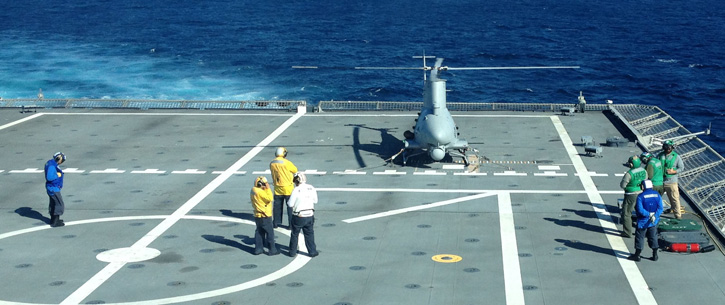
    An unmanned MQ-8B Fire Scout conducts testing aboard USS Coronado (LCS 4) in mid-September off the coast of San Diego. The Fire Scout will deploy with its first littoral combat ship in autumn 2014. Photo: US Navy
    An unmanned MQ-8B Fire Scout conducts testing aboard USS Coronado (LCS 4) in mid-September off the coast of San Diego.
    The Fire Scout will deploy with its first littoral combat ship in autumn 2014. Photo: US Navy

    The LCS will also receive the MQ-8B Fire Scout vertical takeoff and landing UAV (VTUAV). Several tests have already been done with the MQ-8B on the first littoral combat ship, USS Freedom. The drone is expected to deploy for the first time on board the USS Fort Worth (LCS 3) on its upcoming deployment, fall 2014.
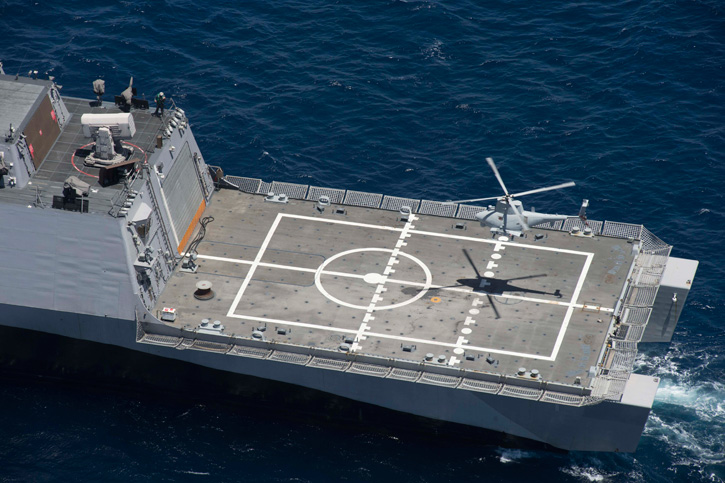
    An MQ-8B Fire Scout unmanned helicopter assigned to Helicopter Maritime Strike Squadron (HSM) 35 prepares to land on the aft deck of the Littoral Combat Ship USS Freedom (LCS 1) on May 12, 2014, during a visit, board, search and seizure (VBSS) training off the coast of Southern California. The training marked the first time the littoral combat ship, an MQ-8B and an SH-60R Sea Hawk helicopter conducted integrated VBSS training. Photo: US Navy
    An MQ-8B Fire Scout unmanned helicopter assigned to Helicopter Maritime Strike Squadron (HSM) 35 prepares to land on the aft deck of the Littoral Combat Ship USS Freedom (LCS 1) on May 12, 2014, during a visit, board, search and seizure (VBSS) training off the coast of Southern California. The training marked the first time the littoral combat ship, an MQ-8B and an SH-60R Sea Hawk helicopter conducted integrated VBSS training. Photo: US Navy

    Oshkosh announce winter lay off in its defense business

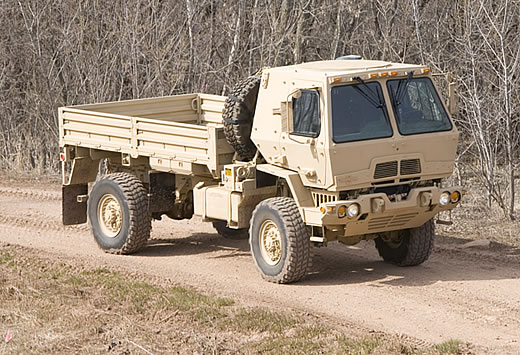
    Oshkosh has recently won new orders for FMTV medium trucks for the U.S. Army and Army National Guard worth over $1.2 billion. Photo: Oshkosh
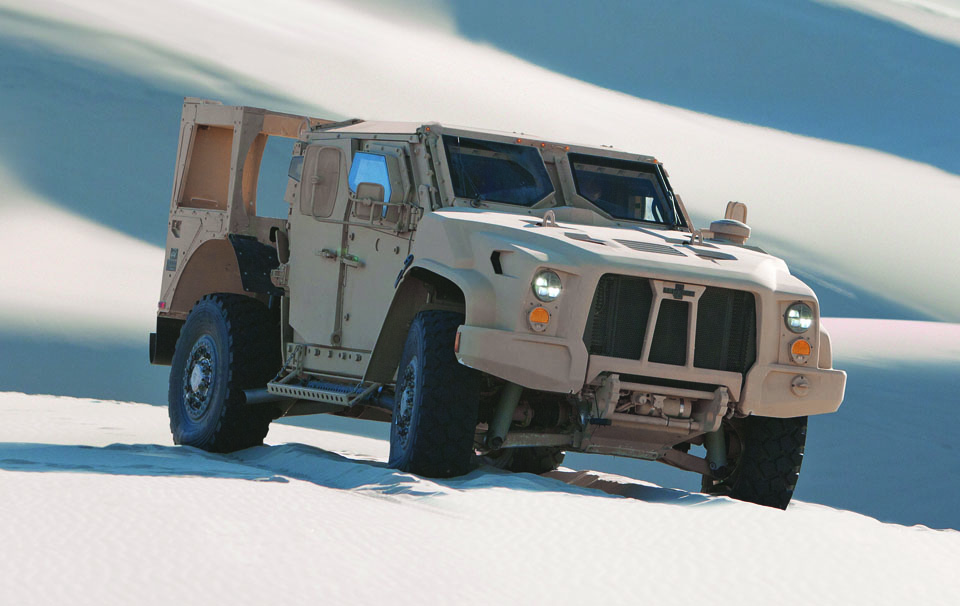
    The Light All terrain Vehicle (L-ATV) proposed by Oshkosh Defense was one of three designs to win the latest EMD phase. Photo: Oshkosh Defense.
    The Light All terrain Vehicle (L-ATV) proposed by Oshkosh Defense was one of three designs to win the JLTV EMD phase. Photo: Oshkosh Defense.

    Oshkosh Corp. announced today it will lay off 250-300 hourly workers and about 70 salaried employees in December 2014 as part of its continued scaling back as a result of decreased military truck orders. The majority of the salaried-employee layoffs will be accomplished by cutting temporary workers, eliminating open positions and through retirement, the company said in a press release.

    “This is the impact of spending being down and the draw-down of troops,”Oshkosh Corp. spokesman John Daggett said. “It’s kind of had a ripple effect. We’re still the number one global manufacturer of tactical wheeled vehicles for the military, but the reduction of force has an impact on the number of vehicles needed.”

    The winter layoff will drop the company’s defense segment workforce to about half of its’ peak of 3,100 employees during Family of Medium Tactical Vehicles (FMTV) production in the early 2010s. According to Daggett, the company will employ about 1,725 defense segment employees once the winter layoff is complete.

    In June this year Oshkosh began lay off of 700 hourly positions and 60 salaried jobs in its defense segment. These lay offs were also said to be in the temporary employees and people who are retiring.

    With the draw down in Afghanistan and budget cuts throughout the military, orders for the company’s FMTV trucks have dropped. By joining the services’ funded engineering and manufacturing development with its privately funded Light All Terrain Vehicle (L-ATV) Oshkosh has improved its chances to win the next major Army and Marine Corps acquisition of the HMMWV successor – the Joint Light Tactical Vehicle (JLTV). Oshkosh has recently announced it has completed the JLTV program production readiness review.

    The review included a review of Oshkosh’s manufacturing readiness, quality management system and production planning capabilities to meet scheduling, performance and cost requirements for production of the Joint Light Tactical Vehicle.

    Oshkosh is one of three remaining competitors for the JLTV contract, which is expected to be awarded in 2015. A total of about 49,000 vehicles are expected to be ordered, with the vast majority destined for the Army and the remainder for the Marine Corps.

    Skunk Works and XTEND Simplify Multi-Drone Command

    0
    Lockheed Martin Skunk Works® and XTEND have achieved a major milestone in JADC2 by integrating the XOS operating system with the MDCX™ autonomy platform. This technical breakthrough enables a single operator to simultaneously command multiple drone classes, eliminating the friction of mission handoffs. From "marsupial" drone deployments to operating in GPS-denied environments, explore how this collaboration is abbreviating the data-to-decision timeline and redefining autonomous mission execution.

    From Ukraine to Taiwan: The Global Race to Dominate the New Defense Tech Frontier

    0
    As traditional defense primes face mounting competition from agile “neoprimes” such as Anduril, Palantir and Helsing, the balance of innovation is shifting toward software-defined warfare and scalable, dual-use technologies, while global industry consolidation—marked by Boeing’s integration of Spirit AeroSystems and other strategic mergers—signals an intensified race to secure control over the defense technology value chain. Our Defense-Tech weekly report highlights these trends.

    Europe’s “Drone Wall”

    0
    In early October 2025, a coordinated wave of unmanned aerial system (UAS) incursions—widely attributed to Russia—targeted critical infrastructure across at least ten European nations. The unprecedented campaign exposed the fragility of Europe’s air defenses...

    Weekly Defense Update & Global Security Assessment

    0
    Executive Summary The past week (September 18-25, 2025) represents an inflection point where strategic defense concepts have transitioned from doctrine to tangible reality. An analysis of global events reveals four primary, interconnected trends shaping an...

    U.S. Air and Space Forces Push Next-Gen Programs at the AS&C 2025 Conference and...

    0
    At the 2025 Air, Space & Cyber Conference, U.S. Air Force and Space Force leaders unveiled major updates on next-generation fighters, bombers, unmanned systems, and space initiatives, highlighting both rapid innovation and critical readiness challenges as the services race to outpace global competitors. A short version is available here, with a more detailed version for subscribers.

    TADTE 2025: Reflecting Taiwan’s Strategic Themes

    0
    The Taipei Aerospace & Defense Technology Exhibition (TADTE) 2025 crystallized around four dominant strategic themes that collectively illustrate Taiwan's comprehensive approach to defense modernization amid escalating regional tensions. Based on a detailed report by Pleronix (available upon request). Includes a Podcast discussion on TADTE 2025's highlighting Taiwan's four strategic themes beyond the post's coverage.

    Iron Beam 450 Completes Testing, Soon to Join With Operational Air Defense Units

    0
    Israel’s Iron Beam 450 high-power laser system has completed final testing, marking a major leap in air defense. Developed by Rafael, it offers precise, cost-effective interception of rockets, UAVs, and mortars, and is set for IDF deployment by 2025.