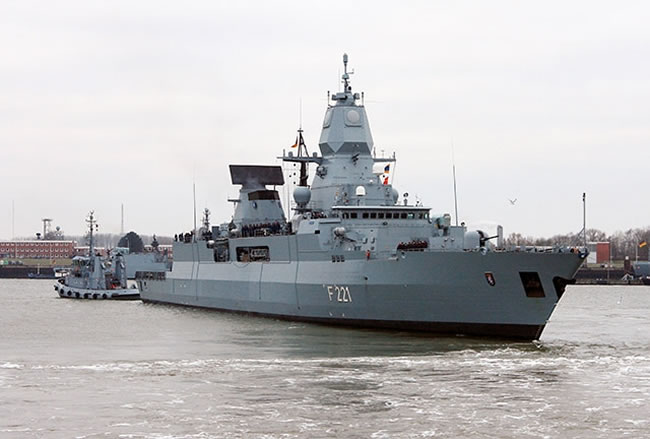
As of January 2013 the German Navy F-124 frigate (F-221) is currently serving as the flagship of NATO Standing Maritime Group 1. The frigate will be part of the modernization of the F-124 program. Photo: German Navy
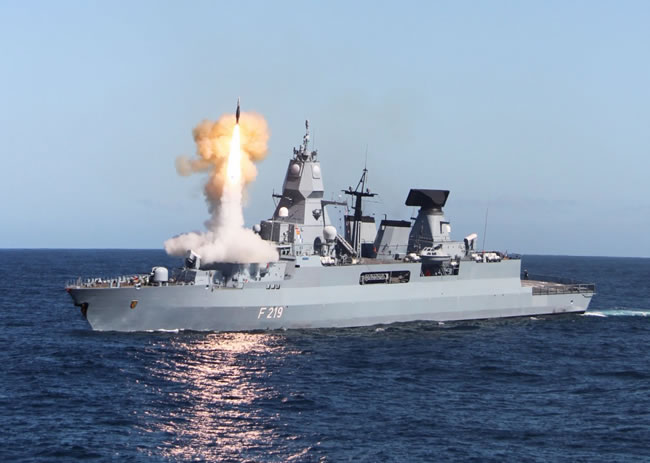
F-219 Sacsen, the first of three F-124 frigates of the German Navy fires an SM-2 Block IIIA on a test firing in 2011. Photo: German Navy
Atlas Elektronik and Thales Deutschland have jointly been commissioned to modernize the combat system of the German Class F124 frigates. The order comprises the three frigates “Sachsen”, “Hamburg” and “Hessen” as well as the Test and Training Centre (EZ/AZ) in Wilhelmshaven and the Reference Maintainer and Training Site (RMTS) in Den Helder. The work is to be organized and managed in such a way that the vessels will not need to be taken out of service. The modernization is scheduled to be completed in 2017.
The program will be managed under the “HW Regeneration CDS F124” consortium, formed by the two companies. Under the program the hardware of the Combat Direction System (CDS) will be refurbished, and receive software updates.
The activities include replacement of the outdated console processors, the data recording modules, and various network modules using components of the latest generation. Supportability of CDS components that are not regenerated yet critical for the system’s realtime response will, however, be ensured. It is expected that the new hardware will provide sufficient capacity for the integration of new subsystems and future CDS functionalities. The modernization will employ as much commercial off the shelf hardware and software modules as possible. Both companies were involved in the construction and equipment development of these vessels.
Volker Paltzo, Managing Director of Atlas Elektronik and Peter Obermark, CEO of Thales Deutschland recently signed the contract at the Federal Office of Bundeswehr Equipment, Information Technology and In-Service Support (BAAINBw) in Koblenz.
The F124 Sachsen class is Germany’s latest class of air-defense frigates. Although designated as frigates, they are in capability and size comparable to destroyers. The frigate incorporates the advanced multifunction radar APAR and SMART-L long-range radar, offering effective air and missile defense capability with the SM-2 Block IIIA missiles on board.
As of January 2013 the German Navy F-124 frigate (F-221) is currently serving as the flagship of NATO Standing Maritime Group 1. The frigate will be part of the modernization of the F-124 program. Photo: German Navy
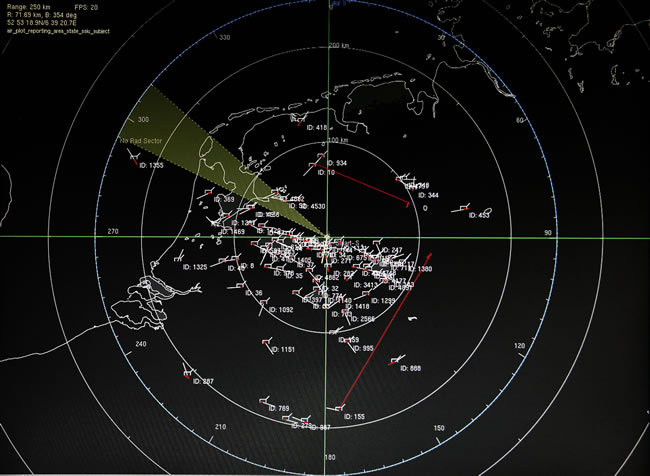
SMART-S MK2 radar display at Thales Nederland BV site, in Hengelo, in may
2008. The SMART-S Mk2 (Signaal Multibeam Acquisition Radar for Tracking) is a member
of 3D multi-beam radar family. This radar is optimised for medium-to-long range surveillance, target designation and accurate air and surface target tracking in littoral environments. Photo: Thales
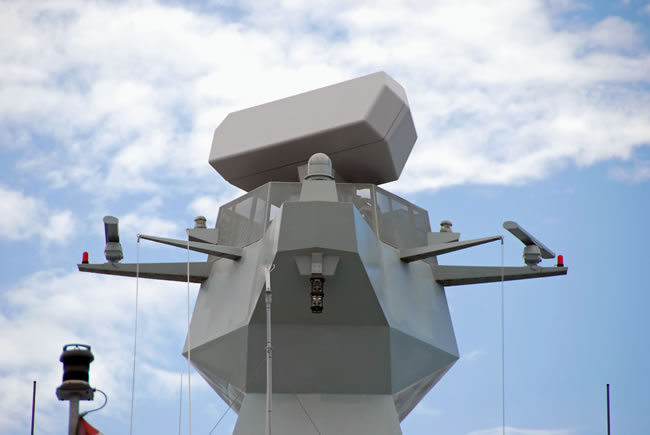
SMART-S Mk2 radar, installed on HDMS Absalon, the first of the Flexible Support Ships of the Royal Danish Navy. The recent test conducted by Raytheon and Thales connected the the Active Phased Array Radar installed below the SMART-L – Photo: Thales
Joint US and European testing of command, control, communications and radar systems are underway to demonstrate the feasibility of integration of European radars and command and control systems into a future missile defense systems based on the planned European Phased Adaptive Approach (EPAA) utilizing the several AEGIS destroyers or cruisers to be based in Spain, land-based SM-3 interceptors to be stationed in Romania and Poland, along with SPY-2 radars sites. These assets are to be complemented by a number of European deployed radar sites.
In recent weeks tests were carried out to evaluate such integration. Last week Raytheon reported about a recent trial that showed that a radar used by Dutch, German and Danish navies could provide target information to the interceptor. The current radar installed on the Dutch frigates is incompatible with the AEGIS/SM-3 link operating over S-band. The demonstration which took place at the Den Helder military test range validated a datalink that allows the missile to receive information from the Thales sensor while retaining the ability to communicate with Aegis combat ships used by the U.S. Navy. Generally, The Dutch, German and Danish navies datalinks are operating on X bands, while Norway, Spain and the U.S. operate AEGIS frigates communicating with their interceptors over the S band. To avoid unique configurations of missiles, Raytheon has developed a dual-band datalink which enables the same missile to communicate in both bands. This dual-band datalink was first tested in 2011.
In 2009, a joint U.S.-Netherlands study concluded SM-3 could be integrated with the Signaal Multibeam Acquisition Radar for Tracking-L (SMART-L) and Advanced Phased Array Radar (APAR) sensor suites, providing non-AEGIS ships a viable missile defense capability. 20 such radars (or their derivatives) are already deployed with frigates and destroyers of six NATO navies, including four DutchDe Zeven Provinciën class frigates, three German Sacsen frigates and three Danish Navy Iver Huitfeldt class frigates.
Six British Type 45 destroyers and four Horizon class frigates of the French and Italian navies are also employing similar radar technology from Thales. To further tighten such integration, the Royal Navy is planning to deploy one of its Type-45 destroyers to take part in a missile interception test to be conducted under the US Missile Defense Agency plan. Another recent test demonstrated datalink connectivity between a French-Italian SAMP/T missile defense unit and the NATO Ballistic Missile Defense Operations Center (BMDOC), using NATO standard Link 16 datalink.
On the recent test, Raytheon’s company-funded the development of the dual-band datalink which would play a key role in enabling more European ships to employ the full range of missiles within the Standard Missile family, including the Standard Missile-3. “Right now, few of Europe’s naval ships can participate in the ‘upper tier’ ballistic missile defense of NATO countries because their radars cannot communicate with the SM-3,” Wes Kremer, vice president of Air and Missile Defense Systems for Raytheon Missile Systems explained. “A common datalink that operates with both X- and S-band radars is a very affordable, near-term solution that allows Europe to take advantage of proven technologies available today.”
Using both sending and receiving signals, the test validated the ability of the dual-band datalink to communicate with the APAR X-band radar, which is part of a radar suite used by the Danish, Dutch and German navies. Integrating a dual-band datalink into any of the Standard Missiles is a ‘drop in’ replacement for the current hardware. “The dual-band datalink has significant implications for our U.S. Navy customers as well, because it allows them to save money by eliminating the need to maintain two separate inventories of Standard Missiles for the Zumwalt (X-band) and Aegis (S-band) ship classes,” said Kremer.
SMART-S MK2 radar display at Thales Nederland BV site, in Hengelo, in may 2008. The SMART-S Mk2 (Signaal Multibeam Acquisition Radar for Tracking) is a member of 3D multi-beam radar family. This radar is optimised for medium-to-long range surveillance, target designation and accurate air and surface target tracking in littoral environments. Photo: Thales
Fierce battles erupting as a Syrian armored troop enters the devastated Damascus suburb of Darayya on patrol. The battle can be seen from various angles, as rebels shooting RPG-29s and videos record the scenes on tape.
We collected several videos taken from the same area (apparently on different dates) showing the situation as it was seen from different angles, Syrian and rebels urban fighting tactics are clearly seen.
In a unanimous vote 7 March, the United Nations’ Security Council agreed to initiate a round of far-reaching new sanctions against the secluded communist North Korean regime of Kim Jong-un in response to Pyongyang’s 12 February nuclear test.
The 15-member Security Council has been engaged in intense negotiations for the past few weeks with the United States working overtime to convince China of the need for a more comprehensive range of sanctions. China, as Pyongyang’s principal ally, did not exercise its veto power to prevent the sanctions from becoming effective.
Since 2006, the UN Security Council has implemented three rounds of sanctions against the North in an effort to restrain the reclusive nation’s repeated efforts to develop a nuclear-weapon’s capability and its efforts to produce an arsenal of ballistic missiles. For the most part, these previous sanctions have failed to curtail Pyongyang’s single-minded determination to be included among the elite few nuclear-capable nations.
This latest round of sanctions target Pyongyang’s cash flow in an effort to cripple the North’s access to financial sources that could be used to fund further development of nuclear devices and acquisition of ballistic-missile technology. It is hoped these new sanctions will prove successful in convincing the North to abandon its efforts to develop a nuclear capability.
North Korea, in years past, has devised ingenious techniques to thwart efforts to restrict the flow of funds into the reclusive regime. Bulk cash acquisitions have continued despite sanctions prohibiting such activities. The North has gone so far as to have agents obtain and deliver suitcases stuffed with currency. These “cash couriers” are believed to include North Korean diplomats.
UN Security Council Resolution 2094 includes articles that:
Requires member nations to freeze or block financial transactions and services that could be used by the North to fund its nuclear and missile projects.
Prohibits states from allowing the North to open bank branches in their territories if such institutions can be linked to prohibited activities or are found to be in violation of Security Council resolutions.
Prohibits financial institutions of member states from opening offices in the North if their activities are suspected of contributing to Pyongyang’s prohibited programs.
Expands financial sanctions to include bulk cash transfers, including funds carried by cash couriers, and encourages member nations to more closely monitor North Korean diplomats who may be engaging in prohibited activities.
Requires member nations to enforce strict mandatory inspections of North Korean seaborne and airborne vessels that might be transporting suspicious cargo.
Calls for member states to deny North Korean planes and ships access to ports and landing facilities should they refuse to be inspected.
Clarifies the determination that brokerage services that contribute to the sale of arms to the North, including conventional arms, contained in existing sanctions remain in force.
Bans the export of high-value jewelry, racecars, luxury autos, and yachts to North Korea.
Bans a wide-range of trade agreements, including trade in export credits, if such agreements might contribute to Pyongyang’s nuclear program or ballistic-missile development.
Requires member states to expel individuals working for North Korean companies included on the UN’s list of sanctioned companies from their territories.
In addition to these sanctions, the UN resolution also bans any further North Korean nuclear tests, rocket launches, and other activities that could be considered provocative. The UN also calls on Pyongyang to abide by the Nuclear Nonproliferation Treaty.
The resolution also names three individuals, The North’s Second Academy of Natural Sciences, and the Korea Complex Equipment Import Corporation to be added to the UN’s sanctioned list for their activities in support of Pyongyang’s prohibited missile and nuclear testing.
Immediately prior to the Security Council vote, an unidentified spokesman for the North’s Foreign Ministry warned on the regime’s state-owned Korean Central News Agency that Pyongyang was prepared to exercise its right to initiate “a preemptive nuclear attack to destroy the strongholds of the aggressors.”
North Korean Army General Kang Pyo Yong also entertained a crowd in Pyongyang numbering in the tens of thousands with a fiery speech that included a statement that the North was now prepared to launch long-range ballistic missiles that would engulf Washington, DC in a “sea of fire.”
Some unidentified sources are reporting that trains and buses in Pyongyang have been covered with camouflage netting in a move that adds to the tense situation. The North has also announced a no-fly order over the sea areas in the east and the west, has restricted seaborne traffic, and has placed restrictions on personal travel.
Pyongyang has also threatened to disavow the cease-fire agreement signed in 1953 that effectively ended the Korean Conflict. North Korea maintains an impressive arsenal of offensive combat forces near the Demilitarized Zone equipped with artillery and other heavy weapons that could strike South Korean and American forces with little warning.
While nearly all experts doubt Pyongyang has the ability to carry-out a missile strike against the United States, the intense rhetoric flowing from the North might be a prelude to future provocations that could push the Korean Peninsula a step closer to open warfare.
The new Security Council resolution, while being the most comprehensive to date, may not be enough to force North Korea’s leaders to abandon their nuclear and missile programs. The success of the new sanctions will depend largely on rigid enforcement by China. China’s leaders have publicly denounced the North and repeatedly claimed to adamantly oppose Pyongyang’s efforts to develop a nuclear-weapon’s capability.
Without a firm commitment from China, these new sanctions are unlikely to stop North Korea’s illicit activities. Even if the sanctions are wholeheartedly enforced, it remains quite likely that Kim Jong-un and the North’s ruling hierarchy will conduct more nuclear tests and will attempt future rocket launches until such time as a lack of funding cripples these efforts.
The most immediate concern is that the North will feel pressured enough to attack South Korea, an action that could escalate into a Peninsula-wide Second Korean Conflict. In the event such a situation did develop, China’s response would be critical.
The US House of Representatives has passed a Continuing Resolution (CR) valued at $982 billion to keep the federal government operational until 30 September 2013. An existing CR is scheduled to end on 27 March.
Attached to the CR is full approval of a $518.1 billion funding measure to finance Department of Defense spending for all of Fiscal Year 2013 (FY 2013). This amount represents $2 billion more than requested by the Obama administration.
Under the House bill, the Pentagon will enjoy greater flexibility in funding critical defense programs. The Senate version is expected to be presented for a vote sometime in the coming week.
The funding measure, drafted by the House Appropriations Committee, added the Pentagon spending bill to the CR as a means of giving the Pentagon some degree of autonomy in dealing with mandatory across-the-board spending cuts mandated under sequestration.
Under the House bill, the Pentagon will enjoy greater flexibility in funding critical defense programs. Additional funding was also authorized for those military accounts that are likely to suffer the most during sequestration, such as operations and maintenance.
A CR alone would have deprived the Defense Department of the degree of flexibility pro-defense legislators believe is needed to maintain national security. With a CR, federal agencies are strictly limited in their ability to realign funds between accounts and are not authorized to transfer money from a low-priority program to a critical-needs account that happens to be short of cash.
Several Congressional lawmakers, in both the House and the Senate, have proclaimed their displeasure that the Defense Department is receiving preferential treatment in dealing with the terms of the sequestration cuts. Despite the criticism, the White House has indicated that President Obama would not be inclined to veto the CR if the finalized bill is similar to the House bill.
While the House was voting in favor of the CR, the Senate Appropriations Committee was busy formulating its own version of the bill. The Senate version is expected to be presented for a vote sometime in the coming week. Once a Senate bill is approved, the two branches of Congress will then need to negotiate the details of a final form to be presented to the president for his signature.
Beechcraft Corporation today announced that it will formally protest to the U.S. Government Accountability Office (GAO) the U.S. Air Force’s (USAF) recent award of the Light Air Support contract to its Brazilian competitor, Embraer. An estimated 1,400 jobs in Kansas and other states are in jeopardy as a result of the Air Force decision.
“We simply don’t understand how the Air Force can justify spending over 40 percent more – over $125 million more – for what we consider to be less capable aircraft,” Bill Boisture, CEO, Beechcraft
“Following our debrief with the Air Force earlier this week, we are very perplexed by this decision,” said Bill Boisture, CEO, Beechcraft. “Our belief that we have the best aircraft was confirmed by the Air Force rating our aircraft ‘exceptional’ and the fact that we are the lower cost solution was confirmed by the USAF’s public award announcement.”
Last year, an Air Force investigation found evidence of bias toward Brazil-based Embraer and its Nevada-based partner, Sierra Nevada (SNC), which led to the decision to restart the competition. Although SNC later sued the Air Force attempting to enforce the biased decision, U.S. Court of Federal Claims Judge Christine O.C. Miller wrote in her Nov. 1, 2012, opinion that based on the investigation’s evidence of bias “the Air Force’s decision to cancel the contract award to SNC and re-solicit proposals was reasonable and rational and should stand.”
“We simply don’t understand how the Air Force can justify spending over 40 percent more – over $125 million more – for what we consider to be less capable aircraft,” Boisture said. “Given our experience of last year and our continued strong concern that there are again significant errors in the process and evaluation in this competition, we are left with no recourse other than to file a protest with the GAO. The Air Force needs to make the right decision for the nation and our future allies.”
“In evaluating the competitors, the U.S. Air Force looked at three criteria, in priority order: mission capability, past performance and pricing in order to determine overall best value.” Sierra Nevada Corp. and Embraer commented in a joint statement. Based on these factors the companies said they are expecting rapid Government Accounting Office decision on Beechcraft’s protest, and are confident the Air Force selected the A-29 as the lowest risk solution and overall best value for the U.S. and its partner nations. “In accordance with the RFP, the US Air Force selected the A-29 based on three factors stated above, not just a single factor. The U. S. Air Force determined that the price they are paying for the superior A-29 aircraft was part of the ‘overall best value’.”
SNC added that an important aspect about our approach is the “in-sourcing” of jobs to Jacksonville. Overall the program is expected to support more than 1,400 American jobs, reflecting both the large U.S. supplier base – including more than 100 companies that will supply parts and services for the A-29 Super Tucano. “We feel it establishes an exciting future model of bringing high tech aerospace manufacturing jobs back to the United States to stem the recent tide of moving jobs offshore.” the SNC statement added.
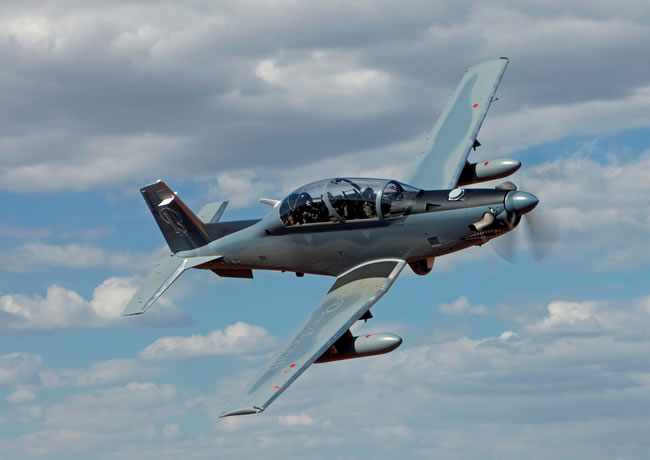
The AT-6 draws its heritage from the Beechcraft T-6 A/B Texan trainer. It was designed to provide close air support and meet the demands of irregular warfare environment. The AT-6 is outfitted with a more powerful engine, a variety of self-protection mechanisms, multiple secure communication functions and advanced surveillance and reconnaissance capabilities. However, unlike the A-29 that is already used in tactical missions worldwide, the AT-6 has not been selected by any air force yet.
Beechcraft Corp. recently celebrated the delivery of the 800th Beechcraft T-6. The aircraft, a T-6B trainer was handed over to the United States Navy’s Training Air Wing 4 based at Naval Air Station Corpus Christi, Texas. Training Air Wing 4 has now received 16 of a total of 98 T-6Bs scheduled to replace an aged fleet of T-34 aircraft for primary flight training. According to Russ Bartlett, president, Beechcraft Defense Company, Military programs around the globe have accumulated more than 2 million flight hours using the T-6 to train pilots, navigators and weapons systems operators.
Production line of T-6B trainers at Beechcraft Corp. Wichita plant. The company is protesting the award of the LAS contract to its competitor Embraer. claiming their proposal was lower and potential loss of US jobs. Photo: Beechcraft Corp.
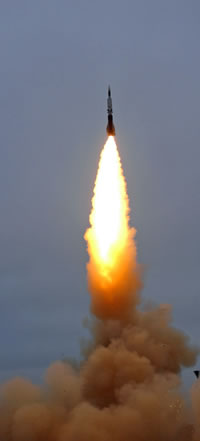
Aster-30 missile launched as part of a SAMP / T missile defense test. Photo: MBDA
The Italian Army and French Air Force carried out yesterday a successful intercept of a ballistic missile target, testing a European missile defense architecture based on the European SAMP/T missile defense system.
The recent intercept test of a theater ballistic-missile target by the MBDA SAMP/T employed NATO standard communications environment for the first time, where integration with NATO Ballistic Missile Defense Operations Center (BMDOC) at Ramstein, Germany could be established via Link 16 data-link. THis configuration is similar to what would be the future NATO ATBM mission, under the aegis of the alliance ALTBMD program. On the recent tests the Aster 30B1 missile scored a direct hit on the target.
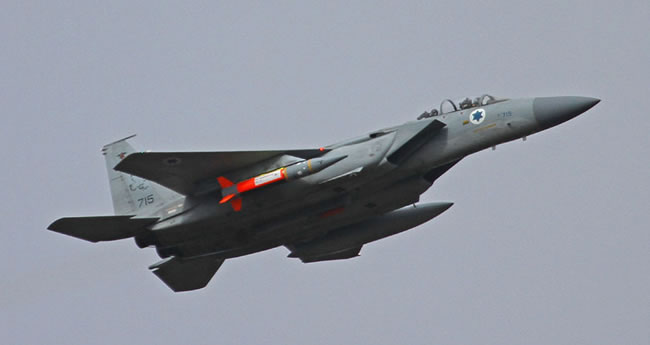
The target, an Israeli RAFAEL Black Sparrow missile was launched by an Israel Air Force F-15 deployed from Cazaux, north of Biscarrosse. AFter takeoff, the F-15 turned to the Atlantic ocean and launched the target missile toward land, as it has done many times on Arrow intercept tests in Israel. The missile flew about 300 km on a ballistic trajectory representing a theater ballistic missile. Once target was acquired by the ARABEL multi-function radars of the two SAMP/T units, battle command committed one of the fire units to fire the ASTER 30B1 missile which scored a direct hit on target. This was the second time of 13 test successful flights that the ASTER 30B1 scores a direct hit. The test campaign began in 2005 and the system has been deployed with operational force since 2008.
An Israel Air Force F-15 (Tail 715) takes of from Cazaux on March 6, 3013, carrying the Black Sparrow target for the SAMP/T test. J.P. Dewam via pics-aeronef.discutfree.comThe test conducted at DGA Biscarrosse missile tests center was performed by the fourth Artillery regiment of Mantova (Italy) and the French center of military & aviation testing (CELM) of Mont-de-Marsan. The successful test represents another milestone for the SAMP/T system in its capability to counter missile threats under NATO’s future missile defense architecture. It follows two previous tests successfully completed in October 2010 and November 2011 against the same type of threat.
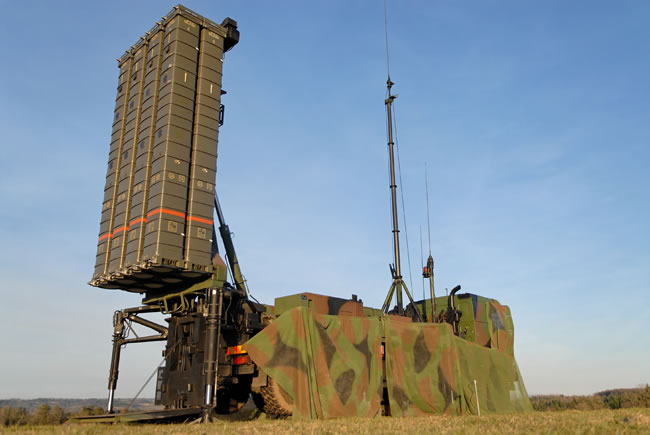
The The SAMP/T is a joint Franco-Italian air and missile defense system based on the MBDA Aster 30 interceptor. As the only non-US built long-range air defense system contributing to the NATO Alliance capability against ballistic threats, SAMP/T is the cornerstone of the European contribution to the evolving European missile defense architecture. French and Italian governments have committed to contribute to NATO ATBM defence with SAMP/T systems.
Eurosam has delivered to date 14 units to Italy and France, including 2 First of Class units. France will deploy 10 SAMP/T in 5 air defence squadrons, 4 of which are currently equipped or being equipped. The Italian Army will regroup 5 SAMP/T units in one Regiment, in Mantova, with 4 already delivered.
Each SAMP / T launcher has eight Aster 30 interceptors. Photo: MBDA
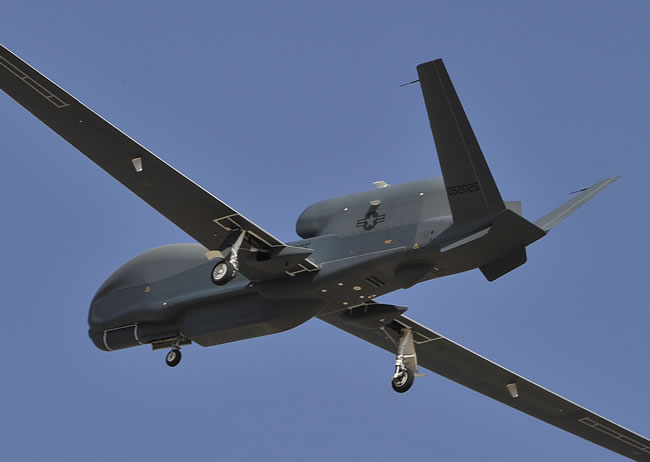
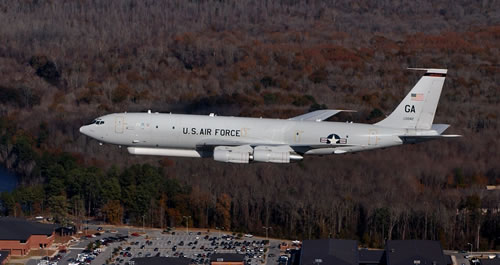
RQ-4B Block 40 carrying the MP-RTIP radar system on its first flight, July 21, 2011. The radar AESA antenna is located in the gondola shaped pod while other radar modules are located in payload bays inside the fuselage. Photo: Northrop Grumman
US Air Force E-8C Joint STARS. Photo: Northrop Grumman
Interoperability of airborne SAR, and Ground-Based Image Processing Systems Empower Global Hawk, Joint STARS to Process, Distribute Radar Imagery through DCGS-I
Northrop Grumman Corporation recently completed a successful exchange of radar data during a flight test involving the U.S. Air Force’s E-8C Joint Surveillance Target Attack Radar System (Joint STARS) and the RQ-4B Global Hawk Block 40 unmanned aircraft system equipped with MP-RTIP radar. The RQ-4B Block 40 first flew with MP-RTIP radar in November 2011.
During the mission that took place February 25 the Global Hawk Block 40 an streamed ground moving target (GMTI) radar data to a Joint STARS aircraft representing “a significant leap forward in terms of possible capabilities for our warfighters,” according to Bryan Lima, Joint STARS program director at Northrop Grumman. “[our] Findings showed increased precision, improved target tracking and the ability to extend the surveillance coverage area. By combining the capabilities of these platforms, we’ve unlocked increased battle management potential, not only by expanding coverage of the surveillance area, but also for compressing the targeting and attack decision chain for warfighters.”
Lima explained.
On typical missions Global Hawk Block 40 streams radar cues and GMTI data are used to find, identify and locate both
stationary and moving targets. The radar images and GMTI tracks are fed into the Distributed Common Ground Station (DCGS) – a common intelligence repository operated by the U.S. Air Force and Army. Analysts subscribed to DCGS receive the data exploiting MP-RTIP Radar imagery into analysed data fed to the combat commands through the DCGS and Battle Management Nodes, where GMTI tracks indicating target movement can also be monitored.
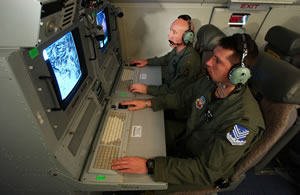
Crewmen of E-3C monitoring the SAR radar screens on board the J-STARS. Photo: Northrop Grumman
Monitoring the drone’s radar sensors in real time, The Global Hawk Mission Control Element (MCE) are involved, to alter collection in real-time in support battle plans. MCE also provides the data servers to store the MP-RTIP radar data and correlate GMTI detection to form target tracks. Acting upon the information provided by the system, as well as from other intelligence inputs, the combat command nominates targets for battle management nodes to
consider for attack while the battle management command and control (BMC2) directs weapons to attack those targets based on SAR and GMTI cues.”The [Feb. 25] flight successfully demonstrated the interoperability of both platforms to potentially improve and expand surveillance capabilities for deployed forces. “Operators in the Joint STARS aircraft were able to use the Global Hawk as an adjunct sensor,” said Lima. “We were able to display and use the Global Hawk’s radar data on the Joint STARS platform to extend and improve the overall surveillance capabilities and utility of both platforms.” as the GMTI data generated by Global Hawk could be processed by Joint STARS could then be relayed from Joint STARS to the ground forces.
RQ-4B Block 40 carrying the MP-RTIP radar system on its first flight, July 21, 2011. The radar AESA antenna is located in the gondola shaped pod while other radar modules are located in payload bays inside the fuselage. Photo: Northrop Grumman
Joint STARS is an airborne battle management and command and control platform that conducts ground surveillance of fixed and moving ground targets to develop an understanding of the enemy situation and support location, tracking, targeting and attack operations. Global Hawk carries a variety of intelligence, surveillance and reconnaissance sensor payloads that allow military commanders to gather imagery and use radar to detect moving or stationary targets on the ground. Capable of flying for more than 30 hours at a time at altitudes up to 60,000 feet, the system also provides airborne communications and information sharing capabilities to military units in harsh environments.
The radar designed for the Block 40 is the AN/ZPY-2 Multi-Platform Radar Technology Insertion Program (MP-RTIP) sensor, which is an advanced air-to-surface-radar for wide area surveillance of fixed and moving targets. MP-RTIP uses an Active Electronically Scanned Array (AESA) to combine Synthetic Aperture Radar and Ground Moving Target detection functions, providing ‘game-changing’ situational awareness and targeting information for warfighters.
Common Imagery Processor Empowers DCGS-I Capabilities
Another integration experiment with DCGS-I the Common Imagery Processor (CIP) disseminated processed Global hawk Block 40 imagery and transferred it to other ground stations via the Distributed Common Ground System – Imagery (DCGS-I) testbed. As the primary sensor processing element of the DCGS-I testbed based in China Lake, Calif., the CIP accepts airborne imagery data, processes it into an exploitable image and then outputs the image to other elements within the testbed. The CIP is the standard image processor used by the U.S. Department of Defense (DOD). The CIP also helps coalition partners to consolidate redundant and stovepiped processing systems.
The CIP’s latest software allowed for the newest synthetic aperture radar (SAR) imagery mode to be processed while simultaneously passing the ground moving target indicator data on to another system for processing. The CIP is the only platform capable of processing concurrent SAR data. Since the year 2000 the CIP has been involved in integration and test activities for many platforms and sensors and was demonstrated in Empire Challenge, an intelligence, surveillance and reconnaissance demonstration that promoted interoperability between U.S. and coalition Distributed Common Ground System assets.
The DCGS-I testbed is used by the DOD to evaluate new intelligence, surveillance and reconnaissance technologies in an operational environment.The testbed has been an active participant in ongoing block upgrades for the Northrop Grumman-developed Global Hawk unmanned aircraft.
Additionally, Northrop Grumman offers the virtualized Common Imagery Processor, also referred to as vCIP, a cost-saving, software-only processing upgrade to the CIP. Already owned by the U.S. government, this architecture allows processing capability to be hosted on a customer’s Linux computer environment and eliminates new hardware costs. Software functionality includes all current sensor processing modes and enhancements already available in the CIP software baseline along with the latest compliance registration afforded by the Joint Interoperability Test Command.
The Air Force operates the Block 40 Global Hawks from Grand Forks Air Force Base, in North Dakota. The Global Hawk and Joint STARS were both built by Northrop Grumman.
Last year it was announced the U.S. was looking to build a secret underground complex in Israel. On February 13 another contract was awarded to Conti Corp Federal Services in Edison, NJ to complete the project. Their bid of almost $63 million came in well below the possible $100 million set aside for the project. Conti’s bid went toward building five underground levels and six above ground buildings to be completed by May 2015. All contractors involved in the program must posses a U.S. or Israeli Secret Security Clearance. Walter Pincus from the Washington Post who broke the story believes the site to be a secure command center.
On December 28, 2012 the U.S. government issued a request for proposal for the construction of ‘Site 81 Phase II’. This site, also in Israel, and also partially underground, will require up to $100 million to complete. This facility will get six underground levels built under currently occupied surface buildings. The construction will be performed under a building that is currently occupied and will continue to be occupied during construction.
When complete the well-guarded compound will have five levels buried underground and six additional outbuildings on the above grounds, within the perimeter. At about 127,000 square feet, the first three floors will house classrooms, an auditorium, and a laboratory — all wedged behind shock resistant doors — with radiation protection and massive security.
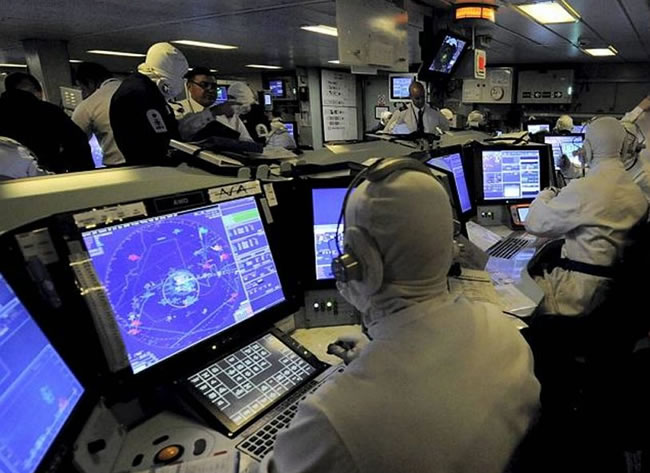
Command and control center of HMS Diamond. Photo: MOD, Crown Copyright
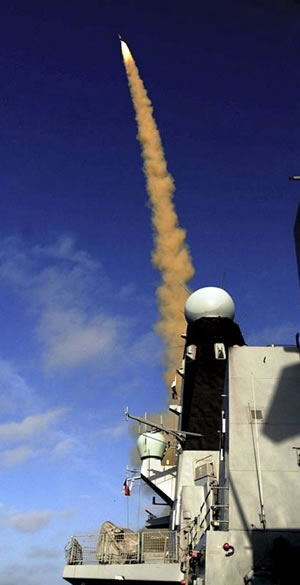
HMS Daring, fires her groundbreaking new air defence missile Viper for the first time.
Royal Navy Type 45 destroyers could join future missile intercept testing conducted by the U.S. missile defense agency (MDA), the British Ministry of Defence announced. MOD have teamed with UK industry-run Missile Defence Centre (MDC) to support the integration of Type 45 destroyers and its primary Sampson radar, as a sensor supporting ballistic missile defense networks.
The Sampson radar is part of the vessels’ Sea Viper air and missile defense system. These tests will task the Sampson radar in detecting and tracking ballistic targets but will not include actual intercepts of ballistic missiles with the Sea Viper missile system. Future integration of European sensors will come into effect when the US deploys its missile defense network in Europe, toward the second half of the decade, under the planned European Phased Adaptive Approach (EPAA).
The UK Missile Defence Centre was established in 2003 following signature of a Memorandum of Understanding between the UK and US on how to jointly conduct ballistic defence studies. By establishing a joint industry and MOD centre the UK government can best meet the UK’s long-term policy and research requirements.
Command and control center of HMS Diamond. Photo: MOD, Crown Copyright
The UK Missile Defence Centre was established in 2003 following signature of a Memorandum of Understanding between the UK and US on how to jointly conduct ballistic defence studies. Building on its relationship with the US Missile Defense Agency (MDA), the joint Ministry of Defence and industry-run UK Missile Defence Centre (MDC) has agreed to take part in a trial which will include, for the first time, a Royal Navy Type 45 taking part in a major research and development program. While there is no program to fit Type 45 with Theatre Ballistic Missile Defence (TBMD) capability, much of the MDC’s research over recent years has been geared towards understanding potential the Royal Navy’s newest destroyers may have in this arena.
“It will be a step change to be able to work so closely with such a ship in an emerging area of Defence. Working with an operational platform will make a significant difference to our level of understanding and could contribute both financially and technically towards any future programme” Simon Pavitt, Head of the MDC said.
The tests are part of an ongoing evaluation of possible integration of NATO assets into the US-lead AEGIS BMD setting, Last week Raytheon reported about a recent trial that showed that a radar used by Dutch, German and Danish navies could provide target information to the interceptor. The current radar installed on the Dutch frigates is incompatible with the AEGIS/SM-3, The demonstration which took place at the Den Helder military test range validated a datalink that allows the missile to receive information from the Thales sensor while retaining the ability to communicate with Aegis combat ships used by the U.S. Navy.
Integration of Thales Nederland SMART-L long-range air and surface surveillance radar will provide a critical factor in the integration of European Navies into the future European missile defense system, given that 20 such radar (or their derivatives),are already deployed with frigates and destroyers of six NATO navies, including four DutchDe Zeven Provinciën class frigates, three German Sacsen frigates, six British Type 45 destroyers, four Horizon class frigates of the French and Italian navies and three Danish Navy Iver Huitfeldt class frigates.
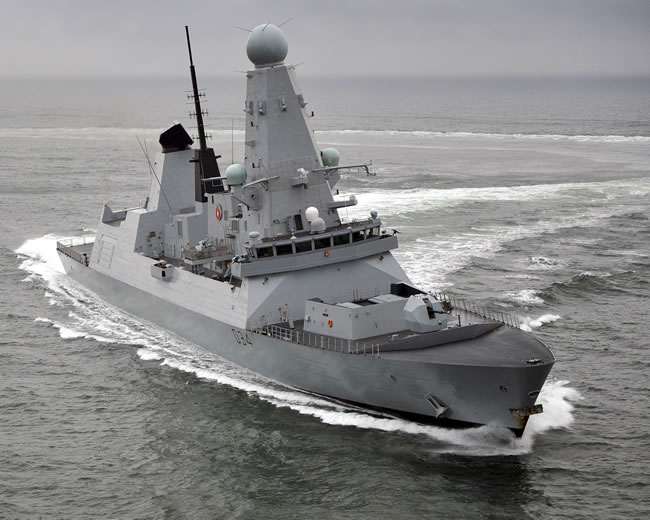
Royal Navy Type 45 destroyer HMS Diamond. HMS Diamond, the Royal Navy’s third Daring class destroyer built by BAE Systems in Govan, made her first return visit to the River Clyde Wednesday 9th February 2011. Photo: MOD, Crown Copyright
Soft Armor container holding ceramic pellets to form a ballistic protection barrier. Photo: Protaurius
Soft Armor container holding ceramic pellets to form a ballistic protection barrier. Photo: Protaurius
Defence and security company Saab has purchased the rights to the ‘Soft Armour’ protection technology, from Protaurius AB. The acquisition is the first step for Saab into the field of ballistic protection technology. “The acquisition of the rights to Soft Armour is a complement to our wide product portfolio within advanced camouflage. We are now expanding our investment in this type of product in both military and civil segments,” says Anders Wiman, Managing Director of Saab Barracuda. “With this transaction, Barracuda is taking the first step in strategically widening its product portfolio beyond the technical field of signature management,” continues Anders Wiman. Saab Barracuda has previously collaborated with Protaurius whereby Barracuda marketed the product in certain markets. Barracuda offers signature management and camouflage solutions is part of the Dynamics business area, one of the six business areas at Saab.
Soft Armour is a patented technology that uses a spherical ceramic pellets as fillers of containers, forming a ballistic protection modules protecting people and sensitive equipment from fragments, small-arms and armour piercing ammunition. Soft Armour is self-healing and can withstand multiple hits in the same area. The technology can also be applied in construction solutions, for shielding walls and soft coverings. Typical Soft Armor protection module is made of galvanized sheet metal box holding the ceramic balls in place so that as the projectile passes through and interacts with the ceramics, the projectile is stopped within the confines of the wall.
Soft Armour has been developed by specialists with vast experience of protective products for military, police and civilian purposes. It is an environmentally friendly and ricochet free protection against projectiles and shrapnel with a predictable and customisable level of protection that is easy to transport and handle. Soft Armour can also be reused and stored in bulk.
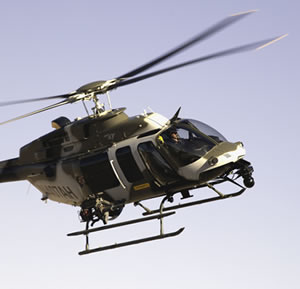
The 407GX can be delivered with high-visibility windows and doors, sliding on both sides for rapid ingress and egress. Photo: bell Helicopters
Bell Helicopter has introduced an armed version of its 407GX commercial aircraft at the Heli-Expo 2013 trade show in the United States. The armed variant of the Bell 407GX can be armed with light munitions and precision weapons, including laser-guided rockets and missiles. The new helicopter is positioned to meet the growing interest in the US and abroad for armed scout helicopters, particularly, as a replacement for the ageing OH-58 Kiowa Warrior.
The new 407XG can be equipped with safety and survivability systems, including threat detection and countermeasures. Photo: Bell Helicopters
“The 407GT is a ‘force multiplier’, with mission capabilities ranging from tactical air assault and troop escort to reconnaissance and search and rescue,” explained Danny Maldonado, Bell Helicopter executive vice president, Sales and Marketing. According to Bell, a variety of optional kits, designed to meet the needs of any tactical mission, will be available for the Bell 407GT with export compliance approval as required. Such Kits could include the AGM-114 Hellfire, General Dynamics GAU-19/B .50 caliber machine gun, HMP-400 machine gun pod, M260 2.75 in. 7-tube rocket launcher, Advance Precision Kill Weapons System (APKWS), LifePort Armor Protection System and more. Under the 407AH variant, the company’s first commercial variant qualified as a weaponized/military platform, Bell is also offering important safety features including a rupture resistant fuel system, engine exceedence monitoring and a collective mounted throttle that keeps power at the pilot’s fingertips.
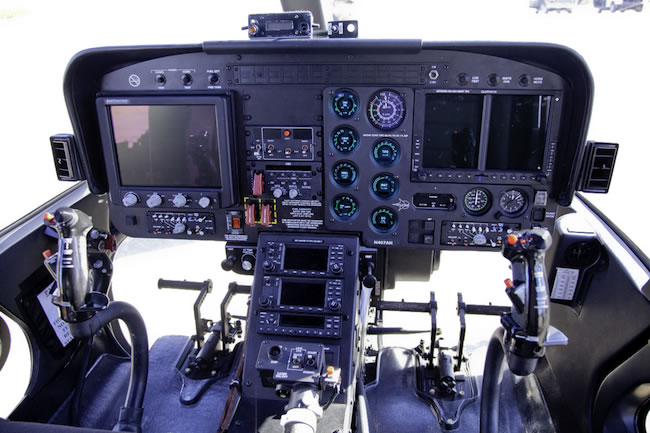
The 407GT includes the Garmin G1000HTM flight deck with twin 10.4” high resolution LCD screens, hosting advanced integrated cockpit and multi-function display information in an easy to scan layout. The aircraft also features a night vision-compatible instrument panel and superior long-range reconnaissance and laser designation capabilities. Photo: Bell Helicopters
The 407GX is equipped with the Garmin G1000HTM flight deck, providing critical flight information at a glance for greater situational awareness. Apart from the weaponry, the mission system for the 407GX employs a flexible and configurable weapons system comprising a gimballed infrared camera system with integrated laser designation capability, weapons management system, universal weapons pylon (UWP), tactical radio suite and aircraft survivability equipment. the L-3 Wescam MX-15DI and the FLIR Systems 230-HD are the two gimballed EO payloads recommended for the helicopter.
The UWP, derived from the battle-tested Bell OH-58D Kiowa Warrior, provides a stable platform for precise delivery of ordnance and can be quickly reconfigured for machine guns or rockets. The pylon can also be easily removed to meet multiple mission requirements such as search and rescue or medical evacuation. Light munitions capabilities of the 407GT include Dillon M13D Mini-guns, .50 caliber machine guns or 2.75 in. rockets, as well as laser-guided weapons featuring a standoff range of more than 5,000 m.
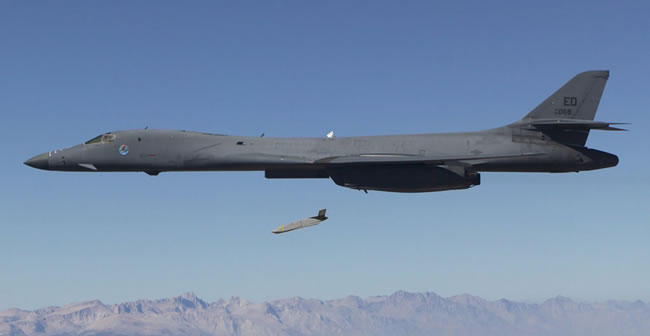
B-1B Lancer drops a JASSM-ER cruise missile on a test flight. USAF Photo
The Defense Advanced Research Projects Agency (DARPA) has added a third flight test of an air-launched Long Range Anti-Ship Missile (LRASM) to be conducted from a B-1B in 2013. There are already two air-launched flight tests scheduled for this year as part of the Phase 2 LRASM contract awarded in 2010. The agency awarded Lockheed Martin has received a $71 million Long Range Anti-Ship Missile (LRASM) modification contract to conduct air- and surface-launched flight tests and other risk reduction activities.
“This contract modification furthers the development of LRASM as we are committed to provide the Navy with an offensive anti-surface weapon (OASuW) alternative that is compatible with multiple platforms,” said Mike Fleming, LRASM air-launched program manager at Lockheed Martin Missiles and Fire Control. What makes the B-1 unique versus the other aircraft is its capability to carry 24 JASSM class weapons. With such capability, two bombers can take out an entire enemy fleet destroying 48 different targets on a single strike, or used against less targets, overwhelming the target defense by saturating attacks. The long range and stealth capabilities of the missiles will gain the advantage of surprise attack from stand-off range. The B-2 Spirit can carry 16 JAASMs and the B-52 Stratofortress can carry 12.
The contract also includes two surface-launched LRASM flight tests scheduled for 2014. Risk reduction efforts, such as electromagnetic compatibility testing of the missile and follow-on captive carry sensor suite missions, are also included under the contract.
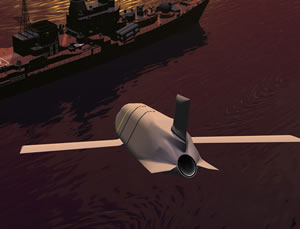
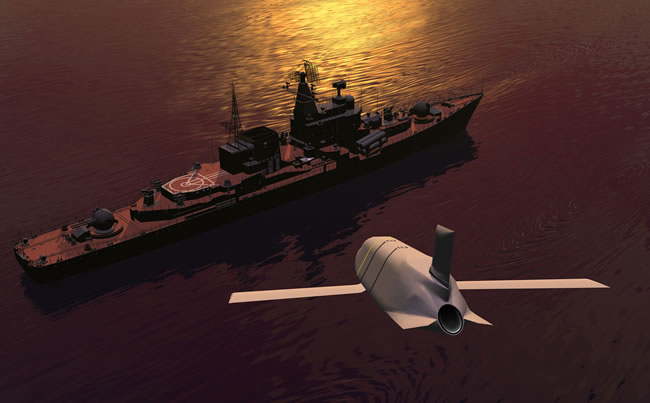
The Joint Air-to-Surface Standoff Missile – Extended Range (JASSM-ER) platform will demonstrate the stealthy air-launched ‘LRASM-A’ variant. Concept image: Lockheed Martin
LRASM is an autonomous, precision-guided anti-ship standoff missile based on the successful JASSM-ER, and is designed to meet the needs of U.S. Navy and Air Force warfighters. LRASM is in development with the Defense Advanced Research Projects Agency and the Office of Naval Research.
In addition to the air-launched capability LRASM is also considered for shipboard integration with the Weapon Control System and MK 41 Vertical Launching System. As part of this investment, Lockheed Martin successfully demonstrated the mission planning of a LRASM-based OASuW capability using a simulated surface ship Weapon Control System.
“Our company investment in shipboard integration, combined with the new surface-launch flight tests, will provide an integrated OASuW solution compatible with surface ships,” said Scott Callaway, LRASM surface-launched program manager at Lockheed Martin Missiles and Fire Control.
Armed with a proven penetrator and blast-fragmentation warhead, LRASM cruises autonomously, day or night, in all weather conditions. The missile employs a multi-modal sensor, weapon data link, and an enhanced digital anti-jam Global Positioning System to detect and destroy specific targets within a group of ships.
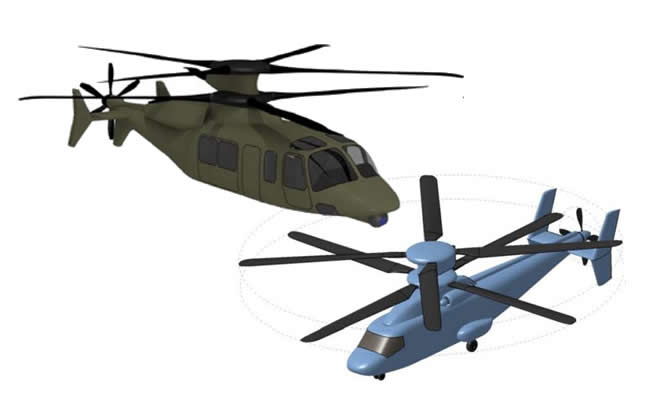
This artist's rendering depicts a Sikorsky-Boeing JMR-FVL concept aircraft with counter-rotating co-axial main rotors and a pusher propeller based on Sikorsky's X2® Technology rotorcraft design. The future rotorcraft will deliver significant improvements in speed, combat radius and hover performance for the Army's next-generation utility and attack helicopter fleets. Photo: Boeing
This artist’s rendering depicts a Sikorsky-Boeing JMR-FVL concept aircraft with counter-rotating co-axial main rotors and a pusher propeller based on Sikorsky’s X2® Technology rotorcraft design. The future rotorcraft will deliver significant improvements in speed, combat radius and hover performance for the Army’s next-generation utility and attack helicopter fleets. Photo: Boeing
Updated March 6, 2013: Sikorsky Aircraft Corp., and Boeing have signed a teaming agreement on Jan. 13, to submit a joint proposal in response to the U.S. Army Aviation Applied Technology Directorate solicitation for the Army’s Joint Multi-Role (JMR) Technology Demonstrator (TD) Phase 1 program. The proposal will be based on Sikorsky’s X2 Technology rotorcraft design. Sikorsky will take the lead role in this JMR TD Phase 1 proposal, and Boeing will take a lead role for Phase 2, the mission systems demonstrator program.
According to Leanne Caret, vice president and general manager of Boeing’s Vertical Lift division, the two companies are fully committed to the long-term nature of the Future Vertical Lift initiative, and we will contribute equally in terms of capital, technological capability and risk on our path to meeting the Army’s requirements.
The JMR TD supports the Department of Defense’s Future Vertical Lift program to deliver the next generation of vertical lift aircraft with greater performance, reliability and affordability. The team will compete to build and fly one or more demonstrator aircraft in 2017 to be evaluated for next-generation vertical lift performance in a medium-lift-sized aircraft.
“The Sikorsky and Boeing proposal will demonstrate how X2 Technology, with its counter-rotating coaxial main rotors, pusher propeller, and advanced fly-by-wire system, will deliver efficient 230-knot cruise airspeed, improved hover efficiency, and weight-optimized design in an affordable package,” said Samir Mehta, president of Sikorsky Military Systems. “By leveraging our proven design, we can offer the Army reduced risk, a 100-knot improvement in speed, a 60 percent improvement in combat radius, and 50 percent better high-hot hover performance.”
Sikorsky intends to develop and fly two S-97 Raider prototypes by 2014, leveraging the coaxial-compound rotor-pusher-propeller combination that took Sikorsky’s X2 demonstrator to a speed of 268 mph in 2010, breaking the world’s helicopter speed record. The S-97 is designed to be a 10,000lb-class helicopter while the design gross weight (DGW) of the JMR Phase 1 aims at three times that weight – 30,000 lb. The teaming with Boeing will enable the company to rely their proposal to include part of the experience Boeing has gained with its own platforms, such as Chinook, V-22, AH-6 and AH-64. Boeing has also ‘played’ with more advanced propulsion techniques, including coaxial counter-rotating rotors. “The Sikorsky and Boeing team brings together exceptional technical expertise,” said Mick Maurer, president of Sikorsky Aircraft Corp. “Our customer can be assured this collaboration will bring together innovative, industry-leading engineering expertise with a deep bench of program leadership talent, and builds upon the combined resources of both companies to deliver a revolutionary capability for the warfighter at an affordable cost for the U.S. taxpayer.”
Bell plans to offer a ‘third generation tilt rotor’ for JMR/FVL. Eventually, it looks as the programme will ultimately come down to a battle between a tilt-rotor design and a pusher-propeller design like the X-2.
Both companies have established good working relations with the Army, as they are currently sharing the delivery and support of the majority of vertical lift platforms for US military programs of record, including various Chinook platforms, CH-53, UH-60 and AH-64. “Our teaming agreement is the continuation of a long-standing relationship between Boeing and Sikorsky and reflects a common vision for the future of Army aviation,” said Chris Chadwick, president of Boeing Military Aircraft. “Our combined technical strengths and our collective program management expertise make this partnership an exciting development in meeting the Army’s JMR program objectives.”
Two different designs previously discussed by Boeing and Sikorsky had striking similarity which could come to effect in their teaming for the JMR Phase 1 program.
Another potential competitor for JMR Phase 1 program was Bell Helicopters, which shared the development, manufacturing and support of the V-22 Osprey Tilt-Rotor program with Boeing, supporting the US Navy, Marine Corps and Special Operations Forces. The Bell-Boeing team considered to submit a tilt-rotor based proposal for JMR Phase 1, but Boeing has not fully committed to this option and has been discussing potential cooperation with a number of local and foreign manufacturers to team for this program, until the decision to go with Sikorsky was made.
Part of the reason is the fact that Bell has lost its position with the Army since the hey days in 1960. Since the 1970s Bell has not been successful in selling helicopters to the Army, where Bell made helicopters were replaced by competitors – AH-1 (Cobra) succeeded by Hughes (later Boeing) offering the AH-64, and the UH-1 Huey – replaced by Sikorsky offering the UH-60 Black Hawk. Boeing, on the other hand, managed to maintain its position with the army, as it continued to supply tandem-rotor based heavy lift helicopters (Chinook) despite growing competition from Sikorsky.
At Heli Expo 2013 Bell Helicopter president and chief executive officer John Garrison, said his company will pitch a third-generation tilt-rotor design for the US Army’s Joint Multi-Role/Future Vertical Lift (JMR/FVL) programme. “We think that puts us in the best position to exploit the capabilities of the tilt-rotor in the JMR/FVL arena” Garrison said. He said Bell does not need outside financial help to develop its new tilt-rotor design but the company is looking at potential partners that would be required to contribute both technically and financially. (Flight Global reported)
Other potential competitors expected to submit proposals for the JMR Phase 1 are EADS North America, currently manufacturing the U-72A Lakota. While this helicopter is based on conventional technology, the Eurocopter subsidiary of the company’s European shareholder has already demonstrated a more advanced, hybrid-propulsion vehicle known as X-3 which could become a potential platform for the JMR.
Another technology that could be evaluated is the coaxial rotor / ducted fan propulsion developed by AVX. THis technique was first proposed for a major rework for the Bell Helicopter Kiowa Warrior.
AgustaWestland is another company that could enter the frey, particularly as they have had experience with tilt-rotor technology in the past. For such companies, Technology specialist companies like US Based AVX Aircraft could become valuable partners, offering both the knowhow and domestic workshare necessary for such programs to move forward in the USA.
The rapid aging and inherent limitations of the current fleet of medium lift helicopters (UH-60), extensively used over the past decade in Iraq and Afghanistan brought the army to seek a replacement to the current UH-60 class helicopter in the next 10 years. The Future Vertical Lift Family of Systems, proposed by a study group led by the Army Aviation Center of Excellence, foresee the current platform that have reached the limit of upgradability, should be replaced by new platforms employing technologies breakthrough now becoming available. Such new aerial vehicles employing innovating capabilities should dramatically improve vertical lift, range, speed, payload, survivability, reliability, and reduced logistical footprint. In its call for proposals the Army said it is seeking capability improvements in combinations of ambient condition hover, speed, range, fuel efficiencies and troop/payload capacities ‘beyond any current rotorcraft’. It is also understood that these future platforms should also reduce operational costs ‘to a fraction of those for the current fleet’.
Through the three-year JMR Phase 1 program the Army plans to evaluate Future Vertical Lift – Medium air vehicle platforms, that should be able to fly at speeds up and above 230 knots, by far exceeding the 170 knots limit of current rotorcraft. The Army will also focus on efficient transition between low and high speed light and high efficiency throughout the flight envelope. Efficiency at high speed means using aerodynamically optimized aerostructures, low-drag fuselage and efficient housing of communications equipment and sensors. Since higher speed contributes to higher vibration loads, the program will also evaluate means for lowering potentially damaging loads and vibrations induced in the different flight regimes, improving durability, tand eventually increasing Time Between Overhaul of components as well as the entire platform.
Proposals for the JMR Phase 1 demonstration program are due March 6, 2013. The Army is expected to award to select several offers for initial evaluation and narrow its selection to two platforms to be built and tested under the $200 million technology demonstration program. Preliminary design reviews for the winning programs will be conducted in Q3 of 2014, and flight demonstrations are expected in the fourth quarter of 2017. The current program will evaluate a scaled down version of the objective platform and will focus on technology demonstration – full scale development of a future helicopter based on the winning design could follow well into the next decade.
Update: Under a parallel path the Army is evaluating an option for a future engines to power the future rotorcraft. The Army’s Aviation Applied Technology Directorate (AATD) has released a soliciting proposals for conceptual design and analysis of a future Advanced Concept Engine (ACE). This will look more broadly than the FVL Medium requirement to replace the UH-60 and AH-64 and study engines in the 40 shp to 10,000 shp range, to power platforms ranging from small unmanned aircraft to large cargo rotorcraft. The AATD is seeking a power system that could significantly improve specific fuel consumption and offer much higher power/weight ratios and deliver higher high power especially at the higher speed regime relevant to future rotorcraft. While the ACE is not expected to be ready to support JMR flight demonstrations around 2017, it will be available to equip the JMR and FVL once they begin to replace the UH-60s and Chinook around 2035.
Video: The last flight of the X2 flight Demonstrator: July 14, 2011.
The X3 technology demonstrator developed by Eurocopter could well fit the US Army JMR Phase 1 requirements.
Lockheed Martin Skunk Works® and XTEND have achieved a major milestone in JADC2 by integrating the XOS operating system with the MDCX™ autonomy platform. This technical breakthrough enables a single operator to simultaneously command multiple drone classes, eliminating the friction of mission handoffs. From "marsupial" drone deployments to operating in GPS-denied environments, explore how this collaboration is abbreviating the data-to-decision timeline and redefining autonomous mission execution.
As traditional defense primes face mounting competition from agile “neoprimes” such as Anduril, Palantir and Helsing, the balance of innovation is shifting toward software-defined warfare and scalable, dual-use technologies, while global industry consolidation—marked by Boeing’s integration of Spirit AeroSystems and other strategic mergers—signals an intensified race to secure control over the defense technology value chain. Our Defense-Tech weekly report highlights these trends.
In early October 2025, a coordinated wave of unmanned aerial system (UAS) incursions—widely attributed to Russia—targeted critical infrastructure across at least ten European nations. The unprecedented campaign exposed the fragility of Europe’s air defenses...
Executive Summary
The past week (September 18-25, 2025) represents an inflection point where strategic defense concepts have transitioned from doctrine to tangible reality. An analysis of global events reveals four primary, interconnected trends shaping an...
At the 2025 Air, Space & Cyber Conference, U.S. Air Force and Space Force leaders unveiled major updates on next-generation fighters, bombers, unmanned systems, and space initiatives, highlighting both rapid innovation and critical readiness challenges as the services race to outpace global competitors. A short version is available here, with a more detailed version for subscribers.
The Taipei Aerospace & Defense Technology Exhibition (TADTE) 2025 crystallized around four dominant strategic themes that collectively illustrate Taiwan's comprehensive approach to defense modernization amid escalating regional tensions. Based on a detailed report by Pleronix (available upon request). Includes a Podcast discussion on TADTE 2025's highlighting Taiwan's four strategic themes beyond the post's coverage.
Israel’s Iron Beam 450 high-power laser system has completed final testing, marking a major leap in air defense. Developed by Rafael, it offers precise, cost-effective interception of rockets, UAVs, and mortars, and is set for IDF deployment by 2025.