Sunday, December 28, 2025
More
    Home Blog Page 159

    BAE Systems Get $43 Million for Developing Micro Bots for the Army Research Lab

    The Micro Autonomous Systems and Technology (MAST) collaborative continues the development of future technology in order to help bring the warfighter home safely. (Photo: BAE Systems)
    The Micro Autonomous Systems and Technology (MAST) collaborative continues the development of future technology in order to help bring the warfighter home safely. (Photo: BAE Systems)

    BAE Systems has been awarded a $43 million cooperative agreement extension to lead the Army Research Laboratory’s (ARL) Micro Autonomous Systems and Technology (MAST) Collaborative Technology Alliance for an additional five years. Defense-Update reports. As a result, the company will have a significant role working with the MAST Alliance’s team of scientists from the U.S. Army, academia, and industry as it advances bio-inspired micro-robotics technology to extend the remote sensing capability of U.S. ground forces. The goal of the research is to enable small robotic platforms – that would be used by individual soldiers – to remotely perform surveillance within complex urban environments and terrain.

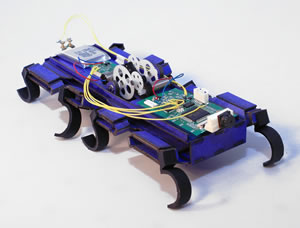
    One of the experimental micro-bots evaluated by the MAST group is this OctoRoach.
    One of the experimental micro-bots evaluated by the MAST group is this OctoRoach.

    The second phase of the MAST program continues the research, development and integration of several key areas including micro-scale aeromechanics and ambulation; propulsion; sensing, autonomy, communications, navigation, and control; and microscale integration, among others, enabling several different mission-capable robotic platforms.

    “Our recent review by the MAST Research Management Board received high marks for the quality and success of the research conducted over the past five years contributing greatly to the decision to award the five year option to extend the program,” said Dr. Brett Piekarski, ARL MAST Consortium manager.

    BAE Systems, in cooperation with primary research labs from the University of Maryland, the University of Michigan, the University of Pennsylvania and the NASA Jet Propulsion Lab, will lead the effort for the ARL into 2017.

    Source: Defense-Update

    AgustaWestland Unveils New TiltRotor Air Vehicle Design

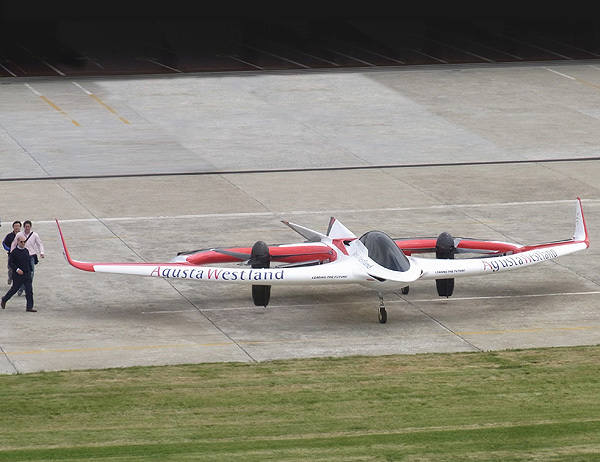
    AgustaWestland today unveiled its ‘Project Zero’, an electrically-powered tilt rotor technology demonstrator, giving an insight into what advanced rotorcraft of the future may look like. The company funded technology demonstrator was designed and built in less than 6 months and has already secretly flown several times in 2011 and 2012.

    An electric powered vehicle, ‘Project Zero’ can hover like a helicopter and convert to a fixed wing aircraft in forward flight thanks to its two integrated rotors, which can be tilted through more than 90 degrees. The demonstrator performed its first unmanned tethered flight in June 2011 at AgustaWestland’s Cascina Costa facility in Italy and has since performed untethered hovering flights inside a secured area.

    Daniele Romiti, AgustaWestland’s CEO, said “The ‘Project Zero’ technology demonstrator program brings together many of the advanced technologies AgustaWestland has been researching in recent years and demonstrates our strong technological base from which we will develop new products to meet the needs of our customers in the future. We strongly believe in the tilt rotor concept as the future of high speed rotorcraft flight as it offers much greater speed and range than compound helicopter technology.”

    The demonstrator’s rotors are driven by advanced electric motors powered by rechargeable batteries; future hybrid solutions have also been investigated using a diesel engine to drive a generator. All of the aircraft control systems, flight control and landing gear actuators are electrically powered, removing the need for any hydraulic system.

    During cruise, the wings will provide most of the lift, with the blended fuselage and shroud also making a contribution. ‘Project Zero’ has been designed with detachable outer wings for missions that will be performed primarily in helicopter mode. Elevons provide pitch and roll control in forward flight while the V-tail provides longitudinal stability. The aircraft has very low noise and thermal signature in flight and does not require oxygen, thereby permitting it to fly at altitude or in heavily polluted conditions, such as volcanic eruptions.

    When parked on the ground the rotors can be tilted forward, with the the aircraft pointed into wind, to allow the rotors to windmill and recharge the aircraft’s electrical storage device. The electrical drive system also has the advantage that it does away with the complex and heavy transmission system required by conventional rotorcraft.

    Submarine HMS Ambush commissioned into the Royal Navy

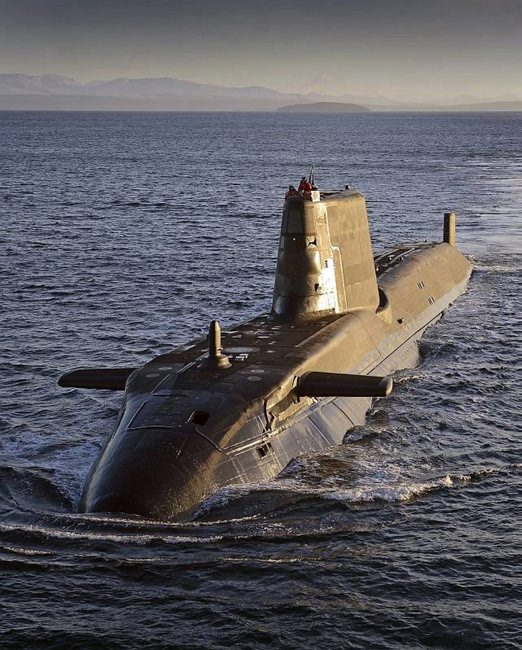
    Astute class submarine HMS Ambush is pictured during sea trials near Scotland. Ambush, second of the nuclear powered attack submarines, was named in Barrow on 16 December 2010 and launched on 5 January 2011. Photo: UK MOD Crown Copyright
    HMS Ambush Insignia
    HMS Ambush Insignia

    The Royal Navy’s latest, most advanced attack submarine was commissioned into the Royal Navy on Friday, 1 March 2013, during a ceremony at Her Majesty’s Naval Base Clyde. HMS Ambush is expected to complete sea trials and be formally handed over to the operational control of the Royal Navy later this year.Ambush is the second Astute Class submarine to enter service with the Royal Navy.

    As the home of the UK submarine service, all 7 Astute Class vessels will eventually be ported at HM Naval Base Clyde. The first of class, HMS Astute, entered service with the Royal Navy in August 2010. The other 5 vessels, Artful, Audacious, Anson, and the as yet unnamed boats 6 and 7, are currently at different stages of build and development.

    Launched on 5 January 2011 at the BAE Systems shipyard at Barrow-in-Furness, Ambush arrived at her home port of HM Naval Base Clyde on 19 September 2012. Since then, Ambush has undergone extensive sea trials to ensure she is ready to become part of the fleet, with the White Ensign being raised for the first time on 18 January after the signing of the ‘certificate of acceptance’, transferring the submarine from her builders to the Ministry of Defence.

    Astute class submarine HMS Ambush is pictured during sea trials near Scotland. Ambush, second of the nuclear powered attack submarines, was named in Barrow on 16 December 2010 and launched on 5 January 2011. Photo: UK MOD Crown Copyright
    Astute class submarine HMS Ambush is pictured during sea trials near Scotland. Ambush, second of the nuclear powered attack submarines, was named in Barrow on 16 December 2010 and launched on 5 January 2011. Photo: UK MOD Crown Copyright

    DARPA’s Future MALE Drones to Operate From Littoral Combat Ships

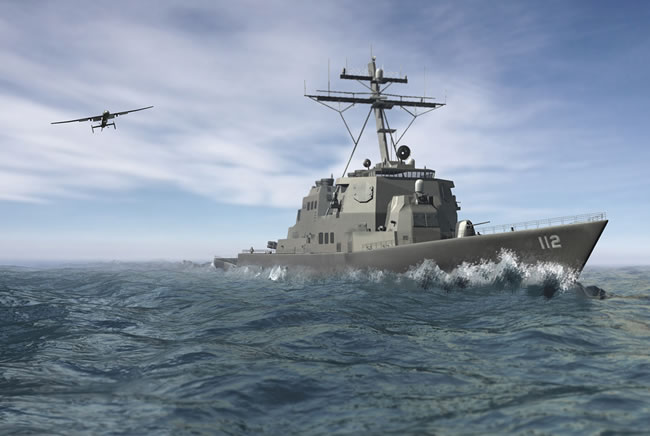
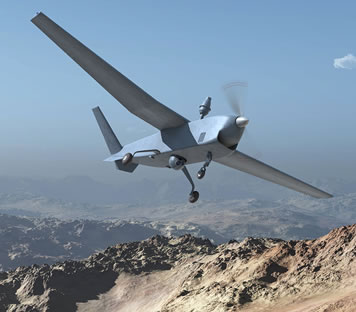
    DARPA wants to introduce a new class of MALE UAS that will be able to deploy from destroyer and frigate size vessels, such as the Independence Class Littoral Combat Ship (LCS-2),extending the Naval ISR and strike capabilities to deploy faster and farther, anywhere in the world. DARPA Artist concept
    DARPA wants to introduce a new class of MALE UAS that will be able to deploy from destroyer and frigate size vessels, such as the Independence Class Littoral Combat Ship (LCS-2),extending the Naval ISR and strike capabilities to deploy faster and farther, anywhere in the world. DARPA Artist concept

    Unmanned vehicles are becoming essential part of modern warfare, but the military is seeking to gain new capabilities for such platforms, relieved from the operational restrictions bounding them to operating bases, involving complex issues of access rights and permission that usually hinder operations that are often handled covertly, at night and far away from the prowling eyes of the media.

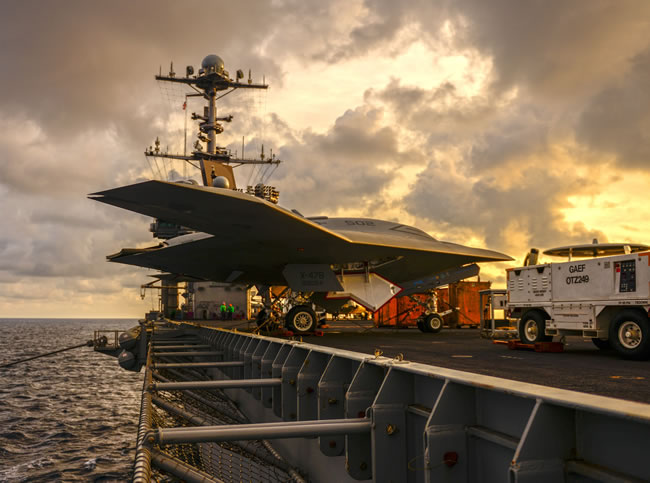
    In December 2012 Northrop Grumman and the U.S. Navy conducted deck handling trials of the X-47B Unmanned Combat Air System aboard the USS Harry S. Truman (CVN-75). Trials were designed to demonstrate the aircraft's ability to integrate smoothly with carrier operations. Photo: Northrop Grumman
    In December 2012 Northrop Grumman and the U.S. Navy conducted deck handling trials of the X-47B Unmanned Combat Air System aboard the USS Harry S. Truman (CVN-75). Trials were designed to demonstrate the aircraft’s ability to integrate smoothly with carrier operations. Photo: Northrop Grumman

    The US Navy is already operating several types of UAVs, including the lightweight Boeing/Insitu ScanEagle, launched and retrieved from ships, and the FireScout helicopter-class drone capable of vertical takeoff and landing on board vessels equipped with flat decks. Both have already been used operationally in the Persian Gulf, Indian Ocean and Libya. Both systems proved valuable, but are lacking the endurance, payload capacity (or both), to effectively integrate with naval operations. For such missions the US Navy is considering new classes of unmanned systems, the potentially stealthy X-47B, soon to de tested on board an aircraft carrier represents one of the concepts, to be followed by the Reaper-size UCLASS – designed for medium-altitude and long endurance (MALE) recce and strike missions, operating from conventional (flat deck) aircraft carriers.

    A third option is currently being evaluated under DARPA’s Tactically Exploited Reconnaissance Node (TERN) program, a complex designation named after the family of seabirds known for flight endurance, during their annual migration. With its TERN, DARPA wants to introduce a new type of UAS that will be able to deploy from destroyer and frigate size vessels, such as the Independence Class Littoral Combat Ship (LCS-2). With TERNs the LCS will be gain ISR and strike capabilities faster and almost anywhere in the world.

    In December 2012 the X-47B embarked onboard the aircraft carrier USS Harry S. Truman for taxi trials. It is on schedule to fly to the USS George HW Bush, with first landing expected in April or May 2013, becoming the first conventional UAV to land on an aircraft carrier.

    Another Navy program currently known as Unmanned Carrier-Launched Airborne Surveillance and Strike (UCLASS) follows on the heels of the Northrop Grumman-led X-47B Unmanned Combat Air system demonstration program (UCAS-D) currently underway. UCLASS will take the carrier-deployed drone a step further, aiming to deploy a small unit of drones on board a carrier for testing by 2020. UCLASS is also expected to follow a tailless design, all potential competitors – Lockheed Martin, Boeing, Northrop Grumman and General Atomics have discussed such designs in addressing the program since the Navy embarked on the concept in 2011. Relying on its reduced signature (stealth), autonomy and precision attack capability, UCLASS will extend the carrier air group capability, particularly in operations in denied areas, as well as enabling the Navy to launch recce missions and attacks against targets of interest from positions in the open sea, thus avoiding complex and lengthy preparations required with access permissions from neighboring countries, necessary for operations of land-based drones. The Navy has yet to define the specific requirements for this class of drones, is expected to publish a Request for Proposal (RFP) for the new drone sometime in 2013. According to Navy officials, UCLASS will be able to carry weapons already available on board aircraft carriers, which means payload capacity and weapons bay will have to be adjusted for large payloads.

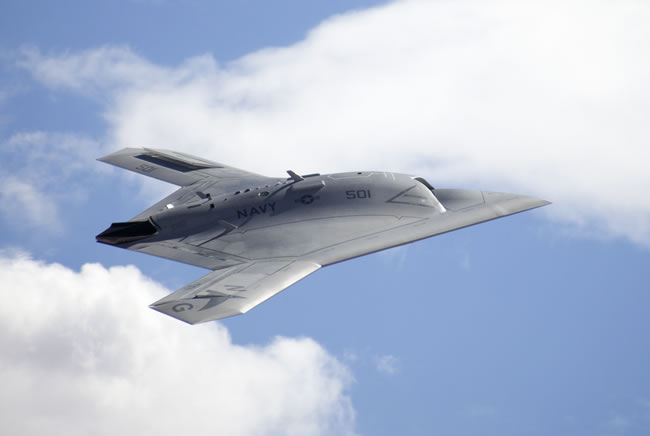
    Northrop Grumman X-47B Unmanned Combat Air System selected by the US Navy to demonstrate carrier operations of an unmanned aircraft. Photo: Northrop Grumman
    Northrop Grumman X-47B Unmanned Combat Air System selected by the US Navy to demonstrate carrier operations of an unmanned aircraft. Photo: Northrop Grumman

    The large footprint required for Fixed-wing manned and unmanned aircraft and the limited range and endurance of helicopters restrict naval operations closer to shore or relying on shore-based assets for operations from land bases. Establishing these bases or deploying carriers requires substantial financial, diplomatic and security commitments that are incompatible with rapid response.

    DARPA expects the TERN to be able to take off and recover automatically from ships, operating safely even at high sea condition up to sea state 5.

    To help overcome these challenges and expand DoD options, the TERN program is seeking to combine the strengths of both land- and sea-based approaches to support airborne assets. TERN envisions using smaller ships as mobile launch and recovery sites for medium-altitude long-endurance (MALE) fixed-wing unmanned aircraft (UAVs).

    Providing small vessels such as the 2,800-ton Independence-class Littoral Combat (LCS) with MALE drones means a radical expansion of naval capabilities, as such drones will be able to can carry payload weight of about 600lb over a distance 600-900nm from its host vessel. The FireScout can also carry 600 lbs, but its endurance is limited to five hours. The larger Bell 407-based MQ-8C will extend the endurance to 11hr with a similar payload, still short in terms of MALE standards.

    “It’s like having a falcon return to the arm of any person equipped to receive it, instead of to the same static perch every time,” said Daniel Patt, DARPA program manager. “About 98 percent of the world’s land area lies within 900 nautical miles of ocean coastlines. Enabling small ships to launch and retrieve long-endurance UAVs on demand would greatly expand our situational awareness and our ability to quickly and flexibly engage in hotspots over land or water.”

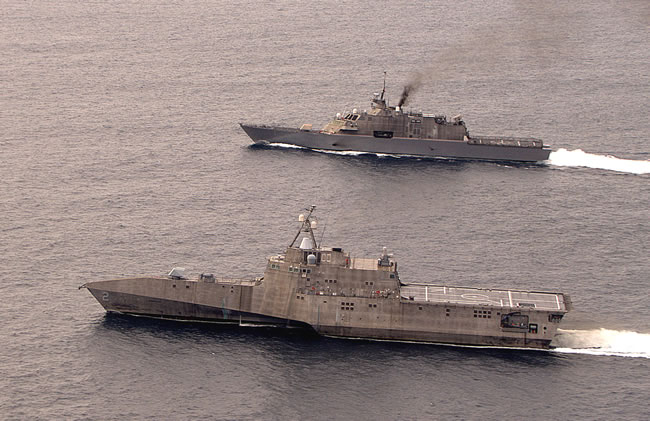
    LCS 2 Independence arriving at San Diego, escorted by USS Freedom (LCS1). Photo: General Dynamics.
    LCS 2 Independence arriving at San Diego, escorted by USS Freedom (LCS1). Photo: General Dynamics.

    DARPA will present its vision to industry on March 20, 2013 at a conference set for industry members interested in becoming involved in the program. DARPA expects the TERN to be able to take off and recover automatically from ships, operating safely even at high sea condition up to sea state 5. TERN will be designed to carry payloads up to 600 lbs, over 600-900 nautical miles. The launch and recovery system would have to fit Littoral Combat Ship 2 (LCS-2)-class ships and other surface combat vessels as feasible. The weapons to be carried by TERN-class drones are likely to be smaller, compared to the weapons to be carried by UCLASS.

    Daniel Patt, DARPA program manager: “We’re trying to rethink how the ship, UAV and launch and recovery domains – which have traditionally worked in parallel – can synergistically collaborate to help achieve the vision of base-independent operations for maritime or overland missions”

    One of the biggest challenges DARPA is seeking to solve is how to operate large aircraft from smaller ships, even in rough seas. Such aircraft should provide range, endurance and payload characteristics of land-based MALE drones, yet endure the maritime environment. Another challenge is support personnel. Land based drones are typically supported by flight operators, land operators, technical support teams and maintainers. When deployed at sea, drones require significant modifications to support the systems. Operating TERNs on small vessels will require minimal personnel for operations and maintenance. It will also be designed to occupy minimal space for storage. The concept of operation envisions deployment of TERNs on existing vessels such as the LCS-2 on-demand, with and minimal and reversible ship modifications for deployment. A TERN objective system operating from a single ship should be able to provide a persistent orbit at radius using not more than two airborne TERN vehicles.

    DARPA plans to roll out 40 month TERN program in three phases, culminating in a full-scale launch and recovery demonstration. The TERN program has aggressive schedule and budgetary goals; demonstration approaches that leverage the re-use of existing hardware components and software components are highly encouraged. New technologies likely to be used include the use of precision relative navigation for approach and landing, high bandwidth air vehicle control, and energy addition and mitigation, supporting the launch and recovery phases.

    [wzslider autoplay=”true” info=”true”]

    INSS: An Updated Assessment of Iran’s Nuclear Program

    inss150
    INSS Insight No. 409, Published March 4, 2013
    By Asculai, Ephraim

    The final week of February 2013 was marked by events that may have changed the perception of Iran’s nuclear program and the chances of finding a non-belligerent solution to this problem. First, the periodic IAEA report on the inspections in Iran was published, with some new details on Iran’s nuclear activities. A careful reading of the latest IAEA report reveals that Iran continues relentlessly to further the potential to break out and achieve a nuclear weapons capability quickly. Second, the 2-day talks between the P5+1 and Iran in Almaty, Kazakhstan apparently included new concessions to and fewer demands of Iran. Third, an article by former British Foreign Minister Jack Straw published in the Telegraph recommended that the world recognize the situation and adopt a policy of “containment,” thereby accepting the inevitability of Iran becoming a de facto nuclear weapons state.[1]

    The world does not view the proliferation of nuclear weapons as a casus belli

    Iran now has about 9,000 uranium enriching centrifuges of the older IR-1 type installed at its facility in Natanz. These centrifuges are enriching uranium hexafluoride to the level of 3.5 percent uranium-235, and so far more than eight tons of this material have been accumulated. Fordow, where some additional enrichment activities have taken place, is another source of concern. At this small well protected facility, installation of some additional 2700 gas centrifuges has neared completion. Of these, some 700 centrifuges were being used to enrich uranium to 19.75 percent, while the other centrifuges were apparently not yet operational. At both enrichment sites, Iran utilized part of the 3.5 percent inventory to produce 280 kilograms of 19.75 percent enriched uranium. 250 kilograms of this material are considered sufficient, through further enrichment to 90 percent, for the production of one core for a nuclear explosive device. Perhaps because of the psychological effect of this surplus, Iran removed some 111 kilograms to Isfahan for the manufacture of nuclear fuel for the Tehran Research Reactor.

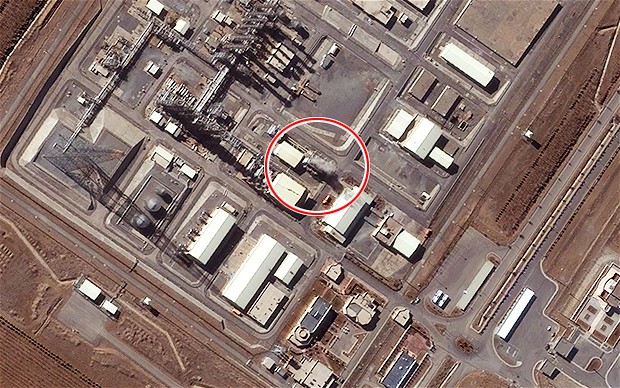
    Water vapour, circled, is seen being emitted from forced air coolers at the Arak heavy water production plant earlier this month, showing that the facility is operational Photo: DigitalGlobe Inc/McKenzie Intelligence Ltd
    Water vapour, circled, is seen being emitted from forced air coolers at the Arak heavy water production plant earlier this month, showing that the facility is operational Photo: DigitalGlobe Inc/McKenzie Intelligence Ltd

    Were Iran to use all of its 3.5 percent inventory, and were it to use all available centrifuges to further enrich this inventory to the 19.75 percent and then up to the military level of 90 percent, it could probably obtain the 25 kilograms of uranium metal for its first nuclear explosive core in less than six months, and subsequent cores in shorter time intervals, obtaining a total of 5-6 cores from the present 3.5 percent inventory. This time estimate will probably be accelerated, since Iran began installing a newer and more efficient type of centrifuge, and if Iran uses any of the 19.75 percent inventory it holds.

    By the first quarter of 2014 Iran is expected to complete the construction of the 40 mW heavy water reactor in Arak. This reactor “going critical”, will cross the point of no return in the Iranian plutonium route

    Working in parallel to the uranium enrichment route, Iran has advanced considerably in the development of the other route to nuclear weapons – the plutonium route. The construction of the 40 megawatt heavy water natural uranium reactor has progressed, and the Iranians reported to the IAEA that they expected to complete the construction of the reactor in the first quarter of 2014. Were the reactor to “go critical” at that point, this would in effect constitute the point of no return in the plutonium route, since a military attack on an operational reactor is considered to be out of bounds in international norms. Although it would still take some two years to have the nuclear fuel from this reactor ready for reprocessing, and some additional time until a plutonium core could be produced, it would still signal an alarming state of affairs. What piqued the world’s attention was the satellite photograph of steam coming out of the cooling system at the heavy water production plant at Arak. In fact, however, this plant has been operating for some years, and this was no extraordinary observation.

    This was the setting for the Almaty talks between the P5+1 and Iran that were held on February 26-27, 2013. Although not all details of the P5+1 offer that was placed on the table are known, it is the first time that certain Security Council demands, e.g., the suspension of uranium enrichment activities, were ignored, and the parallel demand for the suspension of plutonium-related activities was apparently not even mentioned. This is a significant breakthrough for the Iranians, as the other side could gain but little time from the demand that the enrichment activities to the level of 19.75 percent be stopped and the inventory dispersed. From what remains unsaid it seems that Iran could continue to enrich uranium (to 3.5 percent) and continue with the construction of the Arak reactor. In return for an agreement, some sanctions would be eased.

    It is difficult to imagine what the P5+1 expect to achieve with such an agreement, except for an optimistic proclamation that apparently “engagement” can work, and that this approach will be pursued further. The Iranian Foreign Minister even said that relationships between Iran and the US could improve considerably as a result of the “melting ice.” This would constitute a major victory for Iran while it proceeds with its nuclear program, since it has already proved that it can withstand the current sanctions. Iran would retain all its technical capabilities and the ability to further develop them, and any agreement would halt the imposition of new and advanced sanctions that could pressure Iran to heed the Security Council demands.

    Against this backdrop and precisely at this time, the article by a former British Foreign Minister recommended the approach of “containment.” When reviewing the positions of the members of the P5+1, especially the views of the US, Russia, and China, one cannot but assess that no belligerent action against Iran will likely take place. The world (represented by these countries) does not view the proliferation of nuclear weapons as a casus belli. This is perfectly demonstrated by the advances made by North Korea in the development of nuclear weapons in both routes, with sanctions being the strongest action the world has been willing to take to ameliorate the situation. If one projects the present North Korean situation onto that concerning Iran, one cannot but reach the conclusion that containment is in the air, and that unless drastic action is taken, Iran will become a nuclear-capable state in the not too distant future.

    INSS Insight No. 409, By Asculai, Ephraim

    [1] Jack Straw, “Even if Iran gets the Bomb, it won’t be Worth Going to War,” The Telegraph, February 25, 2013: “Containment is a better response than conflict in dealing with a country we have long mishandled.”

    Spain Flys the Atlante UAS

    Atlante is designed for the tactical UAS mission, but is also adapted for civil and homeland security applications, including surveillance over urban and rural areas, search and rescue, monitoring natural disaster areas and forest fires, etc.
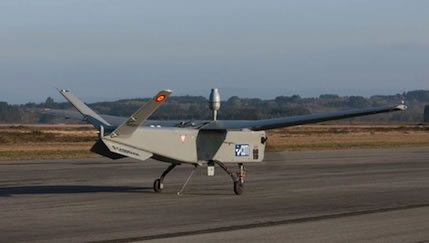
    Atlante UAS Takes off on its first flight, February 28, 2013
    Atlante UAS Takes off on its first flight, February 28, 2013

    Atlante, an unmanned aerial vehicle developed by the European defense group Cassidian has made its first flight at Rozas airfield, near Lugo, Spain last week. Developing the Atlante UAS under a collaborative industrial participation with Spanish Centre for Industrial Technological Development (Centro para el Desarrollo Tecnológico Industrial – CDTI) acting as industry program manager. Cassidian is participating in the program as the driving force behind the industrial model, with three high-tech venture capital partners (Indra, GMV and Aries). More than 140 Spanish subcontractors and suppliers are also cooperating in the program, generating more than 500 skilled jobs.

    Atlante is designed for the tactical UAS mission, but is also adapted for civil and homeland security applications, including surveillance over urban and rural areas, search and rescue, monitoring natural disaster areas and forest fires, etc.
    Atlante is designed for the tactical UAS mission, but is also adapted for civil and homeland security applications, including surveillance over urban and rural areas, search and rescue, monitoring natural disaster areas and forest fires, etc.

    Atlante, designed to address the tactical UAS mission profile is also capable of carrying out civil and homeland security applications, including surveillance over urban and rural areas, search and rescue, monitoring natural disaster areas and forest fires, etc. At its weight category it is designed to operate from prepared runways or being launched from catapults. According to Cassidian, the fact that this air vehicle was designed according to the standards used for manned aircraft, gives it unique features in terms of airworthiness and certification that will allow it to operate in civil airspace. “We have the best team needed to ensure that Atlante is a success in the export market in the coming years” Pilar Albiac Murillo, COO of Cassidian and CEO of Cassidian Spain commented on the maiden flight.

    Russia Plans a Permanent Naval Task Force for the Mediterranean

    Russia is considering deploying a permanent naval task force in the Mediterranean Sea. Such a task force will be commanded by the Black Sea Fleet and could consist of up to 10 combat and auxiliary ships deployed on rgathered from three Russian fleets. The deployment of Russian warships in the Mediterranean had been a subject of planning for some time, to secure the country’s interests in the region. Russian warships have been deployed near Syria for the past six months. The vessels could rely on ports in Cyprus, Montenegro, Greece and Syria as resupply points.

    The Soviet Union maintained the 5th Mediterranean Squadron in the Mediterranean Sea from 1967 until 1992. It was formed to counter the US Navy 6th Fleet during the Cold War, and consisted of 30-50 warships and auxiliary vessels at different times.

    Secretary of Defense Hagel Details Sequestration Impact on the US Military

    Secretary of Defense Chuck Hagel and Deputy Ashton B. Carter. Photo: DOD

    On the first press conference after his nomination US Secretary of Defense Chuck Hagel and his deputy Ashton B. Carter said  yesterday the first step in sequestration measures is being implemented. Initially, training of soldier, Marines, Navy and Air Force pilots flying hours and navy steaming days are curtailed. In response to questions Hagel softened the official tone, referring to the dramatic cuts as ‘adjustments’, “We will manage these issues.

    These are adjustments” Hagel said, “Over the past two months, DOD has begun to see the effects and consequences of that uncertainty… We anticipated these kinds of realities. And we will do what we need to do to assure the capabilities of our forces.” Hagel said, “For these reasons, the department’s senior leadership and I will continue to work with the administration and Congress to help resolve this uncertainty. Specifically, we need a balanced deficit reduction plan that leads to an end to sequestration. And we need Congress to pass appropriations bills for DOD and all federal agencies” he added.

    These actions are required under mandatory cuts of $47 billion in defense spending before Sept. 30, 2013. While the cuts represent only about 10 percent of $487 billion in defense cuts earmarked by the Pentagon in 2012, added to reductions of $300 billion as part of efficiency initiatives announced two years ago, anticipating the Iraq and Afghanistan drawdowns. However, according to Ashton Carter, the sequestration is a different matter. “It is arbitrary. It is abrupt. And on top of sequestration, we have a continuing resolution in force which creates its own set of problems, I won’t go into, but in some categories are just as serious.”

    Hagel also referred to the serious consequences of the current arbitrary measures “Uncertainty puts at risk our ability to effectively fulfill all of our missions. Leadership in the Pentagon, all of us, have two serious concerns: first, the abrupt and arbitrary cuts imposed by sequester; and second, the lack of budget management flexibility that we now face under the current continuing resolution.”

    Impact on Personnel

    While manpower costs are exempt from the cuts, DOD civilians, contractor workforce and employees of defense industries will suffer the full impact of the current measures. Through March 2013 DOD will issue preliminary notifications to thousands of civilian employees who will be furloughed. The department has about 800,000 civilian employees and the vast majority of them face losing 20 percent of their pay through the end of September. “I know that these budget cuts will cause pain, particularly among our civilian workforce and their families. I’m also concerned, as we all are, about the impact on readiness that these cuts will have across our force.” Hagel said.

    As sequester continues, we will be forced to assume more risk, with steps that will progressively have far-reaching effects.” Hagel continued. He said the Navy will began to prepare standing down four fighter wings, the first wing will stand down in April.

    “Effective immediately, Air Force flying hours will be cut back.” Hagel added, saying this will have a major impact on training and readiness. The Army will curtail training for all units except those deploying to Afghanistan, adversely impacting nearly 80 percent of Army operational units. Other measures already implemented under previous cuts included delaying deployment of naval assets; imposing civilian hiring freezes; beginning to lay off temporary and term employees; sharply cutting back facilities maintenance; and beginning reviews to delay contracts. While the services have some flexibility in deciding what programs to support, they are using that flexibility to protect operations in Afghanistan.

    Impact on Air Force Readiness

    According to Deputy Secretary of Defense Ashton Carter the cuts will not be imposed proportionally over all units as certain elements, such as the nuclear-capable Air Force and tactical units supporting operations in Afghanistan will be protected. “That means that the cuts caused by sequestration, also the continuing resolution, will fall more heavily on other parts of the combat Air Force. They’ll need to cease training, which means they won’t be ready for other conflicts, which is a serious impact.” Carter explained.

    According to Carter, the impact on Air Force and Navy pilot training will be immediate and will be felt for years to come. “If you stop training for a while and you’re a combat pilot, then you’d lose your rating and eventually can’t fly at all… This impacts the readiness of the other units, declining the air force’s capability to respond to contingencies” Carter warned, and added “we are trying to minimize that in every way we possibly can”.

    Cuts are implemented across all procurement programs, said Carter, “Sequester affects each of 2,500 individual investment programs individually. And so we’re working with our industry partners on each of those.” He added he expects the services will reduce the number of weapons systems purchased in a given category.

    10 Most Affected States

    All states will be affected, but these 10 states will bear the largest brunt. Deputy Secretary of Defense Carter has sent letters alerting governors of sequestration’s impact on military bases their states, and both the direct and indirect impacts of sequestration. The ten states most affected are: California, Virginia, Texas, Maryland, Pennsylvania, Georgia, Florida, Ohio, Alabama, and Washington. For example, roughly 26,000 Defense Department civilian employees work or reside in Pennsylvania, and they will take home $155 million less over the rest of fiscal 2013. In Virginia, maintenance on 11 Navy ships at Norfolk Naval Base is cancelled, with a associated loss of civilian contractor jobs. In California, sequestration will affect Beale, Edwards, Vandenberg and Travis air force bases. In Maryland, the cuts will impact the Army’s Aberdeen Proving Ground, Andrews Air Force Base and Patuxent Naval Air Station. In Texas, operations at bases around the state will be affected and operations at Red River Army Depot could lose $1.4 billion.


    Japanese Government Approves Export of F-35 Components

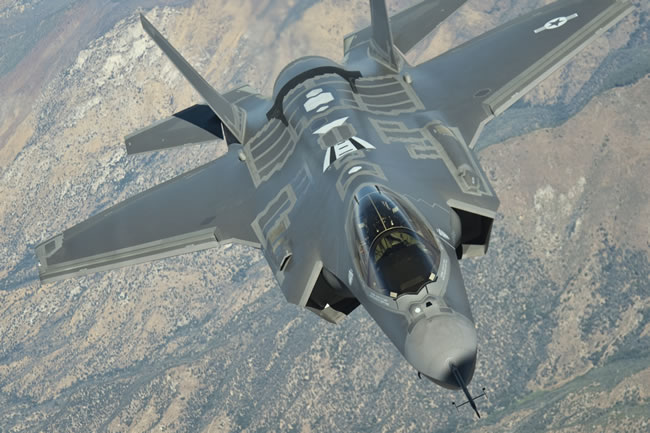
    F-35A test aircraft AF-4, captured during refueling from the U.S. Air Force tanker.
    F-35A test aircraft AF-4, captured during refueling from the U.S. Air Force tanker.

    With Lockheed Martin’s F-35 Lightning II Joint Strike Fighters (JSF) once again cleared for flight operations, the Japanese government has decided to allow domestic defense contractors to manufacture and export components for the aircraft.

    Japan has adhered to a long-standing ban on the export of weapons in an effort to honor a self-imposed rule not to contribute to the perpetuation of international conflicts. Exempting the F-35 from provisions of the ban is predicated on the understanding that the United States, as the primary manufacturer of the aircraft, will accept responsibility for enforcing strict controls over access and use of the components manufactured in Japan.
    The Japanese export ban was initiated in 1967 by the prime minister of the time, Eisaku Sato, outlined in an order embracing a guideline of “three principles” to restrict weapon’s exports to communist nations, all nations subject to United Nations’ armament embargoes, and those countries engaged in international conflict. This prohibition was strengthened in 1976 to become an almost absolute ban.

    Many critics of the ban have long argued that the restrictive nature of this edict has prevented Japanese defense contractors from keeping pace with vital technological advances, has deprived them of lucrative business opportunities, and has increased the overall cost of weapon’s procurement.

    At times, the ban has been eased to satisfy political realities. In 1983, the ban was modified to allow for the sharing of weapon’s technology with the United States and again in 2004 to permit the two allies to combine their efforts in developing a practical missile defense system. In 2011, the ban was again modified to allow Japan to participate in joint projects with foreign nations to develop and manufacture weaponry supposedly aimed at strengthening international peace efforts.

    In a prepared statement released 1 March, Chief Cabinet Secretary Yoshihide Suga announced the government’s decision to relax the ban while continuing to adhere to the nation’s pacifist principles. Secretary Suga stated that it was imperative for Japan to develop a viable framework to upgrade the nation’s defense capabilities, production of defense-related materials, and gain access to associated technology. During a press conference, Secretary Suga indicated that relaxation of the ban would enhance Japan’s national security and was in keeping with the nation’s security agreements with the United States.

    It is expected that Japan’s Mitsubishi Heavy Industries Limited, IHI Corporation, and Mitsubishi Electric Corporation will all have a hand in the production and maintenance of F-35 components. These business entities are expected to contribute to the manufacture of fuselage parts, radar systems, and engine components.

    In addition to authorizing the manufacture and export of F-35 parts, the government also agreed to allow the Japanese Self-Defense Force (JSDF) to use non-warfighting support equipment – construction equipment, protective vests, and the like – to assist foreign nations in humanitarian efforts.

    Japan’s decision to relax the ban comes at a time when the nation is embroiled in territorial disputes with China, South Korea, and Taiwan. The dispute with China over the sovereignty of a collection of rocky outcroppings in the East China Sea has escalated in recent months to the point where both nations have launched fighter aircraft and armed naval vessels to intercept intruders entering the disputed region. China’s apparent advances in military technology and its warfighting capabilities in the past year have also heightened Japan’s national security concerns.

    In 2011, Japan signed an agreement with the United States to procure an initial shipment of four F-35s, with a follow-on order for an additional 42 aircraft to replace the Japanese Air Self-Defense (JASDF) fleet of aging fighters. The first aircraft are tentatively scheduled to begin delivery sometime in 2016 or early 2017.

    Despite the bad press and technical problems that have plagued the Lightning II since its inception, the Japanese Ministry of Defense insists that the aircraft continues to be Japan’s choice for the future of its aerial combat fleet.

    The F-35 is being developed and manufactured by an international consortium under the leadership of the Lockheed Martin Corporation. This consortium now consists of ten nations each contributing parts, technology, maintenance, and expertise to the project. In his statement, Secretary Suga insisted that it was necessary for Japan to become an active member of the consortium to ensure the JASDF had full access to all resources required to optimize the operational capabilities of the aircraft.

    The system presently in use to develop the F-35 into an operational fifth-generation stealth fighter able to outperform any and all potential adversaries is called the Autonomic Logistics Global Sustainment (ALGS) program. The basic premise of this arrangement is to reduce costs and enable participating nations to acquire parts and perform maintenance with a minimum of delay.

    Opposition critics have voiced their concern that Japanese-produced parts will find their way into F-35s operated by Israel, a member of the ten-nation ALGS. This, the critics say, would violate Japan’s claims of pacifism in light of Israel’s precarious situation that has often escalated into armed conflict in the past.

    When presented with this inconvenient reality, Secretary Suga claimed that should any F-35s equipped with Japanese-made components actually become engaged with hostile forces, Japan could always discontinue producing parts for the ALGS. This stance, of course, would be virtually impossible to live up to since Japan will be wholly dependent on the ALGS to keep its own F-35s flying.

    F-35 Lightning II Resume Flying – ‘Blade Crack Caused By Stressful Testing’

    An F-35A aircraft slated for Operational Test at Nellis AFB, Nev., completes a check flight from the Fort Worth, Texas, F-35 factory Oct. 15, 2012 - Photo: Lockheed Martin
    An F-35A aircraft slated for Operational Test at Nellis AFB, Nev., completes a check flight from the Fort Worth, Texas, F-35 factory Oct. 15, 2012. Photo: Lockheed Martin
    An F-35A aircraft slated for Operational Test at Nellis AFB, Nev., completes a check flight from the Fort Worth, Texas, F-35 factory Oct. 15, 2012. Photo: Lockheed Martin

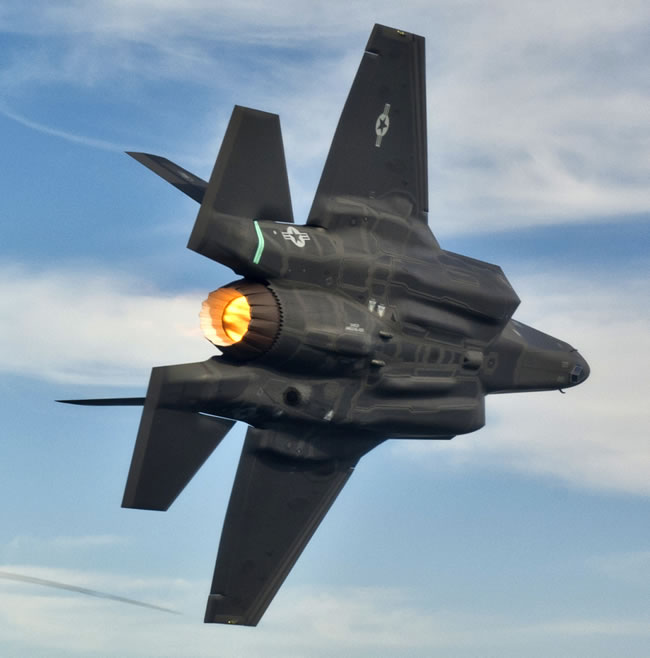
    F-35 Flight will resume soon, following the decision of the Pentagon to end the precautionary grounding of the fleet of 51 Joint Strike Fighters, after the discovery of a cracked engine blade in one of the stealth jets. The engine manufacturer Pratt & Whitney recommended the resumption of flights and ground operations of the engine earlier on Thursday (February 28, 2013) after its engineers ruled out a high-cycle fatigue crack.

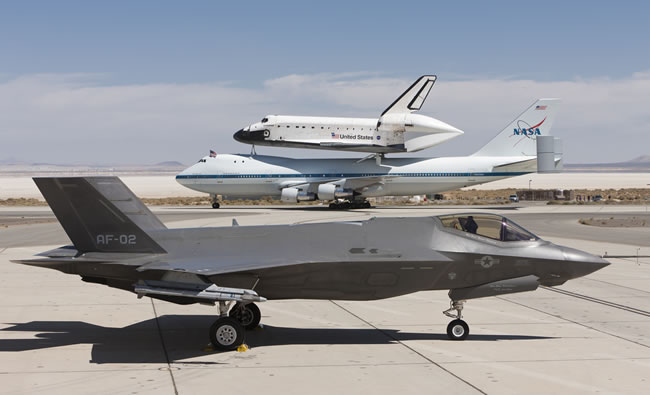
    On February 19 Air Force technicians detected a 0.6-inch crack on a third stage turbine blade, when performing a routine periodical inspection of the F-135 engine on AF-2 test aircraft operating at Edwards Air Force Base in California. The finding triggered the week long flight suspension that began three days later. The affected turbine module and its associated hardware were sent to Pratt & Whitney’s Engine Facility in Middletown, Conn., to evaluate the root cause of the malfunction.

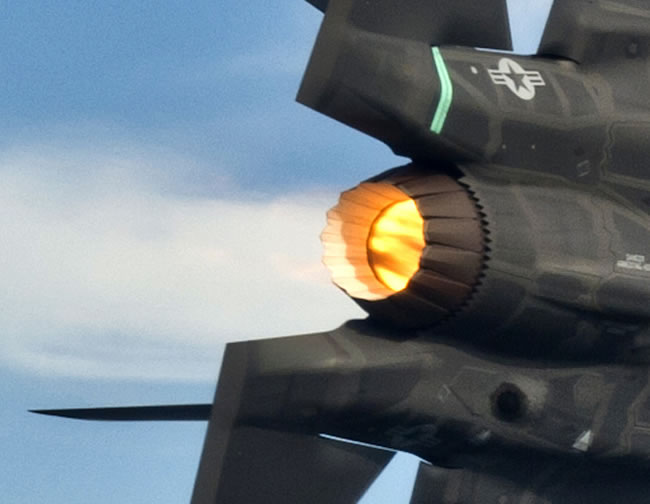
    According to Matthew Bates, a spokesman for Pratt & Whitney, initial examination has determined that the crack resulted from stressful operating environment experienced in flight tests – many of which tested the engine’s powerful afterburners – rather than a high-cycle fatigue crack, which would have required a design change. Inspections of other F-35 fighter jets did not find similar cracks or signs of excessive engine stress, therefore, no redesign will be needed for the JSF F-135 engines. As a precautionary measure engine inspections will now be required every 25 flight hours, compared to usual 50 hours. Reuters reported.

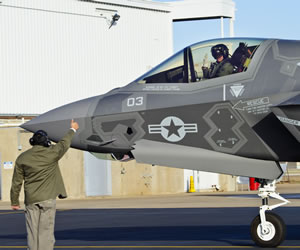
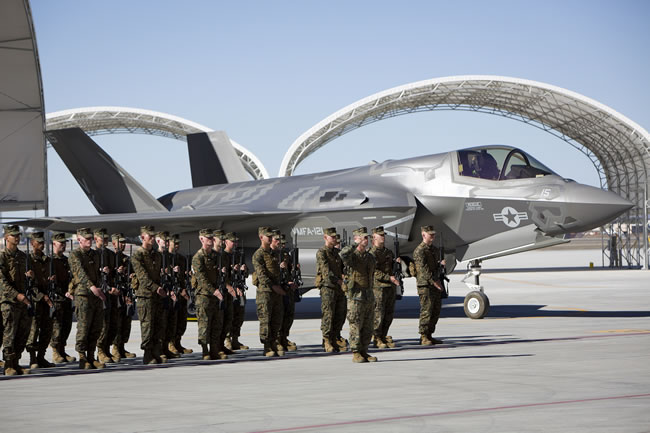
    The Marine Corps re-designated Marine All-Weather Attack Squadron 121 as the first operational F-35 squadron at Marine Corps Air Station Yuma, Ariz., Nov. 20, 2012. The ceremony also welcomed the squadron’s first three F-35B aircraft. Photo: Lockheed Martin
    The Marine Corps re-designated Marine All-Weather Attack Squadron 121 as the first operational F-35 squadron at Marine Corps Air Station Yuma, Ariz., Nov. 20, 2012. The ceremony also welcomed the squadron’s first three F-35B aircraft. Photo: Lockheed Martin

    The engine in question had operated at high temperatures for more than four times longer than a typical F-35 flight, which led to a separation of the grain boundary of the particular blade that experienced the crack. According to the US Navy investigation, that engine had experienced the most “hot engine time exposure” of all the engines in the developmental program.

    Within the current DoD inventory, 17 F-35s are employed in test and development at Patuxent River Naval Air Station and Edwards Air Force Base; the remaining aircraft are assigned to Eglin Air Force Base and Marine Corps Air Station Yuma, and comprise the initial F-35 training fleet.

    The US Air Force F-35 AF2 at Edwards AFB, Calif., gets an up-close view of Space Shuttle Endeavour on Sept. 20, 2012. Photo: Lockheed Martin
    The US Air Force F-35 AF2 at Edwards AFB, Calif., gets an up-close view of Space Shuttle Endeavour on Sept. 20, 2012. Photo: Lockheed Martin

    Australia Requests Buying 24 Super Hornets

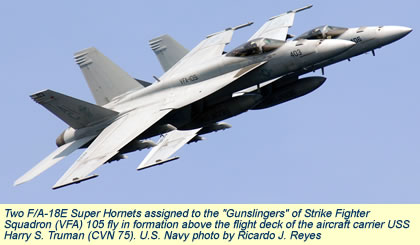
    Anticipating potential delays and uncertainty about the future of the F-35A, the Australian Defence has requested to buy up to 24 Boeing Super Hornet fighters – 12 F/A-18E/F Super Hornet aircraft and 12 EA-18G Growler Electronic Attack aircraft from the USA, at an estimated cost of $3.7 billion, the Defense Security Cooperation Agency notified the US Congress.

    “We placed a letter of request [LOR] with the United States authorities to enable us to investigate the potential purchase of up to 24 more Super Hornets.” Australian Defense Minister Stephen Smith said, adding that the F-35 “has been subject to very serious scheduling delays and that’s what’s causing us to risk a gap in capability…. “We’re now looking not just to the Super Hornets covering a gap in capability, but whether into the longer term it makes sense for Australia to have a mixed fleet — a mixed fleet of Super Hornets, Growlers and Joint Strike Fighters, which is what you essentially see the United States Navy embarking upon.” Aviation Week wrote.

    Canada is also considering the F/A-18E/F as an alternative to the F-35, CBC News reports. According to data released by Boeing, Canada could save about C$23 billion over the 42 year lifespan of the aircraft. Boeing claims its Super Hornet would cost about half the cost of the F-35.

    Mini-Robots for the US Army

    The US Army awarded iRobot and QinetiQ North America two procurement orders for small robotic vehicles, representing the new class of small/miniature robotic systems designed for counter-IED and surveillance missions. iRobot Corp will supply the iRobot 110 ‘FirstLook’ robotic systems, under was awarded $14 million order from the Army, to be fulfilled by August 2013. QinetiQ North America Inc. was awarded about $13 million to supply the Dragon Runner-10 Micro Unmanned Ground Vehicle (MUGV).

    Sequestration and the US Defense Industrial Base – Dawn over Doomsday?

    By morning of March 1, 2013 as mandatory budget cuts will take effect, the US DOD will enter a ruthless, potentially devastating cycle of budget cutting that will be further exacerbated with the planned cutbacks mandated by the sequester. Testifying before the House Armed Services Committee Pentagon leaders said today the planned cuts could continue and affect military preparedness, readiness and acquisitions for years to come.

    The combination of sequestration in fiscal year (FY) 2013 reduced discretionary budget caps in FY 2014-2021, and a possible year-long continuing resolution (CR) are creating a ‘perfect storm’ that have already brought the military acquisition and the whole defense marketplace to a standstill.

    These cuts impact almost all programs – large or small, driving potential layoffs of hundreds of thousands in the military and defense industries in the US. “We will have to address a revised defense strategy based on a post-sequester budget environment.” Lt Gen. Charles R. Davis, USAF Military Deputy, Office of the
    Assistant Secretary of the Air Force (Acquisition) told the Committee, “This will require tough strategic choices to ensure the Air Force balances competing requirements across our enduring contributions – Air and Space Superiority; Intelligence, Surveillance, and Reconnaissance; Rapid Global Mobility; Global Strike; Command and Control.”

    The reduction of about $8 billion in Department of the Navy Fiscal Year 2013 investment accounts due to sequestration are also far reaching – with impacts to naval aviation, ground-warfare systems, strike weapons, research and development, shipbuilding and the associated support, training, and outfitting required for current and future readiness. Vice Admiral Allen G. Myers, USN Deputy Chief of Naval Operations, Integration of Capabilities and Resources (N8), U.S. Navy said the Navy’s $7.8 billion dollar sequestration investment reduction would potentially impact over 100,000 private sector jobs across the nation considering direct and indirect impacts to the economy.

    Defense Industrial Base to Suffer the Most

    According to Lt. General James O. Barclay III, Deputy Chief of Staff Army G-8, if the planned measures will take place, the Army is looking at FY 2013 budget cut of $12 billion, of which half will be cut in operations and maintenance, mostly form the active forces. The cuts will affect the careers of quarter million civilians across all Army levels. Additional $6 billion in cuts will be taken from procurement and construction, research, development and testing. General Barclay said these cuts would be applied equally across over 400 Army programs, causing ripple effects throughout the US industrial base, impacting over 300 companies in 40 states. “The impacts to the industrial base grow in magnitude as the reductions cascade down through the network of companies that support each program,” Barclay explained.

    The industrial base that supports the US military will suffer a major blow, its consequences are yet unknown. Delayed weapon system production and cancelled maintenance and repair will immediately impact aircraft, missile, and land system manufacturers and our military industrial supplier base. “The projected loss of work in Fiscal Year 2013 alone will further stress smaller businesses that provide supplies and services to major manufacturers which have already been negatively impacted due to the general downward trend in defense spending.“ said Vice Admiral Allen G. Myers, USN, Deputy Chief of Naval Operations, Integration of Capabilities and Resources. “Assuming a nine-percent sequestration reduction for the March 1 and March 27, we project industry contract awards will be reduced by approximately $6.7 Billion Fiscal Year 2013.” Myers said.

    According to Adm. Myers, many small businesses, which are often the sole source for aircraft, missile, and land-system components, may be driven to shut down if meaningful disruptions to planned workload occur. “Once these companies, their engineers and skilled workers move on to other work, they are hard and sometimes impossible to reconstitute, even if our national security requires it. With many weapon systems already at minimum sustaining rates and extended production runs, we are continually faced with the challenges of parts obsolescence that will be further exacerbated by sequestration and year-long CR disruptions.”

    Myers added that it is not known how many suppliers have already decided, or plan to exit the defense market due to business base uncertainties driven by frequent CR, sequestration, and the prospect of nine years of continuing budget uncertainty. “When suppliers determine that they can no longer rely on future work, or conclude that the regulatory and contractual environment is unavailing to a reasonably predictable business base, they will adapt and may turn to other economic sectors.” Myers added.

    “Despite our extreme disappointment that sequestration was not averted, we are by no means giving up the fight” Aerospace Industries Association President and CEO Marion C. Blakey said after first steps implementing $85 billion budget cuts (about half in defense spending) took effect this morning. “On March 27, the Continuing Resolution for funding federal agencies through the current fiscal year will expire.  This is the next major opportunity for Congress and President Obama to halt the crisis that our industry has highlighted for nearly two years.  We urge our elected leaders to use this period to put a stop to the damage that sequestration is doing to our country” Blakey added.

    Programs at Risk

    Army procurement programs will experience reductions of roughly nine percent across the board. In his testimony, Gen. Barclay indicated among the programs to be hit immediately is the AH-64E Apache. He said this acquisition is a fixed cost program and reducing quantities means increasing cost due, in part, to fixed costs already incurred in conjunction with planned production this year. Another Army Aviation program to be hit is the OH-58 Kiowa Warrior replacement. The Army also expects at least six month production gap in the MQ-1 Grey Eagle program which could drive cost up. A delay in the acquisition of a new, high definition common sensor payload for the drone will also prevent fielding of essential Intelligence, Surveillance and Reconnaissance asset. Barclay also indicated that the cost of the Javelin Missile could also increase by 12 percent, if the Army buys less than the planned 400 units through 2013.

    The impact of sequestration in Fiscal Year 2013 would result in a loss of more than $1.0 billion in aircraft production for the US Navy. The reductions will affect the Lockheed Martin F-35 Joint Strike Fighter, Bell Huey and Cobra Rotary-Wing Aircraft, Boeing P-8 Poseidon Maritime Patrol Aircraft, Northrop Grumman E-2D Hawkeye Surveillance Aircraft, and Vertical Take-Off Unmanned Aerial Aircraft (VTUAV), and the Boeing/Insitu Small Tactical Unmanned Aerial Vehicle production lines. Further, the Department would delay the Initial Operating Capability (IOC) of VTUAV Intelligence, Surveillance and Reconnaissance in support of Special Operations Forces. Delays are also expected in the Joint Strike Fighter at-sea testing due to postponement of required ship modifications and integration activities.

    Similarly, at the Navy, transitioning the Bell-Boeing MV-22 Osprey program into a multi-year procurement will be suspended, resulting in approximately $1.1 billion in additional program cost to deliver the same number of aircraft.

    Due to sequestration our weapons and ammo procurement accounts will be reduced by approximately $450 million dollars. Impacts will occur to sea-strike and sea-shield weapons procurement that include a reduction of over 200 air-launched weapons for air-to-air and air-to-ground combat; more than 50 sea-launched weapons, including our front-line, deep-strike land-attack weapons; and nearly all of our ammo and direct attack munitions accounts. “Since many of our weapons programs are already at minimum sustaining rates, further quantity reductions will jeopardize the supplier base and drive higher unit production costs.” Myer said, adding that the Navy plans to further reduce procurement of acoustic device countermeasure systems impacting ship torpedo defense and reduce systems engineering and technical assistance oversight of our Mobile User Objective System (MUOS).

    Marine Corps to Suffer ‘Disproportional Impact”

    The entirety of the Marine Corps Fiscal Year 2013 ground material modernization investment is only $2.5 billion, comprising 12 percent of the baseline budget. Further reductions in ground investment accounts, although proportional to the other services in terms of a percentage reduction, will have disproportional impact on Marine Corps modernization and readiness, particularly after a decade of increased operational tempo.

    “The impending sequestration will cause a cut of over $850 million dollars and delay efforts of multiple ground programs directly impacting delivery of future capabilities. “Lt. General John E. Wissler, USMC, Deputy Commandant for Programs and Resources told the committee.

    Examples for such cuts include reduced procurement and installation of safety and force protection modification kits on both the Medium Tactical Vehicle Replacement and Logistics Vehicle System Replacement trucks which will decrease overall fleet capability. Program delays to the Amphibious Combat Vehicle will result in the Marines being required to operate and maintain the already 40-year old Assault Amphibious Vehicle for at least the next decade.

    Maintenance and Support Cuts Drive Long Term Damage

    Lack of funding will virtually eliminate new depot maintenance orders for the third and fourth quarters of this year, causing further pressure on the suppliers of spare parts and equipment. These cuts will also have impact on the rate of reconditioning and reset of tactical wheeled vehicles, radios and other weapon systems. Disrupting reset programs could have long-term effect of three-to-four years as units are redeployed from Afghanistan. The BAE Systems M-109PIM (artillery modernization program) will also suffer from delays in proceeding to Low-rate Initial Production, scheduled for 2013. The Army expects up to two years delay in the development of the Alternative Warhead for the Guided MLRS rockets. Delays are also expected in the procurement of Mid-Tier Networking Vehicular Radios (MNVR).

    According to Adm. Myers, a year-long CR and sequestration will lead to inefficiencies caused by loss of learning; productivity losses; cost increases driven by lengthening schedules; he added that increased burdens on military personnel and lower morale – all translates to reduced readiness. He said the civilian-hiring freeze and overtime restrictions in Naval Shipyards have already caused non-recoverable impacts to the shipyards’ ability to execute many assigned workloads and nuclear submarine availabilities while threatening to impact Docking Planned Incremental Availabilities for the USS Eisenhower (CVN 69) and the USS John C. Stennis (CVN 74).

    For the Navy, current CR restrictions and potential sequestration-driven decreases to naval aviation readiness would impact Fleet Replacement Squadrons (FRS), reduce rotary-wing readiness in support of swarming boat defense, airborne mine counter-measures and antisubmarine warfare, and cancel aircraft and engine depot inductions in the 3rd/4th quarter of Fiscal Year 2013. Depot cancellations jeopardize planned aircraft modernization, mission system software capability improvements, fatigue-life management, depot support, and our flight hour program Across the Department of Navy, there will be a total of 327 aircraft and over 1,200 engine modules that will miss induction in the 3rd/4th quarter of Fiscal Year 2013 due to CR and sequestration, with several years required to recover the backlog. If the forecast impacts were to occur, we would not be able to recover in a timely manner, even if funding were restored.

    In the near-term, these cuts will drive maintenance and training programs that will have effect in the future. Long-term, the fiscal challenges will constrain the Navy’s ability to invest in future capability and capacity, “If a strict year-long CR and sequestration occur, we will not be able to afford in the future the Navy and Marine Corps we have today” Myers concluded.


    Lockheed Martin Tests Vehicle Launched DAGR

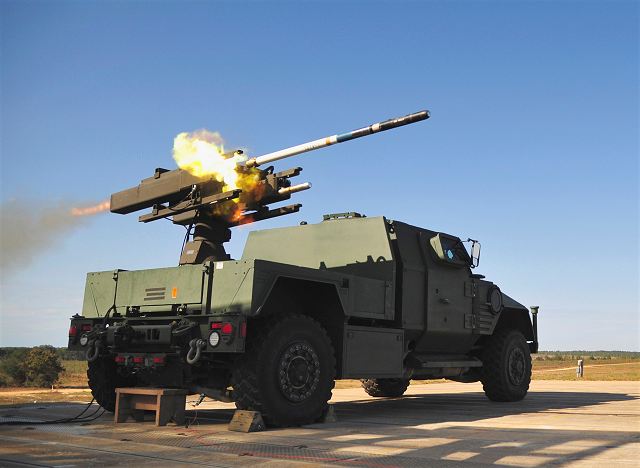
    DAGR missile launched from JLTV prototype. Photo: Lockheed Martin

    Lockheed Martin recently demonstrated the ability of its DAGR laser guided rocket to launch from a ground vehicle during a series of flight tests at Eglin Air Force Base, Fla. During the test, DAGR and two unguided Hydra 70 rockets were launched from a pedestal launcher mounted in the bed of a Lockheed Martin prototype Joint Light Tactical Vehicle (JLTV). DAGR locked onto the laser spot two seconds after launch, flew 5 km down range and impacted the target within 1 meter of the laser spot. The unguided Hydra 70 rockets were launched down the center of the range, and flew 521 and 2,600 meters, respectively.

    The company has conducted 40 DAGR flight tests demonstrating target engagement ranges of 1 to 5.1 kilometers. DAGR has been launched from multiple HELLFIRE-equipped rotary-wing platforms, including the AH-64D Apache, AH-6 Little Bird and OH-58 Kiowa Warrior.

    “DAGR delivers a high-precision defensive capability to the surface combat arena when paired with the pedestal launcher and a mobile ground platform like the Joint Light Tactical Vehicle (JLTV),” said Ken Musculus, director of close combat systems at Lockheed Martin Missiles and Fire Control.

    DAGR missile launched from JLTV prototype. Photo: Lockheed Martin
    DAGR missile launched from JLTV prototype. Photo: Lockheed Martin

    The pedestal launcher used for the test features four M299 launcher rails, associated cables and electronics, providing full compatibility with HELLFIRE II and DAGR missiles. The ground/vehicle-mounted pedestal launcher was used in three guided flight tests and five flights in total. DAGR’s rail-mounted canister attaches to the pedestal launch rails as it would on a standard HELLFIRE launcher designed for aircraft.

    DAGR incorporates proven HELLFIRE II laser homing seeker into a 2.75-inch/70 millimeter guidance kit that integrates seamlessly with legacy Hydra-70 rockets. The result is a laser-guided missile that puts a 10-pound warhead within one meter of the laser spot, defeating high-value, non-armored or lightly-armored targets while minimizing collateral damage. DAGR’s lock-on-before launch mode ensures the missile identifies the correct target prior to launch.

    Skunk Works and XTEND Simplify Multi-Drone Command

    0
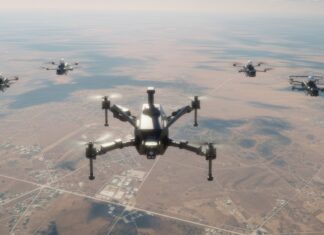
    Lockheed Martin Skunk Works® and XTEND have achieved a major milestone in JADC2 by integrating the XOS operating system with the MDCX™ autonomy platform. This technical breakthrough enables a single operator to simultaneously command multiple drone classes, eliminating the friction of mission handoffs. From "marsupial" drone deployments to operating in GPS-denied environments, explore how this collaboration is abbreviating the data-to-decision timeline and redefining autonomous mission execution.

    From Ukraine to Taiwan: The Global Race to Dominate the New Defense Tech Frontier

    0
    As traditional defense primes face mounting competition from agile “neoprimes” such as Anduril, Palantir and Helsing, the balance of innovation is shifting toward software-defined warfare and scalable, dual-use technologies, while global industry consolidation—marked by Boeing’s integration of Spirit AeroSystems and other strategic mergers—signals an intensified race to secure control over the defense technology value chain. Our Defense-Tech weekly report highlights these trends.

    Europe’s “Drone Wall”

    0
    In early October 2025, a coordinated wave of unmanned aerial system (UAS) incursions—widely attributed to Russia—targeted critical infrastructure across at least ten European nations. The unprecedented campaign exposed the fragility of Europe’s air defenses...

    Weekly Defense Update & Global Security Assessment

    0
    Executive Summary The past week (September 18-25, 2025) represents an inflection point where strategic defense concepts have transitioned from doctrine to tangible reality. An analysis of global events reveals four primary, interconnected trends shaping an...

    U.S. Air and Space Forces Push Next-Gen Programs at the AS&C 2025 Conference and...

    0
    At the 2025 Air, Space & Cyber Conference, U.S. Air Force and Space Force leaders unveiled major updates on next-generation fighters, bombers, unmanned systems, and space initiatives, highlighting both rapid innovation and critical readiness challenges as the services race to outpace global competitors. A short version is available here, with a more detailed version for subscribers.

    TADTE 2025: Reflecting Taiwan’s Strategic Themes

    0
    The Taipei Aerospace & Defense Technology Exhibition (TADTE) 2025 crystallized around four dominant strategic themes that collectively illustrate Taiwan's comprehensive approach to defense modernization amid escalating regional tensions. Based on a detailed report by Pleronix (available upon request). Includes a Podcast discussion on TADTE 2025's highlighting Taiwan's four strategic themes beyond the post's coverage.

    Iron Beam 450 Completes Testing, Soon to Join With Operational Air Defense Units

    0
    Israel’s Iron Beam 450 high-power laser system has completed final testing, marking a major leap in air defense. Developed by Rafael, it offers precise, cost-effective interception of rockets, UAVs, and mortars, and is set for IDF deployment by 2025.